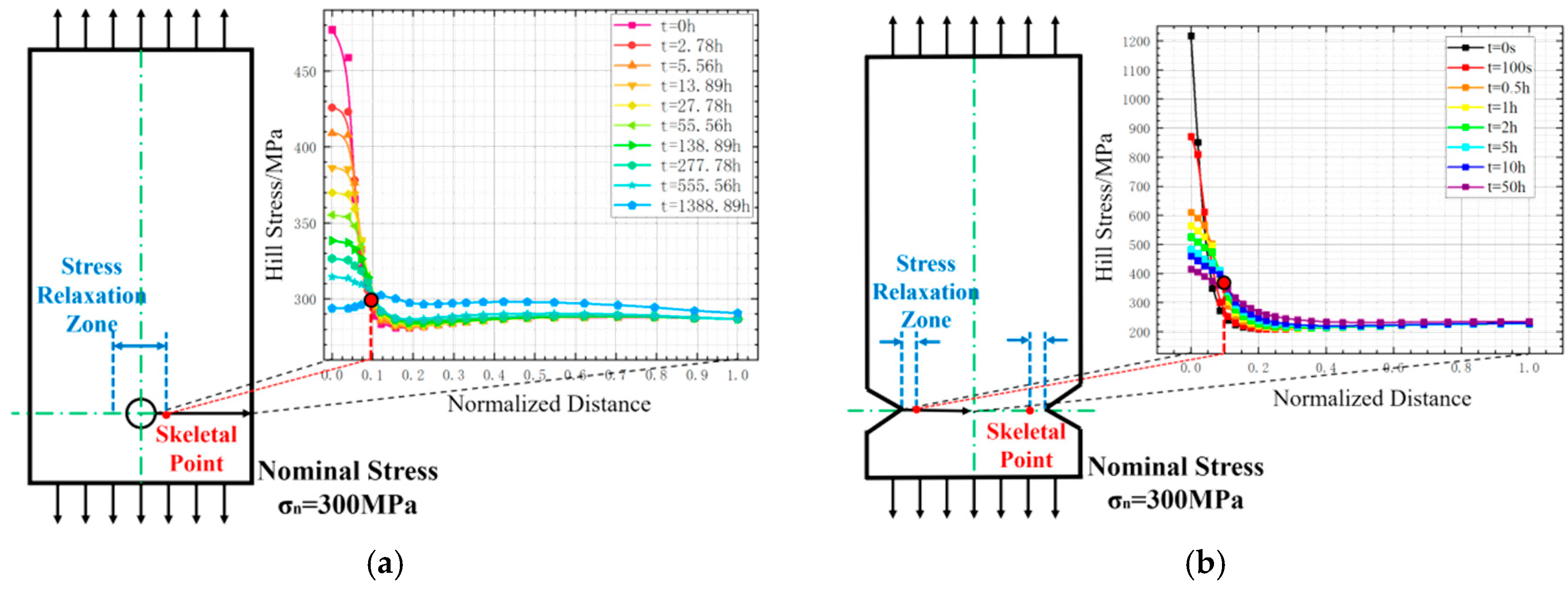
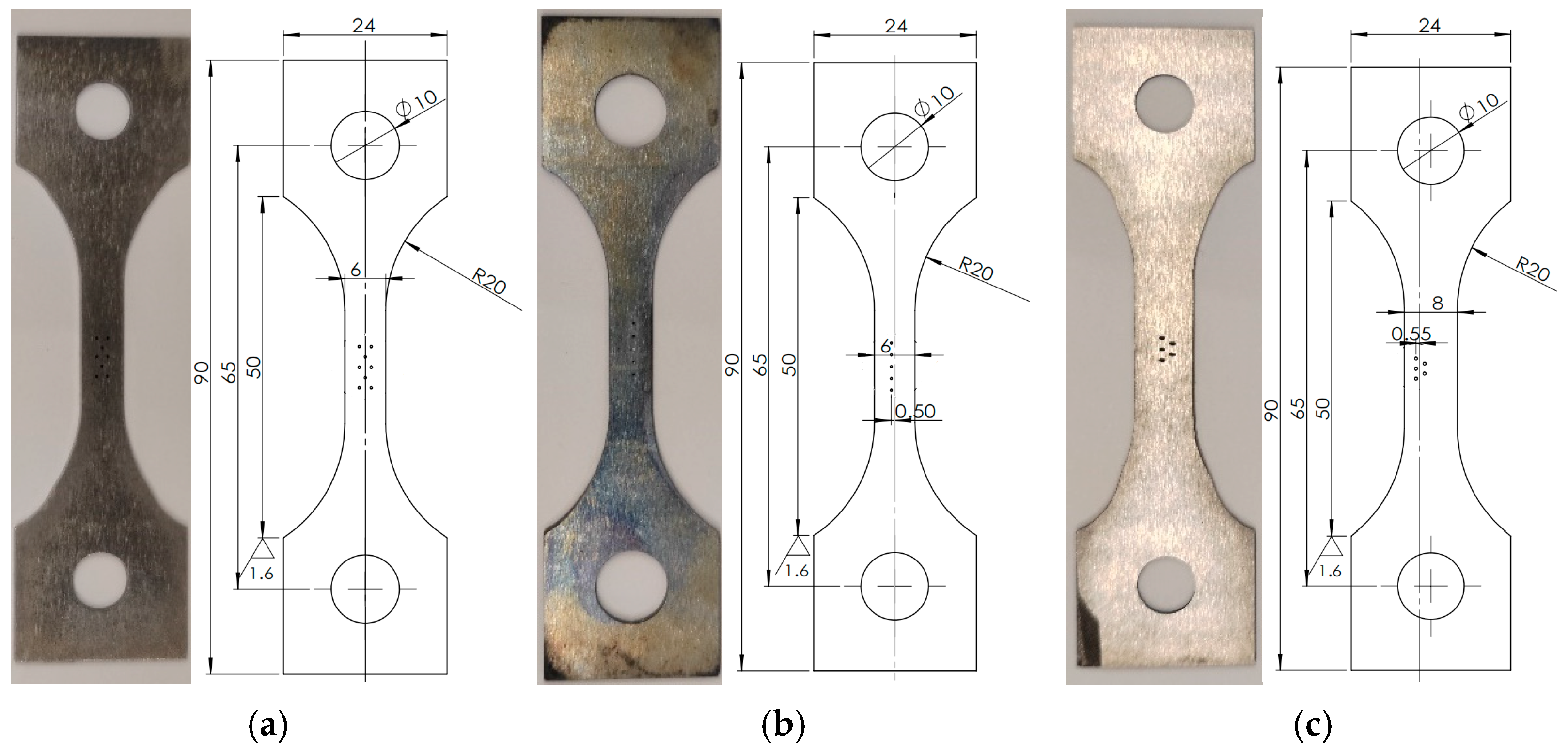
Figure 1.
Photos and analogs of perforated plates, simulating film holes at the (a) leading edge, (b) front concave, and (c) middle concave of the blade.
Figure 1.
Photos and analogs of perforated plates, simulating film holes at the (a) leading edge, (b) front concave, and (c) middle concave of the blade.
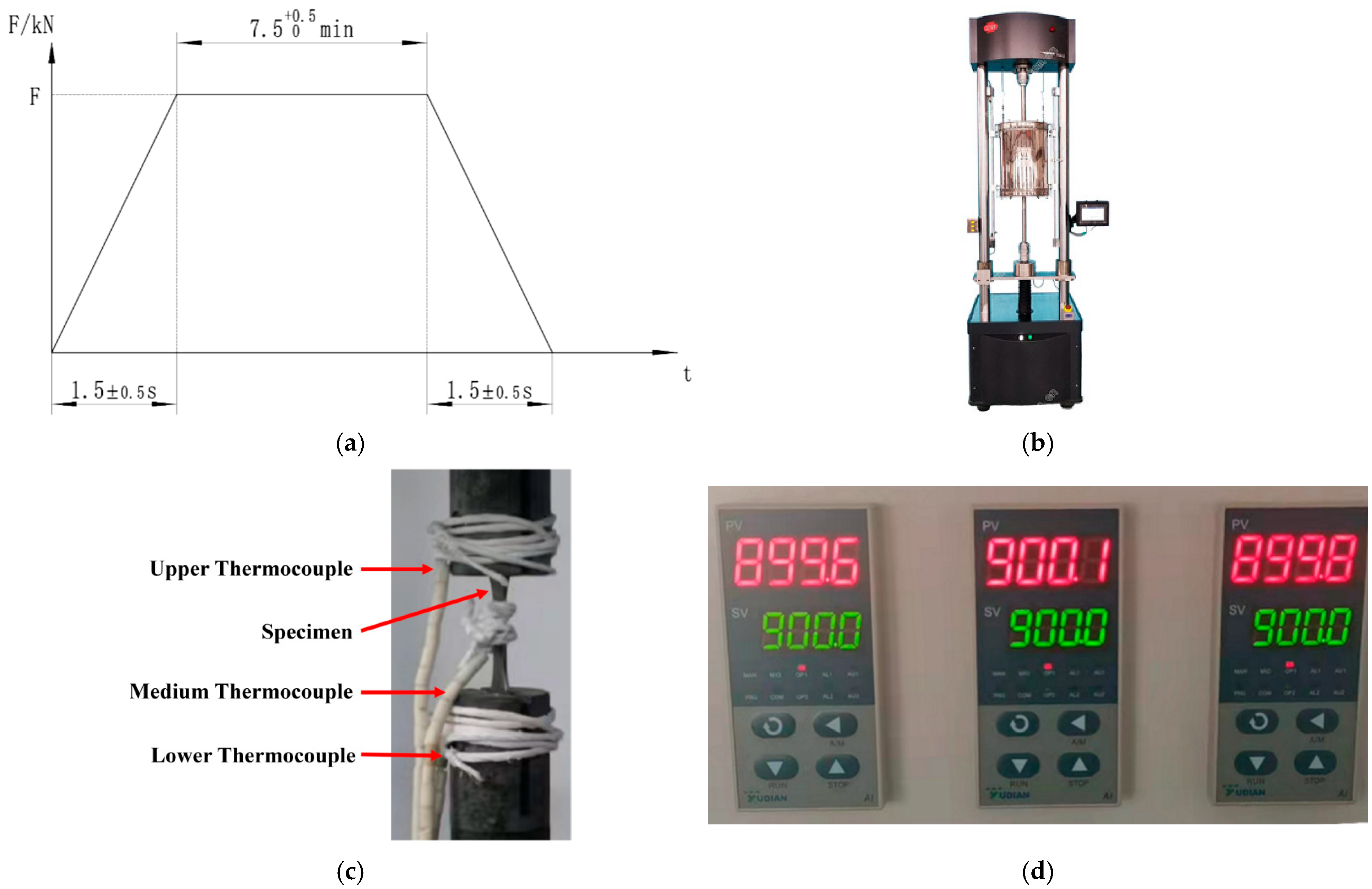
Figure 2.
(a) Loading Spectrum for CFI Testing (b) QBR-100 Electromechanical Creep Testing Machine (c) Specimen Gripping System (d) High-Temperature Monitoring and Control Unit.
Figure 2.
(a) Loading Spectrum for CFI Testing (b) QBR-100 Electromechanical Creep Testing Machine (c) Specimen Gripping System (d) High-Temperature Monitoring and Control Unit.
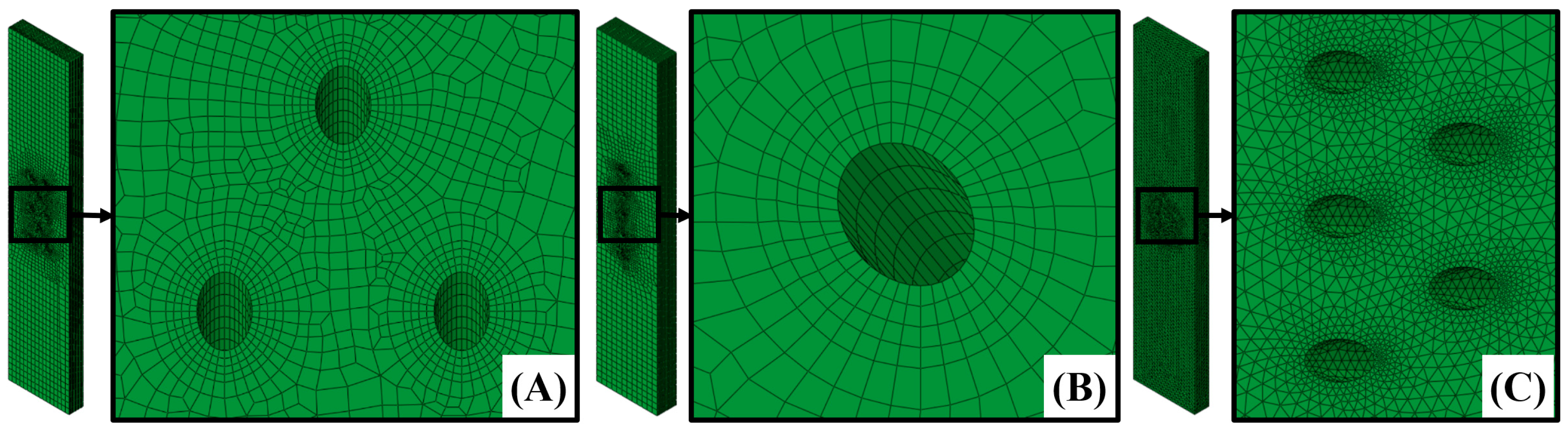
Figure 3.
Finite element models used for simulation: (A) leading edge simulator; (B) front concave simulator; and (C) middle concave simulator.
Figure 3.
Finite element models used for simulation: (A) leading edge simulator; (B) front concave simulator; and (C) middle concave simulator.
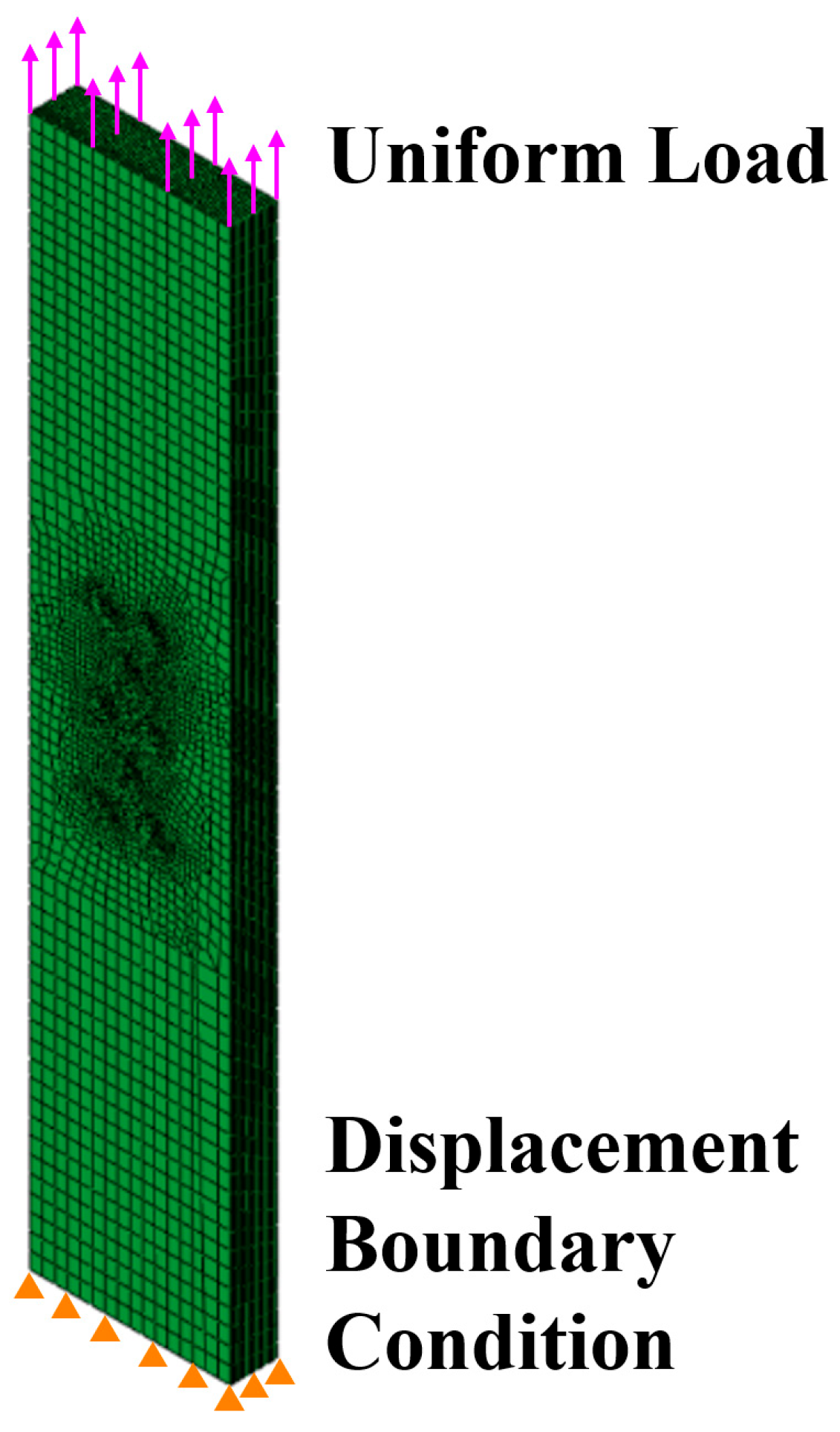
Figure 4.
Loads and boundary conditions (BC) for simulations.
Figure 4.
Loads and boundary conditions (BC) for simulations.
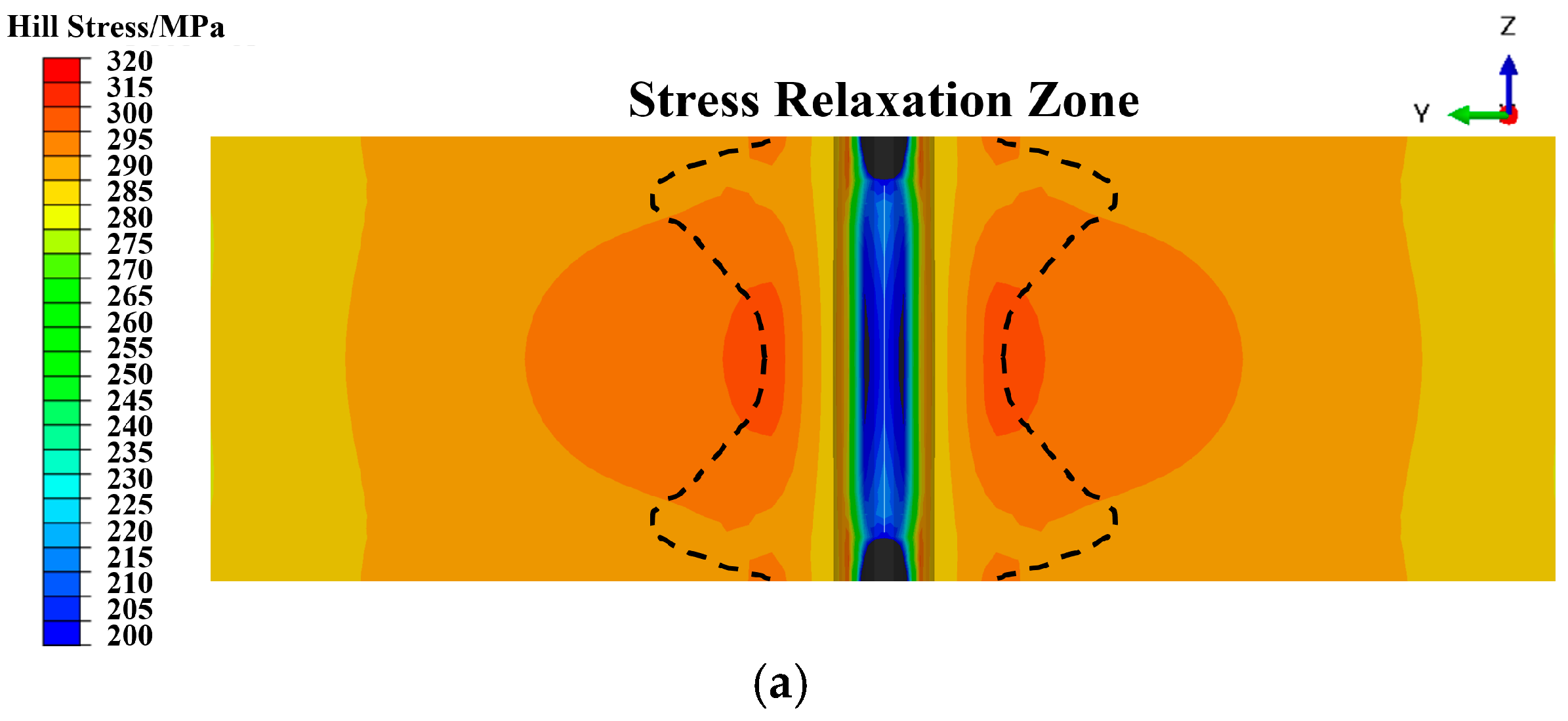
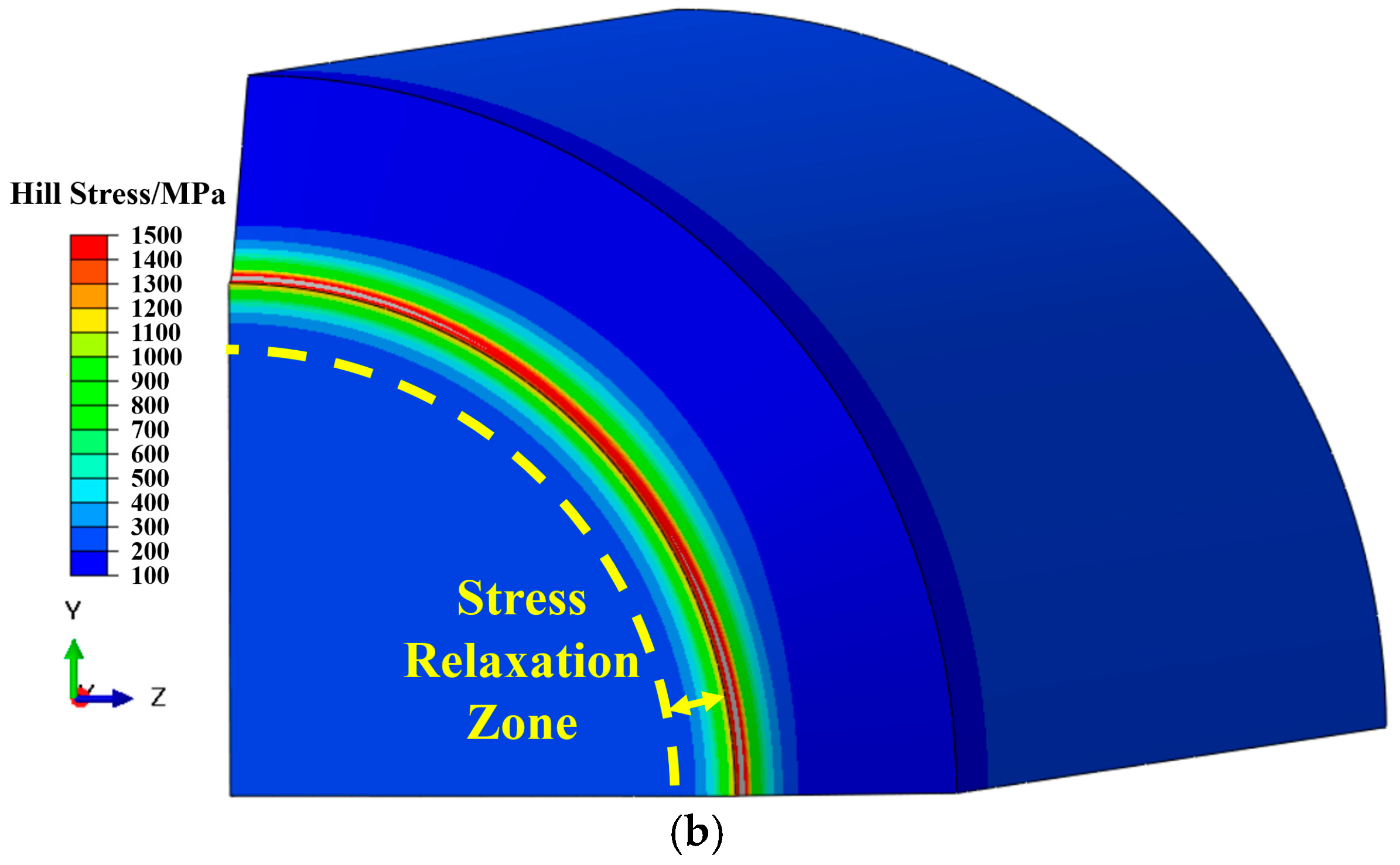
Figure 5.
Time-Resolved Stress Distribution and Relaxation Zone Boundaries in: (a) Single-Hole Plate Specimen and (b) Notched Round Bar Specimen.
Figure 5.
Time-Resolved Stress Distribution and Relaxation Zone Boundaries in: (a) Single-Hole Plate Specimen and (b) Notched Round Bar Specimen.
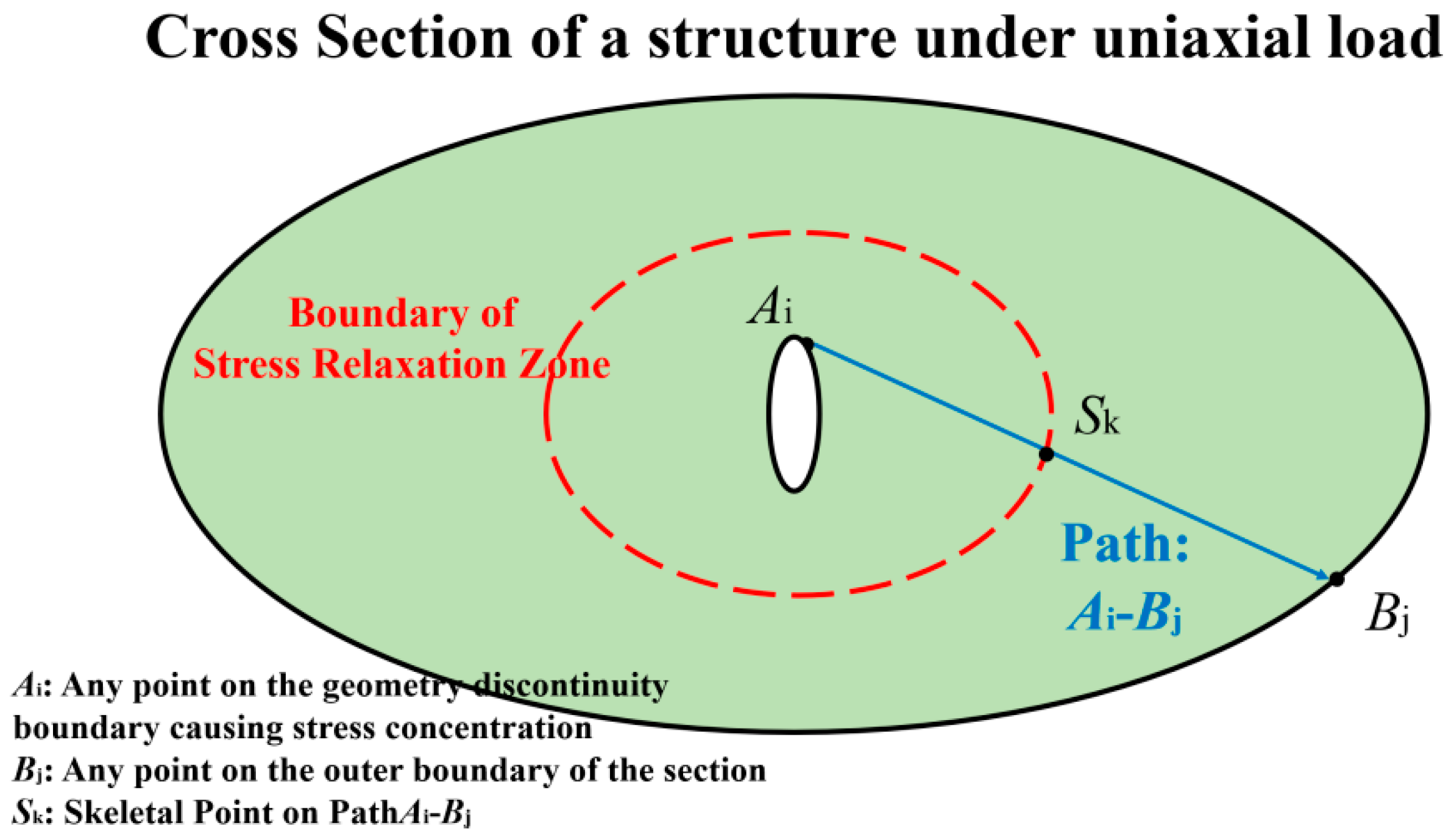
Figure 6.
Schematic Illustration of the Two-Dimensional Skeletal Point Methodology.
Figure 6.
Schematic Illustration of the Two-Dimensional Skeletal Point Methodology.
Figure 7.
Stress relaxation zones for (a) single-hole plate specimen, (b) notched round bar specimen.
Figure 7.
Stress relaxation zones for (a) single-hole plate specimen, (b) notched round bar specimen.
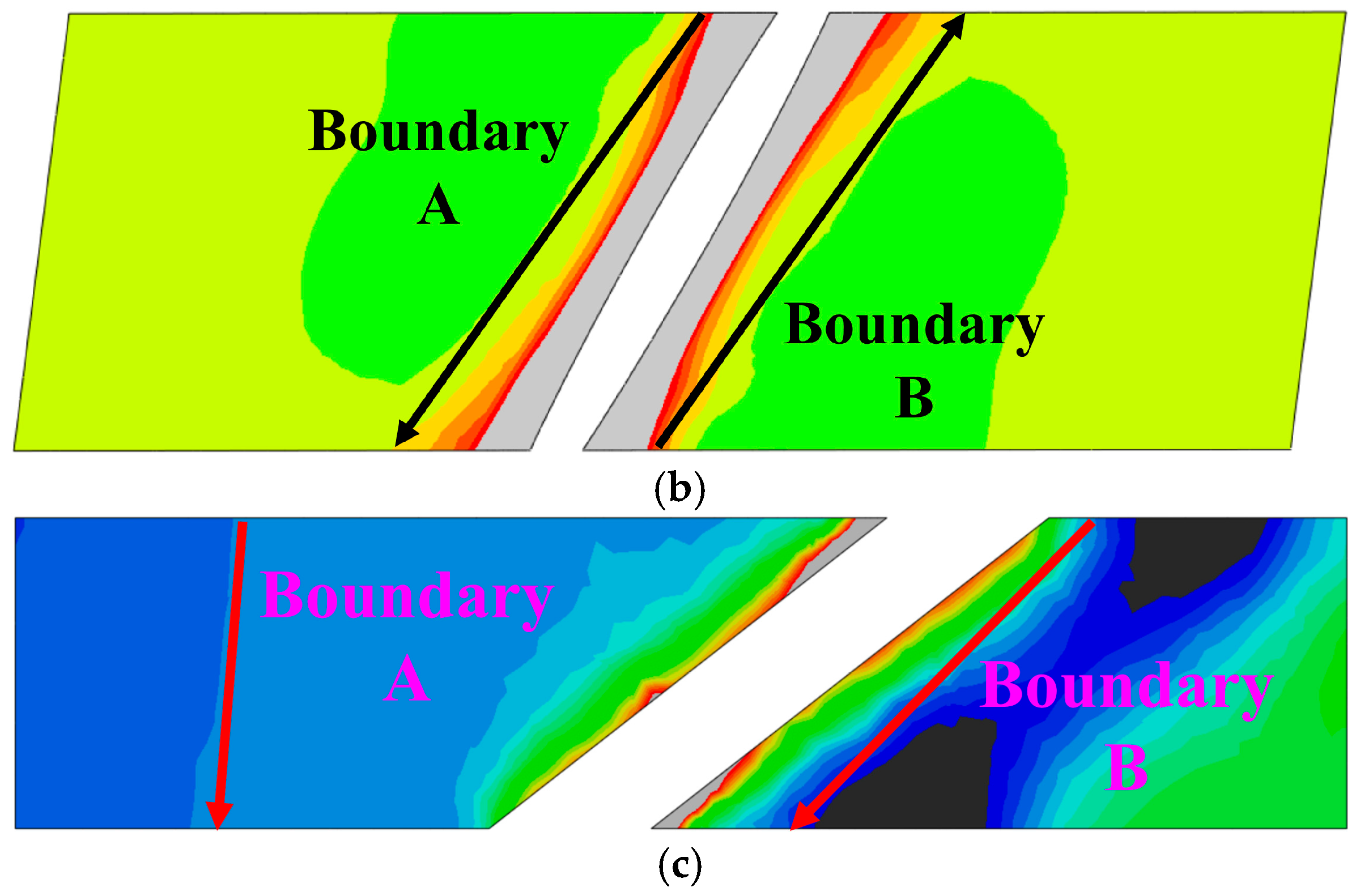
Figure 8.
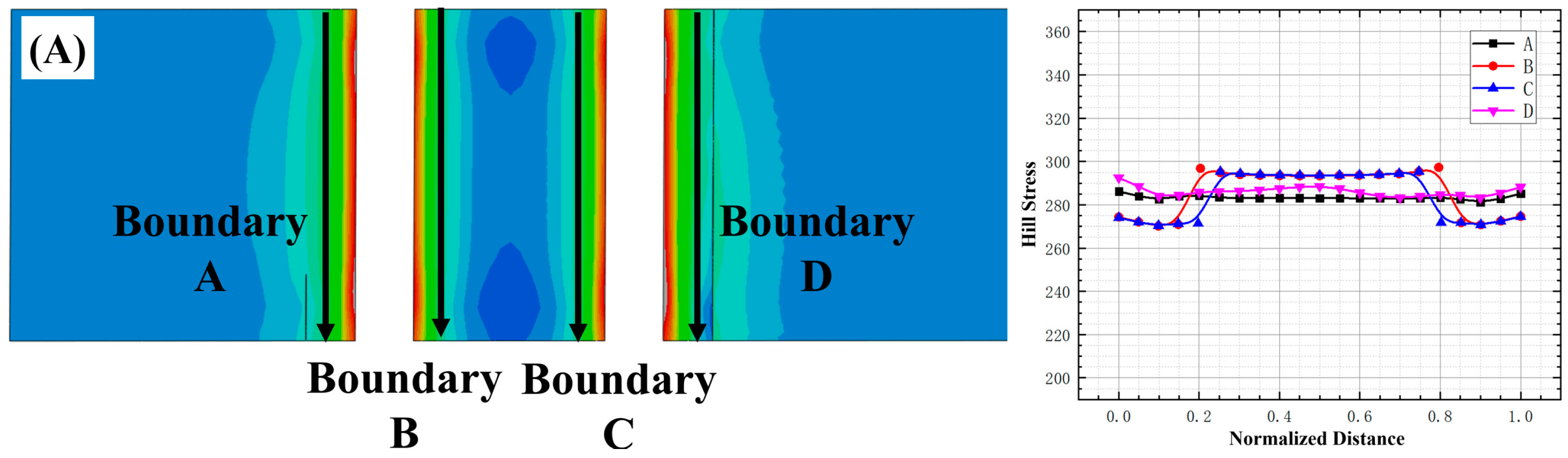
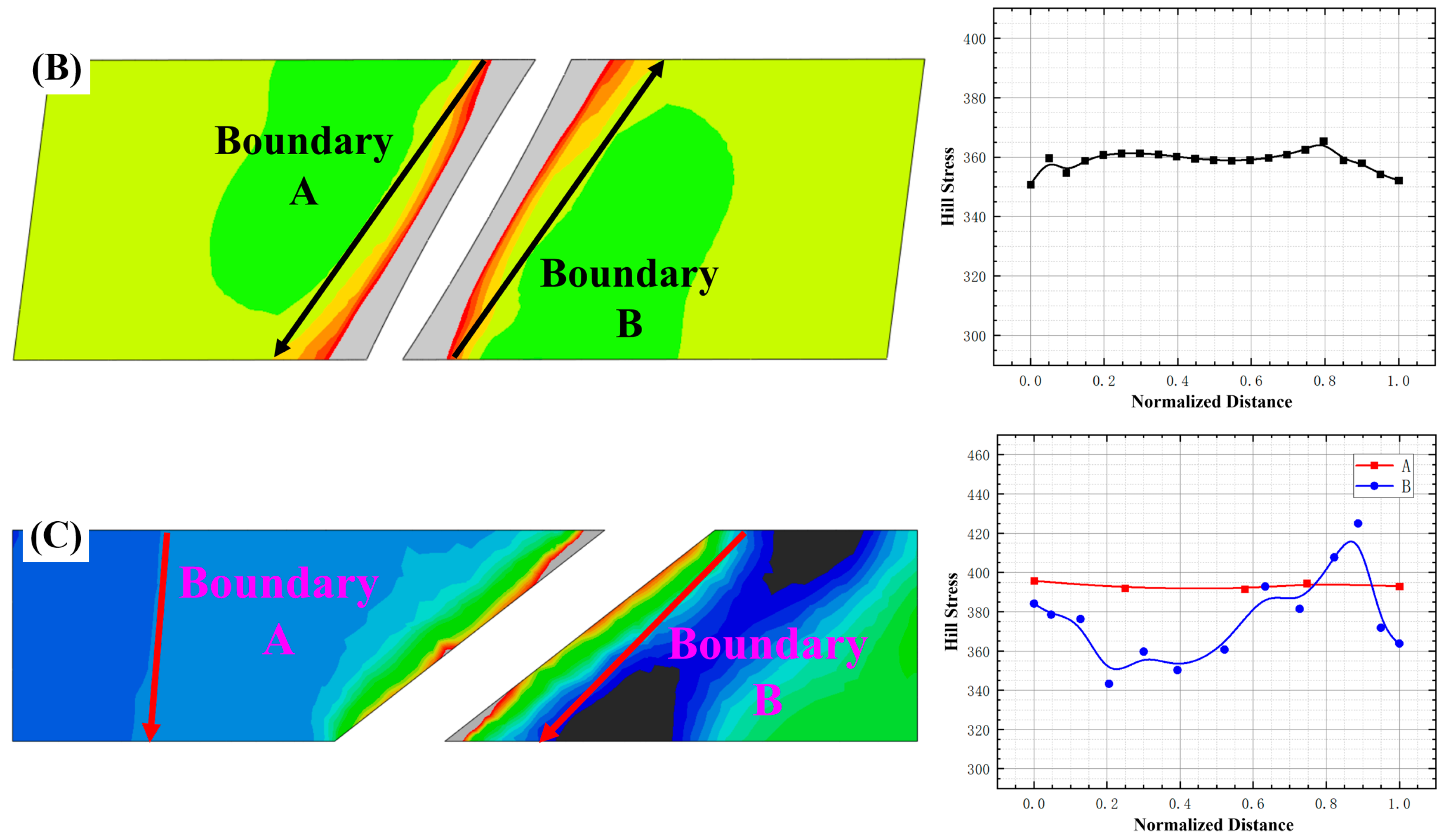
Boundaries of stress relaxation zones at critical sections of each specimen, and stress distributions along them: (A) leading edge simulator, (B) front concave simulator, (C) middle concave Simulator. The time of these stress contours and curves are t = 0, which is before any creep relaxation occurred.
Figure 8.
Boundaries of stress relaxation zones at critical sections of each specimen, and stress distributions along them: (A) leading edge simulator, (B) front concave simulator, (C) middle concave Simulator. The time of these stress contours and curves are t = 0, which is before any creep relaxation occurred.
Figure 9.
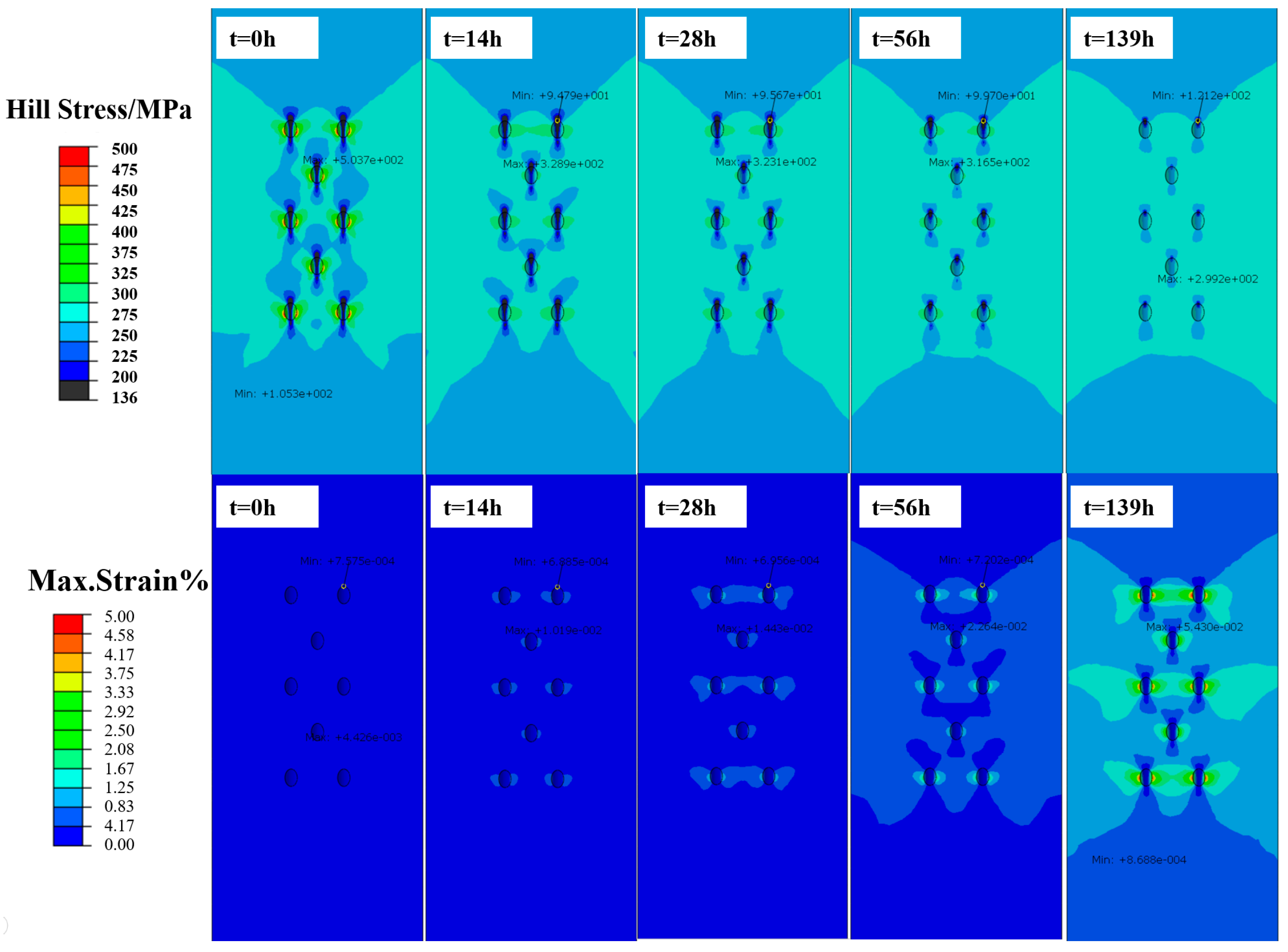
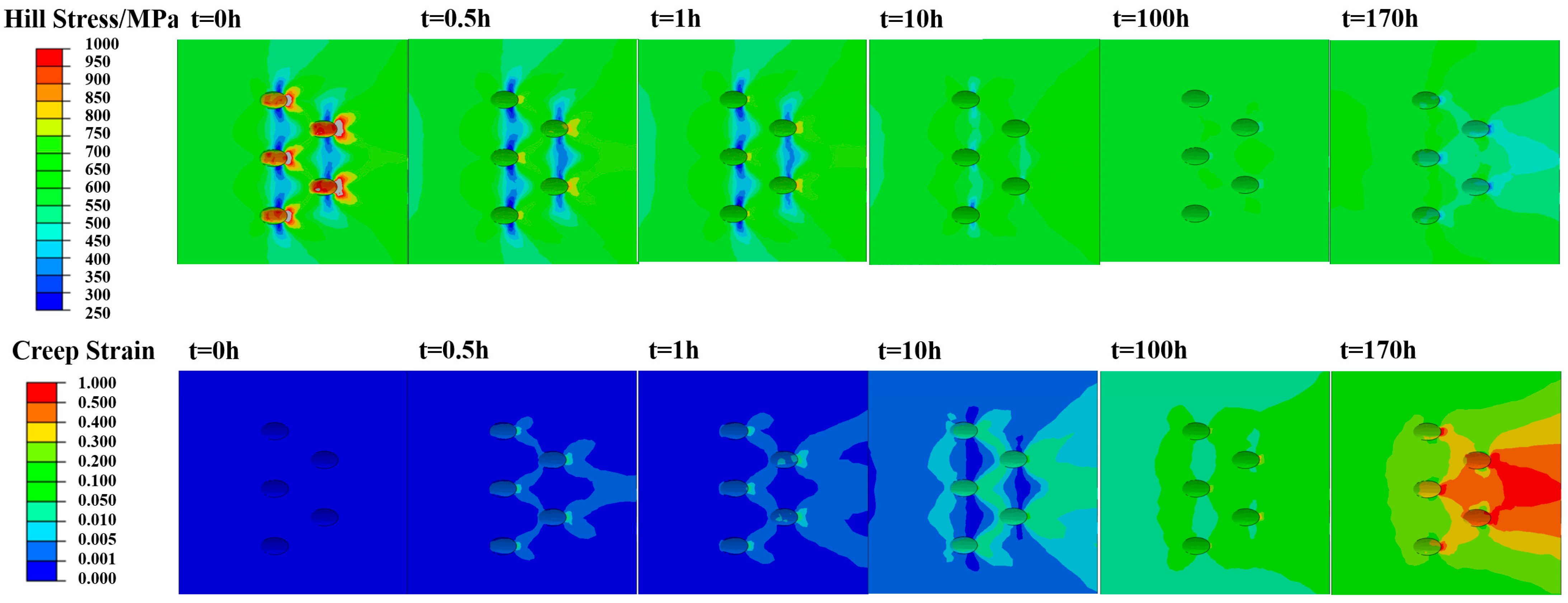
Stress–Strain Contours at Different Creep Durations ((Top): Stress contours, (Bottom): Strain contours).
Figure 9.
Stress–Strain Contours at Different Creep Durations ((Top): Stress contours, (Bottom): Strain contours).
Figure 10.
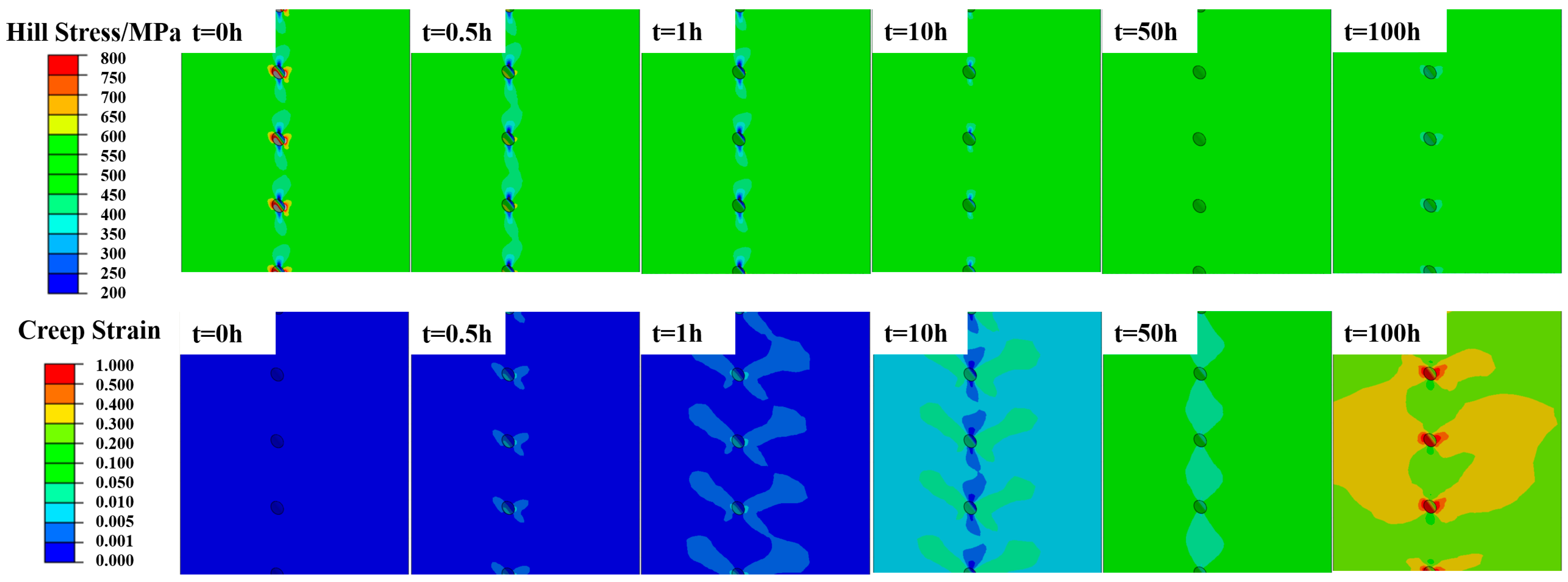
Hill Equivalent Stress and Creep Strain Contours during Creep ((Top): Hill stress, (Bottom): Creep Strain).
Figure 10.
Hill Equivalent Stress and Creep Strain Contours during Creep ((Top): Hill stress, (Bottom): Creep Strain).
Figure 11.
Transient Hill Equivalent Stress and Creep Strain Evolution ((Top): Hill stress, (Bottom): Equivalent Creep Strain).
Figure 11.
Transient Hill Equivalent Stress and Creep Strain Evolution ((Top): Hill stress, (Bottom): Equivalent Creep Strain).
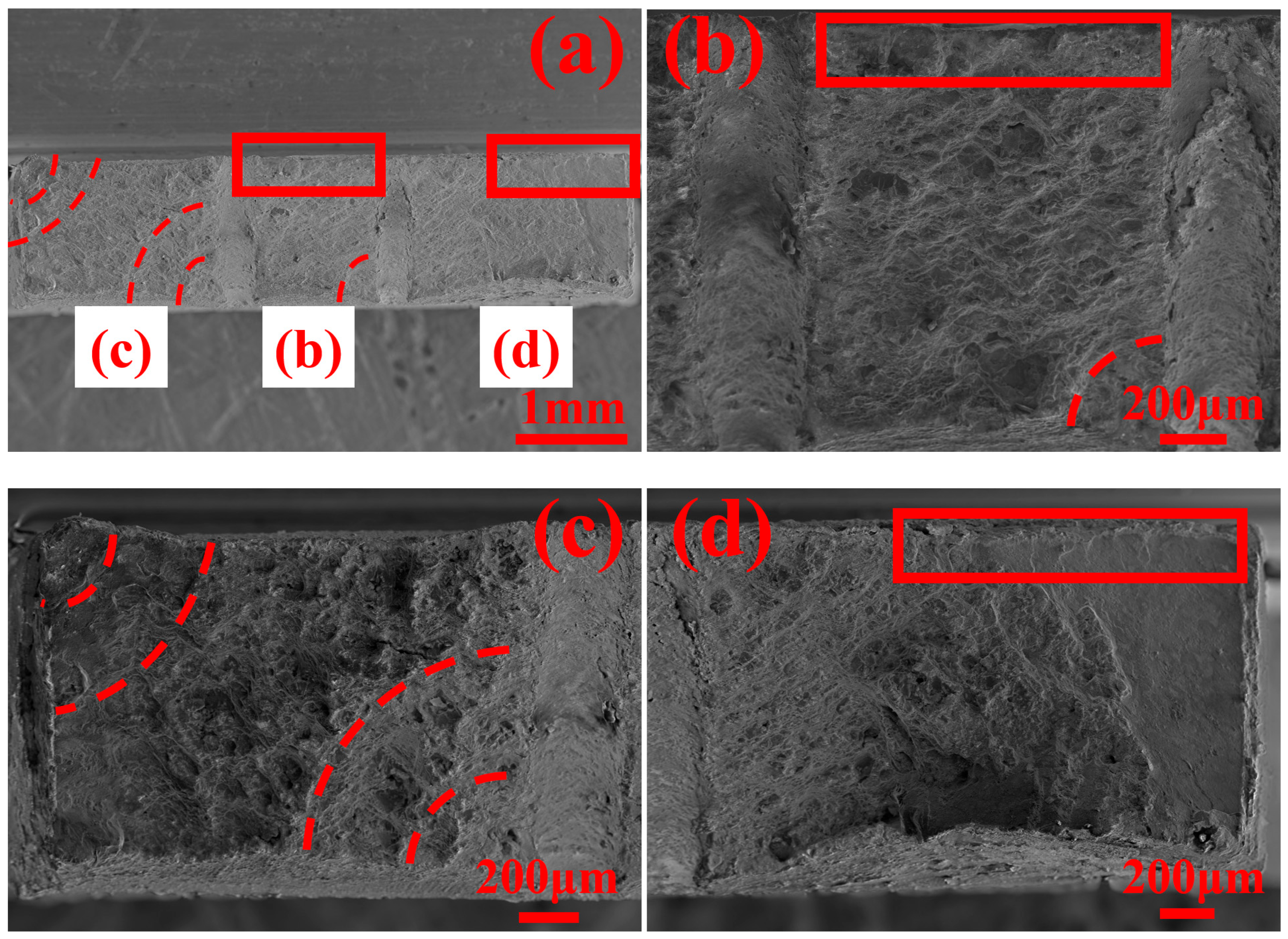
Figure 12.
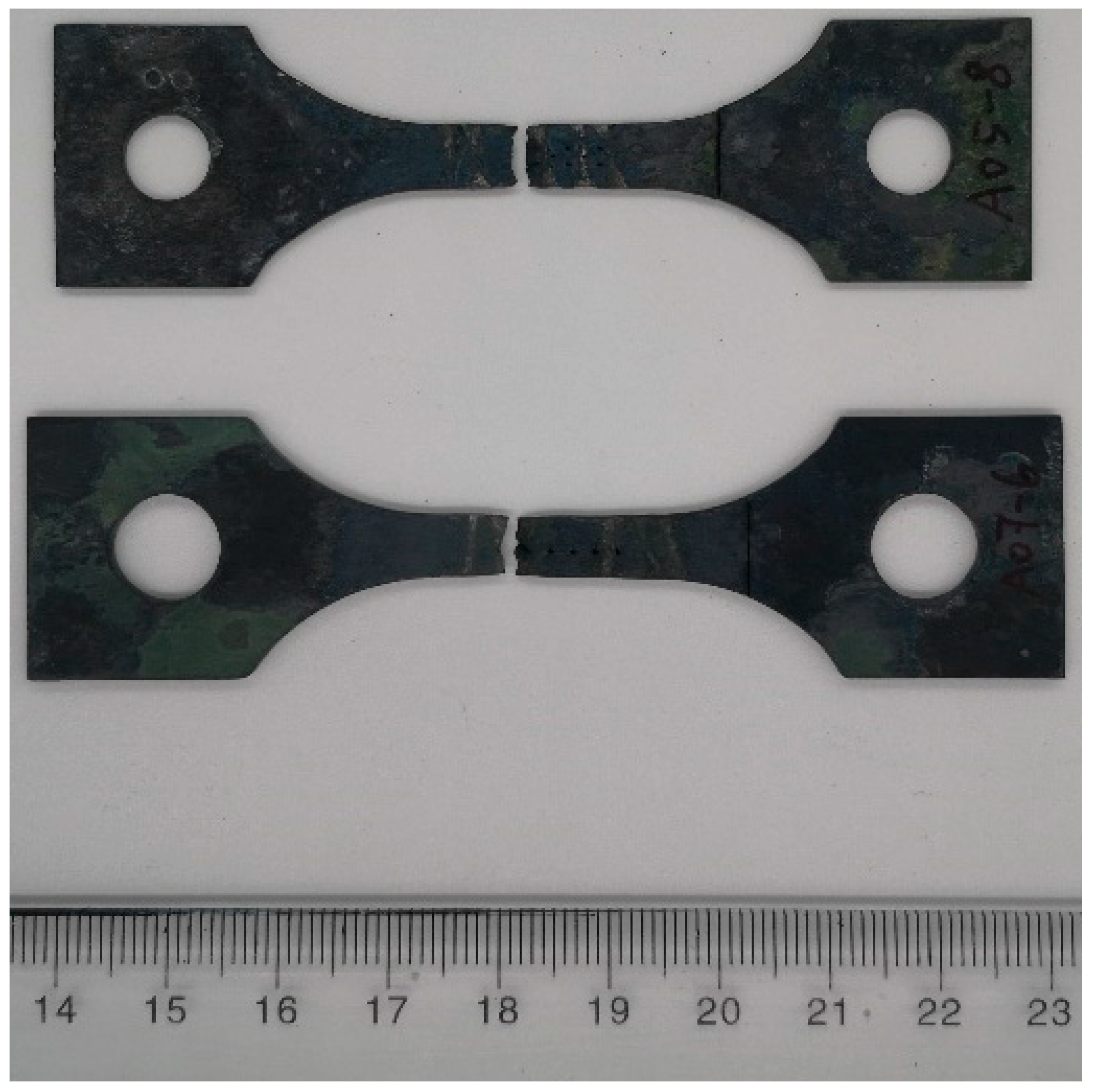
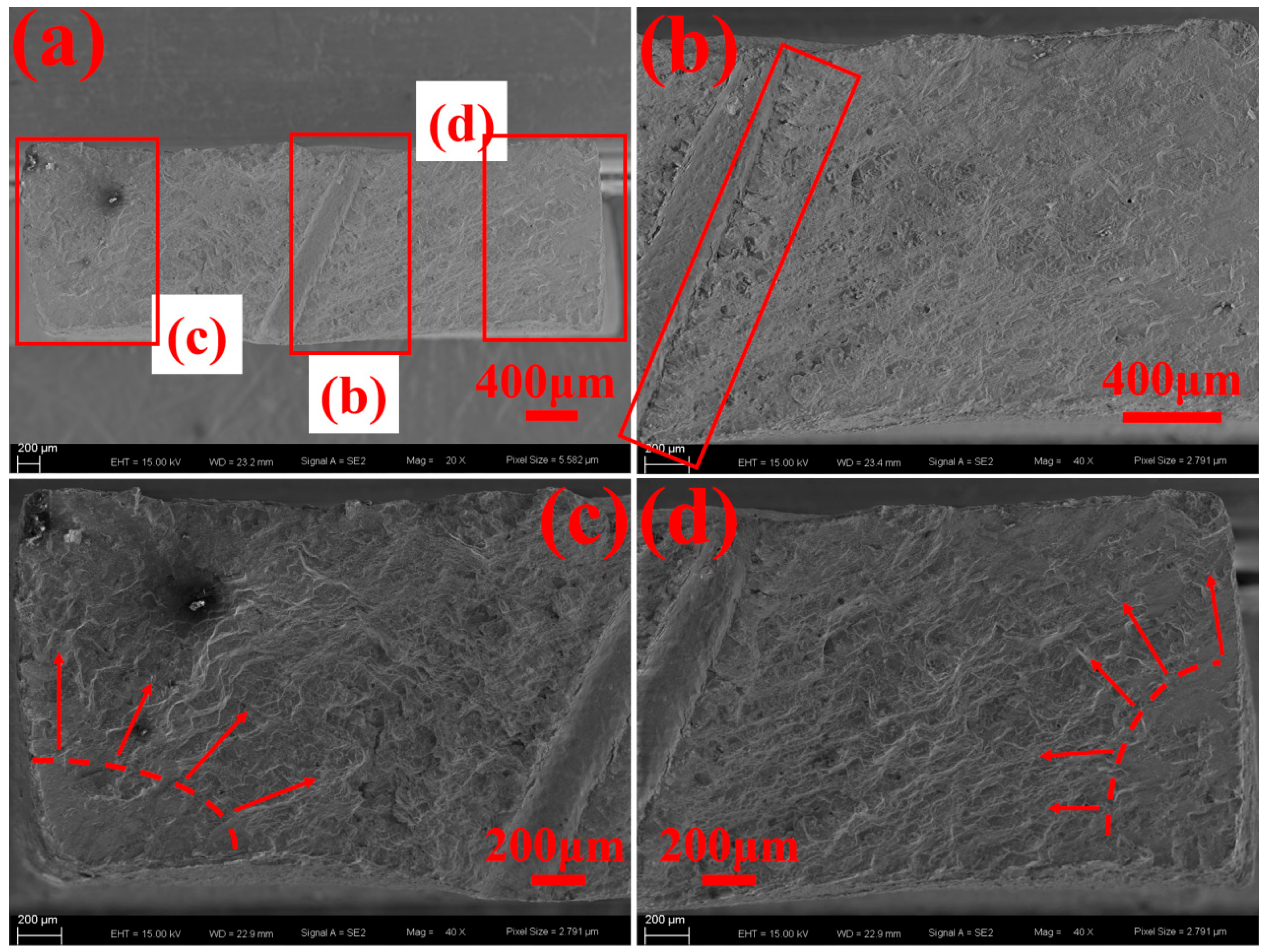
Appearance of the fractured specimens ((Upper): Leading-edge FCHs simulator; (Lower): Mid-concave FCHs simulator).
Figure 12.
Appearance of the fractured specimens ((Upper): Leading-edge FCHs simulator; (Lower): Mid-concave FCHs simulator).
Figure 13.
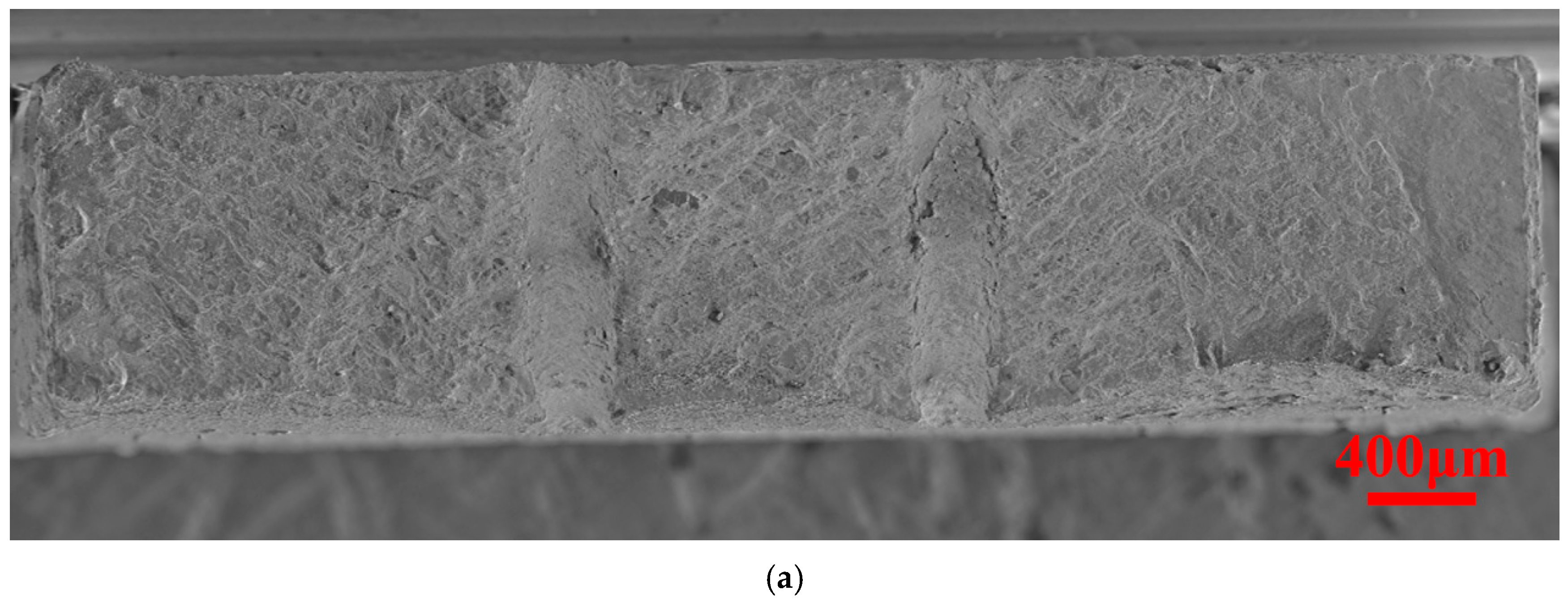
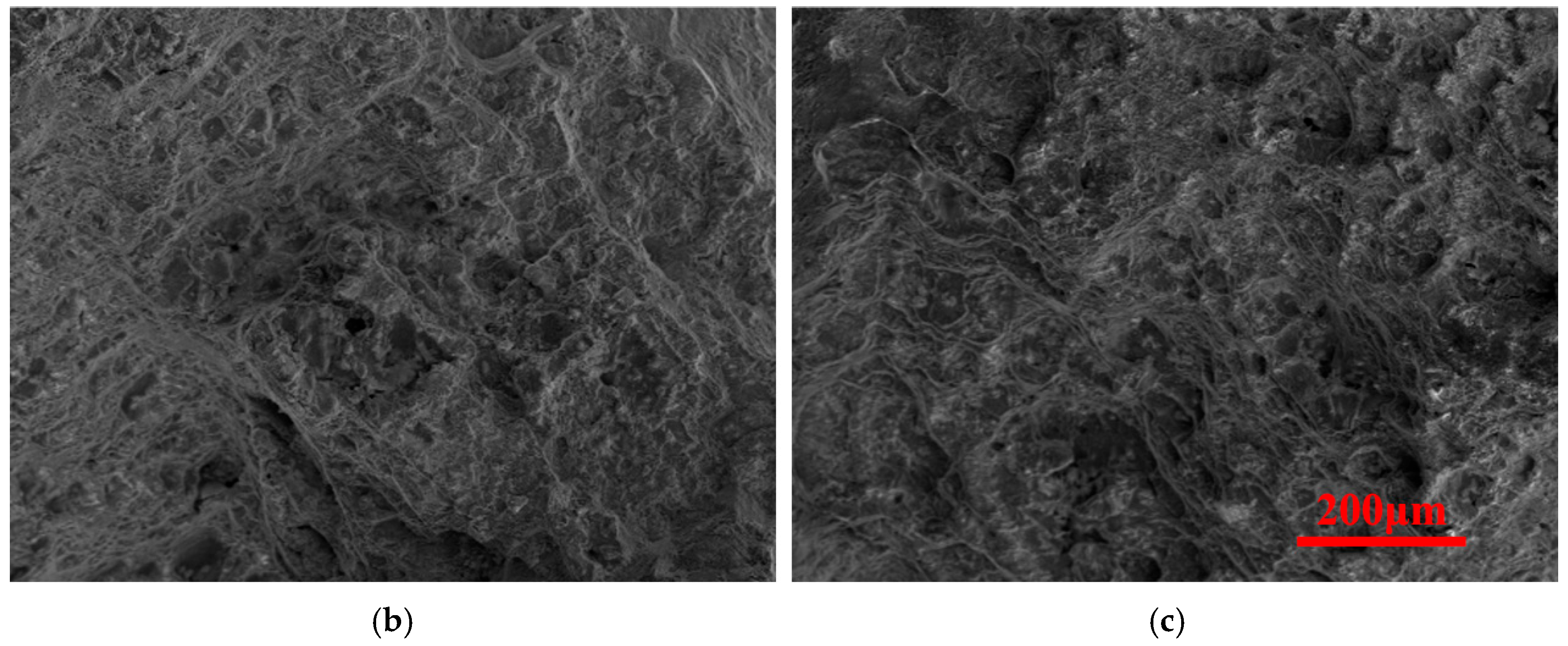
(a) Microstructural Morphology of Primary Fracture Surface in Leading-edge Film-cooling Specimen (b,c) Creep Cavity Characteristics in Leading-edge Film-cooling Simulator.
Figure 13.
(a) Microstructural Morphology of Primary Fracture Surface in Leading-edge Film-cooling Specimen (b,c) Creep Cavity Characteristics in Leading-edge Film-cooling Simulator.
Figure 14.
Multi-origin initiation on leading-edge film-cooling specimen: (a) Overall fracture surface showing initiation zones; (b) Dual initiation mechanisms: stress concentration-induced crack (circle) and linear source (arrowed); (c) Stress-driven initiation at hole periphery with boundary initiation (dotted ellipse); (d) Characteristic quasi-cleavage facets at linear initiation site (magnified in inset).
Figure 14.
Multi-origin initiation on leading-edge film-cooling specimen: (a) Overall fracture surface showing initiation zones; (b) Dual initiation mechanisms: stress concentration-induced crack (circle) and linear source (arrowed); (c) Stress-driven initiation at hole periphery with boundary initiation (dotted ellipse); (d) Characteristic quasi-cleavage facets at linear initiation site (magnified in inset).
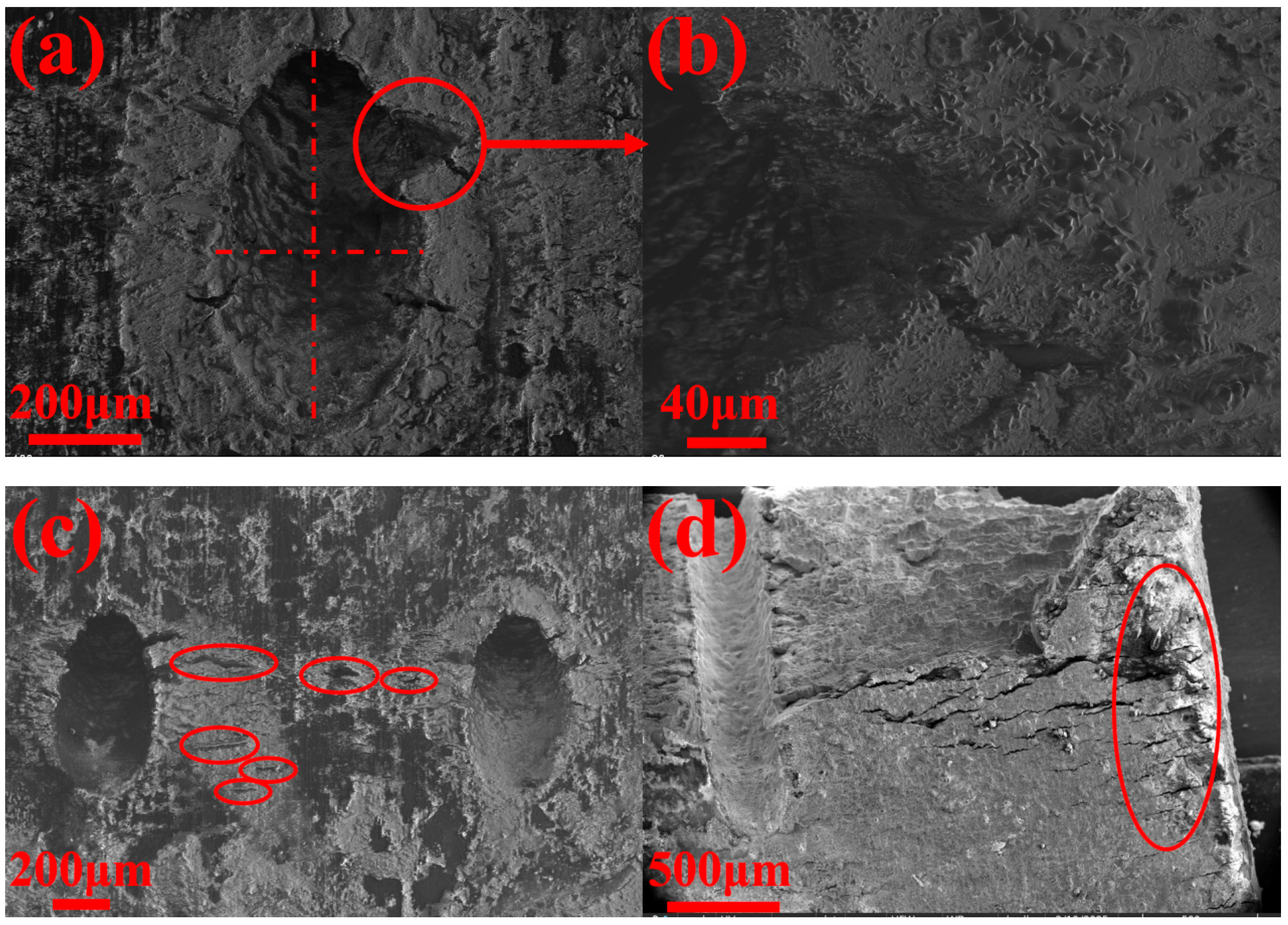
Figure 15.
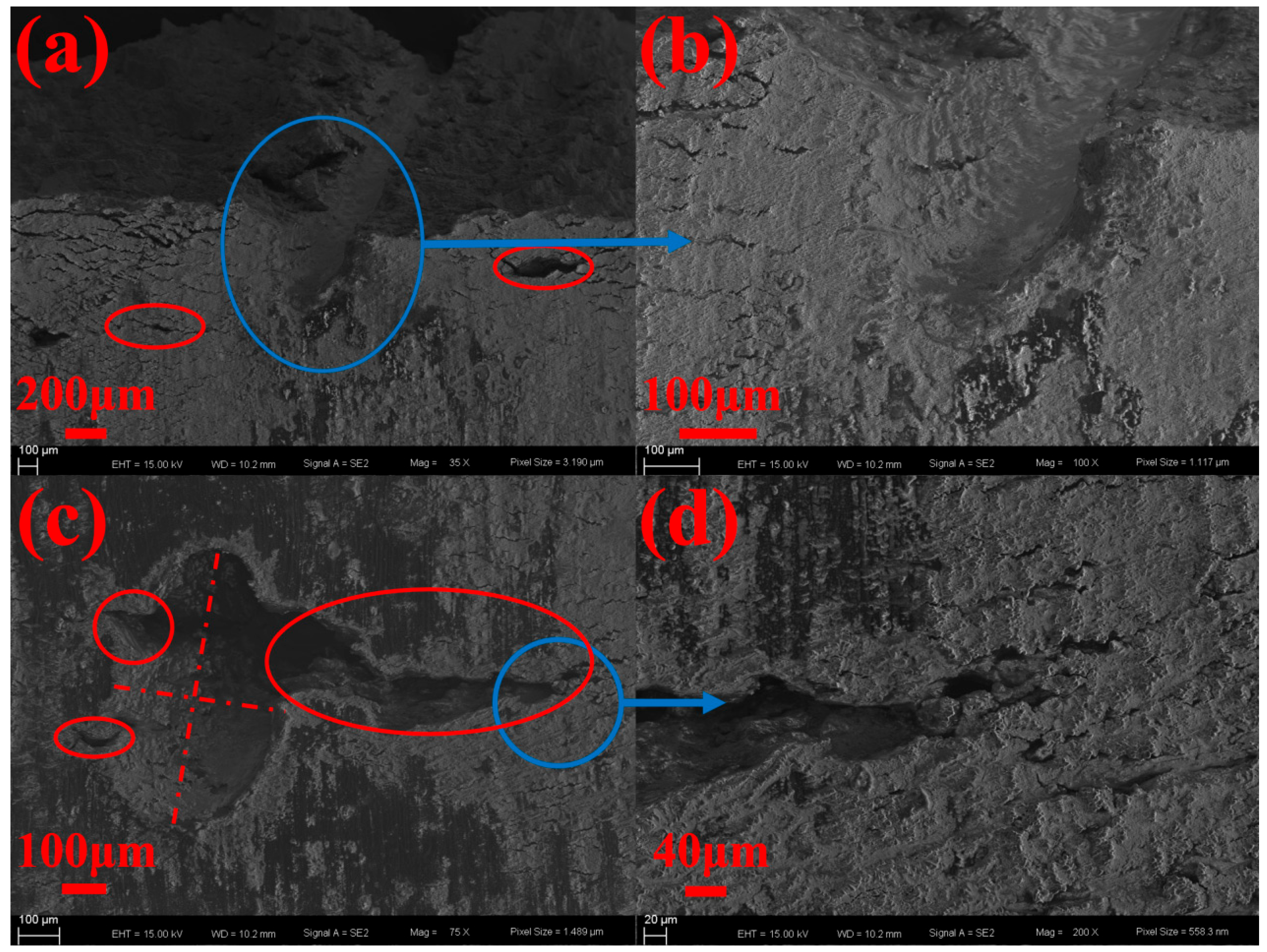
Side-view crack characteristics in leading-edge film-cooling specimen: (a) Hole-periphery crack initiation induced by local stress concentration and (b) its tip morphology; (c) Multi-origin features generated between adjacent holes on specimen surface; (d) Crack nucleation at specimen boundary due to free-edge stress concentration.
Figure 15.
Side-view crack characteristics in leading-edge film-cooling specimen: (a) Hole-periphery crack initiation induced by local stress concentration and (b) its tip morphology; (c) Multi-origin features generated between adjacent holes on specimen surface; (d) Crack nucleation at specimen boundary due to free-edge stress concentration.
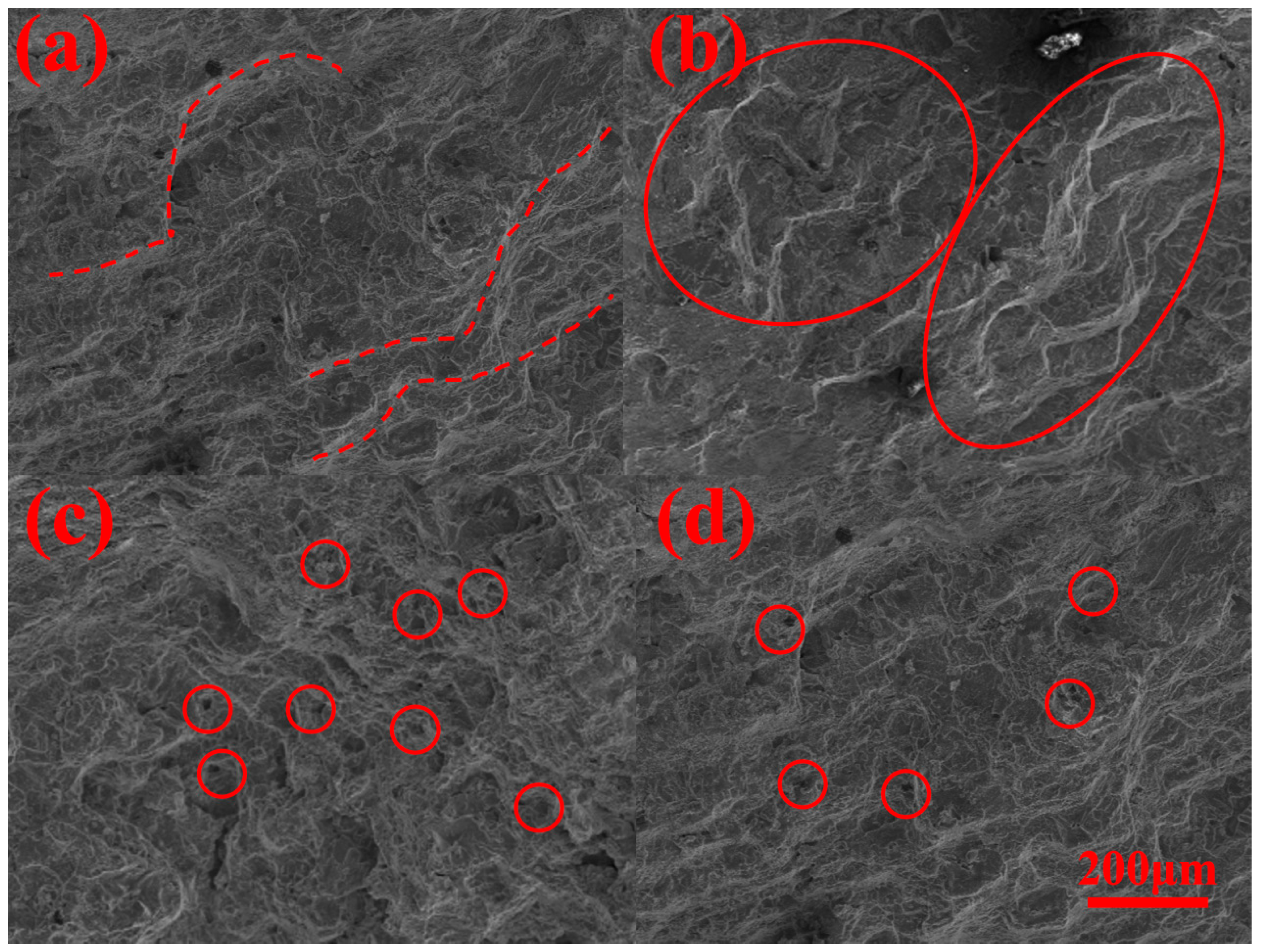
Figure 16.
Microstructural Morphology of Film-cooling Specimen at Mid-pressure Surface (a) Typical Quasi-cleavage Features (Tear Ridges); (b) Cleavage Characteristics (Facets and River Patterns); (c,d) Ductile Features (Microvoid Dimples).
Figure 16.
Microstructural Morphology of Film-cooling Specimen at Mid-pressure Surface (a) Typical Quasi-cleavage Features (Tear Ridges); (b) Cleavage Characteristics (Facets and River Patterns); (c,d) Ductile Features (Microvoid Dimples).
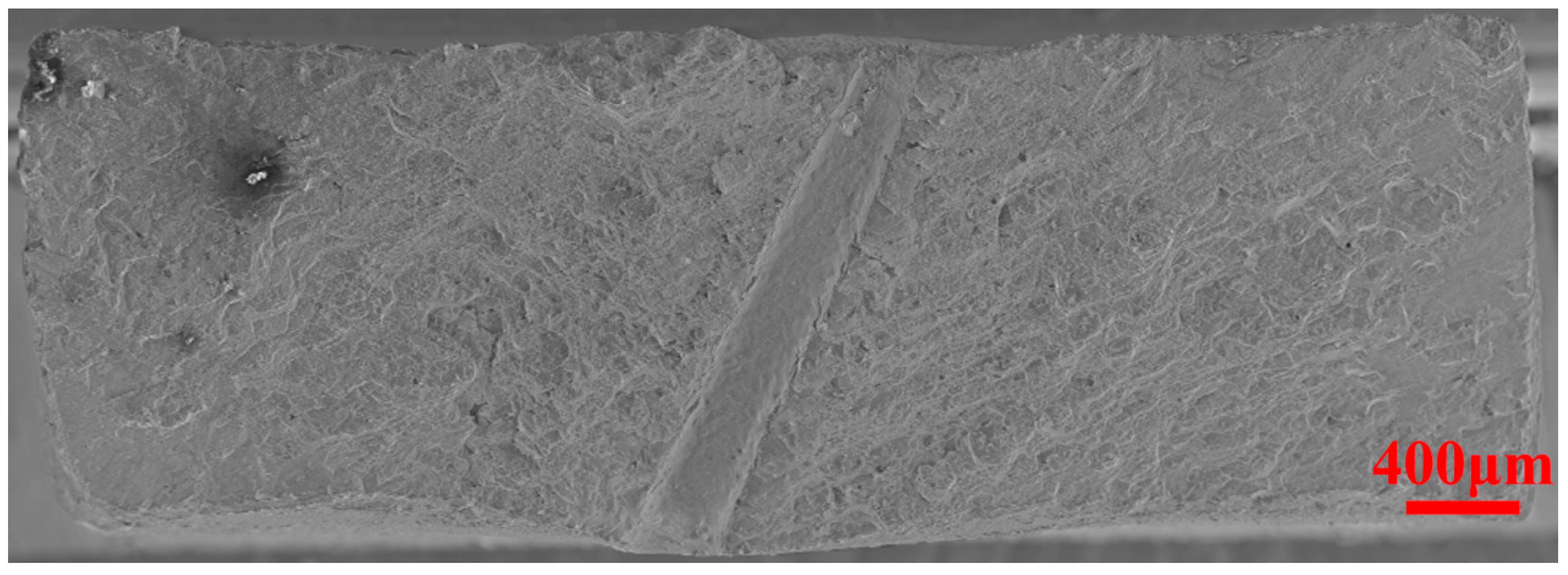
Figure 17.
(a) Overall Morphology of Multi-origin Initiation; (b) Linear Initiation Feature at Film-cooling Hole Edge; (c) Crack Initiation Zone on Left Side of Primary Fracture Surface; (d) Crack Initiation Zone on Right Side of Primary Fracture Surface.
Figure 17.
(a) Overall Morphology of Multi-origin Initiation; (b) Linear Initiation Feature at Film-cooling Hole Edge; (c) Crack Initiation Zone on Left Side of Primary Fracture Surface; (d) Crack Initiation Zone on Right Side of Primary Fracture Surface.
Figure 18.
(a) Film-cooling Hole on Primary Fracture Surface with Secondary Crack Initiation at Free Surface; (b) Crack Initiation Zone around Hole Edge on Primary Fracture; (c) Peripheral Crack Propagation at Adjacent Hole; (d) Crack Tip Morphology Showing Local Plasticity.
Figure 18.
(a) Film-cooling Hole on Primary Fracture Surface with Secondary Crack Initiation at Free Surface; (b) Crack Initiation Zone around Hole Edge on Primary Fracture; (c) Peripheral Crack Propagation at Adjacent Hole; (d) Crack Tip Morphology Showing Local Plasticity.
Figure 19.
Stress Distribution around Holes at Different Time Instants: (a) Leading Edge Simulator, (b) Front Concave Simulator, (c) Middle Concave Simulator.
Figure 19.
Stress Distribution around Holes at Different Time Instants: (a) Leading Edge Simulator, (b) Front Concave Simulator, (c) Middle Concave Simulator.
Figure 20.
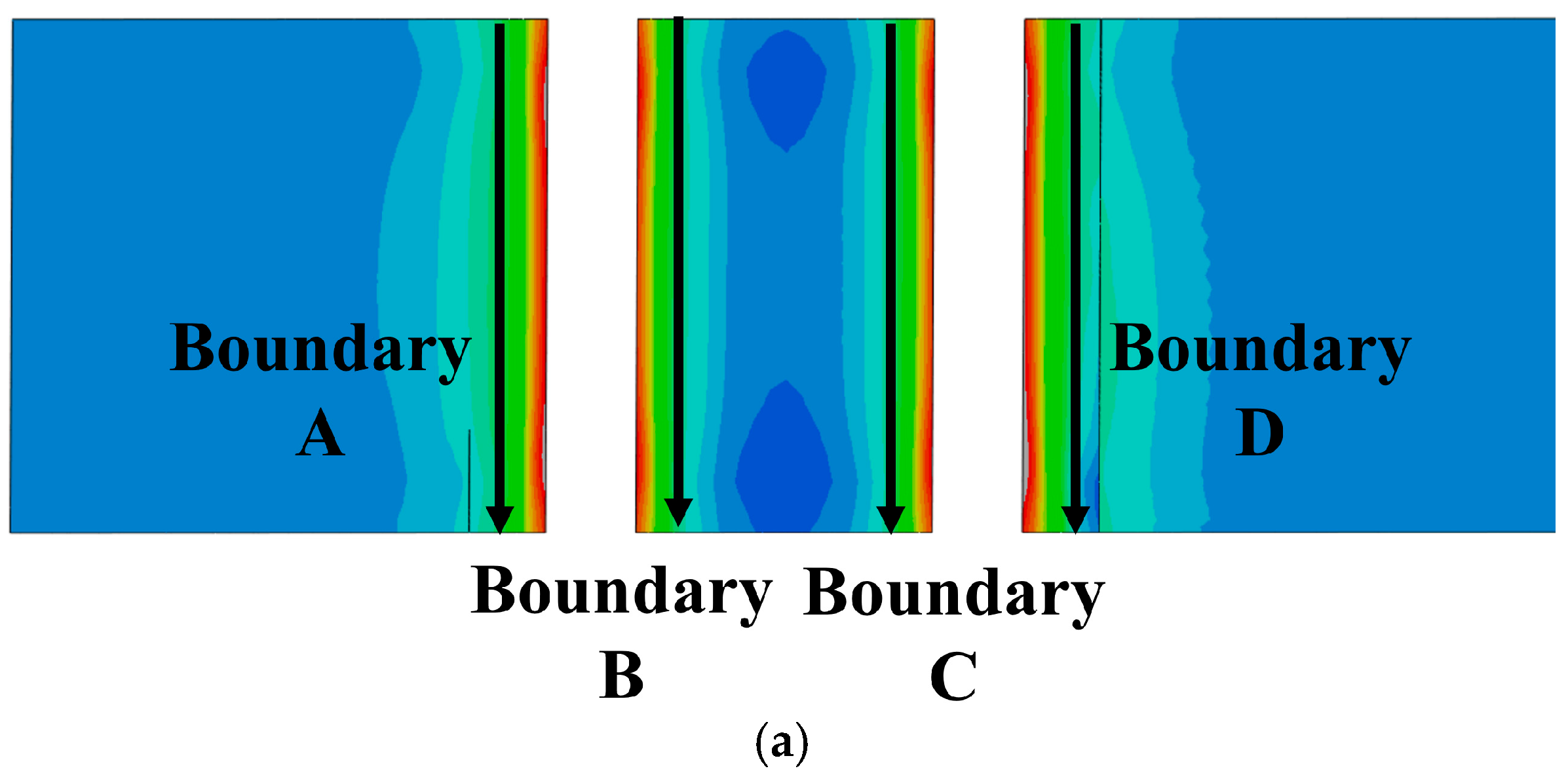
Boundaries of Stress Relaxation Zones at Critical Sections: (a) Leading Edge Simulator, (b) Front Concave Simulator, (c) Middle Concave Simulator.
Figure 20.
Boundaries of Stress Relaxation Zones at Critical Sections: (a) Leading Edge Simulator, (b) Front Concave Simulator, (c) Middle Concave Simulator.
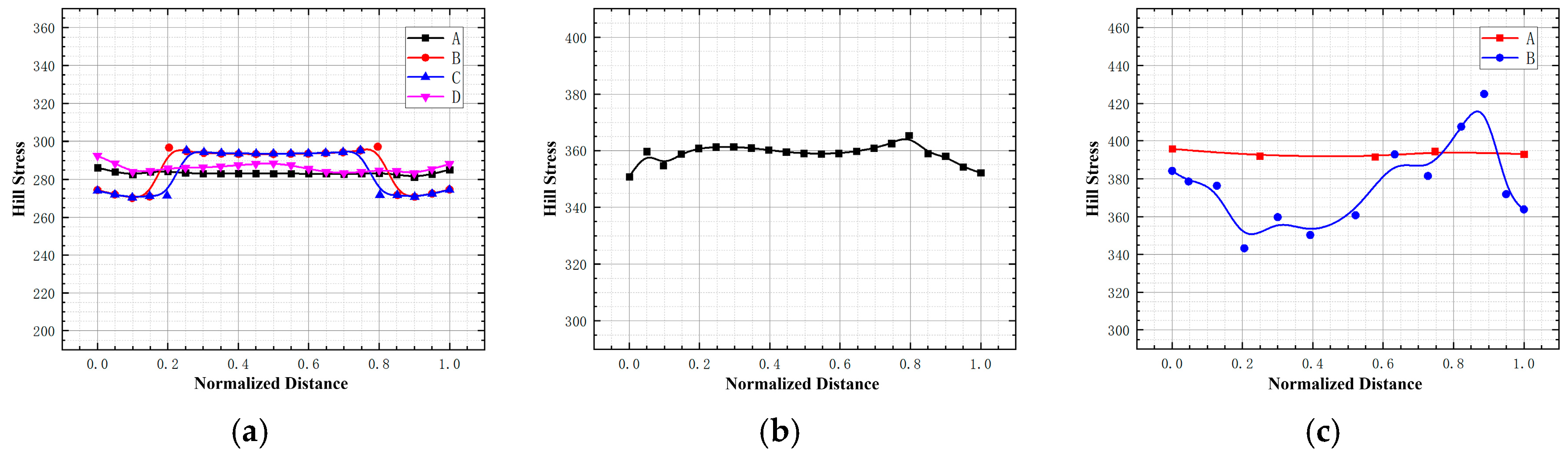
Figure 21.
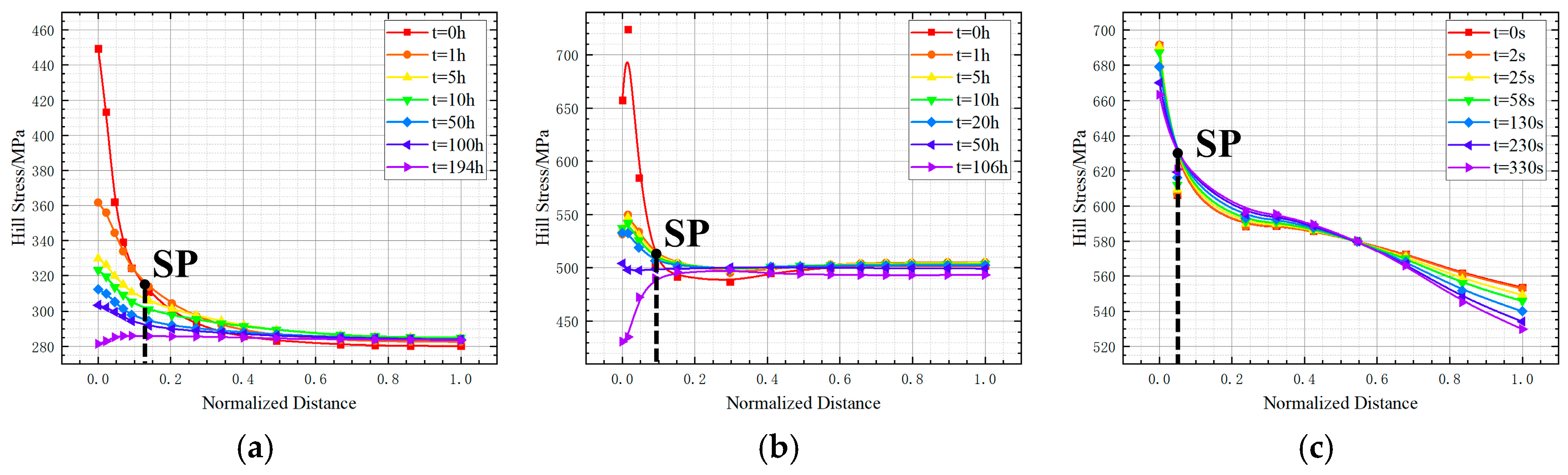
Stress Distribution along Stress Relaxation Zone Boundaries: (a) Leading Edge Simulator, (b) Front Concave Simulator, (c) Middle Concave Simulator.
Figure 21.
Stress Distribution along Stress Relaxation Zone Boundaries: (a) Leading Edge Simulator, (b) Front Concave Simulator, (c) Middle Concave Simulator.
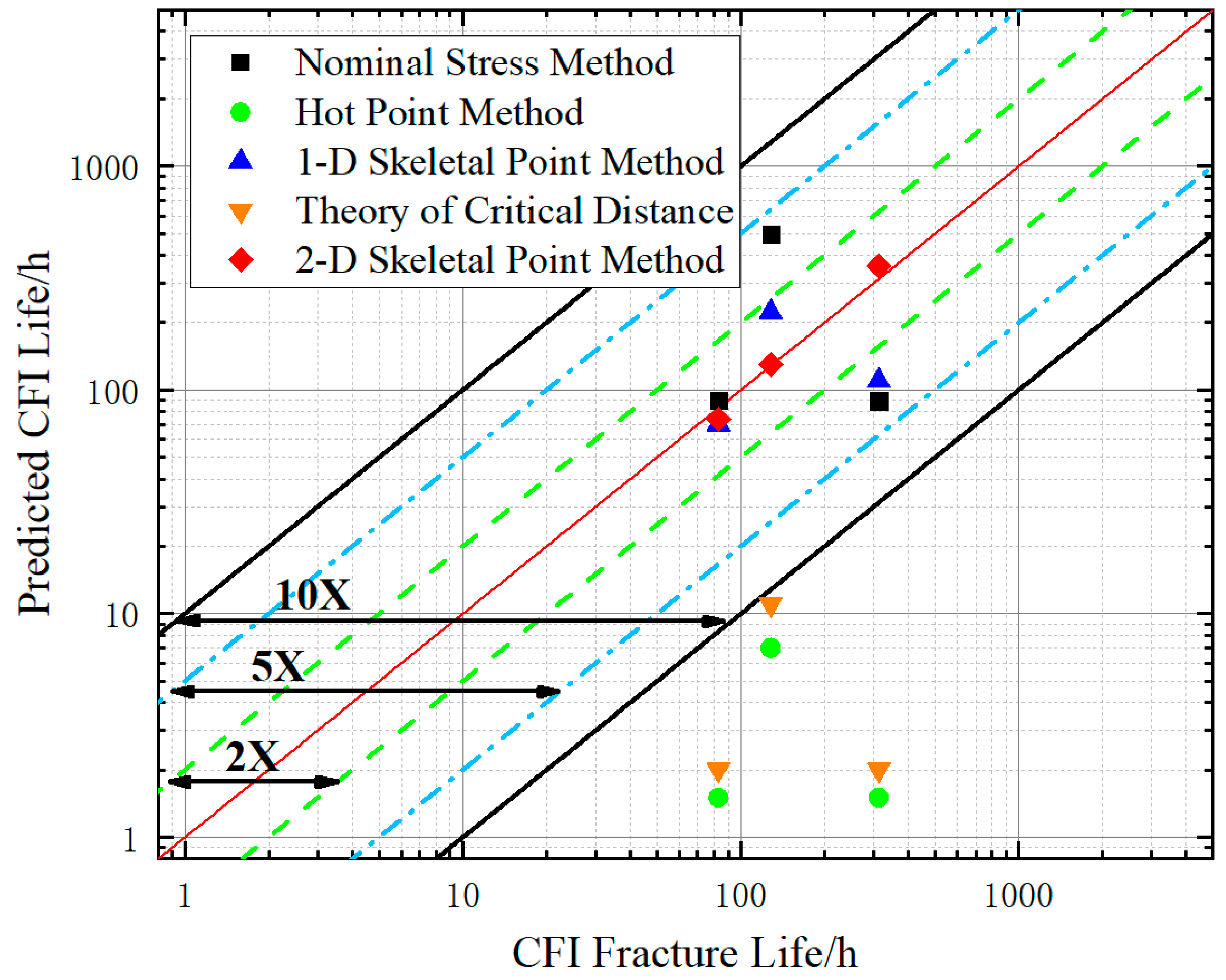
Figure 22.
Creep-Fatigue Life Prediction Results for Perforated Plate Specimens.
Figure 22.
Creep-Fatigue Life Prediction Results for Perforated Plate Specimens.
Table 1.
Components of DD32 Single-Crystal Superalloy.
Table 1.
Components of DD32 Single-Crystal Superalloy.
| Ele | C | Cr | Ni | Co | W |
| wt% | 0.12–0.18 | 4.3–5.6 | - | 8–10 | 7.7–9.5 |
| Ele | Mo | Al | Nb | Ta | Re |
| wt% | 0.8–1.4 | 5.6–6.3 | 1.4–1.8 | 3.5–4.5 | 3.5–4.5 |
Table 2.
Elastic Properties of DD32 Single-Crystal Superalloy.
Table 2.
Elastic Properties of DD32 Single-Crystal Superalloy.
| θ/°C | 20 | 800 | 900 | 1000 |
|---|
| E/GPa | 140 | 111 | 104 | 95.8 |
| G/GPa | 124 | 101 | 96.9 | 92.0 |
| μ | 0.352 | 0.438 | 0.444 | 0.449 |
Table 3.
Test Matrix and Results of Film-Cooling Simulation Specimens.
Table 3.
Test Matrix and Results of Film-Cooling Simulation Specimens.
| | Type | Mean Stress
/MPa | Load/kN | Temperature/°C | Result |
|---|
| Cycle | Hour |
|---|
| 1 | Leading Edge | 279 | 2.27 | 961 | 1024 | 131 |
| 2 | 279 | 2.27 | 961 | 972 | 125 |
| 3 | Front Concave | 500 | 5.63 | 900 | 663 | 83 |
| 4 | Middle Concave | 642 | 4.73 | 845 | 2283 | 307 |
| 5 | 642 | 4.73 | 845 | 2489 | 319 |
Table 4.
Material parameters of the visco-plastic constitutive model at different temperatures.
Table 4.
Material parameters of the visco-plastic constitutive model at different temperatures.
| Temperature/°C | 800 | 845 | 961 |
|---|
| E/MPa | 91,350 | 89,955 | 80,549 |
| ν | 0.438 | 0.4407 | 0.4462875 |
| G/MPa | 62,180 | 65,732 | 70,121 |
| K | 821 | 884 | 1239 |
| n | 6.584 | 6.008 | 4.2853 |
| N11 | 5730 | 6283 | 8338 |
| N44 | 7036 | 5182 | 1486 |
| Q11 | 85 | 66 | 23 |
| Q44 | 799 | 728 | 749 |
| P11 | 0 | 0 | 0 |
| P44 | 0 | 0 | 0 |
| r | 1 | 1 | 1 |
| k0 | 632 | 575 | 440 |
| Dn | 0 | 0 | 0 |
| Kn | 10,000 | 10,000 | 10,000 |
| nn | 1 | 1 | 1 |
| kn | 1 | 1 | 1 |
| Dt | 0 | 0 | 0 |
| Kt | 10,000 | 10,000 | 10,000 |
| nt | 1 | 1 | 1 |
| kt | 1 | 1 | 1 |
| M11 | 1 | 1 | 1 |
| M44 | 1.025 | 0.93815 | 0.99975 |
| b | 226 | 169 | 133 |
| W | 46 | 51 | 68 |
Table 5.
Prediction of Perforated Plate CFI Life via Two-Dimensional Skeletal Point Method.
Table 5.
Prediction of Perforated Plate CFI Life via Two-Dimensional Skeletal Point Method.
| Specimen Type | Characteristic Stress/MPa | Temperature/°C | CFI Life/h | Predicted Life/h | Prediction/Test |
|---|
| Leading Edge Simulator | 341 | 961 | 128 | 130 | 1.02 |
| Front Concave Simulator | 512 | 900 | 83 | 74 | 0.89 |
| Middle Concave Simulator | 562 | 845 | 313 | 360 | 1.15 |
Table 6.
Prediction of Perforated Plate CFI Life via Nominal Stress Method.
Table 6.
Prediction of Perforated Plate CFI Life via Nominal Stress Method.
| Specimen Type | Nominal Stress/MPa | Temperature/°C | CFI Life/h | Predicted Life/h | Prediction/Test |
|---|
| Leading Edge Simulator | 279 | 961 | 128 | 497 | 3.79 |
| Front Concave Simulator | 500 | 900 | 83 | 90 | 1.08 |
| Middle Concave Simulator | 642 | 845 | 313 | 89 | 0.28 |
Table 7.
Prediction of Perforated Plate CFI Life via Hot Point Method.
Table 7.
Prediction of Perforated Plate CFI Life via Hot Point Method.
| Specimen Type | Maximum Stress/MPa | Temperature/°C | CFI Life/h | Predicted Life/h | Prediction/Test |
|---|
| Leading Edge Simulator | 504 | 961 | 128 | 7 | 0.05 |
| Front Concave Simulator | 940 | 900 | 83 | 0.0001 | 0.00 |
| Middle Concave Simulator | 1890 | 845 | 313 | 0.0007 | 0.00 |
Table 8.
Prediction of Perforated Plate CFI Life via 1-D Skeletal Point Method.
Table 8.
Prediction of Perforated Plate CFI Life via 1-D Skeletal Point Method.
| Specimen Type | Skeletal Point Stress/MPa | Temperature/°C | CFI Life/h | Predicted Life/h | Prediction/Test |
|---|
| Leading Edge Simulator | 315 | 961 | 128 | 223 | 1.74 |
| Front Concave Simulator | 515 | 900 | 83 | 70 | 0.84 |
| Middle Concave Simulator | 630 | 845 | 313 | 110 | 0.35 |
Table 9.
Prediction of Perforated Plate CFI Life via Theory of Critical Distance.
Table 9.
Prediction of Perforated Plate CFI Life via Theory of Critical Distance.
| Specimen Type | Characteristic Stress/MPa | Temperature/°C | CFI Life/h | Predicted Life/h | Prediction/Test |
|---|
| Leading Edge Simulator | 479 | 961 | 128 | 11 | 0.09 |
| Front Concave Simulator | 893 | 900 | 83 | 0.06 | 0.00 |
| Middle Concave Simulator | 1795 | 845 | 313 | 0.0008 | 0.00 |
Table 10.
Perforated Plates CFI Life and Predicted Life via Different Methods.
Table 10.
Perforated Plates CFI Life and Predicted Life via Different Methods.
| | Leading Edge Simulator | Front Concave Simulator | Middle Concave Simulator |
|---|
| Nominal Stress/MPa | 279 | 500 | 642 |
| Temperature/°C | 961 | 900 | 845 |
| CFI Life/h | 128 | 83 | 313 |
| Nominal Stress Method | Predicted Life/h | 497 | 90 | 89 |
| Predicted/Test | 3.79 | 1.08 | 0.28 |
| Hot Point Method | Predicted Life/h | 7 | 0.0001 | 0.0007 |
| Predicted/Test | 0.05 | 0.00 | 0.00 |
| 1-D Skeletal Point Method | Predicted Life/h | 223 | 10 | 110 |
| Predicted/Test | 1.74 | 0.84 | 0.35 |
| TCD Method | Predicted Life/h | 11 | 0.06 | 0.0008 |
| Predicted/Test | 0.09 | 0.00 | 0.00 |
| 2-D Skeletal Point Life | Predicted Life/h | 130 | 74 | 360 |
| Predicted/Test | 1.02 | 0.89 | 1.15 |