Article

A Revised Shear Panel Formulation for Parallelogram Panels

Institute of Structural Mechanics and Lightweight Design, RWTH Aachen University, Wüllnerstraße 7, 52062 Aachen, Germany
*
Author to whom correspondence should be addressed.
Aerospace 2026, 13(4), 301; https://doi.org/10.3390/aerospace13040301
Submission received: 27 February 2026 / Revised: 15 March 2026 / Accepted: 20 March 2026 / Published: 24 March 2026

Abstract

The growing complexity of large-scale, thin-walled structures can be managed through the use of hierarchical modelling approaches. In aeroelastic wing design, efficient models are needed during the concept and preliminary design phases, as a large design space must be explored. However, in structural engineering, these models are often reduced-order models that use time-consuming CAD-based FEM models to capture important detail. Shear panel theory has historically been used for such problems, even though it has been reported that the method cannot model the bending-induced torsion of swept wings. Additionally, the assumptions used to derive the parallelogram panel have been criticised for being inconsistent, resulting in deviations in stiffness and stresses. This paper presents a novel formulation for parallelogram shear panels and a novel smearing approach for normal stiffness that does not lead to an overestimation of in-plane bending stiffness. These new formulations are validated through comparisons with FEM reference models of single panels and swept and unswept wings. The results demonstrate that the stiffness and stress state of the new panel formulation match those of the reference model, and that using the formulation achieves the desired bending–torsion coupling of swept wings. Furthermore, the proposed smearing approach allows wing sections to be modelled with the fewest possible degrees of freedom while avoiding the overestimation of bending stiffness.

1. Introduction

The design of aircraft is increasingly driven by multidisciplinary requirements and the co-development philosophy. Early in the design process, environmental impact [1], cost and manufacturing [2,3] need to be considered alongside structural requirements. To handle this increasing complexity, a formalised and consistent hierarchical modelling approach can be adopted throughout the entire design process [4,5], selecting appropriate models for the available and required design stage information. Efficient models are especially required during the concept and preliminary design phases, where large design spaces must be explored [6]. Accordingly, various methods and strategies have been developed for the structural analysis of wings.
In the context of aeroelastic tailoring, a prominent approach is the use of reduced-order models [7,8,9], with the challenge that the structural influence of components such as ribs must be represented adequately [10,11]. By incorporating analytical submodels, individual components can be examined in greater detail [12,13]. However, most modelling techniques ultimately rely on finite element method (FEM) models, which require time-consuming preparation of Computer-Aided Design (CAD) models and therefore limit the efficient exploration of large design spaces. Before the establishment of the FEM, the shear panel theory (SPT) was used to calculate complex wing and fuselage structures in a simple and efficient manner [14]. SPT can therefore be seen as a modelling approach that bridges the gap between analytical methods and highly detailed FEM models.
The SPT is a modelling approach for stiffened thin-walled structures and beam profiles in which the structure is idealised using panels and surrounding stiffeners [15]. For rectangular panels, the SPT approximates the shear flow in the panels as constant and the axial forces in the stiffeners as linearly varying. It can be shown that this idealisation is valid if the cross-sectional area of the panel is much smaller than the area of the stiffeners [16].
However, in modern lightweight structures, these assumptions are often not fulfilled. To address this limitation, Gienke [17] describes a smearing technique for skin and local stringers when the normal stiffness of these structures cannot be neglected. A similar smearing concept for one-dimensional unstiffened structures is described by Dieker and Reimerdes [16], in which the structure is discretised and a trade-off between accuracy and computational cost must be chosen. More recently, Baess and Schroeder [18] developed a three-dimensional curved shear panel formulation capable of modelling curved fuselage and wing sections with low computational effort. Baess et al. [19] applied the curved SPT to NACA wings to investigate the potential for aeroelastic optimisation by comparing the computational efficiency with FEM models of different mesh sizes. The extension of the SPT to non-rectangular geometries was addressed by Garvey [20], who applied the basic assumption of pure shear at the panel edges to parallelogram-shaped panels, resulting in an analytical model with a constant stress state:
σ 11 = 2 τ 12 tan ( α ) , σ 22 = 0 .
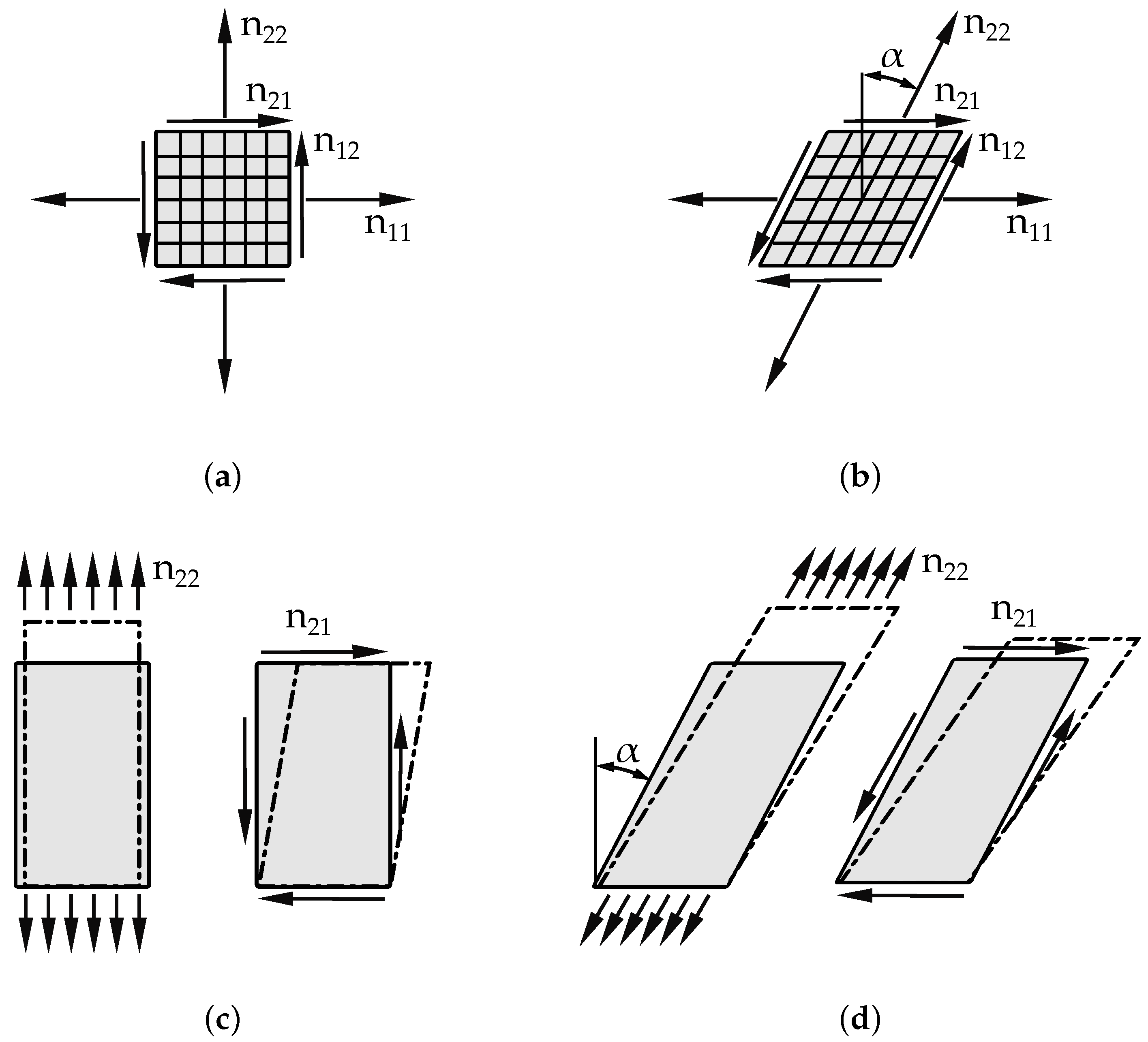
Based on these assumptions, several stress-based FEM elements for quadrilateral panels have been proposed [21,22,23]. These formulations were compared against the analytical solution of Garvey [20] and reported to be exact [21,22,23]. However, Gienke [6] mentions that existing SPT formulations for parallelogram-shaped stiffened panels lack a consistent coupling between normal and shear deformations, as illustrated in Figure 1. As a consequence, bending–torsion coupling effects, which are characteristic of swept wing structures, cannot be depicted.
In order to validate the SPT, Baess and Schroeder [24] investigated the stiffness and stress behaviour of single rectangular and parallelogram panels by comparison with FEM reference models. A significant influence of the second moment of area of the surrounding stiffeners on both stiffness and stress distributions was observed. Inconsistencies in the assumptions and derivation of the parallelogram panel were identified, leading to errors in the calculation of stiffness and stress distributions not consistent with the analytical solution of Garvey [20]. The study showed that the assumptions underlying the rectangular shear panel cannot be directly transferred to parallelogram-shaped panels, as the coupling of normal and shear stresses introduces additional compatibility constraints with the surrounding stiffeners [24].
This work presents a revised formulation for parallelogram-shaped panels based on the findings of Baess and Schroeder [24]. The resulting formulation is referred to in the following as Improved Shear Panel Theory (iSPT). In contrast to classical formulations based on the postulation of pure shear traction at the panel edges [20,21,22,23], the present approach enforces equilibrium and compatibility between panels and surrounding stiffeners. A stress-based finite element formulation is derived using the principle of complementary virtual work, enabling a consistent representation of the coupling between normal and shear deformations required to capture bending–torsion interaction in swept wing structures [6]. In addition, an improved smearing approach for panel normal stiffness is introduced, extending existing concepts [16,17]. The approach avoids the overestimation of in-plane bending stiffness caused by conventional virtual stiffener placement while maintaining the computational efficiency required for reduced-order structural models. The proposed formulations are validated against detailed FEM reference models in single-panel studies [24] as well as in unswept and swept wingbox configurations [10,11], demonstrating accurate stiffness and stress calculations and the correct reproduction of bending–torsion coupling effects.

2. Method

2.1. General Formulation of Stress-Based Elements

FEM elements can be derived with different approaches, as described in the literature [25,26]. Most common is the formulation of displacement-based finite elements, in which Ansatzfunctions for displacements are formulated. Less common is the formulation of stress-based elements that make assumptions about the stress field inside the element. In the following, the derivation of stress-based elements is described using the Principle of Complementary Virtual Work, as described by Curtis and Greiner [22] and Robinson [26], also known as the Principle of Virtual Forces. In the following sections, this method is specialised to a shear panel element with a constant stress field where equilibrium and compatibility conditions uniquely determine the stress parameters.
A system is in equilibrium if the internal complementary virtual work δ U i is equal to the external complementary virtual work δ W e :
δ U i = δ W e
The internal complementary virtual work is defined as
δ U i = V δ σ T ε d V ,
while the external complementary virtual work is given by
δ W e = δ f n T u n + Ω δ t s T u s d Ω + V δ b T u d V ,
where f n is the nodal load vector, u n is the nodal displacement vector, t s is the surface traction vector, u s is the boundary displacement field, u is the displacement field and b is the body force vector. d Ω describes the boundary surface differential element and d V the volume differential element. In the following, the terms with the body forces are neglected. Equation (2) will be transformed to be expressed in nodal displacements. As stated above, a self-equilibrating stress field inside the element is assumed. Often the Airy stress function forms the basis for the stress field ensuring compatibility. The stress vector can than be expressed in terms of the generalised load vector, also called the stress parameter β :
σ = P β ,
where P gives the stress distributions and is called the matrix of stress polynomial terms, if polynomial fields are chosen. The strains can be expressed as
ε = D P β ,
where D describes the strain–stress relations. The surface tractions t s , the boundary displacement field u s and the nodal loads f n can be expressed in terms of the generalised load vector β :
t s = L s β u s = N s u n f n = T n β ,
where the form of L s is dependent on the chosen coordinate system, N s is the boundary shape function and T n establishes the relation between the generalised loads and the nodal point load vector. Inserting Equations (5)–(7) into Equation (2) yields
V δ β T P T D P β d V = δ β T T n T u n + Ω δ β T L s T N s u n d Ω .
As Equation (8) must hold for all virtual loads δ β , the equation yields
V P T D P d V β = T n T + Ω L s T N s d Ω u n .
Equation (9) has the form of
H β = T T u n ,
where H is called the natural flexibility matrix and T is defined as
T = T n + T s ,
with
T s = Ω L s T N s d Ω .
An equivalent nodal load vector f s can then be defined as
f s = Ω N s T t s d Ω .
Equation (10) can be transformed into the general FEM form
T H 1 T T u n = k e u n = f n ,
where k e is the elemental stiffness matrix and f n is the nodal load vector. The generalised load vector β can be recovered from calculated nodal displacements by
β = H 1 T T u n .

2.2. Derivation of the Stress State for a Parallelogram Shear Panel

The parameter studies performed by Baess and Schroeder [24] showed that the stress state inside the shear panel, as well as the stiffness behaviour, is not consistent with the analytical solution. The following reasons were identified:
  • No compatibility conditions between the panel and stiffeners.
  • No compatibility conditions between neighbouring panels.
  • Assumptions of pure shear on the panel’s edges.
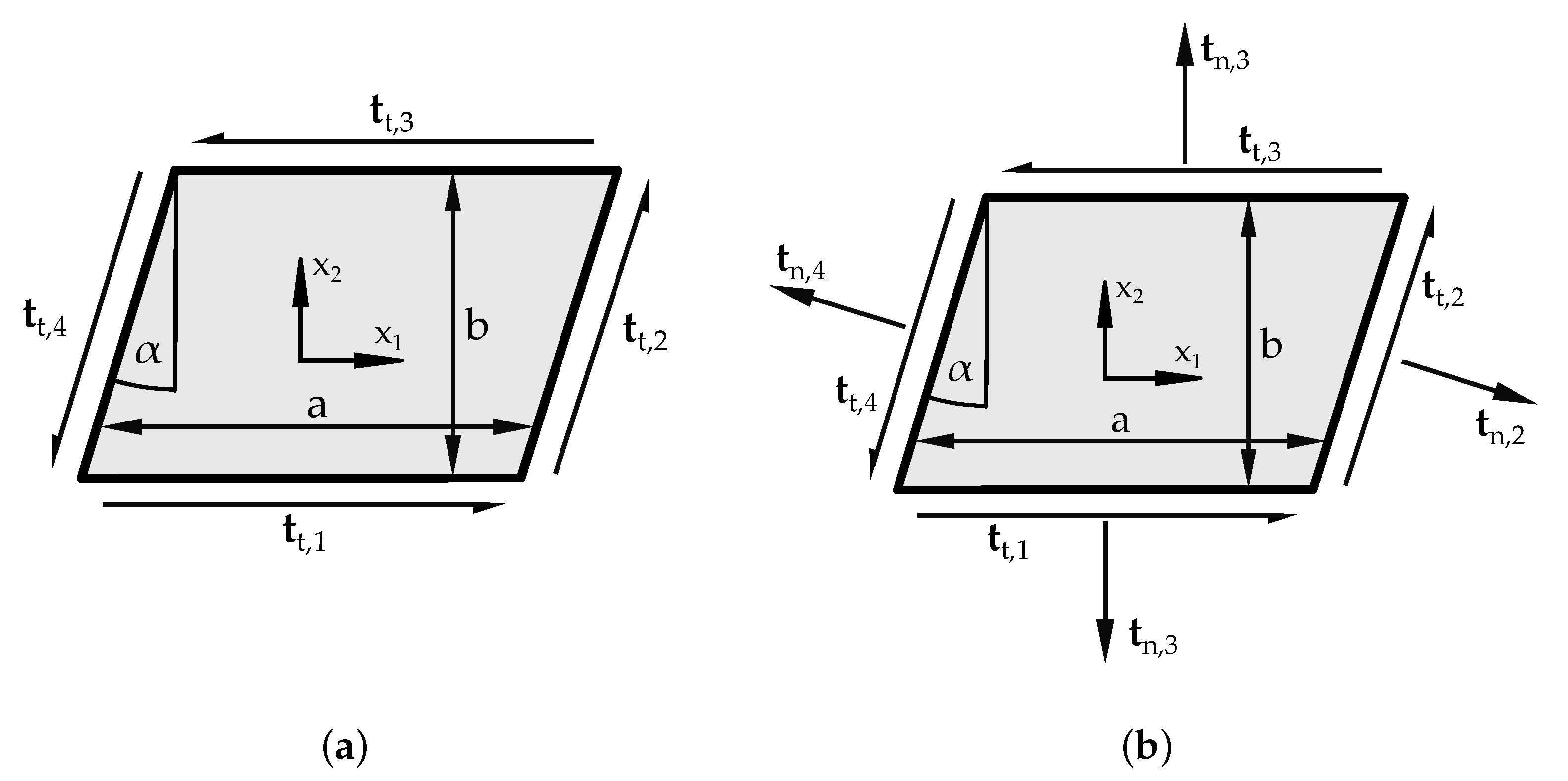
In the following, a revised shear panel formulation for the parallelogram panel and isotropic material behaviour is derived by dropping the assumptions of pure shear at the edges and by introducing compatibility conditions between the panel and stiffeners as well as neighbouring panels. Rigid behaviour of the stiffeners in normal and bending stiffness is assumed, consistent with the rectangular theory [15,16]. The basis of the derivation is a compatible stress field of the first degree, consistent with the observations in [24]. The stress components σ 12 , σ 11 and σ 22 are therefore constant. Figure 2 shows the shear panel with the resulting traction loads for (a) the state-of-the-art formulation (SPT-SOTA) and (b) the iSPT.
It should be explicitly noted that, in contrast to other derivations [21,22,23], it is not required for the normal traction component t n , i to vanish. The normal and tangential stresses at the edges are
σ n , i = σ 11 v 2 , i 2 + σ 22 v 1 , i 2 2 τ 12 v 1 , i v 2 , i ,
σ t , i = ( σ 11 σ 22 ) v 1 , i v 2 , i + τ 12 ( v 2 , i 2 v 1 , i 2 ) ,
where v i = [ v 1 , i , v 2 , i ] T is the unit vector along the i-th edge in the counterclockwise direction.
n i = [ v 2 , i , v 1 , i ] T , t n , i t n , i n i , t t , i t t , i v i .
Due to the constant stress field, the resulting normal forces and tangential forces simplify to
S n , i = 0 l i σ n , i h d s = 0 l i t n , i d s = σ n , i h l i ,
S t , i = 0 l i σ t , i h d s = 0 l i t t , i d s = σ t , i h l i ,
where l i is the corresponding edge length. It is required that the internal forces of the panel are in equilibrium:
i = 1 4 F 1 , i = 0 ,
i = 1 4 F 2 , i = 0 ,
i = 1 4 M 3 , i = i = 1 4 ( r i × S n , i ) 3 + i = 1 4 ( r i × S t , i ) 3 = 0 ,
where r i denotes the vector from the centre of the panel to the edges. Assuming a constant stress state, force equilibrium is satisfied identically. Moreover, the tangential tractions cancel out pairwise, i.e., i = 1 4 ( r i × S t , i ) 3 = 0 , such that moment equilibrium reduces to
i = 1 4 ( r i × S n , i ) 3 = 0 .
This yields a condition of the form
h ( c 1 σ 11 + c 2 σ 22 + c 3 τ 12 ) = 0 .
with
c 1 = i = 1 4 v 2 , i 2 l i r i × n i 3 , c 2 = i = 1 4 v 1 , i 2 l i r i × n i 3 , c 3 = i = 1 4 2 v 1 , i v 2 , i l i r i × n i 3 .
For the parallelogram geometry defined in Figure 2b, these coefficients reduce to
c 1 = a b cos α sin α ,
c 2 = a b tan α 1 sin 2 α ,
c 3 = 2 a b sin 2 α .
From the requirement that the stiffeners are rigid, and because the strain in the stiffener direction must therefore be zero, in combination with the assumption of a plane stress state, an additional equation is obtained:
ε 11 = 1 E σ 11 ν σ 22 = 0 σ 11 ν σ 22 = 0 .
It should be noted here that both stringer directions can be used, but the x 1 -direction is chosen to avoid transformations. Solving Equations (25)–(30) results in
σ 11 = 2 ν tan α 1 ν τ 12 , σ 22 = 2 tan α 1 ν τ 12 .
It is evident that the derived stress state in the parallelogram differs significantly from the stress state described in the literature [15,16,20,21,22]. For one, the constrained transverse contraction is reflected in the stress state, and, additionally, the normal stress in the y-direction is not equal to zero. It can be shown that the stress state of a parallelogram shear panel for α = 0 is equal to the stress field of the rectangular panel, as both σ 11 and σ 22 become zero.

2.3. Derivation of the Stiffness Matrix

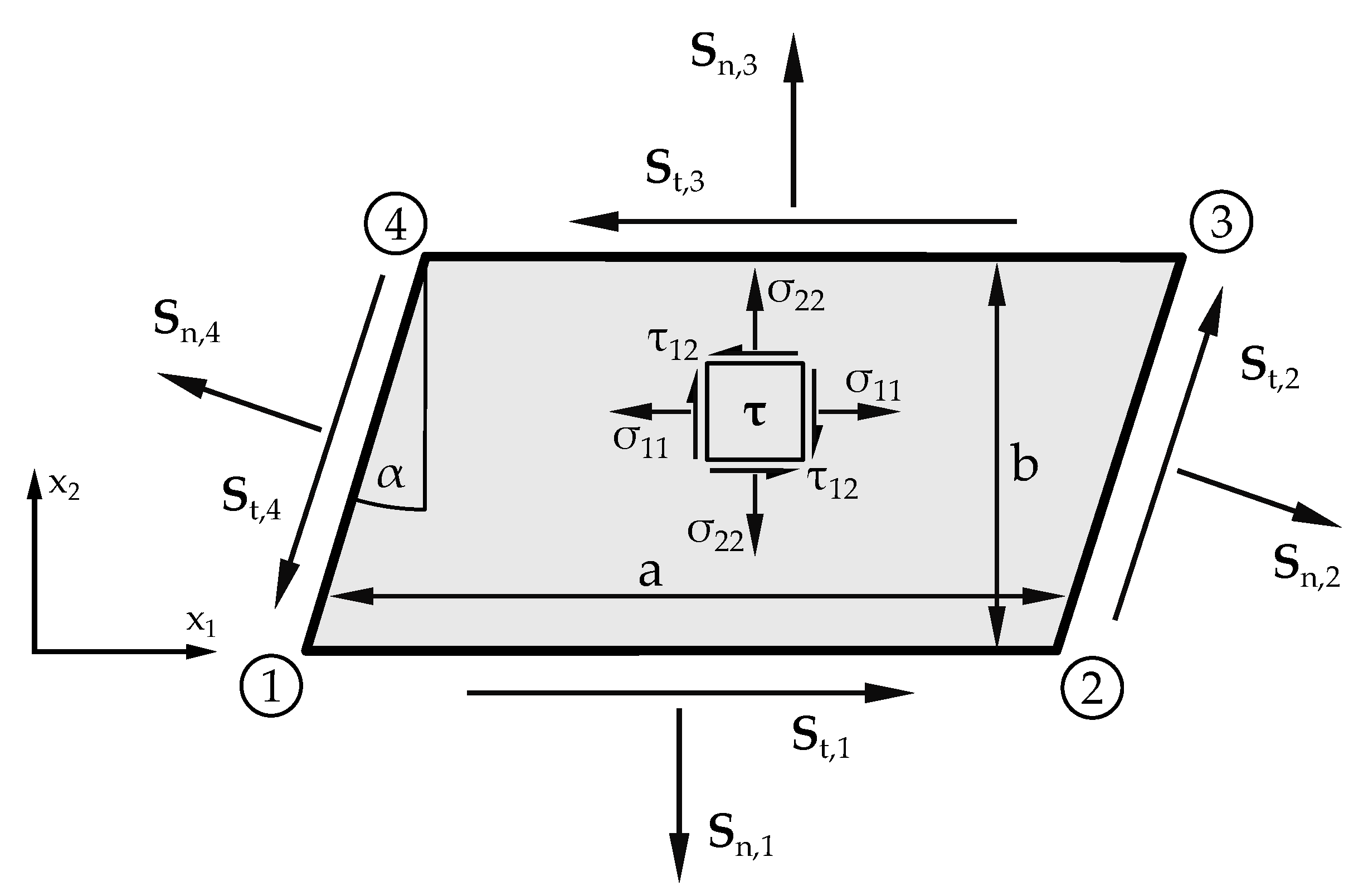
The shear panel considered in the following, illustrated in Figure 3, is a plane, thin-walled structure of parallelogram shape with uniform thickness h and linear-elastic isotropic material behaviour.
The four nodes of the panel, numbered counterclockwise from node Aerospace 13 00301 i003 to node Aerospace 13 00301 i004, form a flat reference plane. The dimensions a and b represent the length and width of the panel; α describes the angle of the parallelogram. The x 1 -axis of the Cartesian coordinate system is oriented along the line connecting node Aerospace 13 00301 i005 and node Aerospace 13 00301 i006. The x 2 -axis is oriented perpendicular to the x 1 -axis. The derivation adopts a stress-based finite element formulation, as described in Section 2.1. With the derived stress field from Equation (31), the stress relations Equation (5) can therefore be assumed:
σ = P β = 2 ν tan α 1 ν 2 tan α 1 ν 1 τ .
As a plane stress state is assumed, the stress–strain relation matrix D is given by
D = 1 E ν E 0 ν E 1 E 0 0 0 1 G .
The natural flexibility matrix H therefore results in
H = V P T D P d V = a b h P T D P , H R 1 × 1 .
As forces are only applied to the edges of the panel as the surface tractions by the surrounding stiffeners, Equation (4) for external complementary virtual work simplifies to
δ W e = S δ t s T u s d Ω
and should be expressed in the form of
Ω δ t s T u s d Ω = T s T u n .
This can be achieved by equally distributing the acting shear and normal traction forces ( S t , i , S n , i ) along the edges to the adjacent nodes. The corresponding surface tractions on the edges can be derived from Equations (16), (17) and (32):
t s , i = h σ n , i σ t , i = h v 2 , i 2 v 1 , i 2 2 v 1 , i v 2 , i v 1 , i v 2 , i v 1 , i v 2 , i v 2 , i 2 v 1 , i 2 2 ν tan α 1 ν 2 tan α 1 ν 1 L s , i τ .
The complete matrix of edge operators is then assembled as follows:
L s = L s , 1 L s , 2 L s , 3 L s , 4 , L s , i R 2 × 1 ( i = 1 , , 4 ) L s R 8 × 1 .
The boundary shape function N s transforms the edge tractions into the panel coordinate system and distributes them to the adjacent nodes:
N s = 1 2 diag T 1 , T 2 , T 3 , T 4 N ,
where
T i = v 2 , i v 1 , i v 1 , i v 2 , i , i = 1 , , 4 ,
and
N = 1 0 1 0 0 0 0 0 0 1 0 1 0 0 0 0 0 0 1 0 1 0 0 0 0 0 0 1 0 1 0 0 0 0 0 0 1 0 1 0 0 0 0 0 0 1 0 1 1 0 0 0 0 0 1 0 0 1 0 0 0 0 0 1 .
As the stress field is constant, Equation (12) simplifies to
T s = Ω L s T N s d Ω = h a a b cos α b cos α a a b cos α b cos α L s T N s ,
and the local element stiffness follows with T = T s as
k e = T s H 1 T s T .

2.4. Improved Smeared Stiffness Approach—Derivation

The SPT is based on the assumption that the in-plane normal stiffness of the panel can be neglected. However, this assumption is not always valid—particularly for unstiffened structures, where the contribution of the panel’s normal stiffness becomes significant. In the state-of-the-art smearing approach (SOTA smearing), to enable the analysis of such structures within the SPT, the normal stiffness of the panel is represented by introducing virtual stiffeners along the panel edges [15,16,17]. These virtual stiffeners are designed such that the overall normal stiffness of the structure remains unchanged. However, when representing the in-plane normal stiffness of a panel by virtual edge stiffeners, the associated Steiner contributions lead to a systematic overestimation of bending stiffness for coarse discretisations. To illustrate this issue, consider an unstiffened rectangular section with height b and thickness h. The analytical expressions for its area A ana and second moment of area I ana are given by
A ana = h b ,
I ana = b 3 h 12 .
If the same section is modelled using two virtual stiffeners placed along the edges of the shear panel, the resulting expressions are
A SPT = h b ,
I SPT = b 3 h 4 .
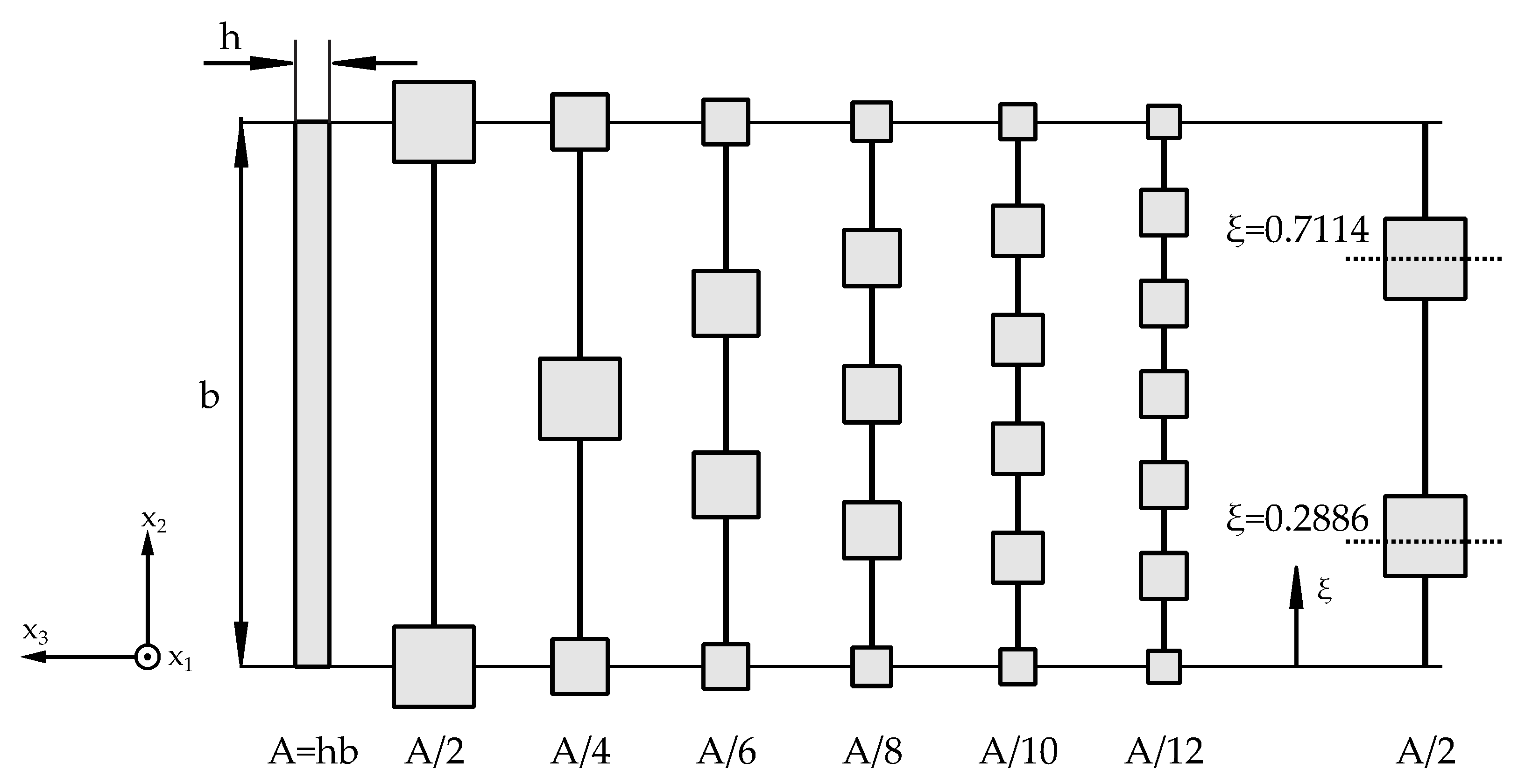
It can be observed that the second moment of area is overestimated due to the Steiner contributions associated with the virtual stiffeners. This overestimation necessitates a discretisation of the panel into multiple elements, as illustrated in Figure 4.
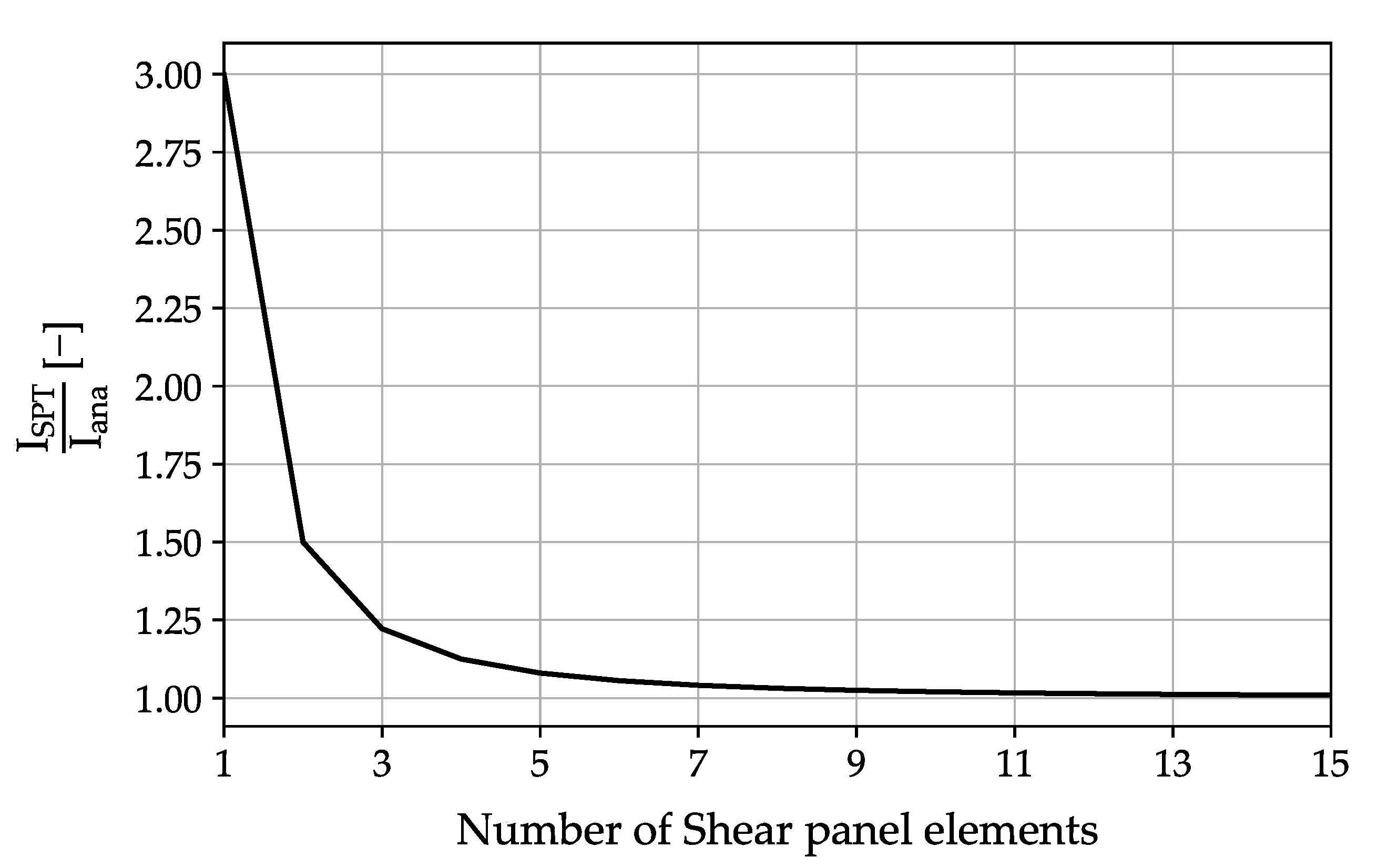
Figure 5 shows the ratio between the analytical and the modelled second moments of area for varying numbers of discretised elements using the SOTA smearing approach. As the number of elements increases, the ratio converges toward unity. To achieve an error below 5%, at least six elements are required. However, this improved accuracy comes at the cost of increased computational effort. Furthermore, there is a risk that discretisation will result in the formation of a kinematic chain.
To accurately represent the second moment of area even with a single shear panel element, the optimal position of the virtual stiffeners is derived analytically in the following. The area and second moment of area of the actual panel are given by Equations (42) and (43). In the SPT model, these quantities are determined by the Steiner contributions of the virtual stiffeners, expressed as
A stiff = h b 2 ,
I SPT = 2 A stiff z 2 ,
where z denotes the distance of each virtual stiffener from the panel’s centreline. By equating the analytical and SPT expressions for both the area and the second moment of area, the ideal position z o p t of the virtual stiffeners can be obtained as
b 3 h 12 = 2 A stiff z opt 2 ,
z opt = b 12 = 0.2887 b .
Although the example is one-dimensional, the underlying mechanism directly transfers to two-dimensional shear panel representations, where the panel normal stiffness is similarly concentrated along the edges.

2.5. Improved Smeared Stiffness Approach—Implementation

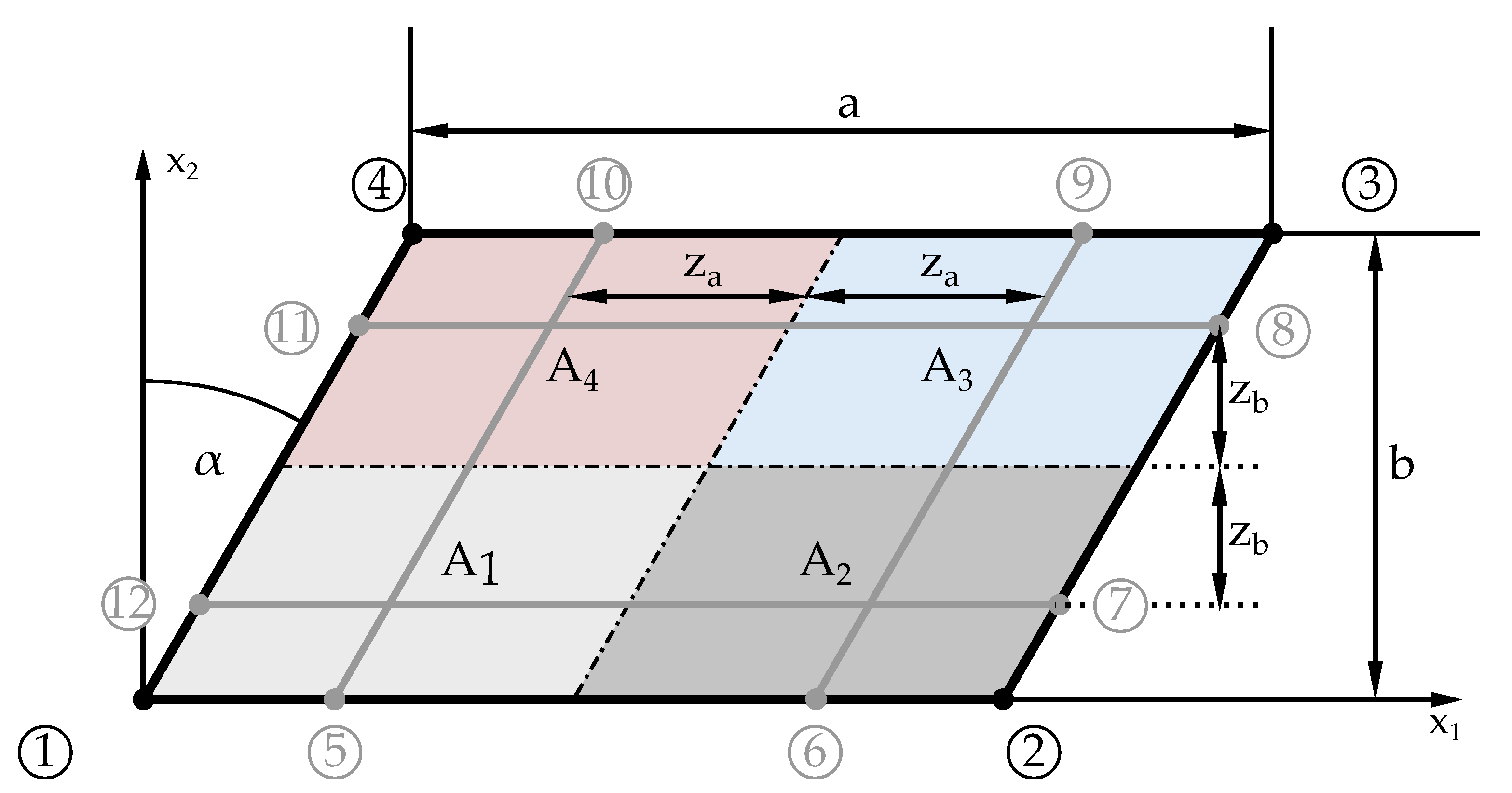
In this section, the implementation of the virtual stringers with an optimised position is described for a parallelogram shear panel with the thickness h. The four corner nodes of the panel are defined as outer nodes (①–④), whereas two additional inner nodes (⑤–⑫) are defined along each edge with respect to the calculated distance for stringer placement ξ = l i 2 z o p t 2 l i . The four stringers are then defined to connect the inner nodes, as seen in Figure 6.
The cross-sectional area of the virtual stringers is calculated by dividing the volume of the adjacent fields through the length of the stringers:
A 5 , 10 = h A 1 + A 4 l 5 , 10 A 6 , 9 = h A 2 + A 3 l 6 , 9 A 7 , 12 = h A 1 + A 2 l 7 , 12 A 5 , 11 = h A 3 + A 4 l 8 , 11 .
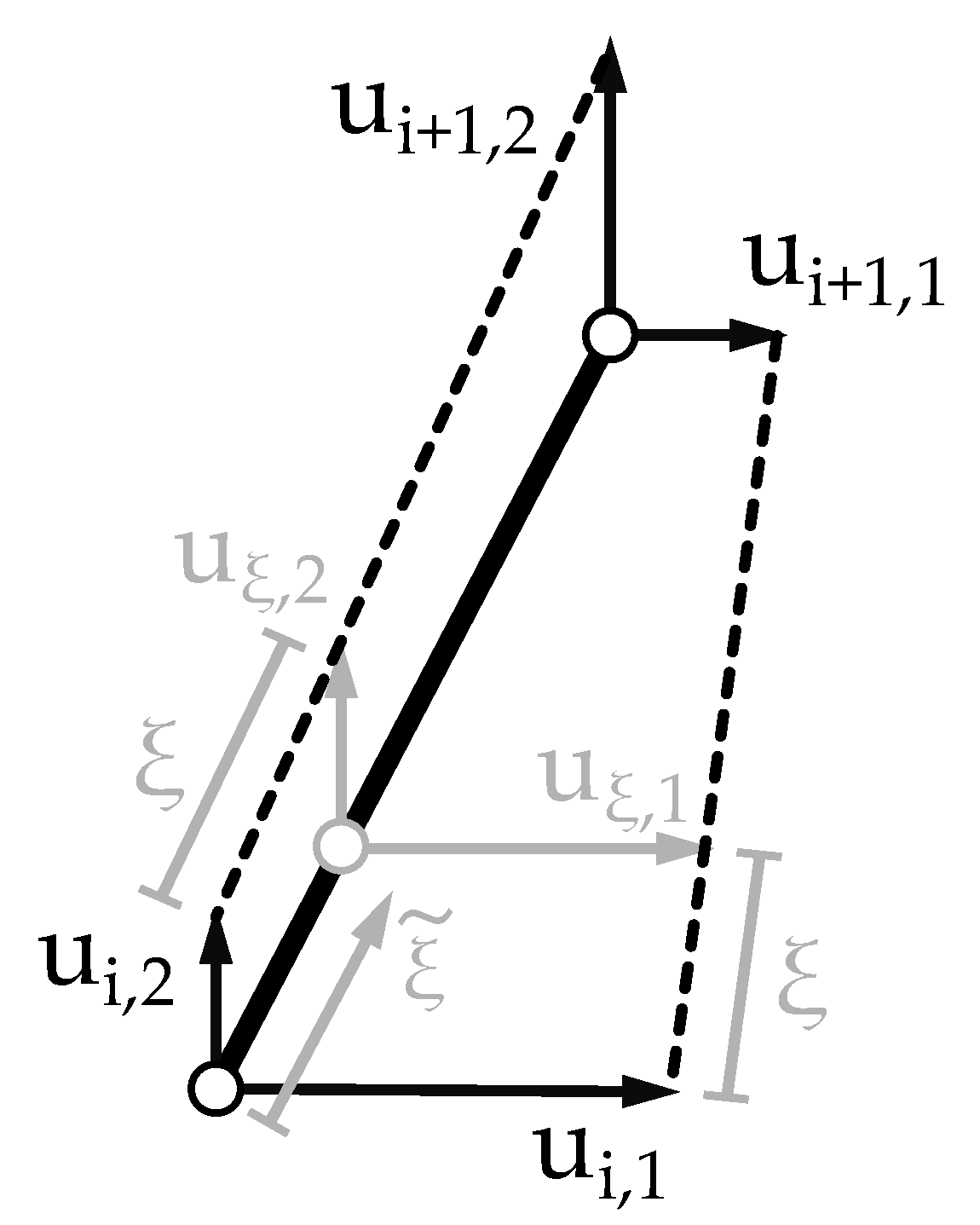
The inner nodes are kinematically coupled to the adjacent nodes of each edge (see Figure 7) with the following relationship:
u 5 , 1 = ( 1 ξ ) u 1 , 1 + ξ u 2 , 1 u 5 , 2 = ( 1 ξ ) u 1 , 2 + ξ u 2 , 2 u 6 , 1 = ξ u 1 , 1 + ( 1 ξ ) u 2 , 1 u 6 , 2 = ξ u 1 , 2 + ( 1 ξ ) u 2 , 2 u 7 , 1 = ( 1 ξ ) u 2 , 1 + ξ u 3 , 1 u 7 , 2 = ( 1 ξ ) u 2 , 2 + ξ u 3 , 2 u 8 , 1 = ξ u 2 , 1 + ( 1 ξ ) u 3 , 1 u 8 , 2 = ξ u 2 , 2 + ( 1 ξ ) u 3 , 2 u 9 , 1 = ( 1 ξ ) u 3 , 1 + ξ u 4 , 1 u 9 , 2 = ( 1 ξ ) u 3 , 2 + ξ u 4 , 2 u 10 , 1 = ξ u 3 , 1 + ( 1 ξ ) u 4 , 1 u 10 , 2 = ξ u 3 , 2 + ( 1 ξ ) u 4 , 2 u 11 , 1 = ( 1 ξ ) u 4 , 1 + ξ u 1 , 1 u 11 , 2 = ( 1 ξ ) u 4 , 2 + ξ u 1 , 2 u 12 , 1 = ξ u 4 , 1 + ( 1 ξ ) u 1 , 1 u 12 , 2 = ξ u 4 , 2 + ( 1 ξ ) u 1 , 2
A static reduction is applied to the element stiffness matrix of each stringer to condense the system to the outer master nodes following the procedure described in [27,28]. The reduction is exemplarily shown for stringer ⑤–⑩, given by
k g l o b , 5 , 10 = T 5 , 10 T k T r u s s , 5 , 10 T 5 , 10
with transformation matrix
T 5 , 10 = I 8 × 8 ( 1 ξ ) 0 ξ 0 0 0 0 0 0 ( 1 ξ ) 0 ξ 0 0 0 0 0 0 0 0 ξ 0 ( 1 ξ ) 0 0 0 0 0 0 ξ 0 ( 1 ξ ) , T 5 , 10 R 12 × 8 .
The stiffness matrix k of a the panel results in the sum of the stiffness matrices of the shear panel and the virtual stringers:
k = k S P T + i k i i [ 1 , 4 ]
The described kinematic coupling and static reduction ensure that the introduced virtual stiffeners contribute to the intended normal stiffness without overestimating in-plane bending stiffness while preserving the global degrees of freedom of the shear panel element.

3. Results

In this section, the Improved Shear Panel Theory (iSPT) for parallelogram-shaped panels is validated against a detailed FEM reference model and the state-of-the-art formulation (SPT-SOTA). The validation is first performed at element level using a single-panel benchmark. Subsequently, the improved stiffness smearing approach for panel normal stiffness is assessed on an unswept wing structure to isolate its influence on the global stiffness response. Finally, the shear panel formulation is evaluated for swept wing configurations to investigate its ability to reproduce bending–torsion coupling effects.

3.1. Single-Panel Validation of the Parallelogram Shear Panel Formulation

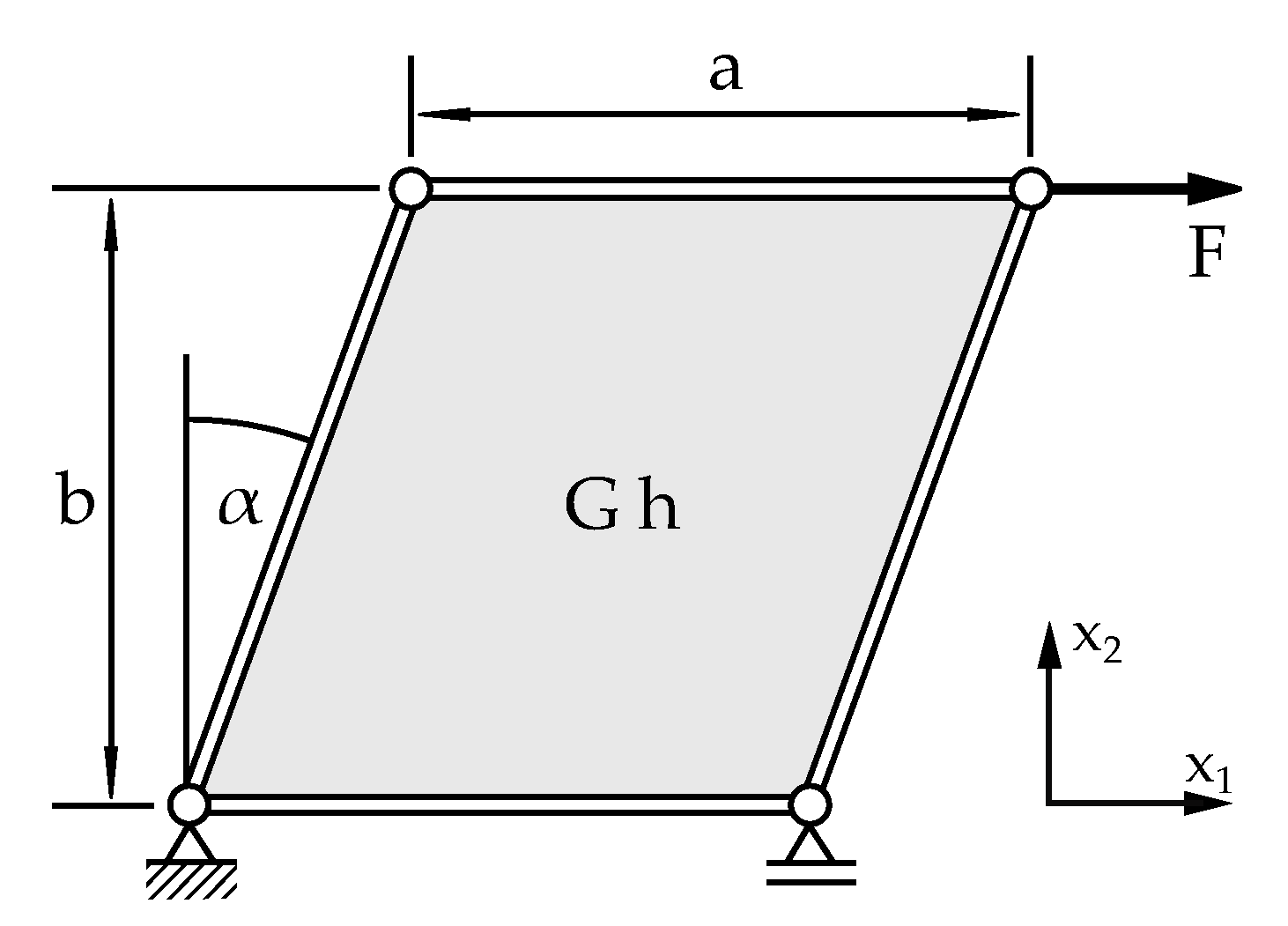
This benchmark is used to validate the iSPT formulation at the element level. Specifically, it assesses whether the derived stress state and stiffness response of a single parallelogram-shaped panel are consistent with a detailed FEM reference model when the surrounding stiffeners approach rigid behaviour. Baess and Schroeder [24] performed FEM parameter studies to investigate the stiffness behaviour and stress field of a parallelogram shear panel, as shown in Figure 8, and compared the results to the analytical solution of Garvey [20].
The shear panel formulation is considered valid if both the stiffness behaviour and the stress state are consistent with the FEM reference model. The relative difference in stiffness is calculated as follows:
k d i f f = k S P T k F E M k F E M .
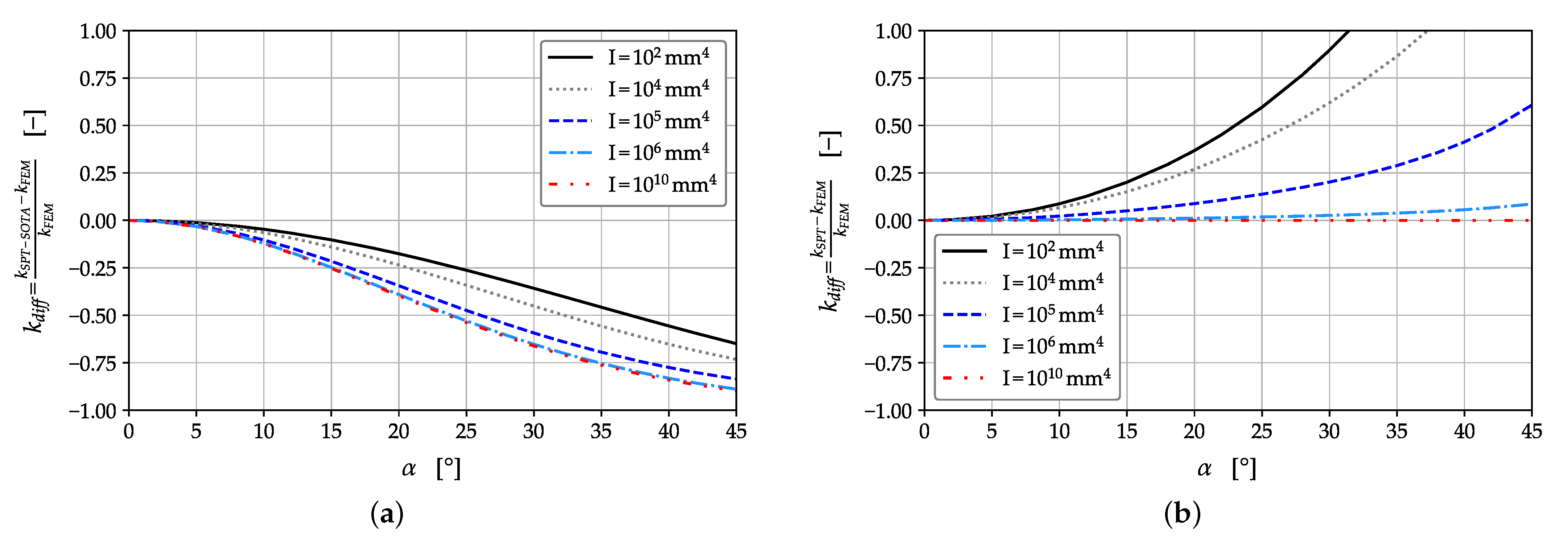
Figure 9 shows the relative difference in shear stiffness between the FEM reference model and the SPT-SOTA formulation (a) as well as the iSPT formulation (b). Baess and Schroeder [24] described a strong dependency of the second moment of area of the stiffeners on the stiffness and argued that adjacent panels would act as an infinite second moment of area, as observed in Wagner panels [29,30]. In contrast to the SPT-SOTA formulation, the difference in the stiffness k d i f f of the iSPT formulation converges to zero for increasing second moments of area. In addition, the reported stress components by Baess and Schroeder [24] for a large second moment of area match the stress ratios derived in Equation (31). The agreement observed for large second moments of area confirms that the iSPT reproduces both the correct stiffness behaviour and the derived stress state, thereby validating the underlying stress field assumptions introduced in Section 2.2.

3.2. Validation of Smearing Approach on Wingbox

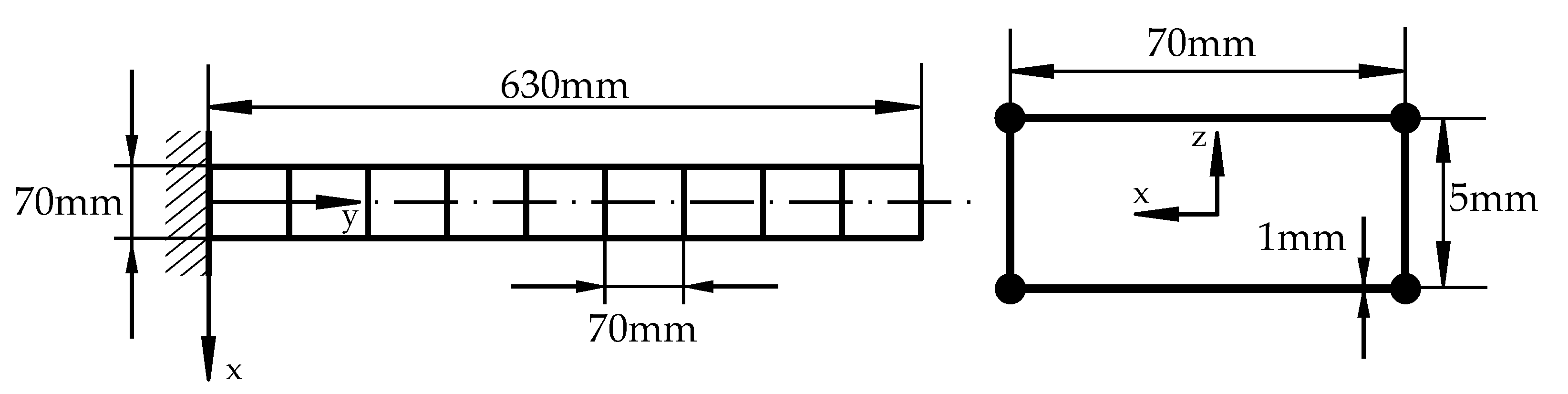
The improved smearing approach is validated through the structural analysis of a steel wingbox benchmark based on [10,11], shown in Figure 10. This benchmark isolates the influence of the smearing approach on the global structural response. The structure is made of steel with a Young’s modulus of E = 210 , 000 MPa , Poisson’s ratio of ν = 0.3 and density of ρ = 7.85 × 10 9 t / mm 3 . The skin thickness is h s k i n = 1 mm and the ten ribs have a thickness of h r i b = 0.5 mm . In addition, longitudinal stringers with parametrised cross-sectional area A are placed at the four corners of the box. Four models of the wingbox are investigated:
(i)
A detailed FEM model serving as reference (FEM);
(ii)
A coarse FEM model (FEM coarse);
(iii)
An SPT model using the state-of-the-art smearing approach (SPT + SOTA smearing);
(iv)
An SPT model using the improved smearing approach (SPT + improved smearing).
Figure 10. Model description of unswept wingbox based on [10,11].
Aerospace 13 00301 g010
The reference model is implemented in Abaqus (Abaqus/CAE 2024) using S4 shell elements and T3D2 truss elements. The mesh is generated with a global element size of 2.5 mm and ten elements along each edge in the z-direction to ensure mesh convergence. The coarse FEM model uses one element for each of the edges, which feature a reduced number of degrees of freedom to decrease computational cost. The shear panel models are represented by structural discretisation using the respective shear panel element and smearing approach for the skin and ribs. Moreover, a standard two-node truss element formulation is used to model the stringers and circumferential frames derived from the ribs and adjacent skin, by applying the smearing approach. Table 1 summarises the mesh parameters, the resulting number of elements and nodes and the total degrees of freedom of the respective models.
The translational degrees of freedom of all four corner nodes of the root section are constrained in all three models. Four load cases are applied to the models: two bending, one torsion and one modal. For the linear static bending load cases, a resulting tip load of Q = 1 N is applied at the four corner nodes in the x-direction respective in the z-direction. The average deflection and rotation of each cross-section are defined as
u x = 1 4 i = 1 4 u x , i , u z = 1 4 i = 1 4 u z , i , ϕ z = 1 4 i = 1 4 ϕ z , i .
The rotation ϕ x , i at corner node i is calculated using the change in orientation between the unloaded configuration (0) and the loaded configuration (1). Let r i , 0 and r i , 1 denote the 2D vectors (in the x–z plane) from the cross-section centre to corner node i in the unloaded and loaded states, respectively. The signed angle between these two vectors is then
ϕ x , i = a tan 2 r x , i , 0 r z , i , 1 r z , i , 0 r x , i , 1 , r x , i , 0 r x , i , 1 + r z , i , 0 r z , i , 1 .
The bending stiffness is then given by
k b , x = Q z / u z , k b , z = Q x / u x .
For the torsion load case, a torsional moment of T y = 1 Nmm is applied at the tip. This is done by applying concentrated forces. These forces are applied in the positive z-direction to the front spar corner nodes and in the negative z-direction to the rear spar corner nodes. The torsional stiffness is then defined as follows:
k t = T y / ϕ y .
In addition, the first five eigenfrequencies are computed for all models in order to assess the accuracy of the improved smearing approach and the chosen mass matrix. To access the quality of the modal shapes, the modal assurance criterion (MAC) [31] is used:
M A C i = ϕ i T ϕ F E M 2 ϕ i T ϕ i ϕ F E M T ϕ F E M ,
where ϕ i is the modal vector of the investigated model and ϕ F E M is the corresponding modal vector of the FEM reference model.
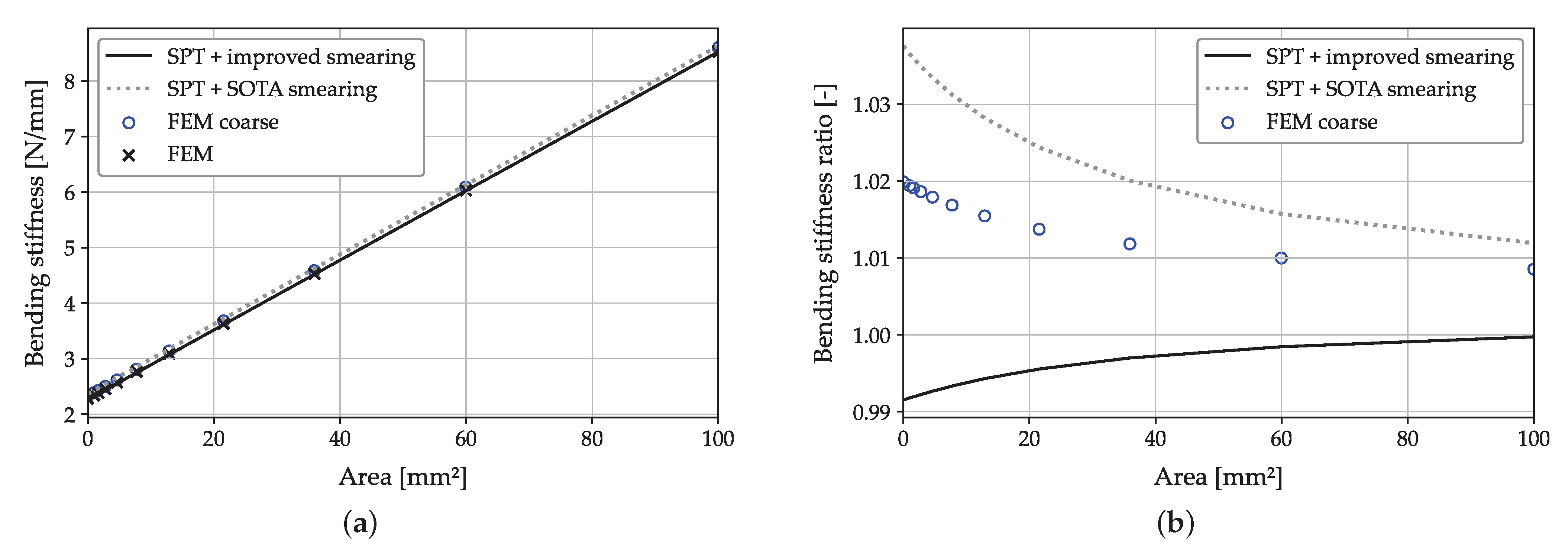
Figure 11a,b present the bending stiffness k b , x about the x-axis and the bending stiffness ratio k i / k F E M for varying stringer cross-sectional areas, respectively. As the Steiner contributions of the web may be considered small, both smearing approaches show good agreement with the FEM reference model across the full range of stringer sizes. However, the improved smearing method shows a smaller error than the SOTA smearing approach. The coarse FEM model yields results comparable to those of the SPT model with improved smearing but slightly overestimates the stiffness and shows a slower convergence toward unity.
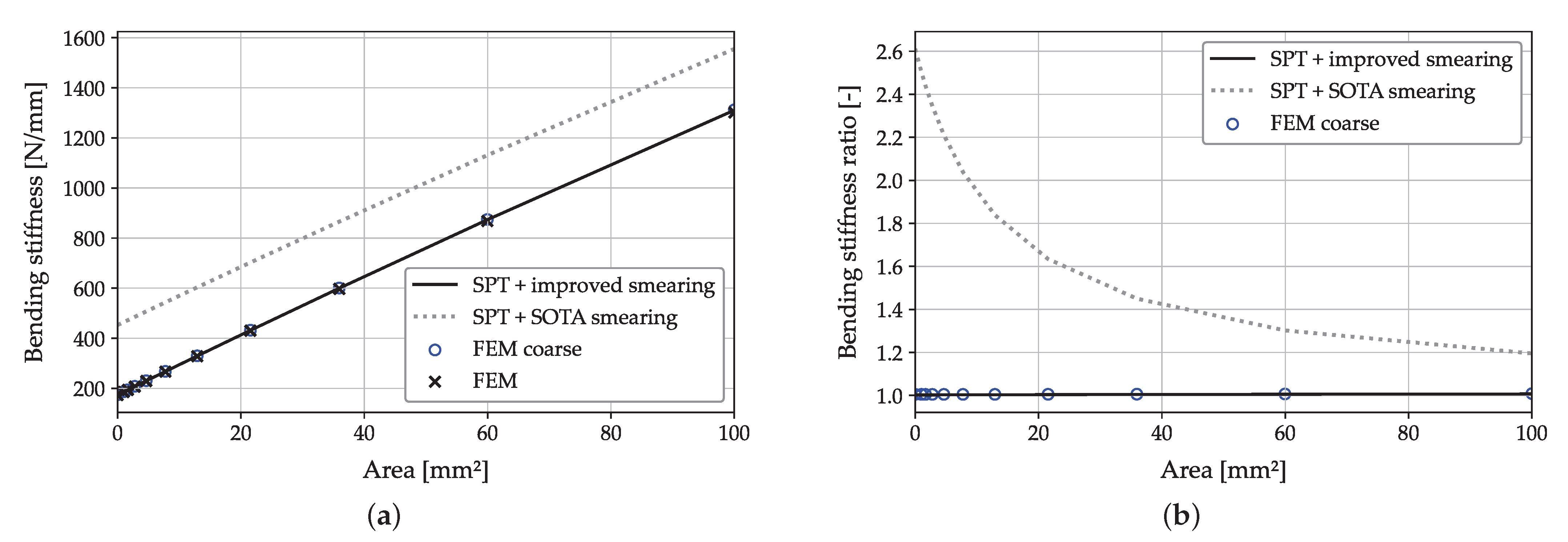
Figure 12a,b present the bending stiffness k b , z about the z-axis and the bending stiffness ratio k i / k F E M for varying stringer cross-sectional areas, respectively. In contrast to the bending stiffness around the x-axis, the SOTA smearing approach shows significant deviation in bending stiffness, overestimating the stiffness for the unstiffened case by a factor of 2.6 and converging only for large stiffeners. The improved smearing approach shows strong agreement with the FEM reference model across the full range of stringer sizes, indicating that the method captures the stiffness contribution of both small and large stiffeners effectively. This behaviour directly reflects the overestimation of in-plane bending stiffness inherent to the SOTA smearing approach, which is explicitly avoided in the improved smearing approach. The coarse FEM model yields similar results to the SPT with improved smearing.
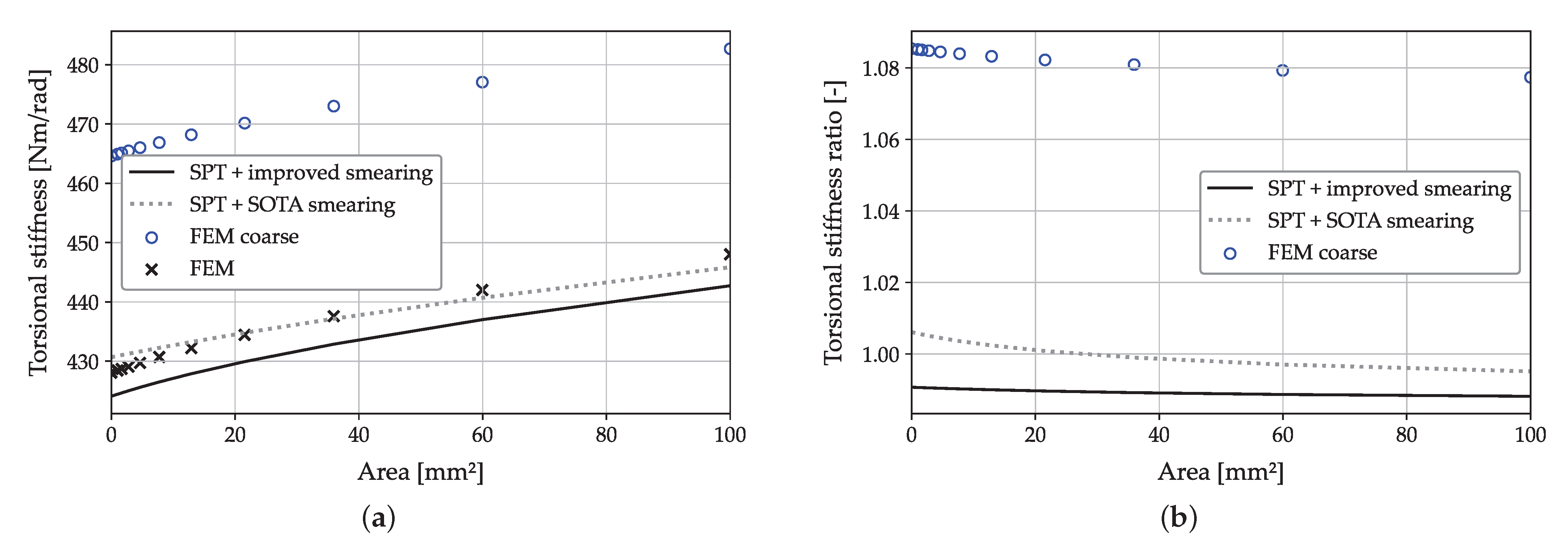
Figure 13a,b show the torsional stiffness k t and the torsional stiffness ratio k i / k F E M as a function of the stringers cross-sectional area. Both SPT modelling approaches predict nearly identical torsional behaviour compared to the FEM reference, including the effect of warping restriction, indicating that the torsional response of the structure is less sensitive to the specific smearing formulation. This can be explained by the fact that torsional rigidity is primarily governed by the shear flow of the closed section rather than the axial stiffness contribution of the individual stringers. The coarse FEM model, however, deviates by approximately 8% from the reference solution.
For modal analyses of SPT-based structures, an appropriate mass matrix formulation is required. In the present work, both a consistent and a lumped mass matrix are employed for the SPT elements in order to assess their influence on the dynamic response. The consistent mass matrix follows the standard finite element formulation for shell elements [25]. The lumped mass matrix is constructed by row-sum lumping of the consistent mass matrix
M e , i i lumped = j M e , i j consistent ,
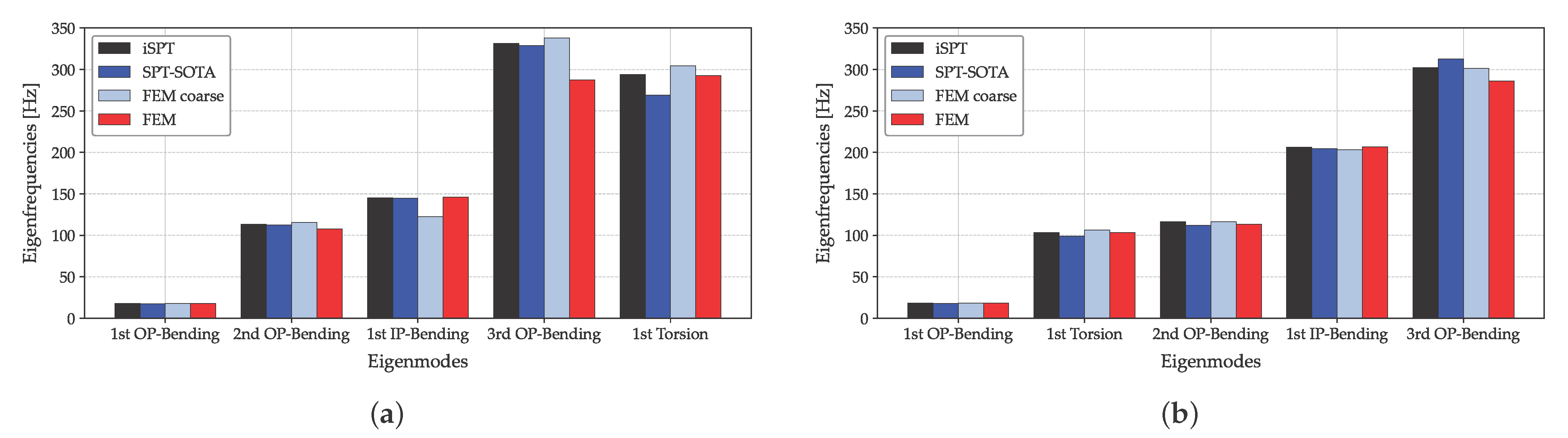
resulting in a diagonal element mass matrix. To assess the accuracy of the improved smearing approach in combination with the mass matrix formulation, the first five eigenfrequencies and corresponding eigenmodes are computed for all models. Two representative configurations with stringer cross-sectional areas of A = 0 mm 2 and A = 100 mm 2 are considered and compared to the FEM reference model in Figure 14.
Figure 14a presents the calculated eigenfrequencies for the unstiffened wingbox configuration. The improved smearing approach combined with a consistent mass matrix accurately reproduces the first four eigenmodes. A larger deviation of approximately 15 % is observed for the third out-of-plane bending mode, which can be attributed to the increased complexity of the mode shape relative to the limited number of degrees of freedom of the reduced-order model. Using the SOTA smearing approach yields comparable results for most eigenmodes, except for the in-plane bending mode, where the eigenfrequency is significantly overestimated. This behaviour is consistent with the stiffness overestimation observed in the static bending results discussed in Section 3.2. The use of a lumped mass matrix slightly reduces the bending eigenfrequencies but leads to a significant underestimation of the torsional eigenfrequency. This effect is caused by the increased rotational mass moment of inertia resulting from the concentration of mass at the corner nodes. The coarse FEM model yields a similar level of accuracy to the SPT model using the improved smearing approach and a consistent mass matrix.
Figure 14b shows the eigenfrequencies for the stiffened wingbox configuration. As in the previous case, combining the improved smearing approach with a consistent mass matrix accurately reproduces the first four eigenmodes. Compared to the unstiffened configuration, the deviation in the third out-of-plane bending mode is reduced but still significant, consistent with the static bending results discussed in Section 3.2. The lumped mass matrix still leads to a slight reduction in the predicted eigenfrequencies, but its impact is less pronounced than in the unstiffened case. The coarse FEM model again yields results comparable to those of the SPT model with improved smearing and a consistent mass matrix.
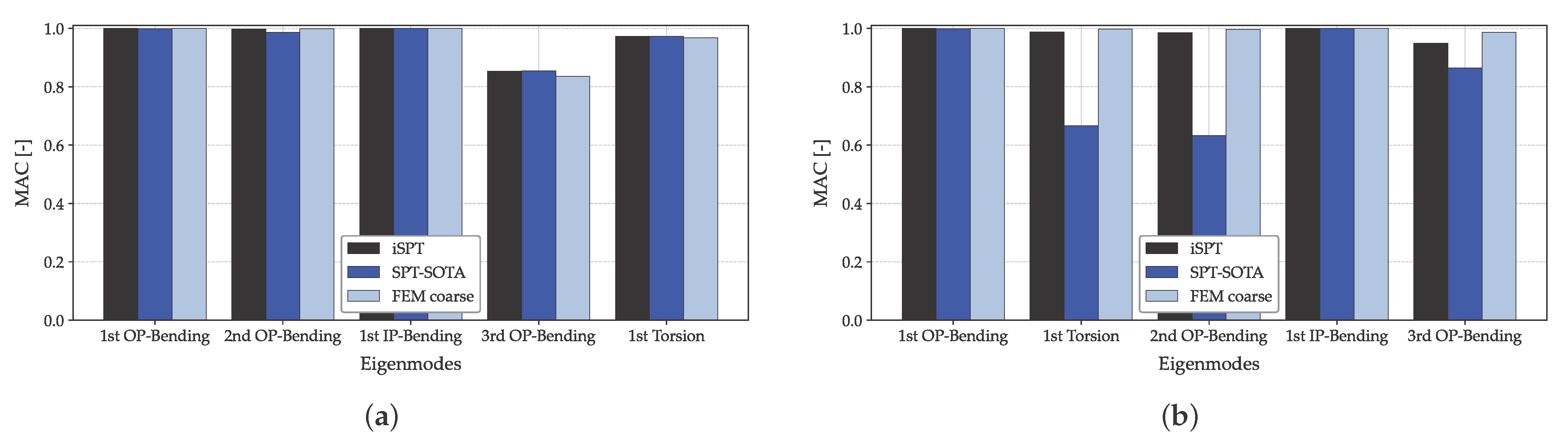
The MAC analysis indicates an excellent correlation between the eigenmodes of the reduced models and the FEM reference model. All MAC values exceed 0.987, confirming that the modal shapes are accurately reproduced. The lowest correlation is observed for the third out-of-plane bending mode, which can be attributed to the limited number of degrees of freedom in the reduced models.
In summary, the improved smearing approach provides more accurate eigenfrequency predictions than the SOTA smearing approach for both unstiffened and stiffened wingbox configurations. The coarse FEM model yields a similar level of accuracy to the SPT model using the improved smearing approach and a consistent mass matrix. The consistent mass matrix is particularly beneficial for unstiffened structures, while its influence diminishes as the contribution of stiffeners to the overall mass and stiffness increases.
Having demonstrated the accuracy of the improved smearing approach for unswept configurations, the following section evaluates the iSPT formulation on swept wing structures, where bending–torsion coupling becomes critical.

3.3. Validation of Proposed Parallelogram-Shaped Shear Panel Formulation on Wingbox

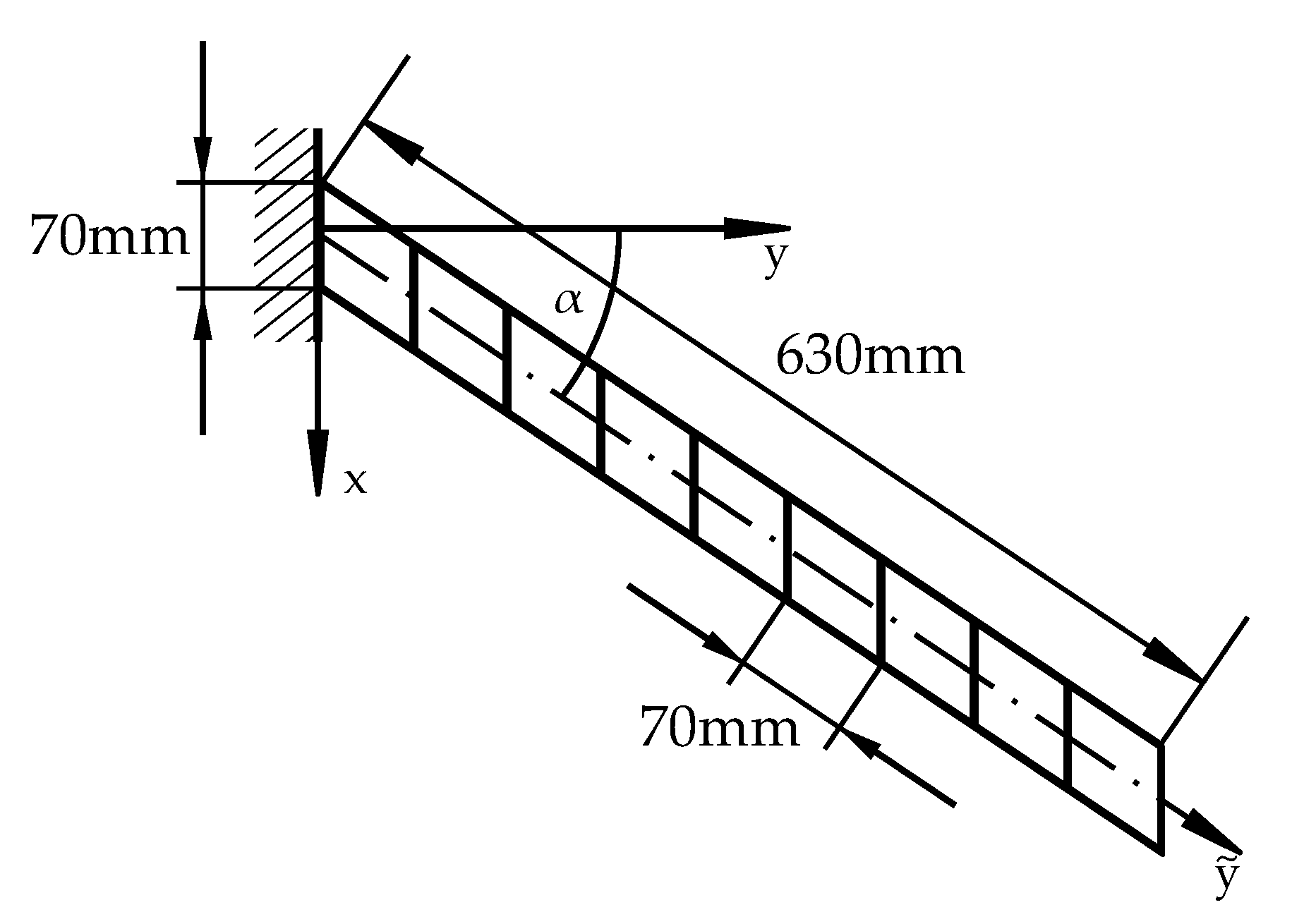
The Improved Shear Panel Theory (iSPT) for parallelogram-shaped panels is validated on the structural level using a swept wingbox geometry based on [10], shown in Figure 15. The swept wingbox benchmark is specifically chosen to assess whether the proposed formulation can reproduce the bending–torsion coupling effects that are known to occur in swept wing structures but are absent in state-of-the-art shear panel formulations (SPT-SOTA) [6].
The structural response calculated by the iSPT is compared against the SPT-SOTA, coarse FEM and a detailed FEM reference models. The shear panel models employ the improved smearing approach in combination with the respective SPT element formulation, whereas the FEM models follow the setup described in Section 3.2, with the sweep angle introduced as an additional parameter. In addition, the dynamic behaviour of the models is assessed through modal analysis, including a comparison of natural frequencies and modal assurance criterion (MAC) values. In contrast to the unswept wing benchmark, only two static load cases are considered for the swept wingbox: bending about the global x-axis and torsion about the y-axis. All evaluations are performed in the global coordinate system. Further details regarding model setup, load definition and evaluation procedures are provided in Section 3.2.
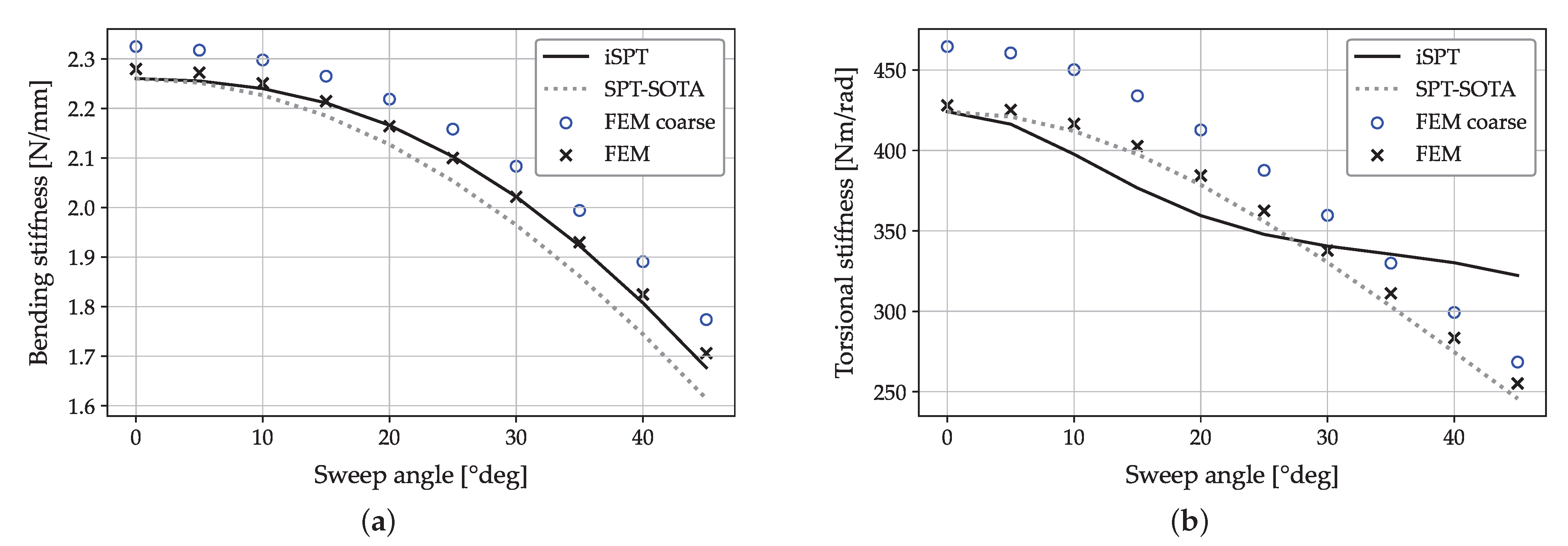
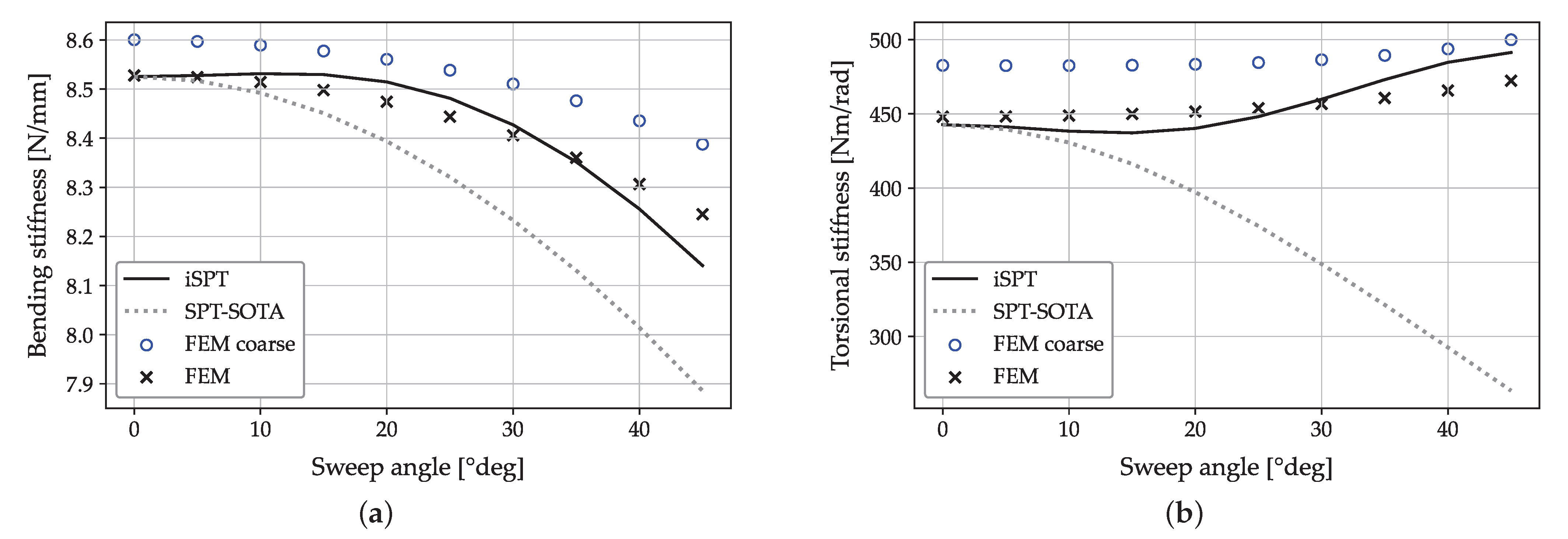
Figure 16, Figure 17 and Figure 18 present the bending stiffness k b , x and torsional stiffness k t as functions of sweep angle α for different stringer cross-sectional areas A. For the unstiffened wingbox configuration, shown in Figure 16a,b, both shear panel formulations accurately capture the bending stiffness across the full range of sweep angles, including the reduction in bending stiffness with increasing sweep. For torsion, the SPT-SOTA model shows slightly better agreement with the FEM reference solution, particularly at large sweep angles. However, it should be noted that the wing structure is not an SPT structure due to the absence of stiffeners, and therefore the panel can contract freely without introducing additional stress components. The coarse FEM model qualitatively follows the reference model for both bending and torsional stiffness but exhibits the largest deviation among the investigated models for sweep angles below 30 .
Figure 17a,b show the corresponding results for the stiffened configuration with A = 100 mm 2 . The iSPT model reproduces the bending stiffness over the whole range of sweep angles with a maximum deviation below 1.5 % , while the SPT-SOTA model shows a slightly larger deviation of approximately 4 % . In contrast, the torsional stiffness calculated by the SPT-SOTA model deviates significantly from both the FEM reference and the iSPT as it decreases with increasing sweep angle instead of increasing. The coarse FEM model shows good agreement in bending, with a maximum deviation of less than 2 % ; however, it exhibits a larger deviation of around 8 % in torsional stiffness.
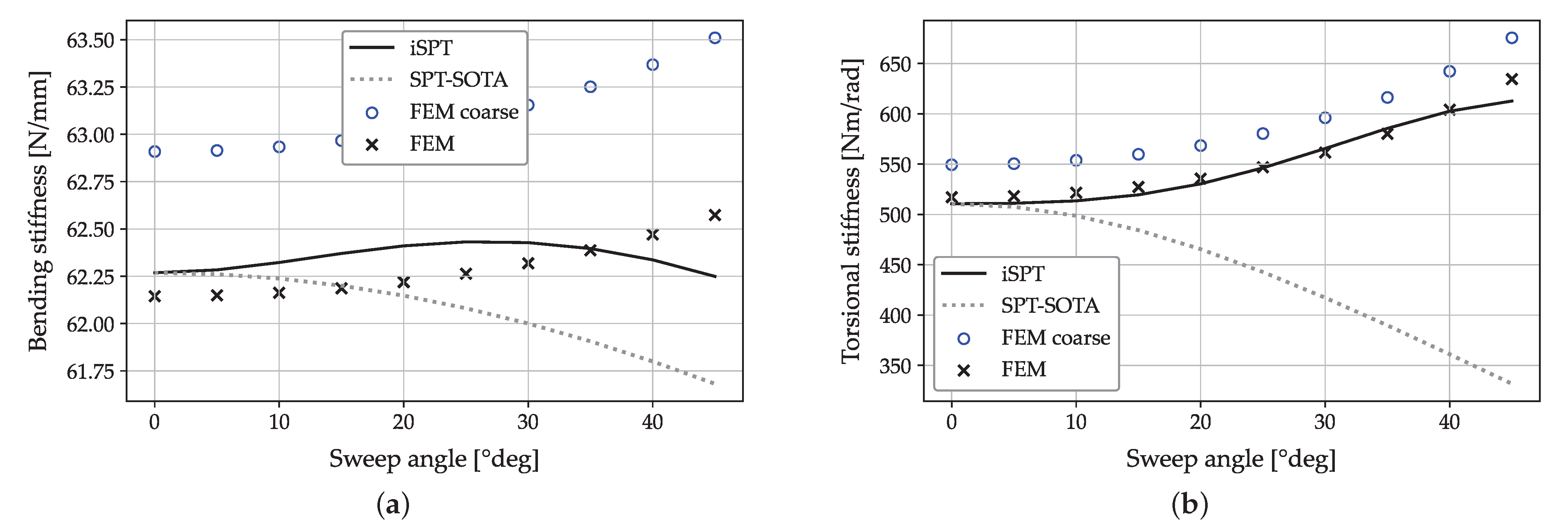
For very large stringer cross-sectional areas of A = 1000 mm 2 , shown in Figure 18a,b, the bending stiffness becomes largely insensitive to the sweep angle. The maximum deviation of the iSPT model remains below 1 % , while the SPT-SOTA model shows deviations slightly above 1 % . More importantly, the iSPT closely reproduces the torsional stiffness of the FEM reference, including its increase with sweep angle, whereas the SPT-SOTA model again exhibits a significant decrease in torsional stiffness. As in the previous cases, the coarse FEM model qualitatively follows the reference solution in both bending and torsion but shows larger deviations in torsional stiffness.
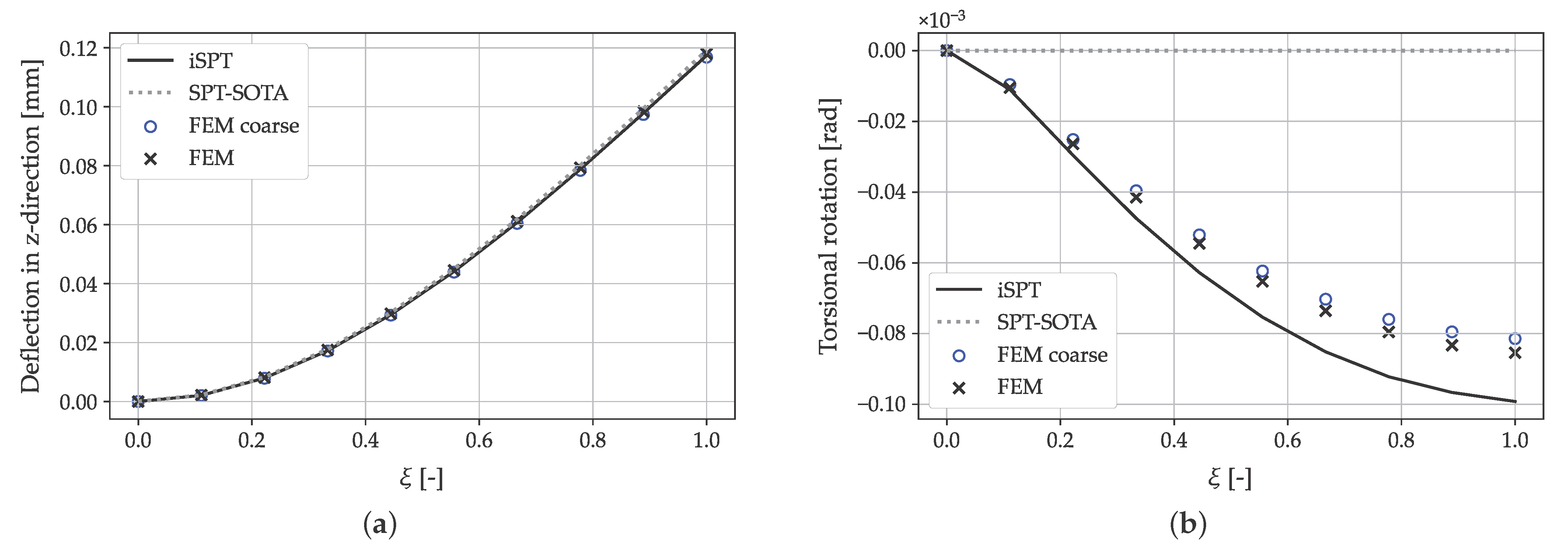
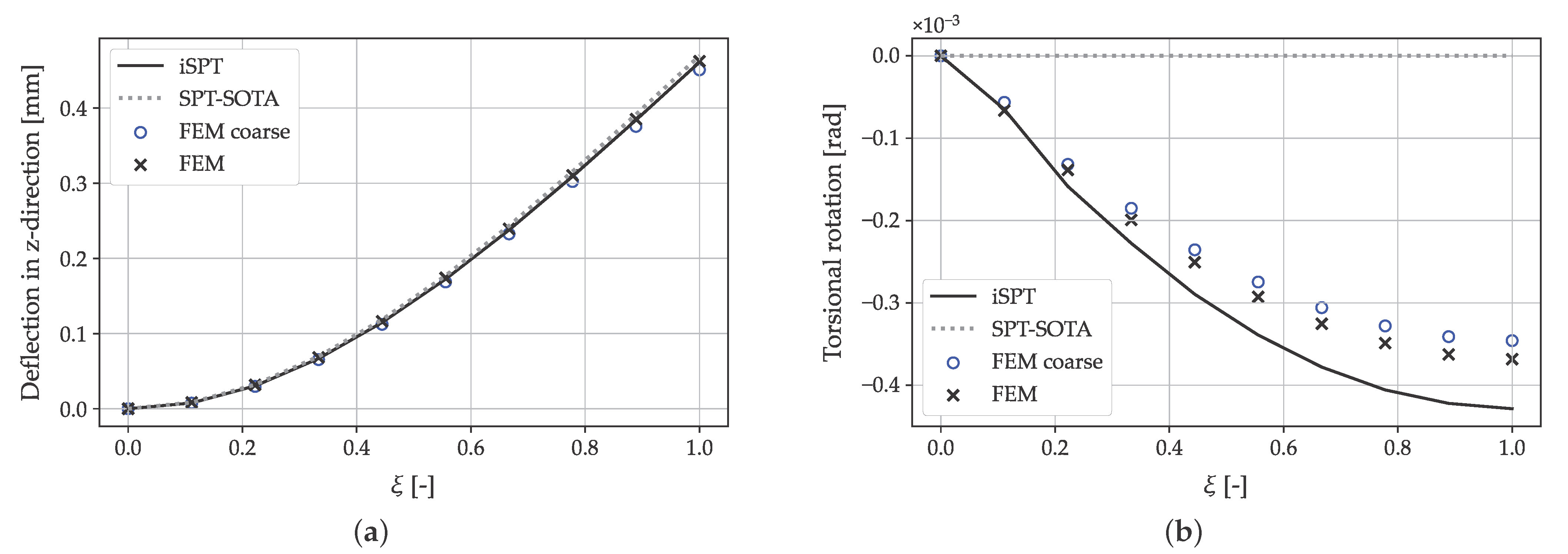
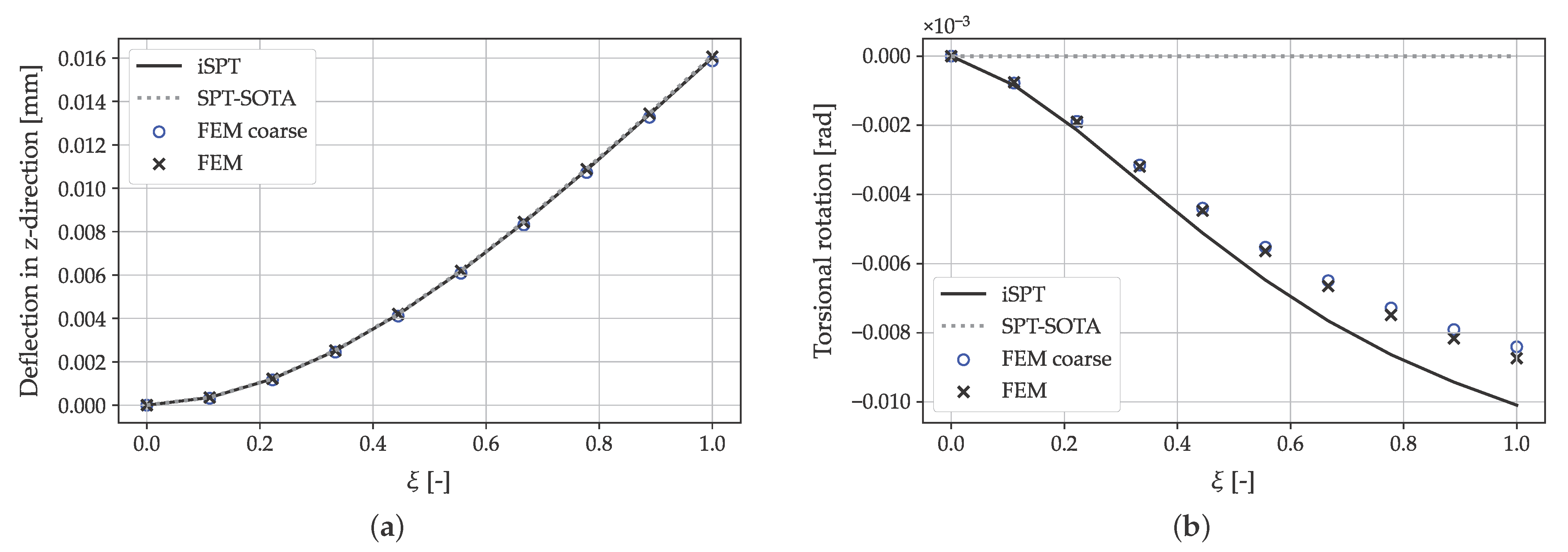
To further investigate bending–torsion coupling, several configurations subjected to bending load at a sweep angle of α = 20 are examined in Figure 19, Figure 20 and Figure 21. The bending deflection lines calculated by both shear panel models, shown in Figure 19a, Figure 20a and Figure 21a, are in close agreement with the FEM reference. Figure 19a, Figure 20a and Figure 21a show the torsional rotation induced by bending along the wing span. While the torsional rotation calculated by the iSPT qualitatively follows the FEM reference with maximum deviations below 15 % , the SPT-SOTA model shows no induced torsion. This directly reflects the missing coupling between normal and shear deformations inherent to the SPT-SOTA model and confirms the ability of the iSPT to capture stiffness coupling effects arising from sweep. The coarse FEM model shows good agreement with the reference solution in both bending deflection and torsional rotation, with a maximum deviation of approximately 6 % in torsional rotation. It should be emphasised that the torsional rotation of the wing cross-section is not strictly uniform because the cross-section may deform. Consequently, the evaluated error exhibits a certain spread depending on the location at which the rotation is measured and on the specific definition used for its calculation.
The following section examines the dynamic properties of the iSPT, SPT-SOTA, FEM coarse and FEM reference models. For the SPT formulations, consistent mass matrices are employed. The dynamic behaviour is assessed by comparing the natural frequencies and by evaluating the modal assurance criterion (MAC) for both an unstiffened wing and a stiffened wing.
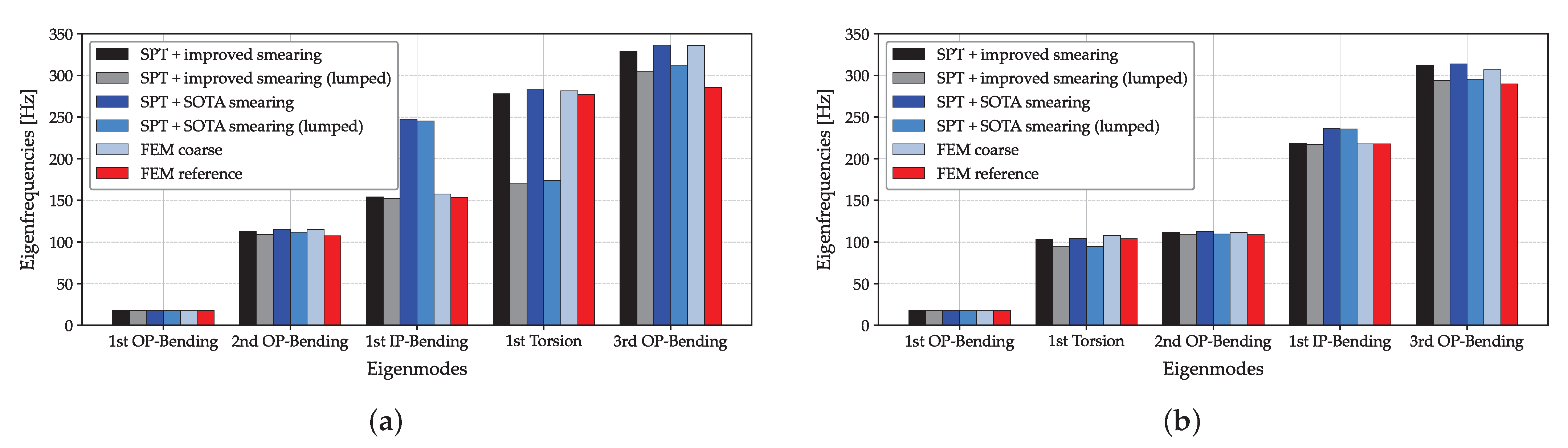
For the unstiffened case ( A = 0 , mm 2 ), the iSPT model shows the best agreement with the FEM reference solution in terms of natural frequencies (see Figure 22a). Only the frequency of the third out-of-plane bending mode is overestimated. The SPT-SOTA model exhibits similar behaviour but shows a larger deviation in the first torsional mode. The coarse FEM model provides comparable results. However, in addition to the deviation in the third bending mode observed for the iSPT, it also shows a larger discrepancy in the first in-plane bending mode.
The accuracy of the corresponding eigenmodes is evaluated using the MAC values (see Figure 23a). All models show high MAC values close to unity for most modes, indicating a good representation of the modal shapes. Only the third out-of-plane bending mode is reproduced less accurately, which can be attributed to the coarse structural resolution.
For the stiffened case ( A = 100 , mm 2 ), all reduced-order models show good agreement with the FEM reference solution in terms of natural frequencies (see Figure 22b). As in the unstiffened configuration, noticeable differences occur mainly for the third bending mode. In this case, both the iSPT and FEM coarse models slightly overestimate the corresponding frequency, while the SPT-SOTA model shows a larger deviation.
The MAC values for the stiffened configuration are shown in Figure 23b. Here, a clear difference between the models becomes visible. While the iSPT and coarse FEM models reproduce the modal shapes well, the SPT-SOTA model shows a reduced accuracy for the first torsional mode and the second out-of-plane bending mode. This behaviour can be attributed to the absence of bending–torsion coupling in the SPT-SOTA formulation.
Overall, the swept wingbox benchmark demonstrates that the iSPT model consistently captures bending–torsion coupling effects induced by sweep. While the SPT-SOTA model performs adequately for unswept configurations, it fails to reproduce these coupling effects in swept wing structures, in agreement with the observations of Gienke [6]. Across all investigated configurations, the iSPT closely matches the FEM reference while retaining a significantly reduced number of degrees of freedom. The coarse FEM model performs similarly to the iSPT in terms of bending stiffness prediction and shows superior results in representing the bending–torsion coupling; however, it is less accurate at predicting torsional stiffness than the iSPT model.


4. Discussion

The results demonstrate that the proposed improvements to shear panel theory address the two central limitations of the current state of the art: the overestimation of bending stiffness and the absence of coupling between normal and shear deformations. As a result, the proposed formulation provides a clear improvement over classical SPT approaches.
At the element level, the single-panel benchmark confirms that the iSPT reproduces the correct stiffness behaviour and stress state for parallelogram-shaped panels when the surrounding stiffeners approach rigid behaviour. In contrast to the SPT-SOTA formulation, the iSPT converges to the FEM reference solution with increasing stiffener second moment of area, which supports the validity of the modified stress assumptions. In addition, the formulation consistently reduces to the classical rectangular shear panel formulation for α = 0 , confirming its consistency with the established theory in the limiting case.
For the unswept wingbox, the improved smearing approach significantly enhances the prediction of both stiffness and dynamic properties and shows close agreement with the FEM reference solution. The largest benefit is observed for the in-plane bending response of the unstiffened configuration, where the SOTA smearing approach strongly overestimates the bending stiffness. The coarse FEM model performs at a similar level to the SPT model with improved smearing, although it shows a larger deviation in the torsional stiffness prediction. In the modal analysis, the improved smearing approach combined with a consistent mass matrix provides the most accurate eigenfrequency prediction and reproduces the mode shapes with very high MAC values. The remaining deviations are mainly limited to the higher out-of-plane bending mode, which can be attributed to the limited number of degrees of freedom of the reduced-order representation.
For the swept wingbox, the advantages of the Improved Shear Panel Theory become even more evident. While both shear panel formulations predict bending stiffness reasonably well, only the iSPT is able to reproduce the increase in torsional stiffness with sweep angle and the bending–torsion coupling observed in the FEM reference model. The SPT-SOTA formulation fails in these cases because it does not include the coupling between normal and shear deformation that arises in parallelogram-shaped swept panels. This deficiency is also visible in the response under bending load, where the SPT-SOTA model predicts no induced torsional rotation, whereas the iSPT captures the coupled deformation with good agreement to the FEM reference. The modal analysis of the swept wingbox further confirms this result. The iSPT yields the closest match in eigenfrequencies and modal shapes, while the SPT-SOTA model shows reduced accuracy, particularly for modes influenced by coupling effects. The coarse FEM model also reproduces the sweep effects qualitatively and, for several stiffness measures, yields errors comparable to those of the iSPT. In particular, it shows smaller errors for the bending-induced torsional rotation. However, across all investigated cases, the coarse FEM model is less accurate than the iSPT model in predicting torsional stiffness. The comparison therefore indicates that both reduced-order approaches are suitable for preliminary design studies, but that the iSPT provides a more consistent representation of the coupling mechanisms governing swept stiffened wing structures.
For the structures considered here, the iSPT and coarse FEM models perform comparably overall. Both require significantly less computational effort than the high-resolution reference FEM model because of their low number of degrees of freedom and are therefore suitable as reduced models for preliminary design applications. However, for more complex geometries, such as curved wing sections, dedicated SPT formulations may provide substantially better results than a coarse FEM model (see [19]). In this context, the iSPT contributes to establishing a consistent reduced-order theoretical framework for both unswept and swept stiffened structures.
The sensitivity of the formulation to geometric parameters should also be considered. The panel aspect ratio mainly influences the representation of higher-order deformation modes, particularly for unstiffened configurations where bending is dominant. The panel thickness primarily affects the relative importance of normal stiffness contributions. For very thin panels, the structural behaviour approaches the classical shear panel assumption where normal stiffness effects become negligible and the assumed stress field is well satisfied. With increasing thickness, however, the influence of normal stresses becomes more pronounced and the accuracy of simplified smearing approaches may decrease. Finally, the sweep angle directly affects the accuracy of shear panel formulations. As the angle increases, the coupling between normal and shear stresses becomes stronger, which may amplify modelling errors when the structural configuration deviates from the ideal assumptions of shear panel theory.
The iSPT is intended for reduced-order modelling in preliminary design. It assumes a constant stress field, linear-elastic isotropic material behaviour and small deformations. Consequently, it does not resolve local stress concentrations, local effects at cut-outs or junctions or post-buckling behaviour. Nevertheless, the proposed formulation is not inherently limited to isotropic materials. In principle, the panel constitutive relation could be extended by introducing an orthotropic in-plane stiffness matrix representing composite laminates, as proposed in [22]. In such a case, the coupling between shear and normal stresses would depend on the anisotropic stiffness components of the laminate. However, the present kinematic assumptions would likely no longer be sufficient, and additional boundary conditions associated with the second stiffener direction would need to be considered. A detailed investigation of orthotropic material systems is therefore left for future work. An extension to general quadrilateral panels is not straightforward. The present derivation is based on the assumption of a constant stress field, which is compatible with rectangular and parallelogram-shaped panels. For general quadrilaterals, the stress state is expected to become significantly more complex and would likely require additional kinematic assumptions and boundary conditions.

5. Conclusions

A revised shear panel formulation for parallelogram-shaped panels has been developed that resolves the inconsistency in classical shear panel approaches. By enforcing compatibility between panels and surrounding stiffeners, the proposed formulation introduces the necessary coupling between normal and shear stresses required to represent bending–torsion interaction in swept wing structures. In contrast to state-of-the-art formulations, which suppress this coupling and may predict non-physical torsional trends with increasing sweep angle, the proposed iSPT model consistently reproduces the stiffness behaviour observed in detailed FEM reference models. The formulation reduces to the classical rectangular shear panel case for zero sweep angle, ensuring consistency. In addition, an analytically derived smearing approach for consideration of panel normal stiffness has been introduced that eliminates the overestimation of in-plane bending stiffness caused by conventional virtual stiffener placement. This improved smearing approach therefore maintains the computational efficiency required for reduced-order modelling. The proposed iSPT therefore extends the applicability of shear panel theory from unswept to swept stiffened wing structures while retaining the computational efficiency required for use in hierarchical and aeroelastic preliminary design frameworks. Future work may focus on extending the formulation to additional panel geometries relevant to aircraft structures, such as trapezoidal panels arising in tapered wing configurations. Furthermore, experimental validation of reduced-order shear panel models through static and modal testing of representative wingbox structures could provide additional insight into the practical applicability of the proposed approach and the SPT in general.

Author Contributions

Conceptualisation, M.B. and K.-U.S.; methodology, M.B. and K.-U.S.; software, M.B.; validation, M.B.; formal analysis, M.B.; investigation, M.B. and K.-U.S.; resources, K.-U.S.; data curation, M.B.; writing—original draft preparation, M.B.; writing—review and editing, M.B. and K.-U.S.; visualisation, M.B.; supervision, K.-U.S.; project administration, K.-U.S.; funding acquisition, K.-U.S. All authors have read and agreed to the published version of the manuscript.

Funding

The work in this paper was realised in the course of the federal aviation research programme LuFo VI., 3rd call, funded by the Federal Ministry of Economic Affairs and Climate Action (Bundesministerium für Wirtschaft und Klimaschutz) of the German government under the funding code 20E2231.

Data Availability Statement

Data are contained within the article.

Conflicts of Interest

The authors declare no conflicts of interest.

Abbreviations

The following abbreviations are used in this manuscript:
anaAnalytical
CADComputer-Aided Design
FEMFinite Element Method
SOTAState-of-the-Art
SPTShear Panel Theory
iSPTImproved Shear Panel Theory

References

  1. Parolin, G.; Borges, A.T.; Santos, L.C.; Borille, A.V. A tool for aircraft eco-design based on streamlined Life Cycle Assessment and Uncertainty Analysis. Procedia CIRP 2021, 98, 565–570. [Google Scholar] [CrossRef]
  2. Lyssakow, P.; Krause, M.; Friedrich, L.; Schröder, K.-U. Towards a coupled structural and economical design procedure of unstiffened isotropic shell structures. Thin-Walled Struct. 2019, 145, 106416. [Google Scholar] [CrossRef]
  3. Lyssakow, P.; Yang, J.; Krause, M.; Schröder, K.-U. Analysis of mass and cost drivers of unstiffened isotropic shell structures considering their imperfection sensitivity. Thin-Walled Struct. 2021, 159, 107221. [Google Scholar] [CrossRef]
  4. Richstein, R.; Schröder, K.-U. Characterizing the Digital Twin in Structural Mechanics. Designs 2024, 8, 8. [Google Scholar] [CrossRef]
  5. Roudbarian, N.; Isfahani, A.; Kettenhofen, L.; Schröder, K.-U. Model-Based Systems Engineering for Sustainable Modular Design: Integrating Design, Manufacturing Operations, and Component Functionality. In Proceedings of the 2025 IEEE Conference on Technologies for Sustainability (SusTech), Los Angeles, CA, USA; IEEE: Piscataway, NJ, USA, 2025; pp. 1–8. [Google Scholar] [CrossRef]
  6. Gienke, E. Über die Berechnung von Flugkonstruktionen. Jahrb. WGLR 1964, 94–108. [Google Scholar]
  7. Malcolm, D.J.; Laird, D.L. Extraction of Equivalent Beam Properties from Blade Models. Wind Energy 2007, 10, 135–157. [Google Scholar] [CrossRef]
  8. Ibrahim, H.S.; Harmin, M.Y.; Romli, F.I.; Mohd Harithuddin, A.S. Investigation of Equivalent Reduced Order Models for Flutter Analysis of Various Wing Plate Configurations. J. Aeronaut. Astronaut. Aviat. 2025, 57, 801–814. [Google Scholar] [CrossRef]
  9. Ritter, M.; Cesnik, C.E.S.; Krüger, W. An Enhanced Modal Approach for Large Deformation Modeling of Wing-Like Structures. In Proceedings of the 56th AIAA/ASCE/AHS/ASC Structures, Structural Dynamics, and Materials Conference; American Institute of Aeronautics and Astronautics: Reston, VA, USA, 2015. [Google Scholar] [CrossRef]
  10. Romli, A.I.; Harmin, M.Y.; Ujang, M.S.O. Parametric Study on the Flutter Characteristics of a Simple Rectangular Wing-Box Model with Varying Ribs Orientation. Int. J. Pure Appl. Math. 2018, 119, 3771–3777. [Google Scholar]
  11. Chan, Y.N.; Harmin, M.Y.; Othman, M.S. Parametric Study of Varying Ribs Orientation and Sweep Angle of Un-Tapered Wing Box Model. Int. J. Eng. Technol. 2018, 7, 155–159. [Google Scholar] [CrossRef]
  12. Mittelstedt, C.; Schröder, K.-U. Local postbuckling of hat-stringer-stiffened composite laminated plates under transverse compression. Compos. Struct. 2010, 92, 2830–2844. [Google Scholar] [CrossRef]
  13. Mittelstedt, C.; Erdmann, H.; Schröder, K.-U. Postbuckling of imperfect rectangular composite plates under inplane shear closed-form approximate solutions. Arch. Appl. Mech. 2011, 81, 1409–1426. [Google Scholar] [CrossRef]
  14. Kurrer, K.-E. The History of the Theory of Structures: From Arch Analysis to Computational Mechanics; Ernst: Berlin, Germany, 2008. [Google Scholar]
  15. Mittelstedt, C. Structural Mechanics in Lightweight Engineering; Springer: Cham, Switzerland, 2021. [Google Scholar]
  16. Dieker, S.; Reimerdes, H.G. Elementare Festigkeitslehre im Leichtbau; Donat Verlag: Bremen, Germany, 1992. [Google Scholar]
  17. Gienke, E. Über die Erweiterung des Schubfeldschemas. Jahrb. WGLR 1962, 1962, 413–421. [Google Scholar]
  18. Bäß, M.; Schröder, K.-U. Simply Curved Shear Panel Theory in Three-Dimensional Space. Aerospace 2026, 13, 26. [Google Scholar] [CrossRef]
  19. Bäß, M.; Kettenhofen, L.; Schröder, K.-U. Curved Shear Panel Theory as an Enabler for Gradient-Based Wing Optimization. Eng. Proc. 2026. accepted. [Google Scholar]
  20. Garvey, S.J. The Quadrilateral ‘Shear’ Panel: The Peculiar Stressing Problems Arising in the Structure of the Non-Rectangular Swept Wing. Aircr. Eng. Aerosp. Technol. 1951, 23, 134–144. [Google Scholar] [CrossRef]
  21. Hoogenboom, P.C.J.; Blaauwendraad, J. Quadrilateral shear panel. Eng. Struct. 2000, 22, 1690–1698. [Google Scholar] [CrossRef]
  22. Curtis, H.D.; Greiner, G.P. A stress-based quadrilateral shear panel. Finite Elem. Anal. Des. 1996, 21, 159–178. [Google Scholar] [CrossRef]
  23. Chen, H.C. A simple quadrilateral shear panel element. Commun. Appl. Numer. Methods 1992, 8, 1–7. [Google Scholar] [CrossRef]
  24. Bäß, M.; Schröder, K.-U. Validity of the Shear Panel Theory as a Reduced Modelling Approach. Eng. Proc. 2025, 90, 23. [Google Scholar] [CrossRef]
  25. Zienkiewicz, O.C.; Taylor, R.L.; Govindjee, S. The Finite Element Method: Its Basis and Fundamentals, 8th ed.; Butterworth-Heinemann: London, UK, 2025. [Google Scholar]
  26. Robinson, J. Integrated Theory of Finite Element Methods; Wiley-Interscience: London, UK, 1973. [Google Scholar]
  27. Bathe, K.-J. Finite Element Procedures; Prentice Hall: Upper Saddle River, NJ, USA, 1996. [Google Scholar]
  28. Felippa, C.A. Introduction to Finite Element Methods; Lecture Notes; Department of Aerospace Engineering Sciences, University of Colorado at Boulder: Boulder, CO, USA, 2004. [Google Scholar]
  29. Wagner, H. Ebene Blechwandträger mit sehr dünnem Stegblech. Z. Flugtech. Mot. 1929, 20, 306–314. [Google Scholar]
  30. Kuhn, P.; Peterson, J.P.; Levin, L.R. A Summary of Diagonal Tension—Part I: Methods and Analysis; NACA TN 2661; National Advisory Committee for Aeronautics: Washington, DC, USA, 1952. [Google Scholar]
  31. Pastor, M.; Binda, M.; Harčarik, T. Modal assurance criterion. Procedia Eng. 2012, 48, 543–548. [Google Scholar] [CrossRef]
Figure 1. Elastic behaviour of rectangular and parallelogram-shaped structural elements, taken from [6]. (a) Definition of section forces on rectangular element; (b) definition of section forces on parallelogram-shaped element; (c) elastic behaviour of rectangular panels; (d) elastic behaviour of parallelogram-shaped panels.
Aerospace 13 00301 g001
Figure 2. Resulting surface traction loads t t , i and t n , i for (a) the state-of-the-art stress field (SPT-SOTA) and (b) the stress field of the Improved Shear Panel Theory (iSPT). In contrast to the SPT-SOTA, the postulation of pure shear traction at the panel edges is omitted.
Aerospace 13 00301 g002
Figure 3. Definition of parallelogram-shaped shear panel for FEM derivation. Aerospace 13 00301 i001 to Aerospace 13 00301 i002 indicate the node numbering.
Aerospace 13 00301 g003
Figure 4. Discretisation of a single web with SOTA smearing and the improved smearing approach (right). Dotted lines indicate the relative distance to the center of the stiffeners.
Aerospace 13 00301 g004
Figure 5. Ratio between the analytically computed in-plane second moments of area and those obtained using the SOTA smearing approach for a single-web structure, parametrised by the number of elements used in the discretisation.
Aerospace 13 00301 g005
Figure 6. Definition of outer (black) and inner nodes (grey) and optimal positioning z a and z b of virtual stiffeners inside a parallelogram-shaped shear panel. Colored regions A 1 A 4 indicate the area of the adjacent fields.
Aerospace 13 00301 g006
Figure 7. Kinematic coupling of an inner node to the adjacent outer nodes.
Aerospace 13 00301 g007
Figure 8. Parameter study of the parallelogram panel, taken from [24].
Aerospace 13 00301 g008
Figure 9. Comparison of the stiffness difference between analytical and reference solutions. Influence of angle and second moment of area on the stiffness difference of the (a) SPT-SOTA formulation [24] and (b) iSPT formulation. In the models, panel dimensions a = 100 mm and b = 100 mm and a thickness h = 1 mm and stiffener cross-sectional area of A = 10 8 mm 2 are used. An isotropic material with E = 210 , 000 MPa and ν = 0.3 is assumed.
Aerospace 13 00301 g009
Figure 11. Out-of-plane bending stiffness (a) of the FEM models and the SPT models with improved and SOTA smearing approaches as well as the bending stiffness ratios (b) for varying sizes of stringer cross-sectional areas.
Aerospace 13 00301 g011
Figure 12. In-plane bending stiffness (a) of the FEM models and the SPT models with the improved and SOTA smearing approaches as well as the bending stiffness ratios (b) for varying sizes of stringer cross-sectional areas.
Aerospace 13 00301 g012
Figure 13. Torsional stiffness (a) of the FEM models and the SPT models with the improved and SOTA smearing approaches as well as the bending stiffness ratios (b) for varying sizes of stringer cross-sectional areas.
Aerospace 13 00301 g013
Figure 14. Eigenfrequencies and eigenmodes of the unswept wing models with stiffeners with a cross-sectional area of (a) A = 0 mm 2 and (b) A = 100 mm 2 , comparing the smearing approach and mass matrix formulation to the FEM reference. IP-Bending (in-plane) describes the bending mode around the z-axis, while OP-Bending (out-of-plane) describes the bending mode around the x-axis.
Aerospace 13 00301 g014
Figure 15. Model description of the swept wingbox based on [10,11].
Aerospace 13 00301 g015
Figure 16. Bending stiffness about x-axis (a) and torsional stiffness about y-axis (b) of iSPT, SPT-SOTA, FEM coarse and FEM reference models for a cross-sectional area of A = 0 mm 2 and varying sweep angle.
Aerospace 13 00301 g016
Figure 17. Bending stiffness about x-axis (a) and torsional stiffness about y-axis (b) of iSPT, SPT-SOTA, FEM coarse and FEM reference models for a cross-sectional area of A = 100 mm 2 and varying sweep angle.
Aerospace 13 00301 g017
Figure 18. Bending stiffness about x-axis (a) and torsional stiffness about y-axis (b) of iSPT, SPT-SOTA, FEM coarse and FEM reference models for a cross-sectional area of A = 1000 mm 2 and varying sweep angle.
Aerospace 13 00301 g018
Figure 19. Deflection in z-direction (a) and torsional rotation about y-axis (b) of the iSPT, SPT-SOTA, FEM coarse and FEM reference models for tip unit load in the z-direction along the wing span for a cross-sectional area of the stiffeners A = 0 mm 2 .
Aerospace 13 00301 g019
Figure 20. Deflection in z-direction (a) and torsional rotation about y-axis (b) of the iSPT, SPT-SOTA, FEM coarse and FEM reference models for tip unit load in the z-direction along the wing span for a cross-sectional area of the stiffeners A = 100 mm 2 .
Aerospace 13 00301 g020
Figure 21. Deflection in z-direction (a) and torsional rotation about y-axis (b) of the iSPT, SPT-SOTA, FEM coarse and FEM reference models for tip unit load in the z-direction along the wing span for a cross-sectional area of the stiffeners A = 1000 mm 2 .
Aerospace 13 00301 g021
Figure 22. Eigenfrequencies and eigenmodes of the 20 swept wing models with stiffeners with a cross-sectional area of (a) A = 0 mm 2 and (b) A = 100 mm 2 , comparing SPT formulations and the coarse FEM model to the FEM reference. IP-Bending (in-plane) describes the bending mode around the z-axis, while OP-Bending (out-of-plane) describes the bending mode around the x-axis.
Aerospace 13 00301 g022
Figure 23. MAC values of the 20 swept wing models with stiffeners with a cross-sectional area of (a) A = 0 mm 2 and (b) A = 100 mm 2 , comparing SPT formulations and the coarse FEM model to the FEM reference. IP-Bending (in-plane) describes the bending mode around the z-axis, while OP-Bending (out-of-plane) describes the bending mode around the x-axis.
Aerospace 13 00301 g023
Table 1. Definition of the investigated models and their mesh parameters.
ModelApprox. Global Element Size [mm]Number of Elements in z-DirectionNumber of ElementsNumber of NodesDegrees of Freedom
FEM2.51022,96021,65864,974
FEM coarse7018240240
SPT + SOTA smearing12240120
SPT + improved smearing8240120
Disclaimer/Publisher’s Note: The statements, opinions and data contained in all publications are solely those of the individual author(s) and contributor(s) and not of MDPI and/or the editor(s). MDPI and/or the editor(s) disclaim responsibility for any injury to people or property resulting from any ideas, methods, instructions or products referred to in the content.