
Article

Concept of Composite Folded Core Skin Heat Exchanger with Experimental Investigation of Surface Temperatures Using Temperature-Sensitive Paints

1
Institute of Aerospace Thermodynamics, Faculty of Aerospace Engineering and Geodesy, University of Stuttgart, 70569 Stuttgart, Germany
2
Institute of Aircraft Design, Faculty of Aerospace Engineering and Geodesy, University of Stuttgart, 70569 Stuttgart, Germany
*
Author to whom correspondence should be addressed.
Aerospace 2026, 13(3), 246; https://doi.org/10.3390/aerospace13030246
Submission received: 3 February 2026 / Revised: 28 February 2026 / Accepted: 2 March 2026 / Published: 6 March 2026

Abstract

With the increasing integration of low-temperature waste heat systems in aviation, large areas are needed for heat dissipation without causing significant pressure losses. Large-area skin heat exchangers (SHXs) are coming into focus as a possible solution. SHXs based on composite materials offer a promising approach due to their weight-saving potential. This article presents a structure-integrated SHX with a folded core using modern materials and design strategies. An analytical 1D heat transfer model, validated by measurements with temperature-sensitive paints (TSPs), was derived to efficiently identify the optimal parameter set in the design process of an SHX. The model focuses on transverse heat conduction effects in the facesheet for lateral heat distribution and uses these specifically for the overall mass-optimized configuration of the SHX. It is shown that with an optimally selected distance between the cooling channels in the case considered here, up to 12% more energy can be dissipated in relation to the total mass of the SHX. This article concludes with a sensitivity analysis of the analytical model. The influence of heat transfer, thermal conductivity in two spatial directions, and facesheet thickness on the optimal channel spacing is examined.

1. Introduction

Research on the development and testing of aircraft with electric propulsion systems has shown that a crucial field of research for the performance and safety of such aircraft is the design of thermal management systems [1]. Conventional turbofan- and turboprop-powered aircraft discard most of their waste heat by the emission of hot combustion products, whereas the propulsion components of electric aircraft cannot take advantage of this open-circuit heat removal but need to be cooled by convective heat exchange to the surrounding atmosphere, most often via an intermediate liquid coolant circuit. These components often are electric motors, power electronics, and lithium-based battery cells for battery electric aircraft but can also include gas turbines or internal combustion engines, electric generators, or fuel cells for hybrid electric propulsion systems [2]. Another difference between conventional combustion-based propulsors and electric propulsion components is the maximum operating temperature. It is typically much lower for the latter, which makes heat transfer to the surroundings more difficult and requires larger heat transfer surface areas. A result of this increased cooling demand is a significant increase in parasitic drag if a conventional cooling system, consisting of a liquid coolant circuit and a ram-air-fed radiator, is used [3]. This study discusses a method of cooling drag reduction through the use of an unconventional skin heat exchanger, which uses the aerodynamically shaped outer shell of the aircraft as a heat transfer surface. This offers the potential of an overall increase in efficiency of the aircraft [4].
The drawbacks of such a cooling system mainly include an increase in mass and a challenging integration into the structure of the aircraft [5]. These could be mitigated by designing a structurally highly integrated system with innovative sandwich core manufacturing techniques, using gaseous or phase-changing coolants such as hydrogen and decreasing the thermal resistance of the heat transfer through the metal or composite skin of an aircraft.
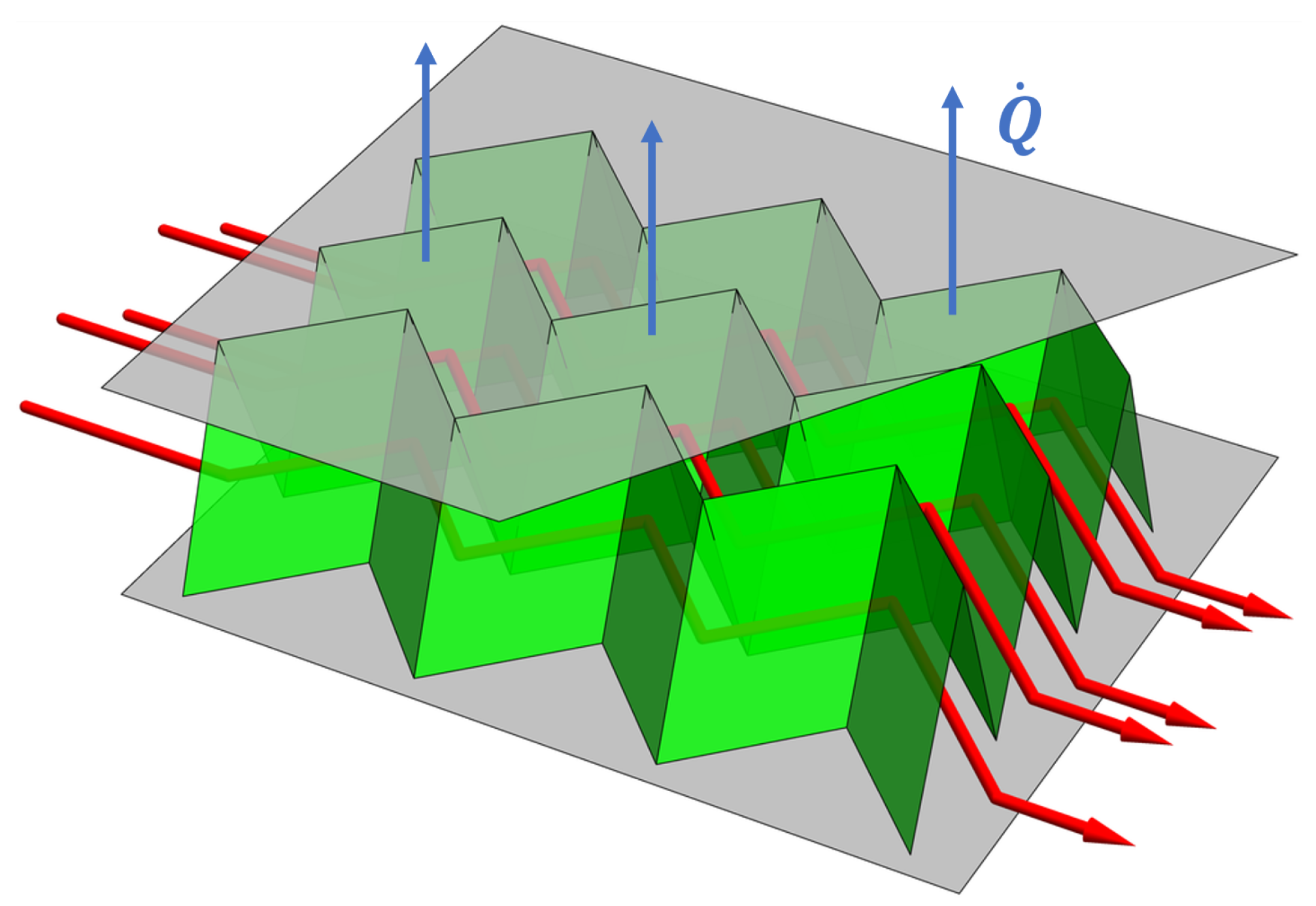
Previous studies on the integration of SHX have primarily focused on embedding discrete coolant tubes into monolithic skins [6] or fin-type structures under the existing outer skin [7]. However, these conventional approaches often result in mass additions due to the added tube and fin structures. To address this gap, this study investigates a novel architecture with a minimal increase in structural weight, namely the integration into primary structures in a load-bearing manner using folded sandwich core materials. Unlike conventional core materials like honeycomb or foam with closed-cell structures, foldcores are manufactured by isometric folding of sheet material into three-dimensional structures following the principles of origami. This manufacturing approach creates an open-cell structure, forming continuous channels along the sandwich cores. These channels can be directly used for near-surface coolant transport. The sandwich core, while also providing high weight-specific mechanical properties under compressive and shear loading, is therefore a highly potent platform for a structurally integrated skin heat exchanger. As the shape of the foldcores can be defined by the folding pattern, the design space of the core geometries is virtually unlimited. This vastly alters the mechanical properties as well as the fluid flow characteristics inside the structure, resulting in a complex interaction of mechanical aspects, fluid dynamics, and conjugate heat transfer. These previously unexplored complex interactions, resulting from the novelty of a truly structurally integrated SHX concept, are studied in this paper (Figure 1).
The heat transfer rate Q ˙ transferred from the cooling fluid to the environment can be described by
Q ˙ = Δ T R t o t .
where Δ T represents the temperature between the cooling fluid and the environment and R t o t describes the total heat transfer resistance. This is calculated as the sum of three partial resistances. First, heat is transferred from the liquid coolant to the facesheet via internal convective heat transfer, characterized by the heat transfer resistance R h c o o l a n t . The heat is then conducted through the facesheet, which is described by the heat conduction resistance R k . In the final step, the heat is released to the environment via external convection, expressed by the heat transfer resistance R h m . Due to the high heat transfer coefficient on the inside, R k R h m R h c o o l a n t is specified so that the internal fluid–solid coupling becomes negligible. The new approach of a structure-integrated foldcore SHX significantly reduces R k so that R h m remains the dominant component. In general, convective heat transfer resistance is defined as
R h m = 1 h m A ,
where h m is the averaged heat transfer coefficient and A is the transfer area. Since heat transfer takes place on the outside of the aircraft and an increase in h m also entails an increase in pressure loss, h m is taken as a constant. To reduce the dominant heat transfer resistance R h m , the transfer area remains the design parameter. The transfer area is defined as any area that contributes to heat dissipation to the environment via a temperature difference between the surface and the environment. Within the scope of this study, the effective transfer area is increased through the targeted utilization of transverse heat conduction in the facesheet.

2. CFRP Fundamentals, SHX Concept, and Experimental Configuration

2.1. Physical Fundamentals of a Composite Material

The thermal properties of a facesheet for a skin heat exchanger made of carbon fiber-reinforced polymer (CFRP) as proposed in this paper are primarily determined by the properties of the epoxy matrix and the anisotropic properties of the carbon fiber. Secondary influences are layup and fiber architecture, fiber volume content, and manufacturing imperfections, such as voids, gaps, and wrinkles. This introduces a complicated anisotropic behavior of the resulting composite, which is important to understand in terms of the thermal performance of the facesheet. With a typical fiber volume content of about 50 %, the dominant factor for through-thickness heat transport in a quasi-isotropic layup is the thermal conductivity of the matrix material. Epoxy resins, commonly used as matrix material in combination with endless carbon fibers [8], have a thermal conductivity between 0.1 W m 1 K 1 and 1.2 W m 1 K 1 [9,10], while (PAN-based) carbon fibers have an anisotropic thermal conductivity with a radially dependent transversal thermal conductivity between 2.4 W m 1 K 1 and 3.1 W m 1 K 1 [11] and a longitudinal thermal conductivity between 5.4 W m 1 K 1 and 20 W m 1 K 1 [11,12]. The resulting conductivity tensor of a CFRP can vary drastically, depending on material choice, architecture, and manufacturing quality. Villière et al. measured through-plane thermal conductivities of CFRPs with twill fabric between 0.55 W m 1 K 1 and 0.75 W m 1 K 1 and in-plane conductivities between 2.62 W m 1 K 1 and 3.73 W m 1 K 1 [13]. Similar ranges of values can be obtained with simple models for single-ply 1D parallel conduction (Voigt) and 1D serial conduction (Reuss):
k = V f k f + ( 1 V f ) k m
k 1 = V f k f 1 + ( 1 V f ) k m 1
where V f is the fiber volume content. These models neglect fiber-to-fiber contact, undulation, and voids. Voids and imperfections decrease the thermal conductivity in both directions, while fiber contact potentially increases the thermal conductivity. The undulation of the weaving can potentially increase the through-thickness thermal conductivity while decreasing in-plane conductivity. The higher longitudinal thermal conductivity results in an in-plane conductivity profile with lower resistance in fiber directions. Depending on the thickness of the facesheet and the spacing of the cooling channels underneath, a higher in-plane conductivity can be beneficial for higher lateral heat spreading and better overall thermal dissipation.

2.2. Concept of the Folded Core Skin Heat Exchanger

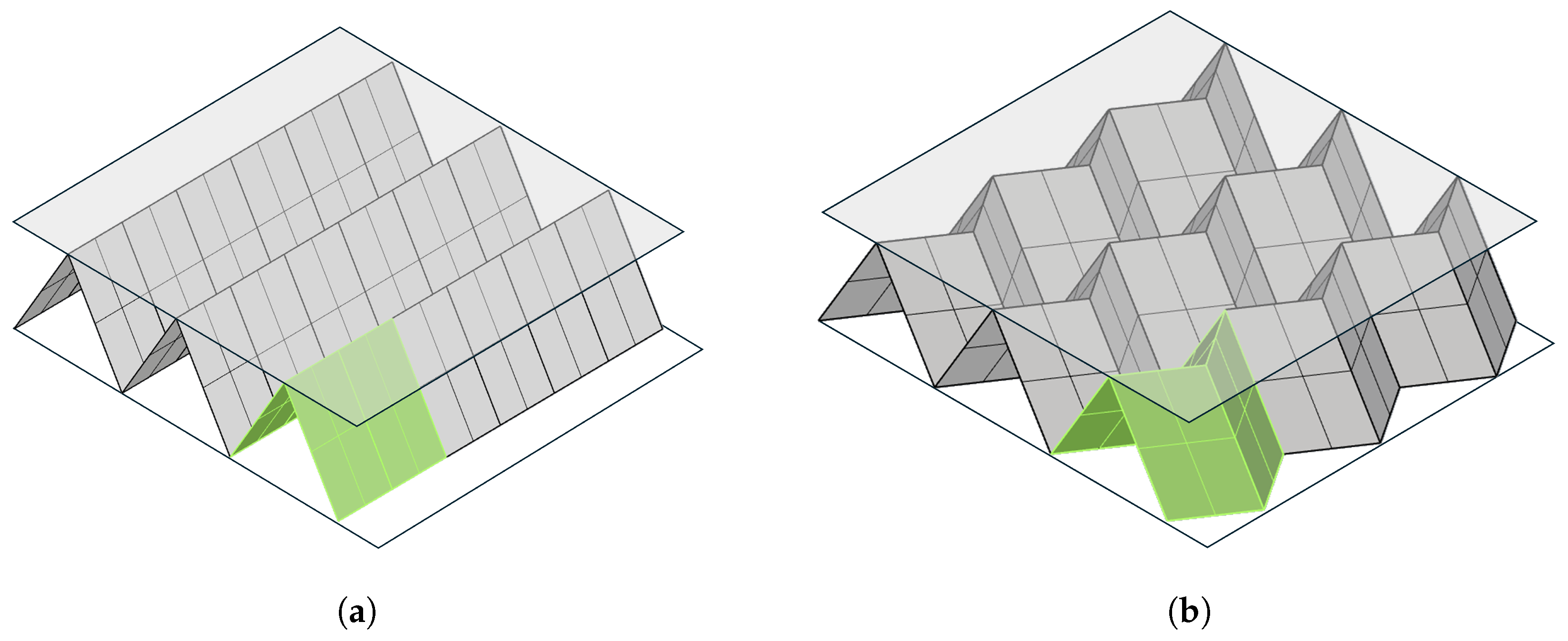
The fundamental design of the proposed skin heat exchanger is using a sandwich panel, where a folded core provides the channels for the fluid flow. This folded core concept is derived from the principles of rigid origami: the cellular structure is formed by isometric folding of continuous sheet material. The final structure is a tessellation of identical unit cells, which varies geometrically and in terms of structural and fluid domain characteristics, depending on the chosen fold pattern. The simplest structure that can be created this way consists of straight crease lines that are formed into mountain and valley folds, resulting in a one-directional corrugated shape (Figure 2a). When the facesheet is added, this geometry provides straight continuous channels for the fluid flow. However, the application of a structurally integrated skin heat exchanger often requires a more complex geometry to meet the requirements for mechanical performance. By introducing a zig-zag shape to the mountain and valley folds, a complex three-dimensional cell structure known as the Miura-ori pattern [14] is established (Figure 2b). These structures are geometrically stiffened due to their specific fold pattern, offering a large increase in shear and compressive stiffness and buckling resistance compared to the simple corrugated design [15]. Consequently, the fluid channels transition from straight to a zig-zag shape as well, which increases the complexity of fluid flow and thermodynamics significantly. Further experimental investigations and analytical modeling in the current study will therefore focus on the straight channels of the corrugated core design.
In both folded core designs, each channel is separated from neighboring channels by the bonding of the sandwich core and the facesheet at each major crease line (mountain and valley folds). Therefore, fluid cross-flow between adjacent rows is prevented. This feature allows for selective coolant flow in specific sections of the core as well as coolant flow in every n-th channel. This is particularly advantageous in combination with the CFRP facesheet material with its significant thermal anisotropy. Heat can be introduced to the material at specific channels and be conducted along the fiber directions of the facesheet.

2.3. Experimental Investigation of the Temperature Distribution in CFRP Using Temperature-Sensitive Paints

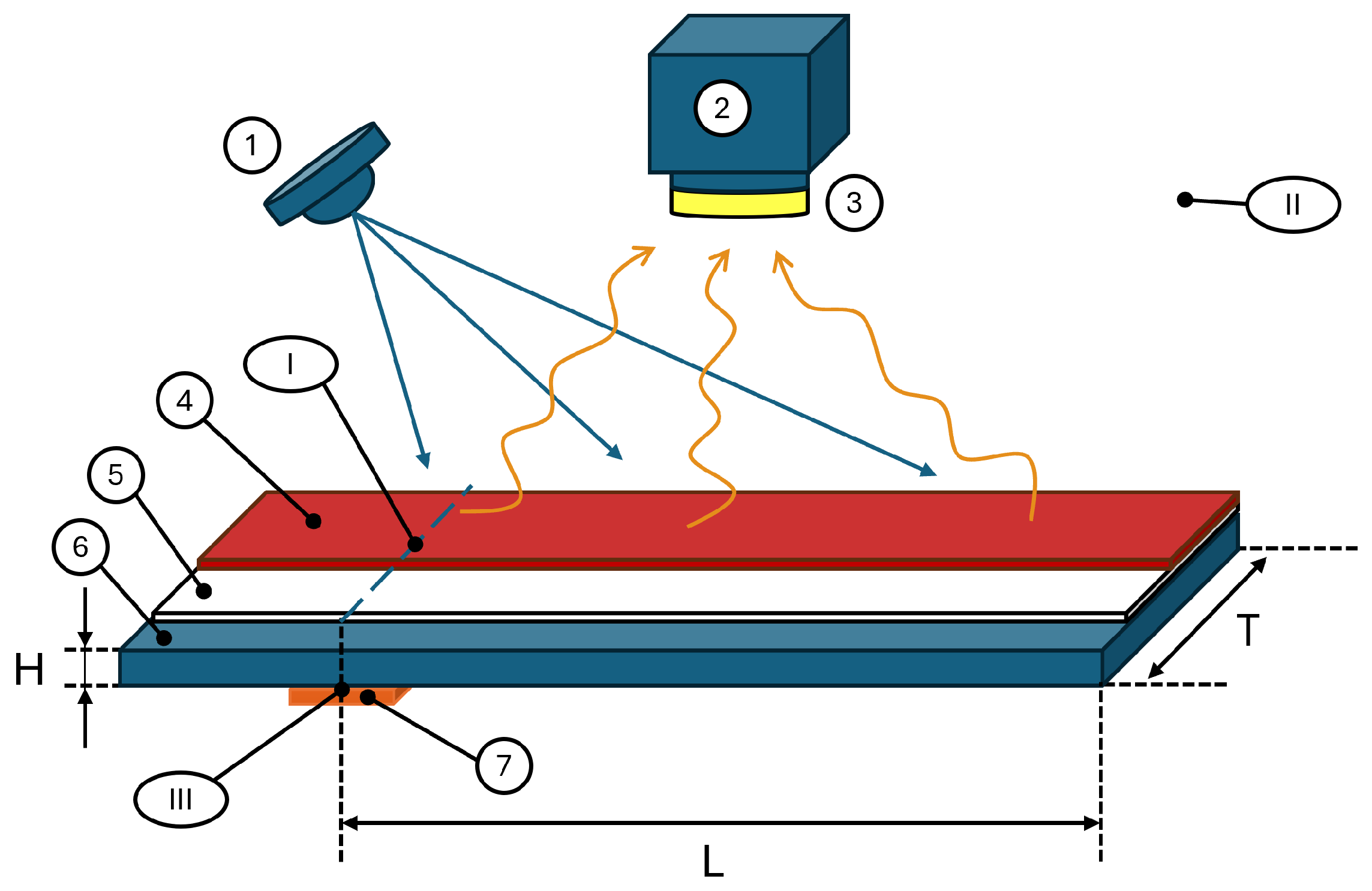
An experimental setup was used to investigate how thermal conductivity and anisotropy affect surface temperature. For this purpose, two material samples of the same size were compared. Sample one was a steel sheet with isotropic thermal conductivity properties, while sample two was a symmetrical four-layer CFRP plate from a plain weave fabric with a [ 0 / 90 , ± 45 ] s layup. Both samples were heated in the experiment via a 4 m m wide current-carrying copper track. The energy was released through the ohmic heating of the copper track. The current flow was PID-controlled based on a constant temperature condition measured by a type K thermocouple directly on the copper track (Figure 3 pos. III). Optimal thermal contact between the copper track and the material sample was achieved using thermal paste. In addition, the ambient temperature was tracked using a thermocouple away from the influence of the heated sample (Figure 3 pos. II). TSP was used to measure the surface temperature, which is calibrated in situ using a type K thermocouple on the surface (Figure 3 pos. I). These paints were applied with a white ground coat (37 μ m ) and consisted of a clear coat (20 μ m ) in which molecules (luminophores) were embedded that absorbed light of a certain wavelength and, after internal relaxation processes, re-emitted the energy in the form of light of a higher wavelength (Stokes-shifted). Thermal quenching causes emission intensity to decrease at higher temperatures. The prefabricated TSP solution UNT-200 from ISSI, Washington, DC, USA [16] was used in the experiments. It has an excitation range from 380 n m to 520 n m and emits light in the range between 500 n m and 720 n m . A light-emitting diode (ams-OSRAM 475-LEBP1MR-FTGR-23-0-H00-ND, Munich, Germany) used for excitation emitted at a peak wavelength at 456 n m . A camera system (IDS UI-3180CP-C-HQ, Obersulm, Germany) with a 50 m m fixed lens, equipped with a cut-in wavelength of a 550 n m long-pass filter (Thorlabs FGL550M, Newton, NJ, USA) to prevent the detection of excitation light was used to capture the emitted light. The intensity method was used to evaluate the temperature. In this method, the sample is continuously illuminated with the excitation light at a constant distance and the emission is recorded over the entire surface with a camera [17].

3. Analytical Modeling, Experimental Validation, and Parameter-Based Optimization of the SHX

3.1. Analytical Model for Estimating Surface Temperature

3.1.1. Assumptions and Simplification

An analytical model is used to predict the surface temperature curve and thus examine parameters that influence the overall system. Overall, the following assumptions apply to the model:
  • Steady-state conditions:
    Both in the experiment and in the application, sufficiently long test periods are planned so that the distribution of the surface temperature does not change over time.
  • Constant thermophysical properties:
    The materials used are subjected to minor temperature changes only. These have no significant effect on their properties and are below the melting temperature.
  • Negligible radiation:
    Due to the comparatively low surface temperature, radiation effects are considered negligible.
The total heat transfer rate ( Q ˙ ) leaving the system is obtained from
Q ˙ ( x , z ) = h ( x , z ) ( T t o p ( x , z ) T ) d x d z
where h is the local heat transfer coefficient at the surface, T t o p is the surface temperature, and T is a reference temperature outside of the boundary layer, which here is the ambient temperature. An analytical model is developed below to estimate this heat transfer rate. The model focuses on the heat conduction processes in the CFRP layer and predicts the surface temperature required according to Equation (3).

3.1.2. Geometry and Periodicity

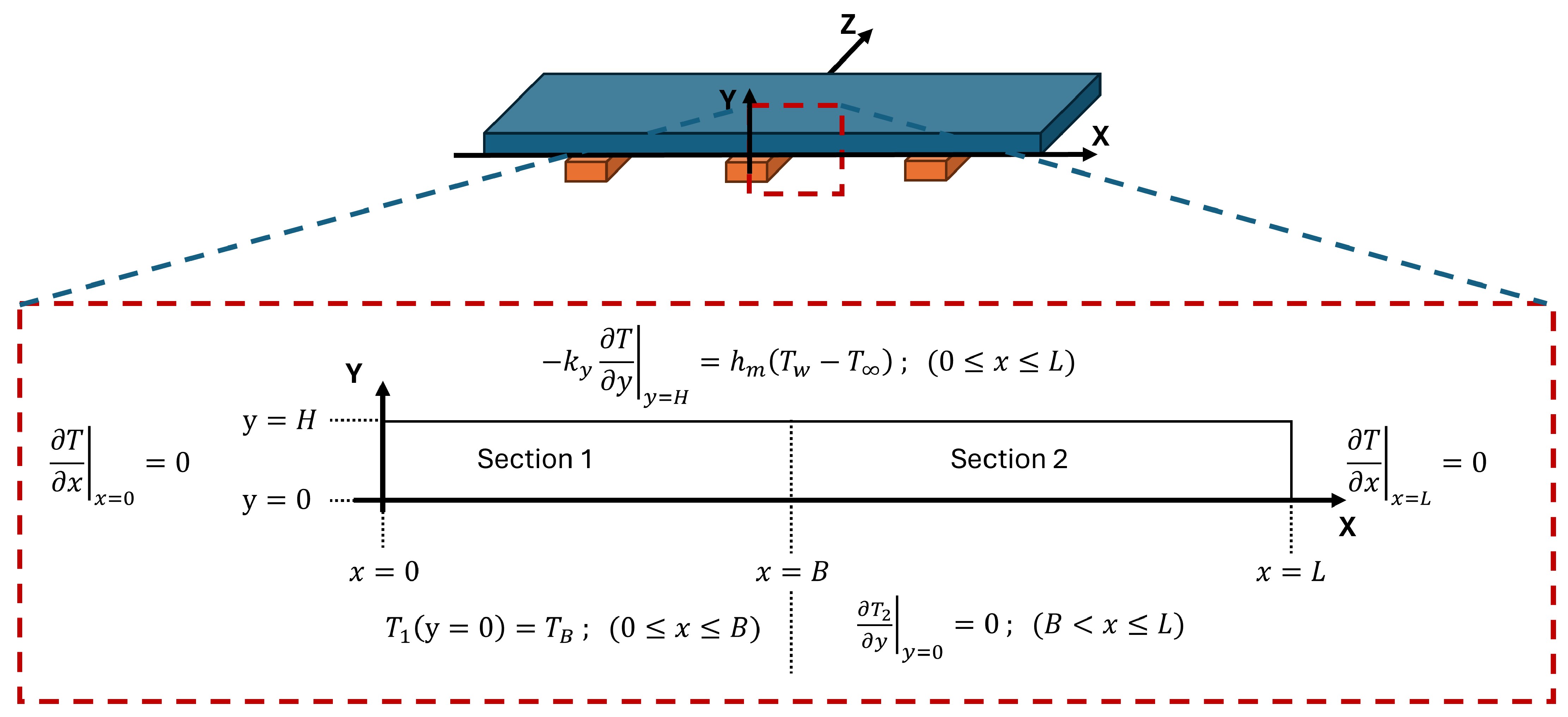
A simplified structure is used to map the processes and identify influences on the temperature profile. Figure 4 shows a schematic diagram of the system structure. The CFRP layer shown in blue is heated on the underside by straight cooling channels at equidistant intervals. Since the heat capacity of the coolant is significantly greater than that of air, the temperature changes in the cooling fluid in the Z direction are relatively small. Consequently, axial temperature gradients in the Z direction are assumed to be negligible. This reduces the model approach to a 2D problem, as shown in Figure 4. Due to the periodicity of the cooling channels, it is also possible to further limit the area to be solved. There is a temperature maximum and minimum in the half of the heated area (above the channel) and in the half of the unheated area (between the channels), respectively. The model should thus solve the area between a maximum and a minimum, which in this paper is within the new limits between x = 0 and x = L .

3.1.3. Boundary Conditions

An adiabatic boundary condition can now be introduced in the X direction at both extreme points (at x = 0 and x = L , Figure 4). The boundary condition at the top at y = H is to be considered a convective boundary condition. Here, the heat transfer coefficient is approximated by its spatial average over
h m = 1 L 0 L h ( x ) d x .
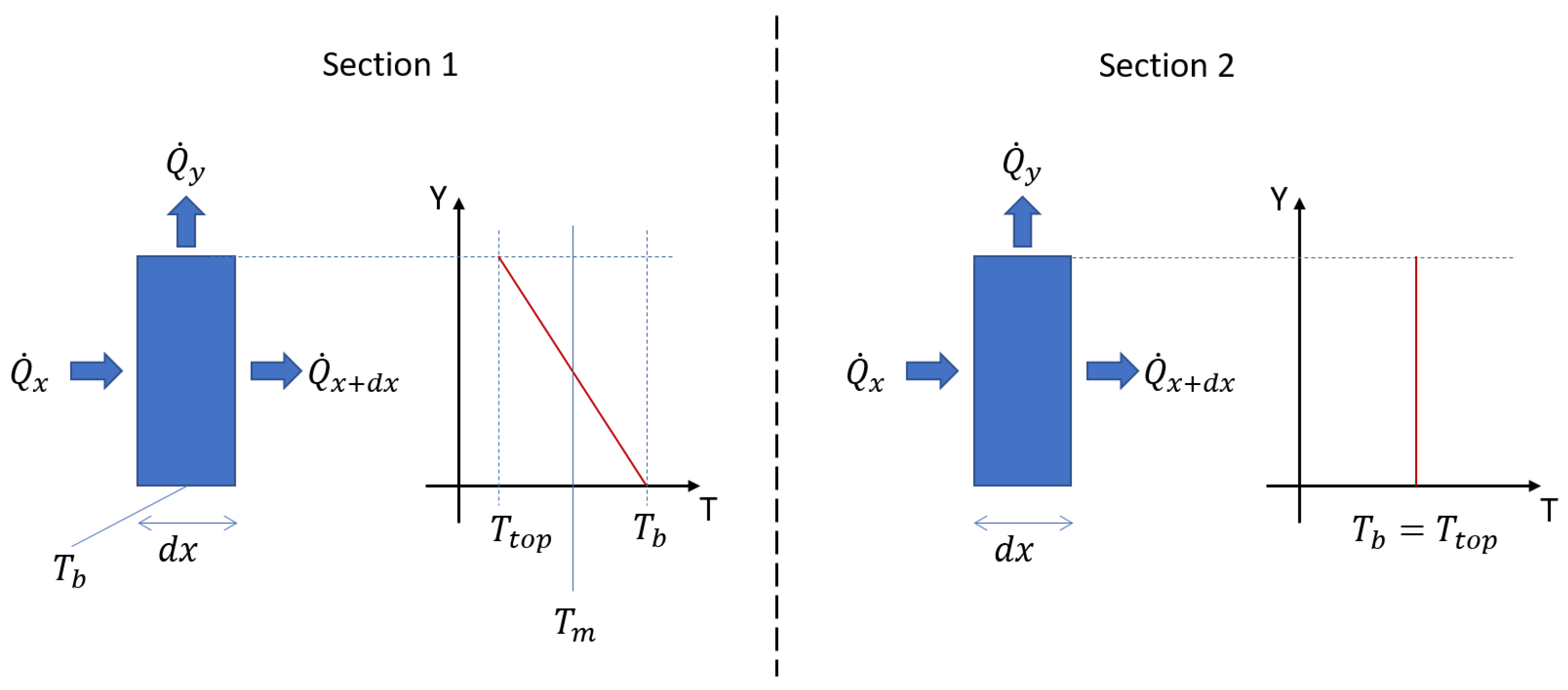
To describe the last condition at y = 0 , the entire system at point x = B is divided into the heated area ( 0 x B )—section 1—and the unheated area ( B < x L )—section 2. The boundary condition for section 1 is a Dirichlet boundary condition with a constant wall temperature T b . For section 2, an adiabatic boundary condition is also assumed, as shown in Figure 4. To derive an analytical solution, separate energy balances are formulated for both sections with corresponding temperature profiles in the Y direction. Figure 5 shows an infinitesimal part with a width of d x and the heat transfer rate of both areas. In section 1, there is a heat transfer rate into and out of the control volume due to transverse heat conduction in the CFRP plate. On the upper side, a heat transfer rate leaves the control volume via convection, and on the lower side, another undefined heat transfer rate enters the control volume. This results in a linear temperature profile between the upper and lower sides of the solid. In section 2, on the other hand, the temperature profile in the Y direction is constant due to the boundary conditions. Here, the energy is only conducted through the control volume and dissipated again on the upper side by convection. The temperature profiles in both sections are thus described by functions. With these functions, the temperature profile in the Y direction can be predicted from a single temperature in the X direction, and the model can be reduced to a 1D problem. Since the average temperature is important for the boundary condition in section 2, the average temperature T m is introduced for section 1.
T m ( x ) = 1 H 0 H T ( x , y ) d y = T b + T t o p ( x ) 2
Now, the analytical model is to be developed based on the energy balance for every section.

3.1.4. Derivation for Section 1

For section 1, based on the energy balance shown in Figure 5, the following relationship can be derived:
Q ˙ x = Q ˙ x , d x + Q ˙ y
The constant temperature boundary condition will be taken into account later using the boundary conditions. After rearranging and inserting the formal relationships, this results in
k x d 2 T m , 1 ( x ) d x 2 h m ( T t o p , 1 ( x ) T ) = 0 .
Inserting Equation (5) leads to
k x d 2 T m , 1 ( x ) d x 2 h m ( 2 T m , 1 ( x ) T b T ) = 0 .
With introducing
m 1 = 2 h m k x H
it can be transformed to
d 2 T m , 1 ( x ) d x 2 m 1 2 T m , 1 ( x ) = m 1 2 2 ( T b + T ) .
The general solution of the differential equation is thus rearranged according to the surface temperature T t o p , 1 :
T t o p , 1 ( x ) = 2 C 1 e m 1 x + 2 C 2 e m 1 x + T b .

3.1.5. Derivation for Section 2

For section 2, based on the energy balance shown in Figure 5, the following relationship can be derived:
Q ˙ x = Q ˙ x , d x + Q ˙ y
Developing this equation leads to
k x d 2 T m , 2 ( x ) d x 2 h m ( T t o p , 2 ( x ) T ) = 0 .
Introducing
m 2 = h m k x H
and the homogeneous temperature profile in the Y direction leads to
d 2 T t o p , 2 ( x ) d x 2 m 2 2 T t o p , 2 ( x ) = m 2 2 T .
The general solution of the differential equation rearranged according to the surface temperature T t o p , 2 is
T t o p , 2 ( x ) = C 3 e m 2 x + C 4 e m 2 x + T .
The governing equations obtained for both sections are mathematically equivalent to fin-type equations with distributed convective heat loss [18].

3.1.6. Coupling and System of Equations

The temperature distributions from Equations (11) and (16) and the boundary conditions shown in Figure 5 yield the following system of equations:
The adiabatic boundary condition for x = 0 results in
0 = 2 C 1 m 1 2 C 2 m 1
The adiabatic boundary condition for x = L results in
0 = C 3 m 2 e m 2 L C 4 m 2 e m 2 L
The coupling condition at x = B of the temperatures results in
2 C 1 e m 1 B + 2 C 2 e m 1 B + T b = C 3 e m 2 B + C 4 e m 2 B + T
The coupling condition at x = B of the heat transfer rate results in
2 C 1 m 1 e m 1 B 2 C 2 m 1 e m 1 B = C 3 m 2 e m 2 B C 4 m 2 e m 2 B

3.2. Temperature Distribution for Straight Channels

In order to compare the analytical model with experimental data, the dimensionless surface temperature Θ defined by
Θ = T T m i n T m a x T m i n
will be used for both samples and the model. The temperature profile for the experimental data on the top surface along the X direction (Figure 3) was evaluated centrally in the Y direction at T / 2 . For the evaluation, 140 pixel lines from the detector (at T / 2 ± 70 ) were averaged column by column. The maximum standard deviation per column is 1.7 K. The input parameters for the model are known material data. The average heat transfer coefficient is specified as h m = 5   W   m 2   K 1 after prior estimation using a correlation for free convection of a flat plate with a warm surface [19]. The copper track temperature is constantly controlled at T b = 358   K with a channel width of 4 m m in the experiment, which experimentally realizes the boundary conditions for the analytical model.
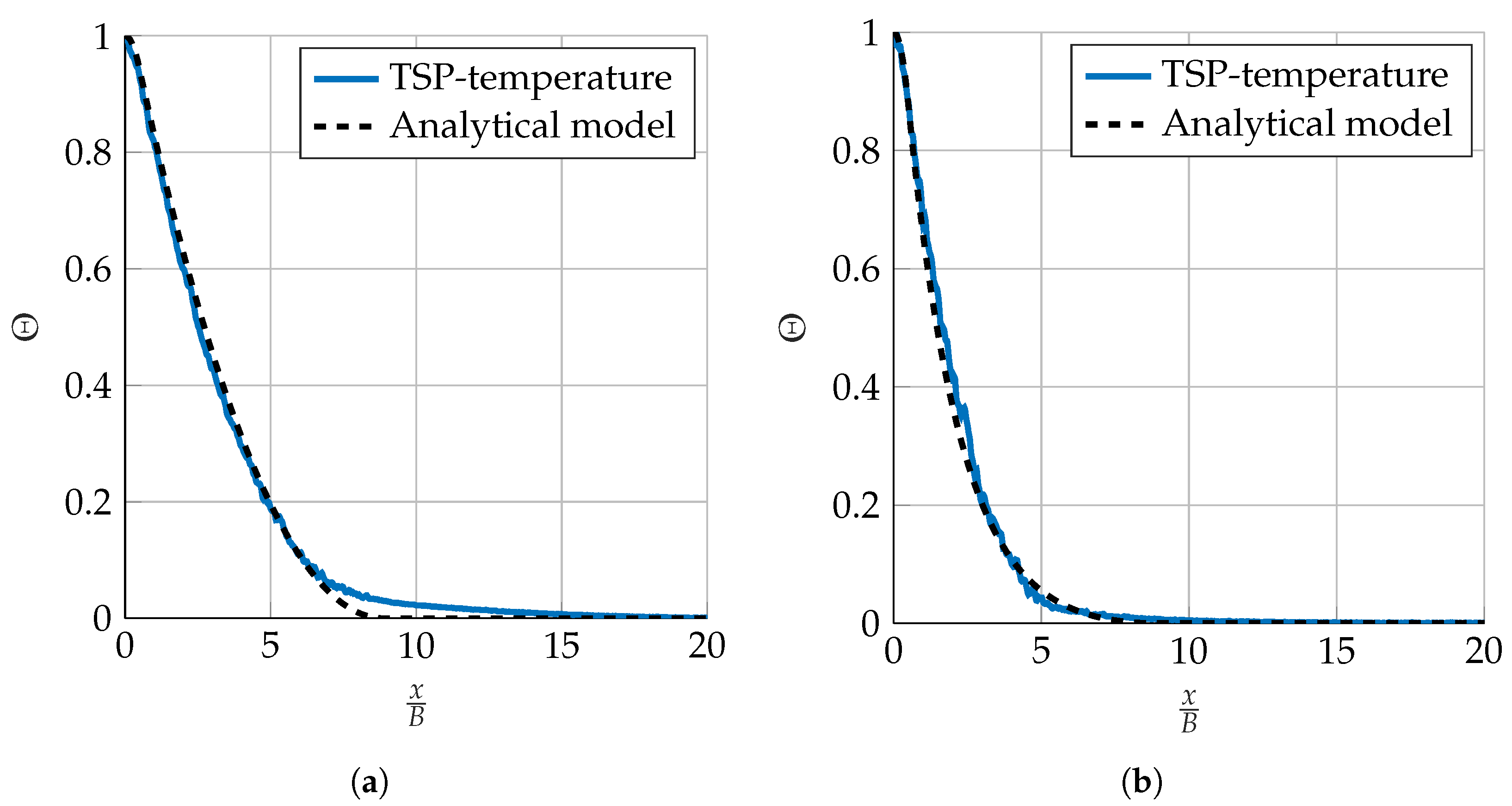
Figure 6 illustrates the dimensionless surface temperature profile for two samples ((a) a steel sample and (b) a CFRP sample). The center of the heated channel is located at point X = 0, making a symmetrical profile with respect to the y-axis. The blue line represents the dimensionless temperature calculated back via the TSP, while the black dashed line represents the prediction of the analytical model. The thermal boundary conditions, such as h m and T b , as well as the geometric boundary conditions, such as B = 4   m m , H = 1   m m , and L = 140   m m , are kept constant in the analytical model between the two samples, as is also the case in the experimental setup. Only the thermal conductivity properties of both samples change between the two cases. In the first sample for the steel plate, an isotropic thermal conductivity of k x = k y = 50   W   m 1   K 1 and in the second example, anisotropic thermal conductivity values of k x = 1   W   m 1 K 1 and k y = 0.2   W   m 1 K 1 are specified. Equations (17)–(20) were solved with the respective parameter set using Matlab R2023a code and compared with the measurement results in Figure 6. The thermal conductivities have been specified based on the literature [20,21] and indirect measurements for the through-plane conductivity, making use of the correlation k = c p α ρ between thermal conductivity, specific heat capacity c p , density ρ , and thermal diffusivity α . c p was determined by differential scanning calorimetry (DSC), ρ by a gravimetric method, and α by the laser flash analysis, in accordance with DIN EN ISO 22007:4 [22]. The measurements were conducted on eight 10   m m by 10   m m CFRP samples of the used resin–fiber combination, resulting in a mean value of k y = 0.23   W   m 1 K 1 . For CFRP, a wider range of values is permissible depending on the composition. The CFRP used here has a high epoxy resin proportion, which is why the thermal conductivities were set low. The assumption was confirmed by the measurement, and both curves show agreement for the choice of thermal conductivities.

3.3. Comparison and Validation

The dimensionless temperature profiles between the measured values via the TSP and the predicted values via the analytical model are compared for steel (Figure 6a) and CFRP (Figure 6b), respectively. For the steel sample with isotropic thermal conductivity properties, the prediction using the model shows very close agreement to the measured dimensionless temperature. For x B > 7 , the analytical model slightly underpredicts the dimensionless surface temperature. This deviation may originate from both the experimental setup and the simplifications in the applied boundary conditions of the model. However, discrepancy occurs in a region where the temperature difference between the surface and the ambient environment is small, such that its influence on the predicted heat transfer rate remains small. This deviation is therefore considered acceptable in the following and will not be discussed further.
For the second anisotropic heat-conducting sample (Figure 6b), the analytical model predicts with excellent agreement the dimensionless temperature profile over the entire length. This demonstrates that the model is capable of correctly incorporating the influence of thermal conductivity in the in-plane direction.
A comparison of both samples reveals the influence of the in-plane thermal conductivity on the lateral heat conduction. In the sample with the higher thermal conductivity (sample 1), the energy is transported further in the X direction, resulting in a broader temperature distribution compared to the sample with lower thermal conductivity properties (sample 2). This behavior is observed in the TSP measurements and is well reproduced by the analytical model. Despite minor deviations in localized regions, it is still applicable for an initial assessment. In addition, the influence of material parameters quickly becomes apparent, allowing the design of the SHX to be optimized for aviation.

3.4. Transfer of the Model to SHX Cooling Efficiency

An inspection of the temperature profiles in Figure 6a,b reveals that the thermal energy is transported in the X direction significantly beyond the heated area (for x / B > 1 ). By considering the dimensionless length L , which is defined as
L = L B B
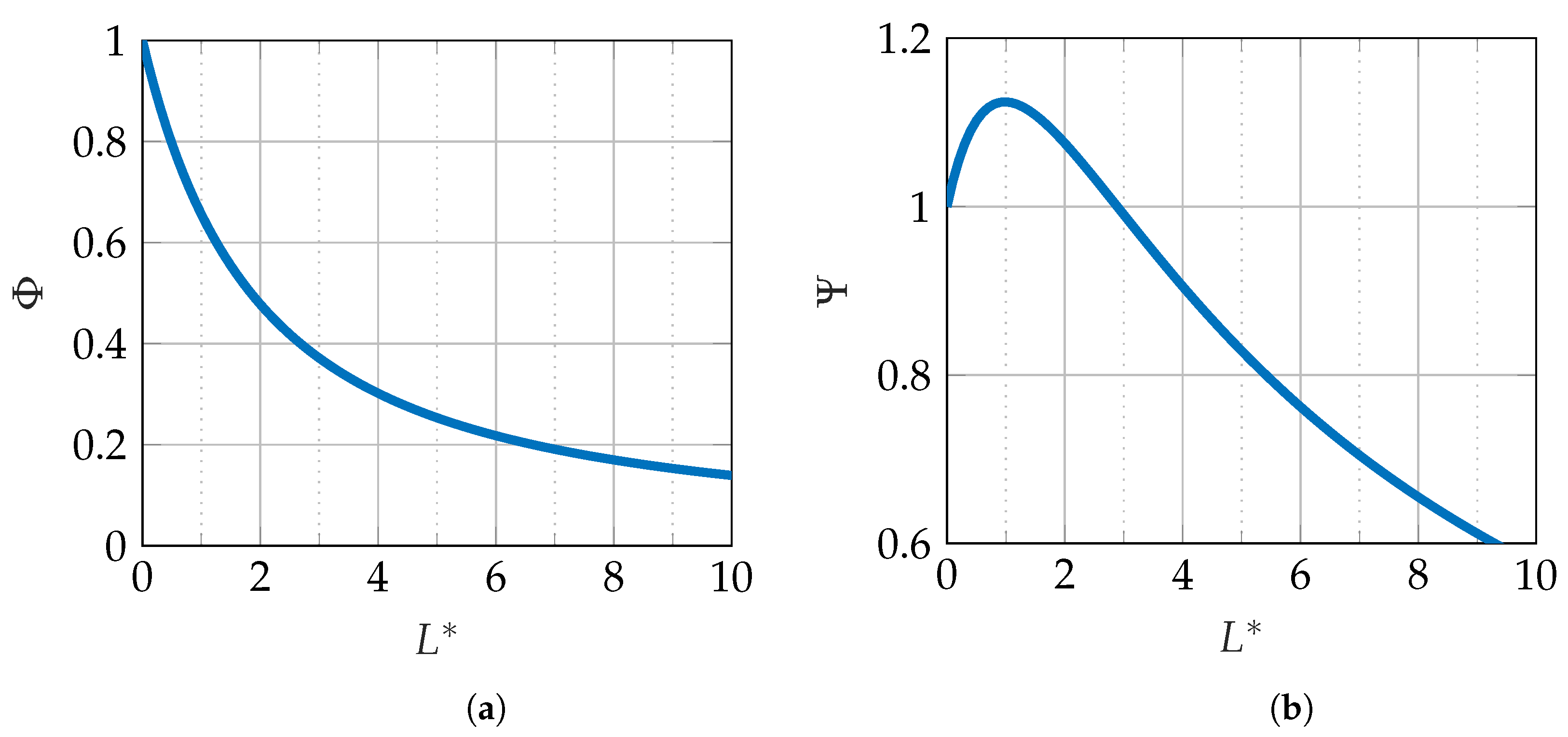
and represents the ratio between the unheated width L B , where L m i n = B and B is the heated width of the sample (Figure 4), the distribution of the surface temperature can be represented as a function of the geometric factors. With this model, the heat transferred per channel is determined as a function of L . An increase in L represents an increase in the channel spacing or, in other words, an increase in the unheated areas between the channels. When L = 1 , there is exactly one channel width of space between the channels. At this point, the dimensionless quantities Ξ , Φ , and Ψ are introduced and used for the following diagrams in Figure 7 and Figure 8. In general, all variables are always normalized to the respective initial variable in the case where there is no distance between the warm surfaces ( L = 0 ). In the following, the heat flow Q ˙ , the surface-specific heat flow q ˙ , and the mass-specific heat flow q ˙ m are compared with each other, which are normalized and represented by the variables
Ξ = Q ˙ ( L ) Q ˙ ( L = 0 ) ; Φ = q ˙ ( L ) q ˙ ( L = 0 ) ; Ψ = q ˙ m ( L ) q ˙ m ( L = 0 )
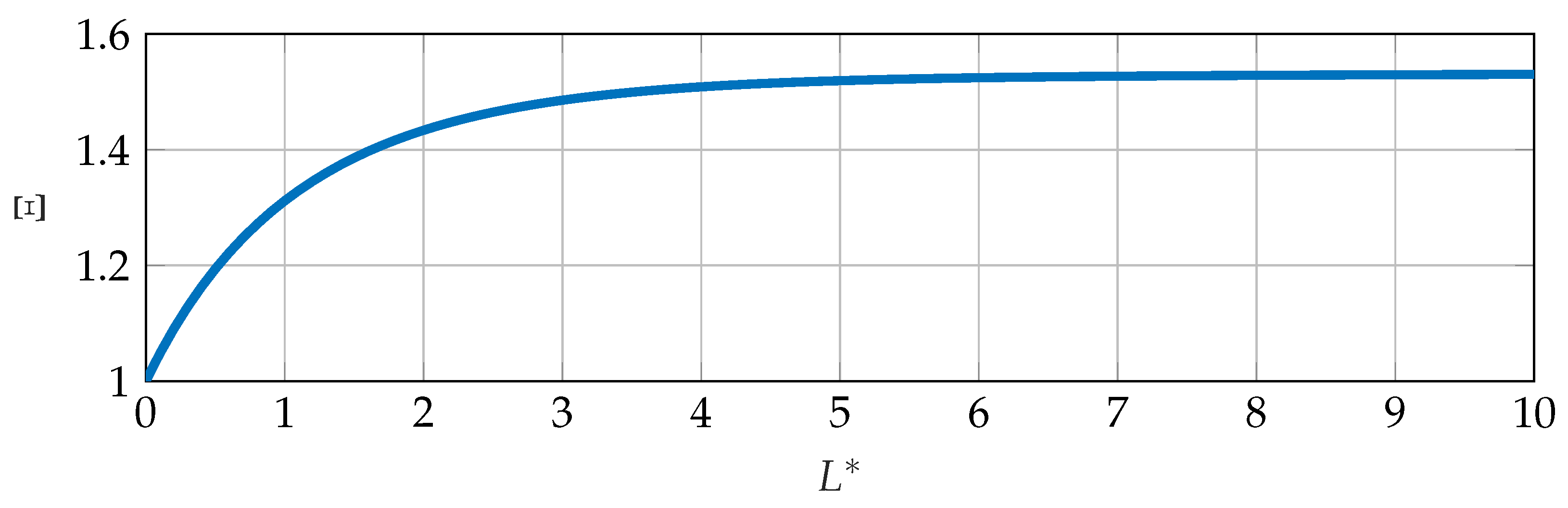
Figure 7 shows the change in the amount of heat transferred in a function of L compared to the amount of heat transferred when L = 0 , i.e., when there is no unheated area between the channels.
If there is transverse heat conduction in the material, the energy can be distributed over a larger area in the form of heat with an increase in volume in the X direction in the unheated area, which then provides a larger area for heat exchange. This increases the amount of heat dissipated per channel as the unheated part becomes larger. As shown in Figure 7, there are natural limitations. For the material pairing in the present case with the respective boundary conditions, the specified amount of heat per channel changes negligibly from L = 6 . Up to that point, however, up to 50% more energy can be exchanged with one channel if the transverse heat conduction in the material is exploited.
When examining the change in the area-specific heat flux, defined as
q ˙ = Q ˙ L T
it becomes apparent that the maximum achievable heat flux is obtained for L = 0 . Figure 8a shows the variation in the dimensionless specific heat flux, defined as the ratio between the specific heat flux as a function of q ˙ ( L ) relative to the maximum possible specific heat flux at L = 0 over L . Figure 8a shows that the area-specific heat flux q ˙ decreases monotonically with increasing L . However, this decrease is not proportional due to transverse heat conduction in the material. For example, the decrease in q ˙ at L = 1 is 35%; meanwhile, there is a gap of one channel width here.
In the aviation sector, cooling performance relative to SHX mass constitutes a key performance metric. The following analysis therefore assesses how transverse heat conduction can be exploited to achieve a weight-optimized SHX design for the present configuration. To this end, the mass-specific heat flux is introduced as
q ˙ m = Q ˙ ρ C F R P H T L + ρ H 2 O A c h T
based on Figure 2a. The increase in the mass of the SHX due to additional material in the cover layer as well as the cooling fluid mass is included in the calculation. The density of the CFRP layer is assumed to be ρ C F R P = 1500   k g   m 3 [23] and water with a density of ρ H 2 O = 1000   k g   m 3 is used as the cooling fluid. A C h represents the cross-sectional area of the channel through which the flow passes. Figure 8b shows the ratio of the mass-specific heat transfer rate to the mass-specific heat transfer rate at L = 0 . For this set, the figure exhibits a well-defined maximum at L = 1 and shows an increase in the mass-specific heat transfer rate of 12%. This maximum thus represents an optimum design for the chosen set of parameters. It will shift depending on the material parameters and system boundary conditions. With the parameters considered here, the mass-specific optimized channel spacing would correspond to a channel width.

3.5. Sensitivity Analysis Compared to a Realistic Case

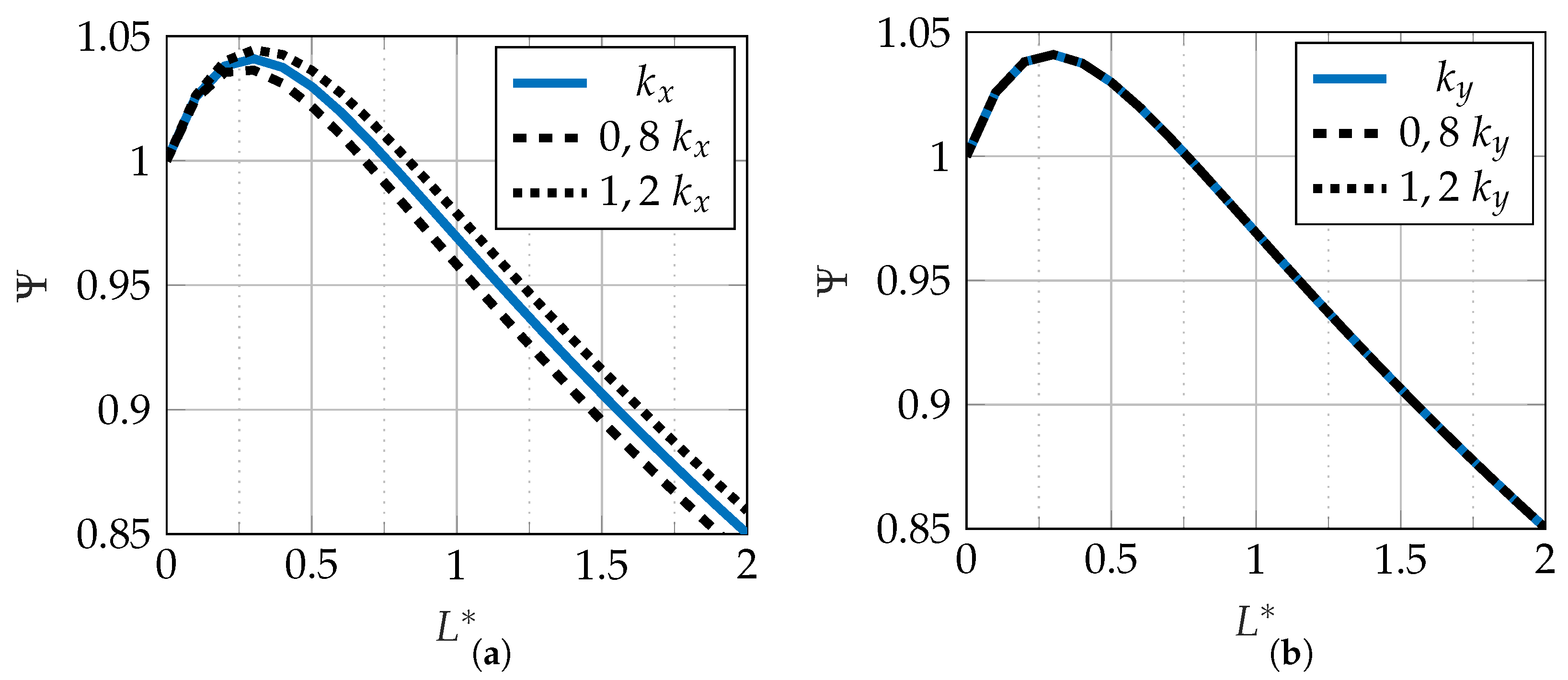
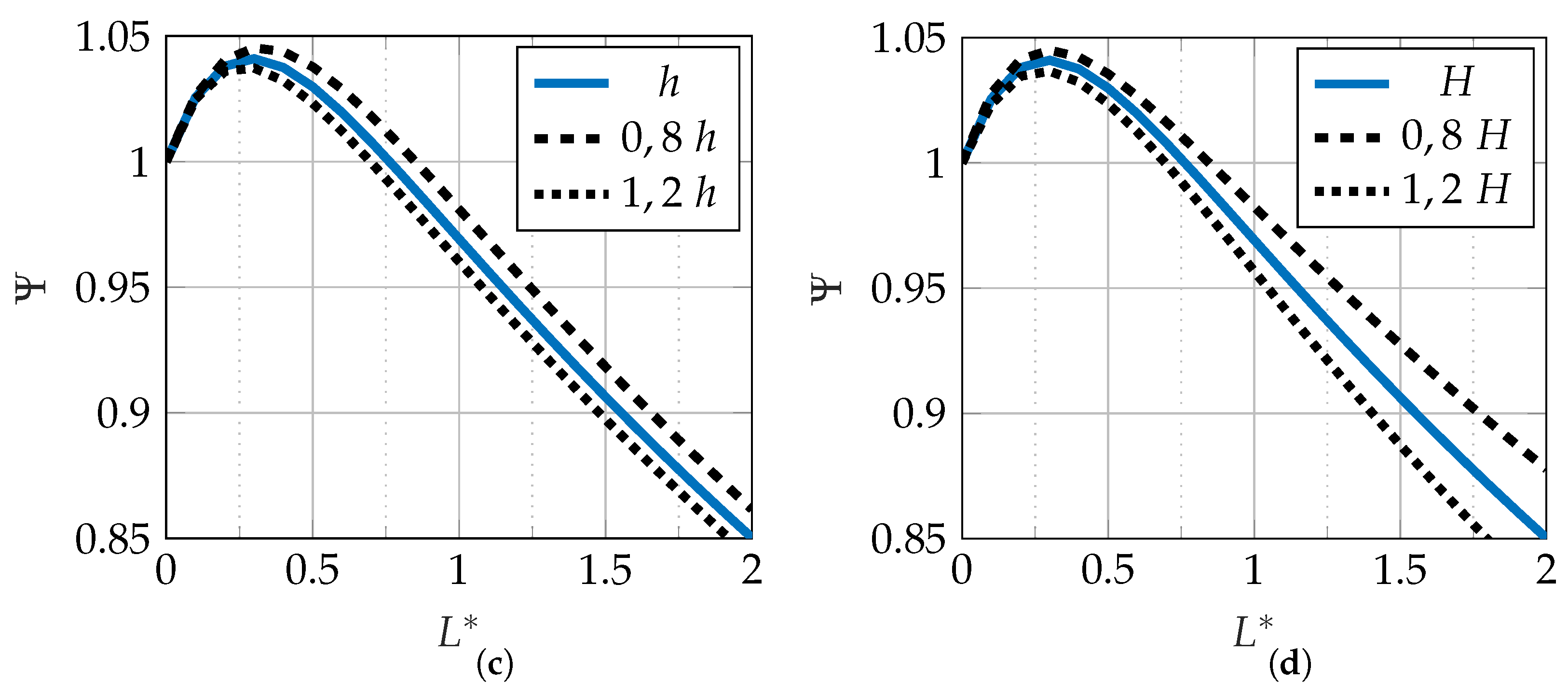
Extending the model beyond the validated range, it is applied below to a parameter set representative of the flight conditions of an ultralight aircraft. For this purpose, k x is set to 4 W   m 1   K 1 , k y to 1 W   m 1   K 1 , and the ambient temperature to T = 273   K . h m is estimated via a correlation of turbulent flow over a flat heated plate [18] at 200   W   m 2   K . All other parameters remain the same as in the previous experimental test. The identical blue curves in Figure 9a–d represent Ψ over L . A comparison of the blue plots in Figure 8b and Figure 9b shows that both the optimal channel spacing and the corresponding increase in cooling efficiency decrease. Nevertheless, a significant optimum for this parameter set still emerges. In a subsequent sensitivity analysis, the influence of various parameters on this optimum was evaluated using the analytical model. Four parameters were independently varied to 80% and 120% of the initial value, respectively. Based on this model, an increase in k x (Figure 9a) results in the hot zones at the optimum design point being further apart from each other. From a physical point of view, the energy is further distributed across the plate, allowing heat exchange to take place over a larger area. An increase in the distance with an increase in thermal conductivity is therefore physically plausible. A change in thermal conductivity in the Y direction (Figure 9b) has less influence. In the case considered here, all three curves are congruent. Thus, the influence of thermal conductivity in the Y direction is not significant here. A plate thickness of H = 1   m m will also contribute to this due to its low thickness. In Figure 9c, h m has been varied. Based on the diagram, the distance between the channels decreases with increasing heat transfer. Finally, a variance in plate thickness was performed, which is shown in Figure 9d. This diagram shows that the optimum distance between the channels increases as the plate thickness decreases. In contrast to the parameter variations considered previously, the plate thickness is included in the heat conduction properties as well as in the total mass of the skin heat exchanger. Thus, the coupled relationship between plate thickness and Ψ is shown here.

4. Conclusions

The proposed concept of structurally integrated SHX combines modern materials and novel design strategies with regard to high mass-specific cooling efficiency. Modern materials, such as CFRP, have anisotropic thermal conductivity properties, which are not only taken into account here but are also used as a new design parameter for SHX. An analytical 1D heat transfer model was developed to identify an optimal point for SHX design depending on the input parameters. Taking into account the transverse heat conduction of the top layer, the energy transferred in relation to the total mass of the SHX can be increased by introducing channel spacing between the cooling channels. The model allowed for a fast design-accompanying configuration for SHX and was validated using TSP measurement technology against experimentally generated data from two experiments. In addition to the convective boundary condition at the top of the SHX, the model also takes into account the spatially different thermal conductivity properties and geometries of the system. Here, straight channels with a constant heat transfer resistance on the outside of the SHX were considered. A sensitivity analysis was performed to determine the impact of various input parameters on the optimal design point. Interactions between the channels, especially on the air side, as well as other channel geometries, were not considered here and will be the subject of future research.

Author Contributions

Conceptualization, M.T.L., S.T., J.G., S.Z. and R.P.; methodology, M.T.L. and R.P.; validation, M.T.L. and R.P.; formal analysis, M.T.L. and R.P.; investigation, M.T.L.; resources, M.T.L., S.T., J.G. and S.Z.; data curation, M.T.L.; writing—original draft preparation, M.T.L., S.T., J.G. and S.Z.; writing—review and editing, R.P. and S.C.; visualization, M.T.L. and S.T.; supervision, R.P. and S.C.; project administration, S.T.; funding acquisition, R.P. and P.M. All authors have read and agreed to the published version of the manuscript.

Funding

This research was funded by the Aviation Research Programme LuFo of the German Federal Ministry for Economic Affairs and Energy in project 20E2214 “Development and integration of a skin heat exchanger concept using a fiber composite sandwich structure into the thermal management for electrified drive trains” and funded by the Deutsche Forschungsgemeinschaft (DFG, German Research Foundation)—SFB/TRR 364: Synergies of Highly Integrated Transport Aircraft-SynTrac—498601949. The authors gratefully acknowledge the funding as well as the support from and discussion by project partners.

Data Availability Statement

Data will be made available upon request.

Acknowledgments

We would like to thank Tim Deggelmann for his assistance with the measurements and data analysis.

Conflicts of Interest

The authors declare no conflicts of interest.

Abbreviations

The following abbreviations are used in this manuscript:
TSPTemperature-Sensitive Paint
CFRPCarbon Fiber-Reinforced Polymer
SHXSkin Heat Exchanger

References

  1. Asli, M.; König, P.; Sharma, D.; Pontika, E.; Huete, J.; Konda, K.R.; Mathiazhagan, A.; Xie, T.; Höschler, K.; Laskaridis, P. Thermal Management challenges in hybrid-electric propulsion aircraft. Prog. Aerosp. Sci. 2024, 144, 100967. [Google Scholar] [CrossRef]
  2. Brelje, B.J.; Martins, J.R.R.A. Electric, hybrid, and turboelectric fixed-wing aircraft: A review of concepts, models, and design approaches. Prog. Aerosp. Sci. 2019, 104, 1–19. [Google Scholar] [CrossRef]
  3. Frey, A.C.; Stonham, J.; Bosak, D.; Sangan, C.M.; Pountney, O.J. Radiators in fuel cell powered aircraft: The effect of heat rejection on drag. Appl. Therm. Eng. 2025, 274, 126697. [Google Scholar] [CrossRef]
  4. Abreu, R.; Santos, P.; Afonso, F.; Suleman, A. A study on the potential of skin heat exchangers for hybrid-electric aircraft. Appl. Therm. Eng. 2025, 280, 128096. [Google Scholar] [CrossRef]
  5. Kellermann, H.; Habermann, A.L.; Hornung, M. Assessment of aircraft surface heat exchanger potential. Aerospace 2020, 7, 1. [Google Scholar] [CrossRef]
  6. Schäfer, S.; Quaium, F.; Muhsal, N.; Speerforck, A.; Thielecke, F.; Becker, C. Integration of a cooling system architecture with a skin heat exchanger for high thermal loads in full cell powered aircraft. In Proceedings of the 19th International Refrigeration and Air Conditioning Conference at Purdue, West Lafayette, IN, USA, 10–14 July 2022. Article 2242. [Google Scholar]
  7. Pang, L.P.; Dang, X.M.; Cheng, J. Study on heat transfer performance of skin heat exchanger. Exp. Heat Transf. 2015, 28, 317–327. [Google Scholar] [CrossRef]
  8. Mallick, P.K. Fiber-Reinforced Composites: Materials, Manufacturing, and Design, 3rd ed.; CRC Press: Boca Raton, FL, USA, 2008. [Google Scholar]
  9. Callister, W.D. Materials Science and Engineering; Wiley: New York, NY, USA, 2019. [Google Scholar]
  10. VDI e. V. VDI-Wärmeatlas; Springer: Berlin/Heidelberg, Germany, 2013. [Google Scholar] [CrossRef]
  11. Ji, X.; Matsuo, S.; Sottos, N.R.; Cahill, D.G. Anisotropic thermal and electrical conductivities of individual polyacrylonitrile-based carbon fibers. Carbon 2022, 197, 1–9. [Google Scholar] [CrossRef]
  12. Campbell, F.C. Structural Composite Materials; ASM International: Almere, The Netherlands, 2010. [Google Scholar] [CrossRef]
  13. Villière, M.; Lecointe, D.; Sobotka, V.; Boyard, N.; Delaunay, D. Experimental determination and modeling of thermal conductivity tensor of carbon/epoxy composite. Compos. Part A Appl. Sci. Manuf. 2013, 46, 60–68. [Google Scholar] [CrossRef]
  14. Miura, K.; Lang, R.J. The Science of Miura-ori: A review. Origami 2009, 4, 87–99. [Google Scholar]
  15. Heimbs, S.; Middendorf, P.; Kilchert, S.; Johnson, A.F.; Maier, M. Experimental and numerical analysis of composite folded sandwich core structures Under compression. Appl. Compos. Mater. 2007, 14, 363–377. [Google Scholar] [CrossRef]
  16. ISSI Inc. Data Sheet for UniTemp Temperature Sensitive Paint. Available online: https://innssi.com/wp-content/uploads/Temperature_Sensitive_Paint/UniTemp/Documentation/UniTemp-TSP-UNT-XXX-Data-Sheet.pdf (accessed on 13 January 2026).
  17. Liu, T.; Sullivan, J.; Asai, K.; Klein, C.; Egami, Y. Pressure and Temperature Sensitive Paints; Springer: Cham, Switzerland, 2021. [Google Scholar] [CrossRef]
  18. Bergman, T.L.; Lavine, A.S.; Incropera, F.P.; DeWitt, D.P. Fundamentals of Heat and Mass Transfer, 7th ed.; John Wiley & Sons, Inc.: Hoboken, NJ, USA, 2011; ISBN 9781118137253. [Google Scholar]
  19. Lloyd, J.R.; Moran, W.R. Natural convection adjacent to horizontal surface of various planforms. J. Heat Transf. 1974, 96, 443–447. [Google Scholar] [CrossRef]
  20. DIN 4108-4:2020-11; Wärmeschutz und Energie-Einsparung in Gebäuden—Teil 4: Wärme- und Feuchteschutztechnische Bemessungswerte. Beuth Verlag GmbH: Berlin, Germany, 2020. Available online: https://www.dinmedia.de/de/norm/din-4108-4/327502903 (accessed on 1 March 2026).
  21. Pilling, M.W.; Yates, B.; Black, M.A. The thermal conductivity of carbon fibre-reinforced composites. J. Mater. Sci. 1979, 14, 1326–1338. [Google Scholar] [CrossRef]
  22. DIN EN ISO 22007-4:2017-11; Kunststoffe_- Bestimmung der Wärmeleitfähigkeit und der Temperaturleitfähigkeit_- Teil_4: Laserblitzverfahren. Beuth Verlag GmbH: Berlin, Germany, 2017. [CrossRef]
  23. Bard, S.; Schönl, F.; Demleitner, M.; Altstädt, V. Influence of fiber volume content on thermal conductivity in transverse and fiber direction of carbon fiber-reinforced epoxy laminates. Materials 2019, 12, 1084. [Google Scholar] [CrossRef] [PubMed]
Figure 1. Skin heat exchanger concept with a folded sandwich core structure.
Aerospace 13 00246 g001
Figure 2. Types of folded sandwich cores with unit cells highlighted in green. (a) Corrugated unit cell. (b) Miura-ori unit cell.
Aerospace 13 00246 g002
Figure 3. Schematic illustration of the experimental setup to investigate the heat conduction. 1—Light source (peak wavelength 456 n m ); 2—camera with 50 m m lens; 3— 550 n m long-pass filter; 4—TSP coat (UNT-200 from ISSI); 5—white base coat; 6—sample (steel/ CFRP); 7—copper track (heat source). There are three thermocouple positions: I—surface temperature, II—ambient temperature, and III—copper track temperature.
Aerospace 13 00246 g003
Figure 4. Model structure with boundary conditions for the analytical model with two subdomains: section 1 with a constant temperature boundary condition and section 2 with a adiabatic boundary condition at y = 0 .
Aerospace 13 00246 g004
Figure 5. Schematic representation of the energy balance of both sections over an infinitesimal width d x with corresponding temperature profiles in the Y direction.
Aerospace 13 00246 g005
Figure 6. Dimensionless surface temperature profile on (a) a steel sample and (b) a CFRP sample. Blue line: measured temperatures with TSP; black dashed line: predicted profile by the analytical model.
Aerospace 13 00246 g006
Figure 7. Ratio of the amount of heat transferred per channel Ξ (Equation (23)) in a function of L to the amount of heat transferred at L = 0 per channel over the dimensionless length L .
Aerospace 13 00246 g007
Figure 8. Ratio of the (a) area-specific heat flux Φ (Equation (23)) and (b) SHX mass-specific heat flux Ψ (Equation (23)) transferred in a function of L to the area-specific heat flux transferred at L = 0 per channel over the dimensionless length L for the parameter set for laboratory conditions.
Aerospace 13 00246 g008
Figure 9. Ratio of the SHX mass-specific heat flux Ψ over the dimensionless length L for a parameter variation in (a) the thermal conductivity coefficient in the X direction k x , (b) the thermal conductivity coefficient in the Y direction k y , (c) the heat transfer coefficient h m , and (d) the thickness of the plate H.
Aerospace 13 00246 g009aAerospace 13 00246 g009b
Disclaimer/Publisher’s Note: The statements, opinions and data contained in all publications are solely those of the individual author(s) and contributor(s) and not of MDPI and/or the editor(s). MDPI and/or the editor(s) disclaim responsibility for any injury to people or property resulting from any ideas, methods, instructions or products referred to in the content.