Article

A Finite State Machine Guidance Architecture for Autonomous Rendezvous with Arbitrarily Elliptic Targets
1
OHB System AG, Universitätsallee 27, 28359 Bremen, Germany
2
Department of Aerospace Science and Technology, Politecnico di Milano, 34, Via La Masa, 20156 Milan, Italy
3
Division of Decision and Control Systems, KTH Royal Institute of Technology, 11428 Stockholm, Sweden
*
Author to whom correspondence should be addressed.
Aerospace 2026, 13(3), 230; https://doi.org/10.3390/aerospace13030230
Submission received: 20 January 2026 / Revised: 26 February 2026 / Accepted: 27 February 2026 / Published: 1 March 2026

Abstract

This paper details the design of a guidance architecture, in the form of a layered, finite state machine, meant to enable safe and autonomous rendezvous operations. The onboard software uses relative state parametrization based on relative orbital elements which provide significant geometrical insight into the shape of the relative orbit. The development is structured in two main steps: first, novel closed-form impulsive control schemes, derived from the Gauss Variational Equations expressed in a velocity-aligned frame, are formulated. These complement available strategies from the literature and generalize them for arbitrarily eccentric reference orbits. Secondly, the definition of the guidance layer provides the chaser spacecraft with the capability to select, schedule, and execute the proper maneuvers to complete a given rendezvous scenario, ensuring operational safety and predictability. The functionality and performance of the implemented architecture are analyzed through numerical tests in a linear propagator and a high-fidelity non-linear simulator. The results provide validation of the developed maneuvers’ strategies, as well as demonstrating how the proposed guidance architecture can be used in a straightforward fashion across different target orbit scenarios, while guaranteeing the same level of passive safety.

1. Introduction

On-Orbit Servicing (OOS) mission architectures are being designed to enhance sustainability of the space environment by mitigating the increasing amount of orbiting debris through life extension, repair and removal of satellites. These kinds of operations require the capability of a maneuvering chaser spacecraft (or servicer) to safely rendezvous with a non-cooperative target to begin proximity operations.
This study focuses on the design of an autonomous maneuver planning architecture for general, on-board use across different mission scenarios, which relies on computationally-efficient, analytical impulsive control techniques to command the relative state of the servicer. Such schemes are based on closed-form solutions to Gauss Variational Equations (GVEs), following an approach successfully adopted in past technology demonstrations including TanDEM-X Autonomous Formation Flying (TAFF) [1], the Spaceborne Autonomous Formation Flying Experiment (SAFE) [2] and the Autonomous Vision Approach and Target Identification (AVANTI) [3]. The considered closed-form maneuvers result from analytical inversion of the model of relative dynamics parametrized using Relative Orbital Elements (ROEs). Notably, D’Amico [4] presented a framework within which single- and double-impulse solutions for formation reconfiguration in near-circular orbits were developed, assuming the chaser (or deputy) spacecraft to have 3D maneuvering capability. To provide an extensive characterization which did not focus on problem-specific maneuvering solutions, Gaias and D’Amico [5] presented a survey of impulsive control schemes characterized by two or three firings, investigating the availability of an analytical solution and the related delta-v cost by changing the direction and location of each burn. The search of fuel-optimal reconfiguration maneuvers naturally shifted the focus towards control schemes which employ firings oriented in the velocity direction. These impulsive techniques were further expanded by Riggi and D’Amico [6] and Chernick and D’Amico [7] by providing new formulations for J 2 -perturbed circular orbits and for unperturbed eccentric targets; for the second case, it was not possible to converge to a closed-form solution for the location of the firings of the in-plane maneuver. On the other hand, more recent studies have focused their attention on closed-form maneuvers which use radial firings to enhance passive safety of the reconfiguration at the expense of a higher delta-v consumption. Lim and Mok [8] presented solutions for (sub-)optimal formation reconfiguration in near-circular targets using two and three firings, while Peters et al. [9] discussed a two-point transfer which can be executed at any point along the orbit. To take advantage of the existing large body of literature which deals with impulsive control schemes, this work provides a way to extend their range of validity across arbitrary target eccentricities through the adoption of a local velocity-aligned (TAN) reference frame, which is obtained through a rotation equal to the flight path angle γ around the out-of-plane direction of the widely-adopted Local-Vertical Local-Horizontal (LVLH) reference frame.
Within the context of non-cooperative rendezvous, Passive-Abort Safety (PAS) is a key feature in the design of the relative trajectory, as it reduces the risk of collision by preventing the chaser spacecraft from entering a safe zone around the target, even in the case of a loss of thrust control [10]. This is obtained by defining proper geometric margins which account for navigation and actuation errors, and represents a major requirement also for standard collaborative rendezvous and docking between spacecraft [11]. In practice, one of the ways by which it is possible to impose PAS is by means of the relative eccentricity/inclination (E/I) separation concept, which allows coping with the uncertainty related to the along-track distance between the satellites by maintaining consistent separation between the two on the plane orthogonal to the orbital velocity. This concept has been widely adopted in past technology demonstrations like the aforementioned AVANTI [3] and TanDEM-X/TerraSAR-X [1] as well as for future on-orbit servicing missions like ClearSpace-1 [12].
PAS can easily be imposed for the trajectory by using relative state parametrization based on ROEs, which are defined as functions of the absolute Keplerian elements of the maneuvering and target spacecraft. In fact, the relative E/I separation concept was formalized for formation design in [4] using a set of quasi-nonsingular ROEs, which, unlike the linear differences between Keplerian elements adopted in [13,14,15], also provides a nonsingular state representation for zero eccentricities. An extension of the presented concept of relative E/I separation to obtain PAS orbits in arbitrarily eccentric targets has been proposed by Peters and Noomen [16], who introduced the C-elements set to aid the design of guidance algorithms in highly elliptical orbits. The presented development exploits this last set to design a relative trajectory which safely spirals around the velocity axis of the target to avoid entering its Keep-Out Zone (KOZ), a surface which wraps the geometry of the spacecraft and which is defined to reduce the risk of collision.
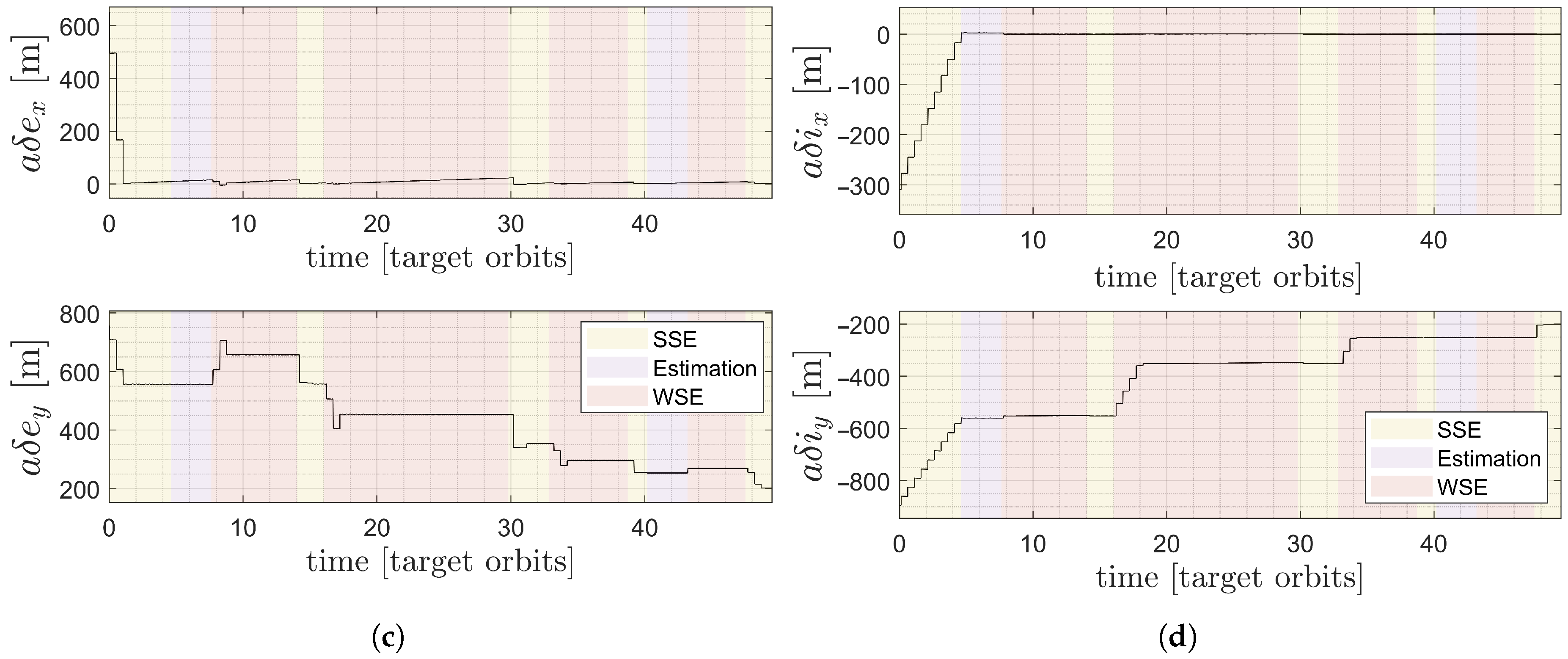
The growing interest among the scientific community towards an increase in spacecraft autonomy in rendezvous missions, mainly motivated by the reduction in operational load on control centers and inactivity periods due to coverage problems and large communication delays [12], is addressed in the presented work through the adoption of a rules-based architecture in the form of a layered, Finite State Machine (FSM). This approach defines the behavior of the chaser spacecraft using a state machine model, characterized by a set of predefined modes and transitions between them [17]. The use of an FSM has been recently formally proposed and studied by Vela et al. [18] in the context of formation maintenance and control, but a layered decision architecture for autonomous elliptic orbit rendezvous was also discussed by Peters and Strippoli [19]. At the highest level, this study implements guidance software that switches between a Walking Safe Ellipse (WSE) and a Stationary Safe Ellipse (SSE) state, based on the estimated value of the relative drift between satellites. Along with the definition of hold points and relative orbit sizes, the chaser can take autonomous decisions according to typical GO/NO-GO conditions which need to be satisfied in the rendezvous scenario [10]. Such a modeling technique makes the approach attractive from an implementation perspective, owing to the low computing power required and the predictability of the decisions being taken, and is also suitable for future adaptations to comply with new operational standards in close proximity operations.
The current study therefore presents a control architecture for autonomous rendezvous applications that can feasibly be reused across different scenarios with varying target eccentricities, while still complying with typical mission requirements. Although the use of a finite state machine as a control framework for embedded systems is not, in itself, a novel concept, the contribution of this work lies in its specific declination as a layered decision-making structure tailored to in-orbit rendezvous; to the best of the authors’ knowledge, such a formulation has not been extensively explored in the literature. In order to enable this architecture, a further significant contribution consists in the formulation of new closed-form impulsive guidance solutions for arbitrarily elliptic targets, derived from existing maneuvering schemes.
This paper is organized as follows. In Section 2, the necessary theoretical background on relative motion models is provided. Section 3 illustrates the process by which the different closed-form maneuvers are derived, whereas Section 4 provides details on the design of the finite state machine guidance used to autonomously execute a rendezvous mission scenario. Lastly, Section 5 illustrates numerical tests to separately validate the developed maneuvers (Section 5.1) and the integrated guidance software (Section 5.2).

2. Relative Motion Models

The research here presented is mostly developed within local reference frames, which are centered on the target spacecraft’s center of mass and rotate during its revolution around the Earth. They are used to describe the relative motion of the chaser with respect to the target, and two different types are considered (visualized in Figure 1):
1.
The Local-Vertical Local-Horizontal (LVLH) frame defines its z-axis aligned with the position vector, positive towards the Nadir direction, and the y-axis directed in the opposite direction to the target’s orbital angular momentum vector. The x-axis completes the right-handed triad. This frame is widely adopted in near-circular rendezvous research in the form of the Radial–Transversal–Normal frame (RTN), which slightly differs in the definition of the main axes ( X R T N = Z L V L H , Y R T N = X L V L H and Z R T N = Y L V L H ). In this work, the LVLH frame is only adopted when validating the developed closed-form maneuvers using a linear propagator based on the Yamanaka–Ankersen State Transition Matrix (STM) [20] (see Section 5.1).
2.
The Tangential (TAN) frame is obtained from the LVLH through a simple rotation in the orbit plane of the target equal to the flight path angle γ such that its x-axis is always aligned with the target velocity vector (the related rotation matrix can be found in Appendix A of [16]). Within this work, this frame is adopted both for control purposes in the derivation of the maneuvers as well as to assess the PAS of the rendezvous trajectory for eccentric targets. This is because for non-zero eccentricities the z coordinate of the LVLH frame becomes dependent on the along-track position of the relative orbit, significantly increasing the complexity of the safety evaluation [16]. Working in the TAN frame therefore allows the retention of simplicity in the analysis by only considering two dimensions (cross-track yz-plane, orthogonal to the velocity direction).

Relative Orbital Elements

The absolute state of a spacecraft orbiting around the Earth can be represented in a quasi-inertial frame centered on the planet using a set of Keplerian elements:
α = a e i Ω ω f or M ,
where a is the semi-major axis of the orbit, e the eccentricity, i the inclination, Ω the Right Ascension of the Ascending Node (RAAN), ω the anomaly of perigee and f the true anomaly of the satellite, whereas M is the mean anomaly.
Relative motion of the chaser spacecraft with respect to the target is instead parametrized using Relative Orbital Elements (ROEs), which are defined as nonlinear combinations of the Keplerian elements of the two spacecraft, defined in Equation (1). The quasi-nonsingular ROEs are defined as in the following:
δ α = δ a δ λ δ e x δ e y δ i x δ i y = ( a c a ) / a ( u c u ) + ( Ω c Ω ) cos i e x , c e x e y , c e y i c i ( Ω c Ω ) sin i ,
where δ λ is defined as the relative mean longitude between the spacecraft, and the eccentricity vector components e x = e · cos ω , e y = e · sin ω have been introduced. Quantities with the subscript < . > c refer to absolute elements of the chaser spacecraft, while elements without a subscript refer to the target. The introduced relative eccentricity and inclination vectors can also be expressed in polar notation as
δ e = δ e cos φ sin φ , δ i = δ i cos ϑ sin ϑ
where φ and ϑ respectively identify the pericenter and the ascending node of the relative orbit. Due to the definition of the set (given in Equation (2)), which matches the integration constants of the solution to the Clohessy–Wiltshire equations [21], the ROEs provide direct insight into the shape of the relative orbit for circular targets. Moreover, the concept of relative E/I separation establishes that the chaser spacecraft maintains non-vanishing minimum separation from the target on the cross-track plane if the vectors δ e and δ i are maintained collinear, provided that the shift a δ a of the orbit in the radial direction is less than the in-plane (IP) dimension a δ e [1].
The C-elements set generalizes this concept to arbitrarily elliptic targets and is defined as in the following [16]:
C = C 1 C 2 C 3 C 4 C 5 C 6 = η 2 Δ a 2 a e Δ e e Δ p p Δ e e p ( Δ ω + cos i Δ Ω ) a ( Δ ω + cos i Δ Ω + η 1 Δ M ) p ( cos ω Δ i + sin i · sin ω Δ Ω ) p ( sin ω Δ i sin i · cos ω Δ Ω )
where the semi-latus rectum of the orbit p = a η 2 and the eccentricity factor η = 1 e 2 have been introduced, while the notation Δ α refers to differences in orbital elements, computed as α c α . According to ref. [16], to generalize the relative E/I separation concept, the following in-plane (IP) and out-of-plane (OOP) phase angles and dimensions are introduced:
σ = atan2 ( C 3 / C 2 ) , β = atan2 ( C 6 / C 5 ) C I P = C 2 2 + C 3 2 , C O O P = C 5 2 + C 6 2
The newly defined vectors can again be expressed in polar notation, as in Equation (3):
δ e g e n = C I P cos σ sin σ , δ i g e n = C O O P cos β sin β
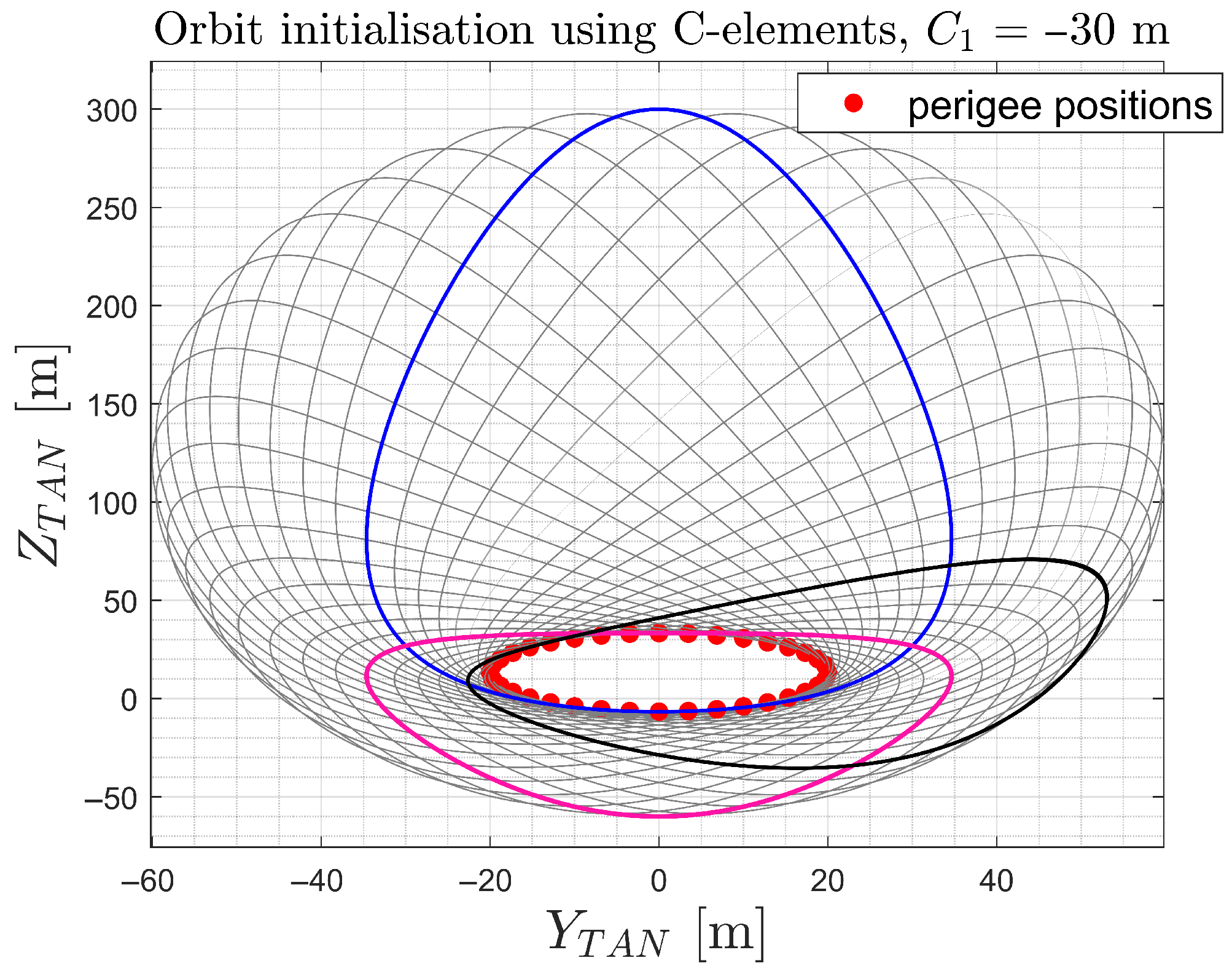
where δ e g e n and δ i g e n represent dimensional, generalized relative eccentricity and inclination vectors. In general, by imposing collinearity between the two and by only changing σ (or β ), a family of safe orbits is obtained, as shown in Figure 2.
To simplify the problem, safe sizing of the relative orbit can be achieved by considering the inner boundary (IB) of the trajectory family, which is formed by the perigee positions of each relative orbit:
y T A N I B = C O O P ( 1 + e ) sin ( f σ ) z T A N I B = ( C 1 + C I P · cos ( f σ ) ) ( 1 + e ) 2
The direct and inverse linear mappings used to convert between the quasi-nonsingular ROEs and C-elements are provided in Appendix A. These conversion matrices are always defined as long as i 0 and η 0 ( e 1 ), due to the singularities of the adopted sets of Relative Orbit Elements.

3. Closed-Form Maneuvers Using ROEs

This section describes the derivation of analytical impulsive control techniques starting from the GVEs expressed in a velocity-aligned frame, which can be retrieved from [22]. This set of equations was originally used as a tool to incorporate small perturbing accelerations, but can also be used in the context of impulsive control by integrating the perturbations to obtain a direct map between a velocity increment Δ v and a discrete change in orbital elements [21]. The adoption of impulsive control, which assumes that the propulsion system of the the controlled spacecraft can generate the commanded velocity change over a negligibly short time interval, allows the derivation of analytical formulations for the maneuvers and is justified in the present work by the use of thrusters which, as discussed in Section 5.2, are required to fire only for a few seconds. As shown by the numerical tests in [23], this approximation only leads to significant propagation errors for burns lasting several minutes and is therefore feasibly applicable to many rendezvous scenarios, with the clear exception of missions which employ low-thrust propulsion systems; in those cases, finite-burn solutions must be considered.
By substituting the GVEs into the definition of the quasi-nonsingular ROEs (Equation (2)), and by considering constant orbital elements of the target (not being maneuvered), the following input matrix is obtained:
Δ δ α = B T A N Δ v = 2 a v μ 0 0 2 sin f v 1 η 1 + η 2 r e η sin f v p 0 + 2 v + r cos f v a 1 η 1 + η 2 e cos ω v + 2 v cos ( ω + f ) e sin ω · r sin ( f + ω ) cos i h sin i r v a sin ( ω + f ) 2 e sin ω v 2 e sin ω v + 2 v sin ( ω + f ) e cos ω · r sin ( f + ω ) cos i h sin i r v a cos ( ω + f ) + 2 e cos ω v 0 r cos ( f + ω ) h 0 0 r sin ( f + ω ) h 0 Δ v x Δ v y Δ v z
where the input Δ v vector is also defined in the TAN frame. The following observations concern the derivation of B T A N :
  • It has been carried out under the linearizing assumption that, when computing each individual entry of B T A N , the target’s absolute orbital elements can be approximated as equal to those of the chaser.
  • It is valid for arbitrary eccentricities of the target, as no circularizing assumptions on e have been introduced. Still, it is not valid for equatorial orbits ( i = 0 ), owing to the singularity of the original ROEs set.
The derived input matrix can be used to build closed-form maneuvering schemes which are suitable for on-board implementation, and are discussed in the next sections.

3.1. Single-Point Maneuvers

In the current treatment, single-point maneuvers refer to impulsive control schemes which are executed at a single anomaly on the reference orbit. The objectives of this class of maneuvers include the following:
  • Control of the shape of the relative orbit by means of changes in the relative eccentricity δ e and inclination δ i .
  • Control of the drift of the relative orbit through changes in δ a .
Mathematically, a single-point scheme can provide complete control of the out-of-plane (OOP) motion (two desired variations and two unknowns (maneuver location and amplitude of OOP firing)), but the same cannot be achieved for the in-plane (IP) motion, which is characterized by four ROEs.

3.1.1. Out-of-Plane Control

From Equation (8) it is possible to see that a single firing in the OOP direction is sufficient to achieve a desired change in both components of the relative inclination vector. In fact, by defining the true argument of latitude of the maneuver as ϑ m a n = f m a n + ω , the location of the firing can be found by dividing the equation for Δ δ i y by the one for Δ δ i x :
ϑ m a n = atan2 ( Δ δ i y , Δ δ i x ) ( mod π )
whereas the magnitude of the firing can be found by taking the squared sum of the two equations and defining r = p / ( 1 + e cos f ) (conic equation from Keplerian motion):
Δ v y = μ a 1 + e cos f m a n η | | Δ δ i | |
where | | Δ δ i | | = Δ δ i x 2 + Δ δ i y 2 . Since the TAN and LVLH (or RTN) frames share the same OOP direction, the derived Equations (9) and (10) can also be found in Equation (39) of [7] with a sign change in the magnitude expression. This is because, as highlighted in Section 2, the RTN frame defines the OOP axis in the direction of the angular momentum, opposite to that of the defined TAN frame. It should be noted that Equation (9) provides two solutions for the firing anomaly, separated by a half orbit period. It should also be observed from Equation (10) that, in the general case for e 0 , the two locations yield different costs for the maneuver, meaning that the choice of either one could be based on timing or fuel minimization requirements.

3.1.2. In-Plane Shape Control

As introduced, the in-plane problem is more complex owing to the inter-dependencies and number of variables to be controlled, doubled with respect to the OOP case. Nevertheless, thanks to the adoption of the TAN reference frame, the problem can be simplified by only controlling the relative eccentricity components using single radial firings (along Z T A N ), which do not change the relative drift. While this choice goes against the typical objective of minimizing the maneuver cost through firings in the velocity direction, it allows decoupling of the walking (or stationary) motion of the relative orbit from shape corrections through changes in δ e . A similar procedure to the Δ δ i control may be followed. In fact, the true anomaly at which the firing needs to be delivered can once again be computed by taking the ratio of the equations modeling the effect of a radial firing onto the components of Δ δ e :
Δ δ e x Δ δ e y = r v a sin ( ω + f m a n ) + 2 e   sin ω v r v a cos ( ω + f m a n ) + 2 e   cos ω v
The solution is obviously less trivial in the non-circular case; still, by re-arranging Equation (11) as K 1 cos f + K 2 sin f = K 3 , the two potential locations of the maneuver can be computed using the auxiliary angle method [24]:
f m a n = arccos K 3 R + atan2 K 2 K 1 , f m a n = 2 π arccos K 3 R + atan2 K 2 K 1 C = Δ δ e x Δ δ e y , K 1 = C p a cos ω + 2 C e 2 cos ω + p a sin ω + 2 e 2 sin ω , K 2 = C p a sin ω + p a cos ω , K 3 = 2 C e cos ω 2 e sin ω , R = K 1 2 + K 2 2
whereas the magnitude of the radial firing is easily found by taking the squared sum of the two relevant equations:
Δ v z = | | Δ δ e | | v a η 2 r ( e 2 + 2 e cos f m a n + 1 )
where | | Δ δ e | | = Δ δ e x 2 + Δ δ e y 2 . Note that in the general case for e 0 , as also observed for the previous control scheme, executing the maneuver at either f m a n or f m a n yields different delta-v costs. Another point to be highlighted is the influence of the radial firing on the relative mean longitude δ λ , which determines the mean along-track position of the relative orbit. In fact, as will be seen in the numerical test in Section 5.1, a large maneuver required for in-plane phasing can move the chaser forward or backward with respect to the original position on the velocity direction. As for rendezvous applications, where inter-satellite distance has a crucial effect on operational safety, such coupling may generate an undesirable side effect. One way to cope with it is to select the one anomaly between the two computed which increases the absolute value of δ λ rather than reducing it. For the present application, higher priority is given to the reactivity of the control, since the single-point maneuvers used to correct Δ δ e will only be employed for small IP phase-angle correction maneuvers and consequently small movements on the along-track axis are considered negligible as long as passive safety is guaranteed.
A point which deserves considerably more attention is the observed coupling between OOP firings and undesired variations on δ e x and δ e y shown in Equation (8). Such an effect becomes problematic when the autonomous guidance schedules a relative orbit resizing in both the IP and OOP dimensions. To account for this, one possible solution is to express the OOP change in velocity from the last part of Equation (8) as
Δ v h = h r sin ( f + ω ) Δ δ i y
The actual required variations on the relative eccentricity components, accounting for the coupling effect produced by an OOP maneuver, become
Δ δ e x a c t u a l = Δ δ e x d e s e sin ω tan i Δ δ i y Δ δ e y a c t u a l = Δ δ e y d e s + e cos ω tan i Δ δ i y
where the superscript des is the desired change in δ e components and actual refers to the change to be obtained through in-plane delta-v components. Accordingly, this compensation scheme can be implemented in practice to cope with concurrent relative E/I separation corrections on both IP and OOP dimensions and is also valid for multiple-point maneuvers.

3.1.3. Relative Drift Control

In order to implement relative drift control the relative semi-major axis has to be changed. As shown by Equation (8), a single tangential impulse can be used at any point of the orbit; however, since tangential maneuvers also yield an effect on the other ROEs, a decision on the actual location of the correction has to be taken. In the context of rendezvous towards uncooperative targets, priority is given to enforcing PAS through E/I separation. Accordingly, the true anomaly of the firing is selected in such a way to always enlarge the relative orbit IP size, which is described by the squared sum of δ e x and δ e y . As underlined in the previous subsection, the tangential firing also has the effect of changing the relative mean longitude δ λ , but, according to the specific application of the rendezvous, this side effect is once again neglected in favor of maintaining safe E/I separation. Using the elements B 31 T A N and B 41 T A N from the input matrix, this means selecting an anomaly that satisfies both of the following equations:
sign ( Δ δ a ) · sign ( δ e x ) · ( A cos f B sin f + A e ) > 0 sign ( Δ δ a ) · sign ( δ e y ) · ( B cos f + A sin f + B e ) > 0 A = cos ω B = sin ω
Once the firing anomaly is picked, v can be computed and the required change in velocity is simply derived by inverting the first equation of Equation (8). Within this work, the anomaly is selected numerically by evaluating the two sign conditions over a discretized domain and retaining only the values of f that satisfy both inequalities. Among these feasible values, the guidance selects the one that minimizes the sum of the first and second equations of (16).

3.2. Multiple-Point Maneuvers

The previous subsections discussed the development of maneuvering schemes which are realized through a single change in velocity in one of the three directions identified by the TAN reference frame. To increase the control authority on the IP problem (i.e., the number of ROEs controlled in a single maneuver), the number of degrees of freedom available needs to be increased. The current section moves from known multiple-point maneuvering schemes from the relevant literature and provides a new closed-form for each which extends their validity to arbitrary eccentricities of the target spacecraft.

3.2.1. Three-Point Tangential Firing Scheme

This maneuver was first formulated for near-circular targets in the survey presented by Gaias and D’Amico [5] (maneuver ID: N 12 ) and proven to achieve the absolute minimum possible Δ v cost when the variation of the in-plane dimension Δ δ e is the dominant cost factor among the IP elements. Because of its predictability and efficiency, the scheme was selected for implementation in the control layer for the autonomous guidance software of the AVANTI experiment [25] and studied in successive publications. In particular, in ref. [6,7] it was argued that the minimum Δ v bound for in-plane reconfiguration found in [5] could be easily extended to eccentric targets, and the scheme was reformulated for unperturbed elliptic orbits. However, because of the adoption of the LVLH frame in both derivations, the maneuver locations could only be provided as a formula to be solved iteratively (see Equation (44) of [7]).
Since the location of the firings needs to be aligned along the desired Δ δ e direction, these can be found by once again taking the ratio of the B T A N 31 and B T A N 41 elements of the derived input matrix from Equation (8):
Δ δ e x Δ δ e y = e cos ω + cos ( ω + f m a n ) e sin ω + sin ( ω + f m a n )
By again using the auxiliary angle method as in Equation (12) the solution is computed as
f m a n = arccos K 3 R + ξ , f m a n = 2 π arccos K 3 R + ξ K 1 = Δ δ e x Δ δ e y sin ω cos ω , K 2 = Δ δ e x Δ δ e y cos ω + sin ω , K 3 = e cos ω Δ δ e x Δ δ e y e sin ω , R = K 1 2 + K 2 2 , ξ = atan2 K 2 K 1
The true anomalies of the maneuvers f m a n and f m a n represent the two points per orbit where the firing may be delivered. Logically, if the maneuver execution time is to be minimized and the next closest anomaly to the chaser’s current position is f m a n , the three maneuvering points to consider are [ f m a n , f m a n , f m a n + 2 π ] . Accordingly, it can be proven that the minimum required time duration of the reconfiguration (since the moment the maneuver is computed) is 1.5 orbits. Alternatively, if fuel minimization represents a more stringent requirement, the planner may prioritize the use of the one opportunity per orbit which requires a smaller Δ v . Other types of mission constraints may also require spreading the firings over larger time periods.
As for the firing amplitudes, they are derived by considering the effect of the i-th firing and unperturbed Keplerian propagation (modeled from time t i to t j with the STM Φ i j ) to express the evolution of the in-plane ROEs as δ α F = Φ 0 F δ α 0 + i = 1 3 Φ i F Δ δ α i , where the subscripts < . > 0 and < . > F respectively define initial and final conditions of the maneuver. By expressing each component one obtains
Δ δ a = δ a F δ α 0 = 2 a v 1 μ δ v T 1 + 2 a v 2 μ δ v T 2 + 2 a v 3 μ δ v T 3 Δ δ λ = M 0 F δ a 0   +   M 1 F 2 a v 1 μ δ v T 1   +   M 2 F 2 a v 2 μ δ v T 2   +   B 21 1 δ v T 1   +   B 21 2 δ v T 2   +   B 21 3 δ v T 3 Δ δ e x = B 31 1 δ v T 1 + B 31 2 δ v T 2 + B 31 3 δ v T 3 Δ δ e y = B 41 1 δ v T 1 + B 41 2 δ v T 2 + B 41 3 δ v T 3
M i j = 3 2 n ( t j t i )
where B k j i refers to the k j component of the input matrix and is evaluated at the time instant of the i-th firing. It should be noted that the maneuver is concluded after the third firing, hence t 3 = t F and the propagation term M 3 F is zero. Once the spacing between the three burns is fixed, the three unknown firing amplitudes can be obtained by only considering three equations of Equation (19):
μ 2 a Δ δ a Δ δ λ M 0 f δ a 0 Δ δ e x = v 1 v 2 v 3 B 21 1 + M 1 F 2 a v 1 μ B 21 2 + M 2 F 2 a v 2 μ B 21 3 B 31 1 B 31 2 B 31 3 δ v T 1 δ v T 2 δ v T 3 = v 1 v 2 v 3 C 1 * C 2 * C 3 D 1 D 2 D 3 δ v T 1 δ v T 2 δ v T 3 = M · δ v T
The closed-form solution is found by analytically inverting the matrix:
δ v T 1 δ v T 2 δ v T 3 = 1 | M | C 2 * D 3 C 3 D 2 v 2 D 3 + v 3 D 2 v 2 C 3 v 3 C 2 * C 1 * D 3 + C 3 D 1 v 1 D 3 v 3 D 1 v 1 C 3 + v 3 C 1 * C 1 * D 2 C 2 * D 1 v 1 D 2 + v 2 D 1 v 1 C 2 * v 2 C 1 * μ 2 a Δ δ a Δ δ λ M 0 f δ a 0 Δ δ e x | M | = v 1 ( C 2 * D 3 C 3 D 2 ) v 2 ( C 1 * D 3 C 3 D 1 ) + v 3 ( C 1 * D 2 C 2 * D 1 )
It should be noted that the matrix M becomes singular in the case in which the user chooses to use the same true anomaly for all three firings (as two rows of M become proportional), even if separated by integer multiples k of the orbit period; this means that both f m a n and f m a n ( + 2 k π ) need to be used at least once. Taking this into account, the presented formulation provides a new closed-form solution to the three-point tangential maneuver for arbitrarily eccentric target orbits, building upon previous generalization efforts found in [6,7].

3.2.2. Two-Point Radial Firing Scheme

In terms of fuel consumption, the in-plane reconfiguration using tangential firings is physically more efficient than the radial ones owing to the higher controllability of the orbit energy in the velocity direction. Nonetheless, in some scenarios the reduced influence of radial maneuvers on the orbital energy can be considered as a benefit:
  • By employing radial burns only, the effect of thrust errors on the in-plane elements is minimized and higher control accuracy can be achieved, as demonstrated by the flight results of the SAFE formation flying guidance experiment [2];
  • A maneuvering scheme which does not impact the relative drift can increase passive safety in formations where a separation on the relative longitude needs to be maintained. In many rendezvous applications, radial maneuvers are also used in the V-bar approach to safely close the distance to the target using “hops” [26].
Lim and Mok [8] proposed two and three-point schemes using radial burns in circular target orbits; to generalize the idea to eccentric reference orbits, the TAN frame is adopted once again to define the control scheme.
In this problem only the changes of three IP components can be commanded, since δ a is not controllable through radial burns. Accordingly, two firings are sufficient to grant full controllability of the problem. The idea is once again to choose the true argument of latitude of the firings in such a way that the individual corrections on δ e are collinear to the total desired Δ δ e ; therefore, the two locations can be computed according to Equation (12). As in the previous scheme, the choice on the maneuver locations (which is the same as the one found in [8] for delta-v-optimal reconfiguration with circular targets) allows minimizing the distance traveled in the space of δ e x / δ e y , making this maneuver a (sub-)optimal choice for in-plane size reconfiguration.
The amplitudes are also computed in a similar way to the previous scheme:
Δ δ λ = M 0 F δ a 0 + B 23 1 δ v R 1 + B 23 2 δ v R 2 Δ δ e x = B 33 1 δ v R 1 + B 33 2 δ v R 2 Δ δ e y = B 43 1 δ v R 1 + B 43 2 δ v R 2
M i j = 3 2 n ( t j t i )
Upon inversion of the first two parts of Equation (22) one obtains
δ v R 1 δ v R 2 = 1 B 23 1 B 33 2 B 33 1 B 23 2 B 33 2 B 23 2 B 33 1 B 23 1 Δ δ λ M 0 F δ a 0 Δ δ e x
Once again, the algorithm gives freedom in the choice of the firing locations ( f m a n / f m a n + 2 k π ) but choosing the same anomaly for both leads to a singularity in the matrix to invert. It should also be highlighted that, since in general δ a 0 0 , the correction on δ λ strongly depends on the final time considered t F , which determines M 0 F . The presented formulation provides a new closed-form solution to the two-point radial firing maneuver. It represents one of the possible generalizations of the two-point algorithm presented in [8] to arbitrarily eccentric targets. For the current application, a three-point scheme, adopted in [8] only to more evenly distribute the impulses, is not considered since the number of degrees of freedom is already sufficient to control the three in-plane variables δ e x , δ e y and δ λ .

3.2.3. Two-Impulse Non-Drifting Transfer Scheme

Peters et al. [9] provided the generalization of the classic “radial hop” maneuver from rendezvous in circular orbits to elliptic, using both a Cartesian and a differential orbit elements formulation. The second of these, which provides a more intuitive parametrization for moving between safe relative orbits, is, however, singular for orbits with zero eccentricity owing to the adoption of the differential elements. To provide a formulation which is singularity-free with respect to the value of the target eccentricity, the set of quasi-nonsingular ROEs is used instead to follow a similar derivation. This maneuvering scheme represents the particular case of δ a 0 = 0 of the scheme described in Section 3.2.2. A further feature is that, instead of fixing the firing locations a priori, this design offers flexibility on the choice of the first anomaly of the burn.
Zero Initial Relative Drift
The algorithm is first developed by assuming δ a 0 = 0 . A further simplification of the overall derivation relies on the fact that the submatrix of the unperturbed STM describing the evolution of the three IP elements is equal to the identity matrix if δ a = 0 . This allows us to write the propagation equation from the first to the second point of the maneuver as
δ α 2 + = δ α 1 + B { 2 : 4 , 3 } | 1 δ v R 1 + B { 2 : 4 , 3 } | 2 δ v R 2
where the notation | i indicates which of the two burns the quantities refer to, while the superscript i + / denotes whether the ROE state is achieved immediately before or after the impulsive maneuver. By expanding the previous equation, it is possible to obtain ( ϑ = f + ω ):
δ λ 2 + δ λ 1 δ e x , 2 + δ e x , 1 δ e y , 2 + δ e y , 1 = 2 v + r cos f v a 1 η 1 + η r v a sin ϑ 2 e sin ω v r v a cos ϑ + 2 e cos ω v 1 δ v R 1 v 1 + 2 v + r cos f v a 1 η 1 + η r v a sin ϑ 2 e sin ω v r v a cos ϑ + 2 e cos ω v 2 δ v R 2 v 2
where v indicates the factorization of the velocity term outside of the bracket. By expressing r = a η 2 / ρ , where ρ = 1 + e cos f , the velocity impulses can be scaled using the formula
δ v ˜ = δ v R ρ v
The Equation (25) can be reorganized in the following form:
δ λ Δ v , 1 δ λ Δ v , 2 δ e x , Δ v , 1 δ e x , Δ v , 2 δ e y , Δ v , 1 δ e y , Δ v , 2 δ v ˜ 1 δ v ˜ 2 = Δ δ λ Δ δ e x Δ δ e y where : δ λ Δ v = 2 ρ + η 2 cos f 1 η 1 + η δ e x , Δ v = η 2 sin ν 2 ρ e sin ω δ e y , Δ v = η 2 cos ν + 2 ρ e cos ω
The Equation (27) represents three equations in the three unknowns δ v ˜ 1 , δ v ˜ 2 and f 2 . Using two equations of (27) (the second and third are arbitrarily picked) it is possible to find the expressions for the scaled velocity changes as
δ v ˜ 1 = δ e x , Δ v 2 Δ δ e y δ e y , Δ v 2 Δ δ e x δ e x , Δ v 2 · δ e y , Δ v 1 δ e y , Δ v 2 · δ e x , Δ v 1 δ v ˜ 2 = δ e y , Δ v 1 Δ δ e x δ e x , Δ v 1 Δ δ e y δ e x , Δ v 2 · δ e y , Δ v 1 δ e y , Δ v 2 · δ e x , Δ v 1
The scaled velocities found in Equation (28) can be substituted into the first of (27). By simplifying the resulting equation and expressing it as a function of the only unknown f 2 , it is possible to once again arrive at the familiar trigonometric form K 1 cos f 2 + K 2 sin f 2 = K 3 and solve it using the already employed auxiliary angle method (see Equation (18)), the respective coefficients of which are reported in Appendix B. To summarize, the maneuver computation takes on the following steps:
1.
The maneuver is called at an arbitrary anomaly f 1 ;
2.
The anomaly of the second firing is computed through the auxiliary angle method solution (Equation (18)) using the provided coefficients K 1 , K 2 , and K 3 . Two solutions are found; the implementation needs to select the anomaly which is neither coincident with f 1 nor separated by a full orbit period, avoiding the singularity found in Equation (28) for a transfer angle ϕ = f 2 f 1 = 2 k π . Note that this singularity is the same as the one found for the more general formulation in Section 3.2.2.
3.
The amplitude of the two required radial firings can be retrieved using (26) and (28).
Non-Zero Initial Relative Drift
To nullify an initial non-zero relative drift δ a 0 , the first velocity needs to include a component along the velocity direction. The tangential component of the first firing δ v T 1 is found from the first equation of Equation (8), where the velocity v is computed on the first arbitrary point of the maneuver f 1 . The effect of δ v T 1 can easily be accounted for in the rest of the derivation by defining a “reduced” set for the remaining ROEs:
δ λ δ e x δ e y R E D = δ λ δ e x δ e y 0 + B 21 1 B 31 1 B 41 1 · δ v T 1
These reduced elements are essentially the initial conditions to be used in the two-pulse radial non-drifting transfer described in the previous case, with δ α 1 = δ α R E D .
From an operational point of view, the non-drifting transfer gives complete freedom in the selection of the first anomaly of the maneuver, which can therefore be executed at any point along the orbit. This paves the way for possible improvements in the algorithm based on what has already been discussed in Section 3.1.3. The first tangential firing can, for example, be placed in such a way to enforce the PAS of the approach by minimizing the IP re-phasing of the intermediate configuration. Such a feature would enable an even safer transfer between the initial and final relative orbits, which are characterized by relative E/I separation. Moreover, if the first of the radial firings is executed at a different point on the orbit with respect to the tangential one, its anomaly can also be picked to achieve a safe maneuver or one which minimizes its fuel cost.
To conclude this section, a high-level summary of the presented maneuvering schemes is provided in Table 1, where the use cases, advantages and disadvantages of each solution are briefly discussed.

4. Guidance Layer Definition

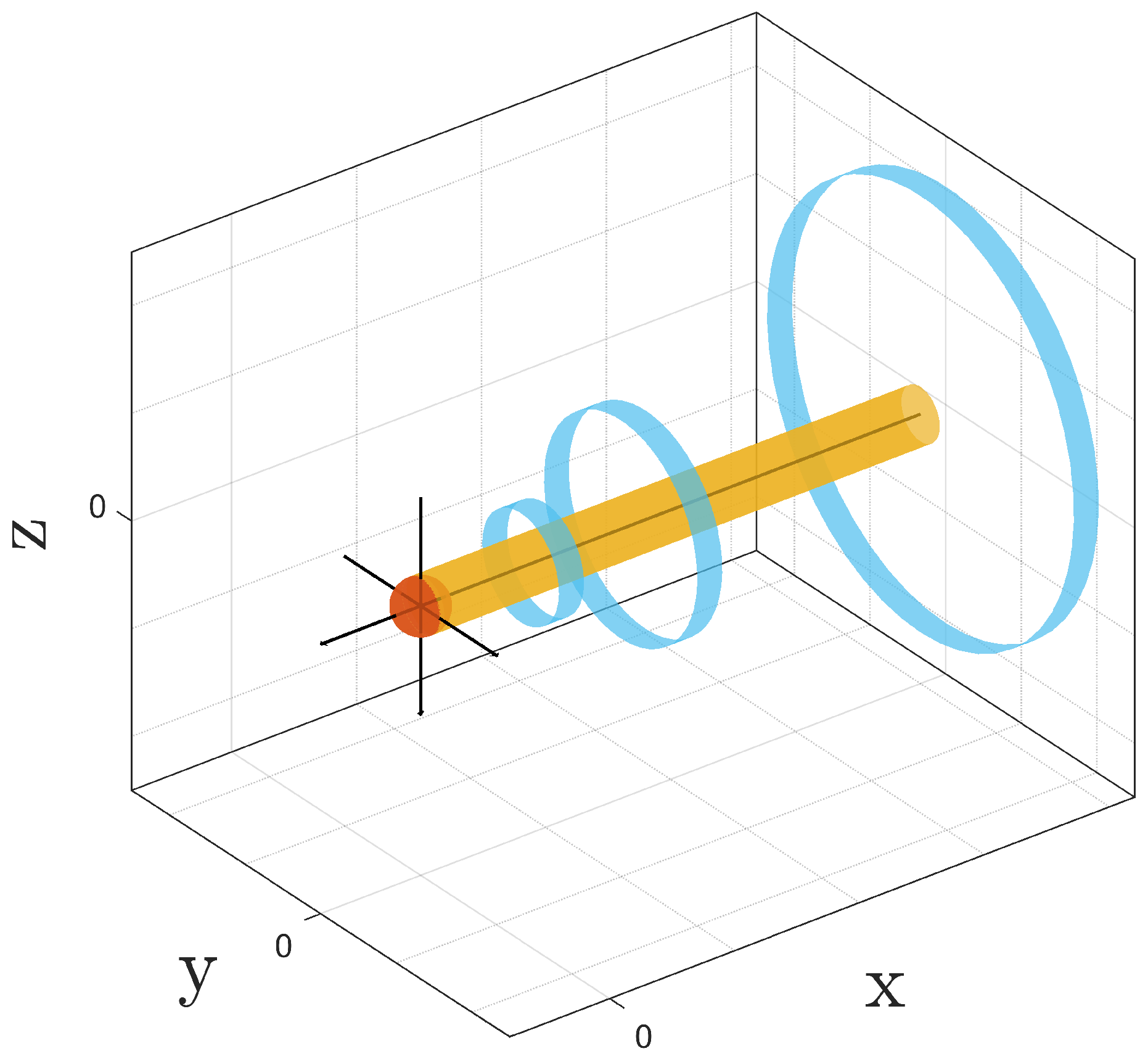
Having completed the development of the manoeuvring schemes which change the relative state of the chaser spacecraft, the discussion can now shift to the higher layer of the guidance software, defined to meet typical mission requirements and constraints. To build a finite state machine logic around the rendezvous concept, a geometry of the approach region which may be generalized to a variety of missions is devised and is visualized in Figure 3.
A spiraling trajectory is selected, characterized by the following features:
  • Based on the definition of a cross-track size of a KOZ around the target position (in red), a safety tube (in orange) is considered around the along-track axis x in order to enforce PAS for the entirety of the approach.
  • The approach trajectory is based on the definition of a series of holding states (or gates, in light blue) which are defined by two characteristics:
    -
    A waiting time, during which the chaser is required to station-keep (maintain its position and relative orbit), allowing it to accommodate a variety of functions, including switch of sensors for relative navigation and holding for convergence of filters or ground contact. In the presented test cases the waiting times are predefined as input parameters, but they can potentially be decided autonomously by the spacecraft and fed as input to the guidance function.
    -
    A geometric size, which defines the nominal position and allowed excursion of the center of the stationary relative orbit along x, as well as minimum distances (margins) to be maintained from the safety tube when sizing the relative trajectory.
Ultimately, the realization of the FSM is based on the autonomous maneuvering capability of the chaser to switch between two main states: a Walking Safe Ellipse (WSE) and a Stationary Safe Ellipse (SSE) state, which are distinguished mainly by the value of the estimated relative drift δ a .
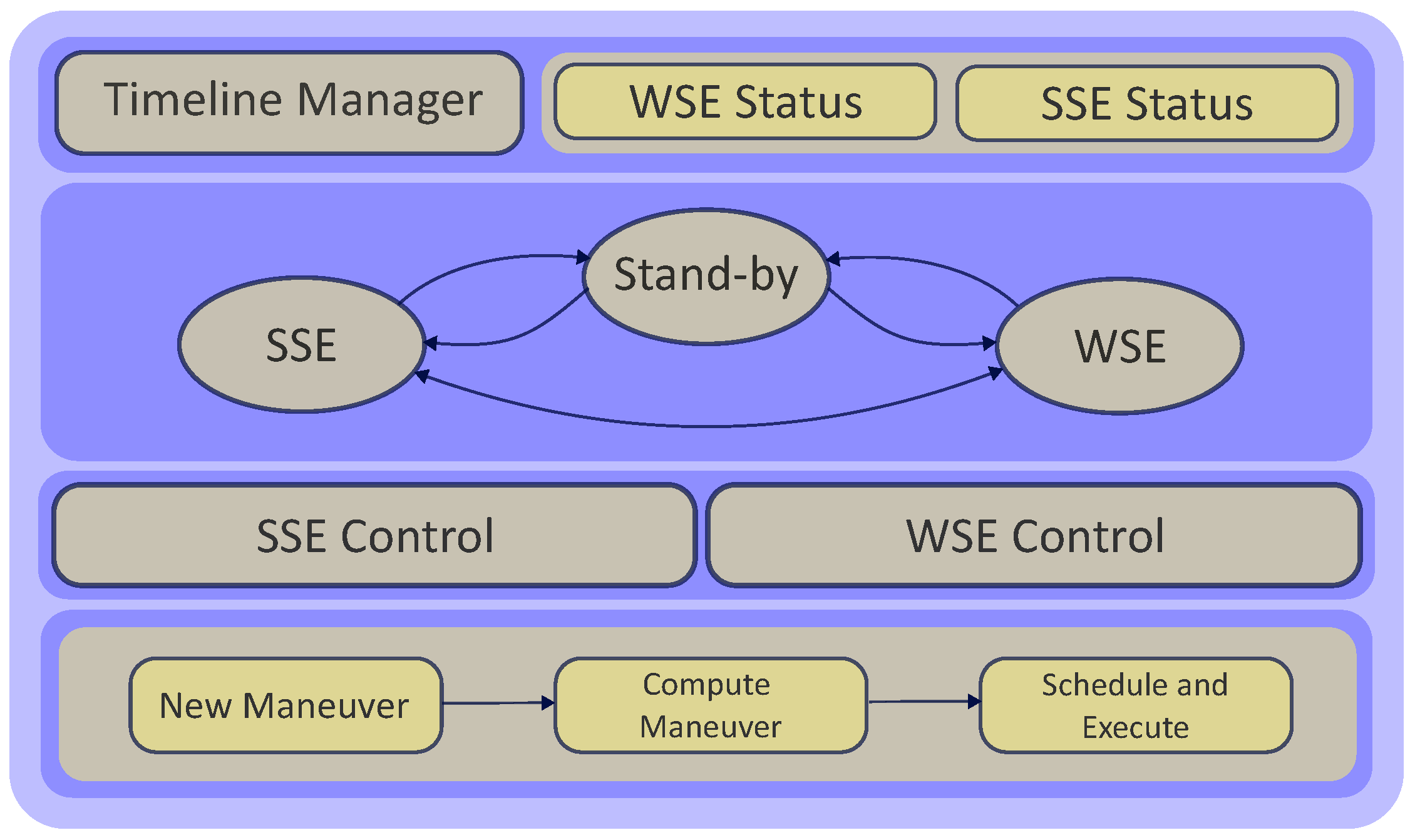
Figure 4 provides a visualization of the layered structure of the implemented state machine, based on the MATLAB/Stateflow model. At the upper layer, three truth tables command the high-level behavior of the agent: the Timeline Manager evaluates whether the chaser spacecraft is outside or inside the prescribed next hold point based on the definition of error bands, which should be related to the expected control and navigation performance, whereas the WSE/SSE status analyzes the current relative orbit to decide whether a certain type of correction needs to be applied. For example, an SSE characterized by an estimated drift a δ a higher than a prescribed threshold is termed as “drifting”. The information from the higher layer is then used as in the following:
  • Decisions from the timeline manager determine the transitions between the main states of the FSM, in practice commanding to stop or move the relative orbit in a specific direction. As will be discussed in Section 5.2, these decisions can also be based on concurring objectives such as estimation of differential drag effects.
  • Classification from the WSE/SSE status truth tables is used to inform decisions in the control layer to choose the proper maneuver within the guidance library (see Section 3).
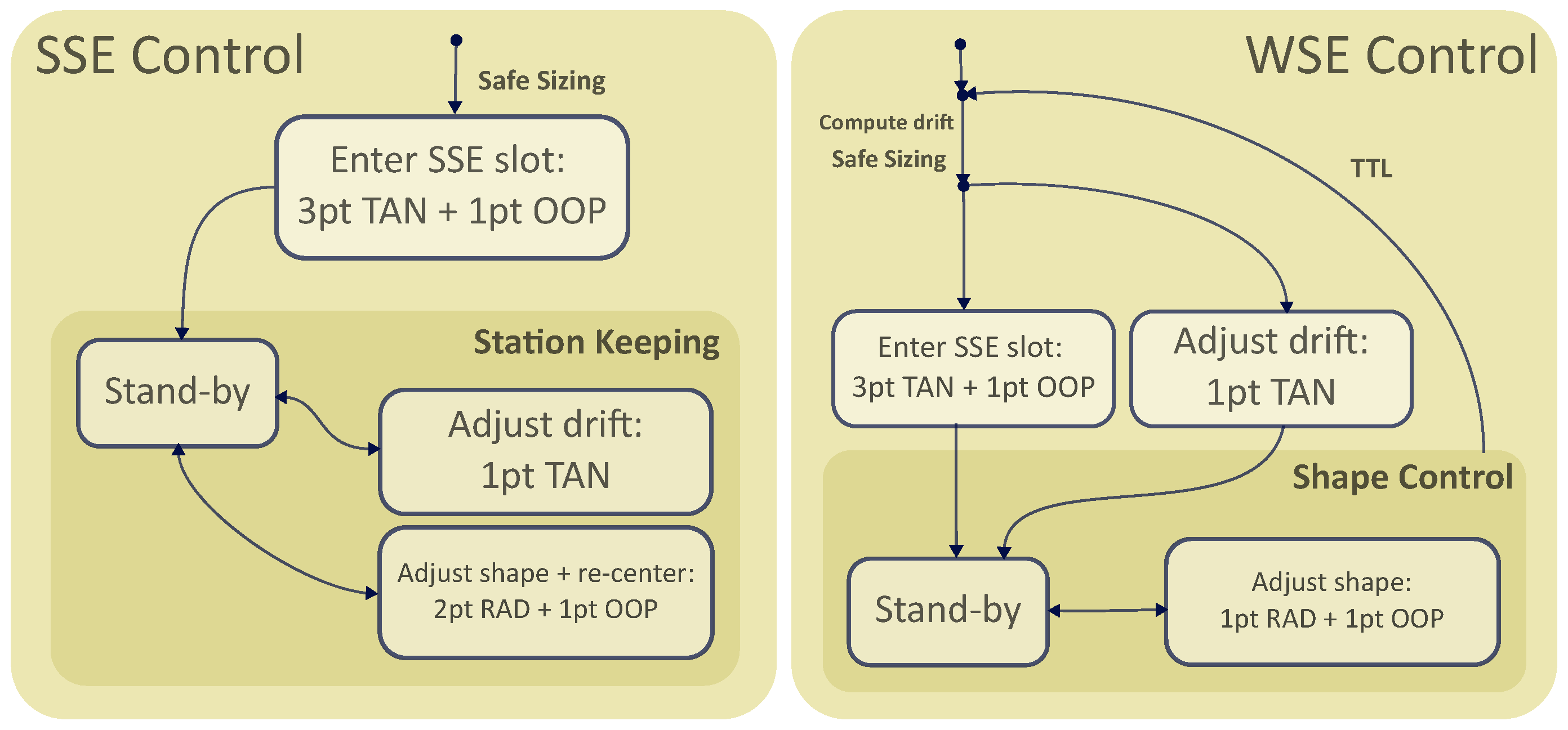
Lastly, the lower layer implements maneuver computation and execution and interfaces the guidance software with the thrusters model used to command the spacecraft, and is not discussed in detail. Figure 5 illustrates the structure of the control layer for the WSE and SSE states.
As can be seen from the figure, both states benefit from the decoupling between drift and shape corrections obtained by adopting a velocity-aligned reference frame for the control; moreover, whenever both an IP and OOP maneuvers are commanded, the relative eccentricity precompensation scheme illustrated in Equation (15) is adopted. Further observations on the structure presented in Figure 5 are discussed:
  • Transitions to the stand-by (or waiting) states are triggered by completion of a selected maneuver scheme, communicated by the lowest layer in Figure 4.
  • “Safe Sizing” refers to a call to a function that returns the relative eccentricity and inclination components based on user-defined margins to be maintained from the KOZ on the cross-track plane and the nominal drift.
  • Given user-defined minimum and maximum drift values of the WSE, “Compute drift” provides the necessary a δ a to reach the next hold point in a prescribed time. The function is called again if after the drifting time the SSE state has not been reached yet, triggered by temporal transition logic (TTL). If the chaser reaches the next hold point within the drifting time, the guidance simply switches to the SSE control submodule.
It is emphasized here that the presented approach can be explicitly tied to any specific mission timeline (defined in terms of, e.g., holding and drifting periods), a feature that is particularly valuable for mission management and ground support of ongoing operations. The following subsections detail the external functions called by the FSM during SSE and WSE control.

4.1. Safe Relative Orbit Sizing

To ensure PAS for any eccentricity of the target orbit, safe relative orbit sizing is based on the described relative orbit C-elements (see Section 2). In their dedicated section, it was shown how the inner bound of the family of orbits generated by different IP phasing γ of the generalized eccentricity vector could be used to conservatively size the relative orbit. Based on Equation (7), the in-plane and out-of-plane dimensions can be computed as in the following:
C I P = | C 1 | + ( K O Z Z + M Z ) · ( 1 + e ) 2 C O O P = ( K O Z Y + M Y ) · ( 1 + e )
where C 1 can be computed on the nominal drift of the relative orbit and K O Z and M refer to the keep-out-zone and the defined margin sizes, respectively, of the next waypoint along a particular dimension. To choose a phasing for the vectors, the OOP component was selected in order to minimize stationkeeping effort against perturbations; in fact the effect of J 2 on the relative inclination vector is contained by adopting a configuration with δ i x = 0 (a different choice on the phasing of the IP/OOP vectors might be needed to enhance visibility on the target spacecraft, for example to support vision-based navigation.), which according to the ROE definition in Equation (2) implies having two orbits with the same inclination. This same choice has also been adopted in past technology demonstrations such as in [1,25]. From the direct mapping in Appendix A, this means that
C 5 = sin ω · δ i y , C 6 = cos ω · δ i y
from which the phasing β can be computed according to Equation (5). The IP phasing γ can then be fixed on either a parallel or anti-parallel condition, depending on the initial state. The C-element state vector can then be converted to the quasi-nonsingular ROE set to be used to call the guidance maneuvers.

4.2. Relative Drift Computation

As already stated, this function is used by the FSM to compute the relative drift δ a required to reach the next waypoint. In order to preserve efficiency against differential drag perturbations, the computation also accounts for the estimated change rate δ a ˙ . Taking into account the effect of a piece-wise constant δ a ˙ the evolution of the relative mean argument of longitude, derived from linearized relative motion [4], can be written as
Δ δ λ = 3 2 n τ δ a 0 3 4 n τ 2 δ a ˙
where τ = ( t t 0 ) . The main ideas of the algorithm are the following:
1.
A nominal user-defined drift period τ between two waypoints is considered and used to compute the relative drift required by inverting Equation (32).
2.
Having defined limit values a δ a M I N and a δ a M A X , if the absolute value of the relative drift a δ a 0 to be commanded is either too high or too low the value is saturated and the drifting time is recomputed by solving Equation (32) for τ . Care must be taken in the presence of opposing differential drag ( δ a ˙ · Δ δ λ > 0 ) and of maximum saturation of the drift value, in which case it might be possible that the next waypoint cannot be reached with a single firing. By setting the discriminant of the quadratic Equation (32) equal to zero the maximum distance that can be traveled is found as
Δ δ λ M A X = 3 4 n δ a 0 2 δ a ˙
for which the drifting time can be computed.
3.
The relative drift to command is used to safely size the relative orbit as explained in the previous section and the drifting time is used as an argument in the TTL condition in Figure 5.

5. Results

This section details the numerical tests that have been conducted to validate both the developed closed-form maneuvers as well as the integrated guidance software. First, Section 5.1 uses a linear propagator based on the Yamanaka–Ankersen STM [20] for unperturbed relative motion to verify the correct derivation of the maneuvers by impulsively changing the chaser’s orbital velocity. The presented tests use close-range scenarios to avoid introducing significant linearization errors. Secondly, Section 5.2 analyses the results obtained by completing two distinct rendezvous scenarios in a high-fidelity simulator which integrates the nonlinear equations of motion of the two satellites considering a complex gravitational model which accounts for the Earth’s mass distribution as well as orbit perturbations, including a differential drag model based on the geometry of the two satellites.

5.1. Maneuvers Using Linear Propagation

5.1.1. Out-of-Plane Control

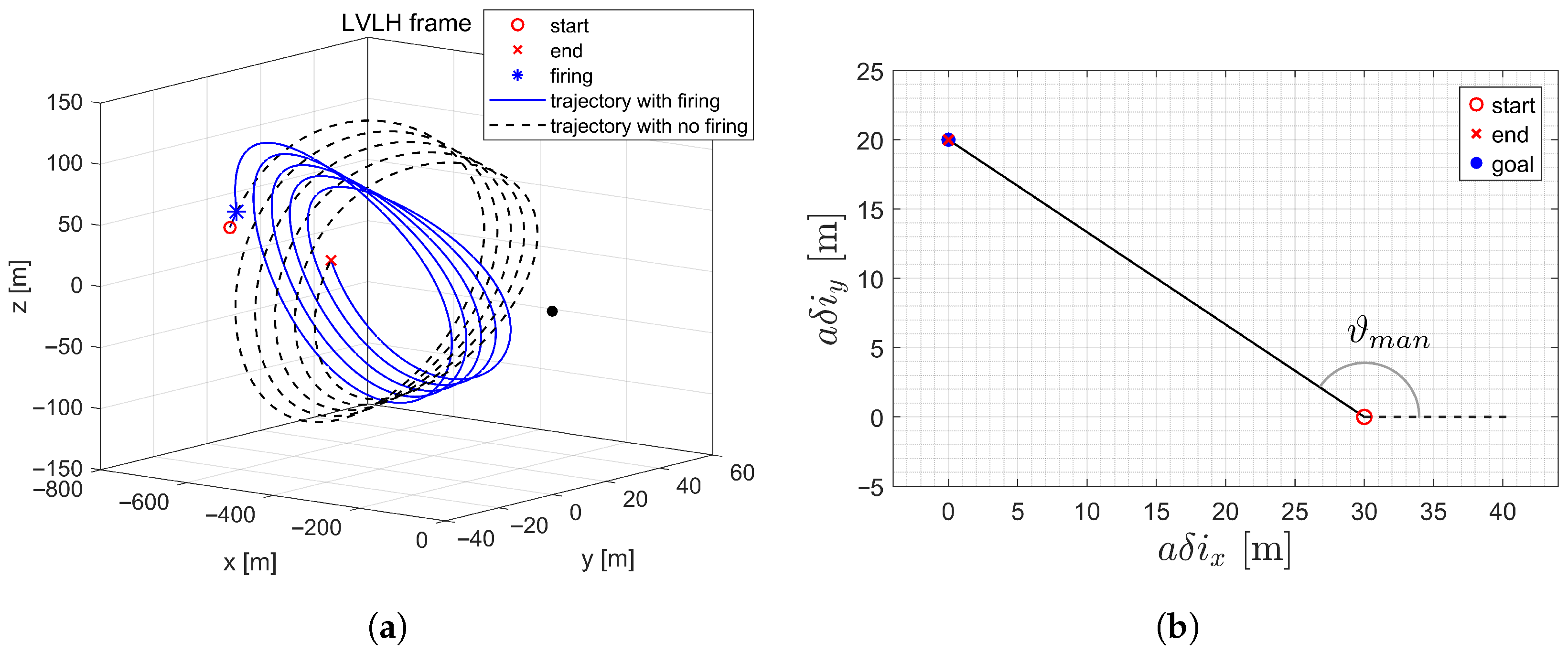
Table 2 presents the initial and final conditions used to test the maneuver in the linear propagator, which takes as input a guidance Δ v table specifying firing time (computed through Kepler’s law from f m a n ) and x , y , z components of the velocity change.
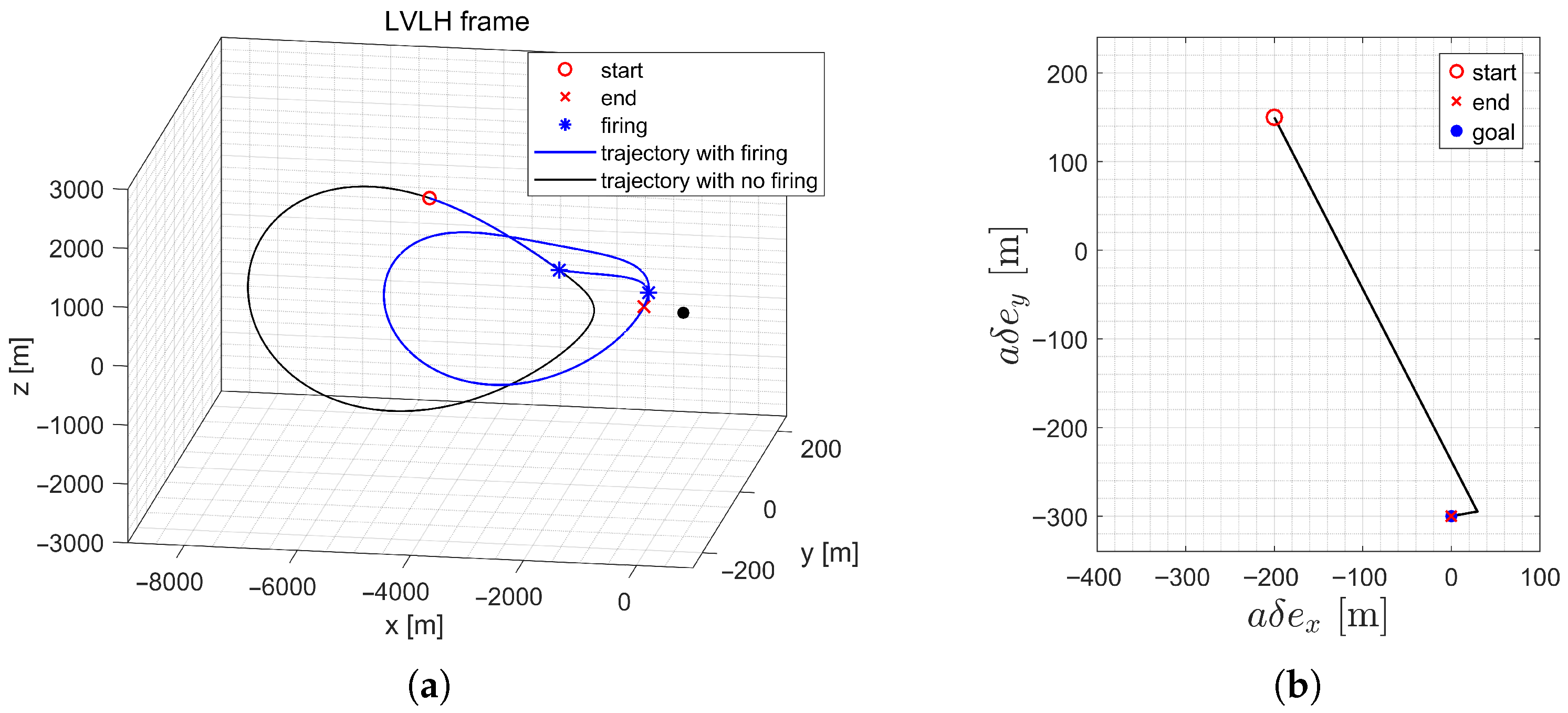
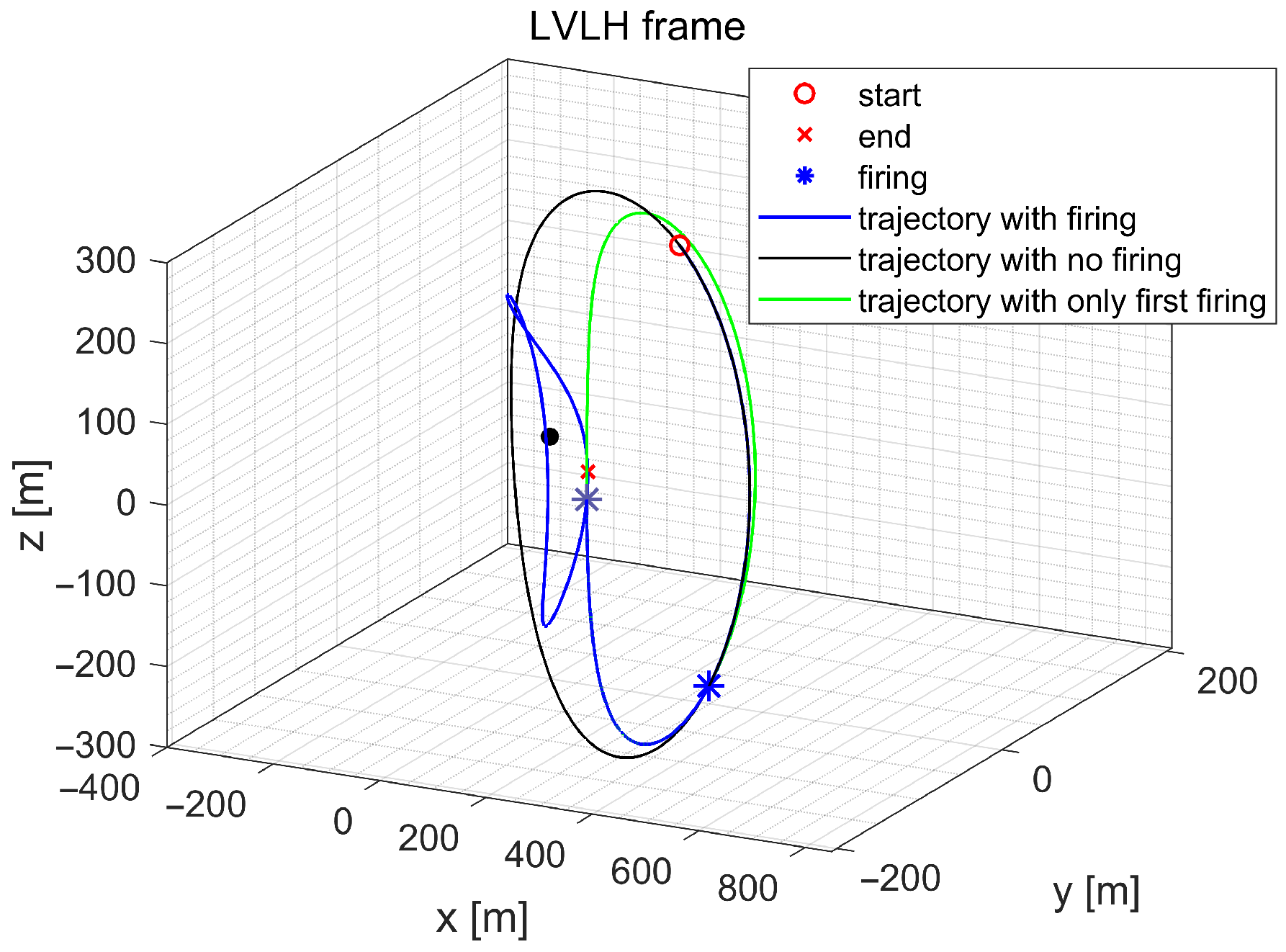
The results of the propagation for five orbital periods are plotted in Figure 6. On the left side, the trajectory evolution in the target LVLH frame is shown, while the right side showcases the values of relative inclination over time, plotted in the δ i x / δ i y plane.
Because of the unperturbed ideal propagation, the values taken by δ i x / δ i y are changed when the impulsive velocity jump is applied. A further observation is that the trajectory with firing in the LVLH space periodically intersects the original one (two times per orbit) on the relative descending and ascending nodes between the initial/final relative orbit. Indeed, these are the locations of the possible single-burn plane-change maneuvers f m a n , which are found by solving Equation (9) or graphically from the true argument of latitude ϑ m a n spanned from the axis δ i x .

5.1.2. In-Plane Shape Control

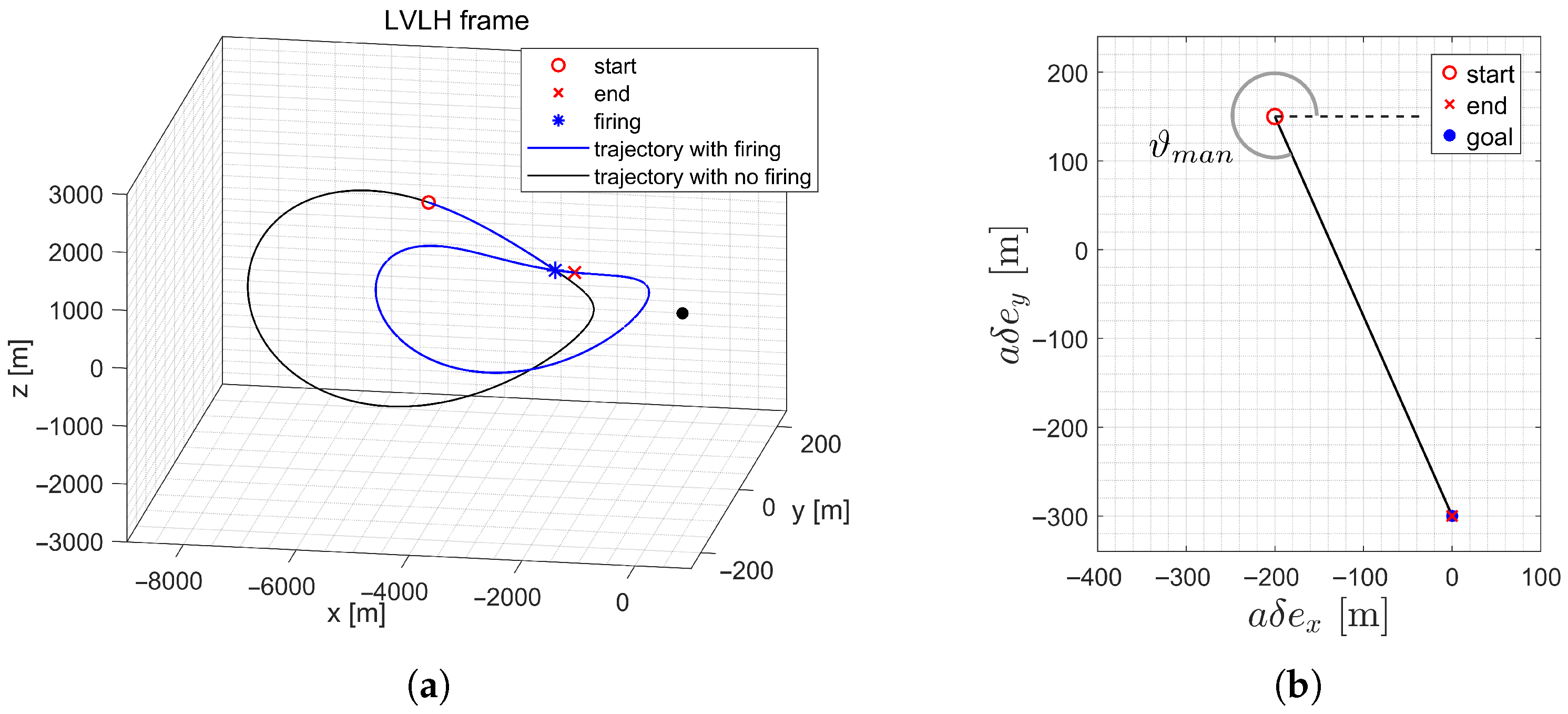
The single-point maneuver is validated using the linear propagator with data reported in Table 3.
The resulting LVLH trajectory is reported on the left of Figure 7, whereas the time evolution of the in-plane ROEs, plotted in the δ e x / δ e y plane, is illustrated on the right side.
Once again, a single-pulse maneuver is able to achieve the desired change in the components of the relative eccentricity vector, and the developed function picks the closest maneuvering anomaly between the computed f m a n and f m a n ; moreover, as also confirmed by the evolution of a δ a over time, it can be seen that the initial and final orbits are both stationary thanks to the velocity change in the radial direction.
A further test is presented to validate the precompensation scheme presented in Equation (15), which accounts for the coupling between in-plane elements and velocity changes in the out-of-plane direction for arbitrarily eccentric targets. The same absolute orbital elements given in Table 3 are used, but the final ROEs are defined in Table 4.
The results of the linear propagation obtained by calling both maneuvering functions validated so far and by using the described compensation scheme in Equation (15) are shown in Figure 8.
As it can be seen, the precompensation allows us to precisely account for the deviation of Δ δ e caused by the OOP firing (which is visualized as the second smaller jump on the right plot of Figure 8), successfully reaching the desired point in the phase plot. It should be noted that the same results would have been obtained if the OOP maneuver had been executed first, leaving to the on-board guidance the freedom to choose to execute the IP maneuver at either the f m a n or f m a n anomaly.

5.1.3. Relative Drift Control

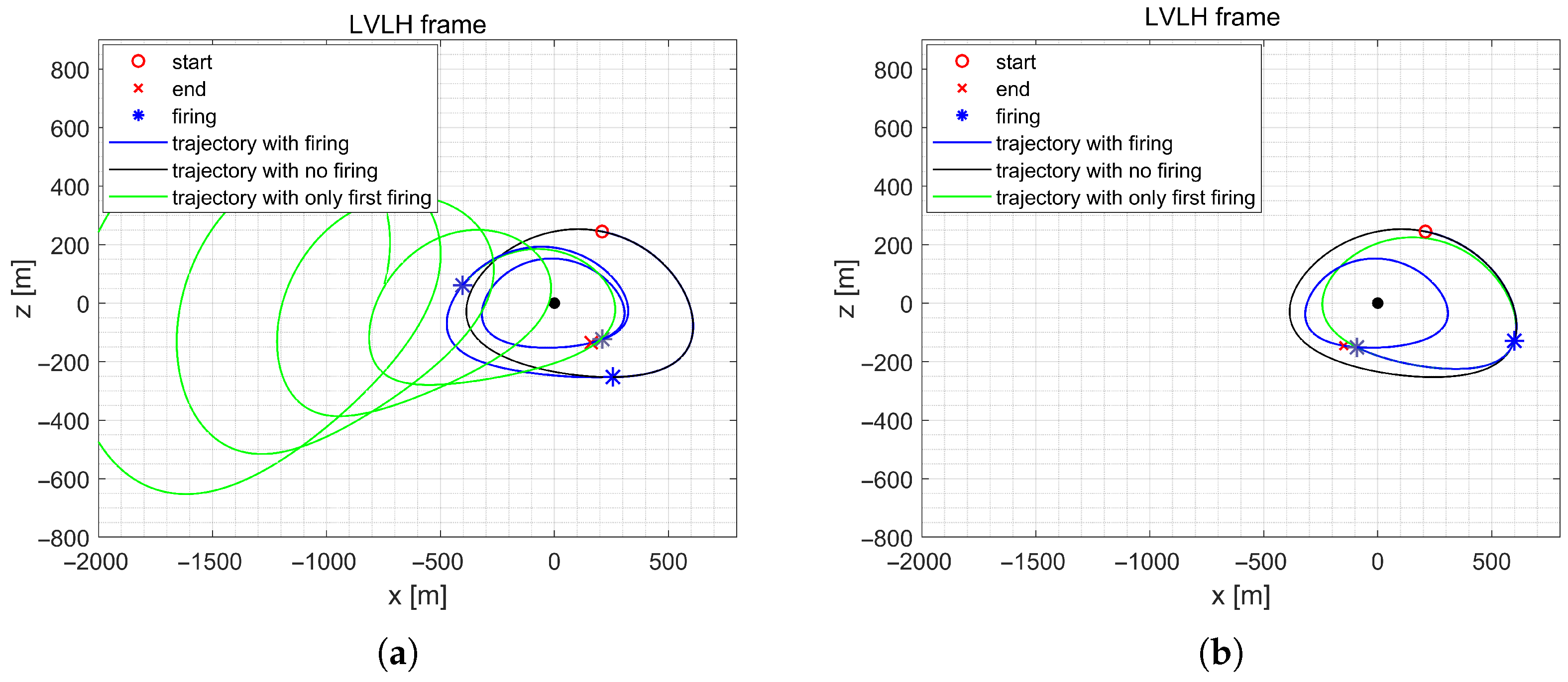
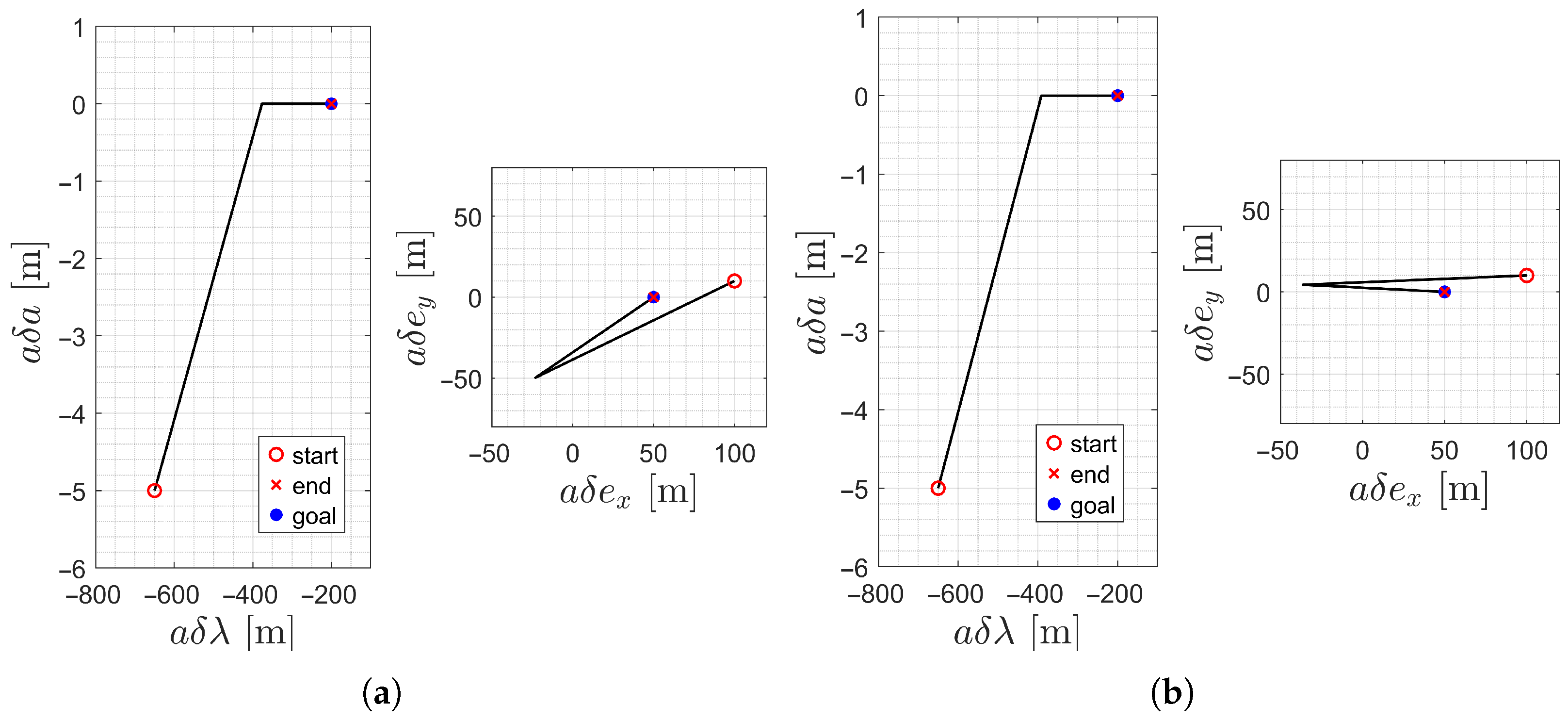
Drift control is demonstrated using linear propagation for the “braking” ( a δ a from −50 to 0) and “accelerating” ( a δ a from 0 to 50) cases using the data reported in Table 5.
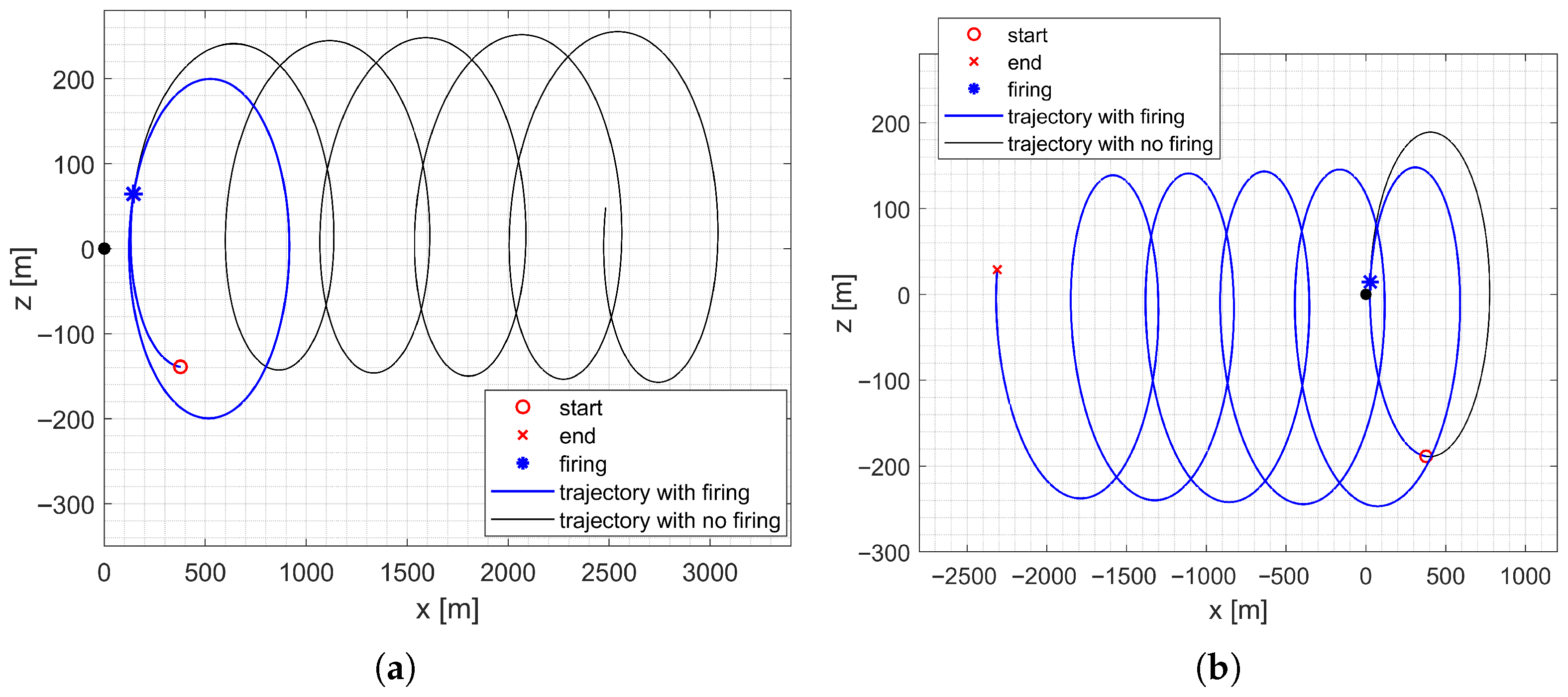
The results of the trajectory propagation in the LVLH frame are reported in Figure 9.
On the left side, the maneuver is called to stop a trajectory which is drifting away from the target, whereas on the right side drift is commanded to initiate a spiraling motion around the target position. Based on the presented formulation, the function picks a maneuvering anomaly which in both cases enlarges the relative orbit in-plane size, enhancing the passive abort safety of the maneuver.

5.1.4. Three-Point Tangential Control

To validate the generality of the implemented maneuver, propagation results are presented for both a circular and eccentric target orbit case, using the data reported in Table 6.
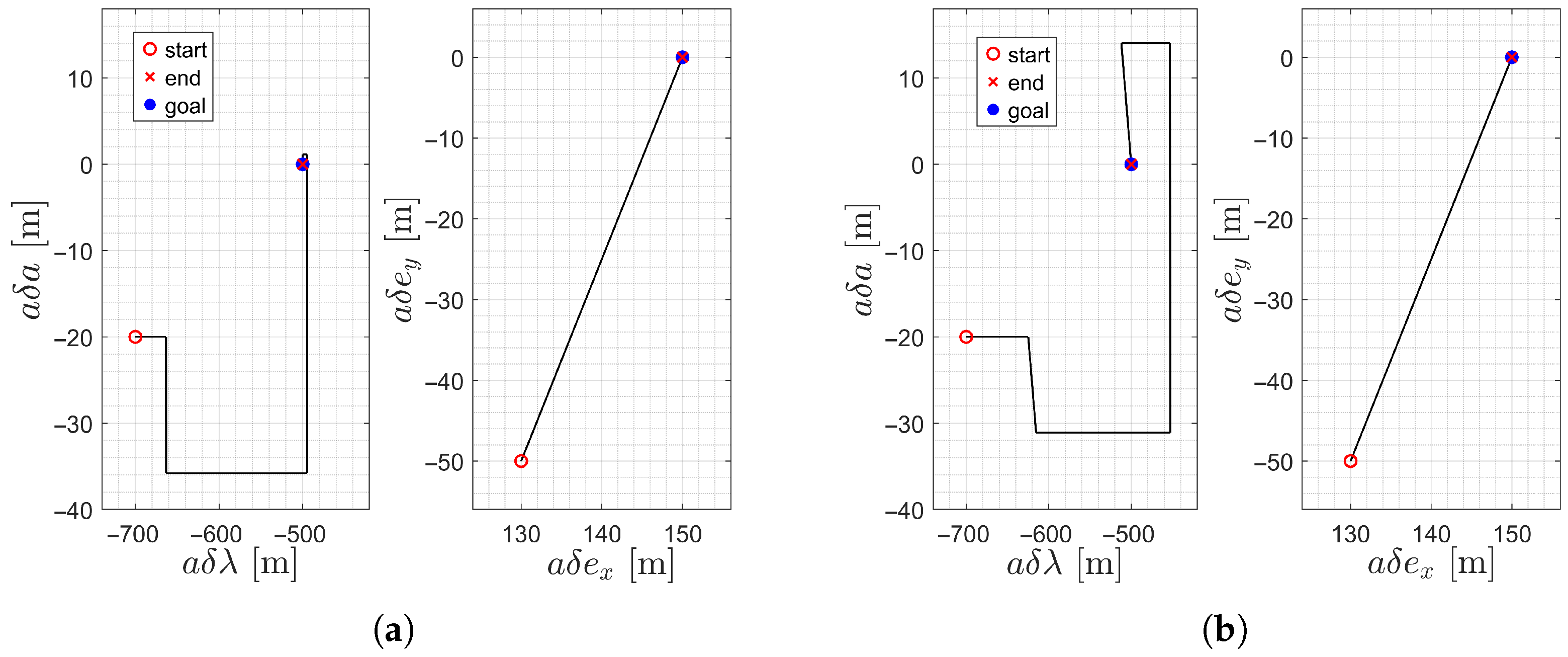
Figure 10 reports the linear propagation results in the in-plane LVLH frame of the target for both eccentricity cases; later firings are represented with a progressively de-saturated color. As already explained in Section 2, within this frame one can notice that the in-plane size along z is increasingly amplified for higher along-track distances x from the origin when e 0 .
A further observation, which is specific to the considered tests, is that in both cases the first firing introduces an intermediate relative drift which is higher than the initial one, making the chaser drift away faster in the case of loss of thrust control during the maneuver. Figure 11 shows instead the paths followed in the ROE space throughout the entire maneuver execution.
Based on these plots, some observations can be made:
  • The maneuver follows a minimum distance path in the δ e x / δ e y space in both cases, owing to the choice on the placing of the firing anomalies.
  • The main notable difference introduced when dealing with non-zero eccentricities of the target is that the jumps caused by the tangential firings in the δ λ / δ a space are no longer exactly vertical. This is explained by the fact that the relative mean longitude δ λ is not affected by velocity changes in the tangential direction when e = 0 (and η = 1 ), as can be verified by the second line of Equation (8).
  • A further significant difference is that in the eccentric scenario the maneuver produces an intermediate relative orbit (after the first firing) which drifts tens of meters past the aimed along-track position of −500 m. This is something which needs to be accounted for when deciding which maneuver to use during proximity operations, owing to the strict requirements coming from other GNC functions (e.g., vision-based navigation).
  • The circular reconfiguration examined requires a total Δ v 0.006 m/s, whereas the eccentric one amounts to Δ v 0.009 m/s.

5.1.5. Two-Point Radial Control

The maneuver is validated using the data in Table 7, which represents a case where the chaser shrinks and re-centers the relative orbit on the target position.
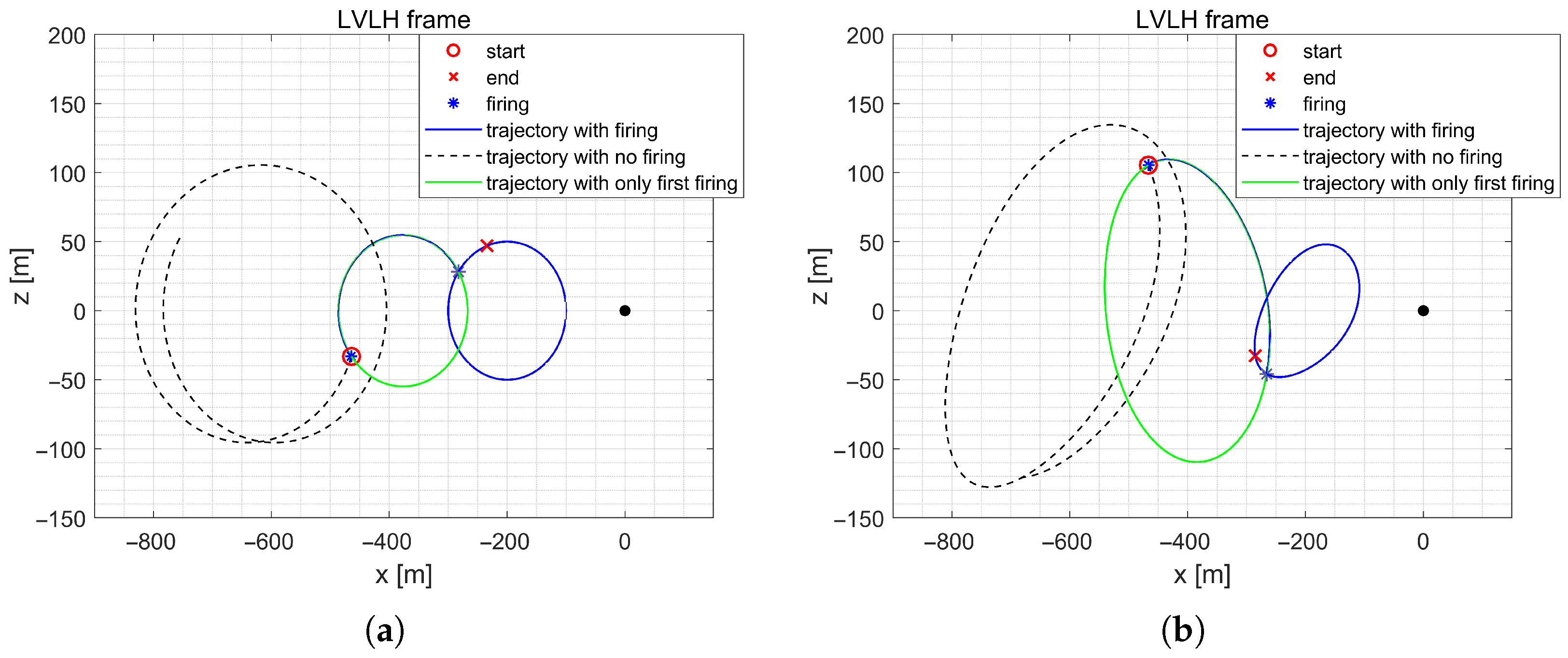
Figure 12 reports the linear propagation results in the LVLH frame.
The main notable feature of the trajectory is the fact that the intermediate orbit (in green) used to reach the final desired one is drift free, by design of the adopted radial control strategy, increasing the safety of the reconfiguration. A comparison may also be drawn to the three-point tangential scheme to analyze the differences between the two maneuvers using the same test data as reported in Table 7, with a final aimed a δ a equal to zero. Figure 13 shows the in-plane trajectory obtained using the two design strategies.
As expected from previous discussions, the key drawback of the tangential scheme is the reduced PAS of the reconfiguration owing to induced non-zero intermediate relative drifts, which lead to significant risk of collision in the case of anomalies occurring during the firings. As for fuel consumption, the radial scheme requires a total of Δ v 0.019 m/s, whereas the second amounts to Δ v 0.010 m/s, which means that almost half of the fuel is saved. The main conclusion is that the choice of either maneuver is to be based on the specific reconfiguration scenario, in particular the following factors:
  • The use of the tangential scheme is ideal whenever the relative orbit reconfiguration asks for large variations in the in-plane size (which would amount to large amounts of fuel being consumed) and for control of the relative drift.
  • The radial scheme is instead suitable for close proximity operations which do not require large reconfigurations. As seen in the previous section, this maneuver might also be preferred in order to avoid “overshoots” of δ λ during the reconfiguration.

5.1.6. Two-Impulse Non-Drifting Transfer

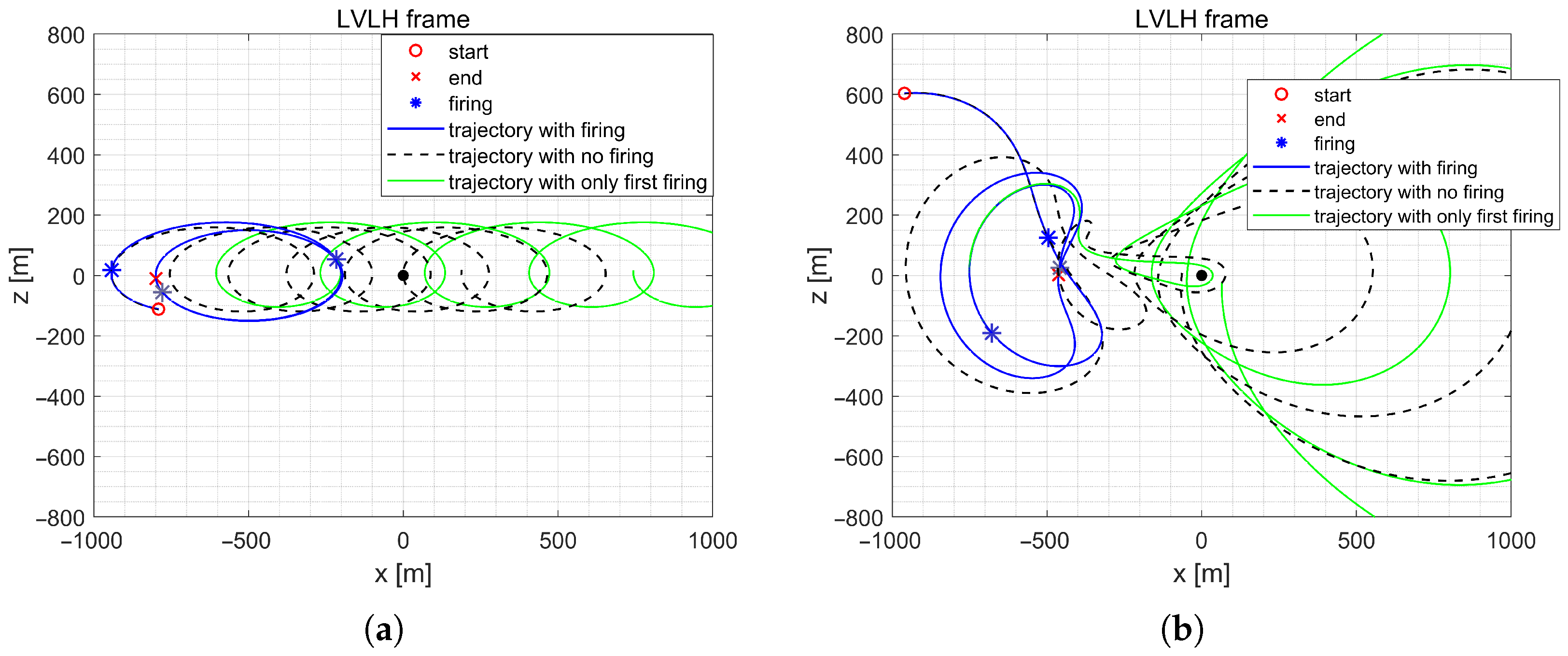
The algorithm is validated in an elliptic target case as well as in a zero eccentricity case (for which the original formulation in ROE is singular) using the data in Table 8.
The propagation results are reported in Figure 14. The initial relative orbit is characterized by a relative drift which is nullified with the tangential component of the first firing.
This generates a transfer orbit which returns to the initial firing point in case the second firing cannot be executed (see green trajectory arc), increasing the passive safety of the approach. Figure 15 reports the evolution of the in-plane ROE over time, plotted in the ROE space. The plots demonstrate that the algorithm is able to successfully reach the desired in-plane ROE for both eccentricity cases. However, it should be noted that in general the intermediate relative eccentricity vector δ e can deviate significantly from the shortest path between the initial and final values of the reconfiguration, depending on the anomaly at which the first firing is executed. This implies that PAS during the maneuver, intended as compliance with the KOZ dimensions or minimum distance in the cross-track plane, needs to be assessed on a case-by-case basis.

5.2. Rendezvous Scenarios in High-Fidelity Simulator

The guidance and control layers are finally validated in a nonlinear simulator through the completion of two rendezvous scenarios for non-cooperative targets. The following points summarize the main observations regarding the integration of the guidance software in the simulator:
  • As introduced, with respect to previous numerical tests, the relative motion between the two spacecraft is now propagated through the direct integration of the nonlinear equations of motion of each satellite. This allows for including realistic orbit perturbations which make the actual relative motion deviate from linear, unperturbed propagation models. To cope with this, the osculating Keplerian elements are converted to mean elements, which remove short/long oscillations generated by the J 2 term of the Earth’s gravity potential, through the first-order mappings based on the Brouwer and Lyddane theory provided in Appendix F of [27]. These mean elements are then used to compute mean relative orbital elements. Their use in the closed-form maneuvers, designed under the assumption of unperturbed propagation, is known to generate negligible errors when considering the J 2 term [28].
  • As discussed in Section 4.2, the FSM guidance uses an estimate of the rate of change δ a ˙ to take decisions when switching to the WSE state. To dynamically estimate its value during the approach, the procedure described in [29] is adopted. The main idea is to hold the position of the relative orbit while a navigation function stores the values of the estimated ROEs. In the simulation setup, in order to emulate the result of such a navigation function, a simple linear regression is used to compute the desired time derivative over the acquisition interval. When the estimation of δ a ˙ needs to be updated, the guidance function can either use one of the predefined FSM waypoints (see Figure 3) as a hold position or generate a “virtual” waypoint at the start of the simulation when no prior estimation is available.
  • Apart from the estimation of the time derivatives, no navigation errors are considered on the relative and absolute states of the chaser, which are assumed to be known exactly by the guidance.
  • A further significant difference from linear validation tests is that orbital maneuvers are now delivered through simulated monopropellant chemical thrusters, using a mathematical model that emulates non-ideal thrust shaping through the definition of rise/fall time constants. For the presented tests, a general firing takes up to ten seconds, which still allows us to model the maneuvers as impulsive [23].

5.2.1. General Simulation Setup

Table 9 reports common simulation data used in both rendezvous scenarios. The chaser spacecraft is a satellite with a characteristic size of ≈1 m which maintains attitude while pointing in the direction of the target.
To deliver the required Δ v commands, six ON/OFF thrusters are mounted within its frame and Pulse-Width Modulation (PWM) logic is used for precise firings. Table 9 also defines a validity period (which corresponds to approximately two days for the first scenario, and five days for the second) for the estimation of the change rate δ a ˙ , after which the guidance software needs to raise a request to create a new dataset. For comparability between the two scenarios, the initial relative conditions of the chaser are defined in both cases as C 0 = [5, 0, 1000, −20,100, 350, −880] m, which represents a case in which the generalized relative eccentricity and inclination vectors are not collinear within the threshold specified in Table 9.

5.2.2. First Scenario: Inspection of Rocket Body in SSO

The first test scenario is based on Phase I of the Commercial Removal of Debris Demonstration (CRD2) project, within which the satellite ADRAS-J, developed by Astroscale Japan, performed rendezvous and inspection of a non-cooperative object in a Sun-Synchronous Orbit (SSO) [30]. The designated target was the H-IIA upper stage, used in 2009 to launch the Greenhouse Gases Observing Satellite (GOSAT). Based on the rocket body NORAD ID (33500), its Keplerian elements have been retrieved from [31] and are reported in Table 10.
The FSM guidance is constrained by the waypoints definition and their related hold times, as provided in Table 11.
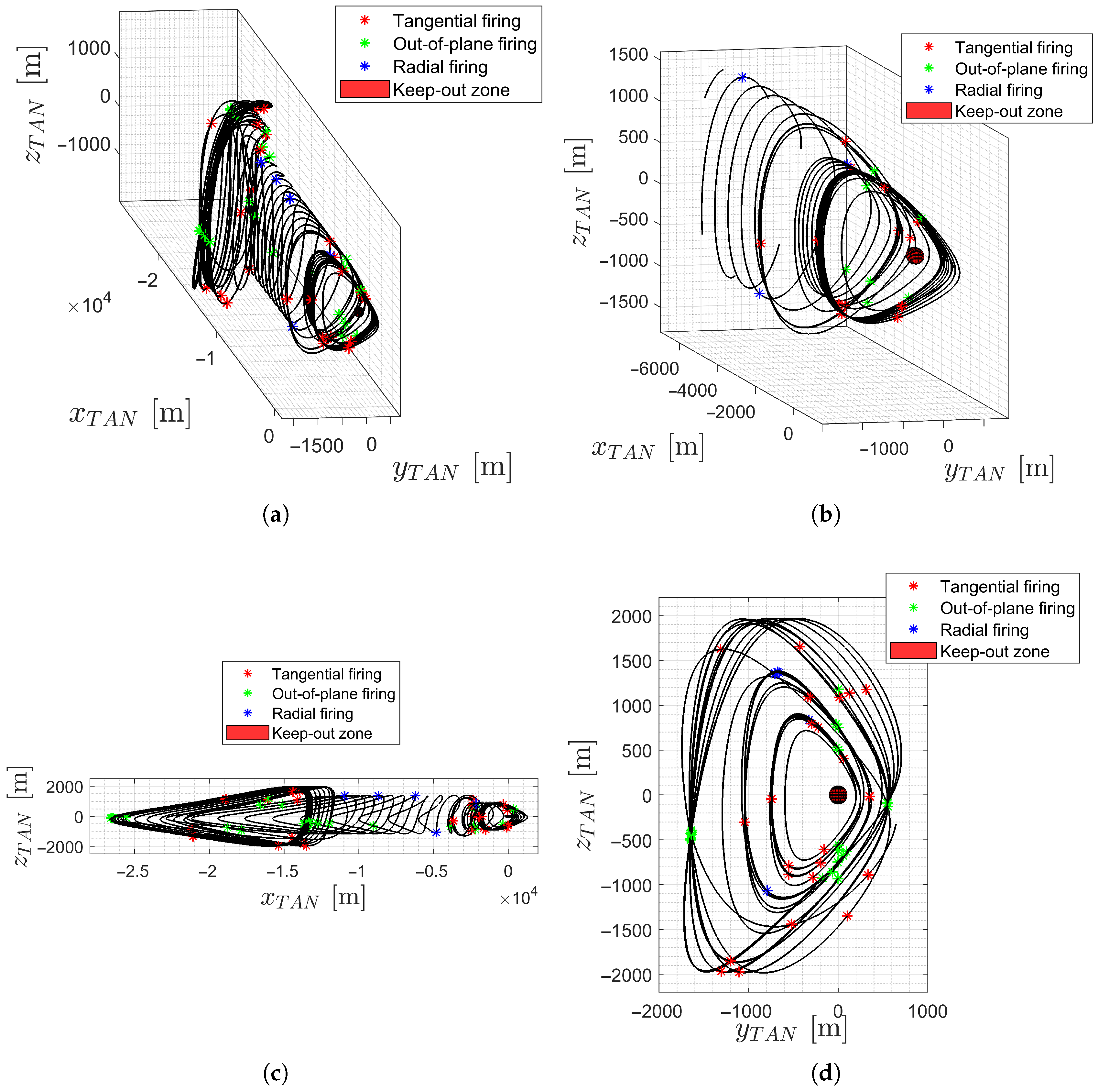
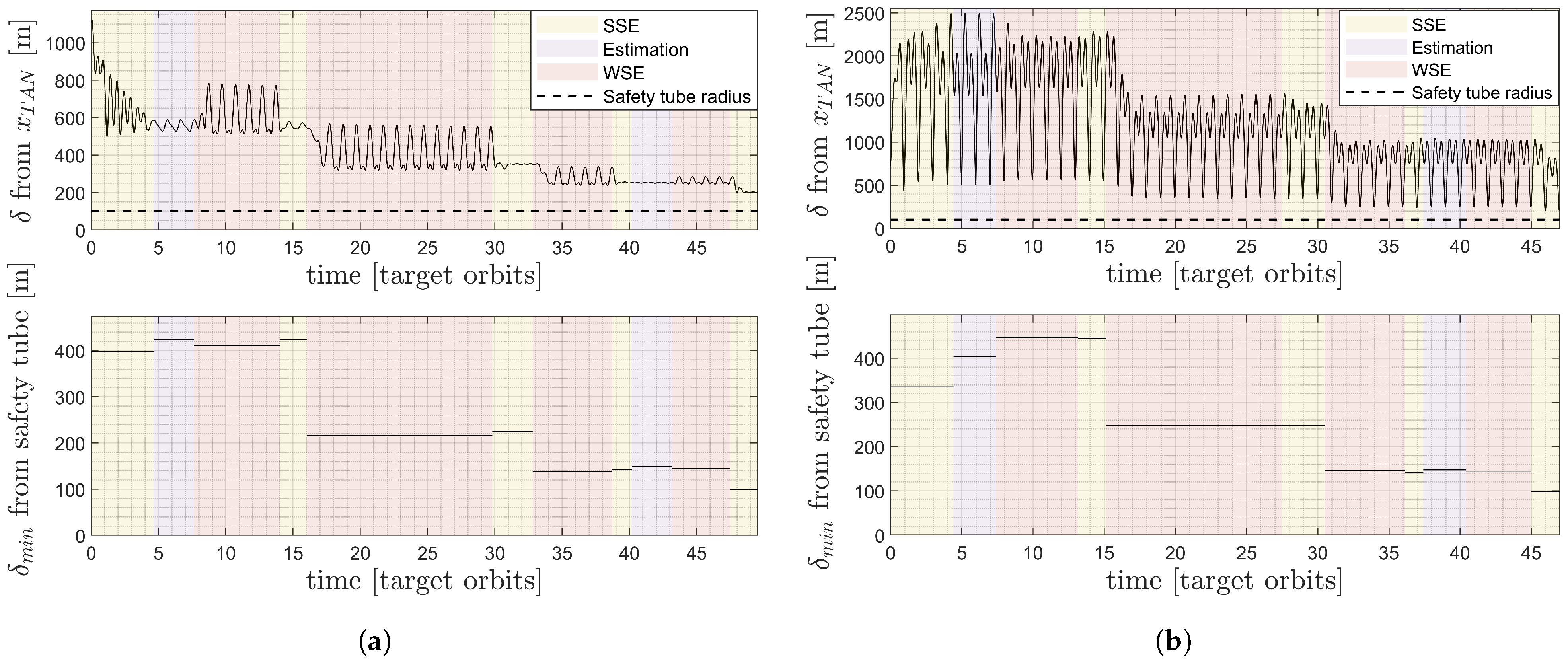
Figure 16 reports the resulting relative trajectory in the TAN frame of the target. For the circular rendezvous case, one can clearly distinguish the phases where the orbit is in a “walking” state and where the chaser station keeps and shrinks the IP/OOP sizes. In that sense, the behavior of the servicer is deterministic and well readable. The cross-track plane projection of the trajectory (shown in the bottom-right of Figure 16) demonstrates how the entire approach happens not only without crossing the KOZ around the target, but also by maintaining the minimum size margins set in Table 11. In this regard, a more quantitative assessment is also presented in Figure A1 of Appendix C, where the relative distance of the chaser on the cross-track plane is plotted against the simulation time.
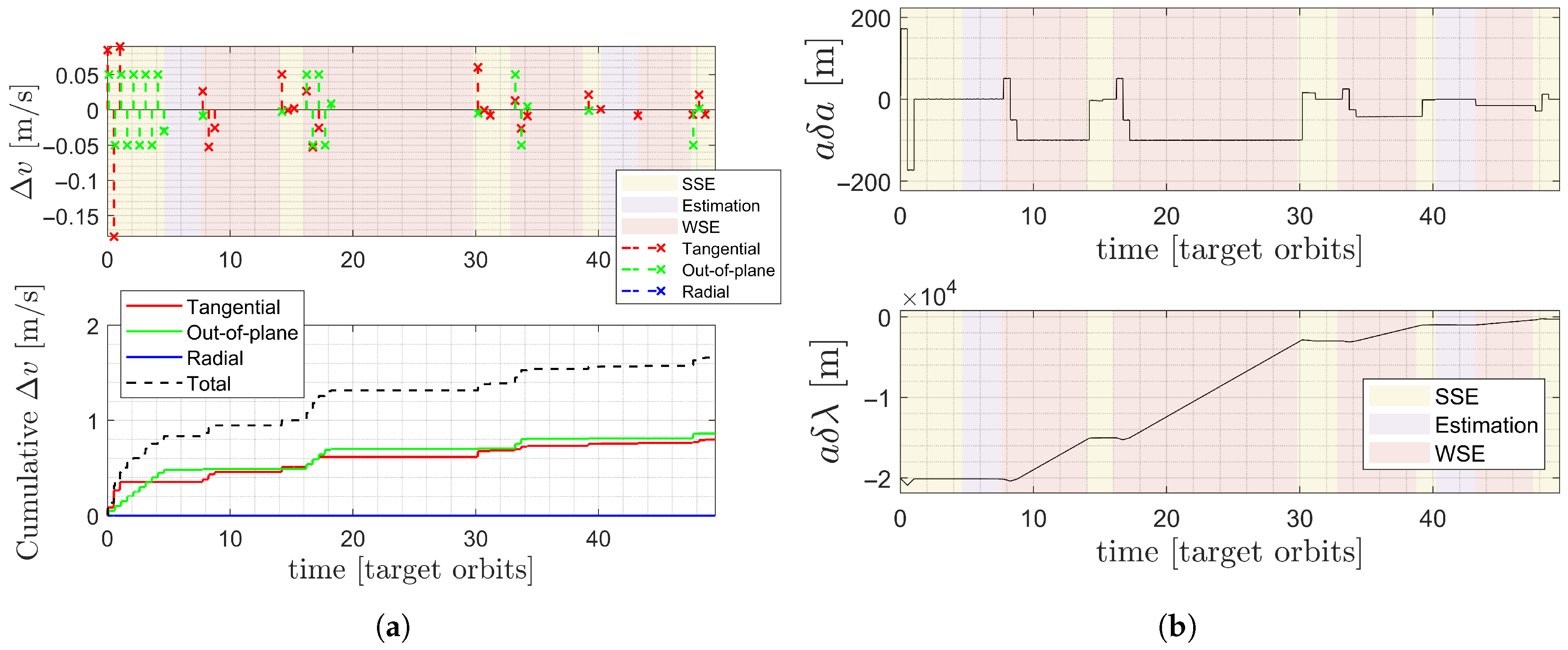
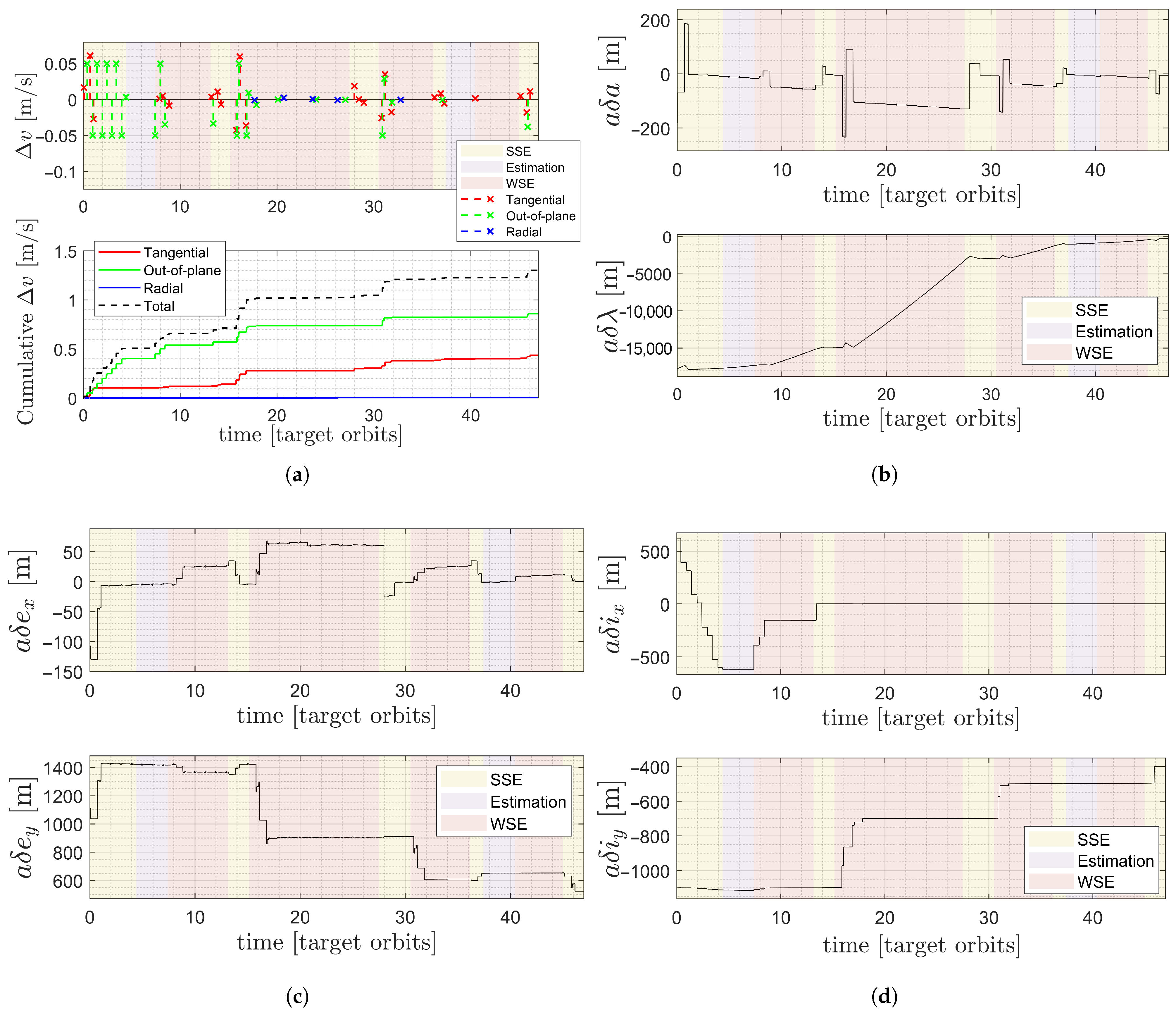
Figure 17 showcases more simulation results which allow for making further observations:
  • As seen from the Δ v commands timeline, an initial large reconfiguration maneuver is needed to re-phase and re-size the relative orbit, and is obtained through concurrent in-plane (through the 3 pt tangential scheme) and out-of-plane control. Because the latter direction typically requires higher amounts of fuel, the guidance software has been programmed to distribute the maneuver over the two OOP firing opportunities available in each orbit (see Section 3.1.1), while preserving the commanded direction in the ( δ i x , δ i y ) plane at each firing. At every opportunity, the guidance thus saturates the delivered impulse to a maximum allowed Δ v (here set to 0.05 m/s), repeating the process until the cumulative OOP correction matches the original single-firing command.
  • Because no prior estimation of the differential drag effects was given, an initial “virtual” SSE is first reached (at the orbital period t o r b 4.5 ) to create the database needed for the estimation of δ a ˙ . Moreover, because of its validity period N o r b v a l specified in Table 9, the third SSE (reached at t o r b 40 ) is also used to update the estimation through an acquisition period with no maneuvers.
  • To preserve the safety of the approach and stay within the prescribed limits for maximum relative drift (see Table 9), the guidance can re-compute longer (or potentially shorter) drifting periods between the given waypoints. This is best observed between the first and second, where the drifting phase starts at t o r b 18 and ends at t o r b 30 , increasing the nominal value specified in Table 9, according to the formulation described in Section 4.2.

5.2.3. Second Scenario: Rendezvous with HEO Satellite

The second scenario is defined to prove the safe rendezvous capability for a Highly-Eccentric Orbit spacecraft. The target specifications are reported in Table 12.
To demonstrate the re-usability of the proposed architecture, the same input data for the FSM as the previous scenario is considered (see Table 11).
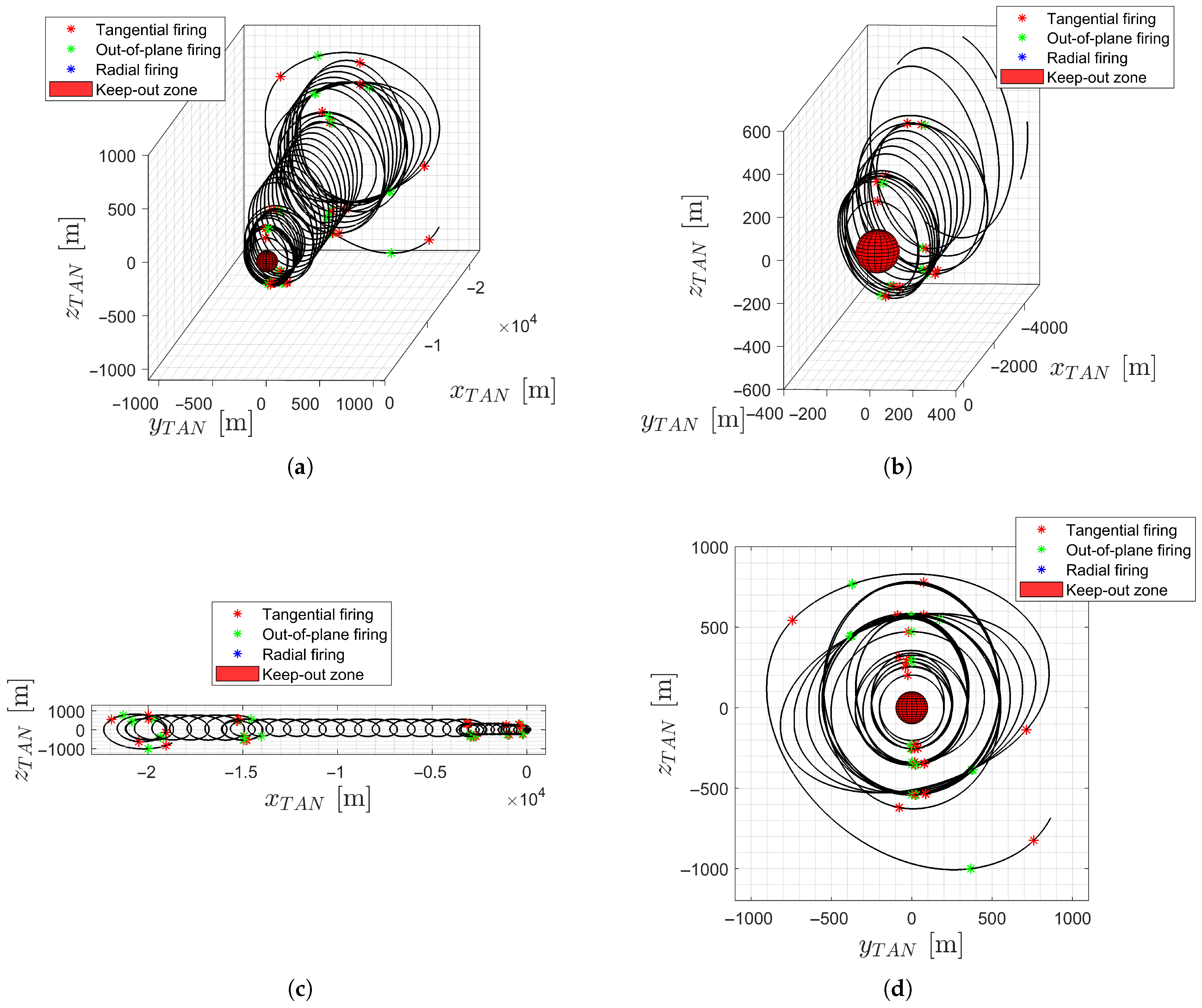
Figure 18 reports the resulting relative trajectory in the TAN frame of the target spacecraft. With respect to the previous scenario, more complex relative orbital dynamics greatly deform the shape of the orbit in the three-dimensional space. However, after the initial large reconfiguration from the initial conditions, which are not characterized by relative E/I separation, the chaser follows a trajectory in which the two defined WSE/SSE states can still be distinguished. Once again, the cross-track plane view shows a followed path which maintains the minimum size margins from the KOZ, as specified in Table 11. This can also be further verified using the plots of the cross-track distance reported in Figure A1.
Lastly, Figure 19 reports the related simulation results in terms of Δ v and time evolution of the quasi-nonsingular ROEs. When compared to Figure 17, it is possible to appreciate that the two scenarios are characterized by similar results both in terms of fuel used as well as in terms of overall time needed (in orbit periods). A major difference is given by the stronger impact of orbit perturbations, which calls for periodic yet small shape-correction maneuvers in the radial and out-of-plane directions while the WSE is drifting between waypoints. The reader is also invited to observe specifically how δ a ˙ takes on a much larger value than the previous scenario, but this is not reflected in more frequent corrections along the tangential direction, thanks to the very definition of the guidance layer.

6. Conclusions

This paper has presented the development and validation of autonomous guidance software for spacecraft rendezvous to arbitrarily elliptic targets. To achieve this, the proposed architecture was structured in two distinct layers: First, the control layer, which represents a library of closed-form, impulsive maneuvers, was devised to give the maneuvering satellite the capability to modify its own relative state through onboard-computed changes in orbital velocity. A high-level guidance layer was then designed to autonomously execute a rendezvous mission, characterized by standard operational constraints which include the definition of a Keep-Out Zone around the target spacecraft as well as specified hold positions and periods where no maneuvers may occur. The design choices taken in both of these two steps led to the definition of a software which can feasibly be adopted across different reference target orbits.
It is noted once again that the validation performed focused solely on the guidance function, assuming perfect knowledge of the relative state; no navigation errors or sensor noise were included. Although the design philosophy partially accounted for uncertainty through the diffused definition of margins, a full end-to-end validation of the complete GNC system should therefore build upon the present work by incorporating realistic navigation uncertainties and, where appropriate, by coupling the guidance module with a dedicated navigation function.
As for the control layer, the closed-form maneuvers have been derived by making no assumptions on the target eccentricity and by using a velocity-aligned reference frame. One of the main related advantages is the possibility to define control schemes for relative orbit in-plane reconfigurations which do not affect the relative drift between the spacecraft. Novel formulations which generalize already existing ROE-based maneuvering schemes to work with arbitrarily eccentric references have been provided; notably, maneuvers based on three tangential firings and two radial firings are discussed and validated numerically. Given their simplicity, these formulations typically require low processing power and can be efficiently deployed on space-graded processors.
A novel finite state machine architecture has been defined to command the high-level decisions of the chaser spacecraft. The adoption of the C-elements as relative state parametrization enabled the definition of a common approach strategy in which the relative trajectory maintains minimum separation from the target on the plane orthogonal to the velocity, exploiting the concept of generalized relative eccentricity/inclination separation. As demonstrated by numerical simulations, the integrated software is able to autonomously complete the rendezvous mission timelines within the given constraints while still taking decisions which are deterministic and readable, characteristics which are favorable for ground support operations. A further advantage of the state machine formulation is its modularity, which allows the user to make quick changes to the architecture to more finely tune its behavior or choose a different set of maneuvers. Notably, future implementations could work on specializing the state machine to tailor it to a specific application; a spacecraft which relies on visual-based navigation could, for example, benefit from a guidance module which phases the relative eccentricity and inclination vectors in such a way as to enhance the visibility of the target. In this scenario, the navigation and actuation errors could be accounted for by a proper definition of the geometric margins to maintain from the Keep-Out Zone.
Many On-Orbit Servicing mission concepts are currently being studied in order to face the ever-growing problem of space debris in the orbital regions around the Earth. Within this context, the proposed framework can be used as a flexible and general baseline to safely and autonomously approach a non-cooperative target spacecraft to begin proximity operations.

Author Contributions

Conceptualization, D.B., S.T. and T.V.P.; methodology, D.B., G.G., S.T., T.V.P. and P.R.; software, D.B.; validation, D.B., S.T. and T.V.P.; investigation, D.B., G.G. and T.V.P.; writing—original draft preparation, D.B.; writing—review and editing, D.B., G.G., S.T., T.V.P. and P.R. All authors have read and agreed to the published version of the manuscript.

Funding

This research was partially funded by OHB System AG.

Data Availability Statement

The original contributions presented in the study are included in the article, and further inquiries can be directed to the corresponding author.

Conflicts of Interest

Authors Diego Buratti, Stefano Torresan, Thomas V. Peters were employed by the company OHB System AG. The remaining authors declare that the research was conducted in the absence of any commercial or financial relationships that could be construed as potential conflicts of interest.

Abbreviations

The following abbreviations are used in this manuscript:
PASPassive-Abort Safety
KOZKeep-Out Zone
FSMFinite State Machine
ROEsRelative Orbital Elements
GVEGauss Variational Equations
OOPOut-Of-Plane
IPIn-Plane
SSEStationary Safe Ellipse
WSEWalking Safe Ellipse
STMState Transition Matrix
LVLHLocal-Vertical Local-Horizontal
TANTangential
GNCGuidance, Navigation and Control

Appendix A. Linear Conversion Matrices

The following matrix of partial derivatives provides a linear map which converts a relative state expressed in the quasi-non-singular ROE set δ α (see Equation (2)) to the relative orbit C-elements C (see Equation (4)), based on [16]:
C δ α = p · 1 0 2 η 2 e cos ω 2 η 2 e sin ω 0 0 e 0 η 2 ( 1 + e 2 ) cos ω η 2 ( 1 + e 2 ) sin ω 0 0 0 0 sin ω cos ω 0 e cot i 0 η 3 sin ω η 3 1 η 1 + η cos ω η 3 1 η 1 + η 0 cot i η 2 ( 1 1 / η ) 0 0 0 0 cos ω sin ω 0 0 0 0 sin ω cos ω
The newly derived inverse transformation is also provided:
δ α C = 1 p · e 2 + 1 ( e 2 1 ) 2 e ( e 2 1 ) 0 0 0 0 0 0 K 1 η 3 sin ω · K 2 cos ω · K 2 e η 2 cos ω ( e 2 + 1 ) η 2 cos ω ( e 2 + 1 ) sin ω 0 e cot i sin 2 ω e cot i cos ω sin ω e η 2 sin ω ( e 2 + 1 ) η 2 sin ω ( e 2 + 1 ) cos ω 0 e cot i cos ω sin ω e cot i cos 2 ω 0 0 0 0 cos ω sin ω 0 0 0 0 sin ω cos ω
K 1 = ( η 1 ) / ( η + 1 ) , K 2 = cot i ( η 1 + e · K 1 )

Appendix B. Non-Drifting Transfer Coefficients

K 1 = Δ δ e x K e x 1 + Δ δ e y K e y 1 + Δ δ λ K λ 1 K 2 = Δ δ e x K e x 2 + Δ δ e y K e y 2 + Δ δ λ K λ 2 K 3 = ( Δ δ e x K e x 0 + Δ δ e y K e y 0 + Δ δ λ K λ 0 )
K e x 0 = 2 e cos ω δ λ Δ v 1 2 δ e y , Δ v 1 , K e x 2 = η 2 δ λ Δ v 1 sin ω K e x 1 = η 2 δ λ Δ v 1 cos ω + 2 e 2 cos ω δ λ Δ v 1 2 e δ e y , Δ v 1 + δ e y , Δ v 1 Ξ K e y 0 = 2 e sin ω δ λ Δ v 1 + 2 δ e x , Δ v 1 , K e y 2 = η 2 δ λ Δ v 1 cos ω K e y 1 = η 2 δ λ Δ v 1 sin ω + 2 e 2 sin ω δ λ Δ v 1 + 2 e δ e x , Δ v 1 δ e x , Δ v 1 Ξ K λ 0 = 2 e cos ω δ e x , Δ v 1 2 e sin ω δ e y , Δ v 1 , K λ 2 = η 2 ( δ e x , Δ v 1 sin ω δ e y , Δ 1 cos ω ) K λ 1 = η 2 δ e x , Δ v 1 cos ω 2 e 2 cos ω δ e x , Δ v 1 2 e 2 sin ω δ e y , Δ v 1 δ e y , Δ v 1 η 2 sin ω
where Ξ = η 2 1 η 1 + η

Appendix C. Additional Results for Rendezvous Scenarios

Figure A1. Relative distances δ of chaser spacecraft on the cross-track plane y T A N / z T A N : (a) First Scenario—rendezvous in near-circular orbit. (b) Second Scenario—rendezvous in highly elliptical orbit.
Aerospace 13 00230 g0a1

References

  1. D’Amico, S.; Montenbruck, O. Proximity operations of formation-flying spacecraft using an eccentricity/inclination vector separation. J. Guid. Control. Dyn. 2006, 29, 554–563. [Google Scholar] [CrossRef]
  2. D’Amico, S.; Ardaens, J.S.; Larsson, R. Spaceborne autonomous formation-flying experiment on the PRISMA mission. J. Guid. Control. Dyn. 2012, 35, 834–850. [Google Scholar] [CrossRef]
  3. Gaias, G.; Ardaens, J.S. Design challenges and safety concept for the AVANTI experiment. Acta Astronaut. 2016, 123, 409–419. [Google Scholar] [CrossRef]
  4. D’Amico, S. Autonomous Formation Flying in Low Earth Orbit. Ph.D. Thesis, TU Delft, Delft, The Netherlands, 2010. [Google Scholar]
  5. Gaias, G.; D’Amico, S. Impulsive maneuvers for formation reconfiguration using relative orbital elements. J. Guid. Control Dyn. 2015, 38, 1036–1049. [Google Scholar] [CrossRef]
  6. Riggi, L.; D’Amico, S. Optimal impulsive closed-form control for spacecraft formation flying and rendezvous. In Proceedings of the 2016 American Control Conference (ACC), Boston, MA, USA, 6–8 July 2016; IEEE: Piscataway, NJ, USA, 2016; pp. 5854–5861. [Google Scholar]
  7. Chernick, M.; D’Amico, S. New closed-form solutions for optimal impulsive control of spacecraft relative motion. J. Guid. Control Dyn. 2018, 41, 301–319. [Google Scholar] [CrossRef]
  8. Lim, Y.; Mok, S.H. In-plane formation reconfiguration with radial maneuvers. J. Guid. Control Dyn. 2020, 43, 1881–1892. [Google Scholar] [CrossRef]
  9. Peters, T.V.; Noomen, R.; Colmenarejo, P. Analytical Solutions to Two-Impulse Nondrifting Transfer Problems for Rendezvous in Elliptical Orbits. J. Guid. Control Dyn. 2014, 37, 775–788. [Google Scholar] [CrossRef]
  10. European Space Agency (ESA). Guidelines on Safe Close Proximity Operations; ESA Technical Note ESA-TECSYE-TN-022522; European Space Agency (ESA): Noordwijk, The Netherlands, 2024. [Google Scholar]
  11. International Rendezvous System Interoperability Standards (IRSIS) Baseline. 2019. Available online: https://internationaldeepspacestandards.com/wp-content/uploads/2024/02/rendezvous_baseline_final_3-2019.pdf (accessed on 28 October 2025).
  12. Vasconcelos, J.; Gaggi, S.; Amaral, T.; Bakouche, C.; Cotuna, A.; Friaças, A. Close-Proximity Operations Design, Analysis, and Validation for Non-Cooperative Targets with an Application to the ClearSpace-1 Mission. Aerospace 2025, 12, 67. [Google Scholar] [CrossRef]
  13. Schaub, H. Relative orbit geometry through classical orbit element differences. J. Guid. Control Dyn. 2004, 27, 839–848. [Google Scholar] [CrossRef]
  14. Schaub, H.; Alfriend, K.T. J2 invariant relative orbits for spacecraft formations. Celest. Mech. Dyn. Astron. 2001, 79, 77–95. [Google Scholar] [CrossRef]
  15. Gim, D.W.; Alfriend, K.T. State transition matrix of relative motion for the perturbed noncircular reference orbit. J. Guid. Control Dyn. 2003, 26, 956–971. [Google Scholar] [CrossRef]
  16. Peters, T.V.; Noomen, R. Linear cotangential transfers and safe orbits for elliptic orbit rendezvous. J. Guid. Control Dyn. 2020, 44, 732–748. [Google Scholar] [CrossRef]
  17. Harris, A.; Teil, T.; Schaub, H. Spacecraft decision-making autonomy using deep reinforcement learning. In Proceedings of the 29th AAS/AIAA Space Flight Mechanics Meeting, Ka’anapali, Maui, HI, USA, 13–17 January 2019; American Astronautical Society: San Diego, CA, USA, 2019; pp. 1–19. [Google Scholar]
  18. Vela, C.; Opromolla, R.; Fasano, G. A low-thrust finite state machine based controller for N-satellites formations in distributed synthetic aperture radar applications. Acta Astronaut. 2023, 202, 686–704. [Google Scholar] [CrossRef]
  19. Peters, T.V.; Strippoli, L. Guidance for elliptic orbit rendezvous. In Proceedings of the AAS/AIAA Space Flight Mechanics Meeting, San Diego, CA, USA, 14–18 February 2010; American Astronautical Society: San Diego, CA, USA, 2010; Paper No. 2010-175. [Google Scholar]
  20. Yamanaka, K.; Ankersen, F. New state transition matrix for relative motion on an arbitrary elliptical orbit. J. Guid. Control Dyn. 2002, 25, 60–66. [Google Scholar] [CrossRef]
  21. D’Amico, S. Relative Orbital Elements as Integration Constants of Hill’s Equations; DLR, TN: Cologne, Germany, 2005; pp. 5–8. [Google Scholar]
  22. Battin, R.H. An Introduction to the Mathematics and Methods of Astrodynamics; AIAA: Reston, VA, USA, 1999. [Google Scholar]
  23. Scalvini, A.; Borelli, G.; Gaias, G. Towards Robust Angles-Only Relative Orbit Navigation: Assessing Key Modelling Factors Using Batch Least Squares Filtering. In Proceedings of the 11th European Conference for AeroSpace Sciences (EUCASS 2025), Rome, Italy, 30 June–4 July 2025; EUCASS Association: Rome, Italy, 2025; pp. 1–15. [Google Scholar]
  24. Calter, P.A.; Calter, M.A. Technical Mathematics; John Wiley & Sons: Hoboken, NJ, USA, 2011. [Google Scholar]
  25. Gaias, G.; D’Amico, S.; Ardaens, J.S. Generalised multi-impulsive manoeuvres for optimum spacecraft rendezvous in near-circular orbit. Int. J. Space Sci. Eng. 2015, 3, 68–88. [Google Scholar] [CrossRef]
  26. Fehse, W. Automated Rendezvous and Docking of Spacecraft; Cambridge University Press: Cambridge, UK, 2003; Volume 16. [Google Scholar]
  27. Schaub, H.; Junkins, J.L. Analytical Mechanics of Space Systems; AIAA: Reston, VA, USA, 2003. [Google Scholar]
  28. Schaub, H.; Alfriend, K.T. Impulsive feedback control to establish specific mean orbit elements of spacecraft formations. J. Guid. Control Dyn. 2001, 24, 739–745. [Google Scholar] [CrossRef]
  29. Koenig, A.W.; Guffanti, T.; D’Amico, S. New state transition matrices for spacecraft relative motion in perturbed orbits. J. Guid. Control Dyn. 2017, 40, 1749–1768. [Google Scholar] [CrossRef]
  30. Yamamoto, T.; Matsumoto, J.; Okamoto, H.; Yoshida, R.; Hoshino, C.; Yamanaka, K. Pave the way for active debris removal realization: Jaxa commercial removal of debris demonstration (crd2). In Proceedings of the 8th European Conference on Space Debris, Darmstadt, Germany, 20–23 April 2021; European Space Agency: Paris, France, 2021; p. 200. [Google Scholar]
  31. Space-Track. Space-Track Satellite Catalog. Available online: https://www.space-track.org/ (accessed on 6 July 2025).
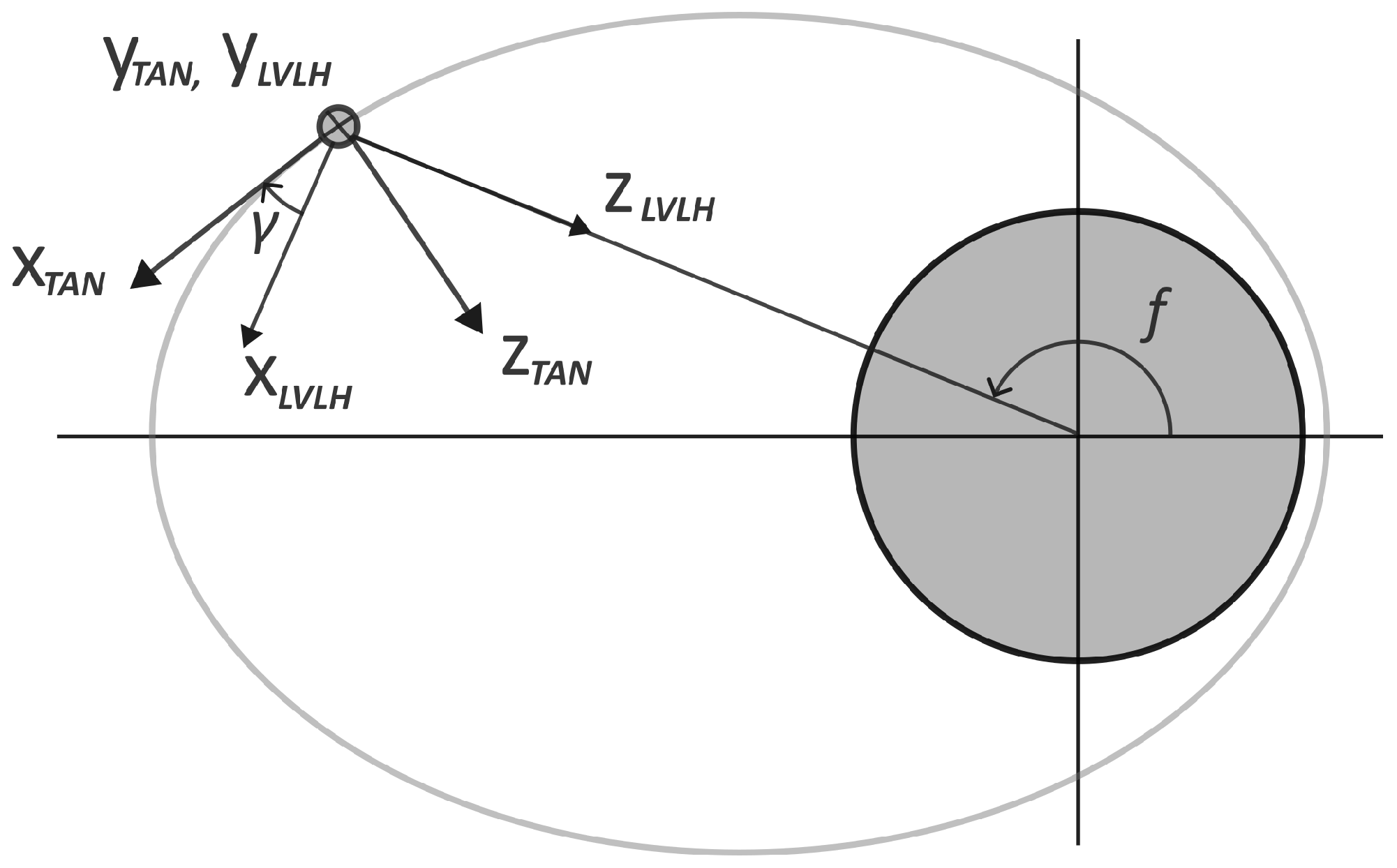
Figure 1. LVLH and TAN frames in the target orbital plane.
Aerospace 13 00230 g001
Figure 2. Safe trajectory family generated by varying σ values, e = 0.5 .
Aerospace 13 00230 g002
Figure 3. Approach geometry for Finite State Machine guidance, TAN frame.
Aerospace 13 00230 g003
Figure 4. Code structure of the FSM.
Aerospace 13 00230 g004
Figure 5. Structure of WSE and SSE control layer.
Aerospace 13 00230 g005
Figure 6. OOP maneuver results with linear propagation from Table 2 for 5 orbit periods. (a) Trajectory evolution in the LVLH frame of the target spacecraft. (b) Results in the δ i x / δ i y phase plane.
Aerospace 13 00230 g006
Figure 7. IP maneuver results with linear propagation from Table 3 (a) Trajectory evolution in the LVLH frame of the target spacecraft for 5 orbit periods. (b) IP ROEs over time.
Aerospace 13 00230 g007
Figure 8. IP+OOP maneuver results with linear propagation using Table 4 (a) Trajectory evolution in the LVLH frame of the target spacecraft for 5 orbit periods. (b) IP ROEs over time.
Aerospace 13 00230 g008
Figure 9. Drift control maneuver results with linear propagation from Table 5 for 5 orbital periods. (a) Braking case. (b) Accelerating case.
Aerospace 13 00230 g009
Figure 10. The 3 pt tangential maneuver results with linear propagation from Table 6. (a) Circular case. (b) Eccentric case.
Aerospace 13 00230 g010
Figure 11. The 3 pt tangential maneuver results in ROE space. (a) Circular case. (b) Eccentric case.
Aerospace 13 00230 g011
Figure 12. The 2 pt radial maneuver results using linear propagation from Table 7.
Aerospace 13 00230 g012
Figure 13. Reconfiguration maneuver results using (a) 3 pt tangential and (b) 2 pt radial scheme.
Aerospace 13 00230 g013
Figure 14. Non-drifting transfer maneuver results using linear propagation from Table 8. (a) Circular case. (b) Eccentric case.
Aerospace 13 00230 g014
Figure 15. Non-drifting transfer maneuver results in ROE. (a) Circular case. (b) Eccentric case.
Aerospace 13 00230 g015
Figure 16. Relative trajectory of Scenario 1 in the TAN frame: (a) Full rendezvous trajectory. (b) Zoom-in on last three waypoints. (c) In-plane projection of trajectory. (d) Trajectory on cross-track plane.
Aerospace 13 00230 g016
Figure 17. Simulation results for Scenario 1: (a) Δ v commands requested by the FSM guidance. (bd) History of quasi-nonsingular ROEs over time.
Aerospace 13 00230 g017aAerospace 13 00230 g017b
Figure 18. Relative trajectory of Scenario 2 in TAN frame: (a) Full rendezvous trajectory. (b) Zoom-in on last three waypoints. (c) In-plane projection of trajectory. (d) Trajectory on cross-track plane.
Aerospace 13 00230 g018
Figure 19. Simulation results for Scenario 2: (a) Δ v commands requested by the FSM guidance. (bd) History of quasi-nonsingular ROEs over time.
Aerospace 13 00230 g019
Table 1. Summary of maneuvering schemes.
ManeuverUseAdvantagesDisadvantagesSolution
1PT OOPFull control of out-of-plane relative motionOnly one firing needed, short reconfiguration time windowHigh Δ v cost and coupling effect on δ e componentsFiring location: Equation (9)
Firing amplitude: Equation (10)
δ e precompensation: Equation (15)
1PT RADControl of relative eccentricity componentsNo effect on relative drift, allows to execute quick and small corrections to compensate perturbation effectsHigher Δ v cost than tangential schemes, not suitable for large shape reconfigurationsFiring location: Equation (12)
Firing amplitude: Equation (13)
1PT TANControl of drifting motion of relative orbitFiring can be executed at any point on the orbitInfluence on relative eccentricity and relative mean longitude needs to be accounted forFiring location: Equation (16)
Firing amplitude:
δ v T = Δ δ a μ 2 a v
3PT TANFull control of IP relative motionFuel consumption nears minimum Δ v bound for large reconfigurations of the relative eccentricity componentsPotentially unsafe intermediate configurations (see numerical tests in Section 5.1.4)Firing locations: Equation (18)
Firing amplitudes: Equation (21)
2PT RADControl of relative eccentricity and relative mean longitudeNo effect on relative drift, minimisation of effect of thrust errors on controlled IP elementsHigher Δ v cost than tangential schemes for IP reconfigurationsFiring locations: Equation (12)
Firing amplitudes: Equation (23)
2PT non-drifting transferPassively safe transfer between relative stationary orbitsInitial orbit can be drifting, first firing can be executed at any point on the orbitHigh Δ v due to radial firings, potentially unsafe intermediate configurationsSecond firing location:
Equation (18), using coefficients K 1 , K 2 , K 3 from Appendix B
Firing amplitudes: Equation (26), Equation (28)
PT—Point; OOP—Out-Of-Plane (YTAN); RAD—Radial (ZTAN); TAN—Tangential (XTAN).
Table 2. Initial and final data for OOP single-point maneuver test.
a [km]e [-]i [deg]Ω [deg]ω [deg] f 0 [deg]
90000.2404510040
ROE [m] a δ a a δ λ a δ e x a δ e y a δ i x a δ i y
Initial−4−5000−40300
Aimed----020
Table 3. Initial and final data for IP single-point maneuver test.
a [km]e [-]i [deg]Ω [deg] ω [deg] f 0 [deg]
18,3480.54045100100
ROE [m] a δ a a δ λ a δ e x a δ e y a δ i x a δ i y
Initial0−4000−2001500200
Aimed--0−300--
Table 4. Aimed ROE for OOP precompensation test.
ROE [m] a δ a a δ λ a δ e x a δ e y a δ i x a δ i y
Initial0−4000−2001500200
Aimed--0−30040150
Table 5. Initial and final data for drift control single-point maneuver test.
a [km]e [-]i [deg]Ω [deg] ω [deg] f 0 [deg]
17,0000.01105022050
ROE [m] a δ a a δ λ a δ e x a δ e y a δ i x a δ i y
Initial−50/0400101900100
Aimed0/50-----
Table 6. Initial and final data for 3 pt tangential control maneuver tests.
a [km]e [-]i [deg]Ω [deg] ω [deg] f 0 [deg]
30,5000/0.75−53578890
ROE [m] a δ a a δ λ a δ e x a δ e y a δ i x a δ i y
Initial−20−700130−50400
Aimed0−5001500--
Table 7. Initial and final data for 2 pt radial control maneuver test.
a [km]e [-]i [deg]Ω [deg] ω [deg] f 0 [deg]
24,5000.44393570350
ROE [m] a δ a a δ λ a δ e x a δ e y a δ i x a δ i y
Initial0100230−502300
Aimed-015025--
Table 8. Initial and final data for non-drifting transfer maneuver test.
a [km]e [-]i [deg]Ω [deg] ω [deg] f 0 [deg]
14,5000/0.21393572890
ROE [m] a δ a a δ λ a δ e x a δ e y a δ i x a δ i y
Initial−5−650100101000
Aimed0−200500--
Table 9. Common simulation data.
ParameterSymbolValueUnit
Chaser mass m c 400kg
Thrusters force F c 20N
Minimum Δ v deliverable Δ v m i n 0.2mm/s
# of orbits for drag effects estimation N o r b e s t 3orbits
Validity of drag effects estimation N o r b v a l 30orbits
FSM relative E/I separation phase threshold E I t h r 5deg
FSM SSE relative drift threshold a δ a t h r 1m
FSM WSE maximum relative drift a δ a m a x 100m
FSM WSE minimum relative drift a δ a m i n 3m
FSM WSE nominal drift period between waypoints T d r i f t 5orbits
KOZ dimension along y T A N K O Z Y 200m
KOZ dimension along z T A N K O Z Z 200m
Table 10. Keplerian elements and assumed characteristics of the H-IIA upper stage.
a [km]e [-]i [deg]Ω [deg] ω [deg] m T [kg]Characteristic Size [m]
7167.50.003698.25211.94139.432000 7 × 3.5 m
Table 11. FSM input data.
Along-Track Positions [km]Hold Durations [orbits]Margins from KOZ [m]
[−15, −3, −1, −0.3][2, 3, 2, 2] M z M y = 450 250 150 100 450 250 150 100
Table 12. Keplerian elements and assumed inertia of the HEO target.
a [km]e [-]i [0]Ω [0] ω [0] m T [kg]Characteristic Size [m]
14,1560.55984188400≈1 m
Disclaimer/Publisher’s Note: The statements, opinions and data contained in all publications are solely those of the individual author(s) and contributor(s) and not of MDPI and/or the editor(s). MDPI and/or the editor(s) disclaim responsibility for any injury to people or property resulting from any ideas, methods, instructions or products referred to in the content.