Article

Multi-Point Contact Dynamics of a Novel Self-Centring Mechanism for In-Space Robotic Assembly

1
School of Aeronautics and Astronautics, Shenzhen Campus of Sun Yat-sen University, Shenzhen 518107, China
2
Advanced Materials and Energy Centre, China Academy of Aerospace System and Innovation, Beijing 100176, China
3
Shenzhen Key Laboratory of Intelligent Microsatellite Constellation, Shenzhen 518107, China
*
Authors to whom correspondence should be addressed.
Aerospace 2026, 13(2), 188; https://doi.org/10.3390/aerospace13020188
Submission received: 8 January 2026 / Revised: 4 February 2026 / Accepted: 13 February 2026 / Published: 16 February 2026

Abstract

Autonomous in-space assembly using a free-flying robot can lead to residual vibrations and positioning errors of the target modules during the grasping process. This places stringent demands on end-effectors, which must tolerate large misalignments while maintaining high positioning accuracy. In this regard, this paper presents a novel self-centring mechanism, which consists of two self-centring fingers mounted on the end-effector and a double V-groove mechanism attached to the target module. The proposed compact structural design passively corrects substantial parallel offsets and angular misalignments between the end-effector and the module. A multi-point contact model consistent with this mechanism is then developed using the virtual sphere layer method to describe the self-centring process. This model incorporates a normal contact force model and a three-dimensional bristle frictional force model to characterise the multi-point bouncing contact behaviours during the self-centring process. Numerical simulations and experimental tests involving the grasping of a module with a single robotic arm confirm that the self-centring mechanism effectively eliminates initial misalignments, achieving sub-millimetre positioning accuracy. The measured parallel offsets and contact forces align closely with numerical predictions, with minor discrepancies attributed to environmental noise and vibrations from the elastic bungees in the gravity compensation system. Finally, the self-centring mechanism is applied to grasp two modules with a dual-arm robot in the Space Proximity Operations Test facility. The centroid displacements of the robot closely match the simulation results, further validating the accuracy of the proposed multi-point contact model.

1. Introduction

The concept of in-space assembly was proposed as early as the 1960s and was successfully carried out in the construction of the International Space Station (ISS) and the China Space Station (CSS) [1]. These projects are widely recognised as tremendous technical achievements in human history. In-space assembly also presents an appealing amasolution for constructing future space infrastructures, such as space solar power stations [2,3], which cannot be packed into a single launch vehicle. Instead, its modules needed to be launched separately and assembled in space. A key technological aspect of in-space assembly is the joining of these separately launched modules [4]. This assembly process can be performed by astronauts, human-operated robotic arms, autonomous robotics, or a combination of these approaches [5]. From the 1970s to the early 1990s, NASA’s Langley Research Centre (LARC) conducted a series of experiments exploring assembly concepts for erectable space structures and precision segmented mirrors. These experiments demonstrated the reliability and efficiency of astronaut extravehicular activities (EVA) in conjunction with robotic assembly methods [6]. The Shuttle Remote Manipulator System (SRMS), developed by the Canadian Space Agency [7], successfully carried out a series of in-space assembly missions through collaborative operations with astronauts. Additionally, the German Aerospace Centre [8] conducted the space robot technology experiment ROTEX in 1986, which successfully assembled individual components and captured a free-floating object through remote control by astronauts. In 2011, NASA introduced Robonaut [9], the first humanoid robot deployed in space. Designed to work alongside astronauts, Robonaut was utilised for tasks such as in-space maintenance and construction.
The substantial risks and high costs associated with human involvement in assembly have led to a growing interest in autonomous assembly using space robots [10]. Autonomous assembly has been identified as a key technology for constructing large-scale, complex space structures in future missions [11,12,13]. One major challenge is achieving high-precision grasps of cooperative target modules in dynamic and unstructured environments. This typically relies on multiple sensors to measure the relative pose of target modules in real time. In the context of in-space assembly of large space structures [14], advanced data fusion and relative pose estimation algorithms have been developed. For instance, Rhodes et al. employed position sensors and video monitoring to reduce the docking errors during assembly process [15]. Doggett’s automated assembly system for space truss structures achieved high-precision assembly through the integration of vision-based guidance, force-torque fine-tuning, and docking verification sensors. Multi-layer redundant sensor coverage was also employed to ensure real-time error detection and correction during the assembly process [16]. Additionally, the NASA Langley Research Centre employed a machine vision system and precision positioners in modular space assembly tasks to achieve millimetre-level assembly accuracy [17]. Lee et al. [18] integrated vision sensors placed on axis-symmetric limbs and the base of the robot, enabling autonomous assembly and maintenance by multi-limbed robots in the presence of minor manufacturing inaccuracies. However, the measurement accuracy of vision sensors is often inadequate when carrying out proximity operations such as grasping and assembling target modules. In these situations, the assembly force is highly sensitive to any misalignments.
To improve positioning accuracy during capture, passive end-effectors are widely employed in space robotic systems. These end-effectors can be broadly categorised into two representative paradigms, according to their capture and alignment principles: (1) Probe-cone capture mechanism. This class relies on geometric self-guidance and compliant coupling interfaces to accommodate and correct relatively large initial positional and angular deviations during the capture stage. Their primary technical contribution lies in enabling a controlled transition from compliant contact to rigid mechanical connection, thereby achieving robust capture under coarse alignment conditions. Representative implementations include the end-effector of the Space Shuttle Remote Manipulator System [19], the latching end-effector (HIT-LEE) [20], and the European Robotic Arm (ERA) [21]. These systems typically integrate capture, latching, and rigidisation modules to ensure high structural stability and connection reliability in on-orbit servicing and manipulation missions. The capture and locking mechanism of Canadarm2 further extends this paradigm by establishing a rigid mechanical interface between the target adapter and the end-effector, enabling highly reliable docking in operational servicing scenarios [22]. (2) Hook–claw capture mechanism. This paradigm employs actuator-driven mechanical fingers to perform capture and latching within a compact and functionally integrated architecture. Its main contribution lies in structural simplicity and clear operational logic, which enables effective grasping under moderate pre-alignment requirements [23]. A representative example is the three-finger, three-petal mechanical hand developed by Harbin Institute of Technology as the end-effector of the EEM system, which demonstrates reliable capture performance in application scenarios requiring moderate position and orientation accuracy [24]. Although both paradigms have been extensively validated in large-scale space manipulators and on-orbit servicing missions, their design objectives primarily emphasise robust capture and structural connection under coarse alignment conditions, often accompanied by increased mechanical complexity and bulky structural configurations. This, to some extent, limits their applicability in modular in-space precision assembly, where dense structural layouts, restricted operational clearances, and stringent requirements for post-capture high-precision pose convergence are typically encountered. In contrast to these paradigms, the proposed self-centring mechanism emphasises passive geometric guidance, a compact structural form, and improved tolerance to large initial misalignments, rendering it particularly suitable for dense, modular in-space precision assembly environments. Therefore, it is necessary to develop a compact end-effector capable of achieving fine pose alignment and error convergence in the post-capture stage, in order to meet the engineering requirements for high-precision positioning and stable connection in modular in-space assembly tasks.
Another key challenge in the process of in-space assembly is the modeling of contact dynamics, which typically encompasses contact detection and the computation of contact force. This complex contact behavior requires precise contact detection algorithms for accurate description. One commonly used approach was the geometric representation-based detection strategy [25], where superquadric functions were employed to describe the geometric shapes of both deformable and rigid bodies. This parametric representation enabled efficient global contact point searches and supported simultaneous detection of multiple contact points. Although this method performed well in representing smooth surfaces of complex geometries, its accuracy heavily depended on parameterisation, especially when dealing with non-convex bodies, often requiring additional refinement for precise detection. To overcome the limitations of purely geometric representations, hierarchical search techniques [26] were introduced. These were particularly suitable for large-deformation bodies or multi-object interactions. This strategy organised the search space into multiple levels, progressively refining potential contact regions to significantly improve computational efficiency. It generally consisted of two main phases: pre-contact search and post-contact search [27]. In the pre-contact phase, coarse regions that were likely to experience contact are defined, while the post-contact phase precisely identifies the interacting segments within the neighbourhoods of the nodes. Although hierarchical search effectively reduced redundant computations, its efficiency declined when contact regions changed frequently, as it required updates to the hierarchical structure. For more flexible multi-body systems, researchers proposed discrete element-based detection [28], where contact was modelled as node-element pairs. The detection process first executed a global search to identify potential contact regions among different subsets of the system, followed by a local search to extract specific contact parameters. Although this method was highly effective for convex geometries, it struggled to handle non-convex or mixed geometries, often requiring hybrid strategies to ensure accuracy. Despite the effectiveness of these contact detection methods in their respective applications, challenges still remain when dealing with dynamic changes and complex non-convex interactions in multi-body systems.
An accurate contact force model is also crucial for comprehending the contact behaviors of in-space assembly. The single point-cone contact force model [29] is commonly used to analyse the capture behaviours of space robots. In the model, a normal force and a frictional force are applied to point pairs in contact. Multiple types of normal force models have been proposed, which can be summarised as follows: (1) linear spring–damping models. Brach (1991) modelled contact interactions by combining spring and damping elements to represent impact dynamics [30]. This formulation was later adopted in compliance contact models for robotic grasping, where Mirza (1993) employed spring–damper elements to address static uncertainty and simplify constrained contact dynamics into an unconstrained form, enabling explicit computation of the normal force [31]. (2) The Hertz contact model. Gilardi and Sharf (2002) provided a systematic survey of Hertz-type contact formulations, in which the normal force is expressed as a nonlinear function of penetration depth to capture elastic deformation during impact [32]. Based on this framework, Yu (2016) applied a Hertz contact model to simulate the interaction between a space robot end-effector and a free-floating target [33], while Zang (2020) introduced a Hertz-based formulation to analyse fingertip contact forces in dual-arm capture and detumbling scenarios [34]. (3) The nonlinear spring–damping model. Hunt and Crossley (1975) introduced a nonlinear spring–damper formulation in which the coefficient of restitution is interpreted as a damping term in vibro-impact processes [35]. Building on this concept, Wu (2018) parameterised local surface indentations and incorporated them into a nonlinear spring–damper model to analyse the normal contact force during rapid free-rolling target capture by a space robot end-effector [36]. Nearly all contact objects involve friction, especially when the contact objects have complex geometries. Correspondingly, friction force models can be summarised as follows: (1) the Coulomb friction model. The Coulomb law has been widely adopted in robotic and space system simulations (e.g., Hsu and Peters, 2014; Benvenuto et al., 2015) [37,38]. However, its discontinuous switching between adhesion and sliding states may lead to stick–slip phenomena, limiting its suitability for describing continuous frictional behaviours during end-effector contact. (2) The Bristle friction model. Haessig (1991) formulated a continuous bristle-based friction model in which the friction force arises from the elastic deflection of distributed bristles [39]. This framework was subsequently extended to three-dimensional contact scenarios by Liang (2012), enabling the description of both adhesion and sliding behaviours in general 3D contact dynamics [40]. Although the above approaches have achieved significant progress in contact modelling, they are primarily applicable to single-point contact problems. In contrast, in-space assembly typically involves distributed and simultaneous interactions across multiple contact points. Therefore, it is necessary to develop modelling approaches capable of accurately characterising the dynamics of multi-point contact processes.
Existing capture mechanisms primarily emphasise robust operation under coarse alignment conditions, which constrains their applicability in modular in-space precision assembly environments characterised by dense structural layouts, restricted operational clearances, and stringent requirements for post-capture fine pose convergence. In contrast, this paper introduces a compact end-effector that integrates passive geometric self-centring through a dual-finger and double V-groove configuration, enabling large initial misalignments to be accommodated while achieving sub-millimetre pose convergence after grasping. Furthermore, whereas conventional single-point contact formulations are limited in representing distributed and simultaneous interactions during the self-centring process, this work develops a mechanism-consistent multi-point contact dynamics model based on the virtual sphere layer method to explicitly capture the evolution of multi-point contact interactions. To establish the relevance of these contributions to multi-arm, free-floating in-space assembly, this paper adopts a progressive validation framework. The proposed model is first verified in a fixed-base single-arm grasping scenario to isolate geometric alignment and contact modelling effects under controlled conditions, and is subsequently extended to a free-flying dual-arm sequential grasping case to provide system-level validation in the presence of coupled system dynamics and floating-base motion. Numerical simulations and experimental tests of grasping a target module with the single robotic arm confirm that the self-centring mechanism effectively eliminates initial misalignment and achieves sub-millimetre positioning accuracy. The measured parallel offsets and contact forces are in high agreement with the numerical predictions. In the space proximity operation test setup, a self-centring mechanism is used to grasp two modules with a free-flying dual-arm robot. The robot’s centroid displacements are in high agreement with the simulation results, further validating the accuracy of the proposed multi-point contact model.
The rest of this paper is organised as follows: Section 2 introduces a novel self-centring mechanism, followed by Section 3, which presents the multi-point contact dynamics. Numerical simulations and experimental results of a single robotic arm grasping a target module are detailed in Section 4, while Section 5 illustrates the process of a free-flying dual-arm robot sequentially grasping two target modules. Finally, conclusions are drawn in Section 6.

2. A Novel Self-Centring Mechanism

2.1. Theoretical Background and Design Methodology

As shown in Figure 1, in robotic assembly and capture tasks, the relative pose between an end-effector and a target is subject to sensing uncertainty and accumulated positioning errors, which constrain the effective capture region of rigid grasping interfaces. Passive alignment mechanisms address this limitation by imposing geometric constraints that guide the system towards a repeatable kinematic configuration, without reliance on active feedback. A formal theoretical basis is provided by the concept of kinematic coupling, in which complementary geometric features establish deterministic constraints on the relative degrees of freedom between two bodies. Classical configurations, including ball–V-groove and Maxwell couplings, exhibit self-alignment and high repeatability by defining a unique and stable relative pose at engagement [41]. Within this framework, the alignment behaviour is governed by the geometry of the coupling elements, such as groove orientation, contact surface angles, and the spatial distribution of constraint features.
Related work in robotic assembly has further demonstrated that passive alignment and compliant capture mechanisms can enlarge the admissible misalignment region in precision mating tasks by converting initial translational and angular deviations into guided motions along predefined geometric paths [42,43]. Building on these concepts, this study adopts a geometric-kinematic design methodology for a self-centring interface based on a double V-groove architecture. The proposed mechanism is formulated as a deterministic constraint system, in which the orientation of the groove axes and the bevel angles of the guiding surfaces define the admissible region of initial pose deviations and the associated alignment trajectories. Appropriate selection of these parameters enables passive reduction of both parallel offsets and angular misalignments during engagement, resulting in a repeatable final kinematic configuration. The alignment performance is therefore determined primarily by the structural geometry of the coupling interface, rather than by active compliance or sensory feedback, enabling modular integration with different target modules and end-effectors.

2.2. Description of the Proposed Mechanism

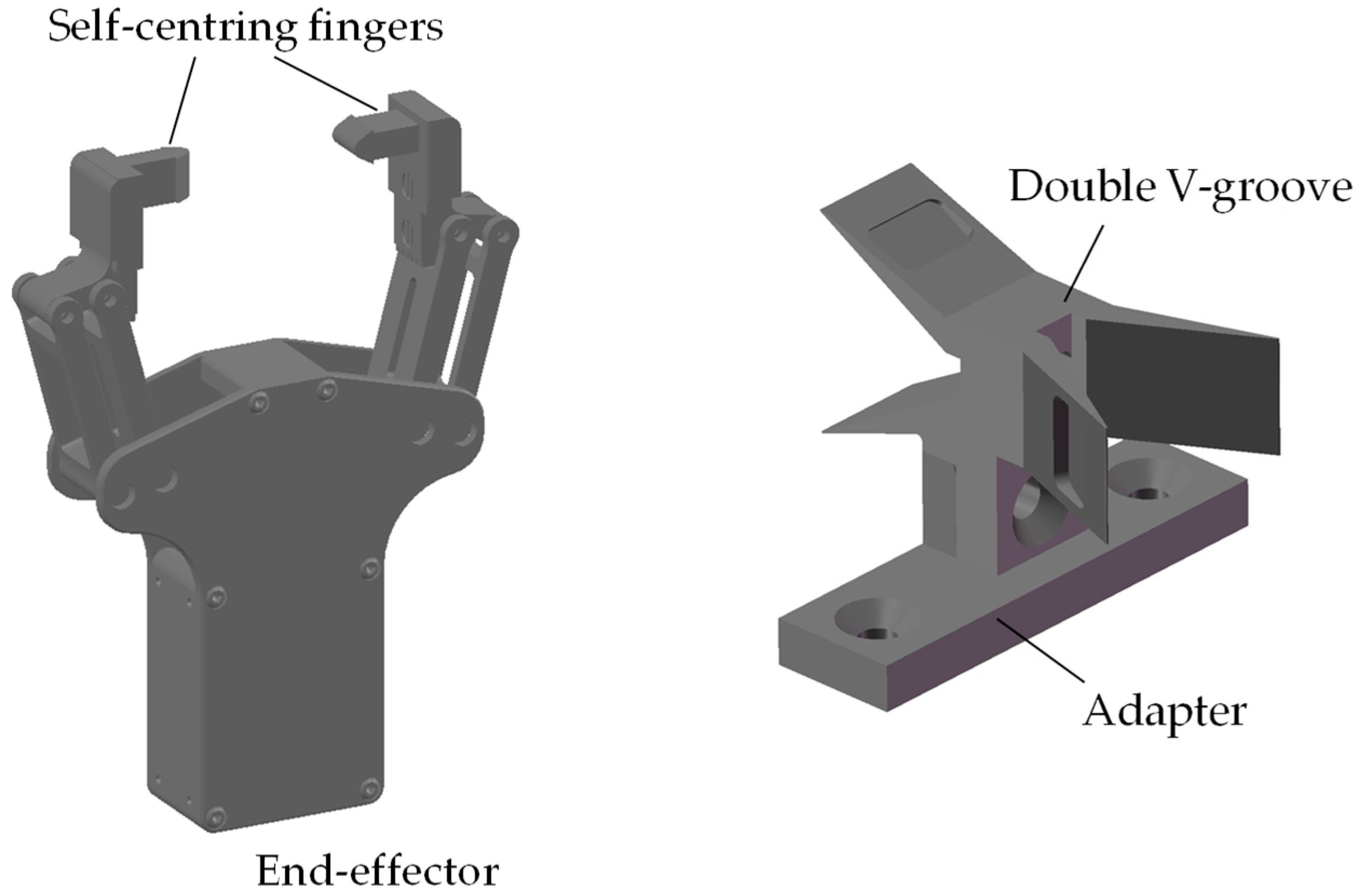
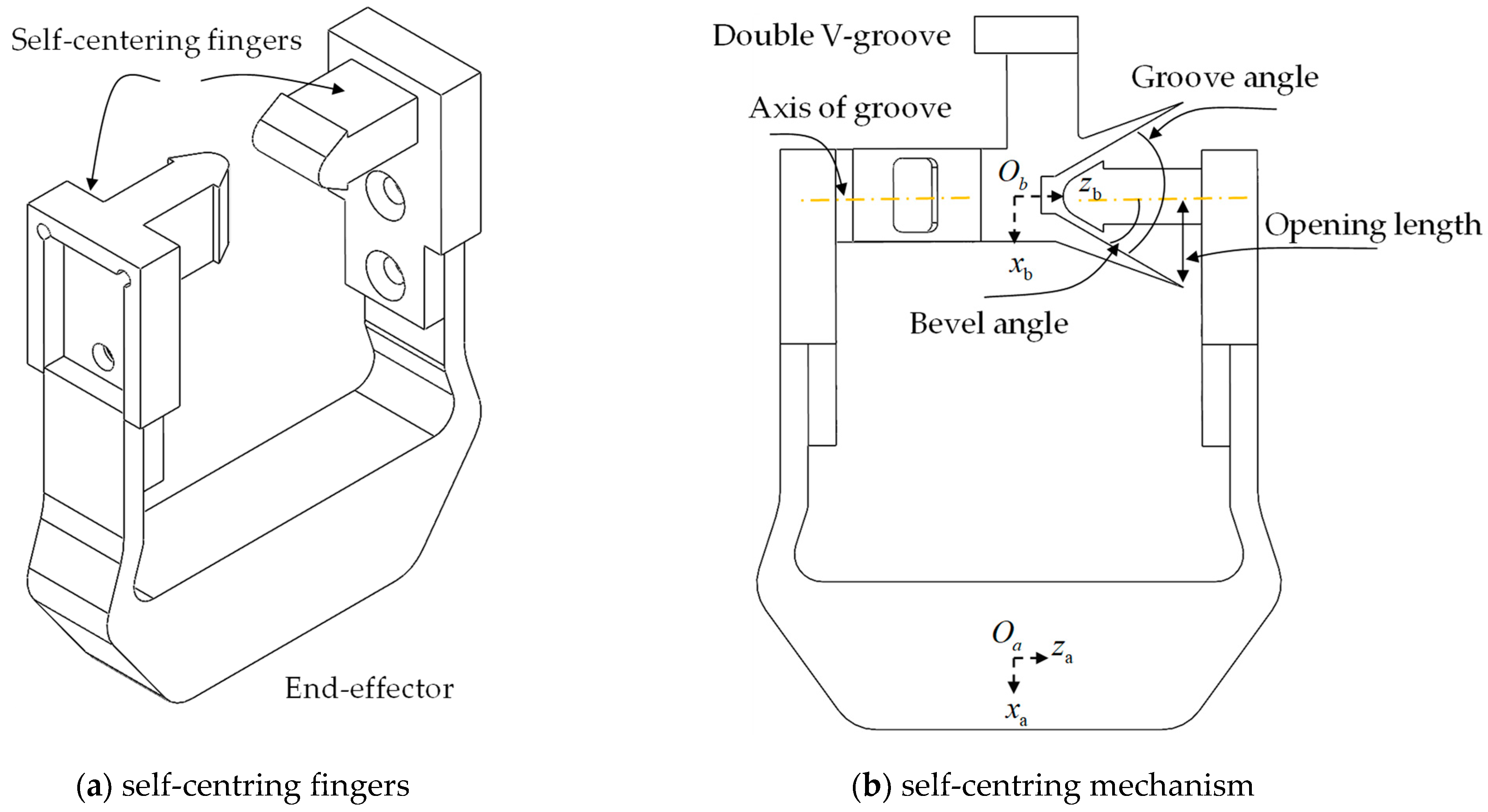
Figure 2 illustrates the mechanical components of the proposed self-centring mechanism. The mechanism consists of two self-centring fingers attached to the gripper body of the robotic arm and a double V-groove rigidly mounted on each target module via an adapter. The self-centring fingers constitute the active grasping components, while the double V-groove provides the passive geometric constraints required for alignment during engagement. The mechanism is designed as a modular interface between the end-effector and the target module. By replacing the V-groove adapter, the same finger assembly can be employed with different module geometries without modification of the end-effector.

2.3. Geometric Configuration

Figure 3 shows the geometric configuration of the self-centring mechanism. The dotted lines represent the axes of the double V-groove. The angles formed between the bevelled edges and axes of the double V-groove, known as the bevel angles, along with the lengths of the bevelled edges and the groove angle magnitudes, determine the ability of the mechanism to tolerate misalignments. The frames O a and O b are defined as local reference frames fixed on the end-effector and the double V-groove, respectively. The design of the self-centring mechanism provides significant misalignment tolerances, accommodating parallel offsets of approximately ± 10 mm in both x a and y a directions, and misalignments of ± 30 ° , ± 30 ° and ± 62 ° in roll, yaw and pitch angles, respectively.

2.4. Working Principle

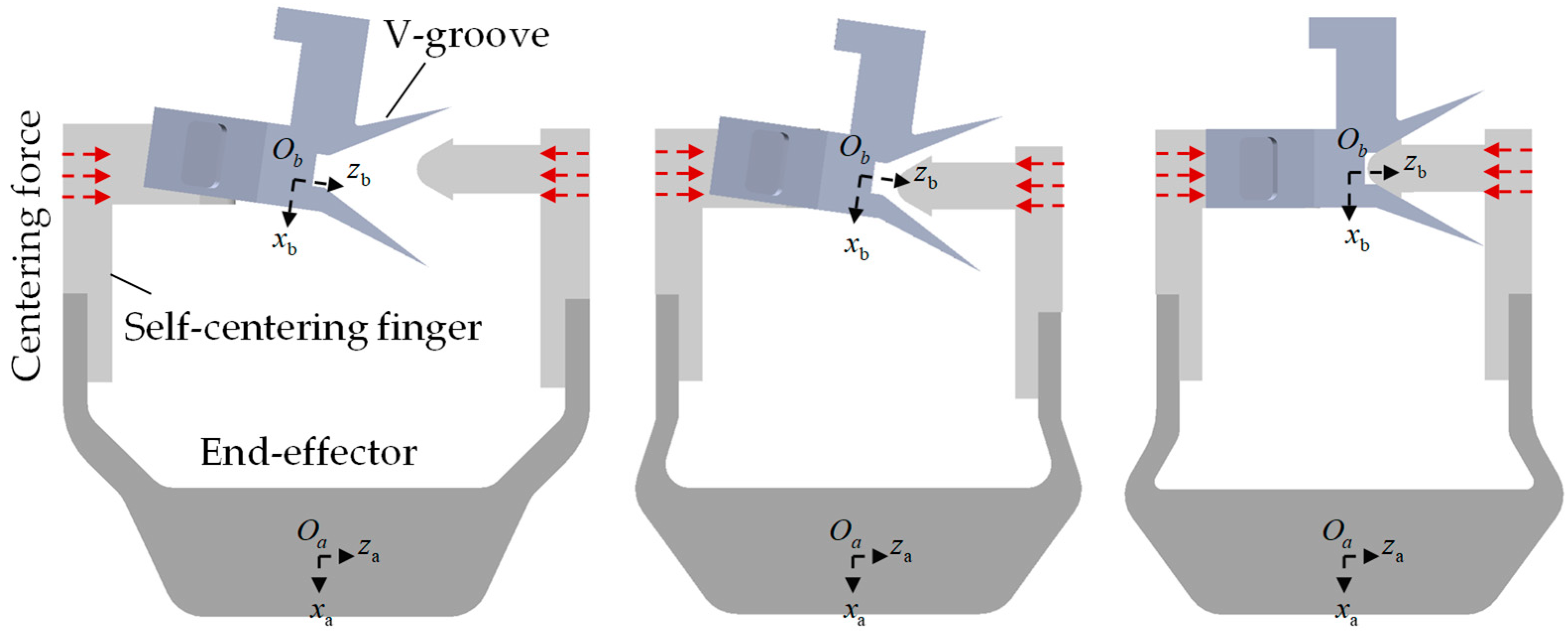
Figure 4 illustrates the working principle of the self-centring mechanism under conditions of the parallel offset and angular misalignment. The grasping process can be divided into three stages:
(1)
Approach
The end-effector of the robotic arm approaches the target module, such that the self-centring fingers enter the tolerance range of the double V-groove.
(2)
Self-centring process
In situations where the frames of the end effector and the target module have parallel offsets, the self-centring fingers initially make contact with one side of the V-groove during the closing process. Upon contact, the finger pushes the groove aside, causing it to make contact with the other finger before bouncing back. The forces exerted by the fingers are referred to as self-centring forces in this paper. As the self-centring fingers continue to close, multiple instances of bouncing contact occur, such that the self-centring forces translate the target module until proper alignment between the V-groove and the end-effector is reached. Similarly, a self-centring torque arises in cases of angular misalignment, i.e., the axes of the two frames are not parallel.
(3)
Completion
Finally, the self-centring process is complete when the contact surfaces of the V-groove achieve a state of force equilibrium. As a result, the frame of the end-effector O a aligns with the frame of the double V-groove O b , effectively eliminating any misalignments.

3. Multi-Point Contact Dynamics

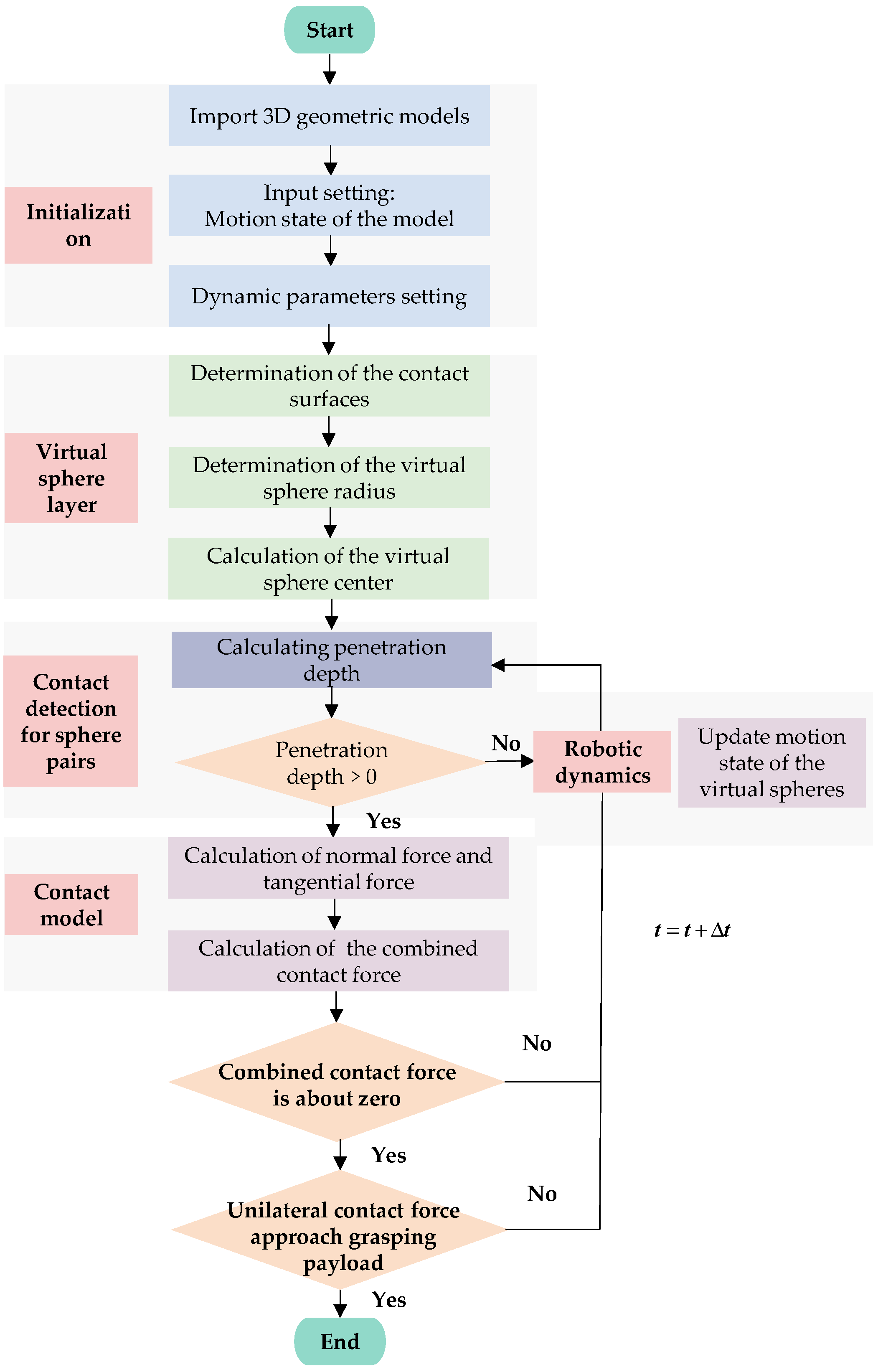
As shown in Figure 5, this section elaborates on the multi-point contact dynamics in the self-centring process. Firstly, a virtual layer of spheres is generated on the contact surfaces of the self-centring fingers and the double V-groove mechanism. The contact condition is assessed by calculating the centre distances between pairs of spheres. Secondly, contact forces are applied to each pair of spheres in contact. The dynamic equation is solved using the explicit time integration method, and the contact forces are updated at each step.

3.1. Multi-Point Contact Model

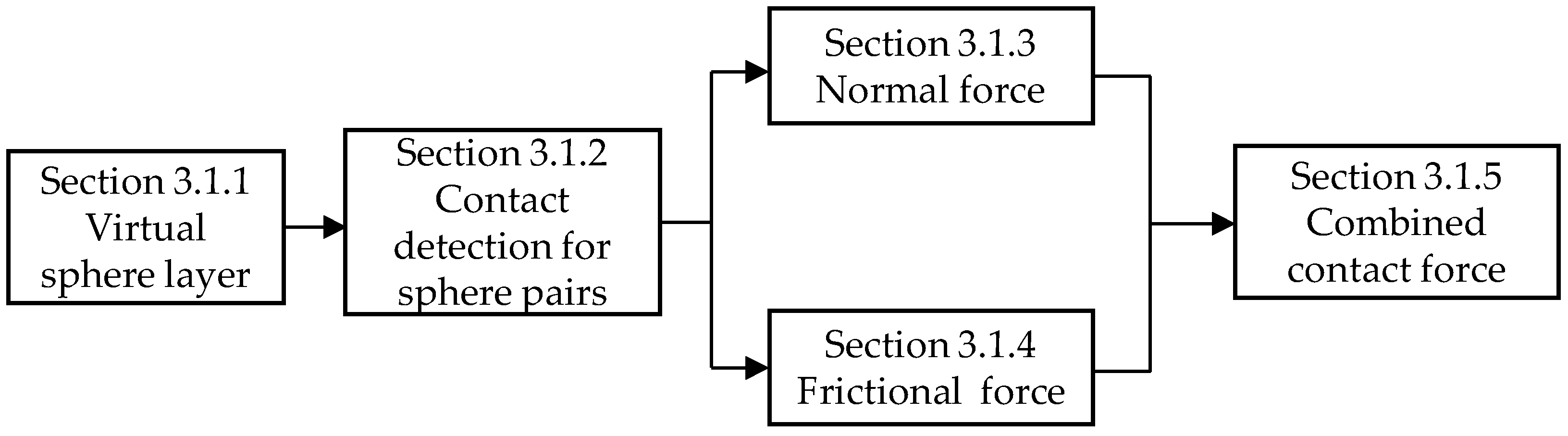
Figure 6 illustrates the detailed steps to build a contact model: (a) generate virtual sphere layers with a prescribed radius on the contact surfaces of the self-centring fingers and double V-groove mechanisms. (b) Contact detection for sphere pairs. (c) Calculate the normal and frictional forces. (d) Calculate the combined contact force.

3.1.1. Virtual Sphere Layer

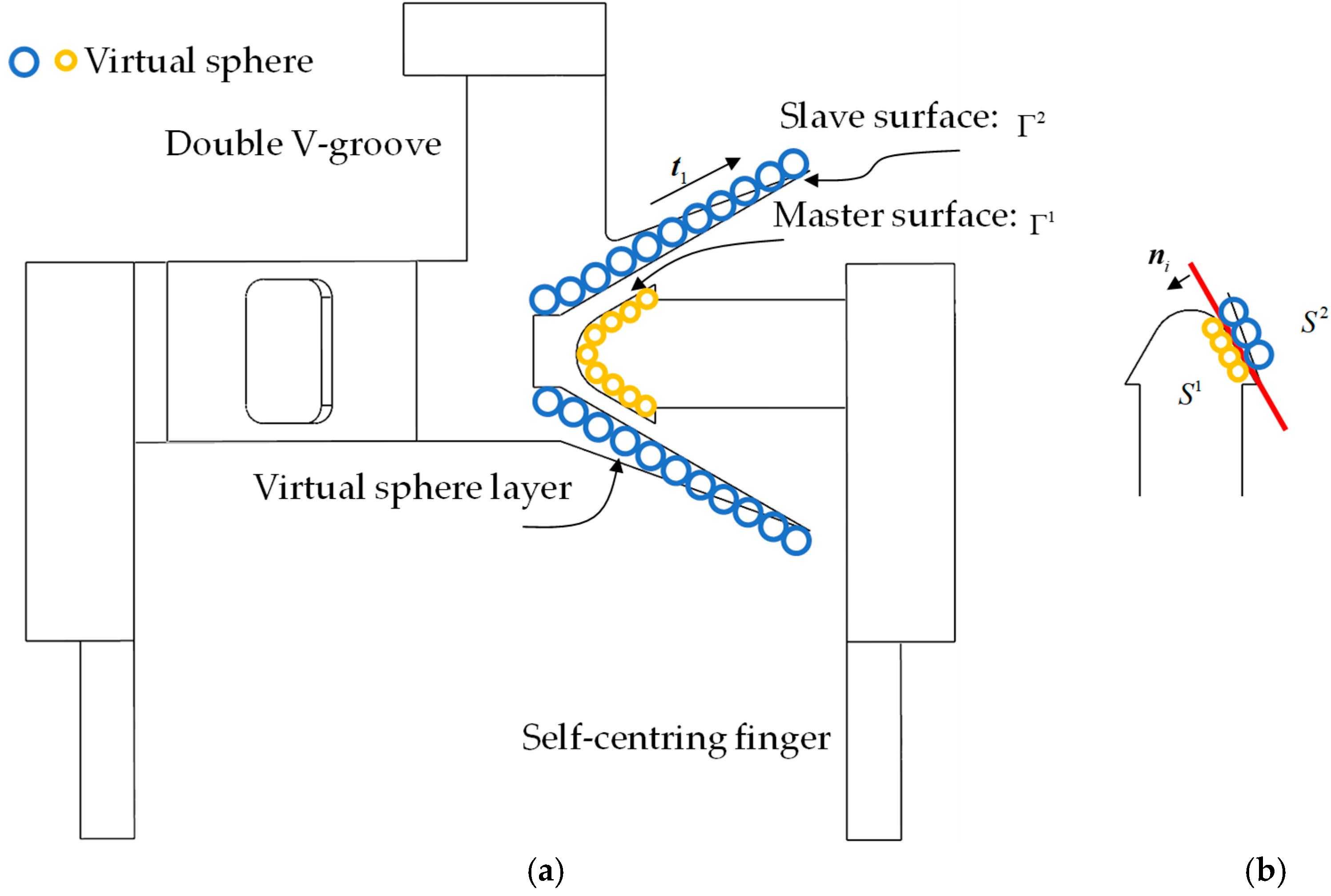
As shown in Figure 7, a virtual sphere layer is generated to discretise the contact surfaces. The detailed steps are as follows:
(a) Identify the master contact surface Γ 1 , the slave contact surface Γ 2 , and the prescribed radius r i of virtual spheres.
(b) Retrieve all vertex coordinates N = N 1 , N 2 , N 3 , N i of the contact surfaces in the inertial frame from the contact model, and perform coordinate transformation (see Equation (1)) to obtain the each vertex coordinate N i b in the body-fixed coordinate system.
N i b = R T N i T
where R represents the rotation matrix of the contacting body in the inertial frame, and T represents its translation vector in the inertial frame
(c) Calculate the normal vector of contact surface n i , and then construct the orthogonal basis vectors t 1 , t 2 within the contact surface.
n i = N 2 b N 1 b × N 3 b N 1 b N 2 b N 1 b × N 3 b N 1 b
t 2 = n i × t 1
(d) Discretise the contact surface along the orthogonal basis vectors with a step size equal to the radius of the virtual sphere.
N i , j b = N 0 b + i r i t 1 + j r i t 2
where N 0 b is a reference vertex of the contact surface, i , j are integer indices that determine the number of steps, and the discrete points are generated by traversing their ranges.
(e) Offset the discrete point coordinates N i , j b along the normal vector of the contact surface to ensure tangency with the surface, thereby obtaining the virtual sphere centres c i , j b and forming the virtual sphere sets. S 1 = S i 1 i = 1 , 2 , 3 , , n represents the virtual sphere sets of the self-centring fingers, whereas S 2 = S j 2 j = 1 , 2 , 3 , , n corresponds to the V-groove.
c i , j b = N i , j b + r i n i

3.1.2. Contact Detection for Sphere Pairs

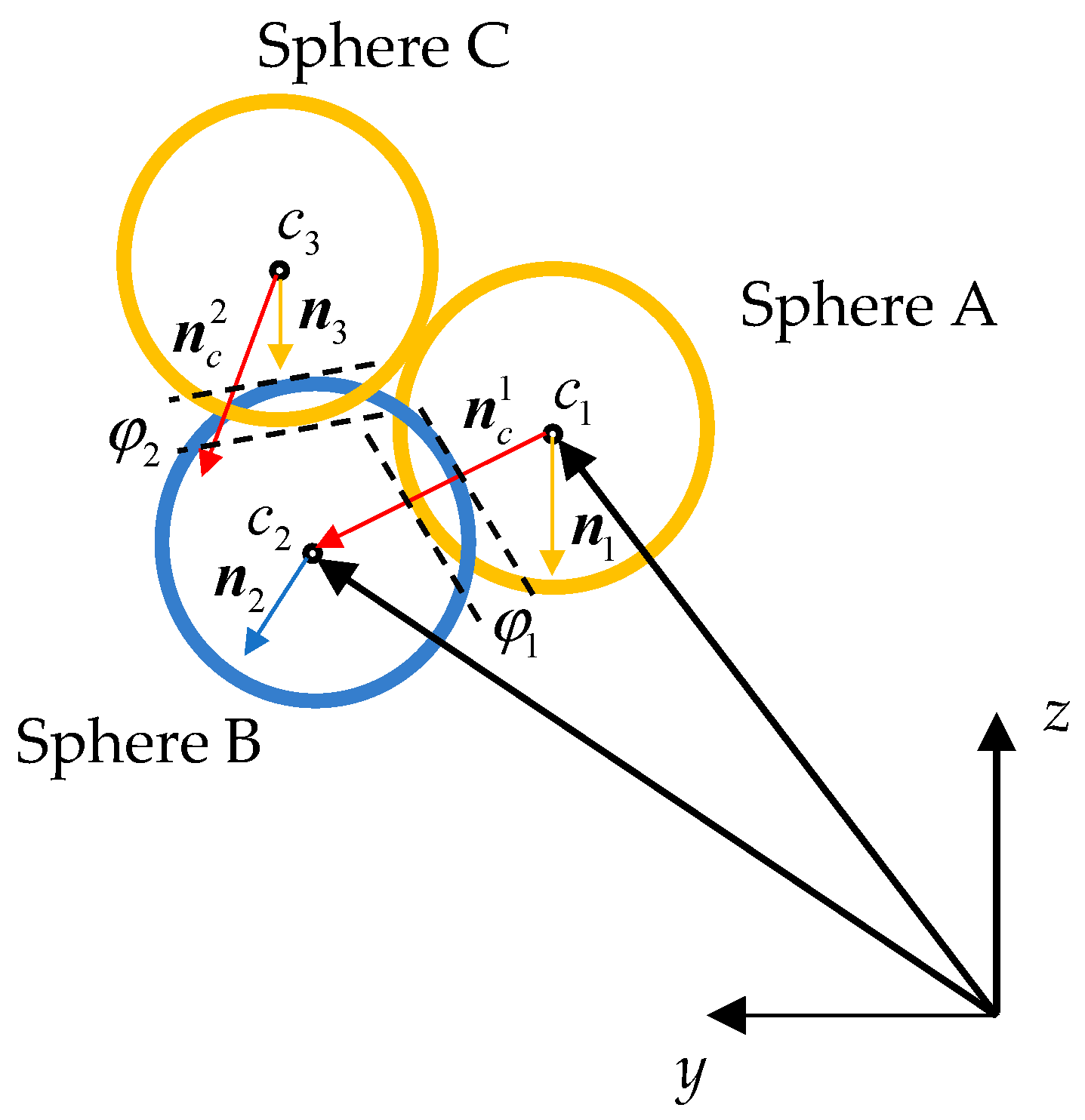
As shown in Figure 8, the detailed steps for detecting contact point pairs between the self-centring fingers and the double V-groove mechanism are described as follows:
(1) The common normal vector n c 1 of the contact surface at the contact point is determined as described in Equation (6). It is obtained by subtracting the normal vector of sphere B, n 1 , from that of sphere A, n 2 , and then normalising the result.
n c 1 = n 2 n 1 / n 2 n 1
(2) The geometric relationship between spheres A and B is characterized by the relative position vector d between their centers, defined as
d = c 1 c 2 + φ 1 n c 1
where c 1 and c 2 are position vectors of the two virtual spheres centers, and φ 1 is the relative displacement along the common normal direction.
(3) The penetration depth φ 1 along the common normal direction is determined by Equation (8):
φ 1 = χ 1 + χ 1 2 w 1
Specifically, when φ 1 < 0 , no contact occurs between the spheres, while φ 1 > 0 indicates penetration along the direction of the common normal n c 1 , signifying that the spheres are indeed in contact.
The χ 1 and w 1 are defined as
χ 1 = n c 1 T ( c 1 c 2 )
w 1 = c 1 c 2 2 r 1 + r 2 2
where r 1 and r 2 are the radii of spheres A and B, respectively.
(4) Repeat Steps (1)–(3), iterating through the virtual sphere sets S 1 and S 2 to complete the detection of all contact point pairs.

3.1.3. Normal Force

A generic local normal contact force [44] is defined as
F n = F n n = K δ α n + λ δ α δ ˙ n
where α is the nonlinear power exponent, with a value of 1.5. δ = φ 1 2 represents the local indentation between the surfaces of the two contacting bodies at the contact point. δ ˙ denotes the relative velocity of the contacting bodies.
K and λ are the contact stiffness and contact damping coefficients, respectively. These coefficients are dependent on material properties and geometric characteristics of the contact zones, defined as
λ = 6 1 c r 2 c r 1 2 + 3 K δ ˙ -
K = 4 3 E 1 E 2 E 1 ( 1 ν 2 2 ) + E 2 ( 1 ν 1 2 ) r 1 r 2 r 1 + r 2

3.1.4. Frictional Force

The frictional force between the self-centring fingers and the target modules can result in various frictional behaviours, including slipping, sticking, or stick–slip. A three-dimensional bristle friction is employed during the multi-point bouncing contact process. The frictional force model is defined as follows:
F f = k b s c b s ˙
where k b is the bristle stiffness; c b is the bristle damping coefficient; s is the average bristle deflection vector, defined as
s ( t ) = s ( t 0 ) + t 0 t v t a n g e n t i a l ( t ) d t i f s < s m a x ( t ) s m a x ( t ) v t a n g e n t i a l ( t ) v t a n g e n t i a l ( t ) i f s s m a x ( t )
where t 0 is the initiation time of the associate contact, and s m a x is the maximum bristle deflection, defined as
s m a x t = s s m a x ( t ) = μ k f n k b i f v tangential > v d s s m a x ( t ) = μ s f n k b i f v tangential v d
where μ k and μ s are the kinetic and static friction coefficients, respectively, and v d is the velocity deadband used to distinguish between the sticking state and slipping states.
The v t a n g e n t i a l is the tangential velocity vector between the two contacting bodies at the contact point, defined as
v t a n g e n t i a l = v - v T n n
where v is the relative velocity vector of the two contacting bodies at the contact surface.

3.1.5. Combined Contact Force and Torque

The combined contact force F c is obtained by summing the normal forces F n i and frictional forces F f i of all contact point pairs detected within a single time step, defined as
F c = i = 1 k F n i + F f i
where k denotes the number of contact point pairs.
In addition to the resultant force, the corresponding combined contact torque is computed by taking the moment of each contact force about the relevant centroid. Let p c i denote the position vector of the i-th contact point in the inertial frame, and the contact force acting at this point is defined as
f c i = F n i + F f i
The combined contact torque about the centroid of the target module, whose position is denoted by r G , t , is given by
τ c , t = i = 1 k p c i r G , t × f c i
Similarly, the contact torque acting on the robot system is evaluated with respect to the robot-system centroid r G , r . Owing to Newton’s third law, the contact force exerted on the robot system at the i-th contact point satisfies f c , r i = f c i . The resulting combined contact torque is therefore expressed as
τ c , r = i = 1 k p c i r G , r × - f c i

3.2. Numerical Solution Procedure

This study employs an explicit time integration method, which discretises the dynamic equations and performs numerical iteration. At each time step, the normal forces and frictional forces at the contact points are dynamically computed, followed by the updating of the displacement, velocity, and acceleration of the virtual spheres. In the virtual-sphere discretisation, the radii of the sphere elements are assigned according to the geometric characteristics of the contacting surfaces. Specifically, the virtual spheres distributed on the double V-groove surfaces are assigned a radius of 0.8 mm, while those associated with the self-centring gripper fingers adopt a radius of 0.7 mm. This parameter selection preserves the geometric resolution of the contact interface and is consistent with the adopted time step (dt = 0.001 s), ensuring numerical stability of both contact computation and explicit time integration under multi-point contact conditions, while meeting the requirements of contact computation accuracy and computational efficiency. The numerical solution is divided into the following three key steps:
(1) Calculate the number of sphere pairs. Using the aforementioned Equations (6)–(10), calculate the normal vectors of each group of spheres and the distances along their common normal direction at each time step. When these distances are less than or equal to the sum of the radii of the spheres, contact is considered to have occurred. It should be noted that in each computational step, each sphere element may potentially be in contact with multiple other sphere elements. It is necessary to iteratively compute the distance between each master sphere element from S 1 and all the slave sphere elements S 2 along the common normal to ensure accuracy in the detection of contact point pairs.
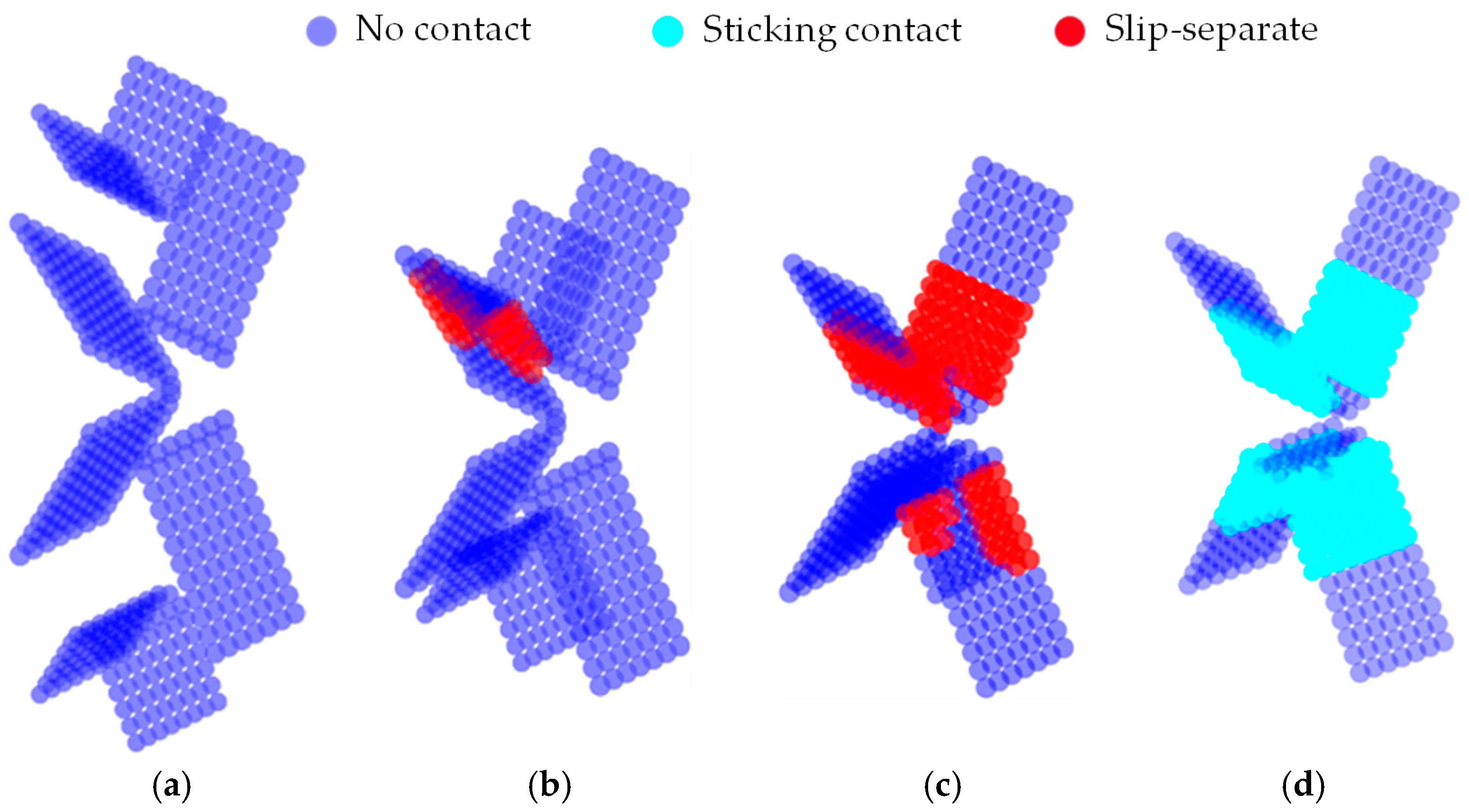
(2) Update the motion state of the virtual spheres. As illustrated in Figure 9, the contact behavior of the virtual spheres can be classified into three types based on interaction conditions: (1) no contact (blue spheres); (2) slipping–separation contact when the frictional force is kinetic (red spheres); and (3) sticking contact when the frictional force is static (light blue spheres). Under external forces, the number of slipping–separation spheres gradually increases, resulting in multi-point bouncing contacts within the V-groove cavity. According to the number of contact point pairs detected during a single time step in Step (1), the combined contact force (including normal forces and frictional forces of all sphere pairs) is computed and projected onto the centroid of the target module to update its motion state. Subsequently, the positions of the virtual sphere sets S 1 and S 2 are iteratively updated.
(3) Completion of the self-centring process. As the self-centring process approaches its end, most of the virtual spheres within the interaction region gradually transition to the sticking state. When the combined contact force reaches equilibrium and the unilateral contact force in the V-groove approaches the maximum grasping load of the end-effector, the self-centring process is complete.

4. Grasping a Module with a Single Robotic Arm

4.1. Numerical Simulations

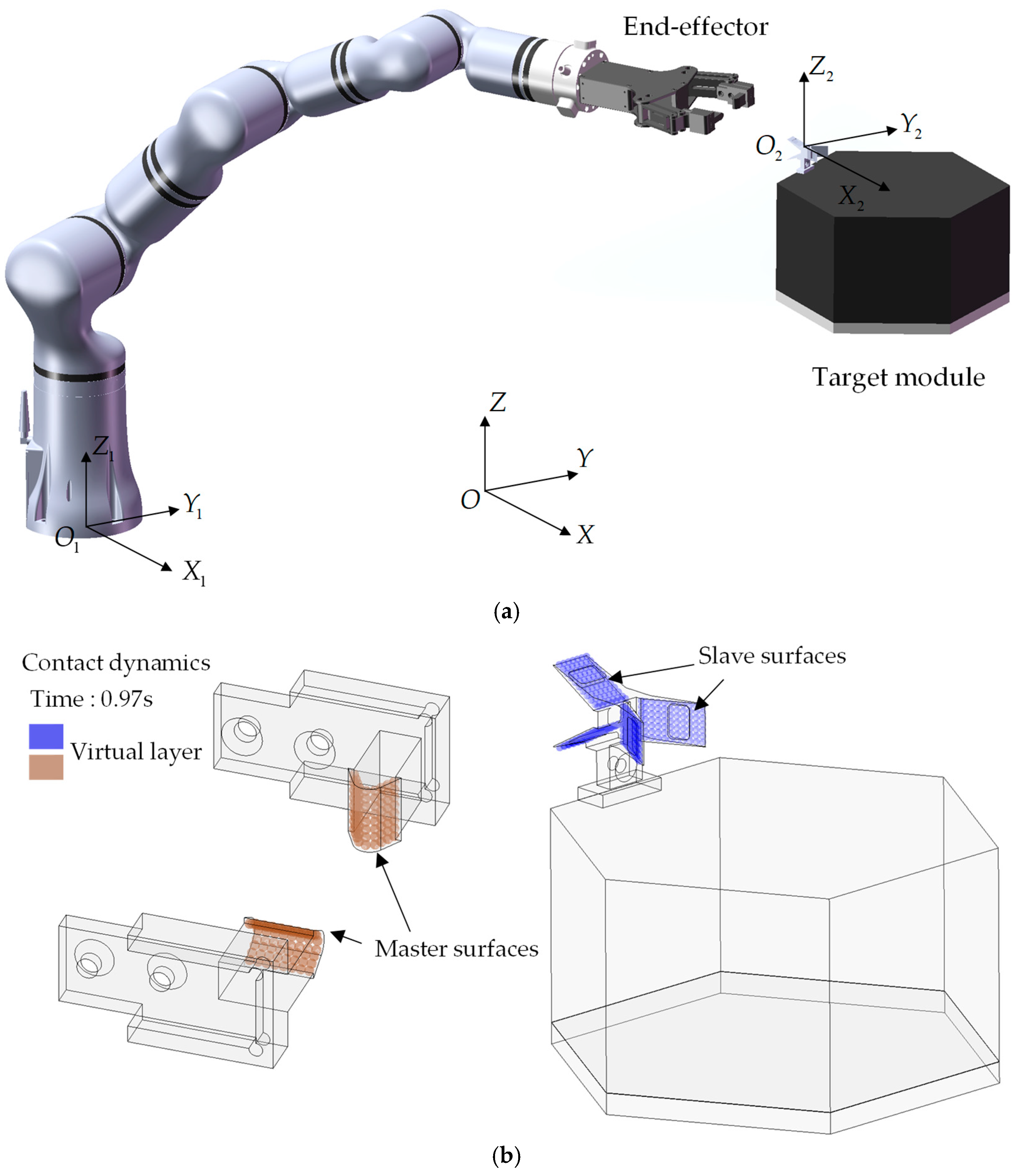
In this section, numerical simulations are conducted to evaluate the positioning accuracy of the self-centring mechanism and to validate the effectiveness of the proposed contact model for a single robotic arm grasping a target module. The configuration of the robotic arm is illustrated in Figure 10a, where the base is rigidly fixed. The six-DOF robotic arm consists of six rigid links and an end-effector equipped with two self-centring fingers. The frame O - X Y Z serves as the inertial reference frame, while O 1 - X 1 Y 1 Z 1 and O 2 - X 2 Y 2 Z 2 are body-fixed frames attached to the robotic arm and the target module, respectively. Figure 10b shows the contact model of the self-centring process. Throughout the grasping phase, the robotic arm is assumed to operate in a self-locking state, such that the system dynamics are driven primarily by the contact interaction at the finger–groove interface.
Table 1 summarises the material and physical properties of the self-centring mechanism and the target module. The elastic parameters ( E 1 , E 2 , ν 1 , ν 2 ) are selected based on the nominal mechanical properties of the aluminium alloy used for the fingers and the V-groove components and primarily determine the normal contact stiffness and peak contact forces during the grasping process. The parameters ( μ k , μ s , k b , c b , v d ) listed in Table 2 are adopted from the three-dimensional bristle friction formulation reported in Ref. [36] and primarily govern the transient convergence behaviour and the dynamic stability of the self-centring process. The final positioning accuracy is predominantly governed by the geometry imposed by the V-groove configuration and the resulting multi-point contact configuration, while the selected parameters ensure stable convergence toward this equilibrium configuration.
To investigate the influence of actuation speed on the convergence characteristics of the self-centring process, three numerical validation scenarios are defined, as summarised in Table 3. The selected closing speeds represent low, nominal, and upper-bound operating conditions of the experimental platform. In all cases, the initial parallel offset between the self-centring fingers and the V-groove mechanism is set to [0, −3, 0] mm and the numerical integration time step is fixed at 1 ms, thereby isolating the effect of closing speed on the resulting contact dynamics and positioning performance. All simulations are conducted in MATLAB R2022a, on a workstation equipped with an Intel® Core™ i7-14700F CPU and 32 GB RAM, without GPU acceleration or parallelisation. For the single-arm self-centring grasping process, the computational times for Case I, Case II, and Case III are 15.23 s, 11.32 s, and 9.21 s, respectively. These timings reflect the algorithmic complexity of the proposed virtual sphere layer method rather than hardware-level optimisation and indicate that the proposed method is primarily intended for offline, high-fidelity numerical analysis.
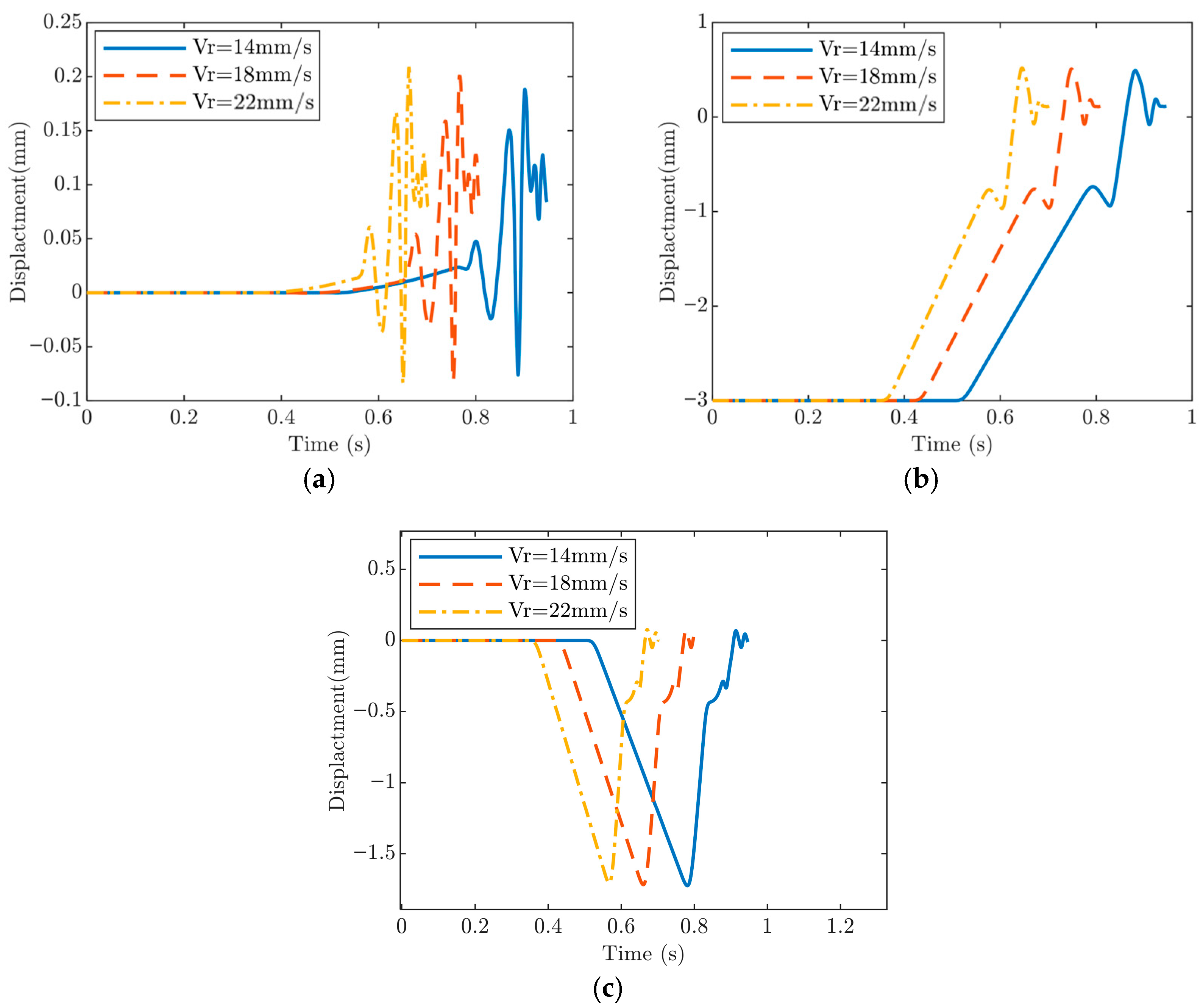
Based on the validation scenarios defined in Table 3, Figure 11 shows the displacements of the centroid of the double V-groove mechanism along the x, y and z directions under different closing speeds of the fingers. This figure serves to validate the convergence and stability properties of the proposed multi-point contact model. During the initial 0.4 s, no physical contact is observed, and the centroid remains stationary. As the fingers gradually close, repeated impact and sliding contacts occur at multiple virtual sphere pairs, inducing coupled translational and rotational motions of the V-groove. The parallel offsets decrease monotonically and converge toward bounded steady-state values, indicating the establishment of a quasi-static equilibrium configuration governed by the geometric constraints of the V-groove and the distributed contact interactions. A comparison among the three cases further reveals that higher closing speeds lead to larger transient oscillation amplitudes and slower decay rates, reflecting the increased impact intensity and energy dissipation demands of the contact process.
The converged residual positioning errors corresponding to the three validation scenarios are quantitatively summarised in Table 4, where the Euclidean norm of the final offset vector is also reported for direct comparison. In all cases, the residual errors remain below 0.131 mm, demonstrating the sub-millimetre positioning accuracy achieved by the self-centring mechanism and the consistency of the numerical predictions across different actuation regimes.
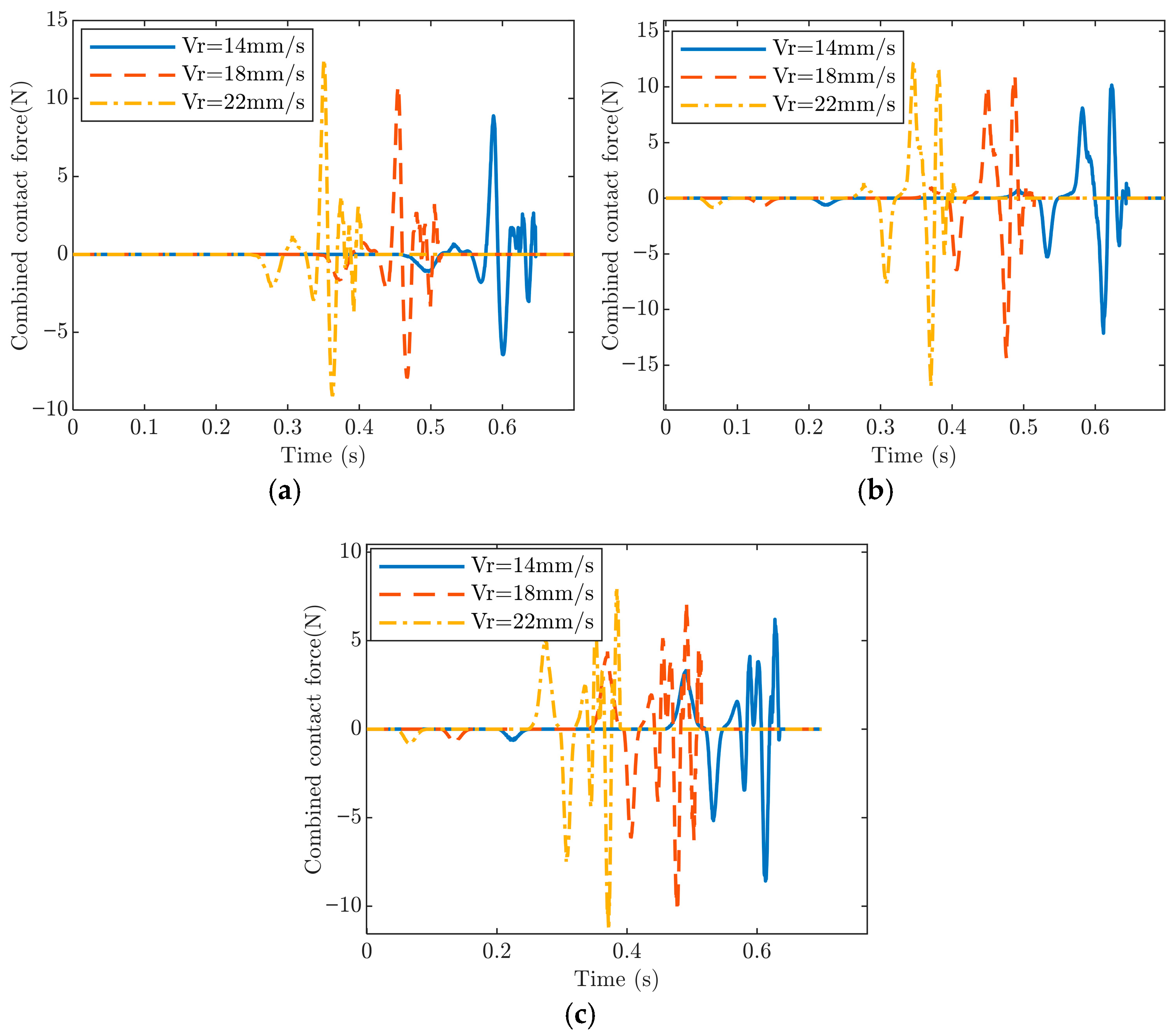
Figure 12 depicts the combined contact forces under different closing speeds of the fingers during the self-centring process. Initially, the self-centring fingers are within the tolerance range of the V-groove but have not yet made contact. As the fingers gradually close along the z-axis, as illustrated in Figure 12c, the initial contact occurs. Subsequently, multiple instances of bouncing contact are observed due to localised impact effects. During this stage, the V-groove continuously interacts with the inner surfaces of the cavity at different positions, resulting in significant fluctuations in the combined contact forces. As depicted in Figure 11a,b, these interactions not only induce force oscillations along the x and y axes but also reveal the dynamic characteristics of multi-point contact during the closing process. Moreover, different closing speeds significantly affect the amplitude of these oscillations. Higher closing speeds (e.g., 22 mm/s) lead to more intense contact force variations, manifesting as [12.26, 10.23, 7.9] N on the x, y, and z axes. In the final 0.1 s, the chances of bouncing contacts increase rapidly and the self-centring is considered to be finished when the combined contact forces reach equilibrium and the unilateral contact force approaches the grasping payload.

4.2. Experimental Validations

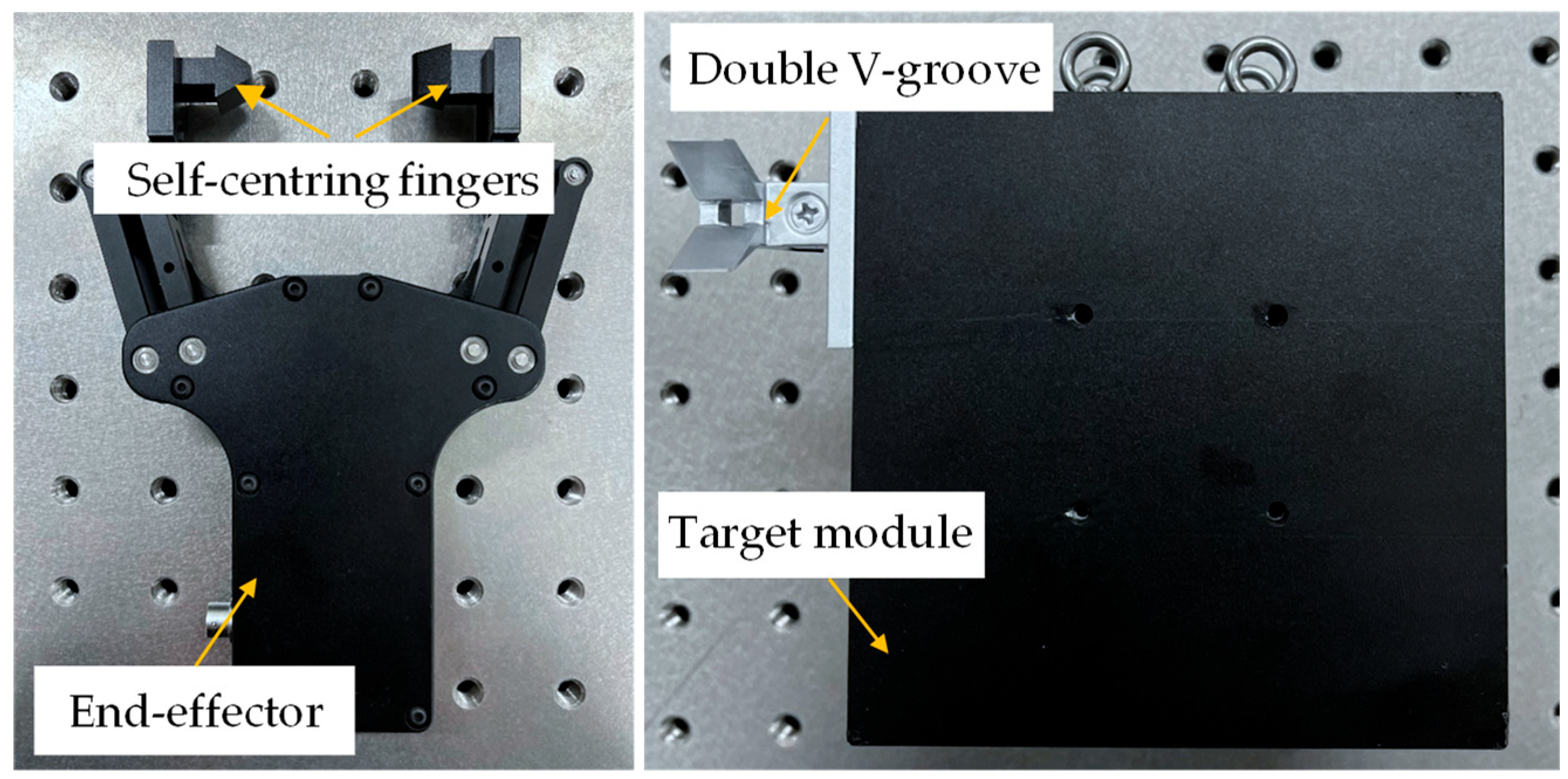
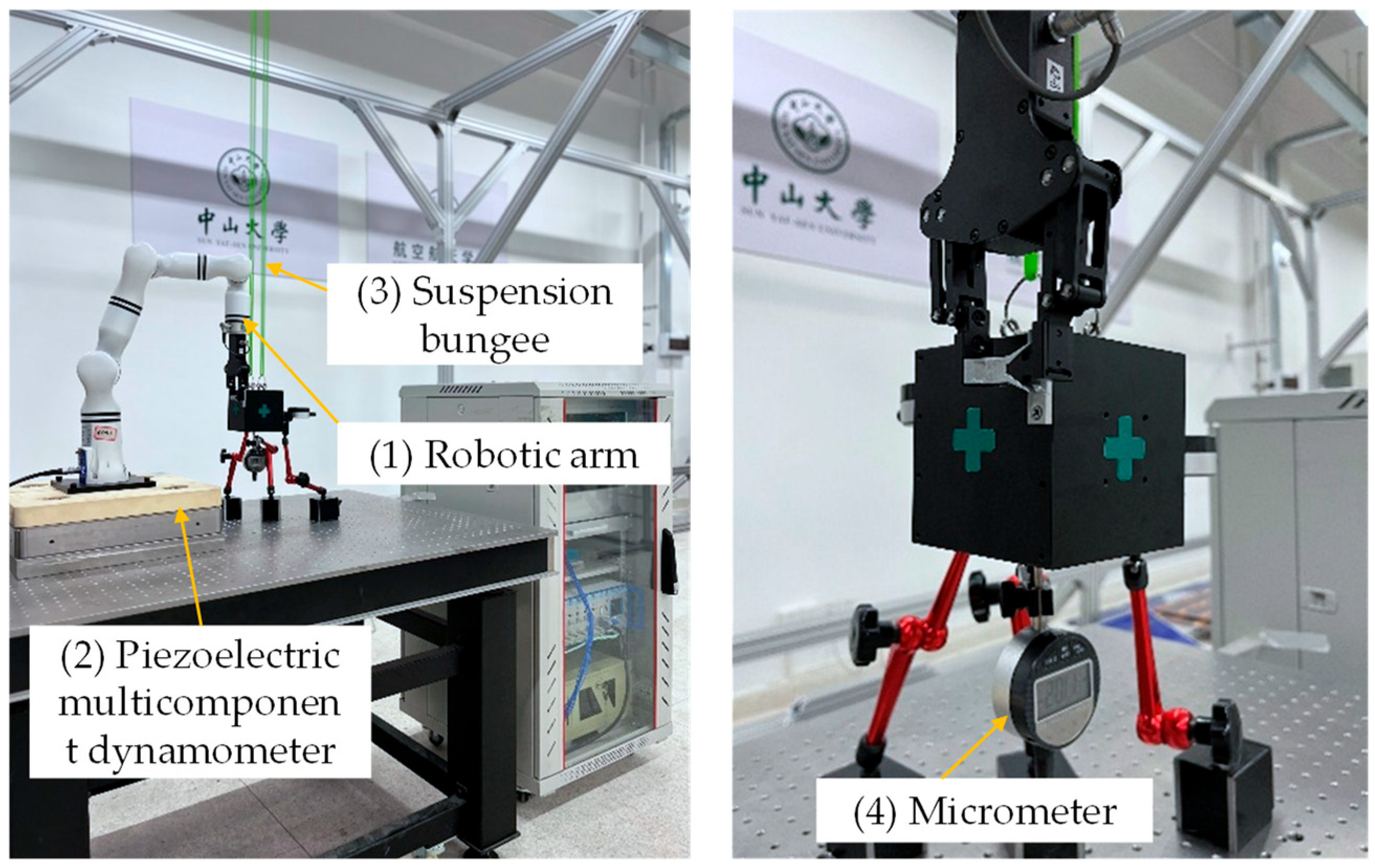
An experimental system for a single robotic arm was also established. Figure 13 shows a picture of the self-centring mechanism and the target module. The experimental system mainly consisted of the following: (1) a robotic arm, (2) a piezoelectric multicomponent dynamometer for measuring the contact forces and torques generated in the self-centring process, (3) suspension bungee for suspending the target module by means of an elastic bungee to place it in a free-floating mode, and (4) three micrometers for measuring the positioning accuracy of the mechanism.
As shown in Figure 14, the robotic arm was mounted on the dynamometer via an adapter plate, allowing the interaction forces and moments generated between the self-centring fingers and the target module during the self-centring process to be fully transmitted to the dynamometer along the mechanical load path. Under this mounting configuration, the measured multi-axis force and moment signals represent the resultant contact loads acting on the end-effector and are used to characterise the overall evolution of multi-point contact forces and moments during the self-centring process. For the positioning accuracy evaluation, three digital micrometres were arranged orthogonally along the x, y, and z axes of the target module and rigidly fixed to the experimental frame, with their probes aligned perpendicular to the corresponding reference surfaces. After calibration and zeroing at the nominal reference configuration, the displacement readings obtained from the micrometres directly represent the residual positioning errors after the completion of the self-centring process. The experimental validation is intended to provide a representative physical verification of the numerical predictions under a nominal operating condition. Owing to the physical constraints of the experimental platform and the suspension system, a single closing speed of 14 mm/s was selected as a representative case to examine the predicted contact force evolution and convergence behaviour of the proposed model. Accordingly, the experimental results are used to assess qualitative agreement in temporal trends and steady-state characteristics, rather than to perform a full parametric validation across the entire range of closing speeds considered in the numerical study.
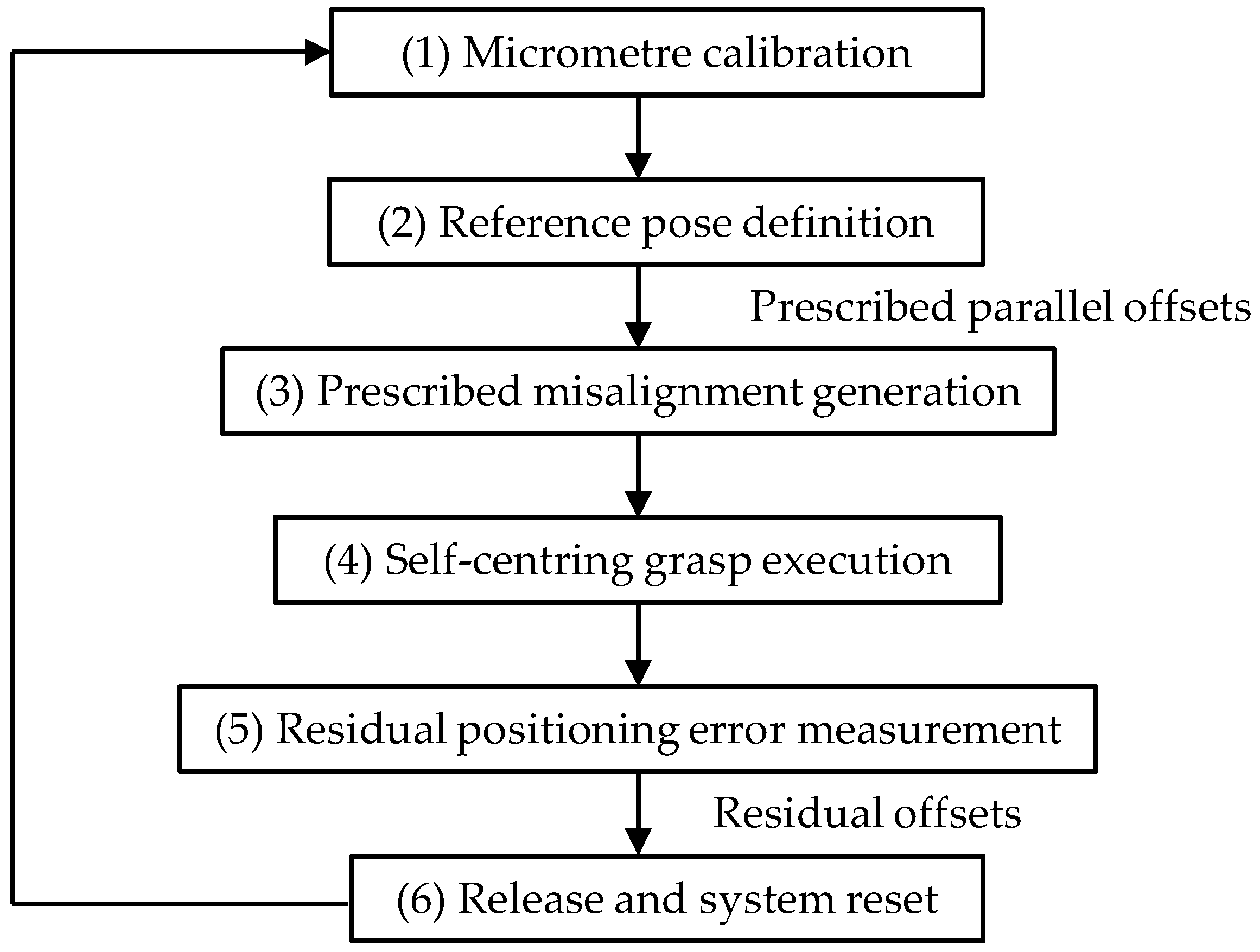
Experiments were conducted to evaluate the positioning accuracy of the self-centring mechanism under prescribed initial misalignment conditions. For clarity and reproducibility, the experimental workflow is illustrated in Figure 15, which summarises the micrometre calibration, reference pose definition under the zero-misalignment condition, controlled generation of parallel offsets via joint-space trajectory planning, execution of the self-centring grasp, measurement of residual positioning errors along the x, y, and z axes, and the release–reset loop for repeated test cases.
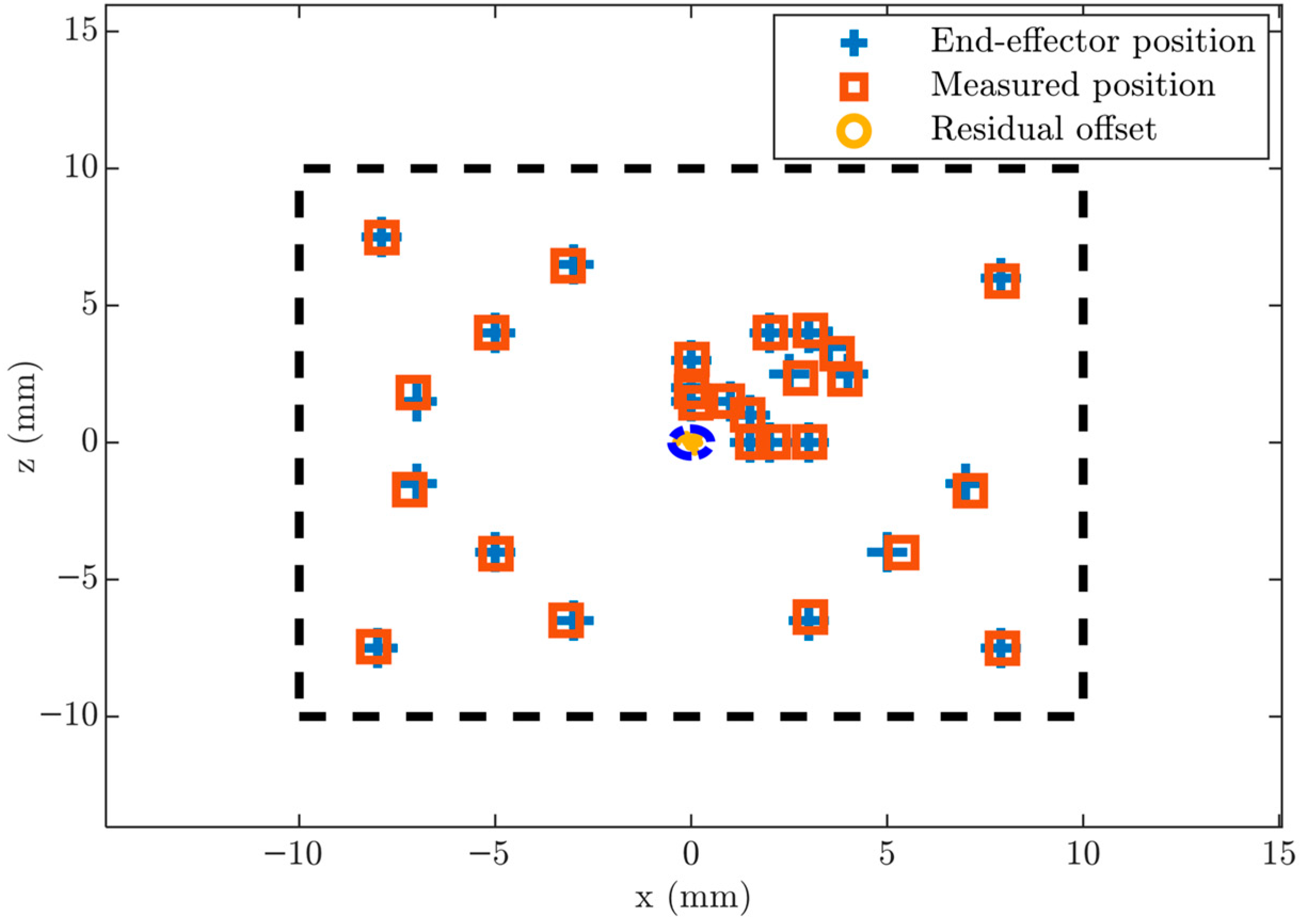
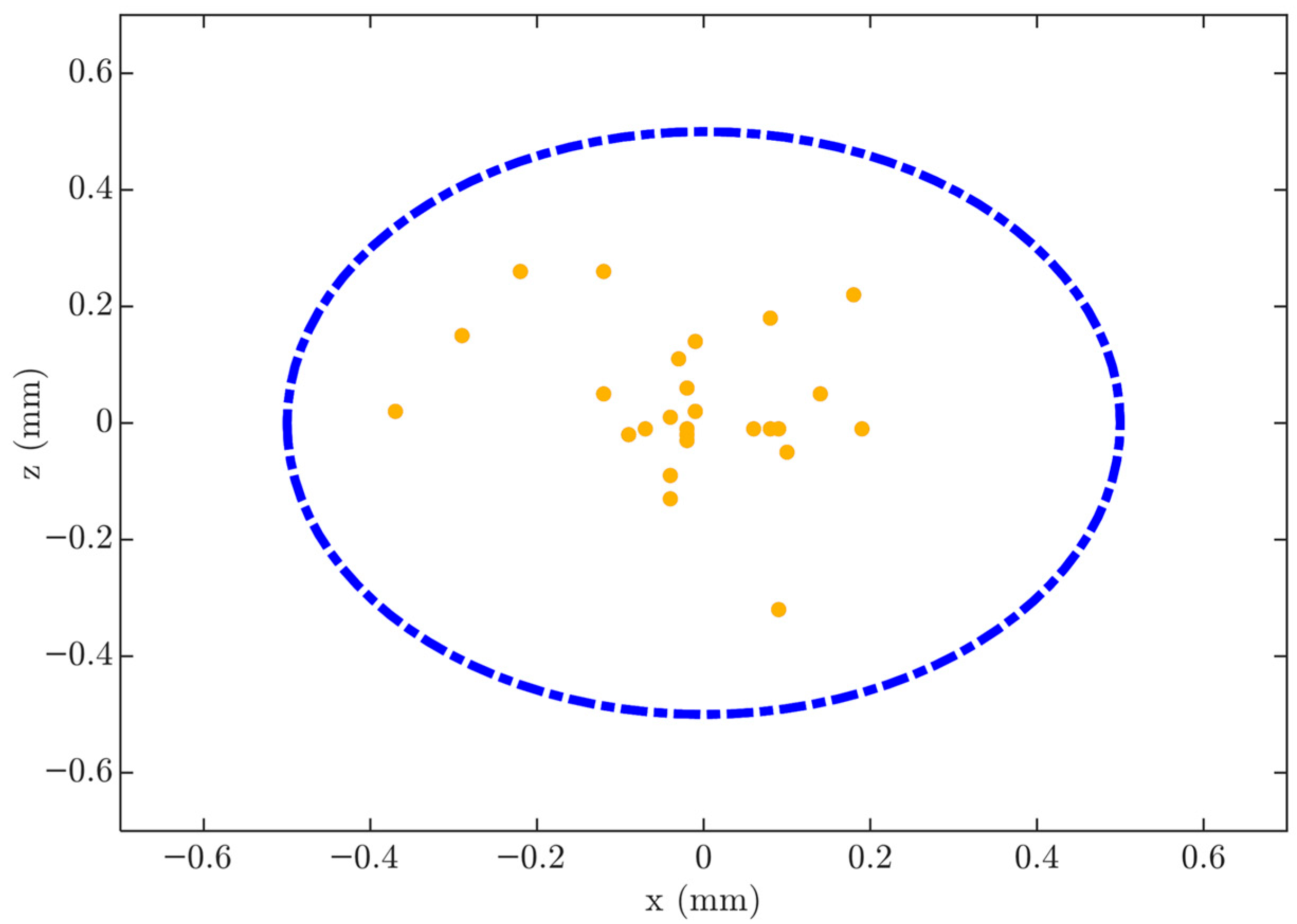
Figure 16 compares the positioning accuracy of the self-centring mechanism under different parallel offsets in the x and z directions. The black dashed rectangle represents the misalignment tolerance of the self-centring mechanism, and the blue cross represents the end-effector positions. The red rectangles denote the measured positions. As shown in Figure 17, the yellow circle represents the residual offsets, which are obtained by subtracting the measured positions from the end-effector positions. It can be seen that all residual offsets are less than 1 mm, demonstrating the sub-millimetre positioning accuracy of the self-centring mechanism.
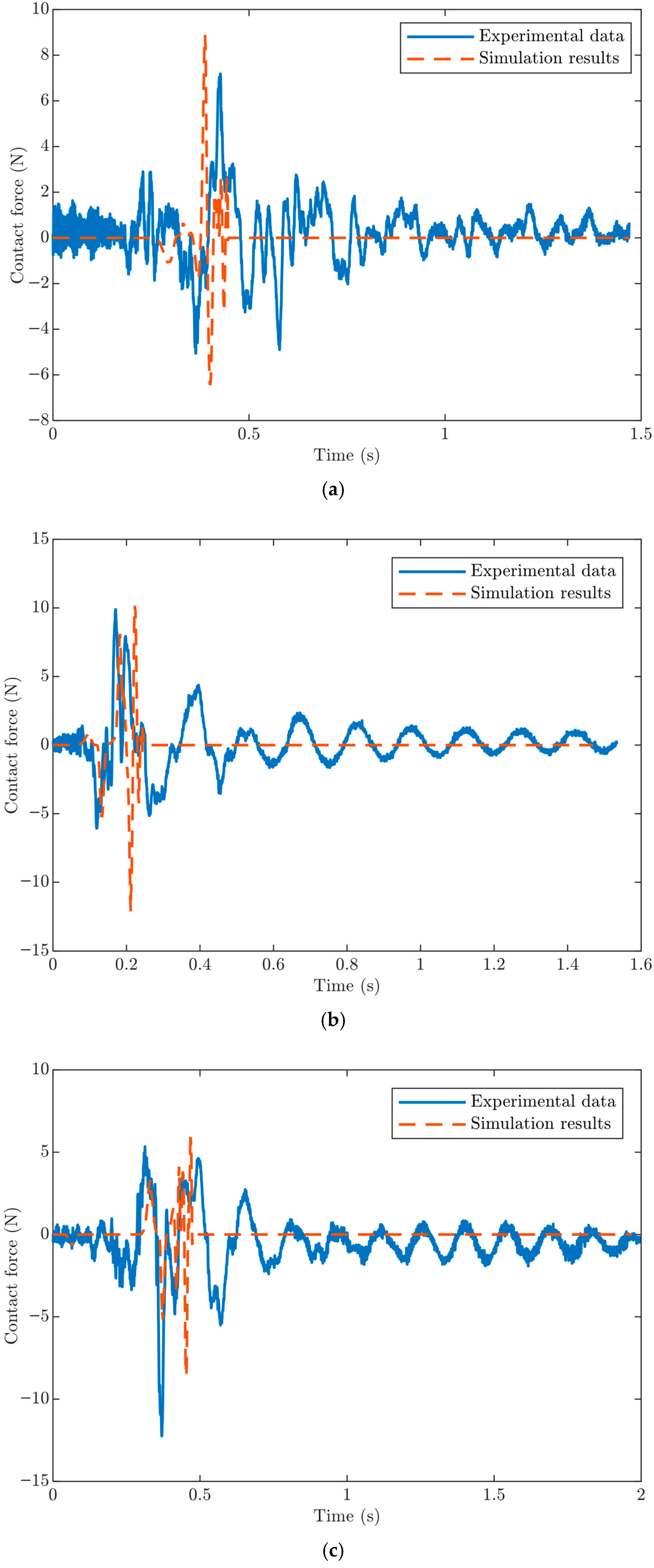
Figure 18 shows the measured contact force curves when the self-centring fingers grasp the target module at a closing speed of 14 mm/s, with a parallel offset of 3 mm on the y-axis. The blue curves represent the contact force variations measured by the piezoelectric multicomponent dynamometer, while the red dashed line represents the numerical simulation results. The comparison reveals that multiple contact collisions occurred within a 0.5 s interval. The contact force variation trends on the x, y and z axes are generally consistent between the numerical simulation result and experimental data. Nevertheless, there are errors in the peak amplitude of the contact forces, which are 1.52 N, 1.7 N, and 1.68 N, respectively. The main reasons for these errors are as follows: (1) environmental noise, as shown in Figure 18a, where a noise signal of 1.5 N is observed before the start of the grasping operation. (2) Errors induced by the suspension bungee. The suspension bungee generates elastic deformation during the self-centring process, producing forces that partially counteract the contact forces. Its elastic properties also cause vibrations after the grasping operation, preventing the contact forces from immediately returning to zero. As shown in Figure 18b,c, the contact force on the z-axis (perpendicular to the bungee length) exhibits oscillations with a period of 1.6 s and an amplitude of −1.27 N. On the y-axis, due to the initial parallel offset of 3 mm, the contact force amplitude is 1.7 N, with an oscillation frequency of 0.91 Hz.
In this section, a contact model for single-arm self-centring grasping of the target module is established, and the evolution of parallel offsets with different closing speeds is analysed. Self-centring grasping experiments are conducted with multiple misalignments, demonstrating the sub-millimetre positioning accuracy of the self-centring mechanism. Additionally, the good agreement between contact forces obtained from numerical simulations and experimental data validates the accuracy and effectiveness of the proposed contact model. While the numerical study provides a parametric analysis over a range of closing speeds, the experimental results presented here serve as a representative physical validation of the predicted contact dynamics and convergence behaviour under a nominal operating condition.

5. Grasping Two Modules with a Dual-Arm Robot

5.1. Numerical Simulations

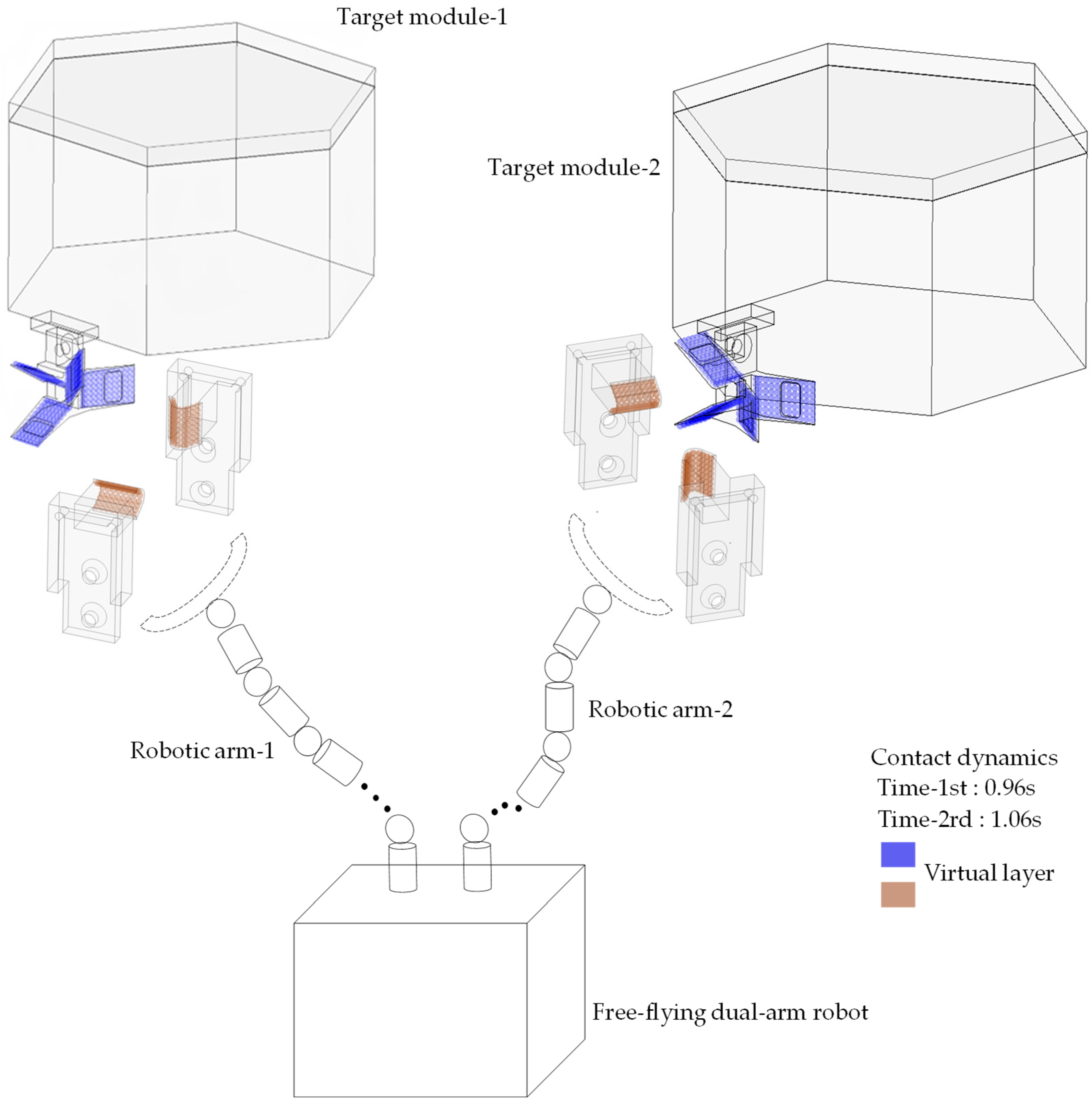
Building on the fixed-base single-arm configuration considered in Section 4, this section extends the proposed self-centring mechanism and multi-point contact model to a free-flying dual-arm sequential grasping scenario as part of a hierarchical validation strategy. The fixed-base case is first employed to isolate and verify the local contact modelling and self-centring behaviour under simplified and controlled conditions. The subsequent free-flying dual-arm case then provides a system-level validation, in which the same contact model is evaluated in the presence of floating-base dynamics and dynamic coupling among the two manipulators, the target modules, and the base. In this formulation, the resultant contact forces and moments at the finger–groove interfaces are incorporated as external generalised force terms in the coupled system state equations and are propagated through numerical integration. Consequently, the contact interactions explicitly influence the global motion evolution and alignment process of the floating-base system.
The configurations of the robotic arms are shown in Figure 19, where the base is assumed to operate in a free-floating mode. The simulation parameters are summarised in Table 5. The closing speeds of end-effector 1 and end-effector-2 are set to 14 mm/s, and the initial parallel offsets between the self-centring fingers and the V-groove interfaces are specified as [0, −2.5, 0] mm. During the first phase, end-effector-1 gradually closes until contact is established and a force equilibrium is reached, which is identified by the relative velocities at the contact interfaces converging to zero. Upon completion of the grasp of target-module-1, end-effector-2 subsequently closes to capture target-module-2. Throughout the entire process, the target modules remain within the admissible misalignment tolerance of the self-centring mechanism. The numerical integration time step is set to 1 ms to ensure stable and accurate resolution of the contact dynamics.
The dynamic equation of the free-flying dual-arm robot is written as:
M i q i q ¨ i + C i q ˙ i , q i = Q c i
Q c i = F c i τ c i T
where M i i = 1 , 2 , 3 , 4 is the mass matrix of the i-th body, with i sequentially representing target module-1, target module-2, the free-flying dual-arm robot, and the system consisting of the free-flying dual-arm robot and TM-1. q i is the generalized coordinate vector of the i-th body. C i denotes the non-linear velocity-dependent term, Q c i is the external force vector, including combined contact forces and contact torques.
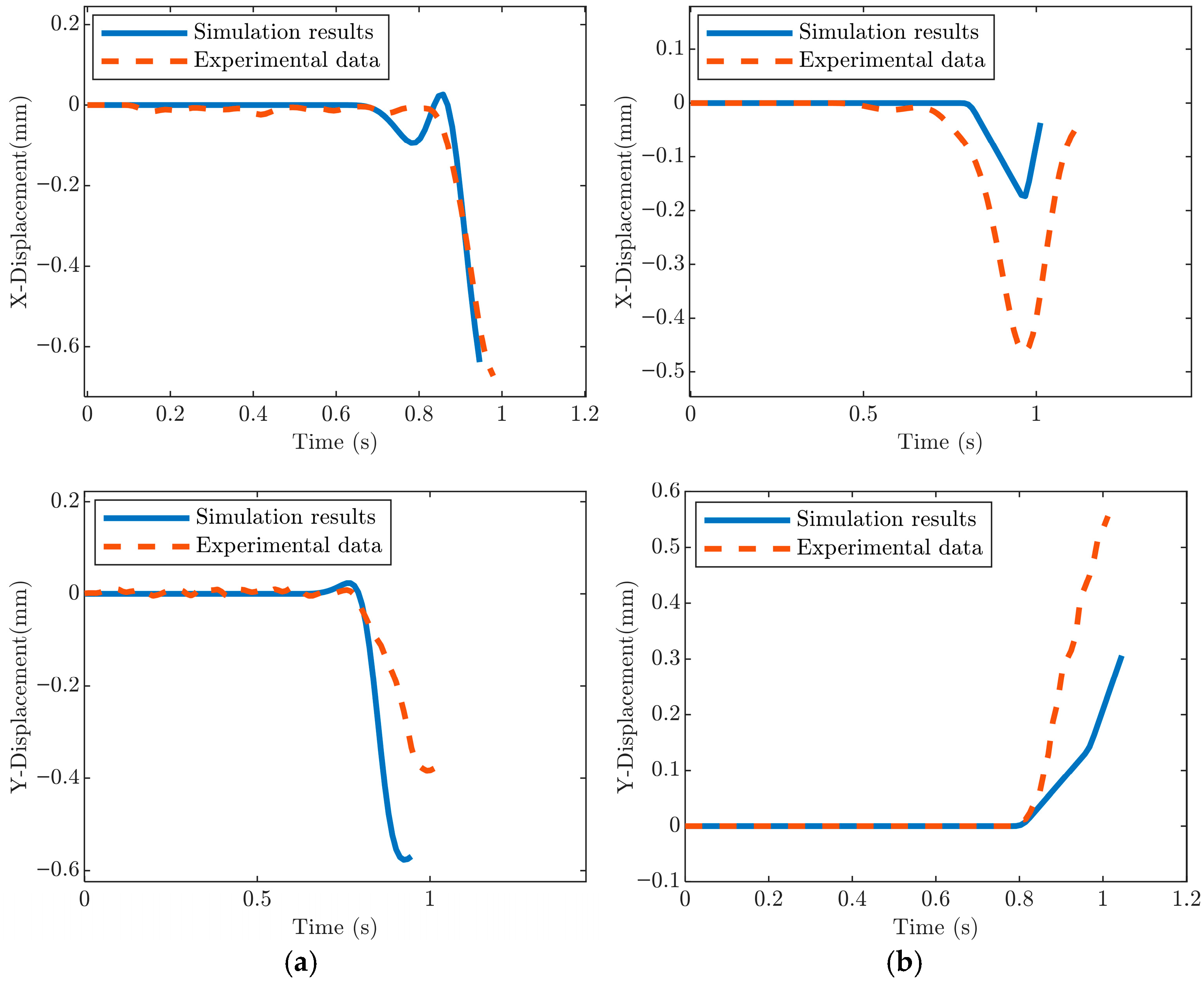
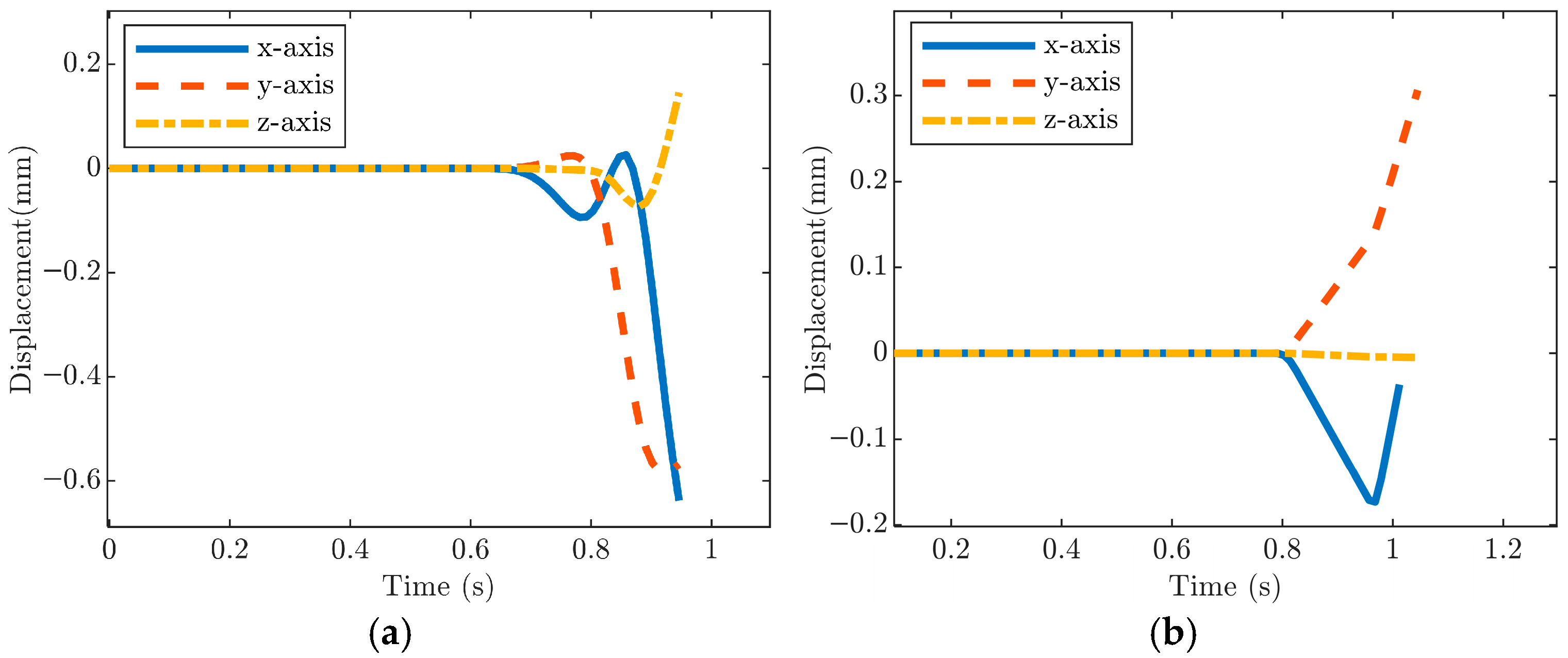
Figure 20 illustrates the displacement of the centroid of the free-flying dual-arm robot. During both grasping operations, bouncing contacts occur between the self-centring fingers and the V-groove, resulting in centroid disturbances along multiple directions. During the first grasping operation, the robot is still in the process of capturing TM-1, and the contact reaction forces induce a larger centroid displacement, measured as [−0.637, −0.582, 0.146] mm. In contrast, during the second grasping, the robot and TM-1 form a composite rigid body, which increases the total system mass. As a result, the centroid displacement under similar contact conditions is significantly reduced to [−0.173, 0.306, −0.05] mm.
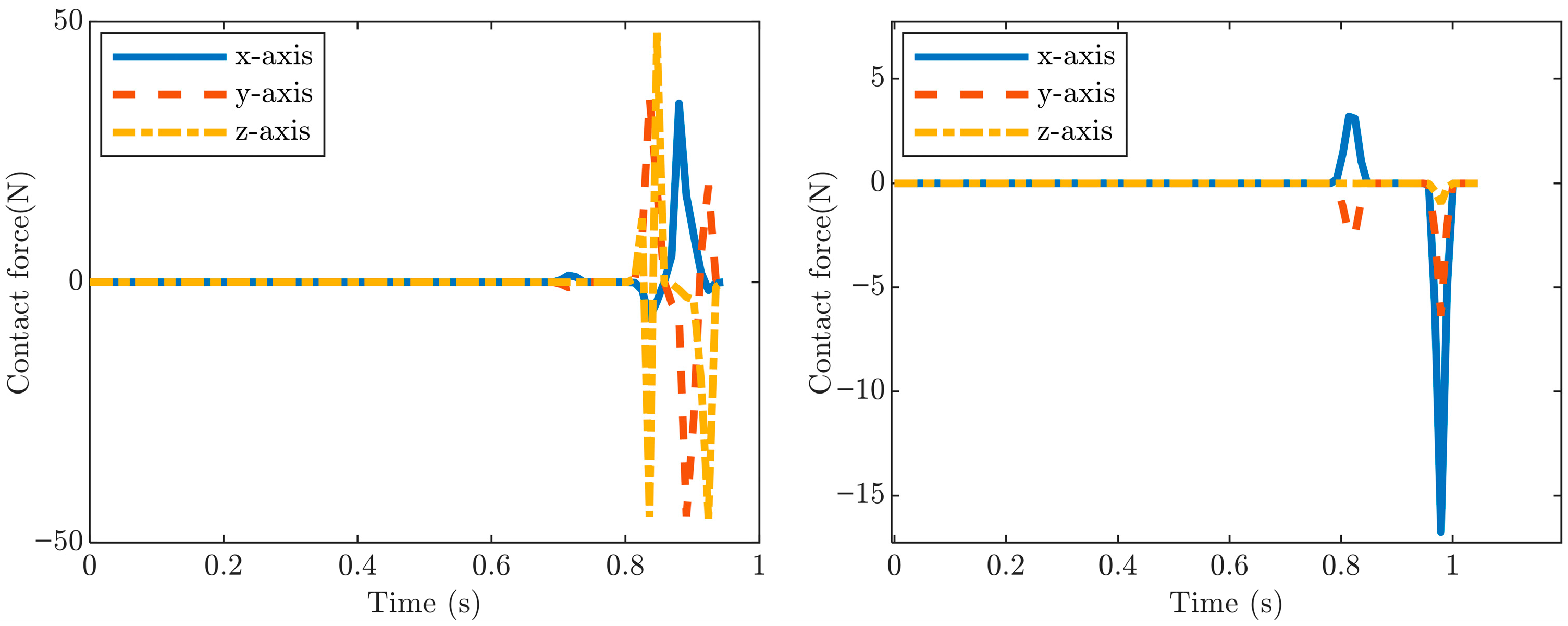
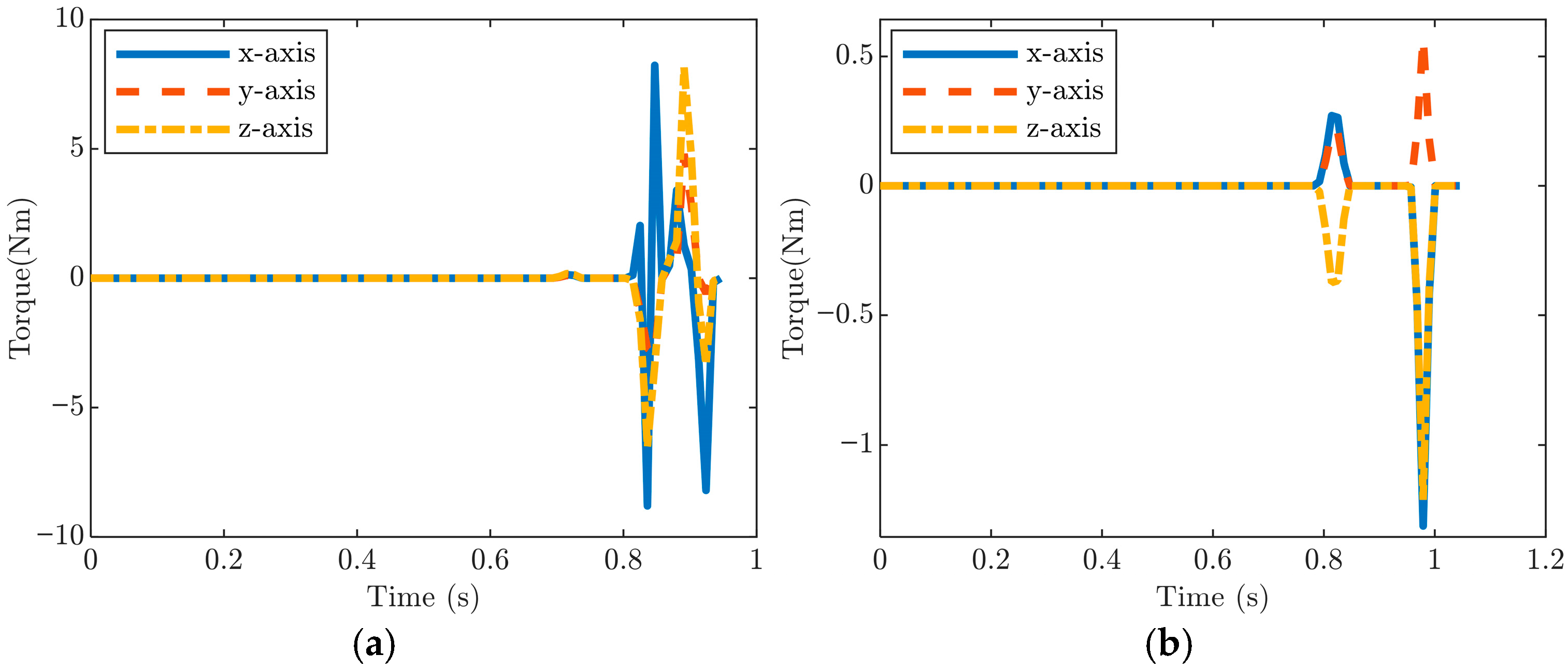
As shown in Figure 21, the variations of contact forces and torques during the first grasping reflect the transition from an initial no-contact state to bouncing contacts at different positions. It can be observed that the magnitudes of the contact forces and torques during the first grasping are significantly larger than those of the second grasping, with the maximum contact force and torque reaching 47.493 N and 8.8 N m , respectively. This difference arises because the disturbances introduced during the first grasping reduce the initial misalignments between end-effector-2 and TM-2, thereby lowering the contact intensity in the second grasping. The reduced contact forces and torques also contribute to the smaller centroid displacement observed in the second grasping.

5.2. Experiment Validations

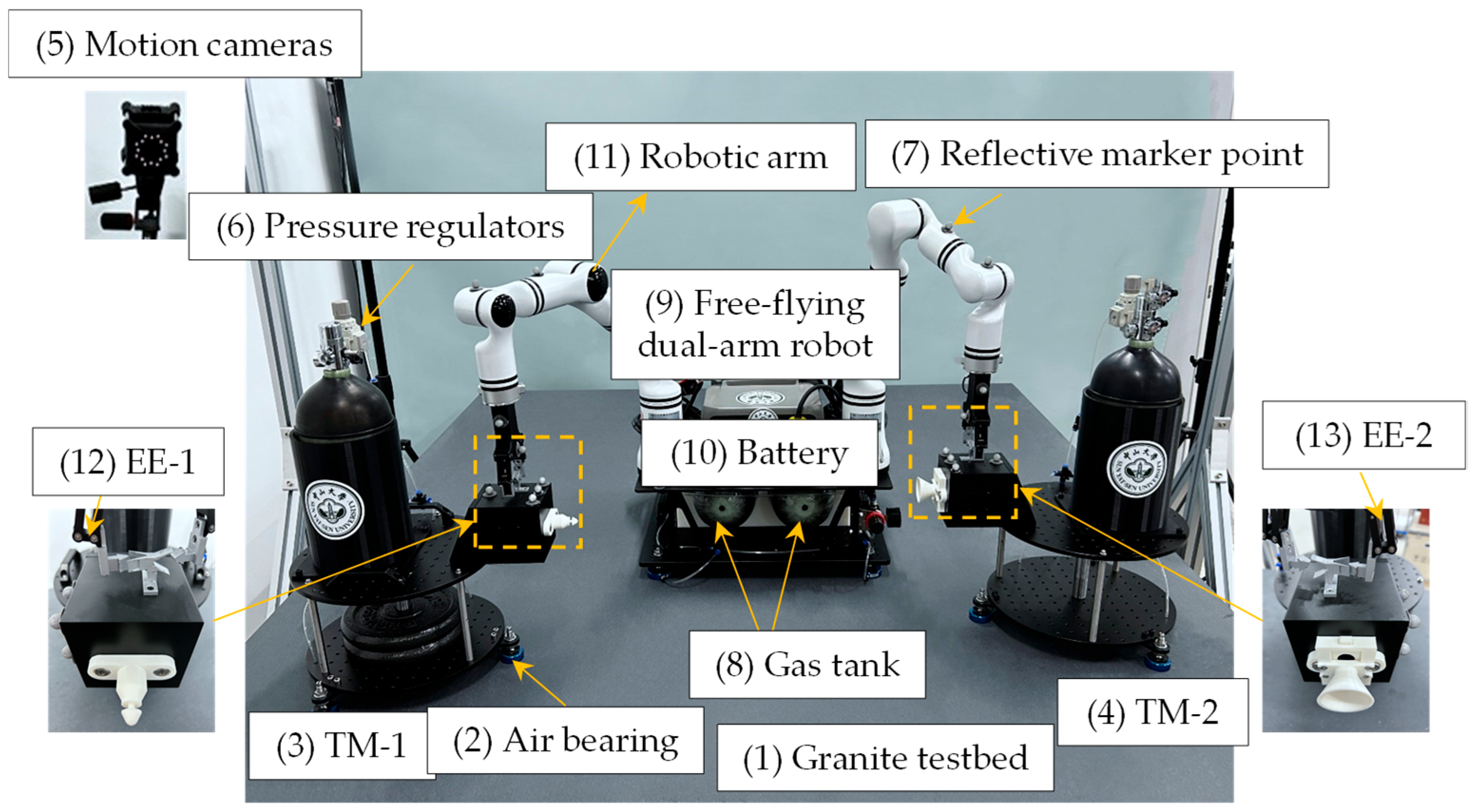
A ground-based experimental system for a free-flying dual-arm robot (FDR) was also established at Sun Yat-sen University, named the Space Proximity Operations Testing (SPOT) facility. It was capable of grasping two target modules sequentially in a microgravity environment, with real-time measurement of displacements throughout the grasping process. As shown in Figure 22, the facility included the following: (1) a granite testbed, (2) air bearings, (3) target module-1, (4) target module-2, (5) motion cameras, (6) pressure regulators, (7) reflective marker points, (8) gas tanks, (9) a free-flying dual-arm robot, composed of (10) batteries, (11) two 6-DOF robotic arms, (12) end-effector-1 (EE-1), and (13) end-effector-2 (EE-2). The robot was floated by air bearings with very low friction, thereby ensuring free movements in the horizontal plane. The pressure regulators controlled the thickness of the air film by adjusting the gas flow from the gas tank. The position and attitude changes of the FDR and target modules during self-centring process were obtained by the motion cameras through measurements of the reflective marker points.
Sequential grasping experiments on the target modules were conducted using the free-flying dual-arm robot. The initial parallel offsets between the self-centring fingers and the double V-groove mechanisms were set to [2.5, 0, 0] mm, [3, 0, 0] mm, and [3.5, 0, 0] mm. The free-flying dual-arm robot, TM-1 and TM-2, remained in a free-floating mode and the initial joint states of the robotic arms were locked with the initial joint angles, as shown in Table 6. The sampling frequency of the camera was set to 90 Hz. The comparison of the simulation results and experiment data further confirmed the validity of the contact model.
Figure 23 illustrates several moments during the self-centring process, comparing the displacement of centroid of the FDR as obtained through numerical simulations and experimental data. During the closure of EE-1, the FDR exhibits translational motion along the x-axis and y-axis and rotational motion about the z-axis, driven by the resulting contact forces. Although EE-2 experiences relative motion during the first grasping due to contact interactions, it remains within the misalignment tolerance of the self-centring mechanism. Consequently, as EE-2 closes, the system undergoes additional translational and rotational motions. Once EE-2 is fully closed, the entire system gradually stabilizes, primarily due to the damping effects of frictional forces.
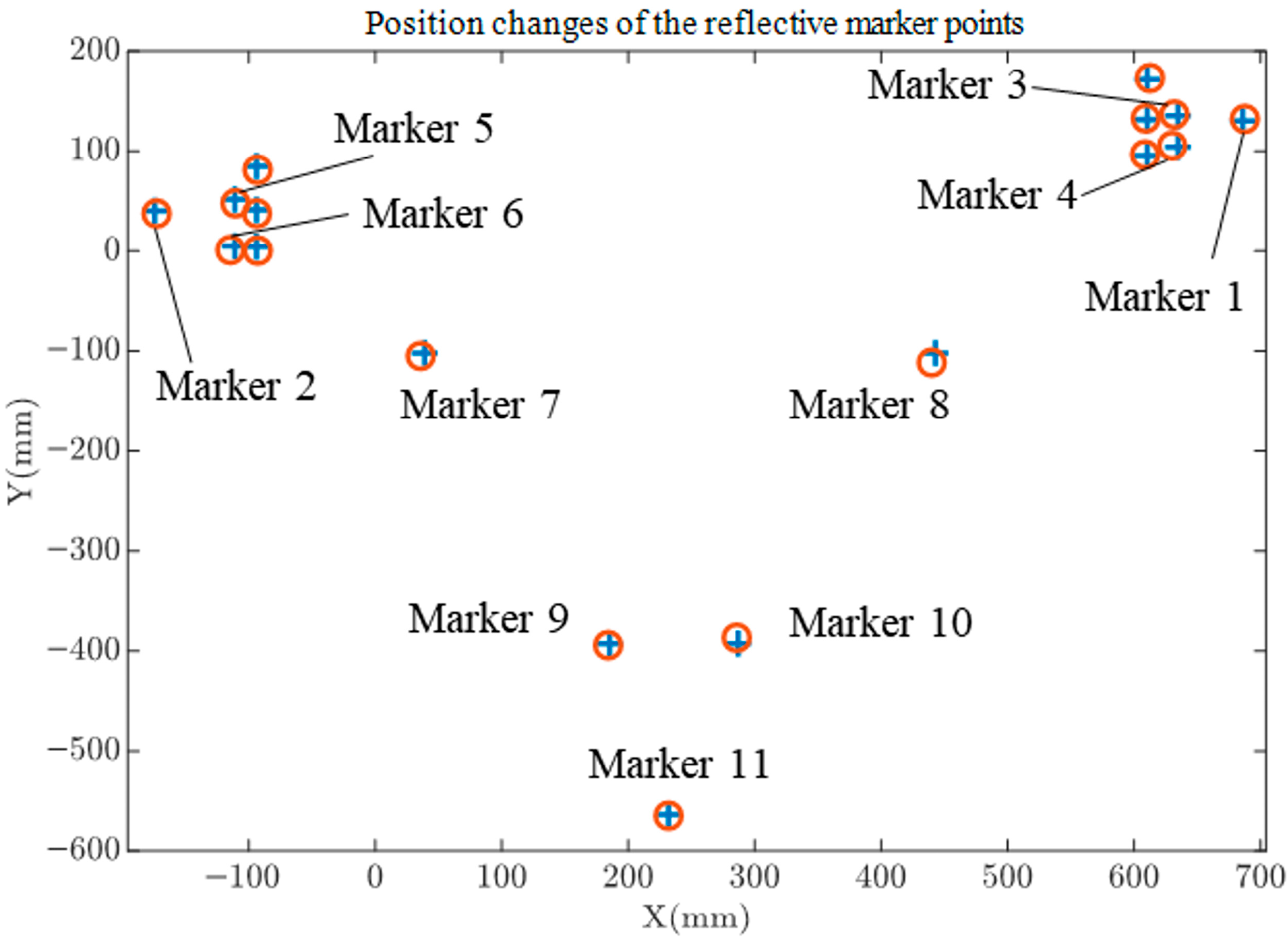
Figure 24 shows the position changes of the reflective marker points mounted on the robot and target modules. In this setup, Marker 1 and Marker 2 correspond to TM-1 and TM-2, respectively; Markers 3 and 4 represent EE-1, while Markers 5 and 6 represent EE-2; Markers 7 and 8 are attached to the robotic arms; Markers 9, 10, and 11 are placed on the floating base.
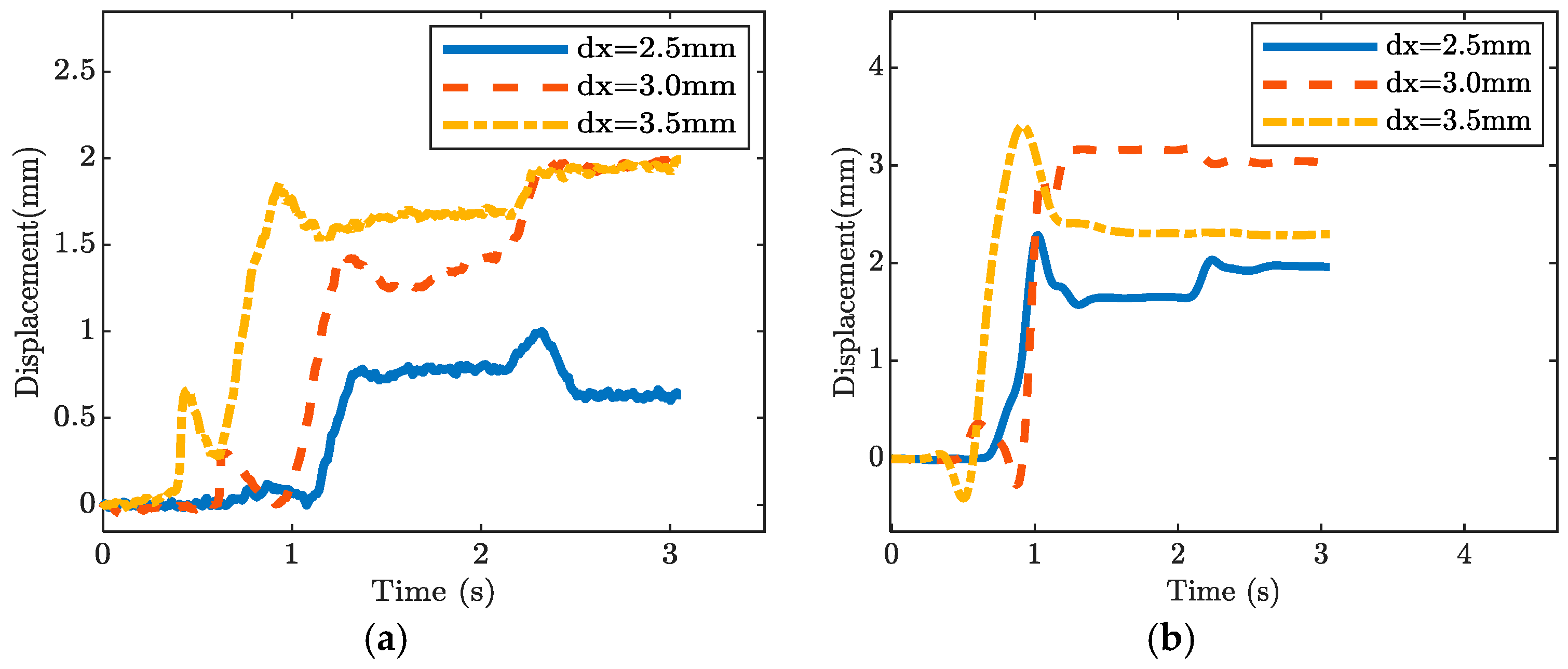
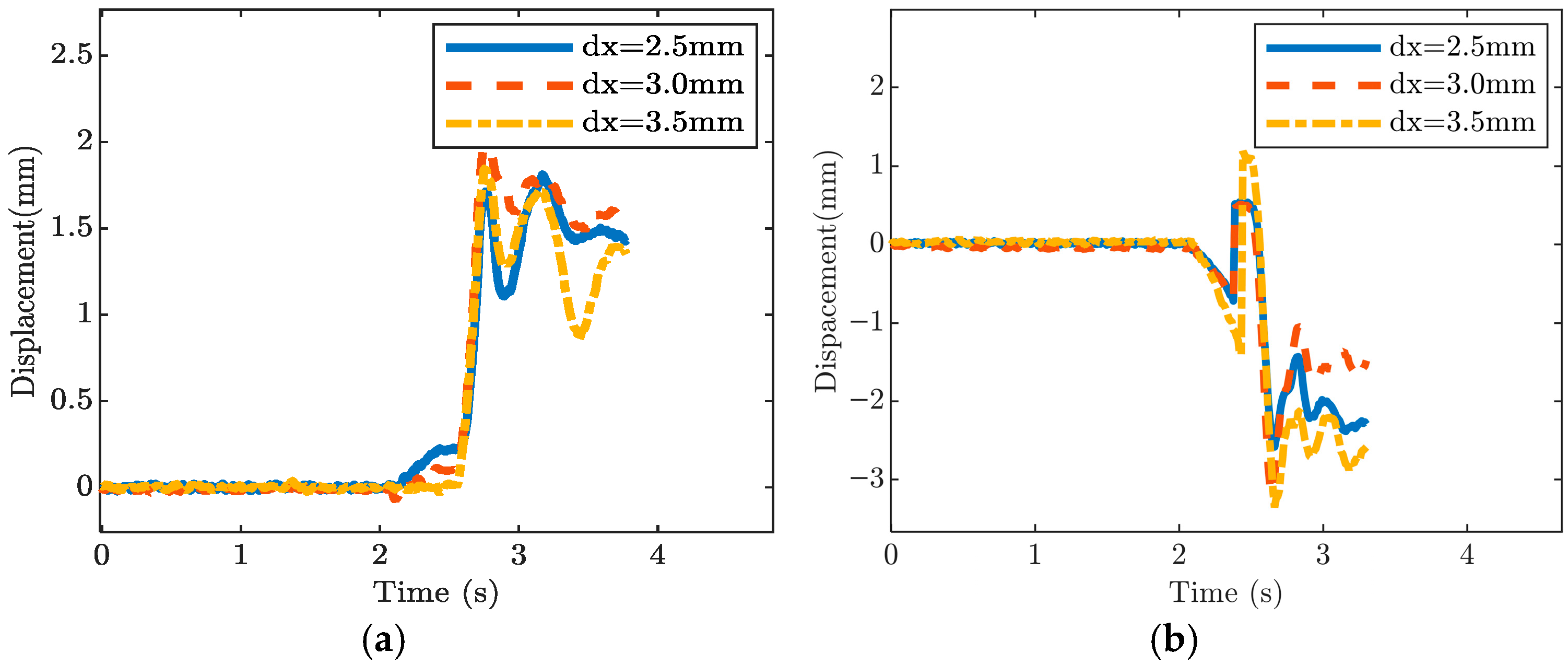
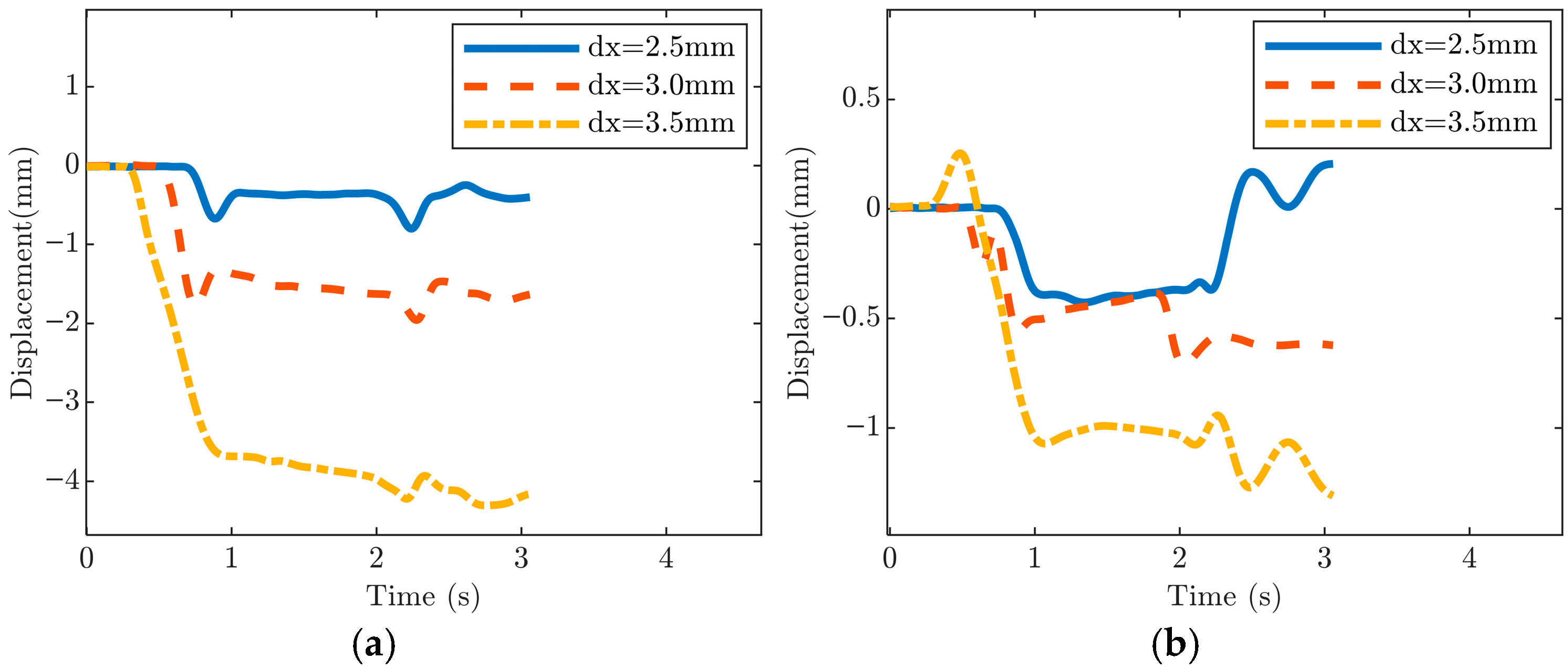
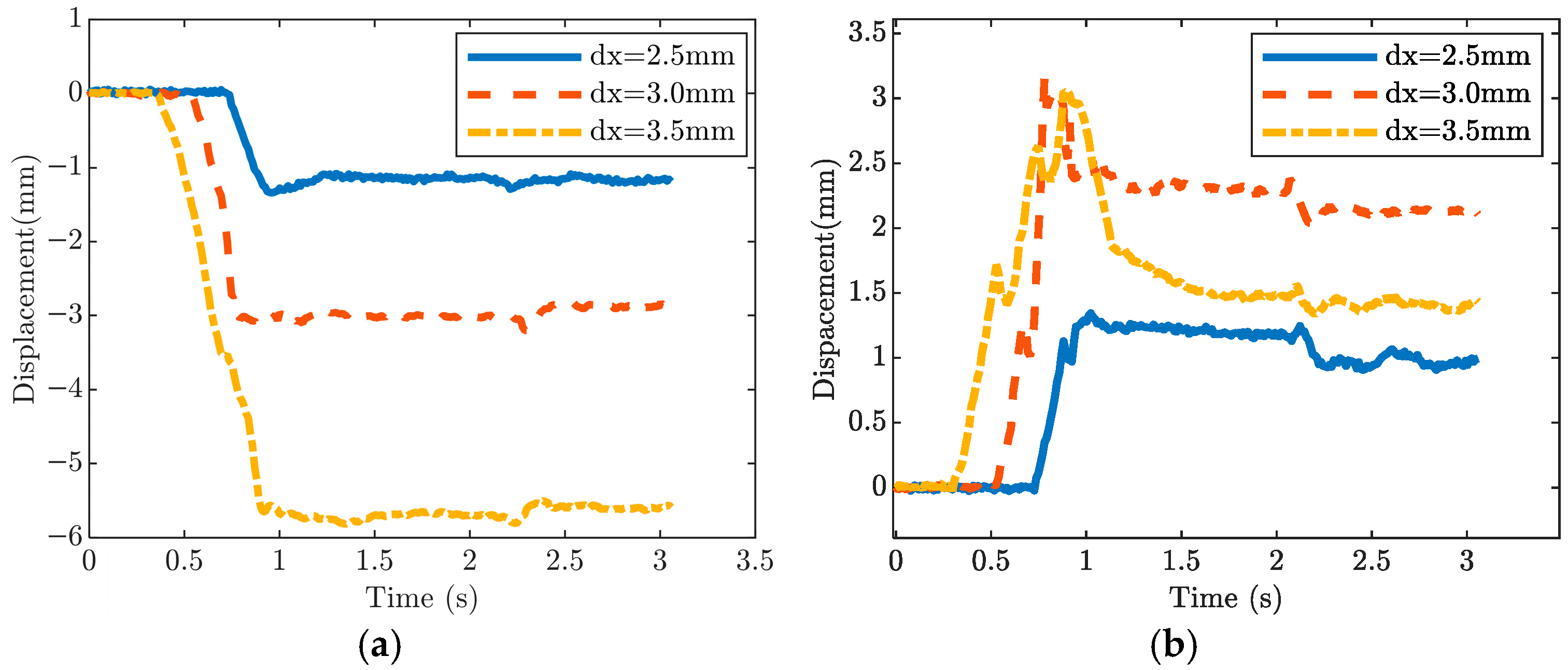
Figure 25 compares the displacements of the floating base under different parallel offsets. As EE-1 gradually closes, the floating base moves along the x-axis and y-axis due to the contact force. A larger initial parallel offset leads to a greater displacement amplitude. Specifically, the x-axis displacement amplitudes are 0.748 mm, 1.968 mm, and 3.697 mm. Subsequently, as the EE-2 closes slowly, the displacement amplitude of the floating base decreases with increasing initial parallel offset, with x-axis amplitudes measured as 0.551 mm, 0.440 mm, and 0.382 mm. A similar trend is observed along the y-axis. This phenomenon occurs because the contact forces generated during the first grasping (by EE-1) induce motion of the floating base, thereby altering the effective initial parallel offset between EE-2 and TM-2, resulting in reduced displacement during the second grasping.
Figure 26 illustrates the displacement of TM-1 under different initial parallel offsets. The analysis indicates that during the first grasping, the displacement amplitudes of TM-1 increase as the initial parallel offset increases. Specifically, for initial parallel offsets of 2.5 mm, 3 mm, and 3.5 mm, the maximum displacement variations along the x-axis are 1.855 mm, 1.442 mm, and 0.782 mm, respectively. Figure 27 presents the displacement variation curves for TM-2. It can be seen that during the first self-centring process, although the FDR moves, it does not make contact with TM-2. When EE-2 performs the second grasping, the corresponding displacement variations of TM-2 are 1.817 mm, 1.980 mm, and 1.849 mm. Notably, comparison of Figure 26 and Figure 27 reveals that the chances of bouncing contact events along the y-axis during the second grasping are significantly higher than during the first. This difference is primarily attributed to the larger mass and inertia of TM-1 compared to TM-2. As a result, TM-1 exhibits a lower rate of displacement change before contact and a higher rate after contact, leading to distinct dynamic responses between the two grasping phases.
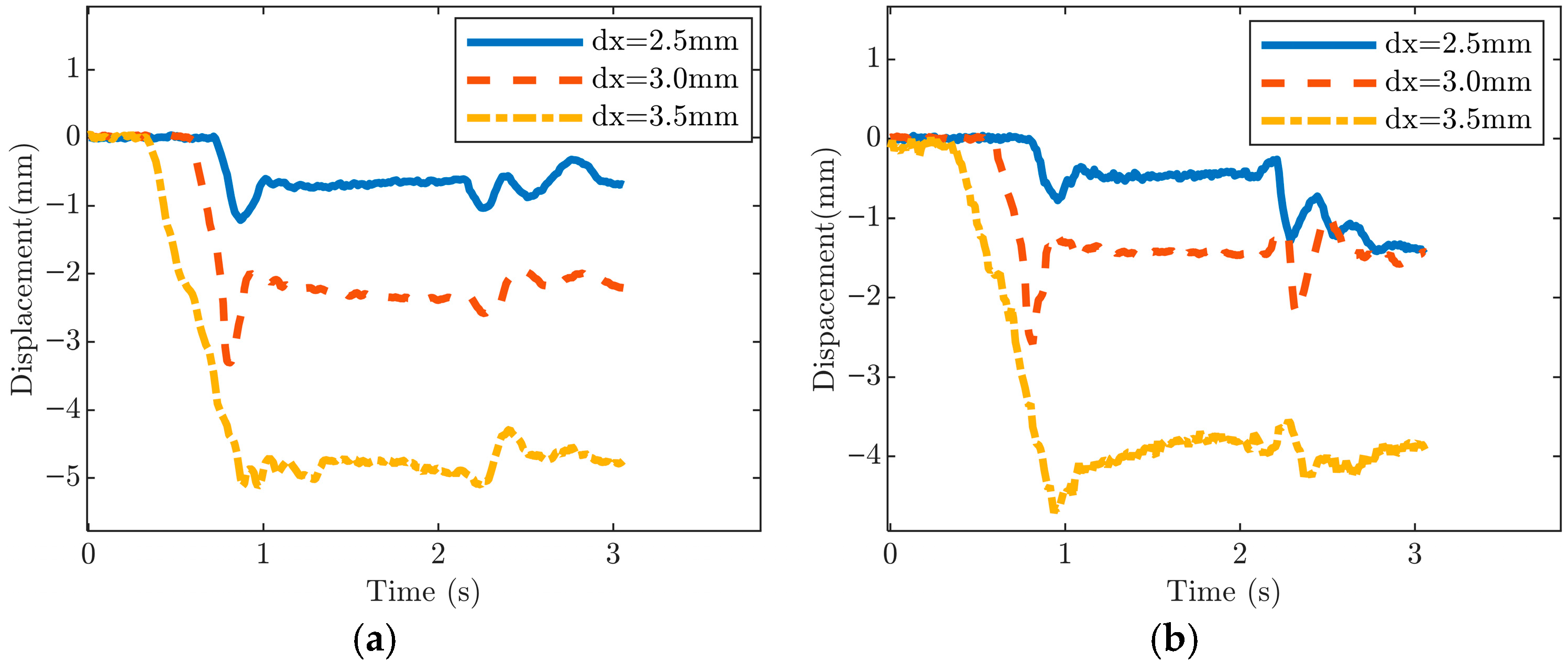
Figure 28 and Figure 29 illustrate the displacements of the two end-effectors during the self-centring process. Notably, the end-effector displacements occur in directions opposite to those of the corresponding target modules, due to the reaction forces generated during contact. It is important to highlight that the displacements shown in Figure 28 (corresponding to the second self-centring process) are smaller than those in Figure 29 (first self-centring). This difference arises from the fact that, after the completion of the first grasping, TM-1 and the FDR form a composite rigid body, increasing the total system mass and moment of inertia, thereby reducing the resulting motion during the second grasping.
In this section, a contact model for a free-flying dual-arm robot sequentially self-centring grasping of the target modules is established. Sequential grasping experiments on the target modules of a free-flying dual-arm robot with different initial parallel offsets are also conducted at Sun Yat-sen University, named the Space Proximity Operations Testing (SPOT) facility. The good agreement of the centroid displacement of the free-flying dual-arm robot obtained from numerical simulations and experimental data further validates the accuracy and effectiveness of the proposed dynamic model.

6. Conclusions

This paper proposes a novel self-centring mechanism designed for in-space assembly, featuring large misalignment tolerance capabilities and sub-millimetre positioning accuracy. A contact model based on virtual sphere layers was established to describe the multi-point bouncing contact behaviour during the self-centring process. Numerical simulations and experimental validations were conducted for two cases involving robotic arms grasping target modules. The key conclusions are summarised as follows:
(1)
Existing paradigms have demonstrated robust performance under coarse-alignment conditions in large-scale manipulators and on-orbit servicing missions; however, this class of mechanisms is typically accompanied by increased mechanical complexity and bulky structural configurations, which to some extent limit their applicability to modular precision in-space assembly tasks. From a design perspective, the proposed self-centring mechanism integrates dual self-centring fingers with a double V-groove interface to jointly accommodate large initial pose deviations while achieving stable sub-millimetre pose convergence, thereby addressing the dual requirements of high alignment accuracy and low disturbance characteristics in precision assembly scenarios. Specifically, the mechanism tolerates parallel offsets of approximately ± 10 mm along the x a and y a directions, and angular misalignments of ± 30 ° , ± 30 ° and ± 62 ° in roll, yaw and pitch, respectively. The fixed-base single-arm experiments confirm a residual positioning error consistently within 0.5 mm after self-centring.
(2)
From a modelling standpoint, the proposed virtual sphere layer-based multi-point contact formulation is more effective than conventional single-point or lumped-contact models in capturing the temporal evolution of distributed contact pairs, transient bouncing behaviours, and the transmission and coupling of contact forces across multiple contact locations. The simulations show that the end-effector closing speed significantly affects the target’s dynamic response, with peak contact forces reaching 12.26 N along the x-axis, 10.23 N along the y-axis, and 7.9 N along the z-axis. The measured contact force profiles show good agreement with simulation predictions, validating the accuracy of the proposed contact model. Moreover, sequential grasping simulations with a free-flying dual-arm robot reveal a pronounced centroid displacement, measured as [−0.637, −0.582, 0.146] mm during the first grasp, which reduces to [−0.173, 0.306, −0.05] mm during the second grasp due to increased effective inertia and reduced initial misalignments. Ground-based experiments conducted on the Space Proximity Operations Testing (SPOT) facility under different initial prescribed y-axis offsets of 2.5, 3, 3.5 mm show that the displacements of the centroid of the free-flying dual-arm robot closely match the simulation results, further validating the accuracy of the proposed multi-point contact model.
Despite the progress reported in this study, the present work remains subject to both experimental and computational constraints. On the experimental side, the current setup limits the range of end-effector closing speeds that can be systematically explored. On the computational side, the overall latency of the multi-point contact simulation framework is currently insufficient to directly support real-time or near-real-time closed-loop control applications. Future work will therefore focus on further optimisation at both the algorithmic and system implementation levels to progressively reduce the overall computational latency and enable control-oriented integration. In parallel, the experimental platform will be upgraded by enhancing the structural stiffness of the suspension system and improving the bandwidth and measurement precision of the force sensing and actuation subsystems, thereby supporting systematic validation over a broader range of closing speeds and further strengthening the quantitative consistency and statistical reliability between numerical predictions and physical measurements.

Author Contributions

Conceptualization, Y.W.; methodology, Y.W.; software, Y.W. and S.M.; validation, Y.W.; formal analysis, Y.W.; investigation, X.W.; resources, X.W. and Y.L.; data curation, Y.W.; writing—original draft preparation, X.W.; writing—review and editing, J.L., J.J., Y.L. and Y.W.; visualization, Y.W.; supervision, Y.W.; project administration, X.W.; funding acquisition, J.L., Y.L. and X.W. All authors have read and agreed to the published version of the manuscript.

Funding

This research was funded by Shenzhen Science and Technology Program (Grants No. RCYX20210706092137055 and No. 202206193000001, 20220815155101002). This research was also funded by Guang Dong Basic and Applied Basic Research Foundation (Grant No. 2024A1515012723). X.W, Y.Y. Li and J.F. Liu also appreciated financial support from the National Natural Science Foundation of China (Grant Nos. 12072378, 12102444, 12172385).

Data Availability Statement

The data presented in this study are available upon request from the corresponding author.

Conflicts of Interest

The authors declare no conflicts of interest.

References

  1. Li, W.J.; Cheng, D.Y. On-orbit service (OOS) of spacecraft: A review of engineering developments. Prog. Aerosp. Sci. 2019, 108, 32–120. [Google Scholar] [CrossRef]
  2. Belvin, W.K.; Dorsey, J.T.; Watson, J.J. Technology challenges and opportunities for very large in-space structural systems. In Proceedings of the International Symposium on Solar Energy from Space, Toronto, ON, Canada, 8–10 September 2009; p. LF99-9135. [Google Scholar]
  3. Hu, W.; Deng, Z. A review of dynamic analysis on space solar power station. Astrodynamics 2023, 7, 115–130. [Google Scholar] [CrossRef]
  4. Okasha, M.; Park, C.; Park, S.-Y. Guidance and control for satellite in-orbit-self-assembly proximity operations. Aerosp. Sci. Technol. 2015, 41, 289–302. [Google Scholar] [CrossRef]
  5. Gralla, E.L. Strategies for Launch and Assembly of Modular Spacecraft. Ph.D. Thesis, Massachusetts Institute of Technology, Cambridge, MA, USA, 2006; pp. 97–101. [Google Scholar]
  6. Watson, J.J.; Collins, T.J.; Bush, H.G. A history of astronaut construction of large space structures at NASA Langley Research Center. In Proceedings, IEEE Aerospace Conference; IEEE: New York, NY, USA, 2002; Volume 7, p. 7. [Google Scholar] [CrossRef]
  7. Bluethmann, W.; Ambrose, R.; Diftler, M.; Askew, S.; Huber, E.; Goza, M.; Rehnmark, F.; Lovchik, C.; Magruder, D. Robonaut: A Robot Designed to Work with Humans in Space. Auton. Robot. 2003, 14, 179–197. [Google Scholar] [CrossRef]
  8. Hirzinger, G.; Brunner, B.; Dietrich, J.; Heindl, J. ROTEX-the first remotely controlled robot in space. In Proceedings of the 1994 IEEE International Conference on Robotics and Automation; IEEE: New York, NY, USA, 1994; pp. 2604–2611. [Google Scholar] [CrossRef]
  9. Diftler, M.A.; Mehling, J.S.; Abdallah, M.E.; Radford, N.A.; Bridgwater, L.B.; Sanders, A.M. Robonaut 2-the first humanoid robot in space. In 2011 IEEE International Conference on Robotics and Automation; IEEE: New York, NY, USA, 2011; pp. 2178–2183. [Google Scholar] [CrossRef]
  10. Izzo, D.; Pettazzi, L.; Ayre, M. Mission Concept for Autonomous on-orbit Assembly of a large Reflector in Space. In Proceedings of the 56th International Astronautical Congress of the International Astronautical Federation, the International Academy of Astronautics, and the International Institute of Space Law, Fukuoka, Japan, 17–21 October 2005; pp. D1–D4. [Google Scholar] [CrossRef]
  11. Di Pippo, S.; Colombina, G.; Boumans, R.; Putz, P. Future potential applications of robotics for the International Space Station. Robot. Auton. Syst. 1998, 23, 37–43. [Google Scholar] [CrossRef]
  12. Flores-Abad, A.; Ma, O.; Pham, K.; Ulrich, S. A review of space robotics technologies for on-orbit servicing. Prog. Aerosp. Sci. 2014, 68, 1–26. [Google Scholar] [CrossRef]
  13. Li, K.; Tian, Q.; Shi, J.W.; Liu, D.L. Assembly dynamics of a large space modular satellite antenna. Mech. Mach. Theory 2019, 142, 103601. [Google Scholar] [CrossRef]
  14. Boning, P.; Dubowsky, S. Coordinated control of space robot teams for the on-orbit construction of large flexible space structures. Adv. Robot. 2012, 24, 303–323. [Google Scholar] [CrossRef]
  15. Rhodes, M.D.; Will, R.W.; Wise, M.A. A Telerobotic System for Automated Assembly of Large Space Structures; No. NASA-TM-101518; National Aeronautics and Space Administration, Glenn Research Center: Cleveland, OH, USA, 1989.
  16. Doggett, W. Robotic assembly of truss structures for space systems and future research plans. In Proceedings, IEEE Aerospace Conference; IEEE: New York, NY, USA, 2002; Volume 7, p. 7. [Google Scholar] [CrossRef]
  17. Doggett, W.R.; Dorsey, J.; Teter, J. Persistent assets in zero-g and on planetary surfaces: Enabled by modular technology and robotic operations. In Proceedings of the 2018 AIAA SPACE and Astronautics Forum and Exposition, Orlando, FL, USA, 17–19 September 2018; p. 5305. [Google Scholar] [CrossRef]
  18. Lee, N.; Backes, P.; Burdick, J. Architecture for in-space robotic assembly of a modular space telescope. J. Astron. Telesc. Instrum. Syst. 2016, 2, 041207. [Google Scholar] [CrossRef]
  19. Han, F.; Liu, Y.; Sun, K.; Liu, H. Development of the Interchangeable Devices for Space Robot System. In 2013 IEEE International Conference on Robotics and Biomimetics (ROBIO); IEEE: New York, NY, USA, 2013; pp. 2055–2061. [Google Scholar] [CrossRef]
  20. Feng, F.; Liu, Y.W.; Liu, H.; Cai, H.G. Design Schemes and Comparison Research of the End-effector of Large Space Manipulator. Chin. J. Mech. Eng. 2012, 25, 674–687. [Google Scholar] [CrossRef]
  21. Boumans, R.; Heemskerk, C. The European robotic arm for the international space station. Robot. Auton. Syst. 1998, 23, 17–27. [Google Scholar] [CrossRef]
  22. Krenn, A.; Stewart, M.; Mitchell, D.; Dixon, K.; Mierzwa, M.; Breon, S. Flight servicing of robotic refueling mission 3. In Proceedings of the Space Cryogenics Workshop, Southbury, CT, USA, 17–19 July 2019. [Google Scholar]
  23. Sun, K.; Liu, H.; Xie, Z.; Ni, F. Structure design of an end effector for the Chinese space station experimental module manipulator. In Proceedings of the 12th International Symposium on Artificial Intelligence, Robotics and Automation in Space; Canadian Space Agency: Montrea, QC, Canada, 2014; pp. 1–8. [Google Scholar]
  24. Rekleitis, I.; Martin, E.; Rouleau, G. Autonomous Capture of a Tumbling Satellite. J. Field Robot. 2007, 24, 275–296. [Google Scholar] [CrossRef]
  25. Williams, J.R.; Pentland, A.P. Superquadrics and modal dynamics for discrete elements in interactive design. Eng. Comput. 1992, 9, 115–127. [Google Scholar] [CrossRef]
  26. Wriggers, P. Finite element algorithms for contact problems. Arch. Comput. Methods Eng. 1995, 2, 1–49. [Google Scholar] [CrossRef]
  27. Zhong, Z.H.; Nilsson, L. A contact searching algorithm for general contact problems. Comput. Struct. 1989, 33, 197–209. [Google Scholar] [CrossRef]
  28. Chen, P.; Liu, J.Y.; Hong, J.Z. Contact-impact formulation for multi-body systems using component mode synthesis. Acta Mech. Sin. 2013, 29, 437–442. [Google Scholar] [CrossRef]
  29. Ma, O.; Flores-Abad, A.; Boge, T. Use of industrial robots for hardware-in-the-loop simulation of satellite rendezvous and docking. Acta Astronaut. 2012, 81, 335–347. [Google Scholar] [CrossRef]
  30. Brach, R.M. Mechanical Impact Dynamics: Rigid Body Collisions; John Wiley and Sons: New York, NY, USA, 1991. [Google Scholar]
  31. Mirza, K.; Hanes, M.D.; Orin, D.E. Dynamic simulation of enveloping power grasps. In [1993] Proceedings IEEE International Conference on Robotics and Automation; IEEE: New York, NY, USA, 1993; pp. 430–435. [Google Scholar] [CrossRef]
  32. Gilardi, G.; Sharf, I. Literature survey of contact dynamics modelling. Mech. Mach. Theory 2002, 37, 1213–1239. [Google Scholar] [CrossRef]
  33. Yu, Z.W.; Liu, X.F.; Cai, G.P. Dynamics modeling and control of a 6-DOF space robot with flexible panels for capturing a free floating target. Acta Astronaut. 2016, 128, 560–572. [Google Scholar] [CrossRef]
  34. Zang, Y.; Zhang, Y.; Zhang, J. Multipoint contact dynamics and the detumbling strategy for a fast-tumbling target. IEEE Trans. Aerosp. Electron. Syst. 2020, 56, 3113–3122. [Google Scholar] [CrossRef]
  35. Hunt, K.H.; Crossley, F.R.E. Coefficient of restitution interpreted as damping in vibroimpact. J. Appl. Mech. 1975, 42, 440–445. [Google Scholar] [CrossRef]
  36. Wu, S.; Mou, F.; Liu, Q. Contact dynamics and control of a space robot capturing a tumbling object. Acta Astronaut. 2018, 151, 532–542. [Google Scholar] [CrossRef]
  37. Hsu, J.M.; Peters, S.C. Extending open dynamics engine for the DARPA virtual robotics challenge. In Proceedings of the International Conference on Simulation, Modeling, and Programming for Autonomous Robots, Bergamo, Italy, 20–23 October 2014; pp. 37–48. [Google Scholar] [CrossRef]
  38. Benvenuto, R.; Salvi, S.; Lavagna, M. Dynamics analysis and GNC design of flexible systems for space debris active removal. Acta Astronaut. 2015, 110, 247–265. [Google Scholar] [CrossRef]
  39. Haessig, D.A., Jr.; Friedland, B. On the modeling and simulation of friction. J. Dyn. Sys. Meas. Control. 1991, 113, 354–362. [Google Scholar] [CrossRef]
  40. Liang, J.; Fillmore, S.; Ma, O. An extended bristle friction force model with experimental validation. Mech. Mach. Theory 2012, 56, 123–137. [Google Scholar] [CrossRef]
  41. Slocum, A. Kinematic couplings: A review of design principles and applications. Int. J. Mach. Tools Manuf. 2010, 50, 310–327. [Google Scholar] [CrossRef]
  42. Slocum, A.H. Design of three-groove kinematic couplings. Precis. Eng. 1992, 14, 67–76. [Google Scholar] [CrossRef]
  43. Whitney, D.E. Quasi-static assembly of compliantly supported rigid parts. J. Dyn. Syst. Meas. Control. 1982, 104, 65–77. [Google Scholar] [CrossRef]
  44. Zhang, L.; Jia, Q.X.; Chen, G. Impact analysis of space manipulator collision with soft environment. In 2014 9th IEEE Conference on Industrial Electronics and Applications; IEEE: New York, NY, USA, 2014; pp. 1965–1970. [Google Scholar] [CrossRef]
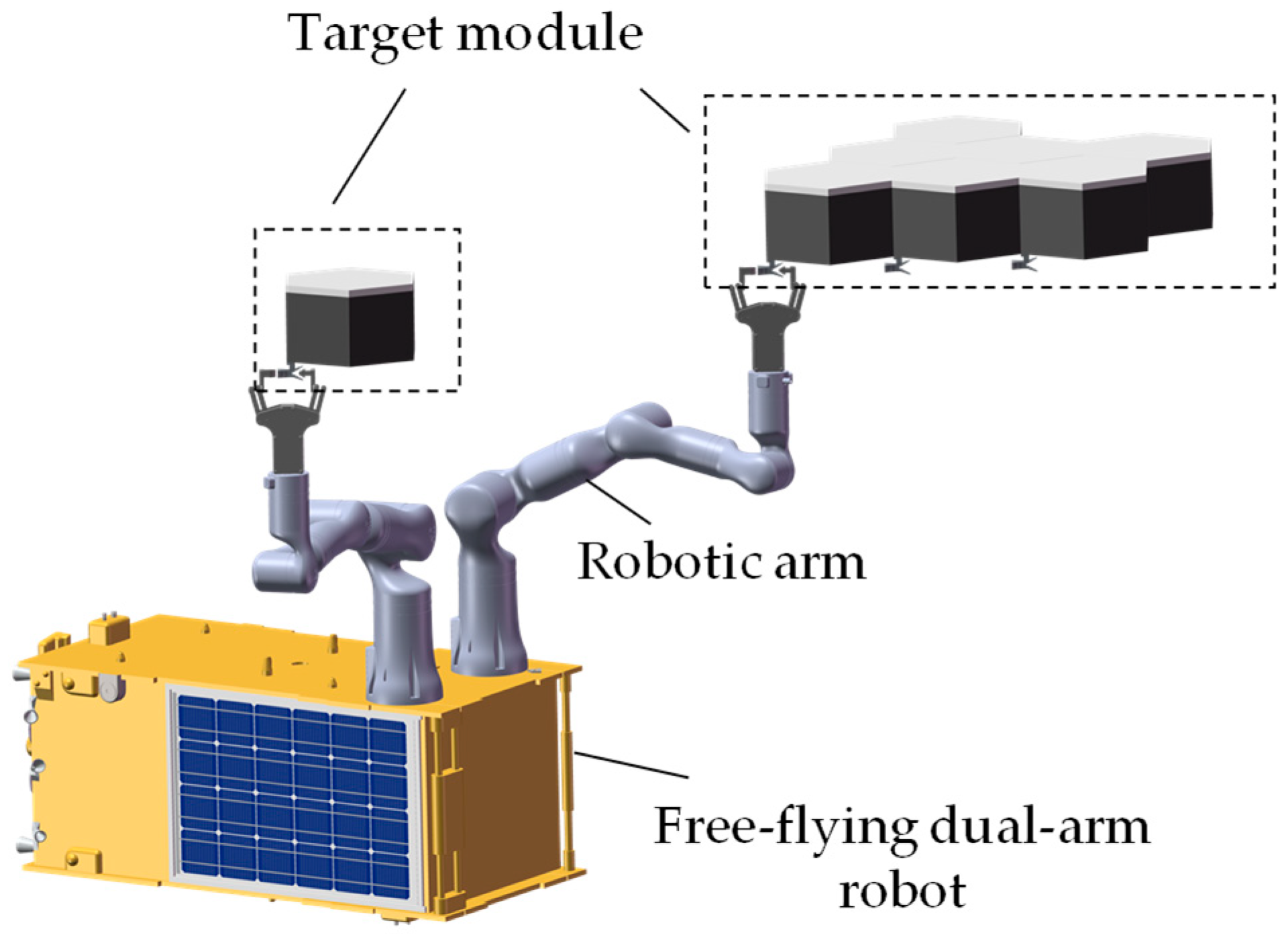
Figure 1. Assembly of target modules in space by a free-flying dual-arm robot.
Aerospace 13 00188 g001
Figure 2. The proposed self-centring mechanism.
Aerospace 13 00188 g002
Figure 3. Schematic representation of the geometrical configuration of the self-centring mechanism.
Aerospace 13 00188 g003
Figure 4. Working principle of the self-centring mechanism with misalignments.
Aerospace 13 00188 g004
Figure 5. The numerical solution process for multi-point contact model.
Aerospace 13 00188 g005
Figure 6. Schematic diagram of the contact model.
Aerospace 13 00188 g006
Figure 7. Discretisation of the contact surfaces. (a) Pre-contact stage, and (b) in-contact stage.
Aerospace 13 00188 g007
Figure 8. Contact detection of the virtual sphere pairs.
Aerospace 13 00188 g008
Figure 9. Contact behaviors of the self-centring process. (a) No contact, (b) initial contact, (c) multi-point bouncing contact, and (d) contact complete.
Aerospace 13 00188 g009
Figure 10. The scenario of a single robotic arm grasping a target module: (a) the single robotic arm, and (b) virtual spheres of the end-effector and the V-groove mechanism.
Aerospace 13 00188 g010
Figure 11. The displacement of centroid of the V-groove with different closing speeds: (a) x-axis; (b) y-axis; (c) z-axis.
Aerospace 13 00188 g011
Figure 12. Combined contact forces for different closing speeds: (a) x-axis; (b) y-axis; (c) z-axis.
Aerospace 13 00188 g012
Figure 13. The self-centring fingers and the double V-groove mechanism.
Aerospace 13 00188 g013
Figure 14. Test device for measuring the positioning accuracy of the self-centring mechanism.
Aerospace 13 00188 g014
Figure 15. Experimental workflow for single-arm self-centring grasping.
Aerospace 13 00188 g015
Figure 16. Positioning accuracy of self-centring mechanism.
Aerospace 13 00188 g016
Figure 17. Residual offsets of the self-centring mechanism.
Aerospace 13 00188 g017
Figure 18. Comparison of contact forces during the self-centring process: (a) x-axis; (b) y-axis; (c) z-axis.
Aerospace 13 00188 g018
Figure 19. The contact model of the free-flying dual-arm robot.
Aerospace 13 00188 g019
Figure 20. Displacement of the centroid of the free-flying dual-arm robot: (a) the first grasping; (b) the second grasping.
Aerospace 13 00188 g020
Figure 21. Contact forces and torques during the sequential dual-arm grasping: (a) the first grasping; (b) the second grasping.
Aerospace 13 00188 g021aAerospace 13 00188 g021b
Figure 22. The component of the Space Proximity Operations Testing facility.
Aerospace 13 00188 g022
Figure 23. Displacement of centroid of the free-flying dual-arm robot during self-centring process: (a) the first grasping; (b) the second grasping.
Aerospace 13 00188 g023
Figure 24. Position changes of the reflective marker points.
Aerospace 13 00188 g024
Figure 25. Displacement of the floating base with different parallel offsets: (a) x-axis; (b) y-axis.
Aerospace 13 00188 g025
Figure 26. Displacement of Marker 1: (a) x-axis; (b) y-axis.
Aerospace 13 00188 g026
Figure 27. Displacement of Marker 2: (a) x-axis; (b) y-axis.
Aerospace 13 00188 g027
Figure 28. Displacement of the middle position between Marker 3 and Marker 4: (a) x-axis; (b) y-axis.
Aerospace 13 00188 g028
Figure 29. Displacement of the middle position between Marker 5 and Marker 6: (a) x-axis; (b) y-axis.
Aerospace 13 00188 g029
Table 1. Material and physical properties of the self-centring mechanism and target module.
ParameterSymbolValue
Young’s modulus of the finger (N/m2) E 1 7 × 10 10
Young’s modulus of the V-groove mechanism (N/m2) E 2 7 × 10 10
Poisson’s ratio of the grasper υ 1 0.25
Poisson’s ratio of the V-groove mechanism υ 2 0.25
The mass of target module (kg) m t 2.768
Moments of inertia of the target module ( k g m 2 ) I x x 4.739 × 1 0 3
I y y 4.668 × 1 0 3
I z z 4.707 × 1 0 3
I x y 5.349 × 1 0 5
I x z 3.760 × 1 0 5
I y z 7.25 × 1 0 5
Table 2. Contact and friction model parameters used in numerical simulations.
ParameterSymbolValue
Kinetic friction coefficient μ k 0.26
Static friction coefficient μ s 0.3
Bristle stiffness k b 3 × 1 0 4
Bristle damping coefficient (N/m) c b 80
Velocity deadband (N/m) v d 0.001
Table 3. Numerical validation scenarios under different finger closing speeds.
Case Closing Speed (m/s) Initial Parallel Offset (mm) Computational Time (s)
I0.014(0, −3, 0)15.23
II0.018 (0, −3, 0)11.32
III0.022(0, −3, 0)9.21
Table 4. Converged residual offsets under different closing-speed cases.
CaseFinal Offset x (m/s)Final Offset y (mm)Final Offset z (mm) e (mm)
I0.0830.097−0.0110.128
II0.0820.101−0.00340.131
III0.0800.102−0.001130.129
Table 5. Parameters of the sequential dual-arm grasping.
i th BodyMass (kg) Moments   of   Inertia   ( k g m 2 )
I x x i I y y i I z z i
130.5310.5330.3970.308
210.5670.3180.1990.190
347.0373.5613.5213.450
477.56810.4598.03913.471
Table 6. Joint states of the robotic arms in experiment.
Joint 1Joint 2Joint 3Joint 4Joint 5Joint 6
Arm-1 (rad)0.5560.4811.412.40 × 10−71.250.555
Arm-2 (rad)−0.5110.9980.4794.00 × 10−61.66−0.511
Disclaimer/Publisher’s Note: The statements, opinions and data contained in all publications are solely those of the individual author(s) and contributor(s) and not of MDPI and/or the editor(s). MDPI and/or the editor(s) disclaim responsibility for any injury to people or property resulting from any ideas, methods, instructions or products referred to in the content.