1. Introduction
Size and weight are critical design considerations in the aviation industry, where compact solutions with equivalent performance are generally favored despite higher costs. Using 400 Hz instead of the common 50/60 Hz AC frequency greatly reduces the size of passive components. As a result, power supplies, motors, transformers, and inverters have smaller dimensions, and power transmission lines are reduced. Following the Second World War, the aerospace industry set 400 Hz as the standard frequency, and this continues with the US Military Standard MIL-STD-704F [
1,
2]. Today, because of the increased use of electronic devices in modern aircraft, nonsymmetrical and nonlinear loads are common in avionics systems. This increase has triggered more complex harmonic generation and made power control more complex [
3]. Moreover, the evolving need for control in aerospace systems has required advanced control approaches with higher bandwidth to effectively manage these complex loads [
4]. Recent aerospace-oriented inverter studies have therefore focused on compact, high-frequency AC power systems operating at 400 Hz, with particular emphasis on power density, harmonic mitigation, and compliance with aircraft power quality standards. Multilevel inverter structures for aircraft ground power and propulsion applications have been reported to enhance waveform quality, reduce switch count, and maintain compliance with aircraft power-quality standards [
5,
6,
7]. Compact GaN-based inverter implementations for 115 V, 400 Hz avionic systems have also demonstrated high efficiency and lightweight realization [
8]. Resonant and isolated single-stage inverter architectures have further been proposed to reduce component count and switching losses while maintaining galvanic isolation in aerospace platforms [
9]. These developments highlight the ongoing effort toward compact and high-performance inverter solutions for modern aircraft systems.
This paper presents an innovative solution to the efficiency, weight, and harmonic distortion problems faced by conventional aircraft power systems. The main contribution of this study is not limited to system-level integration. The novelty lies in the application of an interleaved synchronous Super-Lift Luo DC–DC converter to a high-power 400 Hz three-phase aerospace inverter, combined with analytical modeling and stability verification of the overall system. Unlike conventional boost-based or transformer-isolated solutions, the proposed structure achieves high voltage gain with reduced DC-link ripple and low harmonic distortion, while maintaining a transformerless and weight-efficient architecture suitable for aviation applications. This system is particularly relevant in the context of the More Electric Aircraft (MEA) initiative, which aims to replace traditional hydraulic and pneumatic systems with electrical systems to improve performance and reduce maintenance needs [
10]. Within this framework, high step-up and weight-optimized inverter architectures have been investigated for high-frequency aircraft power systems [
11]. The proposed interleaved synchronous Super-Lift Luo converter (SLLC)-based 24 kVA three-phase inverter is characterized by high power density and low harmonic distortion (<2%). The stability of the system is theoretically proven by state-space modeling and experimentally verified by PLECS simulations and Typhoon HIL tests. Similar trends toward high-density and experimentally validated inverter solutions for aerospace and aircraft ground power applications have been reported in recent literature, highlighting the relevance of compact converter–inverter architectures for modern avionics systems. The findings provide a scalable solution suitable for both existing auxiliary power units (APUs) and the integration of renewable energy sources.
The interleaved design helps reduce the ripple of the input current, which is crucial to maintain a stable power supply in aircraft systems [
12,
13]. The interleaved topology of the DC-DC converter significantly reduces the input current ripple, as demonstrated by Denholm et al. [
14]. Their proposed interleaved two-channel design achieves a peak-to-peak input current ripple of less than 1.5%, which minimizes fuel cell degradation and improves system reliability. This characteristic is particularly advantageous for inverters that require a stable DC-link voltage with low ripple.
The design of interleaved converters also allows for better thermal management and reduced electromagnetic interference [
15,
16,
17]. Interleaved DC-DC converters exhibit superior thermal performance compared to conventional topologies, as demonstrated by Alavi et al. [
15]. Their analysis shows that the floating interleaved boost converter achieves significantly lower junction temperatures (e.g., 62 °C for IGBTs) due to reduced current stress per channel, enhancing reliability and lifespan. Such thermal and EMI advantages are particularly critical in aerospace environments, where stringent reliability and electromagnetic compatibility requirements must be satisfied.
Systems using interleaved converters have achieved efficiencies that exceed 96% to 98% due to optimized switching and conduction strategies [
18,
19,
20]. However, potential disadvantages include increased complexity in control strategies and design, which may complicate implementation in aircraft inverters [
21]. Consequently, practical realization of interleaved architectures requires careful coordination between control design, real-time implementation, and hardware constraints.
Interleaved topologies allow for better current sharing among channels, which reduces the size of filter inductors and capacitors [
22,
23], thus improving the power density of the inverter. The use of a single inductor in some interleaved inverter designs simplifies the architecture while maintaining a high power density [
24]. However, efficiency issues may arise in this type of interleaved topology. For instance, a study demonstrated an interleaved converter achieving 94.6% efficiency at full load [
25] while another study, which has a different kind of interleaved topology, achieved a peak efficiency of 95.6% [
26]. These results indicate that the choice of interleaving strategy and component configuration directly influences efficiency and scalability in high-power inverter systems.
The Super-Lift Luo converter is an advanced DC-DC converter derived from the buck-boost converter, designed to efficiently elevate low photovoltaic voltage to a higher level with minimal voltage and current ripple, and has recently gained attention in high step-up and high power-density power conversion research, making it suitable for various applications [
27,
28,
29,
30]. Simulations have also been carried out for electric vehicle applications as DC-DC converters, resulting in increased efficiency and reduced voltage fluctuations [
31,
32]. However, despite its favorable electrical characteristics, its application in aerospace power systems has received very limited attention. Similarly, the literature contains no studies on aviation using the Super Lift Luo converter other than simulations [
33].
The design and development of a three-phase 24 kVA inverter with an interleaved synchronous Super-Lift Luo converter for aeronautical power systems involves integrating high-power conversion technologies to meet the specific needs of aerospace applications. The system aims to maximize efficiency, reduce ripple, and ensure high-performance stability in various operating conditions. This work therefore addresses a clear gap in the existing literature by extending the application of the Super-Lift Luo converter toward aerospace-grade inverter systems validated under real-time operating conditions.
3. Results
This section presents the results of a 24 kVA three-phase inverter system based on the ISSLLC. The section provides a description of the converter and inverter design, the component selection process, and the control strategy used. Simulation studies conducted in the PLECS environment analysed the steady-state and dynamic performance of the system under different operating conditions, and the simulation results were verified in real time through hardware-in-the-loop validation tests conducted on the Typhoon HIL platform. The comparison of interleaved and noninterleaved structures focuses on output voltage stability and ripple reduction.
3.1. Simulations
To verify the analytical design presented in
Section 2, the proposed interleaved synchronous Super-Lift Luo converter was modelled in PLECS. The simulation setup replicates the target operating conditions of the aircraft electrical system, including the high step-up requirement from a low-voltage DC source to the regulated DC bus feeding a three-phase inverter. All passive and active component values were determined according to the design equations in the previous section, ensuring consistency between analytical predictions and simulation results.
3.1.1. Circuit Design
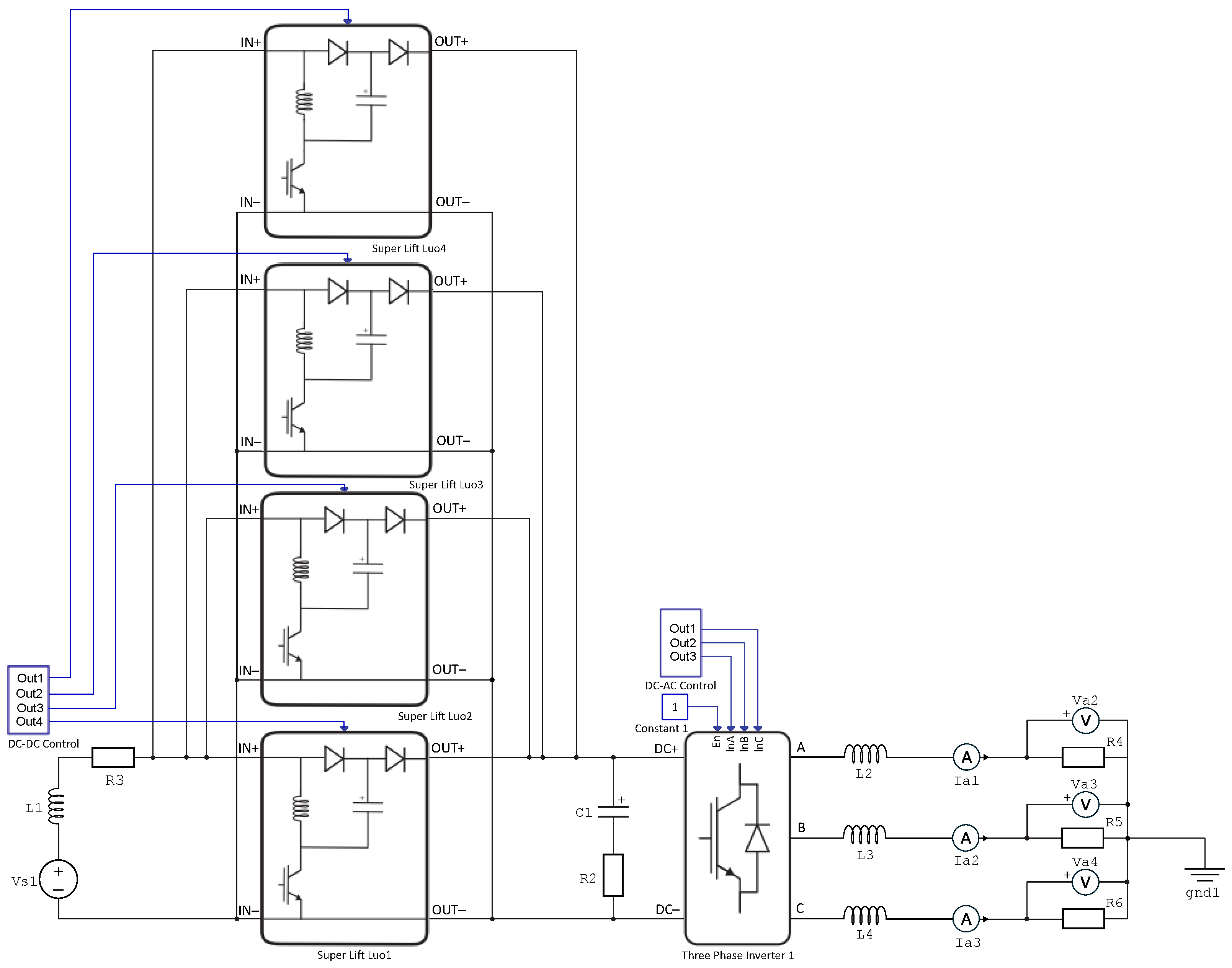
The proposed DC–DC conversion stage is implemented as a four-channel interleaved synchronous Super-Lift Luo converter to achieve the high step-up ratio required for converting
V DC to
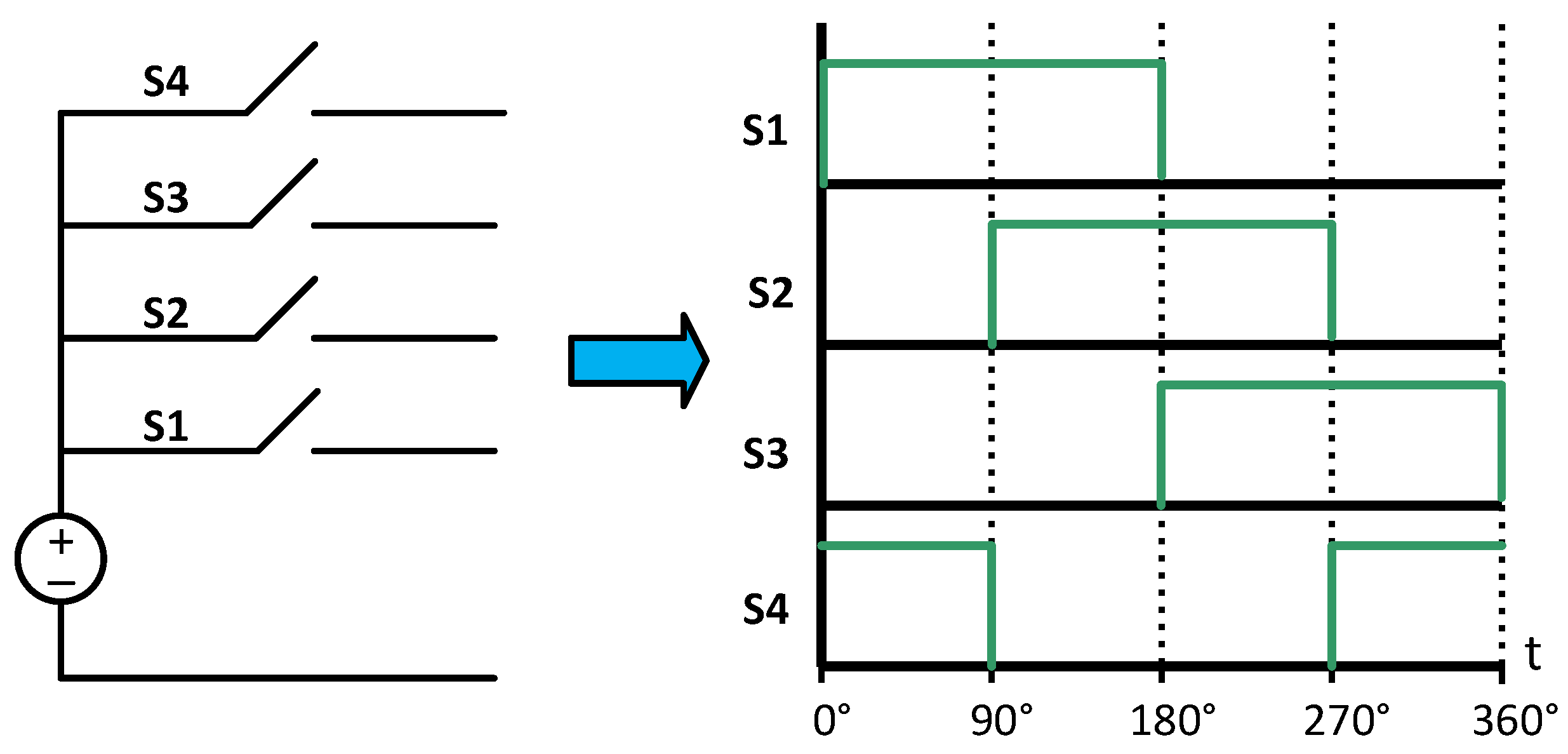
V DC. In the interleaved configuration, each channel shifts 90 degrees to reduce the ripple in both the input and output currents, increase the response time, and evenly distribute the thermal stress across the switching devices. The use of synchronous MOSFET switches instead of diodes minimises conduction losses and improves overall efficiency, particularly at high output voltages.
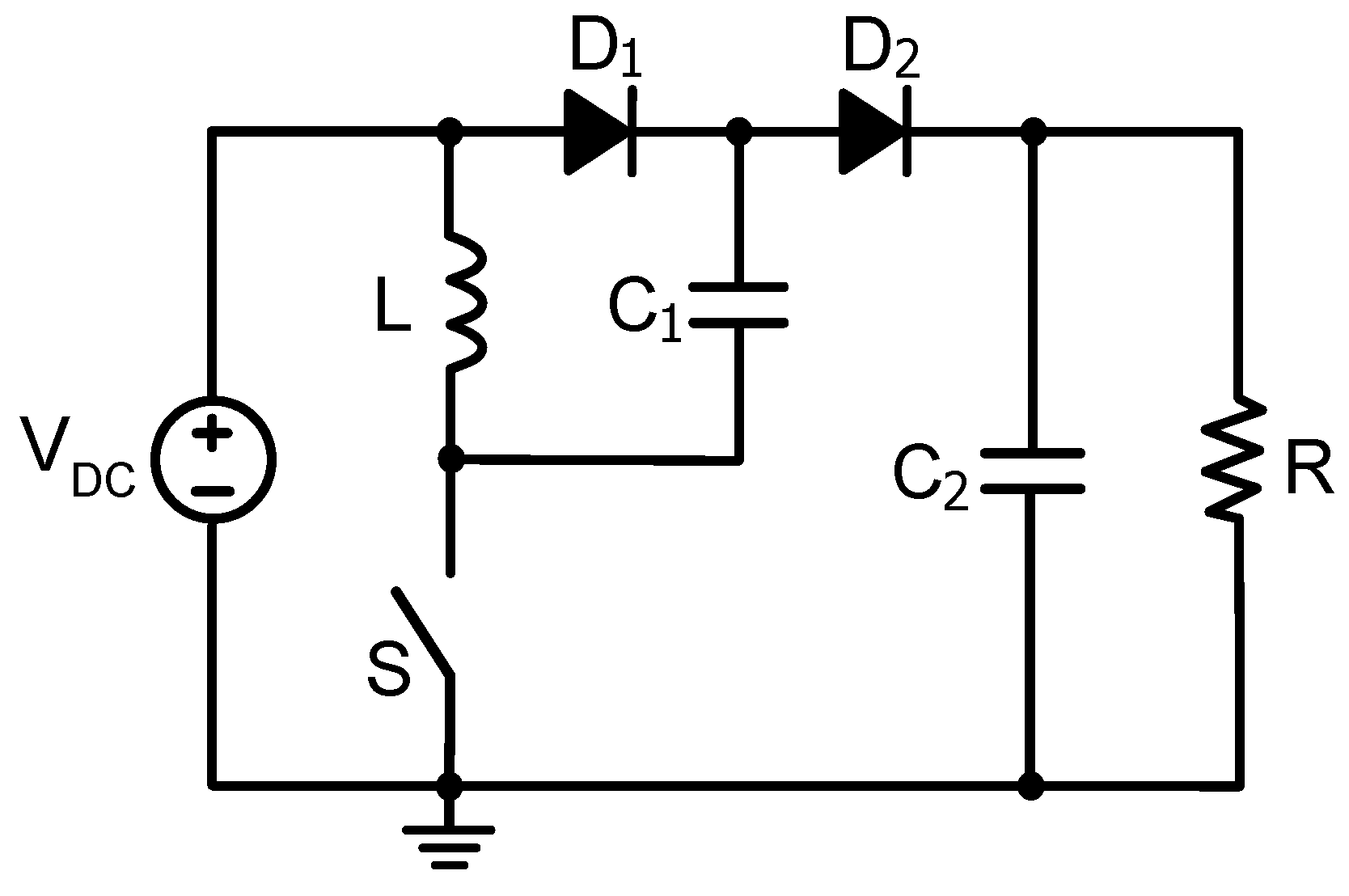
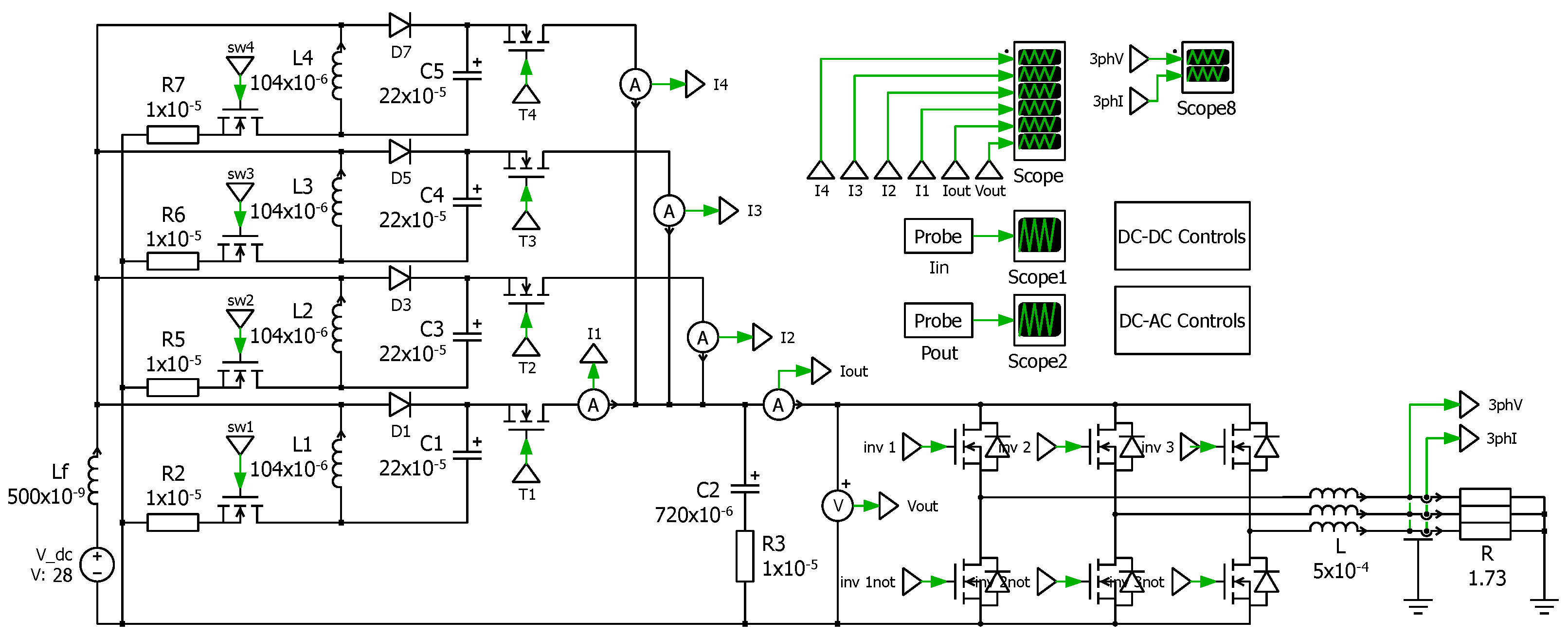
Figure 4 shows the complete schematic of the converter.
Each channel comprises an input inductor
, a primary lift capacitor
, and a bulk output capacitor
. The interleaving effect reduces the equivalent inductance in the small-signal averaged model to Equation (
6).
where
is the number of channels. While the small-signal model uses
the physical design retains the higher per-channel inductance value of
to suppress individual channel current ripple, reduce peak inductor currents, and improve EMI performance. This also ensures that each inductor operates well below its saturation limit during transient load conditions.
The bulk output capacitor
is sized to stabilise the DC bus voltage under load transients and to minimise low-frequency voltage ripple. The value of
is determined based on voltage lift requirements and its role in shaping the converter’s double pole and zero locations, as detailed in the analytical model in
Section 2.
The load is modelled as the DC equivalent of the three-phase inverter’s rated output. Given a per-phase resistance of
at
, the total load power is approximately
corresponding to an equivalent DC-side resistance of
This load representation is used in both steady-state and small-signal simulations to ensure realistic voltage and current waveforms. In addition to the nominal rating point (, corresponding to 22.9 kW at 115 Vrms per phase), a conservative operating point () was intentionally employed in the load–transient and validation studies. This reflects the slightly elevated AC-side RMS voltage (118–120 Vrms) used to emulate practical conduction and switching losses, resulting in an active power of approximately 24 kW at near-unity power factor. The inverter apparent power rating remains at 24 kVA, and all results comply with MIL-STD-704F.
3.1.2. Control Design and Switching Models
The control strategy is implemented in two sequential stages: the front-end DC–DC converter and the back-end DC–AC inverter.
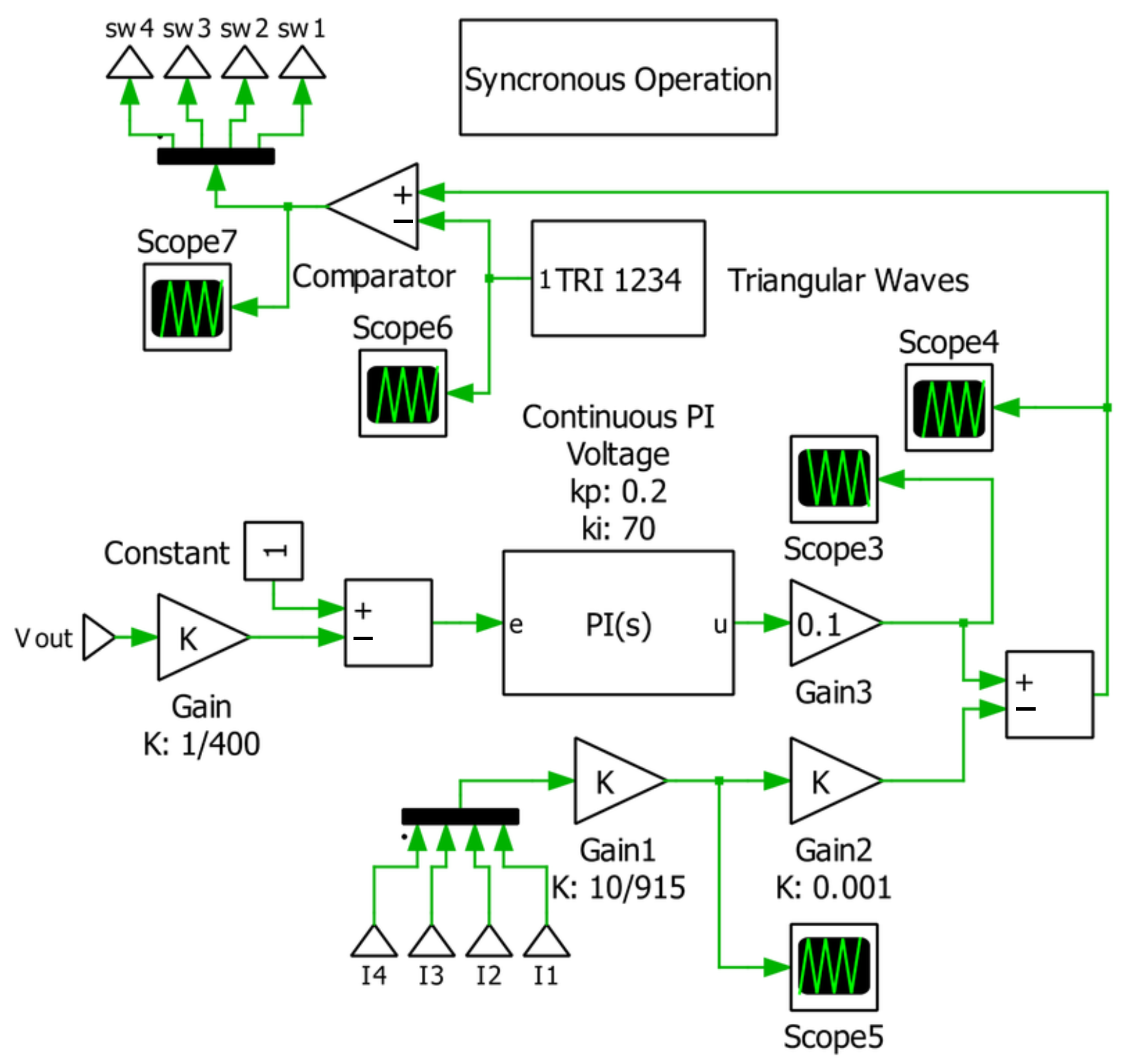
In the DC–DC stage, the converter employs a voltage-mode control scheme with a continuous
PI (Proportional–Integral) controller. The output voltage is sensed and scaled by a gain factor of
, producing the feedback signal. This is compared with the reference command to generate the error signal
e, which is processed by the PI controller as seen in Equation (
9) below.
with
and
. The PI output
u regulates the duty cycle command of the interleaved channels. To implement switching, the PI output is compared with a high-frequency triangular carrier waveform, generating PWM signals for synchronous operation of the four interleaved channels. Interleaving shifts the phase of each PWM signal by
, thereby reducing both input and output current ripple. Current feedback is additionally scaled (
) to observe the summed inductor currents and verify current-sharing symmetry. This ensures robust operation under dynamic load conditions and suppresses EMI by distributing switching harmonics, as shown in
Figure 5.
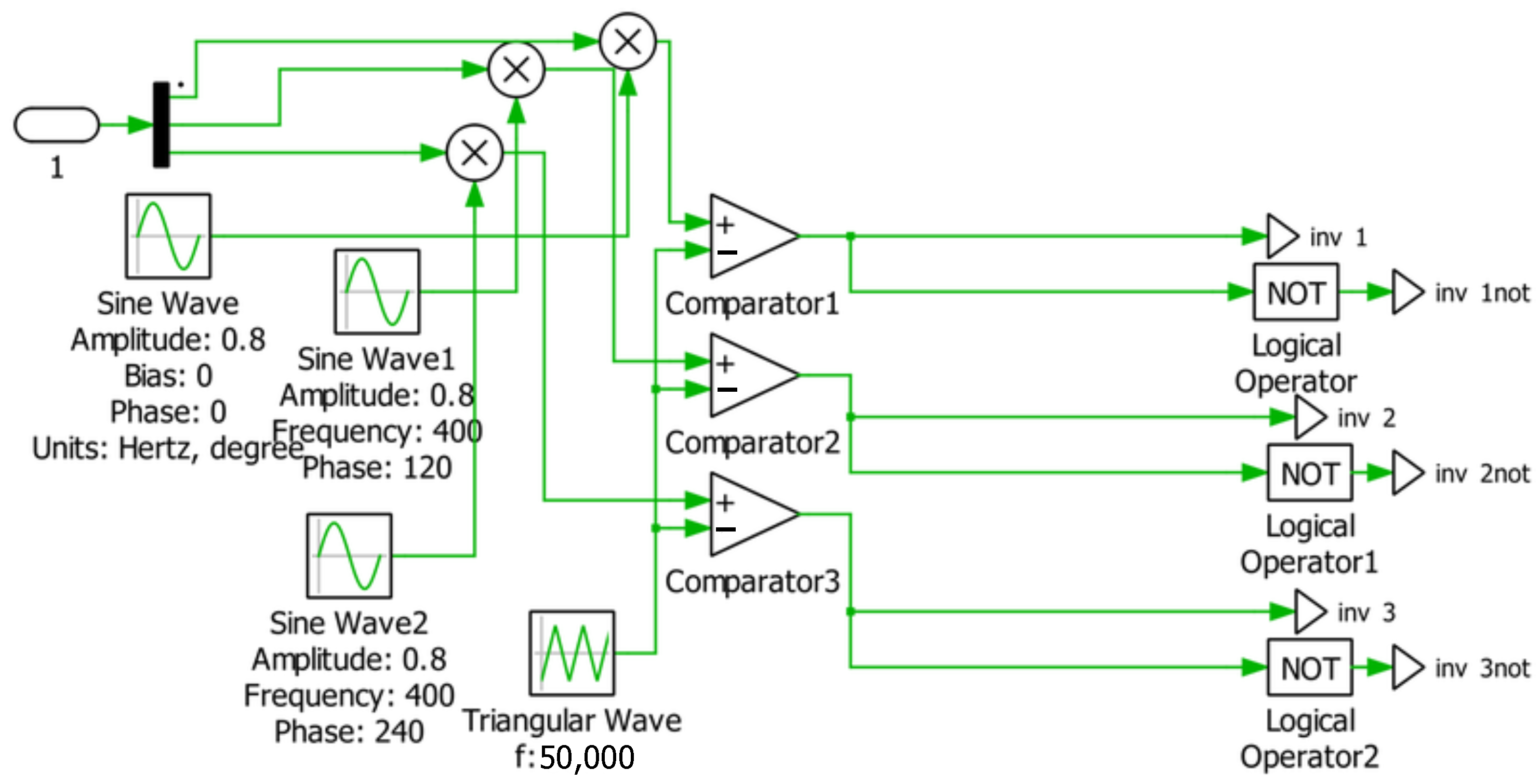
In the DC–AC stage, the regulated DC bus is converted into a balanced three-phase AC output. The modulation strategy employs sinusoidal pulse-width modulation (SPWM), where three sinusoidal reference signals, phase-shifted by
, are compared against a high-frequency triangular carrier waveform (
). The resulting comparator outputs generate the gate signals for the inverter switches, producing three-phase voltages at
. Logical operators ensure that complementary switch pairs are driven with appropriate dead-time insertion to prevent shoot-through (
Figure 6).
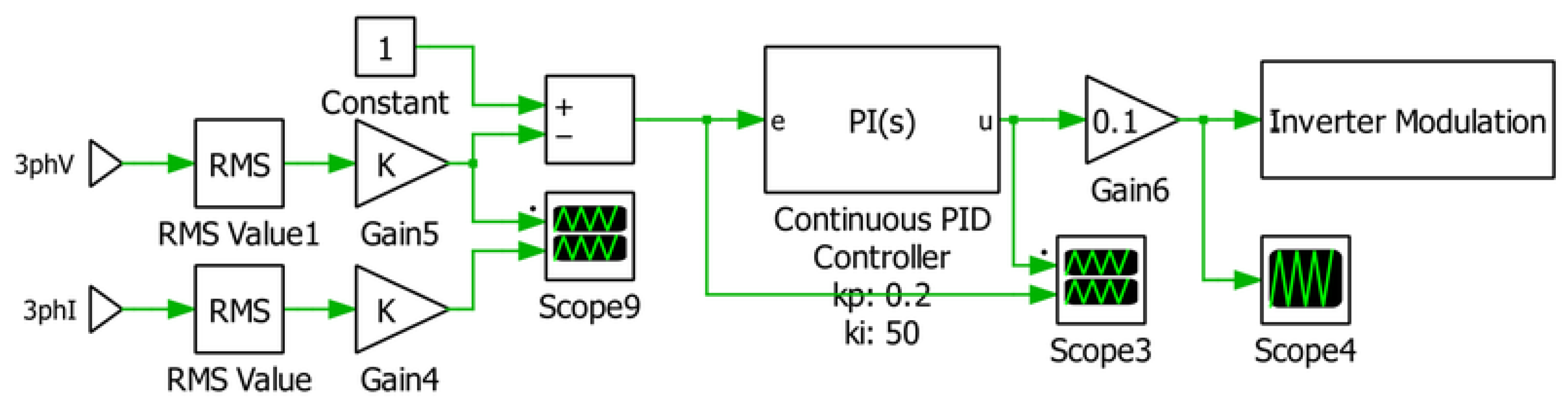
A secondary feedback loop regulates the root-mean-square (RMS) values of the three-phase output voltages and currents. The RMS values of the line voltage and current are measured, scaled, and compared with their respective references. The resulting error is processed by a continuous PID controller of the form shown in Equation (
9), with tuned gains of
and
. The controller output adjusts the modulation index of the SPWM process, thereby maintaining the desired amplitude of the inverter’s three-phase output under varying load conditions. This feedback structure is illustrated in
Figure 7.
The two control stages are interconnected through the regulated DC bus. The DC–DC converter ensures that the intermediate bus voltage remains stable under source and load disturbances, effectively decoupling the input supply from the inverter dynamics. This regulated DC bus then serves as the input to the DC–AC inverter stage, providing a stiff voltage source for high-quality AC waveform generation. In this way, the first stage establishes the required operating conditions for the inverter, while the second stage focuses on delivering sinusoidal three-phase voltages to the load in compliance with aerospace power quality standards.
3.1.3. DC–DC Stage Simulation Results
The simulation results of the DC–DC converter are summarised in
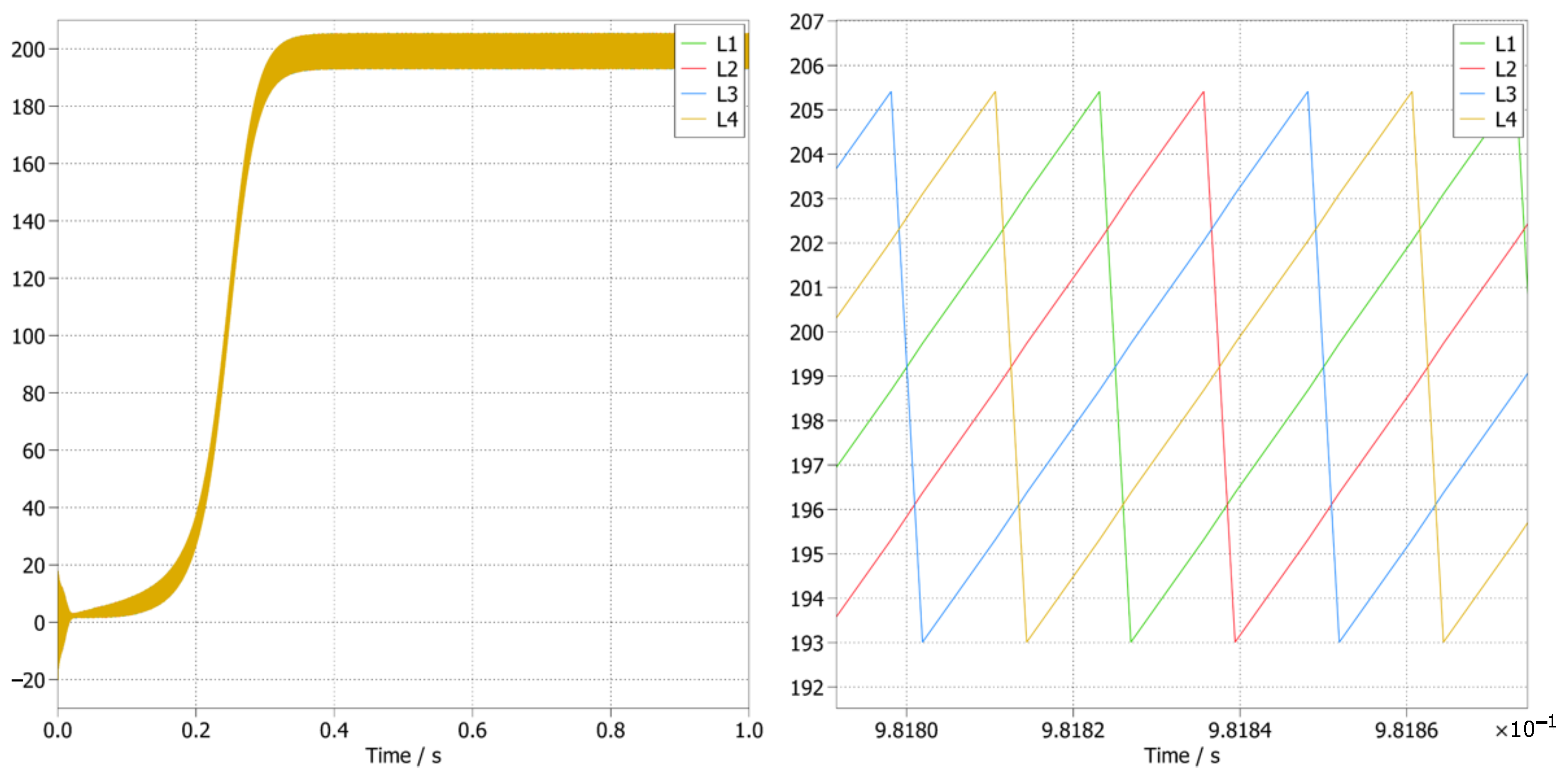
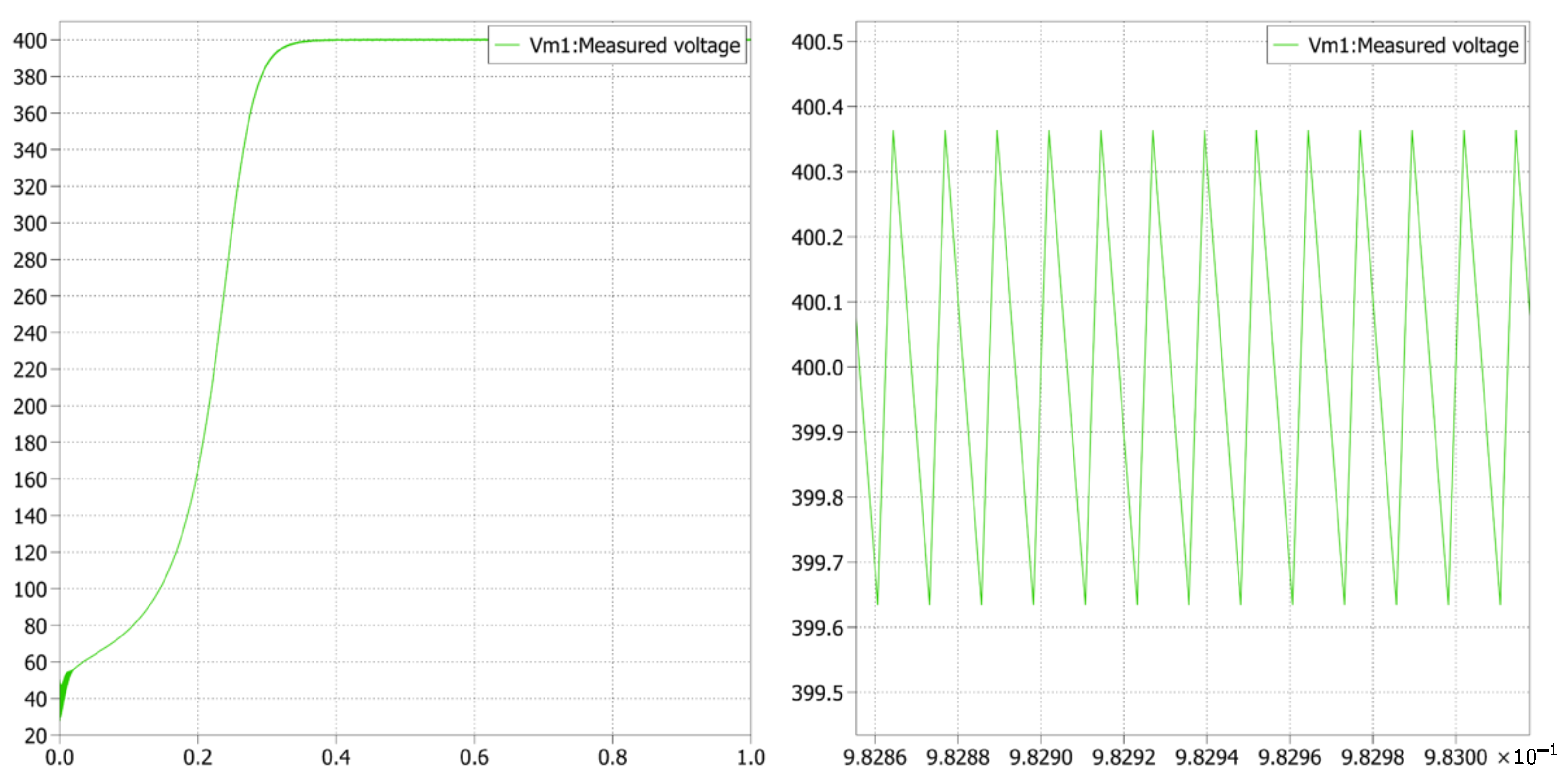
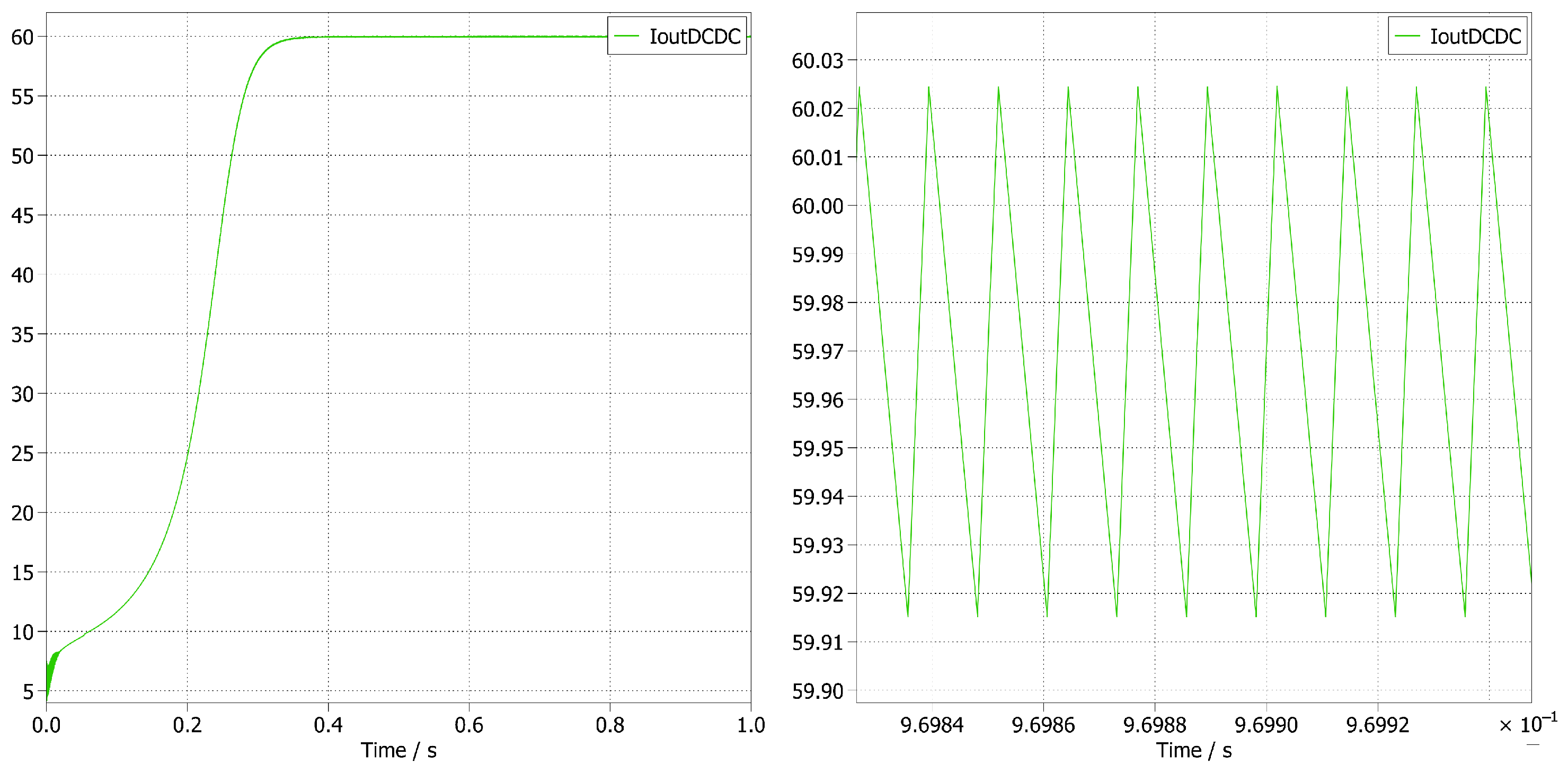
Figure 8 and
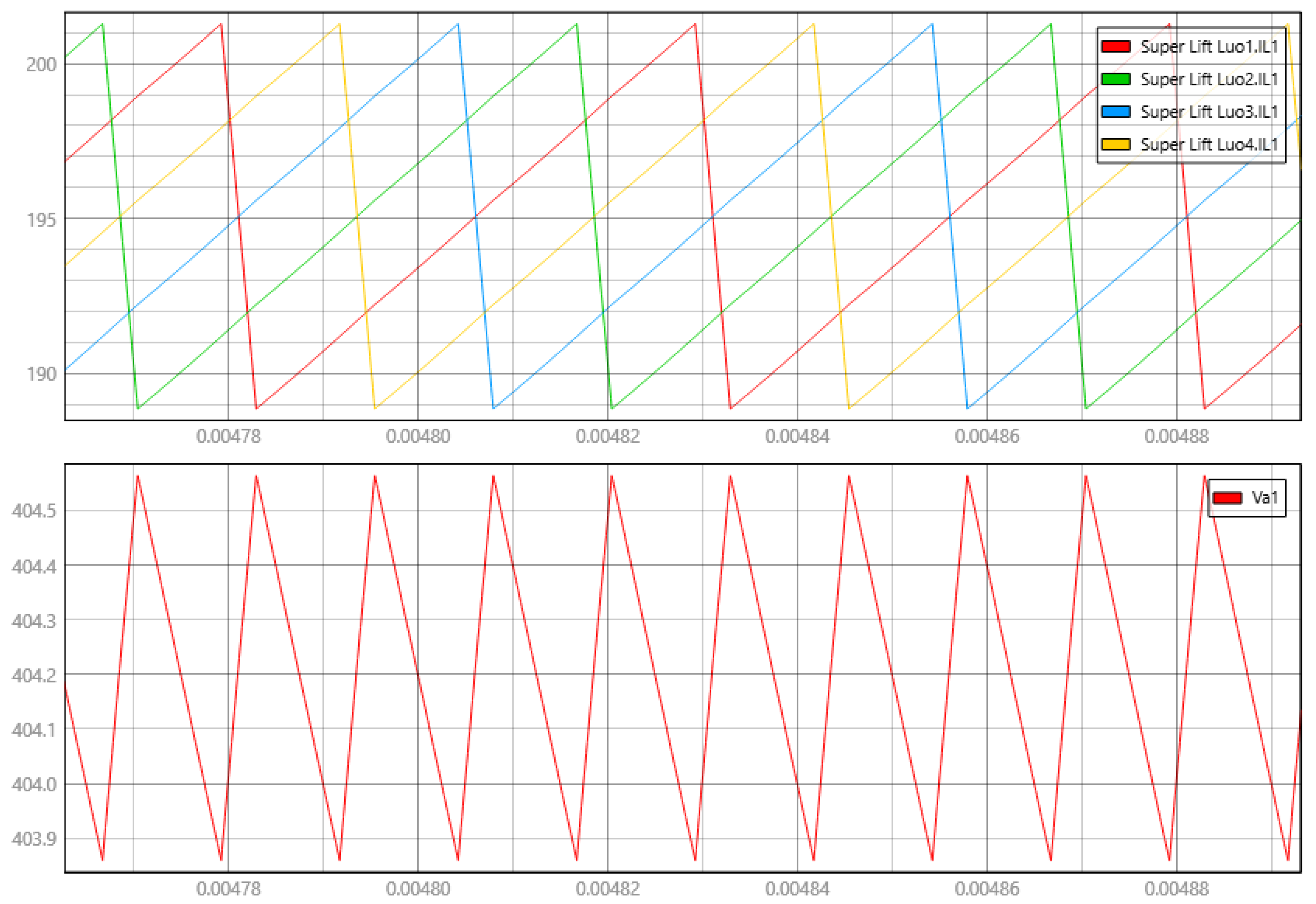
Figure 9. The inductor currents in
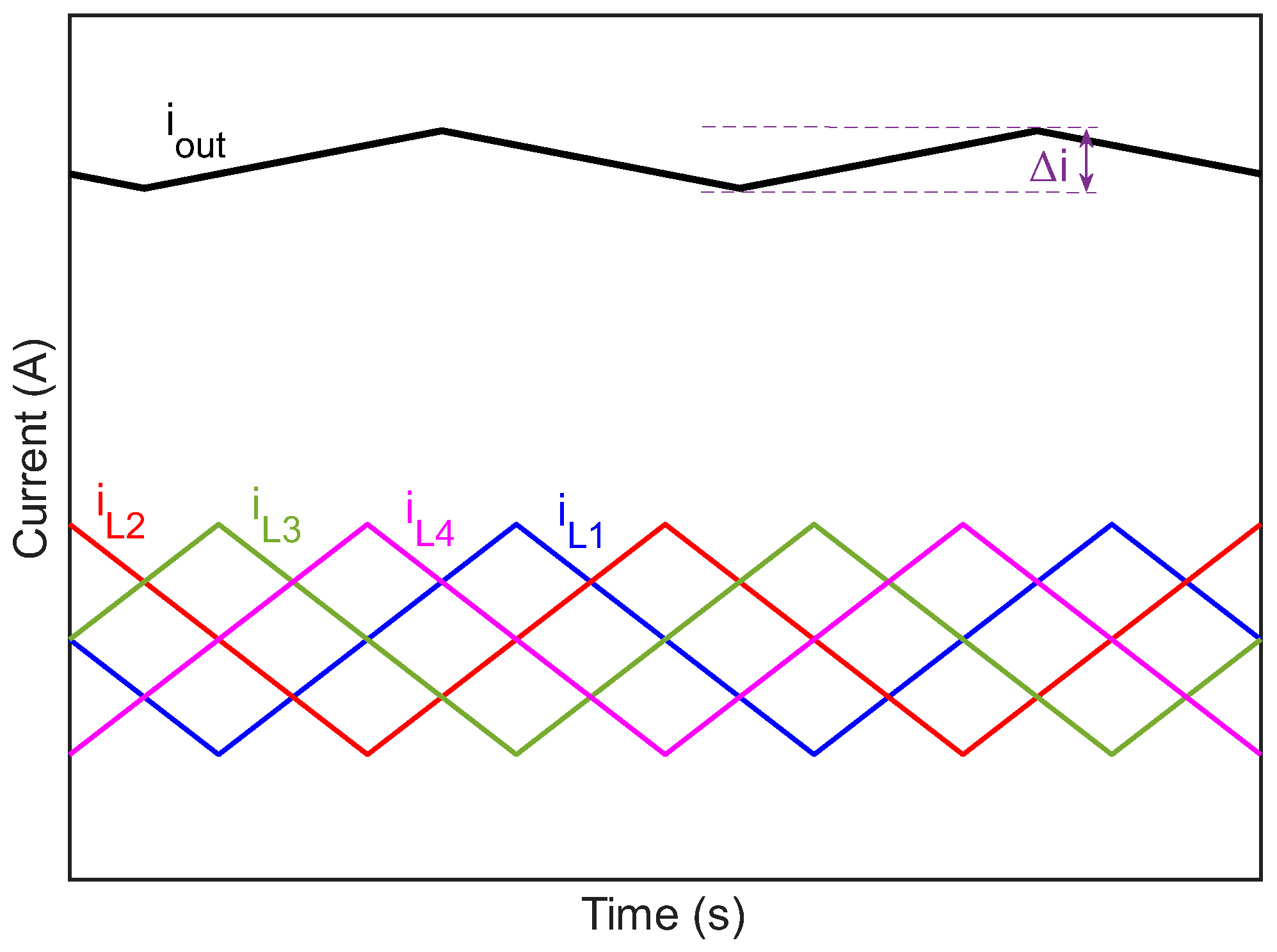
Figure 8 clearly demonstrate the effect of interleaving. During start-up (left), the four channel currents rise smoothly and reach steady state within approximately 0.25 s. According to MIL-STD-704F, airborne DC power buses must return to within
of their nominal value within 0.5 s following a transient disturbance. The observed settling time is significantly faster than this requirement, indicating robust regulation. At steady-state (right), the channel currents are shifted by
, resulting in balanced current sharing and substantial ripple cancellation. The measured effective ripple current is reduced to about 0.6 A compared to the theoretical 2.5 A for a single-channel case, confirming the benefit of interleaving in both ripple reduction and EMI performance.
The corresponding output voltage behaviour is shown in
Figure 9. During start-up (left), the bus voltage settles at the reference value of 400 V in less than 0.25 s, which is well within the 0.5 s recovery window mandated by MIL-STD-704F. Under steady-state conditions (right), the measured ripple is approximately 0.9 V peak-to-peak, which is less than 0.03% of the nominal 400 V. This is more than an order of magnitude lower than the 1% ripple limit specified in MIL-STD-704F, thereby validating the design of the bulk output capacitor and the interleaving scheme. These results confirm that the DC–DC converter provides a stiff and well-regulated DC bus, establishing the necessary operating conditions for the subsequent DC–AC inverter stage.
The output current ripple of the proposed four-channel interleaved converter was measured to be approximately 0.1 A. This reduction is due to the ripple cancellation effect of interleaving. For an
N-channel interleaved converter, the effective ripple magnitude can be estimated as seen in Equation (
10).
where
D is the duty ratio and
is the inductor current ripple of a single channel. In the present case,
and the measured value is
. Without interleaving (
), the same converter operating at 20 kHz would exhibit a ripple of approximately
. Thus, the interleaved structure reduces the effective current ripple by nearly a factor of four while simultaneously increasing the ripple frequency from
to
, greatly improving output filtering is shown in
Figure 10.
3.1.4. Load–Transient Performance
To assess the dynamic performance of the converter, single-step load changes were applied from the conservative test baseline
(
A) to new load levels corresponding to
and
variations. The numerical results of the single-step transient tests are summarized in
Table 1. After the step, the converter continued operation at the new steady-state load. The limits of MIL-STD-704F require the output voltage to recover within
of nominal in less than 0.5 s.
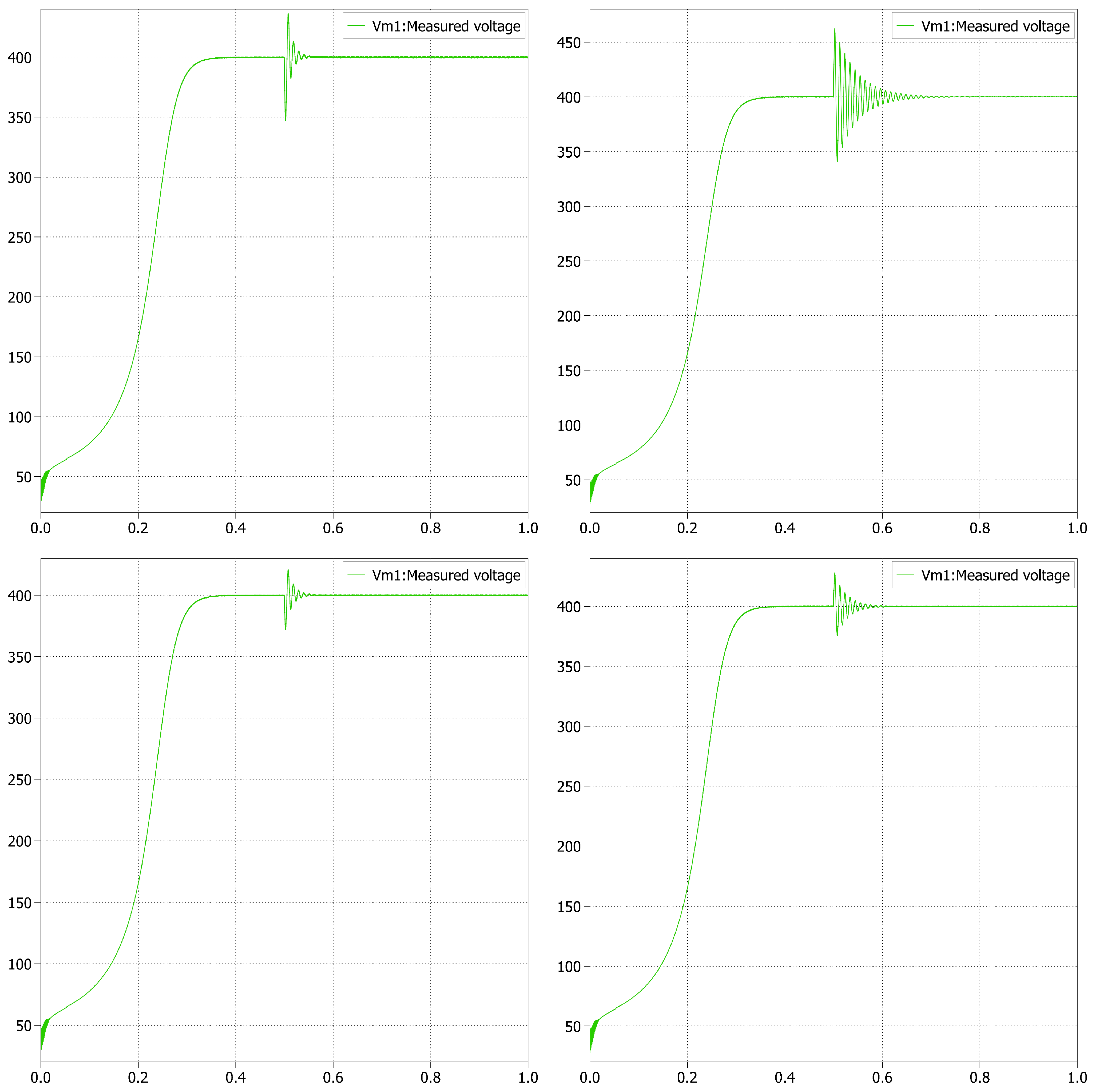
The graphical results are summarized in
Figure 11, where the four panels correspond to the following cases:
Top-left: step (−25% load current). The bus voltage shows a small undershoot of about 3–4% before settling.
Top-right: step (+25% load current). The bus exhibits ∼5% overshoot and stabilizes in ∼0.25 s.
Bottom-left: step (−50% load current). The voltage dips by about 8–10%, then recovers within ∼0.3 s.
Bottom-right: step (+50% load current). This worst-case scenario yields ∼12–15% overshoot, but the voltage still returns to the band within ∼0.35 s.
In all cases, the converter recovered well within the 0.5 s requirement of MIL-STD-704F, demonstrating robust control performance. The interleaved structure further ensured that the output current ripple remained around 0.1 A, significantly lower than a single-channel counterpart.
3.2. DC–AC Stage Performance
The second stage of the proposed power conversion system is the three-phase DC–AC inverter, which converts the regulated 400 V DC bus into a balanced AC output suitable for aircraft applications. This stage employs a SPWM strategy to generate three sinusoidal phase voltages with 120° displacement at the standard 400 Hz frequency. The phase-to-neutral RMS voltage is regulated to approximately 120 V, corresponding to 208 V line-to-line, in accordance with the steady-state voltage tolerance specified for 400 Hz aircraft power systems in MIL-STD-704F. The choice of 120 V in simulation accounts for resistive and conduction losses expected in hardware implementation, ensuring that the delivered voltage under practical conditions settles near the nominal 115 V. This section presents the simulated AC output waveforms and evaluates their compliance with the voltage, frequency, and harmonic distortion requirements specified by MIL-STD-704F.
3.2.1. AC Output Waveforms and Settling
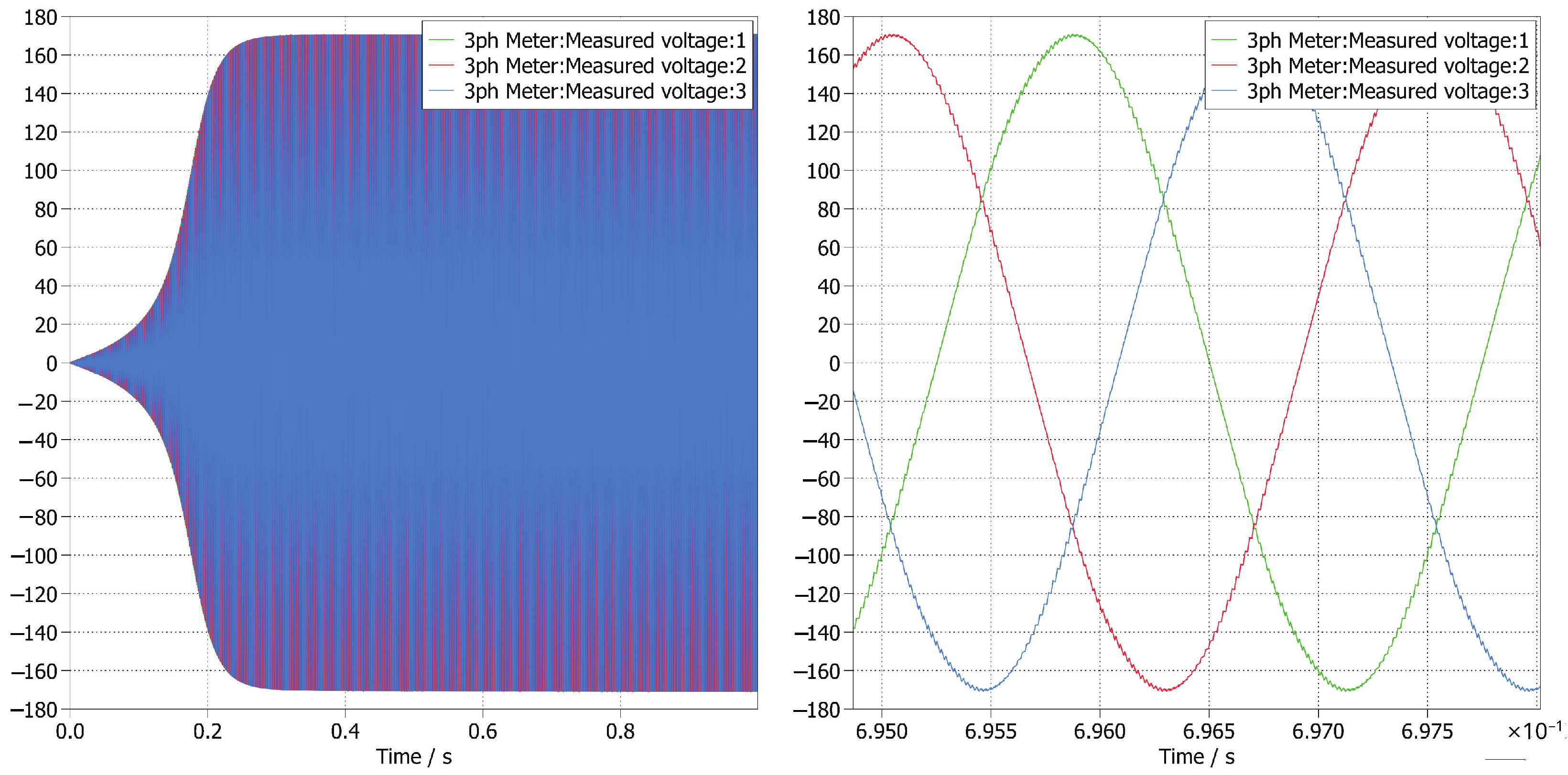
After start-up, the three phase voltages rapidly converge to steady state as illustrated in
Figure 12 (left panel). In steady state (right panel), the phase-to-neutral RMS is ≈120 V for all phases and the line-to-line RMS is ≈208 V. The measured fundamental is
Hz, and the output THD is ≈1.27%, comfortably below the 5% limit. The steady-state voltage, frequency, and THD values are summarized in
Table 2.
3.2.2. Harmonic Analysis and Power Quality
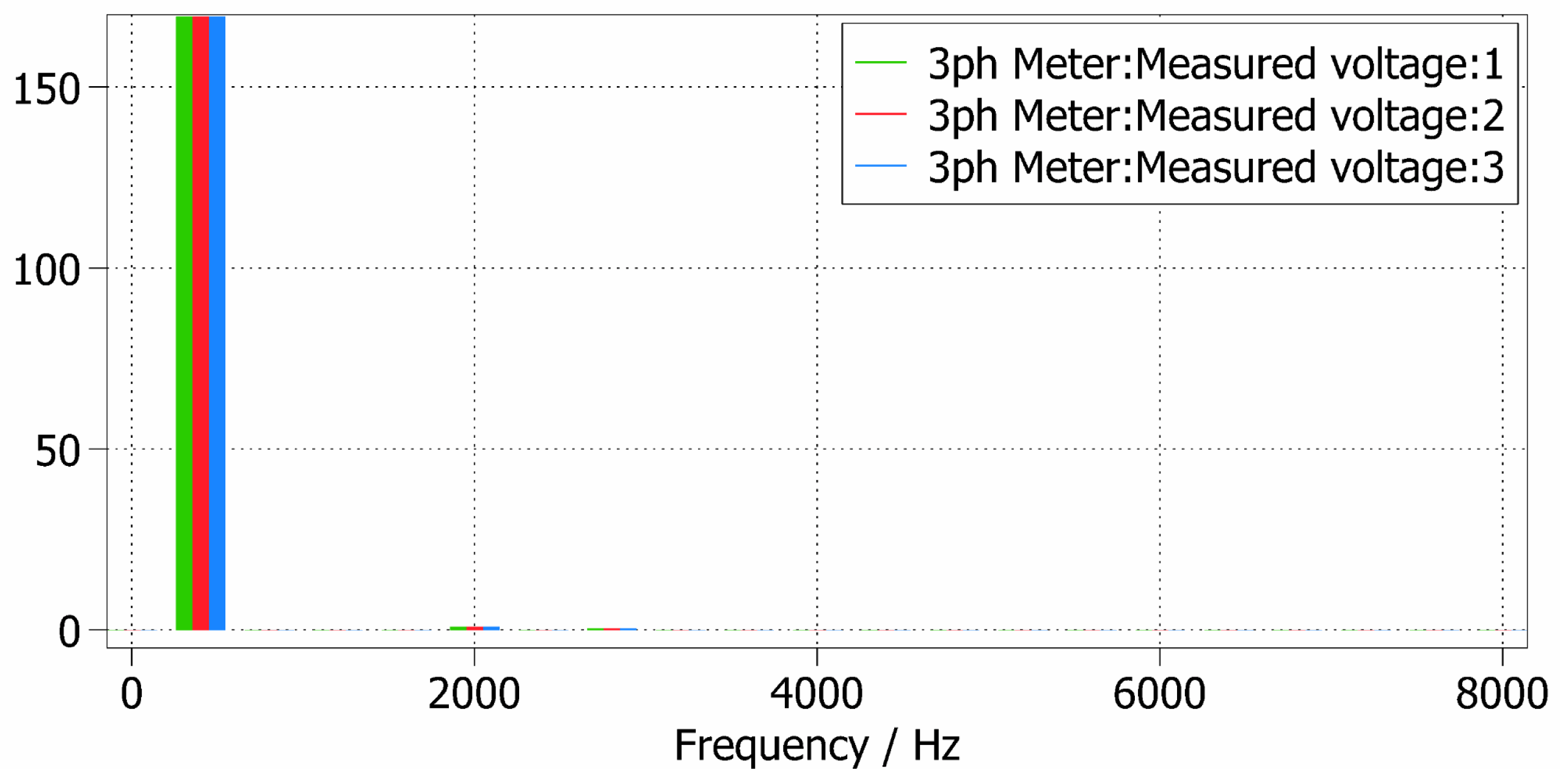
The harmonic spectrum of the inverter output voltages is shown in
Figure 13. The fundamental component at
Hz is clearly dominant and has an RMS value of about 120 V. Higher order harmonics remain at low levels and the THD is about 1.27%. The obtained value is in the acceptable range as MIL-STD-704F allows up to 5% THD. The three phases show almost identical spectra, indicating good balance and phase symmetry.
3.2.3. Power Factor Analysis
At the inverter output (point of common coupling, PCC), the three-phase power factor (PF) was evaluated from the apparent power ratio:
where
is the average active power and
S is the apparent power.
The measured phase RMS voltages were
,
,
, and the corresponding RMS currents were
,
,
. The slight differences observed among the three phase values are mainly caused by interleaving effects, initial condition asymmetries, and numerical discretization inherent to the simulation environment. Since each phase is initialized independently, minor transient deviations may occur during startup and dynamic conditions. These differences are not structural and are effectively mitigated under steady-state operation by the closed-loop control system. The per-phase active powers were
This yields a total active power of
and a total apparent power of
Consequently, the three-phase power factor is
The detailed phase RMS values and calculated power factors are summarized in
Table 3. Given the very low distortion observed in the harmonic analysis, the total PF is essentially displacement-limited (
) and comfortably satisfies the typical aircraft acceptance criteria (PF
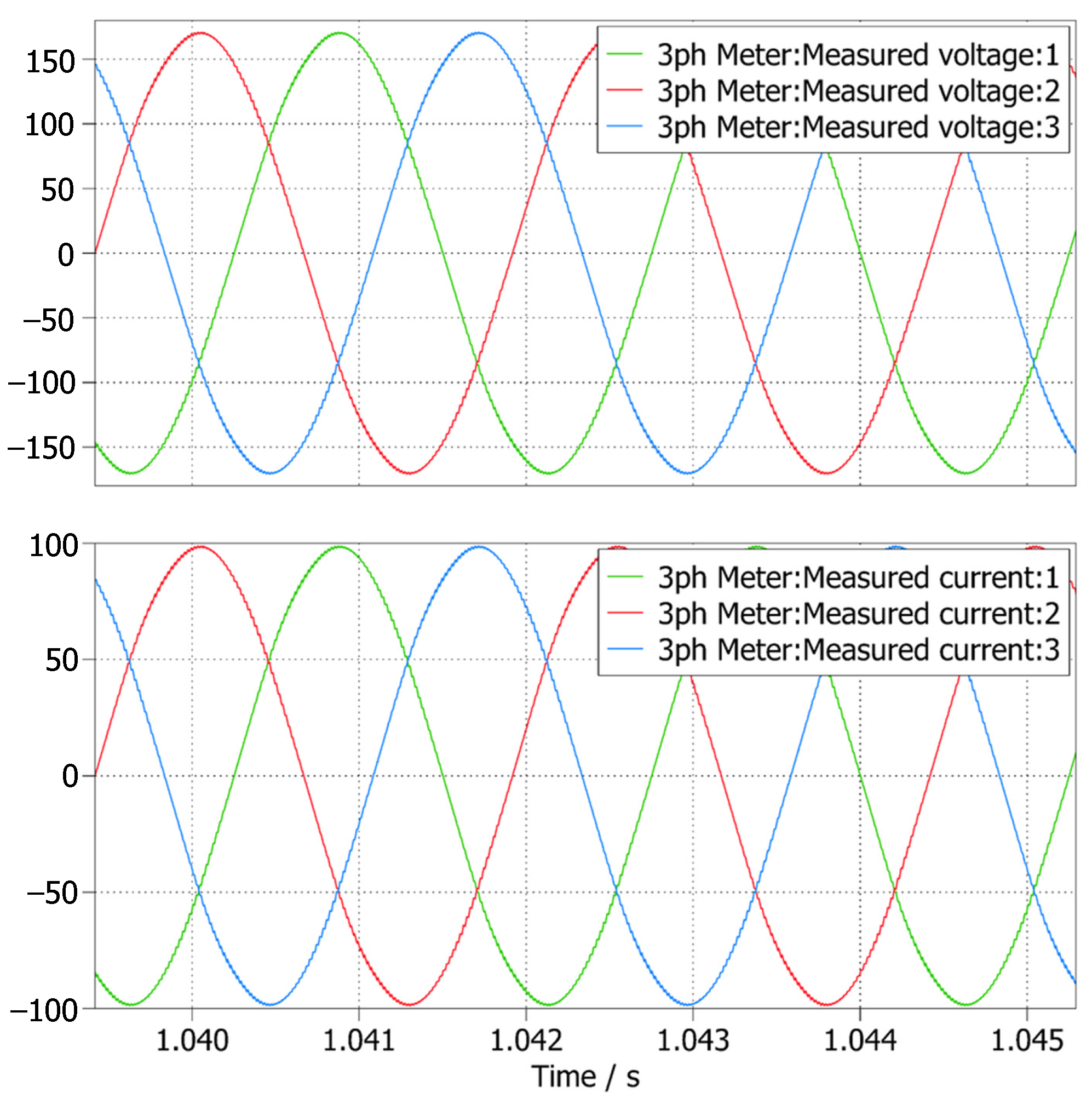
) under rated load. The corresponding phase voltage and current waveforms are shown in
Figure 14, clearly indicating the near-unity displacement factor.
3.3. Hardware-in-the-Loop (HIL) Setup
To evaluate the practical behavior of the proposed interleaved synchronous Super-Lift Luo converter based inverter, a hardware-in-the-loop (HIL) implementation was carried out using the Typhoon HIL real-time platform, as shown in
Figure 15. The complete power conversion structure, including the four-channel interleaved DC–DC stage and the three-phase inverter, was modeled within the HIL environment. This setup enables the interaction between the DC–DC and DC–AC stages to be viewed in a controlled and reliable experimental setup under dynamically changing operating conditions. This is particularly beneficial in power electronics systems where full-scale laboratory testing may pose safety hazards or infrastructure constraints.
All control algorithms were implemented in the Typhoon HIL Control Center and executed in real time. The PWM generation, interleaving logic, and voltage-current feedback loops were evaluated using a fixed simulation step of 1 , which provided consistent timing throughout the control execution. The DC–DC converter switching frequency was set to 20 kHz for each interleaved channel, with appropriate carrier phase displacement applied between channels to reduce input current ripple and distribute thermal stress. The three-phase inverter was operated with sinusoidal PWM at a switching frequency of 50 kHz and an output fundamental frequency of 400 Hz. Voltage and current regulation were performed utilizing PI controllers in accordance with the previously described analytical design.
The HIL setup was primarily used to examine whether the stability, transient response, and ripple behavior observed in conventional time-domain simulations are preserved when the system is operated under real-time constraints. In addition, power-quality indicators such as voltage regulation, harmonic distortion, and power factor were evaluated in real-time operation. Moreover, transient events and parameter variations could be investigated without the risk associated with physical hardware testing. A direct comparison between simulation results and HIL measurements provides confidence in the practical applicability of the proposed converter topology and control strategy for aerospace power system applications. Full-power experimental implementation is considered a logical continuation of this work.
3.3.1. HIL Validation
Figure 16 shows the inductor current waveforms (
–
) of the four interleaved Super-Lift Luo converter channels together with the regulated DC output voltage obtained from the HIL study. A
phase shift between adjacent channels ensures an even current distribution among the four stages during operation. Although the peak-to-peak ripple of each inductor current is approximately
, the combined ripple observed at the DC bus remains below
due to the ripple-cancellation effect inherent to the interleaved topology. This balanced current sharing not only reduces input ripple but also promotes improved thermal distribution and overall electromagnetic compatibility of the converter.
The lower part of
Figure 16 shows the DC bus voltage waveform obtained from the HIL study. The output voltage stays close to
, with a ripple level below
of the nominal value. This result is in good agreement with the simulation outcomes. The observed voltage stability indicates compliance with the steady-state and transient limits defined by MIL-STD-704F, while confirming that the PI-based voltage controller provides effective voltage regulation.
3.3.2. DC–AC Stage Performance and Control Verification
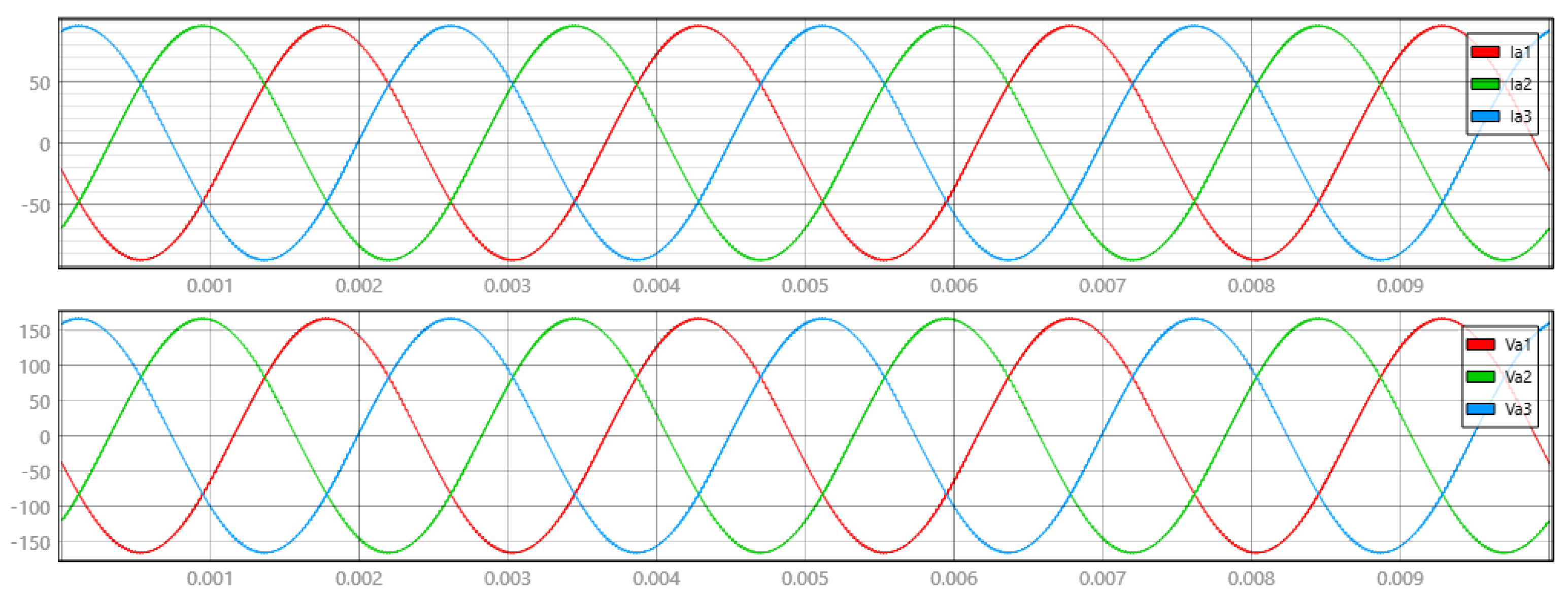
The three-phase inverter is supplied by the regulated DC bus generated by the interleaved SLLC stage and is controlled using sinusoidal PWM with complementary gating and dead-time protection. The HIL results shown in
Figure 17 indicate balanced three-phase currents and phase-to-neutral voltages. The fundamental output frequency is approximately
, remaining within the
tolerance specified by MIL-STD-704F. The measured phase voltage peak is
, corresponding to a phase RMS value of
, which results in a line-to-line RMS voltage of
.
The phase currents have similar magnitudes and are separated by , with no noticeable shift with respect to the corresponding phase voltages. No DC offset or phase asymmetry can be identified in the measured current waveforms. The distortion level is low, which is in line with the harmonic analysis results, where the total harmonic distortion remains well below the limit. During real-time operation, the inverter maintains balanced phase behavior with stable voltage regulation.
3.3.3. Power Quality and Power Factor (HIL Results)
The power quality of the real-time inverter output was assessed by analyzing the phase-
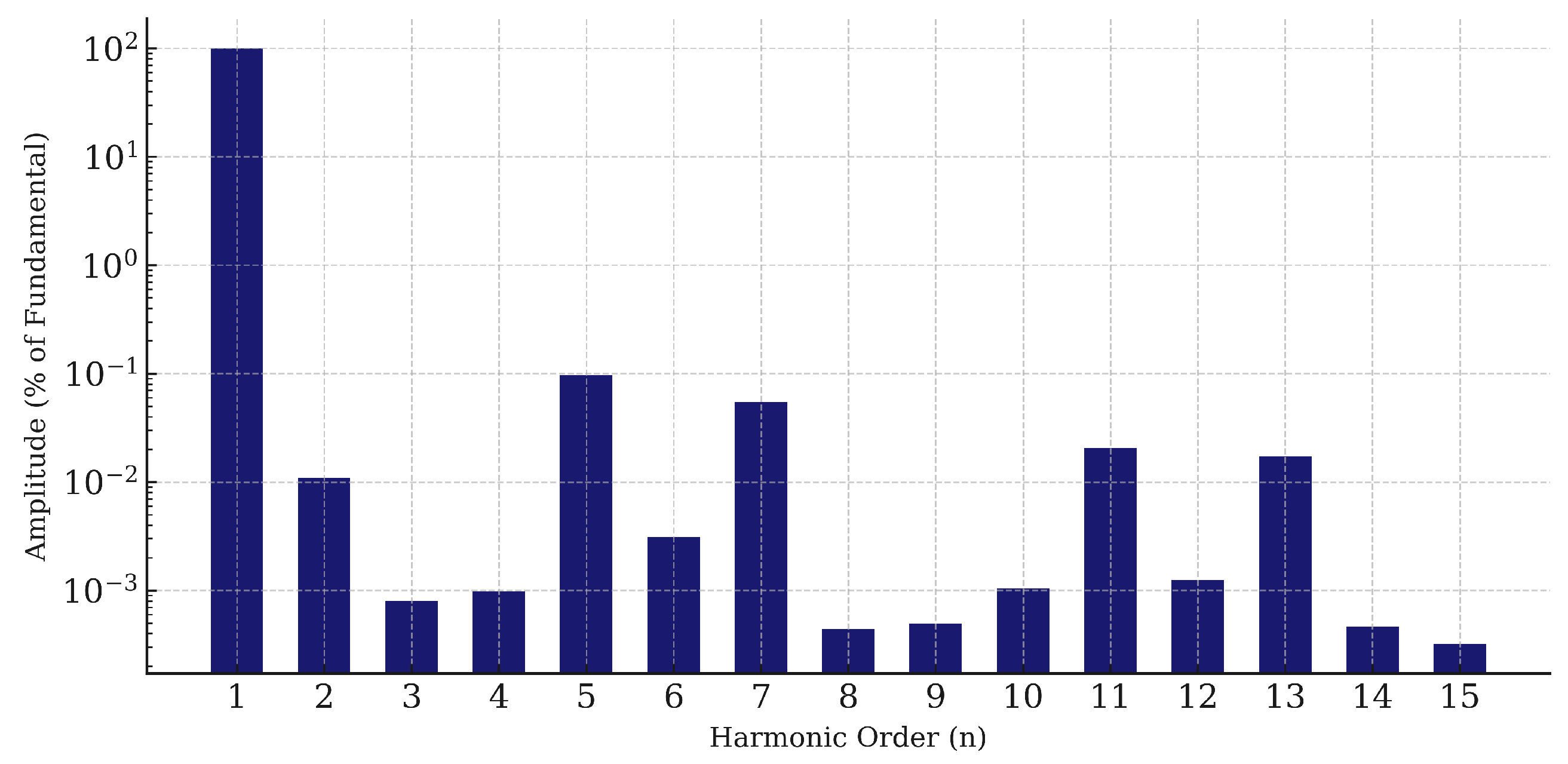
A voltage waveform in the frequency domain. The harmonic spectrum is presented in
Figure 18, plotted on a logarithmic scale to clearly show the very low amplitude of higher-order components. The fundamental frequency appears at
with an amplitude of
(
). All harmonic components above the fundamental remain well below
of the main component amplitude. The third, fifth, and seventh harmonics are each under
, resulting in a total harmonic distortion of
Such an extremely low THD demonstrates that the inverter produces a highly sinusoidal output voltage, fully complying with the
criterion specified in MIL-STD-704F. The nearly zero phase displacement between voltage and current waveforms yields an overall power factor of approximately
Hence, the inverter delivers almost purely active power to the load, confirming the effectiveness of the control strategy in real-time operation. The close numerical agreement between the simulation and HIL results (PF and THD differences below ) validates the accuracy of the real-time implementation.
3.4. HIL Overall Summary
The HIL validation comprehensively confirms the accuracy and real-time feasibility of the proposed ISSLLC based inverter system. The DC–DC stage achieved a regulated output of with an output current ripple below , demonstrating the effective current sharing and ripple cancellation of the four-channel interleaved topology. The subsequent DC–AC inverter stage produced balanced three-phase voltages at with RMS values of approximately per phase and perfectly sinusoidal waveforms.
The FFT analysis of the HIL-measured output voltage (
Figure 18) indicates a fundamental component of 165.8 V and a total harmonic distortion of 0.77%, which is well below the 5% limit specified in MIL-STD-704F. The inverter also operated with a displacement factor close to unity (
) and a total power factor of approximately 0.999, supplying almost all the active power to the load. Both the dynamic and steady-state responses were consistent with the results obtained from the PLECS offline model, with deviations in voltage amplitude, THD, power factor, and frequency remaining under 0.2%.
To place the proposed approach in context, its performance can be qualitatively compared with representative baseline converter solutions commonly used in aerospace and high-frequency power systems, such as conventional boost-based, transformer-isolated, and multilevel inverter topologies. Compared to classical boost converters, the proposed interleaved synchronous SLLC structure achieves higher voltage gain with reduced DC-link ripple, which directly benefits inverter stability and harmonic performance. In contrast to transformer-isolated solutions, the proposed topology eliminates magnetic isolation stages, leading to reduced weight and volume while maintaining compliance with 400 Hz aerospace power requirements. Furthermore, the interleaved architecture contributes to improved transient response and current sharing, enabling high efficiency and low harmonic distortion. These findings are further supported by the HIL results, which validate that the proposed converter and control strategy satisfy the demanding power-quality requirements of 115 V, 400 Hz aircraft electrical systems, confirming their suitability for real-time embedded aerospace applications and compliance with MIL-STD-704F.
4. Conclusions
This study investigated the design, modeling, and real-time validation of a 24 kVA three-phase inverter based on an interleaved synchronous Super-Lift Luo converter for aircraft 115 V, 400 Hz power systems. The presented structure combines the high voltage gain of the Super-Lift Luo converter with the current-sharing and ripple-reduction characteristics of interleaving. The use of synchronous rectification contributes to reduced conduction losses and improved efficiency.
The interleaved DC–DC stage distributes power among four channels, reducing current stress and supporting stable DC-link regulation from a 28 V input to approximately 400 V. The cascaded PI control structure enables consistent voltage regulation under steady-state and transient conditions.
Hardware-in-the-Loop testing showed close agreement with the PLECS simulations. The inverter achieved a regulated three-phase output of 115 V, 400 Hz with a total harmonic distortion of only 0.77% and a power factor of 0.999, indicating almost purely active power delivery. The close agreement between PLECS and HIL results (less than 0.2% deviation) validates both the converter model and the control implementation in real time.
The results indicate that the proposed ISSLLC-based inverter meets the steady-state and transient power-quality requirements defined by MIL-STD-704F for aircraft electrical systems. The topology provides a promising solution for next-generation more-electric aircraft, and its modular structure allows adaptation to other high-gain, high-efficiency applications such as renewable energy interfaces and electric propulsion systems.
Although the experimental cases presented in this study are in the kVA power range, the proposed interleaved synchronous Super-Lift Luo converter based inverter is conceptually scalable to higher power levels. The interleaved architecture facilitates current sharing and thermal balancing, which are essential for high-power operation. Nevertheless, scaling to significantly higher power ratings would require advanced semiconductor devices, reinforced thermal management, and modular system design, which are considered to be future research directions.