1. Introduction
Operational developments in aviation sometimes suffer from the strict, multi-criteria objectives of international organizations such as the Single European Sky (SES) initiative launched in 1999 and associated research institutions such as the SES Air Traffic Management Research (SESAR) group. As laid down in Article 100(2) of the Treaty on the Functioning of the European Union, new developments in the aviation sector must not only increase safety and cost efficiency but also reduce the environmental impact by at least 10%. To achieve this, the environmental impact of both individual flights and the entire air transport system must first be quantified and monitored. Contrails, caused by the emission of water vapor and condensation nuclei in an ice-supersaturated and cold atmosphere [
1,
2] play a particularly volatile role in these endeavors. Their formation, lifetime, and effects on the Earth’s energy budget depend on numerous factors [
1,
2]. Predicting, monitoring, and post-analyzing them has posed particular challenges for scientists for decades [
3].
Scaling represents a major challenge. From a global perspective, contrails are often regarded as infinitely extended cloud cover, and their radiative impact is assessed globally accordingly [
4] or in the spatial and temporal resolution of geostationary satellites [
5]. Both do not allow detailed operational findings for the optimization of individual flights. On the other hand, when the lifetime and optical characteristics of contrails are evaluated on a single-flight basis, the effects of co-existing contrails on their lifetime and radiative properties are not taken into account [
6]. However, when we observe the sky, we often see numerous overlapping contrails without them forming a homogeneous cloud cover.
In this paper, a physical model for calculating the microphysical properties of individual contrails along the life cycle [
7] is extended to calculate the impact of co-existing contrails on their lifetimes. Therefore, the most important input variables for the optical properties of co-existing contrails can be provided.
2. State of the Art
Numerous studies focusing on measuring or tracking contrails from the ground or space give valuable insides in contrail microphysics and lifetime but do not distinguish between single or multiple co-existing contrails [
8,
9,
10,
11,
12,
13]. Thereby, various methods are employed to analyze the contrail life cycle utilizing satellite observations, a method becoming applicable only once the contrail reaches full development, entering the dissipation regime [
8,
9,
12,
14], because satellite observation validity is contingent on the contrail manifesting as a line-shaped artificial cirrus cloud in the atmosphere, particularly when detected automatically [
10,
11,
12]. Wang et al. [
15] delved further into the microphysical properties of satellite-observed contrails. Their examination of an effective radius, particle number density, and optical thickness between contrails, contrail cirrus, and natural cirrus, based on in situ measurements, revealed smaller particle radii in contrails than in natural cirrus. However, a distinction between the properties of single and grouped contrails has not been made. Geraedts et al. [
16] developed an automated detection and matching system that uses satellite data to determine whether individual flights have produced persistent contrails, aiming to improve contrail prediction methods, while Wang [
17] focuses on aircraft contrail detection in global satellite images using semantic segmentation based on the Unified Perceptual Parsing for Scene Understanding (UPerNet) architecture. The approach utilizes two ConvNeXt (a Convolutional Network) configurations to improve performance and a cross-entropy loss with positive-class weights to enhance contrail recognition.
Another assessment technique involves microphysical models, e.g., Contrail Cirrus Prediction Tool (COCiP) describing the individual contrail life cycle as a Lagrangian Gaussian plume [
18]. This model characterizes averaged particle properties of individual contrails, neglecting interaction with the atmosphere [
18], despite detailed observations on contrail lifetime and optical properties published by Schumann and Heymsfield in 2007 [
19]. The contrail lifetime is therefore strongly parameterized in COCiP. Cantin et al. [
20] demonstrate the feasibility of coupling Eulerian–Lagrangian Comuptational Fluid Daynamics (CFD) with ice microphysics to predict near-field contrail formation. The study focuses on the initial stages of single contrail development, emphasizing the dynamics of trailing wake vortices and their influence on microphysical processes. Pauen et al. [
21] investigate the initial stage of the contrail life cycle. The research employs high-fidelity CFD simulations to analyze the impact of various parameters, such as relative humidity and thermal stratification, on contrail evolution. Unfortunately, the method is not described comprehensively. Finally, Ramsay et al. [
22] integrates a contrail microphysics model within Reynolds-Averaged Navier–Stokes (RANS) simulations to assess the environmental impact of aircraft design on contrail formation. The study examines how different aircraft configurations influence ice crystal formation, growth, and dynamics within contrails. Unfortunately, all these studies focus on the early evolution of single very young contrails and do not consider the entire contrail’s lifetime or contrails, which may be embedded in artificial or natural cloud cover. While not primarily intended for modeling individual contrail life cycles, a few in situ [
23] and remote sensing measurements [
24] of contrails are valuable for approximating typical lifetimes and can aid in model validation. A research aircraft equipped with cloud microphysics probes and remote sensing instruments was flown in an ice-supersaturated region to gather such data. Sampling contrails aged between 7 and 30 min, this approach considered the critical timeframe for optimal ice particle observation, extending to the point where typical mid-latitude contrails are no longer present. The contrail life cycle, identified through in-flight Lidar measurements, was later modeled and compared with the UK Met Office NAME III climate model [
25]. While these measurements offer valuable insights and could be applied to single and multiple co-existing contrails, the logistical challenges restrict their ability to comprehensively cover all atmospheric conditions influencing contrail lifetime over the long term.
Another promising method of investigating contrail life cycles is measurements of artificially generated contrails in cloud chambers, such as the Aerosol Interaction and Dynamics in the Atmosphere (AIDA) chamber, which simulates atmospheric processes by modifying aerosols physically and chemically. The accuracy of ice-nucleation control in AIDA is already validated through measurements of homogeneous freezing at approximately −34 °C [
26]. Extending the measurement environment to temperatures around −56 °C would provide ideal conditions for contrails and deliver promising results.
Predicting the occurrence and persistence of contrails remains a challenge due to the strong sensitivity to small-scale atmospheric conditions. While empirical and physics-based models can capture formation probability reasonably well under idealized conditions, their skill in forecasting long-lived contrails in operational settings is limited by uncertainties in humidity and temperature fields [
18,
27]. Beyond simple contrail avoidance, modest adjustments in flight altitude have been shown to significantly reduce contrail climate forcing when suitable ice-supersaturated regions are avoided, although this may conflict with fuel optimality [
28]. Persistent contrails are strongly dependent on meteorological situations characterized by low temperatures and high ice supersaturation, often associated with upper-tropospheric fronts and cirrus regimes [
29]. Conditions such as increased relative humidity with respect to ice and weak vertical wind shear are particularly conducive to contrail persistence [
30]. Preliminary conceptual studies on hydrogen aircraft design suggest that zero persistent contrails may be achievable through reduced water vapor emissions and optimized plume dynamics, although this remains sensitive to cruise altitude and ambient humidity [
31]. The use of sustainable aviation fuels has been shown to alter soot emissions, thereby affecting contrail formation thresholds and microphysical properties, potentially reducing contrail occurrence and radiative forcing [
32]. Innovative aircraft configurations, such as box-wing designs, may alter wake structure and emissions distribution, with implications for contrail coverage and climate impact that are still under investigation [
33]. Hybrid-electric propulsion concepts are also expected to influence contrail coverage through changes in emission indices and flight patterns, though quantitative assessments remain scarce [
34]. Recent advances in linear temperature response modeling provide a framework for characterizing the full climate impact of individual flights, integrating CO
2 and non-CO
2 effects in a consistent manner [
35]. Finally, progress in contrail observation and tracking using geostationary satellite data combined with air traffic trajectories has enabled the improved validation of contrail predictions and a better understanding of contrail evolution in real airspace [
36].
This literature review highlights the challenges associated with determining contrail lifetime and its microphysical properties, which depend on numerous highly variable and non-continuous atmospheric factors. Consequently, many studies are constrained to establishing averaged or typical lifetimes for either individual contrails or infinitely extended contrail cover. Conversely, global observations offer the advantage of tracking the entire evolution of contrails and the non-linear shape of aviation-induced cloudiness. In response to this challenge, our approach focuses on achieving the most precise determination of the atmospheric state and subsequently calculating the lifetime of co-existing contrails based solely on physical laws.
4. Microphysical Modeling of Overlapping Contrails
4.1. Assumptions and Case-by-Case Analysis of Embedded Contrails
The approach described in
Section 3 is extended to analyze two contrails that intersect during their lifetime. To account for this interaction, the model is parallelized. The source code developed for this study is openly available at
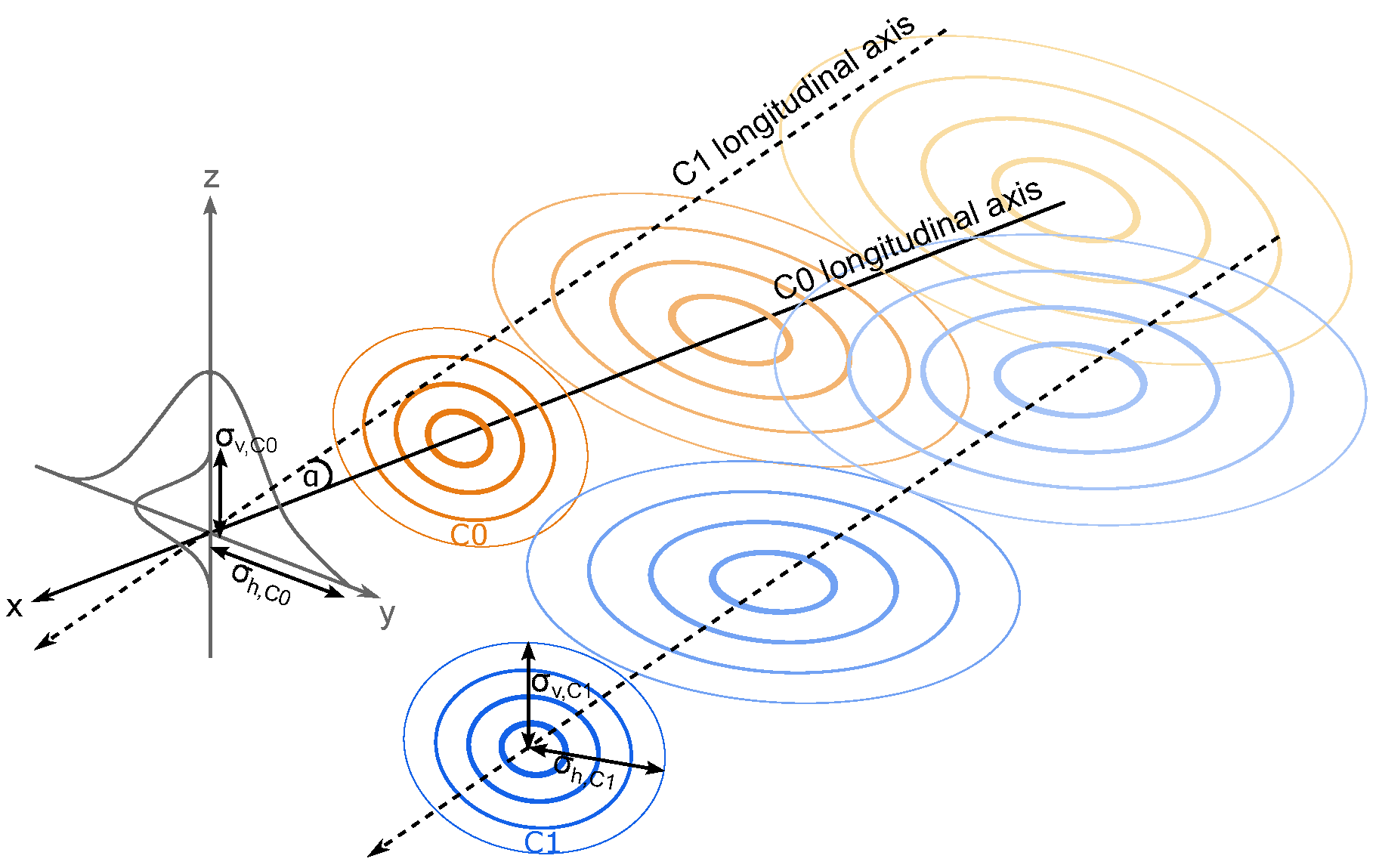
https://github.com/jro-github/intersected_contrails/tree/main (accessed on 1 November 2025), licensed under Apache-2.0. At each time step, overlapping volumes, defined as the intersection of the regions bounded by the contrail centerline and their respective horizontal and vertical standard deviations,
and
are identified. If an intersection occurs, the angle
between contrail segments
and
is determined. Since the modeling framework is independent of contrail orientation,
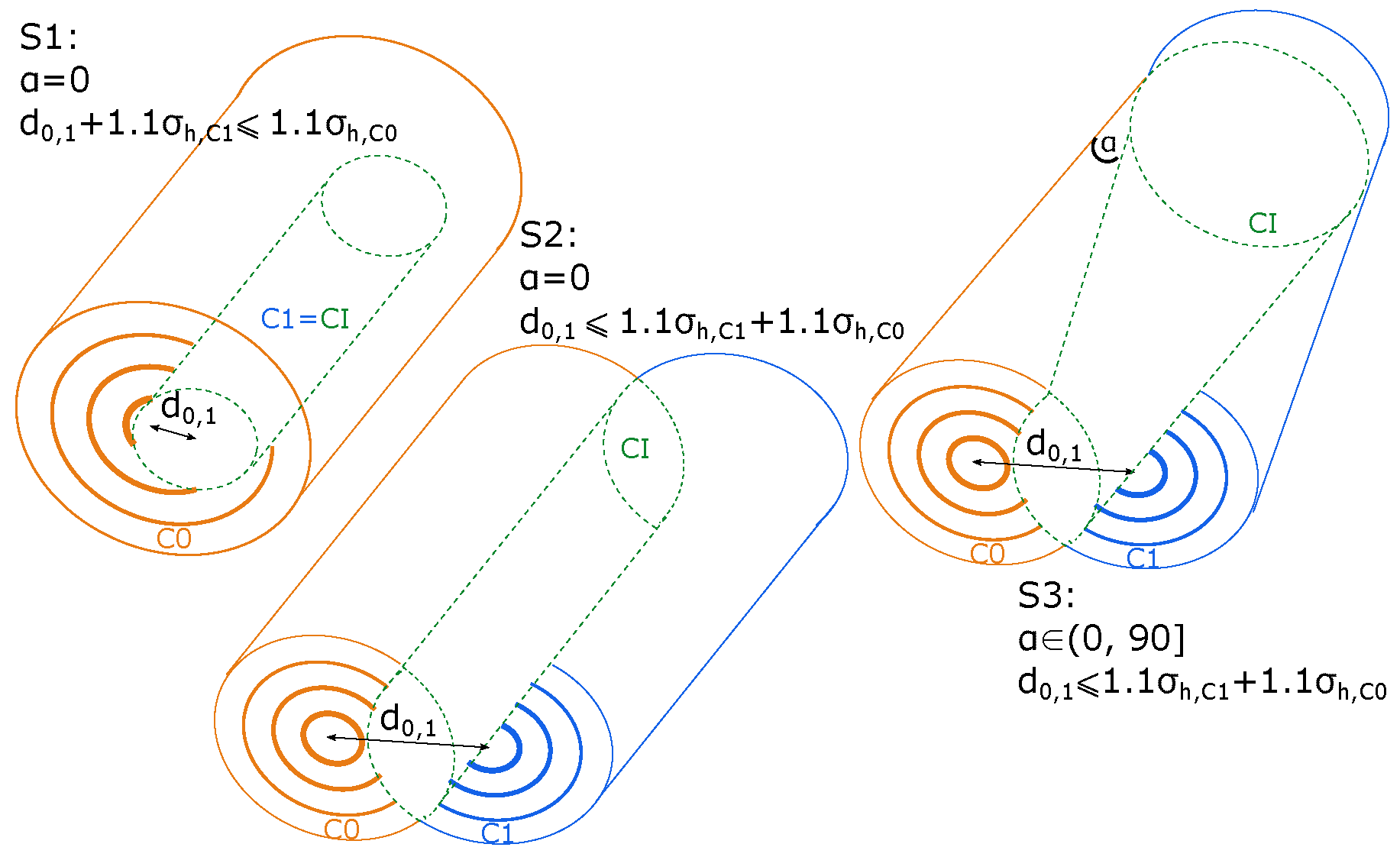
is constrained to a range of 0 to 90 degrees. The non-overlapping sections of both contrails remain distinct, while the overlapping zone is treated as a separate contrail segment without any outer surface, denoted as
, with its own microphysical properties and lifetime (see
Figure 2).
Three scenarios based on the initial angle
and the initial distance between the centers of the two contrails
are differentiated (see
Figure 2). Note that contrails will switch between scenarios during their lifetime, for example, when they separate or converge. The model distinguishes between scenarios because contrail formation and evolution are highly non-linear: small differences in initial conditions can lead to substantially different lifetimes and optical properties. By grouping initial conditions into a few representative scenarios, the complexity of the simulation is reduced and the focus lays on the most relevant dynamics. This approach also improves the interpretability, allowing a clear comparison of the contrail behavior across different cases.
S1: The components and are positioned in a parallel configuration, where is entirely embedded in . Initially, the model calculated the lifetime of and , resulting in and satisfying the condition . Since only the vertical or horizontal extent in one direction from the center point is relevant here, the standard deviation is therefore multiplied by the factor 1.1.
S2: The components and are overlapped in a parallel configuration, where is partially enclosed by . The interaction zone is treated as a separate contrail segment from the beginning on. and .
S3: The components and are overlapped in a non-parallel configuration. Consequently, the model must account for all three components, , , and . The defining conditions in this case are and .
Case S1 represents a scenario of two consecutively flying aircraft. Due to their local offset, contrails of different sizes but with very similar positions and longitudinal-axis orientations converge within the ice-supersaturated region.
Although case S2 () is formally a special case of S3 (), it is treated as a distinct scenario. This distinction is justified by its frequent occurrence in operational environments, which is primarily attributed to the structured airway system and commonly applied lateral offsets.
Case S3 represents the most general case, offering a flexible framework that can be adapted to accommodate any possible configuration of contrails.
4.2. Geometry of Overlapping Contrails
The distance
between two contrail cores is determined using the Haversine formula [
50].
where
R = 6,371,000 m is the Earth radius and
denotes the angular distance
where
,
,
, and
[rad] denote latitude, difference in latitude, longitude, and difference in longitude of the contrail cores
and
.
In the case of an interaction of contrails, the following findings are made:
Once the contrails overlap, they may separate again. Despite being subject to the same wind conditions, variations in particle sedimentation speed can occur due to differences in ice particle diameters.
Initially, the ice water content () within the interaction zone is relatively high, as it corresponds to the combined ice water content of the individual contrails and , weighted by their overlap volume .
The overlap volume increases with time due to the symmetric growth around the center of both contrails.
Given the initially high , a further strong increase in is unlikely due to the growth of embedded within and . can only draw from and and lacks contact with the surrounding ice-supersaturated atmosphere. Instead, it is more likely that decreases over time.
The analysis of overlapping contrails is based on a continuum and statistical representation of contrails, in which ice particles are not treated individually but as a spatially distributed number density field [
51]. Each contrail is assumed to exhibit a Gaussian particle distribution, reflecting the combined effects of turbulent diffusion and large-scale mixing without resolving microphysical processes. Under this assumption, the total number of particles contained in any subvolume of the contrail scales proportionally with the volume fraction of that region relative to the entire contrail [
19]. The overlap between two contrails is therefore described purely geometrically: the number of ice particles within the intersection volume is assumed to be proportional to the ratio of the intersection volume to the respective contrail volumes [
52]. Molecular diffusion, Brownian motion, particle–particle interactions, and sedimentation are neglected, as these processes act on much smaller spatial and temporal scales than those relevant for the considered contrail overlap and are implicitly represented by the Gaussian spread [
53]. Ice particle concentrations are treated analogously to a passive scalar, assuming that the particles do not significantly influence the flow or the mixing process. Furthermore, the analysis focuses on a quasi-static snapshot of the contrail interaction, such that the temporal evolution of the overlap region is of secondary importance. Finally, ice particles in both contrails are assumed to have comparable properties, allowing the overlap to be quantified in terms of particle number without introducing additional microphysical complexities [
54].
The overlap volume
depends on
and
. In S1,
where
s [m] represents the length of the contrail section, determined by the aircraft speed and a fixed time discretization of one second, and
is the area of intersection (Equation (
9)) of
covered by
.
In S2,
is assumed as an ellipse with the semi-major axis
and the semi-minor axis
Therefore,
can be calculated by
and the volume overlap
arises from
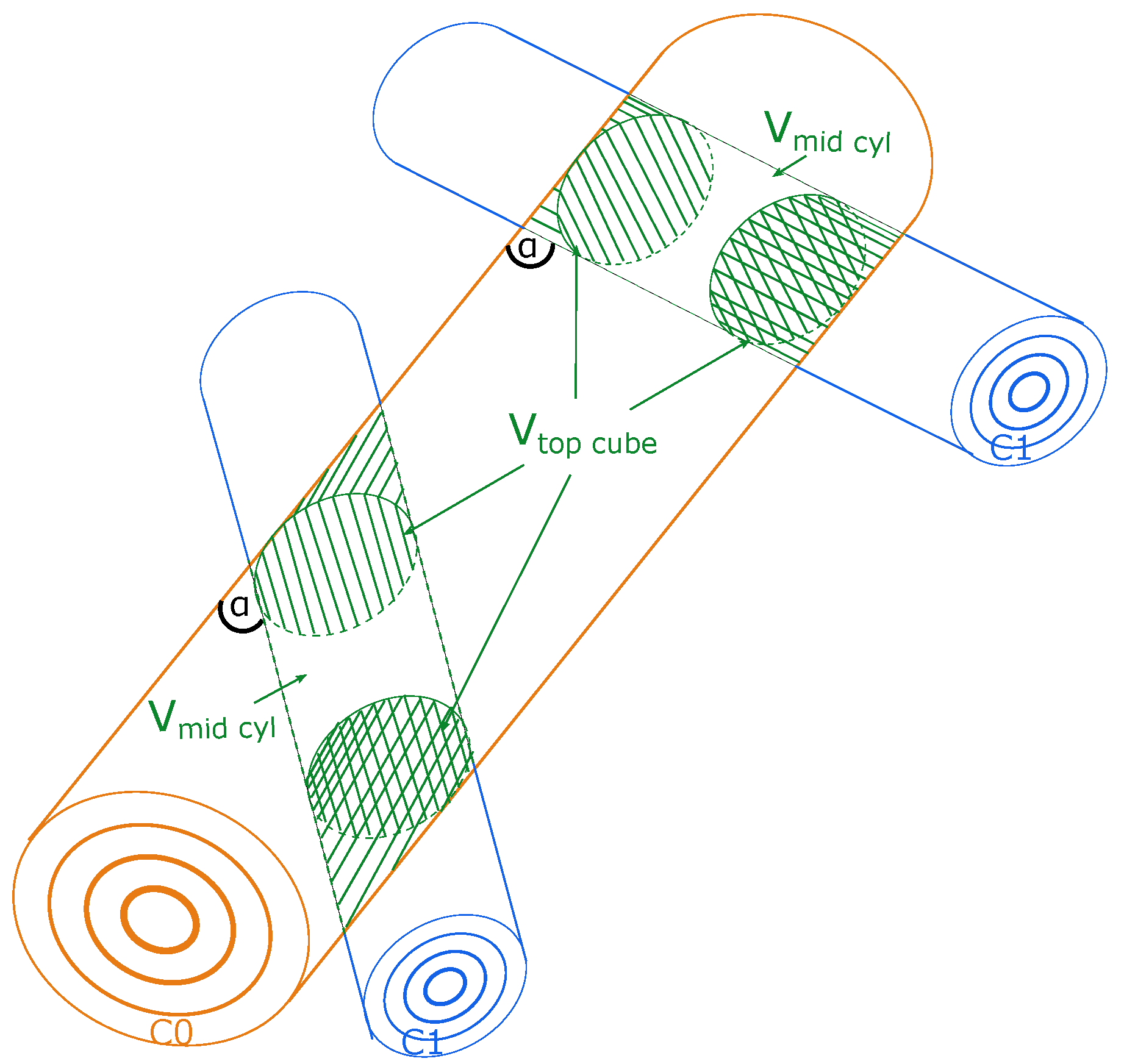
In S3 (contrails overlap with
), the volume overlap
is made up of three parts, two of which are identical: two edge parts
and one central part
(see
Figure 3).
is approximated as a cone with the height:
The cone volume
is considered as
The length of the middle cylinder
multiplied with the contrail cross-section
is the volume of the middle cylinder:
The total volume of the two contrails’ intersection is
The calculation of the overlapped cross-section
depends on the scenario. In S1,
equals
(Equation (
9)). In S2,
is calculated by Equation (
28). In S3 (
),
depends on intersection volume
and on intersection length
:
4.3. Microphysics of Embedded Contrails
For each time step,
is calculated as a function of
,
, and the amount of emitted water vapor (see Equation (
14)). For the initial time step of intersection,
is estimated as the sum of
and
which lies proportionally in the overlap in terms of volume.
In the case of S1 (
and
are in parallel and
is completely covered by
),
is determined by the sum of
, weighted by
compared to
and the water vapor emission of
:
For each additional time step, depends on the type of intersection case.
For scenario S1, a transfer of a fraction of the ice mass and ice particles from
to
, depending on the growth rate of
within
and the volume ratio between
and
, is assumed.
In the cases of S2 and S3 (
and
have different outside surfaces, and
does not have an outside surface),
is initially determined by the sum of
and
, weighted according to the respective contributions of each component within the volume of the intersection (Equation (
37)). Depending on the growth rate of
,
, and
(and the volume ratios between
,
, and
) part of the ice mass (and ice particles) of
and
is transferred to
:
As also increases here at the same time and the increase in is expected to be lower than in and , a decrease in over time is expected.
Simultaneously, the ice particle diameter in
(
) (Equation (
17)) is estimated as a function of the total ice mass in
(
) and of the proportionate number of ice particles
corresponding to
, compared to
and
. Note that
is crucial for the contrail lifetime since it determines the sedimentation speed
.
During their lifetime, the contrails undergo a transition between different geometric configurations (i.e., overlapping, partially overlapping, separated, changes in angle
) as they evolve over time. From this, it follows that the calculation basis can change between scenarios during the service life. Finally, for each time step, the geometric configuration (i.e.,
,
, or
) is determined and the sedimentation speed for
,
, and
(Equation (
18) as a function of particle size
and vertical wind
) is calculated. Subsequently, the lifetime conditions
or
are confirmed. Due to the expected slower growth rate of
, compared to
and
, a slightly lower sedimentation speed of
compared to
and
is expected.
If either or sublimates due to , will also sublimate. In this case, the impact of the intersection on the lifetime is likely small. Conversely, if or sublimates because , may persist longer than , , or both.
5. Simulation Setup
This study investigates the impact of intersecting contrails on their lifetime. To establish a reference scenario (see
Section 6.1), the lifetimes of two contrails,
and
, are calculated independently, using the model described in
Section 3. Subsequently, two overlapping contrails are simulated according to the initial scenarios
to
, and their life cycles with an influence on the lifetime are analyzed.
In each scenario, contrails behind two Airbus A320 aircraft are simulated. is always simulated at ° and ° in H = 10,500 m altitude.
A realistically modeled weather pattern by the Global Forecast System (GFS) from 16 February 2016, 12 p.m. is applied.
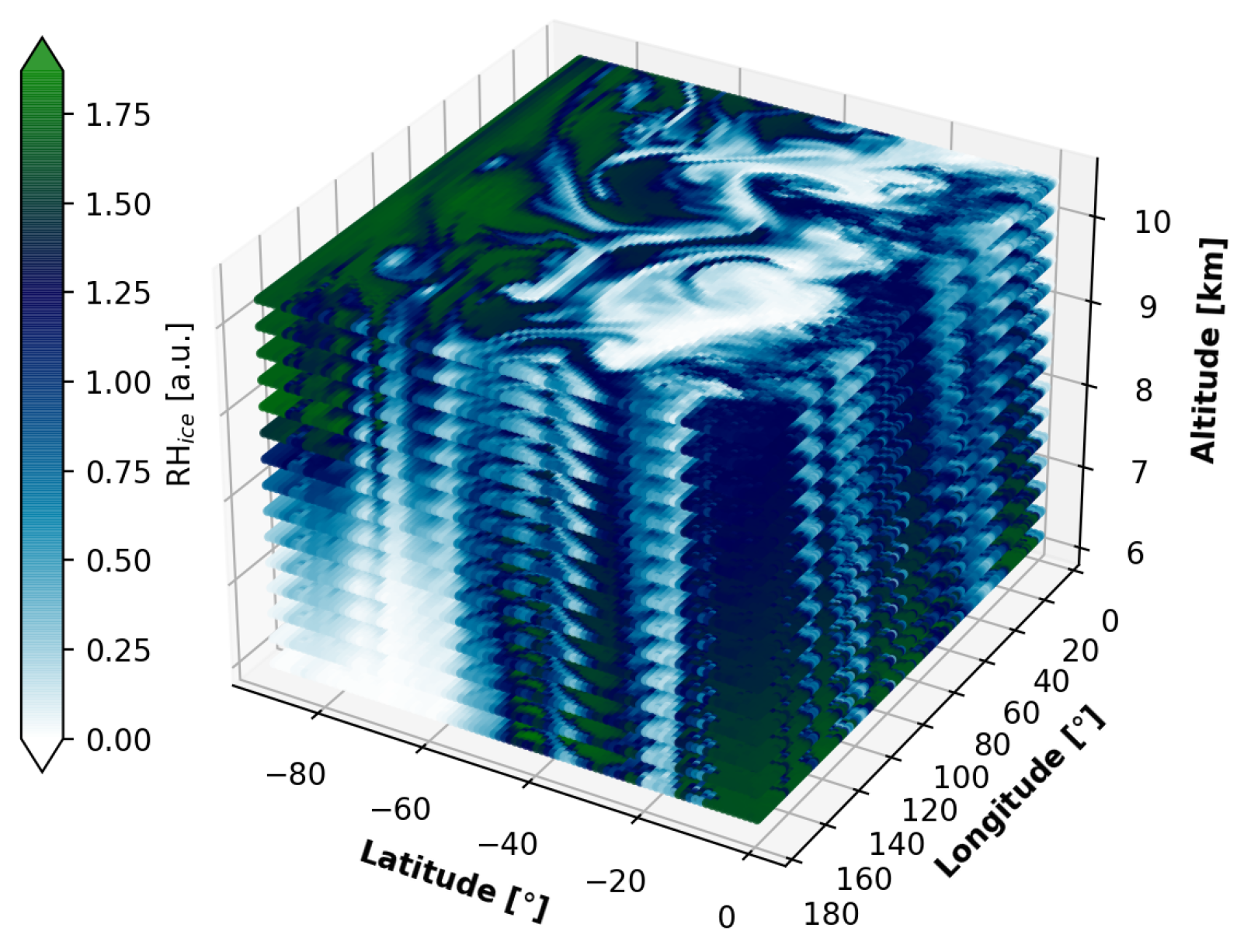
Figure 4 demonstrates the distribution of humidity in the area of investigation. Turbulence in this area (with an impact on the diffusivities
,
, and
) has been calculated assuming a lognormal distribution of turbulence in the lower troposphere and upper stratosphere and a linear correlation between a logarithmic diagnostic turbulence value [
55], such as the vertical velocity
w [Pa s
−1], provided by the GFS resulting in an eddy dissipation rate
m
2 s
−3.
5.1. Initialization of Scenario S1
For a contrail embedded within another contrail with the same longitudinal alignment, two aircraft must fly sequentially along the same track and at the same altitude. To account for a realistic longitudinal separation [
56],
is generated 15 min before
at the same altitude (
m) and with the same aircraft speed (220 m/s). Both contrails are formed at the study location (50° S, 150° E). Since the ice water content (
) is usually higher inside an existing contrail (here
) than in the surrounding atmosphere, the second contrail
develops under favorable conditions, and its ice crystals grow rapidly.
5.2. Initialization of Scenario 2
Two overlapping contrails sharing the same longitudinal axes could be generated behind two aircraft flying along the same track, with a lateral separation, at the same altitude and with the same aircraft speed (220 m/s).
is always formed at the study location 50° S, 150° E at
m. The model is run with different lateral separations between
NM and 130 NM. The minimum difference is in line with separation minima based on Air Traffic System (ATS) surveillance systems (using radar, Automatic Dependent Surveillance-Broadcast (ADS-B), or Multilateration (MLAT)) where the standard minimum separation prescribed by ICAO Doc 4444 of 5 NM may be reduced to 3 NM or
NM [
57]. To ensure an overlap, contrail
is generated at different time steps after
has been formed.
is always placed one horizontal standard deviation
east of the centre
. Different levels of overlap are achieved by initiating
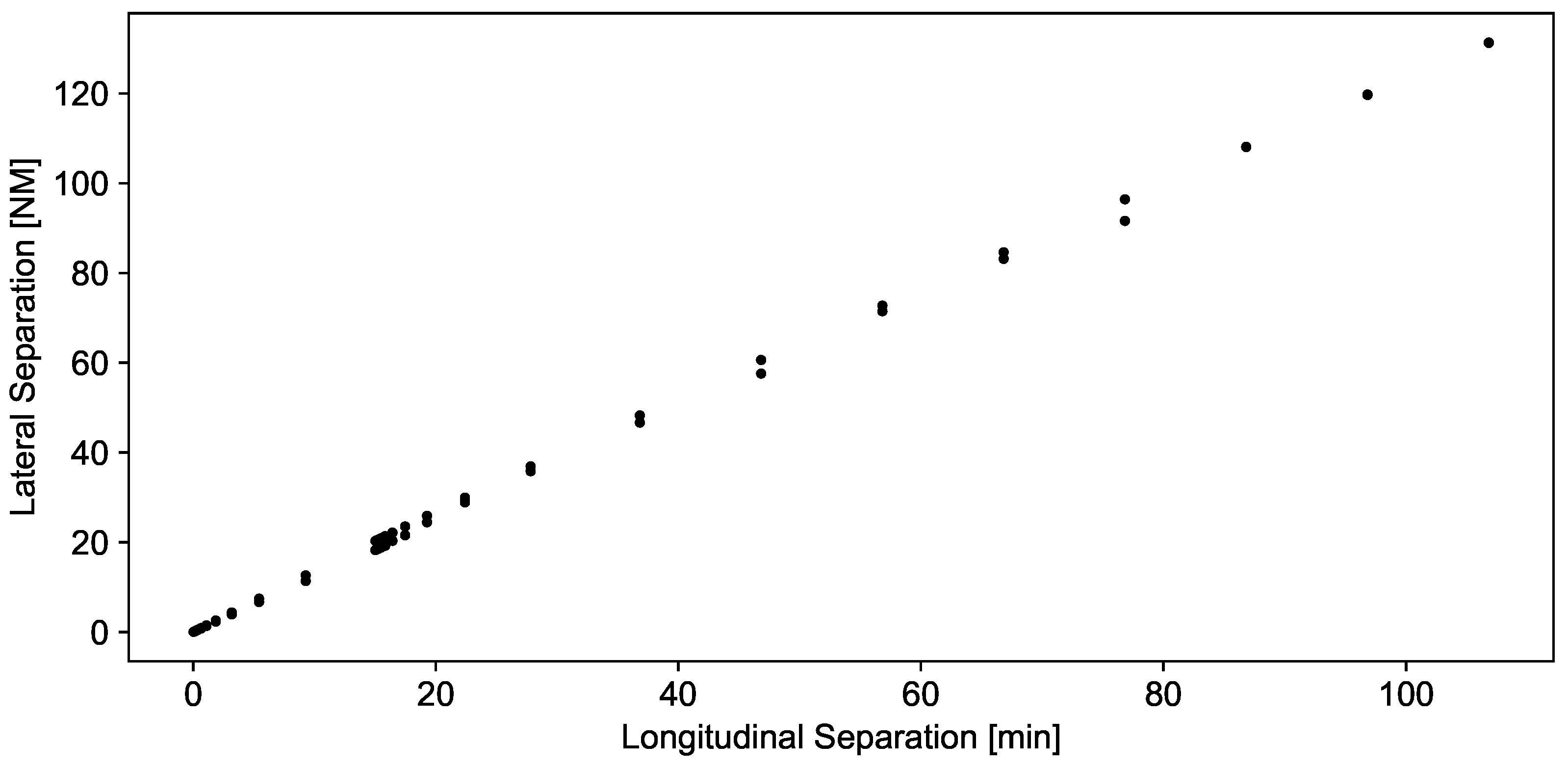
with different longitudinal separations, as contrails initially diffuse very quickly in the lateral direction. The longitudinal separation is varied between a few seconds and a little bit more than 100 min.
Figure 5 gives an overview of the initial longitudinal and lateral separation values used in this study.
5.3. Initialization of Scenario 3
In the third scenario, the intersection angle is varied: . The contrails and are formed at ( m) altitude with a speed of 220 m/s. is formed at the study location (50° S, 150° E), and is formed at 49.9868° S, 150.5253° E.
6. Results
6.1. S0: Contrail Microphysics and Lifetime Without Intersection
As a reference scenario , the lifetimes of two contrails and without intersection are modeled. To take into account the influence of the direction of flight (track), contrail is rotated by 45° in relation to (along the North–South axis)
Without intersection,
and
have similar lifetimes and live for
min and
min, corresponding to
h and
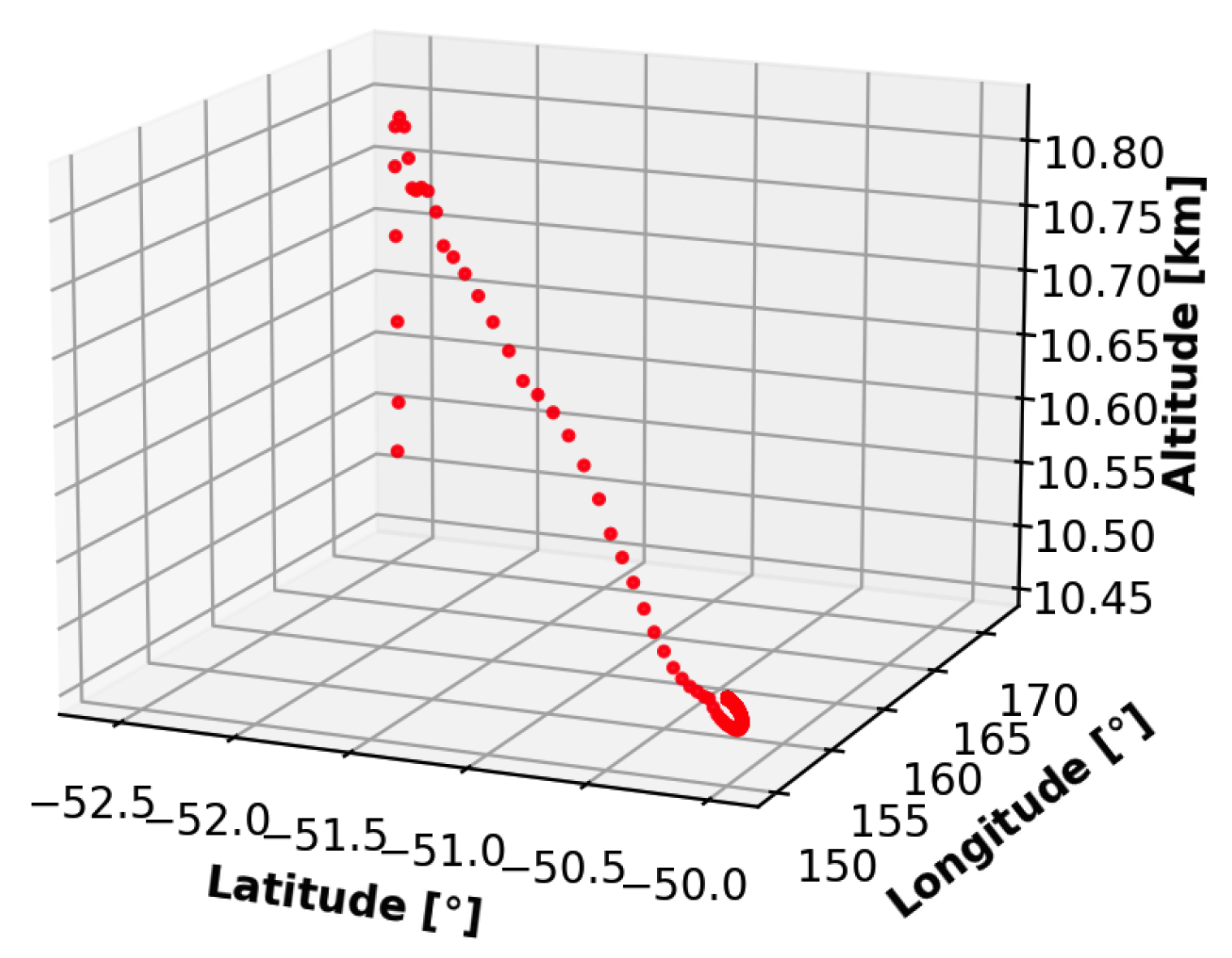
h, respectively. The differences in the lifetimes of the two contrails arise partly from the numerical and temporal resolution of the model and partly from slightly different atmospheric conditions resulting from the spatial rotation of C1 by 45°. Due to wind drift, both contrails are subject to lateral movement to the South–East (see
Figure 6).
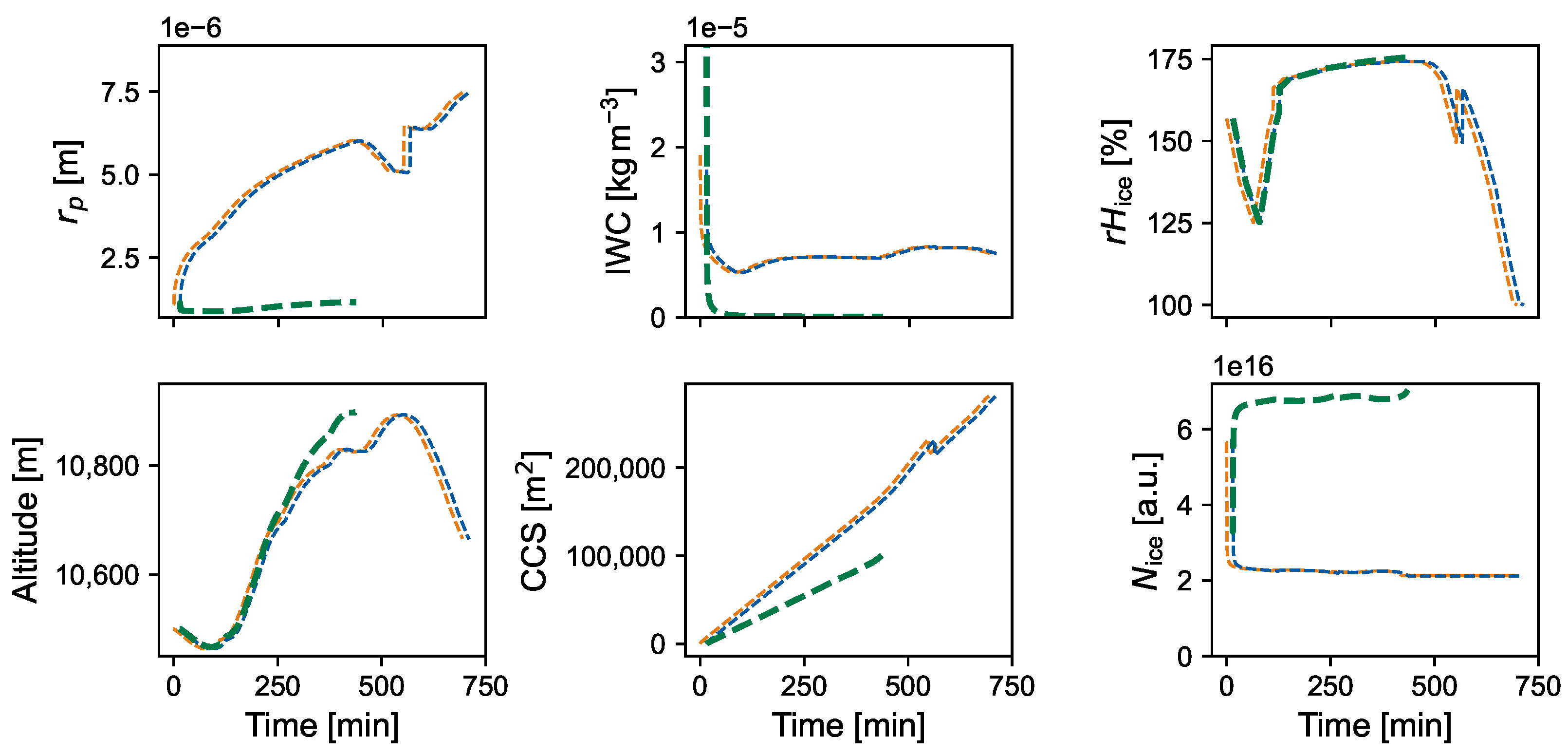
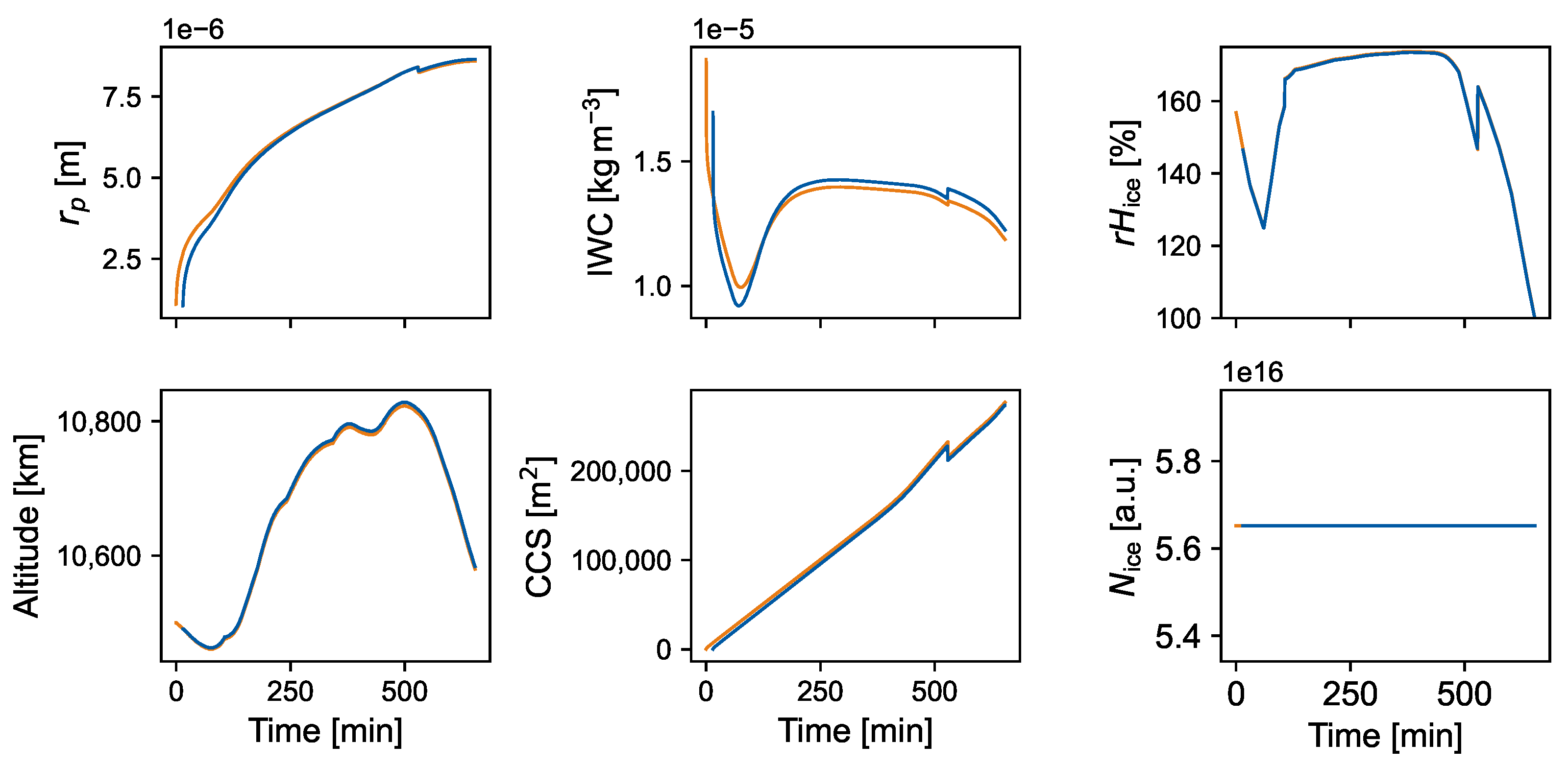
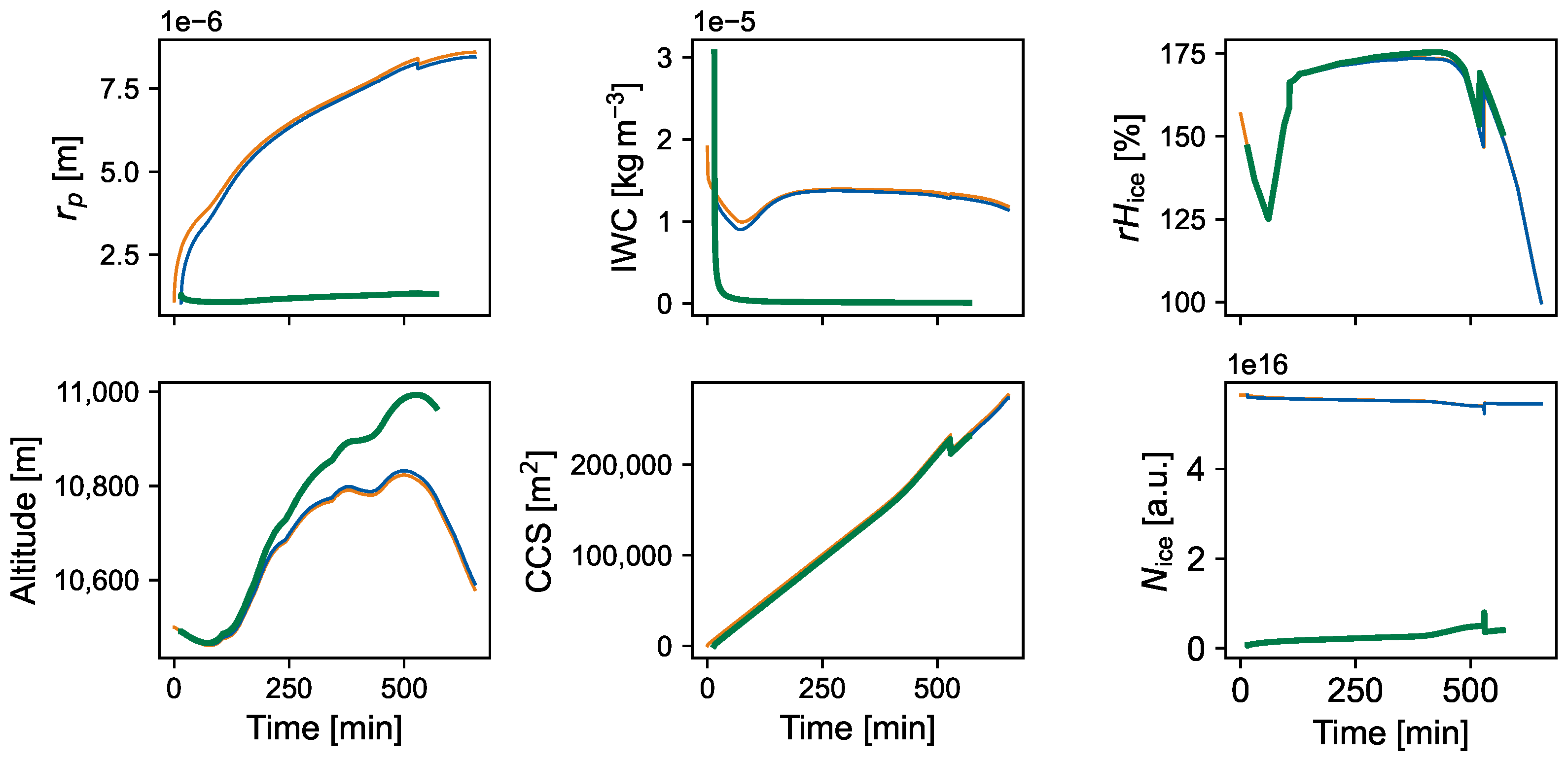
Both contrails die due to
(see
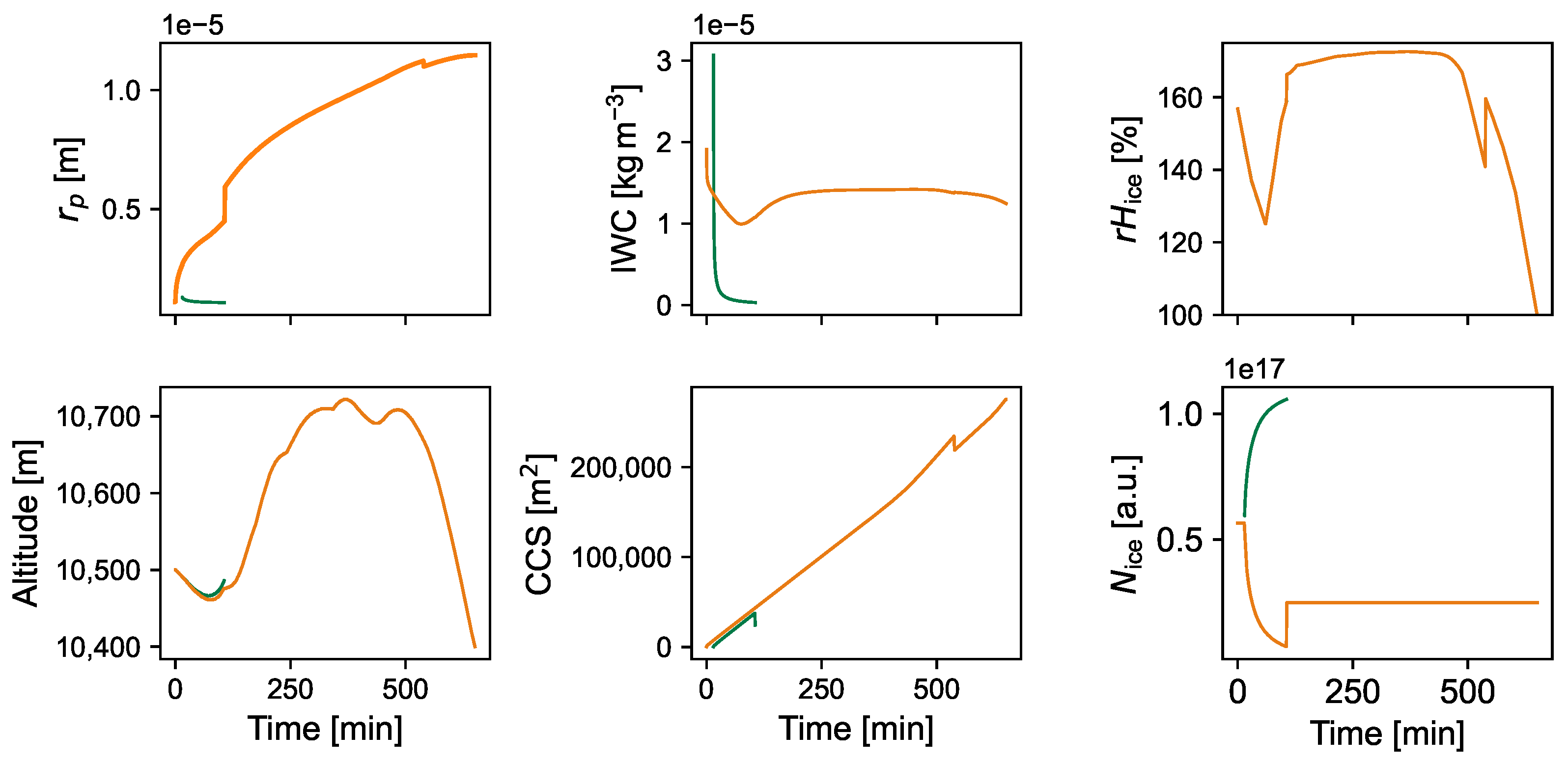
Figure 7 top right). Without intersection, the mean ice particle radius
grows from 1 μm to 7.9 μm (
Figure 7 top left). The initial sinking into less ice-saturated layers is due to a negative vertical wind and can be seen in
Figure 6. It causes a reduction in
and the associated
. Later, a vertical wind-induced upward movement and an increase in
and
can be seen before the ice crystals sink permanently from a radius of
μm and thus leave the ice-supersaturated layer (
Figure 7 bottom left and
Figure 6).
Figure 7 clearly shows that the contrail cross-section
is independent of
, as the growth of the contrail depends solely on the turbulent diffusivities (see Equation (
8)). Due to the absence of interaction between the two contrails in this reference scenario, the number of ice crystals remains constant.
The results also show that the microphysics and lifetime of the contrail are strongly dependent on external influences such as the degree of ice supersaturation, the vertical thickness of the ice-saturated layer, and the three-dimensional wind, and therefore cannot be standardized. The results of the reference scenario now allow a comparison of the microphysics and lifetimes of the contrails when they interact with each other by superposition under identical atmospheric conditions.
6.2. S1: Microphysics and Lifetime of an Embedded Contrail System
If one contrail is embedded in another contrail, as described in S1 in
Figure 2, the amount of
added to the inner contrail
during growth is limited because the intersection part only receives a proportionate amount of ice water and ice particles from the contrail
according to the overlapping volumes. However, as the volumes increase at the same time,
in the intersection part generally decreases, while the number of particles increases slightly. For this reason, the intersection part is likely to die very soon due to
kg m
−3. However, it is not only the added humidity that is decisive for the lifetime. If the contrails grow slowly (e.g., due to less turbulence in the atmosphere), the ice water content decreases less quickly. A long lifetime is expected if the (compact) contrails are kept in the ice-saturated layer by updrafts. The intersection part can then outlive the original contrails.
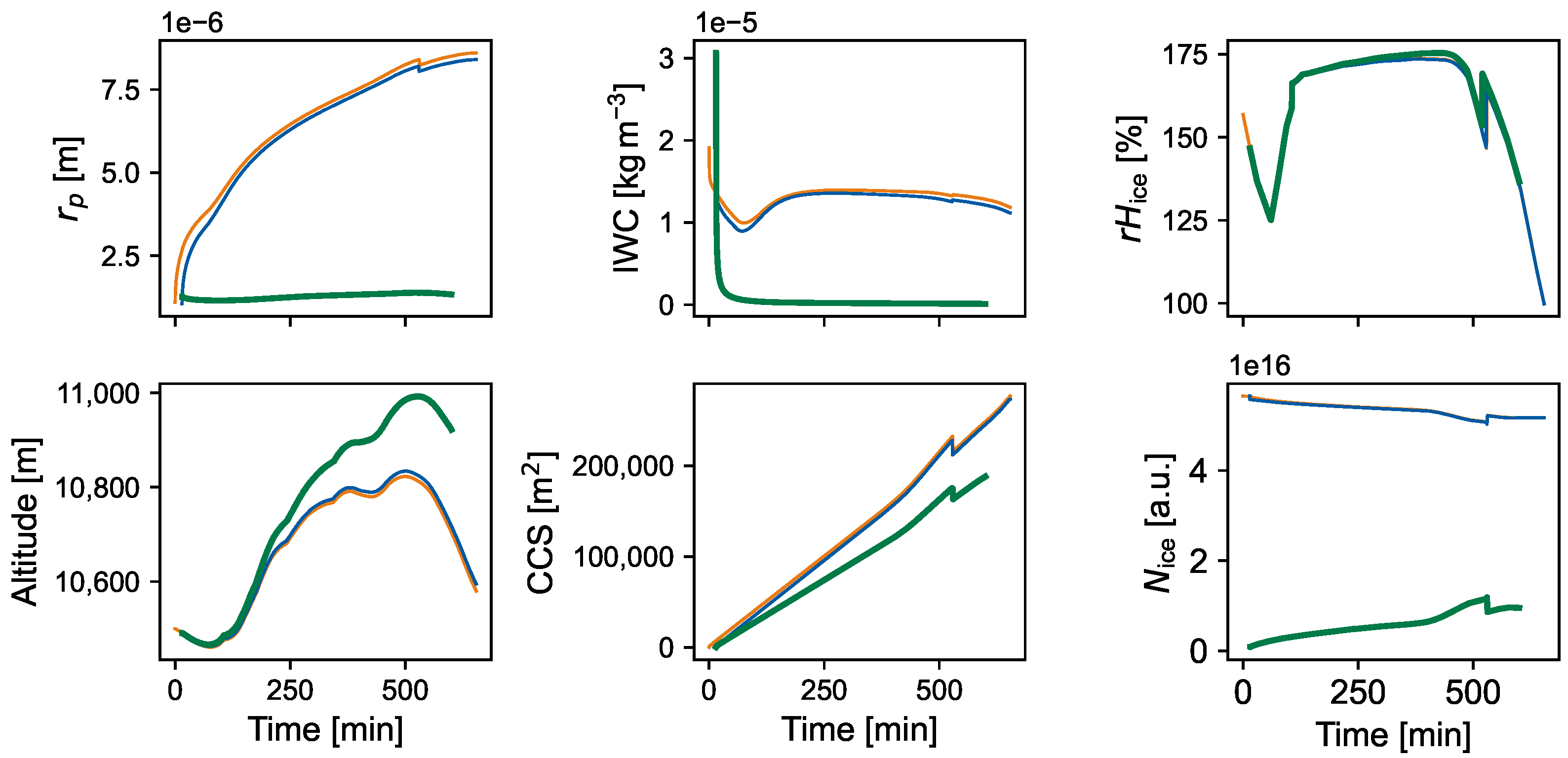
In Scenario 1, the deficit of is maximized for . For this reason, the lifetime of is very short ( min h) compared to min = 10.84 h.
The particles in the intersection part only reach a radius of
μm (see
Figure 8) because
rapidly decreases and converges towards the lower limit to be considered optically effective, whereas the number of ice particles
increases at the cost of
. Note the difference in altitude, caused by the difference in mean ice particle radius
(
Figure 8, bottom, left). The difference in the altitude of roughly 100 m and the lack of humidity for the inner contrail
causes different causes of sublimation for both contrails. While
dies of
kg m
−3 (see
Figure 8, top, middle),
leaves the ice-supersaturated layer after a long lifetime.
6.3. Microphysics and Lifetimes of Two Parallel Overlapping Contrails
If two parallel contrails intersect in such a way that both still have an outside (S2), the contrails are supplied with ice-saturated humidity via the outer surfaces,
can increase, the ice crystals can grow, and both contrails can live for a long time. It follows from this that parallel overlapping does not reduce the contrail lifetime. The intersection part, on the other hand, is expected to sublime quickly. This phenomenon can be seen in
Figure 9, where the longest contrail lifetime of
= 11.55 h = 41,472 s.
Due to an early intersection, the intersecting volume increases rapidly (see bottom center in
Figure 9), resulting in a large number of particles in the overlapping region (bottom right in
Figure 9). Because no external moisture is supplied to the intersection part,
decreases rapidly (see top center of
Figure 9). Over its relatively long lifetime of
h, the overlapping region inhibits the growth of ice crystals in the two outer contrails (see top left of
Figure 9). As a result, the crystals remain within the ice-supersaturated layer for an extended period before eventually descending under their own weight.
In the case of a parallel intersection, the ratio between the overlapping area to the area of each ellipse remains constant due to the symmetric growth of the elliptical cross-sections. This causes the ice particles to grow in a similar way, resulting in nearly the same geometric altitude. The cross-sections of and also grow similarly. As expected, the intersection part dies due to kg m−3, while and again dissipate due to .
Slower ice crystal growth and smaller crystal sizes lead to longer contrail lifetimes, as the crystals remain within the ice-supersaturated layer for a longer period due to the updraft and settle more slowly [
40,
49]. In the case of overlapping contrails, the lifetime of
can therefore be expected to depend on the intersection volume, as this volume determines how many ice crystals are shared between the two contrails and are thus no longer available to each individual plume.
At the same time, a large overlap reduces the exposed outer surface area through which the contrails can take up ice-supersaturated air, which further slows crystal growth (compare the particle radii in
Figure 8 and
Figure 9). Consequently, ice crystal growth appears to depend not only on the volume ratio between
or
and
but also on the available outer surface area able to absorb supersaturated air. However, the complexity of the problem, compounded by four-dimensional and only partially predictable atmospheric boundary conditions, limits the identification of clear lifetime indicators in the simulations.
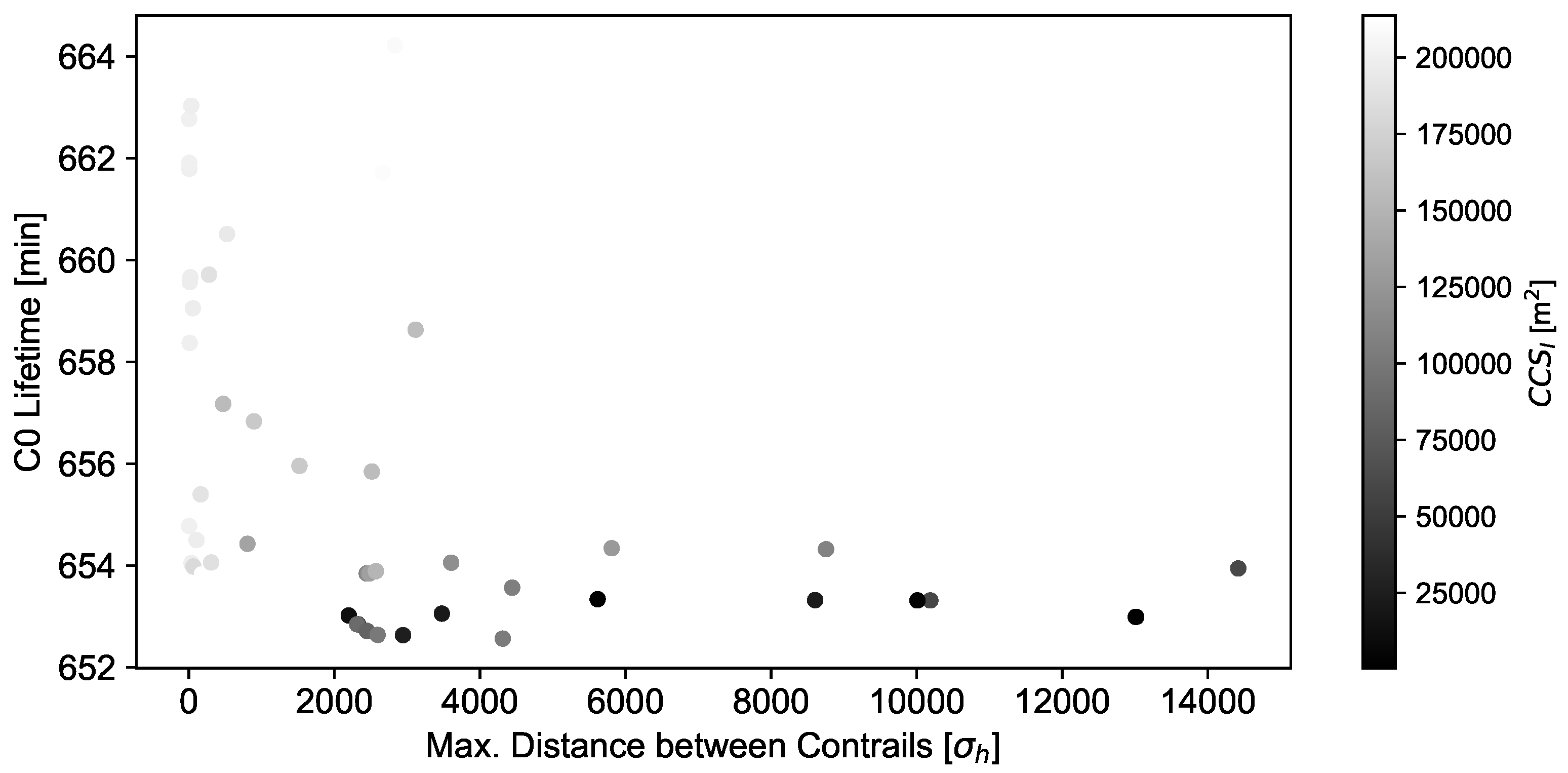
Figure 10 shows that the maximum distance between the contrails exhibits an influence on their lifetime when compared with the horizontal standard deviation of
. Smaller maximum distances correspond to longer lifetimes. This means that a parallel overlap increases the contrail lifetime. This relationship is considerably clearer than the effect of overlapping volume (absolute or relative) or overlapping area on contrail lifetime.
There is a further correlation between the time that is generated after and the lifetime. Here, the later that is generated, the shorter the lifetime of and , because the slower grows, the smaller the overlap volume and the fewer the number of ice crystals transferred from to .
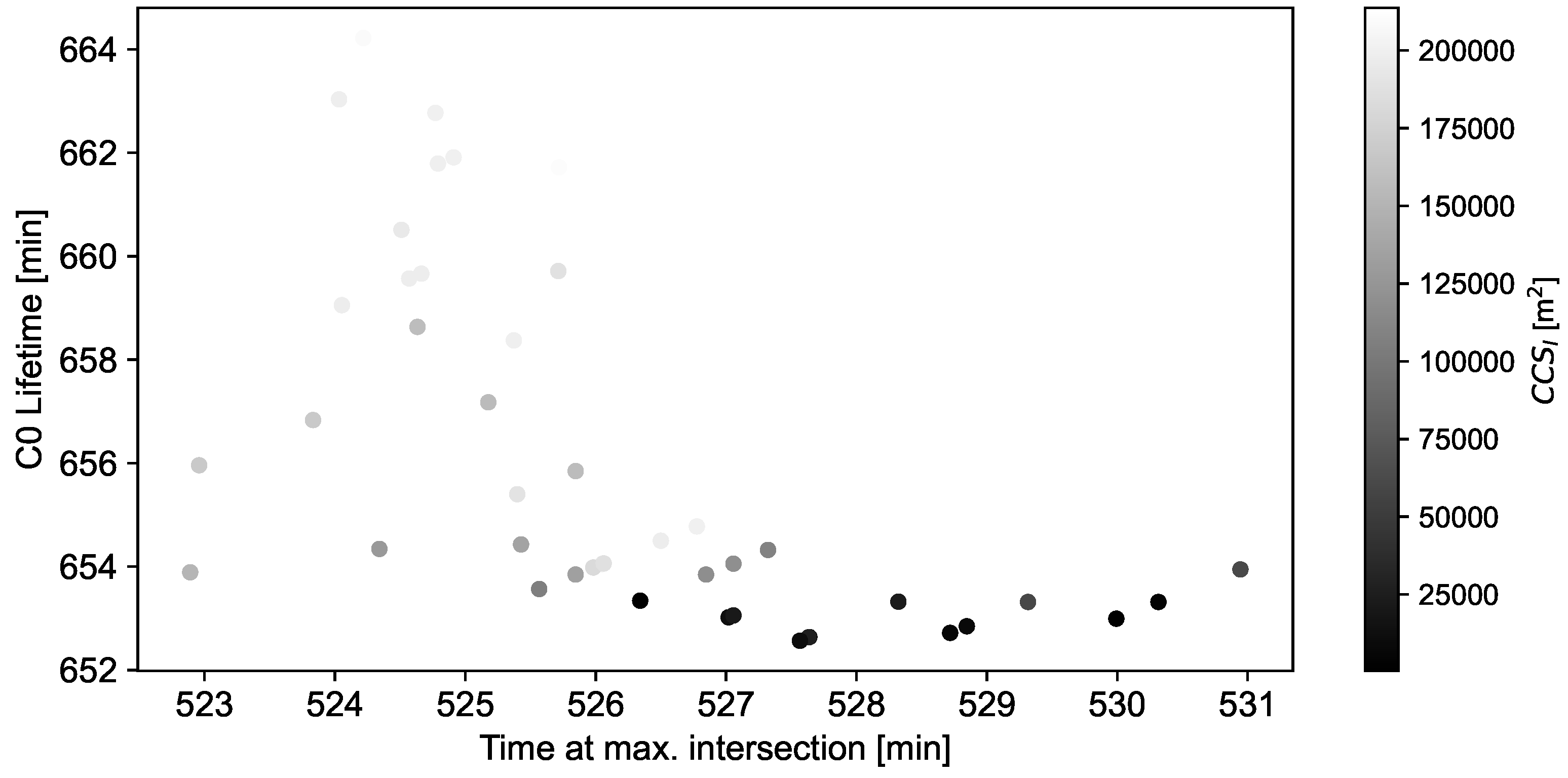
In addition, the timing of the maximum intersection between the two contrails has a direct impact on the lifetime of
(
Figure 11). If the intersection occurs at a later stage of contrail evolution, the resulting intersection area remains small due to the limited spatial overlap. Consequently, the transfer of ice crystals is reduced, leading to a shorter lifetime of
. In contrast, earlier intersections are associated with larger overlap volumes and therefore tend to promote longer-lived contrails.
6.4. Microphysics and Lifetime of Two Arbitrary Overlapping Contrails
If two contrails intersect at an angle
°, the lifetime is surprisingly only weakly dependent on the angle
. As shown in
Figure 12 and
Figure 13, the lifetime of the original contrails with
° and
° is almost identical with
s and
s, corresponding to
h and
h.
Even the interception part
lives for almost the same amount of time:
s (
h). However, the impact of the intersection angle
becomes clear in the
cross-section and the number of particles
(
Figure 12 and
Figure 13, bottom). At
°, the cross-section grows more slowly and
dies with a cross-section of
m
2 compared to
m
2. The number of particles in
increases more slowly at
and only reaches
at the end of the lifetime compared to
at
°. The impact of
on the intersection cross-section can also be seen in
Figure 3.
The impact of
on the contrail microphysics is limited because the intersection volume is reduced to a single contrail section and therefore small, compared to the entire contrail. Regardless of
,
again dies due to
kg m
−3, whereas
and
die due to ice under-saturation (
).
Table 1 represents a few example lifetimes of
for different intersection angles.
The impact of the intersection angle on the contrail lifetime is surprisingly low. However, caused by different cross-sections of and numbers of ice particles in , the impact of on the optical properties remains exciting.
7. Summary and Conclusions
The objective of this investigation is to assess how intersecting contrails influence each other’s lifetimes. As a reference case, the independent lifetimes of two non-intersecting contrails, denoted as and , are first determined. Subsequently, the lifetimes of these two contrails are analyzed for a range of intersection angles and intersection positions under otherwise identical atmospheric conditions. In scenarios S1 and S3, is always initiated 15 min earlier than at the same flight altitude.
Overall, the results show that contrail lifetimes tend to be shortened once contrails intersect, because the amount of ambient humidity available to each individual contrail during its lifetime is reduced. The closer the contrails are to each other, that is, the larger the intersection volume, the stronger this effect becomes. In all investigated scenarios, the intersection part dissipates first due to a local lack of ice water content.
Among the investigated cases, scenario 2, in which two contrails overlap in parallel, proved to be the most interesting. In this configuration, the contrail lifetime was extended compared to other intersection scenarios, while the overlapping part reached the largest volumes and exerted the strongest influence on the overall contrail evolution. A particularly notable result is that, in scenario 2, the second-generated contrail dissipates at the same time as the older contrail . This indicates that contrail lifetime depends more strongly on the prevailing atmospheric conditions than on the specific intersection geometry itself.
Although the direct impact of the intersection on contrail lifetime is relatively small for the case of only two overlapping contrails, this finding is highly relevant for real atmospheric conditions. In reality, tens of contrails often overlap simultaneously within highly trafficked airspaces. Such multiple overlapping interactions are expected to amplify the effects observed here and may lead to a considerably stronger influence on contrail lifetime and climate impact.
In this study, the model is applied to a single global weather data set. From this, it follows that the atmospheric state variables remain constant over time. This unrealistic assumption has an impact on the contrails’ lifetimes. First, in the respective atmospheric layer, ice supersaturation is assumed over an unrealistic long period. In this context, the contrails cannot die because the ice-supersaturated layer dissolves or moves away from the contrail. Furthermore, a constant atmospheric turbulence of m2 s−3 is assumed over the entire period, which creates ideal conditions for long-lasting contrails, regardless of the thermal effects caused by the time of day. Due to these circumstances, a comparison of the lifetimes of different contrails (by minimizing external effects) can be ensured, but very long lifetimes will be obtained.
In extended studies, time-varying weather scenarios will be considered and discrete weather data over time will be interpolated. Here, good experience with the Kriging approach had been made for this purpose [
58].
In the case of a weakly ice-supersaturated atmosphere, the heat emitted by a crossing aircraft can locally sublimate the older contrail. The heat
emitted by the engine per kilogram of fuel burned contributes to a temperature increase
[K], which in turn both reduces the ice supersaturation and influences the difference to the critical temperature in the Schmidt–Appleman criterion. In Equation (
41),
denotes the specific heat capacity of ice-supersaturated air (
[
59]) and
m describes the mass of air, emitted per second by all aircraft engines (
for an CFM56 engine of an A320 in cruise [
60]). This effect has not been investigated so far, as the study has been limited to highly ice-supersaturated areas. In future work, critical ambient temperatures and humidity values that lead to the sublimation of older contrails by younger ones are to be identified.
This study will be continued by means of optical investigations. The impact of intersected contrails on their optical properties will be analyzed by extending the optical single-contrail model
https://github.com/jro-github/rf-contrails [
61] (accessed on 1 September 2025) to “clustered” contrails.