

Experimental Characterization and CFD Validation of Liquid–Liquid Pintle Injector Spray Patterns Using Water as Simulant
 ,
,  , , , , , and
Abstract
1. Introduction
2. Materials and Methods
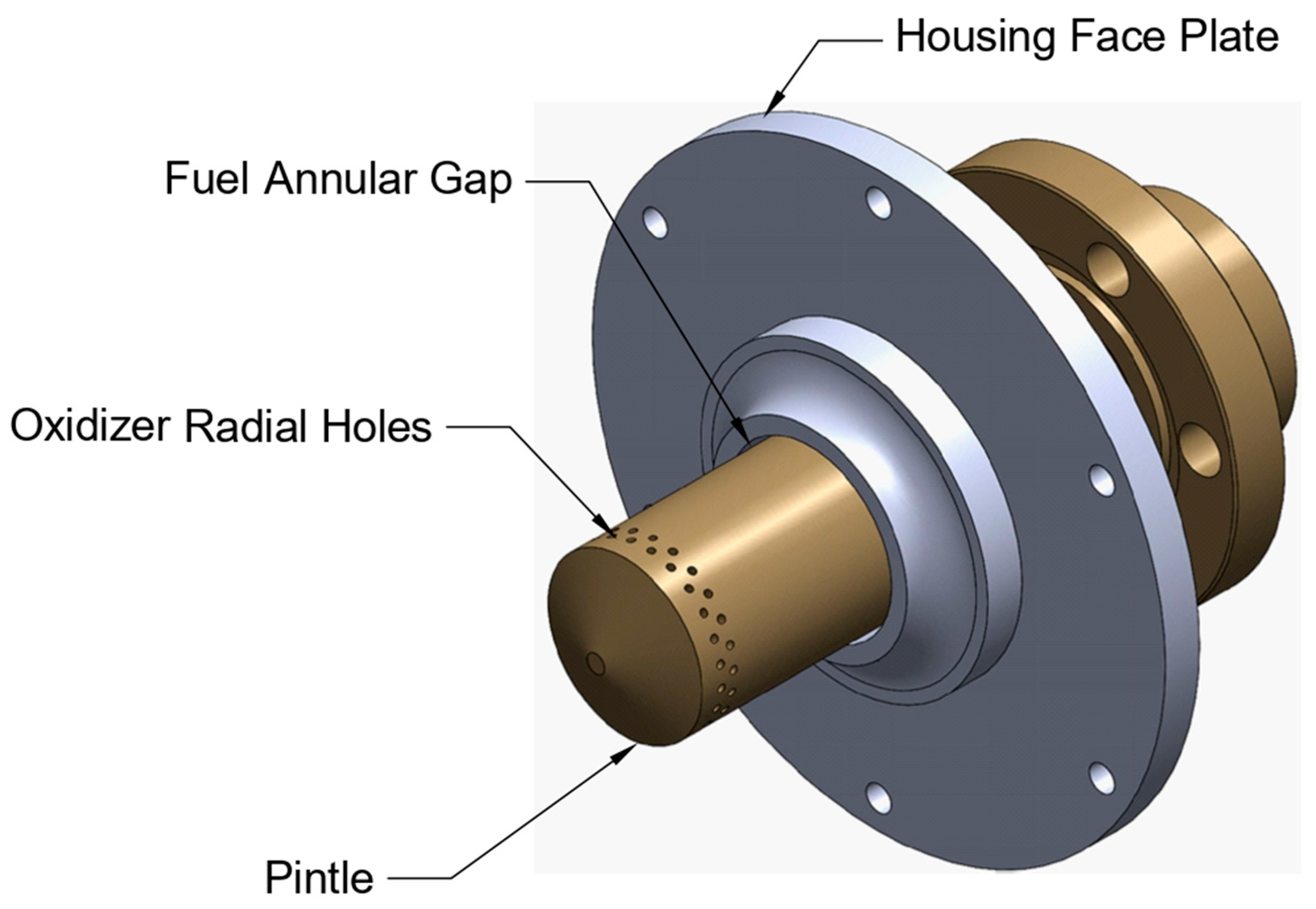
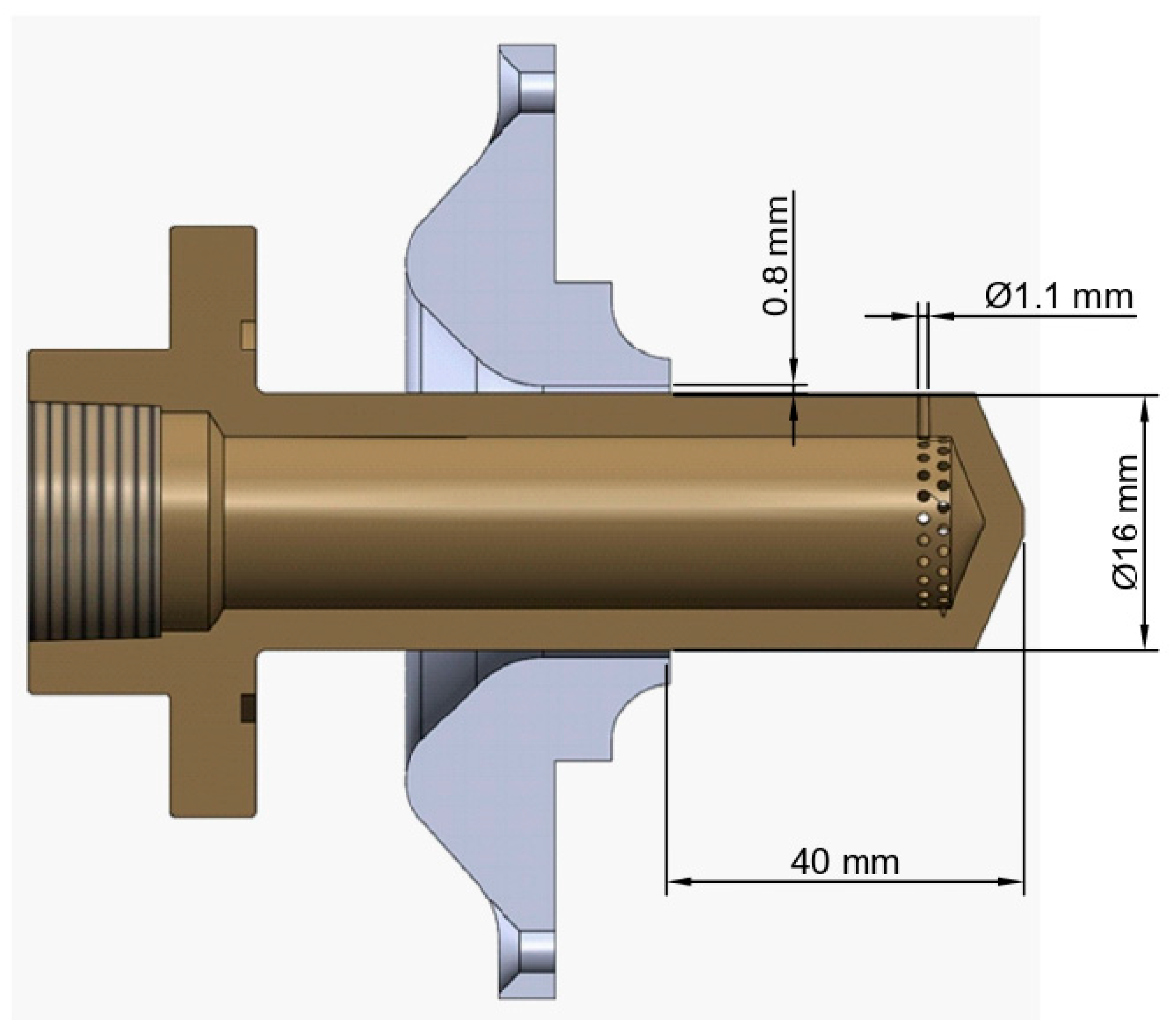
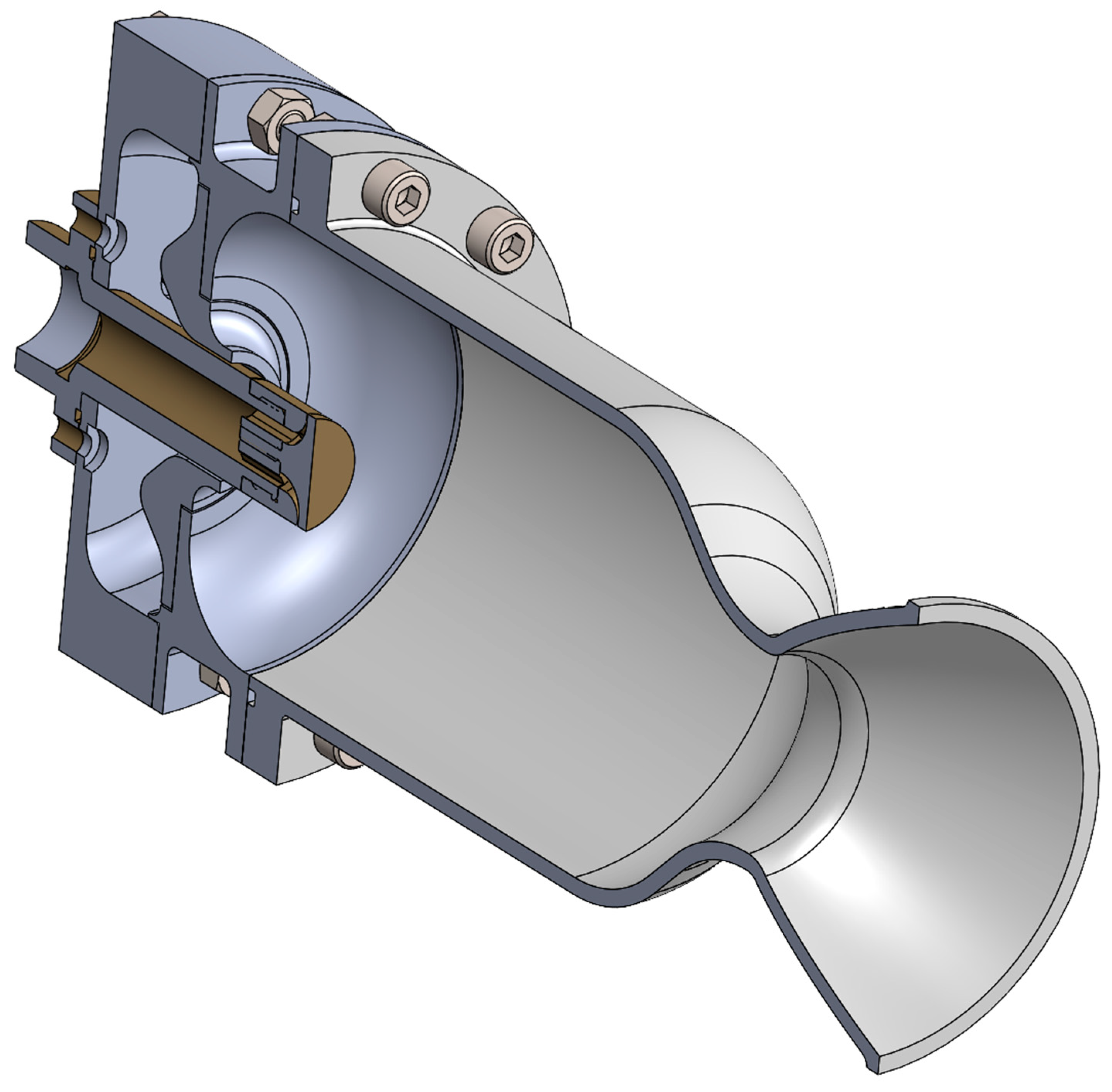
2.1. Pintle Injector Geometry
2.2. Experimental Setup and Instrumentation
2.3. Test Matrix and Operating Conditions
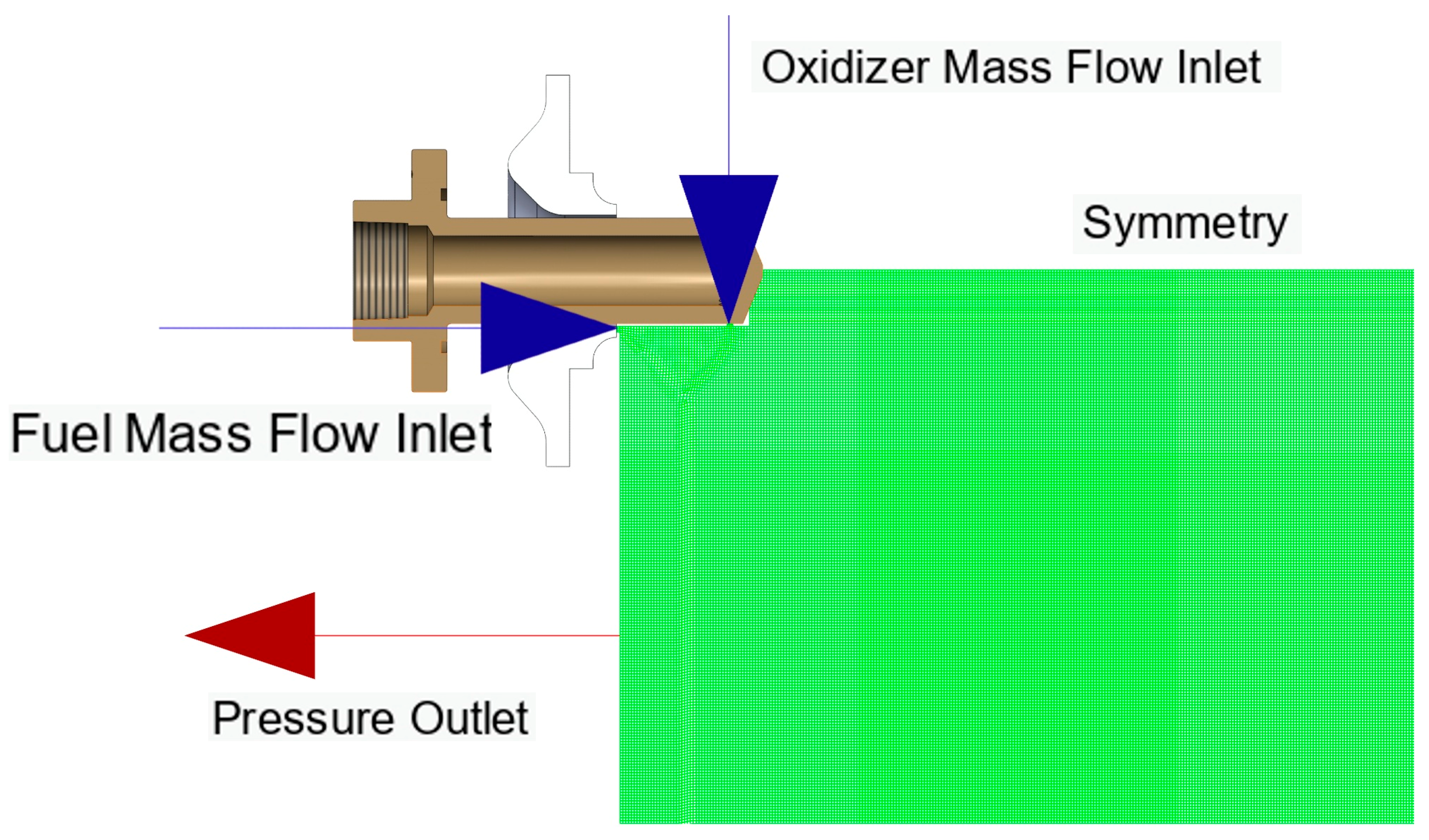
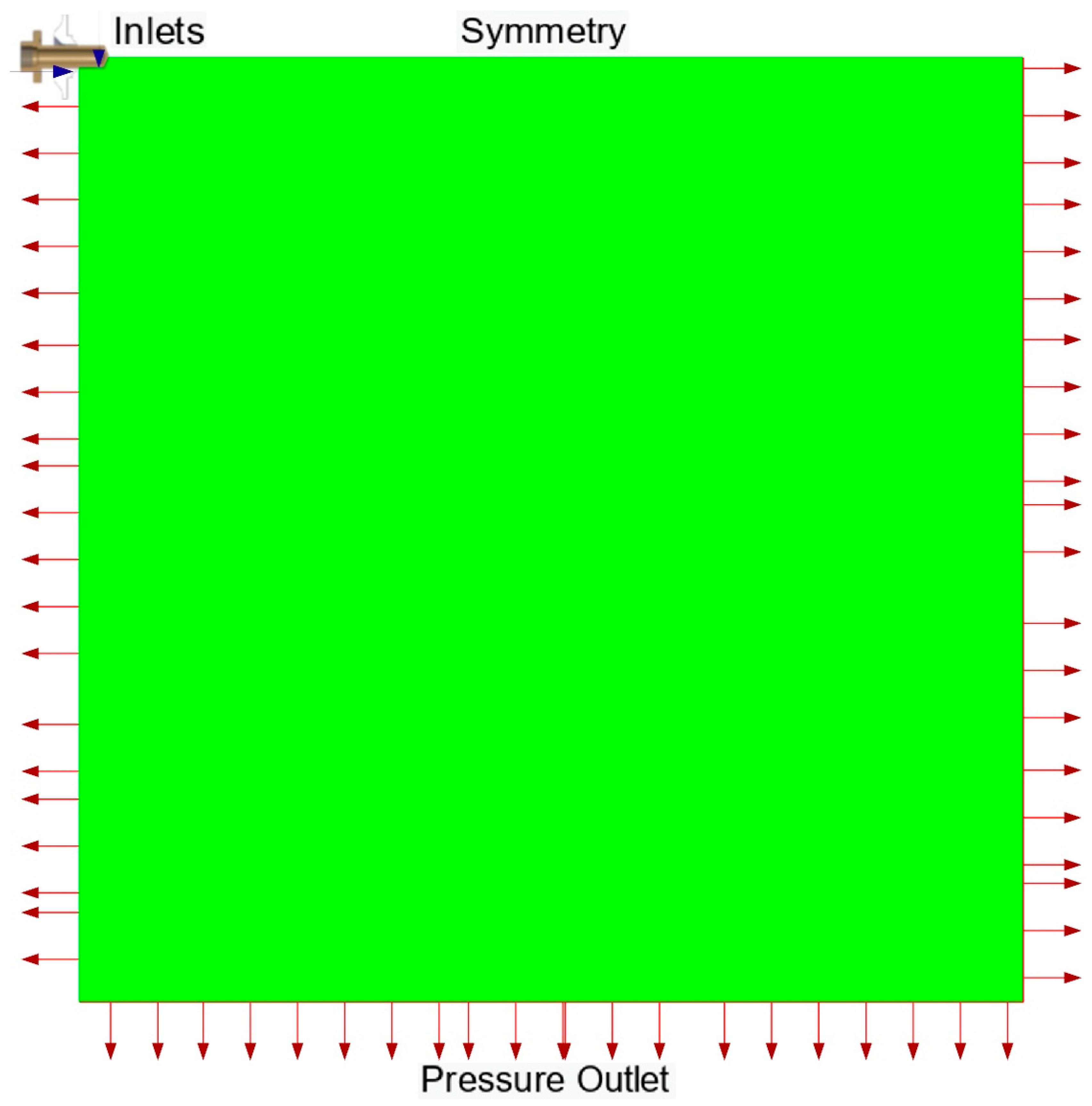
2.4. Computational Fluid Dynamics Methodology
3. Results
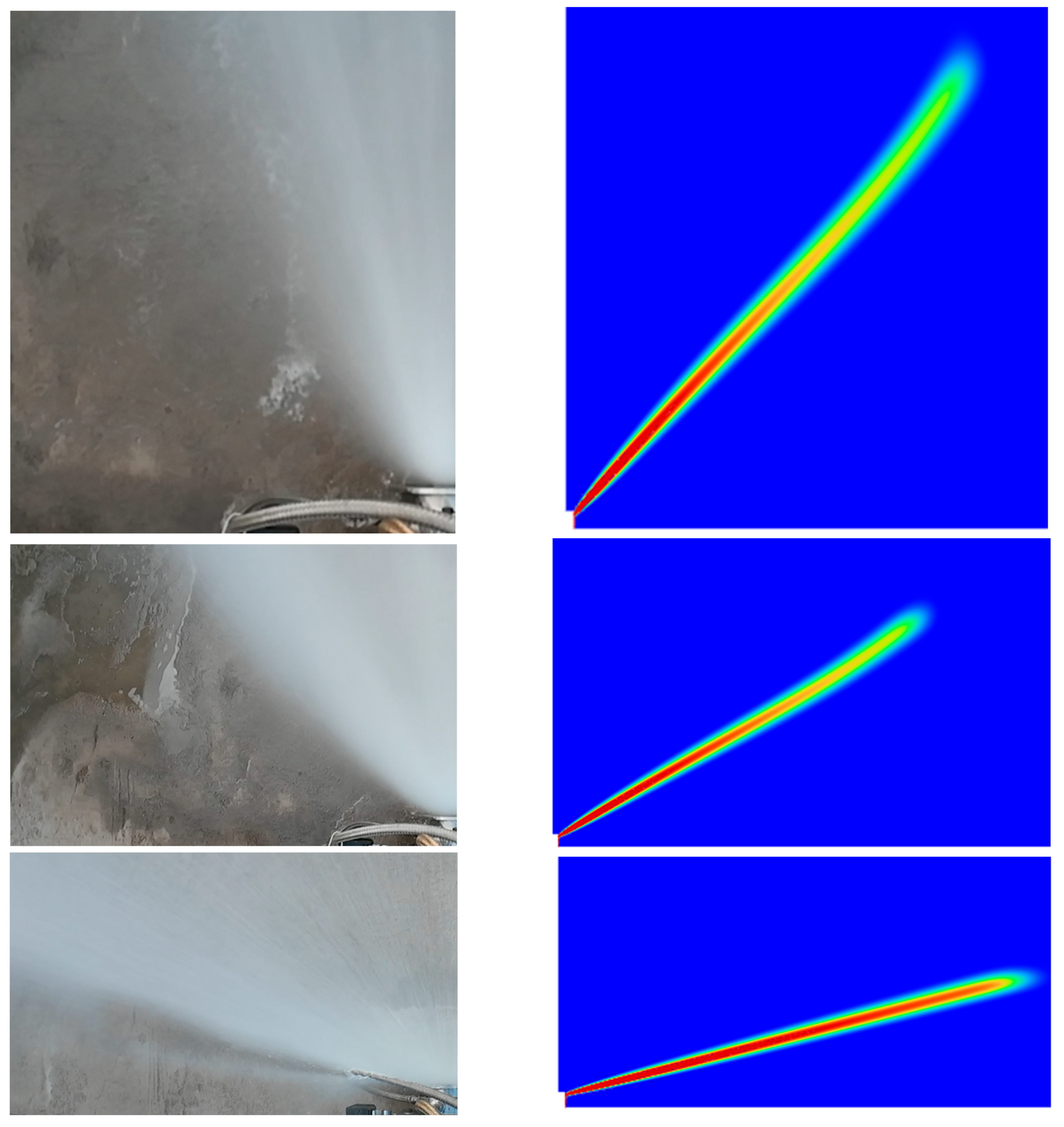
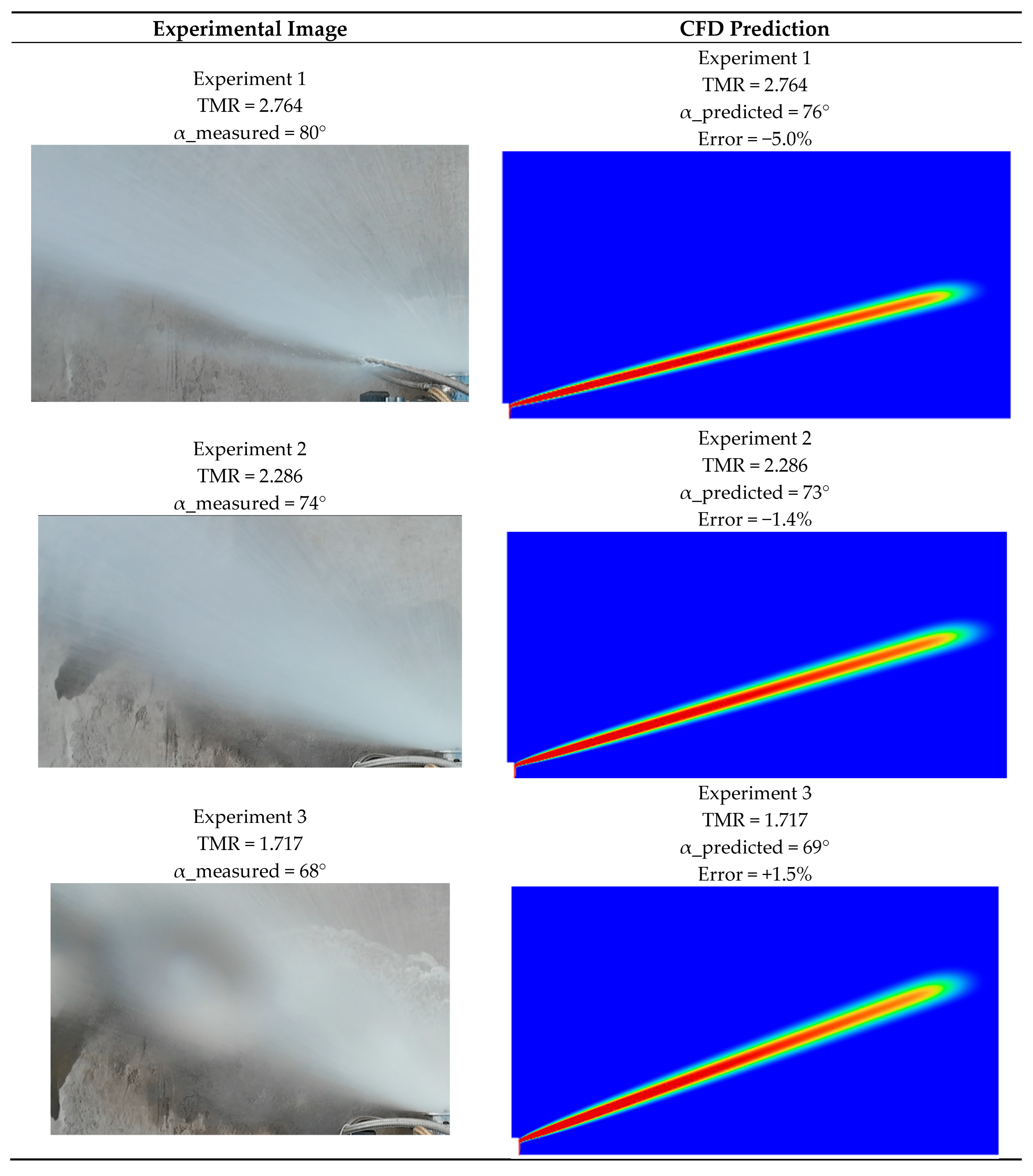
3.1. Experimental Flow Characterization
3.2. Spray Angle Dependence on TMR
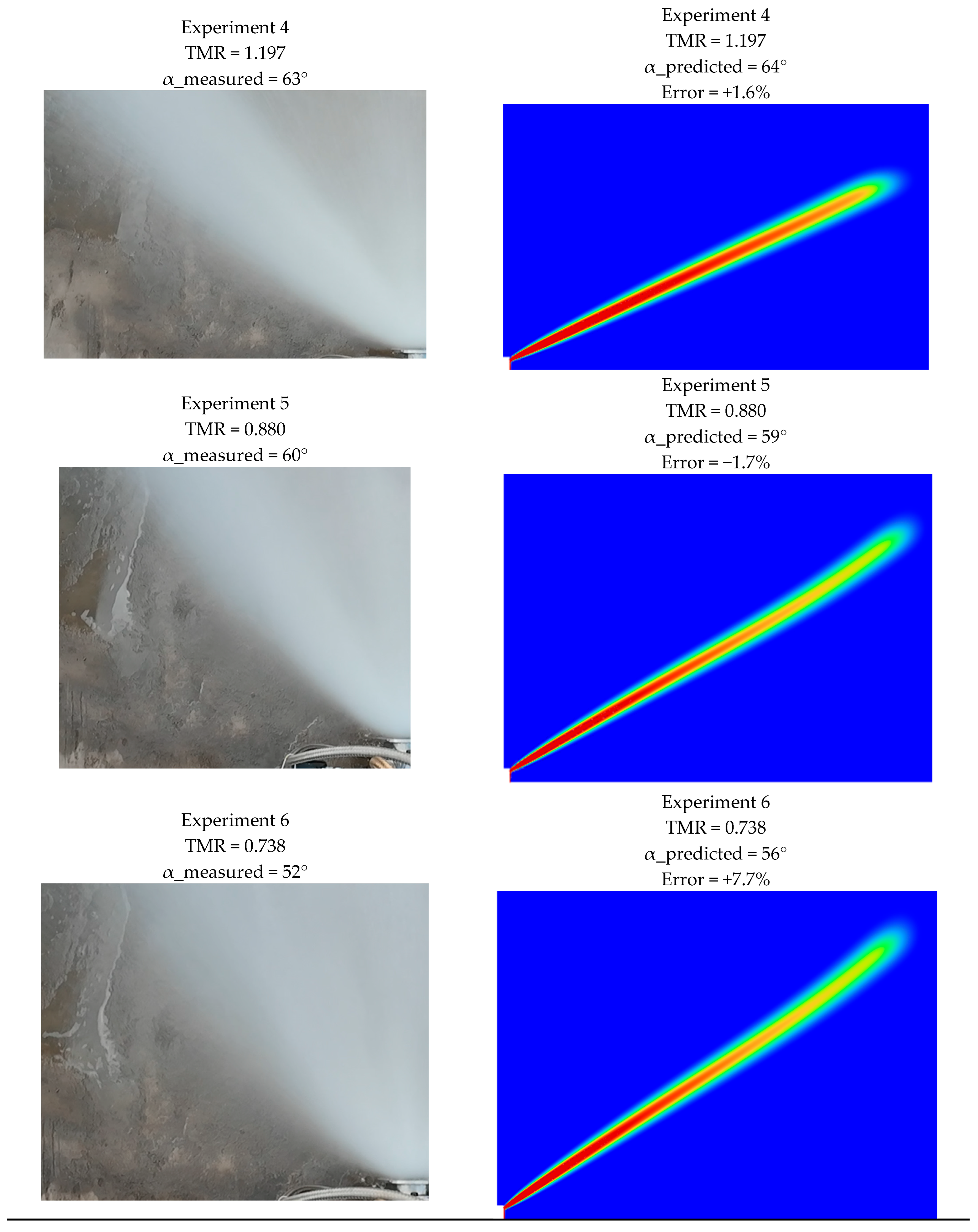
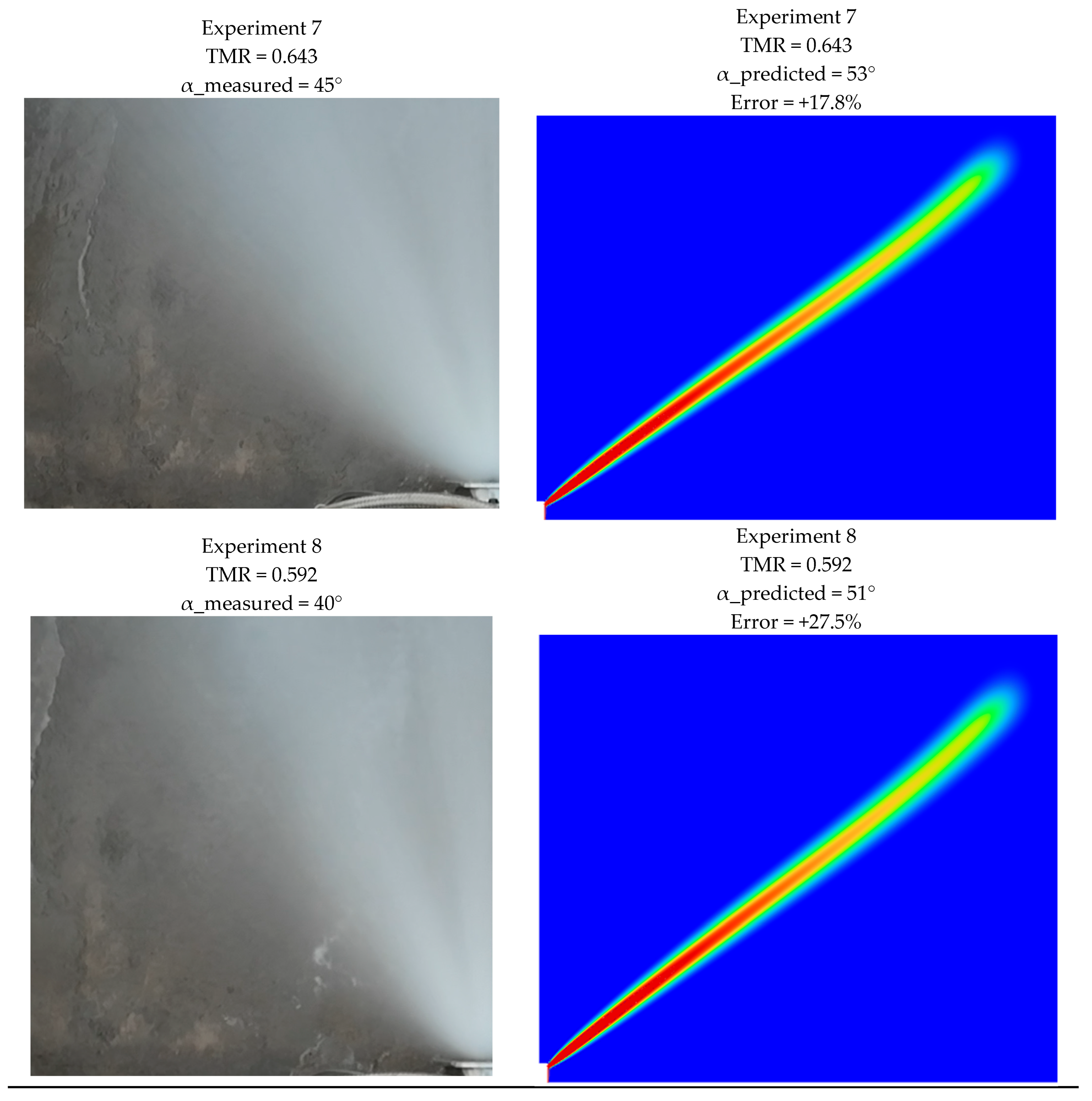
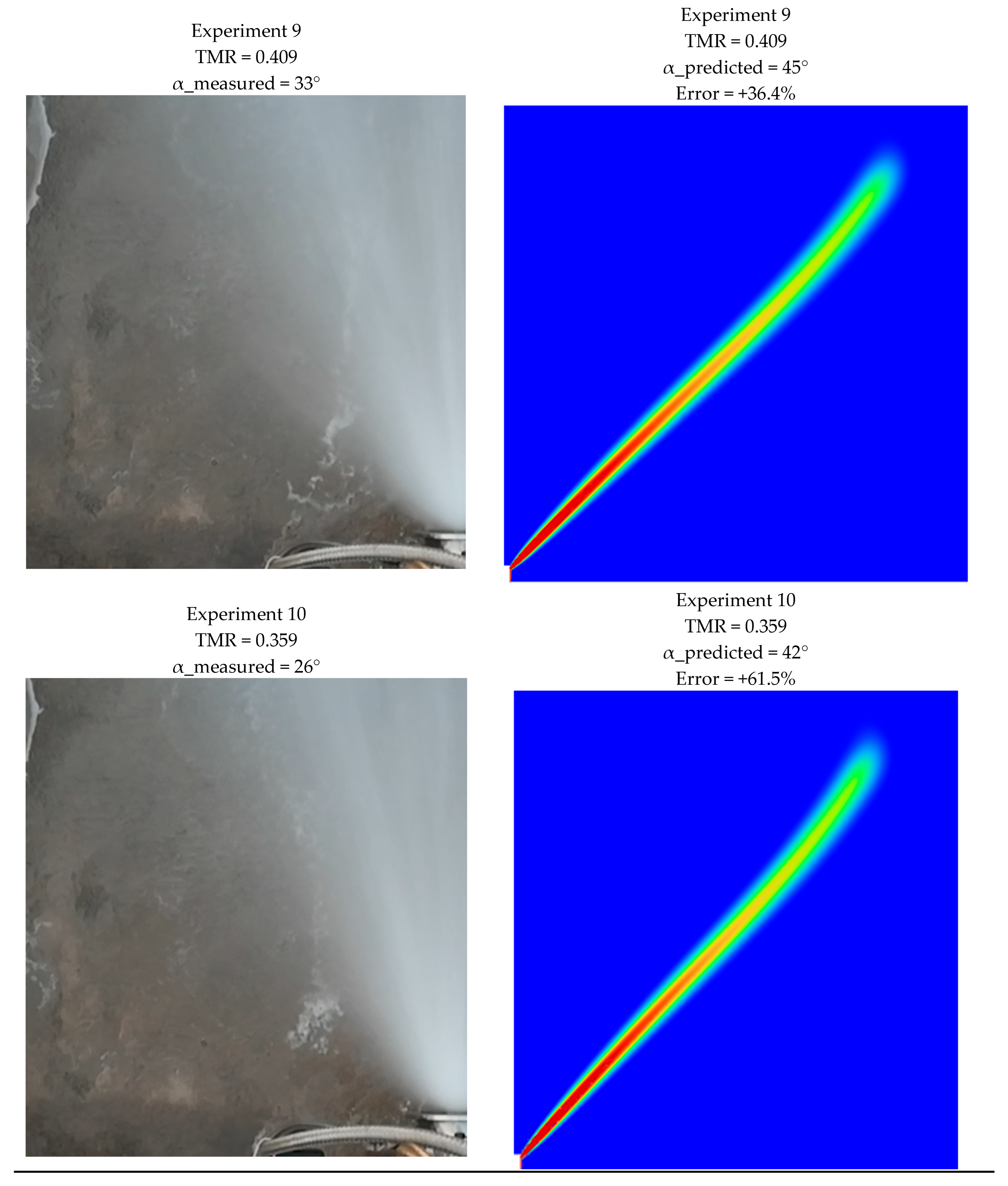
3.3. CFD Validation
3.4. Flow Field Structure
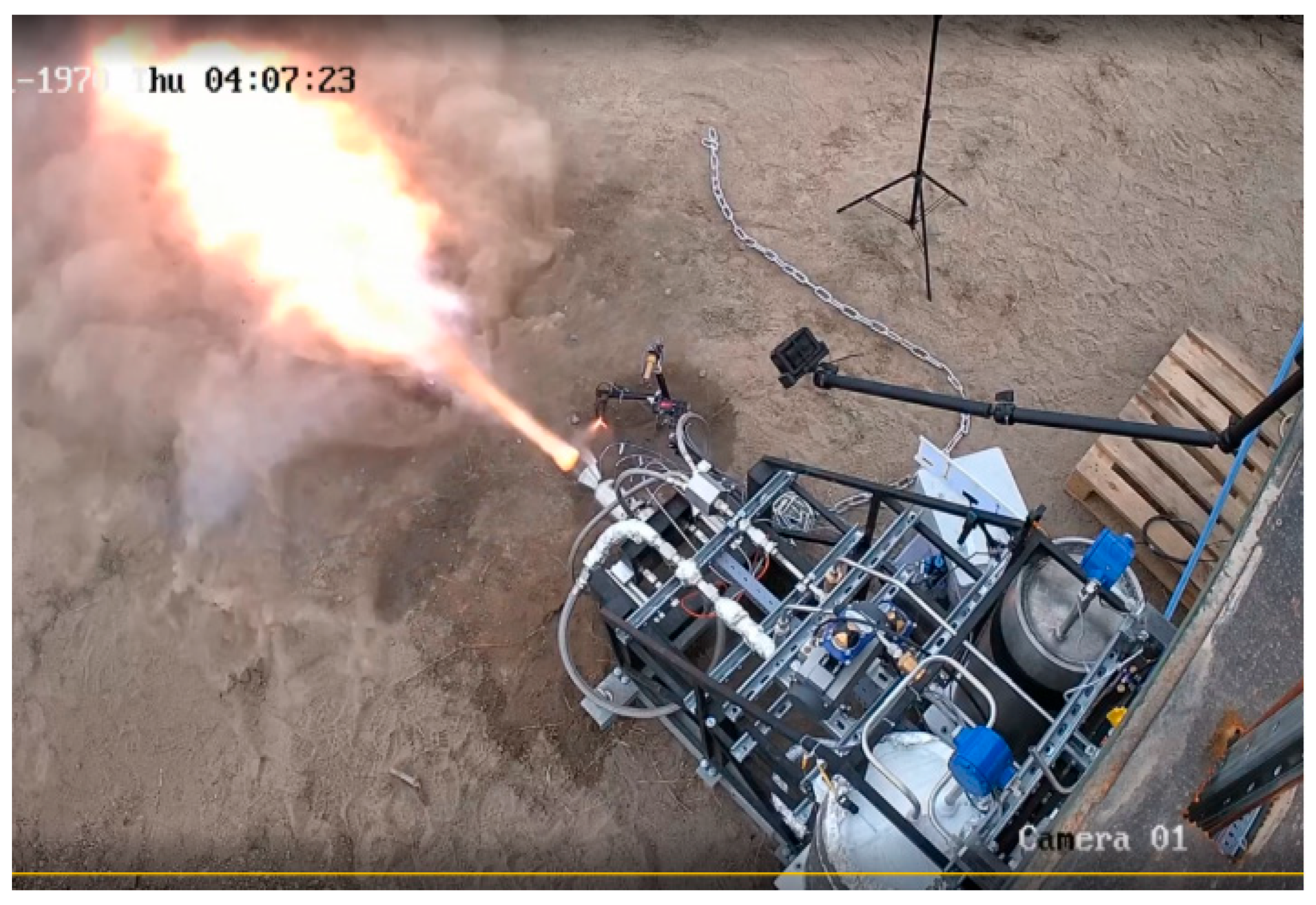
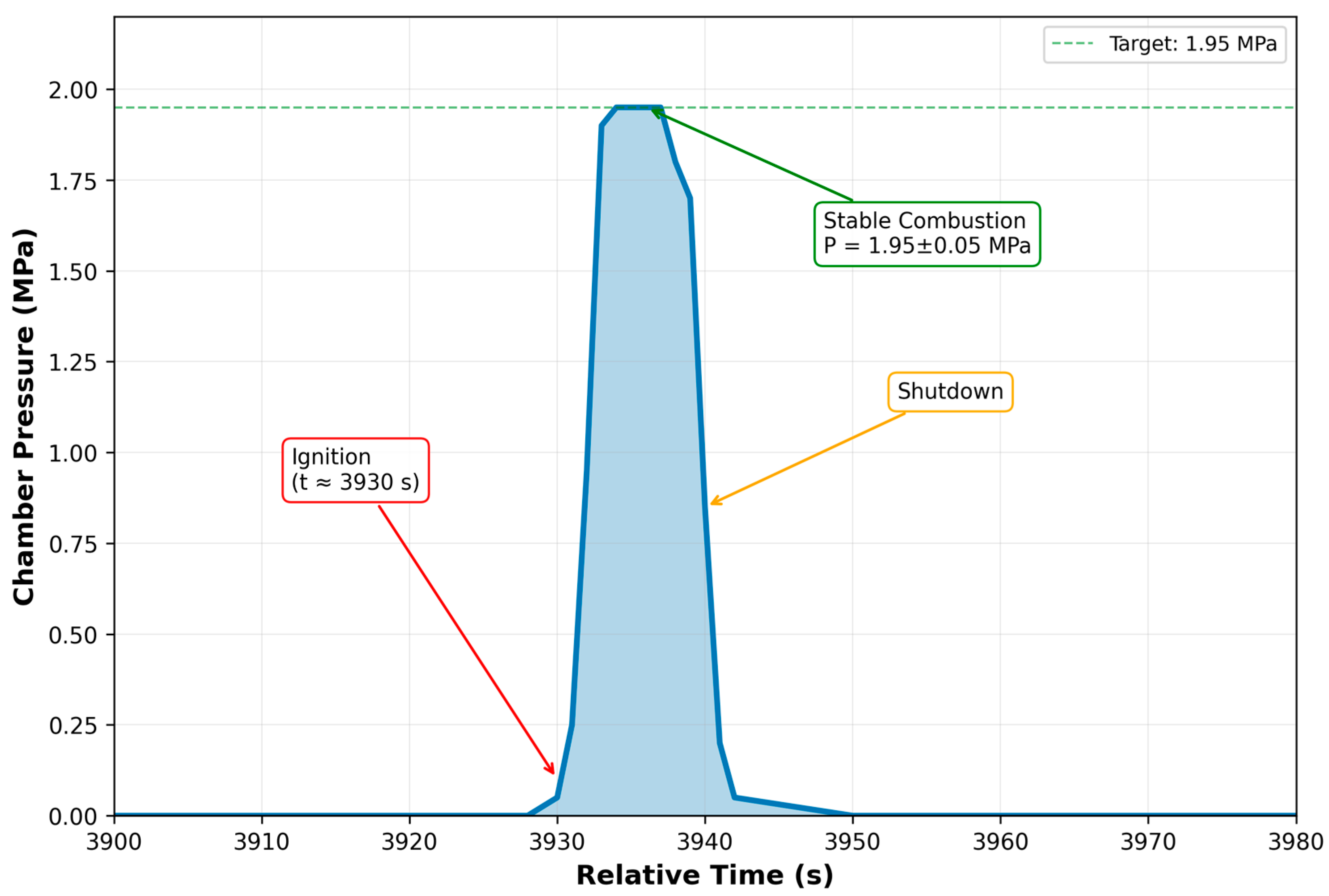
3.5. Preliminary Hot Fire Validation
4. Discussion
4.1. Physical Mechanisms Governing Spray Behavior
4.2. Limitations of Steady-State RANS Modeling
4.3. Design Implications and Literature Comparison
5. Conclusions
- (1)
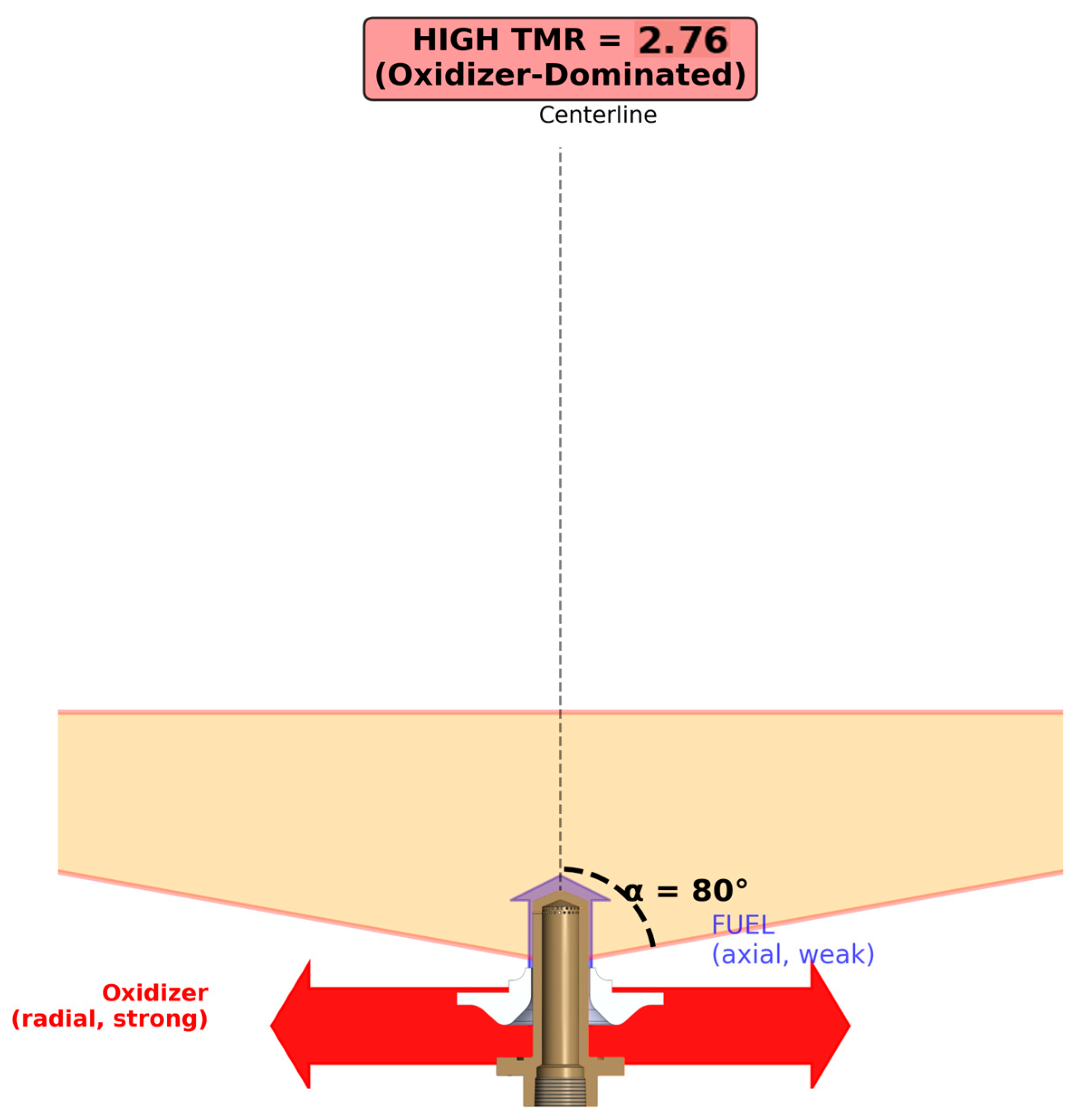
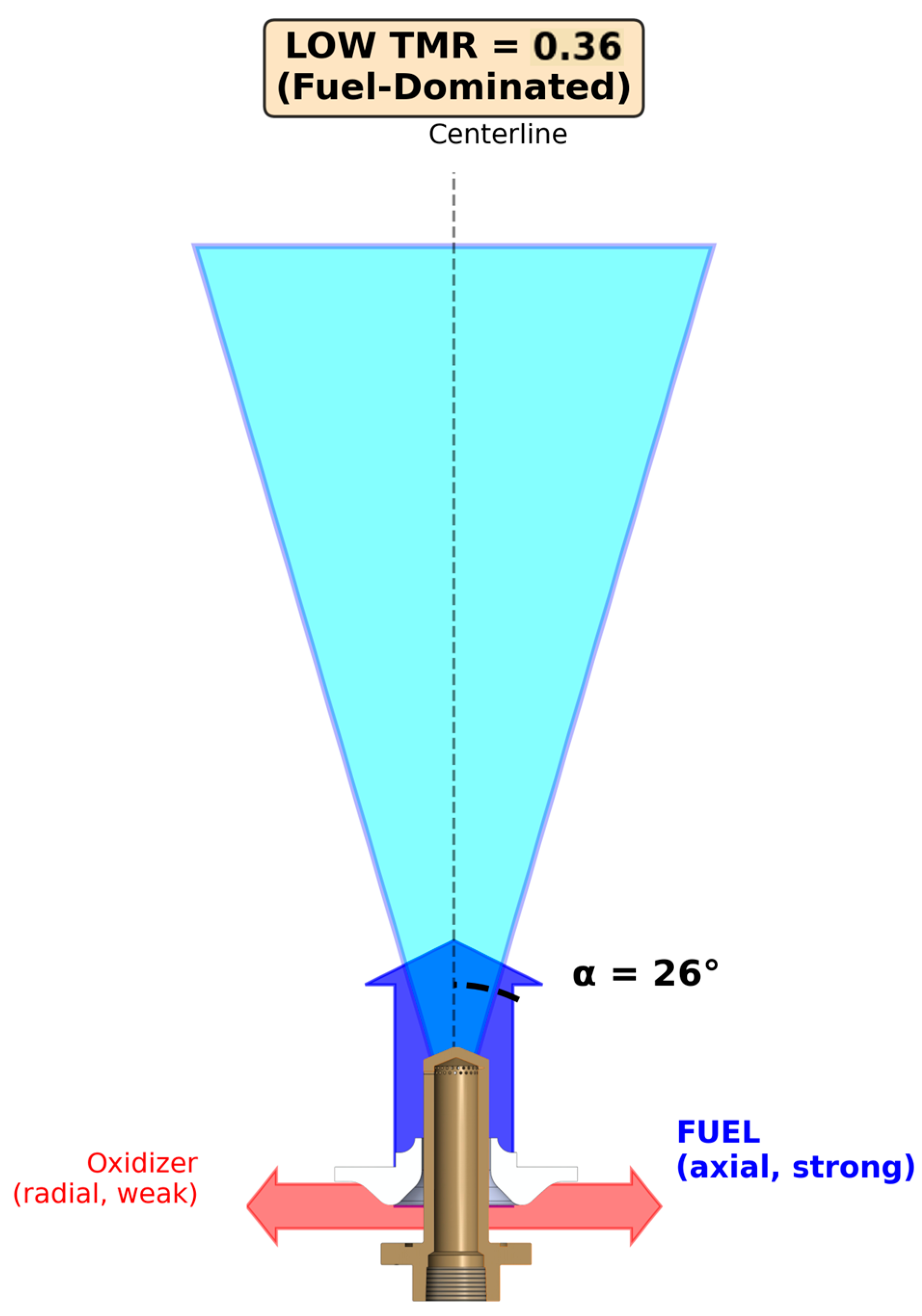
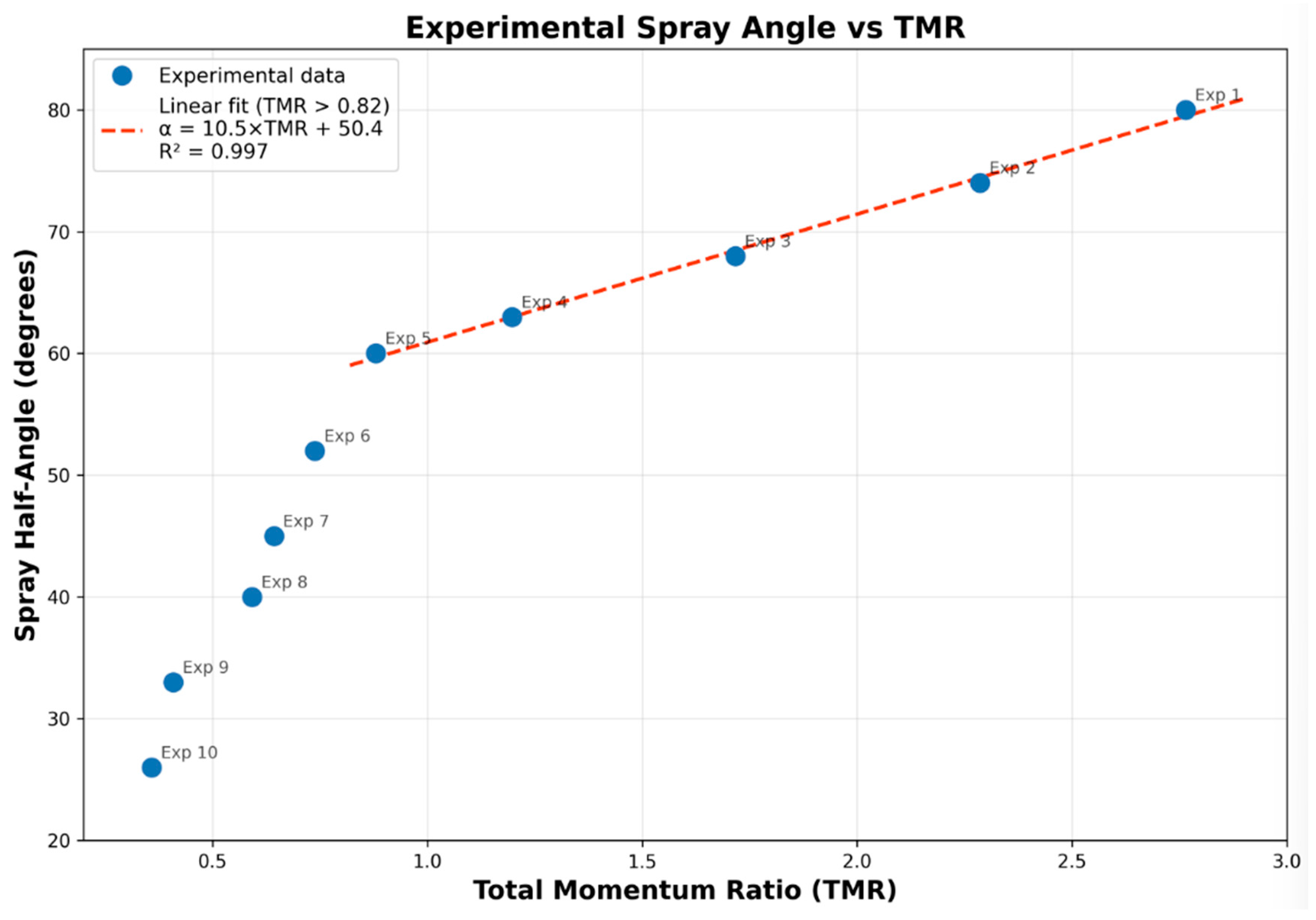
- Spray angle varies from 26° to 80° across the TMR range, with approximately linear dependence for TMR > 0.82 (α = 10.5 × TMR + 50.4, R2 = 0.997). For TMR < 0.82, a steeper nonlinear trend indicates transition to fuel-dominated physics.
- (2)
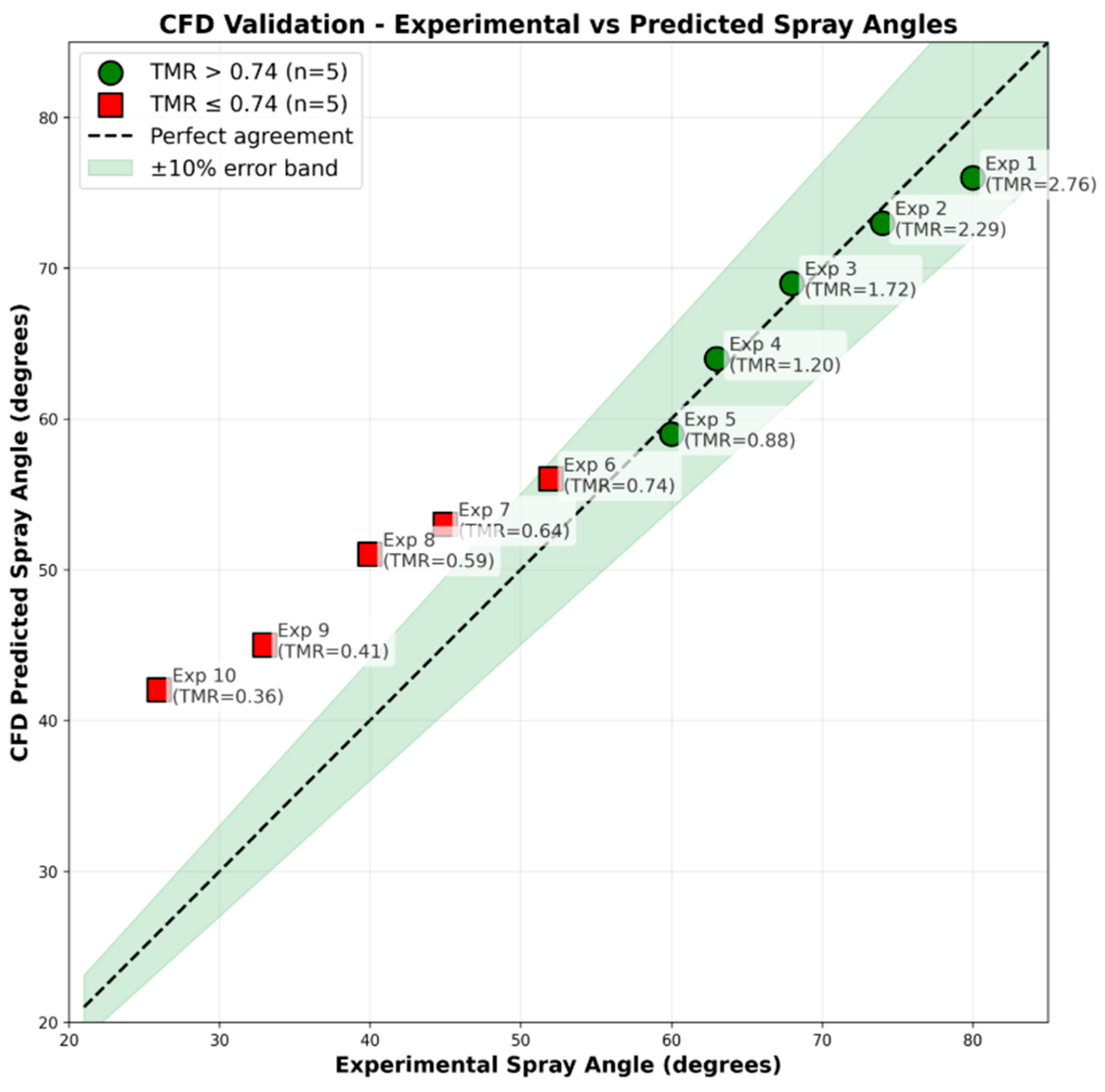
- Steady-state RANS CFD accurately predicts spray patterns for TMR > 0.74 (MAPE 3.2%, maximum error 7.7%), demonstrating the validity of the steady-state assumption for oxidizer-rich and balanced regimes.
- (3)
- For TMR < 0.74, steady-state RANS systematically overpredicts spray angles (up to 62% error at TMR = 0.36), indicating breakdown when fuel-dominated regimes exhibit strong unsteady behavior. The critical threshold TMR ≈ 0.74 delineates where advanced unsteady simulation methods become necessary.
- (4)
- For sounding rocket design, operation near TMR ≈ 0.88 provides optimal spray characteristics with predictable CFD behavior. Throttling should preferentially occur on the high-TMR side to preserve modeling reliability.
- (5)
- Water cold flow testing provides cost-effective spray characterization, correlating well with hot fire behavior. Preliminary hot fire testing demonstrated successful ignition and stable combustion, validating the fundamental design approach. The cold flow dataset and validated CFD methodology provide a foundation for predicting injector behavior across the engine’s throttling envelope.
Author Contributions
Funding
Data Availability Statement
Conflicts of Interest
Appendix A


References
- Dressler, G.; Bauer, J. TRW Pintle Engine Heritage and Performance Characteristics. In 36th AIAA/ASME/SAE/ASEE Joint Propulsion Conference and Exhibit; American Institute of Aeronautics and Astronautics: Reston, VA, USA, 2000. [Google Scholar]
- Elverum, G.W.; Staudhammer, P. The Effect of Rapid Liquid-Phase Reactions on Injector Design and Combustion in Rocket Motors; NASA: Washington, DC, USA, 1959.
- Chen, H.; Li, Q.; Cheng, P. Experimental Research on the Spray Characteristics of Pintle Injector. Acta Astronaut. 2019, 162, 424–435. [Google Scholar] [CrossRef]
- Cheng, P.; Li, Q.; Xu, S.; Kang, Z. On the Prediction of Spray Angle of Liquid-Liquid Pintle Injectors. Acta Astronaut. 2017, 138, 145–151. [Google Scholar] [CrossRef]
- Shen, C.; Zhou, R. Experimental Study on the Combustion Characteristics of LOX/LCH4 Pintle Injectors. Fuel 2023, 339, 126909. [Google Scholar] [CrossRef]
- Ninish, S.; Vaidyanathan, A.; Nandakumar, K. Spray Characteristics of Liquid-Liquid Pintle Injector. Exp. Therm. Fluid Sci. 2018, 97, 324–340. [Google Scholar] [CrossRef]
- Zhou, W.; Xu, X.; Yang, Q.; Zhao, R.; Jin, Y. Experimental and Numerical Investigations on the Spray Characteristics of Liquid-Gas Pintle Injector. Aerosp. Sci. Technol. 2022, 121, 107354. [Google Scholar] [CrossRef]
- Prabhakaran, R.; Basavanahalli, R. Gas-on-Liquid Impinging Injectors: Some New Results. In Proceedings of the 49th AIAA/ASME/SAE/ASEE Joint Propulsion Conference, San Jose, CA, USA, 14–17 July 2013; American Institute of Aeronautics and Astronautics: Reston, VA, USA, 2013. [Google Scholar]
- Cooper, R.W.; Martin, D.J.; Wunderlin, N.; Pitot, J.; Brooks, M.J. Facility Design and Cold Flow Testing Operations for an 18kN LOX/Kerosene Liquid Rocket Engine. In Proceedings of the AIAA SCITECH 2024 Forum, Orlando, FL, USA, 8–12 January 2024; American Institute of Aeronautics and Astronautics: Reston, VA, USA, 2024. [Google Scholar]
- Son, M.; Yu, K.; Radhakrishnan, K.; Shin, B.; Koo, J. Verification on Spray Simulation of a Pintle Injector for Liquid Rocket Engine. J. Therm. Sci. 2016, 25, 90–96. [Google Scholar] [CrossRef]
- Heinrich, M.; Schwarze, R. 3D-Coupling of Volume-of-Fluid and Lagrangian Particle Tracking for Spray Atomization Simulation in OpenFOAM. SoftwareX 2020, 11, 100483. [Google Scholar] [CrossRef]
- Farmer, R.; Cheng, G.; Chen, Y.-S.; Garcia, R. CFD Simulation of Liquid Rocket Engine Injectors; NASA: Washington, DC, USA, 2001.
- Tucker, K.; West, J.; Williams, R.; Lin, J.; Rocker, M.; Canabal, F.; Robles, B.; Garcia, R.; Chenoweth, J. Using CFD as Rocket Injector Design Tool: Recent Progress at Marshall Space Flight Center; NASA: Washington, DC, USA, 2003.
- Cheng, G.; Farmer, R. CFD Spray Combustion Model for Liquid Rocket Engine Injector Analyses. In Proceedings of the 40th AIAA Aerospace Sciences Meeting & Exhibit, Reno, NV, USA, 14–17 January 2002; American Institute of Aeronautics and Astronautics: Reston, VA, USA, 2002. [Google Scholar]
- Cha, J.; Andersson, E.; Bohlin, A. A Numerical Approach to Optimize the Design of a Pintle Injector for LOX/GCH4 Liquid-Propellant Rocket Engine. Aerospace 2023, 10, 582. [Google Scholar] [CrossRef]
- Kang, D.; Han, S.; Ryu, C.; Ko, Y. Design of Pintle Injector Using Kerosene-LOx as Propellant and Solving the Problem of Pintle Tip Thermal Damage in Hot Firing Test. Acta Astronaut. 2022, 201, 48–58. [Google Scholar] [CrossRef]
- Kenny, R.; Moser, M.; Hulka, J.; Jones, G. Cold Flow Testing for Liquid Propellant Rocket Injector Scaling and Throttling. In Proceedings of the 42nd AIAA/ASME/SAE/ASEE Joint Propulsion Conference & Exhibit, Sacramento, CA, USA, 9–12 July 2006; American Institute of Aeronautics and Astronautics: Reston, VA, USA, 2006. [Google Scholar][Green Version]
- Tharakan, T.J.; Rafeeque, T.A. The Role of Backpressure on Discharge Coefficient of Sharp Edged Injection Orifices. Aerosp. Sci. Technol. 2016, 49, 269–275. [Google Scholar] [CrossRef]
- Kang, S.-J.; Rho, B.-J.; Oh, J.-H.; Kwon, K.-C. Atomization Characteristics of a Double Impinging F-O-O-F Type Injector with Four Streams for Liquid Rockets. KSME Int. J. 2000, 14, 466–476. [Google Scholar] [CrossRef]
- Kebriaee, A.; Akbari, M.J.; Zarrin, F.A. Droplet Shadow Velocimetry Based on Monoframe Technique. At. Sprays 2018, 28, 581–598. [Google Scholar] [CrossRef]
- Castanet, G.; Dunand, P.; Caballina, O.; Lemoine, F. High-Speed Shadow Imagery to Characterize the Size and Velocity of the Secondary Droplets Produced by Drop Impacts onto a Heated Surface. Exp. Fluids 2013, 54, 1489. [Google Scholar] [CrossRef]
- Brackbill, J.U.; Kothe, D.B.; Zemach, C. A Continuum Method for Modeling Surface Tension. J. Comput. Phys. 1992, 100, 335–354. [Google Scholar] [CrossRef]
- Mirjalili, B.; Jain, S.; Dodd, M. Interface-Capturing Methods for Two-Phase Flows: An Overview and Recent Developments. 2017. Available online: https://web.stanford.edu/~sjsuresh/mirjalili2017.pdf (accessed on 31 December 2025).
- Popinet, S. Numerical Models of Surface Tension. Annu. Rev. Fluid Mech. 2018, 50, 49–75. [Google Scholar] [CrossRef]
- Wu, P.-K.; Kirkendall, K.A.; Fuller, R.P.; Nejad, A.S. Breakup Processes of Liquid Jets in Subsonic Crossflows. J. Propuls. Power 1997, 13, 64–73. [Google Scholar] [CrossRef]
- Mazallon, J.; Dai, Z.; Faeth, G.M. Primary Breakup of Nonturbulent Round Liquid Jets in Gas Crossflows. At. Sprays 1999, 9, 291–312. [Google Scholar] [CrossRef]
- Ashgriz, N. (Ed.) Handbook of Atomization and Sprays: Theory and Applications; Springer: Boston, MA, USA, 2011. [Google Scholar]
- Lin, S.P.; Reitz, R.D. Drop and Spray Formation from a Liquid Jet. Annu. Rev. Fluid Mech. 1998, 30, 85–105. [Google Scholar] [CrossRef]
- Sallam, K.A.; Aalburg, C.; Faeth, G.M. Breakup of Round Nonturbulent Liquid Jets in Gaseous Crossflow. AIAA J. 2004, 42, 2529–2540. [Google Scholar] [CrossRef]
- Erkal, B.; Sümer, B.; Aksel, M.H. Design Procedure and Cold Flow Experiments of a Pintle Injector. In Proceedings of the AIAA Propulsion and Energy 2019 Forum, Indianapolis, IN, USA, 19–22 August 2019; American Institute of Aeronautics and Astronautics: Reston, VA, USA, 2019. [Google Scholar]



| Study [Ref] | Propellants | TMR Range | Spray Angle (°) | Method | CFD Model | Key Findings |
|---|---|---|---|---|---|---|
| Chen et al. [3] | Water–water | 0.16–0.93 (LMR) | 34–122 | Exp + PDA | — | Hollow-to-solid cone spray pattern. Droplet size and velocity distributions analyzed. “N” shape SMD profile |
| Cheng et al. [4] | Water–water | Theory-based | Formula: cos α = 1/(1 + TMR) | Theory + CFD + Exp | VOF, RANS | Derived theoretical prediction of spray angle. TMR dominates spray angle for liquid–liquid pintle |
| Ninish et al. [6] | Water–water | 0.7–1.0 | — | Exp (shadowgraphy) | — | D32: 650–840 μm. Hollow conical sheet. Lower TMR yields better atomization |
| Present study | Water–water | 0.36–2.76 | 26–80 | Exp + CFD | VOF + dispersed, k-ω SST | Extended TMR range 0.36–2.76 with CFD validation. Identified TMR ≈ 0.74 as steady RANS accuracy limit (>10% error below). Two-dimensional axisymmetric limitation acknowledged. No droplet size measurements |
| Exp | Q_fuel (L/s) | Q_ox (L/s) | TMR | P_fuel (MPa) | P_ox (MPa) |
|---|---|---|---|---|---|
| 1 | 0.822 | 1.435 | 2.764 | 0.486 | 1.321 |
| 2 | 0.957 | 1.519 | 2.286 | 0.660 | 1.283 |
| 3 | 1.137 | 1.564 | 1.717 | 0.885 | 1.320 |
| 4 | 1.376 | 1.581 | 1.197 | 1.266 | 1.312 |
| 5 | 1.633 | 1.609 | 0.880 | 1.694 | 1.327 |
| 6 | 1.677 | 1.513 | 0.738 | 1.708 | 1.139 |
| 7 | 1.726 | 1.454 | 0.643 | 1.704 | 0.936 |
| 8 | 1.712 | 1.383 | 0.592 | 1.729 | 0.775 |
| 9 | 1.726 | 1.159 | 0.409 | 1.738 | 0.582 |
| 10 | 1.696 | 1.068 | 0.359 | 1.736 | 0.450 |
| Exp | TMR | α_exp (°) | α_CFD (°) | Error (°) | Error (%) |
|---|---|---|---|---|---|
| 1 | 2.764 | 80 | 76 | −4.0 | −5.0 |
| 2 | 2.286 | 74 | 73 | −1.0 | −1.4 |
| 3 | 1.717 | 68 | 69 | 1.0 | 1.5 |
| 4 | 1.197 | 63 | 64 | 1.0 | 1.6 |
| 5 | 0.880 | 60 | 59 | −1.0 | −1.7 |
| 6 | 0.738 | 52 | 56 | 4.0 | 7.7 |
| 7 | 0.643 | 45 | 53 | 8.0 | 17.8 |
| 8 | 0.592 | 40 | 51 | 11.0 | 27.5 |
| 9 | 0.409 | 33 | 45 | 12.0 | 36.4 |
| 10 | 0.359 | 26 | 42 | 16.0 | 61.5 |
Disclaimer/Publisher’s Note: The statements, opinions and data contained in all publications are solely those of the individual author(s) and contributor(s) and not of MDPI and/or the editor(s). MDPI and/or the editor(s) disclaim responsibility for any injury to people or property resulting from any ideas, methods, instructions or products referred to in the content. |
© 2026 by the authors. Licensee MDPI, Basel, Switzerland. This article is an open access article distributed under the terms and conditions of the Creative Commons Attribution (CC BY) license.
Share and Cite
Jamakeyev, I.; Stepanov, S.; Khamzatov, D.; Zhunusov, R.; Tleukhabylova, Y.; Beisenov, A.; Nurguzhin, M.; Omarbayev, M. Experimental Characterization and CFD Validation of Liquid–Liquid Pintle Injector Spray Patterns Using Water as Simulant. Aerospace 2026, 13, 133. https://doi.org/10.3390/aerospace13020133
Jamakeyev I, Stepanov S, Khamzatov D, Zhunusov R, Tleukhabylova Y, Beisenov A, Nurguzhin M, Omarbayev M. Experimental Characterization and CFD Validation of Liquid–Liquid Pintle Injector Spray Patterns Using Water as Simulant. Aerospace. 2026; 13(2):133. https://doi.org/10.3390/aerospace13020133
Chicago/Turabian StyleJamakeyev, Islambek, Sergei Stepanov, Denis Khamzatov, Rustem Zhunusov, Yevgeniya Tleukhabylova, Arlan Beisenov, Marat Nurguzhin, and Myrzakhan Omarbayev. 2026. "Experimental Characterization and CFD Validation of Liquid–Liquid Pintle Injector Spray Patterns Using Water as Simulant" Aerospace 13, no. 2: 133. https://doi.org/10.3390/aerospace13020133
APA StyleJamakeyev, I., Stepanov, S., Khamzatov, D., Zhunusov, R., Tleukhabylova, Y., Beisenov, A., Nurguzhin, M., & Omarbayev, M. (2026). Experimental Characterization and CFD Validation of Liquid–Liquid Pintle Injector Spray Patterns Using Water as Simulant. Aerospace, 13(2), 133. https://doi.org/10.3390/aerospace13020133