Article

Atomistic Insights into Structures and Dynamic Properties for Amorphous Aluminum/Lithium Alloys and Oxides


1
College of Chemistry and Molecular Sciences, Wuhan University, Wuhan 430072, China
2
National Key Laboratory of Aerospace Chemical Power, Inner Mongolia Research Institute of Synthetic Chemical Industry, Hohhot 010010, China
*
Authors to whom correspondence should be addressed.
Aerospace 2025, 12(12), 1041; https://doi.org/10.3390/aerospace12121041
Submission received: 21 October 2025 / Revised: 20 November 2025 / Accepted: 21 November 2025 / Published: 24 November 2025
(This article belongs to the Special Issue Combustion of Solid Propellants)

Abstract

Aluminum/lithium (Al/Li) alloy is a promising energetic material for solid composite propellants. The bonding structure, topological shape, density, cohesive energy, and mechanical and diffusion properties of the Al/Li alloy bulks and oxidation shells are calculated systematically using the large-scale force-field molecular dynamics simulations together with the ab initio quantum chemistry calculations. Theoretical predicted structures and dynamic properties for various crystalline and amorphous reference compounds are compared with the available experimental data to validate the force-field simulations. The dependence of the structures and properties on the Li contents ranging from 2 to 50 wt% is clarified. It is revealed that both Al and Li atoms are resident in the same Al or Li environment in the Al/Li alloys. The presence of the crystalline δ’-Al3Li and β-AlLi phases in the Al/Li alloys is rationalized in terms of the coordination of Al/Li and the thermodynamic free energy of Li substitution. A homogenous six-coordinated Al/Li alloy could be generated with a Li content of 20 wt%. Young’s moduli of the alloys are improved via the low Li addition due to the anisotropic effect. The Al/Li/O oxidation shell is less dense than the amorphous alumina but the densities of oxides are generally higher than those of the corresponding Al/Li alloys. As the Li content increases, the Al/Li/O oxides form the ordered four-coordinated AlO4 passages together with the under-coordinated Li-O units, leading to considerably deteriorated mechanical performance and efficient Li diffusion with an activation energy of about 20 kJ/mol. The present work provides a deep understanding of the Al/Li alloys and Al/Li/O oxides in terms of performance and exposure stability.

1. Introduction

Aluminum (Al) is widely used as a fuel additive in solid composite propellants. During combustion, the Al powders may produce the agglomerated droplets of alumina on the burning surface, leading to performance reduction, especially in small motors due to the two-phase flow losses [1,2]. Meanwhile, ammonium perchlorate (AP) is the most common oxidizer in the Al/AP/binder propellant formulations. The combustion of AP generates a considerable amount of hydrochloric acid (HCl), which is not only corrosive to the launch pads but also causes ozone layer depletion of environmental concern [3].
Aluminum/lithium (Al/Li) alloy has attracted great interest as an aspirational fuel to replace the neat Al powder for energetic materials. Li is an extremely active metal with high heat release (45.8 kJ/g) and a dramatically high oxidation reaction rate. Introducing Li into Al forms either supersaturated melt as a solid solution or various intermetallic compounds, avoiding direct Li exposure to the environment. Moreover, the performance of solid rocket composites could be improved significantly in the presence of Al/Li additives. Taking advantage of the characteristic dispersive boiling and shattering microexplosion, the 80/20 wt% Al/Li alloy promotes the specific impulse of the composite propellants by about 7 s via decreasing two-phase flow losses with respect to the pure Al powder [4,5]. Using a 75 mm solid rocket motor, it was demonstrated that the combustion efficiency of a HTPB/AP/RDX/Al propellant increases by 4.4% with 19 wt% Al/Li alloy fuel, even though the Li content in Al/Li alloy is as low as 2.5 wt% [6]. The burning rate and pressure exponent can increase by ~35% and ~50%, respectively, at 7 MPa. The d43 of the combustion residue is reduced by more than one order of magnitude. In addition, the Al/Li alloys exhibit remarkable catalytic capability on the decomposition of AP and are capable of reducing the HCl emission by more than 95% with lithium contents ≥15 wt% [7,8,9], which is beneficial for the use of Al/Li on eco-friendly solid propellant compositions. Besides the energetic merits, the Al/Li alloy is able to promote hydrogen generation by splitting water [10,11]. Using the milled Al-Li alloys, it was found that the apparent activation energy for the reaction of Al powder with water has been reduced significantly, and the hydrogen conversion efficiency by hydrolysis increases to 90% under ambient conditions, which might be a portable H2 source for proton-exchange member fuel cells [12].
Both performance and environmental benefits of use the Al–Li alloys have stimulated extensive experimental and theoretical studies on the compositions and structures of Al/Li alloys with different Li contents. The Al/Li alloy powder in propellants is usually prepared by the centrifugal atomizing method in order to produce spherical particles with high compactness and a uniform metallographic structure [13]. The Al-rich end of the binary Al-Li phase diagram has been reviewed to understand the interaction between ordering and clustering spinodal decomposition mechanisms [14]. The limit of the solid solubility of Li in Al ranges from <1% at 100 °C to 4.2 wt% at 600 °C. During the rapid cooling process, part of Li is dissolved in Al to form the supersaturated solid solution. As illustrated in the SEM images [15], the Al/Li alloy powders are composed of plates and mesh channels where high Li contents exist. The XRD spectroscopy shows that the main components of Al/Li alloys are α-Al and the metastable δ’-Al3Li phases, which are very similar in both structures and lattice parameters. Dendritic and equiaxed grains occur as the randomly oriented δ’-Al3Li precipitates inside the Al-2.4 wt% Li alloy. Consequently, the small lattice mismatch can reduce the strain effect to form coherent spherical particles which retain this shape up to large sizes. The β-AlLi phase appears as the content of Li increases to above 5%. Mechanically, it was observed that the 2~3 wt% addition of Li can increase the specific Young’s modulus by some 30% with respect to the pure Al, resulting from the presence of a large volume fraction of the coherent δ’ phase [16]. First-principles calculations on the electronic structures and thermodynamic and mechanical properties for various crystalline Al-Li binary compounds AlnLim (n = 1–15, m = 1–9) were reported previously [17,18,19,20,21,22,23]. Atomistic mechanisms for the micro-explosion phenomenon of the Al/10 wt% Li alloy were revealed using the reactive molecular dynamics simulation, showing the competition of stresses in the outer shell and inner Li clusters [24]. Meanwhile, the ternary Al/M/Li alloys have been attempted in order to improve the strength of Al/Li [25,26]. However, the atomistic arrangements of Al and Li in the amorphous Al/Li alloys and the respective mechanical properties as a function of Li content remain elusive. The mechanism for the existence of Al3Li and AlLi phases is still unknown yet.
Steady-state combustion of the Al/Li alloys shows that Li burns in the vapor phase and Al reacts on the surface to form various Li/Al/O oxides [27]. In fact, the promotion of the combustion performance of Al with the addition of Li is because of the surface structures of the oxide film, as observed for the single micron-sized Al/Li alloy particles [28]. The high reactivity of Al/Li alloys can cause severe surface oxidation, forming a rough layer over the particles rather than the dense alumina shell. As a result, the oxidation layers might be ruptured readily during heating [29]. In fact, the storage stability of the Al/Li alloy could be affected significantly due to its good chemical reactivity. Since there is no compact inert alumina film on the surface of Al-Li alloys after air oxidation, the oxide film will become rougher and rougher with increasing air exposure time. For example, the Al/10 wt% Li alloy surface involves some small protrusions and even cracks after being exposed in the air for only 3 days [30,31]. More seriously, under the non-vacuum conditions, air can diffuse continuously into the interior of the particle since the oxide shell acts as a passage, leading to continuous oxidation inward for the alloys, with significant deterioration in overall performance [32,33]. The passivation of Al/Li alloys by ambient air was evaluated using a Pilling–Bedworth ratio analysis with an empirical non-steady Li diffusion model [34]. It was proposed that only the Al/Li alloys with a Li content less than 5% may remain passivated in oxygen-containing atmospheres. Various facile surface modifications on the Al/Li alloys were developed to improve the storage stability—for instance, coating by various anti-aging reagents including iron, silicon, polystyrene, fluorosilane, and chelates [30,31,35,36,37,38,39,40]. However, neither microstructures for the Li-doped amorphous alumina shell nor the Li-dependent mechanisms for the diffusion passages of oxidation have been clarified yet up to date. Therefore, the practical use of Al/Li alloys in propellants remains challenging in view of its poor stability and compatibility with other composites.
The objective of this work is to investigate the amorphous structures of the Al/Li alloy bulks and the oxidation shells using the large-scale molecular dynamics (MD) simulations together with the ab initio quantum chemistry calculations. The intermetallic bonding, coordination character, density, elastic modulus, cohesive energy density, and diffusion coefficient have been calculated systematically. The dependence of the structures and properties of the Al/Li alloys on the Li contents has been revealed as well. The present work offers a systematical screening study on the Al/Li alloys at the atom/molecular level and provides useful insights for rational design on the alloy matrix with well-balanced stability and performance.

2. Materials and Methods

The initial configurations of the amorphous periodic unit cells for the Al/Li alloys were set up with the desired system densities. A total of 11 kinds of Al/Li alloys were considered, with Li contents of 2, 3, 5, 7, 9, 10, 15, 20, 25, 30, and 50 wt%, corresponding to the molar ratios of Li in the range 7.3–79.4%. Each cell consists of 500 Al atoms, which are premixed with the relevant amount of Li and O atoms for Al/Li alloys and Al/Li/O oxides, respectively. It is worth noting that the number of Li atoms should be even to meet the stoichiometric requirements on Al2O3 and Li2O. For instance, the Al/Li alloy with 50 wt% Li is composed of 500 Al and 1928 Li, while the Al/Li/O oxide involves 1714 O atoms. For the sake of calibrations, the cells with 1500 Al or 1500 Li atoms were employed to simulate the metallic Al or Li. The amorphous cells for Al2O3 and Li2O were built by 500Al/750O and 1500Li/750O, respectively. Periodic cells with double particles were used to check the possible size effect on the simulations of alloys and oxides. After preliminary energy minimization, the initial cells were subjected to extensive equilibrium and production MD runs for analysis.
Two types of force fields were employed in MD simulations of the Al/Li alloys. One is PCFF, of which the Lennard–Jones potentials parameters were derived by fitting to crystal structures and elastic constants [41]. The other is the consistent-valence CVFF, of which the parameters were developed using crystalline state physical properties such as enthalpy for formation, volume, heat capacity, thermal expansion coefficient, and isothermal compressibility [42]. The potential parameters for Al and Li are listed in Table 1. The significant difference in the potential parameters of PCFF from CVFF is due to the different Lennard–Jones functional form, namely, 9–6 for PCFF and 12–6 for CVFF, respectively. The pairwise additive central potential functions as implemented in PCFF and CVFF have been widely used in various problems related to the solid state—for instance, surface adsorption, nucleation, and intermetallic phase [43]. The optimized lattice parameters for various Al/Li crystalline bulks of our interest are listed in Table 2. In comparison with the experimental lattice parameters, the computational errors for the pure metals are within 0.02 Å. However, the theoretical values for the metallic compounds appear to be overestimated to some extent; the relative error can be up to 10.5%.
The Al/Li/O systems were simulated using the ClayFF force-field [44]. The interatomic potentials were described by a Lennard–Jones (12–6) function augmented by a Coulombic term with partial charges, as parameterized by incorporating both structural and spectroscopic data for a variety of clay-like phases. It is noteworthy that the metal–oxygen interactions are treated as nonbonded so that the energy and momentum transfer between the fluid phase and the solid in the amorphous state could be accounted for correctly, even for the relative large and highly disordered systems of our interest. The ClayFF-calculated lattice parameters and the key bond lengths for various Al/Li/O crystalline phase are listed in Table 3. Apparently, the theoretical results are in good agreement with the experimental data. The mean absolute deviations between the calculations and experiments are 0.12 Å and 0.03 Å for lattice parameters and bond distances, respectively.
Energy-optimized structures were obtained using a combined steepest descent and modified Newton–Raphson algorithms to ensure proper convergence, as implemented in the Forcite molecular mechanics tools in Material Studio (Accelrys Inc., Sandiego, CA, USA). Subsequently, the energy-minimized models were employed as initial structures for the extensive anneal dynamics to explore the conformational space for the sake of the low-energy structures. A total of five annealing cycles were performed for each initial structure. Temperatures start from 300 K and increase to 1000 K with five heating ramps per cycle. MD simulations were carried out using the constant pressure and temperature (NPT) ensemble with the Nose–Hoover–Langevin thermostat for T and the Berendsen barostat for P = 1 bar, respectively. Dynamics steps per ramp were set to 100 ps with a time step of 1 fs in all of the MD runs. The total number of steps for the anneal dynamics is 5 ns. The annealed lowest-energy structure was used as the initial mode for further MD simulations. To ensure thermodynamics equilibrium, 5 ns NPT runs were performed iteratively. The convergence of total energy and its components as well as temperature, density, and atomic radial distribution functions were carefully examined until the equilibration was achieved. Finally, the production run was obtained by 5 ns of MD simulations, and the trajectory was recorded at 1 ps intervals for the statistical analysis of various structural and dynamical properties.
The atomistic structures of the amorphous Al/Li alloy and Al/Li/O oxides were described using the radial distribution function gi,j(r), which represents the probability of finding the species j in a spherical shell sitting on the species i. The average coordination number Nij for the i-j bonding is calculated as follows:
N i j = 4 π ρ j 0 R g i j ( r ) r 2 d r
where R is the cutoff radius, usually chosen to the position of the minimum after the first peak in gij(r), namely, the first solvation shell. The cohesive energy was calculated as the average of total intermolecular interactions, i.e., Ecoh = −〈Einter〉 over the NPT ensemble. The solubility parameter was taken to be the square root of the cohesive energy density, namely, CED = Ecoh/V, where V is the unit cell volume of the system.
The mechanical properties of the Al/Li alloys and the corresponding oxides were calculated using the constant strain approach. For each configuration in the trajectory, four steps of each strain were applied, with a maximum strain amplitude of 0.003. New lattice parameters can be derived from the metric tensor of the strains and optimized to calculate the stress. Finally, the elastic matrix was built up from a linear fit between the applied strain and resulting stress patterns after being averaged over all the configurations. The Young’s moduli in each of the Cartesian directions were calculated from the elastic compliances. For the isotropic phase, the stress–strain behavior can be simplified to only the Lame coefficients, i.e., λ and μ. The bulk and shear modulus can be obtained as K = λ + 2μ/3 and G = μ, respectively.
The self-diffusion coefficients of the particles in the Al/Li alloys and oxides were determined using the mean squared displacement 〈r2〉 via the Einstein relation, viz.,
D = lim t r 2 ( t ) 6 t
The temperature dependence of self-diffusion coefficients can be expressed using an Arrhenius law, D = D0 exp(−Ea/RT), where Ea represents the activation energy for diffusion at constant pressure.
A variety of AlnLim clusters were calculated using ab initio methods in order to reveal the Al-Li bonding interactions. The geometries of the AlnLim clusters were optimized using the density functional M06-2X with Dunning’s correlation-consistent aug-cc-pVTZ basis set [45,46]. An additional tight d function was used for Al to account for its characteristic hyper-valence state [47]. Vibrational frequencies were calculated at the same level of theory to obtain the zero-point energy and thermodynamic free energy using the rigid rotor harmonic oscillator approximation. The optimized minima have all the real frequencies. On the basis of the M06-2X/aug-cc-pVTZ+d optimized geometrical parameters, the high-level energetics were calculated using three kinds of ab initio methods, including the CCSD(T) energies as extrapolated to the complete basis set (CBS) limit [48], the composite CBS quadratic Becke3 model chemistry (CBS-QB3) [49], and the Weizmann-1 scheme (W1) [50]. Note that all the calculations were carried out using the restricted open-shell (RO) wavefunction in order to eliminate any spin contamination. All the ab initio calculations were performed using Gaussian16(Rev. C.01) and Molpro(ver. 2022.2) suits of programs [51,52].

3. Results

3.1. The Al/Li Alloys

The theoretical densities, elastic modulus, and cohesive energies for various Al/Li alloys with the mass weight of Li in the range 2–50% are listed in Table 4. Note that all the mechanical properties were calculated using the PCFF force field because of its proper parameterization using elastic constants. However, the PCFF force field is incapable of dealing with interatomic energy-related properties such as cohesive energy. The CVFF force field was employed for the purpose of structural and thermochemical characterizations of the Al/Li alloys.
Pure Al and Li crystalline metals were simulated first for the sake of validation. The PCFF-predicted bulk moduli for Al and Li are 79.9 GPa and 12.9 GPa, respectively, which is about 5% higher than those found in the experimental data [16,53]. The CVFF-predicted cohesive energy for Al and Li is 76.8 and 38.7 kcal/mol/atom, respectively, with an error of only 2% relative to the experimental data [54]. Interestingly, the densities for Al, Li, and Al/Li calculated using either PCFF or CVFF are in good agreement with the available experimental data [15], with a maximum deviation of 0.05 g/cm3. Therefore, the current force fields exhibit good performance on the simulations of the Al/Li systems.
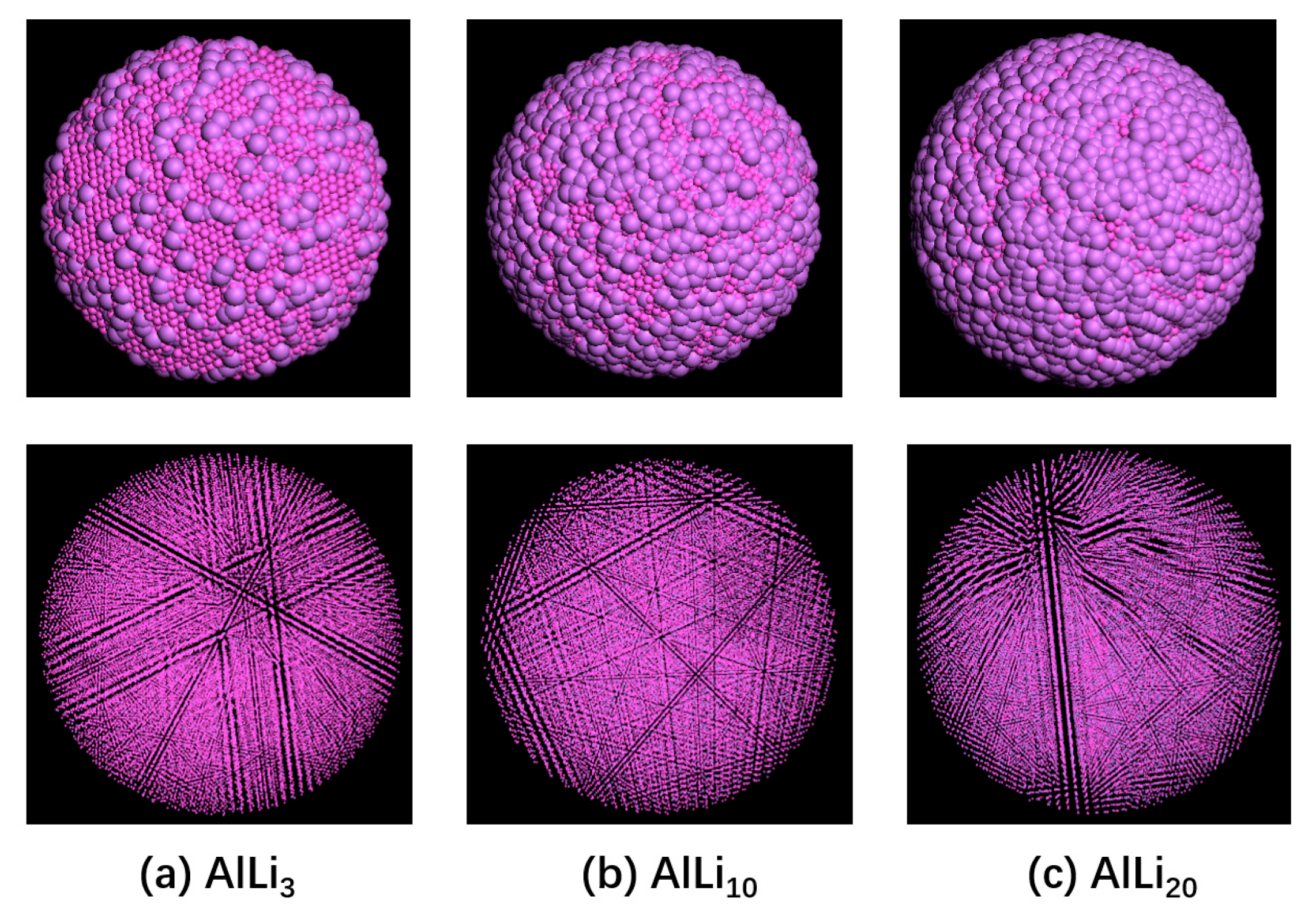
The Al/Li nanoclusters with a diameter of 10 nm were prepared on the basis of the optimized amorphous Al/Li structures to mimic the spherical powders in practical use. The clusters with Li contents of 3, 10, and 20 wt% are illustrated in Figure 1. It is evident the clusters consist of various α-Al regions surrounded by Li, corresponding to the “plates” and “channels”, as observed in SEM imagines. As the Li content increases, more and more Li atoms are accumulated on the surface and thus the “channels” are denser with finer bulk “plates”, which is in agreement with the experimental SEM observations [15]. Meanwhile, the dendrite inside the Al/Li alloys has been simulated successfully. The uniformly distributed dendrites support that the Al/Li alloys are fairly stable without any observable segregation [15,16]. The higher the Li content, the finer the dendrite. Temporal evaluations of MSD of Li atoms inside the Al/Li alloys are depicted in Figure S1. For all the Li contents (e.g., 2–50 wt%) of our interest, the diffusion of Li atoms is negligible at 300 K, implying that the amorphous Al/Li structures are stable enough under ambient conditions.
As the Li content increases, the density of the Al/Li alloy decreases exponentially. On the basis of the CVFF-predicted data, the best-fit density of the AlLim alloy could be expressed as a function of the Li content of m wt%, viz.,
ρ = ρ L i + ( ρ A l ρ L i )   e x p m / 23.92
The crystalline densities for δ’-Al3Li (m~8 wt%) and β-AlLi (m~20.6 wt%) phases are 2.263 g/cm3 and 1.743 g/cm3, respectively. With the same Li contents, the densities for the amorphous Al/Li phase are only 2.08 and 1.45 g/cm3, respectively. Evidently, as the Li atoms are introduced to α-Al lattice, the Al/Li alloys appear to become less dense-packed than the crystalline alloy phases because of the significant difference in the bonding characters of Li from Al.
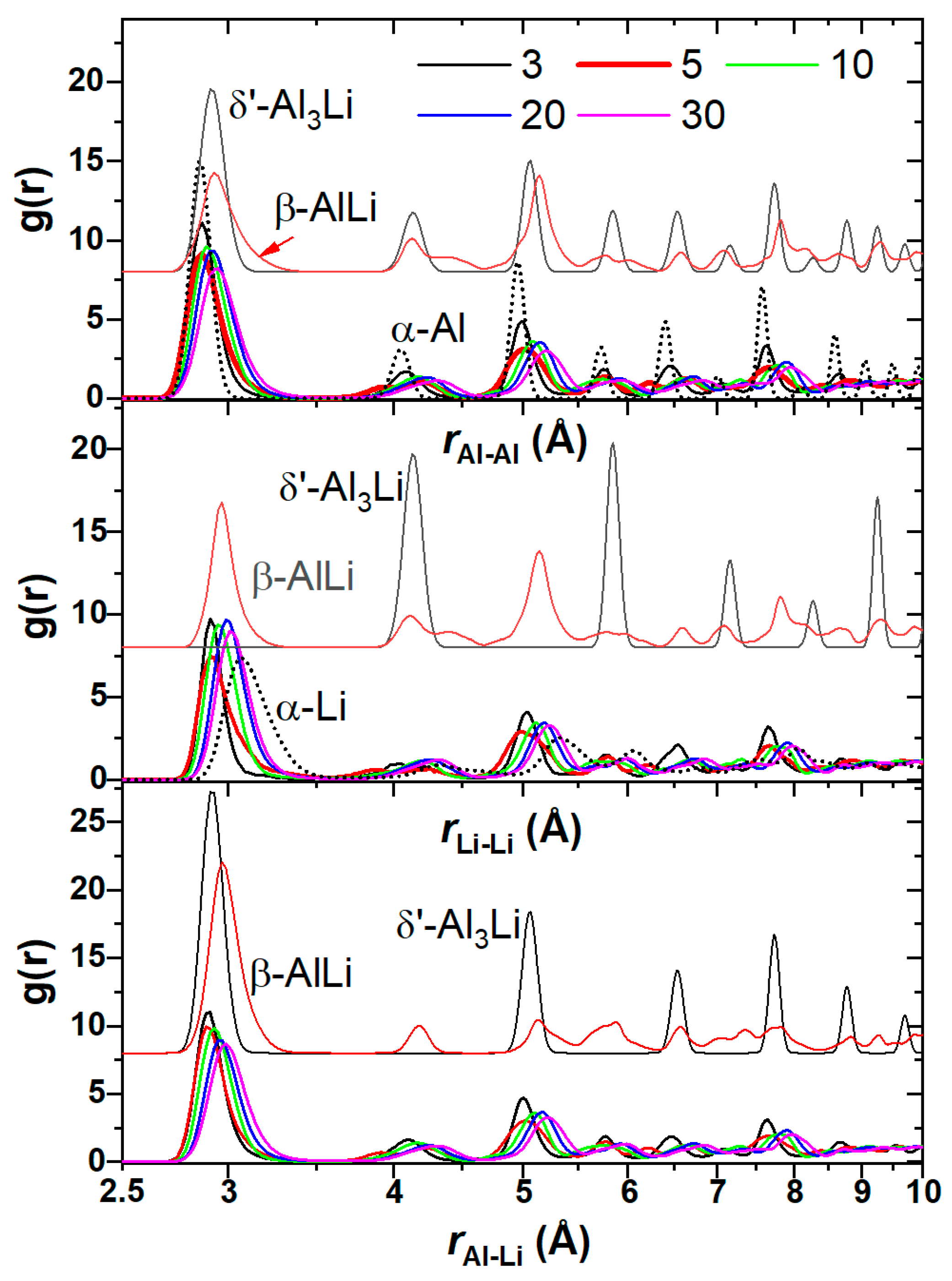
The radial distribution functions g(r) for Al-Al, Li-Li, and Al-Li pairs in the Al/Li alloys are shown in Figure 2 for the typical Li contents of 3, 5, 10, 20, and 30 wt% for comparison. The full g(r) plots for all the alloys are given in Figures S2–S4 in the Supporting Information. Apparently, the Al-Al bond is elongated as the Li atoms are doped to the lattice. For a Li content less than 10 wt%, the Al-Al distances are similar to those in the δ’-Al3Li phase. As the Li content increases above 20 wt%, the Al-Al distribution is close to that in the β-AlLi phase. Similar observation can be obtained for the Al-Li interaction. It was suggested experimentally that the dominant components of the Al/Li alloys at a low Li content include α-Li and δ’-Al3Li, and the β-AlLi phase appears only for high Li content [15]. The present MD simulations support the experimental results. For the Li-Li pairs, the bond distances are always shorter than those in the pure α-Li, indicating that the Li-Li interaction could be enhanced because of Al participation. Note that the Li-Li bonding is analogous to that in the β-AlLi phase for all the Al/Li alloys of concern.
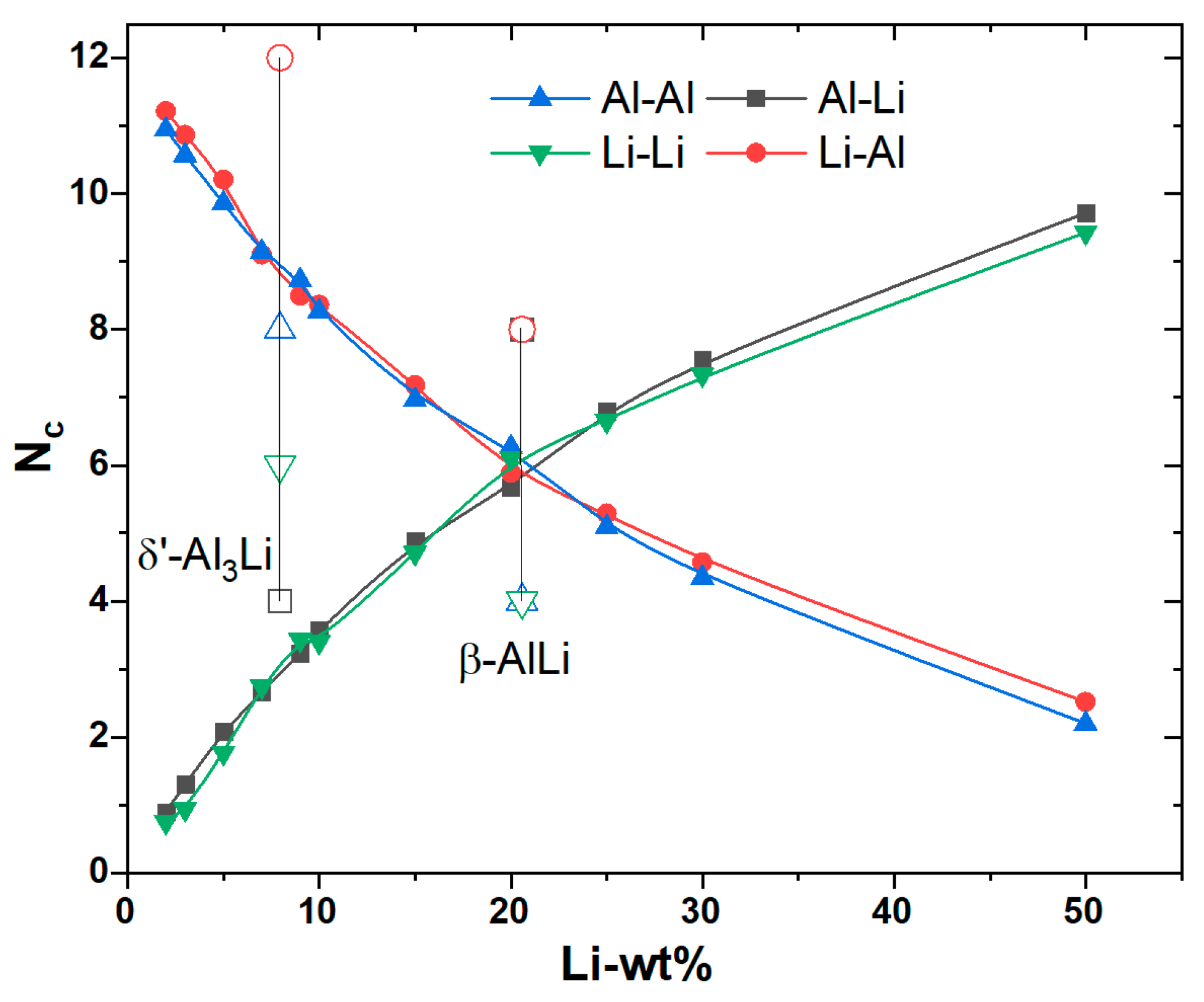
The atom–atom coordination numbers of the Al/Li alloys are shown in Figure 3. Apparently, the Al-Al and Li-Al coordination is nearly identical regardless of the Li contents. However, both Al-Al and Li-Al bond distances do depend on the fractions of Li. As the Li contents increase from 2% to 50%, the Li-Al bond distances increase from 2.90 Å to 3.02 Å, indicative of the weakened Li-Al interaction. Interestingly, the Al-Al bond lengths in the alloys increase as well from 2.86 Å to 2.98 Å, which are 0.01 Å~0.13 Å longer than that in the pure Al. Therefore, the addition of Li to Al melt can deteriorate the Al-Al binding, as shown by the reduction in CED (Table 4). Meanwhile, both Al and Li atoms coordinate equally with the surrounding Li atoms. Obviously, the inter-atom coordination depends strongly on the Li contents. The number of the coordinated Al decreases exponentially from 12 in the crystalline α-Al to roughly 2 in the Al/50 wt% Li alloy. The Al-Li coordination number increases from ~1 in Al/2 wt% Li alloy to ~10 in the Al/50 wt% Li alloy, while the coordination numbers for all the atoms are nearly the same, i.e., 6, in the Al/20 wt% Li alloy. The crystalline β-AlLi exhibits a completely different coordination state, i.e., 8 for Li-Al and Al-Li and 4 for Al-Al and Li-Li, although its Li-content is about 20%. In comparison with δ’-Al3Li, the amorphous Al/Li with the same Li content (~8%) has similar Al-Al and Al-Li coordination numbers but both Li-Al and Li-Li coordination states deviate considerably. Therefore, the amorphous Al/Li alloys generate novel bonding structures rather than the simple metallic admixing or doping with respect to the crystalline alloys.
The miscibility of the Al/Li alloys could be understood in terms of the CED data in Table 4. Although the CED of the alloys decreases exponentially as the Li content increases, the energy of mixing of Al/Li blends changes nonlinearly with respect to the Li content. Local minima exist at 3, 9, and 20 wt% of Li, where that for the Al/3 wt% Li miscibility is only 0.19 × 10¹⁰ J/cm3, which is close to that for the crystalline δ’-Al3Li (0.16 × 10¹⁰ J/cm3), and that for Al/20 wt% Li is 0.23 × 10¹⁰ J/cm3, which is incomparable with β-AlLi (0.22 × 10¹⁰ J/cm3).
In order to clarify the bonding mechanisms between Al and Li, a few AlnLim (n, m = 0–4) clusters were optimized by means of ab initio calculations to obtain the structures and bond energies (Figure S5 and Table S1 in the Supporting Information). First, all the Al-Al, Li-Li, and Al-Li bond distances exhibit strong dependence on the bonding environment. For instance, the Al-Al bond decreases from the longest 2.999 Å in Al2 dimer to the shortest 2.340 Å in tetramer Al4. The Al-Li bonds are shortened more or less with respect to 2.863 Å in AlLi. Second, the bond energy of Al-Li is in between that of Al-Al and Li-Li for the two to three atomic clusters. However, the Al-Li bond seems to be enhanced in Al3Li and Al2Li2 clusters. The tetrahedral Al3Li cluster exhibits greater stability than the Al4 cluster in view of the Al3-Li bond energy. The Gibbs free energy for the Li-substitution reactions of the Aln clusters is summarized in Table 5. It is evident that only the formation of Al3Li by the reaction of Al4 with Li is thermodynamically spontaneous, in accordance with the presence of the δ’-Al3Li phase in the Al/Li alloys. The formation of high-Li-content alloys such as Al2Li and AlLi2 is unfeasible under ambient conditions.
Apparently, the structural characteristics of the Al/Li alloys exert great influence on their mechanical properties. In general, the bulk and shear moduli of the Al/Li alloys are much lower than those of α-Al. Particularly, the shear moduli of the alloys are at most half of the pure Al. However, the changes in bulk and shear moduli with respect to the Li contents in the alloys are nonlinear since a maximum exists at the 3 wt% Li content. The bulk modulus of Al/3 wt% Li is even similar to that of δ’-Al3Li (56 GPa), which is higher than that of β-AlLi (37 GPa). In view of the Young’s moduli, the anisotropic effect is evident for the alloys. The Young’s moduli at x and z directions for the Al/Li alloys with a Li content less than 5% are significantly higher than those of the pure Al. For example, the Ex and Ez moduli of the Al/Li-3 wt% alloy increase from 58 GPa of isotropic α-Al to 82 GPa and 70 GPa, respectively. Experimentally, it was found that the addition of 3 wt% Li to α-Al increases the specific Young’s modulus by around 30%, i.e., 86 GPa [16], which is in line with the current work. Such an enhanced stiffness for the alloys results from the specific inter-atomic binding between Al and Li. Along the x-direction, the Li atoms are intercalated between the layered Al sheets with the covalent bonding interaction instead of the long-range van der Waals interaction. As the Li content increases, the stiffness of the alloys decreases rapidly in all directions because the weak Al-Li and Li-Li interaction plays more and more important roles in the alloys.

3.2. The Al/Li/O Oxidation Shell

The amorphous Al2O3 bulk phase was simulated first for the sake of force-field validation. The experimental Neutron and X-ray spectra for a-Al2O3 could be well reproduced by the MD simulations (Figure S6) [55]. The radial distribution functions are in agreement with the experimental data as well (Figure S7) [55,56]. Peaks for Al-O, O-O, and Al-Al are 1.81, 2.85, and 3.21 Å, respectively, which is in line with the experimental 1.8, 2.8, and 3.2 Å. The Al-O coordination number was calculated to be 4.35, in accordance with the experimental 4.1, 4.25–4.63 by other MD simulations with different force fields, and 4.6 by the ab initio MD study [55,56,57,58,59]. The density of a-Al2O3 was calculated to be 2.943 g/cm3 at 300 K and 1 atm, while the experimental density ranges from 2.8 to 3.0 g/cm3. The Young’s modulus for a-Al2O3 was predicted to be 103 GPa, with good isotropic character (e.g., 112.5, 103.8, and 105.4 GPa for x, y, and z components), which was underestimated by about 15% with respect to the experimental value of 122 ± 12 GPa [60]. In contrast, the amorphous Li2O is only an energetically metastable state because it can transform spontaneously to the stable α-Li2O layered structure after extensive annealing. The calculated bulk modulus for α-Li2O is 84.7 GPa, while the experimental value is 2.7 GPa lower [61]. Overall, the ClayFF force field performs well in the MD simulations of the Al/O and Li/O systems. The MD-calculated densities and elastic moduli for the Al/Li/O oxides with Li contents from 2 to 50 wt% are listed in Table 6.
The density of a-Al2O3 is significantly reduced as the Li atoms are introduced to form the admixture of Al2O3 and Li2O. Therefore, the oxidation shell of the Al/Li alloy becomes less dense than the alumina shell of the Al particle. On the other hand, the densities of Al/Li/O are generally higher than the corresponding Al/Li alloys with the same Li contents. As a result, being analogous to the Al/Al2O3 particles, the Al/Li/O oxidation prefers to form the spherical shells outside the Al/Li alloys. However, the stiffness of the Al/Li/O shell is lowered considerably in comparison with the alumina. Although all the mechanical properties somehow exhibit fluctuations along with the Li contents, the elastic moduli of the Al/Li/O oxides are reduced roughly by 30~50% for the 2~50 wt% Li contents. It is conceivable that the oxidation layers formed outside the Al/Li alloys might not be protective as efficiently as those for the neat Al in terms of density and stiffness.
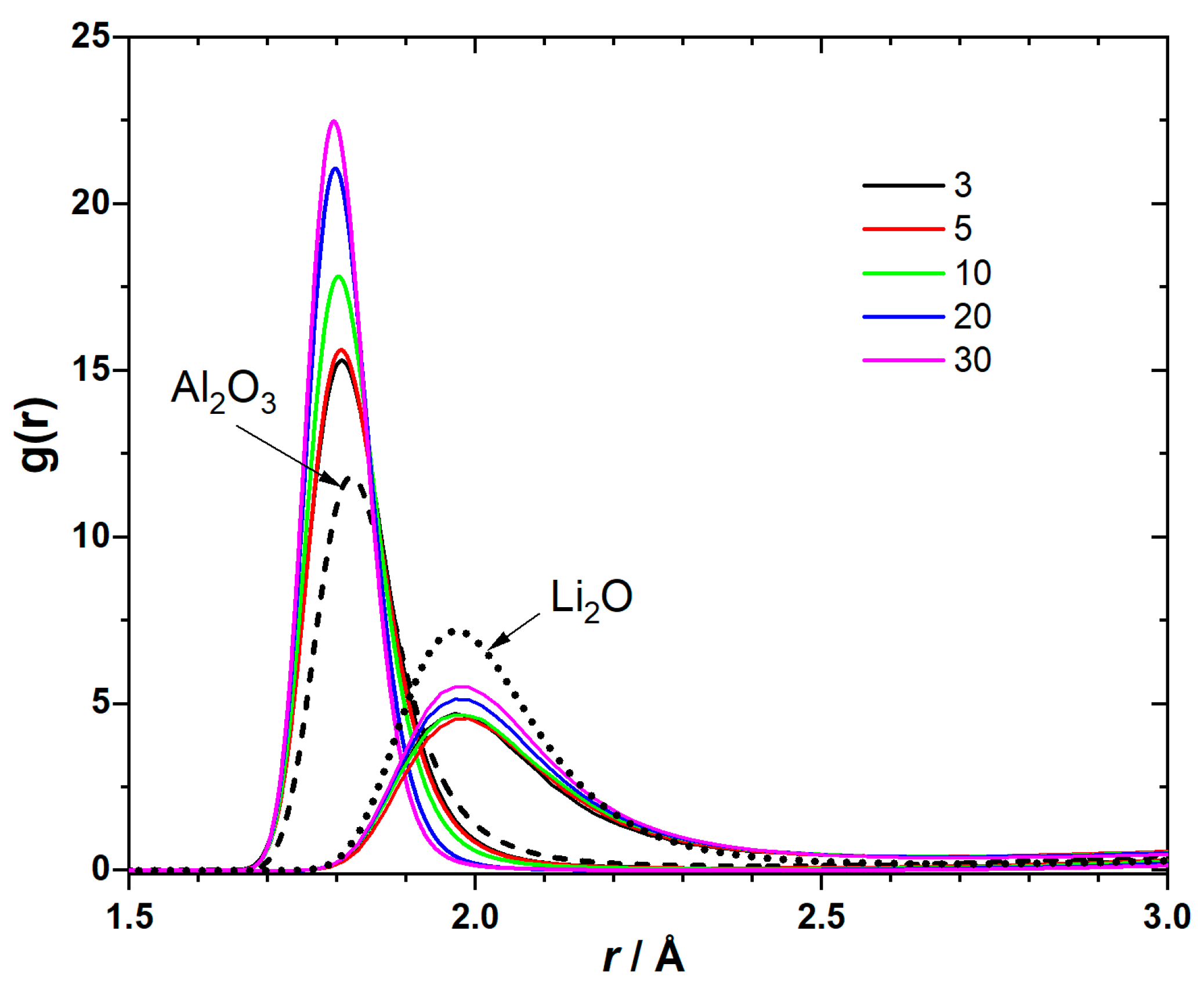
Microstructures of the Al/Li/O oxides were analyzed by means of radial distribution functions for Al-O and Li-O. As shown in Figure 4 (also Figure S8), the Al-O peaks are shifted to the shorter distances with respect to Al2O3. The higher the Li content, the shorter the Al-O bonds, as indicative of the stronger Al-O bonding interactions. Moreover, the strength of the peak increases with the increase in the Li content, indicating that the amorphous Al2O3 phase in the Al/Li/O oxide should be even more ordered in the presence of Li. In contrast, the Li-O peaks at 1.97 Å show little change, but the strength is lowered significantly. Therefore, the Li-O bonding in the Al/Li/O might be even weaker than that in the metastable Li2O.
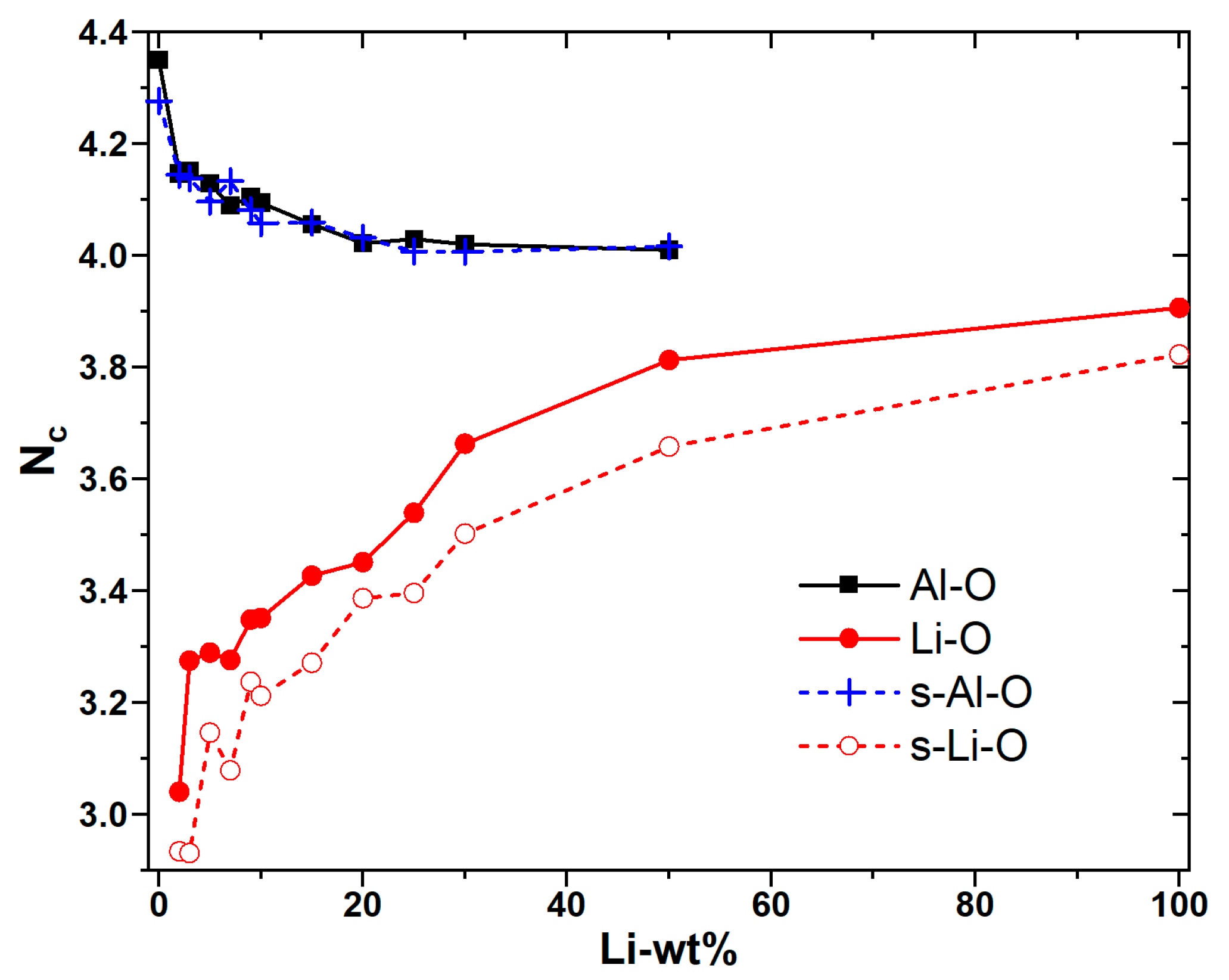
The coordination numbers for Al-O and Li-O are shown in Figure 5. The amorphous Al2O3 is composed of a majority of AlO4 units and a minority of AlO6, with an averaged coordination number of 4.35. Even with the addition of 2 wt% Li, the Al-O coordination number decreases from 4.35 to 4.15. While the Li content increases to 20 wt% and above, the Al-O coordination number keeps constant at 4, namely, the four-coordinated AlO4 tetrahedral structures remains in the Al/Li/O oxides. Apparently, the existence of Li can destroy the dense Al2O3 structure, in which the saturated AlO6 knots are transformed to less coordinated AlO4. Although the structure of amorphous Al/Li/O becomes more ordered than that of a-Al2O3, it is evident that the reactivity of Al/Li/O oxides is enhanced due to the increasing 4-coordinated Al. As for the Li-O bonds, the coordination number increases from 3.0 for Li-2 wt% to 3.8 for the metastable a-Li2O, which is lower than 4 for the crystalline α-Li2O. As a result, the mechanical property of the Al/Li/O oxides is deteriorated to some extent.
The Al/Li/O oxides are closely related to the stability of the Al/Li alloys because they are exposed to the ambient environment. Therefore, the Al/Li/O surfaces have been simulated as well to compare with the bulk oxides. As could be seen in Figure 5, the Al-O coordination states on the surface are almost identical to those in the oxide bulks for all the Li contents of concern, implying that the Al-O bonding remains unchanged from bulk to surface. In contrast, the Li-O coordination numbers on the surface are always smaller by about 0.2 than those in the bulk phase. Therefore, the Li atoms in the Al/Li/O oxides appear to be more reactive after they are transferred from the inner shell to the surface upon exposure to the air.
The temporal MSD profiles for Al/O and Li atoms in the Al/Li/O oxides with various Li contents are shown in Figures S9 and S10, respectively. At 300 K and 1 bar, the self-diffusion coefficients for Al and O in a-Al2O3 were calculated to be 4.2 and 1.4 in the unit of 10−15 m2/s, respectively. In the Al/Li/O oxides, the diffusion coefficients of Al and O appear to be higher than those in the a-Al2O3 phase by one to two orders of magnitude and increase with the Li contents. For instance, the diffusion coefficients for Al and O with 3 wt% Li addition are 1.4 and 1.3 in the unit of 10−14 m2/s, respectively. For the highest Li content of interest, the diffusion coefficients for Al and O in the Li-wt50% bulk are 1.3 and 2.2 in the unit of 10−13 m2/s, respectively. Evidently, the presence of Li leads to faster O diffusion than Al in the Al/Li/O oxides, which is contrary to a-Al2O3.
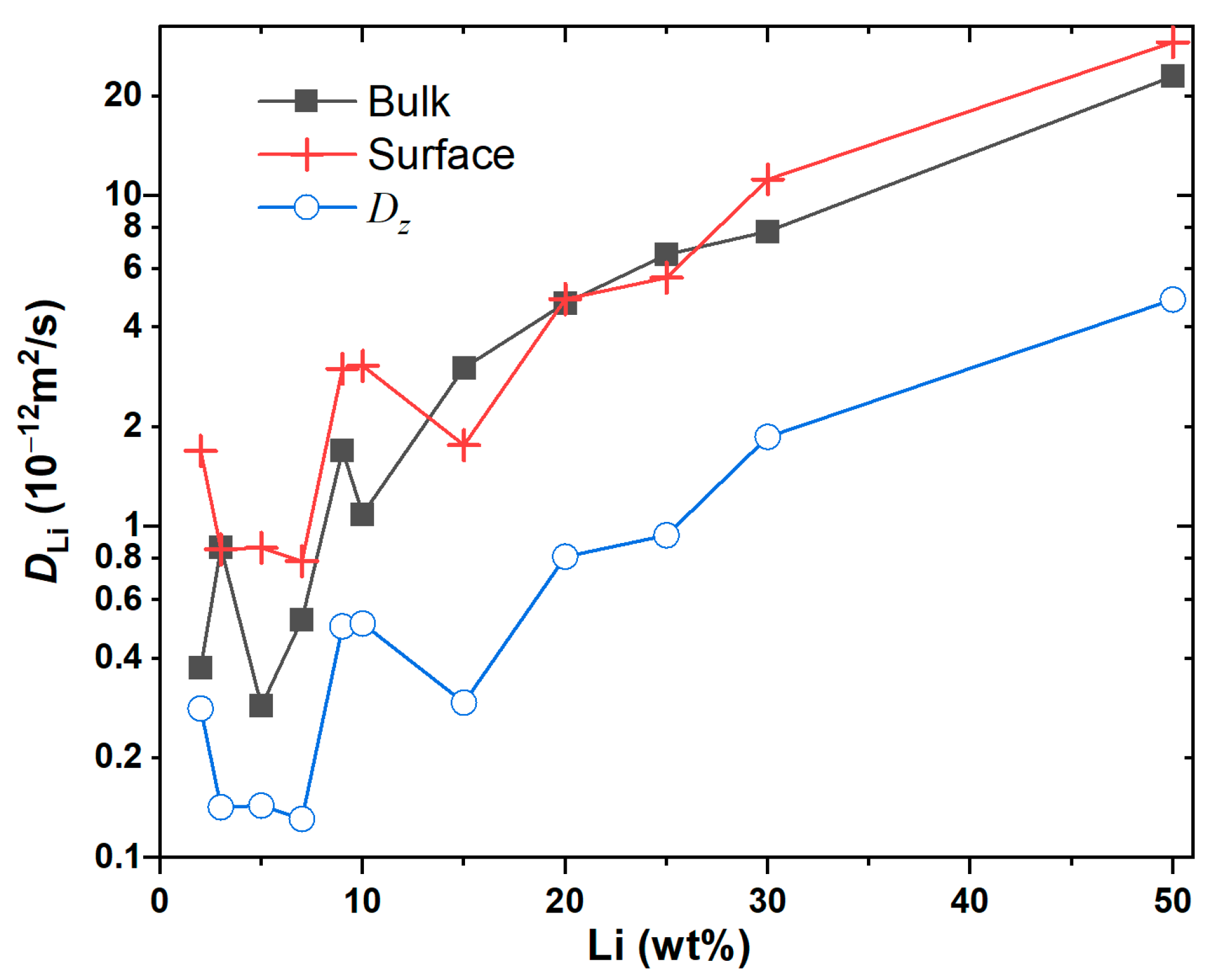
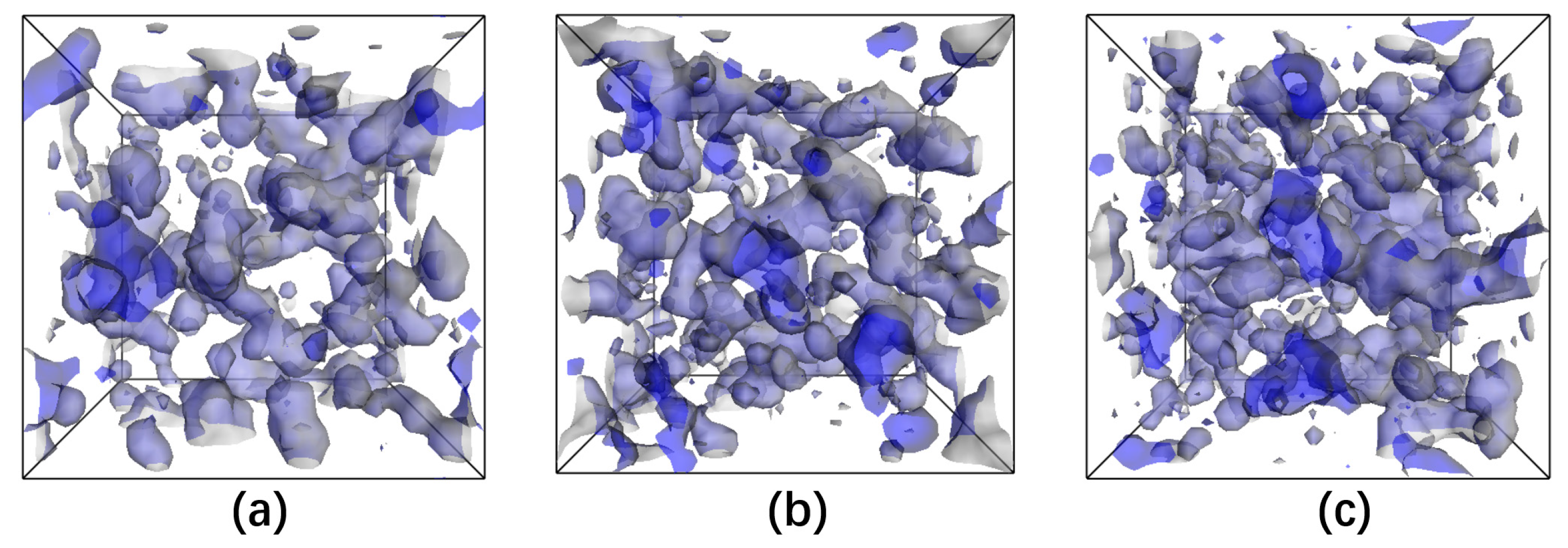
The diffusion of Li in the Al/Li/O is much more efficient than that of Al and O by about two orders of magnitude. The Li-dependent diffusion coefficients are shown in Figure 6. Although the theoretical diffusion coefficients might be subjected to significant uncertainty, the diffusion of Li at low Li content oxides exhibit complex dynamic behavior. The Al/Li/O with a Li content of 5 wt% appears to have the slowest Li diffusion. As the Li contents increase further, the diffusion coefficients of Li increase monotonically. Free cavities for the Li atoms in the Al/Li/O oxides were obtained by removing all the Li atoms from the unit cells and then calculating the Connolly van der Waals isosurface on the basis of Al and O, as shown in Figure 7 for 3, 10, and 20 wt% Li contents. Apparently, the Li ions tend to aggregate at the vacancies of the AlO4 framework at the 3 wt% Li content and thus are localized as the nanoclusters with slow diffusion coefficients. As the Li content increases to 10 wt%, the distribution of Li ions becomes highly uniform in the unit cell. More importantly, the microchannels are formed by crosslinking all the AlO4 pores, leading to preferable Li diffusion along these continuous pathways. As the Li content increases to 20 wt%, the Li ions passages seem to be transparent, and thus, the self-diffusion of Li is even aggressive.
The diffusion of Li on the surface is close to that in the bulk phase, except for the Li contents below 10%. In view of the diffusion of Li outward from the surface, the Li contents within 3–7 wt% seem to involve generally low diffusion coefficients. It is conceivable that the Al/Li alloys with 3–7 wt% Li content might exhibit particular stability after exposure.
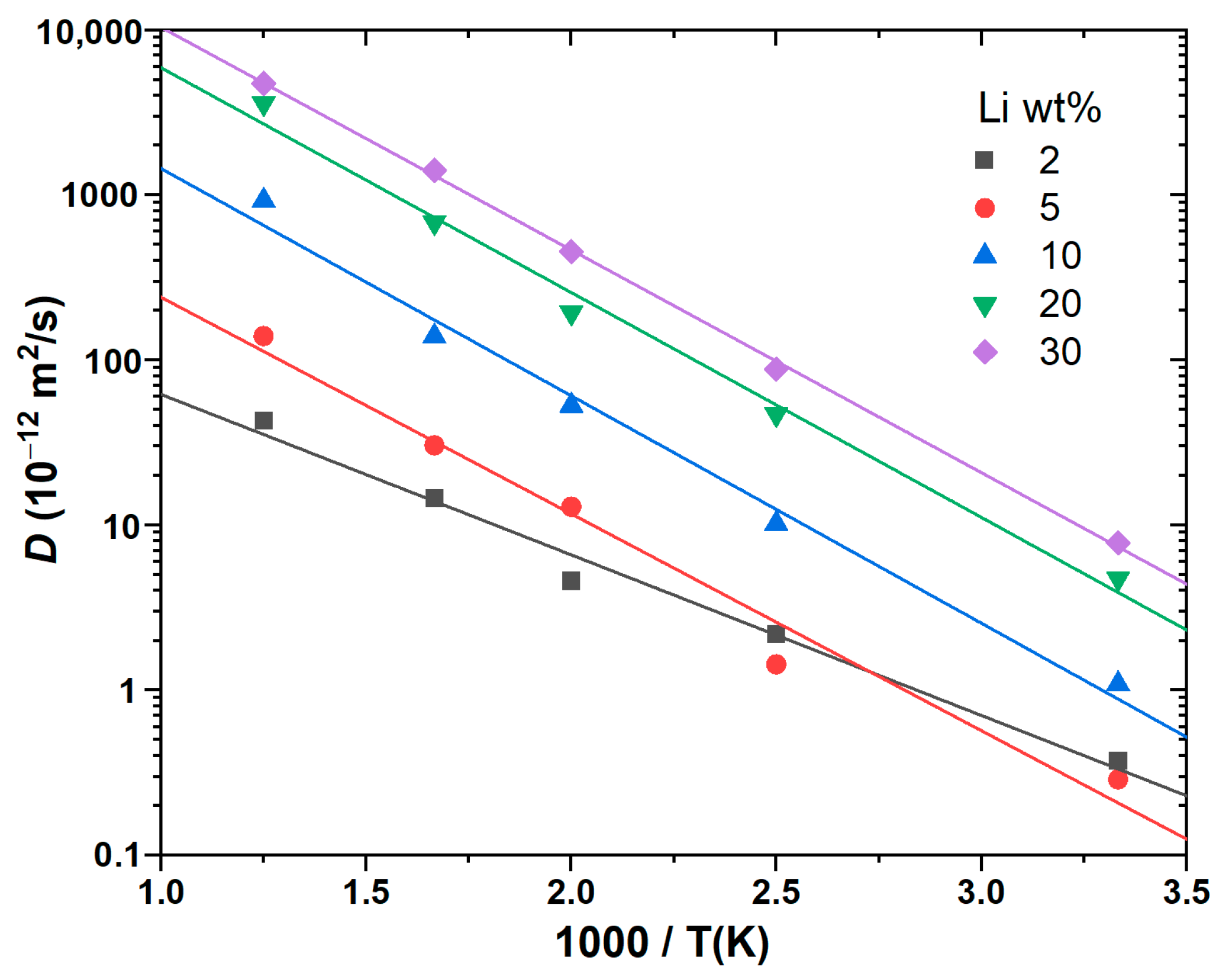
The temperature-dependent self-diffusion coefficients for Li ions in the Al/Li/O oxides are shown in Figure 8. The higher the temperature, the faster the diffusion. The best-fit activation energy for the Li content 2 wt% is 19 kJ/mol. For a Li content above 5 wt%, the activation energy is nearly constant at 26 kJ/mol regardless of Li contents. Note that the activation energy for Li migration in α-Li2O polycrystal was measured to be 98 kJ/mol [62]. It is evident that the Li ions can be viewed as an effectively liquid-like fluid state in the Al/Li/O oxidation shell, which is the major factor in determining the stability of Al/Li alloys.

4. Conclusions

The structures, energetics, mechanical properties, and transportation dynamics of Al/Li alloys and the Al/Li/O oxides have been assessed theoretically using force-field MD simulations together with ab initio calculations. It is shown that the structures and properties of Al/Li and Al/Li/O systems depend strongly on the Li contents. Structurally, the Al/Li alloys are composed of fine α-Al plates surrounded by the dense Li channels with the uniformly distributed fine dendrites. The densities of the Al/Li alloys decrease exponentially with the Li contents. The addition of Li weakens the Al-Al interaction but enhances the Li-Li interaction. The presence of δ’-Al3Li for low Li contents and β-AlLi for high Li contents in the Al/Li alloys has been understood in terms of the Al/Li distributions. The formation of Al3Li by the reaction of Al4 with Li is thermodynamically spontaneous under ambient conditions. Both Al and Li atoms in the Al/Li alloys are resident in the same Al or Li environment. An azeotropic-like state for the Al/Li alloy with the homogenous six-coordinated configuration is formed with the Li content of 20 wt%. The enhanced Young’s moduli for the low Li-connect Al/Li alloys is ascribed to the anisotropic effect.
The Al/Li/O oxidation shell is less dense than the amorphous alumina, but the densities of oxides are generally higher than the corresponding Al/Li alloys. The mechanical property of alumina is deteriorated considerably because of the addition of Li. The elastic moduli of the Al/Li/O oxides can be reduced by 30~50% due to the 2~50 wt% Li contents. The existence of Li can destroy the saturated AlO6 knots, leading to the ordered four-coordinated AlO4 tetrahedral structures together with the under-coordinated Li-O states. The diffusion of the Li ion in the Al/Li/O oxides is faster than that of Al and O by about two orders of magnitude. At low Li contents, the Li ions tend to aggregate at the vacancies of the AlO4 framework. As the Li content increases to 10 wt% and above, the distribution of Li ions becomes uniform, resulting in efficient diffusion through the continuous microchannels, as formed by the transparent AlO4 pores. The aggressive diffusion of Li ions in the Al/Li/O oxide bulks and surfaces appears to be the dominant factor regarding the incapability of the Al/Li/O oxides in improving the exposure stability of the Al/Li alloys.

Supplementary Materials

The following supporting information can be downloaded at: https://www.mdpi.com/article/10.3390/aerospace12121041/s1, Figure S1: Temporal mean-square deviation (MSD, in Å2) of Li atoms in the AlLim (m = 2–50 wt%) alloys; Figure S2: Radial distribution functions for Al-Al in various Al/Li alloys; Figure S3: Radial distribution functions for Li-Li in various Al/Li alloys; Figure S4: Radial distribution functions for Al-Li in various Al/Li alloys; Figure S5: The most stable geometries for the AlnLim clusters optimized at the M06-2X/aug-cc-pVTZ+d level of theory. Bond distances are in Å and angles are in degrees; Figure S6: Neutron and X-ray static structure function for amorphous Al2O3; Figure S7: Pair distribution functions of amorphous Al2O3; Figure S8: Pair distribution functions for Al-O and Li-O for various Al/Li/O oxide systems; Figure S9: Temporal mean square displacements (MSD) for Al (solid lines) and O (dashed lines) in the Al/Li/O oxides with the Li contents 2–50 wt%; Figure S10: Temporal mean square displacements (MSD) for Li atoms in the Al/Li/O oxides with the Li contents 2–50 wt% and in the amorphous Li2O; Table S1: the calculated Gibbs free energies for various AlnLim clusters.

Author Contributions

Conceptualization, L.B. and B.W.; methodology, M.Z.; software, J.X.; validation, M.Z., J.X. and N.G.; formal analysis, M.Z.; investigation, M.Z.; resources, L.B. and B.W.; data curation, M.Z.; writing—original draft preparation, M.Z.; writing—review and editing, H.H. and B.W.; visualization, M.Z.; supervision, H.H. and B.W.; project administration, B.W.; funding acquisition, B.W. All authors have read and agreed to the published version of the manuscript.

Funding

This research was funded by the Stable Support Plan for Basic Research Institutes (grant number WDZC20230201).

Data Availability Statement

Data are contained within the article.

Conflicts of Interest

The authors declare no conflicts of interest.

References

  1. Sippel, T.R.; Son, S.F.; Groven, L.J.; Zhang, S.; Dreizin, E.L. Exploring mechanisms for agglomerate reduction in composite solid propellants with polyethylene inclusion modified aluminum. Combust. Flame 2015, 162, 846–854. [Google Scholar] [CrossRef]
  2. Ao, W.; Fan, Z.; Liu, L.; An, Y.; Ren, J.; Zhao, M.; Liu, P.; Li, L.K.B. Agglomeration and combustion characteristics of solid composite propellants containing aluminum-based alloys. Combust. Flame 2020, 220, 288–297. [Google Scholar] [CrossRef]
  3. Ross, M.; Toohey, D.; Peinemann, M.; Ross, P. Limits on the space launch market related to stratospheric ozone depletion. Astropolitics 2009, 7, 50–82. [Google Scholar] [CrossRef]
  4. Terry, B.C.; Gunduz, I.E.; Pfeil, M.A.; Sippel, T.R.; Son, S.F. A Mechanism for Shattering Microexplosions and Dispersive Boiling Phenomena in Aluminum–Lithium Alloy Based Solid Propellant. Proc. Combust. Inst. 2017, 36, 2309–2316. [Google Scholar] [CrossRef]
  5. Diez, G.A.; Manship, T.D.; Terry, B.C.; Gunduz, I.E.; Son, S.F. Characterization of an Aluminum–Lithium-Alloy-Based Composite Propellant at Elevated Pressures. J. Propuls. Power 2021, 37, 332–337. [Google Scholar] [CrossRef]
  6. Xiong, W.; Liu, Y.; Zhang, T.; Wu, S.; Zeng, D.; Guo, X.; Pang, A. Effect of Al–Li Alloy on the Combustion Performance of AP/RDX/Al/HTPB Propellant. Aerospace 2023, 10, 222. [Google Scholar] [CrossRef]
  7. Li, J.; Cai, S.; Wang, L. Effect of Gas atomized Al-Li alloy powder on thermal decomposition of AP. Guangzhou Chem. Indust. 2019, 47, 32–35. [Google Scholar]
  8. An, J.; Ding, L.; Zhu, Y.; Chang, H.; Liang, Y. Effect of Al-Li powders on the thermal decomposition behaviors of AP. J. Solid Rocket Technol. 2016, 39, 383–387. [Google Scholar]
  9. Terry, B.C.; Sippel, T.R.; Pfeil, M.A.; Gunduz, I.E.; Son, S.F. Removing Hydrochloric Acid Exhaust Products from High Performance Solid Rocket Propellant Using Aluminum-Lithium Alloy. J. Hazard. Mater. 2016, 317, 259–266. [Google Scholar] [CrossRef]
  10. Chen, X.; Zhao, Z.; Hao, M.; Wang, D. Hydrogen generation by splitting water with Al–Li alloys. Int. J. Energy Res. 2013, 37, 1624–1634. [Google Scholar] [CrossRef]
  11. Zhang, T.; Yang, W.; Zhou, J.; Chao, C.; Liu, J.; Cen, K. Kinetics analysis and reaction characteristics of Al-Li alloys in water vapor. J. Solid Rocket Technol. 2015, 38, 79–82. [Google Scholar]
  12. Fan, M.; Sun, L.; Xu, F.; Mei, D.; Chen, D.; Chai, W.; Huang, F.; Zhang, Q. Microstructure of Al-Li alloy and its hydrolysis as portable hydrogen source for proton-exchange membrane fuel cells. Int. J. Hydrogen Energy 2011, 36, 9791–9798. [Google Scholar] [CrossRef]
  13. Hinojosa-Torres, J.; Rios-Jara, D.; Champier, G. Microstructural study of centrifugally atomized powders of Al-Li and Al-Li-Fe alloys. Mater. Trans. JIM 1990, 31, 703–709. [Google Scholar] [CrossRef][Green Version]
  14. Prasad, N.E.; Gokhale, A.A.; Wanhill, R.J.H. Aluminum-Lithium Alloys: Processing, Properties, and Applications; Elsevier Inc.: Oxford, UK, 2014; pp. 61–97. [Google Scholar]
  15. Zhu, Y.; Le, W.; Zhao, W.; Ma, X.; Liu, D.; Li, J.; Jiao, Q. Promising fuels for energetics: Spherical Al-Li powders with high reactivity via incorporation of Li. Fuel 2022, 323, 124393. [Google Scholar] [CrossRef]
  16. Noble, B.; Harris, S.J.; Dinsdale, K. The elastic modulus of aluminum-lithium alloys. J. Mater. Sci. 1982, 17, 461–468. [Google Scholar] [CrossRef]
  17. Mehl, M.J. Pressure dependence of the elastic moduli in aluminum-rich Al-Li compounds. Phys. Rev. B 1993, 47, 2493–2500. [Google Scholar] [CrossRef]
  18. Yu, H.; Duan, X.; Ma, Y.; Zeng, M. First Principles Study of Al-Li Intermetallic Compounds. Chin. J. Chem. Phys. 2012, 25, 659–665. [Google Scholar] [CrossRef]
  19. Alam, A.; Johnson, D.D. Structural properties and relative stability of (meta)stable ordered, partially ordered, and disordered Al-Li alloy phases. Phys. Rev. B 2012, 85, 144202. [Google Scholar] [CrossRef]
  20. Mao, Z.; Seidman, D.N.; Wolverton, C. The effect of vibrational entropy on the solubility and stability of ordered Al3Li phases in Al-Li alloys. APL Mater. 2013, 1, 042103. [Google Scholar] [CrossRef]
  21. Huang, Y.; Zhang, X.; Sun, S. First-principles study of crystal structure prediction, electronic, thermodynamic and mechanical properties of Al-Li binary system. Mater. Today Commun. 2021, 29, 102920. [Google Scholar] [CrossRef]
  22. Wu, Q.; Ud Din, M.A.; Guo, W.; Ma, Y.; Zhao, L.; Pan, N.; Cheng, N. Negative poisson’s ratio behavior of Al4Li9 alloy. Phys. Scripta 2024, 99, 025943. [Google Scholar] [CrossRef]
  23. Xue, C.; Zhang, Y.; Wang, S.; Tian, G.; Yang, X.; Ke, Y.; Xie, Z.; Wang, J. Achieving highest Young’s modulus in Al-Li by tracing the size and bonding evolution of Li-rich precipitates. J. Mater. Sci. Technol. 2023, 145, 125–135. [Google Scholar] [CrossRef]
  24. Zhou, Y.; Mao, Q.; Ng, S.; Chu, Q.; Liao, L.; Shi, B. Fundamental investigation on the micro-explosion of aluminum-lithium alloy particle. Combust. Flame 2025, 274, 113983. [Google Scholar] [CrossRef]
  25. Wang, H.; Duan, Z.; Guo, Q.; Zhang, Y.; Zhao, Y. Machine Learning Design of Aluminum-Lithium Alloys with High Strength. Comput. Mater. Continua 2023, 77, 1393–1409. [Google Scholar] [CrossRef]
  26. Li, G.; Xiao, W.; Li, X.; Li, Y.; Yan, L.; Li, Y.; Wen, K.; Yan, H.; Zhang, Y.; Wang, X.; et al. Atomic insights for elevated modulus in Al–Li alloys: Synergies and design strategy. J. Mater. Sci. 2024, 59, 18864–18881. [Google Scholar] [CrossRef]
  27. Moore, J.T.; Turns, S.R.; Yetter, R.A. Combustion of Lithium-Aluminum Alloys. Combust. Sci. Technol. 2005, 177, 627–669. [Google Scholar] [CrossRef]
  28. Xu, D.; Wang, F.; Li, S.; Huang, X.; Li, H.; Guo, Y. Laser-Induced Ignition and Combustion of Single Micron-Sized Al-Li Alloy Particles in High Pressure Air/N2. Aerospace 2023, 10, 299. [Google Scholar] [CrossRef]
  29. Lee, W.M.; Ford, R.D. Reactivity of Al-2.5 Pct Li alloy with water as studied by the exploding wire technique. Metall. Trans. 1988, 19, 255–259. [Google Scholar] [CrossRef]
  30. Cao, Z.; Hu, A.; Xia, B.; Pang, A.; Cai, S. Preparation and Characterization of Aluminum-Lithium Alloy Powder Coated by In-situ Polymerization of Styrene. Propell. Explos. Pyrotech. 2020, 45, 1141–1148. [Google Scholar] [CrossRef]
  31. Zhang, D.; Zou, H.; Cai, S. Effect of Iron Coating on Thermal Properties of Aluminum-Lithium Alloy Powder. Propell. Explos. Pyrotech. 2017, 42, 953–959. [Google Scholar] [CrossRef]
  32. Xiong, W.; Liu, Y.; Zhang, T.; Zeng, D.; Guo, X.; Pang, A. Effect of Al-Li alloy with various Li content on the energy and combustion performance of HTPB propellant. Defence Technol. 2025, 52, 319–328. [Google Scholar] [CrossRef]
  33. Yao, J.; Chang, K.; Yang, F.; Guo, X.; Bi, X.; Nie, J.; Yan, S.; Jiao, Q. Energy output characteristics of an enhanced aluminized explosive: Impact of Al-Li alloy fuel. Combust. Flame 2025, 275, 114064. [Google Scholar] [CrossRef]
  34. Harper, C.N.; Son, S.F. Theoretical passivation limits of binary aluminum-lithium alloys in oxygen and fluorine environments. Corros. Sci. 2025, 257, 113328. [Google Scholar] [CrossRef]
  35. Wang, H.; Wang, S.; Liu, X.; Zhu, Y.; Song, T.; Yu, H.; Fu, H.; Xu, K.; Zhu, H.; Zhao, Y.; et al. Preparation of Al-5Li@FSG powders through fluorination-energetic modification to improve the comprehensive performance of alloy powders. Chem. Eng. J. 2025, 506, 160210. [Google Scholar] [CrossRef]
  36. Le, W.; Zhao, W.; Zhu, Y.; Wei, Z.; Liu, Z.; Liu, D.; Jiao, Q. Stable aluminum-lithium alloy fuels for solid propellants by facile surface modifying. Chem. Eng. J. 2024, 497, 154451. [Google Scholar] [CrossRef]
  37. Le, W.; Zhao, W.; Zhu, Y.; Zeng, X.; Liu, D.; Jiao, Q. In-situ assembly of Al-Li-Si alloy powders with enhanced thermal stability and tailored combustion. J. Alloys Comp. 2023, 968, 172270. [Google Scholar] [CrossRef]
  38. Li, J.; Du, F.; Tang, C.; Wang, L.; Yang, Y.; Xia, D.; Zhang, J.; Tao, B.; Wang, P.; Lin, K. Selective coating fabrication and combustion performance of Al-5Li alloy particles with high stability and compatibility with HTPB. Mater. Today Commun. 2024, 41, 110335. [Google Scholar] [CrossRef]
  39. Fu, H.; Wang, S.; Liu, X.; Zhao, Y.; Wang, H.; Tang, S.; Zhu, H.; Yan, W.; Xu, K.; Zhu, L.; et al. High energy chelating coating improves the combustion performance and propellant compatibility of AL-5Li alloy powder. Fuel 2025, 395, 135181. [Google Scholar] [CrossRef]
  40. Zhu, J.; Wang, S.; Xiong, W.; Wang, J.; Li, X.; Zou, M. Preparation of core-shell structured Al-5Li@HTPB powders with improved stability and combustion performance by using perfluoroalkylsilane as a surfactant. Combust. Flame 2024, 264, 113326. [Google Scholar] [CrossRef]
  41. Sun, H.; Mumby, S.J.; Maple, J.R.; Hagler, A.T. An Ab-Initio CFF93 All-Atom Force Field for Polycarbonates. J. Am. Chem. Soc. 1994, 116, 2978–2987. [Google Scholar] [CrossRef]
  42. Halicioglu, T.; Pound, G.M. Calculation of Potential Energy Parameters from Crystalline State Properties. Phys. Stat. Sol. 1975, 30, 619–623. [Google Scholar] [CrossRef]
  43. Heinz, H.; Vaia, R.A.; Farmer, B.L.; Naik, R.R. Accurate Simulation of Surfaces and Interfaces of Face-Centered Cubic Metals Using 12-6 and 9-6 Lennard-Jones Potentials. J. Phys. Chem. C 2008, 112, 17281–17290. [Google Scholar] [CrossRef]
  44. Cygan, R.T.; Liang, J.J.; Kalinichev, A.G. Molecular Models of Hydroxide, Oxyhydroxide, and Clay Phases and the Development of a General Force Field. J. Phys. Chem. B 2004, 108, 1255–1266. [Google Scholar] [CrossRef]
  45. Zhao, Y.; Truhlar, D.G. The M06 suite of density functionals for main group thermochemistry, thermochemical kinetics, noncovalent interactions, excited states, and transition elements: Two new functionals and systematic testing of four M06-class functionals and 12 other functionals. Theor. Chem. Acc. 2008, 120, 215–241. [Google Scholar] [CrossRef]
  46. Woon, D.E.; Dunning, T.H., Jr. Gaussian-basis sets for use in correlated molecular calculations.3. The atoms aluminum through argon. J. Chem. Phys. 1993, 98, 1358–1371. [Google Scholar] [CrossRef]
  47. Dunning, T.H., Jr.; Peterson, K.A.; Wilson, A.K. Gaussian Basis Sets for Use in Correlated Molecular Calculations. X. The Atoms Aluminum Through Argon Revisited. J. Chem. Phys. 2001, 114, 9244–9253. [Google Scholar] [CrossRef]
  48. Mackie, I.D.; DiLabio, G.A. Approximations to complete basis set-extrapolated, highly correlated non-covalent interaction energies. J. Chem. Phys. 2011, 135, 134318. [Google Scholar] [CrossRef]
  49. Wood, G.P.F.; Radom, L.; Petersson, G.A.; Barnes, E.C.; Frisch, M.J.; Montgomery, J.A., Jr. A restricted-open-shell complete-basis-set model chemistry. J. Chem. Phys. 2006, 125, 094106. [Google Scholar] [CrossRef]
  50. Barnes, E.C.; Petersson, G.A.; Montgomery, J.A., Jr.; Frisch, M.J.; Martin, J.M.L. Unrestricted Coupled Cluster and Brueckner Doubles Variations of W1 Theory. J. Chem. Theory Comput. 2009, 5, 2687–2693. [Google Scholar] [CrossRef]
  51. Frisch, M.J.; Trucks, G.W.; Schlegel, H.B.; Scuseria, G.E.; Robb, M.A.; Cheeseman, J.R.; Montgomery, J.A.; Vreven, T.; Kudin, K.N.; Burant, J.C.; et al. Gaussian 16, Revision C.01; Gaussian, Inc.: Wallingford, CT, USA, 2019. [Google Scholar]
  52. Werner, H.-J.; Knowles, P.J.; Knizia, G.; Manby, F.R.; Schutz, M. Molpro: A General Purpose Quantum Chemistry Program Package. Wiley Interdiscip. Rev. Comput. Mol. Sci. 2012, 2, 242–253. [Google Scholar] [CrossRef]
  53. Mousavi, S.M.; Mao, Y.; Zhang, Y. Evaluation of copper, aluminum, and nickel interatomic potentials on predicting the elastic properties. J. Appl. Phys. 2016, 119, 244304. [Google Scholar] [CrossRef]
  54. Lin, C.; Yin, G.; Zhao, Y. Calculation of the cohesive energy of solids with the use of valence electron structure parameters. Comput. Mater. Sci. 2015, 101, 168–174. [Google Scholar] [CrossRef]
  55. Lamparter, P.; Kniep, R. Structure of amorphous Al2O3. Phys. B 1997, 236, 405–406. [Google Scholar] [CrossRef]
  56. Nakamura, R.; Toda, T.; Tsukui, S.; Tane, M.; Ishimaru, M.; Suzuki, T.; Nakajima, H. Diffusion of oxygen in amorphous Al2O3, Ta2O5, and Nb2O5. J. Appl. Phys. 2014, 116, 033504. [Google Scholar] [CrossRef]
  57. Gutierrez, G.; Johansson, B. Molecular dynamics study of structural properties of amorphous Al2O3. Phys. Rev. B 2002, 65, 104202. [Google Scholar] [CrossRef]
  58. Hoang, V.V. Molecular dynamics study on structure and properties of liquid and amorphous Al2O3. Phys. Rev. B 2004, 70, 134204. [Google Scholar] [CrossRef]
  59. Davis, S.; Gutierrez, G. Structural, elastic, vibrational and electronic properties of amorphous Al2O3 from ab initio calculations. J. Phys. Condens. Matter 2011, 23, 495401. [Google Scholar] [CrossRef]
  60. Alcala, G.; Skeldon, P.; Thompson, G.E.; Mann, A.B.; Habazaki, H.; Shimizu, K. Mechanical properties of amorphous anodic alumina and tantala films using nanoindentation. Nanotechnology 2002, 13, 451–455. [Google Scholar] [CrossRef]
  61. Hull, S.; Farley, T.W.D.; Hayes, W.; Hutchings, M.T. The elastic properties of lithium oxide and their variation with temperature. J. Nuclear Mater. 1988, 160, 125–134. [Google Scholar] [CrossRef]
  62. Oishi, Y.; Kamei, Y.; Akiyama, M. Self-diffusion coefficient of lithium in lithium oxide. J. Nuclear Mater. 1979, 87, 341–344. [Google Scholar] [CrossRef]
Figure 1. Metallographic images for the prototypical Al/Li clusters (10 nm in diameter). Upper panel: CPK images with 1.2 and 2.0 vdW radii for Al and Li, respectively. Lower panel: Line images.
Aerospace 12 01041 g001
Figure 2. Radial distribution functions for Al-Al, Li-Li, and Al-Li pairs in the Al/Li alloys. The crystalline phases for α-Al, α-Li, δ’-Al3Li, and β-AlLi are shown for comparison.
Aerospace 12 01041 g002
Figure 3. Coordination numbers of Al-Al, Al-Li, Li-Li, and Li-Al for the AlLin alloys (solid symbols) as a function of Li content. The data for the crystalline δ’-Al3Li and β-AlLi are included (open symbols) for the purpose of comparison.
Aerospace 12 01041 g003
Figure 4. Radial distribution functions for Al-O and Li-O in the Al/Li/O bulk systems with the Li contents of 3, 5, 10, 20, and 30 wt%.
Aerospace 12 01041 g004
Figure 5. Coordination numbers of Al-O and Li-O for the Al/Li/O bulk (solid lines) and surfaces (dashed lines).
Aerospace 12 01041 g005
Figure 6. Diffusion coefficients of Li atoms for the Al/Li/O bulks and surfaces and the azimuthal z-component (Dz) with various Li contents.
Aerospace 12 01041 g006
Figure 7. Free cavities for the Li atoms in the bulk Al/Li/O oxides, as shown by the Connolly iso-surface of Al/O. (a) 3 wt%. (b) 10 wt%. (c) 20 wt%.
Aerospace 12 01041 g007
Figure 8. Temperature-dependent self-diffusion coefficients for Li ions in the Al/Li/O oxides with different Li contents.
Aerospace 12 01041 g008
Table 1. Potential energy parameters in various force-fields.
Force-FieldsAtomic TypesRe (Å)ε (kcal/mol)Charges
PCFFAl2.99643.32320
Li3.24940.72140
CVFFAl2.94099.0430
Li3.18674.7350
ClayFFAl4.79431.3298 × 10−5+1.575
Li4.72579.0298 × 10−6+0.525
O3.55320.1554−1.05
Table 2. Lattice parameters for various Al/Li crystalline bulks.
Crystals (Space Group)PCFF (Å)CVFF (Å)Experiment (Å)
α-Al (Fm-3m)4.034.044.05
α-Li (Im-3m)3.503.503.51
δ’-Al3Li (Pm-3m)4.104.124.01
β-AlLi (Fd-3m)6.686.736.37
β’-AlLi (I41/amd)4.83, 6.384.95, 6.214.48, 6.34
Table 3. Lattice parameters and bond lengths for the Al/Li/O oxides a.
Crystals (Space Group)abcAl-OLi-O
α-Al2O3(R-3c)4.854.8513.361.877/2.041
4.764.7612.991.856/1.969
α-Li2O(Fm-3m)4.624.624.62 1.998
4.624.624.62 2.0
α’-Li2O(R-3m)3.263.267.99 1.998
3.623.627.97 1.992
γ-LiAlO2(P41212)5.305.306.371.79/1.802.01/2.11
5.175.176.301.75/1.781.94/2.08
β-Li5AlO4(Pmmm)6.466.454.681.77/1.781.97/2.11
6.426.304.621.75/1.781.94/2.16
a All data are in Å. The experimental data are given in Italics.
Table 4. Density (ρ, in g/cm3), elastic modulus (K, G, Ex, Ey, Ez, in GPa), and cohesive energy density (CED, in kcal/mol/atom) of the Al/Li alloys a.
Species
(AlLi-wt%)
Formula
AlnLi
ρ (PCFF)ρ (CVFF)KGExEyEzCED
Aln/a2.6672.699 (2.7)79.9 (76.3)41.758.158.158.176.8 (78.2)
AlLi212.72.4322.43853.820.684.228.378.970.7
AlLi38.382.3642.377 (2.41)54.724.882.039.569.870.2
AlLi54.932.2072.224 (2.24)47.422.567.145.936.267.3
AlLi73.442.0302.077 (2.10)40.512.929.333.928.964.8
AlLi92.621.9451.972 (1.92)39.115.442.335.140.062.9
AlLi102.331.9051.90835.513.629.525.347.161.9
AlLi151.471.6611.671 (1.68)29.913.821.426.945.357.5
AlLi201.041.4801.49724.812.819.927.034.755.0
AlLi250.781.3231.33719.59.619.724.424.351.8
AlLi300.601.1921.22116.79.128.817.127.650.0
AlLi500.260.8420.8979.65.719.512.713.144.8
Li00.4250.532 (0.53)12.9 (12.3)3.93.23.23.238.7 (37.8)
a The data in parentheses are taken from the experimental densities in [15], the moduli in [16,53], and the CED in [54].
Table 5. Gibbs free energy (ΔGr,298, in kcal/mol) for the Li-substitution reactions calculated at various levels of theory.
ReactionsM06-2X/AVTZCCSD(T)/CBSCBS-QB3W1
Al2 + Li ⟶ AlLi + Al2.72.62.32.7
Al3 + Li ⟶ Al2Li + Al16.615.416.416.2
Al4 + Li ⟶ Al3Li + Al−2.7−7.0−5.9−6.6
Al3Li + Li ⟶ Al2Li2 + Al17.217.618.618.1
Table 6. Densities (ρ, in g/cm3) and elastic moduli (K, G, E, in GPa) for the Al/Li/O systems.
SpeciesUnit Cell CompositionρKGE
a-Al2O3Al500O7502.943 (2.8–3.0)86.139.6103.0 (122 ± 12)
AlLi2OAl500Li40O7702.47563.128.674.5
AlLi3OAl500Li60O7802.41654.025.265.4
AlLi5OAl500Li102O8012.44457.627.270.5
AlLi7OAl500Li146O8232.36050.624.964.2
AlLi9OAl500Li190O8452.35946.422.959.0
AlLi10OAl500Li214O8572.31347.425.164.0
AlLi15OAl500Li340O9202.26743.723.158.9
AlLi20OAl500Li482O9912.18940.221.254.1
AlLi25OAl500Li642O10712.14537.320.652.2
AlLi30OAl500Li826O11632.14637.320.652.2
AlLi50OAl500Li1928O17142.07836.419.449.4
a-Li2OLi1500O7501.88938.422.556.5
Disclaimer/Publisher’s Note: The statements, opinions and data contained in all publications are solely those of the individual author(s) and contributor(s) and not of MDPI and/or the editor(s). MDPI and/or the editor(s) disclaim responsibility for any injury to people or property resulting from any ideas, methods, instructions or products referred to in the content.