1. Introduction
Air transportation is a complex system [
1] with several elements (aircraft, airports, air traffic control systems, humans, etc.) interacting with each other to ensure a safe traffic flow. In the past, it has faced several challenges exacerbated by the traffic increase experienced (despite the COVID-19 crisis) [
2], such as those relating to the aim to increase its capacity without degrading current safety levels or the goal to have improvements in efficiency and the environment. SESAR is currently addressing these new challenges in Europe [
3], while NextGen is doing the same in the United States [
4].
Safety is the core element of the aviation system as it connects all the elements relating to it [
5]. It plays a key role in determining the system’s capacity by constraining it with fixed separation standards. ICAO defines safety as ‘the state in which risks associated with aviation activities, related to, or in direct support of the operation of aircraft, are reduced and controlled to an acceptable level’ [
6].
To assess the safety level in an airspace, the Airspace Collision Risk Estimate [
7] is used to determine the frequency and severity of unsafe events. Collision Risk Models (CRMs) are developed to precisely estimate this frequency of collision occurrences, based on separation standards applicable to each airspace. The first CRM was the Reich Model [
8], which assessed the feasibility of the reduction of lateral separation in the North Atlantic Region (NAT). Since the derivation of this first model, many other authors have developed it in an attempt to overcome some of its limitations, until the development of the Rice Model [
9], which is applicable in more generic situations and adopted by ICAO as a unified framework [
10].
Separation standards used in the CRMs and currently applied in the aviation systems are set as safety buffers for the avoidance of collisions between aircraft in the tactical phase, where the air traffic control (ATC) is responsible for maintaining those separation standards and avoiding the occurrence of losses of separation between aircraft. If separation standards are broken, a conflict happens. To mitigate this, ATC carries out Conflict Detection and Resolution (CD&R) during the tactical phase. However, conflicts can also be prevented earlier, during the strategic analysis, by addressing potential conflicts before they are formally detected.
Ensuring safety in the strategic phase is crucial for enhancing overall aviation safety performance. This proactive approach aligns with the ongoing challenge of measuring safety performance, which has been under discussion for over fifty years [
11]. As highlighted by Roelen and Klompstra [
12], the creation and assessment of effective safety performance indicators is a complex task, with many important issues still unaddressed, such as identifying the most relevant indicators that best represent safety performance. They also observe that, in the past, accident rates were the standard measure for assessing aviation safety performance. However, with advancements in safety leading to fewer accidents, a more extensive statistical dataset became necessary. Tarrants [
13] suggested using incidents as a basis for safety performance indicators. By focusing on strategic conflict prevention, it is possible to develop more comprehensive and forward-looking safety performance indicators, ultimately contributing to a more robust and proactive safety management system.
This study introduces a novel framework for using potential conflicts as indicators of Sector Safety Performance (SeSPe) to provide a more comprehensive and dynamic evaluation of airspace safety. By assessing both the frequency and severity of potential conflicts, along with their geospatial characteristics, SeSPe is designed for use in the strategic phase of air traffic management, with the goal of minimising accidents and incidents while ensuring efficient and safe traffic flow across the network.
The growing complexity and increased traffic demand on global airspace highlight the need for enhanced safety metrics in air traffic management. Understanding the current state of the Air Traffic Management (ATM) system, which is often referred to as ‘performance’, is crucial for this purpose. While performance evaluation has traditionally focused on economic factors, there is a growing recognition of the importance of safety and environmental protection. This paper proposes the SeSPe framework as a novel method for assessing safety performance, paving the way for more effective and safety-focused air traffic management practices.
Potential conflict risk assessment in the strategic phase for airspace planning has previously been approached in a framework [
14] where several scenarios of different traffic levels were analysed through two main indicators—conflict probability and the number of conflicts—to determine the influence that the reduction of separation minima could have on the safety level of the airspace. To detect loss of separation and anticipate disturbance propagation dynamics, Pozzi et al. [
15] integrate big data processing systems with operational expertise. Di Gravio et al. [
16] built synthetic safety-related indicators using a hierarchy process, which combined safety events over time and later evolved into a statistical model of safety events (accidents, incidents, and issues) to predict the overall safety performance of the Air Traffic Management System. Similarly, Chen and Li [
17] propose a method for measuring safety performance, which employs a series of safety performance indicators. Finally, Panagopoulos et al. [
18] introduce a conceptual framework aimed at enhancing aviation safety performance. They argue that effective safety performance indicators or metrics should indicate the probability of an accident and assist in identifying and addressing potential incidents proactively before an accident takes place. Other studies [
19] have used Bayesian networks to assess the safety of air routes by analysing separation minima infringements (SMIs) between en-route aircraft, which aims to predict the frequency of SMIs and evaluate the impact of changes in airspace and operational conditions on air traffic management barriers and aircraft separation distances. Liang et al. [
20] applied complex network theory to analyse the characteristics and invulnerability of the sector network in North China, revealing that the network does not function as a small-world model, and highlighting the critical role of betweenness centrality in identifying vulnerable sectors. Finally, Ref. [
21] goes beyond the traditional quantitative Collision Risk Estimate by analysing how the existing interactions between airspace design, traffic, and Air Traffic Control could lead to high-risk situations in terms of safety. They present a methodology for pinpointing collision risk hotspots in a given airspace, facilitating strategic planners in identifying high-risk areas or hotspots.
Despite these efforts, there remains a gap in measuring airspace safety performance holistically through potential conflict risk assessment across both spatial and temporal dimensions. This research aims to fill that gap by proposing the SeSPe framework, which offers an adaptable method for assessing sector safety performance. Unlike previous methods that focus on static safety indicators, SeSPe provides a dynamic evaluation of criticality in airspace sectors. The framework uses radar-track data to build weighted networks, capturing traffic patterns and identifying critical nodes in hourly snapshots.
A significant contribution of this paper is the application of SeSPe to the Spanish Air Traffic Network, specifically within four Madrid ACC sectors, using flight data from 2019. Through the construction of temporal networks and comparative analyses, the study demonstrates the practical effectiveness of SeSPe in identifying critical nodes and assessing the sector’s safety performance throughout the month. This case study showcases how SeSPe can enhance the proactive management of air traffic safety, offering airspace planners a more refined tool for identifying and mitigating potential safety risks.
In summary, the contributions of this work are threefold:
- 1.
The introduction of a novel framework (SeSPe) for assessing Sector Safety Performance based on potential conflicts and their Potential Risk Level (PRL), combined with topological metrics from Complex Network Theory.
- 2.
The capture of the dynamic evolution of the SeSPe framework over time, enabling a deeper understanding of how sector safety performance adapts to changing conditions in air traffic.
- 3.
The provision of a case study demonstrating the practical application and effectiveness of SeSPe within the Madrid ACC sectors.
This research lays the groundwork for future studies to further validate and expand the SeSPe framework across different airspace sectors and operational contexts.
This paper is structured as follows.
Section 2 explains the Sector Safety Performance (SeSPe) Framework, including the dataset used, the algorithm to calculate potential conflicts and the indicators derived. Results are discussed in
Section 3. Finally,
Section 4 presents the conclusions.
2. Sector Safety Performance (SeSPe) Framework
This paper presents a framework for the calculation of Sector Safety Performance (SeSPe) based on potential conflicts, which allows the evaluation of the performance of the Air Traffic Management (ATM) systems. The target users of this framework are system planners and designers, who can employ it to evaluate the safety contributions of various proposed enhancements at the strategic level.
Potential conflicts used in the SeSPe framework are calculated from the perspective of complex networks and combined with inherent topological indicators to determine Sector Safety Performance (SeSPe). To ensure accuracy and reliability in real applications, multiple criteria should be considered for detecting critical waypoints, i.e., specified geographical location used to define critical points in the navigation route or flight path of an aircraft. Relying on a single criterion provides an incomplete assessment, as different criteria capture various aspects of waypoint importance and potential failure impacts. While using more indicators can enhance adaptability to different operational conditions, it is the quality and relevance of the indicators, rather than their number, that determine the effectiveness of the assessment. In the SeSPe framework, three perspectives were selected to provide a balanced evaluation of critical waypoints:
Potential conflicts offer insights into the likelihood of dangerous proximities between aircraft, directly addressing the safety of the air traffic network.
Potential Risk Level (PRL) accounts for the severity of conflicts, enabling the prioritisation of waypoints based on the potential impact of their conflicts.
Network topology indicators highlight the importance of nodes critical to the overall flow and connectivity of the air traffic network from a structural viewpoint.
These perspectives complement each other, ensuring a comprehensive evaluation that balances safety, risk, and network structure. Selecting these three ensures the SeSPe framework remains precise, relevant, and adaptable to real-world scenarios, reducing the risk of overlooking critical vulnerabilities.
2.1. Potential Conflicts
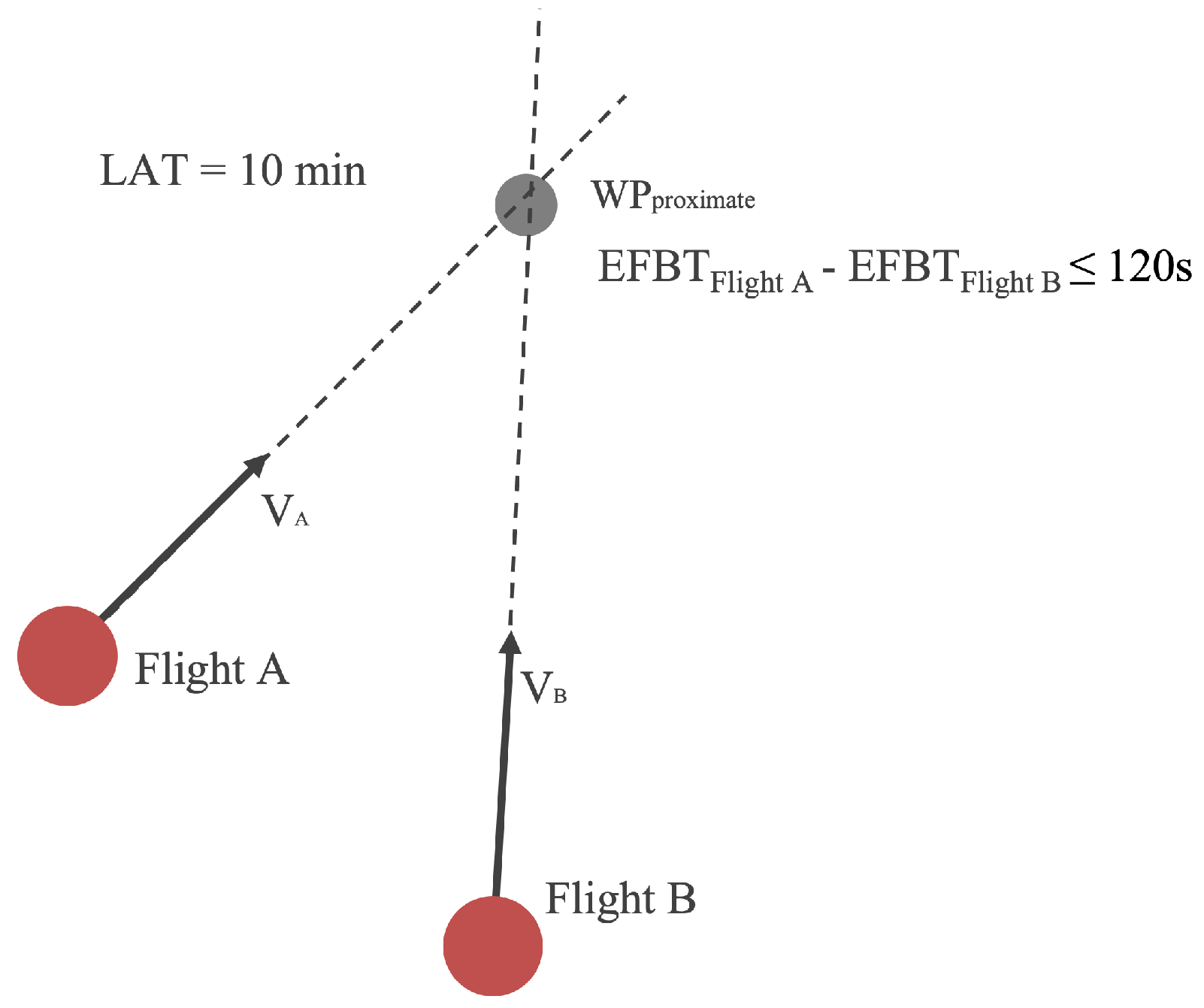
A potential conflict is defined as an occurrence where two aircraft are predicted to be in conflict within a certain Look Ahead Time (LAT). The LAT is the time horizon in which to look for potential conflicts and is set to 10 min to avoid false positives and eliminate corrective actions issued by the controller in a tactical corrective action. This tactical action normally takes place between 120 and 48 s ahead of the conflict and before the initial Traffic Advisory (TA) alert issued by TCAS (Traffic Alert and Collision Avoidance System); therefore, the 10 min LAT allows for sufficient margin. The type of incident considered for the calculation of potential conflicts is separation minima infringement, i.e., a situation in which prescribed separation is not maintained between aircraft. All other types of incidents that could lead to a conflict are discarded.
Potential conflicts are identified from the point of view of Complex Network Theory, which describes a network as a set of items, called nodes,
N, connected between them by edges,
E [
22]. Networks are characterised using an adjacency matrix, denoted as
A, where the presence of a connection between nodes
i and
j is represented by
if the connection exists and
if it does not. The nature of networks can be categorised based on edge directionality into directed or undirected. In directed networks, connections between nodes are directional, indicating a link only in the specified direction. In contrast, undirected networks feature edges that can be traversed in both directions. Additionally, networks may exhibit weighting, with edges assigned weights based on a specific parameter, or they may be unweighted.
This research is based on a navigation point network where nodes are navigation points used as a reference for the definition of aircraft trajectories, while edges represent the connections between those points in case they are linked by any of the flight trajectories analysed. This way of building the network provides a data-driven model with the required dynamicity for the study, as it translates into a traffic network where connections are not the pre-defined ones, but the real ones used during operation.
Spatio-temporal networks are derived, accounting for the dynamicity of the network by using 60 min snapshots. The reason for adopting this time scale is that 60 min is the commonly used horizon for the evaluation of sector capacity based on controllers’ workload. The majority of existing methods only deal with static networks, while real-world transportation networks are time-evolving [
23], thus, the use of this time scale provides operational value to the research.
2.1.1. Dataset
This investigation accounts for two types of data: aircraft trajectories and airspace structure characteristics. Aircraft trajectories come in the form of radar tracks to be able to determine the real operation during the analysis period, rather than the planned one. These radar tracks are provided by ENAIRE, the Spanish Air Navigation Service Provider (ANSP), and describe the position of each flight every 5 s. They are only available in the controlled Spanish airspace and cover the month of June of the year 2019 in an FL greater than 245. Although June is characterised by higher traffic volumes, it does not coincide with the peak of the summer season, providing a balanced dataset for the analysis.
The year 2019 was selected for this investigation because the traffic data from 2020 to 2022 were significantly impacted by the COVID-19 pandemic, which caused unprecedented disruptions in air traffic patterns. Consequently, data from these years do not accurately reflect typical air traffic levels. The year 2023 showed signs of recovery; however, traffic levels did not fully return to pre-pandemic standards, making it less suitable for analysis. By using 2019 traffic data, a more stable and representative dataset that reflects normal operational conditions is ensured.
The information regarding the airspace structure includes sectors, airways, and waypoints and it is obtained from the AIP Spain. Waypoints are predetermined geographical positions defined in terms of latitude and longitude used to build the network and calculate metrics. In the period, a total of 956 waypoints are considered.
All these data have been obtained from the ENAIRE CRIDA data warehouse (DWH), a private and confidential database with high-granularity and structured ATM data containing over 40 billion elements in more than 500 tables.
Operational factors encompassing elements such as human factors (including situational awareness and workload) and weather conditions fall beyond the scope of the present research.
2.1.2. Potential Conflict Identification
The algorithm designed to identify potential conflicts is a refinement of the one proposed in previous research [
24], based on the principle of determining which waypoint is the closest to each point of the trajectory.
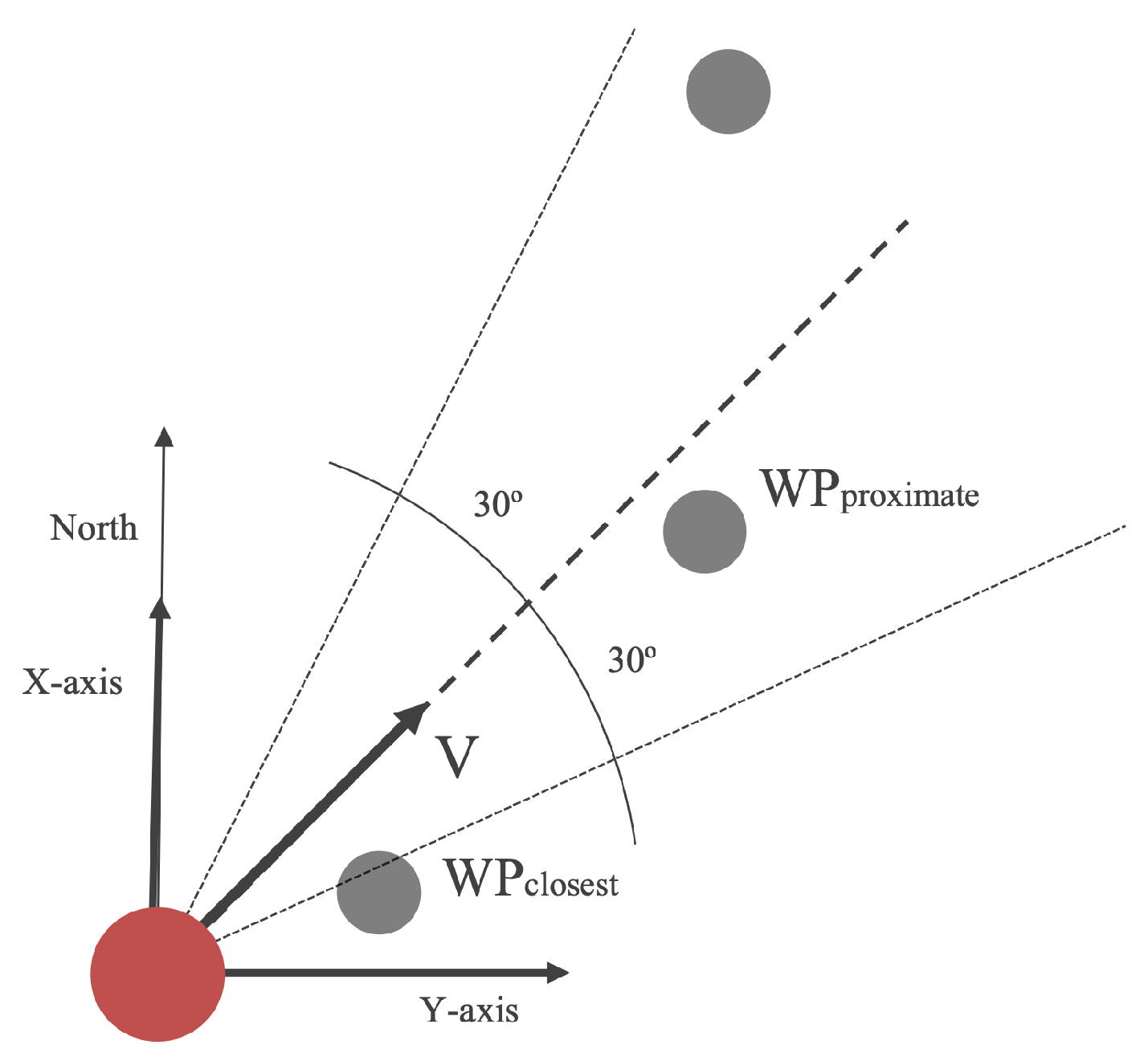
The first step is to load the full dataset composed of radar tracks and airspace structure. Then, the volume of airspace and time interval in which to conduct the identification of potential conflicts is selected. Based on this, the algorithm detects the radar tracks to analyse and unifies their time base so that they all are referred to as the same. Radar tracks are provided as a file containing the coordinates and timestamp of each point of the trajectory every 5 s but on different time bases, that is why they should be unified to perform the identification of potential conflicts. When this is performed, the algorithm finds the closest and proximate waypoints for each point of each of the trajectories comprised in the time interval under analysis using a field of view (fov) of 60 degrees, i.e., 30 degrees to the right and 30 degrees to the left of the trajectory, as shown in
Figure 1. The term ‘closest waypoint’ denotes the nearest geographical location that the aircraft is currently approaching, whereas the ‘proximate waypoint’ refers to the forecasted location at the given time step towards which the aircraft is heading after passing the closest waypoint. Once the closest and proximate waypoints are detected, the Estimated Fly By Time (EFBT) to each is calculated, together with the Estimated Flight Level (EFL), which indicates the approximate FL of the flight based on its vertical speed and the time to reach the waypoint.
Finally, pairs of aircraft arriving at the same proximate WP within the Look Ahead Time (LAT) of 10 min and a difference in the Estimated Fly By Time (EFBT) below 120 s are studied to detect potential conflicts as depicted in
Figure 2.
This logic is formalised in Algorithm 1 and in the flowchart diagram
Figure 3.
| Algorithm 1 Potential conflict identification |
INPUTS: Radar tracks: file containing coordinates and timestamp at each point of the trajectory for all flights in the analysed period. Waypoints: latitude and longitude of the set of waypoints . Time step to generate the homogeneous time base. Look Ahead Time (). OUTPUTS: Processed radar tracks in a unified time base, including the closest WP (), proximate WP (), , and . Adjacency matrix of the network in the period analysed: A. Potential conflicts in the period analysed and the associated Potential Risk Level. STEPS: 1: Load radar tracks and the geographical location of the nodes. 2: Generate a unified time base. 3: for each flight: 4: Interpolate the flight radar track in the unified time base. 5: for each temporal instant ‘’, : 6: Find the closest to the position of the aircraft at : . 7: Find the proximate to the position of the aircraft at : . 8: Compute and . 9: if then and , and . end if 10: end for 11: end for 12: for each 13: Find pairs of aircraft arriving at the same within the 14: if , then compute Potential Risk Level. end if 15: end for |
2.1.3. Potential Risk Level (PRL)
Potential conflicts identified are classified according to their severity by using an adaptation of the Severity Classification based on the Risk Analysis Tool Methodology [
25]. It evaluates several criteria and determines the score of each criterion. The sum of all the scores allocated to each criterion results in an overall score associated with a certain severity.
The severity of separation minima infringements is the result of the sum of two factors: risk of collision and controllability. The risk of collision accounts for separation (the minimum distances achieved between aircraft) and rate of closure (the vertical and horizontal speed at the moment the separation is infringed) of the conflict, while controllability refers to the level of control maintained by ATCOs and pilots over the situation. However, this existing methodology is focused on conflicts rather than potential conflicts, and that is why it should be adapted for this research.
The result of the adaptation of the methodology described above is the Potential Risk Level (PRL) Classification composed only of the risk of collision part since the controllability factor is discarded as it refers to the specific situation once it has occurred. Additionally, the scale normally used for separation in terms of scores is also adapted to reflect the potential conflict. The new scale created is reflected in the
Table 1,
Table 2 and
Table 3.
The PRL on the horizontal layer accounts for the difference in the EFBT of the pair of aircraft at the WP in which the potential conflict is predicted and its rate of closure. On the separation factor, the difference in the EFBT is used instead of the percentage of minimum separation achieved. In this situation, it is assumed that potential conflicts are in a range lower than 120 s and greater than 45 s, as set in this research. All occurrences above 120 s are not considered potential conflicts at all, and a score of 0 is assigned, while all those occurrences below 45 s are identified as actual conflicts and the maximum score of 10 is given. This scale adds a new score (score equal to 9) to the original one to accommodate all cases of potential conflicts and still assign the maximum score of 10 to the actual conflicts where there is a separation minima infringement. The rate of closure scale on the horizontal layer is the same as in the original methodology, as in this case, the parameter is still valid to determine the rate at which aircraft are approaching the point where a potential collision may occur. In the vertical layer, both scales for risk of collision and rate of closure are kept the same.
In the separation factor, the greatest score obtained in the horizontal and vertical layers is used. And the same applies to the rate of closure, the greatest of the predefined intervals for each of the horizontal, and vertical speeds should be considered for the evaluation. Then, the PRL is calculated as the sum of the score of the separation and rate of closure factors and divided into 15 to normalise it between 0 and 1.
2.2. Topological Indicators
Network characteristics are measured using topological metrics which describe the inherent geospatial characteristics of the network. There are sundry topological metrics [
26,
27], but for this work, only four are examined: degree, clustering coefficient, betweenness centrality and eigenvector centrality. These metrics are chosen by following their relation with the airspace factors and influencing the occurrence of losses of separation: spatial distribution of waypoints, spatial distribution of airways, and spatial distribution of aircraft [
24].
Table 4 describes the link between each of these airspace factors and the selected topological metrics, as well as a justification for its selection.
2.3. Sector Safety Performance (SeSPe)
Potential conflicts, Potential Risk Level (PRL), and topological metrics are finally combined into a single indicator, the so-called Sector Safety Performance (SeSPe) indicator. The combination of several metrics into a single one involves a series of steps to ensure the original metrics are appropriately normalised, weighted, and aggregated. The SeSPe indicator reflects the level of the safety performance of a certain sector based on past safety experience (total number of potential conflicts and their Potential Risk Level associated) and the inherent topological characteristics of that sector (topological metrics).
There are several methods to combine metrics, but in this work, the entropy weights method (EWM) has been used to obtain the weights of the different metrics combined in the SeSPe indicator. The EWM [
28] is a widely used data-driven technique for information weighting in decision-making, as it relies on mathematical calculations rather than subjective judgments to determine the weights. It is commonly applied in comprehensive evaluation studies involving various assessment indices. In these studies, the weights of different indices are determined by their degree of dispersion, i.e., how much the values for a particular variable vary [
29]. There are two opposite perspectives on how to determine the weights. One viewpoint suggests that a lower information entropy value, understood as the amount of disorder or variability in the data for each variable, indicates that the data are derived from numerous useful attributes, justifying a higher weight, and vice versa. In contrast, another perspective determines that a lower entropy value of the prediction error indicates greater variability and uncertainty in the model’s predictions, thus requiring a lower weight for the model and vice versa. In this study, the second option is selected, assuming that if an individual variable has a smaller entropy value, it indicates greater variability and uncertainty. Therefore, a higher weight coefficient should be assigned to it.
The weights in the EWM are calculated by firstly, normalising the data to ensure they are comparable. Secondly, calculating the entropy of each metric as , where is the normalised value of the variable j for alternative i, m is the number of alternatives, and k is defined as . If , then . Then, the degree of diversification is obtained as . Finally, the weights for each metric based on its degree of diversification are computed as , where n is the number of variables.
3. Results and Discussion
The described method for Sector Safety Performance (SeSPe) proposed in
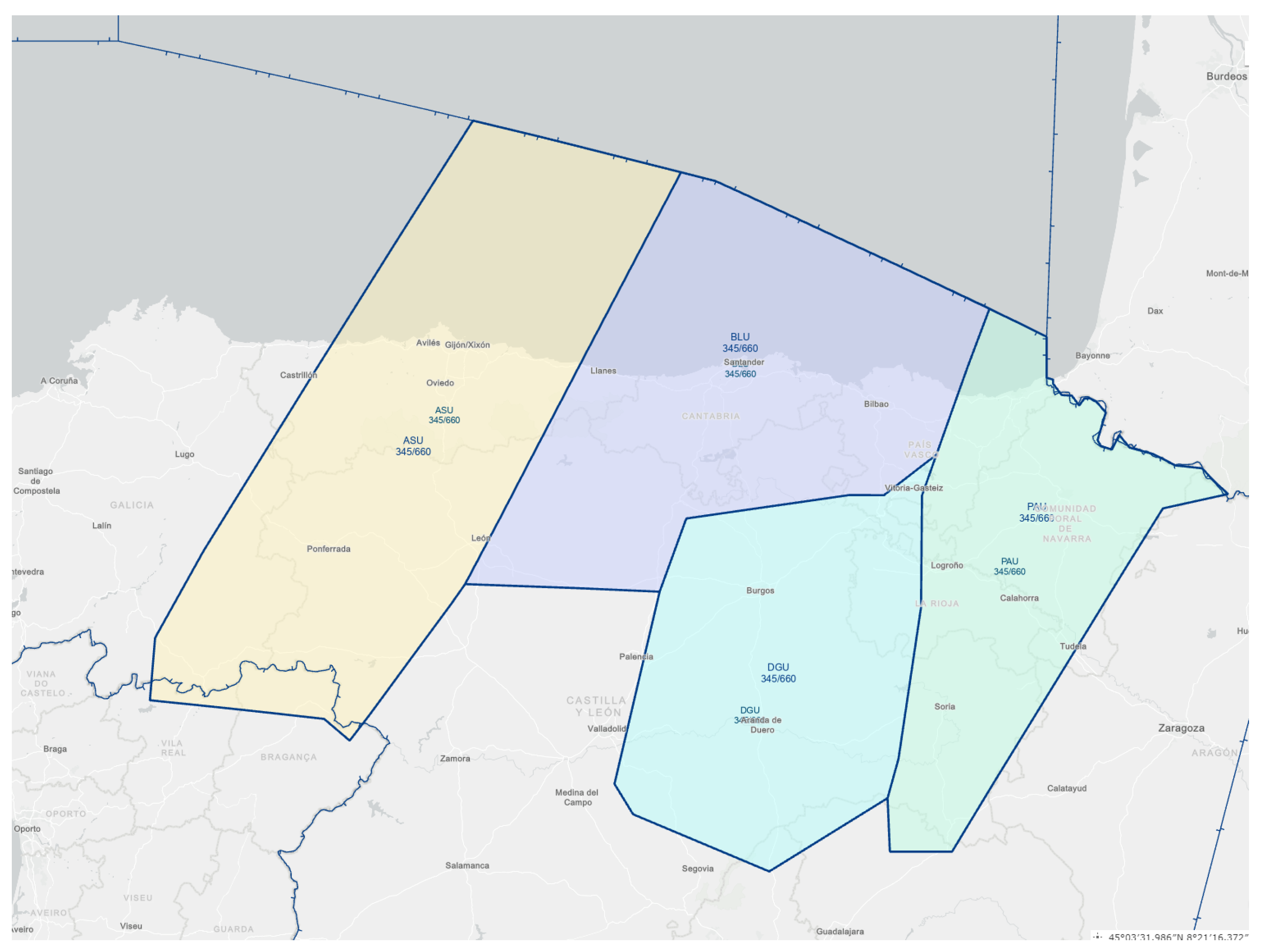
Section 2 is now tested in the Spanish Air Traffic Network, in 4 upper sectors (Asturias Upper, LECMASU; Bilbao Upper, LECMBLU; Domingo Upper, LECMDGU; and Pamplona Upper, LECMPAU;) in the Madrid Route-1 ACC (presented in
Figure 4) with one month (June 2019) of radar track data to demonstrate its validity.
The sectors analysed belong to the upper Spanish airspace with mainly en-route traffic but also traffic in evolution coming from terminal areas located below them and different complexity conditions. LECMASU is an upper sector whose traffic is mainly overflights except for arrivals to Oporto airport, Bilbao TMA, and Madrid TMA, for which the traffic is decent in coordination with the lower sector, LECMASL. Its declared capacity is 37. LECMBLU is an upper sector with a high percentage of overflight and a small amount of traffic in evolution, with two main flows. Its declared capacity is 47. LECMDGU is an upper sector with a high percentage of overflights combined with traffic in evolution. It has traffic flows in different directions with two key confluence points, NEA and DGO. Its declared capacity is 44. LECMPAU is also an upper sector whose traffic is mostly composed of overflights with some evolution traffic for arrivals to Madrid airport and flows in different directions. Its declared capacity is 46.
3.1. Sector Topological Characteristics
The LECMASU sector is composed of 35 nodes and 118 edges. The LECMBLU sector consists of 46 nodes and 172 edges, while the LECMDGU sector is composed of 20 nodes and 89 edges. Finally, the LECMPAU sector consists of 42 nodes and 173 edges. These numbers correspond to the built-in networks of the sectors with the one-month radar track data corresponding to June 2019.
3.2. Temporal Distribution of Potential Conflicts
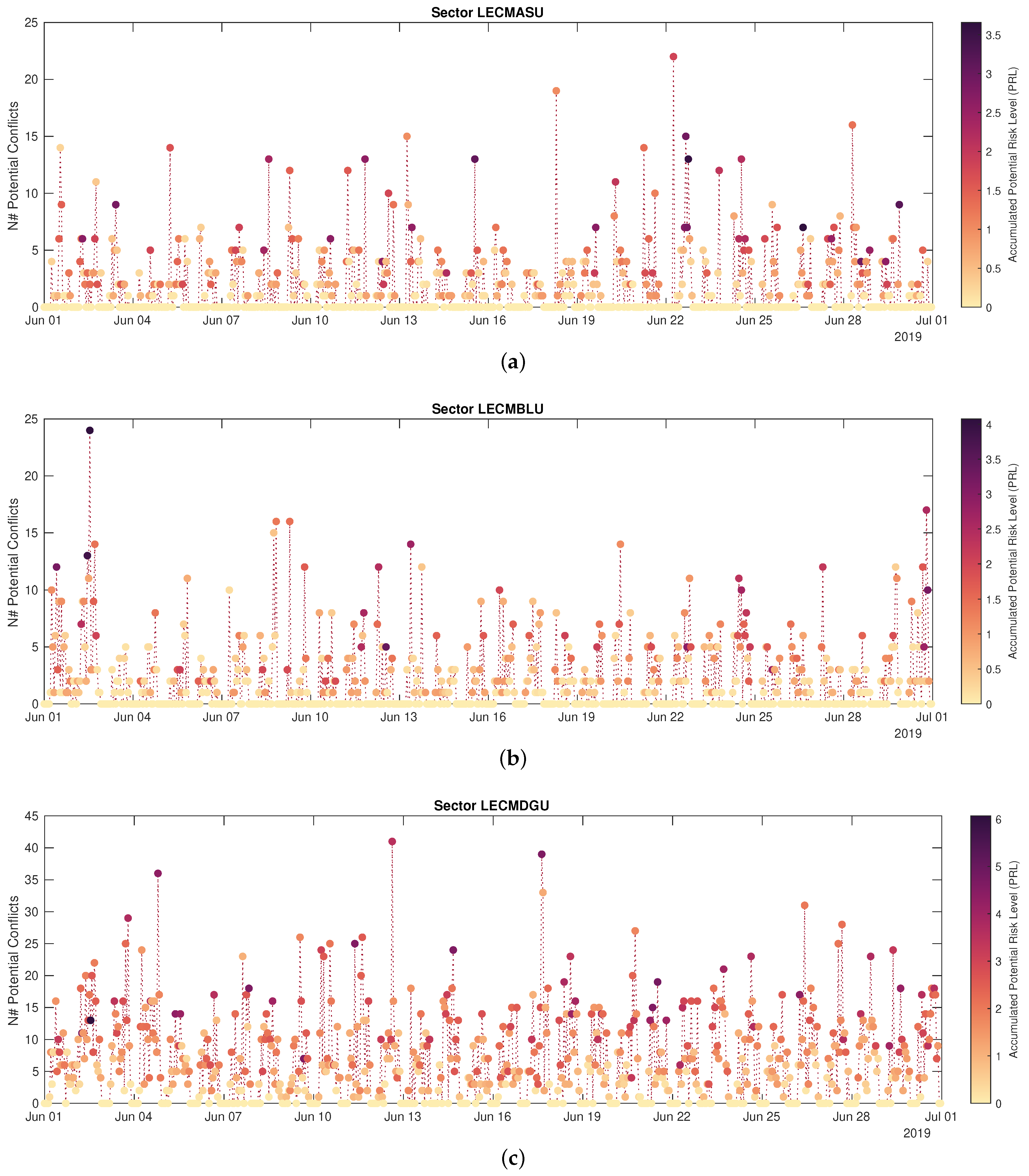
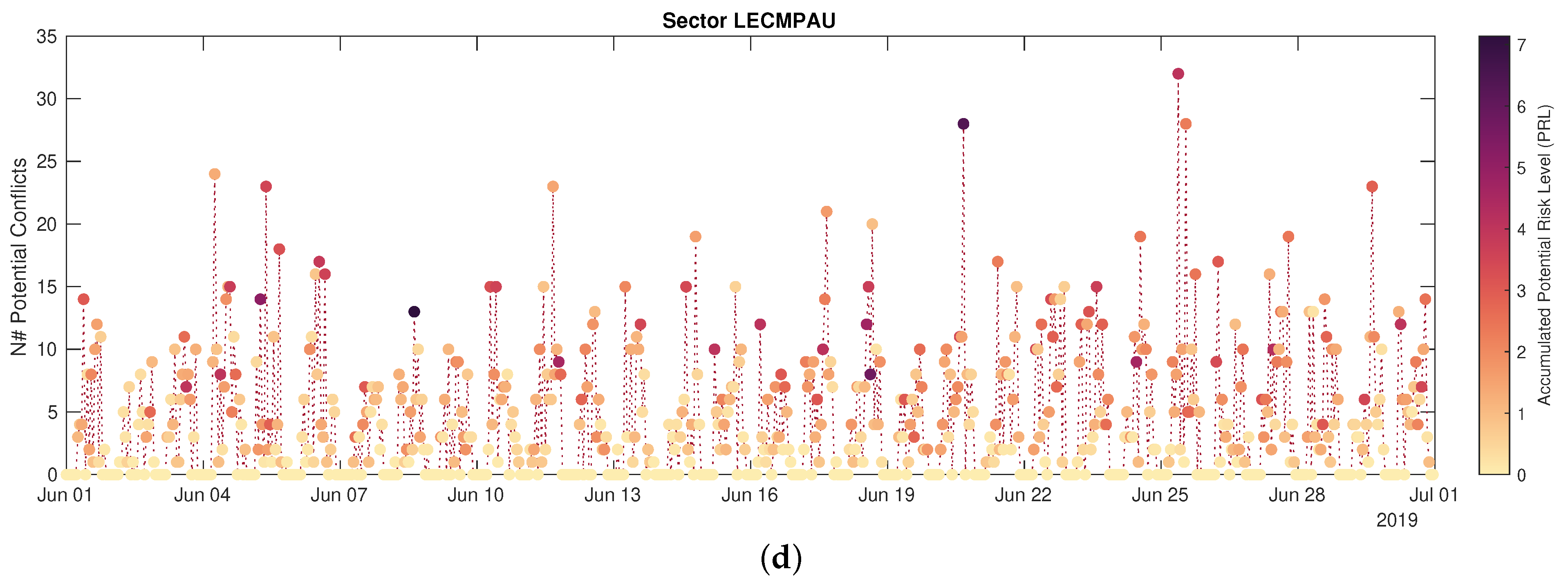
The time series plot illustrating the number of potential conflicts over June 2019 for the four sectors is presented in
Figure 5. The x-axis represents dates from 1 June to 30 June 2019, in one-hour steps, while the y-axis shows the total number of potential conflicts per hour in each sector. Moreover, the colour gradient from yellow to dark purple represents the ‘Accumulated PRL’ associated with the total number of conflicts per hour.
Figure 5a provides a visual representation of the fluctuation in potential conflicts over the month analysed for sector LECMASU. There are frequent variations in the number of potential conflicts, with some days showing significantly higher numbers than others. Peaks in the number of conflicts are evident on several days, such as June 4th, 10th, 13th, 19th, 22nd, and 28th, where the number of conflicts reaches 15 or more. The colour intensity varies, indicating changes in the accumulated PRL. For instance, some high-conflict days have dots with darker shades, implying higher risk levels.
Figure 5b refers to sector LECMBLU, showing a time series plot of the number of potential conflicts over the month. There are visible peaks on certain days where the number of potential conflicts is significantly higher, including June 1st, 4th, 12th, 19th, and 27th. The colour gradient indicates that higher accumulated PRL is often associated with these peaks.
Figure 5c refers to sector LECMDGU, where periodic peaks in the number of potential conflicts are seen, notably around June 4th, 11th, 13th, 18th, 25th, and 30th. These peaks suggest that there might be certain days or periods within the month when conflicts are more frequent. Higher accumulated PRL values, up to 6, tend to occur on days with higher numbers of conflicts, up to 45. This might suggest that higher PRL accumulation is associated with an increased number of potential conflicts. However, over the month, there is no clear upward or downward trend in the number of conflicts, suggesting a relatively stable conflict pattern with regular peaks.
Figure 5d presents the number of potential conflicts per hour for the whole month for sector LECMPAU. As for the other sectors analysed, there are visible peaks on certain days where the number of potential conflicts is significantly higher, including June 4th, 8th, 19th, 22nd, and 26th. The accumulated PRL is especially high on two of those dates (June 19th and 26th).
The figure effectively visualises the temporal distribution of potential conflicts over a month and highlights significant patterns that could be valuable for predictive analysis and conflict management. It shows a general tendency for the four sectors analysed: the accumulated Potential Risk Level (PRL) in the month analysed increases with a higher number of potential conflicts. As such, it is observed that between zero and five potential conflicts per hour in each sector, the accumulated PRL ranges between 0 and 2 in the majority of the cases for the four sectors. Beyond five potential conflicts, accumulated PRL value increases, and higher values are found for higher numbers of potential conflicts. In this regard, the Normalised Mutual Information (NMI) has been computed between the total Number of Conflicts and the accumulated Potential Risk Level (PRL) per sector (see
Table 5).
Normalised Mutual Information (NMI) is a measure used to evaluate the similarity between two clustering results or the amount of shared information between two random variables. It ranges from 0 to 1, where 0 indicates no mutual information (i.e., the clusterings are independent) and 1 indicates perfect correlation (i.e., the clusterings are identical). NMI values around 0.7 indicate a high level of similarity or shared information between two variables. This high similarity is explained because PRL is computed from the conflict information.
The periodic peaks in potential conflicts could indicate recurring issues or events that trigger conflicts. These could be analysed further to understand underlying causes and possibly mitigate them. The relationship between accumulated PRL and the number of conflicts might be significant for predicting conflict-prone periods based on PRL accumulation metrics.
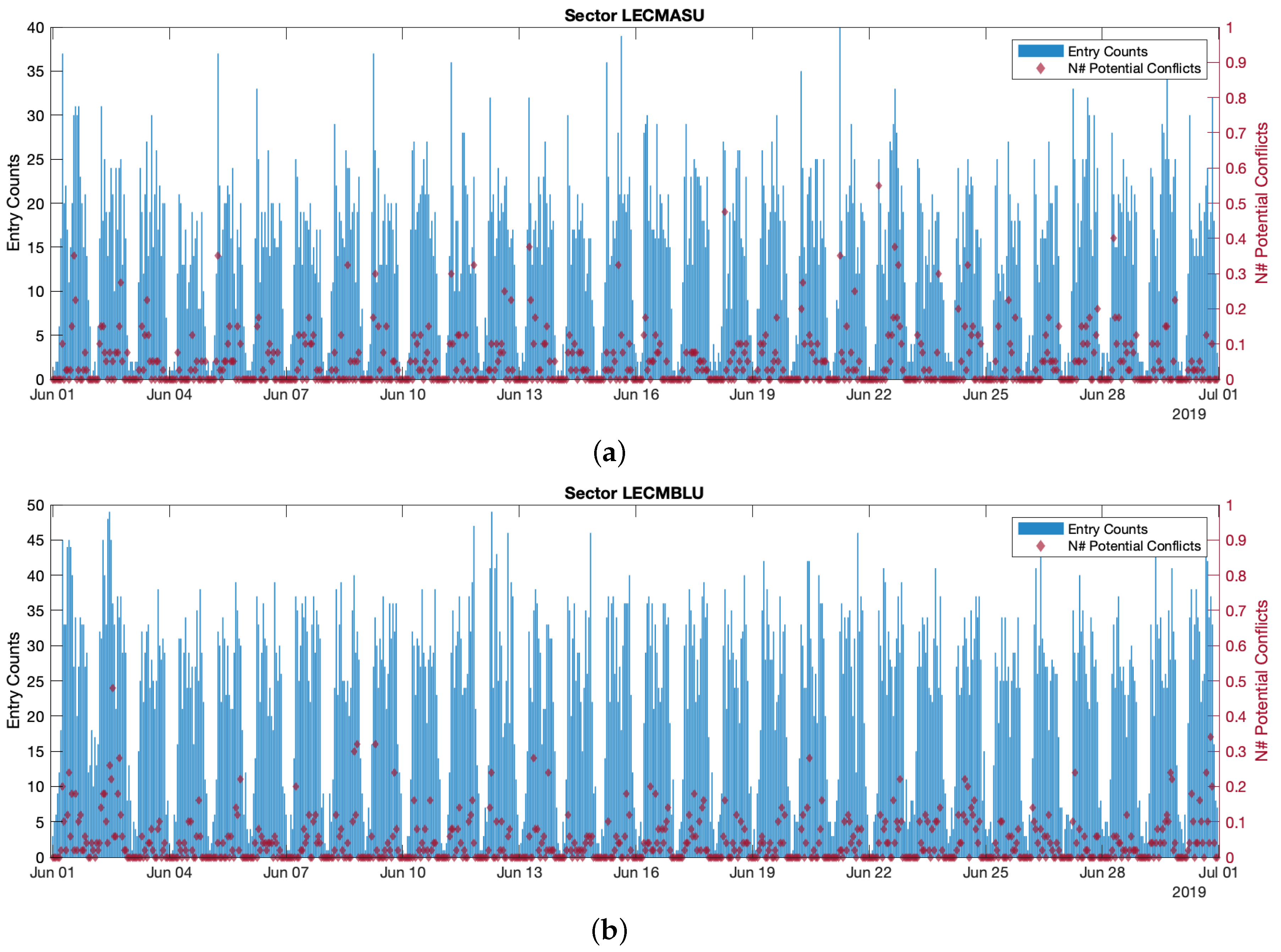
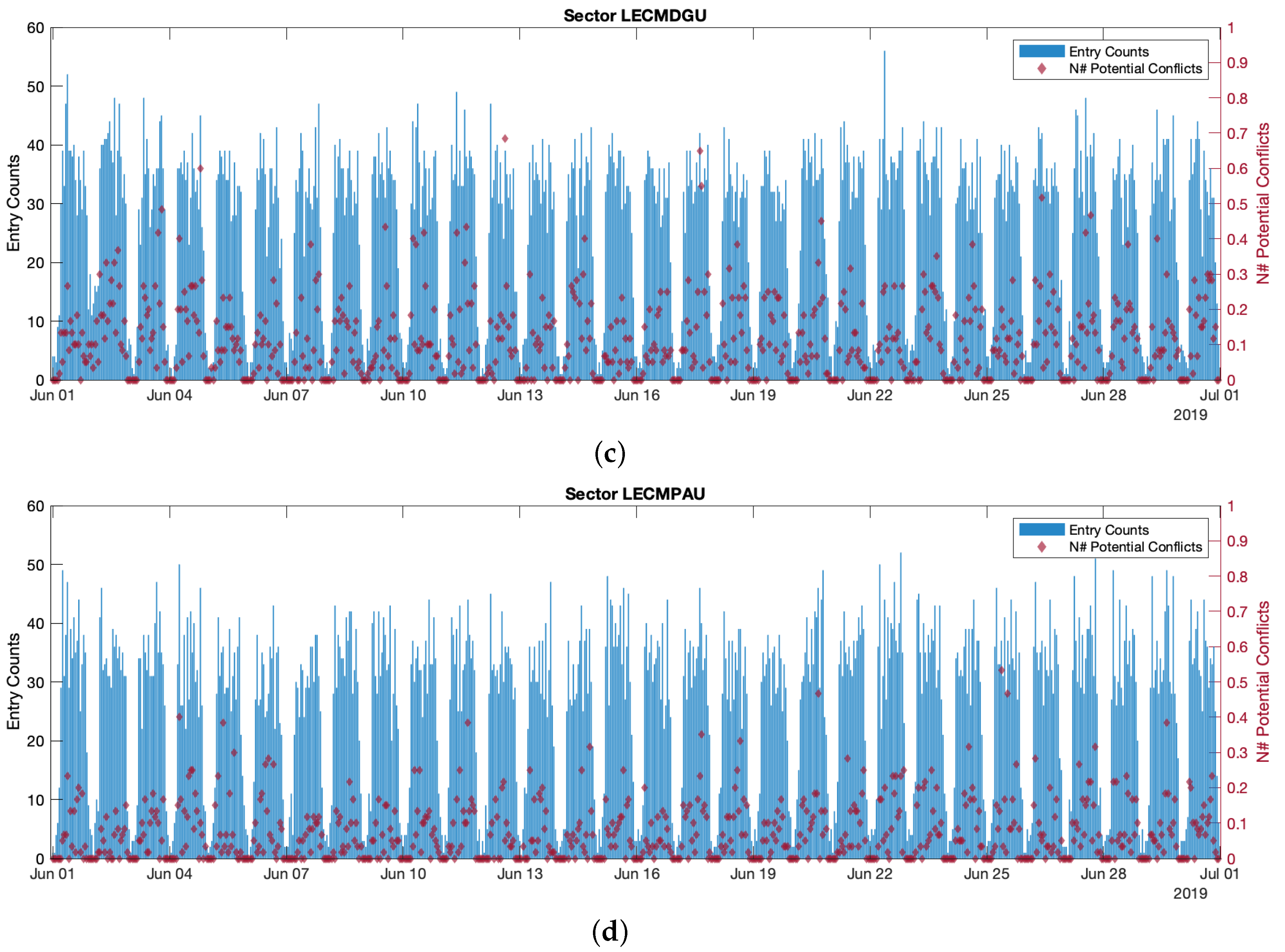
Additionally,
Figure 6 shows the temporal evolution of the total number of conflicts per hour over June 2019, together with the distribution of Entry Counts (EC), over the month for the four sectors: (a) LECMASU; (b) LECMBLU; (c) LECMDGU; (d) LECMPAU. The x-axis presents the dates ranging from 1 June to 30 June 2019. The left y-axis refers to the Entry Count values per hour, represented by blue bars, while the y-axis shows with red diamond markers the total number of conflicts detected in the sector at each hour. As it could be advanced, the Entry Counts (EC) have a repeating daily pattern with regular peaks and troughs, suggesting a cyclic or periodic nature in the traffic in each sector, responding to the demand experienced along the day. The EC range depends on the specific sector, with occasional peaks reaching up to around 35 in LECMASU, 50 in LECMBLU and LECMPAU, and 60 in LECMDGU. The total number of conflicts is much smaller in scale, with values mostly clustered below 0.2 in all sectors except LECMDGU where it is around 0.4. There are small peaks in the number of conflicts that appear sporadically throughout the month.
The plot suggests that there might be some correlation between the peaks in Entry Counts (EC) and the number of conflicts, as some higher EC values coincide with an increase in the number of conflicts. For this reason, the Normalised Mutual Information (NMI) between the total Number of Conflicts and the Entry Counts per sector has also been analysed (see
Table 5). However, NMI values in the range of 0.2–0.3 suggest a low but non-zero level of similarity or shared information between the two clustering results. The weaker correlation between the number of potential conflicts and Entry Counts suggests that simply counting the number of aircraft entries into a sector is not a sufficient indicator of conflict likelihood, highlighting the need for more complex or multi-faceted approaches to manage airspace safety.
3.3. Spatial Distribution of Potential Conflicts
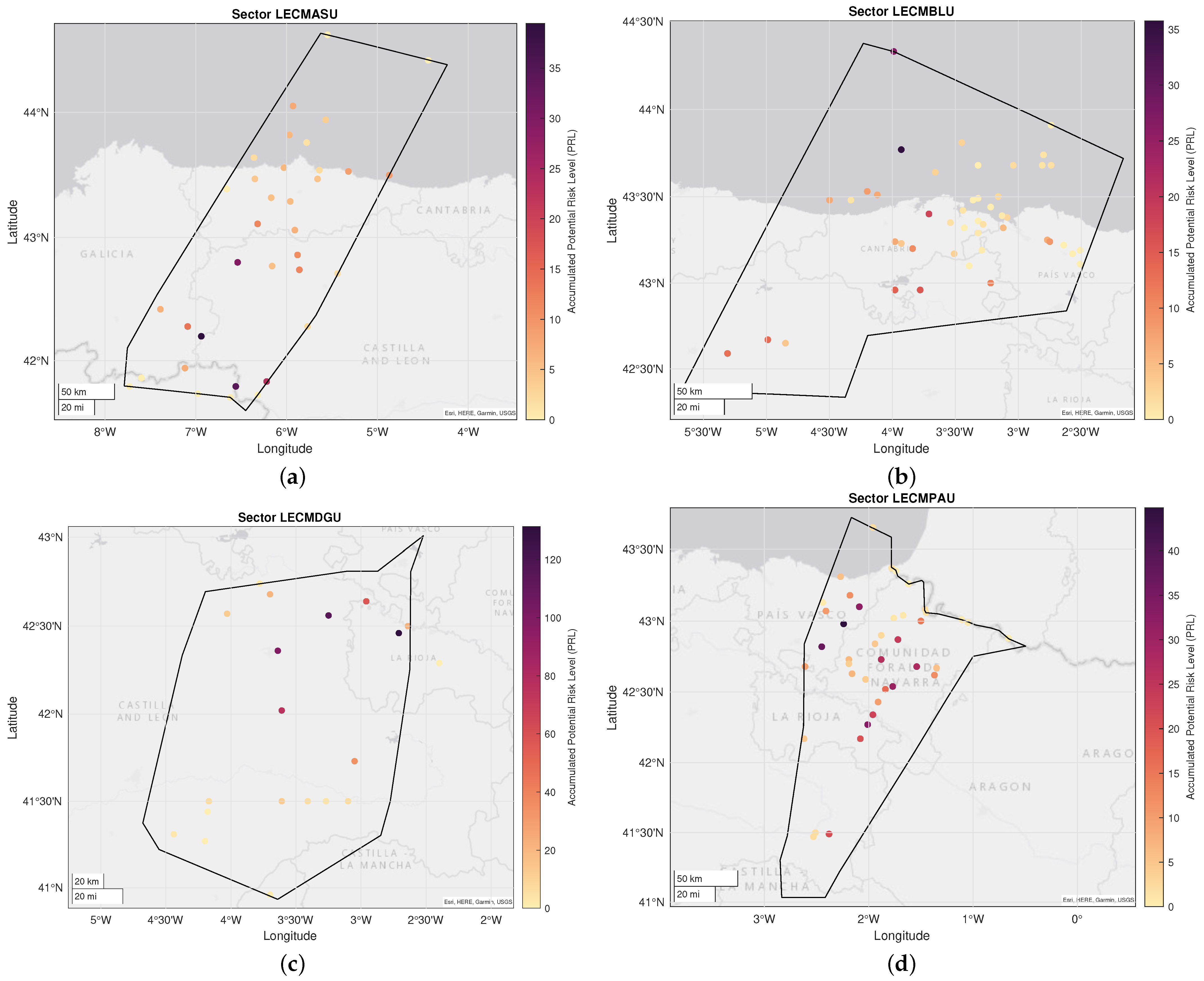
Figure 7 presents a geographic representation of the accumulated Potential Risk Level (PRL) in each waypoint over the four sectors analysed: (a) LECMASU; (b) LECMBLU; (c) LECMDGU; (d) LECMPAU. The colour gradient ranges from low (yellow) to high (dark) purple represents the accumulated PRL of the total number of conflicts taking place in the proximity of that waypoint over the month under study. The distribution of high-level accumulated PRL waypoints indicates that some areas have higher concentrations (darker colours) than others, indicating that those areas are more conflicting in terms of potential risk.
Table 6 shows the top five waypoints in each sector and their relative accumulated Potential Risk Level (PRL).
Particularly in sector LECMASU, several dark purple spots indicate areas with high accumulated PRL, suggesting significant potential conflict risks in these locations close to the Portugal border (BARKO, INSID) and the Zamora sector border (MOSEN, DESAT). Yellow to light orange areas are located in the centre and upper border of the sector, close to the French border. It is observed that the distribution of PRL is not uniform across the sector.
In LECMBLU, the high-risk area corresponds to the left half side of the sector, where several waypoints with high accumulated PRL values are located close to the borders with the French airspace on the top (DELOG), and the LECMDGU sector at the bottom (TITAN, EMANU). The low-risk area corresponds to the right half side of the sector.
In LECMDGU the area where more waypoints with high accumulated PRL levels are located around Burgos and extending slightly to the north and northeast. Lower PRL values are observed towards the southern and southwestern parts of the region.
Finally, in LECMPAU, the high accumulated PRL point concentrations are in the northern part of the region, particularly near Bilbao. The values decrease as one moves towards the southern part of the region, near Zaragoza.
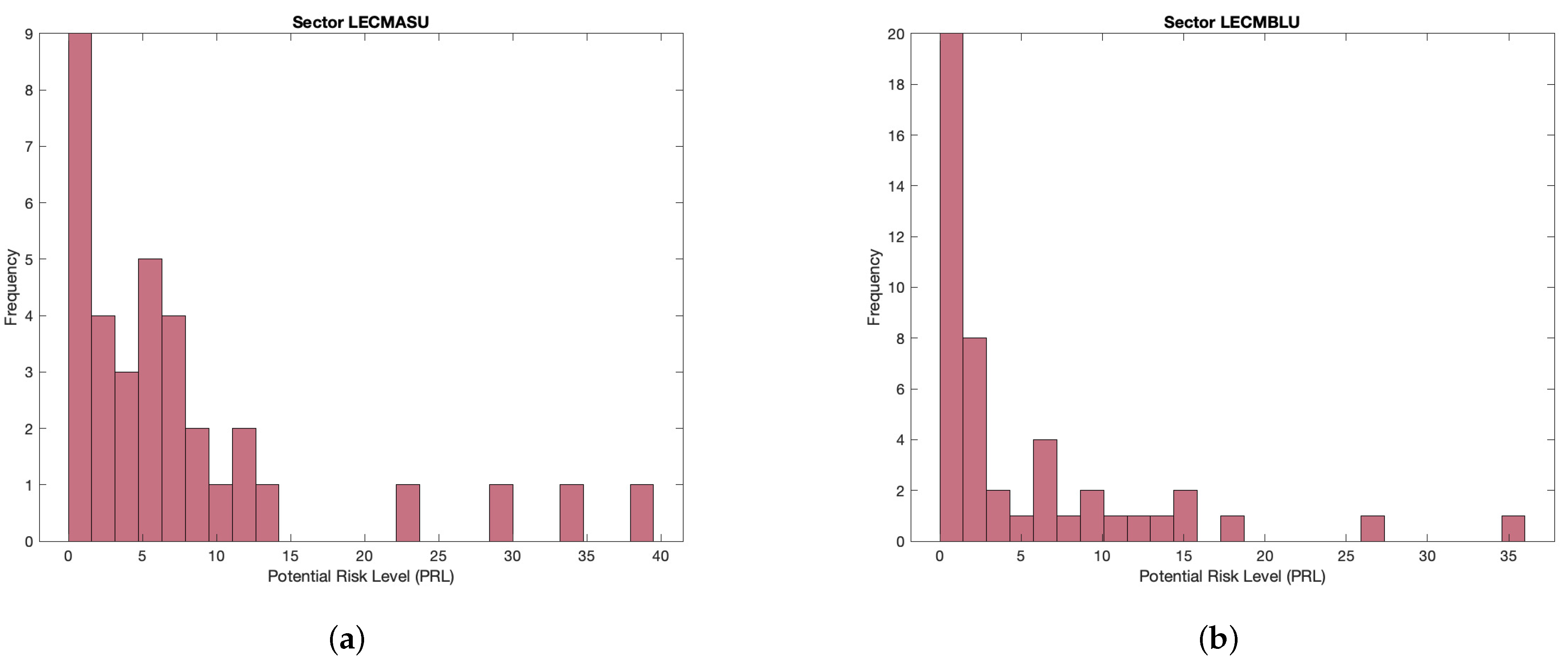
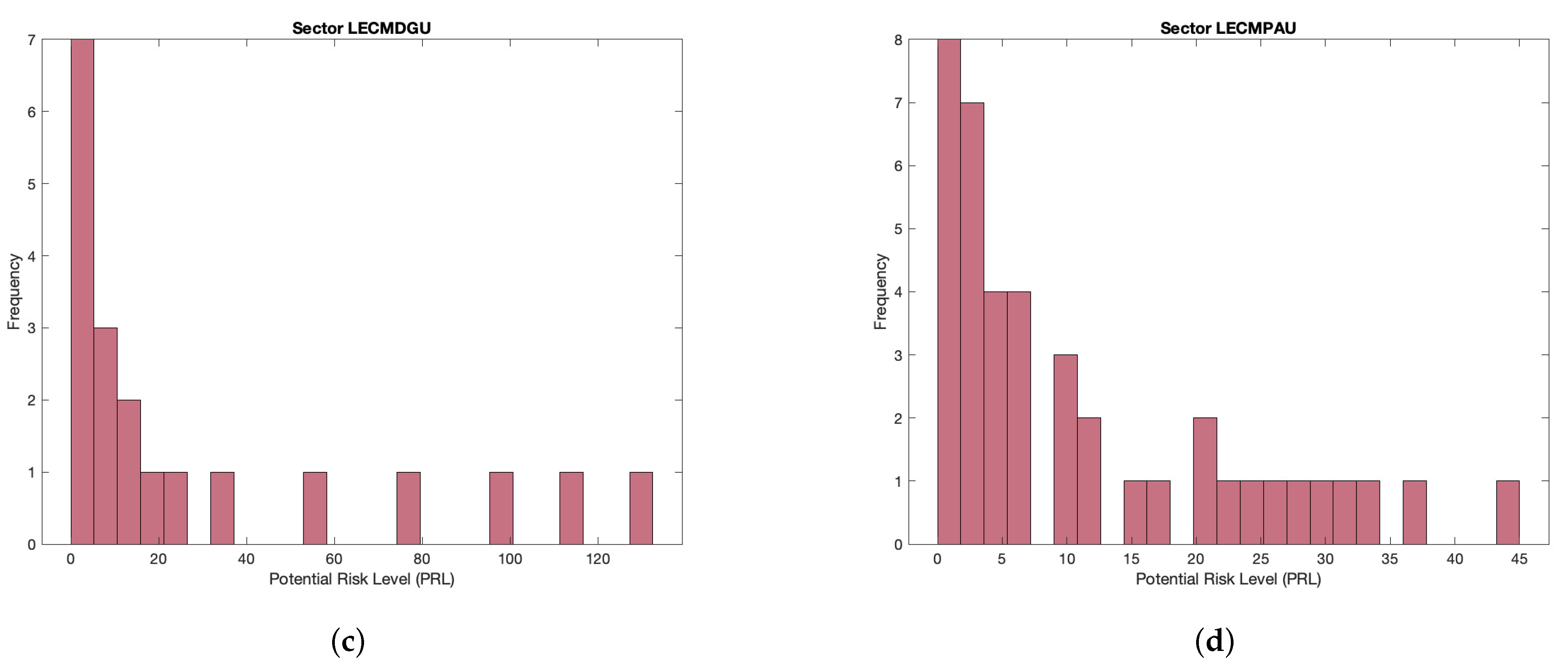
In a comparative analysis, LECMDGU shows the highest range of PRL values (over 120), while the other sectors (LECMASU, LECMBLU, LECMPAU) have lower maximum values (around 35–40). Both LECMASU and LECMBLU show higher PRL values concentrated in the northern parts of their regions, similar to LECMPAU. LECMDGU stands out with a wider distribution of higher PRL values, especially around Burgos.
3.4. Potential Risk Level (PRL) Characterisation
Finally,
Figure 8 represents the histogram with the Potential Risk Level (PRL) for the four sectors: (a) LECMASU; (b) LECMBLU; (c) LECMDGU; (d) LECMPAU. LECMASU and LECMBLU present a similar pattern with a concentration in the lower range and fewer high-value occurrences. LECMDGU exhibits a wider spread with significant values at higher PRL intervals, indicating more variability. Finally, LECMPAU is similar to LECMASU and LECMBLU but has a slightly broader distribution, with occasional higher PRL values up to 45. For all sectors, the highest frequency of occurrences is in the range of PRL values close to 0, which indicates that the majority of conflicts identified in each sector are of low severity. As the PRL increases, the frequency of occurrences decreases sharply, meaning that there are few cases of high-severity potential conflicts. All the occurrences of higher PRL values range between 0 and 1. It can be concluded that for the four sectors, most of the PRL values are concentrated at the lower end of the scale, indicating that lower PRL values are much more common, while high PRL values are relatively rare, highlighting that the majority of potential conflicts are associated with lower PRL values.
3.5. SeSPe
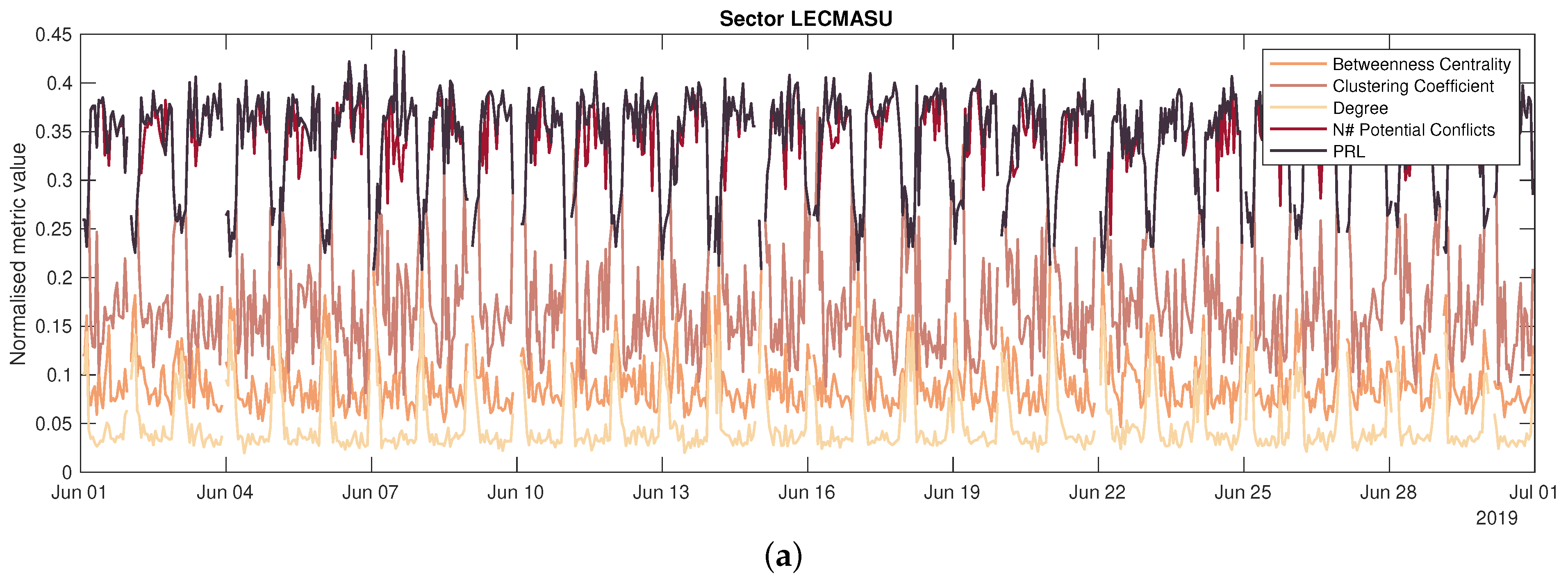
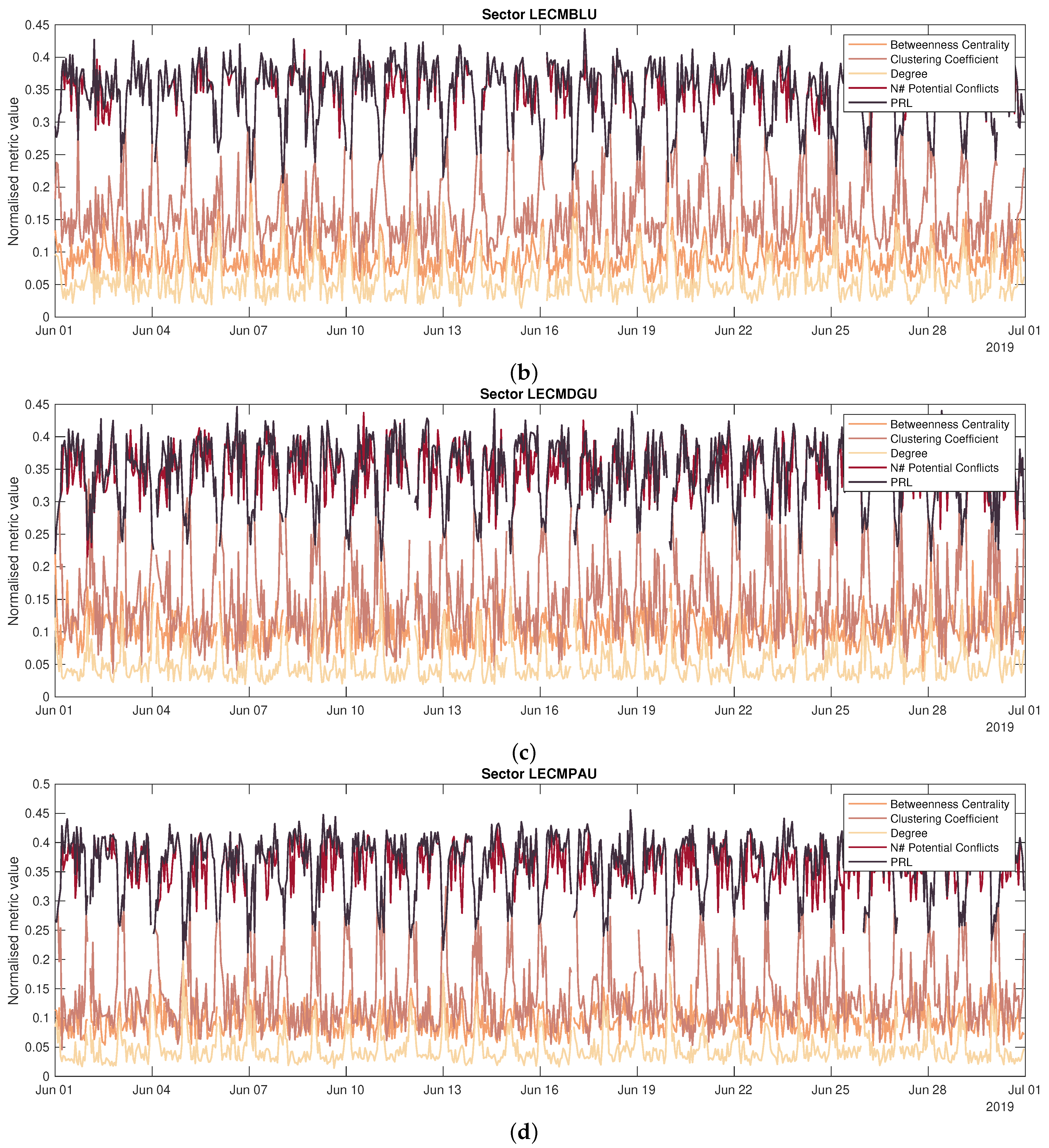
The temporal evolution of metrics’ weights for Sector Safety Performance (SeSPe) is depicted in
Figure 9 for the four sectors under analysis. SeSPe represents the combination of topological and sector safety metrics into a single one, excluding for this analysis, the topological metrics of eigenvector centrality (as it leads to complex values) and strength (as it provides similar information to the degree values). In detail, it could be observed that the two metrics with higher weights are the Potential Risk Level (PRL) and the number of potential conflicts. The PRL (purple line) appears to dominate the upper range of the plot, oscillating between 0.25 and 0.45, while the number of potential conflicts (red line) shows values frequently fluctuating between 0.25 and 0.40. Topological metrics tend to have lower values, with degree (yellow line) ranging between 0.05 and 0.15, betweenness centrality (orange line) ranging between 0.05 and 0.20, and the clustering coefficient (brown line) ranges between 0.10 and 0.25. At night, the values of the different metrics are close to zero due to low levels of traffic, leading to a SeSPe value close to zero.
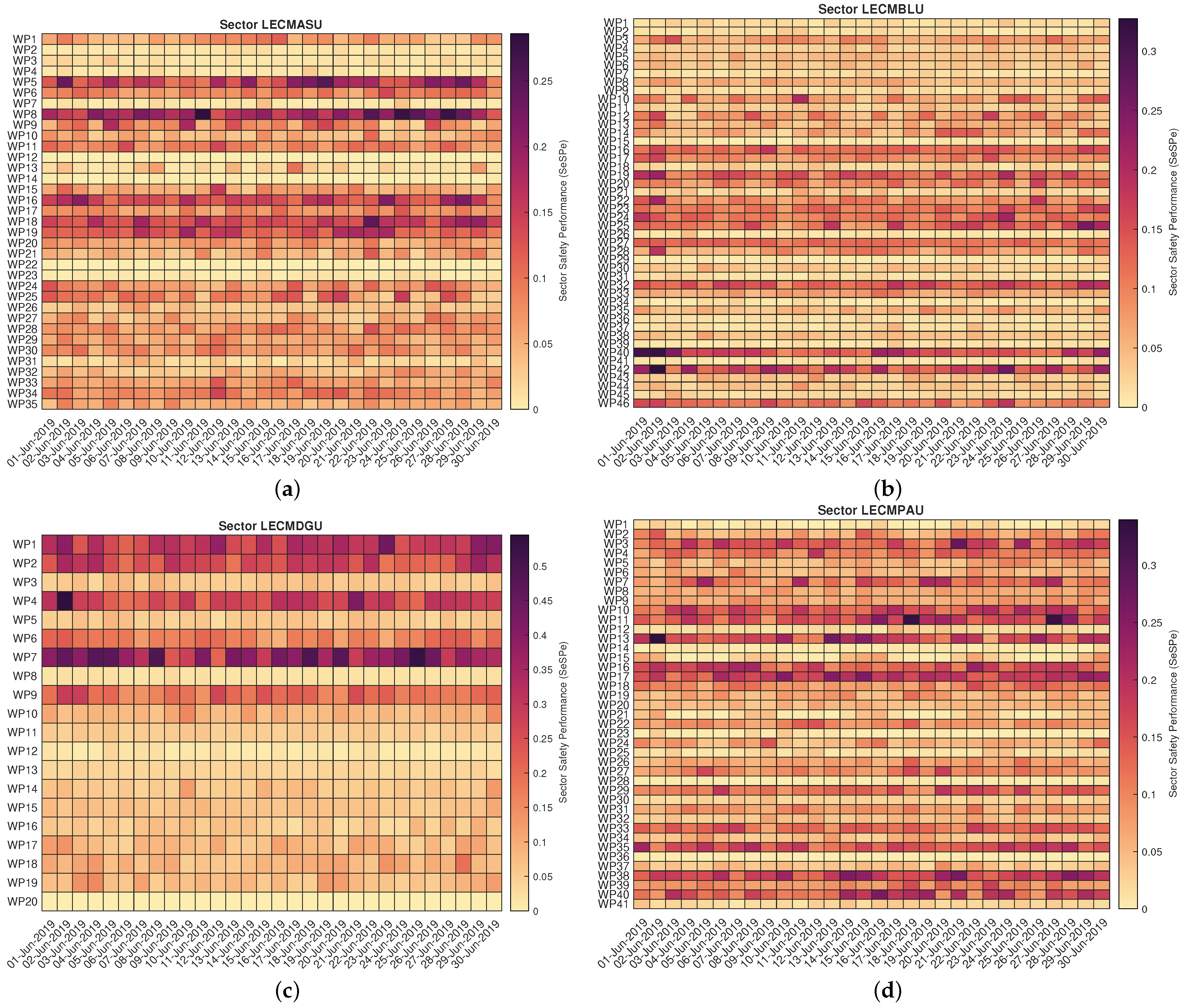
Figure 10 presents the Sector Safety Performance (SeSPe) for the four sectors in the shape of heatmaps displaying data across all waypoints (WPs) over time. In LECMASU, there is a relatively balanced distribution of values, with some WPs (like WP6 and WP16) showing more intense (darker) colours, indicating higher values across multiple dates. The colour range goes up to about 0.25, and the distribution is somewhat uniform, but there are noticeable periods where specific WPs have higher values. LECMBLU SeSPe presents a broader range of colours, indicating more variation in values over time and across different WPs. Some WPs like WP5, WP10, and WP15 show consistently higher values, indicated by darker colours. The scale in LECMBLU reaches up to 0.3, indicating slightly higher maximum values compared to LECMASU. In LECMDGU, the SeSPe heatmap is distinct from the others as it covers fewer WPs (fewer waypoints in the sector) and has the most intense colours, particularly in the top rows (WP1 to WP7). This indicates significantly higher values in these WPs, with the scale reaching up to 0.5. There is a noticeable drop in intensity in the lower half (WP11 to WP20), suggesting different behaviour in these WPs. Finally, LECMPAU SeSPe covers a wide range of WPs, similar to LECMASU and LECMBLU. It has a balanced colour distribution with a band of higher values in the middle rows (WP10 to WP20). The colour scale also goes up to about 0.3, and the distribution of high and low values appears more scattered across the WPs and dates.
4. Conclusions
This study presents a comprehensive investigation into Sector Safety Performance (SeSPe) within the Spanish Air Traffic Network, specifically focusing on the Madrid ACC sectors and utilizing one month of flight track data. Employing Complex Network Theory, we constructed multiple weighted spatial-temporal networks based on 60 min intervals to conduct comparative analyses of selected metrics in each temporal snapshot. This approach allowed for a robust assessment of SeSPe for each sector, whose main outcomes are as follows:
- 1.
Effectiveness of Complex Network Theory: The application of Complex Network Theory has proven effective in conducting a detailed analysis of the network, revealing valuable insights into its interconnections and overall structure. This methodology has demonstrated its robustness in capturing the system’s characteristics and emphasised the importance of network-based metrics.
- 2.
Dynamic Analytical Approach: By integrating temporal changes observed over the month, our dynamic approach has enhanced analytical accuracy, uncovering evolving trends and patterns. This temporal integration has provided a more detailed understanding of sector safety performance.
- 3.
Potential Conflict Calculation Methodology: The methodology developed for calculating potential conflicts by integrating radar track data and airspace structure has proven effective. By synchronising trajectories to a unified time base, identifying closest and proximate waypoints using a 60-degree field of view, and calculating Estimated Fly By Time (EFBT) and Estimated Flight Level (EFL), potential conflicts were identified and categorised based on severity with the Potential Risk Level (PRL).
- 4.
Significance of the Sector Safety Performance (SeSPe) Indicator: The development of the SeSPe indicator represents a significant advancement in the evaluation and management of sector safety performance. By integrating past safety experience with the inherent topological characteristics of a sector, the SeSPe indicator offers a comprehensive measure of safety performance. The SeSPe indicator’s ability to combine historical safety data with topological metrics provides a holistic view of sector safety. This dual focus ensures a more accurate and insightful assessment of safety performance by considering both the empirical evidence of past incidents and the structural properties of the sector.
The SeSPe framework is designed to be entirely generic and adaptable for use in any airspace around the world. It is structured to accept radar tracks and airspace information, allowing the methodology to be applied to any sector, regardless of traffic complexities or operational challenges. This means that the findings from the case study of the Madrid ACC sectors serve as a foundational example to prove the framework’s effectiveness in a specific context. However, the methodology can be implemented in different airspaces, enabling analysts to assess safety performance across diverse environments.
The SeSPe indicator significantly enhances data-driven decision-making in air traffic safety management through its integration of detailed safety records and sophisticated topological analyses. It enables stakeholders to identify high-risk areas and the underlying factors that contribute to potential conflicts in the strategic phase. The adaptability of the methodology to various sectors ensures that the unique attributes and risk profiles of each area are adequately reflected in safety assessments, making it a versatile tool for evaluating safety performance across different environments. By combining past conflict patterns with inherent structural risks, the insights provided by the SeSPe indicator allow safety managers to implement more effective safety strategies aimed at reducing potential conflicts and enhancing overall sector safety.
Future research should aim to broaden the application of the SeSPe indicator across a wider range of sectors and operational contexts, further validating its adaptability and effectiveness. A key focus will be on comparing SeSPe with established industry safety performance metrics, which will help showcase its unique strengths and identify areas for enhancement. Incorporating real-time data and machine learning techniques could also significantly boost SeSPe’s predictive capabilities, enabling more proactive and dynamic safety management over varying time horizons.
Finally, expanding the analysis to account for variations in traffic patterns and operational conditions, such as differences between peak and off-peak hours, will help fine-tune the model for improved robustness and applicability across diverse scenarios.