Article

Application of WRF-CAMx over West Asia, Part I: Meteorological and Air Quality Model Evaluation

Department of Civil and Environmental Engineering, Northeastern University, Boston, MA 02115, USA
*
Author to whom correspondence should be addressed.
Climate 2026, 14(6), 128; https://doi.org/10.3390/cli14060128 (registering DOI)
Submission received: 30 March 2026 / Revised: 5 June 2026 / Accepted: 10 June 2026 / Published: 14 June 2026
(This article belongs to the Special Issue Multi-Physics and Chemistry of Urban Climate Modelling)

Highlights

What are the main findings?
  • The WRF-CAMx system reasonably reproduces meteorology and air quality over West Asia, with good performance for temperature, wind, PM2.5, and AOD.
  • Model limitations include underestimation of humidity and cloud effects in winter and larger errors in trace gas concentrations.
What are the implications of the main findings?
  • Improving emissions inventories and chemical mechanisms is essential to reduce biases in trace gases across the region.
  • Refinements in model physics, particularly cloud and humidity representation, are critical for better seasonal performance.

Abstract

Air pollution poses significant risks to public health, ecosystems, and regional economies, particularly in rapidly developing regions. Despite its importance, the Middle East remains relatively understudied in regional air quality, with limited evaluations of pollutant transport and model performance. This study applies the WRF (Weather Research and Forecasting) model coupled with the CAMx (Comprehensive Air Quality Model with Extensions) model to simulate meteorology and air quality over West Asia, with a focus on the United Arab Emirates (UAE). Six representative months are analyzed, including three winter periods (January 2018, 2020, 2022) and three summer periods (June 2017, 2019, 2021). WRF shows good agreement with observations, reproducing near-surface temperature with an index of agreement (IOA) between 0.90 and 1.00 and generally low wind speed (MB < ±0.5 m s−1) and wind direction biases (MB < ±0.5), although cloud-radiative forcing is underestimated during winter. CAMx reproduces PM2.5 concentrations with moderate-to-high correlations (r = 0.44–0.65) and low bias, while AOD and O3 column concentration show larger uncertainties. Satellite-based evaluation indicates good performance for NO2 and CO column abundances but larger discrepancies for HCHO and SO2, particularly during summer. Overall, the results demonstrate that the WRF-CAMx modeling system provides a reliable framework for regional air quality simulations over West Asia, while highlighting uncertainties associated with emissions, atmospheric chemistry, and satellite retrieval products.

1. Introduction

Air pollution poses a significant environmental challenge in multiple regions worldwide, such as West Asia, which covers several fast-growing countries, including the United Arab Emirates (UAE) [1,2]. The UAE has experienced substantial growth in commerce, tourism, and industry. Its unique geographical setting (characterized by arid desert conditions, intense solar radiation, and the presence of the Persian Gulf and Gulf of Oman) creates complex atmospheric dynamics that influence air quality. Rapid urbanization with increased vehicular traffic, industrial activities, and large-scale infrastructure development has significantly elevated concerns about air pollution in the country [3].
In addition to local emissions, the UAE is affected by transboundary pollution and natural sources such as dust storms, which further complicate air quality management. Particulate matter from wind-blown dust is an important source of air pollutants in the region that affects not only the air quality locally [4,5] but also the air quality in various regions depending on the atmospheric conditions [6] through long-range transport.
Several studies have advanced our understanding of dust storms in West Asia, revealing their variability, transport mechanisms, and modeling challenges. Ref. [7] analyzed extreme dust events over the Arabian Peninsula from 2003 to 2017 using satellite data, while ref. [6] explored seasonal variability and transport pathways of dust aerosols. Ref. [8] examined frontal dust storms and their atmospheric circulation patterns. Modeling studies by reference [9] compared dust emission schemes (Air Force Weather Agency scheme, AFWA, reference [10] versus reference [11]) in WRF-Chem, finding significant differences in particle size distributions of the dust emissions and PM10 concentrations. Refs. [12,13] both used WRF-Chem to study dust storm impacts on the Arabian Peninsula and Red Sea, demonstrating reductions in surface solar radiation and effects on regional climate and biogeochemical cycles through nutrient deposition. Despite these advancements, significant gaps persist in accurately predicting West Asian dust storms. While ref. [14] improved dust modeling by incorporating the West Asia Source Function (WASF) into WRF-Chem, showing improvements over reference [15], unidentified dust sources and uncertainties in soil moisture data continue to affect model outputs. Ref. [16] found that increased spatial resolution alone does not improve dust predictions, highlighting the need to identify additional performance factors.
Air quality modeling in West Asia faces several challenges that limit its accuracy. One major gap is the limited availability of comprehensive, high-quality, and long-term air quality observational data across the region [7], and, consequently, there is no systematic evaluation of meteorological variables and atmospheric composition, which are essential for accurately simulating atmospheric chemistry and pollutant transport. Many models struggle to accurately represent dust emissions and transport due to uncertainties in identifying natural dust sources and complex atmospheric circulation patterns. Additionally, there is a lack of comprehensive sector-specific inventories for anthropogenic emissions, leading to additional uncertainties. High-resolution modeling remains challenging due to computational constraints and uncertainties in local-scale meteorological processes and emissions. Moreover, few studies systematically validate models against ground-based and satellite observations or conduct multi-model intercomparisons to assess model reliability. Finally, air quality models are underutilized in policy-driven research, limiting their role in assessing emission control measures and climate adaptation strategies.
The coupled WRF-CAMx modeling system has been applied to investigate air quality, pollutant transport, and aerosol processes across a variety of environments. Previous studies have used WRF-CAMx to evaluate ozone, particulate matter, and trace gas concentrations in North America [17,18], Europe [19,20], and East Asia [21,22], demonstrating its capability to reproduce regional meteorology and atmospheric chemistry while identifying key uncertainties associated with emissions, chemical mechanisms, and meteorological inputs. These applications have shown that the accuracy of air-quality simulations strongly depends on the quality of the meteorological fields provided by WRF, as well as on the representation of emissions and boundary conditions. Consequently, comprehensive evaluations of both meteorological and air-quality performance remain an essential step before using the modeling system for scientific or regulatory applications.
This work is presented in two parts. Part I (this manuscript) focuses on applying and validating the Weather Research and Forecasting (WRF) and Comprehensive Air Quality Model (CAMx) for West Asia. Part II (this manuscript) focuses on ozone (O3) formation regimes and the processes controlling O3 and PM2.5 over the United Arab Emirates (UAE). The goal of Part I is to assess the models’ ability to simulate meteorological conditions and air pollutant distributions through comparisons with available ground-based and satellite observations, highlighting the main gaps and limitations of the current modeling framework.

2. Materials and Methods

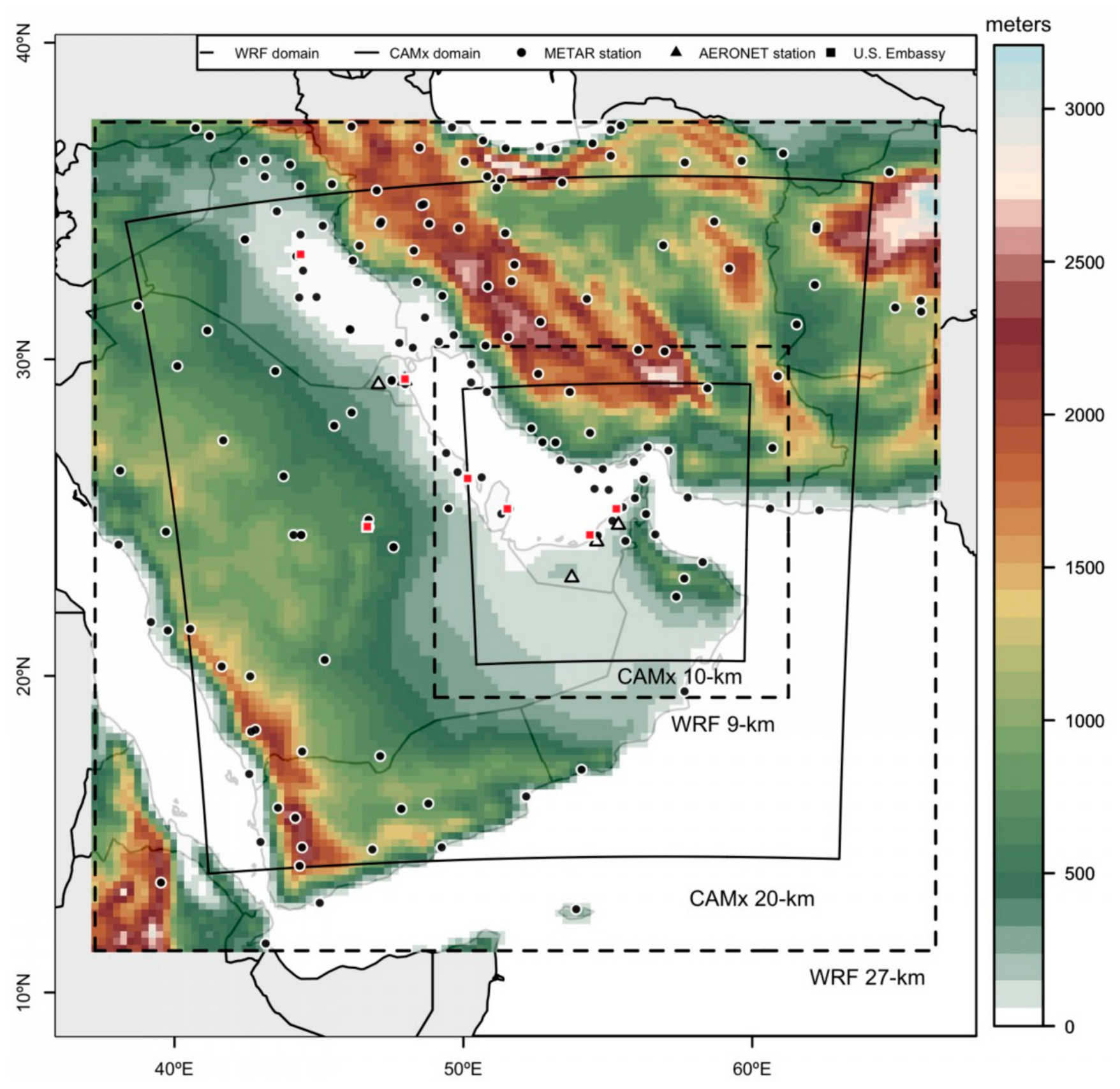
The WRF-CAMx simulations are performed using double-nested domains, with the coarse domains covering most of West Asia and the nested domains covering the UAE. WRF and CAMx are configured with different spatial resolutions to optimize computational efficiency and meet the modeling objectives. Figure 1 shows the WRF domains (dashed lines) at 27 km and 9 km resolutions, along with the CAMx domains (solid lines) at 20 km and 10 km resolution; the elevation is represented by the color scale. The WRF domains are intentionally larger than the corresponding CAMx domains to avoid using meteorological results near the model boundaries, where numerical artifacts and boundary condition influences can negatively affect the CAMx results. The 27 km WRF outer domain provides boundary conditions for the 9 km nest, which better resolves wind fields and boundary layer dynamics. CAMx uses a 20 km outer domain to better resolve emission sources and chemical gradients, which typically show sharper spatial variations than meteorological fields, while the 10 km inner domain is appropriate for regional air quality modeling given the available emission inventory resolution. The WRF model is a widely used numerical weather prediction system that incorporates various physical parameterizations to simulate atmospheric processes [23], simulating meteorological variables such as wind fields, temperature, pressure, and humidity that serve as input for CAMx (WRF 27 km outputs are processed for CAMx 20 km and WRF 9 km outputs for CAMx 10 km). CAMx simulates air quality processes, including the transport, dispersion, chemical transformation, and deposition of atmospheric pollutants [24].
In this study, version 4.3.1 of the WRF model is used. Both domains use a vertical resolution of 35 layers. Table 1 summarizes its physics and assimilation options. The simulations are performed using the Rapid Radiative Transfer Model for General circulation model (RRTMG) schemes for shortwave and longwave radiation, which incorporates cloud and aerosol interactions and an accurate treatment of the gaseous and aerosol absorption [25]. For microphysics, the Morrison two-moment scheme is used, which predicts both the mass and number concentrations of key hydrometeor species, including cloud water, rain, cloud ice, snow, and graupel [26]. For the surface layer, the option Pleim–Xiu Scheme is selected, providing the representation of fluxes of momentum, heat, and moisture between the land surface and the lower atmosphere [27]. Further, this scheme dynamically adjusts soil moisture and temperature using a force-restore approach, improving the representation of surface energy fluxes and boundary layer evolution [28,29]. The Asymmetric Convective Model version 2 (ACM2) scheme is used for boundary layer processes. This hybrid scheme combines local and non-local closure to represent both small-scale diffusion and large-scale eddy transport, allowing for upward and downward mixing [30]. For the cumulus option, the Tiedtke scheme of reference [31] is chosen. This option accounts for deep, shallow, and mid-level convection, making it suitable for tropical and mid-latitude convection processes.
The meteorological initial and boundary conditions for the WRF simulations are from the Global Forecast System model from the National Centers for Environmental Prediction (NCEP GFS) with a spatial resolution of 0.25°. Land-use characteristics are from the United States Geological Survey (USGS) land-use dataset. To improve the accuracy of the meteorological variables, Four-Dimensional Data Assimilation (FDDA) is applied using the NCEP final operational global analysis (NCEP GDAS/FNL) with a resolution of 0.25° and deep soil nudging using Meteorological Aerodrome Reports (METARs) observations from the Meteorological Assimilation Data Ingest System (MADIS) system [32]. The assimilation is performed every six hours for all model layers outside the Planetary Boundary Layer (PBL), with nudging coefficients for wind speed (guv), temperature (gt), and humidity (gq) as detailed in Table 1. WRF uses fixed time steps determined according to the grid spacing of each domain (120 s for the 27 km domain and 40 s for the 9 km domain). Additionally, the simulation is initialized 10 days prior to the analysis period to allow for model spin-up.
Table 1. WRF and CAMx model options.
WRF ParameterWRF Option
Shortwave radiationRRTMG shortwave [25]
Longwave radiationUpdated RRTMG scheme [25]
Cloud microphysicsMorrison 2-moments Scheme [26]
Surface layerPleim-Xiu [27]
Land surfacePleim-Xiu Land Surface Model [28,29,33]
Boundary layerACM2 PBL [30]
Cumulus cloudsTiedtke scheme [31,34]
FDDAguv = 0.0003, gt = 0.0003, gq = 0.00001
Deep soil nudgingPleim & Gilliam [32]
CAMx ParameterCAMx Option
Chemistry mechanismCB6r4 + DMS + CF2 [35]
Aerosol treatmentCoarse/fine CF 2-mode model (CF2)
Inorganic PM chemISORROPIA [36,37]
Organic PM chemSOAP2.2 [38]
Horizontal advectionPPM [39]
Chemistry solverEBI [40]
Dry deposition modelWESELY89 [41,42]
Inline Ix emissionsYes
Super stepping optionYes
RRTMG: Rapid Radiative Transfer Model for General circulation model, ACM2: Asymmetric Convection Model 2 Scheme, PBL: Planetary Boundary Layer, CB6r4: Carbon Bond v6, DMS: including dimethyl sulfide oxidation reactions, CF2: coarse/fine model, ISORROPIA: Improved State Of Reversible Reactions Reacting Organic particles in the atmosphere aerosol thermodynamic equilibrium model, SOAP2.2: Secondary Organic Aerosol Partitioning, PPM: piecewise parabolic method, EBI: Euler backward iterative, Inline Ix emissions: oceanic inorganic iodine emissions, Super stepping: option that allows the model to use large time-steps possible, keeping the solution numerically stable.
The CAMx model (version 7.20) is used. Both domains use a vertical resolution of 22 levels. The first 15 layers correspond to the first 15 levels of WRF, and the remaining 7 layers are mapped to WRF model layers of 16 to 32 with spacing gradually increasing up to WRF level 32.
Table 1 also provides a summary of the physics, chemistry, and other configurations used in the CAMx simulations. For horizontal advection, CAMx uses the Piecewise Parabolic Method (PPM) [39]. The dry deposition is modeled using WESELY89, a resistance-based approach that accounts for the deposition of gases [42] and aerosols [41]. For the chemical mechanism, the Carbon Bond v6 (CB6r4) scheme [43] is used, including dimethyl sulfide (DMS) oxidation reactions [44]. This mechanism includes 233 reactions among 87 species (62 state gases and 25 radicals). The coarse and fine aerosol (CF2) scheme divides the size distribution into two static modes. Primary species are modeled as fine and/or coarse particles, while all secondary (chemically formed) species are modeled as fine particles only. Partitioning of inorganic aerosol constituents (sulfate, nitrate, chloride, ammonium, and sodium) between the gas and aerosol phases is performed using ISORROPIA v1.7 [36,37]. For secondary organic aerosol (SOA) chemistry, the SOAP2.2 mechanism [38] is applied. These mechanisms are solved using the Euler Backward Iterative (EBI) method [40], which provides a balance of computational speed and accuracy. The model is run using the super stepping option that allows the model to select the largest grid-specific driving time steps possible [24].
Anthropogenic emissions are generated using R (version 4.2.0) and Python (version 3.11.0) scripts, in combination with the EmissV R-package [45], the emissions from the Emissions Database for Global Atmospheric Research EDGAR 5.0 [46] (native resolution of 0.1° × 0.1°) are allocated to the CB6r4 mechanism Volatile Organic Compounds (VOCs) species using data from the Speciation Tool [47]. All EDGAR 5.0 available emission sectors were processed and applied as surface emissions within the CAMx modeling system. There are many uncertainties regarding the total estimated emissions in EDGAR for the region of West Asia; for example, the uncertainty for emissions is 69.4% for NOx, 108.1% for CO, 47.7% for SO2, 133.9% for VOCs, 56.5% for PM2.5, 104.3% for PM10 [48]. Initial model applications using the original EDGAR emissions showed systematic biases in simulated pollutant concentrations relative to observations, as summarized in Table S1. The scaling factors were empirically selected based on the sign and approximate magnitude of the normalized mean biases identified during the initial model evaluation. To partially account for these uncertainties, empirically derived constant scaling factors were applied to the model-ready emissions as first-order adjustments. Specifically, NOx emissions were reduced by 20%, while emissions of CO, SO2, VOCs, PM2.5, and PM10 were increased by 120%, 35%, 102%, 300%, and 250%, respectively. These adjustments are intended to partially account for uncertainties in emission magnitude, rather than to represent optimized or universally applicable correction factors, and they do not address uncertainties related to sectoral representation or spatial allocation in the inventory.
Dust and oceanic emissions are generated using CAMx preprocessors. The CAMx wind-blown dust preprocessor (WBDUST) version 2.0 is used. Initial simulations showed substantial overprediction of particulate matter concentrations associated with dust emissions, particularly during strong wind events. Because WBDUST dust emissions are highly sensitive to friction velocity and surface characteristics, relatively small uncertainties in wind speed, soil properties, and land surface datasets can lead to very large uncertainties in simulated dust emissions over arid regions. To partially account for these uncertainties and reduce systematic PM overprediction, PM10 dust emissions were reduced by 90% and PM2.5 dust emissions by 97% as first-order sensitivity adjustments. Oceanic emissions are generated using the CAMx oceanic preprocessor version 4.3, and the CAMx options for inline emissions of inorganic iodine are activated. Additionally, ozone column and photolysis rates are generated using O3MAP version 3.1 and the Tropospheric Ultraviolet and Visible (TUV) radiation model (version 4.8).
Boundary conditions and initial conditions for CAMx/CB6r4 species are extracted from Community Atmosphere Model with Chemistry (CAM-Chem) outputs for simulations covering 2017–2020 and from Whole Atmosphere Community Climate Model (WACCM) outputs from simulations covering 2021–2022. Adjustments to ozone boundary conditions are applied based on an initial model evaluation at a rural monitoring station in the region. For winter months (January 2019 and January 2020), a 20% reduction is applied, while summer boundary conditions are increased by 80% in June 2017, 20% in June 2018, 40% in June 2020, and 60% in June 2021. These adjustments are determined after reducing local emissions to zero to isolate the influence of lateral boundary conditions.
Model performance is evaluated using available observational datasets. Table 2 summarizes the datasets used to assess meteorological variables from WRF and atmospheric composition from CAMx. Hourly data from 127 surface stations, obtained from the Meteorological Aerodrome Reports [49], are used to evaluate meteorological variables, including temperature at 2 m (T2), specific humidity at 2 m (Q2), wind speed at 10 m (WS10), and wind direction at 10 m (WD10). Additionally, aerosol optical depth (AOD) is evaluated using ground-based remote sensing data from the Aerosol Robotic Network [50]. AOD is a dimensionless measure of the effect of the absorbing or scattering of sunlight by the aerosols in the atmosphere. Of the 28 AERONET stations located within the CAMx 20 km simulation domain, five have AOD data available for the simulated periods. The satellite products are used to validate the model covering various meteorological and atmospheric composition variables. Precipitation predictions are obtained from the Global Precipitation Climatology Project (GPCP) v3.2 [51] and Tropical Rainfall Measuring Mission-TRMM satellite [52], which provide the long-term global precipitation data.
Radiation flux components are evaluated using products from the Clouds and the Earth’s Radiant Energy System (CERES) [53,54], which offer detailed information on longwave (GLW) and shortwave (GSW) radiation at surface levels, the Longwave Cloud Forcing (LWCF) and Shortwave Cloud Forcing (SWCF), and Outgoing Longwave Radiation (OLR) and Downward Shortwave Radiation at the Surface (SWDOWN). Additionally, cloud parameters such as cloud droplet number concentration (CDNC), cloud condensation nuclei (CCN), cloud optical thickness (COT), cloud water path (CWP), and cloud fraction (CL) are compared with data from the Moderate Resolution Imaging Spectroradiometer (MODIS) [55]. CF and OLR are compared with Atmospheric Infrared Sounder (AIRS) v7.0 [56].
AOD is compared with MODIS and Multi-Angle Implementation of Atmospheric Correction (MAIAC) [57]. To evaluate atmospheric composition, column pollutant concentrations are analyzed using data from the Measurement of Pollution in the Troposphere [58], which provides carbon monoxide (CO) column predictions, and the Ozone Monitoring Instrument (OMI) [59], which provides column concentrations of nitrogen dioxide (NO2), Ozone (O3), sulfur dioxide (SO2), and formaldehyde (HCHO). Finally, AIRS is also used to evaluate O3 column. These satellite datasets serve as critical references for assessing CAMx model performance, since there is a lack of data available for the study domain.
To evaluate the performance of the WRF and CAMx models, statistical analysis is conducted using criteria from the literature and implemented through the R-package eva3dm [60]. For evaluation using ground-based data, observed data is spatially and temporally paired with model time series. In the case of the evaluation using satellite data, model results and satellite observations are first averaged monthly, followed by interpolation using the bilinear method of the satellite data to the model grid. To ensure reliable comparisons, only data points located at least five grid points away from the model boundary are considered. The evaluation includes the calculation of common statistical metrics such as mean error (ME), mean bias (MB) of the absolute value, index of agreement (IOA), Root Mean Square Error (RMSE), and correlation coefficient (r), as well as modified normalized mean bias (NMB) and modified normalized mean error (NME), both computed using an absolute-value denominator to ensure consistent normalization for variables that may take negative values.
The evaluation criteria for model performance vary depending on the variable, simulation goals, observational variability, and measurement errors. For meteorological variables such as temperature at 2 m (T2), specific humidity at 2 m (Q2), wind speed (WS), and wind direction (WD), criteria from [61,62] are applied for simple terrain, while [63] is referenced for complex terrain. For precipitation, the evaluation follows the recommendations of [64].
Unlike meteorological variables, there are no standardized evaluation criteria for AOD in the literature. Most existing guidance comes from studies conducted in the U.S., including the early work by [64,65] and the more comprehensive assessment by [66]. For the study region, several publications exist [67,68,69,70,71,72] but they do not provide a consistent set of evaluation benchmarks. Thus, we review these studies to identify commonly used criteria that can guide the evaluation of AOD for the region. One common metric in these studies is the use of r2 values, which typically range from 0.5 to 0.8. Bias metrics such as MB and NMB are commonly used, with acceptable thresholds between 20% and 40% [70,73,74]. However, ref. [70] note that global biases often compensate for regional errors. Ref. [72] report a mean error (ME) of 0.3 for polluted regions (AOD ≥ 1) and 0.05 for less polluted areas (AOD < 0.5). In this study, AOD evaluation is based on r, NMB, and NME, with threshold values derived from previous literature. The selected thresholds are comparable to those for PM2.5 proposed by [75], where NMB ranges between 10% and 30% and NME between 35% and 50%. For the PM2.5 from satellite, we are using thresholds based on the previously mentioned literature: values equal to or higher than 0.7 indicate good model performance, while values equal to or higher than 0.4 indicate acceptable performance, which are stricter than traditional evaluation against surface stations in [75].
For column O3 abundances, the evaluation follows the criteria from [75], included in Table 3. For the column abundances of CO, NO2, SO2 and HCHO only the NMB metric is considered, with acceptable threshold values of ±15%, ±30%, ±30%, and ±50%, respectively, to assess the degree of underprediction or overprediction [75].
The evaluation conducted in this study is affected by the limited availability of observational datasets over West Asia. Surface observations for air pollutants remain sparse across much of the region, particularly for PM2.5, aerosol properties, and trace gas measurements, relying partially on satellite retrieval products that contain additional uncertainties related to retrieval assumptions, cloud contamination, spatial representativeness, and vertical sensitivity. Although multiple independent datasets were combined to support the model evaluation, additional surface observations and aerosol profile measurements would be essential for a more in-depth assessment of model performance and atmospheric processes.

3. Results and Discussion

Meteorological variables from the WRF simulations for domains d01 (27 km) and d02 (9 km), as well as chemical results from the CAMx simulations for domains d01 (20 km) and d02 (10 km), are presented in this section. The analysis covers six simulated cases: three winter cases (January 2018, January 2020, and January 2022) and three summer cases (June 2017, June 2019, and June 2021). The analyzed simulation periods were selected based on the availability of meteorological and air quality observations and their consistency with the typical seasonal conditions identified in broader simulations conducted for 2017–2022. Although the selected months do not represent the full interannual variability of the region or all extreme dust and pollution episodes, they provide representative winter and summer conditions suitable for evaluating the performance of the WRF-CAMx modeling system under distinct meteorological and chemical environments over West Asia.

3.1. WRF Evaluation

Table 4 shows the evaluation of WRF results for all domains using surface stations from METAR for T2, Q2, WS10, and WD10 and precipitation from satellite from Global Precipitation Climatology Project (GPCP) and Tropical Rainfall Measuring Mission (TRMM), however TRMM is available only until 2019. The evaluation of meteorological variables shows different degrees of performance across different seasons. T2 shows good agreement with observations, with an IOA ranging from 0.9 to 1.0. It exhibits a moderate seasonal bias, with an underprediction in winter (MB ≈ −0.5 °C) and an overprediction in summer (MB ≈ 0.4 °C), while maintaining moderate errors (ME between 1.71 and 2.52 °C), that are considered acceptable for complex terrain. Good performance is mainly attributed to the use of deep soil nudging, which reduces the MB and RMSE while increasing IOA. Q2 shows good agreement in terms of IOA (0.83–0.88), but a consistent underprediction (MB ranging from −0.37 to −1.1 g kg−1) that exceeds the recommended benchmarks. Q2 errors are moderate in summer but much larger in winter, particularly in the 9 km WRF domain, where ME ranges from 1.57 to 4.48 g kg−1 (outside the benchmarks). WS10 presents a low bias (MB between −0.4 and 0.18 m s−1) and moderate errors (RMSE between 2 and 2.6 m s−1) that are close to the benchmarks for complex terrain. WD10 also has a low bias (MB of 3.8 to 6.4°) but moderately large errors (ME ranging from 45 to 53°), that are within the benchmark for complex terrain. The systematic underprediction of Q2 during winter is observed at both coastal and inland stations despite the generally good performance of T2, WS, and WD. This suggests that the bias is not primarily associated with errors in the large-scale meteorological conditions or atmospheric circulation. Instead, the dry bias likely reflects limitations in the representation of processes controlling near-surface moisture availability and moisture exchange.
Precipitation shows a moderate negative bias in winter (NMB between −15% and −11%) and a significant negative bias in summer (NMB between −37% and −53%) when compared to GPCP data. However, when evaluated against TRMM data, precipitation bias is lower in summer (NMB between −23% and 18%) and significant in winter (NMB between −8% and 73%). Notably, TRMM data is only available until 2019, and comparisons with TRMM for winter and summer are similar to the GPCP comparisons for January 2018 and June 2017, respectively.
The results from the 27 km and 9 km domains can be intercompared by analyzing the rows in Table 1 labeled “27 km in d02” and “9 km in d02.” Statistically, the evaluation metrics indicate that the model performances at both resolutions are quite similar. However, some differences emerge, particularly in precipitation. The 9 km simulation shows a reduced underprediction of precipitation compared to the 27 km simulation, suggesting that the higher resolution captures precipitation patterns more accurately. Additionally, during summer, the 9 km simulation exhibits a slight improvement in WS10 performance.
Table 5 evaluates the WRF results for radiation variables (GLW, GSW, LWCF, SWCF, OLR, and SWDOWN) and cloud-related variables (CF, CWP) with data retrieved from satellite observations. The radiation variables generally show good performance, with correlation coefficients ranging from 0.65 to 0.98 and low NMB (lower than 15%) and NME (lower than 30%) for most variables, these results are comparable to the findings on the literature for this type of evaluation [76,77,78,79]. However, LWCF and SWCF, which are linked to cloud processes, exhibit lower correlations and higher NMB and NME compared to other radiation variables for the winter session. This is an indication that the radiative effect of clouds is underestimated in winter; during summer, similar NME indicates that the model representation has limitations on the representation of the cloud structure and radiative effect. Other cloud-related variables, CF and CWP, show the worst performance, reflecting the high uncertainties associated with model cloud parameterizations, that can be associated with the representation of high clouds [79] in the Morrison cloud microphysics scheme [26].
The seasonal surface temperature biases in the WRF simulations are linked to systematic errors in cloud–radiation interactions. During winter, a negative temperature bias (MB = −0.5 °C) is associated with substantial underpredictions in LWCF (NMB = −41%) and CF (NMB = −37%), leading to insufficient longwave trapping and enhanced radiative cooling. Although OLR is only slightly underpredicted, the large LWCF and cloud fraction biases suggest that the modeled clouds are inefficient at modulating the surface energy balance. In summer, the model exhibits a positive 2 m temperature bias (MB = 0.4 °C), which can be attributed to underpredictions in cloud forcing from LWCF (NMB = −8.6%) and overprediction of SWCF (NMB = 6.7%). Notably, the model overpredicts cloud fraction relative to MODIS and AIRS retrievals, yet still reflects insufficient shortwave radiation, indicating that simulated clouds may be optically thin or poorly represented in the radiation scheme. These findings suggest that uncertainties in cloud microphysics and radiation parameterizations can significantly impact temperature simulations, particularly during winter.
Uncertainties in model inputs, particularly land-use and elevation datasets, can introduce significant biases in WRF simulations. Land-use classification directly affects surface energy fluxes, vegetation-driven moisture availability, and the development of the atmospheric boundary layer. These processes are critical for accurately representing near-surface temperature, wind, and humidity [80]. Elevation errors are especially problematic in regions with complex terrain, such as West Asia, where they can distort terrain-induced circulations, influence orographic precipitation patterns, and misrepresent wind flow, contributing to observed errors in wind speed and direction [8]. The arid climate and highly heterogeneous land cover further complicate the representation of land–atmosphere interactions [81,82]. Additionally, uncertainties in the meteorological initial and boundary conditions can propagate through the simulation period, affecting large-scale circulation patterns and regional dynamics.
The performance of the WRF meteorological model plays a critical role in determining the accuracy of CAMx air quality simulations, as meteorological fields govern atmospheric transport, dispersion, mixing, cloud processes, deposition, and chemical transformation of pollutants [83,84]. In this study, discrepancies in meteorological variables, particularly under stable wintertime conditions with limited atmospheric mixing, are likely to propagate into CAMx, influencing the representation of pollutant concentrations. Inaccuracies in temperature, humidity, and wind fields can lead to errors in simulating mixing layer height, horizontal and vertical transport pathways, and chemical reaction rates. These effects ultimately alter the spatial and temporal distributions of both primary and secondary pollutant formation.

3.2. CAMx Evaluation

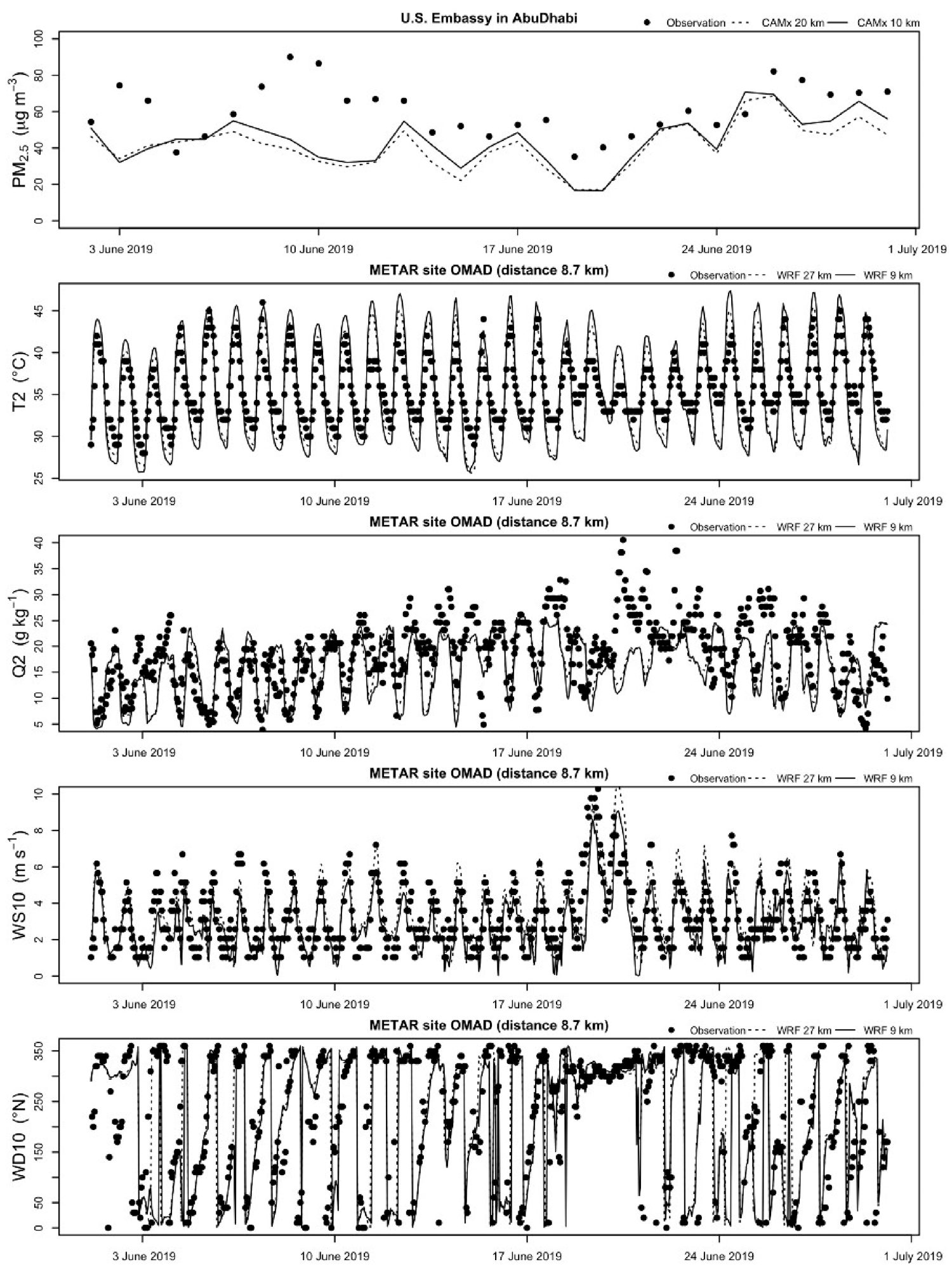
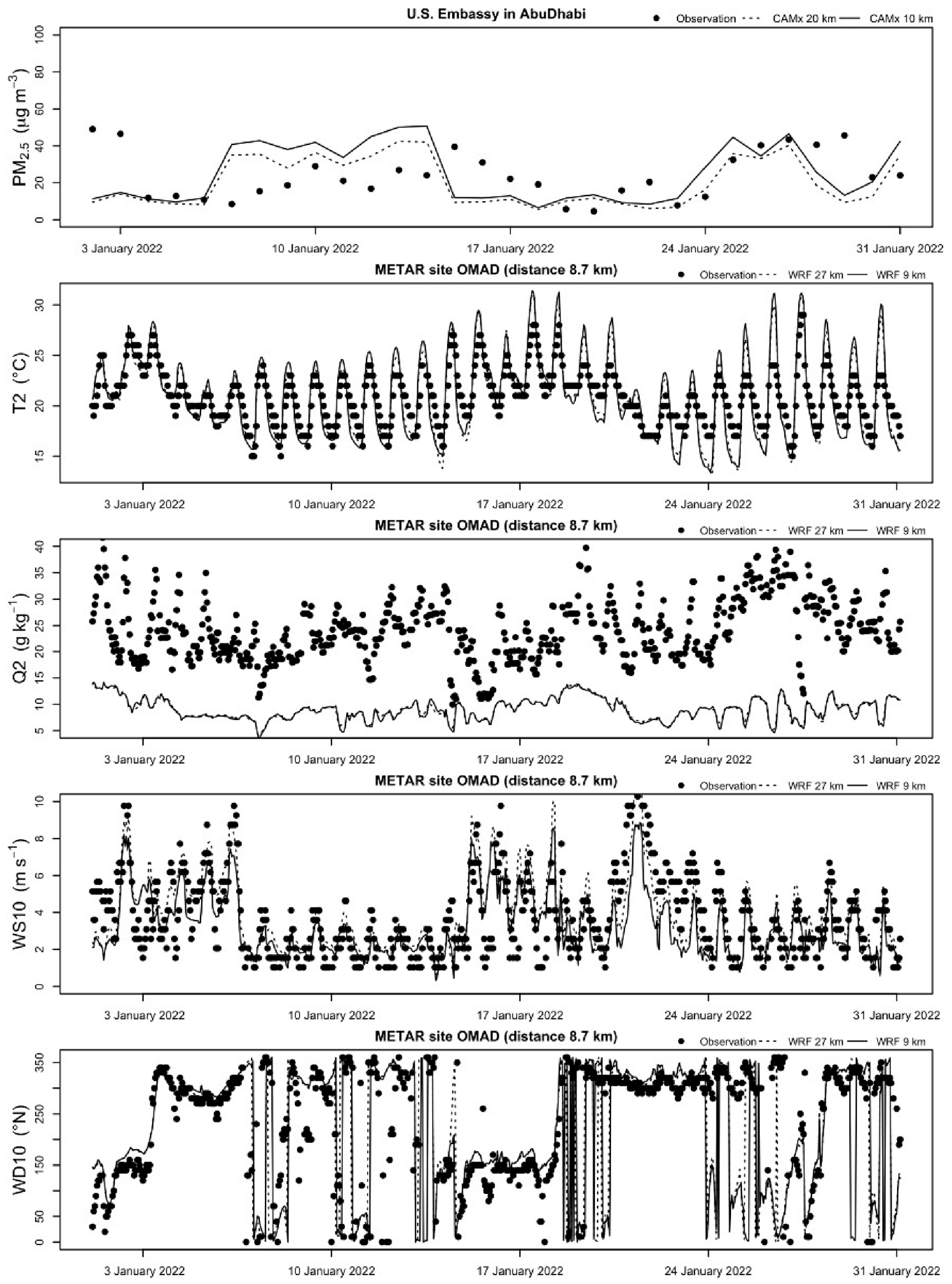
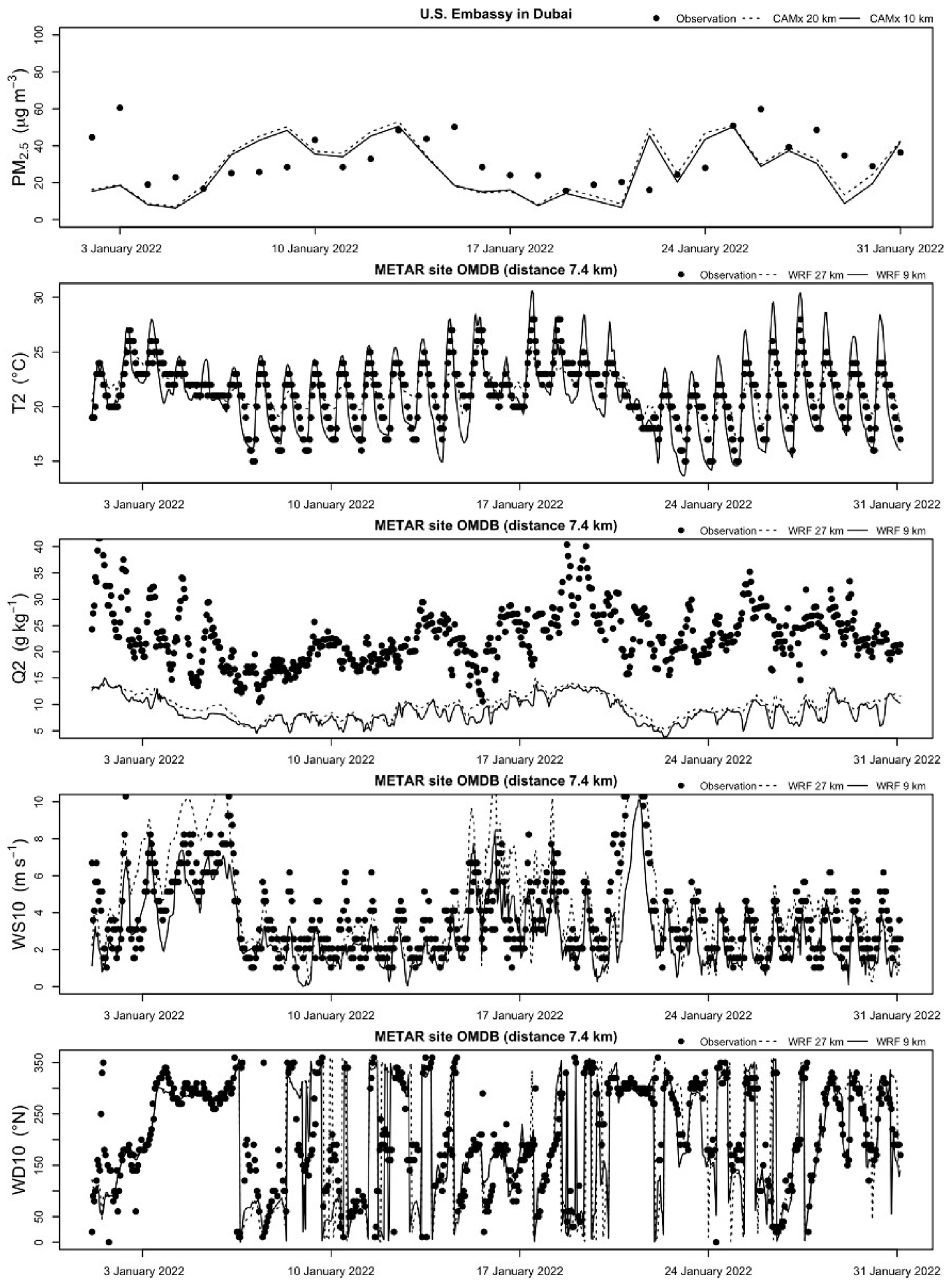
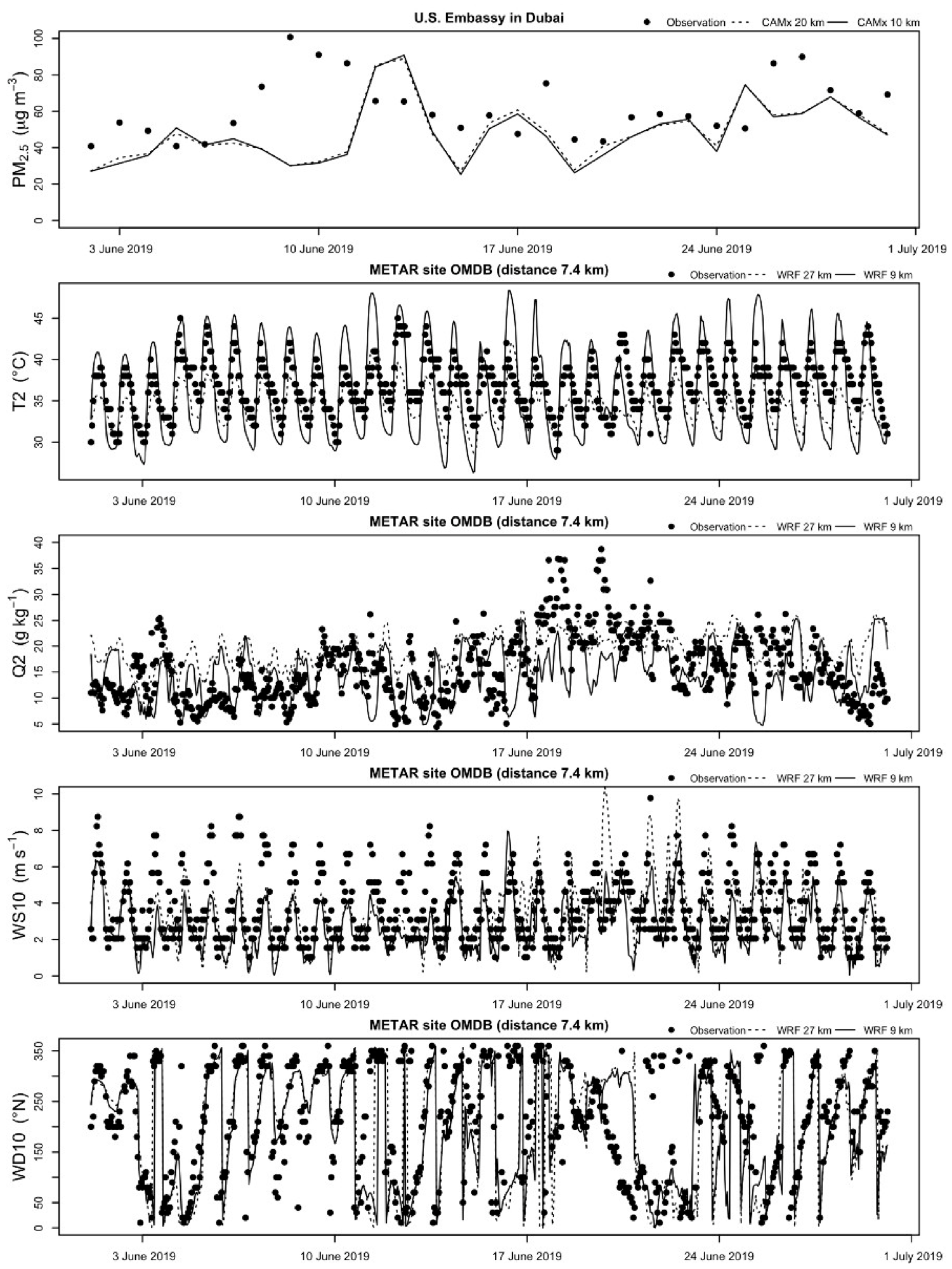
Table 6 shows the evaluation of the CAMx results using surface observations for PM2.5 at the U.S. Embassy sites and AOD from AERONET. The comparison indicates good model performance for PM2.5 and AOD. PM2.5 exhibits good correlation (ranging from 0.44 to 0.65) and moderately large negative bias (NMBs between −28% and 0.5%), and NMEs range from 39% to 45.4%, which fall within the acceptable to good model performance criteria outlined in Table 3. The CAMx 10 km results show an approximately 10% improvement in NMB for both cases, indicating reduced bias compared to the CAMx 20 km results. However, the 10 km resolution simulation gives slightly lower correlation values (r) and no significant change in NME. The AOD comparison reveals low correlation (r between −0.14 in summer and 0.41 in winter), NMBs ranging from 9% to 42%, and NME ranging from 49% to 52% in winter and from 60% to 70% in summer. Time series of PM2.5 and AOD are included in the (Figure 1, Figure 2, Figure 3 and Figure 4 and Supplementary Material Figures S5 and S6). The simulated PM2.5 temporal trends agree with the observations from U.S. embassy sites (Figure 2, Figure 3 and Figure 4 and Figures S2–S5), especially in cases where wind speed and direction are well captured (e.g., Figure S2). In contrast, AOD time series from the AERONET site (Figures S5 and S6) show poor temporal agreement with observations, although the magnitudes are comparable. A significant underprediction of Q2 is evident at the collocated METAR sites for January; however, there is no direct evidence that this bias is affecting the performance of PM2.5 or AOD.
The weaker agreement for AOD relative to surface PM2.5 suggests additional uncertainties in the representation of aerosol vertical distribution and dust transport processes. Dust emissions remain one of the largest sources of uncertainty in regional air quality modeling over West Asia due to limitations in soil, vegetation, and land surface datasets used by WBDUST. These uncertainties can affect both surface PM2.5 concentrations and aerosol column loading. While the evaluation of wind speed and direction indicates that the horizontal transport of aerosols is reasonably represented, the vertical redistribution of dust remains an additional source of uncertainty that was not directly evaluated in this study. Aerosol vertical distribution is strongly influenced by boundary layer dynamics, surface properties, radiation fluxes, and atmospheric stability, particularly over heterogeneous oceanic, desert, and urban surfaces. Consequently, uncertainties in vertical mixing and aerosol lofting may contribute to discrepancies between simulated and observed AOD, even when surface PM2.5 concentrations are reasonably reproduced. Figure 2 and Figure 3 present the time series of PM2.5 and AOD for January 2022, while Figure 4 and Figure 5 show the corresponding time series for June 2019. These figures provide examples of colocated aerosol observations from U.S. Embassy and AERONET sites, together with meteorological observations from nearby METAR stations (the distances between sites are indicated in the figures). Although differences in Q2 are evident, variations in the other meteorological variables are relatively small and appear to have only a limited impact on model performance in simulating aerosol concentrations and optical properties.
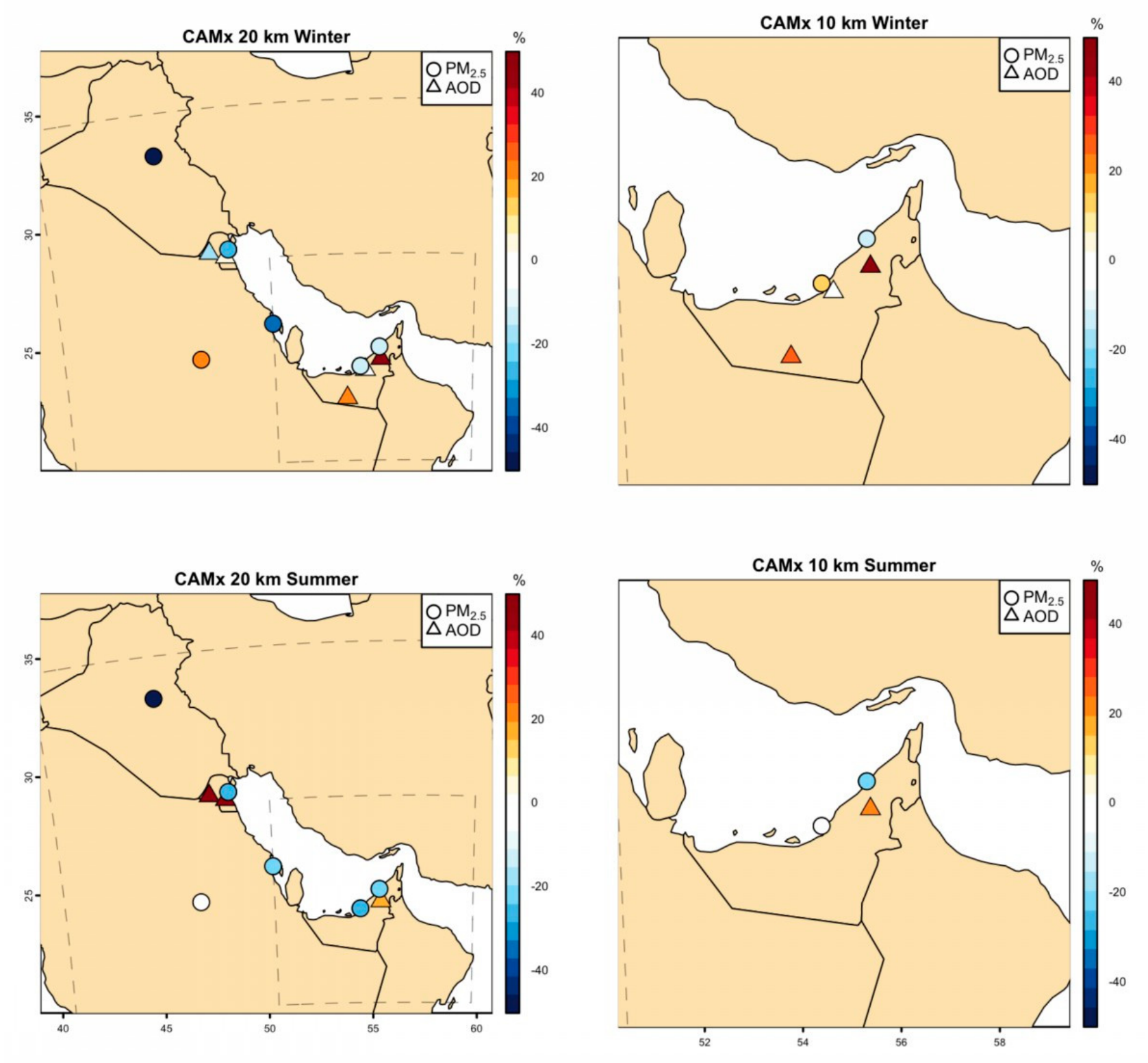
Figure 6 shows the spatial distribution of the NMB of PM2.5 and AOD based on surface observations. The highest underprediction of PM2.5 concentrations occurs at sites located outside the 10 km domain, particularly in Iraq and Saudi Arabia. However, the spatial pattern for AOD in winter shows the opposite from PM2.5, the larger overprediction occurs within the 10 km domain and lower overprediction occurs outside it. For summer, the availability of data is more limited, making it insufficient for a similar comparison. Additionally, AOD data from AERONET are not available for all simulated cases.
Table 7 evaluates the column abundances of NO2, SO2, HCHO, CO, and O3, as well as the AOD, from the CAMx 20 km simulation using satellite observations. The CAMx results show a low bias for NO2 and CO column abundances in both seasons, indicating acceptable model performance. During summer, the model exhibits moderate underprediction of NO2 (NMB = −14%) and CO (NMB = −28%), but both remain within the adopted performance criteria. HCHO shows a small overprediction in winter (NMB = 25%) but a substantial underprediction in summer (NMB = −80%), suggesting greater uncertainty in the representation of VOC emissions and secondary HCHO production during the warm season. Similar seasonal discrepancies have been reported in previous studies evaluating regional air quality models. SO2 column abundances are substantially overpredicted, with NMB values ranging from 270% in winter and 450% in summer, well outside the performance criteria. However, the interpretation of this bias is complicated by known limitations on OMI SO2 retrievals in regions with elevated CO or O3 concentrations, where SO2 can be underestimated or not detected [85].
O3 columns abundances show strong spatial correlation in winter (r ~ 0.86) but considerably weaker correlations in summer (r values between 0.16 and 0.26). The model underpredicts O3 in winter (NMB = −38%) and overpredicts it in summer (NMB = 40%), while maintaining moderate errors in both seasons (NMEs ranging from 36% to 48%). These results suggest that the model reproduces the large-scale winter distribution of O3 reasonably well but exhibits greater uncertainty in summertime photochemical production and transport processes. The substantial summer underprediction of HCHO and moderate underprediction of NO2 are not fully reflected in the O3 results, which exhibit a positive bias during summer. This behavior highlights the nonlinear nature of tropospheric O3 chemistry and suggests that factors beyond local precursor abundances, including chemical regime sensitivity, long-range transport, and boundary conditions, may contribute to the simulated O3 columns.
AOD exhibits very low correlation (r = −0.18 to 0.15), indicating difficulties in reproducing the observed aerosol spatial patterns. Relative to MODIS, the model shows a moderate underprediction (NMB = −38% to −40%), whereas comparison with MAIAC indicates only a small bias (NMB = 1% to 15%). Despite the relatively low bias, the model exhibits moderate to large error (NME = 44–48% for MODIS and 61–63% for MAIAC), suggesting substantial uncertainty in the representation of aerosol emissions, dust transport, and aerosol option properties over West Asia.
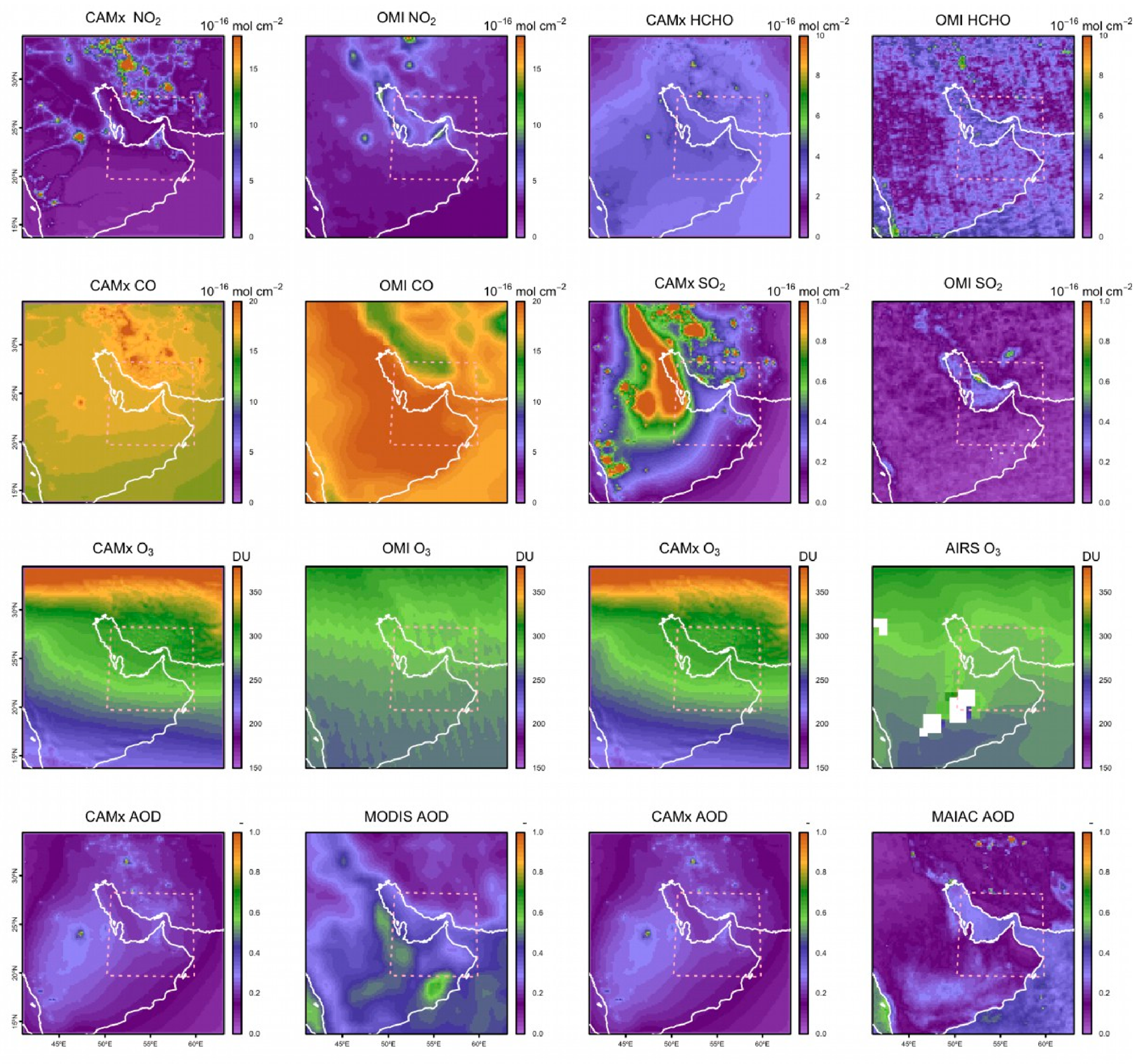
Figure 7 shows the column abundances of NO2, SO2, HCHO, CO and O3, and calculated AOD [65,86,87] from CAMx model results and satellite retrievals. The CAMx column abundances of NO2 exhibited hotspots over urban areas and along major roads connecting these cities, reflecting significant NO2 emissions from the transportation and industrial sectors [88]. The spatial distribution of NO2 from OMI matches with the model results over urban areas, suggesting that the model reasonably captures the major emission sources and their spatial distribution.
For HCHO, CAMx identifies a few small hotspots over Saudi Arabia and Iran. However, OMI data appear noisy, with some hotspots detected in the same regions of Iran, though the overall patterns are less consistent. The limited agreement between CAMx and OMI may reflect uncertainties in both satellite retrievals and the representation of VOC emissions and secondary HCHO production. The CO distribution in CAMx is primarily concentrated in Saudi Arabia, with additional hotspots over urban areas in Iran. In contrast, OMI CO data depict a different spatial pattern, with low abundances over Iran and an extensive region of high abundances covering most of the domain.
CAMx SO2 column abundances indicate several hotspots over Saudi Arabia and Iran; however, OMI did not detect the same hotspots over parts of Saudi Arabia. One important source of uncertainty is related to documented limitations in OMI SO2 retrievals over regions with elevated concentrations of CO and O3, where interference in the retrieval algorithm can lead to underestimation or even non-detection of SO2. Under these conditions, model results that reasonably represent atmospheric SO2 levels may appear artificially biased high when compared against the satellite retrievals. This also complicates the evaluation of the spatial distribution of SO2 hotspots. In addition, SO2 emissions over West Asia remain highly uncertain due to limitations in regional emission inventories, particularly from industrial and power generation sources. Boundary conditions may also contribute to the modeled bias. Because of the limited availability of surface SO2 observations in the study region, it is difficult to fully isolate the dominant source of the overprediction.
For O3, CAMx simulations produce spatial patterns similar to those observed in OMI and AIRS data, with higher column abundances at higher latitudes, aligning well with satellite observations. The northward increase in O3 column abundances is consistent with the latitudinal gradient observed in satellite products. CAMx AOD results show numerous small hotspots over Iran, the United Arab Emirates, and several cities in Saudi Arabia. However, MODIS AOD data highlight different hotspot locations, particularly over the Red Sea and southern Oman. MAIAC AOD data show similar hotspots to MODIS but in different regions, including the Red Sea. The differences between CAMx and the satellite products likely reflect uncertainties in dust emissions and vertical transport processes, which are major contributors to aerosol loading over West Asia.
The spatial distributions of HCHO, CO, SO2, O3, and AOD are influenced by distinct physical and chemical processes. Elevated HCHO columns over Saudi Arabia and Iran are consistent with regions of intense anthropogenic VOC emissions associated with urban, petrochemical, and oil-production activities. Similarly, CO and SO2 hotspots coincide with major urban and industrial centers and regions of fossil-fuel extraction and processing that have been identified as important emission sources in previous studies. The northward increase in O3 column abundances is consistent with the large-scale latitudinal gradient observed in satellite retrievals. For AOD, the differences between CAMx and satellite products are likely related to uncertainties in dust emissions and transport, which represent a major source of aerosols over West Asia.
Overall, the meteorological evaluation indicates that temperature, wind speed, wind direction, and precipitation are reasonably represented by WRF across both seasons. Although larger uncertainties were identified for specific humidity and some cloud-radiation variables, particularly during winter, the generally good performance of the meteorological fields suggests that the major transport and dispersion processes are adequately captured (Figure 2, Figure 3, Figure 4 and Figure 5 are clear examples). Therefore, the discrepancies observed in the CAMx column abundances are likely influenced not only by meteorological uncertainties but also by factors such as emission inventories, chemical mechanisms, boundary conditions, and satellite retrieval uncertainties.

4. Conclusions

In this study, the WRF and CAMx modeling system was applied to simulate meteorological conditions and air quality over West Asia during representative winter (January 2018, 2020, and 2022) and summer (June 2017, 2019, and 2021) periods. Evaluation against available surface, satellite, and aerosol observations indicates that the modeling framework is capable of reproducing the major meteorological conditions and air-quality patterns of the region while also identifying important sources of uncertainty related to cloud processes, emissions, chemistry, and aerosol representation.
The WRF model generally reproduces the meteorological conditions over West Asia with good performance, particularly for near-surface temperature, humidity, wind speed, wind direction, and radiation variables. Temperature exhibits a slight underprediction during winter and a slight overprediction during summer, while precipitation shows moderate seasonal biases depending on the observational dataset used for evaluation. Cloud and radiation variables are generally well represented; however, cloud-related processes remain an important source of uncertainty. The poorer performance of cloud fraction, cloud water path, and cloud radiative forcing indicates limitations in the representation of cloud-radiation interactions, which contribute to the seasonal temperature biases. In winter, underestimated cloud forcing and cloud fraction are associated with excessive surface cooling, whereas in summer, uncertainties in cloud optical properties contribute to warm biases despite generally improved meteorological performance. These results highlight the importance of improving cloud microphysics and radiation parameterizations for applications in arid and semi-arid regions.
The CAMx model demonstrates generally good performance in reproducing PM2.5 concentrations, with acceptable correlations, biases, and errors across the evaluated periods. Increasing the horizontal resolution from 20 km to 10 km reduced some biases but resulted in only modest improvements in overall model skill. The model also reproduces the major spatial patterns and hotspots of NO2 and O3 column abundances observed by satellite retrievals. However, larger uncertainties remain for HCHO, SO2, CO, and aerosol optical depth, particularly during summer conditions, when biases and spatial discrepancies become more pronounced. These results suggest that uncertainties in emissions, chemical mechanisms, boundary conditions, and satellite retrieval products play an important role in the remaining model biases. Although meteorological uncertainties may contribute to some discrepancies, the generally good performance of WRF indicates that these factors are likely more important drivers of CAMx errors over West Asia.
A key finding of this study is that the season with the best meteorological performance does not correspond to the season with the best air-quality performance. While WRF exhibits its largest biases during winter, particularly for Q2 and cloud-related variables, CAMx generally performs better during this season. Conversely, larger air-quality biases are observed during summer despite the overall improved meteorological performance. This indicates that meteorological uncertainties alone cannot explain the observed CAMx errors and suggests that uncertainties in emissions, chemical processes, boundary conditions, and satellite retrievals are likely the dominant contributors to the summertime biases.
The present modeling framework remains subject to several sources of uncertainty. Important limitations include the resolution and accuracy of emission inventories, meteorological and chemical boundary conditions, and geographic datasets such as land use, vegetation, and topography. These uncertainties are particularly relevant for the representation of dust emissions, aerosol optical properties, vertical transport, and boundary-layer processes, which directly influence PM2.5 concentrations and column-integrated quantities such as AOD. The evaluation also identified cloud-related processes, including cloud fraction, cloud water path, and cloud radiative forcing, as important sources of meteorological uncertainty. Although increasing horizontal resolution improved the representation of some local-scale features, the overall model performance remained broadly consistent across resolutions, indicating that resolution alone is insufficient to substantially reduce the remaining biases. Future improvements will likely depend on more accurate emissions, improved physical and chemical parameterizations, higher-quality boundary conditions, and the incorporation of additional observations through data assimilation and other observationally constrained approaches.
A final limitation of this study is the scarcity of observational datasets available for model evaluation over West Asia. Ground-based monitoring networks for particulate matter, trace gases, aerosol properties, and boundary-layer processes remain sparse across much of the region, limiting the ability to perform comprehensive regional-scale assessments. Consequently, part of the evaluation relies on satellite retrieval products, which introduce additional uncertainties related to retrieval assumptions, cloud contamination, surface reflectance, vertical sensitivity, and spatial representativeness. Despite these limitations, the combined use of surface observations, satellite products, and aerosol measurements provides a valuable assessment of model performance over a region where observational constraints remain limited. Future improvements in both model evaluation and air-quality prediction will require expanded monitoring networks, additional vertical profile observations, and more comprehensive long-term measurements of trace gases and aerosols across West Asia.

Supplementary Materials

The following supporting information can be downloaded at https://www.mdpi.com/article/10.3390/cli14060128/s1, Figure S1: Time-series of PM2.5 from U.S. embassy in AbuDhabi and collocated METAR stations for January 2018; Figure S2: Time-series of PM2.5 from U.S. embassy in AbuDhabi and collocated METAR stations for January 2020; Figure S3: Time-series of PM2.5 from U.S. embassy in Dubai and collocated METAR stations for January 2018; Figure S4: Time-series of PM2.5 from U.S. embassy in Dubai and collocated METAR stations for January 2020; Figure S5: Time-series of AOD from AERONET site in Dewa and collocated METAR stations for January 2020; Figure S6: Time-series of AOD from AERONET site in Dewa and collocated METAR stations for June 2019. Table S1: Preliminary evaluation of the CAMx simulations using the original EDGAR emissions before the application of emission scaling adjustments. Dust emissions were not included in this evaluation. The resulting normalized mean biases (NMB) were used as first-order guidance for the empirical emission adjustments applied in this study.

Author Contributions

Conceptualization, D.S. and Y.Z.; methodology, D.S.; software, D.S. and K.F.; validation, D.S.; formal analysis, D.S.; investigation, D.S.; resources, Y.Z.; data curation, D.S. and K.F.; writing—original draft preparation, D.S.; writing—review and editing, Y.Z.; visualization, D.S.; supervision, Y.Z.; project administration, Y.Z.; funding acquisition, Y.Z. All authors have read and agreed to the published version of the manuscript.

Funding

This work is supported by Northeastern University, Department of Civil and Environmental Engineering, Boston, MA, funding number #00066692383.

Data Availability Statement

The source code used in this study is available as open-source software [https://CRAN.R-project.org/package=eva3dm, accessed on 15 February 2022]. The datasets generated and analyzed during the current study are available upon request.

Conflicts of Interest

The authors declare no conflicts of interest.

Abbreviations

The following abbreviations are used in this manuscript:
WRFWeather Research and Forecasting Model
CAMxComprehensive air quality model with extensions
UAEUnited Arab Emirates
O3Ozone
NO2Nitrogen dioxide
SO2Sulfur dioxide
COCarbon monoxide
HCHOFormaldehyde
VOCVolatile organic compound
PM2.5Fine particulate matter
AODAerosol optical depth
T2Temperature at 2 m
Q2Specific humidity at 2 m
WSWind speed
WDWind direction
GLWLong-wave radiation
GSWShort-wave radiation
LWCFLong-wave cloud forcing
SWCFShort-wave cloud forcing
OLROutgoing long-wave radiation
SWDOWNDownward long-wave radiation
CDNCCloud droplet number concentration
CCNCloud condensation nuclei
CLCloud fraction
COTCloud optical thickness
CWPCloud water path
MEMean error
MBMean bias
IOAIndex of agreement
RMSERoot mean square error
rCorrelation coefficient
NMBNormalized mean bias
NMENormalized mean error

References

  1. Omidvarborna, H.; Baawain, M.; Al-Mamun, A. Ambient air quality and exposure assessment study of the Gulf Cooperation Council countries: A critical review. Sci. Total Environ. 2018, 636, 437–448. [Google Scholar] [CrossRef]
  2. Irankunda, E.; Menendez, M.; Khan, B.; Paparella, F.; Pauluis, O. Systematic Review and Meta-Analysis of Urban Air Quality in the Arabian Peninsula. Atmosphere 2025, 16, 990. [Google Scholar] [CrossRef]
  3. Akasha, H.; Ghaffarpasand, O.; Pope, F.D. Climate Change, Air Pollution and the Associated Burden of Disease in the Arabian Peninsula and Neighbouring Regions: A Critical Review of the Literature. Sustainability 2023, 15, 3766. [Google Scholar] [CrossRef]
  4. Prospero, J.M.; Ginoux, P.; Torres, O.; Nicholson, S.E.; Gill, T.E. Environmental characterization of global sources of atmospheric soil dust identified with the Nimbus 7 Total Ozone Mapping Spectrometer (TOMS) absorbing aerosol product. Rev. Geophys. 2002, 40, 2-1–2-31. [Google Scholar] [CrossRef]
  5. Yu, Y.; Notaro, M.; Liu, Z.; Wang, F.; Alkolibi, F.; Fadda, E.; Bakhrjy, F. Climatic controls on the interannual to decadal variability in Saudi Arabian dust activity: Toward the development of a seasonal dust prediction model. J. Geophys. Res. Atmos. 2015, 120, 1739–1758. [Google Scholar] [CrossRef]
  6. Gandham, H.; Dasari, H.P.; Karumuri, A.; Ravuri, P.M.K.; Hoteit, I. Three-dimensional structure and transport pathways of dust aerosols over West Asia. npj Clim. Atmos. Sci. 2022, 5, 45. [Google Scholar] [CrossRef]
  7. Gandham, H.; Dasari, H.P.; Langodan, S.; Karumuri, R.K.; Hoteit, I. Major Changes in Extreme Dust Events Dynamics Over the Arabian Peninsula During 2003–2017 Driven by Atmospheric Conditions. J. Geophys. Res. Atmos. 2020, 125, e2020JD032931. [Google Scholar] [CrossRef]
  8. Hamzeh, N.H.; Karami, S.; Kaskaoutis, D.G.; Tegen, I.; Moradi, M.; Opp, C. Atmospheric Dynamics and Numerical Simulations of Six Frontal Dust Storms in the Middle East Region. Atmosphere 2021, 12, 125. [Google Scholar] [CrossRef]
  9. Fountoukis, C.; Ackermann, L.; Ayoub, M.A.; Gladich, I.; Hoehn, R.D.; Skillern, A. Impact of atmospheric dust emission schemes on dust production and concentration over the Arabian Peninsula. Model. Earth Syst. Environ. 2016, 2, 115. [Google Scholar] [CrossRef]
  10. LeGrand, S.L.; Polashenski, C.; Letcher, T.W.; Creighton, G.A.; Peckham, S.E.; Cetola, J.D. The AFWA dust emission scheme for the GOCART aerosol model in WRF-Chem v3.8.1. Geosci. Model Dev. 2019, 12, 131–166. [Google Scholar] [CrossRef]
  11. Shao, Y.; Ishizuka, M.; Mikami, M.; Leys, J.F. Parameterization of size-resolved dust emission and validation with measurements. J. Geophys. Res. 2011, 116, D08203. [Google Scholar] [CrossRef]
  12. Prakash, P.; Stenchikov, G.; Kalenderski, S.; Osipov, S.; Bangalath, H. The impact of dust storms on the Arabian Peninsula and the Red Sea. Atmos. Chem. Phys. 2015, 15, 199–222. [Google Scholar] [CrossRef]
  13. Kalenderski, S.; Stenchikov, G.; Zhao, C. Modeling a typical winter-time dust event over the Arabian Peninsula and the Red Sea. Atmos. Chem. Phys. 2013, 13, 1999–2014. [Google Scholar] [CrossRef]
  14. Nabavi, S.O.; Haimberger, L.; Samimi, C. Sensitivity of WRF-chem predictions to dust source function specification in West Asia. Aeolian Res. 2017, 24, 115–131. [Google Scholar] [CrossRef]
  15. Ginoux, P.; Chin, M.; Tegen, I.; Prospero, J.M.; Holben, B.; Dubovik, O.; Lin, S.-J. Sources and distributions of dust aerosols simulated with the GOCART model. J. Geophys. Res. Atmos. 2001, 106, 20255–20273. [Google Scholar] [CrossRef]
  16. Nikfal, A.; Ranjbar Saadatabadi, A.; Rahnama, M.; Tajbakhsh, S.; Moradi, M. Intercomparisons of some dust models over West Asia. E3S Web Conf. 2019, 99, 01012. [Google Scholar] [CrossRef]
  17. Emery, C.; Baker, K.; Wilson, G.; Yarwood, G. Comprehensive Air Quality Model with Extensions: Formulation and Evaluation for Ozone and Particulate Matter over the US. Atmosphere 2024, 15, 1158. [Google Scholar] [CrossRef]
  18. Nawaz, M.O.; Johnson, J.; Yarwood, G.; De Foy, B.; Judd, L.; Goldberg, D.L. An intercomparison of satellite, airborne, and ground-level observations with WRF–CAMx simulations of NO2 columns over Houston, Texas, during the September 2021 TRACER-AQ campaign. Atmos. Chem. Phys. 2024, 24, 6719–6741. [Google Scholar] [CrossRef]
  19. Nopmongcol, U.; Koo, B.; Tai, E.; Jung, J.; Piyachaturawat, P.; Emery, C.; Yarwood, G.; Pirovano, G.; Mitsakou, C.; Kallos, G. Modeling Europe with CAMx for the Air Quality Model Evaluation International Initiative (AQMEII). Atmos. Environ. 2012, 53, 177–185. [Google Scholar] [CrossRef]
  20. Fountoukis, C.; Racherla, P.N.; van der Gon, H.A.C.D.; Polymeneas, P.; Charalampidis, P.E.; Pilinis, C.; Wiedensohler, A.; Dall’Osto, M.; O’Dowd, C.; Pandis, S.N. Evaluation of a three-dimensional chemical transport model (PMCAMx) in the European domain during the EUCAARI May 2008 campaign. Atmos. Chem. Phys. 2011, 11, 10331–10347. [Google Scholar] [CrossRef]
  21. Meng, F.; Du, X.; Tang, W.; He, J.; Li, Y.; Wang, X.; Yu, S.; Tang, X.; Xing, J.; Xie, M.; et al. Evaluation of Regional Atmospheric Models for Air Quality Simulations in the Winter Season in China. Atmosphere 2025, 17, 1. [Google Scholar] [CrossRef]
  22. Xiao, H.; Wu, Q.; Yang, X.; Wang, L.; Cheng, H. Numerical study of the effects of initial conditions and emissions on PM2.5 concentration simulations with CAMx v6.1: A Xi’an case study. Geosci. Model Dev. 2021, 14, 223–238. [Google Scholar] [CrossRef]
  23. Skamarock, C.; Klemp, B.; Dudhia, J.; Gill, O.; Liu, Z.; Berner, J.; Wang, W.; Powers, G.; Duda, G.; Barker, D.; et al. A Description of the Advanced Research WRF Version 4; NCAR: Boulder, CO, USA, 2019. [Google Scholar]
  24. Emery, C.; Baker, K.R.; Wilson, G.M.; Yarwood, G. Comprehensive Air Quality Model With Extensions, v7.20: Formulation and Evaluation for Ozone and Particulate Matter Over the US. Geosci. Model Dev. Discuss. 2024. [Google Scholar] [CrossRef]
  25. Iacono, M.J.; Delamere, J.S.; Mlawer, E.J.; Shephard, M.W.; Clough, S.A.; Collins, W.D. Radiative forcing by long-lived greenhouse gases: Calculations with the AER radiative transfer models. J. Geophys. Res. Atmos. 2008, 113, D13103. [Google Scholar] [CrossRef]
  26. Morrison, H.; Thompson, G.; Tatarskii, V. Impact of Cloud Microphysics on the Development of Trailing Stratiform Precipitation in a Simulated Squall Line: Comparison of One- and Two-Moment Schemes. Mon. Weather Rev. 2009, 137, 991–1007. [Google Scholar] [CrossRef]
  27. Pleim, J.E. A Simple, Efficient Solution of Flux–Profile Relationships in the Atmospheric Surface Layer. J. Appl. Meteorol. Climatol. 2006, 45, 341–347. [Google Scholar] [CrossRef]
  28. Pleim, J.E.; Xiu, A. Development and Testing of a Surface Flux and Planetary Boundary Layer Model for Application in Mesoscale Models. J. Appl. Meteorol. 1995, 34, 16–32. [Google Scholar] [CrossRef]
  29. Xiu, A.; Pleim, J.E. Development of a Land Surface Model. Part I: Application in a Mesoscale Meteorological Model. J. Appl. Meteorol. 2001, 40, 192–209. [Google Scholar] [CrossRef]
  30. Pleim, J.E. A Combined Local and Nonlocal Closure Model for the Atmospheric Boundary Layer. Part I: Model Description and Testing. J. Appl. Meteorol. Climatol. 2007, 46, 1383–1395. [Google Scholar] [CrossRef]
  31. Tiedtke, M. A Comprehensive Mass Flux Scheme for Cumulus Parameterization in Large-Scale Models. Mon. Weather Rev. 1989, 117, 1779–1800. [Google Scholar] [CrossRef]
  32. Pleim, J.E.; Gilliam, R. An Indirect Data Assimilation Scheme for Deep Soil Temperature in the Pleim–Xiu Land Surface Model. J. Appl. Meteorol. Climatol. 2009, 48, 1362–1376. [Google Scholar] [CrossRef]
  33. Pleim, J.E.; Xiu, A. Development of a Land Surface Model. Part II: Data Assimilation. J. Appl. Meteorol. 2003, 42, 1811–1822. [Google Scholar] [CrossRef]
  34. Zhang, C.; Wang, Y.; Hamilton, K. Improved Representation of Boundary Layer Clouds over the Southeast Pacific in ARW-WRF Using a Modified Tiedtke Cumulus Parameterization Scheme*. Mon. Weather Rev. 2011, 139, 3489–3513. [Google Scholar] [CrossRef]
  35. Yarwood, G.; Jung, J.; Whitten, G.Z.; Heo, G.; Mellberg, J.; Estes, E. Updates to the Carbon Bond Mechanism for Version 6 (CB6). In Proceedings of the 9th Annual CMAS Conference, Chapel Hill, NC, USA, 11–13 October 2010. [Google Scholar]
  36. Nenes; Pilinis, C.; Pandis, S. ISORROPIA: A New Thermodynamic Model for Multiphase Multicomponent Inorganic Aerosols. Aquat. Geochem. 1998, 4, 123–152. [Google Scholar] [CrossRef]
  37. Nenes; Pilinis, C.; Pandis, N. Continued Development and Testing of a New Thermodynamic Aerosol Module for Urban and Regional Air Quality Models. Atmos. Environ. 1999, 33, 1553–1560. [Google Scholar] [CrossRef]
  38. Strader, R. Evaluation of secondary organic aerosol formation in winter. Atmos. Environ. 1999, 33, 4849–4863. [Google Scholar] [CrossRef]
  39. Colella, P.; Woodward, P.R. The Piecewise Parabolic Method (PPM) for gas-dynamical simulations. J. Comput. Phys. 1984, 54, 174–201. [Google Scholar] [CrossRef]
  40. Butcher, J.C. Numerical Methods for Ordinary Differential Equations; John Wiley & Sons: New York, NY, USA, 2003. [Google Scholar]
  41. Slinn, S.A.; Slinn, W.G.N. Predictions for particle deposition on natural waters. Atmos. Environ. (1967) 1980, 14, 1013–1016. [Google Scholar] [CrossRef]
  42. Wesely, M.L. Parameterization of surface resistances to gaseous dry deposition in regional-scale numerical models. Atmos. Environ. (1967) 1989, 23, 1293–1304. [Google Scholar] [CrossRef]
  43. Yarwood, G.; Rao, S.; Yocke, M.; Whitten, G. Updates to the Carbon Bond Chemical Mechanism: CB05; U.S. EPA: Washington, DC, USA, 2005.
  44. Emery, C.; Vennam, P.; Yarwood, G. Work Assignment 5-07. Task 9: Develop DMS Emissions Pre-Processor and Update CAMx Chemical Mechanism; Task 10: Add Explicit Elemental Emissions to CAMx; EP-D-12-044; U.S. Environmental Protection Agency (EPA): Washington, DC, USA, 2019.
  45. Schuch, D.; Ibarra, S.; Freitas, E.D.; Andrade, M.F. EmissV: A preprocessor for WRF-Chem model. J. Atmos. Sci. Res. 2019, 1, 1–5. [Google Scholar] [CrossRef]
  46. Crippa, M.; Solazzo, E.; Huang, G.; Guizzardi, D.; Koffi, E.; Muntean, M.; Schaaf, E.; Dentener, F.; van Aardenne, J.A.; Monni, S.; et al. High resolution temporal profiles in the Emissions Database for Global Atmospheric Research. Sci. Data 2020, 7, 121. [Google Scholar] [CrossRef]
  47. Strum, M.; Kosusko, M.; Shah, T. SPECIATE and using the Speciation Tool to prepare VOC and PM chemical speciation profiles for air quality modeling. In Proceedings of the 2017 International Emissions Inventory Conference, Balmore, MD, USA, 14–18 August 2017. [Google Scholar]
  48. Crippa, M.; Guizzardi, D.; Muntean, M.; Schaaf, E.; Dentener, F.; van Aardenne, J.A.; Monni, S.; Doering, U.; Olivier, J.G.J.; Pagliari, V.; et al. Gridded emissions of air pollutants for the period 1970–2012 within EDGAR v4.3.2. Earth Syst. Sci. Data 2018, 10, 1987–2013. [Google Scholar] [CrossRef]
  49. METAR. Iowa State University—Iowa Environmental Mesonet. 2020. Available online: https://mesonet.agron.iastate.edu/request/download.phtml (accessed on 9 June 2026).
  50. AERONET. AERONET Website. 2024. Available online: https://aeronet.gsfc.nasa.gov/index.html (accessed on 9 June 2026).
  51. Huffman, G.J.; Behrangi, A.; Bolvin, D.T.; Nelkin, E.J. GPCP Version 3.1 Satellite-Gauge (SG) Combined Precipitation Data Set. 2020. Available online: https://disc.gsfc.nasa.gov/datasets/GPCPMON_3.1/summary (accessed on 9 June 2026).
  52. TRMM. Tropical Rainfall Measuring Mission (TRMM) (2011), TRMM (TMPA) Rainfall Estimate L3 3 Hour 0.25 Degree x 0.25 Degree V7. 2011. Available online: https://disc.gsfc.nasa.gov/datasets/TRMM_3B42_7/summary (accessed on 9 June 2026).
  53. Kato, S.; Rose, F.G.; Rutan, D.A.; Thorsen, T.J.; Loeb, N.G.; Doelling, D.R.; Huang, X.; Smith, W.L.; Su, W.; Ham, S.-H. Surface Irradiances of Edition 4.0 Clouds and the Earth’s Radiant Energy System (CERES) Energy Balanced and Filled (EBAF) Data Product. J. Clim. 2018, 31, 4501–4527. [Google Scholar] [CrossRef]
  54. Loeb, N.G.; Doelling, D.R.; Wang, H.; Su, W.; Nguyen, C.; Corbett, J.G.; Liang, L.; Mitrescu, C.; Rose, F.G.; Kato, S. Clouds and the Earth’s Radiant Energy System (CERES) Energy Balanced and Filled (EBAF) Top-of-Atmosphere (TOA) Edition-4.0 Data Product. J. Clim. 2018, 31, 895–918. [Google Scholar] [CrossRef]
  55. Hubanks, P.; Platnick, S.; King, M.; Ridgway, B. MODIS Atmosphere L3 Gridded Product Algorithm Theoretical Basis Document (ATBD) & Users Guide. Collection 6.0 & 6.1; NASA Goddard Space Flight Center: Greenbelt, MD, USA, 2019. [Google Scholar]
  56. Kahn, B.H.; Irion, F.W.; Dang, V.T.; Manning, E.M.; Nasiri, S.L.; Naud, C.M.; Blaisdell, J.M.; Schreier, M.M.; Yue, Q.; Bowman, K.W.; et al. The Atmospheric Infrared Sounder version 6 cloud products. Atmos. Chem. Phys. 2014, 14, 399–426. [Google Scholar] [CrossRef]
  57. Lyapustin, A.; Wang, Y.; Korkin, S.; Huang, D. MODIS Collection 6 MAIAC algorithm. Atmos. Meas. Tech. 2018, 11, 5741–5765. [Google Scholar] [CrossRef]
  58. MOPITT. MOPITT Measurement of Pollution in the Troposphere Level 1-B Algorithm Theoretical Basis Document; NASA Goddard Space Flight Center: Greenbelt, MD, USA, 1996. [Google Scholar]
  59. Lamsal, L.N.; Krotkov, N.A.; Vasilkov, A.; Marchenko, S.; Qin, W.; Yang, E.S.; Fasnacht, Z.; Joiner, J.; Choi, S.; Haffner, D.; et al. Ozone Monitoring Instrument (OMI) Aura nitrogen dioxide standard product version 4.0 with improved surface and cloud treatments. Atmos. Meas. Tech. 2021, 14, 455–479. [Google Scholar] [CrossRef]
  60. Schuch, D. eva3dm: A R-package for model evaluation of 3D weather and air quality models. J. Open Source Softw. 2025, 10, 7797. [Google Scholar] [CrossRef]
  61. Emery, C.; Tai, E. Enhanced Meteorological Modeling and Performance Evaluation for Two Texas Ozone Episodes; Environ, International Corp.: Novato, CA, USA, 2001. [Google Scholar]
  62. Tesche, T.W.; McNally, D.E. Evaluation of CAMx and Models-3/CMAQ over the Lower Lake Michigan Region with Inputs from the RAMS3c and MM5 Models; Alpine Geophysics, LLC: Fort Wright, KY, USA, 2001. [Google Scholar]
  63. Monk, K.; Guérette, E.A.; Paton-Walsh, C.; Silver, J.D.; Emmerson, K.M.; Utembe, S.R.; Zhang, Y.; Griffiths, A.D.; Chang, L.T.-C.; Duc, H.N.; et al. Evaluation of Regional Air Quality Models over Sydney and Australia: Part 1—Meteorological Model Comparison. Atmosphere 2019, 10, 374. [Google Scholar] [CrossRef]
  64. Zhang, Y.; Jena, C.; Wang, K.; Paton-Walsh, C.; Guérette, É.A.; Utembe, S.; Silver, J.D.; Keywood, M. Multiscale Applications of Two Online-Coupled Meteorology-Chemistry Models during Recent Field Campaigns in Australia, Part I: Model Description and WRF/Chem-ROMS Evaluation Using Surface and Satellite Data and Sensitivity to Spatial Grid Resolutions. Atmosphere 2019, 10, 189. [Google Scholar] [CrossRef]
  65. Zhang, Y.; Wen, X.; Wang, K.; Vijayaraghavan, K.; Jacobson, M.Z. Probing into regional O3 and particulate matter pollution in the United States: 2. An examination of formation mechanisms through a process analysis technique and sensitivity study. J. Geophys. Res. Atmos. 2009, 114, D22305. [Google Scholar] [CrossRef]
  66. Wang, K.; Yahya, K.; Zhang, Y.; Hogrefe, C.; Pouliot, G.; Knote, C.; Hodzic, A.; Jose, R.S.; Perez, J.L.; Jiménez-Guerrero, P.; et al. A multi-model assessment for the 2006 and 2010 simulations under the Air Quality Model Evaluation International Initiative (AQMEII) Phase 2 over North America: Part II. Evaluation of column variable predictions using satellite data. Atmos. Environ. 2015, 115, 587–603. [Google Scholar] [CrossRef]
  67. Belle, J.; Liu, Y. Evaluation of Aqua MODIS Collection 6 AOD Parameters for Air Quality Research over the Continental United States. Remote Sens. 2016, 8, 815. [Google Scholar] [CrossRef]
  68. Cordero, L.; Wu, Y.; Gross, B.M.; Moshary, F. Assessing satellite AOD based and WRF/CMAQ output PM2.5 estimators. In Proceedings Sensing Technologies for Global Health, Military Medicine, and Environmental Monitoring III; Southern, Š.O., Ed.; SPIE: Baltimore, MD, USA, 2013; Volume 8723, p. 872319. [Google Scholar] [CrossRef]
  69. Hyer, E.J.; Reid, J.S.; Zhang, J. An over-land aerosol optical depth data set for data assimilation by filtering, correction, and aggregation of MODIS Collection 5 optical depth retrievals. Atmos. Meas. Tech. 2011, 4, 379–408. [Google Scholar] [CrossRef]
  70. Schutgens, N.; Sayer, A.M.; Heckel, A.; Hsu, C.; Jethva, H.; de Leeuw, G.; Leonard, P.J.T.; Levy, R.C.; Lipponen, A.; Lyapustin, A.; et al. An AeroCom/AeroSat study: Intercomparison of Satellite AOD Datasets for Aerosol Model Evaluation. Atmos. Chem. Phys. 2020, 20, 12431–12457. [Google Scholar] [CrossRef]
  71. Yao, F.; Si, M.; Li, W.; Wu, J. A multidimensional comparison between MODIS and VIIRS AOD in estimating ground-level PM2.5 concentrations over a heavily polluted region in China. Sci. Total Environ. 2018, 618, 819–828. [Google Scholar] [CrossRef] [PubMed]
  72. Palacios-Peña, L.; Jiménez-Guerrero, P.; Baró, R.; Balzarini, A.; Bianconi, R.; Curci, G.; Landi, T.C.; Pirovano, G.; Prank, M.; Riccio, A.; et al. Aerosol optical properties over Europe: An evaluation of the AQMEII Phase 3 simulations against satellite observations. Atmos. Chem. Phys. 2019, 19, 2965–2990. [Google Scholar] [CrossRef]
  73. You, W.; Zang, Z.; Pan, X.; Zhang, L.; Chen, D. Estimating PM2.5 in Xi’an, China using aerosol optical depth: A comparison between the MODIS and MISR retrieval models. Sci. Total Environ. 2015, 505, 1156–1165. [Google Scholar] [CrossRef]
  74. Gliß, J.; Mortier, A.; Schulz, M. Multi-model evaluation of aerosol optical properties in the AeroCom phase III Control experiment, using ground and space based observations from AERONET, MODIS, AATSR and a merged satellite product as well as surface in-situ observations from GAW sites. In Proceedings of the EGU General Assembly 2020, Online, 4–8 May 2020. [Google Scholar] [CrossRef]
  75. Emery, C.; Liu, Z.; Russell, A.G.; Odman, M.T.; Yarwood, G.; Kumar, N. Recommendations on statistics and benchmarks to assess photochemical model performance. J. Air Waste Manag. Assoc. 2017, 67, 582–598. [Google Scholar] [CrossRef]
  76. Schuch, D.; Zhang, Y.; Ibarra-Espinosa, S.; De Fatima Andrade, M.; Gavidia Calderón, M.E.; Bell, M.L. Multi-year evaluation and application of the WRF-chem model for two major urban areas in Brazil part II: Multi-Year evaluation and urban-centric analysis. Atmos. Environ. 2026, 364, 121632. [Google Scholar] [CrossRef]
  77. Zhang, Y.; Hong, C.; Yahya, K.; Li, Q.; Zhang, Q.; He, K. Comprehensive evaluation of multi-year real-time air quality forecasting using an online-coupled meteorology-chemistry model over southeastern United States. Atmos. Environ. 2016, 138, 162–182. [Google Scholar] [CrossRef]
  78. Sicard, P.; Crippa, P.; De Marco, A.; Castruccio, S.; Giani, P.; Cuesta, J.; Paoletti, E.; Feng, Z.; Anav, A. High spatial resolution WRF-Chem model over Asia: Physics and chemistry evaluation. Atmos. Environ. 2021, 244, 118004. [Google Scholar] [CrossRef]
  79. Baró, R.; Jiménez-Guerrero, P.; Stengel, M.; Brunner, D.; Curci, G.; Forkel, R.; Neal, L.; Palacios-Peña, L.; Savage, N.; Schaap, M.; et al. Evaluating cloud properties in an ensemble of regional online coupled models against satellite observations. Atmos. Chem. Phys. 2018, 18, 15183–15199. [Google Scholar] [CrossRef]
  80. Stull, R. Micrometeorology. Eos 2009, 90, 7. [Google Scholar] [CrossRef]
  81. Nelli, N.R.; Temimi, M.; Fonseca, R.M.; Weston, M.J.; Thota, M.S.; Valappil, V.K.; Branch, O.; Wulfmeyer, V.; Wehbe, Y.; Al Hosary, T.; et al. Impact of Roughness Length on WRF Simulated Land-Atmosphere Interactions Over a Hyper-Arid Region. Earth Space Sci. 2020, 7, e2020EA001165. [Google Scholar] [CrossRef]
  82. Zhang, H.; Pu, Z.; Zhang, X. Examination of Errors in Near-Surface Temperature and Wind from WRF Numerical Simulations in Regions of Complex Terrain. Weather Forecast. 2013, 28, 893–914. [Google Scholar] [CrossRef]
  83. Seinfeld, J.H.; Pandis, S.N. Atmospheric Chemistry and Physics: From Air Pollution to Climate Change, 3rd ed.; Wiley: Hoboken, NJ, USA, 2016; Available online: https://www.wiley.com/en-gb/atmospheric-chemistry-and-physics-from-air-pollution-to-climate-change-3rd-edition-p-9781118947401 (accessed on 3 June 2026).
  84. Byun, D.; Schere, K.L. Review of the Governing Equations, Computational Algorithms, and Other Components of the Models-3 Community Multiscale Air Quality (CMAQ) Modeling System. Appl. Mech. Rev. 2006, 59, 51–77. [Google Scholar] [CrossRef]
  85. Li, C.; Krotkov, N.A.; Leonard, P. OMI/Aura Sulfur Dioxide (SO2) Total Column L3 1 Day Best Pixel in 0.25 Degree x 0.25 Degree V3; Goddard Earth Sciences Data and Information Services Center (GES DISC): Greenbelt, MD, USA, 2025. [Google Scholar]
  86. Chameides, W.L.; Luo, C.; Saylor, R.; Streets, D.; Huang, Y.; Bergin, M.; Giorgi, F. Correlation between model-calculated anthropogenic aerosols and satellite-derived cloud optical depths: Indication of indirect effect? J. Geophys. Res. Atmos. 2002, 107, 4085. [Google Scholar] [CrossRef]
  87. Wang, K.; Zhang, Y.; Jang, C.; Phillips, S.; Wang, B. Modeling intercontinental air pollution transport over the trans-Pacific region in 2001 using the Community Multiscale Air Quality modeling system. J. Geophys. Res. Atmos. 2009, 114, D04307. [Google Scholar] [CrossRef]
  88. Seinfeld, J.H. Atmospheric Chemistry and Physics: From Air Pollution to Climate Change, 1st ed.; New York Academy of Sciences Series; John Wiley & Sons, Incorporated: Newark, NJ, USA, 2016. [Google Scholar]
Figure 1. WRF model domain (dotted lines), CAMx model domain (solid lines), METAR stations (circles), AERONET sites (triangles), U.S. Embassy sites (red squares), and elevation (color).
Climate 14 00128 g001
Figure 2. Time series of PM2.5 from the U.S. embassy in Abu Dhabi and collocated METAR stations for January 2022.
Climate 14 00128 g002
Figure 3. Time series of PM2.5 from the U.S. embassy in Dubai and collocated METAR stations for January 2022.
Climate 14 00128 g003
Figure 4. Time series of PM2.5 from the U.S. embassy in Abu Dhabi and collocated METAR stations for June 2019.
Climate 14 00128 g004
Figure 5. Time series of PM2.5 from the U.S. embassy in Dubai and collocated METAR stations for June 2019.
Climate 14 00128 g005
Figure 6. NMBs of PM2.5 (circles) and AOD (triangles) from the CAMx simulations at spatial grid resolutions of 20 km and 10 km. Dash lines correspont to the CAMx model domain for 20 km and 10 km.
Climate 14 00128 g006
Figure 7. Column abundances of NO2, SO2, HCHO, CO and O3, and AOD from the CAMx model and satellite. Dashed lines represent the boundary of CAMx 10 km domain.
Climate 14 00128 g007
Table 2. Observational datasets for model evaluation.
DatasetTypeVariablesSpatial ResolutionTemporal Resolution
METARSurfaceT2, RH2, WS10, WD10127 siteshourly
U.S. EmbassySurfacePM2.56 siteshourly
AERONETSurfaceAOD5 sitesdaily
GPCP v3.2SatelliteRAIN0.5ºmonthly
TRMMSatelliteRAIN0.25ºmonthly
CERESSatelliteGLW, GSW, LWCF, SWCF, OLR, SWDOWNmonthly
MODISSatelliteCDNC, CCN, CF, COT, CWP, AODdaily
MAIACSatelliteAOD1 kmdaily
MOPITTSatelliteCOmonthly
OMISatelliteNO2, O3, SO2, and HCHO0.25ºdaily
AIRS v7.0SatelliteO3, CF, OLRmonthly
T2: temperature at 2 m, RH: relative humidity, WS: wind speed, WD: wind direction, PM2.5: particulate matter ≤ 2.5 µm, AOD: aerosol optical depth, RAIN: precipitation, GLW: long-wave radiation, GSW: short-wave radiation, LWCF: long-wave cloud forcing, SWCF: short-wave cloud forcing, OLR: outgoing long-wave radiation, SWDOWN: downward long-wave radiation, CDNC: cloud droplet number concentration, CCN: cloud condensation nuclei, CF: cloud fraction, COT: cloud optical thickness, CWP: cloud water path, NO2: nitrogen dioxide column, CO: carbon monoxide column, O3: ozone column, SO2: sulfur dioxide column, HCHO: formaldehyde column.
Table 3. Criteria and thresholds used for the WRF and CAMx models’ evaluation.
ModelVariableCriteriaBenchmarks
Simple Terrain 1Complex Terrain 2
WRFT2IOA≥0.8
MB≤±0.5 °C<±1.0 °C
ME≤2 °C<3.0 °C
Q2IOA≥0.6
MB≤±1 g/kg
ME≤2 g/kg
WSMB≤±0.5 m/s<±1.5 m/s
RMSE≤2 m/s<2.5 m/s
WDMB≤±10 deg
ME≤30 deg<55º
RAIN 3NMB≤±30%
AOD 4 Good performanceAcceptable performance
CAMxr>0.8>0.6
NMB<±20%<±40%
NME<30%<50%
PM2.5 5r>0.7>0.4
NMB<±10%<±30%
NME<35%<50%
O3 5r>0.75>0.5
NMB<±5%<±15%
NME<15%<25%
Col. CO 5NMB <±15%
Col. NO2 5NMB <±30%
Col. SO2 5NMB <±30%
Col. HCHO 5NMB <±50%
IOA: index of agreement, MB: mean bias, ME: mean error, RMSE: Root Mean Square Error, NMB: normalized mean bias, r: correlation coefficient, and NME: normalized mean error. 1—criteria from references [61,62] for simple terrain. 2—criteria from reference [63] for complex terrain. 3—criteria from reference [65]. 4—based on the literature [67,68,69,70,71,73]. 5—criteria from reference [75].
Table 4. Evaluation of WRF meteorological variables.
SeasonVariableDomainnObsIOAMBMERMSENMB
WinterT227 km in d01214,22332.80.96−0.62.22.8−1.8
27 km in d0267,30734.60.92−0.62.32.9−1.7
9 km in d0267,30734.60.91−0.52.53.2−1.5
Q227 km in d01191,9049.70.88−0.73.14.4−6.8
27 km in d0264,57414.40.84−1.14.35.9−7.7
9 km in d0264,57414.40.83−1.04.56.2−6.7
WS27 km in d01190,1894.20.730.11.72.32.3
27 km in d0260,0294.50.78−0.31.62.2−7.0
9 km in d0260,0294.50.78−0.41.62.2−8.8
WD27 km in d01209,363189.20.935.349.767.52.8
27 km in d0265,100192.30.933.846.865.32.0
9 km in d0265,100192.30.933.84664.82.0
RAIN
GPCP
27 km in d0134,3470.70.84−0.10.40.8−13.8
27 km in d0243321.20.84−0.20.71.2−15.6
9 km in d0257,1321.10.81−0.10.71.3−11.2
RAIN
TRMM
27 km in d0111,4490.20.820.00.20.4−8.3
27 km in d0214440.20.35−0.10.10.3−73.8
9 km in d0219,0440.20.52−0.10.10.3−66.8
SummerT227 km in d01217,93912.50.97−0.12.02.7−0.8
27 km in d0270,63916.80.960.41.82.42.5
9 km in d0270,63916.80.960.41.92.42.6
Q227 km in d01203,8555.90.87−0.41.62.1−6.3
27 km in d0268,1027.70.86−0.61.72.3−7.9
9 km in d0268,1027.70.85−0.61.82.3−7.7
WS27 km in d01182,9923.70.650.21.62.64.9
27 km in d0260,8584.00.790.11.52.02.0
9 km in d0260,8584.00.800.01.52.0−0.4
WD27 km in d01212,735170.40.926.453.872.13.8
27 km in d0268,496188.60.935.047.966.42.6
9 km in d0268,496188.60.946.345.563.43.4
RAIN
GPCP
27 km in d0134,3470.270.83−0.100.190.74−37.53
27 km in d0243320.040.50−0.030.040.08−62.83
9 km in d0257,1320.040.41−0.020.050.13−53.08
RAIN
TRMM
27 km in d0122,8980.310.78−0.070.231.06−23.13
27 km in d0228880.010.340.000.020.03−5.71
9 km in d0238,0880.020.120.000.030.1418.49
1—“27 km in d01” and “27 km in d02” indicate that the 27 km WRF simulation results are evaluated against all observations within the d01 and d02 domains, respectively (see Figure 1). Additionally, “9 km in d02” indicates that the 9 km simulation results are evaluated against all observations in the d02 domain. 2—shaded values can be compared to literature-based thresholds; unshaded values have no such reference. 3—winter and summer consider all the observations for each season in the calculation of the evaluation metrics.
Table 5. Evaluation of WRF radiation and cloud variables.
SeasonSatelliteVariablenObsrMBNMBRMSENME
WinterCERESGLW34,347308.50.97−8.6−2.814.53.4
GSW34,347140.60.9223.917.029.417.6
LWCF34,3479.40.79−3.9−41.85.044.2
SWCF34,347−12.60.70−6.4−50.89.154.2
OLR34,347266.60.98−1.5−0.64.61.3
SWDOWN34,347177.60.9829.016.330.216.3
MODISCF34,3470.30.22−0.1−37.50.250.7
CWP31,55272.4−0.0216.923.4197151.6
AIRSCF34,3470.30.12−0.1−20.70.250.4
OLR34,347270.80.96−5.7−2.18.72.5
SummerCERESGLW34,347391.60.92−14.1−3.619.53.9
GSW34,347249.30.6534.914.043.014.4
LWCF34,34711.60.81−1.0−8.66.644.4
SWCF34,347−8.20.81−0.5−6.77.257.1
OLR34,347307.70.95−10.9−3.612.93.7
SWDOWN34,347317.60.9536.811.638.311.6
MODISCF34,3470.2−0.240.141.60.4159.2
CWP30,24062.9−0.018.613.7196.6144.8
AIRSCF34,3470.2−0.320.018.50.3104.1
OLR34,347315.70.93−19.0−6.021.16.1
1—winter and summer consider all the observations for each season to the calculation of the evaluation metrics.
Table 6. Evaluation of PM2.5 and AOD against surface data.
SeasonVariableDomainnObsrNMBNME
WinterPM2.520 km in d0181835.90.44−25.444.2
20 km in d0239627.20.55−11.242.1
10 km in d0239627.20.490.545.5
AOD20 km in d01770.20.389.649.0
20 km in d02430.20.4121.750.9
10 km in d02430.20.4025.052.4
SummerPM2.520 km in d0185239.00.51−28.641.3
20 km in d0239335.00.65−22.738.9
10 km in d0239335.00.58−14.039.8
AOD20 km in d01750.30.2542.670.1
20 km in d02290.4−0.1318.060.9
10 km in d02290.4−0.1421.563.0
1—“20 km in d01” and “20 km in d02” indicate that the 20 km CAMx simulation results are evaluated against all observations within the CAMx d01 and d02 domains, respectively (see Figure 1). Additionally, “10 km in d02” indicates that the 10 km simulation results are evaluated against all observations in the CAMx d02 domain. 2—shaded values can be compared to literature-based thresholds; unshaded values have no such reference. 3—winter and summer consider all the observations for each season in the calculation of the evaluation metrics.
Table 7. Evaluation of CAMx gaseous column abundances at a grid resolution of 20 km.
SeasonSatelliteVariablenObsrMBNMBRMSENME
WinterOMINO234,9923.30.430.13.83.951.8
HCHO34,9302.60.000.624.91.340.8
CO34,96718.7−0.15−1.3−7.02.611.9
SO231,2910.10.190.3270.70.9279.5
O334,992270.20.87−93.8−34.7107.436.8
AIRSO333,2182710.86−91.8−33.9105.636.0
MODISAOD34,9920.3−0.18−0.1−38.80.148.3
MAIACAOD29,8150.10.120.015.70.161.3
SummerOMINO234,9924.30.41−1.2−28.32.641.0
HCHO34,49624.3−0.21−19.6−80.784.387.1
CO34,99218.30.01−2.7−14.73.115.4
SO233,5360.10.140.4449.40.9453.8
O334,992281.80.26118.742.1160.548.6
AIRSO333,280284.70.1611640.8158.747.9
MODISAOD34,9920.40.00−0.2−40.80.344.0
MAIACAOD31,3030.30.150.01.10.363.8
1—shaded values can be compared to literature-based thresholds; unshaded values have no such reference.
Disclaimer/Publisher’s Note: The statements, opinions and data contained in all publications are solely those of the individual author(s) and contributor(s) and not of MDPI and/or the editor(s). MDPI and/or the editor(s) disclaim responsibility for any injury to people or property resulting from any ideas, methods, instructions or products referred to in the content.