Review

Climate Change and Dengue Virus Infection: An Underestimated Threat?

by
Natalia G. Vallianou
1,*,
Eleni V. Geladari
2,
Vasileios Sevastianos
2,
Maria Masouridi
3,
Andreas Adamou
1,
Nikos Adamidis
1,
Fotis Panagopoulos
1,
Alexandros Tousis
4,
Ilektra Tzivaki
1 and
Dimitris C. Kounatidis
5
1
First Department of Internal Medicine, Sismanogleio General Hospital, 15126 Athens, Greece
2
Third Department of Internal Medicine, Evangelismos General Hospital, 10676 Athens, Greece
3
Infection Control Committee, Sismanogleio General Hospital, 15126 Athens, Greece
4
Department of Cardiology, University Hospital of Patras, 26504 Patra, Greece
5
Diabetes Center, First Propaedeutic Department of Internal Medicine, Medical School, National and Kapodistrian University of Athens, Laiko General Hospital, 11527 Athens, Greece
*
Author to whom correspondence should be addressed.
Climate 2026, 14(6), 127; https://doi.org/10.3390/cli14060127 (registering DOI)
Submission received: 30 April 2026 / Revised: 12 June 2026 / Accepted: 12 June 2026 / Published: 14 June 2026

Highlights

What are the main findings?
  • Due to climate change, DENV infection is spreading even in non-endemic areas.
  • Global rising in temperatures, increasing rainfalls and humidity are all contributing factors.
What are the implications of the main findings?
  • The multi-omics approach together with the usage of machinery learning will aid us in providing accurate and timely diagnosis of DENV infection.
  • Dengue controlled human infection models (CHIMs) could be useful in the development of vaccines and antiviral agents against all four serotypes of DENV.
  • The One Health Approach with integrated collaborations and educational protective programs seems to be very promising.

Abstract

Dengue virus infection is a febrile illness caused by the Orthoflavivirus Dengue, which is transmitted by the mosquitoes Aedes aegypti or Aedes albopictus. Despite the fact that Dengue virus (DENV) is present in tropical and subtropical areas, climate change with global warming has been associated with the spread of Aedes aegypti and Aedes albopictus mosquitoes in several other regions worldwide. Notably, as the presence of Aedes albopictus has been confirmed in Southern Europe, already locally transmitted cases of Dengue virus infection have been reported in Europe. Apart from Europe, Australia has reported DENV cases in the 21st century that have been associated with the transmission of Aedes aegypti in the neighboring islands. Climate change, namely increasing temperatures, higher humidity and rainfalls, together with the development of urban heat islands, uncontrollable deforestation and urbanization, travelling and trade, has contributed significantly to the spread of DENV infection. Modern diagnosis based upon the advent of “multi-omics” techniques and machinery learning programs will be of the utmost importance for the early and accurate diagnosis of DENV infection. Finally, preventive measures for controlling Dengue virus infection, such as the use of repellents, educational programs, and improvement in water storage and waste management at the community levels would be very useful. Regarding climate change, the One Health Approach by integrating collaboration of various sectors and raising public awareness seems to be of the utmost importance in this context. Further investigations regarding the development of antiviral agents and vaccines will be an important asset in our armamentarium against DENV infection.

1. Introduction

Dengue virus infection is a febrile illness caused by dengue virus (DENV), which is transmitted mainly by infected female mosquitoes of the Aedes genus. Aedes aegypti mosquito is the most frequently involved species, followed by Aedes albopictus [1]. Dengue virus infections may vary from asymptomatic to severe cases and even death. Historically, it has been an infection affecting people in tropical and sub-tropical climates, especially of the southern hemisphere. However, nowadays, it has been reported that nearly half of the earth’s population is at risk, with an estimated 100 to 400 million cases occurring each year [2,3]. Indeed, the World Health Organization (WHO) has announced more than 4 million cases of dengue fever infection and over 3000 deaths between January 2025 and July 2025 [3].
Climate change encompasses the effects of the greenhouse phenomenon, which is attributed to the release of carbon dioxide, ozone, methane and nitric oxide in the atmosphere. The greenhouse gas (GHG) emissions are associated with fossil fuels, industrial activities, transportation, deforestation, urbanization and excess agriculture. These GHG emissions have been related to increasing ambient temperatures and other extreme weather effects, such as floods, wildfires and droughts [4,5,6]. As climate conditions are changing globally, dengue virus infections seem to be increasingly present worldwide. Thus, apart from endemic areas, like Latin America, Southeast Asia, Western Pacific Islands and Africa, non-endemic regions, like Europe and Australia, are also facing autochthonous DENV infections.
The purpose of this review is to delve into the interconnection between the widespread appearance of dengue virus infection and climate change. Based on data exhibiting DENV spread on a global scale, we will discuss trajectories regarding DENV infection and implementations that should be undertaken to prevent a potentially serious public health problem. Its prevention, timely diagnosis and preparedness of the health system to confront this menace will be further discussed.

2. Clinical Manifestations

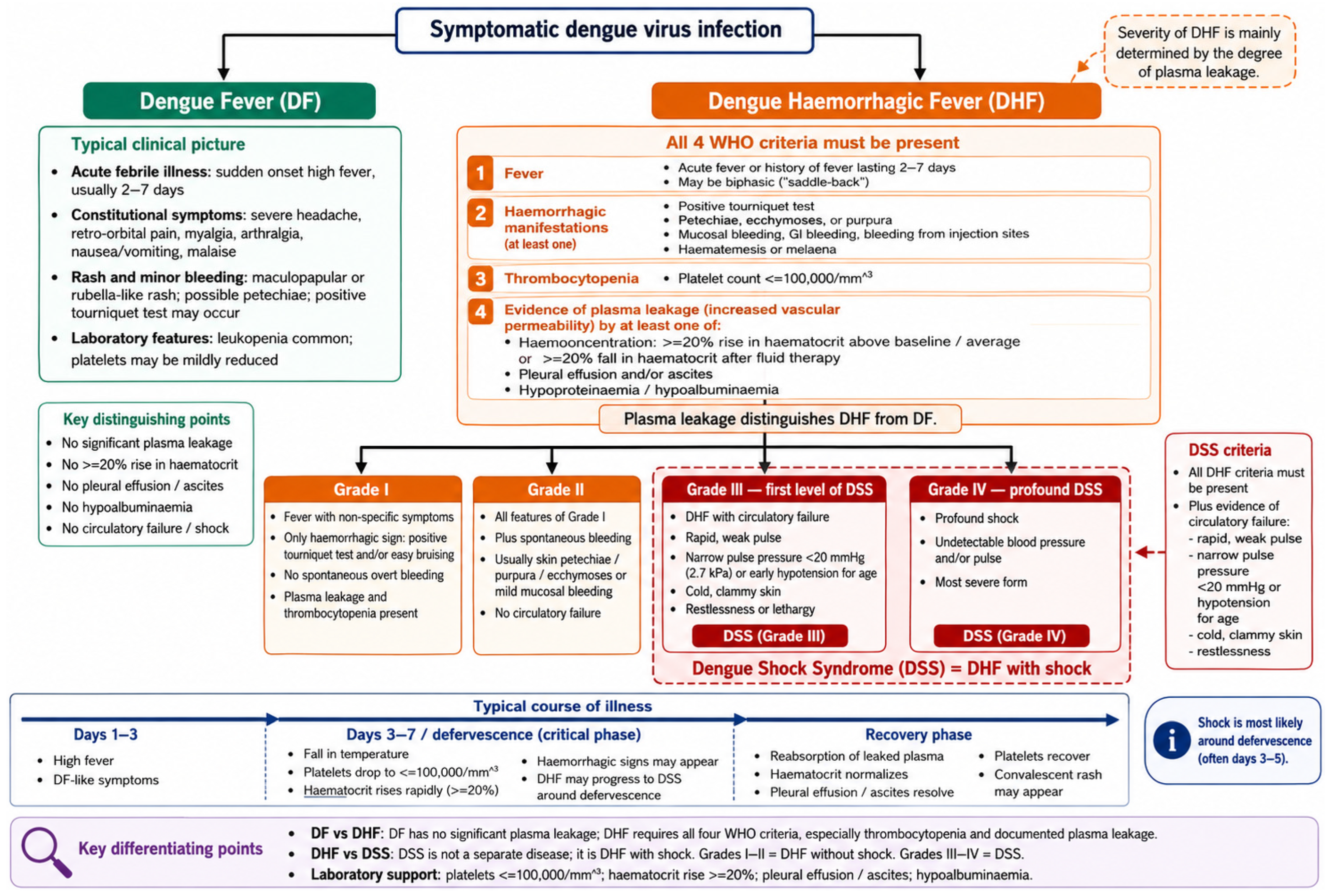
There are four distinct serotypes of DENV: DENV-1, DENV-2, DENV-3 and DENV-4. There is transient cross-protection among these four serotypes, which disappears several months after infection. Therefore, even though infection with one serotype usuallybut not always—leaves life-long protection against DENV infections, there is always the risk of infection with another serotype during lifetime, especially where DENV infection is endemic. DENV infections may range from asymptomatic cases to severe forms characterized by plasma leakage, shock and even death [7]. In 1997, the WHO issued a classification of symptomatic DENV infection into three categories: Dengue Fever (DF), Dengue Hemorrhagic Fever (DHF) and Dengue Shock Syndrome (DSS) [8]. DF is also known as “break-bone fever” due to intense muscle and joint pain. DHF is characterized by fever with hemorrhagic manifestations and plasma leakage caused by increased vascular permeability. Plasma leakage may manifest as hemoconcentration, as evidenced by a 20% increase in the hematocrit levels, pleural fluid, ascites or hypoalbuminemia. Extreme plasma leakage may lead to DSS [8]. Figure 1 depicts the 1997 WHO classification of DENV infections in more detail.
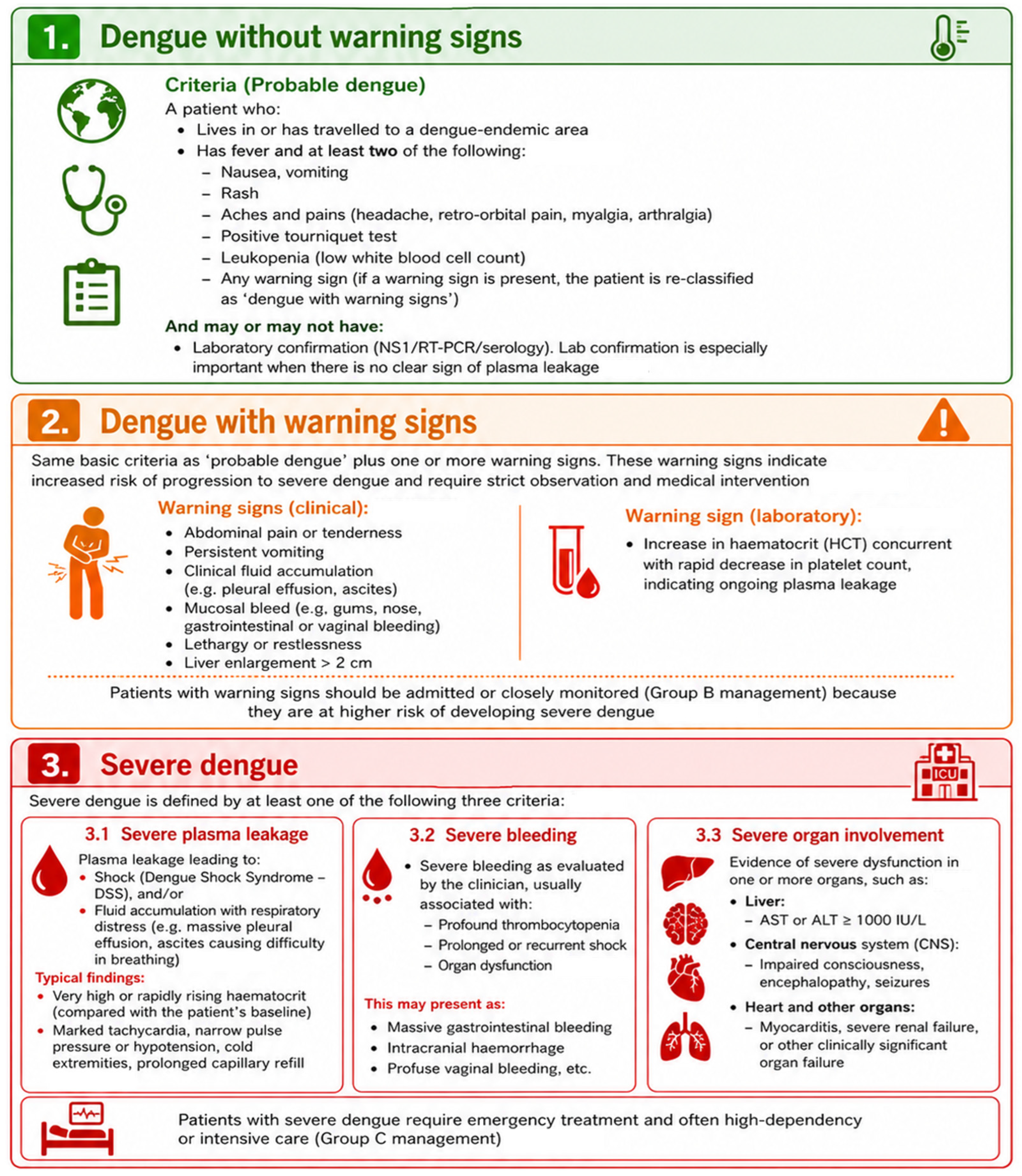
Apart from this classification, the WHO issued in 2009 a revised classification as follows: dengue without any warning signs, dengue with warning signs and severe dengue. This 2009 WHO classification was aiming for a more timely recognition of signs that could be associated with a worse prognosis [9]. Figure 2 depicts the 2009 WHO classification of DENV infection.
Additionally, there may be involvement of the CNS, the myocardium, the liver and the kidneys as well. Involvement of the CNS is most usually in the form of encephalopathy, with headaches and altered mental status. Nevertheless, acute meningoencephalitis with fever, lethargy, vomiting and seizures may also occur. Other neurological manifestations include transverse myelitis, Guillain–Barre syndrome, mononeuropathies, polyneuropathies, stroke and hypokalemic paralysis, the latter being managed with potassium supplementation [10,11]. Involvement of the myocardium may manifest as myocarditis with impaired myocardial function and/or arrhythmias [12]. In low-income and medium-income countries, DENV infection is considered among the most prevalent causes of infectious origin myocarditis together with HIV, Plasmodium spp. and Trypanosoma cruzi [13]. Notably, Wee et al. in their study enrolling 65,207 DENV cases have concluded that patients after DENV infection should be monitored for cardiovascular (CVD) complications, including MACE (major adverse cardiovascular events), arrhythmias and ischemic heart disease [14]. Liver involvement most frequently presents in the form of acute liver injury (ALI), ranging from mild elevations in liver enzymes to liver failure requiring liver transplantation [15,16]. Acute kidney injury (AKI) may also occur during DENV infection and may be attributed to shock, acute tubular necrosis, rhabdomyolysis and glomerulonephritis [17]. Lim et al. have elaborated upon post-dengue infection sequelae. They have reported increased rates of post-acute dengue infection complications, such as a 46% increase in CVD and a 29% increase in neuro-psychiatric sequelae. More specifically, cases involving neuro-psychiatric disorders, cognitive deficits, cerebrovascular events, movement disorders and peripheral neuropathy were recorded. It is noteworthy that they reported an enhancement in the risk of autoimmune diseases including connective tissue disorders by 37%. Gastrointestinal disorders, such as gastritis, pancreatitis, hepatitis, biliary tract disorders and irritable bowel syndrome were increased by 42%. It is noteworthy that patients had an increased risk for renal diseases by 230% and of endocrine disorders, mainly diabetes and dyslipidemia by 19% [18]. Accordingly, apart from acute and sometimes atypical clinical presentations, sequelae affecting multiple organs may occur within 300 days post-acute dengue infection. Lim et al. propose that due to the increased risk of sequelae for 300 days after acute dengue infection, patients should be monitored in order to reduce the rates of death and hospitalizations [18]. This holds particularly true during the first year after DENV infection. Long-term sequelae that may extend after the period of one year have not yet been studied.
As cross-protection between the four distinct serotypes of DENV disappears soon after infection, people living in endemic areas are at risk for infection with a different serotype. It is noteworthy that re-infection with a different serotype has been related to a more severe form of DENV infection on account of an antibody-mediated reaction, known as antibody-dependent enhancement (ADE). ADE is a phenomenon attributed to the interference of IgG with the Fcγ receptors (FcγR) on the immune cells leading to an increased viral entry and replication, which has been associated with pro-inflammatory responses. In particular, afucosylated IgG1s, which lack the fucose moiety, have a high affinity for FcγRIII, thus enhancing the IgG1-FcγRIII binding, a fact that may be related to increased immune responses [19]. These enhanced immune and inflammatory responses have been suggested to be implicated in the increased vascular permeability, as seen in severe DENV infection. In the era of climate change, where different serotypes may circulate simultaneously in the same region, the ADE phenomenon may be more frequently encountered and equally perplexed.

3. Diagnosis

The diagnosis of DENV infection relies on the isolation of viral parts by nucleic acid amplification test (NAAT), such as an RT-PCR, or the identification of non-structural protein 1 (NS1) in serum and the IgM antibodies against DENV in serum. The Centers for Diseases Control and Prevention (CDC) suggests that during the acute phase, i.e., the days 0 to 7 of the symptoms, a NAAT and an IgM antibody test, or an NS1 antigen and an IgM antibody test should be performed. If the aforementioned tests are negative, in the convalescent phase, i.e., after 7 days of the appearance of symptoms, an IgM antibody test is recommended. Notably, even after 7 days of the appearance of symptoms, the NAAT or NS1 antigen test may still turn out to be positive in the convalescent phase. Regarding IgG antibodies testing, a single test is not recommended, as this may be positive due to past flavivirus infection. However, when first IgG antibody testing is negative and second testing in paired samples is positive after the symptoms have subsided, this is considered a recent DENV infection [20].

4. Treatment

Unfortunately, there is no specific treatment for dengue virus infection. Treatment is mainly supportive and aims at confronting hypotension, capillary leakage syndrome and hemorrhagic complications [21,22,23]. The administration of crystalloids and, if not enough, colloids together with red cell pack transfusions and even platelets and fresh frozen plasma remains the cornerstone of treatment in cases of DHF and DSS [21,22,23].
Recently, in 2025, Durbin et al. reported a controlled human infection model enrolling healthy individuals aged 18 to 55 years old, who were infected with a weakened DENV strain and were closely monitored. In this randomized controlled trial (RCT) Phase 2a study, the participants received mosnodenvir for a total of 26 days. For the first 5 days, i.e., in the loading phase, they were assigned into four different groups: the first group received a low dose of 40 mg, the second group a medium dose of 200 mg, the third group a high dose of 600 mg and the fourth group was the placebo group. For the following 21 days, i.e., the maintenance phase, they received 10 mg, 50 mg, 200 mg and placebo, respectively. Durbin et al., noted a dose-dependent effect of mosnodenvir, which, in the higher dose, resulted in 60% of the participants having undetectable viral RNA and 70% having no dengue rash at all, when compared with the placebo group. The participants were monitored for 90 days after the first dose of mosnodenvir [24]. Mosnodenvir is the first antiviral acting agent that has been developed for combating dengue virus. It works by inhibiting a crucial step in the replication of DENV. More specifically, it binds to the non-structural protein 4B (NS4B), thus not allowing the interaction between NS4B and NS3 [25]. In mouse models and other animal models, it has demonstrated protection against lethal effects, while in Phase 1 studies in humans, it has shown no safety concerns and a promising effect [23,26]. Despite the fact that mosnodenvir holds promise as an anti-DENV drug, there are still many unresolved questions: its therapeutic and not only prophylactic potential, its efficacy under real world data, baring in mind the narrow therapeutic window of DENV infection, as well as the development of resistance [23]. More specifically, based upon the results of Denvir et al., mosnodenvir seems to be effective as a prophylactic agent in adults 18 to 55 years old. However, children, the elderly and pregnant women, who are more prone to severe DENV infection, were excluded from the study. Besides, due to the narrow therapeutic window of DENV infection, early administration of mosnodenvir is of the utmost importance. Nevertheless, timely administration of mosnodenvir could be challenging, particularly in low-income countries, where diagnosis could be delayed due to insufficient infrastructure [23]. Additionally, no drug interactions between mosnodenvir and other therapeutic agents have been studied thoroughly, so far. Moreover, the probability of developing resistance to mosnodenvir should not be overlooked. Interestingly, Bouzidi et al., have reported a significant decrease in sensitivity to mosnodenvir among DENV-2 lineages from the 2023–2024 epidemic in the French Caribbean Islands. As a matter of fact, these DENV-2 lineages exhibited the NS4B:V91A mutation, which has been associated with a markedly reduced sensitivity to mosnodenvir [25] Despite these barriers, mosnodenvir seems to possess beneficial properties without any serious adverse effects. Larger studies with real world data regarding mosnodenvir alone or with the addition of another anti-viral agent to combat resistance are eagerly anticipated in this regard. Other antiviral agents, such as balapiravir, a prodrug of a nucleoside analogue, with proven activity against hepatitis C virus, have been studied in a RCT among male adults, but lacked efficacy against DENV [26]. Another agent that has been studied is celgosivir in the CELADEN Study, a RCT among febrile patients with DENV [27]. More specifically, among 50 febrile patients with DENV, 24 were administered celgosivir and 26 placebo. Despite the fact that mean virological log reduction (VLR) was increased in the celgosivir group versus placebo group, this trend was not significant [27]. Therefore, although generally safe, celgosivir did not reduce the viral load significantly and has not proceeded into Phase 2 or 3 studies in humans. Even statins have been suggested to have a beneficial effect on DENV infection. However, lovastatin that was administered in 300 Vietnamese adult patients with DENV infection did not result in any beneficial effects regarding viremia nor did it ameliorate clinical manifestations [28]. Thus, further studies regarding the antiviral potential of statins in DENV infections as part of their pleiotropic anti-inflammatory effects have been abandoned. In a 2026 systematic mapping review of clinical studies regarding DENV infection, no single agent had sufficient evidence as a potential antiviral against DENV infection [29].

5. Epidemiology and Climate Change

Haider et al. have reported a historical record of over 14 million cases of DENV infections in 2024 as well as 9000 deaths, approximately, during the same period [30]. In 2025, the recorded cases of DENV infections were still alarmingly increased, when compared to 2014, thus confirming the presence of an epidemic and not a temporary inclination. Nowadays, DENV infection has been announced as the fastest-growing mosquito-borne infection globally [31,32]. Climate change has been one of the most significant contributing factors in this context. Uncontrollable urbanization and deforestation together with higher mean annual temperatures and moderate rainfall patterns account for this disproportionate augmentation in DENV cases worldwide. In particular, urbanization and deforestation have been suggested to be associated with an increase in the population of Aedes mosquitoes [33,34,35,36,37,38]. These two rapidly developing events facilitate the growing and reproduction of Aedes mosquitoes in watery places like in plant pots, car tires and plastics. These moist places make an ideal hotspot for the breeding cycle of mosquitoes [33,34,35,36,37,38]. Additionally, the global rise in ambient temperature, the more frequently occurring rainfalls as well as humidity all serve as contributing factors to the spread of Aedes mosquitoes [39,40,41,42,43,44,45,46,47,48]. The gonotrophic cycle of Aedes mosquitoes encompasses three stages: the first stage is the stage of seeking and blood eating, in which the female mosquito searches for a host to ingest blood, which provides nutrients for the eggs; the second stage is the stage of digestion and maturation, when the nutrients are utilized to mature eggs and the third stage is that of oviposition, when the female mosquito finds a suitable place to deposit mature eggs. This gonotrophic cycle may vary, due to differential temperatures and humidity from 3 to 6 days [49]. As a matter of fact, the gonotrophic cycle of Aedes mosquitoes at 30 °C was estimated at 4 days for Aedes aegypti and 4–6 days for Aedes albopictus. In sharp contrast, at 20 °C, the gonotrophic cycle for Aedes aegypti was 6 days and for Aedes albopictus 7–15 days approximately [50]. Notably, under experimental conditions Aedes aegypti may survive for at least 40 days under temperatures between 20 °C and 30 °C, whereas at temperatures lower than 10 °C and above 35 °C, the longevity of Aedes aegypti is short. For Aedes albopictus, there is a high probability of longer survival periods of 50 to 60 days under temperatures between 20 °C and 30 °C, whereas at temperatures below 10 °C and above 40 °C, longevity is much shorter [51]. According to the Intergovernmental Panel on Climate Change (IPCC), an increase by 2 °C to 4 °C may multiply the reproduction rate of mosquitoes, thus shortening its extrinsic incubation period (EIP) [52]. EIP refers to the period that takes for the virus to multiply inside the mosquito, so it may affect people [52]. Nevertheless, Shared Socioeconomic Pathways (SSPs) Scenario SSP5-8.5, the hottest scenario, projects that temperatures in tropical regions could surpass the thermal threshold beyond which the Aedes mosquitoes survival becomes endangered; thus, there could be a flattening in Aedes mosquitoes in tropical and hyper-arid areas [53,54]. Apart from temperature, humidity also seems to affect their gonotrophic cycle [52]. The IPCC has reported that higher atmospheric humidity results in increased mosquitoes’ longevity and therefore may prolong the transmission season [52]. Regarding humidity, Kramer et al. have projected that by 2100, Aedes aegypti may still be restricted due to low humidity in Europe [54]. They have concluded that the interconnection between the gonotrophic cycles of Aedes mosquitoes at differential temperatures with different humidity status underscores the necessity of constantly redefining forecasts regarding Aedes mosquitoes in the era of climate change [54].
Moreover, wind speed and phenomena, like the El Nino event, have been related to surges in cases of DENV infection. More specifically, the 2015–2016 and the 2023–2024 El Nino events have been reported to have induced an additional 4.1 and 9.6 million cases of DENV infection, respectively [55].
Aedes albopictus, also known as the “Asian tiger mosquito”, and a vector of DENV, has already spread to Africa, Australia and Europe, apart from America. In Europe, it was first isolated in 1979 in Albania, but has now been detected in other European countries, such as Italy, Germany, Switzerland, Belgium, Hungary, Montenegro, the Netherlands, Spain, Portugal, Greece and Cyprus [56,57,58]. Climate change, migration and travelling remain the main factors contributing to that spread. The dissemination of Aedes mosquitoes poses a significant threat for people worldwide and underscores the need for preparedness of hospitals for severe dengue, even in territories like Europe. The surge of DENV infections globally together with the emergence of autochthonous cases in Europe and Australia impose surveillance programs on DENV [57,58].
Areas endemic for DENV infection are mainly Southeast Asia, the Western Pacific Islands, Latin America and Africa [59]. Latin America accounts for an overwhelming majority of DENV cases, with Brazil alone having reported 6.4 million probable cases and 5067 deaths in 2024 [59]. Asian and Southeast Asian countries, like India, Bangladesh, the Philippines, Vietnam, Cambodia and Lao Peoples’ Democratic Republic as well as sub-Saharian Africa, where DENV remains under-diagnosed, are considered endemic areas. It is noteworthy that endemic areas are even more vulnerable to climate change. Indeed, climate variability in Asia has been associated with extreme weather phenomena, like heavy rainfalls, flooding and droughts [60]. These extreme weather events endanger inhabitants’ lives not only in the short term, but also provoke long-lasting adverse effects, such as agricultural, nutritional and economical problems. Additionally, climate velocity, i.e., the rapid shifting of climate zones that forces disease vectors, in particular Aedes mosquitoes, to migrate towards higher latitude and altitude should be pointed out [61]. Moreover, the appearance of urban heat islands, i.e., metropolitan regions that experience significantly warmer temperatures than the surrounding rural areas, is a meteorological phenomenon attributed to climate change. The One Health Approach provides a framework for addressing these issues, based on the recognition that there is an intricate interplay between human, animal and environmental health. The One Health Approach is a multidisciplinary strategy based on the perspective that human well-being is interconnected with animal health and the ecosystem fostering [62]. In the Anthropocene, factors such as climate change, global travel and trade together with urbanization, intense animal farming and extensive deforestation, all contribute to the spread of zoonotic diseases like DENV infection. Thus, the One Health Approach aims, among other commissions, at mitigating the spread of DENV infection in endemic and non-endemic areas, through national and international policies and collaborative interventions across sectors [63]. In this context, even in non-endemic areas, reports of non-imported clinical cases should be pursued in an attempt to contain local outbreaks. It is noteworthy that Birhanie et al. advocate the notion that, apart from tracing clinical cases, entomological approaches may be useful. As the vast majority of DENV infection cases remain asymptomatic or with only mild clinical symptoms, silent spread of the mosquitoes may go unnoticed and under favorable circumstances could lead to a sudden outbreak on clinical grounds. Therefore, Birhanie et al. have suggested integration of mosquito-based surveillance systems even in lowtransmission areas. They have proposed detecting DENV in Aedes mosquitoes in non-endemic areas at risk for an outbreak due to travel-associated DENV, such as the United States [64]. The most widely utilized mosquito surveillance tools are the Biogents-Sentinel traps, which are based upon olfactory and visual properties that mimic human scent. These traps are effective in attracting Aedes aegypti as well as Aedes albopictus mosquitoes, which are both vectors of DENV [64,65]. When compared to reports of human DENV infections, the surveillance programs at the level of Aedes mosquitoes provide a more timely diagnosis of a plausible epidemic. Thus, epidemiological data together with virological and entomological approaches should be combined in an attempt to control or even prevent an outbreak [64,65]. Although classical statistical methods have been applied to study future trajectories regarding DENV infection, these have been limited by the complexity of the phenomenon. Thus, machine learning models have been developed to incorporate the plethora as well as the diversity of data. Notably, among the most frequently used machine learning models are the Random Forest (RF), the Support Vector Machines (SVMs), the Neural Networks (NNs) and the ensemble models [64,65]. Very recently, Siabi et al., have assessed a Spatio-Temporal Graph Convolutional Network (STGCN) that seems to be very promising for the timely identification of a dengue epidemic [64]. Additionally, Xu et al. have studied the Biomod2 model, which has incorporated 19 climatic variables, to forecast future Aedes aegypti and Aedes albopictus distribution in China [65]. Other prediction models have been used, as already mentioned above, and suggested that there is a trajectory for increased cases of DENV infection by the end of the century. These machine learning models should guide our efforts to mitigate dengue worldwide. A well-orchestrated surveillance system would be of the utmost importance in this regard [66,67,68,69,70,71,72,73,74,75,76,77,78].

6. Future Perspectives

Public awareness in terms of mosquito-associated diseases and precaution measures is mandatory to decrease the burden of DENV infection. Educational campaigns would be very helpful in that context [79,80,81,82]. Protective measures, such as the use of repellents, as well as ameliorating environmental factors by improving water storage and management of waste at the community levels would be very effective ways to decrease the rates of DENV infection. Apart from public awareness and community-associated measures as aforementioned, advances in early diagnosis of DENV infection with the usage of sophisticated equipment could play a pivotal role in containing dengue epidemics. High-throughput technologies integrating data from genomics, proteomics and metabolomics or the so-called “multi-omics” approach may provide us with novel biomarkers. These biomarkers may differentiate between cases of asymptomatic dengue or mild symptomatic dengue infection and cases that will proceed to severe dengue with DHF or DSS [83,84,85,86]. Notably, there is increasing interest regarding biomarkers using the “multi-omics” approach. Regarding metabolomics profile, by utilizing a logistic regression model, Josyula et al. have documented that amongst 423 metabolites, three compounds, namely S-adenosyl-homocysteine, hypotaurine and shikimic acid metabolites, could predict severe DENV infection with an accuracy and an area under the curve (AUC) of 0.75 [87]. Jiravejchakul et al. have studied 41 inflammatory mediators between five asymptomatic and 42 symptomatic patients with DENV infection. They demonstrated that almost all cytokines and chemokines were elevated in symptomatic versus asymptomatic patients in the acute phase, while growth factors were increased during the convalescent phase. They also proposed that elevated interleukin-15 (IL-15) levels could be an early biomarker of more severe DENV infection [88]. It is noteworthy that Perera et al., in their proteomics analysis have documented that 160 proteins were differentially expressed in peripheral blood mononuclear cells (PBMCs) between eight infected patients and two healthy controls. Moreover, they identified differential expression in 90 proteins in PBMCs between the four patients with DF and the four patients with DHF. In particular, proteins implicated in oxidative stress and p38 MAPK signalling were increased early during infection in cases of DHF, when compared with patients with DF. They concluded that this differential profile could serve as an early biomarker of evolving into DHF [89]. Collectively, the “multi-omics” approach seems to pave the way for more accurate and specific biomarkers in terms of early recognition of more severe cases of DENV infection.
Moreover, there is an urgent need for antiviral drugs to combat DENV. For this purpose, an international Delphi consensus study, the DEN-CORE, has been published in 2025 to determine a core outcome measurement set (COMS) for dengue trials in hospitalized patients and in patients in the ICU, in particular [90]. Hanson et al. have proposed machine learning combined with molecular docking and simulations to predict potential DENV antiviral agents. In particular, they used a database of 21, 250 chemical compounds from the PubChem database (AID 651640) together with 1444 descriptors as revealed by various logistic models. They identified 18 DENV inhibitors, amongst which 11 were active. Molecular docking studies were further implemented on NS2B/NS3 protease, an enzyme necessary for viral replication. They concluded that in silico studies could provide us with potential candidates and strong validations regarding these candidates in our combat against DENV infection [91].
Apart from educational campaigns, advances in diagnosis and the development of antiviral drugs in our armamentarium against DENV, the role of vaccines should not be overlooked [92,93]. Nowadays, two vaccines have been approved for clinical use, the Dengvaxia and the Qdenga. In April 2016, Dengvaxia was launched as part of a school-based vaccination program among children 9–10 years old in the Philippines. More than 830,000 children received at least one dose of Dengvaxia. However, in November 2017, the manufacturer reported data that administration of Dengvaxia in dengue-naive children could lead to severe dengue and even death. Thus, the program was halted and for mainly that reason the manufacturer suggested vaccination with Dengvaxia among patients 9 to 45 years old only with prior DENV infection. In other words, it is mandatory to test individuals aged 9 to 45 years old for a prior DENV infection before the administration of Dengvaxia [92,93]. Other candidate vaccines are also under development amongst which the tetravalent live-attenuated vaccines TV003-TV005 seem to be the most promising [94,95]. However, the genetic diversity of DENV with the presence of four distinct serotypes and the ADE phenomenon resulting in complex immunological responses may account for the difficulties in developing an effective vaccine for all serotypes [96,97,98]. Immunological challenges such as the ADE phenomenon, the original antigenic sin and the need for long-lasting effects against all four serotypes have yet to be addressed. Despite these obstacles, there is ongoing research in the field of vaccine development for DENV [96,97,98,99,100,101,102,103]. Notably, in 2025, Barningham et al. published their research on a vaccine that could target immunomodulation in terms of the host skin response to the mosquitoes salivary antigens [104]. This novel concept could pave the way for combating all arboviruses diseases. However, further largescale studies are needed to evaluate the effectiveness and safety of this vaccine. Table 1 depicts clinical trials for vaccines for DENV that are currently being developed. mRNA vaccines are also under investigation regarding DENV. However, as these mRNA platforms have largely been developed after mRNA vaccines for SARS-CoV2, there is scepticism and much debate upon them.
Nevertheless, prevention may also focus on entomological grounds. More specifically, Vasquez et al., have suggested a tool for improving biological control of vectors, in particular the mosquito Aedes aegypti. This tool, the GeneDrive.jl, has been designed as a software package to integrate genetic and climate change data within this framework. It offers us the opportunity to decide within the same tool taking into account different scenarios of extreme weather events using Julia, this software’s programming language. Vasquez et al. have initiated a biocontrol method called “the release of insects carrying a dominant lethal gene” [105]. Conforming with this notion is the use of infection of Aedes aegypti with an obligatory intracellular bacterium, the Wolbachia pipientis. Despite the fact that Wolbachia pipientis may infect a plethora of insects, it does not infect Aedes aegypti, the most common vector of DENV. Transinfection of Aedes aegypti with wolbachia confers resistance to disseminated infections by DENV. Thus, stable transinfection of the most common vector of DENV with the wMel strain of wolbachia may lead to dengue control [106,107]. Interestingly, among 8144 individuals in Indonesia, Utarini et al. demonstrated that participants on clusters with introgression of wMel strains of Aedes aegypti had significantly fewer hospitalizations and reductions in the incidence of dengue fever than individuals in clusters with the wild-type Aedes aegypti [108]. Furthermore, very recently, Lim et al. studied 393,236 individuals living in the intervention clusters in Singapore and 331,192 participants living in Singapore in control clusters. The intervention clusters included the release of Aedes aegypti male mosquitoes that had been infected with wAlbB Wolbachia pipientis strains. Wild-type female Aedes aegypti that mate with wAlbB wolbachia bacteria produce offspring that do not survive due to cytoplasmic incompatibility. Thus, repeated release of male wAlbB wolbachia bacteria may result in reductions of the risk of DENV infection. Lim et al. documented that by releasing male wAlbB wolbachia infected Aedes mosquitoes resulted in suppression of the Aedes aegypti population and to a lesser risk of DENV infection in Singapore [109]. Notably, Dean et al., in their study in Mexico with targeted indoor spraying with insecticides, they did not find any statistically significant lower cumulative incidence of aedes-borne diseases, when compared with no indoor spraying control group [110]. Nevertheless, future studies are eagerly anticipated to confirm the effectiveness of indoor residual spraying. In this context, the phenomenon of emerging resistance regarding insecticides should not be overlooked. As a matter of fact, Fay et al., have very recently reported an increase of pyrethroid resistance mutations in Aedes aegypti from Posadas, in Argentina [111]. Besides, Liu et al. have elaborated upon resistance of Aedes albopictus in insecticides by using integrated transcriptome-microbiome techniques [112]. As live organisms, vectors may also show alterations in the composition of their microbiome as has already been identified in humans.
Dengue controlled human infection models (DCHIMs) are increasingly being developed to further study the efficacy of vaccines, molecules like mosnodenvir and other antiviral agents with therapeutic potential against DENV. These DCHIM have been demonstrated to be safe and may pave the way for assessing the potency of vaccines and antivirals in the near future [113].

7. Conclusions

Climate change with weather phenomena, like extremes of temperatures, rainfalls and humidity seems to be deeply implicated in the surge of DENV infections worldwide. Despite the fact that most cases of DENV infections remain asymptomatic or have only mild symptoms, DHF and DSS are life-threatening. Therefore, prevention of dengue virus infections with measures focusing upon the entomological, viral and human basis of this multi-faceted disease is warranted. The need for early diagnosis of DENV infection with more sophisticated equipment and the use of the multi-omics approach is anticipated to shed light on the complexity of DENV infection. The fact that cases of DENV infections still remain under-diagnosed, especially in the sub-Saharian region, underscores the need for relevant infrastructure. The One Health Approach with integrated collaborations among sectors and with raising public awareness aims at mitigating the spread of DENV in endemic as well as in non-endemic areas. DCHIM together with machinery learning programs seem to be promising tools for further studying and decoding this disease. Moreover, these models and programs offer us the opportunity to develop vaccines and antiviral agents to be added in our armamentarium against DENV infection.

Author Contributions

N.G.V. conceived the idea and wrote major parts of the manuscript; E.V.G. was responsible for the figures and the table; V.S., M.M., A.A., N.A. and F.P. were responsible for literature search and the references; A.T. and I.T. wrote minor parts of the manuscript; D.C.K. supervised and did the final editing. All authors have read and agreed to the published version of the manuscript.

Funding

This research received no external funding.

Data Availability Statement

There are no available data regarding this study.

Conflicts of Interest

The authors declare no conflicts of interest.

References

  1. Ross, P.A.; Robinson, K.L.; Yang, Q.; Callahan, A.G.; Schmidt, T.L.; Axford, J.K.; Coquilleau, M.P.; Staunton, K.M.; Townsend, M.; Ritchie, S.A.; et al. A Decade of Stability for wMel Wolbachia in Natural Aedes Aegypti Populations. PLoS Pathog. 2022, 18, e1010256. [Google Scholar] [CrossRef]
  2. Lim, A.; Shearer, F.M.; Sewalk, K.; Pigott, D.M.; Clarke, J.; Ghouse, A.; Judge, C.; Kang, H.; Messina, J.P.; Kraemer, M.U.G.; et al. The overlapping global distribution of dengue, chikungunya, Zika and yellow fever. Nat. Commun. 2025, 16, 3418. [Google Scholar] [CrossRef] [PubMed]
  3. WHO Facts. Dengue. Available online: https://www.who.int/zh/news-room/fact-sheets/detail/dengue-and-severe-dengue (accessed on 9 February 2026).
  4. Kounatidis, D.C.; Evangelopoulos, A.; Geladari, E.V.; Evangelopoulos, A.A.; Adamou, A.; Kargioti, S.; Geladari, C.V.; Dalamaga, M.; Sevastianos, V.; Vallianou, N.G. Antimicrobial Resistance in the Era of Climate Change: Why We Should All Embrace and Integrate the One Health Approach in Clinical Practice? Antibiotics 2025, 14, 1042. [Google Scholar] [CrossRef]
  5. Vallianou, N.G.; Kounatidis, D.C.; Geladari, E.V.; Evangelopoulos, A.; Kaldis, V.; Stratigou, T.; Evangelopoulos, A.A.; Karampela, I.; Dalamaga, M. Climate Change, Air Pollution and the Global Obesity Syndemic: A Review of Current Evidence. Curr. Obes. Rep. 2025, 14, 78. [Google Scholar] [CrossRef] [PubMed]
  6. Araza, A.; Hein, L.; Feng, Y.; Melo, J.; Herold, M. Exploring the application of Earth Observation datasets for SEEA carbon accounting and its comparison with national GHG reporting to the UNFCCC. Sci. Total Environ. 2026, 1015, 181189. [Google Scholar] [CrossRef]
  7. Totaro, V.; Novara, R.; Capruzzi, D.; Dargenio, A.; Di Gregorio, S.; Cotugno, S.; Papagni, R.; Segala, F.V.; Metrangolo, G.; D’ABramo, A.; et al. Dengue in the Anthropocene: Intersections of environmental change, disease epidemic, management and current challenges in global health. Pathog. Glob. Health 2025, 120, 47–74. [Google Scholar] [CrossRef]
  8. World Health Organization. Dengue Haemorrhagic Fever: Diagnosis, Treatment, Prevention and Control, 2nd ed.; World Health Organization: Geneva, Switzerland, 1997. [Google Scholar]
  9. World Health Organization. Dengue Guidelines for Diagnosis, Treatment, Prevention and Control: New Edition; World Health Organization: Geneva, Switzerland, 2009. [Google Scholar]
  10. Trivedi, S.; Chakravarty, A. Neurological Complications of Dengue Fever. Curr. Neurol. Neurosci. Rep. 2022, 22, 515–529. [Google Scholar] [CrossRef] [PubMed]
  11. Gójska-Grymajło, A.; Biernat, B.; Sikorska, K. Neurological Presentations of Endemic Tropical Diseases in Central Europe. J. Clin. Med. 2025, 14, 7393. [Google Scholar] [CrossRef]
  12. Torres-Hernández, D.; Grubaugh, N.D.; Murillo-Ortiz, M.A.; Hurtado, I.C.; Hill, V.; Breban, M.I.; Gómez-Zambrano, M.; López, P.; Cantor, E.; Dávalos, D.M.; et al. Epidemiology and severity risk factors of dengue virus infection during the 2023-2024 outbreak in Colombia. PLoS Negl. Trop. Dis. 2025, 19, e0013115. [Google Scholar] [CrossRef]
  13. Klingel, K.; Tschöpe, C.; Yon, D.K.; Mensah, G.A.; Weber, B.N.; Kontorovich, A.R.; Lee, S.; Cooper, L.T.; Ammirati, E. Global epidemiology of myocarditis: Disparities in age, sex and geography. Nat. Rev. Cardiol. 2026. Epub ahead of printing. [Google Scholar] [CrossRef]
  14. Wee, L.E.; Tan, W.Z.; Chow, J.Y.; Lim, J.T.; Chiew, C.; Chia, P.Y.; Ng, L.C.; Amanullah, M.R.; Yap, J.; Yeo, K.K.; et al. Cardiovascular complications in acute dengue infection: A population-based cohort study. Lancet Reg. Health West Pac. 2025, 64, 101713. [Google Scholar] [CrossRef]
  15. Agrwal, S.; Kumari, S.; Pandey, P.; Attri, K.; Samanta, A.; Pal Yadav, T.; Chandra, J. Acute liver injury in hospitalized children: Clinical and etiological profile from a tropical country. J. Trop. Pediatr. 2026, 72, fmag001. [Google Scholar] [CrossRef] [PubMed]
  16. Kohsar, M.; Haar, M.; Schmidt-Chanasit, J.; Ramharter, M.; Buchholz, B.M.; Krasemann, S.; Bernreuther, C.; Cadar, D.; Omansen, T.F.; Wichmann, D.; et al. Fatal Dengue Fever in a Traveler Returning from Togo to Germany. Am. J. Trop. Med. Hyg. 2026, 114, 720–723. [Google Scholar] [CrossRef]
  17. Burdmann, E.A.; Andrade, L.C. Infectious Tropical Diseases That Acutely Affect the Kidneys: What Physicians and Health Care Workers in Nonendemic Countries Should Know. Am. J. Kidney Dis. 2025, 86, 814–827. [Google Scholar] [CrossRef]
  18. Lim, J.T.; Wee, L.E.; Tan, W.Z.; Chiew, C.; Kurupatham, L.; Poh, C.; Md Suhaimi, N.A.; Chua, H.Z.; Ng, L.C.; Chia, P.Y.; et al. Characterization of post-acute multi-organ sequelae following dengue infection. Clin. Microbiol. Infect. 2025, 31, 1865–1872. [Google Scholar] [CrossRef]
  19. Teo, A.; Tan, H.D.; Loy, T.; Chia, P.Y.; Chua, C.L.L. Understanding antibody-dependent enhancement in dengue: Are afucosylated IgG1s a concern? PLoS Pathog. 2023, 19, e1011223. [Google Scholar] [CrossRef]
  20. Clinical Testing Guidance for Dengue. 2026. Available online: www.cdc.gov (accessed on 9 February 2026).
  21. Pisaneschi, G.; Manfredi, P.; Landi, A.; Stollenwerk, N.; Aguiar, M. When Few Mosquitoes Are Enough: Dengue outbreaks in non-endemic areas. One Health 2025, 22, 101308. [Google Scholar] [CrossRef]
  22. Ulgheri, F.M.; Bernardes, B.G.; Lancellotti, M. Decoding Dengue: A Global Perspective, History, Role, and Challenges. Pathogens 2025, 14, 954. [Google Scholar] [CrossRef]
  23. Xie, X. Toward a Dengue Pill. N. Engl. J. Med. 2025, 393, 2166–2167. [Google Scholar] [CrossRef]
  24. Durbin, A.P.; Van Wesenbeeck, L.; Pierce, K.K.; Herrera-Taracena, G.; Ebone, L.; Buelens, A.; Lutton, P.; Sabundayo, B.P.; Van Eygen, V.; De Clerck, K.; et al. Daily Mosnodenvir as Dengue Prophylaxis in a Controlled Human Infection Model. N. Engl. J. Med. 2025, 393, 2107–2118. [Google Scholar] [CrossRef] [PubMed]
  25. Bouzidi, H.S.; Sen, S.; Piorkowski, G.; Pezzi, L.; Ayhan, N.; Fontaine, A.; Canivez, T.; Geulen, M.; Amaral, R.; Grard, G.; et al. Genomic surveillance reveals a dengue 2 virus epidemic lineage with a marked decrease in sensitivity to Mosnodenvir. Nat. Commun. 2024, 15, 8667. [Google Scholar] [CrossRef] [PubMed]
  26. Nguyen, N.M.; Tran, C.N.; Phung, L.K.; Duong, K.T.; Huynh Hle, A.; Farrar, J.; Nguyen, Q.T.; Tran, H.T.; Nguyen, C.V.; Merson, L.; et al. A randomized, double-blind placebo controlled trial of balapiravir, a polymerase inhibitor, in adult dengue patients. J. Infect. Dis. 2013, 207, 1442–1450. [Google Scholar] [CrossRef]
  27. Low, J.G.; Sung, C.; Wijaya, L.; Wei, Y.; Rathore, A.P.S.; Watanabe, S.; Tan, B.H.; Toh, L.; Chua, L.T.; Hou, Y.; et al. Efficacy and safety of celgosivir in patients with dengue fever (CELADEN): A phase 1b, randomised, double-blind, placebo-controlled, proof-of-concept trial. Lancet Infect. Dis. 2014, 14, 706–715. [Google Scholar] [CrossRef]
  28. Whitehorn, J.; Nguyen, C.V.V.; Khanh, L.P.; Kien, D.T.H.; Quyen, N.T.H.; Tran, N.T.T.; Hang, N.T.; Truong, N.T.; Hue Tai, L.T.; Cam Huong, N.T.; et al. Lovastatin for the Treatment of Adult Patients With Dengue: A Randomized, Double-Blind, Placebo-Controlled Trial. Clin. Infect. Dis. 2016, 62, 468–476. [Google Scholar] [CrossRef]
  29. Huyen, T.B.; McBride, A.; Thein, T.L.; Le, K.M.; Luu, T.; Huy, N.Q.; Harriss, E.; Kain, M.J.W.; Cattrall, J.; Naylor, C.; et al. A systematic mapping review of therapeutic clinical trials in dengue. PLoS Negl. Trop. Dis. 2026, 20, e0014382. [Google Scholar] [CrossRef]
  30. Haider, N.; Hasan, M.N.; Onyango, J.; Billah, M.; Khan, S.; Papakonstantinou, D.; Paudyal, P.; Asaduzzaman, M. Global dengue epidemic worsens with record 14 million cases and 9000 deaths reported in 2024. Int. J. Infect. Dis. 2025, 158, 107940. [Google Scholar] [CrossRef]
  31. Mehmood, M.S.; Hajj, F. Dengue 2025 global surge: Urgent call to bolster hospital preparedness for severe dengue. Ann. Med. Surg. 2025, 88, 1032–1033. [Google Scholar] [CrossRef]
  32. Choo, E.L.W.; Ma, P.; Chow, J.Y.; Yim, S.H.; Brady, O.; Dickens, B.L.; Lim, J.T. Projecting long-term excess risks of major infectious diseases associated with future extreme weather events in Thailand. PLoS Negl. Trop. Dis. 2026, 20, e0013896. [Google Scholar] [CrossRef] [PubMed]
  33. Lin, L.; He, Y.; Guang, X.; Xiang, L.; Kong, D.; Diao, K.; Wang, H.; Zhu, B. Spatial pattern assessment of Aedes mosquito bite risk in a subtropical metropolitan area: A case study in Shenzhen. PLoS Negl. Trop. Dis. 2025, 19, e0013843. [Google Scholar] [CrossRef] [PubMed]
  34. Haryanto, B.; Dwirahmadi, F.; Nurlambang, T.; Asyary, A. Spatial Analysis on Dengue Fever Vulnerability in the Provinces of South Sulawesi and East Nusa Tenggara in Indonesia. Ann. Glob. Health 2025, 91, 86. [Google Scholar] [CrossRef]
  35. Olivera, M.J.; Porras-Villamil, J.F.; Fuentes, M.V. Outbreaks and incidence of vector-borne diseases in Colombia (2007-2024): Impact of climate change and deforestation. Biomedica 2025, 45, 17–29. [Google Scholar] [CrossRef]
  36. Herbreteau, V.; Maquart, P.O.; Hoeun, S.; Doeurk, B.; Girond, F.; Boyer, S. Spatio-temporal distribution and environmental determinants of dengue vectors in Phnom Penh, Cambodia. PLoS Negl. Trop. Dis. 2025, 19, e0013667. [Google Scholar] [CrossRef] [PubMed]
  37. Nikookar, S.H.; Hoseini, S.; Dehghan, O.; Fazelidinan, M.; Enayati, A. Dengue Fever Resurgence in Iran: An Integrative Review of Causative Factors and Control Strategies. Trop. Med. Infect. Dis. 2025, 10, 309. [Google Scholar] [CrossRef]
  38. Dobbs, K.G.; Radomski, T.; Medley, K.A.; Westby, K.M. The effect of stage-specific heatwaves on Aedes albopictus (Diptera: Culicidae) survival and development. J. Med. Entomol. 2026, 63, tjaf194. [Google Scholar] [CrossRef]
  39. Osako, H.; Tayama, Y.; Ueda, M.; Ihara, M.; Yamasato, K.; Tun, M.M.N.; Thuy, N.T.T.; Hang, N.L.K.; Phuong, H.V.M.; Abe, H.; et al. Comprehensive Spatiotemporal Analysis of Dengue Epidemics in Vietnam Reveals Key Hotspots and Transmission Dynamics. Int. J. Infect. Dis. 2026, 165, 108445. [Google Scholar] [CrossRef]
  40. Islam, J.; Dowsett, C.K.; Qi, X.; Bambrick, H.; Frentiu, F.D.; Hu, W. Refining the suitable conditions index to predict dengue fever transmission in Bangladesh and Sri Lanka. Trop. Med. Health 2026, 54, 32. [Google Scholar] [CrossRef]
  41. Swain, S.; Sharma, G.; Samantaray, R.K.; Suman, D.S. Thermal stress responses on developmental time, survival, and wing morphometrics in desert and coastal strains of Aedes aegypti (Diptera: Culicidae) from India. Acta Trop. 2026, 275, 107994. [Google Scholar] [CrossRef] [PubMed]
  42. Lima, C.L.; Sancho, K.A.; Silva, A.C.G.D.; Vital, R.; Silva, C.C.D.; Mendonça, M.F.S.; Borges, F.T.; Siqueira, C.E.G.; Santos, W.P.D. Leveraging Climate Data Through Intelligent Systems for the Prediction of Arbovirus Transmission by Aedes aegypti. Int. J. Environ. Res. Public Health 2025, 23, 12. [Google Scholar] [CrossRef]
  43. Finch, E.; Chang, C.C.; Kucharski, A.; Sim, S.; Ng, L.C.; Lowe, R. Climate variation and serotype competition drive dengue outbreak dynamics in Singapore. Nat. Commun. 2025, 16, 11364. [Google Scholar] [CrossRef]
  44. Zhou, Z.; He, G.; Hu, J.; Li, G.; Pan, H.; Li, Y.; Yu, S.; Chen, Z.; Ma, W.; Zhu, G.; et al. Spatiotemporal expansion of Aedes aegypti and the dengue fever epidemic under climate change in China. PLoS Negl. Trop. Dis. 2025, 19, e0013702. [Google Scholar] [CrossRef] [PubMed]
  45. Dennington, N.L.; Grossman, M.K.; Teeple, J.L.; Johnson, L.R.; Shocket, M.S.; McGraw, E.A.; Thomas, M.B. Phenotypic variation in populations of the mosquito vector, Aedes aegypti, and implications for predicting the effects of temperature and climate change on dengue transmission. PLoS Negl. Trop. Dis. 2025, 19, e0013623. [Google Scholar] [CrossRef]
  46. Walker, R.J.; Kingpriest, P.T.; Gong, J.; Naisanga, M.; Ashraf, M.N.; Roberti, J.; Lang, T. Global perspectives on infectious diseases at risk of escalation and their drivers. Sci. Rep. 2025, 15, 38630. [Google Scholar] [CrossRef] [PubMed]
  47. Barkhad, A.; de Almeida Santos, G.; Roberto Costa Campos, S.; Maria Almeida Braz, L.; Picinini Freitas, L.; Zinszer, K.; de Souza, R.; Waldron, I.; Loeb, M.; Luna, E.; et al. Knowledge, Attitudes, Practices and Perceptions of the Eco-Bio-Social Determinants of Dengue Transmission in São Paulo, Brazil: A Mixed-Methods Study. Trop. Med. Int. Health 2026, 31, 58–79. [Google Scholar] [CrossRef] [PubMed]
  48. Alqassim, A.Y. Differential Impacts of Extreme Weather Events on Vector-Borne Disease Transmission Across Urban and Rural Settings: A Scoping Review. Healthcare 2025, 13, 2425. [Google Scholar] [CrossRef]
  49. Mateescu, I.; Lequime, S. Dengue-mediated changes in the vectorial capacity of Aedes aegypti (Diptera: Culicidae): Manipulation of transmission or infection by-product? J. Med. Entomol. 2025, 62, 19–28. [Google Scholar] [CrossRef]
  50. Brady, O.J.; Golding, N.; Pigott, D.M.; Kraemer, M.U.; Messina, J.P.; Reiner, R.C., Jr.; Scott, T.W.; Smith, D.L.; Gething, P.W.; Hay, S.I. Global temperature constraints on Aedes aegypti and Ae. albopictus persistence and competence for dengue virus transmission. Parasit. Vectors. 2014, 7, 338. [Google Scholar] [CrossRef] [PubMed]
  51. Rocklöv, J.; Tozan, Y. Climate change and the rising infectiousness of dengue. Emerg. Top. Life Sci. 2019, 3, 133–142. [Google Scholar] [CrossRef]
  52. IPCC. Climate Change 2014: Synthesis Report. Contribution of Working Groups I, II and III to the Fifth Assessment Report of the Intergovenmental Panel on Climate Change; IPCC: Geneva, Switzerland, 2014. [Google Scholar]
  53. Nejati, J.; Saghafipour, A.; Sarvi, M.; Bueno-Marí, R. Spatiotemporal Patterns and Historical Overview of Aedes Mosquitoes in Iran: A Systematic Review. Trop. Med. Infect. Dis. 2026, 11, 131. [Google Scholar] [CrossRef]
  54. Kramer, I.M.; Vereecken, S.; Vanslembrouck, A.; Smekens, Y.; de Witte, J.; Vielma, S.; Niamir, A.; Müller, R. Heatwaves Constrain the Future Persistence of Mosquito Vectors in Europe. Glob. Chang. Biol. 2026, 32, e70876. [Google Scholar] [CrossRef]
  55. Tian, Y.; Xu, Y.; Liang, Y.; Zhou, Z.; Susong, K.M.; Chen, Y.; Joshi, K.; Campbell, A.M.; Lim, A.; Lin, Q.; et al. Rising dengue risk with increasing El Niño-Southern Oscillation amplitude and teleconnections. Nat. Commun. 2025, 16, 8629. [Google Scholar] [CrossRef]
  56. González-Moreno, M.Á.; Miqueleiz-Autor, E.; Oroz-Santamaría, I.; Domench-Guembe, M.; Poveda-Urkixo, I. The Silent Conquest of Aedes albopictus in Navarre: Unraveling the Unstoppable Advance of the Tiger Mosquito Invasion in Progress. Insects 2025, 16, 852. [Google Scholar] [CrossRef] [PubMed]
  57. Piccinno, R.; Fiorenza, G.; Vasquez, M.I.; Bouyer, J.; Notarides, G.; Gomulski, L.M.; Meletiou, S.; Akiner, M.; Michaelakis, A.; Forneris, F.; et al. On the tracks of an uninvited guest, the Asian tiger mosquito, Aedes albopictus in Cyprus. Parasit. Vectors 2025, 18, 39. [Google Scholar] [CrossRef] [PubMed]
  58. Bogacka, A.; Kant, R.; Grzybek, M. Surveillance-based insights into mosquito-borne disease trends: Implications for public health in Poland and Europe (2018–2024). Travel Med. Infect. Dis. 2026, 70, 102953. [Google Scholar] [CrossRef]
  59. Deiana, G.; Figoni, I.; Arghittu, A.; Campus, G.; Satta, G.; Foxi, C.; Piana, A.; Castiglia, P.; Dettori, M. Temporal Trends of Dengue Surveillance in Sardinia, Italy: Implications of Climate Change on Human and Entomological Monitoring. Medicina 2025, 61, 2024. [Google Scholar] [CrossRef] [PubMed]
  60. Nazareth, T.; Seixas, G.; Lourenço, J.; Bettencourt, P.J.G. Aedes albopictus arrives in Lisbon: An emerging public health threat. Front. Public Health 2023, 11, 1332334. [Google Scholar] [CrossRef]
  61. Rau, J.; Köchling, K.; Schäfer, M.; Tews, B.A.; Wylezich, C.; Schaub, G.A.; Werner, D.; Kampen, H. Viral RNA in Mosquitoes (Diptera: Culicidae) Collected between 2019 and 2021 in Germany. Viruses 2023, 15, 2298. [Google Scholar] [CrossRef]
  62. Da Re, D.; Deblauwe, I.; Kern, E.I.; Hermy, M.; Romero, J.R.; Tersago, K.; Versteirt, V.; Dumez, B.; Houtsaeger, C.; Rouffaer, L.; et al. A warming welcome? Belgium’s increasing suitability for Aedes albopictus. Parasit. Vectors. 2025, 18, 491. [Google Scholar] [CrossRef]
  63. Thompson, K.; Lyons, S.; Malone, K.; Fryk, J.; Pyke, A.; Murton, K. Locally Acquired Dengue in Townsville, Australia, 2024-2025: An Outbreak Report in a Non-Endemic Region with wMel Wolbachia-Infected Aedes aegypti. Trop. Med. Infect. Dis. 2026, 11, 66. [Google Scholar] [CrossRef]
  64. Birhanie, S.K.; Brown, M.Q. The imperative of Aedes mosquito testing for enhanced dengue surveillance in the United States. J. Am. Mosq. Control Assoc. 2026, 41, 246–257. [Google Scholar] [CrossRef]
  65. Xu, Z.; Bambrick, H.; Frentiu, F.D.; Devine, G.; Yakob, L.; Williams, G.; Hu, W. Projecting the future of dengue under climate change scenarios: Progress, uncertainties and research needs. PLoS Negl. Trop. Dis. 2020, 14, e0008118. [Google Scholar] [CrossRef]
  66. Quan, N.K.; Taylor-Robinson, A.W. Climatic determinants" and simple thresholds for dengue early warning in Vietnam: A One Health perspective. Sci. One Health 2026, 5, 100159. [Google Scholar] [CrossRef] [PubMed]
  67. Kianfar, N.; Savoji, K.; Huang, X.; Yang, D.; Mollalo, A. The role of citizen science in mosquito-borne disease surveillance and control: A scoping review. PLoS ONE 2026, 21, e0348697. [Google Scholar] [CrossRef]
  68. Benton, N.; Krokovsky, L.; Gasparotto, A.; Hunter, F.F. New record of Psorophora howardii (Diptera: Culicidae) in Southern Ontario, Canada. J. Med. Entomol. 2025, 62, 1349–1352. [Google Scholar] [CrossRef] [PubMed]
  69. Naeem, M.; Zhu, L.; Bashir, N.H.; Riasat, M.; Li, W.; Chen, H. Habitat Quality Assessment Within Expanded Ranges of Dengue Vectors Using a Composite Index Scale. Ecol. Evol. 2026, 16, e72387. [Google Scholar] [CrossRef]
  70. Siabi, N.; Son, R.; Thomas, M.; Irrgang, C.; Saynisch-Wagner, J. Innovative application of a traffic-prediction spatio-temporal graph convolutional network for dengue disease forecasting. Sci. Rep. 2026, 16, 2594. [Google Scholar] [CrossRef]
  71. Xu, J.; Wang, R.; Mo, Z.; Zhang, H.; Zhang, Y. Composite function and Biomod2 for evaluating the influence of climate change on the distribution of Aedes aegypti and Aedes albopictus in China. One Health 2025, 21, 101212. [Google Scholar] [CrossRef]
  72. Lemma, A.G.; Tilahun, G.T.; Bekele, B.T. Modeling the impact of climate change on dengue transmission dynamics in Dire Dawa, Afar, and Somali, Ethiopia: An African regional perspective. Sci. Rep. 2025, 15, 33979. [Google Scholar] [CrossRef] [PubMed]
  73. Carbone, G.; Boiardi, G.; Infantino, C.; Cunico, D.; Esposito, S. Vectors on the Move: How Climate Change Fuels the Spread of Arboviruses in Europe. Microorganisms 2025, 13, 2034. [Google Scholar] [CrossRef]
  74. Heath, K.; Muniz Alves, L.; Bonsall, M.B. Climate change, urbanisation and transmission potential: Aedes aegypti mosquito projections forecast future arboviral disease hotspots in Brazil. PLoS Negl. Trop. Dis. 2025, 19, e0013415. [Google Scholar] [CrossRef]
  75. Childs, M.L.; Lyberger, K.; Harris, M.J.; Burke, M.; Mordecai, E.A. Climate warming is expanding the dengue burden in the Americas and Asia. Proc. Natl. Acad. Sci. USA 2025, 122, e2512350122. [Google Scholar] [CrossRef]
  76. Abbasi, E. Global epidemiology and evolutionary dynamics of arboviruses: A systematic review of surveillance, control strategies, and emerging threats. Dialogues Health 2026, 8, 100280. [Google Scholar] [CrossRef] [PubMed]
  77. Yang, L.; Liu, C.; Bi, P.; Vardoulakis, S.; Huang, C. Local actions to health risks of heatwaves and dengue fever under climate change: Strategies and barriers among primary healthcare professionals in southern China. Environ. Res. 2020, 187, 109688. [Google Scholar] [CrossRef]
  78. Chandel, A.; DeBeaubien, N.A.; Ganguly, A.; Meyerhof, G.T.; Krumholz, A.A.; Liu, J.; Salgado, V.L.; Montell, C. Thermal infrared directs host-seeking behaviour in Aedes aegypti mosquitoes. Nature 2024, 633, 615–623. [Google Scholar] [CrossRef]
  79. Nosrat, C.; Altamirano, J.; Anyamba, A.; Caldwell, J.M.; Damoah, R.; Mutuku, F.; Ndenga, B.; LaBeaud, A.D. Impact of recent climate extremes on mosquito-borne disease transmission in Kenya. PLoS Negl. Trop. Dis. 2021, 15, e0009182. [Google Scholar] [CrossRef]
  80. Monoldorova, S.; Jeong, J.U.; Lee, S.; Titov, I.; Lee, I.Y.; Jun, H.; Han, J.H.; Muh, F.; Lee, K.J.; Jeon, B.Y. Phylogeographic Insights into Aedes albopictus in Korea: Integrating COX1, ND5, and CYTB Analyses. Insects 2026, 17, 82. [Google Scholar] [CrossRef] [PubMed]
  81. Côrtes, N.; Lira, A.; Prates-Syed, W.; Dinis Silva, J.; Vuitika, L.; Cabral-Miranda, W.; Durães-Carvalho, R.; Balan, A.; Cabral-Marques, O.; Cabral-Miranda, G. Integrated control strategies for dengue, Zika, and Chikungunya virus infections. Front. Immunol. 2023, 14, 1281667. [Google Scholar] [CrossRef]
  82. Malavige, G.N.; Sjö, P.; Singh, K.; Piedagnel, J.M.; Mowbray, C.; Estani, S.; Lim, S.C.L.; Siquierra, A.M.; Ogg, G.S.; Fraisse, L.; et al. Facing the escalating burden of dengue: Challenges and perspectives. PLoS Glob. Public Health 2023, 3, e0002598. [Google Scholar] [CrossRef]
  83. Gibb, R.; Colón-González, F.J.; Lan, P.T.; Huong, P.T.; Nam, V.S.; Duoc, V.T.; Hung, D.T.; Dong, N.T.; Chien, V.C.; Trang, L.T.T.; et al. Interactions between climate change, urban infrastructure and mobility are driving dengue emergence in Vietnam. Nat. Commun. 2023, 14, 8179. [Google Scholar] [CrossRef]
  84. Romano, G.; Ferrari, G.; Pitrolo, A.M.G.; Rovida, F.; Piralla, A.; Baldanti, F. Tracing the Origin, Spread, and Molecular Evolution of Dengue Type 1 Cases That Occurred in Northern Italy in 2023. Pathogens 2024, 13, 1124. [Google Scholar] [CrossRef] [PubMed]
  85. Presser, L.D.; Baronti, C.; Moegling, R.; Pezzi, L.; Lustig, Y.; Gossner, C.M.; Reusken, C.B.E.M.; Charrel, R.N. Excellent capability for molecular detection of Aedes-borne dengue, Zika, and chikungunya viruses but with a need for increased capacity for yellow fever and Japanese encephalitis viruses: An external quality assessment in 36 European laboratories. J. Clin. Microbiol. 2025, 63, e0091024. [Google Scholar] [CrossRef]
  86. Alkhatabi, H.A.; Alahmadi, A.G.; Alotibi, R.M.; Alhashmi, M.H.; Basabrain, A.A.; Pushparaj, P.N. Dengue virus infection: Potential applications of "Omics" based approaches. Bioinformation 2024, 20, 802–807. [Google Scholar] [CrossRef] [PubMed]
  87. Josyula, J.V.N.; JeanPierre, A.R.; Jorvekar, S.B.; Adla, D.; Mariappan, V.; Pulimamidi, S.S.; Green, S.R.; Pillai, A.B.; Borkar, R.M.; Mutheneni, S.R. Metabolomic profiling of dengue infection: Unraveling molecular signatures by LC-MS/MS and machine learning models. Metabolomics 2024, 20, 104. [Google Scholar] [CrossRef]
  88. Jiravejchakul, N.; Chan-In, W.; Thuncharoen, W.; DENFREE Thailand; Sungnak, W.; Charoensawan, V.; Vacharathit, V.; Matangkasombut, P. Cytokine and chemokine kinetics in natural human dengue infection as predictors of disease outcome. Sci. Rep. 2025, 15, 15612. [Google Scholar] [CrossRef]
  89. Perera, N.; Kumar, A.; Gangadharan, B.; Ranasinghe, D.; Wijewickrama, A.; Malavige, G.N.; Miller, J.L.; Zitzmann, N. Proteomics Analysis of Peripheral Blood Mononuclear Cells from Patients in Early Dengue Infection Reveals Potential Markers of Subsequent Fluid Leakage. Viruses 2025, 17, 805. [Google Scholar] [CrossRef]
  90. Yacoub, S.; Demidova, A.; Chan, X.H.S.; Ajam, A.; Baimukhambetova, D.; Horn, A.; Kakotkina, E.; Kosenko, M.; Mursalova, A.; Van Nuil, J.I.; et al. DEN-CORE Study Group. Core outcome measurement set for clinical trials in dengue: An international Delphi consensus study (DEN-CORE). Lancet Infect. Dis. 2025, 26, E231–E244. [Google Scholar] [CrossRef] [PubMed]
  91. Hanson, G.; Adams, J.; Kepgang, D.I.B.; Zondagh, L.S.; Tem Bueh, L.; Asante, A.; Shirolkar, S.A.; Kisaakye, M.; Bondarwad, H.; Awe, O.I. Machine learning and molecular docking prediction of potential inhibitors against dengue virus. Front. Chem. 2024, 12, 1510029. [Google Scholar] [CrossRef]
  92. Halstead, S.B.; Katzelnick, L.C.; Russell, P.K.; Markoff, L.; Aguiar, M.; Dans, L.R.; Dans, A.L. Ethics of a partially effective dengue vaccine: Lessons from the Philippines. Vaccine 2020, 38, 5572–5576. [Google Scholar] [CrossRef]
  93. Sridhar, S.; Luedtke, A.; Langevin, E.; Zhu, M.; Bonaparte, M.; Machabert, T.; Savarino, S.; Zambrano, B.; Moureau, A.; Khromava, A.; et al. Effect of dengue serostatus on dengue vaccine safety and efficacy. N. Engl. J. Med. 2018, 379, 327–340. [Google Scholar] [CrossRef] [PubMed]
  94. He, S.; Fan, D.; Guo, Y.; Guan, Y.; Sheng, Z.; Gao, N.; An, J. Current status of dengue fever epidemics and vaccine development. Virol. Sin. 2026, 41, 1–9. [Google Scholar] [CrossRef] [PubMed]
  95. Unali, G.; Douam, F. Orthoflavivirus Vaccine Platforms: Current Strategies and Challenges. Vaccines 2025, 13, 1015. [Google Scholar] [CrossRef]
  96. Wilder-Smith, A.; Cherian, T.; Hombach, J. Dengue Vaccine Development and Deployment into Routine Imunization. Vaccines 2025, 13, 483. [Google Scholar] [CrossRef]
  97. Kallás, E.G.; Moreira, J.A.; Patiño, E.G.; Braga, P.E.; Tenório, J.C.V.; Alves, L.B.O.; Infante, V.; Silveira, D.H.R.; Miraglia, J.L.; Cintra, M.A.T.; et al. Long-term efficacy and safety of the single-dose tetravalent Butantan dengue vaccine. Nat. Med. 2026, 32, 1393–1400. [Google Scholar] [CrossRef] [PubMed]
  98. Kallás, E.G.; Cintra, M.A.T.; Moreira, J.A.; Patiño, E.G.; Braga, P.E.; Tenório, J.C.V.; Infante, V.; Palacios, R.; de Lacerda, M.V.G.; Batista Pereira, D.; et al. Live, Attenuated, Tetravalent Butantan-Dengue Vaccine in Children and Adults. N. Engl. J. Med. 2024, 390, 397–408. [Google Scholar] [CrossRef]
  99. Wilder-Smith, A. The Dengue-in-Dhaka Initiative: Results from a phase 2 trial evaluating the TV005 tetravalent dengue vaccine in Bangladesh. Lancet Infect. Dis. 2024, 24, 112–113. [Google Scholar] [CrossRef] [PubMed]
  100. Sengupta, A.; Bhattacharyya, J. Overcoming Challenges in Dengue Vaccine Development: Advanced Delivery Approaches. Mol. Pharm. 2026, 23, 1319–1336. [Google Scholar] [CrossRef]
  101. Lyke, K.E.; Chua, J.V.; Koren, M.; Friberg, H.; Gromowski, G.D.; Rapaka, R.R.; Waickman, A.T.; Joshi, S.; Strauss, K.; McCracken, M.K.; et al. Efficacy and immunogenicity following dengue virus-1 human challenge after a tetravalent prime-boost dengue vaccine regimen: An open-label, phase 1 trial. Lancet Infect. Dis. 2024, 24, 896–908. [Google Scholar] [CrossRef]
  102. Manoff, S.B.; Sausser, M.; Falk Russell, A.; Martin, J.; Radley, D.; Hyatt, D.; Roberts, C.C.; Lickliter, J.; Krishnarajah, J.; Bett, A.; et al. Immunogenicity and safety of an investigational tetravalent recombinant subunit vaccine for dengue: Results of a Phase I randomized clinical trial in flavivirus-naïve adults. Hum. Vaccines Immunother. 2019, 15, 2195–2204. [Google Scholar] [CrossRef] [PubMed]
  103. Marangoni, D.; Barbiero, A.; Spinicci, M.; Bartoloni, A.; Rossanese, A.; Bonanni, P.; Zammarchi, L. State of the Art on Vaccine Development Against Dengue Infection: Scoping Review of the Literature. Infect. Dis. Rep. 2025, 17, 117. [Google Scholar] [CrossRef]
  104. Barningham, L.; Carr, I.M.; Jossi, S.; Cole, M.; Ponce, A.; Short, M.; Meneses, C.; Lacsina, J.R.; Valenzuela, J.G.; Oliveira, F.; et al. AGS-v PLUS, a Mosquito Salivary Peptide Vaccine, Modulates the Response to Aedes Mosquito Bites in Humans. Vaccines 2025, 13, 1026. [Google Scholar] [CrossRef]
  105. Vásquez, V.N.; Mordecai, E.A.; Anthoff, D. GeneDrive.jl: A decision tool to optimize biological vector control strategies under climate change. PLoS Comput. Biol. 2025, 21, e1013600. [Google Scholar] [CrossRef]
  106. Branda, F.; Cella, E.; Scarpa, F.; Slavov, S.N.; Bevivino, A.; Moretti, R.; Degafu, A.L.; Pecchia, L.; Rizzo, A.; Defilippo, F.; et al. Wolbachia-Based Approaches to Controlling Mosquito-Borne Viral Threats: Innovations, AI Integration, and Future Directions in the Context of Climate Change. Viruses 2024, 16, 1868. [Google Scholar] [CrossRef]
  107. Hamer, D.H. Dengue-Perils and Prevention. N. Engl. J. Med. 2021, 384, 2252–2253. [Google Scholar] [CrossRef]
  108. Utarini, A.; Indriani, C.; Ahmad, R.A.; Tantowijoyo, W.; Arguni, E.; Ansari, M.R.; Supriyati, E.; Wardana, D.S.; Meitika, Y.; Ernesia, I.; et al. AWED Study Group. Efficacy of Wolbachia-Infected Mosquito Deployments for the Control of Dengue. N. Engl. J. Med. 2021, 384, 2177–2186. [Google Scholar] [CrossRef]
  109. Lim, J.T.; Chong, C.S.; Chang, C.C.; Mailepessov, D.; Dickens, B.; Lai, Y.L.; Deng, L.; Lee, C.; Tan, L.Y.; Chain, G.; et al. Dengue Suppression by Male Wolbachia-Infected Mosquitoes. N. Engl. J. Med. 2026, 394, 12. [Google Scholar] [CrossRef]
  110. Dean, N.E.; Crisp, A.M.; Che-Mendoza, A.; Kirstein, O.D.; Barrera-Fuentes, G.A.; Earnest, J.T.; Puerta-Guardo, H.N.; Collins, M.H.; Pavia-Ruz, N.; Ayora-Talavera, G.; et al. Randomized Trial of Targeted Indoor Spraying to Prevent Aedes-Borne Diseases. N. Engl. J. Med. 2025, 393, 1387–1398. [Google Scholar] [CrossRef]
  111. Fay, J.V.; Espindola, S.L.; Gallara, B.; Zarate, R.; Zelaya, F.; Busch, S.M.; Blariza, M.J.; Argüelles, C.F.; Ferreras, J.A.; Miretti, M.M. Rising of pyrethroid resistance mutations (kdr) in the dengue vector Aedes aegypti from northeastern Argentina. Front. Public Health 2026, 14, 754455. [Google Scholar] [CrossRef]
  112. Liu, L.; Liang, G.; Gao, H.; Xing, S.; Wang, K.; Zhou, X.; Huang, X.; Li, C. Integrated transcriptome-microbiome analysis reveals a host-microbe interplay associated with insecticide resistance in Aedes albopictus. Front. Microbiol. 2026, 17, 1788609. [Google Scholar] [CrossRef]
  113. Chhabra, S.; Chia, P.Y.; Leo, Y.S.; Young, B.E. A systematic review of dengue controlled human infection studies: Safety, viral kinetics and immunology. PLoS Negl. Trop. Dis. 2026, 20, e0014086. [Google Scholar] [CrossRef]
Figure 1. Dengue classification according to the 2009 WHO guidelines, showing the three categories—dengue without warning signs, dengue with warning signs, and severe dengue—along with key clinical and laboratory criteria for each stage and indications for hospital or ICU management.
Climate 14 00127 g001
Figure 2. World Health Organization (1997) case classification of symptomatic dengue virus infection, showing the distinction between Dengue Fever (DF), Dengue Haemorrhagic Fever (DHF) and Dengue Shock Syndrome (DSS) based on clinical features, haemorrhagic manifestations, thrombocytopenia, and evidence of plasma leakage, as well as the typical course of illness from febrile to critical and recovery phases.
Climate 14 00127 g002
Table 1. Showing clinical trials regarding vaccines that are being investigated for the prevention of DENV.
Name/TypePhaseMain Remarks
Dengvaxia
(CYD-TDV)
Tetravalent Live Attenuated Vaccine
[94,95]
Approved for individuals 9–45 y.o. with prior DENV infection.
The only FDA approved vaccine against DENV.
Limited protection against DENV-2.
Still risk for severe dengue in seronegative individuals and in children < 9 y.o.
Qdenga
(TAK-003)
Tetravalent Live Attenuated Vaccine
[96,97]
Approved for use in individuals ≥ 4 y.o., irrespective of previous DENV infection.
Not FDA approved, but EMA approved.
Inadequate data on DENV-4 protection.
Limited protection against DENV-3 in seronegative individuals.
TV003-TV005
Tetravalent Live Attenuated Vaccine
[98,99,100]
TV003 in Phase 3 trial
TV005 in Phase 2 trial
Limited assessment against DENV-4.
High antiviral efficacy of TV-003 against DENV-1 and DENV-2 among individuals ages 2–59 y.o.
TV-003 differs from TV-005 in their dosing for serotype 2.
TDENV-PIV
Purified Inactivated Vaccine
[101]
Phase 1 trial in conjunction with a live attenuated vaccine
(TDENV-PIV followed by TVENV-LAV)
Not efficacious against DENV-1.
Increased immunological and clinical evidence of inflammation.
V180 Tetravalent
Recombinant Subunit Dengue Vaccine
[102]
Phase 1 Trial
Published in 2019
The authors concluded that this vaccine could not be efficacious when administered alone due to waning antibodies titers. Further studies are needed in combination with another vaccine.
TVDV Tetravalent DNA Vaccine
[103]
Phase 1 Trial
Published in 2018
Efficacy not determined in the long run.
It has been used with a cationic lipid-based adjuvant known as Vaxfectin.
AGS-vPLUS
A mosquito salivary antigens target to immunomodulate the host skin response to mosquitoes biting.
[104]
Phase 1 Trial
Published in 2025.
The authors concluded that by targeting the host response to mosquito salivary antigen in a new concept that may prove to be useful in combating arboviruses.
Abbreviations: EMA: European Medicines Agency; FDA: Food and Drug Administration; y.o.: years old.
Disclaimer/Publisher’s Note: The statements, opinions and data contained in all publications are solely those of the individual author(s) and contributor(s) and not of MDPI and/or the editor(s). MDPI and/or the editor(s) disclaim responsibility for any injury to people or property resulting from any ideas, methods, instructions or products referred to in the content.