Article

Risk of Powerline Failure Induced by Heavy Rainfall Hazards: Debris Flow Case Studies in Talamona and Campo Tartano


RSE S.p.A.—Ricerca Sistema Energetico, Via Rubattino 54, 20134 Milan, Italy
*
Author to whom correspondence should be addressed.
Climate 2026, 14(5), 90; https://doi.org/10.3390/cli14050090
Submission received: 13 February 2026 / Revised: 4 April 2026 / Accepted: 15 April 2026 / Published: 23 April 2026
(This article belongs to the Special Issue Hydroclimatic Extremes: Modeling, Forecasting, and Assessment)

Abstract

The power system is the backbone of the energy network, and overhead lines are its vital structures. Weather threats may jeopardise the reliability of lines and make them a weak link. In particular, heavy rainfall episodes can cause failures, especially in mountain areas. Current climate changes may exacerbate the effects on the ground, intensifying rainfall episodes and increasing the frequency of extreme events. In this context, debris flows triggered by rather intense precipitation and characterised by fast kinematics can destroy pylons and electric connections, affecting the infrastructures not only in the upper ridges but also downstream across the fan apex, where powerlines are much more distributed. This study presents an in-depth back-analysis of two debris flow events triggered in concomitance with a heavy cloudburst that occurred in Talamona (Sondrio Province, Italy) in July 2008 and in Campo Tartano (Sondrio Province, Italy) in April 2024. These events hit onsite powerlines, causing blackouts and showing the potential vulnerabilities of the local electricity system. An analysis of rainfall-induced landslide failure is carried out using the numerical model CRHyME (Climatic Rainfall Hydrogeological Modelling Experiment) and MIST-DF (Modelling Impulsive Sediment Transport—Debris Flow) with the aim of reconstructing the dynamics of the first (i.e., Talamona) geo-hydrological event. Powerline vulnerability is also investigated against debris flow dynamics, discussing possible strategies to reduce pylon exposure and to increase the resilience of the local electro-energetic network. Since, under climate change scenarios, heavy rainfall episodes are projected to intensify, an alternative approach based on rainfall-threshold curves is presented and applied to both cases of study. The latter, already implemented for civil protection purposes, could be useful in early-warning procedures against potential debris flow hazards. For both methodologies, the findings from the study confirm the strength of the approaches and foster their application in different situations (back-analysis and early warning) to reduce powerlines’ geo-hydrological risks.

1. Introduction

Overhead lines are vital structures ensuring a fundamental functionality of the power system, i.e., the transmission and distribution of electricity along the entire energy system at the minimum cost and the highest levels of reliability [1,2]. Powerlines are exposed to outdoor environmental conditions that may impact their performance or even threaten their structural integrity. Weather events are becoming more extreme in intensity, frequency, and duration, and such episodes are expected to increase in the future because of climate change [3]. Among them, heavy rainfall is projected to intensify in terms of magnitude (i.e., amounts) and frequency, sensibly reducing their return period by half by the end of the century [4]. However, the effects of climate change are expected not to be homogeneous across the globe. In this regard, the Italian Peninsula is located within the Mediterranean climate “hot-spot”, a region where the effects of future climate change (i.e., increases in temperature and extreme rainfall events) are expected to be more severe [3,5].
A collateral problem related to climate change modification considers its potential side effects on the ground, impacting territory and arid environments [3]. Therefore, geo-hydrological phenomena triggered by heavy and intense rainfall represent a serious threat to buildings, infrastructures, and human lives, especially across mountain environments [6]. Geo-hydrological phenomena include two macro types of processes, which are floods and landslides [7]. Floods frequently happen across floodplains and near major rivers, while landslides occur along steep slopes [8]. Among them, debris flow represents a type of instability that has intermediate characteristics between landslides and floods: it can carry huge amounts of solid material and its propagation (runout) can extend to several kilometres from the source point [9,10]. This behaviour is quite unpredictable because it depends on the amount of material involved and the solid–water mixing ratio, and the effect of debris flow failures on the territory is frequently severe. Italy is a country where geo-hydrological phenomena are rather diffused across the entire territory, and debris flow is one of the processes that has occurred more frequently in the past [11]. Due to their strength, dynamicity and diffusion, debris flows are particularly insidious for linear infrastructures (roads, powerlines, aqueducts, etc.) since they can cut off and disconnect the networks [8]. Among them, powerlines and power plants may be hit, causing a local failure that could propagate through the whole electrical network, causing extensive blackouts [12,13].
Energy network operators are committed by the Italian National Regulator to provide “resilience plans”, elaborating strategies against external and natural threats to increase strategic infrastructure resilience [1,14]. In fact, the partial or total failure of the electrical system may have extended impacts on several sectors of human lives, especially regarding power supply and energy transmission and distribution, which is a fundamental resource for the local community [8,15]. Geo-hydrological threats are considered due to the possible side effects on the operability and functionality of power system infrastructures, and future climate change intensification is currently being taken into account within resilience methodologies [1,14].
According to [8,13,16], vulnerability curves of buildings and infrastructures (generally roads) are developed using data from past debris flow events, including damage assessments and measurements of flow intensity (e.g., flow depth, velocity). Statistical methods, such as regression analysis, are applied to fit a curve to the observed data, establishing the relationship between the intensity parameter and damage. Moreover, they can be used to estimate the potential economic losses associated with debris flow events [17]. In the studies conducted by [6,9,18], there are several examples of vulnerability curves, but no examples have been reported for powerline assets. In this work, a specific focus on the powerline infrastructure characteristics is discussed, trying to retrieve possible vulnerability curves against debris flow threat.
This paper discusses a couple of methodologies for assessing overhead powerlines’ vulnerability against geo-hydrological hazards. The first one is a numerical approach that starts from a rainfall back-analysis, using numerical models to provide the hazard assessment of the affected area, evaluating a powerline risk analysis. The second approach is more empirically based and uses rainfall threshold curves for debris flows to assess potential powerline risk more rapidly and addresses the needs of geo-hazard early-warning systems. Both tools can be used to identify the most vulnerable overhead lines in the portion of a network affected by a heavy precipitation episode. In both cases, rainfall was reported as not exceptional (i.e., the return period (RP) was evaluated on the order of 20 years by [19,20,21]), but, considering future climate change intensification, similar events are expected to be much more frequent in accordance with the possible hydrological cycle acceleration across mountain areas [3,22,23]. The validity of the first approach is demonstrated by means of a back-analysis of the debris flow event that occurred in Talamona, a town in Sondrio Province (Italy), on 12–13 July 2008 after an episode of heavy precipitation [11,18]. Conversely, for the second approach, a similar case study occurring on 1 April 2024 in the same areas was investigated. The geo-hydrological hazards caused damage across the Malasca basin areas (2008) [20] and near Campo Tartano village (2024), also affecting the local powerlines and interrupting the electrical supply.
The numerical tools and the methodology implemented in the study are briefly described in the Materials and Methods, Section 2, while the results of debris flow hazard and risk assessment are reported within the Results, Section 3. The Discussion and Conclusions are formulated in Section 4 and Section 5.

2. Materials and Methods

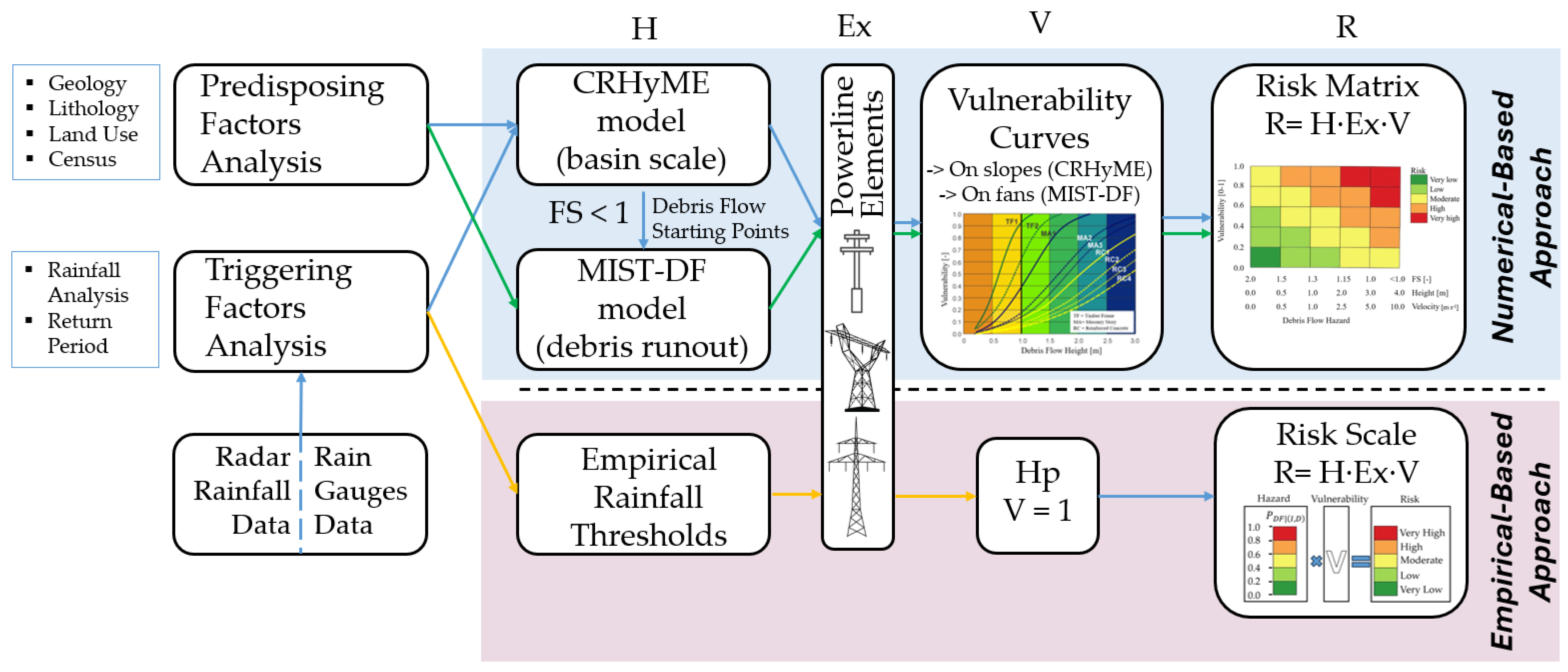
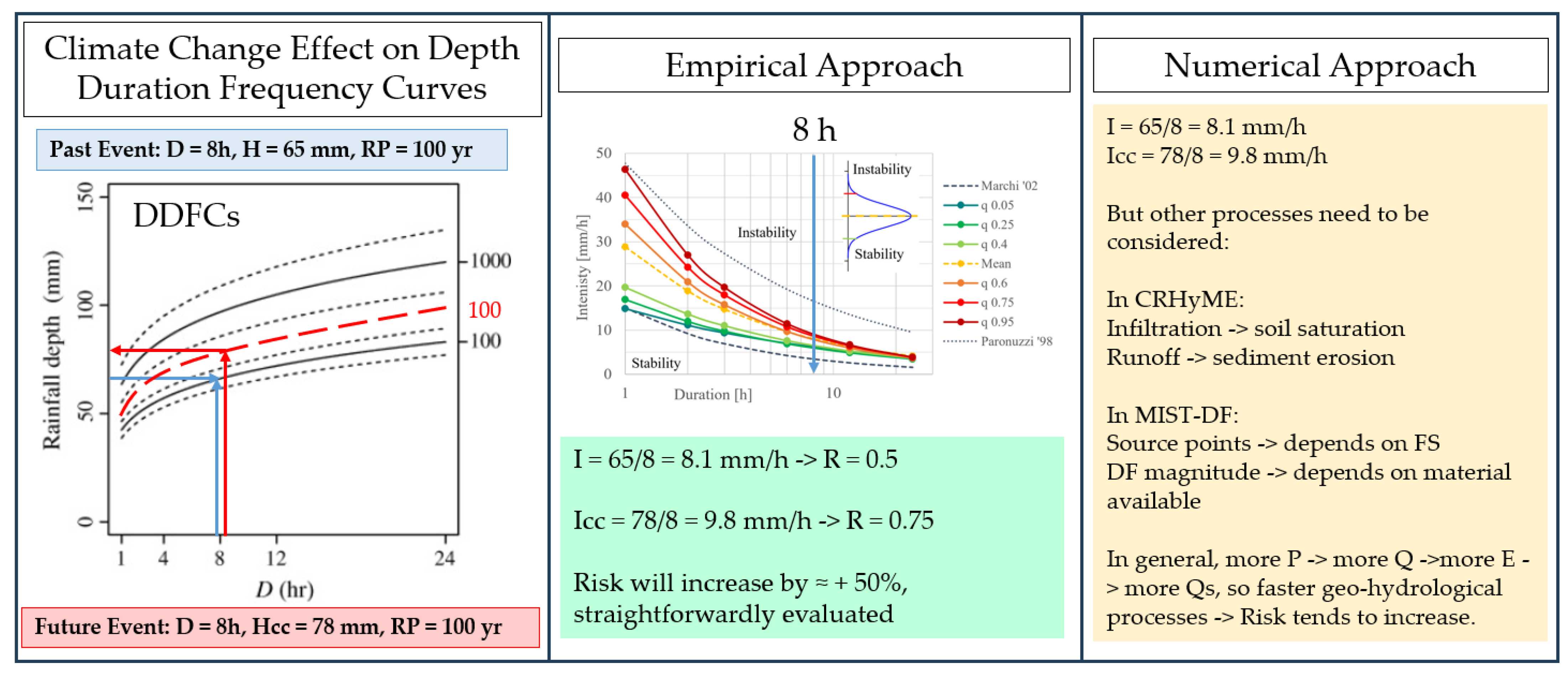
To carry out the risk analysis of powerlines affected by debris flow threats, a literature survey has been conducted by the authors, considering the most recent developments in this field. According to [24], the risk evaluation (R) strongly depends on the quantification of the hazard (H), and it is correlated with the spatial distribution of the exposed electrical facilities (Ex) (such as powerlines, power stations, etc.) and their vulnerability (V). The risk equation is presented in Equation (1), and (R) can be quantified only after the other components (H, Ex and V) are estimated. In the following paragraphs, the application of Equation (1) (generally adopted by [8,25,26] for geo-hazards risk assessment) to the two approaches, numerically based (1°) and empirically based (2°), is reported (see Figure 1).
R = H · E x · V

2.1. Numerical-Based Approach for Assessing Powerline Risk in Back-Analysis

Since geo-hydrological phenomena are sometimes too complex to be investigated straightforwardly, two instruments based on numerical models have been developed, firstly to calculate and quantify the debris flow hazard (H). The first one is the CRHyME geo-hydrological model (Climatic Rainfall Hydrogeological Modelling Experiment) [22]. It is a tool designed to conduct detailed analyses on specific areas relating to geological and hydrological problems connected to floods or landslides that can impact the power system. The second instrument developed is called MIST-DF (Modelling Impulsive Sediment Transport—Debris Flow). It is a software able to describe the debris flow downstream propagation and runouts using the equation of the fluid motion in two dimensions.

2.1.1. The CRHyME (Climatic Rainfall Hydrogeological Modelling Experiment) Code

The CRHyME model is a spatially distributed hydrological model (written in Python, version 3.13) that exploits the potential of matrix calculation to perform the hydrological balance at the basin scale [22]. In fact, the reconstruction of the hydrological cycle represents a fundamental step in obtaining a realistic description of the state of the hydrographic basin, even when geo-hydrological issues occur [27]. CRHyME’s focus consists of simulating rainfall-induced geo-hydrological instabilities such as shallow landslides, debris flows, catchment erosion and sediment transport into a river [22]. These phenomena are conventionally decoupled from a hydrological routine, while in CRHyME, they are simultaneously and quantitatively evaluated within the same code through a multi-hazard approach. CRHyME is divided into 7 modules, each of which is responsible for the simulation of one or more components of the geo-hydrological cycle [22]. Compared to classical distributed hydrological models, CRHyME minimises the calibration parameters through data processing that integrates different geological and hydrological data mappings that considerably reduce the random dependence of the parameters derived from physically based data (see Figure 1). CRHyME has been tested using meteorological data coming from both reanalysis databases and from climate models, thus making it quite versatile in the reconstruction of past and future flood or drought scenarios [22,28,29,30]. In this paper, we present a further extension of the CRHyME model that has been run considering a past reconstructed radar rainfall field over a square domain.

Detailed Rainfall Reconstruction Using Radar Images

Across the mountain area, for assessing geo-hazards, the investigation of triggering factors is a necessary task [31]. In this paper, we have investigated the rainfall as the principal triggering factor for debris flow and shallow landslide failures at the basin scale. In a mountain environment, rainfall reconstruction (in terms of total precipitation and intensities) is a challenge due to the mutual influence of the orography in rainfall generation and distribution (in space and time) [32]. Generally speaking, ground-based rain gauge networks are instruments able to record with high temporal resolution (on the order of minutes) the possible critical rainfalls, but, depending on the scale of analysis, their spatial coverage may not be sufficient sometimes [33,34]. Especially in summer, convective precipitation is frequent in Alpine environments, but their intensities and localisation may not be recorded by the ground-based rain gauge network, missing, especially across remote and isolated areas, the real magnitude of the event that may have triggered geo-hazards [32]. In this regard, another source of information has been explored in order to cope with these issues, including in the rainfall data reconstruction, as well as the information coming from meteorological radar [35,36]. Meteorological radar is a remote-sensing system used to detect, track, and measure the intensity of precipitation (rain, snow, and hail) and storm structures in real time. It detects precipitation and atmospheric scattering, enabling the monitoring of storms, wind, and turbulent layers. Modern Doppler radars also determine the speed and direction of precipitation movement, and they are instruments for short-term forecasting (nowcasting), flood warnings, agriculture monitoring, and aviation safety [35,36].
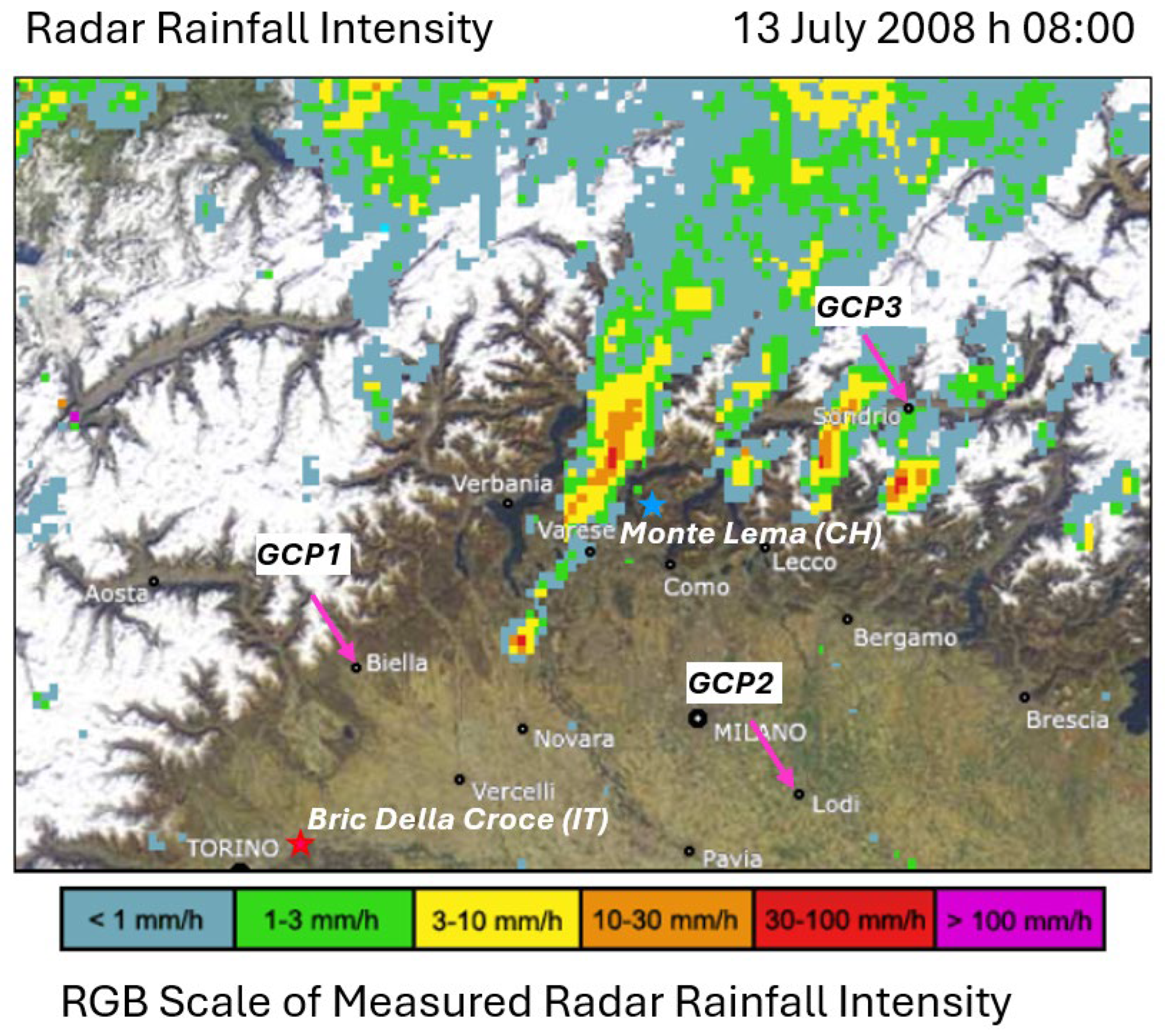
Radar images (especially those elaborated and bias-corrected using ground observations) are not always available to the public [35], especially in the past (before 2020 in Italy), while open source repositories are now becoming more common and radar data adoption in numerical computation is increasing [37]. However, to cope with the lack of radar images for past events (often not downloadable in a tractable “raster” format but still available as RGB images within online repositories [37,38]), a new strategy has been implemented. Through a Python script routine, the radar images available from [37] (covering a significant portion of the North-Western Alps) were processed to obtain an indication of the hourly mean intensity of rain for past events. The scripts have been programmed to carry out automatic georeferencing operations of radar images extracted from the website repository, considering at least 3 ground control points (GCP) on the surface (see Figure 2). Then, a subsequent conversion from RGB to .tiff format has been carried out using appropriate scales of rainfall intensity based on image colour indexes (see Table 1). This procedure has been processed using the data coming from “Mosaicatura Radar” performed by Italian civil protection [37,38]. In the North-Western Alps portion investigated, a composition of ARPA Piemonte (Bric della Croce, [39]) and Meteo Swiss (Monte Lema, [40]) radars has been considered, and the intensity has been computed from row data on reflectivity (Figure 2). Here, for the available images, no correction or processing of the rainfall field considering the ground-based station has been previously conducted [37]. Each georeferenced and converted image has been combined following the time series of the events in a .netcdf format, ready for ingestion within the CRHyME tool.

2.1.2. The MIST-DF (Modelling Impulsive Sediment Transport—Debris Flow) Code

MIST-DF is a model designed for reproducing debris flow runouts across mountain environments, written in the Python programming language. Debris flows are a complex geo-hydrological phenomenon that lies between a flood and a landslide [9]. Depending on the percentage of water–solid mixture, debris can have different behaviour due to different water–solid particle interactions [41]. The code can include several types of debris flow rheology [9,41], considering the fact that debris flow kinematics have been reported to be extremely variable in nature depending on the characteristics of the material involved (coarse fragments or fine soils) and the water mixing ratio [9]. Debris flows can be broadly classified into muddy debris flows, granular debris flows and hyperconcentrated flows [9]. Muddy debris flows are characterised by a high proportion of fine-grained material and tend to exhibit viscoplastic or Bingham-type behaviour. Granular debris flows contain more coarse particles, and they are typical of the Alpine regions [10,41]. Depending on the specific composition and water content, they may exhibit dilatant behaviour, where viscosity increases with shear rate. Hyperconcentrated flows are transitional flows between clear water flow and debris flows, with intermediate solid concentrations also depending on particle size distribution [9].
The software has been designed to work with high-resolution digital elevation models (DEM) in order to capture the evolution of debris flow along the runout path (i.e., downstream river valley). DEM extension defines the 2D domain where MIST-DF numerical integration is executed. In order to carry out the debris flow simulations, initial and boundary conditions (ICs and BCs) need to be specified across the domain (further details of the numerical implementation of the code are reported in Appendix A). Regarding ICs, an abrupt release of a water–solid mixture of mobilisable material should be assigned at t = 0 s at a certain location. Considering a hydrologic basin, source areas are generally located in the upper part of the mountains, and they can be identified using available landslide census (such as IFFI, Inventario Fenomeni Franosi Italiano [7,23]), from onsite investigation and airborne images’ interpretation or considering the outputs from any slope stability models (such as those implemented within the CRHyME routine). The spatial localisation of the source areas is crucial since they represent the starting point of debris flow that significantly perturb and influence their kinematic and downstream propagation [9]. At each source point, for a certain volume of material (expressed in m3), a release function is calculated according to Equation (2).
Q d f t , x , y = Q m a x ( x , y ) x · y · e k t
The hypothesis behind this formula, where release is described by a negative exponential curve with a maximum at t = 0 s, considers the debris flow triggering as an instant release of material similar to those experienced during sudden dam-break events [42,43]. Here, Qmax is evaluated from the expected debris flow volume (not evaluated explicitly by CRHyME) but calculated from empirical formulae using the equation proposed by [10,41] and reported in Equations (3) and (4): GS is the expected debris flow volume (in m3) calculated as a function of basin area A (in km2) and slope i (adimensional), and dependent on the Erodibility Index (EI) and Transport Index (TI). EI takes into account the geological features of the watershed, increasing predicted debris flow volume with lithologies with a higher predisposition to trigger erosion (see Table 2) [44]. At the basin scale, the EI index is evaluated from available geological and lithological maps, assigning to each category a value from 0 to 5 and weighting them spatially considering their spatial extension. The TI index can amplify the estimated volume as a function of the expected (or reported in event chronicles) rheology of the flow (which could be closer or not to the clear-water flood type). If debris is more similar to a flood, the expected GS reduces progressively (see Table 2). α is an empirical parameter coming from the regression proposed by [10,41] and equal to 3.9 · 104, and Qmax is calculated empirically from GS using Equation (4). In the case of back-analysis, GS can be estimated from onsite surveys or reported records. The parameter k introduced in Equation (2) describes the impulsivity of the phenomena and is expressed in s−1. Generally, higher k brings more impulsivity and is representative of a sudden and small volume collapse, while lower k is representative of a higher amount of material release through time. Within the domain, Qdf can be assigned not only at a certain location, but multiple point sources can be specified. The former may produce a fraction of the total Qdf or have their own source function (Qdf1, Qdf2 …). Depending on the survey data available, the two methods can be applied alternatively. Since the other quantities are known or estimated from empirical formulaes, the k parameter was calibrated depending on the total volume relased (GS) and considering the number of source points.
G S = α · A · E I · i 1.5 · T I 0.3
Q m a x = 0.1 · G S 0.833
Regarding BCs, at the domain borders (coincident with the perimeter of DEM extension), an open-transparent boundary has been implemented. At those BCs, the outflow velocity is imposed equal to the mean value recorded in the proximity of the border and updated every time step of the computation [45]. Possible leakage due to numerical approximation of the fluxes involved in the simulation can be easily detected since the overall mass balance ratio between the inputs (i.e., Qdf at source points) and the outputs (i.e., Qdf propagation across the domain) is assessed at every time step. Further details on the numerical implementation of the MIST-DF code are reported in Appendix A.

2.1.3. Powerline Exposure and Vulnerability Against Debris Flow Hazard

After the hazard (H) evaluation, the powerlines’ exposure (Ex) and their vulnerability (V) have been investigated. In this regard, CRHyME and MIST-DF have been implemented in combination for evaluating source points of possible landslide failures on slopes and for computing the debris flow runout along the valley, respectively. Both areas are critical for powerline risk. Firstly, transmission powerlines (Ex) are generally located across mountain ridges and slopes, which are areas prone to triggering shallow landslides (which may evolve into debris flows). Secondly, along valley fans, distribution pylons (Ex) are settled to transport electricity to towns and cities, so it is not infrequent that they may be hit by debris flow scours. Moreover, the vulnerability of pylons (V) against debris flow or landslides that involve a significant amount of material (terrains and rocks) could be rather high: the structure is sometimes tilted or destroyed by these events, causing an abrupt disconnection of the electricity network [12]. For these reasons, powerlines’ vulnerability curves against debris flow threats have been calculated.

Powerlines Vulnerability Curves

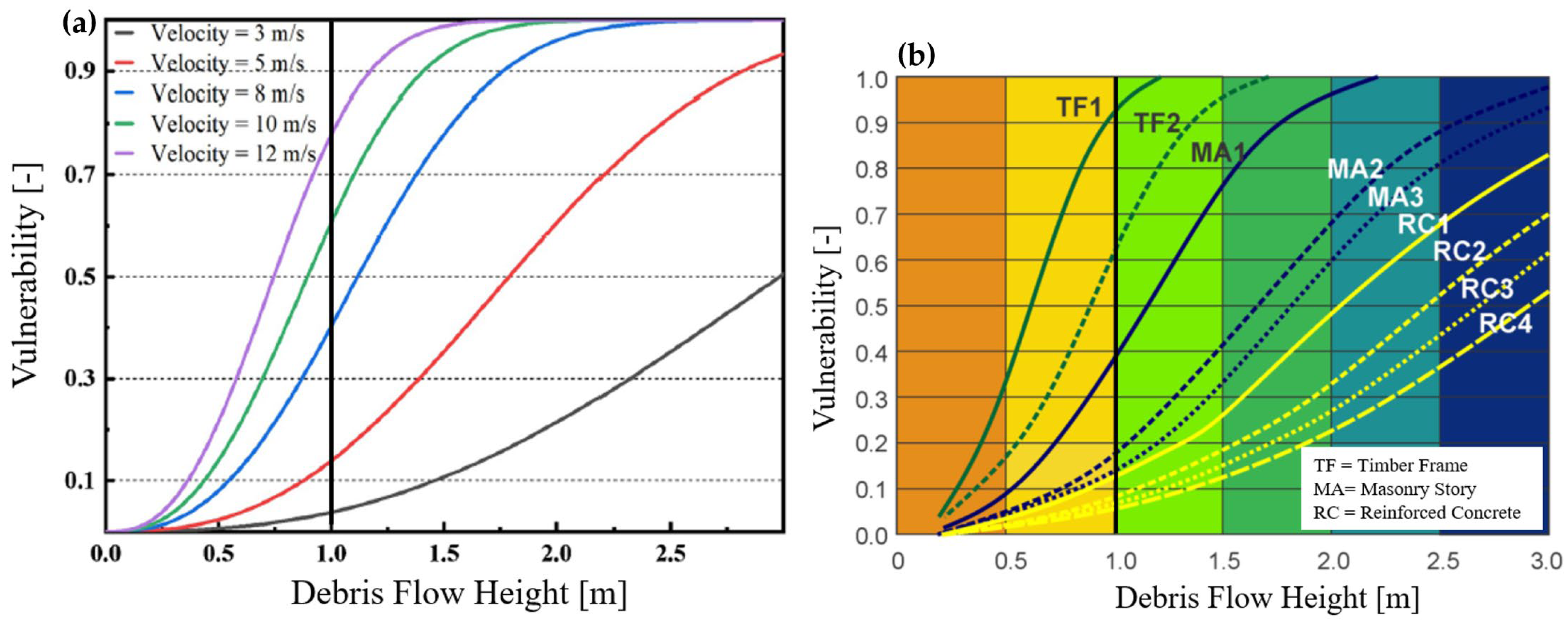
Debris flow vulnerability curves are graphical representations that show the relationship between the magnitude of a debris flow (in terms of its depth, velocity, discharge or impact pressure) and the degree of damage it causes to structures, typically buildings or infrastructures [18]. They are essential tools for assessing the potential impact of debris flows and are used in risk assessment and mitigation planning [8]. Graphically, the x-axis represents the intensity of the debris flow, measured by various parameters such as flow depth, velocity, impact pressure, or a combination of these. On the y-axis, the degree of damage is represented, often normalised on a scale from 0 (no damage) to 1 (complete damage or loss) [17]; see Figure 3. In this regard, vulnerability curve types are empirical-based, physical-based or damage-based. Debris flow magnitude parameters used for vulnerability curves are as follows.
Flow depth hdf: the vertical height of the debris flow, in m.
Velocity vdf: the speed of the debris flow, a combination of horizontal components u and v, in m s−1.
Impact pressure: the force exerted by the debris flow on a structure, in kPa.
Impact force: the total force exerted by the debris flow, in kN.
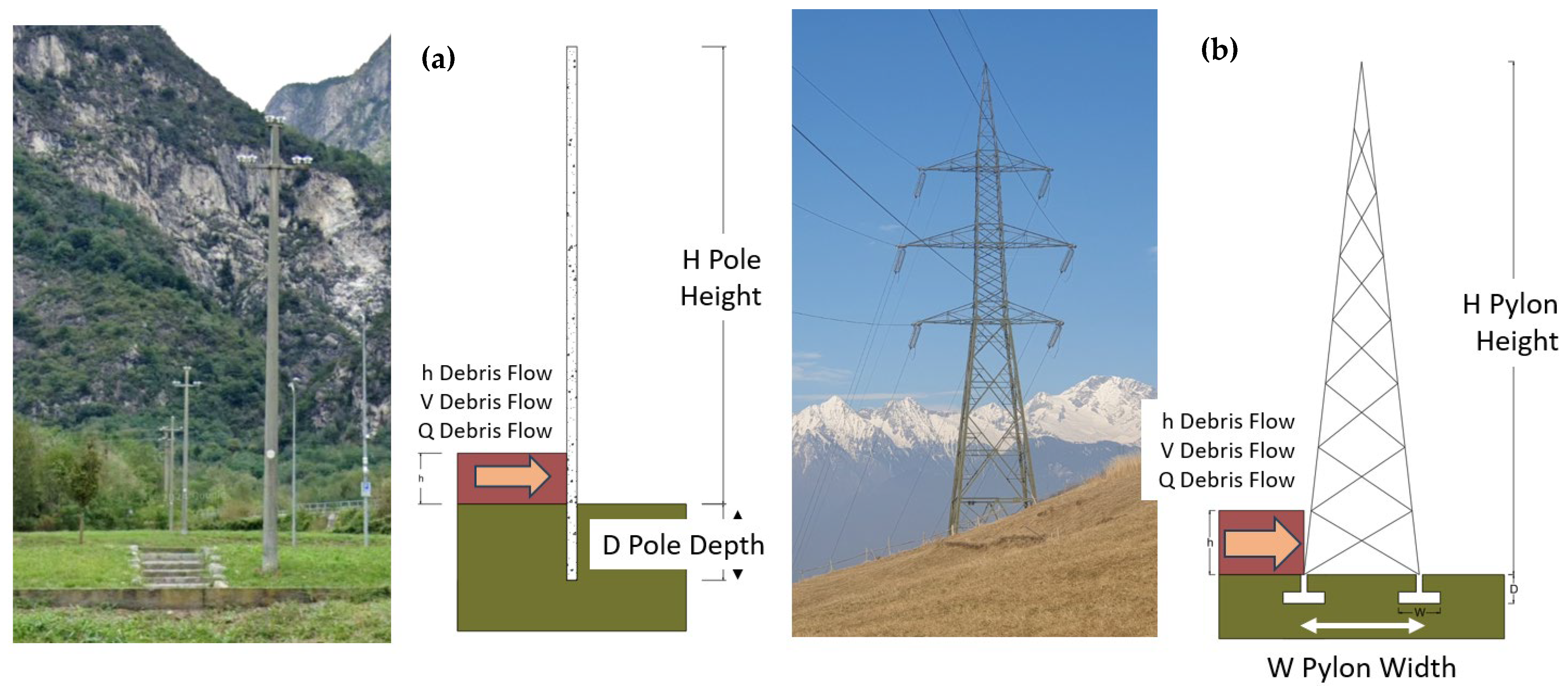
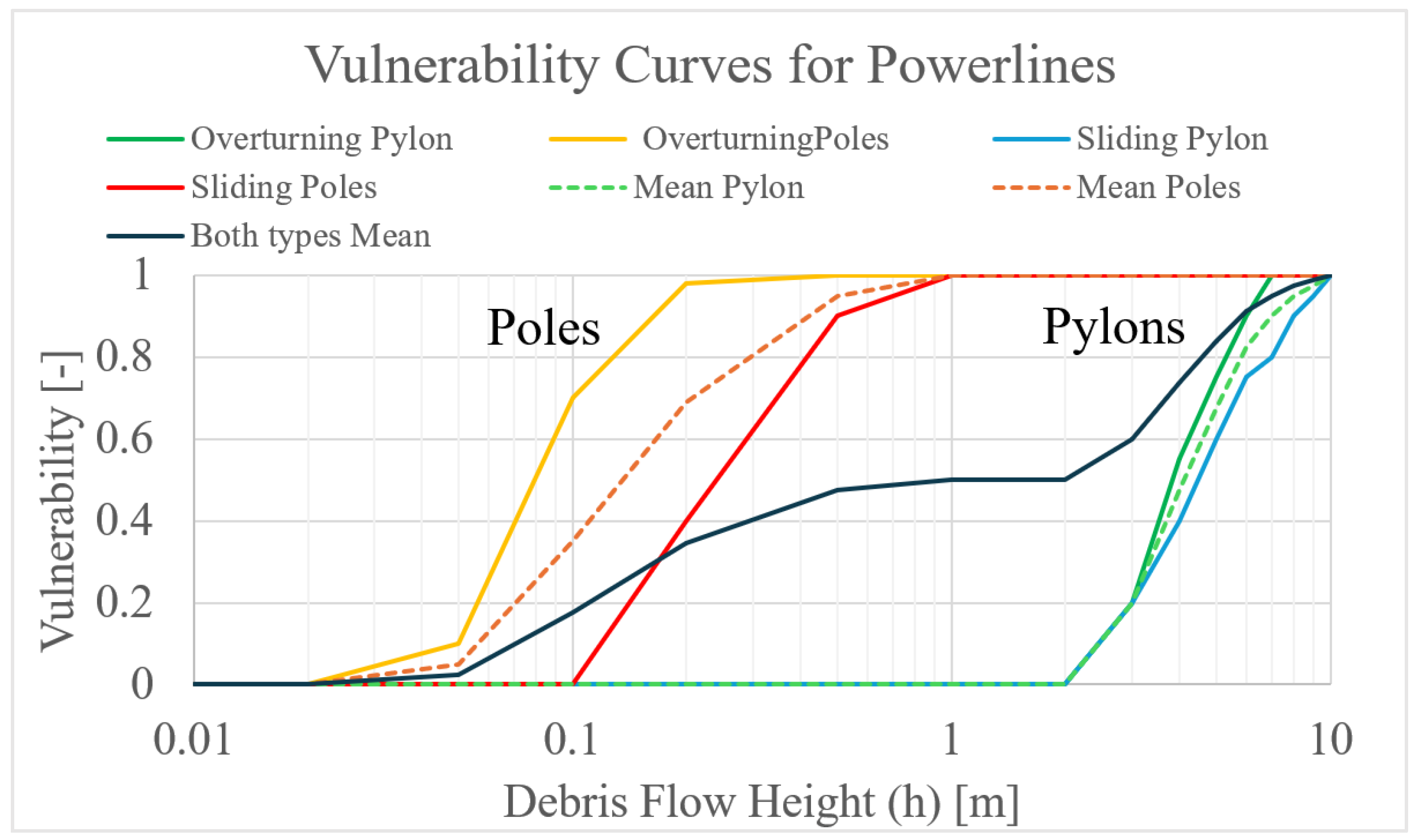
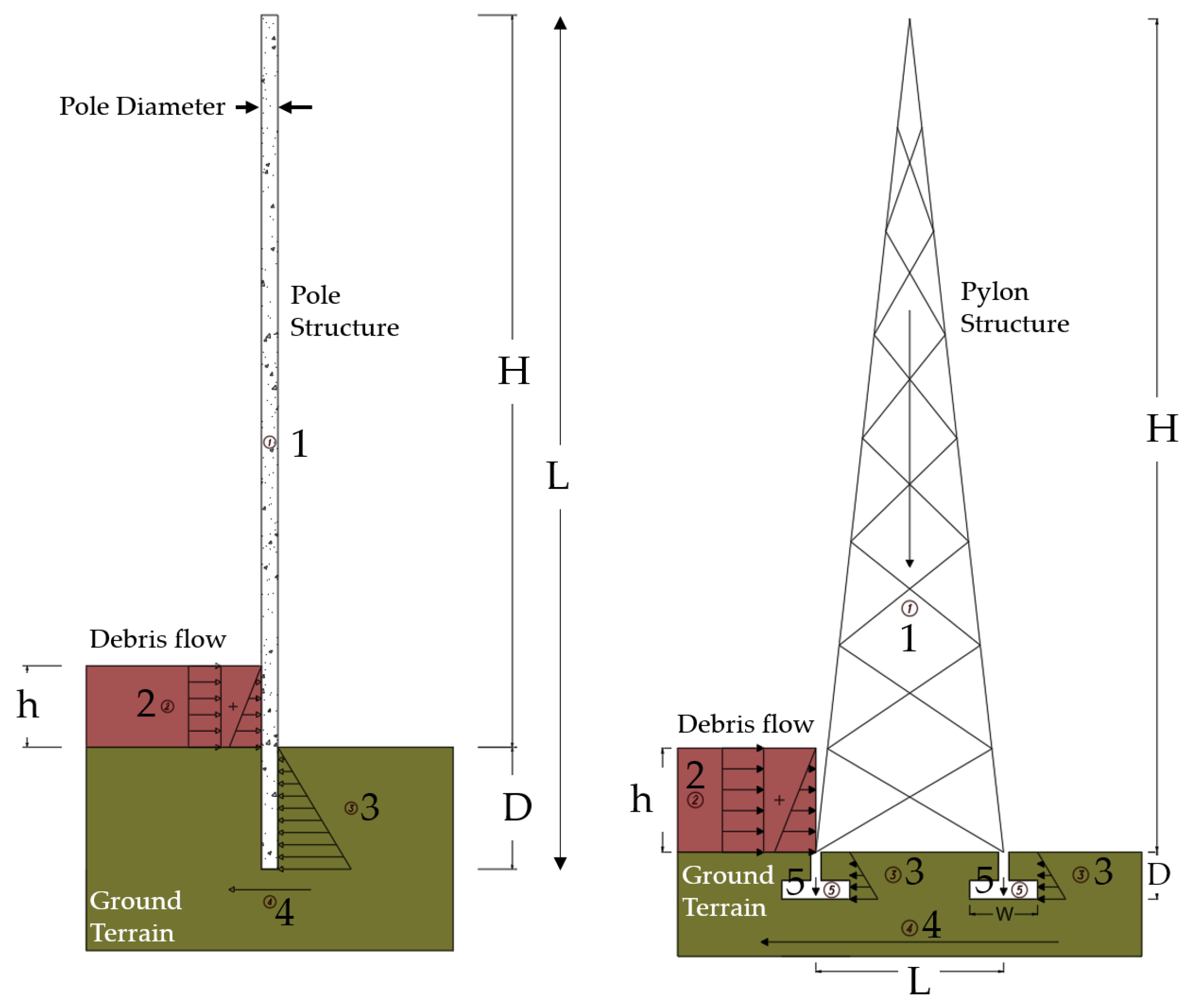
In Figure 4, the geometrical characteristics of poles and pylons are shown. They represent the most common powerline infrastructure type diffused across the Italian landscape (further details on this type of infrastructure are reported in Appendix C). According to [6,18], vulnerability is estimated considering a hazard variable (such as debris flow height or velocity) and the design characteristics of infrastructure. Regarding electrical structures, such as pylons and poles, no information about their vulnerability has been found in the investigated literature. Generally speaking, if a debris flow hits a pylon, the structure may fail in two ways: rotating (i.e., overturning failure) or translating (i.e., sliding failure). Therefore, an analytical strategy for evaluating the vulnerability has considered the computation of the limit equilibrium safety factor (FS), consisting of a ratio between resisting (i.e., the structural and foundation resistance) and the triggering forces (static and dynamic debris flow action). The details about the analytics expression adopted for calculating the powerline vulnerability curve are reported in Appendix C, considering the geometries of poles and pylons shown in Figure 4. The shape of representative curves obtained for poles and pylons for sliding and overturning failure mechanisms is shown in Figure 5. Those curves have been obtained specifying the typical geometries and material of powerline structures, considering a representative debris flow velocity (v) on the order of 10 m s−1 [9,41] and leaving debris flow height (h) as a free variable for hazard intensity computation. From analytical computation, poles have been revealed to be much more vulnerable than pylons, also showing a different behaviour among the sliding and overturning mechanisms. The former represents the most critical one in both cases.
Those vulnerability curves have been calculated assuming a lateral action of debris flow at the base of the poles and pylons (as represented in Figure 5). However, in the proximity of source areas and across slopes, debris flow actions cannot be computed explicitly. Therefore, the vulnerability could be estimated as a function of the limit equilibrium safety factor (FS) of the slope, a quantity directly evaluated from the CRHyME code that implements this type of slope stability model [22] (Harp infinite-slope stability model [47] was adopted for this analysis). In Table 3, the proposed relationship between the slope FS and the powerline vulnerability is reported, elaborated on the basis of the landslide risk management indications found in [8,9,48,49], valid for a generic structure (no examples for powerlines were available). According to the authors, as the landslide approaches the failure condition, the structure vulnerability starts to rise until the maximum value of 1.

2.1.4. Risk Assessment Coupling CRHyME, MIST-DF and Vulnerability Curves

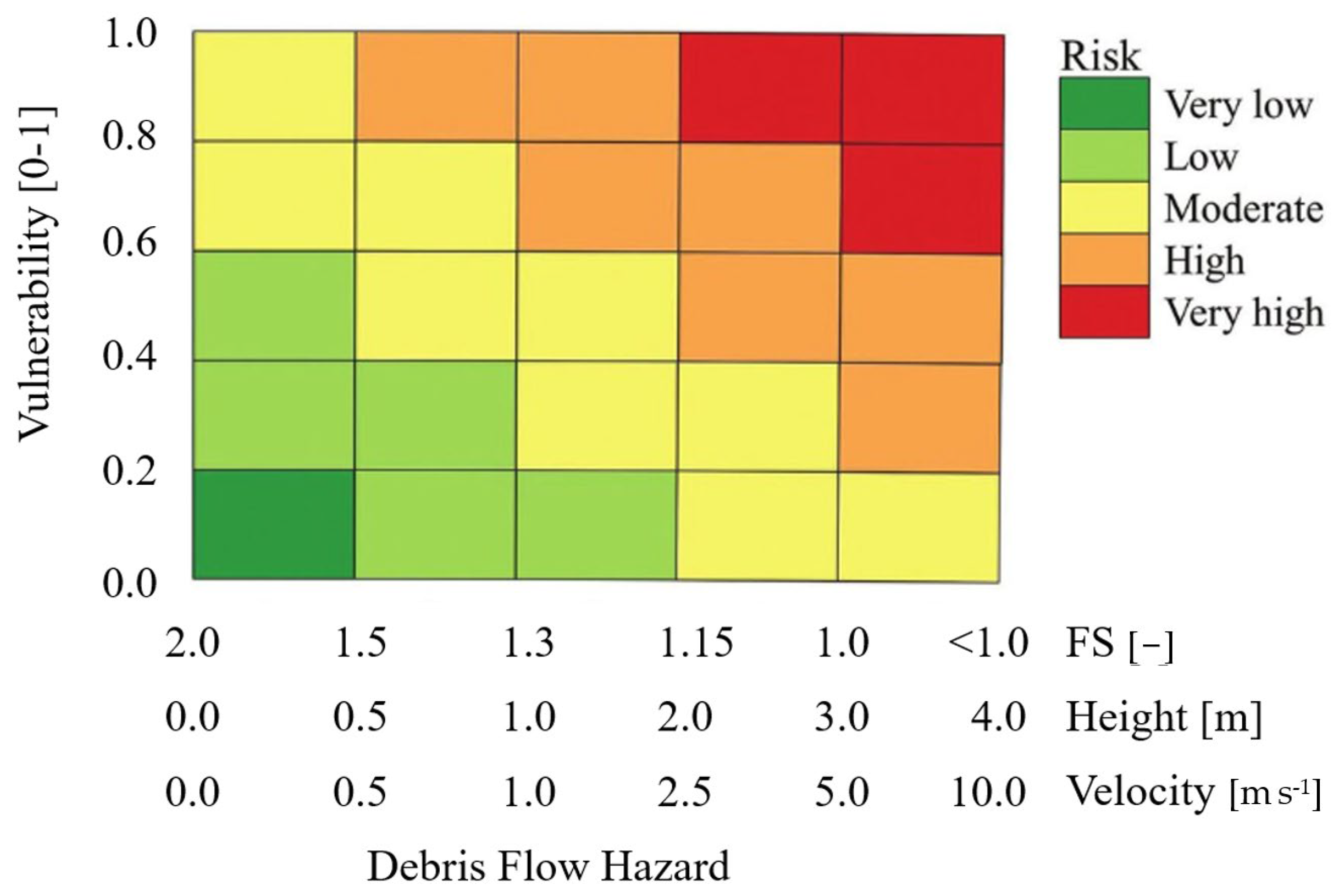
After hazard (H) and vulnerability (V) calculation, to take into account their possible combinations and to evaluate the associated risk, a risk matrix approach (R) has been proposed following the indications proposed by [8,9,25,50]. A landslide risk matrix (see Figure 6) is a decision-making tool that maps the likelihood of a landslide (hazard) against its potential consequences (vulnerability/impact) to categorise risk levels (e.g., low, moderate, high, extreme). It combines hazard intensity, spatial impact, and vulnerability to enable targeted risk mitigation. It facilitates fast and comprehensive assessments, supporting quick decisions during critical response scenarios or preliminary land-use planning. The matrix provides a clear, colour-coded visual representation of risks (from green to red), making complex landslide hazard data easy for non-technical stakeholders, planners, and politicians to understand [8,9,25,50].
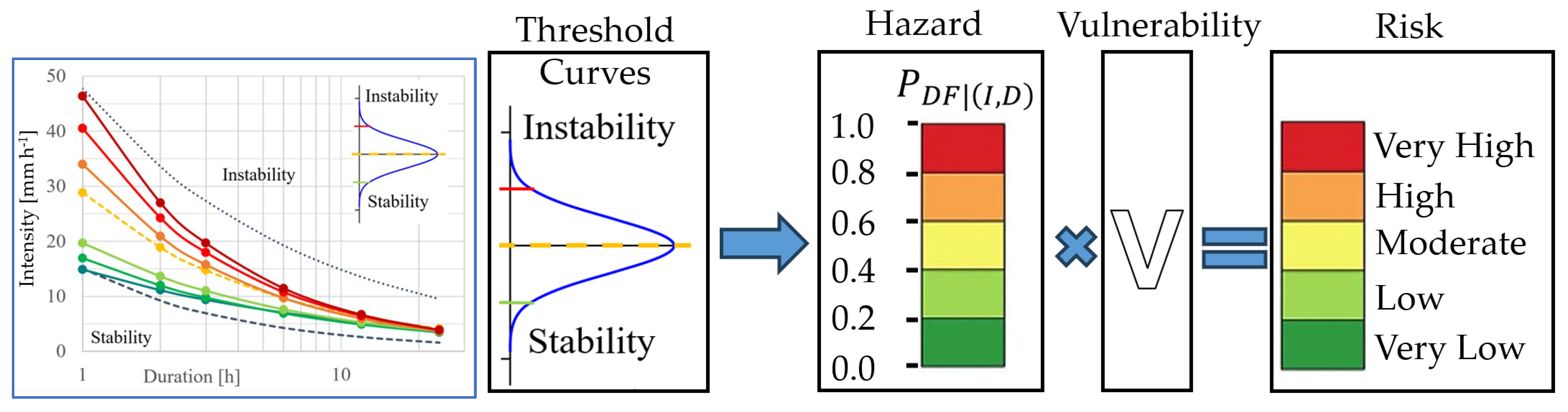
The calculated infrastructure risk is low when both the hazard component and the vulnerability are small (green sector); conversely, for more severe episodes or higher vulnerabilities, high risk is expected (red sector). The hazard associated with debris flow has been synthesised considering three parameters: the FS (e.g., safety factor, adimensional) coming from the slope stability assessment conducted by CRHyME [22], and the height (h in m) and velocity (v in m s−1) quantities evaluated by MIST-DF along the debris runout in the downstream valley. The matrix colour classification has been carried out following the scheme proposed by [50], considering the hazard scale references proposed in [8,9] and taking into account the peculiarity of the debris flow threats and powerline infrastructure. The aim was to find a compromise between a vulnerability conservative approach (assuming V = 1) and an efficient detection of the overhead lines at risk, considering powerline structure resistance (0 ≤ V ≤ 1).

2.2. Empirical Approach for Assessing Early-Warning Powerline Potential Risk

The critical rainfall intensities for rainfall-induced landslides can be evaluated by applying the rainfall threshold curves [21,31,51], and these tools can be considered further for evaluating associated geo-hydrological hazards and risks [8]. The thresholds are determined through empirical relationships that link duration (D) and intensity (I) in Equation (5) or critical cumulative (E) in Equation (6) of the rain to the triggering of the phenomenon [31,52]. The relationship between the variables is linear in a bi-logarithmic graph and can be described through the following equations, in which the parameters a and b are the regression coefficients.
I = a ·   D b
E = I · D
The precipitation thresholds separate the I-D space into two different zones. Below the line (i.e., the rainfall threshold) are settled all rainfall events that are generally unable to trigger a landslide or debris flow (“stability” condition), while above the line are those that can cause “instability”. This type of interpretation is quite functional and immediate, and that is why these thresholds are widely used in the field of civil protection early warning for prevention purposes [23,31,52]. However, a more careful analysis of the rainfall thresholds allows further details of the ignition, suggesting a more statistically based and less deterministic methodology.
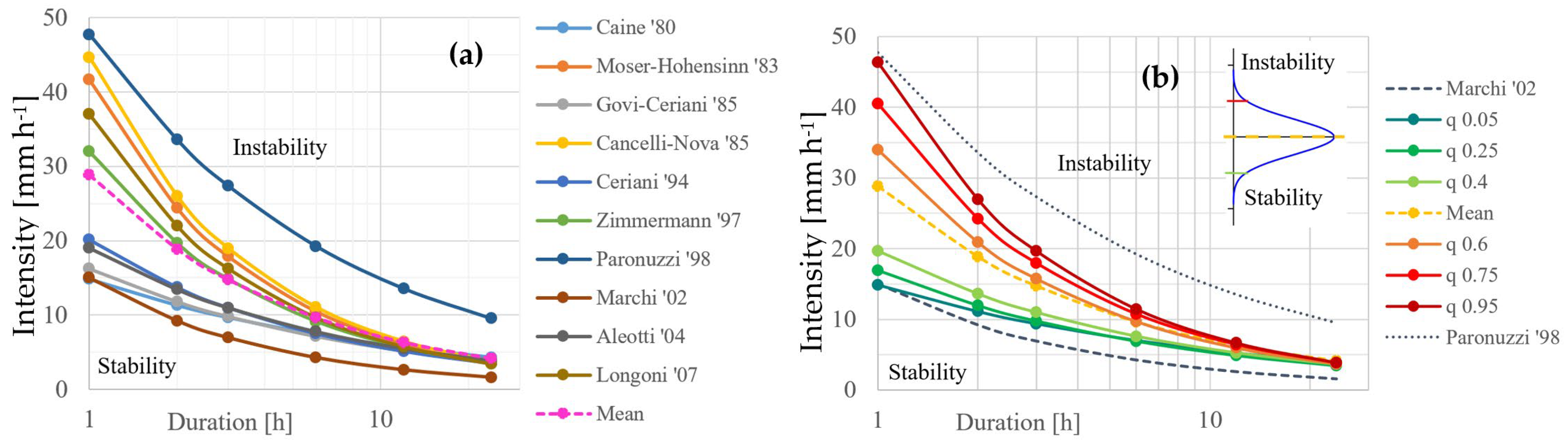
The empirical methodology based on the rainfall threshold is able to detect possible debris flow failure (i.e., the hazard component H of the risk Equation (1)) using only local rain gauge data. However, it should be intended as a preliminary and expeditious analysis suitable for geo-hazard early-warning [25,53] that could support, in principle, onsite investigation and more complex numerical analysis. According to [51], in the literature, several studies have been conducted on rainfall-induced landslides, which proposed different thresholds across the same area. Even though the reconstruction of the threshold consists of a regression, the high variability in their reference datasets (i.e., the precision of rainfall record, the sensitivity of rain gauges, and the validity of historical chronicles) may undermine the univocity of the threshold reconstruction [31,52]. As an example, in the area of the Central-Southern Alps, several thresholds (~10) have been published in the past, and they are still retained as valid for describing debris flow triggering across the Alpine environment [31]. Nevertheless, they are quite different from each other since their construction was influenced by the local landslide’s susceptibility factors, which embed the geology, lithology, climatology and morphology of the investigated area. From Equations (7)–(14) are listed the threshold curves reported by [51]. Equation (15) represents the mean of the previous, also considering the Caine and Ceriani curves (see Section 3.2). The latter is the most important since it is adopted by the Lombardy region for civil protection purposes against geo-hydrological risks [31].
M o s e r H o h e n s i n n   1983 I = 41.66 D 0.77
G o v i C e r i a n i   1985 I = 16.24 D 0.46
C a n c e l l i N o v a   1985   I = 44.668 D 0.78
Z i m m e r m a n n   1997 I = 32 D 0.7
P a r o n u z z i   1998 I = 47.74 D 0.507
M a r c h i   2002 I = 15 D 0.7
A l e o t t i   2004 I = 19 D 0.5
L o n g o n i   2007 I = 37 D 0.75
M e a n I = 28.82 D 0.61
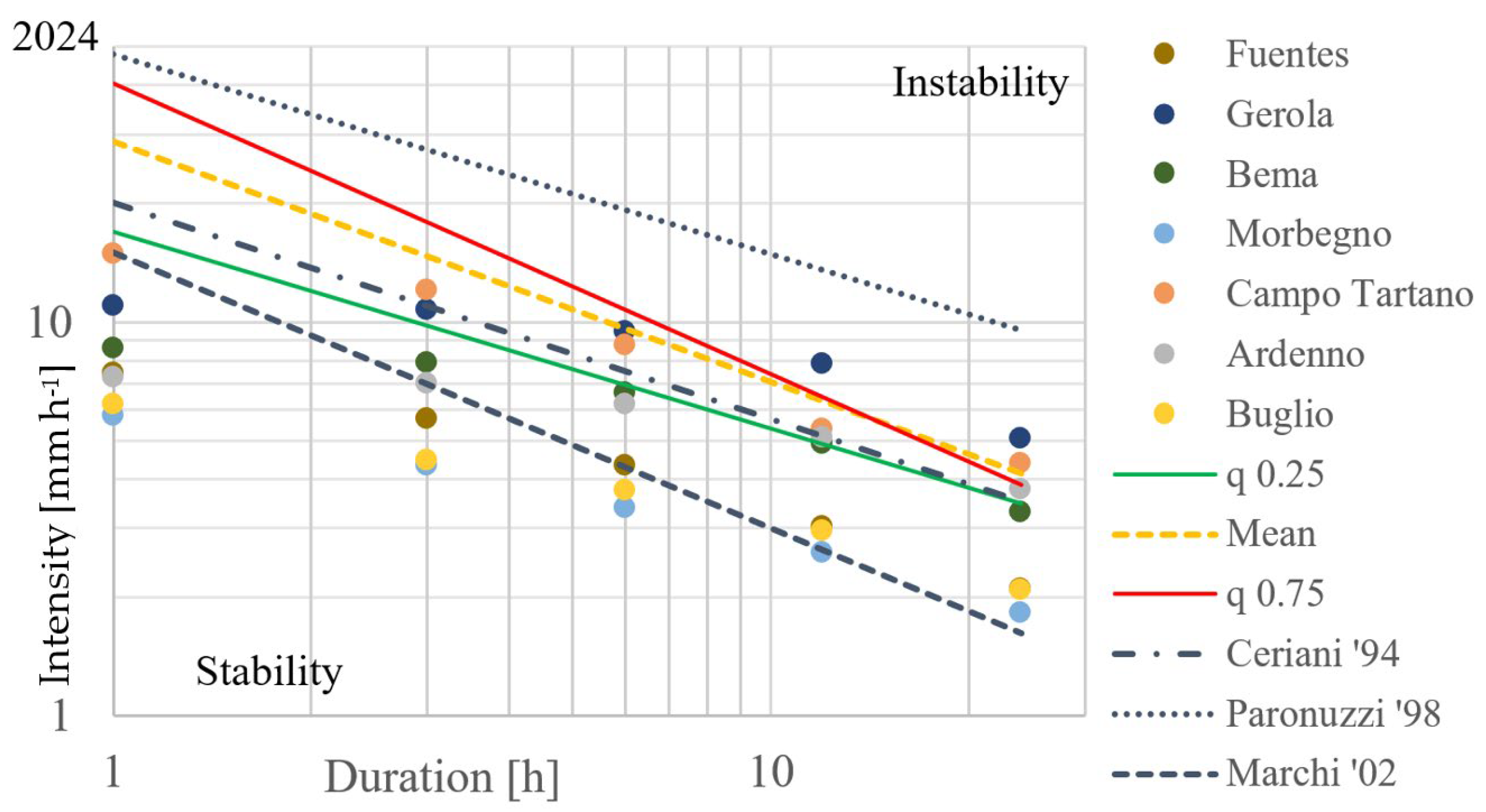
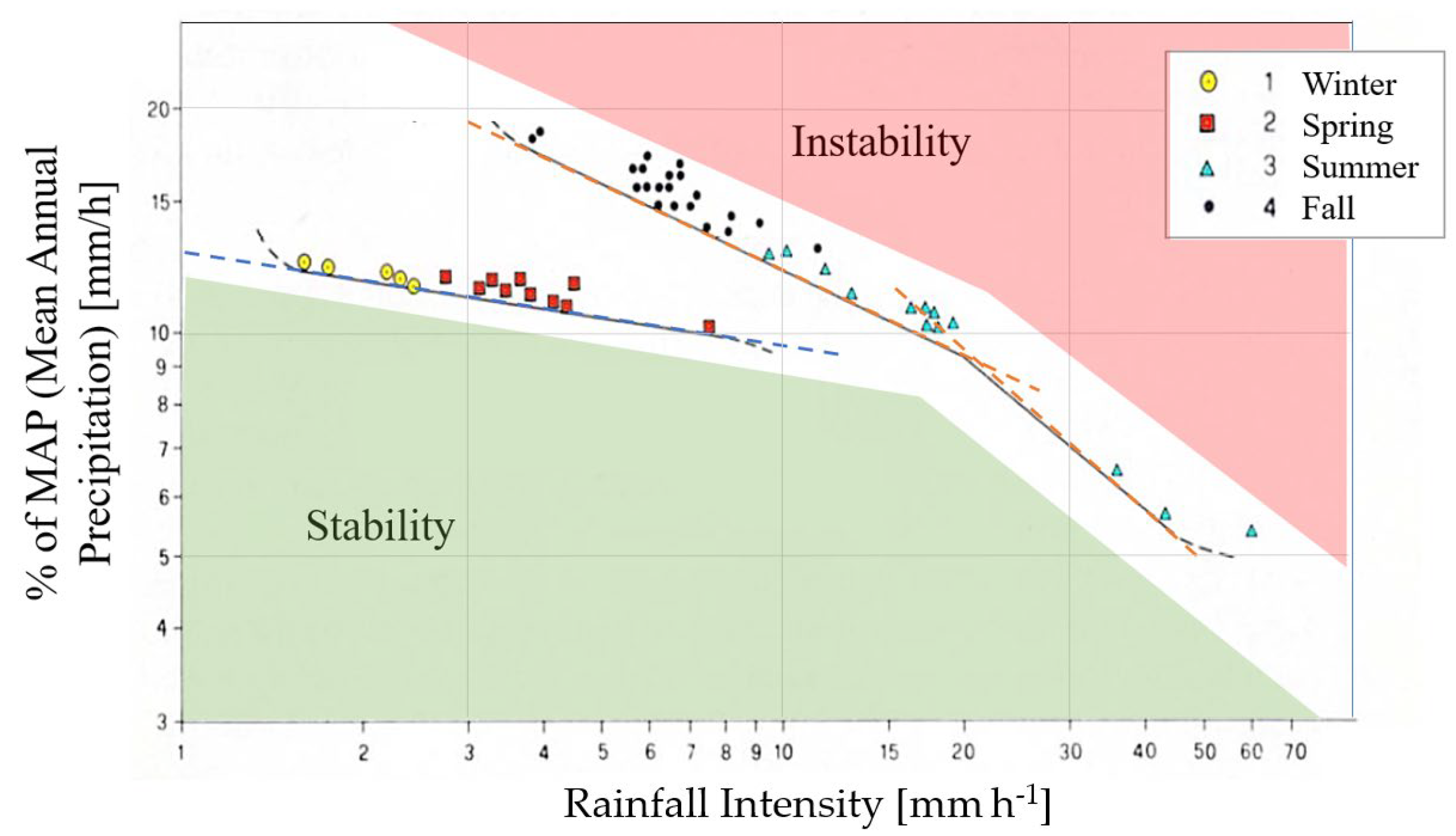
In Figure 7a, the threshold curves from Equations (7)–(15) are represented in the I-D graph. As can be noticed, the dispersion of the curves is rather high, especially for short-duration rainfall where the threshold intensity spans from a minimum of 15 mm h−1 up to 47 mm h−1. The average of all curves is around 28 mm h−1, which is approximately in the middle of the range. Conversely, for higher durations, the curves are less dispersed and converge around the I value of 3–5 mm h−1 for a rainfall duration of 24 h. This dispersion is motivated by the fact that short event data are more difficult to glimpse than longer ones since they are generally more localised, scattered in time and space, so that the rain gauge density may not be sufficient to glimpse the event accurately [32,53]. Moreover, the variability of short events amplifies the uncertainties of shallow landslide failure evolving into debris flow, which is highly non-linear and associated with a very local stability of the terrain and deposits [54]. During short events, high rainfall rates may trigger sudden failures due to superficial oversaturation and due to intense erosion and sediment transport triggered by abrupt runoff generation. On the other hand, lower rainfall intensities are able to saturate the soil more slowly, giving time for the geo-hydrological system to absorb the rainfall perturbation [55].
The “model uncertainties” embedded in rainfall thresholds have been “resolved” following a probabilistic approach explored by [52,53]. The idea was to create an ensemble of threshold curves valid for a certain area, taking into account their possible variability and associating with it a probability of debris flow failure. In Figure 7b, the same graph as Figure 7a is reported, showing the quantiles of the rainfall threshold ensemble distribution. The curve variability is interpreted considering the probability of having a landslide if a certain rainfall (characterised by a certain I and D) overcomes a threshold ( P D F | I , D ) . We have assumed that if an I-D point characterising a certain rainfall event is settled below all the curves, its conditional probability to generate a debris flow triggering P D F | I , D is almost 0. Conversely, if the I-D point is above all of the curves, the P D F | I , D is equal to 1, predicting a debris flow being triggered. In more detail, if the I-D point of a certain rainfall event is settled above the light-green curve of Figure 7b (q 0.4), it indicates that there exists a probability of 0.4 (40%) for having a failure. Moving upward in the graph (i.e., a more intense event), the probability rises, reaching values > 0.7 (70%) when crossing red curves. Conversely, when the point is settled well below (i.e., an ordinary, not intense event), the probability may reduce to <0.3 (30%) when green lines are crossed.
Knowing P D F | I , D , it is possible to calculate the associated risk (R) simply by using the proposed contingency table (Table 4) and the scheme reported in Figure 8. This risk scale is a simplified version of the risk matrix of Figure 6, where the vulnerability has been fixed to 1. Assuming V = 1, the vulnerability component of the exposed assets (i.e., powerlines or a generic infrastructure) is not investigated in detail as in the numerical approach. This represents a conservative choice where infrastructure geometries and characteristics are not explicitly taken into account [8,25,26]. Moreover, it was adopted since it is difficult to establish a robust correlation between rainfall magnitude (i.e., intensity) and the probability of infrastructure failure [12,21]. In these cases, the numerical analysis presented in the previous paragraph confirms the complexity of vulnerability assessment of powerlines, which require a systematic reconstruction of geo-hazards and a detailed knowledge of the exposed infrastructure. Therefore, the risk scale proposed in Table 4 addresses the aim of maintaining the empirical approach as simply as possible, suitable for having a fast but robust risk assessment of the exposed assets. Following the scheme in Figure 8, increasing the severity of the rainfall event (I-D point higher in the graph), the hazard probability and the risk of having a shallow landslide or debris flow failure tend to rise proportionally.

2.3. The Cases of Study of Talamona 2008 and Campo Tartano 2024

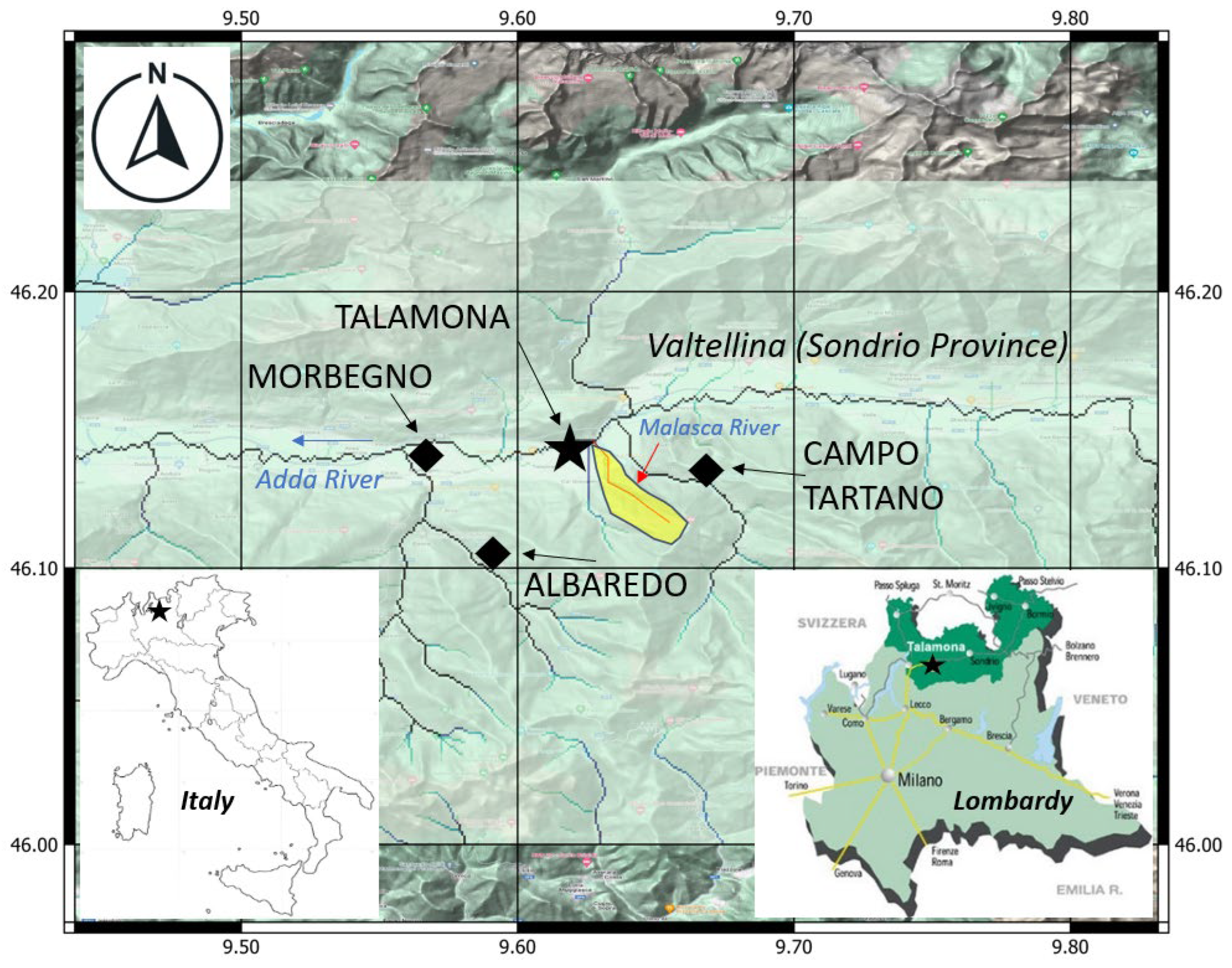
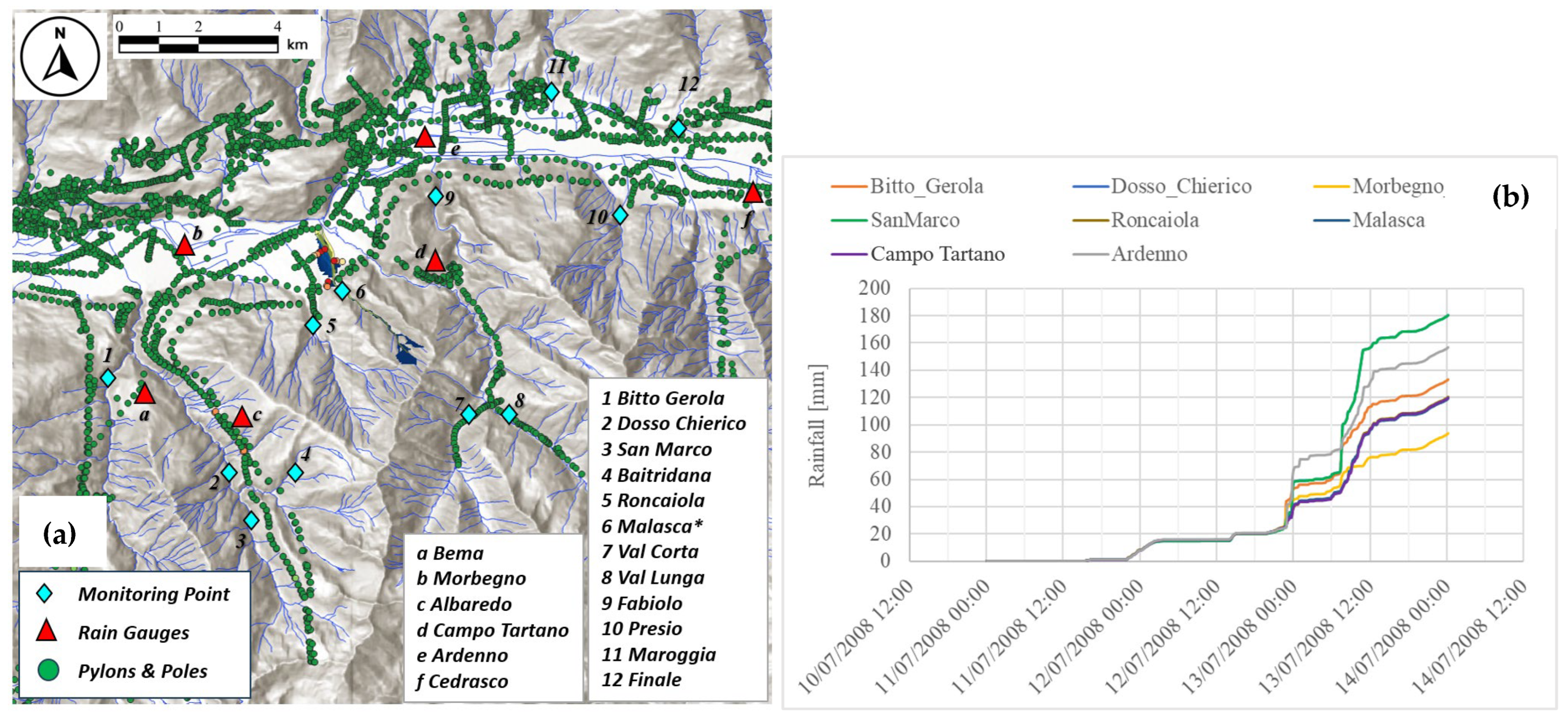
The two approaches described above have been applied separately for two cases of study that occurred in 2008 and 2024 across the Valtellina Valley (Sondrio Province, Lombardy region, Italy) in the Southern Alps (see Figure 9).
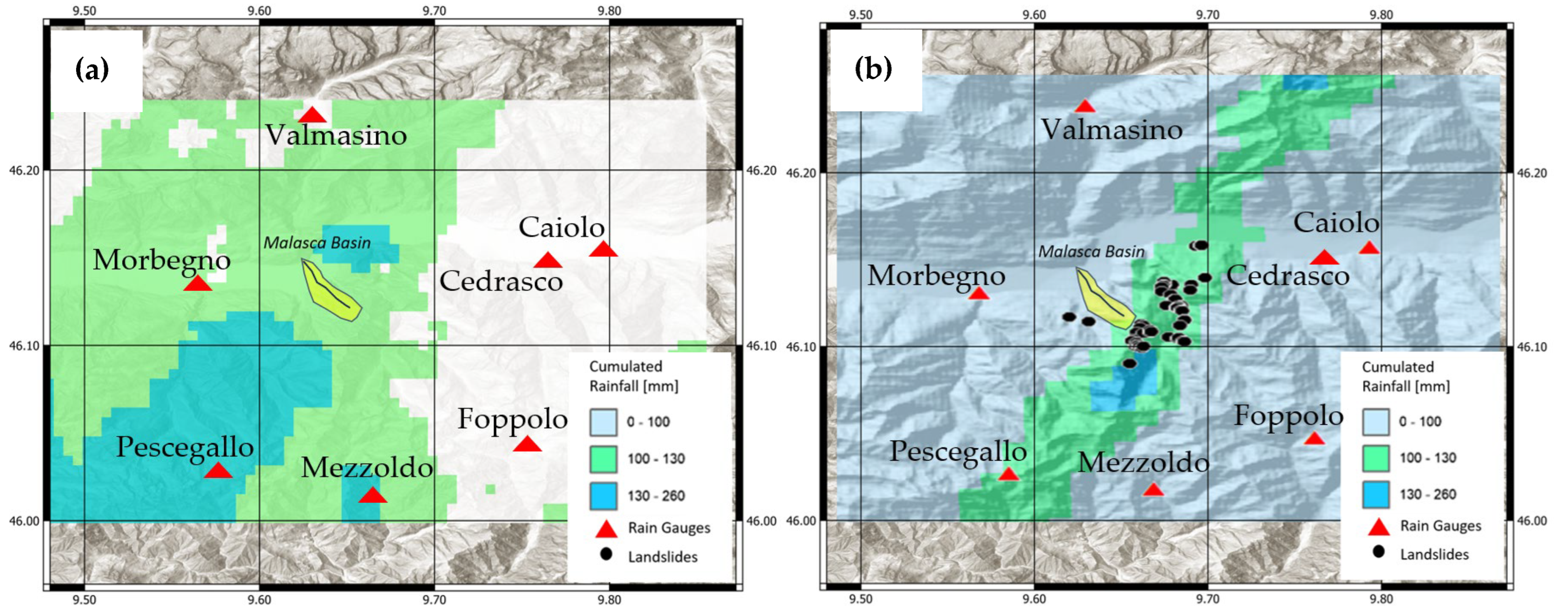
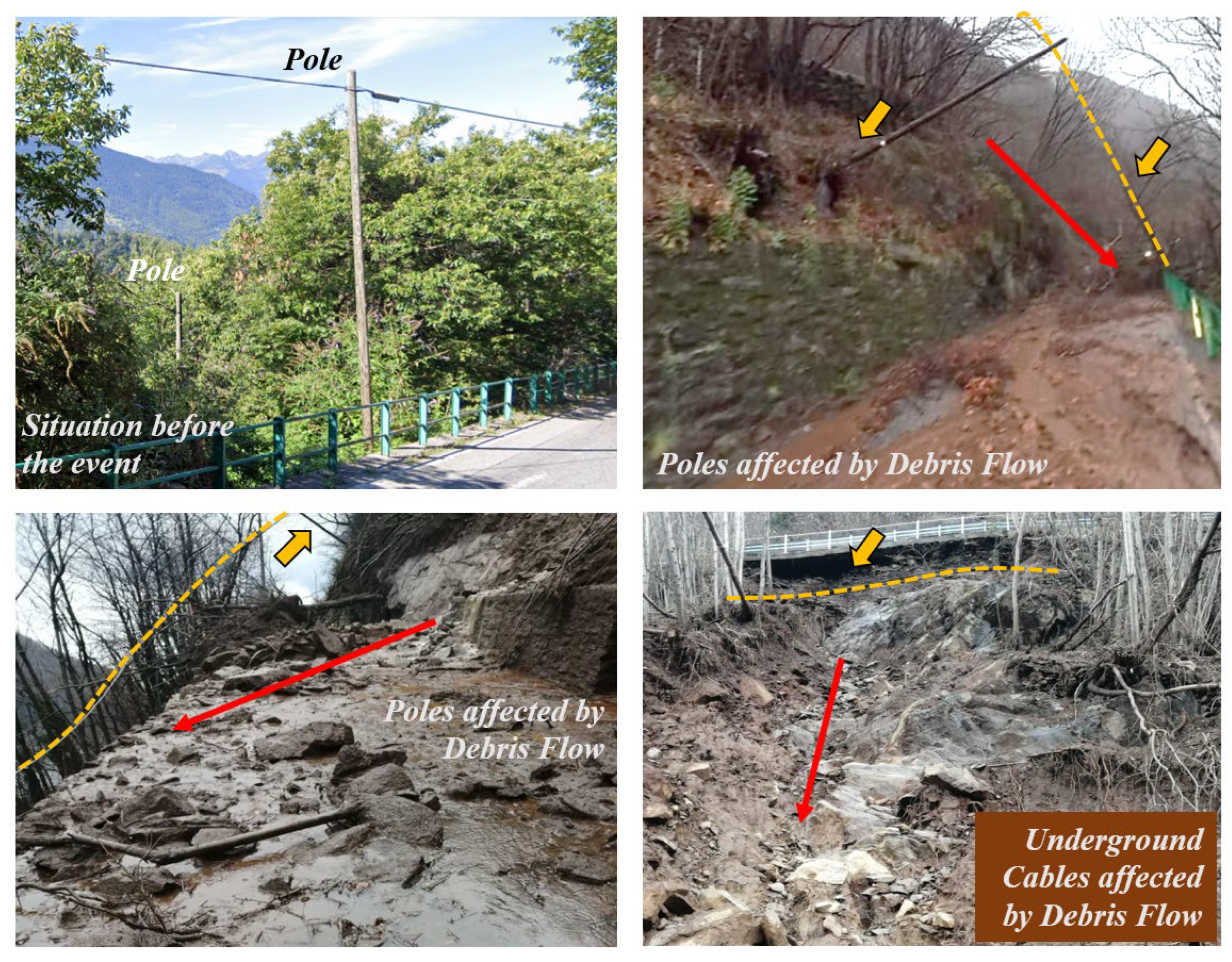
In July 2008, the mountain area near the town of Talamona, represented in Figure 9, was hit by an intense debris flow (which occurred within the Malasca basin) together with several episodes of widespread geo-hydrological instability, such as soil slips and local flash floods. Significant damage affected several buildings and local infrastructures, including those related to electricity distribution. The instability event was caused by very localised convective precipitation characterised by short duration and strong intensity (about 100 mm in 12 h) [20]. The singularity of this event is related to the significant localisation of the precipitation that was distributed along a convective orographic band in a SW -> NE direction. As represented in Figure 7 reported by [56], the precipitation event was not recorded by any rain gauge present in the area (red triangles) while it was clearly identified through weather radar data. Similar to 2008, in a more recent event on 1 April 2024, another debris flow-like episode happened in the area of Campo Tartano (near Talamona) after an intense precipitation event with similar magnitude but lower intensity (around 100 mm in 36 h) [57]. A peculiarity of this event was that the highest rainfall rates (>15 mm h−1) were recorded in the final part of the cloudburst, hitting the soil almost saturated by antecedent precipitation. Here, medium-voltage overhead powerlines were affected by a shallow landslide triggering that evolved into a debris flow due to high local slopes (>30°) [58]. Debris flow hit the poles, overturning or collapsing them, and underground cables were also interrupted. The highest impacts and damages were recorded in the proximity of the initial detachment scarp. Also on this occasion, the local roads were affected, temporarily interrupting the transport communication within the Tartano municipality [58].
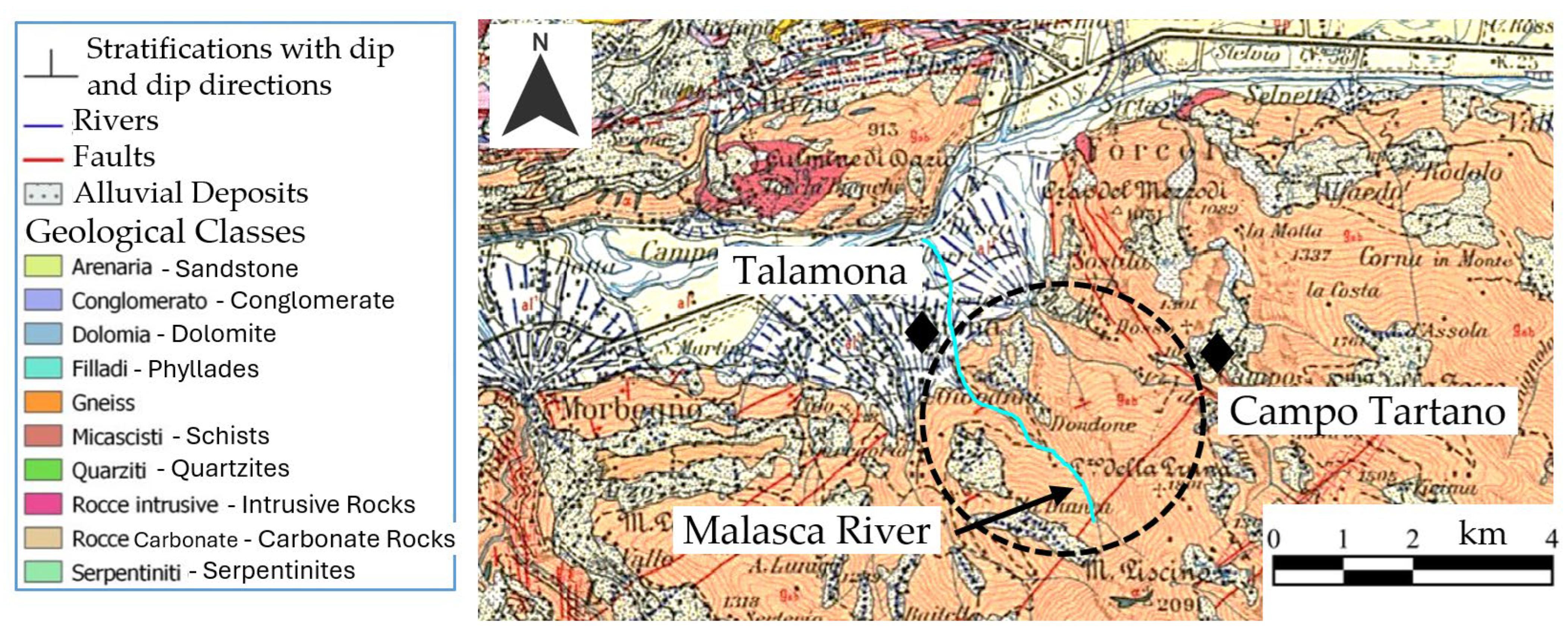
Figure 10. Geological map of Talamona, Campo Tartano and Malasca Basin (black circle) case study, where geo-lithological classes are indicated [59].
Climate 14 00090 g010
According to the local geological map and landslide census, the investigated area is rather active from a geo-hydrological point of view. The Malasca river has experienced several debris flow episodes in the past, which have always occurred in correspondence with heavy precipitation episodes and with a mean recurrence every 20–30 years [60]. The prevalent geological formation is called “Gneiss di Morbegno” (indicated in orange in Figure 10) [54,59,61,62]. It is a metamorphic rock of the southern Alpine crystalline basement, typical of the Lower Valtellina. Of sedimentary origin (paragneiss), it is characterised by a medium metamorphic degree, schist texture and a composition of quartz, feldspars and phyllosilicates (biotite/muscovite). The area is crossed by important tectonic dislocations, with minor sub-parallel faults that condition the structure. The area is located in a context of Alpine uplift, structurally active. Moreover, it is structurally influenced by its proximity to the Insubric tectonic line, with often fractured and faulted rocks, subject to intense erosion and instability phenomena [11,54,62].
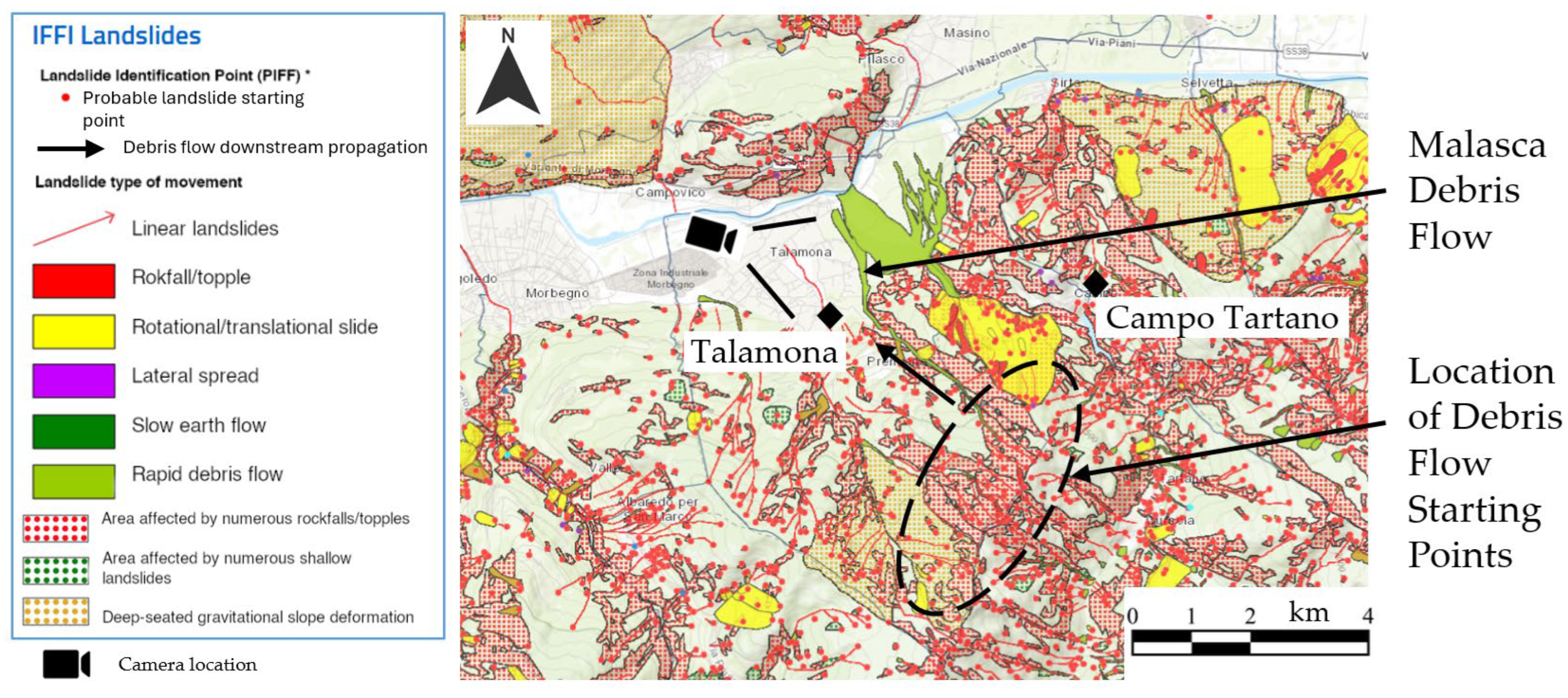
As can be appreciated from the IFFI census [7,23] (Figure 11), in proximity to and within the Malasca basin and near Campo Tartano town, several areas affected by rockfalls and shallow landslides are mapped. In addition, linear landslides (i.e., debris flows) and diffuse landslide starting points are reported, especially in the upper parts of hydrological systems, such as those within the back circle. These data are not intended as “recorded” landslides but represent a landslide susceptibility since they have been retrieved automatically, considering aerial photo interpretation and DEM analysis [7,23]. The most significant data are included within IFFI polygons which mapped existing or more recent landslides, such as the Malasca debris flow, which occurred in July 2008 (see Figure 11).
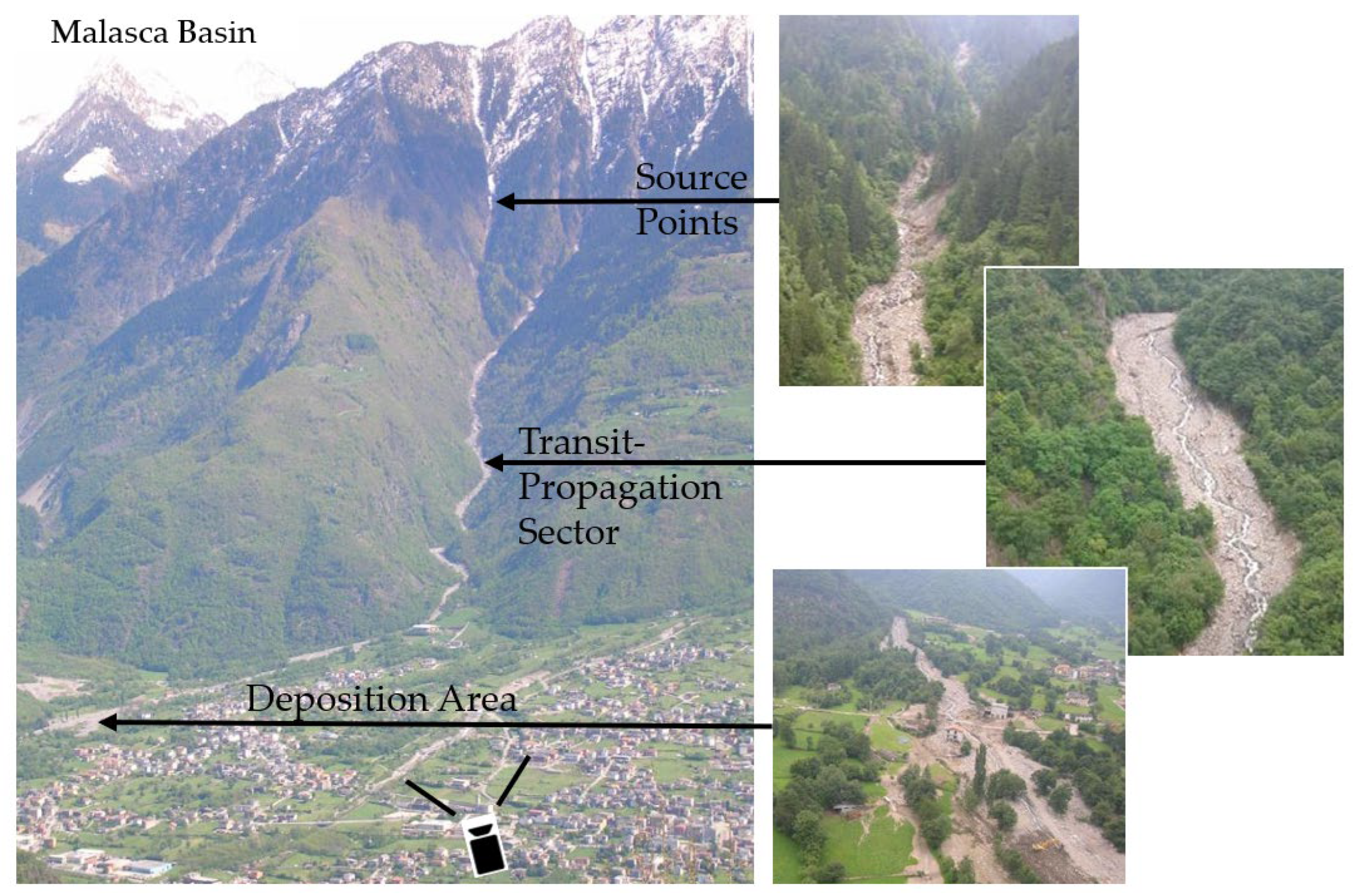
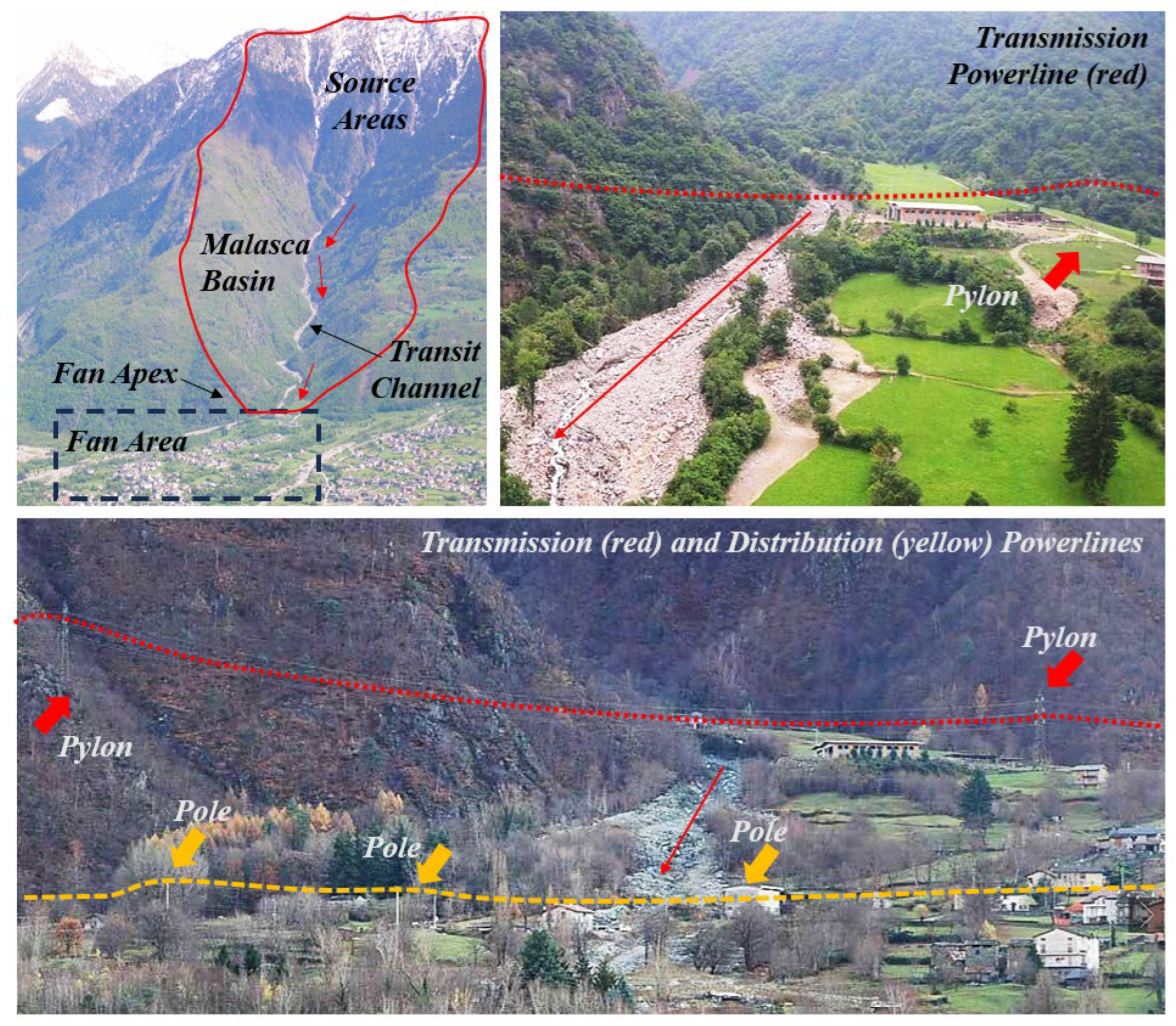
A confirmation of the geological activity of the area is also reported in Figure 12, where a graphical description of the Malasca basin just after the event of 2008 (photos are from April 2009) is shown [19]. In the pictures, the source points, the transit sector and the deposition area of the debris flow are clearly visible. In particular, the source points are co-located within the black circled areas of Figure 11, while the transit sector and deposition area are represented by the “green” IFFI polygon indicated in Figure 11. As can be appreciated, the 2008 debris flow involved a significant portion of the Malasca basin. Regarding the 2024 event, no information about the event description or debris flow images has been found in the literature.

Numerical Setting of the Back-Analysis Conducted for the Two Case Studies

The numerical approach was adopted to investigate the powerline risk for the July 2008 event, thanks to the larger amount of monitoring and survey data available [11,19,20]. In this context, the ability of the CRHyME code to reproduce the ground effects of instability events in relation to the radar maps provided was tested. The simulation was conducted working at a DEM resolution of ~90 m [63] and with a time step equal to the temporal resolution of the rain gauge records and radar images samplings (every 10 min). The CRHyME routine works with an internal adaptive time-stepping scheme, applied to ensure numerical stability of some PCRaster functions utilised especially in kinematic routing of the water flows within the hydrological modules [22,64]. For CRHyME initialisation, the geo-hydrological characteristics of the area in Figure 9 have been examined. According to [19,20,54], the middle-upper part of the Malasca basin is generally characterised by slopes > 30°, up to sub-vertical. Terrain covers are made by glacial, fluvio-glacial and colluvial deposits with a strong heterogeneity and variable thicknesses (up to ~3.0 m), eventually disappearing where rocky benches or terraced areas exist. In situ and laboratory tests cited by [54] revealed that sandy loam is the prevalent terrain texture in the area, with a saturated permeability in the range of 10−6 m s−1. Moreover, the internal friction angles and cohesion values range between 25° and 43° and 1.0–30.0 kPa, depending on location and soil coverage. Due to these morphological, geological and anthropic contributing factors, soil covers are frequently impacted by rainfall-induced slope instabilities such as soil slips or debris flows [20]. In this regard, a sensitivity analysis (not reported) on terrain parameters has been conducted in CRHyME in order to calibrate the model with respect to the hydro-mechanical soil properties and the terrain thicknesses, also considering the onsite investigations conducted by [20] in 2008. In Table 5 are reported the data considered in the simulation.
The debris flow runouts have been tested against different types of debris flow rheology using the MIST-DF code. The 7 types have been considered and subdivided into two groups [41]. The first group include the options “Hydraulic”, “Chezy”, “Manning” and “Turbulent”, which try to model debris flow runout using the equation suitable for liquid floods. The second group include “Dilatant”, “Laminar” and “Rickenmann” equations, which model debris flow runouts using laws where solid sediment plays a significant role (see Appendix A). These simulations have been carried out to investigate the influence of rheology on debris flow downstream evolution. According to [22] and considering the information coming from the onsite survey [20], three source points were selected in the upper part of the Malasca basin, considering a total debris flow volume of ~100,000 m3. A DEM (digital elevation model) provided by [65] with a higher resolution (~20 m) with respect to the one adopted for the CRHyME elevation (~90 m) was considered for the runout computations with MIST-DF. CRHyME and MIST-DF codes are currently under development, so a “user-friendly” interface has not been implemented. However, their implementation is quite straightforward: for CRHyME, a “config” file is organised in order to set all the options required for the simulations (i.e., time step, data paths, output folder, etc.; see [22]), while for MIST-DF the options can be directly modified in the Python code. The former essentially include five options: reference DEM, debris flow volume, number and location of the source points, k parameter (for debris flow source function of Equation (2)) and the length of simulation (in seconds).
On the other hand, the empirical approach has been applied to both events, July 2008 and April 2024, addressing the performance of rainfall threshold curves to detect potential infrastructure risk associated with heavy rain episodes. A dedicated paragraph contains the comparisons of the empirical methods application, also showing the similarities and differences between the two events.

3. Results

In this section, the results of numerical and empirical approaches are presented, evaluating the rainfall-induced debris-flow hazard (H) and assessing the powerline vulnerability (V) and risk (R). In Section 3.1, the results of the numerical approach applied to the event of July 2008 are presented and commented on, while in Section 3.2, the application of empirical methodology is applied and compared for both events (July 2008 and April 2024).

3.1. Results of the Numerical Approach Applied to the July 2008 Event

3.1.1. Rainfall Field Reconstruction and Radar Images Correction

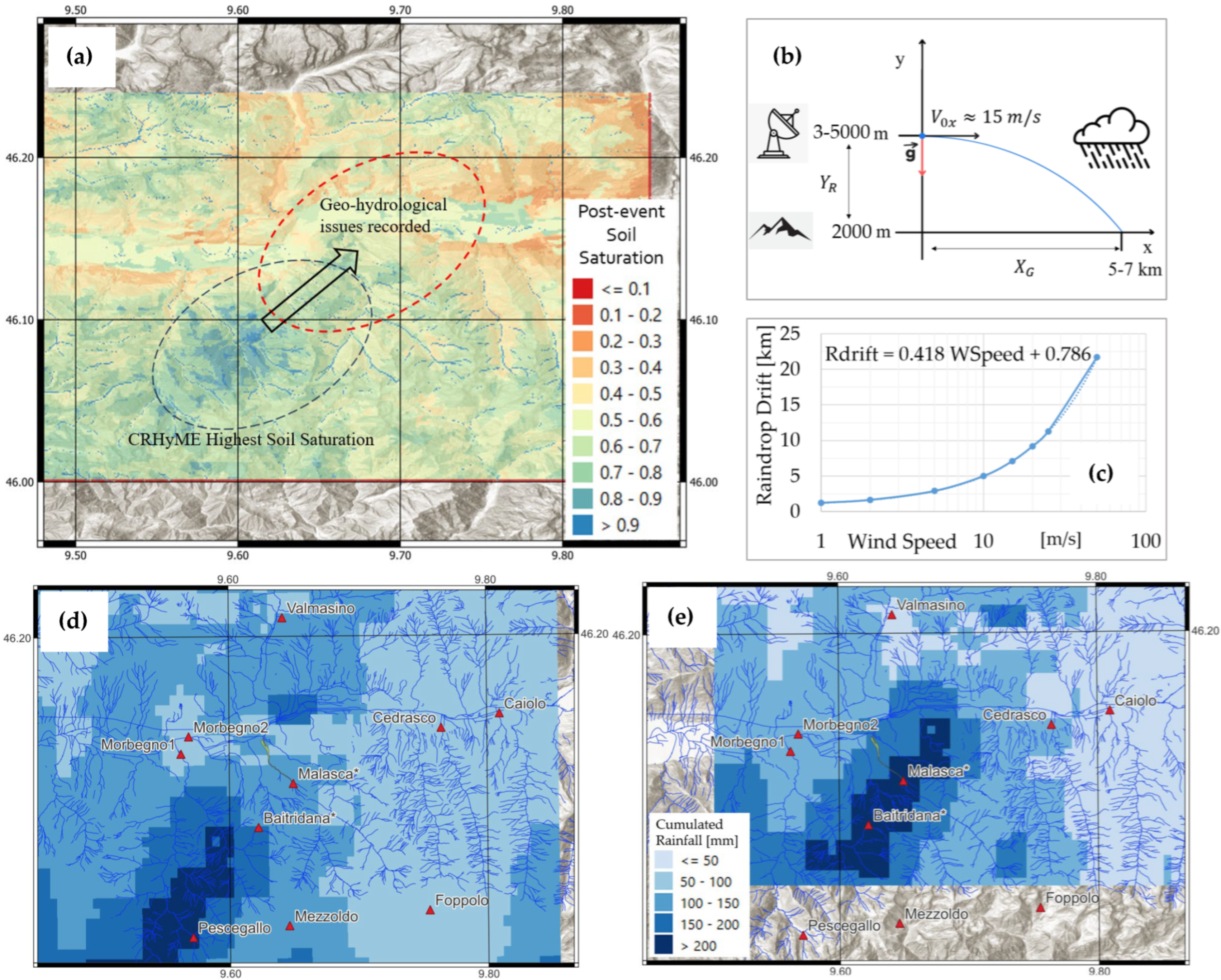
The precipitation sequence of the event that occurred between 11 and 14 July 2008 has been reconstructed considering radar images from [38] archive and elaborating on them using the methodology presented previous chapter. The total rain accumulation has been calculated simply by summing the rainfall images organised within the .netcdf file format (Figure 13a), depicting the rainfall distribution across the investigated domain. The latter has been compared with the reference data reported in [56] and represented in Figure 13b, where the same colour scale has been considered in both legends. At first glance, it can be noticed that the two images are similar but they are not completely overlapping. In fact, in the left image (calculated), radar data post-processing corrections have not been explicitly considered [35], while in the right image (reference), these adjustments have been implemented by the authors [56]. Here, both the rainfall field spatial resolution and consequently the rain shadows’ extension (which is much more localised) are more refined. Moreover, the reference image appears slightly north-east shifted, showing the highest rainfall accumulation in the proximity of the Malasca basin and in correspondence with the recorded landslides on the ground (black dots). Conversely, in the calculated map, the highest rainfall amounts are shown in the south-west sector of the domain. As was described by [11,20] and confirmed by [56], the maximum rain intensities in the July 2008 event were positively correlated with a higher density of geo-hydrological hazards detected on the ground. Therefore, using the calculated image (shifted) within a numerical model (i.e., CRHyME) might reflect a wrong spatial prediction of the geo-hazard location.
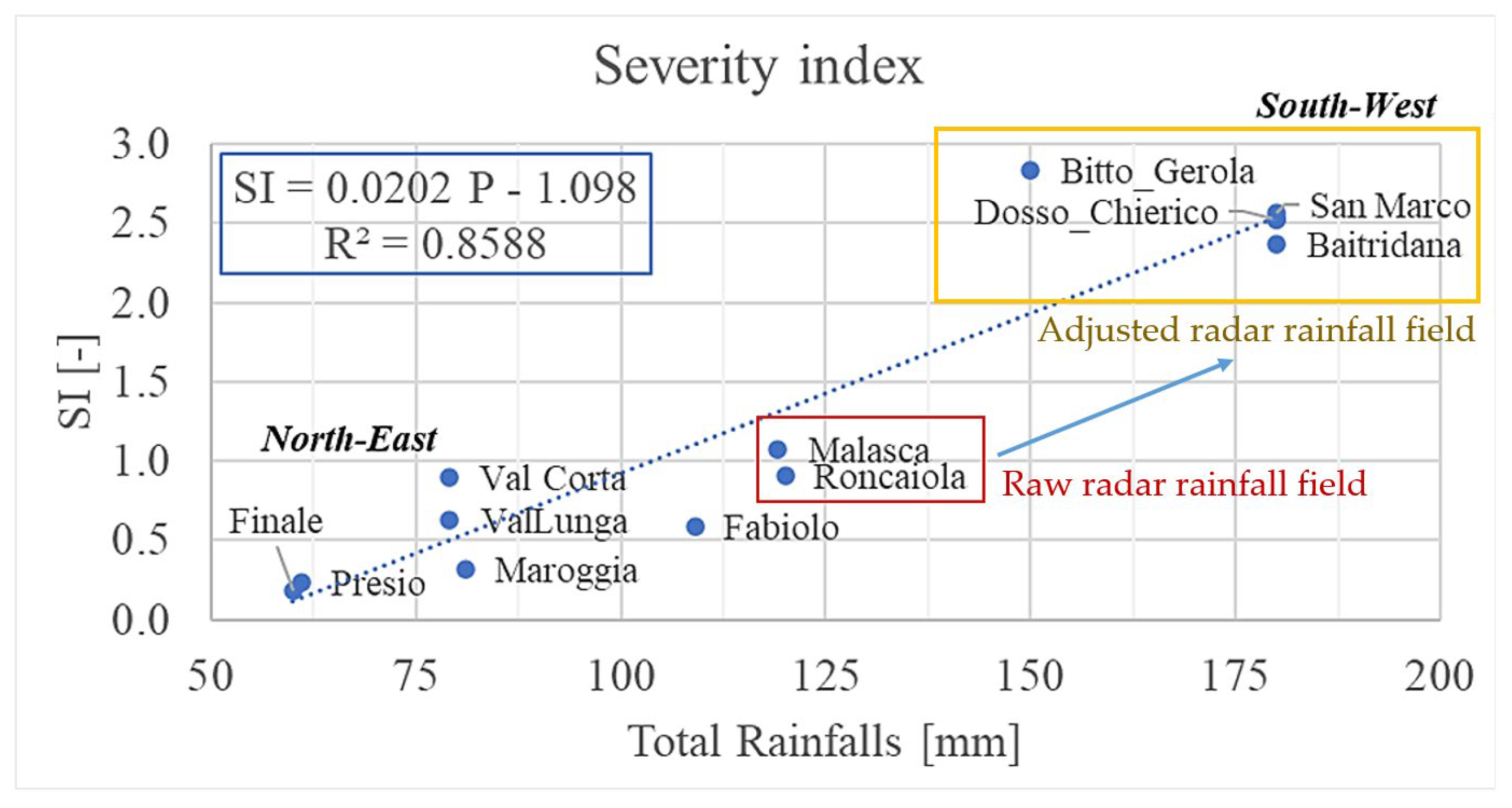
A further confirmation of this discrepancy in rainfall field reconstruction is reported in Table 6, where a quantitative comparison among the reconstructed radar rainfall field, reference local ARPA Lombardia rain gauges [57], and the reference radar map from [56] was carried out. As can be appreciated, the BIAS (error) and RMSE (Root Mean Square Error) metrics [66] calculated comparing reconstructed radar field and ARPA data show appreciable BIAS, especially across the Morbegno town and nearby Malasca basin, where significant underestimations of the total rainfall (up to −61.2 mm) are obtained. This negative trend is also present across the surrounding stations in the north-eastern part of the domain (around −20 mm), while overestimations of +30–40 mm are clearly detected in the south-west sector. The RMSE calculated for the seven ARPA Lombardia stations located in the investigated area is about 33 mm, which is not a negligible error with respect to the mean total rainfall of the domain recorded during the event (around 100–120 mm).
Comparing these results with the image of Figure 14a (where a preliminary CRHyME run has been implemented using not corrected radar images), it is more evident that a possible rainfall north-eastern (NE) shift occurred in the July 2008 event. According to [67], this discrepancy may happen when the radar images are not “translated” to the ground, introducing a correction due to the possible rainfall drift generated by the presence of a sustained lateral airflow. This may perturb the path of raindrops falling, which could be slightly “shifted” from the vertical in the direction of the prevailing wind. This fact has been verified considering the radiosonde data recorded by Linate station during the central phase of the event (between 13 July 2008 at 00 a.m. and 13 July 2008 at 12 p.m.) [68]. As reported in Table 7, the mean wind velocity recorded from 1000 hPa up to 300 hPa ranged between 50 and 60 km h−1 (around 15 m s−1). Moreover, the direction of the wind was from a south-west (SW) direction, which is compatible with the axes of the supposed rainfall shift, while the cloud heights (LFC and LCL) were around 1000–1500 m. Therefore, a probable NE shift of the precipitation reaching the ground was experienced due to intense mid-troposphere winds recorded.
To calculate and verify the possible rainfall shift, the simple equation of parabolic motion has been applied, studying the motion of the raindrop from the cloud to the ground [67]. According to the literature [35,56], the radar beam generally records the rain reflectivity at an elevation between 1000 and 5–6000 m, a range where microphysical rainfall mechanisms generally occur and where the bright band and melting layer may be frequently co-located. In the specific case of Monte Lema radar (located at 1625 m a.s.l), the one investigated in this study, vertical scans consisting of 20 sweeps, ranging from 1000 m up to 18,000 m, were completed in around 5 min [35]. However, due to the presence of the Orobie Pre-Alps that reach an elevation up to 3000 m (2000 m on average), the minimum height of the radar beam is set to >2000 m in order to avoid possible beam distortions and shadows [35]. To estimate the average beam elevation (Hbeam), the equation proposed by [67] has been adopted. The former considers a few parameters such as the distance between radar and investigated site (Rd, around 60–70 km south-west from Malasca basin), the earth radius (Re, 6371 km), the radar elevation angle (Rea, comprised between 0.45° and 38°, and a median of 3.5° considering the 20 sweeps) and the reflective index (Ri, 1.21).
H b e a m = R d sin R e a + R d 2 2   R i R e
Through Equation (16), the representative radar Hbeam has been calculated, ranging between 3800 m and 4700 m, which is in accordance with our initial hypothesis, positing that Hbeam is in the range between 3000 and 5000 m. Therefore, the radar data have recorded the rainfall field at least 2500–3500 m above the mountain range mean elevation, considered as 2000 m a.s.l due to the presence of the Orobie Mountain range. This elevation difference is not negligible if the parabolic motion of the raindrop is taken into account. Another confirmation is the co-location of the melting layer (corresponding to the bright band detected by the radar) that, during the most intense phase of the event of 13 July 2008, was co-located around 4000 m, within the range of the computed radar beam elevation (see Table 7).
X g = V 0 x t
Y R = 0.5 g t 2 + V 0 y t
V y = m i n ( g t , V r e g i m e )
t f l i g h t Y R / V r e g i m e
Inverting Equation (17) fixing the value of YR ≈ 2000 m, with V0y = 0 m s−1 and assuming that droplet vertical velocity Vy can reach a regime value (maximum) of about 5–6 m s−1, in Equation (19), the flight time tflight in Equation (20) was evaluated on the order of 300–600 s (i.e., between 5 and 10 min). Therefore, applying Equation (16) using tflight, Xg resulted between 5 and 7 km, which is the order of the expected radar rainfall shift (Figure 14b), calculated on a map comparing the reference total rainfall fields (from [56]) and the retrieved rainfall field from radar images. According to [67], an empirical relationship could be considered for estimating from wind velocity and the expected raindrop shift (Figure 14c). Assuming a wind velocity on the order of 10–15 m s−1, as in the analysed case study, the expected rainfall drift is between 5 and 7 km, in accordance with the results of the parabolic motion model. As suggested by [67], for a precise reconstruction of the raindrop motion and fall velocities, some consideration of raindrop diameters should be carried out. However, this consideration requires data which were not available; therefore, the assumption on the typical regime velocity of raindrops was adopted following the indications of [69,70].
Considering the corrected rainfall field (Figure 14e), the error statistics have been improved significantly, reducing the BIAS across the investigated areas (now they are on the order of ± 10 mm) and reducing the overestimation of the rainfall reconstruction in the southwest part of the domain. RMSE has now been reduced to 15 mm with respect to the not corrected radar field. Moreover, comparing the [56] total rainfall field with the two fictitious rain gauges of Batridiana* and Malasca*, the total rainfall now falls within the range proposed by the author, confirming that these areas were the most affected by that rainfall episode.

3.1.2. Areas of Triggered Debris Flows (CRHyME)

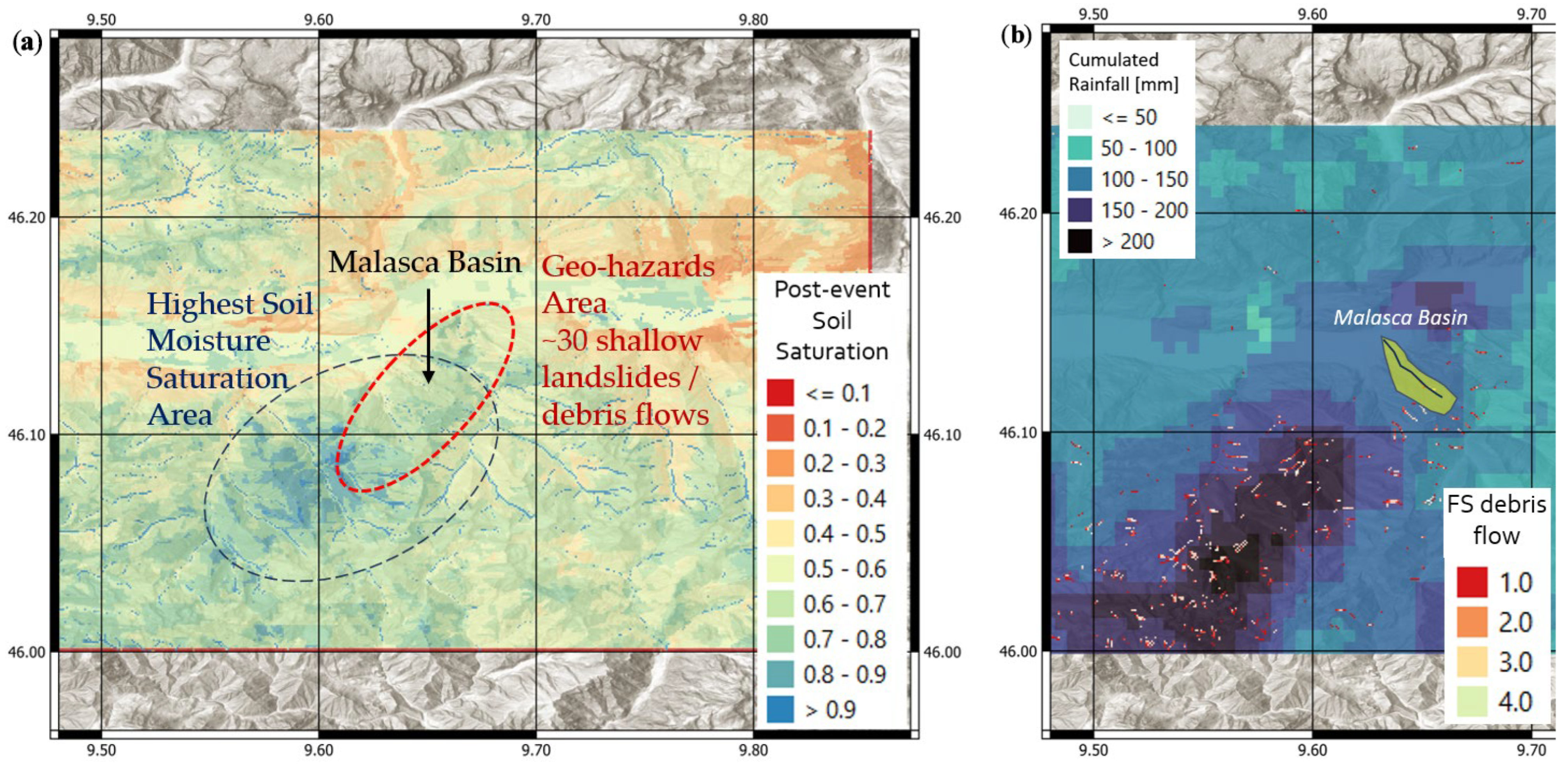
After rainfall data correction, the debris flow source point areas were computed with the CRHyME code. Initially, the model was calibrated by carrying out a pre-simulation starting two years before the July 2008 event. The pre-simulation used the rainfall and temperature information from the ARPA Lombardia weather stations [71] available in the area (about 6) with a 1-day resolution. Subsequently, from 11 July 2008 at 00 a.m. until 14 July 2008 at 00 a.m., the simulation was conducted with the reconstructed radar images, using the .netcdf produced by RGB raw image interpretation with a time frequency of 10 min. In Appendix B, the geo-hydrological analysis conducted with CRHyME is presented, showing the calibration and validation of the model settings with respect to the 2008 event reconstruction. For brevity, a comment on the numerical calculation of the possible debris flow source points activated during that occasion is described. In the CRHyME code, their temporal activation and their spatial co-location significantly depend on accurate reproduction of the hydrological process within the investigated areas (i.e., in the precise pre- and post-event evaluation of terrain soil moisture conditions, Figure 15a) [22].
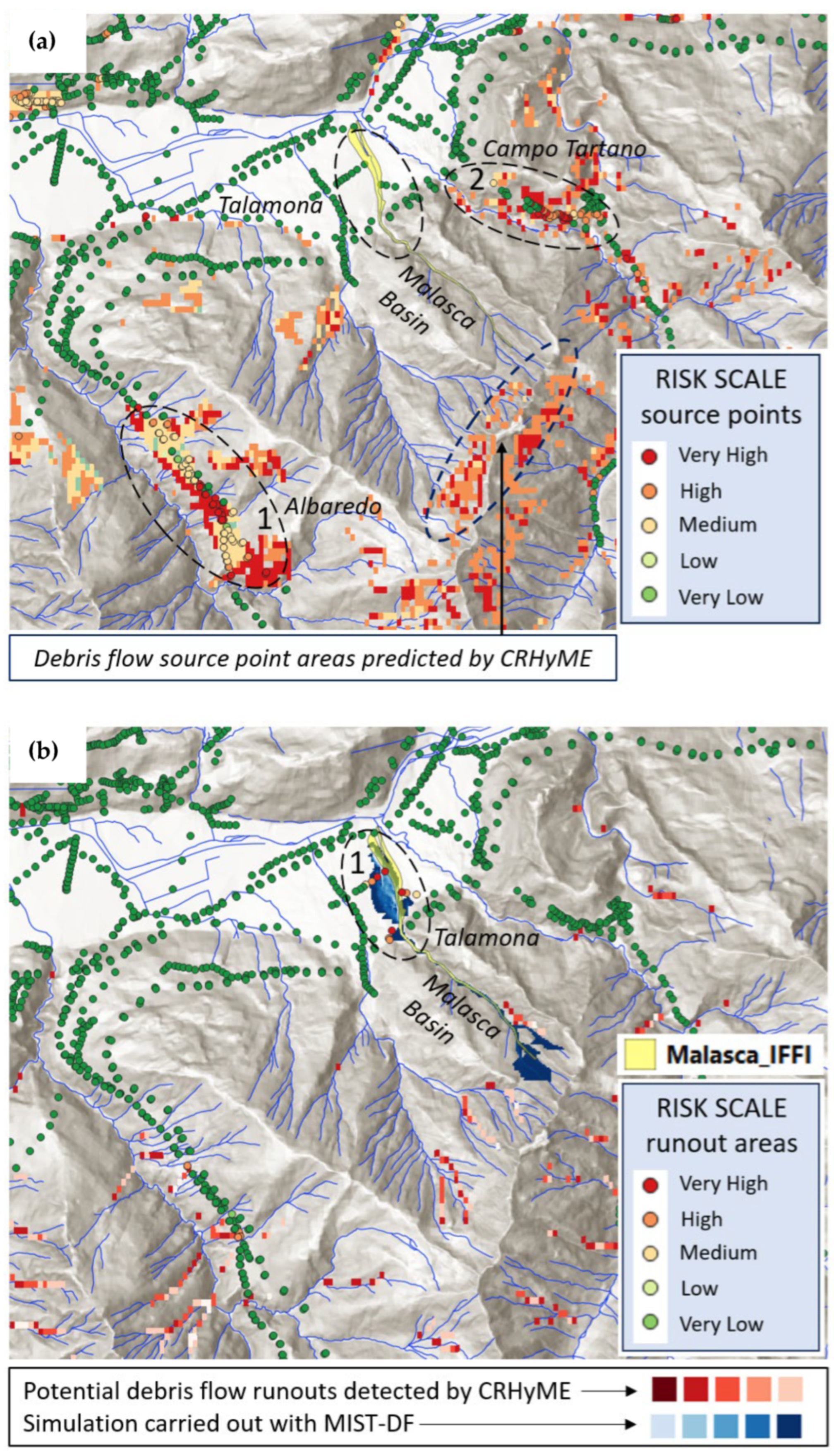
Figure 15b shows the spatial distribution of the stability safety factors (FS) calculated by CRHyME using the infinite slope model implementing the limited equilibrium stability method [22]. The map highlights the predicted areas where the shallow landslides and debris flows may have occurred during the July 2008 event. Regarding timing, triggers were reported in greater numbers between the night and morning of 13 July 2008, as confirmed by the investigations carried out by [20]. The spatial density of the potential triggers increases significantly in correspondence with the greatest rainfall amounts. These results have been visually compared with the census of instability carried out with onsite investigations by [56] (black dots in Figure 13b). In general, the number of landslides triggered in the Malasca area by CRHyME is greater than the number of landslides surveyed (~30). This could be caused by a non-optimal parameterisation of the stability models (e.g., the thickness of soil covers and friction angle) or, conversely, by an incomplete census of the landslide across inaccessible areas that occurred during the event. In the IFFI catalogue, only the main Malasca debris flow has been reported for the 2008 event (green polygon of Figure 11) while the landslides localised by [56] have not been explicitly included in the census, missing precious information about their precise localisation. Therefore, due to the lack of data, the ROC (Receiver Operating Characteristic) curve analysis was not implemented for assessing the CRHyME performance in landslide location detection [22], reducing the comparison to a purely visual inspection between Figure 13b and Figure 15b. Nevertheless, the result seems interesting since the most probable debris flow triggering point source areas have been correctly detected in the area with the highest rainfall amounts recorded. Looking at Figure 15b, the area in the proximity of the upper basin of the Malasca river has been detected as one of the most prone to shallow landslide failure, confirming the onsite survey reported by [11,19,20]. These results describe the probable co-location of debris flow source points that occurred in the Malasca basin and have been considered for simulating its propagation across the Malasca watershed using the MIST-DF code.

3.1.3. Runout of Debris Flow (MIST-DF)

After the definition of the Malasca debris flow source point localisation, comparing the CRHyME detected areas with the onsite investigations found in the literature, the MIST-DF simulation has been implemented. Here, the real magnitude of the debris flow (reported to be ~90–100,000 m3, evaluated by [20]) has been compared with the value obtained by applying the empirical formula in Equations (3) and (4). Considering the basin geomorphological characteristic examined in Appendix B (e.g., A = 2.8 km2, ibasin of 0.54 and ireach of 0.18) and assigned EI = 4 (due to the presence of “Gneiss di Morbegno” as a prevalent lithology), and using an IT index between 2 and 3 (the event was considered by [19] to be between a “debris flow type” and a “debris flood”), the debris flow magnitude GS was evaluated to be between 80,000 m3 and 130,000 m3. This result has confirmed the validity of the GS formula as a good estimator of debris flow magnitude at the basin scale in the absence of any onsite investigation [10].
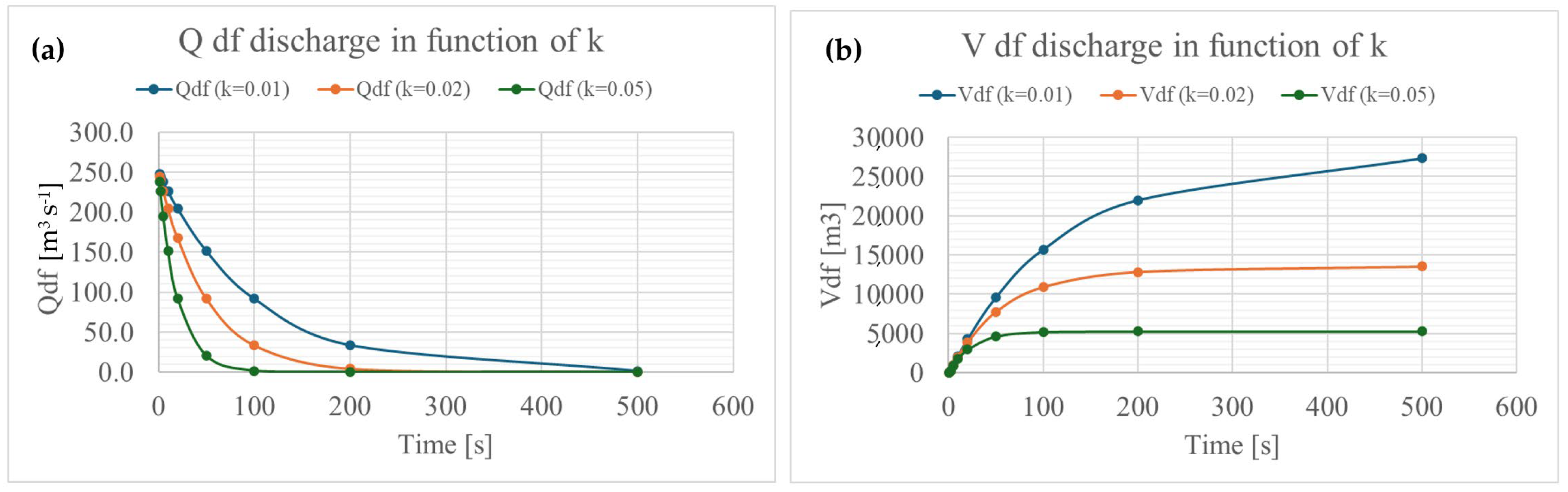
Subsequent to debris flow magnitude quantification, in the MIST-DF simulation, we considered three main source points located in the upper part of the Malasca basin, clustering the CRHyME unstable pixels in the proximity of the reported onsite investigation [19]. The total volume assigned (~90,000 m3) has been equally distributed among the three point sources (30,000 m3) in the absence of the indication of the possible volume release at each location, but assuring mass conservativity of 30,000 m3 × 3 = 90,000 m3. Applying Equation (4), Qmax has been computed as ~250 m3 s−1, and this was adopted for reconstructing the discharge function of Equation (2). Considering that the volume under the curve should meet the value of 30,000 m3 for each source point, the k parameter was calibrated to 0.01. Therefore, within the time duration of the simulation assigned to 5–10 min corresponding to the debris flow runout time observed during the July 2008 event [19,20], each source point has released almost 30,000 m3 with higher rates at the beginning and progressively reducing through time (see Figure 16).
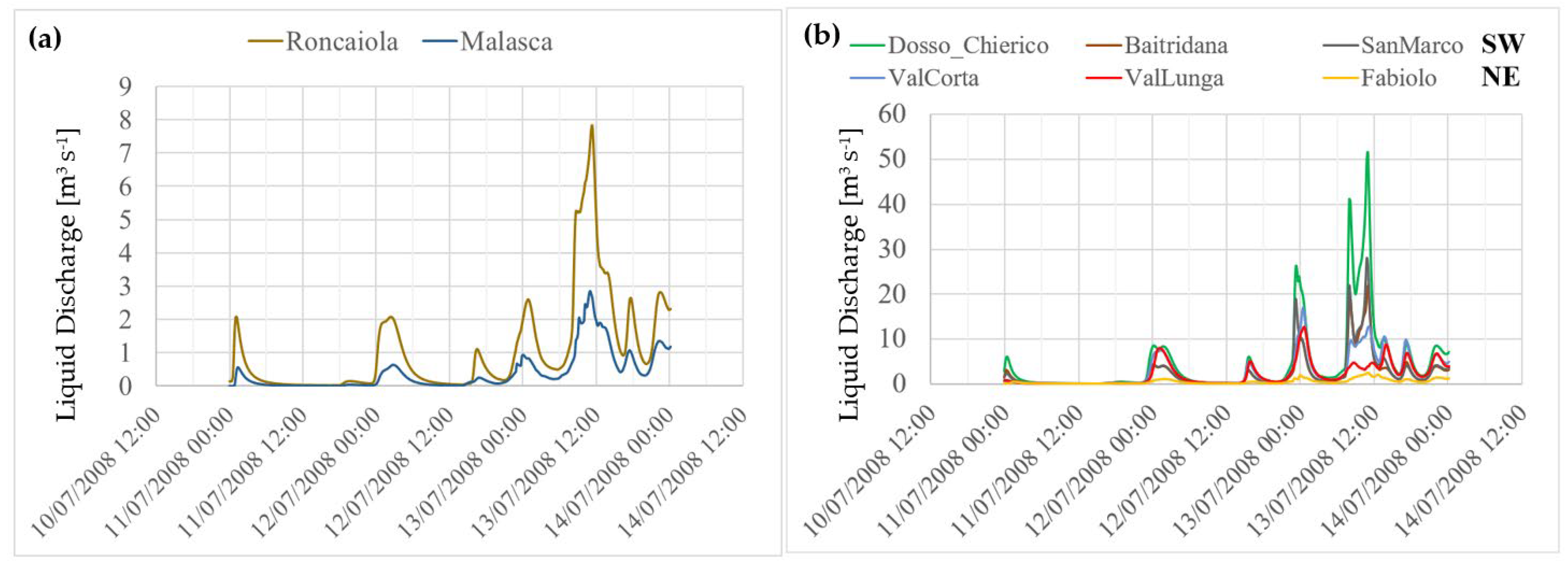
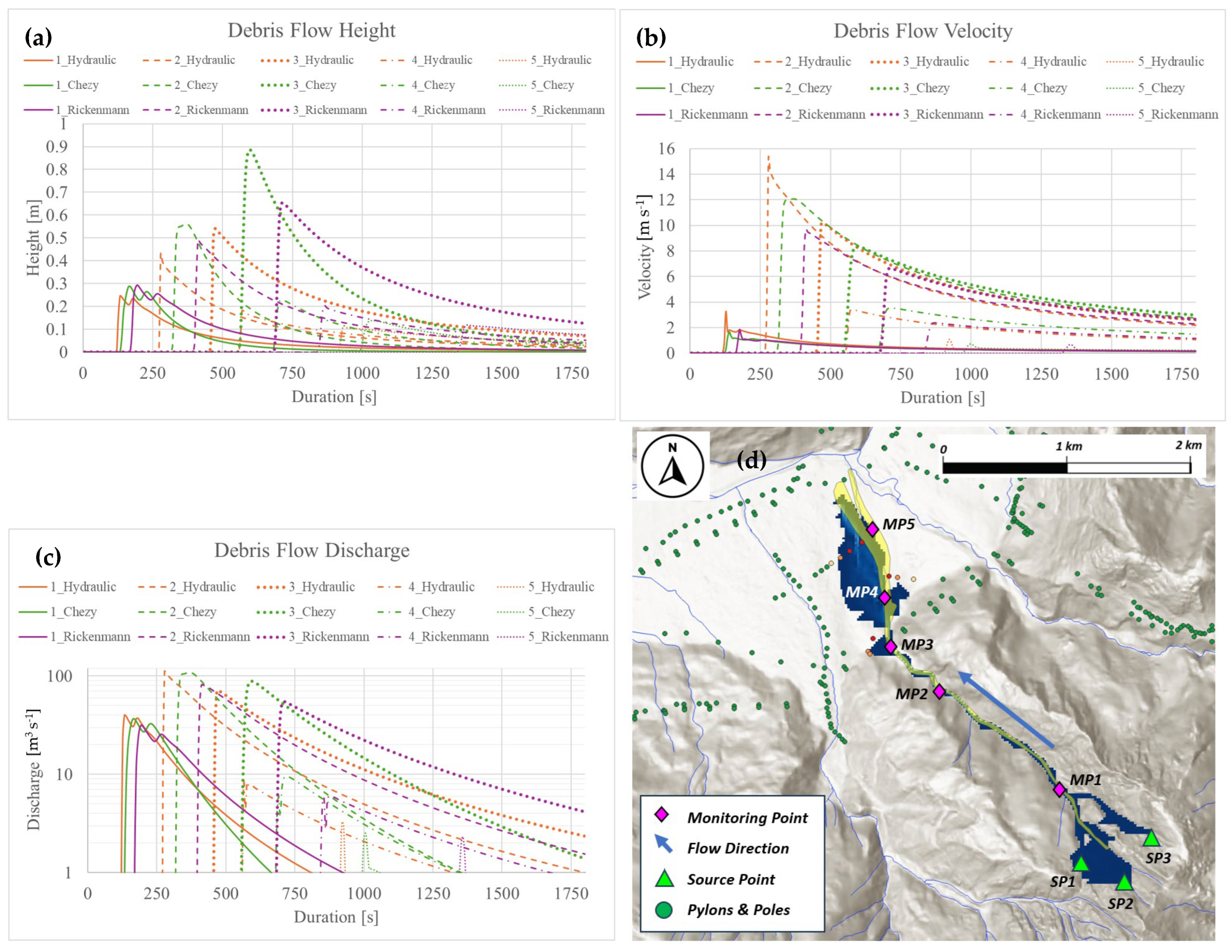
In order to assess the debris flow risk quantitatively, the kinematic variables of height, velocity and discharge have been investigated more closely. Five monitoring points (MPs) have been positioned along the possible downstream runout and in correspondence with the electrical infrastructure located in the area to observe more closely how the debris flow propagation occurs. In Figure 17d, the position of monitoring points across the basin is reported. Their numbering (from 1 to 5) follows a downstream direction, and n°3 and n°4 are the ones closest to high-voltage powerlines crossing the Malasca area.
In Figure 17a–c, the height, velocity and discharges recorded at monitoring points during the debris flow propagation are reported. The graph shows the three most significant rheologies that have been evaluated during the simulations: the “Hydraulic”, the “Chezy” and the “Rickenmann” flow formula. As can be appreciated, modifying the flow rheology, the debris wave propagation may vary, anticipating or retarding its arrival at the monitoring point. Moreover, the magnitude and the shape of the wave modify along the path, remodulating the initial impulsive material release. Maximum velocities have been recorded on the order of 10–15 m s−1, which correspond to a discharge on the order of 50–70 m3 s−1, mainly evaluated along the downpart of the river channel (MP2) and at the outlet of Malasca basin (MP3) in correspondence with the fan apex. These values, reconstructed through a numerical approach, are confirmed by onsite investigation [19,20], looking at deposited height, which has measured sediment accumulations on the order of 1–2 m across the fan apex (near MP3), reducing progressively and moving downstream (MP4 and MP5). The highest deposits were reported just downstream of the fan apex, where flow propagation starts to decelerate, decreasing its velocity and discharges and increasing debris deposits.
Table 8 summarises all the principal outcomes of the analysis, as a function of rheology and of the variable investigated. Among others, the most critical simulation was the “Hydraulic” one, which exhibits its maximum values of the three variables in correspondence with the monitoring point n°2 (see Figure 17d). The latter is located in the “transit” sector of the debris flow (see Figure 12), where higher velocity and discharges typically occur [9]. Here, the Malasca valley is narrow, keeping a rather steep riverbed, which contributes to higher sediment yield delivery. Conversely, debris flow heights were much higher in correspondence with the fan apex located downstream of the 2° monitoring point (near MP3). From the powerline vulnerability viewpoint, this location is retained as the most critical since a combination of rather high velocity, discharge, and height may cause pylon collapse.
As can be appreciated, changing the rheology of the debris flow, the hazard may vary significantly, showing “Hydraulic” > “Chezy” > “Rickenmann”, from the most to the least critical. Another aspect is the timing. Using the “Rickenmann” flow equation (see Appendix A), the downstream propagation was slower by about 2–3 min (>100 s) with respect to the “Hydraulic” case, while “Chezy” was co-located in the middle. In fact, the onsite surveys have suggested a significant water content in the flow (between a granular debris flow and a debris flood) characterised in a fast kinematic (the debris started, propagated and deposited within ~10 min according to the observations in [20]). That debris flow happened after a significant amount of precipitation (>100 mm), where the liquid components were clearly prevalent, suggesting a more flood-like process, which is typically driven by Manning–Strickler fluxes equation (i.e., “Hydraulic” rheology) [9,27]. From a civil protection point of view, in case of rapid phenomena such as debris flows, addressing the propagation timing is important for designing an efficient alarm system to protect goods, buildings and infrastructure [8,9,12]. According to [41], due to the uncertainties embedded in the debris flow propagation, applying different flow rheologies, related to the geomorphological characteristics of the area [10], could give useful insight for reducing uncertainties in per-alarm activation. Nevertheless, material entrainments and other local variables not included in MIST-DF may perturb debris flow propagation, modifying the expected damage scenario or enhancing debris flow magnitude [72].
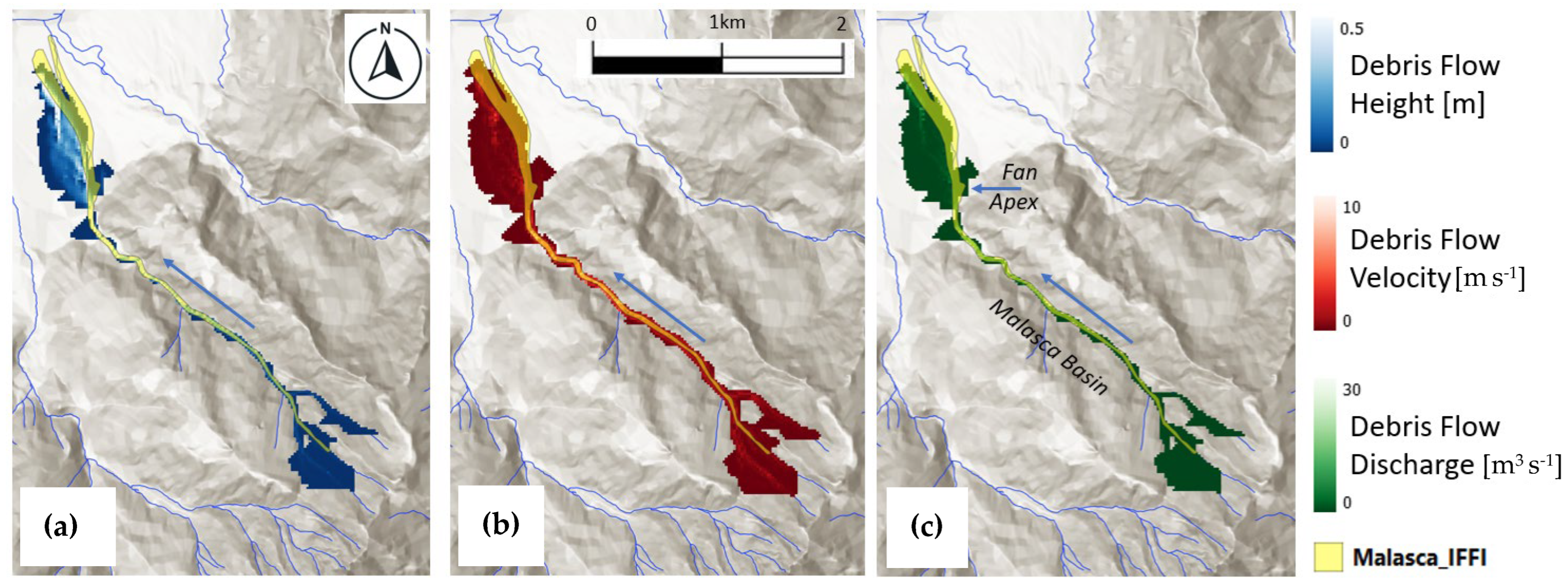
In Figure 18a–c, the simulation of the debris flow runout and downstream propagation, using the “Hydraulic” rheology option, is presented from a plain view. The planimetric extension of the numerically modelled debris flow was compared with the IFFI (Inventario Fenomeni Franosi Italiano) map [23], showing a rather good agreement of the reference census shapes (yellow polygon).

3.1.4. Vulnerability Curves for Powerlines

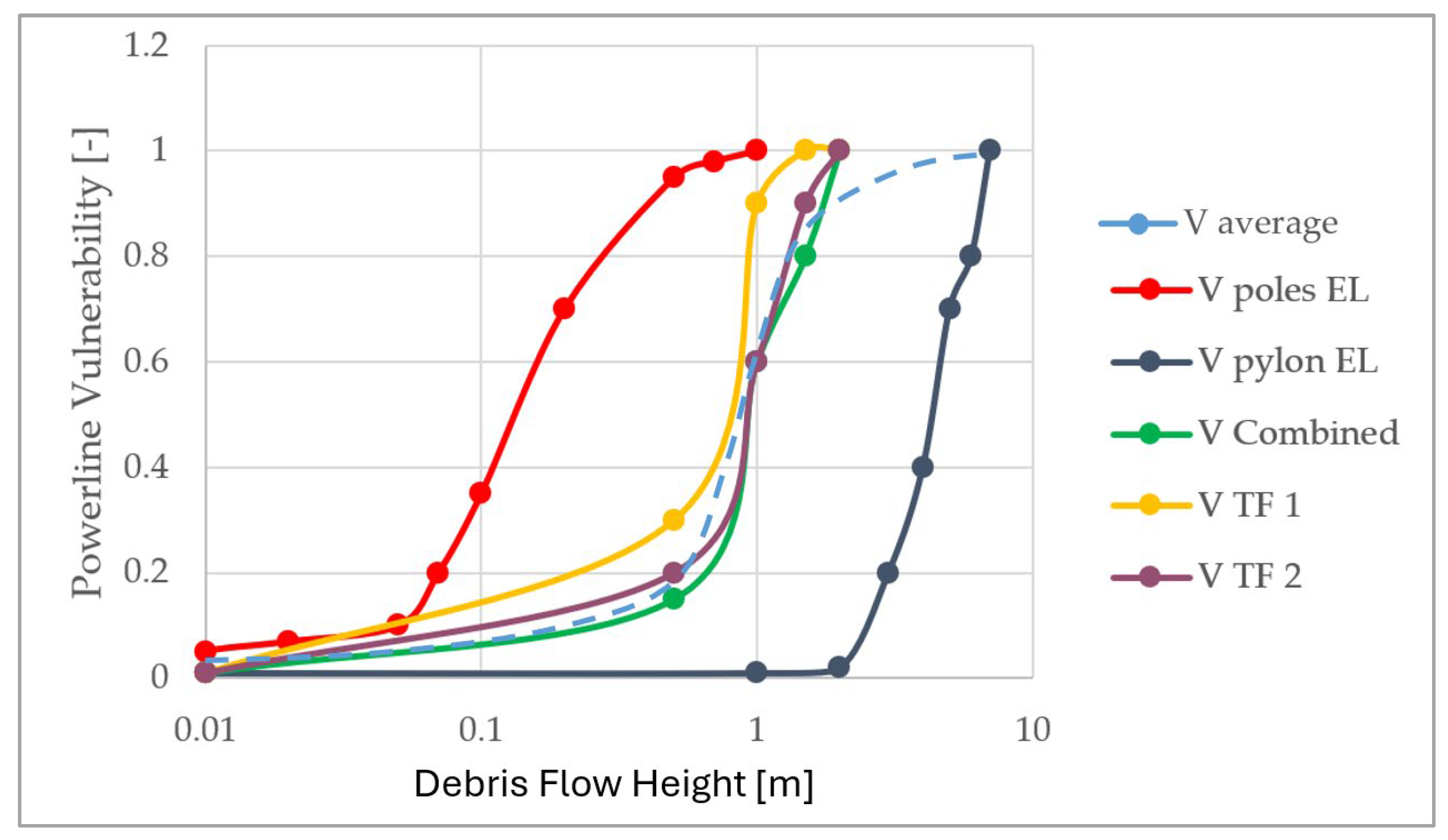
In correspondence with the MP2, MP3, MP4 and MP5 monitoring points of Figure 17d, the depth–damage curves presented in previous paragraphs were applied to quantify the expected grade of vulnerability of powerline infrastructure. Here, only the debris flow height has been considered for vulnerability curves. However, a clear distinction between poles and pylons was detected: the structure of poles is generally more vulnerable than pylons since they may collapse at debris heights < 1 m, while pylons may be affected only with heights > 2 m. In both cases, the worst failure condition is overturning, while sliding is a secondary failure mechanism. These curves show the response of the infrastructure only considering the debris flow height, not explicitly depicting the dependence on the kinematic variables (i.e., velocity and discharge). Looking at Figure 3a, the vulnerability curves may be a function of the height and velocity of the debris, taking into account all of the possible combinations of these kinematic quantities. Moreover, for poles and pylons, a steep shape of the vulnerability curve could be assumed, like the Timber Frame (TF) type depicted in Figure 3b, since powerlines are not a massive structure and their resistance to flow is rather low compared to a building. Combining all three investigated approaches in Figure 3a,b and Figure 5 for poles and pylons located near monitoring points n°2, 3, 4 and 5, the results show different behaviour depending on the rheology choice and on the type of vulnerability curve. In Table 9, the powerline vulnerability has been computed considering an “average curve” (dashed blue line in Figure 19) by combining the studies investigated in [46] and [16], also including the curves calculated through the analytical approach of limited equilibrium of poles and powerline structure (see Appendix C). The results show that higher vulnerabilities were reached for higher debris flow heights and velocity at MP2 and MP3, highlighting that a possible total collapse of the infrastructure could occur for the scenarios with “Chezy” rheology. Conversely, with the “Rickenmann” and “Hydraulic” options, the simulations were more conservative, giving lower vulnerability, especially for MP2, MP3 and MP4. All three rheologies converge to low vulnerabilities for powerlines located far downstream (MP5) from the fan apex, where debris flow height and velocities sensibly decrease.
Other authors [18] have created and applied a “multi-parameter” vulnerability curve, also considering kinematic variables such as the impact pressure of the debris flow. Equations (21) and (22) describe the formulae adopted by [18], where F I P D F (e.g., the debris flow impact force) is evaluated as the sum of the hydrostatic and hydrodynamic components. Here, ρdf is the debris flow density (highly variable within the range of water density ρw = 1000 kg/m3 and the grain density ρs = 2700 kg/m3) depending on the water–solid mix composition. kp is the lateral passive earth coefficient of debris (assumed equal to 1.6 according to the literature), v d f is the debris flow velocity, while λ is the dynamic pressure coefficient (assumed equal to 3 according to the literature but highly variable from 0.4 to 17) [73]. The vulnerability is expressed through an empirical function of F I P D F , and it is valid for F I P D F less than 37 kPa.
F I P D F = 0.5 k p ρ d f g h d f + λ ρ d f v d f 2
V u l = 1.596 F I P D F 28.16 1.808 1 + F I P D F 28.16 1.808 f o r   F I P D F 37   k P a
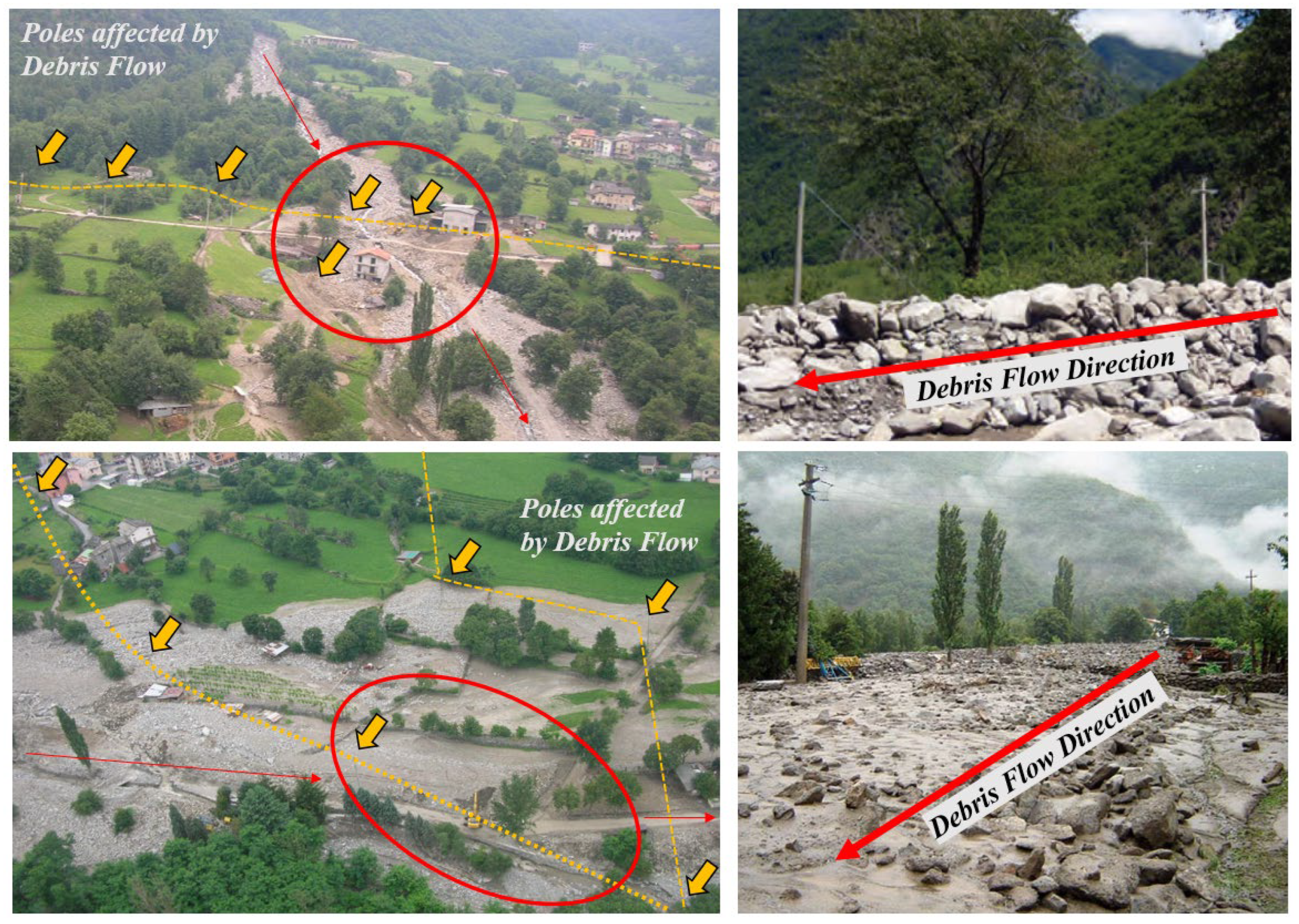
Applying Equations (21) and (22) to the case study, considering the kinematic quantities evaluated at monitoring points n° 3 and 4, the total impact force resulted in 67–74 kPa, which was far above the maximum value of 37 kPa required for reaching the maximum vulnerability (see Table 10). This evidence has been compared with the damage to the powerlines reported in Figure 20 and located within the debris flow runout at MP4 and MP5, confirming a rather high level of vulnerability.
Equation (22) proposed by [18] was retrieved for a debris flow that happened quite near the Malasca basin (i.e., Rodolo basin), during the same heavy rainfall triggering event of July 2008. The curve was calculated empirically using the on-field data gathered locally for masonry buildings, whose resistance characteristics are completely different from the powerlines’ structure. Therefore, the results obtained from the analytical expression of Equation (22) could be affected by error, underestimating or overestimating the real vulnerability, with possible significant changes in the 37 kPa threshold. Bearing in mind these uncertainties associated with this multi-parameter vulnerability curve, the risk assessment reported in the next paragraph was carried out by applying the values obtained in Table 9.

3.1.5. Risk Assessment of Powerlines

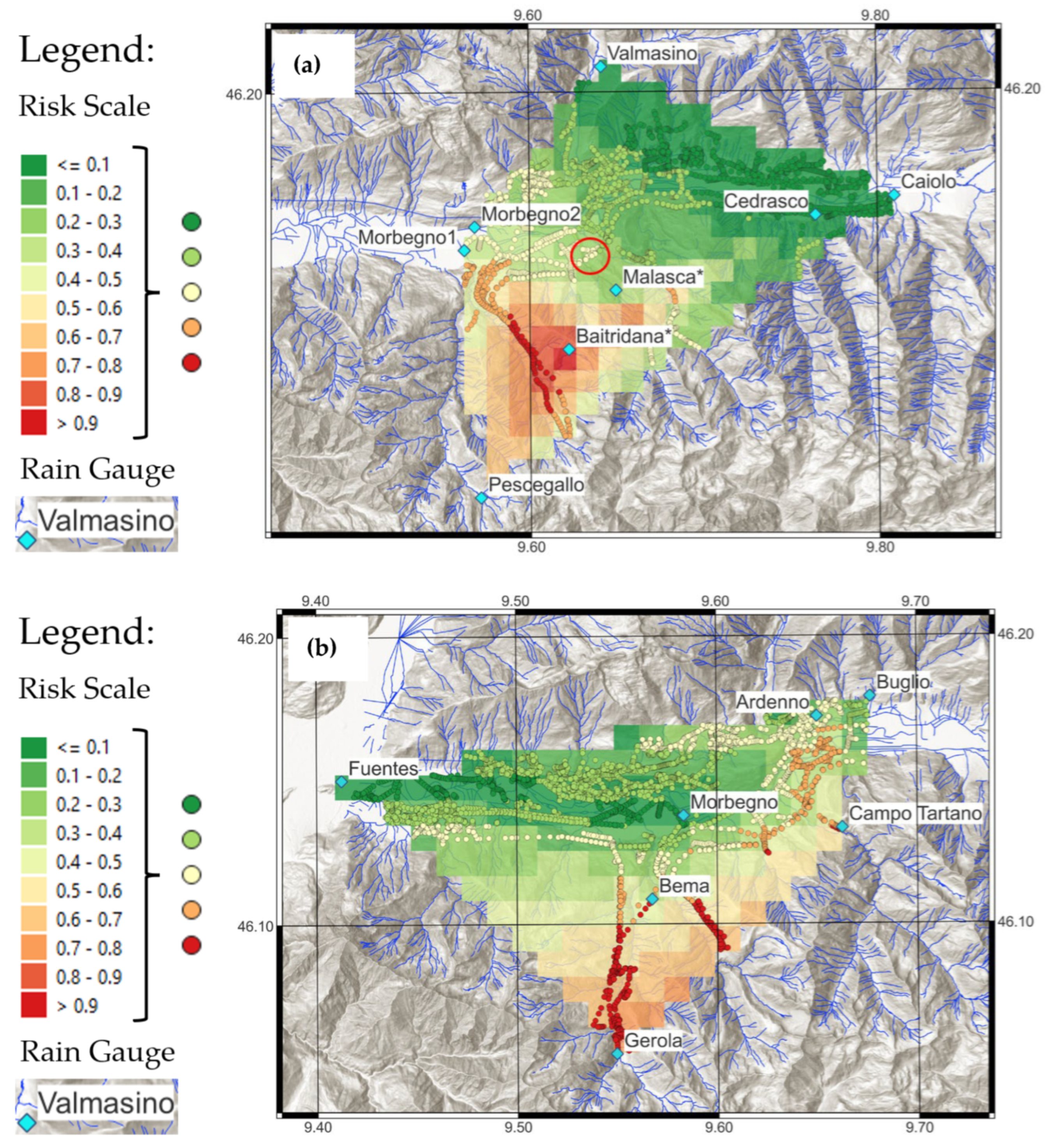
The source points located in the upper part of basins may represent a threat since shallow landslides triggered by heavy precipitation can undermine the pylon stability settled in the proximities, destabilising its foundation, and causing its collapse. Therefore, the positions of the pylons were overlapped with the safety factor (FS) computed by CRHyME, retrieving a risk map of the powerline infrastructure through the application of the risk matrix presented in Figure 6. As can be appreciated in Figure 21, the areas prone to instabilities were quite widespread. Due to the coarse resolution of the DEM utilised in CRHyME and the initial data uncertainties (i.e., the rainfall field reconstruction), not all of the predicted failures were effectively activated during that episode of July 2008. Therefore, the results of the simulation should be interpreted as a sort of susceptibility map able to highlight the areas where the failure would have the highest probability of happening during an intense event characterised by a similar rainfall magnitude (i.e., similar return period, RP). In this regard, two powerline sectors (1 and 2) were identified as vulnerable. These areas are located in proximity to the steep slopes where the landslide failure model in CRHyME computed a lower FS during the heavy rain episode of 2008. Sector 1, located near the town of Albaredo, involves an important transmission dorsal and, historically, it has already experienced some geo-hydrological issues during prior flood events that happened in November 2002 [11,54]. Sector 2, located near the town of Campo Tartano, involves a local distribution line which was cut off during the intense rainfall event that happened on 1 April 2024, due to a shallow landslide failure that evolved into debris flow.
Furthermore, the risk analysis was carried out considering the debris flow runout applying the MIST-DF tool. Carrying out the numerical simulation of debris flow propagation made it possible to highlight that vulnerable powerlines are located in the downstream part of the Malasca valley, especially across the fan apex. As can be appreciated in sector 1 of Figure 21b, the vulnerable pylons along the debris flow propagation path were now identified, resulting in a more complete and correct risk mapping of Figure 21b if compared against Figure 21a. Looking at the map in Figure 21a, the pylons were not detected as vulnerable by CRHyME, but by increasing the DEM resolution and the accuracy of the simulation with MIST-DF, the vulnerability of downstream pylons has been assessed. This situation, where slope instabilities and debris flow propagation act simultaneously, is very common across mountain landscapes and has been reported several times as a sort of “hidden hazard” since the high dynamicity of debris flow and its unpredictability may lead to underestimating the risk [8].
Figure 22 shows the effects recorded on the ground caused by the debris flow of Malasca during the event of 2008. As can be appreciated, both transmission and distribution powerlines have been affected, showing significant damage to the structures located within the debris flow scour. The highest impact was recorded in the area of the fan apex of the Malasca River. The local roads have been affected, temporarily interrupting the transport communication within the Talamona municipalities. It can be noticed how, in this case, the debris flow propagation reconstruction (Figure 12) and the risk assessment carried out using the proposed risk matrix (Figure 21) are in accordance with the onsite surveys.

3.2. Results of the Empirical Approach Applied to the July 2008 and April 2024 Events

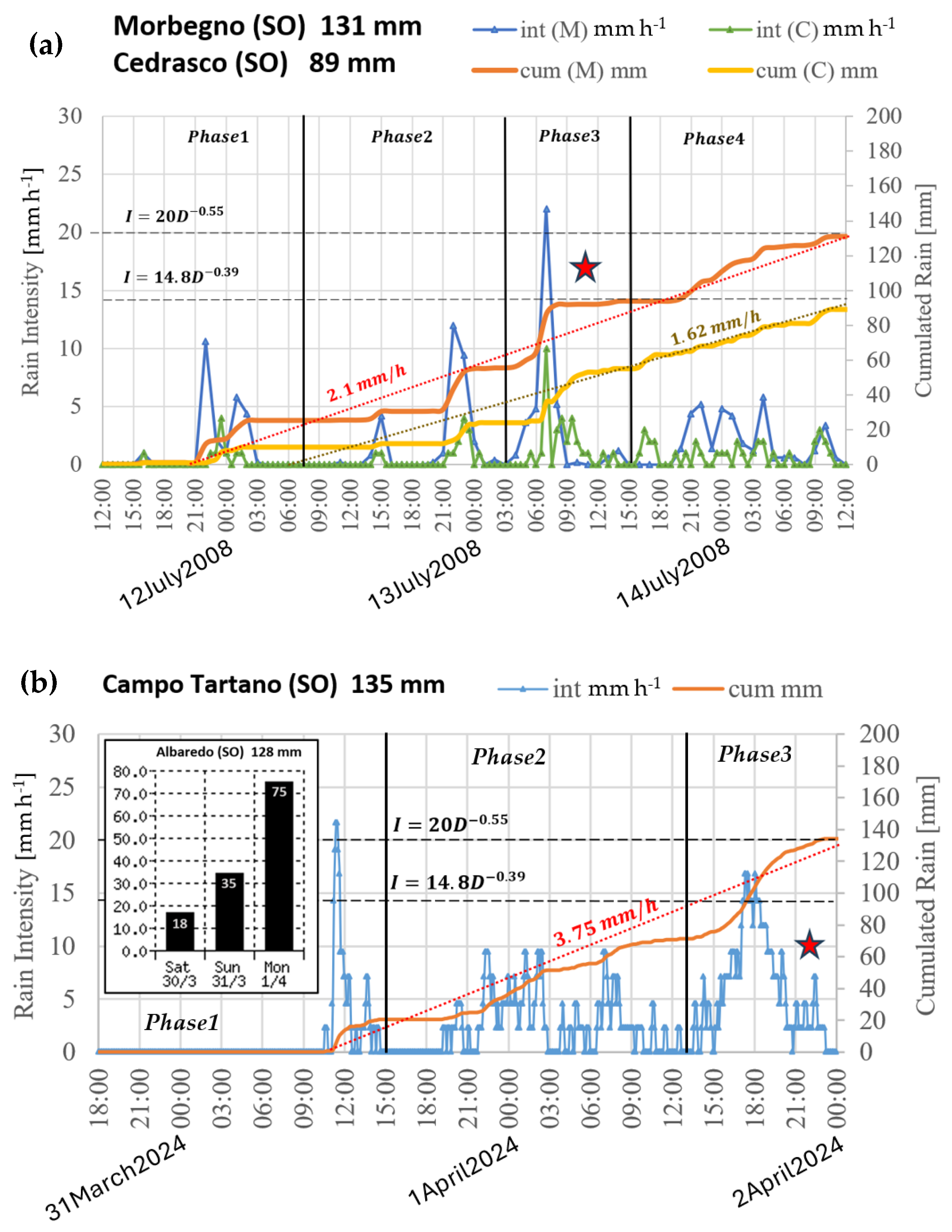
The critical rainfall intensities able to trigger shallow landslides can be evaluated starting from the rainfall threshold curves (Figure 7), and the powerline risk can be retrieved by applying the proposed empirical approach (Figure 8) [52,53,74,75]. For the July 2008 event, the rainfall values recorded at the nearest rain gauges of the Morbegno area (3 km from Talamona) were firstly compared with rainfall thresholds reported in the literature [74].: the “Caine 1980” curve Equation (23); the “Ceriani 1994” curve Equation (24).
C a i n e   1980 I = 14.8 D 0.39
C e r i a n i   1994 I = 20.1 D 0.55
It should be noted in Figure 23a that the maximum hourly rainfall potentially critical for the activation of the debris flow was recorded above the trigger threshold proposed by Caine; in particular, the precipitation assessed in the Morbegno stations was also higher than the threshold proposed by Ceriani, which represents the reference curve adopted for the analysed areas. Similar results have been recorded for the April 2024 event. Figure 23b represents the rain series of the nearest stations where the debris flow has occurred. As can be appreciated, the maximum rainfall intensity recorded has crossed or reached the Caine and Ceriani rainfall threshold by at least two points: the one at the beginning of the event and the other at the end of the event. The debris flow failure was detected in correspondence with the second peak (red star).
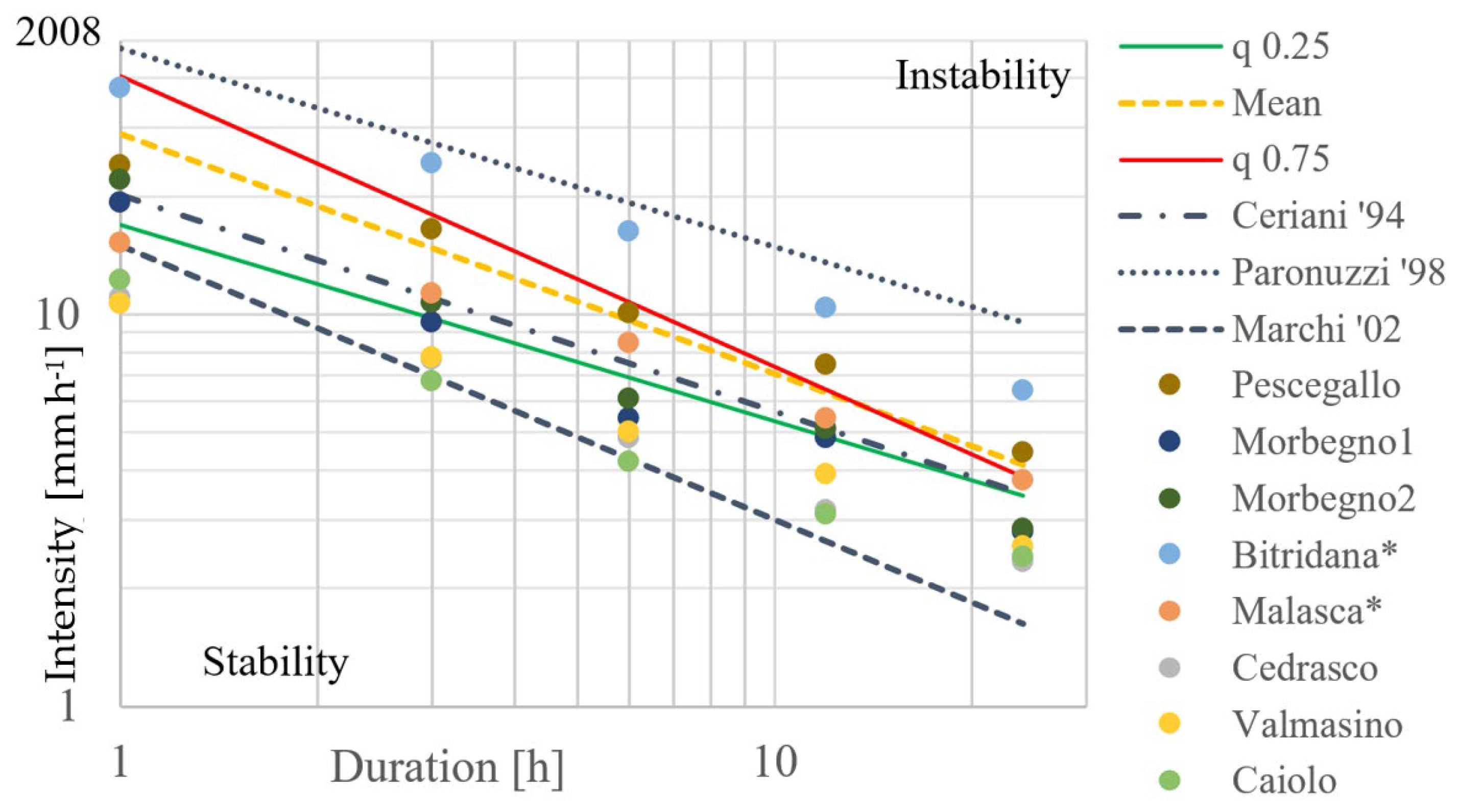
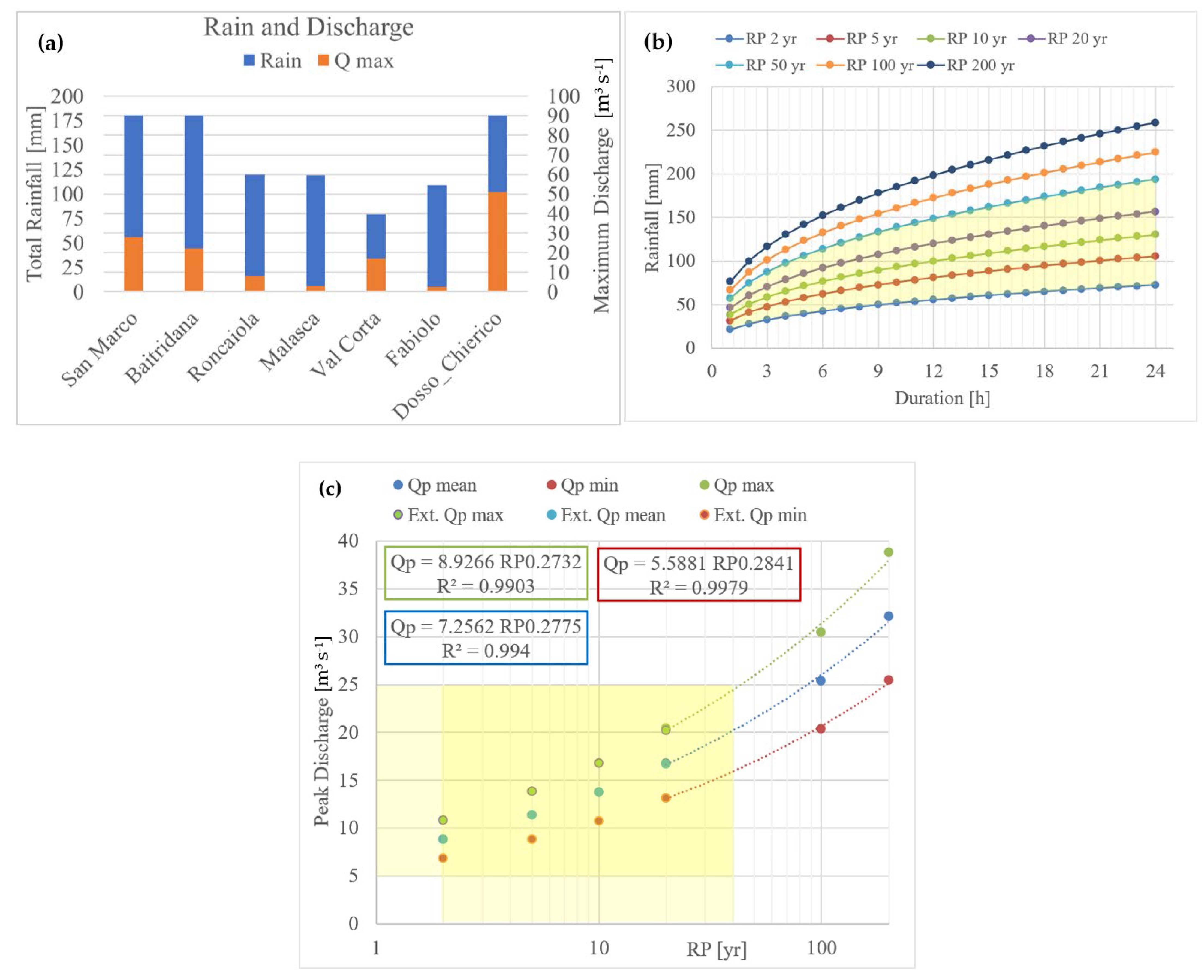
Considering the threshold curve of Ceriani and a group of rain gauges in the surrounding areas of the two events, an analysis of the debris flow critical rainfall has been carried out. In Table 11, the rainfall intensities recorded in July 2008 at Pescegallo, Morbegno, Cedrasco, Valmasino and Caiolo stations have been calculated for durations of 1 h, 3 h, 6 h, 12 h and 24 h. Intensities were compared against the Ceriani curve, and all of the intensity values were settled below the threshold except for Pescegallo (critical for all durations) and Morbegno2 (critical for 1 h duration). According to the analysis conducted by [56], due to the narrow strip of the persistent orographic band that characterised the event of 2008, only the station of Pescegallo exhibited a cumulative rainfall closer to that shown by radar images. Therefore, in Table 11, the “synthetic” rain gauges of Baitridana and Malasca (*) coming from numerical analysis have also been included, considering the possible 5–7 km NE shift of the processed rain radar. As a result, both stations have been reported to be critical with respect to the Ceriani threshold, confirming the improvements acquired by radar image implementation. As can be noticed, in order to spot critical rainfall episodes, rain gauge network density and the timeseries temporal resolution are important in discriminating spatially distributed debris flow triggering alerts. In Figure 24, the data from Table 11 are represented in the I-D graph. Baitridana, Malasca and Pescegallo were settled significantly above the Ceriani ’94 curve, which lies close to the q 0.25 line. Bearing in mind that all of the examined rain gauges are within a 15 km radius from the Malasca basin, it can be appreciated how short-duration heavy rainfalls (mainly convective, such as thunderstorms) have shown high spatial and temporal variability.
The same rainfall analysis was also applied for the April 2024 event, with a slightly different rain gauge ensemble (within 15 km distance from Campo Tartano town). Here, in the more recent event that happened on 1 April 2024, another debris flow-like episode occurred in the area of Campo Tartano after an intense precipitation event. Figure 25 shows the effects recorded on the ground caused by debris flow runout.
In Table 12, the Campo Tartano station was the closest to the debris flow and recorded critical values of rainfall for durations above 3 h. On the other hand, only the stations of Gerola (10 km SW) and Ardenno (3 km NE) have experienced critical intensity. Gerola had a similar behaviour to Pescegallo since it was located across the Orobie ridge, one of the wettest areas of the entire Lombardy region, with an annual rainfall close to 3000 mm [57]. Therefore, it happens frequently that threshold curve predictions may fail across this area since the territory is already “trained” to absorb large amounts of precipitation intensities, like the Ligurian region, and local thresholds are generally higher [52]. In Figure 26, the data of Table 12 are represented in the I-D graph. As can be appreciated, only Campo Tartano and Gerola were settled significantly above the Ceriani ’94 curve, which lies close to the q 0.25 line. The 2024 event happened in spring, showing a longer duration with respect to 2008, which was more sudden. This fact is confirmed by the analysis of [75], which has depicted triggering summer events as characterised by higher intensities with respect to early spring and winter events, characterised by lower I and longer D (Figure 27), depending on local MAP (Mean Annual Precipitation). Figure 23a,b highlight this aspect. Even though the total rainfalls of 2008 (110 mm) and 2024 (135 mm) were very close and their duration was around 2 days, the first one shows at least three clearly separated phases (rather impulsive) that lasted between 3 and 6 h. Conversely, the shape of 2024 was less scattered, showing almost continuous rainfall with lower rainfall intensities.
In Table 11 and Table 12, the risk evaluation was carried out for each rain gauge station, considering the scheme in Figure 8. As can be noticed, increasing the rainfall intensity brings a higher probability of landslide failure (higher H) that translates into higher risk (R). Here, the risk assessment is carried out at the rain gauge location, but could, in principle, be extended to powerlines, assuming the nearest rain gauge to the infrastructure as the most representative. As can be appreciated, the higher risk is correctly evaluated in the proximity of Malasca and Campo Tartano rain gauges, confirming the empirical approach as suitable for rapid and effective geo-hazard mapping and risk assessment. In Figure 28a,b, the risk map obtained by rainfall analysis shows the spatial distribution of the risk with respect to the location of the powerline. Here, the TIN interpolation has been applied to show the rain gauge influence across the territory, correctly highlighting the Malasca area and Campo Tartano areas among the most dangerous locations prone to geo-hydrological failures. However, in the red circle of Figure 28a are shown missed powerlines at risk due to debris flow runout for the July 2008 event (not computed within the empirically based methodology).

4. Discussion

This work reported a back-analysis carried out for the debris flow events that hit Talamona and Campo Tartano, two towns in Sondrio Province (Italy), in July 2008 and in April 2024, respectively, which occurred after an episode of intense rainfall. In this section, a discussion about some points of the two analyses conducted is presented, commenting on the results obtained and comparing the two approaches.

4.1. The Importance of the Rainfall Data Series Reconstruction for the Risk Assessment

The reconstruction of the most accurate rainfall field using radar images was necessary to reduce the uncertainties of the triggering rainfall across the ungauged basin of Malasca. This task was mandatory since, as reported by [56] and as shown in Figure 13, the local rain gauge network partially missed recording the actual intensity of the event. As was mentioned in the Results, Section 3.1.1, the narrow strip of rainfall that persisted in the area was visible only by looking at radar data. Fortunately, for July 2008, the radar data recorded by [37] were examined by browsing through the historical archive of [38], where a reconstruction of the rainfall amounts and their evolution in space and time was carried out. This procedure was necessary to correctly feed the CRHyME model, although the Talamona debris flow triggering would not be reproduced at all, considering only ground-based rain gauges or their simple spatial interpolation. However, this in-depth analysis of the rainfall field is not always feasible due to the possible lack of data (caused by radar maintenance or absence) and due to the location of the geo-hydrological issues that generally happen across a mountain valley, where the radar’s beam is sometimes hidden or not sufficiently precise [36,76]. Moreover, as was experienced in this study, radar’s outputs sometimes require postprocessing techniques to correct possible local errors and distortions that could be fixed only from the analysis of ground-based measurements, even if they are scarce. As a result, the combination of multiple source rainfall data is necessary for enhancing precision and the accuracy in rainfall field reconstruction (RMSE reduced from 33 mm to 15 mm after applying the radar images correction) [66].
The rainfall analysis conducted for the July 2008 event was reconsidered in the application of the second empirical approach proposed, based on rainfall-threshold curves [31,53]. In this method, the I and D characteristics of the rain have been compared against the shallow landslide triggering thresholds in order to retrieve the hazard and the risk associated with it. Here, the uncertainty associated with the rainfall data has been added to the uncertainties associated with the choice of the most suitable threshold. According to several authors [52,53], the former represents a challenge since thresholds are empirically retrieved from various studies and they are not homogeneous across the territory. The best solution should try to reconstruct a locally based threshold valid for the Malasca basin, but the lack of a complete long-time series of past rainfalls in the area and the scarcity of chronicles reporting past landslides’ reactivation have hindered this task [11,31,53]. Instead, the thresholds dispersion has been examined in this study in a rather innovative way, applying a statistical distribution over the available and most representative curves valid for the Central Alps region, and associating them with a probability of landslide occurrence P D F | I , D . Moreover, applying the scheme in Figure 8, in analogy with the risk matrix proposed in Figure 6 for a numerically based approach, the geo-hydrological risk associated with the rainfall I and D has been evaluated. The empirical methodology, as for radar data processing, strongly depends on ground-based records, so that a certain degree of approximation is expected for ungauged areas and basins located across a mountain range. Nevertheless, for the event of April 2024, rain gauges available in the Campo Tartano area were much closer to the location of the debris flow, enhancing the accuracy of this methodology in depicting the associated geo-hydrological risk. Conversely, for July 2008, the fictitious rain gauges retrieved from radar image reconstruction were necessary to better highlight the higher risk located across the Malasca basin, in the Talamona area. Bearing in mind the limitations of applying the empirical approach, the latter has been demonstrated to be a valid alternative to a more complex numerical model-based analysis conducted with CRHyME and MIST-DF software, especially for rapidly surveying large and remote areas (such as mountain regions) where powerline infrastructures (i.e., both transmission and distribution lines) are sometimes settled [1,12,14,28]. Moreover, the threshold curves are a useful tool both for back-analysis risk assessment and for applying in meteorological models for a nowcasting landslide risk prediction.

4.2. The Risk Assessment of Powerlines Using a Numerical Approach

With the two proposed methodologies, it was possible to investigate the most vulnerable powerlines across the Talamona and Campo Tartano areas, also studying the debris flow downstream propagation path. Regarding the application of the numerical approach, a model chain constituted by CRHyME and MIST-DF code has been proposed and tested in the Talamona case study. A first risk assessment against potential shallow landslide failure was carried out using CRHyME outputs. Several areas were identified to be susceptible to possible failure just after the July 2008 event, slightly overestimating the effective hazard. A bias in radar images has been detected, showing a shift of about 5–7 km in the N-E direction of the ground precipitation. However, considering this spatial lag, the source points of the recorded debris flow (i.e., the slopes with FS < 1) and the area where landslide failures were more diffuse have been correctly localised by the code, posing them in the upper part of Malasca, Roncaiola and Bitto basins. Bearing in mind that the coarser DEM used in CRHyME (~90 m) may not be sufficient for describing the debris flow runout and deposition, its resolution was increased from 90 m to 20 m [65], and the MIST-DF software was applied. Computing the runout of the debris flow, the pylons partially destroyed and affected by the debris flow scour across the fan apex in the upper part of Talamona town have been correctly identified, matching the observation carried out during onsite investigations [20]. Moreover, the MIST-DF outputs in terms of debris flow height, velocity and discharge have been analysed against the vulnerability curves of pylons. Depending on the type of simulation (i.e., different rheologies and volumes estimations), on the locations along debris runout (transit or fan area) and on the selected damage curve (poles, pylons and single-multi parameter), the final risk assessment may result quite differently. Adopting the “Hydraulic” rheology, that resulted as the most representative of the debris flow occurred in July 2008 in terms of kinematic behaviour (e.g., heights, velocities, discharges, runout total time and deposition area), the powerline infrastructure located in the proximity of the fan apex (MP2, MP3 and MP4) exhibits the highest vulnerabilities (V ≥ 0.4–0.5), confirming the onsite evidence (i.e., severe damages to the infrastructures) recorded after the event (Figure 12, Figure 20 and Figure 22). The fan apex is therefore the most critical sector in debris flow episodes, confirming some literature evidence [6,8,9,23]. The numerical analysis has pointed out how the combination of two codes with different levels of precision (i.e., DEM resolution and type of processes investigated) can give a physically consistent reconstruction of rainfall-induced geo-hydrological phenomena. Modelling debris flow runouts is essential to spot the most vulnerable powerlines located across the fan apex, several kilometres downstream with respect to the shallow landslides instabilities on slopes that define the source point. In this case, numerically based simulations of MIST-DF are able to quantify the destructive power of rapid and high magnitude debris, allowing for better addressing a risk zonation in the proximity of towns’ settlements across the downstream fan [8,72] (taking into account hazard transferability).
Uncertainties are still embedded in the numerical methodology, depending both on physical modelling of complex geo-hydrological processes and on the quality of onsite data investigated and considered for calibrations [22]. The former is the reason why the numerical approach has been applied only for the event of July 2008. In addition, the absence of vulnerability curves explicitly calculated for powerline infrastructure represents another source of uncertainty in the risk assessment quantification [8,9]. At the time of writing this work, no example of powerline vulnerability curves evaluated against debris flow threat has been published yet. The ones proposed in the study come from analytical interpretation of the possible mechanisms of powerline failures (sliding and overturning), considering two types of structures (poles and pylons). Poles and pylons have shown completely different responses to debris flow forces: poles are the most vulnerable, while pylons are more resistant. Additional vulnerability curves have been proposed through the study considering other authors’ interpretation of the phenomena [1,6,18,49], but a direct correspondence for powerlines has not been found since those curves have been retrieved from other types of buildings (masonry and timber frame structures) [6,46]. Therefore, in vulnerability quantification through the numerically based approach, an “averaged” curve has been proposed, considering all of the curves listed in Figure 19. In our opinion, bearing in mind the approximation included in the curve proposed (that considered the vulnerability dependence on solely debris flow height), it represents a first step in the direction of considering these structures’ response to debris flow geo-hazard explicitly.
The vulnerability curves proposed try to reduce the conservativeness of the classical approach generally adopted for lean and flexible structures (such as powerlines, cables, etc.), where V is automatically set equal to 1 [8]. The latter has been implemented in the empirically based approach; as was observed in the case study of July 2008, even the powerlines hit by debris could be partially damaged (tilted or spatially translated, such as those in Figure 20) and not completely obliterated or destroyed by the flow. This fact is rather important not only for risk back-analysis but also for quantification of the cascade effect on the local connected energy network [1,14]. Powerline failure cascades are domino-effect disruptions where an initial component failure forces power to overload surrounding lines, causing successive, rapid failures and widespread blackouts. These events could be caused by natural disasters such as extreme weather (ice/snow overloading lines and high winds), equipment failure, and physical hazards like falling trees, landslides, floods, etc., leading to massive, interconnected infrastructure failure rather than isolated incidents [77]. These failures can cause a large, interconnected network to become unstable within seconds [2]. In some cases, incomplete powerline damage means that blackouts are avoided, guaranteeing the functionality of the service that could be particularly critical and essential across affected areas, especially if located in rural and isolated mountain places (such as those analysed in this study). In this regard, studies in this direction are undoubtedly significant in order to better understand the resistance and resilience of the electro-energetic network against geo-hazards, providing mitigation solutions or strategies for avoiding infrastructure damage [1,14].
In case of the lack of data about debris flow events, such as for the event of April 2024, V = 1 is a necessary approximation, and the second methodology proposed based on rainfall thresholds has been revealed to be sufficiently accurate for highlighting potential risky situations in those areas affected by geo-hydrological hazards (Figure 28). In the case of rainfall-induced landslides, the analysis of the triggering rainfall RP (i.e., the magnitude of precipitation) and the comparison with rainfall thresholds permits inference about possible side effects on the ground [21,25], giving a less detailed but effective and straightforward prediction of the magnitude of geo-hydrological episodes and a risk map of the most vulnerable infrastructures. However, since the kinematics of debris flow and its downstream propagation are not taken into account, risk underestimation could be detected, especially across the fan apex of Talamona for the July 2008 event (Figure 28), where debris hit more seriously and exhibited the highest velocities and discharges [8,9,25].

4.3. Two Methodologies Comparison and Their Application Under Future Climate Change

In this analysis, two approaches (the numerical and the empirical) have been presented for assessing powerline vulnerability and risk. Their combination has shown how it is possible to disentangle and reconstruct the effect of geo-hydrological phenomena that may occur during an intense rainfall event. These methodologies could be rather accurate or approximated depending on their usage and application. The numerical one is more physically based but requires several data (for model calibration and validation [22]) and onsite investigations (for describing ground effects [20]) to be applied in an effective way [24]. Therefore, it is principally suitable for carrying out back-analysis studies that require in-depth geo-hydrological assessment of a basin with respect to rainfall-induced phenomena. Running CRHyME and MIST-DF codes does not require too many heavy computational resources since they are light codes developed in Python language, easily running on a personal computer, while their calibration requires onsite investigation, such as debris flow volume and area propagation (for MIST-DF) and a precise rainfall field reconstruction (CRHyME). Conversely, the use of a rainfall-threshold curve [51,52] could be an alternative solution to spot the areas that are much more prone to risk, by simply looking at precipitation intensity data. Moreover, this technique could, in principle, be adopted within a civil protection plan for early warnings against geo-hazard or within resilience plans for infrastructure risk and vulnerability analysis [12,52]. As was shown in the analysis presented, the empirical approach is lightweight and requires only ground-based rain gauge data series to be implemented and is suitable for those events where onsite investigations are not available (such as the case of April 2024). Ideally, the two methodologies presented could be intended as a part of a numerical chain that could also be utilised for both real-time risk assessment [31] if rainfall data were provided continuously (empirical approach) and for detailed back-analysis surveys (numerical approach).
The two methodologies presented here are currently under development and refinement. Geostatistical techniques and data-driven models are being experimented on to close the gap between the need for high-resolution spatially distributed data and computational accuracy, which is a requirement for the numerically based approach. The degree of complexity and adherence to reality is improving according to the increasing trend of information availability and studies around these topics [52]. Therefore, new features will be included in the two codes presented here (CRHyME and MIST-DF), thanks to the availability of the new territorial data. Fortunately, the ongoing digitalisation and sharing of environmental and infrastructure data will certainly help to prevent future dangerous situations, adding precious information about past failures (i.e., improved landslide census) and highlighting the most vulnerable infrastructures [7,23,78]. These aspects represent an active research frontier [8,9,25] that perhaps will be explored in future works.
Another interesting task related to the future development of the two methodologies reported is relative to the consideration of climate change forcings. As can be noticed, the approaches strongly depend on rainfall magnitude estimation since the investigated geo-hydrological issues are driven by rather heavy to extreme precipitation phenomena [79]. Recent studies [3,4,5,80,81,82] have projected a possible increment in this kind of event, suggesting a +20% increase in rainfall intensities and a return period reduction in the most intense ones by −50%. Therefore, higher magnitudes are expected to occur more frequently, especially for those areas where rainfall strength is perturbed by dynamic and thermodynamic forcings (i.e., orographic areas and warm sea proximity) [32,83]. In this context, the Italian peninsula has already been addressed as a sensible “hot-spot”, and the mountain regions are the areas where extreme events are projected to intensify more due to the higher rate of temperature rise [3]. Thus, climate drivers will play a significant role and rainfall-induced geo-hydrological hazard would probably (in future decades) experience a rapid evolution and “anomaly” intensification due to territorial adaptation to the new hydrometeorological forcings [84,85,86]. The two approaches presented here have been designed for modelling and predicting the ground effect of any intense precipitation event, taking into account both the spatial and temporal variability of the rainfall field and its possible future intensification. The former will probably reflect the vulnerability of lifeline infrastructures, increasing their risk [3,8,17]. This fact may be appreciated rather straightforwardly by looking at the empirical methodology exemplified in Figure 8. Under the hypothesis of fixed landslide threshold curves, an increase of 20–30% of the mean intensity with respect to the same event that occurred in the past would translate into a higher risk for the infrastructure.
Nowadays, using climate models and studying extreme event rainfall statistics (i.e., evaluating new Depth Duration Frequency Curves, DDFCs) permits us to better address the future modification of the rainfall phenomena, also addressing their spatial variability [4,80]. Then, considering the return period (RP) of a past event, its expected intensification in the future is possible to retrieve, recalculating a new risk scenario that takes into consideration the climate forcings. Moreover, applying different radiative scenarios as those proposed by IPCC (Intergovernmental Panel on Climate Change) [82], it could be possible to evaluate several risk scenarios for the investigated infrastructures. In Figure 29, the example shows how the expected rainfall intensification, recalculated from new DDFCs (the dashed red line in the first box on the left) for a design event with RP = 100 yrs, could translate into a higher risk for the investigated infrastructure applying the empirical approach (central box). The straightforward evidence of climate change influence assessed with the empirical method could also be directly translated to the numerical ones. However, since the numerical models are run just by modifying the rainfall forcings, it is hypothesised that all of the geo-hydrological parameterisations and calibrations would not be affected by a changed boundary condition. This is not always correct since, as reported by [8,9,27], geo-hydrological process and in particular debris flow runouts are affected by large uncertainties that also depend on the state of the ground surface, by the availability of erodible material, by geological processes at slope scale and by a certain grade of randomness, which are difficult to control without onsite investigation or in-depth analysis of past-event datasets. As a result, a non-linear response in risk assessment could be possible due to hidden feedback, which may occur at local and basin scales and due to numerical and modelling uncertainty propagation [22,87]. However, as far as this relationship is difficult to disentangle, it represents an active research frontier where, according to recent IPCC and CMCC (Centro Euro-Mediterraneo sui Cambiamenti Climatici) reports [3,82], a positive trend characterised by risk increment is expected. In this context, the two approaches described are helpful tools for the risk assessments required by civil protection plans and by infrastructure resiliency plans, taking into account not only current geo-hydrological hazards, but also their possible future modifications under climate change scenarios.

5. Conclusions

This paper has described a methodological approach for assessing powerline vulnerability to geo-hydrological hazards. Debris flows are complex phenomena triggered by heavy precipitation and characterised by high variability and uncertainties since they are difficult to measure and model. From a powerline risk assessment perspective, it is highly recommended to try to quantify the magnitude and the effect of these phenomena since a pylon failure could be a serious problem in guaranteeing the continuity and quality of the electrical supply, avoiding cascade effects and blackouts. In this regard, the very first action that aims to increase powerline resilience against extreme events is to try to understand past episodes (back-analysis) using numerical models that are based on post-event data surveys.
The scope of the study was to assess the geo-hydrological risk related to the onsite powerline infrastructure, analysing the cause-and-effect processes involved in debris flows being triggered and their downstream propagation. Recalling Equation (1), the most complex component for evaluating the risk (R) is the hazard quantification (H), which is mainly correlated with the local territory characteristics, climate and geo-hydrological processes. Therefore, for the case study of Talamona, two numerical models have been tested to try to address the powerline hazard, reconstructing in detail the geo-hydrological process that occurred during the event of July 2008. Starting from onsite investigation and rainfall data series, the CRHyME and MIST-DF models have been implemented to investigate the ground effects at a basin scale. This detailed investigation was possible thanks to the availability of several onsite surveys and data that were gathered during that occasion [11,19,20,21,56]. Conversely, for the event of April 2024 in Campo Tartano, another methodology, more empirically based, has been applied to assess powerline risk using the recorded rain gauge data. On that occasion, no surveys or reports were available. The study has shown how it is possible to deal with the complexity and uncertainties of rainfall-induced geo-hydrological episodes, proposing a twofold approach that has highlighted the most vulnerable powerlines across the investigated area. Bearing in mind ongoing climate change, the approaches are designed for considering possible future rainfall intensification and its implications on hazard and risk evaluation, giving useful tools for building multiple risk scenarios necessary in civil protection plans and infrastructure resiliency plans.

Author Contributions

Conceptualisation, A.A. and L.M.; methodology, A.A.; software, A.A.; validation, A.A., L.M. and M.d.N.; formal analysis, A.A.; investigation, A.A.; resources, A.A. and L.M.; data curation, A.A.; writing—original draft preparation, A.A.; writing—review and editing, A.A., L.M. and M.d.N.; visualisation, A.A.; supervision, A.A. and L.M.; project administration, M.d.N.; funding acquisition, M.d.N. All authors have read and agreed to the published version of the manuscript.

Funding

This work has been financed by the Research Fund for the Italian Electrical System under the Three-Year Research Plan 2025–2027 (MASE, Decree n.388 of 6 November 2024), in compliance with the Decree of 12 April 2024.

Data Availability Statement

All the computations carried out in the study are based on open-source codes (based on Python language) and free-accessible data coming from European, national and regional repositories.

Acknowledgments

The authors really wants to thank students of Politecnico di Milano, Isabella Botero Marulanda and Esteban Ceccarelli Calle, and their supervisor Laura Longoni, who helped in studying, reconstructing and modelling the vulnerability curves for electrical infrastructures.

Conflicts of Interest

The authors declare no conflicts of interest.

Abbreviations

The following abbreviations are used in this manuscript:
DDFCDepth Duration Frequency Curves
RPReturn Period
IPCCIntergovernmental Panel on Climate Change
SIMNServizio Idrografico Mareografico Nazionale
VAPIValutazione Piene Italiane
EURO-CORDEXEuropean branch of the international CORDEX initiative
RCPRepresentative Concentration Pathway
ARPARegional Environmental Protection Agency
DEMDigital Elevation Model
IFFIInventario Fenomeni Franosi Italiano
CMCCCentro Euro-Mediterraneo sui Cambiamenti Climatici
CRHyMEClimate Rainfall Hydrogeological Modelling Experiment
MIST-DFModelling Impulsive Sediment Transport—Debris Flow
ROCReceiver Operating Characteristic
CFLCourant–Friedrichs–Lewy
CSFT“Centred in space” and “forward in time”

Appendix A. MIST DF Numerical Code

According to [9,10], debris flow rheology can significantly affect its downstream propagation, sensibly modifying the fluxes across the landscape. In MIST-DF, fluxes and velocities are computed for a group of rheologies where their behaviour can be approximated to turbulent Newtonian flow. To describe it, in the literature, some equations are applied (from Equations (A1)–(A5)) derived from the studies that depend on roughness (Ks of Strickler, adimensional), reach slope (ireach, adimensional and calculated from DEM), hydraulic radius (R, sometimes approximated to the flow height h, in m) and discharge (Qdf, in m3 s−1, calculated empirically from [41]):
V H y d r a u l i c = K s   i 0.5 R 2 3 K s = 35
V C h e z y = 10 Q d f 2 25 i 0.5 R 2 3
V M a n n i n g = K s   i 0.5 R 0.5 K s = 20
V T u r b o l e n t = ( 1 0.077 Q d f 1 15 )   i 0.5 R 2 / 3
V R i c k e n m a n n = 2.1   i 1 3 R 1 3
Among them, “Hydraulic”, “Manning” and “Chezy” equations are derived from the study of clear water flood propagation [27,41]. The Newtonian rheological model is the simplest, assumes constant viscosity, is suitable for clear water flow and is sometimes extended (with some correction) to debris flow [9]. In some cases, when debris contains a significant amount of water, these formulae have been reported to be sufficiently representative of flow runout. However, other authors have carried out more detailed reanalysis studies on past events, retrieving new equations. Here, the empirical equation proposed by [41] and derived from regression analysis has highlighted the slope “i” and the discharge as the most significant predictors of the debris flow fluxes. In MIST-DF, other rheologies are implemented, such as laminar and dilatant ones, but they were not taken into account in the present analysis.
The MIST-DF code implements 2D shallow water equations using an explicit finite difference numerical scheme [88]. The former is commonly adopted for describing flood propagation along floodplains and valleys [27]. The 2D shallow water equations, often derived from Navier–Stokes equations under shallow water assumptions, consist of a continuity equation (that expresses conservation of mass) and two momentum equations [9,27,72] (see Equations (A6)–(A8)). Their numerical discretisation is conducted in space and time. The computational domain is divided into a grid of cells (e.g., using a rectangular grid). Spatial derivatives are approximated using finite differences (e.g., forward difference, backwards difference or central difference) at each grid point. Time is also discretised into steps (in s). Explicit schemes use a time-marching approach, calculating the solution at the next time step based on the current time step (see Equation (A9)) [88]. The variables involved in the equations are as follows.
h: water depth (or water surface elevation), in m;
u, v: velocities in the x and y directions, in m s−1;
g: acceleration due to gravity, equal to 9.81 m s−2.
h t + u h x = 0   C o n t i n u i t y
u t + u u x + g h x = 0   M o m e n t u m   a l o n g   x
v t + v v x + g h x = 0   M o m e n t u m   a l o n g   y
h i , j n + 1 = h i , j n Δ t     u h i + 1 2 , j n u h i 1 2 , j n Δ x Δ t     v h i , j + 1 2 n v h i , j 1 2 n Δ y
Since they are implemented using an explicit scheme “centred in space” and “forward in time” (CSFT), a condition for stability is required by the numerical method. The Courant–Friedrichs–Lewy condition [89] (CFL) is a necessary criterion for the convergence of explicit numerical schemes used to solve partial differential equations, in particular those of the hyperbolic type. In practice, the CFL condition imposes an upper limit on the size of the time step based on the grid spacing and the speed of the phenomenon being studied. If the time step exceeds this limit, the numerical solution can become unstable and produce incorrect results. The CFL condition is particularly relevant when solving hyperbolic equations, which describe phenomena such as wave propagation or fluid flow [88]. The condition is expressed using the Courant number in Equation (A10), where
C is the Courant number, non-dimensional;
u or v are the flux velocities, in m s−1;
Δt is the time step, in s;
Δx or Δy are the cell dimensions, in m.
C = t   V x 0.5   or   C = t   g h 0.5 x   0.5
The Courant number is dimensionless, and it is critical to the stability of the explicit numerical methods, where a Courant number greater than 1 can lead to instability and non-physical results due to numerical instabilities. In the simulations carried out in this study, the Δx has been fixed to 20 m; therefore, the Δt of numerical integration has been assessed to 0.5 s in order to satisfy the Courant condition. Having velocities on the order of 10 m s−1, C ≈ (0.5 × 10)/20 = 0.25 < 0.5, satisfying the stability condition.
Being an explicit scheme, the CSFT scheme computes the future state based solely on current known values, making it computationally fast per step. However, this scheme is conditionally stable, meaning stability is only maintained if the time step (Δt) is sufficiently small relative to the spatial step (Δx) [89]. While simple to implement, the strict stability restrictions often make this method inefficient compared to implicit schemes. In the future release of MIST-DF, an upwind method will be tested [88]. The upwind method is a finite difference numerical technique for solving the advection equation by biasing spatial derivatives toward the direction of flow [90,91]. It ensures stability by using upstream data points, avoiding the instabilities of downwind methods. However, it is also conditionally stable (CFL condition is necessary to meet to assure numerical stability [89]) and could introduce numerical dissipation (diffusion), acting as a first-order accurate method [90]. However, it has been reported to be highly stable for hyperbolic equations, easy to implement, and physically intuitive.

Appendix B. Geo-Hydrological Assessment for Talamona Case Study

Applying the CRHyME model, the geo-hydrological assessment of the area during the event of 2008 has been carried out. In Figure A1a, the location of 12 monitoring points adopted for sampling the hydrological response of the territory to the intense rainfall event is presented. As can be appreciated from Figure 13, the former was rather localised, pouring in 48 h up to 180 mm on the ground along a narrow strip. In Figure A1b, rainfall time series are reported at different locations across the area.
Figure A1. (a) Monitoring points and rain gauge stations are considered for geo-hydrological assessment using CRHyME data outputs. (b) Rainfall time series sampled at rain gauges and monitoring points, showing high spatial variability of the total precipitation, ranging between 90 and 180 mm. (*) are fictious rain gauges evaluated from radar map in the proximity of Malasca Basin.
Climate 14 00090 g0a1
The most intense phase of the event occurred between 13 July 2008 at 00 a.m. and 14 July 2008 at 00 a.m., where total rainfall increased sharply in a range between 40 and 120 mm, depending on location. According to [20], the highest ratios were recorded in the early morning of 13 July, as was correctly represented by the reconstructed rainfall field. On that occasion, the Malasca and Rodolo [18] debris flows were triggered, highlighting the cause-and-effect relationship with the intense rainfalls. Due to higher intensity, the local rivers and streams experienced a sudden rise in discharges that occurred slightly after the most intense phase of the storm (i.e., in the late morning of 13 July). According to [27], this delay was caused by the time of concentration (Tc), which expresses the time passed before the rainfall collects and then starts to contribute to flood formation. More precisely, the time of concentration is the time it takes for runoff from the furthest point of a drainage area to reach the outlet. In the area investigated, Tc, expressed in h or min, is generally on the order of ~1 h or less since it strongly depends on the extension (A, in km2) and on the geomorphological characteristics of the basin such as main reach length (L, in m), mean elevation (Hmean, in m) and elevation range (ΔH, in m), basin and reach slopes (i, adimensional); see Table A1a. Tc has been computed using the empirical formula of Kirpich (A11), Giandotti (A12), Pezzoli (A13) and Ferro (A14) [27,92]. The former estimates the time of concentration (Tc) for a watershed as an empirical formula, meaning it is based on experimental data. These formulations are suitable for watersheds with well-defined channels and relatively steep slopes [92].
T c K i r p i c h = 0.02   L 0.77 i r e a c h 0.385
T c G i a n d o t t i = 4 A 0.5 + 1.5 L 0.8 H m e a n 0.5
T c P e z z o l i = 0.055 L i r e a c h 0.5
T c F e r r o = 0.675   A 0.5
In Table A1b, the Tc values for the investigated sub-basins in the area of Malasca are reported. Among others, the Malasca watershed is the one that exhibits the fastest hydrological response, on the order of 20–25 min. According to Tc formulations, Tc is influenced by a relatively short length of the main reach (only 2.5 km) and a rather steep slope (0.7 ≈ 35°). Moreover, as was reported by [20], the Tc evaluated for Malasca is comparable with the rapidity of debris flow propagation that occurred on the morning of 13 July 2008.
Table A1. (a) Morphological characteristics (A, L, ΔH and i) of sub-basins calculated in the investigated area and (b) the time of concentration Tc from Kirpich, Giandotti, Pezzoli, and Ferro formulae. These data have been retrieved automatically using SAGA GIS software, version 9.2 [93,94] and the HydroSHED DEM at ~90 m resolution provided by [63,95].
(a)Area [km2]L [km]ΔH [km]H Mean [m]ibasin [-]ireach [-]
Dosso_Chierico20.26.74100011000.150.05
Bitto_Gerola67.012.28200016000.160.05
San Marco10.94.95150013500.300.10
Baitridana9.34.57150013500.330.11
Roncaiola8.84.45180011000.400.13
Malasca2.83.35180011000.540.18
Val Corta18.94.35150017500.350.12
Val Lunga19.04.36150017500.340.11
Fabiolo4.33.1110007000.320.11
Maroggia12.25.24200012000.380.13
Presio5.63.55200012000.560.19
Finale6.63.85200012000.520.17
(b)Tc Kirpich [min]Tc Giandotti [min]Tc Pezzoli [min]Tc Ferro [min]Tc mean [min]
Dosso_Chierico56.363.557.860.759.6
Bitto_Gerola86.295.9100.4110.598.3
San Marco33.842.151.444.643.0
Baitridana30.838.945.741.239.1
Roncaiola27.841.940.040.037.4
Malasca20.026.526.122.623.8
Val Corta29.042.942.358.743.2
Val Lunga29.143.042.558.843.4
Fabiolo23.136.731.428.029.8
Maroggia32.347.348.547.243.8
Presio20.632.027.031.927.9
Finale22.634.830.634.730.7
The hydrological response of the Malasca basin and its adjacent Roncaiola watershed was computed by CRHyME and is depicted in Figure A2. As can be noticed, both rivers have experienced an abrupt increase in the discharge after the storm passed. This variation happened rather quickly (reaching its maximum in a few hours during the morning of 13 July), highlighting the fast response of this basin to the local rainfall. According to [79], the abrupt change in hydrological regime of little watersheds, where discharges jumped from the minimum << 1 m3 s−1 to values on the order of 10 m3 s−1, may locally have triggered debris flow, especially in those “recharge areas” where incoherent deposits accumulated over time due to geo-hydrological processes. As was studied by [9], the latter is a long-term process that is driven by multiple factors that depend on local morphology, geology, vegetation and climatology and that scale with t0.5. Thus, the availability of incoherent material along slopes and accumulated along river networks may be mobilised by rapid saturation coming from intense precipitation, abruptly increasing the river network discharge. In this process, local infiltration plays a significant role [96] since it modulates runoff and may perturb shallow landslide failure, which represents an additional source of material available for debris flow formation. Apart from shallow landslide contribution, all of these geo-hydrological processes have been implemented in CRHyME for the debris flow formation mechanism, considering the local hydrological response.
Figure A2. Liquid discharge recorded at monitoring points for Malasca and Roncaiola basins (a) and other watersheds in the area (b). In the late morning of 13 July, one can appreciate the spike in the floods triggered by heavy rain. The intensity is higher in south-western basins (i.e., Dosso Chierico, Baitridana and San Marco) and lower in the north-eastern ones (Val Corta, Val Lunga and Fabiolo).
Climate 14 00090 g0a2
According to the present analysis, the Malasca debris flow has been influenced not only by heavy rains but also by abrupt discharge increase within a small watershed. Looking at Figure A2, the rainfall–runoff responses are highly correlated: more rainfall can produce higher peak discharge. Therefore, an analysis of the magnitude of the rainfall phenomena has been improved, evaluating the return period (RP) of precipitation and comparing the Q statistic with previous studies conducted in the area. From the local environmental agency (ARPA Lombardia), the Depth–Duration–Frequency curves (DDFCs) parameters have been extracted and evaluated for RP 2, 5, 10, 20, 50,100 and 200 years [97] (see Figure A3).
Figure A3. (a) Comparison between total rains and maximum discharges in the investigated basins. As a general trend, higher rainfall amounts correspond to higher Qmax. (b) DDFC was adopted for the Malasca area to evaluate the RP of precipitation during the event of July 2008. (c) Qp calculated by [19] in the Malasca area during the event of July 2008, considering the RP range (2–40 yr) of the occurred precipitation (in yellow box).
Climate 14 00090 g0a3
Looking at Figure A1, the rainfall amounts maximum and minimum ranges for durations of 1 h, 3 h, 6 h, 12 h, and 24 h have been listed in Table A2. As can be appreciated from Table A2, the rainfall event was not particularly strong with an RP comprised between 10 and 20 years. A confirmation of that, the study conducted by [19] applying simplified rainfall–runoff models has estimated the maximum liquid discharge (Qp) for different RP of precipitation. Looking at Figure A3, only for RP between 10 and 20 yr peak discharges are the values on the order of 10 m3 s−1, which are very close to the one computed by CRHyME for Malasca and Roncaiola rivers (Figure A1a) and surrounding basins (Figure A1b). The curve of Figure A3c, calculated by [19], is in accordance with the results of the CRHyME analysis.
In addition, the geometry of the basin and, in particular, its extension should be taken into account in hazard assessment. For the continuity equation of water, the integral of the liquid discharge at the outlet should be equal to the integral of rainfall intensity by the area of the basin [27]. This is assumed true during heavy rain events where the watershed dynamics are fast, and losses (due to groundwater recharge and evapotranspiration) may be neglected. Therefore, a way to measure the “severity” of the heavy-rain event is to compare the recorded maximum liquid discharge Ql-max scaled by basin area and the mean total rainfall recorded over the basin.
S I = Q l m a x / A b a s i n
Table A2. RP calculation for the rain gauges of Figure A1. RP is evaluated for durations of 1 h, 3 h, 6 h, 12 h and 24 h. RP is comprised between 2 and 40 years, with a mean value around 10–20 years, configuring July 2008 as not an extreme event.
D = 1 hD = 3 hD = 6 hD = 12 hD = 24 h
San Marco (max) [mm]4074.4101.4140160
Morbegno (min) [mm]2032.136.46080
RP San Marco [yr]11.324.729.838.221.9
RP Morbegno [yr]1.81.91.52.32.4
RP mean [yr]4.56.96.79.47.2
The “severity index” (SI) of Equation (A15) was calculated in Table A3 and was then correlated with the mean total rainfall poured across each sub-basin (Figure A4). As can be noticed, there exists a significant correlation (R2 ≈ 0.86) between SI and total P, which is useful for highlighting the most exposed basin to geo-hydrological issues. From Figure A4, Malasca and Rocaiola exhibit an SI around 1 and are located in an intermediate position with respect to the other sub-basins. Moreover, a south-west/north-east trend is depictable that is in accordance with the rainfall spatial distribution recorded by radar data during the event. Considering the correction applied in Figure 14, Malasca and Roncaiola points should be moved upright in the graph, closer to Baitridana and San Marco severities.
Table A3. Severity index SI of the investigated basins.
Sub-BasinsA Basin [km2]Total Rain [mm]Q l-Max [m3 s−1]SI [-]
San Marco10.9180282.57
Baitridana9.3180222.37
Roncaiola8.812080.91
Malasca2.811931.07
Val Corta18.979170.90
Fabiolo4.31092.50.58
Dosso_Chierico20.2180512.52
Bitto_Gerola671501902.84
ValLunga1979120.63
Maroggia12.2813.840.31
Presio5.6611.30.23
Finale6.6601.20.18
Figure A4. Severity index of the investigated basins and their correlation with total event precipitation. Malasca and Roncaiola amounts are shown considering raw radar data (red box) and moved upright (yellow box) for adjusted radar rainfalls, closer to Baitridana and San Marco amounts.
Climate 14 00090 g0a4

Appendix C. Analytical Evaluation of Poles and Pylons Vulnerability Curves

Electrical infrastructure enables the continuous transmission and distribution of energy from generation sources to end users. Among its most visible and widespread components are utility poles and transmission pylons, which form the backbone of both urban and rural power networks [1]. The structural integrity of these components is critical, especially in regions exposed to severe weather events and natural hazards, and their failure can lead to widespread power outages, economic losses, and safety risks [1]. Here, how the vulnerability curves against debris flow impact have been retrieved for poles and pylons components of powerline infrastructures.
Poles are vertical electrical structures commonly made of wood, steel, or reinforced concrete [98,99]. Their cross-sectional shape is typically circular, although hexagonal or polygonal sections are also observed. These structures are used primarily in low and medium-voltage distribution networks. According to [98,99], low and medium-voltage distribution poles have a height between 10.0 and 12.0 m above ground, with diameters that range from 22.5 to 62.0 cm at the base and 10.0 to 24.0 cm at the top. Their weight ranges from 112.0 kg to 754.0 kg. Unlike pylons, poles are usually embedded directly into the ground without a separate foundation. According to [100], the embedment depth is calculated using Equation (A16):
e m b e d m e n t   d e p t h   D = 10 %   o f   t o t a l   p o l e   l e n g t h   ( L ) + 0.6   ( m )
The simplified model of the pole considers the action forces generated by a debris flow. The resistance forces are generated by the weight of the pole (Force 1), the passive pressure of the foundation soil (Force 3), and the friction at the base (Force 4). On the other hand, the action forces are generated by the mass movement (Force 2), which varies according to the type (debris flow, landslide, or rockfall) and its characteristics (height of mass, position of impact force, geotechnical parameters, etc.). In order to analyse the behaviour of the pole, the following assumptions were established for the modelling process: vertical element, constant cross-section along its entire height composed of a single homogeneous material, without joints or discontinuities. The dimensions of the simplified model of the pole (see Figure A5) considered are presented in Table A4.
Table A4. Dimensions of the simplified model of the pole.
GeometryUnitValue
Diameterm0.27
Height—Hm10.0
Foundation—Dm1.6
Weightkg230.0
Figure A5. Pole and pylon geometrical schemes are adopted for reconstructing vulnerability curves. The impact forces (numbers) of debris flow (red) and the resistance forces of the structures thanks to the foundations (green) are reported, showing their vertical distribution and directions (black arrows).
Climate 14 00090 g0a5
Pylons are large-scale metallic structures with a lattice framework designed to support high-voltage transmission lines [13,14]. Due to their size and structural requirements, pylons typically have four support legs, forming a square footprint in plain view. Each leg is anchored to the ground with a foundation system, which may be shallow or deep and may work independently or as a group, depending on the geotechnical characteristics of the site. According to [101], the average height of high-voltage pylons that belong to the national transmission grid generally ranges from 30.0 to 50.0 m, depending on their location, terrain, and the voltage level of the transmission line they support. Additionally, the average weight of the high-voltage pylons is 30.0 tons [101].
The simplified model of the pylon is shown in Figure A5. As an example, the model presented considers the action forces generated by a debris flow. The resistance forces are generated by the weight of the pylon (Force 1) and shallow foundations (Force 5), the passive pressure of the foundation soil against the shallow foundations (Force 3), and the friction at the base (Force 4). On the other hand, the action forces are generated by the mass movement (Force 2), which varies according to the type (debris flow, landslide, or rockfall) and its characteristics (height of mass, position of impact force, geotechnical parameters, etc.). To analyse the behaviour of the pylon, the following assumptions were established for the modelling process: the steel thickness is constant along its entire height, the foundation is modelled as shallow individual foundations on each leg, and the shallow foundations are made of reinforced concrete. The dimensions of the simplified model of the pylon considered are presented in Table A5.
Table A5. Dimensions of the simplified model of the pylon.
GeometryUnitValue
Weightton30.0
Height—Hm40.0
Foundation depth—Dm2.25
Foundation width—Wm3.25
Distance between foundations—Lm9.0
Foundation thicknessm0.9
Column widthm0.25
Thickness of steelm0.2
The impact of debris flow material on infrastructure is modelled using a hydrodynamic approach, which is widely adopted in debris flow simulations due to its ability to represent the fluid-like behaviour of saturated granular masses [18,100]. This modelling technique (similar to Equation (21) by [18]) allows for the estimation of both static, resulting from the weight of the accumulated material, and dynamic pressures, generated by the velocity and momentum of the flow upon impact. According to [9,102], the static and dynamic pressures are calculated as shown in Equation (A17). The front inclination of the debris flow is assumed to be vertical, and its height to be constant along its length, impacting the structure in a horizontal direction.
F = 1 2 k a ρ g h d f 2 + ρ v 2 α h d f
k a = 1 sin φ 1 + sin φ
where, k a is the lateral active earth coefficient of debris flow. The values and units of the parameters used to model the debris flow are shown in Table A6.
Table A6. Parameters considered for debris flow description.
ParameterDescriptionUnitsValue
φ equilibrium friction angle of debris flowdegrees (°)35.0
ρdensity of debris flowkg m−32000.0
ggravitym s−210.0
hdfheight of debris flowmfree variable
vvelocity of debris flowm s−110.0
αdynamic pressure coefficient of debris flow-3.0
According to [103], the typical value of friction angles for debris flow mixtures ranges from 25.0 to 45.0 degrees. A mean value of 35° was adopted for all simulations. Despite the complexity and the wide range of material combinations that can constitute a debris flow, a constant density value of 2000 kg m−3 was adopted for all simulations. The selected density reflects a representative average for saturated debris flows composed of mixed granular materials. A representative velocity value of 10.0 m s−1 was selected for all simulations, which is in the range of typical debris flow velocities according to [41,104]. The empirical coefficient of dynamic pressure defines the relationship between the flow regime and the granular composition ratio. This coefficient varies between 0.45 and 5 [104]. For the simulations conducted in this study, an average value of 3 was adopted.
Each electrical structure can be located on different foundation soil, which results in different calculations for the resistance forces. In this evaluation, we have considered a granular soil that is typical of valley floodplains in mountain areas. Based on Rankine’s lateral earth pressure theory [105], passive pressure develops at the interface between the foundation structure and the surrounding soil. The lateral earth pressure is modelled as a triangular pressure component, which is a function of the soil unit weight, the depth, and the lateral pressure coefficient. The passive pressure is calculated according to Equations (A19) and (A20).
F H = γ H 2 2 k p
k p = 1 + sin φ 1 sin φ
where k p is the lateral passive earth coefficient of granular soil. The values and units of the parameters used to model the granular soil are shown in Table A7.
Table A7. Parameters considered for granular soil.
ParameterDescriptionUnitsValue
γ Specific weight of granular soilkN m−318.0
φ Friction angle of granular soildegrees (°)42.5
cCohesion of granular soilkN m−20.0
HEmbedded depth of electrical infrastructuremSee Equation (A16)
The values of specific weight, friction angle, and cohesion were selected considering a uniform dense sand. According to [105], the typical value of specific weight is 18.0 kN m−3, and the values of friction angles range from 40.0 to 45.0 degrees. A mean value of 42.5° was adopted for all simulations. Figure A6 shows, in summary, the mechanisms of failure evaluated for each type of electrical infrastructure. The sliding failure mechanism is assessed by performing a horizontal force equilibrium analysis. For each possible combination of soil type (resistance forces), mass movement (action forces), and electrical infrastructure, the ratio between resistance forces and action forces is evaluated to determine the safety factor (see Equation (A21)). This approach allows for a systematic comparison of stability under varying conditions, ensuring that the influence of soil-structure interaction and interface friction is properly accounted for in the assessment of potential sliding failure. F S s l i d i n g is the Factor of Safety against sliding (-), F r e s i s t a n c e is the sum of the resistance forces in the foundation soil (kN) and F a c t i o n are debris flow action forces (kN).
F S s l i d i n g = F r e s i s t a n c e F a c t i o n
The overturning failure mechanism is evaluated by performing a moment equilibrium analysis in the lower corner of the structure being evaluated. For each evaluated case, the safety factor is calculated as the ratio (see Equation (A22)) between the resistance moment -primarily generated by passive earth pressure of the foundation soil and the weight of the electrical infrastructure- and the action moment -generated by the mass movement. F S o v e r t u r n i n g is the Factor of safety against overturning (-), M r e s i s t a n c e is the sum of the resistance momentum in foundation soil (kN m) and M a c t i o n is the debris flow action momentum (kN m).
F S o v e r t u r n i n g = M r e s i s t a n c e M a c t i o n
Figure A6. Pole and pylon geometrical schemes showing the mechanisms of sliding (left) and overturning (right) failure (see red arrow on the top of the structure). In the red box the incoming debris is represented while the green area shows the foundation terrain.
Climate 14 00090 g0a6
To obtain the vulnerability values, in the case of the poles and pylons, a normalisation of the safety factor values obtained during the simulations was performed. According to [106,107,108], retaining walls designed for resisting debris flow impacts consider safety factor values of 1.5 for both overturning and sliding failure mechanisms. Since a specific safety factor value for the sliding or overturning failure mechanism of electrical structures was not found, in the case of high-voltage overhead powerlines’ foundations, the minimum safety factor value was assigned to 1.5, following classical best design practices suggested by [105,109,110]. Based on this, a relationship between vulnerability values and safety factor values was established for poles and pylons: values of safety factors less than 1.0 represent a value of vulnerability equal to 1.0, while values of safety factors higher than 1.5 represent a value of vulnerability equal to 0.0. Finally, values of safety factors between 1.0 and 1.5 represent a value of vulnerability that ranges from 0.0 to 1.0, and they are linearly interpolated as a function of the safety factor (see Table A8).
Table A8. Values of vulnerability according to the factor of safety (poles and pylons).
Factor of Safety (FSoverturning or FSsliding)Vulnerability (V)
≤1.01.0
1.0–1.5V = −2.0 × FS + 3.0
>1.50.0

References

  1. Ciapessoni, E.; Cirio, D.; Pitto, A. Advanced Vulnerability Models for Power System Substation Equipment to Quantify System Resilience to Floods. In Proceedings of the 2025 IEEE Kiel PowerTech; IEEE: Piscataway, NJ, USA, 2025; pp. 1–6. [Google Scholar]
  2. Alminhana, F.; Albermani, F.; Mason, M. Cascading Collapse of Transmission Lines. Eng. Comput. Mech. 2018, 171, 115–132. [Google Scholar] [CrossRef]
  3. Spano, D.; Mereu, V.; Bacciu, V.; Serena, M.; Trabucco, A.; Adinolfi, M.; Giuliana, B.; Bosello, F.; Breil, M.; Coppini, G.; et al. Analisi Del Rischio. I Cambiamenti Climatici in Italia; Centro Euro-Mediterraneo sui Cambiamenti Climatici: Lecce, Italy, 2020. [Google Scholar]
  4. Abbate, A.; Papini, M.; Longoni, L. IDF Curve Modification Under Climate Change: A Case Study in the Lombardy Region Using EURO-CORDEX Ensemble. Atmosphere 2026, 17, 14. [Google Scholar] [CrossRef]
  5. Faggian, P. Future Precipitation Scenarios over Italy. Water 2021, 13, 1335. [Google Scholar] [CrossRef]
  6. Ciurean, R.L.; Hussin, H.; van Westen, C.J.; Jaboyedoff, M.; Nicolet, P.; Chen, L.; Frigerio, S.; Glade, T. Multi-Scale Debris Flow Vulnerability Assessment and Direct Loss Estimation of Buildings in the Eastern Italian Alps. Nat. Hazards 2017, 85, 929–957. [Google Scholar] [CrossRef]
  7. Iadanza, C.; Trigila, A.; Starace, P.; Dragoni, A.; Biondo, T.; Roccisano, M. IdroGEO: A Collaborative Web Mapping Application Based on REST API Services and Open Data on Landslides and Floods in Italy. ISPRS Int. J. Geo-Inf. 2021, 10, 89. [Google Scholar] [CrossRef]
  8. Corominas, J.; van Westen, C.; Frattini, P.; Cascini, L.; Malet, J.-P.; Fotopoulou, S.; Catani, F.; Van Den Eeckhaut, M.; Mavrouli, O.; Agliardi, F.; et al. Recommendations for the Quantitative Analysis of Landslide Risk. Bull. Eng. Geol. Environ. 2014, 73, 209–263. [Google Scholar] [CrossRef]
  9. Jakob, M.; Hungr, O. Debris-Flow Hazards and Related Phenomena; Springer: Berlin/Heidelberg, Germany, 2005. [Google Scholar]
  10. D’Agostino, V.; Marchi, L. Debris Flow Magnitude in the Eastern Italian Alps: Data Collection and Analysis. Phys. Chem. Earth Part C Sol. Terr. Planet. Sci. 2001, 26, 657–663. [Google Scholar] [CrossRef]
  11. Luino, F. Sequence of Instability Processes Triggered by Heavy Rainfall in the Northern Italy. Geomorphology 2005, 66, 13–39. [Google Scholar] [CrossRef]
  12. Ciapessoni, E.; Cirio, D.; Pitto, A.; Mancusi, L.; Abbate, A. Modeling the Vulnerability of Power System Components to Debris Flows for Power Systems Resilience Analyses. In Proceedings of the 2022 17th International Conference on Probabilistic Methods Applied to Power Systems (PMAPS); IEEE: Piscataway, NJ, USA, 2022; pp. 1–6. [Google Scholar]
  13. Deng, C.; Cao, Y.; Xue, Z.; Bo, X.; Li, W.; Shi, Y.X. A Case Study of Landslide Monitoring System for a Transmission Tower in Maoxian, Sichuan China. In Proceedings of the 2017 IEEE 9th International Conference on Communication Software and Networks (ICCSN); IEEE: Piscataway, NJ, USA, 2017; pp. 1516–1519. [Google Scholar]
  14. Ciapessoni, E.; Pitto, A.; Cirio, D. An Application of a Risk-Based Methodology to Anticipate Critical Situations Due to Extreme Weather Events in Transmission and Distribution Grids. Energies 2021, 14, 4742. [Google Scholar] [CrossRef]
  15. Fekete, A. Critical Infrastructure and Flood Resilience: Cascading Effects beyond Water. WIREs Water 2019, 6, e1370. [Google Scholar] [CrossRef]
  16. Guthrie, R.; Befus, A. DebrisFlow Predictor: An Agent-Based Runout Program for Shallow Landslides. Nat. Hazards Earth Syst. Sci. 2021, 21, 1029–1049. [Google Scholar] [CrossRef]
  17. Albano, R.; Mancusi, L.; Abbate, A. Improving Flood Risk Analysis for Effectively Supporting the Implementation of Flood Risk Management Plans: The Case Study of “Serio” Valley. Environ. Sci. Policy 2017, 75, 158–172. [Google Scholar] [CrossRef]
  18. Quan Luna, B.; Blahůt, J.; Westen, C.J.; Sterlacchini, S.; Asch, T.W.J.; Akbas, S. The Application of Numerical Debris Flow Modelling for the Generation of Physical Vulnerability Curves. Nat. Hazards Earth Syst. Sci. 2011, 11, 2047–2060. [Google Scholar] [CrossRef]
  19. Grossi, D.; Conforto, G. Progetto Interventi Di Sistemazione Del Bacino Del Torrente Malasca Realizzazione Pista Di Accesso e Sacca Di Deposito–Opere Di Inalveamento a Valle Della Stessa; Studio GEO3: Sondrio, Italy, 2010. [Google Scholar]
  20. Luino, F.; Turconi, L. Eventi Di Piena e Frana in Italia Settentrionale Nel Periodo 2005–2016-Anno 2008; SMS: Moncalieri, Italy, 2018. [Google Scholar]
  21. Abbate, A.; Papini, M.; Longoni, L. Analysis of Meteorological Parameters Triggering Rainfall-Induced Landslide: A Review of 70 Years in Valtellina. Nat. Hazards Earth Syst. Sci. 2021, 21, 2041–2058. [Google Scholar] [CrossRef]
  22. Abbate, A.; Mancusi, L.; Apadula, F.; Frigerio, A.; Papini, M.; Longoni, L. CRHyME (Climatic Rainfall Hydrogeological Modelling Experiment): A New Model for Geo-Hydrological Hazard Assessment at the Basin Scale. Nat. Hazards Earth Syst. Sci. 2024, 24, 501–537. [Google Scholar] [CrossRef]
  23. Trigila, A.; Iadanza, C.; Bussettini, M.; Lastoria, B. Dissesto Idrogeologico in Italia: Pericolosità e Indicatori Di Rischio. Edizione 2018; ISPRA, Rapporti 287/2018; Istituto Superiore per la Protezione e la Ricerca Ambientale: Rome, Italy, 2018.
  24. Abbate, A.; Mancusi, L. Strumenti per La Mappatura Delle Minacce Idrogeologiche per Il Sistema Energetico e Incidenza Dei Cambiamenti Climatici; Ricerca di Sistema RSE S.p.A. n.: Milano, Italy, 2021. [Google Scholar]
  25. Guzzetti, F.; Reichenbach, P.; Cardinali, M.; Galli, M.; Ardizzone, F. Probabilistic Landslide Hazard Assessment at the Basin Scale. Geomorphology 2005, 72, 272–299. [Google Scholar] [CrossRef]
  26. Albano, R.; Mancusi, L.; Sole, A.; Adamowski, J. FloodRisk: A Collaborative, Free and Open-Source Software for Flood Risk Analysis. Geomat. Nat. Hazards Risk 2017, 8, 1812–1832. [Google Scholar] [CrossRef]
  27. Chow, V.T.; Maidment, D.R.; Mays, L.W. Applied Hydrology; McGraw-Hill: New York, NY, USA, 1988; ISBN 0-07-010810-2. [Google Scholar]
  28. Abbate, A.; Mancusi, L.; de Nigris, M. Heavy Rainfall, Debris Flow Hazard and Powerline Vulnerability: The Case Study of Talamona Event. In Proceedings of the 2024 IEEE International Humanitarian Technologies Conference (IHTC); IEEE: Piscataway, NJ, USA, 2024; pp. 1–7. [Google Scholar]
  29. Alterach, J.; Abbate, A.; Volonterio, M. Mapping and Evaluating Potential Italian Traditional and Seawater Pumped Hydro Storage Plants: Siltation Impact and New GIS Approaches. In Proceedings of the IOP Conference Series: Earth and Environmental Science; IOP Publishing: Bristol, UK, 2025; Volume 1442, p. 012005. [Google Scholar]
  30. Corti, M.; Francioni, M.; Abbate, A.; Papini, M.; Longoni, L. Analysis and Modelling of the September 2022 Flooding Event in the Misa Basin. Ital. J. Eng. Geol. Environ. 2024, 1, 69–76. [Google Scholar]
  31. Rappelli, F. Definizione Delle Soglie Pluviometriche d’innesco Frane Superficiali e Colate Torrentizie: Accorpamento per Aree Omogenee; IRER, Istituto Regionale di Ricerca della Lombardia: Milano, Italy, 2008. [Google Scholar]
  32. Abbate, A.; Longoni, L.; Papini, M. Extreme Rainfall over Complex Terrain: An Application of the Linear Model of Orographic Precipitation to a Case Study in the Italian Pre-Alps. Geosciences 2020, 11, 18. [Google Scholar] [CrossRef]
  33. Houze, R.A., Jr.; Hobbs, P.V.; Biswas, K.R.; Davis, W.M. Mesoscale Rainbands in Extratropical Cyclones. Mon. Weather Rev. 1976, 104, 868–878. [Google Scholar] [CrossRef]
  34. Rotunno, R.; Houze, R. Lessons on Orographic Precipitation for the Mesoscale Alpine Programme. Q. J. R. Meteorol. Soc. 2007, 133, 811–830. [Google Scholar] [CrossRef]
  35. Germann, U.; Boscacci, M.; Clementi, L.; Gabella, M.; Hering, A.; Sartori, M.; Sideris, I.V.; Calpini, B. Weather Radar in Complex Orography. Remote Sens. 2022, 14, 503. [Google Scholar] [CrossRef]
  36. Germann, U.; Galli, G.; Boscacci, M.; Bolliger, M. Radar Precipitation Measurement in a Mountainous Region. Q. J. R. Meteorol. Soc. 2006, 132, 1669–1692. [Google Scholar] [CrossRef]
  37. Dipartimento della Protezione Civile Piattaforma Radar-Radar-DPC 2026. Available online: https://mappe.protezionecivile.gov.it/it/mappe-e-dashboard-rischi/piattaforma-radar/ (accessed on 1 February 2026).
  38. MeteoLecco Archivio Rilevamenti Radar-Radar Archive 2026. Available online: http://www.meteolecco.it/radar.html (accessed on 1 February 2026).
  39. ARPA Piemonte Radar Meteorologico. Available online: https://www.arpa.piemonte.it/rischi_naturali/snippets_arpa_alpine/radar/ (accessed on 1 February 2026).
  40. MeteoSvizzera La Rete Svizzera Di Radar Meteorologici. Available online: https://www.meteosvizzera.admin.ch/tempo/i-sistemi-di-rilevamento/atmosfera/la-rete-svizzera-di-radar-meteorologici.html (accessed on 1 February 2026).
  41. Rickenmann, D. Empirical Relationships for Debris Flows. Nat. Hazards 1999, 19, 47–77. [Google Scholar] [CrossRef]
  42. Costa, J.E. Floods from Dam Failures; U.S. Geological Survey Open-File Report; U.S. Geological Survey: Tallahassee, FL, USA, 1988; pp. 85–560.
  43. Walder, J.S.; O’Connor, J.E. Methods for Predicting Peak Discharge of Floods Caused by Failure of Natural and Constructed Earth Dams. Water Resour. Res. 1997, 33, 2337–2348. [Google Scholar] [CrossRef]
  44. D’Agostino, V.; Cesca, M.; Marchi, L. Field and Laboratory Investigations of Runout Distances of Debris Flows in the Dolomites (Eastern Italian Alps). Geomorphology 2010, 115, 294–304. [Google Scholar] [CrossRef]
  45. Shiue, M.-C.; Laminie, J.; Temam, R.; Tribbia, J. Boundary Value Problems for the Shallow Water Equations with Topography. J. Geophys. Res. Ocean. 2011, 116, C02015. [Google Scholar] [CrossRef]
  46. Wei, L.; Zhang, X.; Zhang, H.; Xu, Y.; Ao, M.; Dai, Y.; Tolomei, C.; Liu, S.; Dong, F.; Li, B.; et al. Debris Flow Risk Assessment via Numerical Simulation: A Case Study in Northeast China. Landslides 2025, 22, 3429–3454. [Google Scholar] [CrossRef]
  47. Harp, E.L.; Michael, J.A.; Laprade, W.T. Shallow-Landslide Hazard Map of Seattle, Washington; Open-File Report; Geological Society of America: Reston, VA, USA, 2006; p. 23. [Google Scholar]
  48. Corominas, J.; Moya, J. A Review of Assessing Landslide Frequency for Hazard Zoning Purposes. Eng. Geol. 2008, 102, 193–213. [Google Scholar] [CrossRef]
  49. Chen, Q.; Chen, L.; Gui, L.; Yin, K.; Shrestha, D.P.; Du, J.; Cao, X. Assessment of the Physical Vulnerability of Buildings Affected by Slow-Moving Landslides. Nat. Hazards Earth Syst. Sci. 2020, 20, 2547–2565. [Google Scholar] [CrossRef]
  50. Ivanov, P.; Dobrev, N.; Berov, B.; Fantzova, A.; Krastanov, M.; Nankin, R. Landslide Risk for the Territory of Bulgaria by Administrative Districts. Geol. Balc. 2022, 51, 21–28. [Google Scholar] [CrossRef]
  51. Guzzetti, F.; Peruccacci, S.; Rossi, M.; Stark, C.P. The Rainfall Intensity–Duration Control of Shallow Landslides and Debris Flows: An Update. Landslides 2008, 5, 3–17. [Google Scholar] [CrossRef]
  52. Peruccacci, S.; Brunetti, M.T.; Gariano, S.L.; Melillo, M.; Rossi, M.; Guzzetti, F. Rainfall Thresholds for Possible Landslide Occurrence in Italy. Geomorphology 2017, 290, 39–57. [Google Scholar] [CrossRef]
  53. Guzzetti, F.; Peruccacci, S.; Rossi, M.; Stark, C.P. Rainfall Thresholds for the Initiation of Landslides in Central and Southern Europe. Meteorol. Atmos. Phys. 2007, 98, 239–267. [Google Scholar] [CrossRef]
  54. Fusco, F. A Hybrid Approach for Estimating Hydro-Geomorphological Rainfall Thresholds to Shallow Landslides. J. Mt. Sci. 2025, 22, 4072–4092. [Google Scholar] [CrossRef]
  55. Longoni, L.; Scaioli, A.; Panzeri, L.; Arosio, D.; Corti, M.; Hojat, A.; Papini, M. A New Landslide Investigation and Simulation Archive through Downscaled Landslide Experiments. Sci. Data 2025, 12, 1668. [Google Scholar] [CrossRef]
  56. Sala, G.; Lanfranconi, C.; Frattini, P.; Rusconi, G.; Crosta, G. Cost-Sensitive Rainfall Thresholds for Shallow Landslides. Landslides 2021, 18, 2979–2992. [Google Scholar] [CrossRef]
  57. ARPA Lombardia Rete Monitoraggio ARPA Lombardia. Available online: https://www.arpalombardia.it/temi-ambientali/meteo-e-clima/form-richiesta-dati/ (accessed on 1 February 2026).
  58. SondrioToday Smottamento Sulla Provinciale 11: Frana in Val Tartano, Valle Isolata. Available online: https://www.sondriotoday.it/cronaca/smottamento-provinciale-11-frana-val-tartano-isolata.html (accessed on 1 February 2026).
  59. Italia, S.G. Carta Geologica d’Italia. 1961. Available online: https://www.isprambiente.gov.it/it/attivita/suolo-e-territorio/cartografia/carte-geologiche-e-geotematiche/carte-geologiche-e-geotematiche/carta-geologica-alla-scala-1-a-100000 (accessed on 1 February 2026).
  60. Conforti, M.; Pascale, S.; Robustelli, G.; Sdao, F. Evaluation of Prediction Capability of the Artificial Neural Networks for Mapping Landslide Susceptibility in the Turbolo River Catchment (Northern Calabria, Italy). Catena 2013. online first. [Google Scholar] [CrossRef]
  61. Chiarelli, D.D.; Galizzi, M.; Bocchiola, D.; Rosso, R.; Rulli, M.C. Modeling Snowmelt Influence on Shallow Landslides in Tartano Valley, Italian Alps. Sci. Total Environ. 2023, 856, 158772. [Google Scholar] [CrossRef]
  62. Brambilla, D.; Papini, M.; Ivanov, V.I.; Bonaventura, L.; Abbate, A.; Longoni, L. Sediment Yield in Mountain Basins, Analysis, and Management: The SMART-SED Project. In Applied Geology: Approaches to Future Resource Management; De Maio, M., Tiwari, A.K., Eds.; Springer International Publishing: Cham, Switzerland, 2020; pp. 43–59. ISBN 978-3-030-43953-8. [Google Scholar]
  63. Lehner, B.; Verdin, K.; Jarvis, A. New Global Hydrography Derived from Spaceborne Elevation Data. Eos Trans. Am. Geophys. Union 2008, 89, 93–94. [Google Scholar] [CrossRef]
  64. Karssenberg, D.; Schmitz, O.; Salamon, P.; de Jong, K.; Bierkens, M.F.P. A Software Framework for Construction of Process-Based Stochastic Spatio-Temporal Models and Data Assimilation. Environ. Model. Softw. 2010, 25, 489–502. [Google Scholar] [CrossRef]
  65. Regione Lombardia Geoportale Regione Lombardia. Available online: https://www.geoportale.regione.lombardia.it/ (accessed on 1 February 2026).
  66. Abbate, A.; Apadula, F. LUME 2D: A Linear Upslope Model for Orographic and Convective Rainfall Simulation. Meteorology 2025, 4, 28. [Google Scholar] [CrossRef]
  67. Dai, Q.; Han, D. Exploration of Discrepancy between Radar and Gauge Rainfall Estimates Driven by Wind Fields. Water Resour. Res. 2014, 50, 8571–8588. [Google Scholar] [CrossRef]
  68. University of Wayoming Upperair Air Data. Available online: http://weather.uwyo.edu/upperair/sounding.html (accessed on 1 February 2026).
  69. Smith, R.B.; Barstad, I. A Linear Theory of Orographic Precipitation. J. Atmos. Sci. 2004, 61, 1377–1391. [Google Scholar] [CrossRef]
  70. Barstad, I.; Schüller, F. An Extension of Smith’s Linear Theory of Orographic Precipitation: Introduction of Vertical Layers. J. Atmos. Sci. 2011, 68, 2695–2709. [Google Scholar] [CrossRef]
  71. ARPA Emilia Rete Monitoraggio ARPA Emilia. Available online: https://www.arpae.it/it/temi-ambientali/meteo (accessed on 1 February 2026).
  72. Scheidl, C.; Rickenmann, D. TopFlowDF—A Simple Gis Based Model to Simulate Debris-Flow Runout on the Fan. Ital. J. Eng. Geol. Environ. 2011, 253–262. [Google Scholar]
  73. Zheng, H.; Shi, Z.; de Haas, T.; Shen, D.; Hanley, K.J.; Li, B. Characteristics of the Impact Pressure of Debris Flows. J. Geophys. Res. Earth Surf. 2022, 127, e2021JF006488. [Google Scholar] [CrossRef]
  74. Ceriani, M.; Lauzi, S.; Padovan, M. Rainfall Thresholds Triggering Debris-Flow in the Alpine Area of Lombardia Region, Central Alps–Italy. In Proceedings of the Man and Mountain’94, Ponte di Legno, Italy, 20 June 1994. [Google Scholar]
  75. Govi, M.; Mortara, G.; Sorzana, P.F. Eventi Idrologici e Frane. Geol. Appl. Idrogeol. 1985, 20, 359–375. [Google Scholar]
  76. Ciach, G.J.; Krajewski, W.F. Radar–Rain Gauge Comparisons under Observational Uncertainties. J. Appl. Meteorol. 1999, 38, 1519–1525. [Google Scholar] [CrossRef]
  77. Schäfer, B.; Witthaut, D.; Timme, M.; Latora, V. Dynamically Induced Cascading Failures in Power Grids. Nat. Commun. 2018, 9, 1975. [Google Scholar] [CrossRef] [PubMed]
  78. ISPRA Inventario Fenomeni Franosi. Available online: http://www.isprambiente.gov.it/it/progetti/suolo-e-territorio-1/iffi-inventario-dei-fenomeni-franosi-in-italia (accessed on 1 February 2026).
  79. Takahashi, T. A Review of Japanese Debris Flow Research. Int. J. Eros. Control Eng. 2009, 2, 1–14. [Google Scholar] [CrossRef]
  80. Martel, J.-L.; Brissette, F.P.; Lucas-Picher, P.; Troin, M.; Arsenault, R. Climate Change and Rainfall Intensity–Duration–Frequency Curves: Overview of Science and Guidelines for Adaptation. J. Hydrol. Eng. 2021, 26, 03121001. [Google Scholar] [CrossRef]
  81. IPCC; Allen, M.; Babiker, M.; Chen, Y.; de Coninck, H.; Connors, S.; van Diemen, R.; Dube, O.; Ebi, K.; Engelbrecht, F.; et al. Summary for Policymakers. In Global Warming of 1.5 °C; An IPCC Special Report; IPCC: Geneva, Switzerland, 2018. [Google Scholar]
  82. Arias, P.; Bellouin, N.; Coppola, E.; Jones, R.; Krinner, G.; Marotzke, J.; Naik, V.; Palmer, M.; Plattner, G.-K.; Rogelj, J.; et al. IPCC AR6 WGI Technical Summary; IPCC: Geneva, Switzerland, 2021. [Google Scholar]
  83. Daly, C.; Taylor, G.; Gibson, W. The PRISM Approach to Mapping Precipitation and Temperature. In Proceedings of the 10th AMS Conference on Applied Climatology, Reno, NV, USA, 19–23 October 1997. [Google Scholar]
  84. Ciabatta, L.; Camici, S.; Brocca, L.; Francesco, P.; Stelluti, M.; Berni, N.; Moramarco, T. Assessing the Impact of Climate-Change Scenarios on Landslide Occurrence in Umbria Region, Italy. J. Hydrol. 2016, 541, 285–295. [Google Scholar] [CrossRef]
  85. Clifton, C.F.; Day, K.T.; Luce, C.H.; Grant, G.E.; Safeeq, M.; Halofsky, J.E.; Staab, B.P. Effects of Climate Change on Hydrology and Water Resources in the Blue Mountains, Oregon, USA. Clim. Serv. 2018, 10, 9–19. [Google Scholar] [CrossRef]
  86. Mamuye, M. Review on Impacts of Climate Change on Watershed Hydrology. Environ. Earth Sci. 2018, 8, 91–99. [Google Scholar]
  87. Clark, M.P.; Wilby, R.L.; Gutmann, E.D.; Vano, J.A.; Gangopadhyay, S.; Wood, A.W.; Fowler, H.J.; Prudhomme, C.; Arnold, J.R.; Brekke, L.D. Characterizing Uncertainty of the Hydrologic Impacts of Climate Change. Curr. Clim. Change Rep. 2016, 2, 55–64. [Google Scholar] [CrossRef]
  88. Quarteroni, A. Modellistica Numerica per Problemi Differenziali; Springer Science & Business Media: Milano, Italy, 2013; ISBN 88-470-2748-9. [Google Scholar]
  89. Courant, E.D.; Ruth, R.D.; Weng, W.T. Stability in Dynamical Systems I; Brookhaven National Lab.: Upton, NY, USA; Stanford Linear Accelerator Center: Menlo Park, CA, USA, 1984.
  90. Hirsch, C. Numerical Computation of Internal and External Flows: The Fundamentals of Computational Fluid Dynamics; Elsevier: Amsterdam, The Netherlands, 2007. [Google Scholar]
  91. Courant, R.; Isaacson, E.; Rees, M. On the Solution of Nonlinear Hyperbolic Differential Equations by Finite Differences. Commun. Pure Appl. Math. 1952, 5, 243–255. [Google Scholar] [CrossRef]
  92. Perdikaris, J.; Gharabaghi, B.; Rudra, R. Reference Time of Concentration Estimation for Ungauged Catchments. Earth Sci. Res. 2018, 7, 58. [Google Scholar] [CrossRef]
  93. SAGA User Group Association SAGA. GIS-System for Automated Geoscientific Analyses. 2024. Available online: https://saga-gis.sourceforge.io/en/index.html (accessed on 1 February 2026).
  94. Conrad, O.; Bechtel, B.; Bock, M.; Dietrich, H.; Fischer, E.; Gerlitz, L.; Wehberg, J.; Wichmann, V.; Böhner, J. System for Automated Geoscientific Analyses (SAGA) v.2.1.4. Geosci. Model Dev. 2015, 8, 1991–2007. [Google Scholar] [CrossRef]
  95. HydroSHEDS: Hydrological Data and Maps Based on Shuttle Elevation Derivatives at Multiple Scales 2024. Available online: https://www.hydrosheds.org/ (accessed on 1 February 2026).
  96. Iverson, R.M. Landslide Triggering by Rain Infiltration. Water Resour. Res. 2000, 36, 1897–1910. [Google Scholar] [CrossRef]
  97. De Michele, C.; Rosso, R.; Rulli, M.C. Il Regime Delle Precipitazioni Intense Sul Territorio Della Lombardia: Modello Di Previsione Statistica Delle Precipitazioni Di Forte Intensità e Breve Durata; ARPA Lombardia: Milano, Italy, 2005. [Google Scholar]
  98. Enel Distribuzione S.p.A. Pali Di Acciaio per Linee BT/BT-DS 3010. 2007. Available online: https://sipapali.it/wp-content/uploads/2020/05/DS3010Ed10.pdf (accessed on 1 February 2026).
  99. C.M.L. S.R.L. Pali Ottagonali per Linee Aeree MT e BT 2018. Available online: https://www.refielectric.com/media/prodotti/cml-pali/lavorazione_pali/pali_per_trasporto_energia.pdf (accessed on 1 February 2026).
  100. Faug, T. Impact Force of Granular Flows on Walls Normal to the Bottom: Slow versus Fast Impact Dynamics. Can. Geotech. J. 2021, 58, 114–124. [Google Scholar] [CrossRef]
  101. Meyer Utility Structures Meyer Light Duty and Distribution Class Steel Poles 2020. Available online: https://meyerutilitystructures.com/wp-content/uploads/2021/05/Meyer_LD_Catalog_2020.pdf (accessed on 1 February 2026).
  102. Ng, C.W.W.; Poudyal, S.; Liu, H.; Bhatta, A.; De Silva, W.A.R.K.; Jia, Z. Investigation of Debris Flow Impact Mechanisms and Designs. In Progress in Landslide Research and Technology; Springer: Cham, Switzerland, 2023; pp. 311–322. [Google Scholar]
  103. Iverson, R.; Reid, M.; Lahusen, R. Debris-Flow Mobilization from Landslides. Annu Rev Earth Planet Sci. Annu. Rev. Earth Planet. Sci 1997, 25, 85–138. [Google Scholar] [CrossRef]
  104. Cui, P.; Zeng, C.; Lei, Y. Experimental Analysis on the Impact Force of Viscous Debris Flow. Earth Surf. Process. Landf. 2015, 40, 1644–1655. [Google Scholar] [CrossRef]
  105. Terzaghi, K.; Peck, R.B.; Mesri, G. Soil Mechanics in Engineering Practice; John Wiley & Sons: Hoboken, NJ, USA, 1996. [Google Scholar]
  106. International Code Council. 2021 International Building Code; International Code Council: Washington, DC, USA, 2020. [Google Scholar]
  107. Ministero delle Infrastrutture e dei Trasporti Aggiornamento Delle Norme Tecniche per Le Costruzioni 2018. Available online: https://www.gazzettaufficiale.it/eli/id/2018/2/20/18A00716/sg (accessed on 1 February 2026).
  108. Ministero delle Infrastrutture e dei Trasporti Norme Tecniche per Le Costruzioni 2008. Available online: https://www.studiopetrillo.com/normativa/normativa%20nazionale/Normativa%20sulle%20costruzioni/Decreto%20Ministero%20Infrastrutture%2014.1.2008.pdf (accessed on 1 February 2026).
  109. Atkinson, J. The Mechanics of Soils and Foundations, 2nd ed.; Taylor & Francis: London, UK, 2007. [Google Scholar]
  110. Das, B.M. Principles of Foundation Engineering, 7th ed.; Cengage Learning: Stamford, CT, USA, 2011. [Google Scholar]
Figure 1. The modelling framework adopted for the study is presented. Both numerical-based and empirical methodologies are described, showing the tools (i.e., CRHyME, MIST-DF and Rainfall Thresholds) adopted for determining hazard component, exposure elements (i.e., powerlines), vulnerability description (i.e., vulnerability curves) and the risk assessment (through risk-matrix and risk-scale approaches). “Predisposing” and “triggering” factors are necessary initial data for both methodologies.
Climate 14 00090 g001
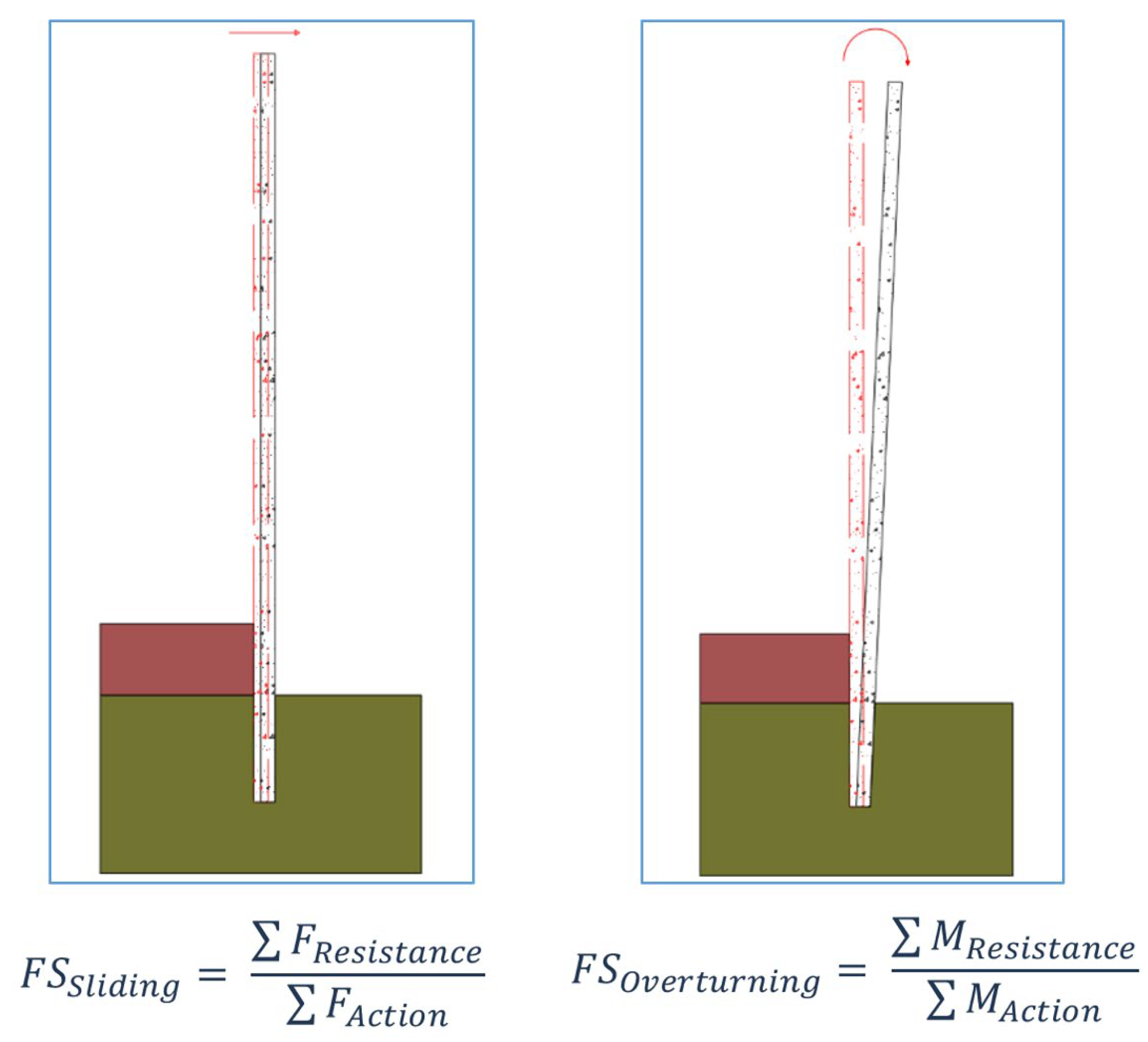
Figure 2. Example of the radar images obtained from repository [38], where the locations of the 2 radars (Bric Della Croce and Monte Lema) are shown, respectively, with red and blue stars. Also, the three ground control points (GCP) of Biella, Lodi and Sondrio cities adopted for image geo-referencing are reported. The scale of intensity and relative RGB colours is shown in the map.
Climate 14 00090 g002
Figure 3. Examples of debris flow vulnerability curves as a function of debris height and velocity (a) and of the type of structure (b) (from [16,46], modified after).
Climate 14 00090 g003
Figure 4. Geometrical features of poles (a) and pylons (b) powerline infrastructures evaluated considering the lateral impact (orange arrow) of debris flow (red box). Foundation terrain is represented in green.
Climate 14 00090 g004
Figure 5. Vulnerability curves computed for poles and pylons as a function of debris flow heights, applying limit equilibrium analysis on overturning and sliding failure mechanisms.
Climate 14 00090 g005
Figure 6. Risk matrix adopted in this study, considering hazard and vulnerability values calculated with CRHyME, MIST-DF and the powerlines vulnerability curves, from [50], modified after.
Climate 14 00090 g006
Figure 7. (a) Rainfall threshold curves from [51] are available for shallow landslide and debris flow failure in an Alpine environment. (b) Probabilistic interpretation of the rainfall threshold curve dispersion, expressing the composite probability P D F | I , D . Curves’ dispersion is bounded inferiorly by the Marchi ’02 threshold and superiorly by the Paronuzzi ’98 threshold.
Climate 14 00090 g007
Figure 8. Risk evaluation using the P D F | I , D evaluated for threshold curve analysis. As the severity of the rainfall event (I-D point higher in the graph) increases, the probability of having a shallow landslide or debris flow failure tends to rise, and the risk increases accordingly.
Climate 14 00090 g008
Figure 9. Location of Talamona case study (Sondrio Province, Lombardy, Italy) where the Malasca Basin is represented by yellow polygon.
Climate 14 00090 g009
Figure 11. IFFI census of Talamona and Campo Tartano case study, where landslide types (see legend) and points (*) are indicated [23].
Climate 14 00090 g011
Figure 12. Photographic interpretation of the July 2008 debris flow occurred in the Malasca basin, from [19] and modified after.
Climate 14 00090 g012
Figure 13. (a) Rainfall field reconstruction of the 11–14 July 2008 event from radar images, from [28], modified after. (b) Rainfall amounts triggered shallow landslides, and the rain gauge location with respect to the Malasca basin for the Talamona case study. From [56], modified after.
Climate 14 00090 g013
Figure 14. (a) Post-event soil moisture computed by CRHyME with respect to the area where geo-hydrological issues were recorded using uncorrected radar images. A probable shift of the highest rainfall amounts is expected to be around 5–10 km in the NE direction. (b,c) Calculation of the probable rainfall shift occurred on the ground due to sustained wind velocity coming from the SW during the 13 July morning using parabolic motion equations and the empirical equation proposed by [67]. (d,e) Comparison between not-corrected and corrected rainfall fields: the NE shift applied on the right images moves the area with the highest rainfall amounts closer to the Malasca basin. (*) are fictious rain gauges evaluated from radar map in the proximity of the Malasca Basin.
Climate 14 00090 g014
Figure 15. (a) Soil saturation reconstruction of the 11–14 July 2008 post-event using CRHyME software. In the blue circle, the area that experienced the greatest soil moisture saturation is highlighted, while in the red circle, the area where the mapped geo-hazard occurred is shown. (b) Safety factor (FS) for debris flow using CRHyME software overlapped with the cumulated rainfall of the analysed event. The spatial frequency of the predicted instabilities is higher over most large, cumulated rainfall amounts, from [28], modified after.
Climate 14 00090 g015
Figure 16. Source Q (in m3 s−1, (a)) and V (in m3, (b)) of debris flow calculated using (12), varying k parameter value (0.01, 0.02 and 0.05).
Climate 14 00090 g016
Figure 17. Runout modelling using MIST-DF software: (a) computed debris flow height, (b) velocity and (c) discharge at monitoring points from 1 to 5. Changing the rheology, the kinematic behaviour of the debris flow changes and the highest discharge and velocities are recorded in the transit area above the fan apex and between monitoring points n°2 and 4. (d) Runout modelling using MIST-DF software showing monitoring points (MPs), source points (SPs), and pylon and pole locations (points).
Climate 14 00090 g017
Figure 18. Runout modelling using MIST-DF software: (a) computed debris flow height, (b) velocity and (c) discharge, from [28], modified after.
Climate 14 00090 g018
Figure 19. Vulnerability curves obtained from the limited equilibrium (“EL”) analysis (see Appendix C, for poles and pylons), the curves presented in [46] (“combined”, see Figure 3a with V~10 m s−1) and the curve reported in [16] (“TF 1” and “TF 2”, see Figure 3b). In blue dashed line is reported the “average” vulnerability curve, obtained averaging all the curves reported.
Climate 14 00090 g019
Figure 20. Poles (yellow lines and arrows) damaged during the event of July 2008 in Talamona (Sondrio Province): red circles show the location of the photos on the right.
Climate 14 00090 g020
Figure 21. (a) Pylon at risk in the proximity of the source points of shallow landslides computed by CRHyME. In circle 1 is presented the vulnerable area of Albaredo (SO), and in circle 2 the area of Campo Tartano, from [56], modified after. (b) Pylon at risk in the proximity of the runout areas of debris flow computed by MIST-DF. In circle 1 is presented the vulnerable area of Talamona settled downstream of the Malasca basin, from [56], modified after.
Climate 14 00090 g021
Figure 22. Transmission and distribution powerlines are located across the fan apex of the Malasca River. Pole (orange line and arrows) and pylon (red line and arrows) locations are shown.
Climate 14 00090 g022
Figure 23. Rainfall series recorded for the events of (a) July 2008 and (b) April 2024, which have triggered debris flows across the investigated area. In both events, rainfall intensity has reached and surpassed the thresholds proposed by Ceriani and Caine [31], considered valid for detecting possible debris flow failure triggering. In the graph are shown the event phases (4 for July 2008 and 3 for April 2024), defined as a function of the different rainfall intensities recorded. The red star indicated the moment of debris flow activation.
Climate 14 00090 g023
Figure 24. Visual interpretation of Table 11, where I-D points are plotted against rainfall thresholds for the July 2008 event. (*) are fictious rain gauges evaluated from radar map in the proximity of the Malasca Basin.
Climate 14 00090 g024
Figure 25. Poles damaged during the event of 1 April 2024 near Campo Tartano (Sondrio Province). Red arrow shows the direction of debris flow downstream propagation.
Climate 14 00090 g025
Figure 26. Visual interpretation of Table 12, where I-D points are plotted against rainfall thresholds for the April 2024 event.
Climate 14 00090 g026
Figure 27. Correlation between rainfall intensity I and %MAP proposed by [75] considering the seasonality (see the legend where winter, spring, summer and fall events are reported).
Climate 14 00090 g027
Figure 28. Powerline risk assessment (points) applying the empirical approach based on threshold curves (using the risk scale of Table 4) for the two events of July 2008 for D = 3 h (a) and April 2024 for D = 12 h (b). In (a), see the red circle showing the “non-detected” powerline at risk due to debris flow runouts. (*) are fictious rain gauges evaluated from radar map in the proximity of the Malasca Basin.
Climate 14 00090 g028
Figure 29. Application of the future climate change modification to the two approaches proposed, evaluating modifications in powerline risk assessment starting from DDFC recalculation.
Climate 14 00090 g029
Table 1. Table of conversion from RGB image to grey-scale .tiff image, considering the minimum, maximum and mean intensity computed from pixel scale colours. From cyan to magenta, the rainfall intensity (expressed in mm h−1) is reported to increase. Mean intensity has been adopted in this study as a representative value.
Pixel ColourRGB CodeMin Intensity [mm h−1]Max Intensity [mm h−1]Mean Intensity [mm h−1]
“cyan”(0,153,153)010.5
“green”(0,255,0)132
“yellow”(255,255,0)3106
“orange”(255,153,51)103020
“red”(255,0,0)3010060
“magenta”(255,51,204)100300200
Table 2. EI and TI indices are adopted for calculating GS. EI decreases with the strength of the lithological class, while TI is a function of the debris flow rheology.
Lithological ClassEIGS Weight
Alluvial and Morenic55
Gneiss and Metamorphic44
Marls33
Basalts and Lavic Rocks22
Limestones11
Granites and Diorites00
Flow TypeTIGS weight
Debris Flow11
Debris Flood (closer to flood)20.87
Bed Load (flood)30.80
Table 3. Powerline vulnerability is estimated from landslide FS across slope areas.
IndicationsLandslide StateFS—Landslide
Safety Factor
V—Powerline
Vulnerability
Damage
Intensity
Safety
Condition
Stable20-
Intermediate
Conditions
Stable1.50.2-
Critical1.30.5Minimal
Very Critical1.150.8Cracks, Minor Deformations
Failure
Condition
Unstable11Structural Failure
Table 4. Risk scale proposed as a simplified version of the risk matrix of Figure 6, considering the landslide probability of failure P D F | I , D and a vulnerability of the powerline asset equal to 1.
PDF|(I,D)VulnerabilityRisk
0.8–1.01Very High 0.8–1.0
0.6–0.81High 0.6–0.8
0.4–0.61Moderate 0.4–0.6
0.2–0.41Low 0.2–0.4
≤0.21Very Low ≤0.2
Table 5. Hydro-mechanical soil properties adopted in the slope stability analysis with CRHyME.
ParameterDescriptionLiterature Values RangeSlope Stability Analysis
γdryDry unit weight volume [kN m−3]14–1515
γsatWet unit weight volume [kN m−3]20–2221
KsSaturated permeability [m s−1]~10−62 × 10−6
ϕFriction angle [°]25–4334
cCohesion [kPa]1–3010
h_terrainTerrain depth [m]1–2~2
TextureSandy loam/loam--
Table 6. Precipitation analysis was conducted also considering the possible rainfall field north-eastern shift. Applying the radar data correction, RMSE was reduced sensibly from 33 mm to 15 mm on average. (*) are fictious rain gauges evaluated from radar map in the proximity of the Malasca Basin.
Station
Investigated
P
Reconstructed [mm]
P
Measured (from ARPA Lombardia) [mm]
P
Radar (from [56]) [mm]
P
Shifted Adjusted
BIAS
ARPA—Not Adjusted [mm]
BIAS
ARPA—Adjusted [mm]
Morbegno58.40119.6<100112−61.2−7.6
Valmasino103.25117.4<100106.2−14.15−11.2
Caiolo7295<10079−23−16
Foppolo78.694.2<100102.5−15.68.3
Mezzoldo137.8110.1<10012827.717.9
Pescegallo217.4174100–130171.643.4−2.4
Malasca * 120-130–260224.4--
Baitridana *155.6-130–260241.2--
Cedrasco7090<100105−2015
RMSE Not Adjusted [mm]RMSE Adjusted [mm]
~33~15
Table 7. Analysis of Wyoming radiosonde data of Milano Linate station (the nearest to the investigated area, about ~100 km distance) recorded on 13 July 2008 morning. Mean data of wind velocity and direction considers a range of from 1000 hPa up to 300 hPa. The calculation of the probable rainfall shift Xg occurred on the ground due to sustained wind velocity during considered a total radar beam height of ~4000 m a.s.l. (i.e., 2000 m above average Orobie mountain range elevation).
SymbolDescription13 July 2008 00:00 UTC13 July 2008 06:00 UTC13 July 2008 12:00 UTC
V0x [km h−1]Mean velocity in km h−151.5960.0749.47
V0x [m s−1]Mean velocity in m s−114.3316.6913.74
D [-]Mean wind directionSWSSWWSW
LFC [m]Level of free convection in m323814571623
LCL [m]Lifting condensation level in m11315011443
Xg [m]Ground raindrop drift in m5719.196688.965479.45
Xg [km]Ground raindrop drift in km5.726.695.48
T = 0 °C Elev [m]Freezing level in m407139903200
Table 8. Debris flow simulation varying rheology, recorded at five monitoring points.
HeightVelocityDischargeTiming
Hydraulic.lower than others
(<0.3 m)
highest
(up to 15 m s−1)
highest
(up to 110 m3 s−1)
faster (MP5 reached in 850 s~15 min)
Chezyhighest
(up to 0.9 m at MP3)
similar to “Hydraulic”similar to “Hydraulic”slightly delayed (100 s)
Rickenmannhighest for MP4 and MP5
(up to 0.1–0.2 m)
lower than others
(<10 m s−1)
lower than others
(−30/−50%)
significantly delayed (>300 s)
Table 9. Vulnerability calculation varying rheology and considering the “average” vulnerability curves (blue) of Figure 19, using debris flow height recorded at monitoring points n° 2–3–4 and 5.
Model“Average” Vulnerability Curve
MP2MP3MP4MP5
Hydraulic0.43 (H = 0.4 m)0.47 (H = 0.5 m)0.21 (H = 0.1 m)0.2 (H < 0.1 m)
Chezy0.47 (H = 0.55 m)0.56 (H = 0.9 m)0.33 (H = 0.2 m)0.2 (H < 0.1 m)
Rickenmann0.50 (H = 0.6 m)0.51 (H = 0.7 m)0.25 (H = 0.15 m)0.2 (H < 0.1 m)
Table 10. Vulnerability calculation varying rheology and applying the impact-pressure curve calculated by [18] and using data recorded at monitoring points n° 2–3 and 4.
HydraulicChezyRickenmann
h [m]0.50.90.7
v [m s−1]101010
ρ [kg/m3]200020002000
Static [Pa]784814,12610,987
Dynamic [Pa]60,00060,00060,000
Ratio Dynamic/Static845
Sum [Pa]67,84874,12670,987
Sum [kPa]~68~74~71
Table 11. (a) Comparison of the recorded rainfall intensities for durations of 1 h, 3 h, 6 h, 12 h and 24 h for the event of July 2008 with respect to the Ceriani ’94 threshold. In red are highlighted the values that exceeded the threshold (in green the values below the threshold). (b) Risk evaluation considering the rainfall I-D distribution with respect to threshold curves and the risk scale of Table 4: lower risk locations are in green, while the most hazardous areas are in yellow and red. (*) are fictious rain gauges evaluated from radar map in the proximity of the Malasca Basin.
(a) Rainfall Intensities (I) (b) Evaluated Risk (R)
Event 2008 D = 1 hD = 3 hD = 6 hD = 12 hD = 24 hEvent 2008D = 1 hD = 3 hD = 6 hD = 12 hD = 24 h
Pescegallo2416.4710.037.424.44Pescegallo0.450.600.250.950.95
Morbegno119.29.535.434.822.78Morbegno10.400.400.010.010.01
Morbegno22210.676.075.12.83Morbegno20.430.400.010.010.01
Baitridana *37.6724.2816.1910.356.36Baitridana *0.700.980.980.990.95
Malasca *15.1711.288.445.43.77Malasca *0.050.250.250.050.05
Cedrasco117.674.833.172.33Cedrasco0.010.010.010.010.01
Valmasino10.67.775.023.922.55Valmasino0.010.010.010.010.01
Caiolo12.26.734.23.082.4Caiolo0.010.010.010.010.01
T. Ceriani ‘9420.110.987.55.123.5
Table 12. (a) Comparison of the recorded rainfall intensities for durations of 1 h, 3 h, 6 h, 12 h and 24 h for the event of April 2024 with respect to the Ceriani ’94 threshold. In red are highlighted the values that exceeded the threshold (in green the values below the threshold). (b) Risk evaluation considering the rainfall I-D distribution with respect to the threshold curves: lower risk locations are in green, while the most hazardous areas are in yellow and red according to Table 4.
(a) Rainfall Intensities (I) (b) Evaluated Risk (R)
Event 2024D = 1 hD = 3 hD = 6 hD = 12 hD = 24 hEvent 2024D = 1 hD = 3 hD = 6 hD = 12 hD = 24 h
Fuentes7.45.674.333.022.1Fuentes0.010.010.010.010.01
Gerola1110.739.437.825.07Gerola0.010.250.50.80.8
Bema8.67.876.64.923.28Bema0.010.010.020.450.45
Morbegno5.84.333.372.61.83Morbegno0.010.010.010.010.01
Campo Tartano14.8812.078.735.344.37Campo Tartano0.050.450.250.50.5
Ardenno7.226.966.195.093.75Ardenno0.010.010.010.30.3
Buglio6.24.473.732.952.08Buglio0.010.010.010.010.01
T. Ceriani ‘9420.110.987.55.123.5
Disclaimer/Publisher’s Note: The statements, opinions and data contained in all publications are solely those of the individual author(s) and contributor(s) and not of MDPI and/or the editor(s). MDPI and/or the editor(s) disclaim responsibility for any injury to people or property resulting from any ideas, methods, instructions or products referred to in the content.