


Abstract
This study focuses on the recovery and digitization of three fragmentary meteorological datasets from the archives of the Royal Observatory of the Spanish Navy in Cádiz, covering selected days in 1776, 1788, and 1793. These records include temperature, pressure, and occasional wind observations originally linked to astronomical measurements. After manual transcription and quality control, the historical data were compared with long-term climate statistics from the period 1955–2021 for Cádiz. Despite the absence of metadata on instruments and installation, the 18th-century observations show reasonable agreement with present-day seasonal patterns, indicating their reliability. Wind data, although limited, were documented using an eight-point wind rose and terminology consistent with historical standards. These findings highlight the scientific and historical value of scattered early observations. They provide reference points for validating historical reanalysis and suggest that additional records may exist in naval archives. Continued efforts to recover such data will improve long-term climate reconstructions for southern Spain and beyond.
1. Introduction
Recovering historical meteorological series is a highly relevant and essential task for building long datasets that enable a better understanding of climate variability, as well as long-term trends and extreme values of different variables [1,2,3]. Recovering early meteorological records is particularly crucial for the eighteenth and nineteenth centuries, as several studies have shown that a large number of instrumental observations from this period remain undigitized or insufficiently exploited [4,5,6]. These data represent a critical source of information for extending instrumental climate records and improving our understanding of past climate variability prior to the widespread establishment of standardized meteorological networks. For this reason, rescuing climate data must remain an ongoing, long-term commitment [7,8]. The process of retrieving these historical observations requires substantial effort from numerous scientists worldwide. Early efforts in historical climatology were strongly shaped by pioneering initiatives such as the ClimHist project (https://www.euroclimhist.unibe.ch/, last accessed: 8 January 2026) led by Prof. Christian Pfister, which demonstrated the scientific value of systematically analyzing documentary sources to reconstruct past climate variability, particularly prior to the availability of dense instrumental networks. Notable examples of organized international initiatives in this field include the Atmospheric Circulation Reconstructions over the Earth (ACRE) project (http://www.met-acre.org/, last accessed: 8 January 2026). Significant progress has also been made in recovering early meteorological data across various regions, such as Latin America and the Caribbean [9], South Africa [10], Italy [11,12], Switzerland [13] or Ireland [14].
In the Iberian Peninsula, numerous initiatives have been undertaken over the past two decades to recover early meteorological records [15,16]. For instance, Alcoforado et al. [17] retrieved Portuguese meteorological measurements dating back to the 18th century, while the SIGN project concentrated on data from the 19th and early 20th centuries in Portugal [18,19]. In Spain, Domínguez-Castro et al. [20] compiled more than 100,000 meteorological observations prior to 1850, and Vaquero et al. [21] recovered over 750,000 instrumental observations spanning from 1826 to the mid-20th century in the Extremadura region (southwestern interior of the Iberian Peninsula), which are now available in the CliPastExtrem database.
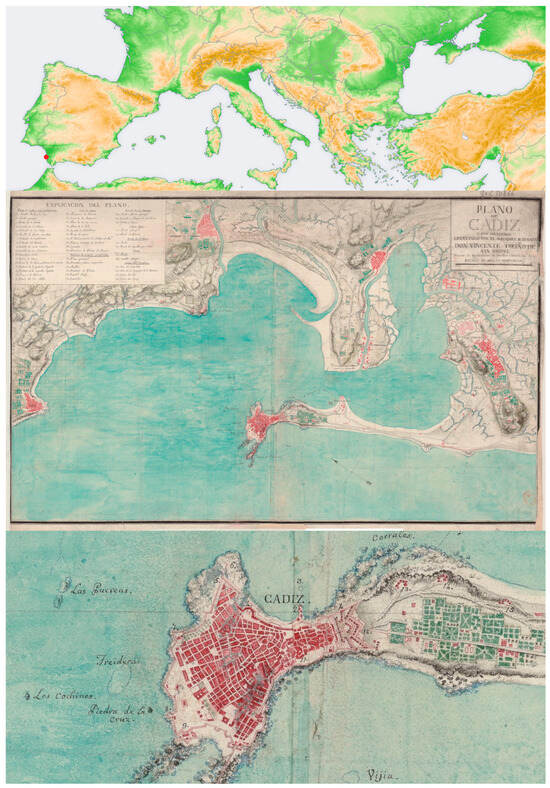
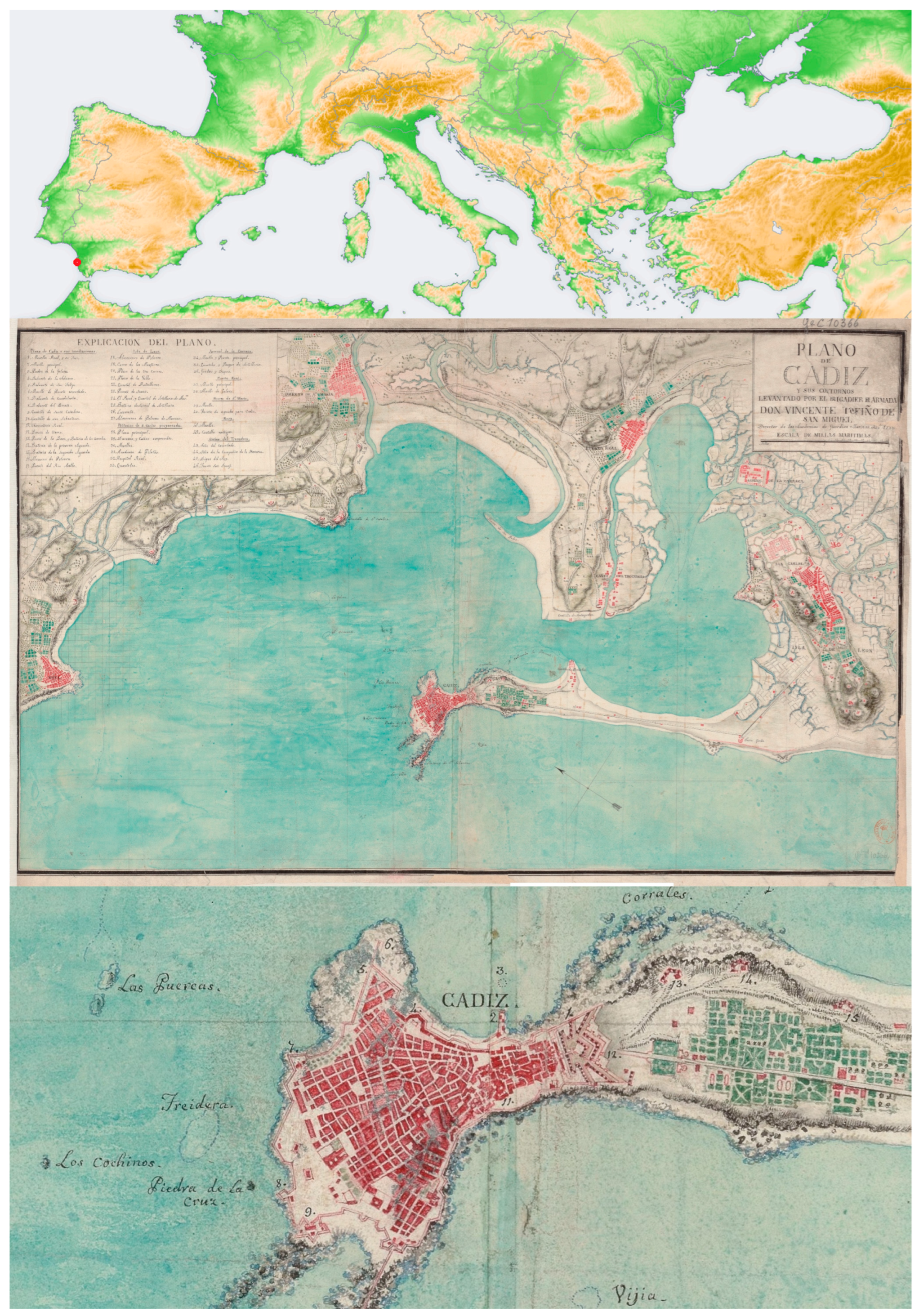
Within this broader context, the city of Cádiz and its surrounding area stand out (Figure 1). This prominence is not only due to the existence of early meteorological records for this location but also to the abundance of observations collected in the region, which facilitates comparative analyses and the construction of reliable climatological series. In the Bay of Cádiz, several initiatives aimed at rescuing historical meteorological data have resulted in a substantial body of scholarly work [22,23,24,25,26,27,28].
Figure 1.
(Upper Panel) Physical map of southern Europe showing the location of the city of Cádiz (red dot). (Middle Panel) “Map of Cádiz and its Surroundings” [Plano de Cádiz y sus contornos] by Vicente Tofiño (1789). The city of Cádiz occupies the center of the image, while the town of San Fernando is located on the right side. (Lower Panel) An enlargement showing the city of Cádiz and the (now demolished) building that housed the Observatory, marked with the number 11. Courtesy of the Historical Archive of the Royal Naval Observatory in San Fernando.
The abundance of documentary sources of meteorological interest in Cádiz can be attributed to two main factors. First, Cádiz was a prosperous city thanks to its port and its thriving trade with the American colonies. This economic activity fostered an enlightened elite with both the knowledge and financial means to acquire meteorological instruments. Numerous towers, located in both public and private buildings, were transformed into meteorological observatories and vantage points for monitoring maritime traffic [29]. Second, in 1753, the Spanish Navy established an astronomical observatory in the “Castillo de la Villa” [Castle of the Town] as an annex to the “Academia de Guardias-Marinas” [Academy of Midshipmen]. Its initial purpose was to teach future naval officers the science of astronomy, a discipline essential for navigation. This observatory became the southernmost in Europe. By the late 18th century, a decision was made to relocate the observatory to the nearby “Isla de León,” now known as San Fernando (Figure 1). A magnificent building was constructed for this purpose, and the transfer was completed in 1798. Since then, the Royal Observatory of the Spanish Navy has remained in San Fernando, preserving an exceptional documentary, bibliographic, and material heritage [30,31,32,33,34].
The extensive documentary collection preserved in the archive of this institution has been widely used for studies on the secular evolution of the solar radius [35], past solar activity [36,37,38], specific astronomical observations [39], and early geomagnetic storms [40,41], in addition to purely meteorological research. The aim of this study is the recovery of three meteorological series that were discovered fortuitously in the historical archive and library of the Royal Observatory of the Spanish Navy (ROA) while searching for solar and, more generally, astronomical observations. These three series contain daily meteorological readings corresponding to some days of the years 1776, 1788, and 1793. This work seeks to retrieve these series and make them available to the international scientific community, thereby contributing to the reconstruction of historical climate data and supporting broader research on long-term atmospheric variability.
2. Historical Sources and Data
All the data recovered in this study originates from historical documents preserved in the archives and historical library of the ROA. The three datasets described in this manuscript were discovered serendipitously. They were rediscovered while we were compiling astronomical observations made at the Observatory, specifically records of solar transits across the meridian. Below, we provide a detailed description of each historical source consulted. Three distinct data series were retrieved, hereafter referred to as Series 1, Series 2, and Series 3, corresponding, respectively, to Source 1, Source 2, and Source 3. For clarity, the discussion follows a chronological order: Series 1 contains data from several days in 1776, while Series 2 and Series 3 correspond to the years 1788 and 1793, respectively.
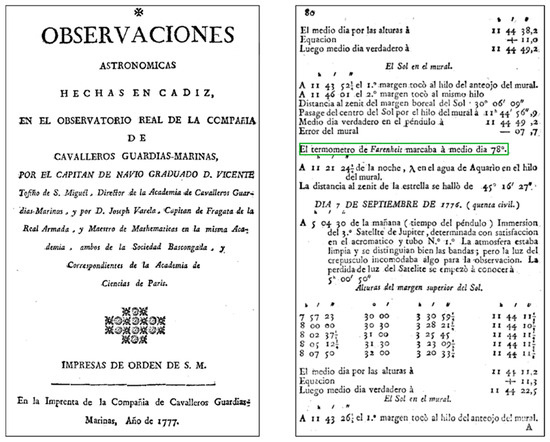
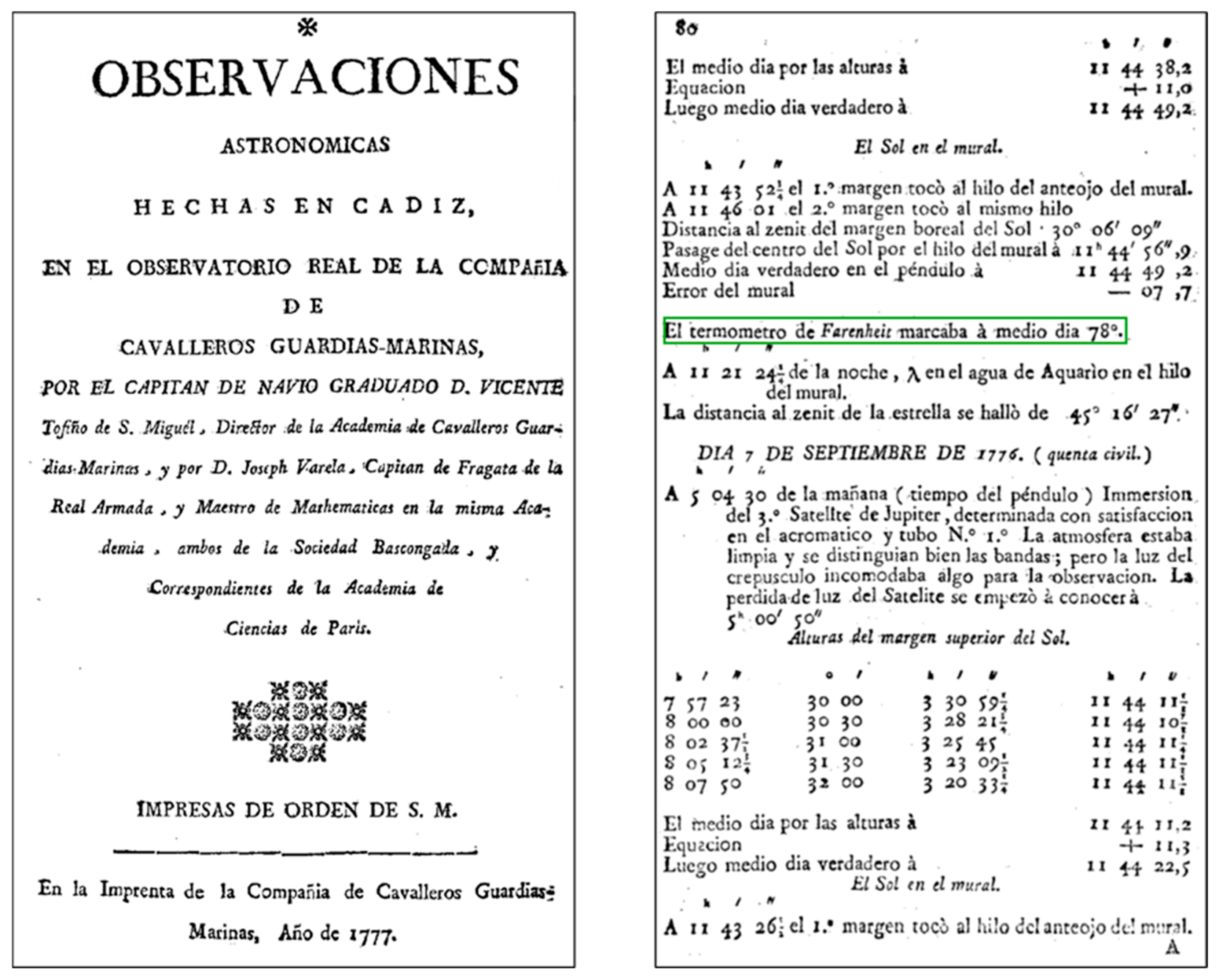
The first source is a printed book entitled “Observaciones Astronómicas hechas en Cádiz en el Observatorio Real de la Compañía de Cavalleros Guardias-Marinas” [Astronomical Observations made in Cadiz at the Royal Observatory of the Company of Knights Midshipmen], authored by Vicente Tofiño and Joseph Varela, both officers of the Spanish Navy (Figure 2). The book was printed in Cádiz by the press of the “Compañía de Cavalleros Guardias-Marinas” [Company of Knights Midshipmen] in 1777. It contains detailed descriptions of astronomical observations carried out at the Cádiz Observatory, many of which were meridian observations, i.e., measurements of celestial bodies crossing the local meridian.
Figure 2.
Cover of the book “Observaciones astronómicas hechas en Cádiz” [Astronomical Observations Made in Cádiz] (1777) by Vicente Tofiño and Joseph Varela, where the thermometric observations carried out in Cádiz are found (left panel). Sample page from this work (in this case, page 80) showing the thermometric reading corresponding to September 6, 1776 (right panel). In the green box, the following can be read: “El termómetro de Farenheit marcaba a medio día 78°” [Fahrenheit thermometer marked 78° at noon].”.
In some of these solar meridian observations, the authors also recorded the temperature of the room where the observations were conducted. This practice was motivated by the astronomers’ interest in assessing the influence of meteorological variables on the performance of the observatory’s pendulum, an essential instrument for maintaining accurate time, a priority in 18th-century astronomical work. It is worth noting that an earlier volume, printed in 1776, documented observations from 1773, 1774, and 1775, but contained no temperature records. Therefore, temperature data are only available for 1776.
Wheeler [23] examined this dataset, concluding that while its scientific value is limited, its historical significance is considerable. However, thirty years later and following the passing of Wheeler [42], these data remain inaccessible to the international research community, except through their original historical source. For this reason, we have reproduced the original thermometer readings in Table A1 of the Appendix A, ensuring their preservation and availability for future studies.
The other two historical sources, associated with the observations from 1788 and 1793, consist of handwritten sheets. These documents were most likely the original working papers used by naval officers to record observational data before it was transcribed into clean copies. Remarkably, these manuscripts have been preserved for more than 230 years, providing invaluable insight into the observational practices of the period.
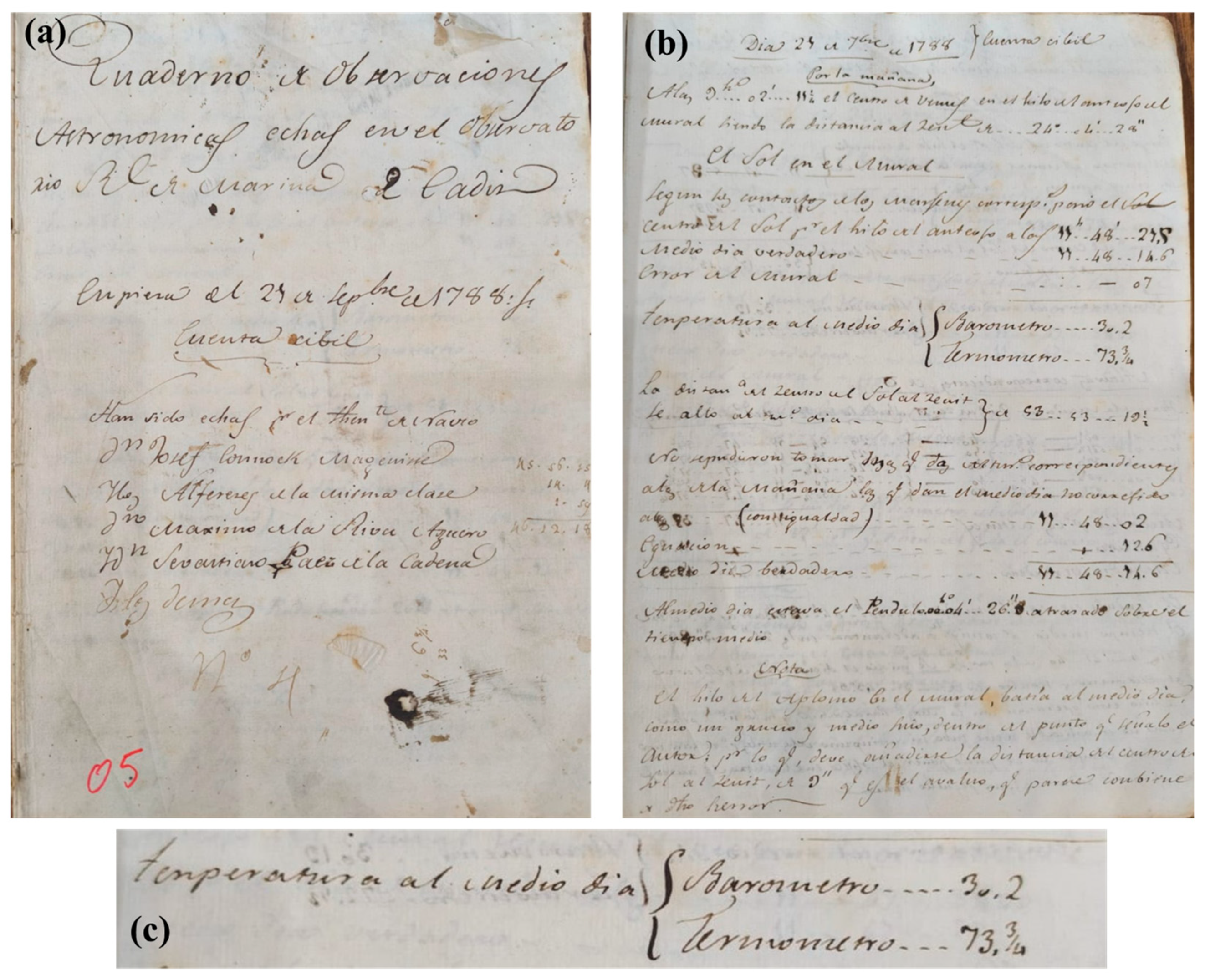
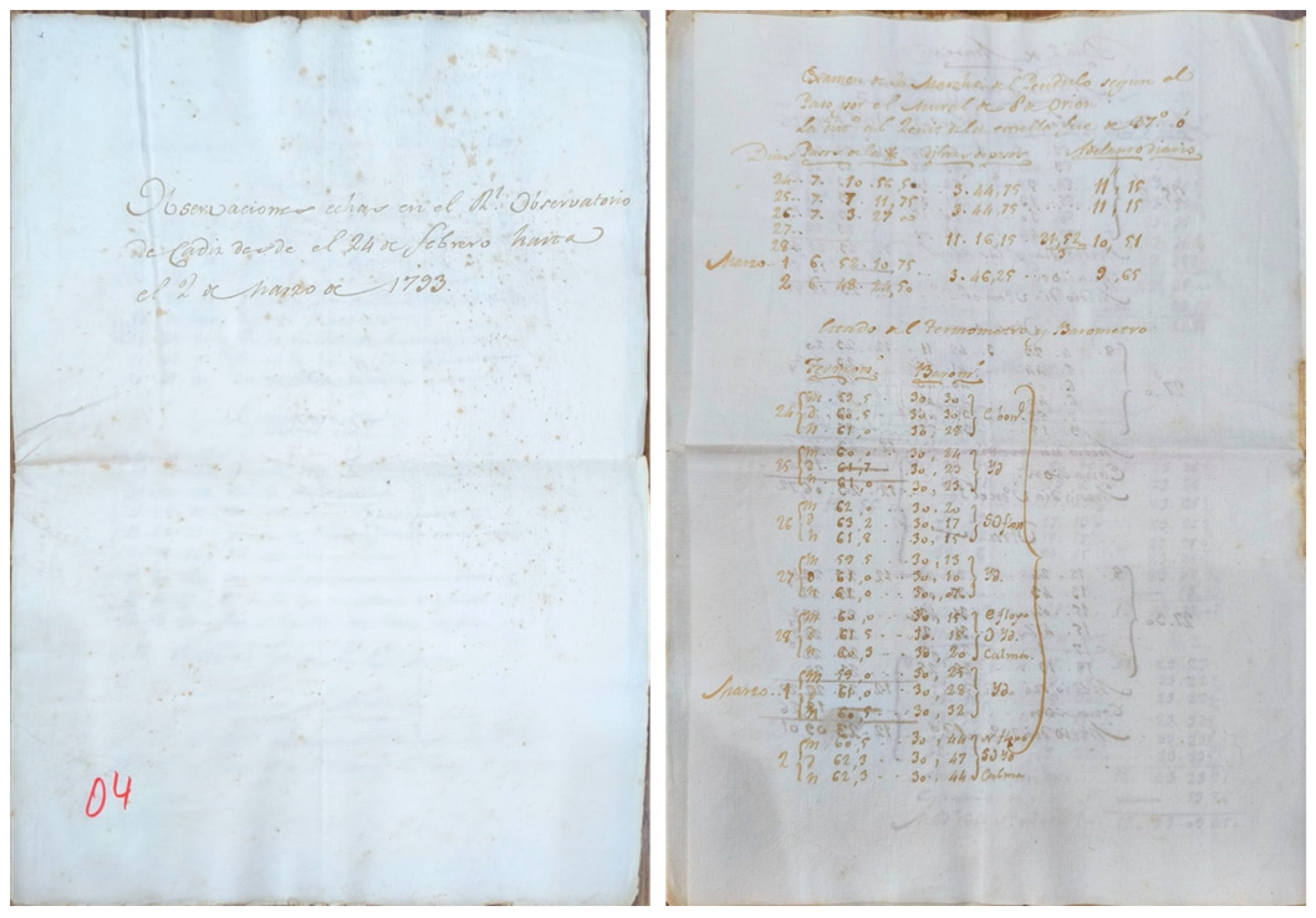
Both Source 2 and Source 3 are stored in standardized archival box number 131, which belongs to the series entitled “Astronomía–observaciones” [Astronomy-observations] within the ROA historical archive. The title of Source 2 reads “Cuaderno de Observaciones Astronómicas echas en el Observatorio Real de Marina de Cádiz. Empieza el 21 de septiembre de 1788” [Notebook of Astronomical Observations made at the Royal Naval Observatory of Cádiz. Begins on 21 September 1788] (Figure 3). Source 3 bears the title: “Observaciones hechas en el Real Observatorio de Cádiz desde el 24 de febrero hasta el dos de marzo de 1793” [Observations made at the Royal Observatory of Cadiz from February 24th to March 2nd, 1793] (Figure 4).
Figure 3.
Handwritten sheets untitled “Cuaderno de Observaciones Astronómicas echas en el Obervatorio Real de Marina de Cádiz. Empieza el 21 de septiembre de 1788” [Notebook of Astronomical Observations made at the Royal Naval Observatory of Cádiz. Begins on 21 September 1788]. The (a) cover page, (b) a sample page, and (c) an enlarged view of the area with meteorological data are shown.
Figure 4.
Handwritten sheets untitled “Observaciones hechas en el Real Observatorio de Cádiz desde el 24 de febrero hasta el dos de marzo de 1793” [Observations made at the Royal Observatory of Cadiz from 24 February to 2 March 1793] (left). A part of the meteorological table in this manuscript (right).
The survival of these original manuscripts is of particular importance because they represent primary observational records rather than later compilations. Their preservation allows for a direct examination of the data as it was initially recorded, offering a unique opportunity to assess the reliability and context of meteorological measurements from the late 18th century.
In Source 2, we find records of pressure and temperature associated with astronomical observations of the Sun’s meridian passage, similar to those in Source 1. Consequently, these measurements were taken precisely at solar noon and, most likely, within the observatory’s main observation hall.
In contrast, Source 3 contains a dedicated table exclusively for meteorological observations. This table includes temperature and pressure readings for three distinct times of day, labeled as “m,” “d,” and “n,” which we interpret as abbreviations for “mañana” (morning), “medio-día” (midday), and “noche” (night). However, the exact timing of these observations remains uncertain, except for the midday measurement. Additionally, the table provides a brief description of the wind direction and velocity.
A major limitation of these historical observations is the absence of metadata. No information is available regarding the instruments used or their installation. For this reason, we assume that temperatures are expressed in the Fahrenheit scale. It should also be noted that there is no indication of the barometer’s scale or the height at which it was installed. The original meteorological readings of Sources 2 and 3 are listed in Table A2 and Table A3 of the Appendix A, respectively.
To compare the historical data with a modern climatology, we used the datasets available through the KNMI Climate Explorer (https://climexp.knmi.nl/) [last accessed: 8 January 2026]. Specifically, we employed data from the station “Cádiz” (ECA station code 415), which covers the period 1955–2021 [43].
3. Results and Discussion
The three datasets were manually transcribed into a machine-readable format without using OCR [44,45]. Manual digitization can introduce errors, which were classified as original errors (incorrect values in the institutional document compared to the observer’s manuscript) and digitization errors (mistakes during transcription from the original source). Some errors are difficult to detect, such as those in decimal digits, while others are more evident, like outliers in leading digits. A visual check was performed immediately after transcription.
A basic quality control was applied to daily data to identify typos and suspicious values, following procedures similar to Domínguez-Castro et al. [9] and Vaquero et al. [21]. This included the following: (i) “Tolerance” tests (outliers beyond ±3 standard deviations), (ii) “Temporal consistency” checks (differences between consecutive days), and (iii) “Limit” tests (values outside plausible ranges). All daily temperature and pressure values passed these tests, and no anomalies were flagged.
In this section, we compare the historical pressure and temperature records with a modern climatology for Cádiz. Wind direction and speed data are not included in this comparison due to their very limited coverage (only one week) and high variability. Nevertheless, these observations are provided in the Appendix A to ensure their availability to the international scientific community. In any case, it can be stated that the officers employed an eight-point wind rose and several commonly used terms to describe wind speed, consistent with those listed in the multilingual meteorological dictionary CLIWOC [46].
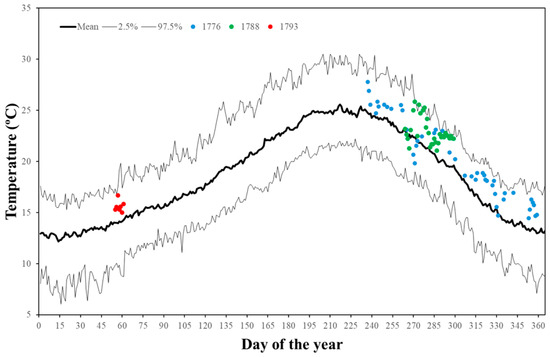
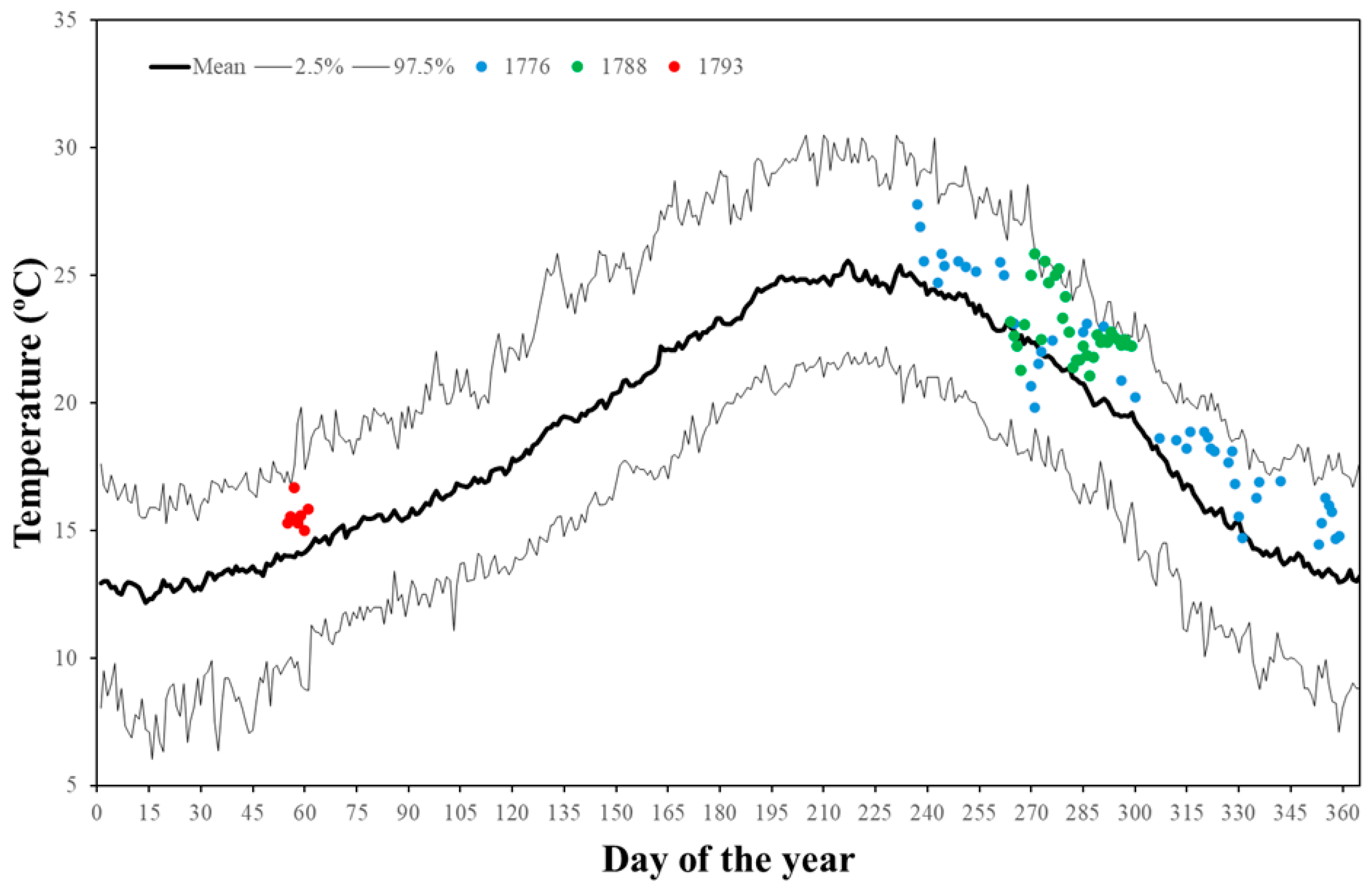
Figure 5 displays the thermometric observations recorded in Cádiz (blue dots for 1776, green dots for 1788, and red dots for 1793) as presented in the Appendix A of this work. For the 1793 dataset, only the midday readings were selected. The figure also includes solid lines representing a daily long-term climate statistic for Cádiz during the period 1955–2021: thin lines indicate the 2.5th and 97.5th percentiles, while the thicker line shows the mean value. Overall, the 18th-century observations align reasonably well with this modern climatology. Most measurements lie slightly above the contemporary mean temperature but without significant deviations. This pattern is expected, as the historical observations were taken around midday, approximately two to three hours before the daily maximum temperature. Furthermore, we assume that the thermometer was installed indoors, likely in a well-ventilated room typical of an observatory setting. In any case, the data should be taken with great caution due to the possible effects of thermal inertia and even the effects of some possible internal heat source. Thus, the systematically higher temperatures with respect to modern values, as shown in Figure 5, are therefore not unexpected and are fully consistent with the observational context.
Figure 5.
Thermometric observations recorded in Cádiz (dots) for the years 1776, 1788, and 1793. Solid lines represent a daily climatology (2.5th percentile, mean value, and 97.5th percentile) of the mean temperature in Cádiz for the period 1955–2021.
Unfortunately, no contemporary instrumental observations from stations close to Cádiz are available for the periods covered by the recovered datasets, which prevents a direct comparison with nearby records. However, weekly qualitative weather descriptions from the town of Zafra, located in the interior of southwestern Iberia, slightly more than 200 km north of Cádiz, are preserved in the Municipal Archive of Zafra [47]. A qualitative comparison between the temperature values recorded in Cádiz and the contemporaneous weather descriptions from Zafra indicates no apparent inconsistencies. The reported weather conditions in Zafra are broadly compatible with the temperature variability observed in Cádiz, providing additional contextual support for the plausibility of the recovered temperature records, despite the lack of nearby instrumental data.
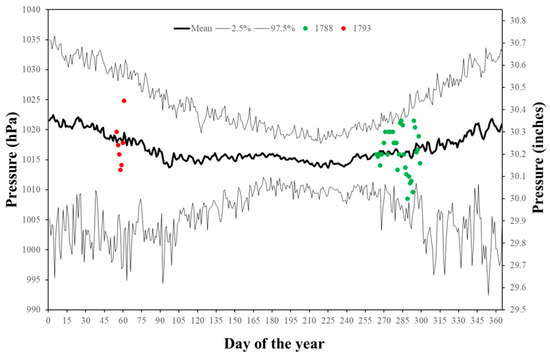
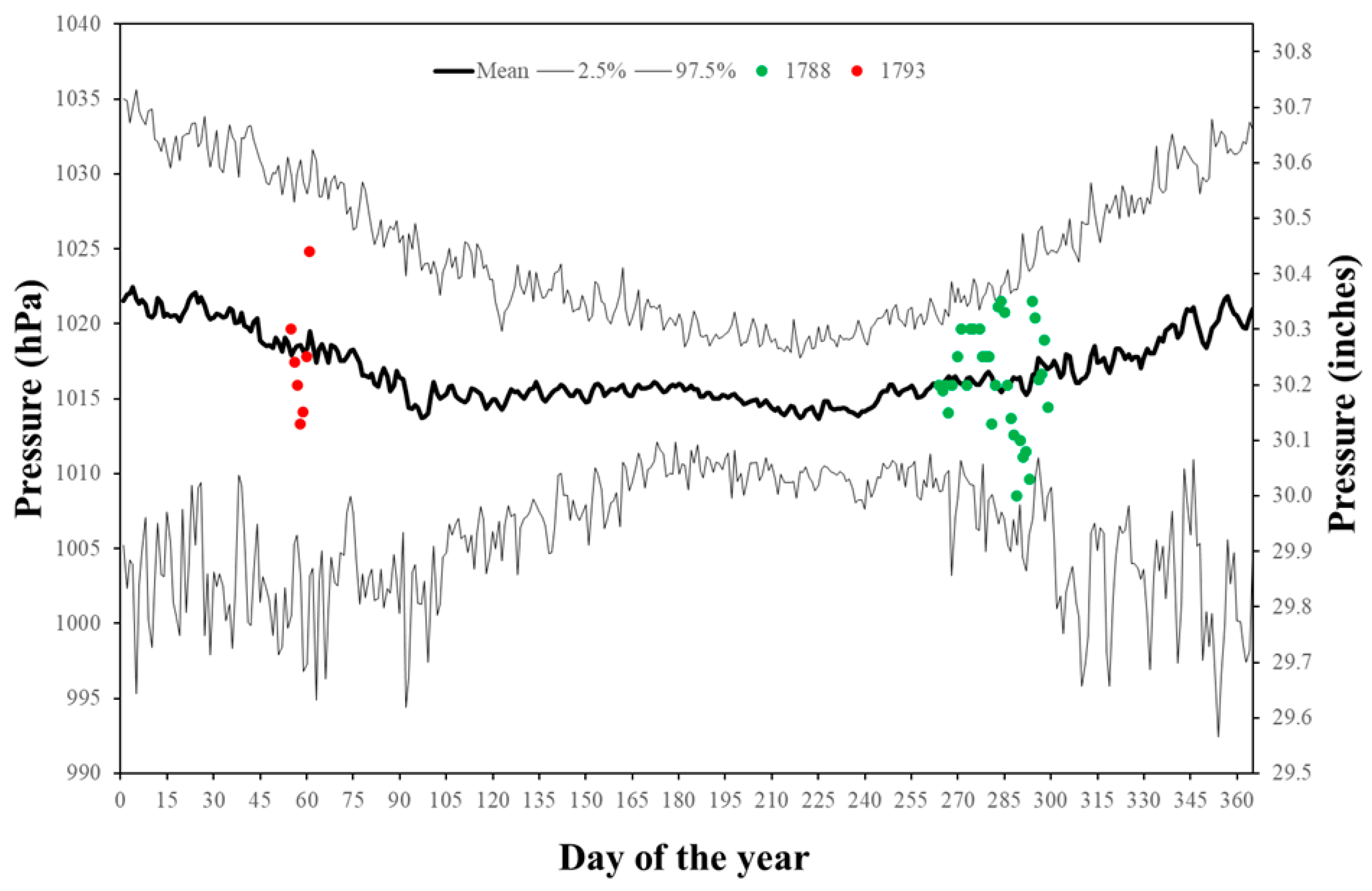
Figure 6 presents the barometric observations recorded in Cádiz for the years 1788 (green dots), and 1793 (red dots). The figure also includes solid lines representing a daily climatology of atmospheric pressure in Cádiz for the period 1955–2021. Thin lines indicate the 2.5th and 97.5th percentiles, while the thicker line shows the mean value.
Figure 6.
Barometric observations recorded in Cádiz (dots) for the years 1776, 1788, and 1793. Solid lines represent a daily climatology (2.5th percentile, mean value, and 97.5th percentile) of atmospheric pressure in Cádiz for the period 1955–2021.
Unfortunately, the absence of metadata prevents an exact comparison. Although the barometric readings are expressed in inches, numerous length standards existed at the time, even in meteorology [48]. However, this issue is minor compared to the uncertainty regarding the barometer’s location. The elevation of the instrument is critical for reducing and homogenizing pressure measurements. Even knowing that the observations were made at the former Castillo de Cádiz (now demolished), assigning a precise installation height remains difficult. For these reasons, we opted for an empirical adjustment between the historical and modern data, as shown in Figure 6. This approach suggests that the historical records capture the seasonal cycle of atmospheric pressure reasonably well, with greater variability during the winter months. Please note that, because the exact installation height of the barometer is unknown, the pressure data can only be interpreted in terms of relative barometric trends rather than absolute pressure values.
From a historical perspective, these findings encourage the scientific community to continue searching for additional dispersed records in the archives of the Spanish Navy, which could complement the series recovered in this study as well as previously published datasets from the Bay of Cádiz region.
4. Conclusions
This study reports the recovery and digitization of three fragmentary meteorological datasets from the archives of the Royal Observatory of the Spanish Navy in Cádiz, covering selected days in 1776, 1788, and 1793. These records include temperature, pressure, and occasional wind observations originally associated with astronomical measurements. After transcription and quality control, the historical data were compared with modern climatology (1955–2021) for Cádiz. Despite the absence of metadata regarding instruments and installation, the 18th-century observations show a reasonable agreement with seasonal patterns.
Although these scattered and incomplete observations may have limited utility for many climatological applications, they remain significant for several reasons. First, they suggest that systematic observations were likely carried out at the Cádiz Observatory, with additional records possibly preserved in other archives. Second, even fragmentary datasets can serve as reference points for validating historical reanalysis products and reconstructing past atmospheric conditions [49,50].
The successful recovery of these series underscores the importance of archival research for extending instrumental climate records into the pre-industrial era. We encourage further exploration of naval and astronomical archives to identify additional dispersed meteorological observations, which would complement the datasets presented here and contribute to improving long-term climate reconstructions for southern Spain and beyond.
Author Contributions
Conceptualization, J.M.V. and M.C.G.; methodology, J.M.V. and M.C.G.; formal analysis, J.M.V. and M.C.G.; investigation, J.M.V. and M.C.G.; data curation, J.M.V. and M.C.G.; writing—original draft preparation, J.M.V.; writing—review and editing, J.M.V. and M.C.G.; project administration, J.M.V.; funding acquisition, J.M.V. All authors have read and agreed to the published version of the manuscript.
Funding
This research has been supported by the Junta de Extremadura (grant no. GR24049).
Data Availability Statement
The original data presented in the study are openly available in the Appendix A of this article.
Acknowledgments
The authors are in debt to the staff of the historical archive and library of the Royal Observatory of the Spanish Navy in San Fernando (Spain).
Conflicts of Interest
The authors declare no conflicts of interest.
Abbreviations
The following abbreviations are used in this manuscript:
| ACRE | Atmospheric Circulation Reconstructions over the Earth |
| CLIWOC | Climatological Database for the World’s Oceans |
| ECA | European Climate Assessment |
| KNMI | Koninklijk Nederlands Meteorologisch Instituut (Royal Netherlands Meteorological Institute) |
| OCR | Optical Character Recognition |
| ROA | Real Observatorio de la Armada (Royal Observatory of the Spanish Navy) |
Appendix A
All meteorological data recovered in this study are listed below. Table A1, Table A2 and Table A3 present the available observations corresponding to the years 1776, 1788, and 1793, respectively.
Table A1.
Thermometrical readings recovered for 1776 from Source 1 (year 1776).
Table A2.
Meteorological readings recovered for 1788 from Source 2 (year 1788).
Table A3.
Meteorological readings recovered for 1793 from Source 3 (year 1793).
References
- Lamb, H.H. Climate: Present, Past and Future; Routledge: Methuen, MA, USA, 1972; Volume 2. [Google Scholar]
- Brönnimann, S. Climatic Changes Since 1700; Springer: Berlin/Heidelberg, Germany, 2015. [Google Scholar]
- Pfister, C.; Wanner, H. Climate and Society in Europe. The Last Thousand Years; Haupt: Bern, Switzerland, 2021. [Google Scholar]
- Brönnimann, S.; Brugnara, Y.; Allan, R.J.; Brunet, M.; Compo, G.P.; Crouthamel, R.I.; Jones, P.D.; Jourdain, S.; Luterbacher, J.; Siegmund, P.; et al. A roadmap to climate data rescue services. Geosci. Data J. 2018, 5, 28–39. [Google Scholar] [CrossRef] [Scilit]
- Allan, R.J.; Brohan, P.; Compo, G.P.; Stone, R.; Luterbacher, J.; Brönnimann, S. The international Atmospheric Circulation Reconstructions over the Earth (ACRE) initiative. Bull. Am. Meteorol. Soc. 2011, 92, 1421–1425. [Google Scholar] [CrossRef] [Scilit]
- Ashcroft, L.; Allan, R.; Bridgman, H.; Gergis, J.; Pudmenzky, C.; Thornton, K. Current climate data rescue activities in Australia. Adv. Atmos. Sci. 2016, 33, 1323–1324. [Google Scholar] [CrossRef] [Scilit]
- Camuffo, D.; Jones, P. Improved Understanding of Past Climatic Variability from Early Daily European Instrumental Sources; Climatic Change; Springer: Berlin/Heidelberg, Germany, 2002; Volume 53, pp. 1–4. [Google Scholar]
- Brönnimann, S.; Allan, R.; Ashcroft, L.; Baer, S.; Barriendos, M.; Brázdil, R.; Brugnara, Y.; Brunet, M.; Brunetti, M.; Chimani, B.; et al. Unlocking pre-1850 instrumental meteorological records: A global inventory. Bull. Am. Meteorol. Soc. 2019, 100, ES389–ES413. [Google Scholar] [CrossRef] [Scilit]
- Domínguez-Castro, F.; Vaquero, J.M.; Gallego, M.C.; Farrona, A.M.M.; Antuña-Marrero, J.C.; Cevallos, E.E.; García-Herrera, R.; de la Guía, C.; Mejía, R.D.; Naranjo, J.M.; et al. Early meteorological records from Latin-America and the Caribbean during the 18th and 19th centuries. Sci. Data 2017, 4, 170169. [Google Scholar] [CrossRef] [Scilit]
- Picas, J.; Grab, S.; Allan, R. A 19th century daily surface pressure series for the Southwestern Cape region of South Africa: 1834–1899. Int. J. Climatol. 2019, 39, 1404–1414. [Google Scholar] [CrossRef] [Scilit]
- Camuffo, D.; Becherini, F.; della Valle, A. The Beccari series of precipitation in Bologna, Italy, from 1723 to 1765. Clim. Change 2019, 155, 359–376. [Google Scholar] [CrossRef] [Scilit]
- Camuffo, D.; della Valle, A.; Becherini, F.; Zanini, V. Three centuries of daily precipitation in Padua, Italy, 1713–2018: History, relocations, gaps, homogeneity and raw data. Clim. Change 2020, 162, 923–942. [Google Scholar] [CrossRef] [Scilit]
- Pfister, L.; Hupfer, F.; Brugnara, Y.; Munz, L.; Villiger, L.; Meyer, L.; Schwander, M.; Isotta, F.A.; Rohr, C.; Brönnimann, S. Early instrumental meteorological measurements in Switzerland. Clim. Past 2019, 15, 1345–1361. [Google Scholar] [CrossRef] [Scilit]
- Murphy, C.; Broderick, C.; Burt, T.P.; Curley, M.; Duffy, C.; Hall, J.; Harrigan, S.; Matthews, T.K.R.; Macdonald, N.; McCarthy, G.; et al. A 305-year continuous monthly rainfall series for the island of Ireland (1711–2016). Clim. Past 2018, 14, 413–440. [Google Scholar] [CrossRef] [Scilit]
- Martín-Vide, J. (Ed.) Advances in Historical Climatology in Spain; Oikos-Tau: Barcelona, Spain, 1997. [Google Scholar]
- Alberola Romá, A. Los Cambios Climáticos. La Pequeña edad de Hielo en España; Cátedra: Barcelona, Spain, 2014. [Google Scholar]
- Alcoforado, M.J.; Vaquero, J.M.; Trigo, R.M.; Taborda, J.P. Early Portuguese meteorological measurements (18th century). Clim. Past 2012, 8, 353–371. [Google Scholar] [CrossRef] [Scilit]
- Morozova, A.L.; Valente, M.A. Homogenization of Portuguese long-term temperature data series: Lisbon, Coimbra and Porto. Earth Syst. Sci. Data 2012, 4, 187–213. [Google Scholar] [CrossRef] [Scilit]
- Bližnák, V.; Valente, M.A.; Bethke, J. Homogenization of time series from Portugal and its former colonies for the period from the late 19th to the early 21st century. Int. J. Climatol. 2015, 35, 2400–2418. [Google Scholar] [CrossRef] [Scilit]
- Domínguez-Castro, F.; Vaquero, J.M.; Rodrigo, F.S.; Farrona, A.M.M.; Gallego, M.C.; García-Herrera, R.; Barriendos, M.; Sanchez-Lorenzo, A. Early Spanish meteorological records (1780–1850). Int. J. Climatol. 2014, 34, 593–603. [Google Scholar] [CrossRef] [Scilit]
- Vaquero, J.M.; Bravo-Paredes, N.; Obregón, M.A.; Carrasco, V.M.S.; Valente, M.A.; Trigo, R.M.; Domínguez-Castro, F.; Montero-Martín, J.; Vaquero-Martínez, J.; Antón, M.; et al. Recovery of early meteorological records from Extremadura region (SWIberia): The “CliPastExtrem” (v10) database. Geosci. Data J. 2022, 9, 207–220. [Google Scholar] [CrossRef] [Scilit]
- Wheeler, D. The Royal Observatory of San Fernando (Cádiz) and its place in the development of meteorological studies in Spain. Weather 1992, 47, 56–63. [Google Scholar] [CrossRef] [Scilit]
- Wheeler, D. Early instrumental weather data from Cadiz: A study of late eighteenth and early nineteenth century records. Int. J. Climatol. 1995, 15, 801–810. [Google Scholar] [CrossRef] [Scilit]
- Barriendos, M.; Martín-Vide, J.; Peña, J.C.; Rodríguez, R. Daily Meteorological Observations in Cádiz—San Fernando. Analysis of the Documentary Sources and the Instrumental Data Content (1786–1996). Clim. Change 2002, 53, 151–170. [Google Scholar] [CrossRef] [Scilit]
- Gallego, D.; García-Herrera, R.; Calvo, N.; Ribera, P. A new meteorological record for Cádiz (Spain) 1806–1852: Implications for climatic reconstructions. J. Geophys. Res.-Atmos. 2007, 112, D12108. [Google Scholar] [CrossRef] [Scilit]
- Rodrigo, F.S. Completing the early instrumental weather record from Cádiz (Southern Spain): New data from 1799 to 1803. Clim. Change 2012, 111, 697–704. [Google Scholar] [CrossRef] [Scilit]
- Rodrigo, F.S. Early meteorological data in southern Spain during the Dalton Minimum. Int. J. Climatol. 2019, 39, 3593–3607. [Google Scholar] [CrossRef] [Scilit]
- Bravo-Paredes, N.; Gallego, M.C.; Trigo, R.M.; Vaquero, J.M. Earliest meteorological readings in San Fernando (Cádiz, Spain). Clim. Past 2023, 19, 1397–1408. [Google Scholar] [CrossRef] [Scilit]
- García Herrera, R. (Ed.) El Clima de Cádiz en la Primera Mitad del Siglo XIX Según los Partes de la Vigía; Servicio de Publicaciones de la Fundación Unicaja: Málaga, Spain, 2008. [Google Scholar]
- Lafuente, A.; Sellés, M. El Observatorio de Cádiz (1753–1831) [The Observatory of Cádiz (1753–1831)]; Ministerio de Defensa: Madrid, Spain, 1988. [Google Scholar]
- González González, F.J. El Observatorio de San Fernando (1831–1924) [The Observatory of San Fernando (1831–1924)]; Ministerio de Defensa: Madrid, Spain, 1992. [Google Scholar]
- González González, F.J. El Observatorio de San Fernando en el Siglo XX [The Observatory of San Fernando in the 20th Century]; Ministerio de Defensa: Madrid, Spain, 2004. [Google Scholar]
- González González, F.J. Instrumentos Científicos del Observatorio de San Fernando. Siglos XVIII, XIX y XX; Ministerio de Defensa: Madrid, Spain, 1995. [Google Scholar]
- Martínez Rodríguez de Lema, M.E. Los Fondos Humanísticos del Real Instituto y Observatorio de la Armada en San Fernando; Universidad de Cádiz: Cádiz, Spain, 2005. [Google Scholar]
- Vaquero, J.M.; Gallego, M.C.; Ruiz-Lorenzo, J.J.; López-Moratalla, T.; Carrasco, V.M.S.; Aparicio, A.J.P.; González-González, F.J.; Hernández-García, E. Monitoring the Solar Radius from the Royal Observatory of the Spanish Navy Since 1773. Sol. Phys. 2016, 291, 1599–1612. [Google Scholar] [CrossRef] [Scilit]
- Vaquero, J.M.; Gallego, M.C. Reconstructing Past Solar Activity using Meridian Solar Observations: The Case of the Royal Observatory of the Spanish Navy (1833–1840). Adv. Space Res. 2014, 53, 1162–1168. [Google Scholar] [CrossRef] [Scilit]
- Galaviz, P.; Vaquero, J.M.; Gallego, M.C.; Sánchez-Bajo, F. A small collection of sunspot drawings made in the Royal Astronomical Observatory of the Spanish Navy in 1884. Adv. Space Res. 2016, 58, 2247–2254. [Google Scholar] [CrossRef] [Scilit]
- Gallego, M.C.; Aparicio, A.J.P.; Carrasco, V.M.S.; Vaquero, J.M. Three Scattered Sunspot Records in the Archive of the Royal Astronomical Observatory of the Spanish Navy (1789–1790). Res. Notes AAS 2023, 7, 235. [Google Scholar] [CrossRef] [Scilit]
- Almorza-Salas, D.; Almorza-Gomar, D. References of Halley’s Comet at the Royal Observatory of Cádiz (Spain). Phys. Astron. Int. J. 2020, 4, 169–170. [Google Scholar] [CrossRef] [Scilit]
- Ribeiro, P.; Vaquero, J.M.; Gallego, M.C.; Trigo, R.M. The first documented space weather event that perturbed the communication networks in Iberia. Space Weather 2016, 14, 464–468. [Google Scholar] [CrossRef] [Scilit]
- Hayakawa, H.; Ribeiro, P.; Vaquero, J.M.; Gallego, M.C.; Knipp, D.J.; Mekhaldi, F.; Bhaskar, A.; Oliveira, D.M.; Notsu, Y.; Carrasco, V.M.S.; et al. The Extreme Space Weather Event in 1903 October/November: An Outburst of Quiet Sun. Astrophys. J. Lett. 2020, 897, L10. [Google Scholar] [CrossRef] [Scilit]
- Burt, S.; Jones, P. Dennis Alexander Wheeler (latterly known as Deborah Smith) 1948–2023. Weather 2023, 78, 281–282. [Google Scholar] [CrossRef] [Scilit]
- Klein Tank, A.M.G.; Wijngaard, J.B.; Können, G.P.; Böhm, R.; Demarée, G.; Gocheva, A.; Mileta, M.; Pashiardis, S.; Hejkrlik, L.; Kern-Hansen, C.; et al. Daily dataset of 20th-century surface air temperature and precipitation series for the European Climate Assessment. Int. J. Climatol. 2002, 22, 1441–1453. [Google Scholar] [CrossRef] [Scilit]
- Brönnimann, S.; Annis, J.; Dann, W.; Ewen, T.; Grant, A.N.; Griesser, T.; Krähenmann, S.; Mohr, C.; Scherer, M.; Vogler, C. A guide for digitising manuscript climate data. Clim. Past 2006, 2, 137–144. [Google Scholar] [CrossRef] [Scilit]
- World Meteorological Organization. Guidelines on Best Practices for Climate Data Rescue; WMO-No. 1182; World Meteorological Organization: Geneva, Switzerland, 2024; p. 49. [Google Scholar]
- García-Herrera, R.; Prieto, L.; Gallego, D.; Hernández, E.; Gimeno, L.; Können, G.P.; Koek, F.B.; Wheeler, D.A.; Wilkinson, C.; Prieto, M.R.; et al. CLIWOC Multilingual Meteorological Dictionary; EU contract EVK2-CT-2000-00090; Alfred Wegener Institute: Bremerhaven, Germany, 2003; Available online: http://hdl.handle.net/10013/epic.26889.d001 (accessed on 30 November 2025).
- Fernández-Fernández, M.I.; Gallego, M.C.; Domínguez-Castro, F.; Trigo, R.M.; García, J.A.; Vaquero, J.M.; Moreno González, J.M.; Castillo Durán, J. The climate of Zafra from 1750 to 1840: History and description of weather observations. Clim. Change 2014, 126, 107–118. [Google Scholar] [CrossRef] [Scilit]
- Lamb, H.H. Ancient units used by the pioneers of meteorological measurements. Weather 1986, 41, 230–233. [Google Scholar] [CrossRef] [Scilit]
- Compo, G.P.; Whitaker, J.S.; Sardeshmukh, P.D.; Matsui, N.; Allan, R.J.; Yin, X.; Gleason, B.E.; Vose, R.S.; Rutledge, G.; Bessemoulin, P.; et al. The Twentieth Century Reanalysis Project. Q. J. R. Meteorol. Soc. 2011, 137, 1–28. [Google Scholar] [CrossRef] [Scilit]
- Slivinski, L.C.; Compo, G.P.; Sardeshmukh, P.D.; Whitaker, J.S.; McColl, C.; Allan, R.J.; Brohan, P.; Yin, X.; Smith, C.A.; Spencer, L.J.; et al. An Evaluation of the Performance of the Twentieth Century Reanalysis Version 3. J. Clim. 2021, 34, 1417–1438. [Google Scholar] [CrossRef] [Scilit]
Disclaimer/Publisher’s Note: The statements, opinions and data contained in all publications are solely those of the individual author(s) and contributor(s) and not of MDPI and/or the editor(s). MDPI and/or the editor(s) disclaim responsibility for any injury to people or property resulting from any ideas, methods, instructions or products referred to in the content. |
© 2026 by the authors. Licensee MDPI, Basel, Switzerland. This article is an open access article distributed under the terms and conditions of the Creative Commons Attribution (CC BY) license.