Article

A Climate–Geomechanics Interface for Adaptive and Resilient Geostructures

Faculty of Civil Engineering, Transportation Engineering and Architecture, University of Maribor, Smetanova 17, 2000 Maribor, Slovenia
*
Author to whom correspondence should be addressed.
Climate 2026, 14(1), 23; https://doi.org/10.3390/cli14010023
Submission received: 20 November 2025 / Revised: 2 January 2026 / Accepted: 16 January 2026 / Published: 19 January 2026

Abstract

Geostructures, such as foundations, embankments, retaining structures, bridge abutments, and both natural and engineered slopes, interact with the ground to ensure structural safety and functionality. One significant factor influencing these systems is climate, which continuously affects soil conditions through dynamic processes. Over the past century, climate change has intensified, increasing uncertainties regarding the safety of both existing and planned geostructures. While the impacts of climate change on geostructures are evident, effective methods to address them remain uncertain. This paper presents an approach for mitigating and adapting to climate change impacts through a stepwise geomechanical analysis and geotechnical design framework that incorporates expected climatic conditions. A novel framework is introduced that systematically integrates projected climate scenarios into geomechanical modeling, enabling climate-resilient design of geostructures. The concept establishes an interface between climate effects and geomechanical data, capturing the causal chain of climate hazards, their effects, and potential consequences. The proposed interface provides a practical tool for integrating climate considerations into geotechnical design, supporting adaptive and resilient infrastructure planning. The approach is demonstrated across different geostructure types, with a detailed slope stability analysis illustrating its implementation. Results show that the interface, reflecting processes such as water infiltration, soil hydraulic conductivity, and groundwater flow, is often critical to slope stability outcomes. Furthermore, slope stability can often be maintained through simple, timely implemented nature-based solutions (NbS), whereas delayed actions typically require more complex and costly interventions.

1. Introduction

Fluctuating precipitation, including rain, snow and other forms, fluctuations in air temperature, heavy rainfall or droughts, more frequent freeze–thaw cycles, changes in sea level, higher wind speeds and phenomena such as hurricanes and storms are natural processes that significantly affect daily life on Earth. Meteorologists continuously monitor, document and exchange data on these phenomena, which are collectively referred to as weather. Over long periods of time, these events exhibit predictable patterns known as climate. Changes in these periodic patterns, especially those that are repeated over time, are referred to as climate change.
There are some important points to note about climate. The climate is not static over long periods of time, as geological records and historical geology show that climate changes have occurred throughout the Earth’s history. There is clear and documented evidence of climate variability and change even on a human timescale. In recent decades, extreme weather events such as heat waves, heavy rainfall, droughts, and tropical cyclones have increased in frequency and severity. This alarming trend has become a critical social problem.
The Intergovernmental Panel on Climate Change (IPCC) is the United Nations body responsible for assessing the scientific evidence on climate change [1]. In 2023, the IPCC published the Synthesis Report AR6 [2], which emphasizes the significance of climate change impacts on environmental stability. This aligns with Calvin (2023) [3], who contributed to the synthesis, discussing the integration of climate considerations into various fields, including geotechnical design, to address the challenges posed by climate change on infrastructure stability. Report IPCC AR6 (2023) [2] summarizes the latest scientific findings. It confirms that human activities are clearly driving warming of the atmosphere, oceans, and land, leading to rapid and extensive changes in the climate system. Climate-related extreme events are already having significant negative impacts on ecosystems and human societies. Furthermore, the report warns that without immediate and substantial reductions in greenhouse gas emissions, the goal of limiting global warming to 1.5 °C or even 2 °C above pre-industrial levels will become unattainable, increasing the risk of severe, widespread, and irreversible impacts. While adaptation measures remain essential, they cannot fully mitigate all loss and damage, underscoring the urgent need for large-scale and sustained emissions reductions. Effective climate action must integrate mitigation and adaptation strategies supported by international cooperation and inclusive governance. The World Climate Research Programme—WCRP (2023) [4] is an international scientific initiative aimed at advancing the understanding of the Earth’s climate system and improving climate predictions. WCRP coordinates global research efforts focusing on climate variability, predictability, and long-term changes, which are central to understanding key climate processes, including interactions between the atmosphere, oceans, land, and cryosphere. By fostering international collaboration, WCRP provides essential scientific insights that support climate adaptation and mitigation efforts worldwide.
The findings of the Working Group on Climate Change Adaptation-Elgip WG CCA [5], which operates within the framework of the European Large Geotechnical Institutes Platform-Elgip [6], have made a significant contribution to overcoming these challenges. The Climate Change Adaptation Working Group, dealing with climate-related risks, has developed an innovative framework for causal chains. This approach establishes a systematic link between climate change signals, observed effects, structural responses, and potential mitigation strategies. With this approach, it is possible to identify specific climate signals and effects, evaluate their impacts on geostructures, and propose targeted adaptation measures to reduce the associated risks [5,7]. As part of the research activities of the Working Group on Adaptation to Climate Change, a scientific survey was conducted on the significance of climate change impacts on geostructures in EU countries. The survey included a series of targeted questions, and the analysis excluded responses reflecting a lack of awareness of climate change and its impact on engineering geostructures, as well as data from countries with fewer than six responses to ensure the reliability of the results. The results show that slope instability is a significant and critical challenge related to climate change [8].
This study does not contribute to the development of climatological models; instead, it uses established and widely accepted climate projections as input data for geotechnical analyses. The objective is not to define or assess the relevance of climate change itself, but to focus exclusively on geotechnical adaptation to already observed and anticipated climate-induced changes. The analysis is conducted from a geotechnical adaptation perspective, considering factors such as climate, topography, geology, morphology, hydrology, vegetation, biodiversity, and sustainability. Particular emphasis is placed on how these interacting characteristics influence varying levels of slope resilience. Geotechnical adaptation to climate change inherently requires an interdisciplinary approach, integrating social relevance and community collaboration with international organizations and authorities, legislative and normative frameworks, technical expertise, legal compliance, economic considerations, environmental factors, and geomechanical analyses. Such a comprehensive approach is essential for developing sustainable and resilient solutions capable of addressing both present and future challenges.
Special emphasis is placed on adapting geomechanical analyses to incorporate the effects of climatic phenomena and their consequences. In this context, Bračko et al. (2022) presented solutions for integrating climate effects into slope stability analyses [9] and developed the Climate Adaptive Resilience Evaluation (CARE) concept for [10]. The CARE concept provides a framework for understanding land characteristics, identifying resilience threats, assessing impacts, and designing risk-reduction measures. The concept follows a structured model that defines the causal chain linking climate hazards, their immediate effects, and their long-term consequences. This model establishes a logical sequence in which climate threats induce specific effects, ultimately resulting in measurable consequences. By structuring these relationships, it provides a systematic approach to analyzing slope stability challenges and supporting informed decision-making.
The CARE analysis follows a step-by-step process. The first step is characterization of slope, which involves gathering detailed information on slope properties and geotechnical conditions, such as material composition, slope geometry, and vegetation cover. The next step is identifying climate-related hazards, including increased rainfall intensity, temperature fluctuations, and changing weather patterns. A crucial part of this process is assessing the climatic impacts, which involves evaluating the direct effects of climate hazards, such as changes in soil moisture levels, erosion rates, and slope stability. A common consequence of these impacts is an increased landslide hazard. However, these consequences often only become evident after they have occurred, making preventive measures ineffective at that stage. Therefore, timely geomechanical analysis is essential for effective risk assessment and the prevention of adverse outcomes. Slope management measures can only be implemented based on this analysis, and their scope significantly depends on when they are carried out, either preventively or after a landslide has already occurred.
Defining the interface between climate change effects and geomechanical parameters is crucial for analyzing slope stability. Climatic parameters such as precipitation, temperature, relative humidity, wind speed and solar radiation can be measured at weather stations, while soil and vegetation properties can be assessed through laboratory tests or field investigations [11]. Surface water runoff occurs when the amount of precipitation exceeds the infiltration capacity of the soil. Fredlund et al. (2012) [12] investigated how evaporation and transpiration, driven by climate factors such as temperature, humidity, and wind speed, contribute to the transfer of water from the soil to the atmosphere [12]. Their study highlights the significance of these processes within the hydrological cycle and their direct impact on soil moisture levels. Accurate assessment of evaporation and transpiration is crucial for understanding water infiltration at the soil surface and the overall water balance. The computational methods used to calculate water balances are complex and involve numerous assumptions [13]. Laboratory model tests [14] and finite element analyses [15] can be used to investigate the stability and water infiltration properties under precipitation conditions. Cho (2017) examined the influence of internal friction angle and water content on soil stability, showing how these factors affect soil behavior under various conditions [16]. Similarly, Chen et al. (2019) studied hydraulic conductivity [14], while Dyson et al. (2019) focused on the impact of precipitation duration and intensity [17], and Oggero et al. (2021) investigated the combined effects of these factors on soil performance in areas susceptible to flooding and landslides [18]. Infiltration and evaporation of water are mainly influenced by climatic factors and the water content of the soil [19]. These processes depend on slope inclination, vegetation cover and rough surface, while the hydraulic conductivity of the soil determines infiltration, which is associated with changes in soil suction [13,15]. In this study, the term suction refers to matric suction (ψ), unless otherwise stated. Evapotranspiration, the sum of actual evaporation and water loss through plant roots, also contributes to the reduction in net water infiltration [20,21,22,23]. Key factors that influence slope stability in addition to net water infiltration include precipitation, runoff, evaporation, hydraulic conductivity, cohesion and the friction angle. These interrelated parameters are crucial for understanding and assessing slope stability. Variations in hydraulic conductivity, moisture content and degree of saturation, in addition to net water infiltration, can reduce the friction angle and cohesion, which ultimately reduces the shear strength of the soil and affects slope stability.
Due to increasingly frequent and intense climatic influences, the stability of earth structures, particularly slopes, is becoming progressively more exposed to risk. To address this challenge, this paper presents a methodological approach for integrating climate change effects into geomechanical slope analysis, with a specific focus on the interface between climatic parameters and geomechanical soil properties. The study introduces the Climate Adaptive Resilience Evaluation (CARE) concept, which enables a systematic examination of causal chains involving climate hazards, their effects, and potential consequences. An analytical model of a soil slope with a planar sliding surface was developed, incorporating variables that represent this climate–geomechanics interface. The results are interpreted with an emphasis on the role and significance of the interface in slope stability assessment.
The key objective of this study is to introduce and formalize a Climate–Geomechanics Interface for use in geomechanical analyses of slope stability under changing climatic conditions. The objectives of the study are to: (i) identify key climatic factors affecting slope stability; (ii) establish a connection between these factors and geomechanical parameters through an analytical model; (iii) evaluate the impact of the interface on slope stability using both analytical and numerical approaches; and (iv) provide recommendations for integrating climate considerations into geotechnical design and for implementing measures to enhance slope resilience.
By focusing on the climate–geomechanics interface, this approach not only improves understanding of slope behavior under changing climatic conditions but also supports the design of adaptive and resilient geostructures, offering practical guidance for future climate-resilient infrastructure planning.
This paper is organized as follows. Section 2 presents the materials and methods, including the analytical slope stability model, definition of climate–geomechanical parameters, parametric study design, and case study methodology. Section 3 discusses the broader climate change context and its geotechnical implications. Section 4 introduces the Climate Adaptive Resilience Evaluation (CARE) concept. Section 5 formalizes the Climate–Geomechanics Interface and describes the governing parameters and processes linking climatic drivers to geomechanical response. Section 6 presents an interface-controlled stability analysis of a theoretical infinite slope, including parametric analyses. Section 7 demonstrates the application of the CARE framework through a real case study. Section 8 summarizes the conclusions and outlines limitations and future research directions.

2. Materials and Methods

2.1. Study Area and Sample Collection

The study was conducted using a representative infinite slope model characterized by specific soil composition, geometry, and stratigraphy. A selected site was investigated in detail, where borehole drilling and soil sampling were performed to capture vertical variability in key soil physical and shear strength properties. The sampling strategy was designed to adequately represent the spatial heterogeneity of slope materials.

2.2. Laboratory Testing

The experimental program investigated the influence of water content on the mechanical properties of two representative soil types: medium plasticity clay (ClM) and silty sand (SiSa). All tests were conducted in May 2025 at the Soil Mechanics Laboratory, University of Maribor, in accordance with relevant European EN ISO standards (EN ISO 17892) [24].
Soil material was obtained from samples routinely delivered to the laboratory for standard geotechnical investigations. Test specimens were artificially prepared to ensure controlled and repeatable conditions. For each soil type, multiple specimens were prepared at predefined moisture contents by adding calculated amounts of water to air-dried soil, followed by thorough mixing. The specimens were sealed and stored for at least 24 h prior to testing to allow moisture equilibration.
Direct shear tests were performed on unsaturated (non-flooded) specimens to capture the effect of increasing water content on shear strength. For each moisture condition, at least three specimens were tested under controlled laboratory temperature (20 ± 2 °C). Cohesion and internal friction angle were determined from shear stress–normal stress relationships, and their reduction with increasing water content was used to establish empirical input parameters for slope stability analyses.
The testing approach reflects the behavior of unsaturated soils, where shear strength is influenced by matric suction, as described by Rahardjo et al. [25]. However, since suction was not directly measured or controlled, the results cannot be quantitatively interpreted using extended unsaturated soil strength models. Nevertheless, the obtained empirical relationships provide practical estimates of strength reduction with increasing moisture content, suitable for simplified or preliminary slope stability analyses.
In addition to mechanical testing, laboratory electrical resistivity (ER) measurements were conducted on specimens at controlled moisture contents using standard resistivity measurement techniques (e.g., a laboratory electrode configuration). Empirical correlations between ER, water content, and shear strength parameters were established, enabling indirect estimation of in situ moisture conditions and updating of strength parameters in slope stability simulations. These findings are supported by complementary laboratory results reported by Boga et al. [26], demonstrating the potential of ER measurements as a non-invasive tool for monitoring moisture-induced mechanical changes in soils.
The laboratory testing program described in this section represents a generic experimental investigation. The tested soil types (ClM and SiSa) are representative of materials typically encountered in Slovenian slopes and serve to support the parametric and methodological analyses presented in this study. Site-specific parameters for the case study were obtained independently, as described in Section 7.

2.3. Slope Stability Modeling

Parametric slope stability analyses were carried out to evaluate the sensitivity of the factor of safety to variations in water content and soil mechanical properties. The analyses were performed using both a conceptual infinite slope model and two-dimensional finite element method (FEM) simulations. The infinite slope approach provided a simplified analytical framework for evaluating the influence of hydro-meteorological conditions, while the FEM analysis enabled a more detailed assessment of stress–strain behavior and failure mechanisms. This combined approach provided a quantitative basis for assessing the effects of hydro-meteorological fluctuations on slope stability and for understanding slope behaviour under various environmental scenarios.

2.4. Analytical Slope Stability Model

Slope stability was primarily evaluated using a theoretical infinite slope model with a planar failure surface parallel to the ground surface. This approach is widely used for shallow, rainfall-induced translational landslides and is well established in the literature (e.g., Iverson [27]; Rahardjo et al. [25]; Sidle and Bogaard [28]). The model assumes uniform slope geometry, homogeneous soil properties, and one-dimensional stress conditions.
The factor of safety (FS) is defined as the ratio of available shear strength to mobilized shear stress along the potential failure surface. Shear strength is described using the extended Mohr–Coulomb failure criterion, accounting for effective normal stress, pore water pressure, and matric suction effects in unsaturated soils, following Rahardjo et al. [25]. Governing equations are presented in Section 6.
Hydrological effects are introduced through time-dependent variables, including rainfall infiltration, degree of saturation, groundwater level, and pore water pressure. Increasing infiltration leads to progressive saturation, groundwater level rise, and reduction in effective stress, with the saturated zone migrating upward toward the ground surface, consistent with the conceptual framework of Sidle and Bogaard [28].
The analytical formulation follows established models and was adopted directly without structural modification. The novelty of this study lies in integrating experimentally derived, moisture-dependent shear strength parameters and electrical resistivity–based moisture estimates into the infinite slope framework to better represent transient hydro-mechanical effects on slope stability.

2.5. Parametric Study Design

A comprehensive parametric study was conducted to evaluate the sensitivity of slope stability to variations in climatic and geomechanical parameters. The baseline configuration of the infinite slope model was defined using representative geometric, hydraulic, and mechanical properties.
Key parameters varied in the parametric analysis include net infiltration rate, duration of rainfall, degree of saturation, groundwater level, hydraulic conductivity, cohesion, friction angle, slope inclination, and thickness of the potentially unstable layer. Parameter ranges were selected to represent both current and projected climatic conditions.
The parametric combinations were systematically generated, resulting in more than 21,000 individual simulations. The outcomes were evaluated in terms of factor of safety evolution over time. Detailed parameter values and results are presented in Section 6.2.

2.6. Case Study Methodology

The case study applies the CARE framework and the Climate–Geomechanics Interface to a representative slope in the Pohorje region, northeastern Slovenia. The study area is located at approximately 46.4° N, 15.3° E, at an elevation of about 700 m above sea level, within a pre-Alpine mountainous environment characterized by a humid pre-Alpine climate.
The terrain is moderately to steeply inclined, with a local road embedded into the natural slope and aligned approximately along the contour lines. The slope consists of three main layers: an upper clay layer, an intermediate layer of weathered marl, and a lower marl bedrock. The clay is characterized by low cohesion and internal friction angle and relatively high hydraulic conductivity, whereas the marl exhibits significantly higher mechanical strength and very low hydraulic conductivity and is therefore treated as a practically impermeable layer in the model.
Climatic forcing was introduced through rainfall-related input parameters. A mean precipitation intensity of 94 L/day was adopted, incorporating projected changes in extreme rainfall. Based on data from the Slovenian Environment Agency (ARSO) and climate projections under the RCP 4.5 scenario, an increase of approximately 7% in extreme rainfall intensity by the mid-21st century was assumed and included in the calculations of rainfall excess, infiltration, and soil saturation.
The soil types ClM and SiSa investigated in the laboratory represent generic fine-grained and granular materials and are not intended to correspond directly to individual stratigraphic layers. Site-specific geotechnical layers derived from field investigations of the case study slope. Geotechnical parameters were derived from field investigations, laboratory testing, and available documentation. Slope stability analyses were performed using the analytical infinite slope model described in Section 2.4, while detailed results are presented in Section 7.

3. Climate Change Context and Geotechnical Implications

Climate change represents an increasing challenge for civil and geotechnical engineering, affecting not only the technical stability of soils and geostructures, but also the broader environmental, legal, economic, and social context. Many aspects of climate change—such as rising temperatures, increased precipitation variability, and more frequent extreme weather events—impact both the built and natural environment. Among these, the geotechnical implications are particularly critical due to their direct influence on soil behavior, water retention, slope stability, and infrastructure safety.
This chapter focuses on the geotechnical aspects of climate change, recognizing them as part of a broader framework that encompasses technical, environmental, legal, economic, normative, and social dimensions. Understanding the interconnectedness of these factors is essential for developing sustainable and climate-resilient geotechnical solutions.
To ensure the resilience and safety of geostructure, it is necessary to adopt a multidisciplinary approach that integrates the diverse impacts of climate change. This section highlights five interrelated domains that influence geotechnical responses under changing climatic conditions.

3.1. Climatic and Hydrological Dimension

Changes in temperature, precipitation patterns, snow cover, and the frequency of extreme weather events directly affect soil moisture dynamics, pore-water pressures, and groundwater fluctuations. These processes influence slope stability, erosion, settlement, and the performance of geotechnical systems. Intense rainfall events can trigger landslides and reduce shear strength, while prolonged droughts may lead to shrinkage and cracking of clay-rich soils [3,29,30]. The fundamental geomechanical problem is how to incorporate these processes into geomechanical analyses.
These hydrological processes form a critical part of the climate–geomechanics interface, directly influencing slope stability and soil behavior in geotechnical analyses.
To ensure operational applicability, climatic and hydrological projections are translated into time-dependent rainfall intensities, infiltration rates, and groundwater boundary conditions, which directly influence pore-water pressure development and effective stresses in slope stability models. These processes form a practical part of the climate–geomechanics interface, enabling the CARE framework to be applied in geomechanical analyses.

3.2. Environmental and Geological Dimension

Soil degradation, vegetation loss, and land-use changes reduce the natural protection against erosion and slope failure. Vegetation plays a critical role in root reinforcement and hydrological buffering. At the same time, climate-induced shifts in geological processes, such as landslides, rockfalls, and subsidence, introduce additional risks, particularly in mountainous or previously disturbed regions. Incorporating these processes into geomechanical analyses is essential for enhancing land resilience [10].
Changes in soil structure and vegetation modify the climate–geomechanics interface, affecting how climatic factors translate into geomechanical responses.
Operationally, soil stratigraphy, weathering, and vegetation cover are incorporated via spatially variable mechanical and hydraulic soil properties, including, where relevant, root reinforcement effects. This ensures that environmental and geological factors are directly linked to geomechanical parameters and slope stability modeling.

3.3. Socioeconomic Dimension

Geotechnical impacts of climate change can threaten public safety, damage infrastructure, and increase social vulnerability. These hazards may lead to temporary or permanent displacement of communities. From an economic perspective, preventive adaptation measures, such as slope reinforcement or improved drainage, are often far less costly than post-failure emergency interventions. Cost–benefit analyses support early integration of geotechnical resilience into infrastructure planning [31]. Therefore, a comprehensive preventive socioeconomic analysis is essential in the pre-failure phase, when no visible signs of slope instability or landslides have yet occurred, as it enables timely and efficient risk mitigation planning.
Socioeconomic considerations inform the climate–geomechanics interface by defining acceptable risk levels and influencing adaptive geotechnical strategies.
Operationally, acceptable risk levels (e.g., minimum factor of safety or tolerable probability of failure) are defined based on land use and infrastructure exposure, serving as performance criteria in slope stability analyses. This links socioeconomic factors quantitatively to geomechanical models and slope design.

3.4. Normative and Regulatory Dimension

Current design standards and codes often fail to account for the implications of climate change. Updating geotechnical standards to reflect changing rainfall intensities, groundwater fluctuations, and freeze–thaw cycles is essential. Legal frameworks and spatial planning policies should integrate climate risk assessments and support flexible, adaptive approaches to land use and infrastructure development [32]. A key challenge is the lack of regulatory guidance that engineers can rely on when designing climate-resilient land and infrastructure systems.
Regulatory frameworks shape the operational boundaries of the climate–geomechanics interface, guiding how climate impacts are incorporated into geotechnical design.
Operationally, relevant design standards (Eurocode EN 1997 [33] and local safety factors are applied as boundary conditions in geomechanical modeling. Pending updates in climate-related design codes are considered to evaluate potential adjustments, ensuring that regulatory constraints are directly integrated into slope stability assessments.

3.5. Engineering Dimension

Temperature and moisture fluctuations affect key geomechanical properties such as shear strength, compressibility, and hydraulic conductivity. Geotechnical design must evolve by refining laboratory testing protocols, integrating advanced numerical modeling approaches (e.g., finite element methods), and incorporating remote sensing and real-time monitoring technologies. Modern geotechnical solutions require not only technical robustness but also adaptability and sustainability in the face of increasing climate uncertainty.
Operationally, analytical and numerical tools, including limit equilibrium and finite element methods, are used to integrate the combined effects of climatic, environmental, and socioeconomic constraints. This provides a unified geomechanical framework, linking the CARE dimensions directly to measurable input parameters, design criteria, and slope stability outcomes.
Engineering interventions and monitoring strategies directly manage the climate–geomechanics interface, allowing for more accurate prediction and mitigation of slope instability under changing climatic conditions.
Climate-resilient geotechnical design increasingly relies on advanced tools such as digital terrain modeling, remote sensing techniques, and simulation platforms. These technologies facilitate the prediction of slope behavior under extreme weather conditions, such as intense rainfall or drought, enable real-time monitoring with early warning capabilities, and improve parameter calibration through inverse modeling and machine learning. Their application enhances risk assessment and supports more informed decision-making in both design and maintenance.
Given the cross-sectoral nature of climate change impacts, interdisciplinary collaboration is essential. Geotechnical engineers must work closely with hydrologists, climatologists, ecologists, economists, and policymakers to develop and implement integrated adaptation strategies. Furthermore, engaging communities and ensuring transparent communication of risks and available options is key to securing public support and achieving effective implementation.

4. Climate Adaptive Resilience Evaluation (CARE) Geotechnical Concept

Addressing climate change requires strategies aimed at achieving climate neutrality and mitigating its impacts. The proposed approach integrates geomechanical analysis to anticipate the effects of climate change on slope stability and to support geotechnical planning. This comprehensive methodology examines the full causal chain of climate hazards, their direct effects, and the resulting consequences, enabling a systematic identification and mitigation of associated risks.
The CARE concept establishes the theoretical foundation for linking climatic drivers with geotechnical system responses. It emphasizes that slope stability under changing climatic conditions results from a continuous interaction between external forcing (e.g., precipitation, temperature, and hydrological shifts) and internal soil behavior (e.g., strength reduction, deformation, and failure mechanisms).
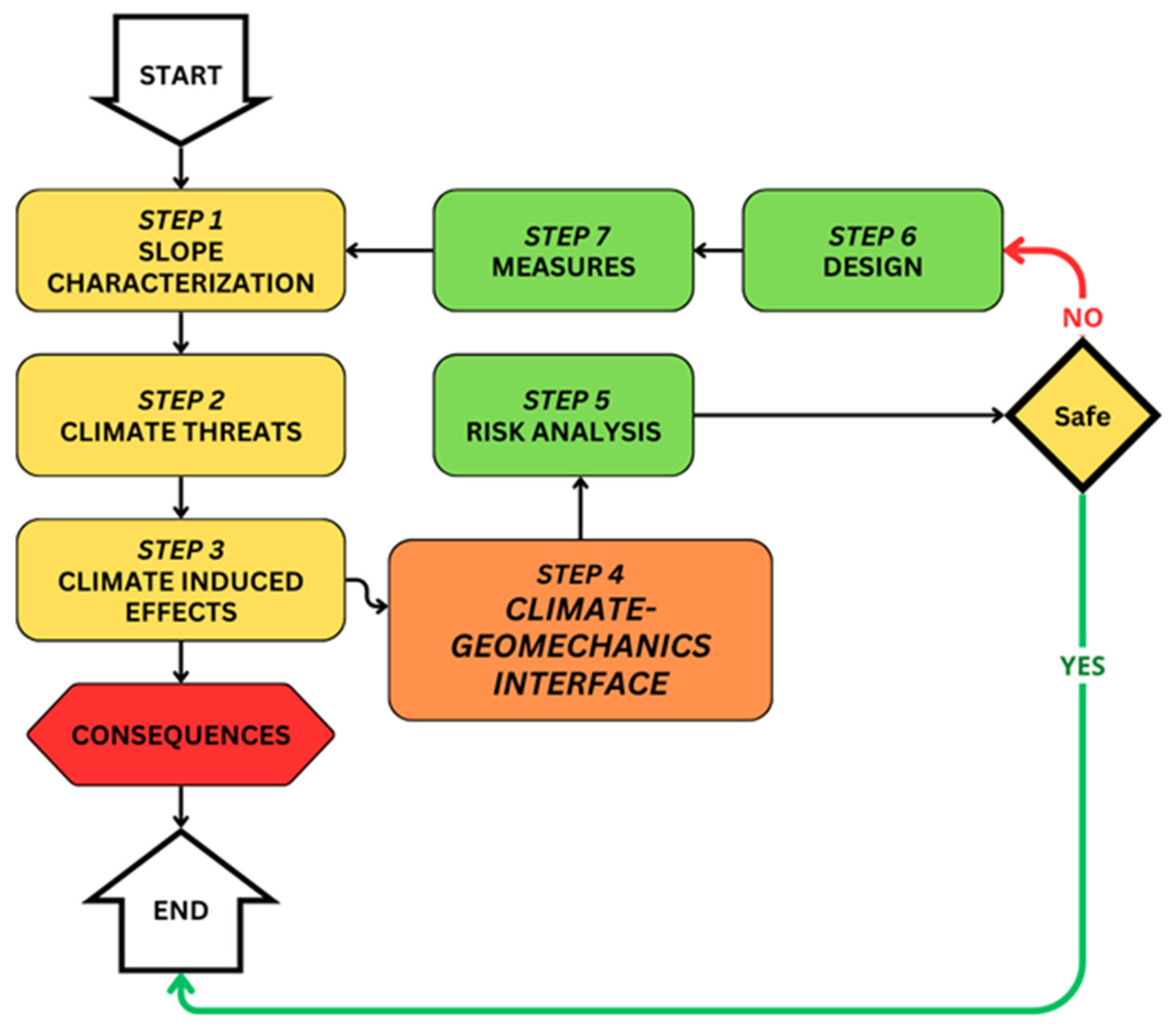
The Climate Adaptive Resilience Evaluation (CARE) framework [10] provides a structured model that links climate hazards with their effects and consequences (Figure 1). This causal chain is conceptualized as a sequence in which climate-induced threats trigger specific geotechnical responses, leading to measurable outcomes. Understanding these interconnections is essential for effective risk management and the design of targeted mitigation strategies. The CARE approach operationalizes the climate–geomechanics interface, linking climatic hazards to geomechanical responses and enabling targeted mitigation strategies.
The core components of the CARE approach include the characterization of slope conditions, identification of relevant climate hazards, assessment of their effects on geotechnical behavior, and evaluation of potential or observed consequences for slope performance. A key intermediate phase involves the development and implementation of mitigation measures, with a focus on preventing instability and erosion.
The core components of the CARE approach (Figure 1) include:
  • Characterization of slope conditions, encompassing geometry, stratigraphy, and mechanical properties.
  • Identification of relevant climate hazards, such as rainfall intensity, drought duration, or temperature fluctuations.
  • Assessment of climate-induced effects on geotechnical behavior, including variations in water content, shear strength, and pore pressure.
  • Analysis of the climate–geomechanics interface, linking external climatic forcing to internal geotechnical responses.
  • Risk analysis, evaluating the probability and potential consequences of slope failure under varying climatic scenarios.
  • Design of mitigation measures, aimed at reducing vulnerability and enhancing slope stability; and,
  • Implementation and evaluation of measures, ensuring continuous feedback, monitoring, and refinement of the system.
This iterative process allows for continuous improvement through the reevaluation of input data, supporting adaptive and resilience-oriented slope management

4.1. Step 1—Slope Characterization

Slope characterization should include as much relevant data as possible for the analysis, such as location and affected area, geological characterization of the region (including geological, geomorphological, seismological, and hydrogeological features), slope type and geometry, as well as the results of geotechnical investigations, including field studies and laboratory tests.

4.2. Step 2—Climate Threats

Climate events and their threats encompass a wide range of hazards, including increased or decreased precipitation, longer droughts, higher air temperatures, prolonged warm spells in winter, more frequent heavy rainfall events, recurrent droughts, more freeze–thaw cycles, and increasing intensity and frequency of hurricanes and storms [7].

4.3. Step 3—Climate-Induced Effects

The development of effective adaptation strategies.
Climate change influences soil behavior and geotechnical performance through multiple mechanisms:
  • Material degradation due to moisture fluctuations: Increased saturation from rainfall or snowmelt, as well as desiccation during droughts, reduces soil strength through softening, shrinkage, and the formation of microcracks [34].
  • Chemical alteration due to increased temperature and humidity accelerates mineral dissolution and affects soil composition [35].
  • Freeze–thaw cycles disrupt soil structure, reduce cohesion, and lower stiffness, especially in fine-grained soils [36].
  • Erosion from intensified rainfall and wind removes fine particles, reshapes surfaces, and reduces topsoil stability [37].
  • Hydrological changes alter pore pressures and moisture regimes, impacting hydraulic conductivity and shear strength (Permafrost degradation reduces stiffness and bearing capacity, leading to settlement and instability in frozen soils [38].
  • Expansive clay behavior intensifies, with shrink–swell activity increasing deformation risks [39].
These impacts highlight the direct effects of climate threats on slope geotechnical properties, crucial for assessing stability and resilience.

4.4. Potential Consequences for Slopes

Climate-related threats and their effects on slopes, such as increased landslide occurrence, require precise classification systems to support effective hazard assessment and risk management. A foundational framework for landslide velocity classification was introduced by Varnes (1978) [40] and later refined into a more systematic approach by Cruden and Varnes (1996) [41], offering a clearer understanding of landslide dynamics.
Subsequent advancements by the IUGS Working Group on Landslides, particularly through the work of Hungr et al. (2001) [42], contributed to a more detailed and practical classification of landslide behavior. Additionally, Highland et al. (2008) [43] developed a widely used guide on landslide types and movement rates, serving both educational purposes and hazard mitigation strategies.
According to geotechnical literature and hazard classification guidelines, landslides are commonly categorized based on material type, type of movement, velocity, and depth of failure. This standardized classification enables consistent communication among professionals and supports the development of targeted mitigation and monitoring strategies.
Based on the classification systems described in [39,40,41,42], landslides can be classified based on four main criteria: material type, type of movement, depth of failure, and velocity of movement. A clear understanding of these categories is essential for hazard assessment and communication.
In terms of material, landslides may involve rock (bedrock or large fragments), soil (fine-grained materials such as clay, silt, sand, or gravel), or debris (a mixture of rock, soil, and organic matter).
Movement types include falls (sudden free fall), topples (forward rotation), slides (movement along a failure plane, either rotational or translational), flows (viscous movements like debris flows, mudflows, and earthflows), creep (slow, imperceptible movement), and spreads (lateral extension, often due to liquefaction).
The rate of movement varies widely, from extremely rapid (>5 m/s) to extremely slow (<1.3 mm/day), encompassing categories such as very rapid, rapid, moderate, slow, and very slow.
Finally, landslides are also classified by depth: superficial, shallow (≤2 m), medium deep (2–5 m), deep (5–12 m), and very deep (≥12 m).

4.5. Step 4—Climate–Geomechanics Interface

The interface between climate change and geomechanical slope stability modeling involves a dynamic set of time-dependent parameters through which climatic influences are translated into the mechanical response of slopes. These parameters are not constant; instead, they vary as functions of key climatic variables, including air temperature, precipitation amount and timing, snowmelt intensity, evapotranspiration, and groundwater levels. This interface is of critical importance, as it captures the evolving interdependence among hydrological and mechanical parameters during the analysis. A proper representation of this interface allows for more realistic predictions of slope behavior under changing climatic conditions. Further details about this interface are provided in Section 5.

4.6. Steps 5–7—Risk Analyses, Design, and Measures for Slope Stability

Effective slope stability measures aim to prevent or reduce instability, mitigate landslide risks, and enhance long-term resilience of slopes under changing climatic conditions. These strategies combine engineering, nature-based, and hybrid solutions, tailored to site-specific conditions while balancing structural performance and ecological sustainability. Stabilization measures can broadly be grouped into two complementary categories:
  • Adaptation-focused measures: Designed to reduce the vulnerability of slopes to climate-related impacts (e.g., increased rainfall, drought, freeze–thaw cycles). These include surface and subsurface drainage, slope reinforcement, re-vegetation, erosion control, and use of flexible retaining systems.
  • Mitigation-supportive measures: Solutions that contribute to broader climate goals, such as reducing carbon footprint using low-carbon materials, sustainable construction practices, and nature-based approaches (e.g., bioengineering, afforestation, and green infrastructure) that also enhance carbon sequestration.

4.7. Approaches for Achieving Climate Neutrality

Achieving climate neutrality requires the implementation of regulatory and management strategies that integrate Nature-Based Solutions (NbS). These solutions leverage natural processes and ecosystems to provide cost-effective, sustainable interventions with environmental, social, and economic benefits [44,45]. Key approaches include afforestation, soil restoration, natural sediment application, and green infrastructure, which help regulate temperature, manage extreme rainfall, and improve water infiltration [46]. While individual actions may have limited immediate impact, their cumulative effect is significant—necessitating coordinated strategies supported by robust regulatory frameworks [32].
This paper highlights NbS as a cost-effective strategy for enhancing mountain slope resilience, evaluated through geotechnical methodologies [47]. Climate-adaptive geotechnical analysis ensures the durability and functionality of both existing and newly designed structures in mountainous regions. When NbS alone are insufficient, Hybrid Solutions (HbS)—which combine nature-based and conventional engineering techniques—offer more effective responses to complex geotechnical challenges [48].

4.8. Approaches to Climate Change Mitigation

Landslide prevention and remediation strategies are typically divided into three categories: Conventional (Gray) Solutions, Nature-Based Solutions (NbS), and Hybrid Solutions (HbS).
Conventional (Gray) Solutions: Rely on engineered structures such as retaining walls, drainage systems, and anchors to stabilize slopes immediately. These methods are effective but often involve high environmental impact, significant cost, and require continuous maintenance [49].
Nature-Based Solutions (NbS): Improve slope resilience using vegetation, bioengineering techniques, and ecosystem restoration.
Nature-based solutions (NbS) involve working with and enhancing nature to effectively address societal challenges [50,51]. They encompass a broad range of measures, including the conservation and sustainable management of natural and semi-natural ecosystems, the integration of green and blue infrastructure into urban areas, and the application of ecosystem-based principles in agriculture. NbS are founded on the understanding that healthy, natural and managed ecosystems provide a diverse array of services essential for human well-being—ranging from carbon sequestration, flood regulation, and stabilization of coasts and slopes to the provision of clean air and water, food, fuel, medicine, and genetic resources [52].
NbS serve as an overarching concept that includes other established nature-based approaches, such as ecosystem-based adaptation, ecosystem-based mitigation, disaster risk reduction, and green infrastructure [53]. More recently, the term “Natural Climate Solutions” (NCS) has also emerged in the scientific and policy lexicon [54]. NCSs also fall under the umbrella of NbS but specifically focus on conservation and management actions that reduce greenhouse gas emissions from ecosystems and enhance their carbon storage potential [54,55,56].
These approaches promote long-term sustainability with minimal maintenance and additional environmental benefits [57].
Hybrid Solutions (HbS): Integrate both conventional and nature-based techniques to address complex geotechnical and environmental conditions. They provide both structural stability and ecological co-benefits [58].
A holistic approach that integrates all three strategies leads to more effective and sustainable slope stabilization, reducing landslide risk while supporting environmental goals. A crucial component of such integrated planning is the geomechanical analysis of slope stability.
This involves understanding the interface between geological, climatic, and geotechnical factors, including the influence of climatic drivers on soil behavior and slope conditions [29]. Key parameters affecting stability include precipitation, surface runoff, evaporation, net water infiltration, hydraulic conductivity, cohesion, and the friction angle. These interrelated variables are fundamental for assessing slope stability and must be considered together for reliable hazard evaluation [59,60].

5. Climate–Geomechanics Interface

The interface between climate change and geomechanical slope stability modeling represents a dynamic set of time-variable parameters through which climate impacts are incorporated into the geomechanical response of slopes. These parameters are not constant but functionally dependent on key climatic factors such as air temperature, precipitation amount and timing, snowmelt intensity, evapotranspiration, and groundwater levels.
In numerical modeling, these dynamic interface elements enable real-time updating of input parameters based on current and forecasted climatic conditions, allowing temporally and spatially adaptive slope stability predictions. This approach significantly improves model realism and reliability by accounting for the influence of variable climatic factors on soil properties such as cohesion, shear strength, saturation, and hydraulic conductivity [29,60].
A structured methodology that systematically integrates climate scenarios and hydrogeological models facilitates detection of transitions from stable to marginally stable or unstable conditions, which is critical in regions prone to increasing extreme weather events [61]. Such interdisciplinary integration is essential for robust risk assessment and the development of effective adaptation strategies. Table 1 provides a summary of the typical parameters and processes involved in this interface, supporting consistent implementation in modeling frameworks.
Indirect indicators such as electrical resistivity and conductivity, obtained through geophysical methods, can also be used to monitor changes in soil moisture content, degree of saturation, or structural integrity in response to climate-driven variations. These indicators enable real-time or time-lapse monitoring of hydro-mechanical processes relevant to slope stability assessment.

5.1. Aspect A. Parameters of Climate Influences as Interface Elements

Climate-related parameters act as interface elements that translate long-term climatic trends, such as rising temperatures or altered precipitation regimes, into internal soil processes. They enable the integration of non-stationary geomechanical responses into numerical slope stability models, which is crucial for reliably predicting long-term slope behavior under changing climate conditions [29].
Air temperature (T): Functions as an interface by driving thermal processes such as heat conduction and freeze–thaw cycles. These processes affect deformation, settlement, and strength reduction in soils.
Precipitation amounts and duration: Precipitation (P), including rainfall, snowfall, hail, sleet, and freezing rain, represents the primary water input to the soil, driving infiltration, modifying saturation levels, reducing matric suction, and increasing pore water pressure. These processes are key mechanisms that lower effective stress and consequently compromise slope stability. The temporal distribution of precipitation (P(t)) governs the rate and timing of infiltration, with short-duration, high-intensity events posing particular risk due to rapid saturation and pore pressure buildup. Snowmelt intensity (M) acts as a seasonal hydrological interface, introducing delayed but often abrupt water input into the subsurface. Rapid snowmelt can lead to sudden saturation, elevated pore pressure, and reduced effective stress, all of which increase the likelihood of slope failure. The combined effect of these precipitation-related inputs highlights the importance of accurately modeling hydrological dynamics in slope stability assessments under changing climatic conditions.
Relative air humidity (wa): Indirectly controls evapotranspiration rates and soil drying. By modifying suction and moisture content, it impacts cohesion and shear strength.

5.2. Aspect B. Hydrological and Hydrogeological Parameters as Interface Elements

Hydrological and hydrogeological processes form a critical functional interface between climate influences and the geomechanical response of slopes. Through this interface, climatic changes, such as variations in precipitation amount, intensity, and timing, are transmitted into soil moisture dynamics, pore pressures, and ultimately slope stability [60].
Net infiltration (NI): Net infiltration represents the portion of precipitation or snowmelt that infiltrates into the soil after subtracting surface runoff (RO) and actual evapotranspiration (ET). It acts as a primary interface between climatic inputs and subsurface hydrological processes, directly affecting soil moisture, saturation, and pore pressure.
However, NI is physically constrained by the saturated hydraulic conductivity of the soil k (m/s). The infiltration rate cannot exceed the soil’s ability to transmit water downward. Therefore, NI (e.g., in m3/s over a given area) must not exceed k. If this threshold is surpassed (i.e., NI > k), the excess water cannot infiltrate and will instead accumulate at the surface, resulting in surface ponding or overland flow. This principle is consistent with unsaturated flow theory and soil physics, where the maximum infiltration capacity is determined by the hydraulic conductivity of the soil (see [62]).
It is a key hydrological parameter that directly influences the volumetric water content (θ), degree of saturation (Sr), and pore water pressure (u) in the vadose zone. These variables control changes in effective stress (σ′), which in turn govern the shear strength of soils and play a central role in slope stability assessments [22,63]. Infiltration dynamics are controlled by soil texture, structure, porosity, initial moisture content, vegetation cover, climatic conditions, and topographic gradients. When rainfall intensity exceeds the soil’s infiltration capacity, excess water becomes surface runoff, reducing potential infiltration and contributing to erosion and mechanical weakening of slopes. In numerical modeling frameworks such as GeoStudio SEEP/W [64] can be used with the formulation captures transient moisture flow and suction loss during infiltration events, allowing simulation of pore pressure rise and related slope instability processes [27].
Net infiltration influences the soil’s volumetric water content (θ), degree of saturation (Sr), and pore water pressure (u), all of which govern changes in effective stress. In unsaturated soils, the effective stress can be expressed as:
σ = σ u a · χ ( u a u w )
where σ is the total stress (kPa), ua is the pore air pressure (kPa), uw is the pore water pressure (kPa), and χ is the effective stress parameter (–).
Effective stress parameter χ is defined as a function of the degree of saturation [22]. As net infiltration increases, so does the water content and pore pressure, resulting in a reduction in effective stress, which lowers the shear strength of the soil. This process represents a key hydromechanical coupling mechanism relevant to rainfall-induced slope instability.
The rate and extent of infiltration are governed by the physical properties of the soil (e.g., texture, porosity, structure), vegetation cover, meteorological conditions (e.g., temperature, wind, humidity), topography, and the initial saturation state. When rainfall exceeds the soil’s infiltration capacity, surface runoff occurs, which limits further infiltration but may promote erosion and surface weakening of hillslopes.
Soil moisture (w), Porosity (n, e), and Degree of saturation (Sr): in the unsaturated zone are directly related to soil suction, which in turn affects the shear strength of the soil.
Relative moisture content (w) of the soil is defined as the ratio of the mass of water to the mass of dry soil. Volumetric water content θ is defined as the ratio of the volume of water contained in the soil to the total soil volume (water + solid particles + air). Volumetric water content is used to describe and model the soil water regime, influencing infiltration, evapotranspiration, and soil mechanical properties. As water content increases, it reduces effective stress and thus affects slope stability. Saturation (Sr): Ratio of water-filled pores to total pore volume. Rising saturation reduces suction and increases pore water pressure, weakening effective stress and shear strength. The degree of saturation (S) represents the fraction of the pore space in the soil that is filled with water. It is a dimensionless parameter ranging from 0 (completely dry) to 1 (fully saturated). Porosity (n) and Void ratio (e): This indicates the soil’s storage and flow capacity. Subject to long-term changes due to drying, freezing, and weathering, making it a dynamic interface element.
w = m w m s ,
n = V p V t = e 1 + e ,
θ = V w V t = n · S r = w · ρ d ρ w ,
S r = W w V p = w · G s n ,
where mw is the mass of water (kg), ms is the mass of dry soil (kg), Vw is the volume of water in the pores (m3), V is the total volume of soil (m3), including water, solids, and air; n is the porosity (–), defined as the fraction of total volume occupied by pores; Sr is the degree of saturation (–); Vp is the total volume of pores (m3); and Gs is the specific gravity of soil solids (–).
Groundwater Level Fluctuations, Pore Pressure, and Effective Stress Changes: Fluctuations in groundwater levels—whether due to seasonal cycles, long-term climatic trends, or changes in precipitation patterns—significantly affect the distribution of saturation and pore pressure in soils. Increased pore pressure reduces effective stress, potentially triggering landslides or subsidence. Studies by Iverson (2000) [27] and others confirm that such changes are critical for predicting transitions to unstable conditions. Key input parameters include temporally variable groundwater levels, pore pressure changes, corresponding effective stress variations, and hydro-mechanical feedback loops influencing soil stability.
Groundwater table (hw): Represents the boundary between saturated and unsaturated zones. Its fluctuations, driven by seasonal rainfall or snowmelt, strongly affect pore pressures and slope stability.
Pore Pressure (u) and Effective Stress ( σ ): One of the key factors affecting the mechanical behavior of soil is the variation in effective stress ( σ ), which is governed by changes in pore water pressure (u). According to Terzaghi’s principle of effective stress:
σ = σ u,
where σ is the effective stress (kPa), σ is the total stress in the soil (kPa), and u is the pore water pressure (kPa). An increase in pore water pressure, caused, for example, by infiltration or a rising groundwater table, reduces the effective stress, thereby decreasing the shear strength and potentially compromising slope or foundation stability.
Hydraulic conductivity (k): defines the soil’s intrinsic ability to transmit water through its pore structure. It governs infiltration dynamics and directly influences the rate of pore pressure development, which in turn affects the timing and magnitude of slope failures [63,65]. Changes in hydraulic conductivity due to hydrological processes can significantly alter water flow behavior and the internal stress regime in soil. These changes may result from structural evolution of the soil, saturation-dependent conductivity, or long-term weathering processes.
In numerical modeling, hydraulic conductivity is often treated as a spatially and temporally variable parameter, expressed as k = k(x, y, t), to reflect natural heterogeneity and transient hydrological conditions [65,66]. The distribution of hydraulic conductivity controls the evolution of saturation and pore pressure fields within the subsurface, particularly during and after rainfall infiltration. In coupled hydro-mechanical modeling approaches, changes in water content and pore pressure are dynamically linked to stress and deformation within the soil mass, influencing slope stability over time [34,63].
Suction (ψ):
Reflects the tension in unsaturated soils and links climate-induced moisture variation to changes in effective stress. Reductions in suction due to rainfall or prolonged wet periods lead to strength loss in unsaturated soils.
These parameters are not constant inputs but time-dependent variables that respond dynamically to changing climatic conditions, allowing for realistic and adaptive modeling of slope stability over time. Studies have shown that increasing the degree of saturation (Sr) leads to a reduction in suction and shear strength, a trend that is also confirmed by laboratory direct shear tests [23].

5.3. Aspect C. Geomechanical Response as an Interface

The third aspect of the interface between climate change and slope stability involves the mechanical properties of soils, such as cohesion, shear angle, and compressibility. These properties are not constant but vary dynamically in response to hydrological and thermal conditions, including saturation, water content, temperature, and pore pressure. Changes in these conditions directly affect effective stress, which governs soil behavior and slope stability.
Due to these interdependencies, mechanical parameters act as key interface elements, through which climate influences are transferred into geomechanical responses—such as variations in shear strength, deformability, and overall stability.
Cohesion (c): Increased water content reduces cohesion due to the lubricating effect of pore water, which decreases internal friction. Cohesion thus reflects the impact of rainfall, snowmelt, and drought conditions.
Friction angle (φ): Prolonged saturation and repeated wetting–drying cycles degrade soil microstructure, reducing the friction angle. As such, φ serves as an indicator of long-term changes in slope stability due to climatic shifts.
Compressibility (mv): Increased moisture and reduced effective stresses result in higher soil deformability. Compressibility therefore represents the soil’s mechanical response to climatic water dynamics.
m v = 1 ν E ( 1 + ν ) · ( 1 2 ν ) = 1 E O E D ,
here mv is coefficient of compressibility (1/kPa), EOED is oedometer modulus (kPa), E is elastic modulus (kPa), and ν is Poisson’s coefficient (−).
In advanced numerical models, these parameters are often expressed as functions of temperature and saturation, e.g., c(T, Sr) or φ(T, Sr). This formulation allows the incorporation of time-dependent soil behavior, enabling more realistic and robust predictions of long-term slope stability under changing climatic conditions.

5.4. Changes in Shear Strength and Compressibility Due to Moisture Content and Saturation–Experimental Support

Mechanical properties of soil, such as shear strength and compressibility, are strongly influenced by the degree of saturation, water content, and temperature conditions. An increase in water content reduces matric suction and, consequently, apparent cohesion, leading to a decrease in effective shear strength. This behavior has been thoroughly investigated by Lu and Godt (2013) [63], Fredlund and Rahardjo (1993) [22], and Iverson (2000) [27], who emphasized the key role of hydrological parameters in triggering landslides and inducing ground deformations.
Temperature also affects the deformation behavior of soils, as the elastic modulus E(θ,T) is a function of both water content and temperature. Variations in these parameters can lead to spatial redistribution of stresses within the soil mass. As a result, input parameters in coupled hydro-mechanical models often include water- and temperature-dependent values of cohesion c(θ,T), friction angle φ(θ,T) and elastic modulus E(θ,T), along with their functional relationships with moisture content w. Understanding these dependencies is essential for the realistic prediction of soil behavior under changing climatic conditions.
To support these findings, a series of geomechanical laboratory tests were conducted on reworked soil specimens of different types in the geotechnical laboratory of the University of Maribor, in accordance with EN ISO 17892; Part 1–12 (Geotechnical investigation and testing—Laboratory testing of soil) [24]. The objective was to assess the influence of water content on the shear strength and deformability of the material. The specimens were subjected to varying degrees of saturation, while changes in cohesion, friction angle, and elastic modulus were systematically monitored. The results indicate a reduction in cohesion, friction angle, and stiffness with increasing water content in a silty sand sample. This material is representative of the slope investigated in the case study discussed in Section 6.

5.5. Cohesion, Friction Angle and Deformability

In standard direct shear tests, specimens are typically not fully saturated, which causes the measured shear strength to generally exceed the value that would be obtained for fully saturated soils. Partial saturation allows the development of negative pore pressure (suction), which increases the effective stress and, consequently, the soil’s shear strength. This is particularly important in parametric slope stability analyses, as it explains why soils under partial saturation often exhibit greater stability than fully saturated soils, even without direct measurement of suction.
Conversely, performing the test on unsaturated specimens can lead to overestimated shear parameters, since the effective stress is not accurately represented. Therefore, it is essential to precisely measure the specimen’s moisture content and porosity and to appropriately correct the shear parameters based on the actual saturation state. This approach ensures that laboratory results are consistent with unsaturated soil mechanics theory and suitable for use in numerical models and slope stability analyses.
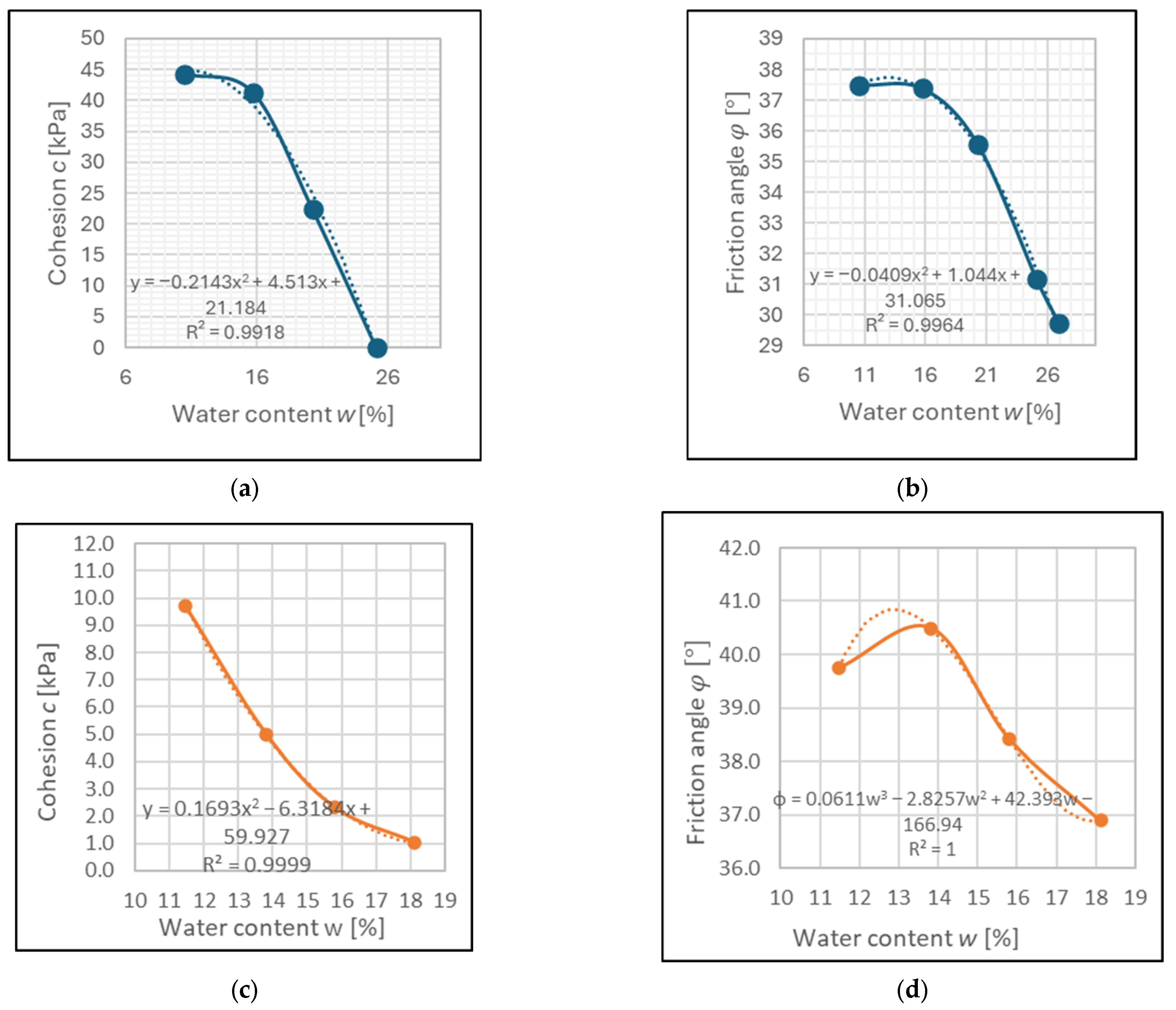
A laboratory investigation was conducted on two representative soil types—medium plasticity clay (ClM) and silty sand (SiSa)—whose properties correspond to those used in the slope stability analysis (see Figure 2). While testing all soil types according to geomechanical classification would undoubtedly provide significant added value, it would require an extensive research program, which is beyond the scope of this study. The results indicate that uniaxial compressive strength, cohesion (c), friction angle (φ), and deformability (EOED) decrease significantly in zones of increased saturation, particularly where the moisture content (w) exceeds the optimum water content.
For medium plasticity clay (ClM), cohesion decreases by approximately 4.5 kPa for every 1% increase in moisture content near optimum saturation, with the rate of decrease slowing at higher water contents (Figure 2a). The relationship is described by quadratic regression (Equation (8)):
c = −0.21·w2 + 4.51·w + 21.18,
Similarly, the friction angle decreases by about 1° per 1% increase in moisture content, with a reduced rate of decline at higher contents (Figure 2b). This trend is captured by the nonlinear regression (Equation (9)):
φ = −0.04·w2 + 1.04·w − 31.07,
The regression line is different for each soil type, e.g., for silty sand (SiSa), cohesion decreases much less than in clay, by about 1 kPa for each 1% increase in moisture content, again with a slower decrease at higher water contents (Figure 2c). The regression model is (Equation (10)):
c = 0.17·w2 − 6.32·w + 59.93,
The friction angle of silty sand decreases more than 2° per 1% increase in moisture content (Figure 2d). This trend is captured by the nonlinear regression (Equation (11)):
φ = 0.06·w2 − 2.83·w + 42.39,
The experimental results show that an increase in water content beyond the optimum reduces shear strength and compressibility, consistent with the findings of Lu and Godt (2013) [63] and Fredlund and Rahardjo (1993) [22]. For cohesion (c), the decrease with increasing water content can be described by a quadratic regression, with a slower reduction at higher moisture contents (Equation (12)):
c = a 1 c · w 2 + a 2 c · w + a 3 c ,
For the friction angle (φ), the trend is more complex: the reduction is initially steeper (less than 1° per 1% increase in w) but becomes more gradual at higher water contents (Figure 2d). This behavior is captured by a cubic regression (Equation (13)), which is applied meaningfully only from the vertex of the curve onward, i.e., along the descending branch where the model matches the observations:
φ = a 2 φ · w 2 + a 3 φ · w + a 4 φ ,
For deformability (EOED), the variation with water content also follows a quadratic trend (Equation (14)). Similarly to φ, the regression equation is considered valid only from the vertex onward, ensuring consistency with the experimental data:
E O E D = a 1 M · w 2 + a 2 M · w + a 3 M ,
Together, these relationships provide a consistent basis for incorporating moisture-dependent changes in geomechanical parameters into slope stability modeling, while also highlighting the need for further laboratory testing across different soil types.

5.6. Aspect D. Thermo-Hydraulic Processes as an Interface

This interface focuses on interconnected thermal and hydraulic processes in the soil, especially those associated with freezing and thawing, which influence saturation, pore pressure, and hydraulic conductivity. These processes are critical in shaping the mechanical behavior of soils, particularly in regions with strong seasonal temperature variability.
Climate change, by altering temperature regimes, snow cover duration, frost depth, and freeze–thaw frequency, induces both temporal and spatial variability in thermal and hydrological conditions. As such, thermo-hydraulic phenomena serve as a key interface between atmospheric forcing and geomechanical slope response, forming a direct link between climate variables and soil behavior.
Temperature (Ts): Triggers phase changes between water and ice, affecting pore pressure, saturation, and soil structure. It acts as an interface by connecting air temperature changes to subsurface thermal regimes and controlling the onset and extent of freezing or thawing.
Soil Swelling (ΔVsw,T) Due to Increased Moisture Content (w): Soils rich in expansive clay minerals, such as montmorillonite and illite, exhibit significant volumetric changes in response to increasing water content. Moisture infiltration leads to volumetric expansion (swelling), which can cause localized deformation, stress redistribution within the soil matrix, and reductions in both dry density and mechanical strength. This swelling behavior is associated with the development of swelling pressure under constrained conditions and swelling strain in deformable systems.
The increase in porosity and loss of compaction contribute to a reduction in shear strength, primarily due to decreases in cohesion and internal friction angle. Additionally, swelling alters the hydraulic properties of the soil, including a potential increase in hydraulic conductivity k. Key parameters that describe this behavior include swelling strain, swelling pressure, moisture-dependent cohesion c(w), friction angle φ(w), and hydraulic conductivity k(w).
Shrinkage (ΔVT): Volume reduction due to ice melting or soil drying causes settlement and cracking. These deformations alter the mechanical integrity of slopes, increasing susceptibility to failure.
Shrinkage, Cracking, Loosening, and Vegetation Cover Reduction due to prolonged dry periods (droughts) cause dehydration of the upper soil layers, leading to shrinkage, crack development, and soil loosening. These changes modify layer geometry, increase porosity, and reduce the material’s internal cohesion. Reduced matric suction decreases capillary forces contributing to shear strength, which, together with moisture loss–induced cohesion reduction, diminishes soil stability. Furthermore, decreased evapotranspiration and degradation of vegetation cover reduce the stabilizing effect of roots and increase susceptibility to erosion. Relevant input parameters include changes in volumetric porosity, cohesion, internal friction, and shrinkage-related geometric deformations.

5.7. Aspect E. Volume Changes and Degradation as an Interface

Soil volume changes and degradation form a key interface between climatic drivers and slope stability. Processes such as swelling, shrinkage, cracking, vegetation loss, and freeze–thaw cycling alter soil structure, strength, and hydraulic conductivity.
Swelling (ΔVsw) and Shrinkage (ΔVw) occur due to moisture fluctuations, especially in fine-grained soils. Swelling increases volume and induces internal stress, while shrinkage leads to desiccation cracks, loss of cohesion, and reduced shear strength [22,63].
Cracking due to wetting–drying cycles enhances infiltration and weakens the soil mass. The crack ratio is a key parameter describing this effect [67]. Crack Ratio (CR) is a quantitative measure of crack development induced by repeated wetting–drying cycles. Cracks arise due to imbalances between water retention and drainage, acting as structural interfaces that enhance hydraulic conductivity, promote deeper infiltration, and weaken the soil mass.
Vegetation degradation, caused by drought or disturbance, reduces root cohesion and erosion resistance, increasing net infiltration and mechanical instability [63,65]. Vegetation Cover (VC) is expressed as a percentage of ground coverage or vegetation density index. Vegetation reinforces soil through root cohesion and reduces erosion. Climate-driven degradation (e.g., from drought, heatwaves, or wildfires) decreases this natural protection, enhancing net infiltration and destabilizing slopes. Vegetation Cover thus represents a biological interface linking climate variability with geomechanical behavior.
Cracking and Loosening of Soil Layers Due to Freeze–Thaw Cycles: Freeze–thaw processes cause volumetric expansion, cracking, and loosening of upper soil layers. Thawing increases permeability and pore pressure, while repeated cycles reduce cohesion and the friction angle [68].

5.8. Indicator Aspect

The indicator aspect comprises parameters that quantitatively reflect the indirect effects of climate change on soil conditions and slope stability, without the need to explicitly model all associated hydrogeological and geomechanical processes. These indicators provide a non-invasive means of monitoring subsurface changes driven by evolving climatic conditions. Soil Electrical Conductivity (EC) is one of the most prominent indicators, which correlates with soil moisture and saturation levels. EC varies in response to precipitation input, drying processes, and fluctuations in the groundwater table. As such, EC serves as an effective interface parameter by capturing climate-induced subsurface changes that can indirectly signal alterations in the mechanical behavior of soils.
In slope stability analysis, monitoring EC trends offers a valuable tool for early warning, helping to detect evolving conditions that may precede failure events [69].

6. Interface-Controlled Stability Analysis of an Infinite Slope Under Surface and Interlayer Saturation

This section presents a practical implementation of the interface-based stabilization assessment within the framework of a theoretical infinite slope. The aim is to illustrate how climate change factors, particularly rainfall patterns, influence slope stability through hydromechanical interactions.
The analysis examines how climate-driven variations in key parameters influence the factor of safety, providing a realistic understanding of slope behavior under climate change. The approach assumes the failure surface develops at or just above the saturated zone, while also accounting for the unsaturated zone above, including the contribution of matric suction.
Several typical slope instability scenarios driven by hydrological changes have been reported in the literature. The first two of the listed scenarios are presented:
  • Prolonged rainfall and sustained infiltration raise the groundwater table and increase pore pressures above impermeable layers [69,70].
  • Intense short-term rainfall can generate temporarily perched water tables in shallow layers, reducing matric suction and enabling lateral flow.
  • Droughts produce desiccation cracks that facilitate rapid infiltration during subsequent rainfall [71].
  • Wetting of interlayer contacts reduces shear strength along interfaces.
  • Rapid fluctuations in groundwater levels create imbalances between pore pressures and stresses in the soil.
  • Snowmelt enhances infiltration and surface runoff.
  • Surface erosion reduces geometric slope stability [28].
Particular emphasis is placed on two key saturation mechanisms that commonly occur in natural slopes. The first is progressive surface-induced saturation, resulting from prolonged or intense rainfall, which leads to a reduction in suction, an increase in water content, and a gradual decrease in effective stresses in the near-surface soil layers. The second mechanism is saturation at the interface between layers with contrasting hydraulic conductivity, where water accumulates above a less permeable layer, causing a localized increase in pore water pressure and creating favorable conditions for the development of a failure surface along the interface.
The presented example highlights the applicability of interface-based stability analysis as an effective tool for understanding and quantifying the effects of climate-driven hydrological changes on the stability of infinite slopes.
The shear strength of partially saturated soils is therefore commonly expressed using a generalized form of the extended Mohr–Coulomb equation, which accounts for effective stress and the influence of matric suction (Equation (15)).
τ = c + ( σ n u a ) tan φ + ( u a u w ) tan φ b
where τ is the shear stress at failure [kPa], c′ is the effective cohesion [kPa], σn is the normal component of the total stress [kPa], ua is the pore air pressure [kPa], uw is the pore water pressure [kPa], φ′ is the effective friction angle [°], and φb is the angle describing the contribution of matric suction to shear strength.
These processes generally increase saturation and pore pressures, which reduces effective stress and consequently compromises slope stability. In the following, a theoretical infinite slope is used to illustrate these effects, focusing on the rise of the saturated zone as a representative case.
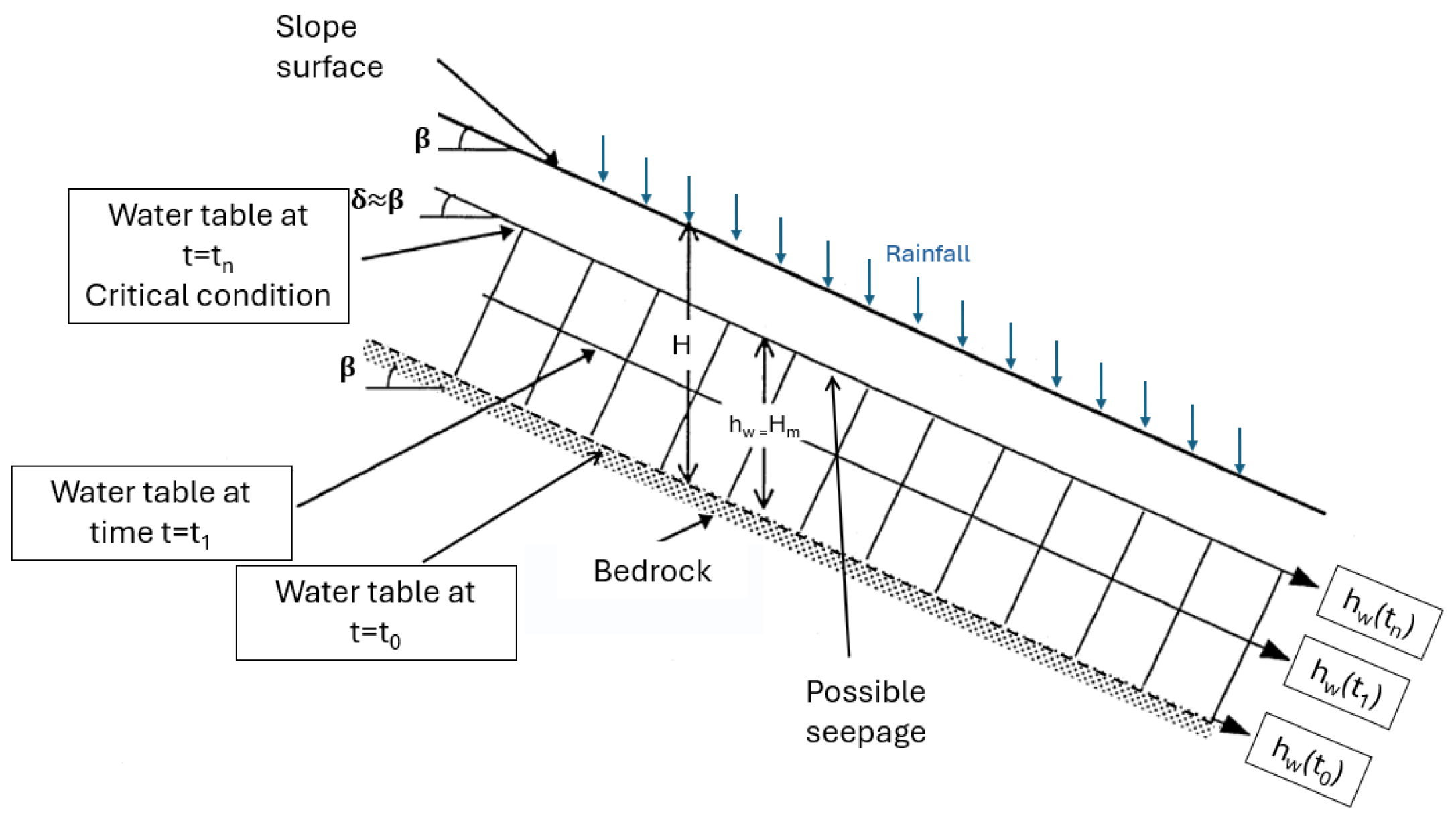
To investigate slope stability under hydrologically driven scenarios, a theoretical infinite slope model with a planar failure surface was adopted (Figure 3). The model relies on the following assumptions:
a.
Geometric conditions: The slope is uniformly inclined with no boundary effects along the longitudinal direction (parallel to the soil layers). In the transverse direction, where the slip analysis is conducted, conditions are assumed to be constant along the entire slope length.
b.
Mechanical conditions: The mechanical properties of the soil (density, cohesion, the friction angle, and degree of saturation) are assumed to be constant along the slope. The stress state and shear resistance do not vary in the longitudinal direction.
c.
Type of failure: Translational sliding is assumed to occur along a planar failure surface parallel to the slope surface.
d.
Hydrogeological conditions: The groundwater table and the impermeable layer are both parallel to the slope surface, implying a uniform hydraulic gradient.
e.
Geometrical proportions: The slope length in the direction of analysis is at least ten times greater than height, allowing edge effects to be neglected.
The key climatic parameters at the slope–atmosphere interface are precipitation amount and timing. Since the water that effectively infiltrates into the soil is critical for stability analysis, the input parameter in this model is the average daily precipitation over a selected time period.
The geomechanical parameters include: slope inclination number: nsl (-), initial thickness of the unsaturated soil layer: h (m), level of ground water: hw(m), depth to failure surface: hfs (m), specific weight of soil γs (kN/m3), porosity n (-), degree of saturation Sr (%), hydraulic conductivity k (m(s), daily precipitation: P (m3/s), number of rainfall days: tr (days).
Climate change affects infiltration dynamics and soil saturation primarily through increased rainfall amounts and intensities, as well as altered evaporation regimes, potentially causing fluctuations in groundwater levels and variations in pore water pressures.
At the climate–geomechanics interface, cohesion and friction angle are the key geomechanical parameters, strongly influencing shear strength. Other parameters, such as slope inclination, layer thicknesses, and unit weight of the soil, are treated as constant in this analysis.
The factor of safety is calculated as the ratio of the available shear strength to the shear force acting along the failure line. For the infinite slope model, the factor of safety (FS) is determined using the following equation:
F S = c + ( γ · z · c o s 2 β u ) · t a n   φ γ · z · s i n   β · c o s   β ,
where FS is factor of safety, c′ is effective cohesion [kPa], φ′ is effective friction angle [°], γ is unit weight of soil [kN/m3], z is depth to the failure surface [m], β is slope angle [°], u is pore water pressure at the failure surface [kPa], cos β and sin β are trigonometric functions of the slope angle.
NI, representing the portion of precipitation that effectively enters the soil profile, is governed by the soil’s hydraulic conductivity, rainfall intensity, surface runoff, and evapotranspiration. It can be mathematically expressed as:
NI = PAEATRO = PETRO,
Here, NI denotes net infiltration, P is precipitation, AE represents actual evaporation, AT is actual transpiration, ET refers to total evapotranspiration, and RO denotes runoff; all values are expressed in mm/day.
A critical condition for infiltration is that the net infiltration must not exceed the saturated hydraulic conductivity of the soil:
N I k ,
Over time t, the thickness of the saturated zone hw increases as:
h w ( t ) = h w i ( t = 0 ) + N I · t n · ( 1 S r ) ,
As the thickness of the saturated zone increases, especially in proximity to a potential failure surface, the pore water pressure u also rises, leading to a reduction in effective stress σ . This reduction in effective stress is a fundamental factor influencing the mechanical behavior and stability of soils.
The variation in pore water pressure is typically quantified using the pore pressure ratio ru, defined as:
r u = γ w · h w γ · h ,
The time to full saturation, denoted t (Sr = 1), marks the moment when the entire soil layer becomes fully saturated, possibly leading to surface overflow. Note that overflow may also occur earlier if the infiltration rate exceeds the soil’s permeability:
t ( S r = 1 ) = N I · h w n · ( 1 S r ) ,
The infinite slope expression can be rearranged to give the stability number Nk, expressed as:
N k = c γ · H = F S · s i n   β · c o s   β ( 1 r u ) · γ · H · c o s 2   β · t a n   φ ,
Finally, the factor of safety (FS) is expressed by the following equation:
F S = c + ( 1 r u ) · γ · H · c o s 2   β · t a n   φ γ · H · s i n   β · c o s   β ,

6.1. Effect of Rainfall Infiltration on Slope Stability–Surface Saturation

Rainfall infiltration is a primary trigger for shallow landslides, as it increases soil saturation, raises pore pressure, and reduces effective stress, thereby decreasing shear strength and slope stability. The dynamics of saturation depend on rainfall intensity and duration, soil hydraulic properties (permeability, porosity), and initial moisture content.
In geomechanical models, infiltration effects are accounted for using coupled hydro-mechanical approaches, where changes in suction influence effective stress and the factor of safety (FS). Linear models (Lumb) allow rapid estimation of saturation depth as a function of net infiltration (NI) and time (t). Advanced models (Green–Ampt, modified Green–Ampt, Richards) incorporate suction, a transitional zone between saturated and unsaturated layers, and nonlinear hydraulic effects, enabling more accurate simulation of pore pressure development and saturation during rainfall. Numerical models (e.g., GeoStudio, PLAXIS, HYDRUS) further account for soil heterogeneity, complex geometry, and real rainfall sequences, allowing an integrated assessment of infiltration impacts on slope stability.
Combining analytical and numerical models provides reliable preliminary estimates of soil saturation and factor of safety, while identifying key parameters controlling infiltration dynamics, especially under intense rainfall or changing hydrological conditions.

6.2. Parametric Analyses of a Deep-Seated Failure Surface at the Layer Interface

To investigate the influence of climatic and geomechanical parameters on slope stability, a parametric analysis was conducted using baseline data. The analysis employed the initial input parameters, which were systematically varied according to the ranges defined in Table 2. In total, 21,546 simulations were performed, allowing a detailed assessment of the individual contribution of each parameter to slope stability.

6.3. Results and Discussion of Parametric Analyses

Based on the parametric analysis performed using a theoretical infinite slope model, in which a progressively expanding zone of saturation develops beneath the surface, particularly along the soil–bedrock interface (i.e., within the potential slip surface), the following key findings and conclusions have been established.
The purpose of the graphical representations of the parametric analysis results is to provide a clear and intuitive understanding of the influence of individual parameters on slope stability. This visualization facilitates the identification of key factors, highlights nonlinear relationships between hydrological and geomechanical variables, and supports the practical application of the results in slope design and risk assessment.

6.4. Precipitation and Net Infiltration

Only rainfall is considered (intensity, duration), while snow and hail are excluded. Rainfall governs net infiltration (NI)—the portion of precipitation that enters the soil and alters pore pressure and saturation. NI is typically smaller than total rainfall (P) due to evapotranspiration and runoff. Once full saturation is reached (Sr = 1), additional rainfall produces surface overflow. NI is limited by soil hydraulic conductivity (k); if rainfall exceeds k, excess water contributes to runoff. NI directly controls slope stability, coupling climatic input with soil mechanical response. Figure 4 shows the factor of safety (FSn(t)) over time (0–6 days) for different net infiltration rates, normalized to the no-rainfall condition. Figure 4 shows the factor of safety (FSn(t)) over time (0–6 days).

6.5. Porosity, Moisture Content, Saturation, and Permeability

Porosity itself does not directly affect the outcome of slope stability analysis. However, the magnitude of net infiltration (NI) depends strongly on the initial porosity (n), permeability (k), and degree of saturation (Sr). Importantly, NI cannot exceed the saturated permeability of the soil. This means that in soils with very low permeability (k ≤ 10−7 m/s), infiltration rates remain low and precipitation-induced processes evolve slowly. Conversely, in soils with higher permeability (k ≥ 10−6 m/s), infiltration occurs much more rapidly, making the hourly intensity of precipitation a controlling factor.
As soils approach saturation, the volumetric moisture content (θ or w) increases, which leads to a reduction in shear strength. Once full saturation is reached (Sr = 1), additional rainfall no longer contributes to infiltration but instead produces surface overflow. Therefore, the initial degree of saturation (Sri) and initial porosity (ni) are critical input parameters, as they control both the rate and the duration of infiltration prior to saturation.
In standard geotechnical analyses, parameters such as porosity (n), volumetric moisture content (θ), degree of saturation (Sr), and permeability (k) are usually treated as constant input values. Under transient infiltration, however, these parameters evolve dynamically and are interdependent; changes in one parameter influence the others. This interrelation directly affects the mechanical response of the soil and, consequently, the results of slope stability analysis.
Figure 5 illustrates the normalized safety factor FSN(t) over time for various initial degrees of saturation and groundwater table positions, while all other parameters are kept constant. The factor of safety is normalized with respect to the initial value (FSIN), enabling direct comparison of slope responses under different initial hydraulic conditions. The results show that increasing saturation causes a nonlinear reduction in FSN, even when other soil properties remain unchanged. This highlights the strong hydro-mechanical coupling that governs slope stability during transient infiltration processes. Notably, the factor of safety decreases nonlinearly with increasing degree of saturation (Sr): even moderate increases in Sr can lead to disproportionately large reductions in slope stability due to the loss of matric suction and decreased shear strength. Similar nonlinear trends are observed when varying other hydro-mechanical parameters, underscoring the high sensitivity of slope stability to changes in hydraulic state.

6.6. Groundwater Level

The initial groundwater level is a critical parameter in slope stability analysis. As the groundwater level rises, the factor of safety decreases significantly—by approximately 0.16 to 0.26 for each 1 m increase in the initial groundwater table, even when all other conditions remain constant. This highlights the importance of accurately characterizing initial hydrogeological conditions when assessing landslide risk, particularly in the context of increased infiltration or rising groundwater levels driven by climate change.
Figure 6 illustrates the normalized factor of safety FSN(t) over time for varying initial groundwater table elevations, also at a constant degree of saturation (Sr = 70%). The factor of safety is normalized with respect to the initial value (FSIN), enabling direct comparison of the temporal evolution of slope stability under different initial hydraulic conditions.
Higher initial groundwater level causes a pronounced and nonlinear reduction in the factor of safety. This behavior results primarily from the increase in pore water pressure, which reduces effective stress in the soil and thereby decreases shear strength, ultimately exerting a strong negative influence on slope stability.

6.7. Suction

Suction plays a significant role in the stability of unsaturated soil slopes by increasing effective stress and thereby enhancing shear strength. Its magnitude and depth distribution depend on hydrogeological conditions and the degree of soil saturation, making accurate characterization of negative pore water pressure essential for reliable stability assessment.
When the zone above the failure surface reaches a high degree of saturation, the influence of suction decreases, and at saturation levels above 95% it nearly disappears.

6.8. Functional Interaction Between Climate Change Factors and Slope Stability

Graphical representations of the results facilitate easy interpretation and practical application; however, they have limitations. Previous graphs are presented for a specific slope inclination and selected values of rainfall and saturation, which restricts their general applicability and make comprehensive interpretation difficult. To address this limitation, it is useful to express the interaction between climate change drivers and the geomechanical factor of safety (FS) of slopes within a functional framework, allowing for a broader and more systematic analysis of their impacts.
The analysis begins with the calculation of the stability number Nk (Equation (21)) and the friction angle φ for selected values of the safety factor. Guidance on determining appropriate safety factors is provided by BS 6031:2009 (British Standard Code of Practice for Earthworks) [72]. While the standard does not prescribe a universal value, it recommends minimum factors of safety depending on the type of construction, the importance of the slope, and the potential consequences of failure. Specifically, BS 6031:2009 [72] suggests:
  • FS = 1.0–1.2 for temporary excavations and slopes of minor importance,
  • FS ≥ 1.3 for long-term slope stability,
  • FS ≥ 1.5 for slopes where failure would have significant consequences.
These values represent minimum thresholds; in practice, higher factors of safety are often adopted to account for uncertainties. Comparable guidance is provided in EN 1997-1:2004 (Eurocode 7–Geotechnical Design, Part 1) [33], which employs the concept of partial safety factors rather than a single global factor. Nevertheless, both approaches lead to comparable levels of reliability in slope stability assessments.
In the following section, an example calculation is presented for the limit state of failure (FS = 1.0) as well as for a representative stable condition (FS = 1.5), along with the corresponding values of Nk1, Nk3, and φ1, φ3. The calculation is performed both for the initial set of parameters and for the variable input parameters used in the parametric analysis (Table 2).
Equation (24) expresses the relationship for cohesion corresponding to the selected factor of safety FS = 1.0, while Equation (25) provides the analogous relationship for FS = 1.5. The initial parameters—hi (m), nsli (–), hwi (m), hfsi (m), Pi (m3/s), ki (m/s), Sri (%), ti (days), ci (kPa), and φ′i (°)—as well as the variable parameters—h (m), nsl (–), hw (m), hfs (m), k (m/s), Sr (%), n (–), NI (m/s), t (days), c′ (kPa), and φ′ (°)—are defined in Table 2. For each equation, there are 2 × 8 = 16 unknowns to be solved. In the equations, due to the imposed conditions, the groundwater height is expressed as Hw = hw + 1, and similarly, the time is expressed as T = t + 1.
N k 1 = N k 1 i · g 1 H · ( H H i ) g 2 H · g 1 Hw · ( H w H w i ) g 2 H w · g 1 nsl · ( 1 / n s l 1 / n s l i ) g 2 n s l · g 1 k · ( k k i ) g 2 k · g 1 n · ( n n i ) g 2 n · g Sr · ( S r S r i ) g 2 S r · g 1 NI · ( N I N I i ) g 2 N I · g 1 t · ( t t i ) g 2 H
N k 3 = N k 3 i · h 1 H · ( H H i ) h 2 H · h 1 Hw · ( H w H w i ) h 2 H w · h 1 nsl · ( 1 / n s l 1 / n s l i ) h 2 n · h 1 k · ( k k i ) h 2 k · h 1 n · ( n n i ) h 2 H · h 1 Sr · ( S r S r i ) h 2 S r · h 1 NI · ( N I N I i ) h 2 N I · h 1 t · ( t t i ) h 2 H
ϕ 1 = ϕ 1 i o · i 1 H · ( H H i ) i 2 H · i 1 Hw · ( H w H w i ) i 2 H w · i 1 nsl · ( 1 / n s l 1 / n s l i ) i 2 n · i 1 k · ( k k i ) i 2 k · i 1 n · ( n n i ) i 2 H · i Sr · ( S r S r i ) i S r · e 1 N i 1 · ( N I N I i ) i 2 N I · i 1 t · ( t t i ) i 2 H
ϕ 3 = ϕ 30 · j 1 H · ( H H i ) j 2 H · j 1 Hw · ( H w H w i ) j 2 H w · j 1 nsl · ( 1 / n s l 1 / n s l i ) j 2 n · j 1 k · ( k k i ) j 2 k · j 1 n · ( n n i ) j 2 H · j Sr · ( S r S r i ) j S r · j 1 NI · ( N I N I i ) j N I · j 1 t · ( t t i ) j 2 t

6.9. Analysis Without Rainfall

In the absence of rainfall, the stability of the slope depends primarily on the groundwater level (Hwi), the thickness of the soil layer (H), and the slope inclination (nsl). Under these conditions, the values of cohesion (c1, c3) and friction angle (φ1, φ3) are governed by the initial hydrogeological state rather than by external climatic inputs. The stability number (Nk3) is thus a function solely of the slope inclination (nsl).

6.10. Analysis with Rainfall

When rainfall is introduced into the model, all relevant hydrological and geomechanical parameters are considered simultaneously. In this case, the analysis involves 32 unknowns, corresponding to four time steps and eight interacting parameters. These include the slope inclination (nsl), layer thickness (H), groundwater level (Hwi), degree of saturation (Sr), hydraulic conductivity (k), cohesion (c), friction angle (φ), and daily precipitation (P). This configuration enables the evaluation of time-dependent variations in pore pressure, saturation, and shear strength throughout the rainfall period.

6.11. Functional Parametric Analysis Results

The results of the parametric analysis clearly demonstrate that, under initial conditions prior to rainfall, the factor of safety is influenced by both the thickness of the potentially unstable layer, i.e., the depth of the sliding surface and the initial groundwater level (hw). Variations in these parameters affect the calculated cohesion (c) and friction angle (φ), while the stability number (Nk) remains constant, as the depth is already accounted for in its calculation.
Changing the slope inclination (nsl) leads to adjustments in both the friction angle (φ) and the stability number (Nk). These three variables of layer thickness, groundwater level, and slope inclination play a critical role in determining slope stability. However, it is important to note that these are input parameters for the analysis and not yet part of the Climate–Geomechanics Interface; they are treated in the same manner as in a standard slope stability assessment.
These results highlight the functional dependencies of key geotechnical parameters on fundamental slope characteristics and underscore their importance as input variables in both standard and climate-coupled slope stability assessments.
Table 3 presents the analytical results obtained using the equations described in Section 5.3 and Section 5.4, as well as the corresponding functional relationships introduced in Section 5.5. The input parameters include the layer thickness (h), groundwater level (hw), slope inclination (1/n), hydraulic conductivity (k), porosity (n), degree of saturation (Sr), net infiltration (NI), and duration of rainfall (t). Based on these inputs, the analytical computations yield the parameters Nki and φi, which are summarized in Table 3, while the intermediate calculated unknowns used in these evaluations are listed in Table 4.

6.12. Discussion of Parametric Analysis Results Under Rainfall

The results of the parametric analysis under rainfall indicate that, similar to initial conditions prior to precipitation, slope stability is influenced by the thickness of the potentially unstable layer (h), the initial groundwater level (hw), and the slope inclination (nsl). These variables, however, remain standard input parameters and are not considered part of the Climate–Geomechanics Interface.
Among the interface parameters, the actual net infiltration (NI) of rainfall water is clearly the most significant, with both its magnitude and duration affecting slope stability.
These results emphasize that, under rainfall conditions, the temporal evolution of net infiltration and soil saturation are the key interface parameters controlling slope stability, while geometric and initial geotechnical inputs remain essential but static.

6.13. Key Findings

The parametric analysis of an infinite slope model highlights the strong interdependence between hydrological processes and geomechanical responses that control slope stability. Net infiltration emerges as the critical interface through which climatic forcing, such as rainfall or snowmelt, translates into pore pressure changes, effective stress reduction, and variations in shear strength. Both the degree of saturation and groundwater level were identified as key drivers of instability, showing nonlinear impacts on the factor of safety. The study therefore emphasizes the necessity of explicitly accounting for transient hydrological conditions in slope stability assessments, particularly under changing climatic regimes. Based on the analysis, the main conclusions are as follows:
  • Net Infiltration:
    a.
    FS decreases nonlinearly with increasing NI.
    b.
    The temporal development of Sr(t) is critical: once Sr = 1, additional precipitation leads to surface runoff rather than infiltration.
  • Degree of Saturation and Groundwater Level:
    c.
    Even moderate increases in Sr cause disproportionate reductions in FS due to loss of matric suction.
    d.
    FS decreases by 0.16–0.26 per 1 m rise in groundwater table, highlighting the sensitivity of slope stability to hydrogeological conditions.
  • Slope Geometry and Layer Thickness:
    e.
    Increased layer thickness or slope angle reduces FS.
    f.
    Slope geometry has a nonlinear influence on FS, interacting with hydro-mechanical parameters.
  • Functional Interface:
    g.
    Net infiltration acts as the critical interface between climatic forcing and soil mechanical response.
    h.
    FS can be functionally expressed as a response to NI, Sr, hw, c′, and φ′, enabling climate–geomechanics coupling.

7. Case Study: Application of the CARE Framework Through the Climate–Geomechanics Interface

This case study applies the CARE framework to assess slope stability under changing climatic conditions by linking climatic drivers, hydrogeological processes, and geomechanical responses. The analysis illustrates how the climate–geomechanics interface enables a structured, adaptive approach to slope stabilization through both natural and engineered measures.

7.1. Step (1) Slope Characterization

This case study demonstrates the application of the CARE concept to a slope in the Pohorje region, Slovenia, where a landslide was triggered and later remediated (Figure 7). The site offers a suitable basis for comparative analysis, with data obtained from the original design documentation. The slope lies in a suburban area beneath a low-traffic local road in a natural environment, making it appropriate for the implementation of Nature-based Solutions (NbS).
The site is located in a high landslide hazard zone. The average terrain slope is approximately 28°, while an equivalent inclination of 21.8° (nsl = 2.5) was adopted in the analytical infinite slope model for consistency with the parametric framework. Geologically, a 4 m thick layer of silty sand overlies weathered marl. Seasonal rainfall affects soil saturation, and while groundwater was not observed, it is assumed that rainwater accumulates at the contact between the soil and marl during heavy precipitation. Initial data for infinite slope stability analysis is presented in Table 5. Figure 8 presents the engineering geological cross-section of the case study slope, including slope geometry, soil stratigraphy, and the interpreted failure surface. The vertical profile corresponds to borehole P-2, with depth below ground surface indicated in meters. The colored zones represent the identified geotechnical layers: sandy clay (M1), weathered marl (M2), and marl bedrock (M3). The red line indicates the interpreted slip surface, while green lines denote stratigraphic boundaries.
Geotechnical investigations included drilling, sampling, standard penetration testing (SPT), and laboratory testing to determine the properties of slope layers (see Table 6). Elevated moisture levels were found to reduce shear strength and increase the weight of the soil mass, contributing to instability.

7.2. Step (2) Climate Change Threats

The primary climate threat for the site is extreme rainfall. To capture projected changes, precipitation trends under the RCP4.5 scenario were analyzed, indicating a 7% increase in extreme rainfall events over the next 50 years [73].
Extreme precipitation was estimated for the Ritoznoj station (northeastern Slovenia) using regional Intensity–Duration–Frequency (IDF) curves and ARSO data. These projections form the climatic input for the slope–atmosphere interface.
Table 7 presents the estimated extreme precipitation and predicted future extreme precipitation for the slope location, corresponding to a 100-year return period. The projected values show a consistent increase in precipitation intensity, which directly affects infiltration dynamics and groundwater rise during extreme events.

7.3. Step (3) Climate Change Effects

Based on observed climate data, the following effects of climate change on slope stability were identified:
  • increased soil saturation and infiltration rates,
  • reduction in shear strength,
  • enhanced seepage and pore water pressure,
  • elevated groundwater and surface water levels and flows,
  • and accelerated physical weathering processes.

7.4. Step (4) Interface and Hydro-Mechanical Response

Translating geological and climatic inputs into geomechanical parameters is crucial for assessing slope stability. In this study, precipitation amount (P), precipitation duration, and net infiltration (NI) were estimated by accounting for evapotranspiration, surface runoff, and soil permeability. A projected 7% increase in precipitation over the next 50 years due to climate change was incorporated into the analysis. The hydrological balance considered natural processes such as runoff, evaporation, and transpiration, and several infiltration scenarios were defined, with infiltration rates reaching a maximum of 1 × 10⁻⁶ m/s.
Interface-related hydro-mechanical parameters, including porosity (n), gravimetric water content (w), degree of saturation (Sr), groundwater level (hw), matric suction (ψ), and hydraulic conductivity (k), were incorporated into the analytical model. Geomechanical parameters such as cohesion (c′), internal friction angle (φ′), and compressibility were also considered. The analysis focused on the interaction between the clay layer and the underlying low-permeability rock substrate, highlighting the influence of saturation changes at the clay–rock interface. As saturation increases, pore water pressure rises and effective stress decreases, reducing shear strength through decreases in both cohesion and the friction angle.
Fundamental physical soil parameters were used to quantify the influence of saturation on water content and resulting mechanical properties. A porosity of 0.4 and a particle density of 2.7 g/cm3 were assumed. Gravimetric water content increased from approximately 10.4% at Sr = 0.7 to 14.8% at full saturation (Sr = 1.0), corresponding to a moisture content rise of ~4.4%.
These results highlight the strong sensitivity of clayey soils to hydro-mechanical changes. Even moderate increases in moisture content can significantly reduce shear strength and the slope safety factor. Therefore, incorporating saturation-dependent changes in mechanical parameters—together with precipitation, net infiltration, groundwater level, suction, hydraulic conductivity, and compressibility—is essential for reliable slope stability analyses, particularly under scenarios of increased rainfall or groundwater rise due to climate change.

7.5. Step (5) Analysis of Slope Stability Under Rainfall Conditions

The geotechnical model incorporates the effects of climate change into slope stability analysis in accordance with EN 1997 (Eurocode 7) [33]. All the results are shown in Table 8. Next, scenarios were analyzed:
Case A: no intervention,
Case B: preventive measure to reduce water net infiltration (NbS),
Case C: preventive measure with HbS.

7.6. Case A—Slope Stability Without Remediation

This scenario reflects the actual condition of the slope without any remediation measures implemented. Stability was assessed for both current and future climate scenarios, considering the expected increase in precipitation over the next 50 years. The scenario would only be considered acceptable if the safety factor (FS) meets the required threshold (FS ≥ 1.3).
The analysis was performed for dry conditions and for high values of net infiltration, covering a range of present and future climatic conditions. Based on the permeability of the soil layer, the maximum net infiltration was estimated at NI = 7 × 10⁻⁷ m3/s, corresponding to approximately 40 L/day. In addition, due to saturation at the interface between the soil and the underlying rock, a decrease in shear strength was observed along this contact.
Table 8 shows the safety factor at the onset of intense rainfall and its evolution over the following days. The results indicate that the FS is already below the acceptable threshold defined by EN 1997 [33] at the start of the rainfall event, and slope failure is predicted to occur within a few days.

7.7. Case B—Slope Stability with NbS Measures to Reduce Net Infiltration

This scenario considers the slope condition after the implementation of Nature-based Solutions (NbS) aimed at reducing net rainfall infiltration. These measures include vegetation cover (trees and shrubs) and runoff management practices. Stability was assessed assuming a reduced net infiltration of NI = 5 × 10⁻⁷ m3/s, which represents an optimistic assumption.
The scenario is considered acceptable only if the safety factor meets the required minimum (FS ≥ 1.3). However, even with this significantly reduced infiltration, the safety factor does not reach the required value.
The analysis was again conducted for dry conditions and high infiltration rates, capturing the full range of potential climate variability. Table 8 shows the safety factor at the beginning of a rainfall event and how it evolves over time. The results demonstrate that, despite a significant reduction in rainfall infiltration, the FS remains below the minimum requirement set by EN 1997 [33].

7.8. Case C—Slope Stability with HbS Drainage Measures

Scenario C builds upon the Nature-based Solutions (NbS) from Scenario B by adding structural drainage elements: stone counterforts (filled with rockfill) and a perforated collection pipe at the soil–rock interface. This drainage system rapidly removes infiltrated water, preventing pore pressure build-up. Combined with Measure B, which further reduces infiltration, shear strength is maintained or even improved over time. The hybrid solution meets the stability requirements of EN 1997 [33].
Table 8 shows the factor of safety over time during a rainfall event for shallow and deep failure surfaces under the different scenarios. It should be noted that the results for shallow and deep failure surfaces are not directly comparable, as each case represents a different failure mechanism and depth.

8. Conclusions

This study addressed the challenges posed by increasingly frequent and intense climatic influences on slope stability. The Climate Adaptive Resilience Evaluation (CARE) framework was developed to systematically integrate climate change effects into geomechanical slope assessments.
A comprehensive set of interface parameters was considered, including precipitation amount and duration, net infiltration, porosity, moisture content, degree of saturation, groundwater level, suction, hydraulic conductivity, cohesion, friction angle, and compressibility. These parameters capture the coupled hydro-mechanical processes that govern slope response under variable climatic conditions.
Parametric analyses and FEM simulations demonstrated that net infiltration is the primary interface linking climatic forcing to soil mechanical response. Increases in soil saturation and groundwater levels reduce effective stress and shear strength, particularly in fine-grained, moisture-sensitive soils, significantly lowering the factor of safety. Suction, though conservatively neglected in some models, plays a stabilizing role in unsaturated zones.
The study also evaluated practical stabilization measures. Nature-based solutions (NbS) reduce net infiltration, while hybrid solutions (HbS), combining NbS with structural drainage, effectively maintain or improve shear strength and slope stability under projected future rainfall scenarios.
Overall, the CARE framework provides a scientifically grounded, operational approach for assessing and enhancing slope resilience under changing climatic conditions. By explicitly coupling hydro-climatic processes with geomechanical parameters, it supports predictive analyses, scenario-based decision-making, and the design of adaptive and sustainable slope stabilization strategies.

Limitations and Future Work

Several limitations of this study were identified, which at the same time provide directions for future research:
  • Surface runoff and erosion were not explicitly included in the analysis. These processes are closely linked to infiltration and slope degradation and would require a coupled hydro-erosional modeling approach to quantify their influence on slope stability.
  • The analysis was based on one-dimensional vertical infiltration and a simplified infinite slope geometry, which does not fully capture the natural variability of slope conditions such as lateral flow, heterogeneous stratification, or irregular surface morphology.
  • The shear strength correlations were derived from laboratory testing of clayey and silty soils. Broader validation through additional experimental and field data for different soil types would enhance the robustness and generality of the proposed model.

Author Contributions

Conceptualization, T.B. and B.Ž.; methodology, B.Ž.; software, T.B.; validation, T.B. and B.Ž.; writing—original draft preparation, T.B. and B.Ž.; writing—review and editing, T.B. and B.Ž. All authors have read and agreed to the published version of the manuscript.

Funding

This research was funded by the Slovenian Research Agency (grant number P2-0268) and by the EU project GEOLAB (grant number 101006512).

Data Availability Statement

The data presented in this study are available on request from the corresponding author.

Conflicts of Interest

The authors declare no conflicts of interest.

References

  1. Intergovernmental Panel on Climate Change. Available online: https://www.ipcc.ch/ (accessed on 13 November 2025).
  2. Intergovernmental Panel on Climate Change (IPCC). Climate Change 2023: Synthesis Report; IPCC: Geneva, Switzerland, 2023. [Google Scholar]
  3. Calvin, K.; Dasgupta, D.; Krinner, G.; Mukherji, A.; Thorne, P.W.; Trisos, C.; Romero, J.; Aldunce, P.; Barret, K.; Blanco, G.; et al. IPCC, 2023: Climate Change 2023: Synthesis Report, Summary for Policymakers. Contribution of Working Groups I, II and III to the Sixth Assessment Report of the Intergovernmental Panel on Climate Change; Arias, P., Bustamante, M., Elgizouli, I., Flato, G., Howden, M., Méndez-Vallejo, C., Pereira, J.J., Pichs-Madruga, R., Rose, S.K., Saheb, Y., et al., Eds.; IPCC: Geneva, Switzerland, 2023. [Google Scholar]
  4. World Climate Research Programme (WCRP). World Climate Research Programme. Available online: https://www.wcrp-climate.org (accessed on 7 January 2026).
  5. European Large Geotechnical Institutes Platform, Working Group Climate Change Adaptation. Available online: https://elgip.org/blog/working-groups/climate-change-adaptation/ (accessed on 24 July 2025).
  6. European Large Geotechnical Institutes Platform. Available online: https://elgip.org/ (accessed on 24 July 2025).
  7. Insana, A.; Beroya-Eitner, M.A.; Barla, M.; Zachert, H.; Žlender, B.; van Marle, M.; Kalsnes, B.; Bračko, T.; Pereira, C.; Prodan, I.; et al. Climate Change Adaptation of Geo-Structures in Europe: Emerging Issues and Future Steps. Geosciences 2021, 11, 488. [Google Scholar] [CrossRef]
  8. WG CCA. Results of the Survey on the Significance of Climate Change Impacts on Geo-Structures across EU Countries. 2022. Available online: https://elgip.org/wp-content/uploads/2022/04/Results-of-survey_rev03.pdf (accessed on 7 January 2026).
  9. Bračko, T.; Žlender, B.; Jelušič, P. Implementation of Climate Change Effects on Slope Stability Analysis. Appl. Sci. 2022, 12, 8171. [Google Scholar] [CrossRef]
  10. Bračko, T.; Jelušič, P.; Žlender, B. Geotechnical Aspects of N(H)BSs for Enhancing Sub-Alpine Mountain Climate Resilience. Land 2025, 14, 512. [Google Scholar] [CrossRef]
  11. Vardon, P.J. Climatic Influence on Geotechnical Infrastructure: A Review. Environ. Geotech. 2015, 2, 166–174. [Google Scholar] [CrossRef]
  12. Fredlund, D.G.; Rahardjo, H.; Fredlund, M.D. Unsaturated Soil Mechanics in Engineering Practice; Wiley Online Books; John Wiley & Sons, Inc.: Hoboken, NJ, USA, 2012; ISBN 9781118280492. [Google Scholar]
  13. Davies, O. Numerical Analysis of the Effects of Climate Change on Slope Stability. Ph.D. Thesis, Newcastle University, Newcastle, UK, 2011. [Google Scholar]
  14. Chen, R.; Huang, J.W.; Chen, Z.K.; Xu, Y.; Liu, J.; Ge, Y.H. Effect of Root Density of Wheat and Okra on Hydraulic Properties of an Unsaturated Compacted Loam. Eur. J. Soil Sci. 2019, 70, 493–506. [Google Scholar] [CrossRef]
  15. Yuan, B.; Xu, K.; Wang, Y.; Chen, R.; Luo, Q. Investigation of Deflection of a Laterally Loaded Pile and Soil Deformation Using the PIV Technique. Int. J. Geomech. 2017, 17, 04016138. [Google Scholar] [CrossRef]
  16. Cho, S.E. Prediction of Shallow Landslide by Surficial Stability Analysis Considering Rainfall Infiltration. Eng. Geol. 2017, 231, 126–138. [Google Scholar] [CrossRef]
  17. Dyson, A.P.; Tolooiyan, A. Prediction and Classification for Finite Element Slope Stability Analysis by Random Field Comparison. Comput. Geotech. 2019, 109, 117–129. [Google Scholar] [CrossRef]
  18. Oggero, M.; Insana, A.; Barla, M. Climate Change Effects on Slope Stability BT—Challenges and Innovations in Geomechanics; Barla, M., Di Donna, A., Sterpi, D., Eds.; Springer International Publishing: Cham, Switzerland, 2021; pp. 473–481. [Google Scholar]
  19. Pk, S. Effects of Climate Change on Soil Embankments; York University: Toronto, ON, Canada, 2017. [Google Scholar]
  20. van Genuchten, M.T. A Closed-form Equation for Predicting the Hydraulic Conductivity of Unsaturated Soils. Soil Sci. Soc. Am. J. 1980, 44, 892–898. [Google Scholar] [CrossRef]
  21. Van Genuchten, M.T.; Nielsen, D.R. Describing and Predicting the Hydraulic Properties of Unsaturated Soils. Ann. Geophys. 1985, 3, 615–627. [Google Scholar] [CrossRef]
  22. Fredlund, D.G.; Rahardjo, H. Soil Mechanics for Unsaturated Soils; Wiley: Hoboken, NJ, USA, 1993; ISBN 9780471850083. [Google Scholar]
  23. Pratama, G.B.S.; Waspodo, R.S.B.; Putra, H. An Experimental Study on the Unsaturated Soil Parameters Changes Due to Various Degree of Saturation. Civ. Eng. Archit. 2022, 10, 1505–1511. [Google Scholar] [CrossRef]
  24. EN ISO 17892 (Parts 1–12); Geotechnical investigation and testing — Laboratory testing of soil. European Committee for Standardization (CEN): Brussels, Belgium, 2014.
  25. Rahardjo, H.; Kim, Y.; Satyanaga, A. Role of Unsaturated Soil Mechanics in Geotechnical Engineering. Int. J. Geo-Eng. 2019, 10, 8. [Google Scholar] [CrossRef]
  26. Boğa, A.R.; Gücek, S.; Žlender, B.; Bračko, T. Electromechanical Behavior of Afyonkarahisar Clay Under Varying Stress and Moisture Conditions. Appl. Sci. 2025, 15, 7766. [Google Scholar] [CrossRef]
  27. Iverson, R.M. Landslide Triggering by Rain Infiltration. Water Resour. Res. 2000, 36, 1897–1910. [Google Scholar] [CrossRef]
  28. Sidle, R.C.; Bogaard, T.A. Dynamic Earth System and Ecological Controls of Rainfall-Initiated Landslides. Earth Sci. Rev. 2016, 159, 275–291. [Google Scholar] [CrossRef]
  29. Gariano, S.L.; Guzzetti, F. Landslides in a Changing Climate. Earth Sci. Rev. 2016, 162, 227–252. [Google Scholar] [CrossRef]
  30. Alvioli, M.; Melillo, M.; Guzzetti, F.; Rossi, M.; Palazzi, E.; von Hardenberg, J.; Brunetti, M.T.; Peruccacci, S. Implications of Climate Change on Landslide Hazard in Central Italy. Sci. Total Environ. 2018, 630, 1528–1543. [Google Scholar] [CrossRef]
  31. Varga, R.; Žlender, B.; Jelušič, P. Optimization of Embedded Retaining Walls Under the Effects of Groundwater Seepage Using a Reliability-Based and Partial Factor Design Approach. Appl. Sci. 2024, 14, 11135. [Google Scholar] [CrossRef]
  32. European Commission—NbS. Available online: https://research-and-innovation.ec.europa.eu/research-area/environment/nature-based-solutions_en (accessed on 24 July 2025).
  33. EN 1997-1; Eurocode 7: Geotechnical Design—Part 1: General Rules. British Standards: London, UK, 2004.
  34. Zhou, D.; Zhang, Z.; Li, J.; Wang, X. Seepage-Stress Coupled Modeling for Rainfall Induced Loess Landslide. Theor. Appl. Mech. Lett. 2019, 9, 7–13. [Google Scholar] [CrossRef]
  35. Mermut, A.R.; Eswaran, H. Some Major Developments in Soil Science since the Mid-1960s. Geoderma 2001, 100, 403–426. [Google Scholar] [CrossRef]
  36. Chamberlain, E.J.; Gow, A.J. Effect of Freezing and Thawing on the Permeability and Structure of Soils. In Developments in Geotechnical Engineering; Elsevier: Amsterdam, The Netherlands, 1979; pp. 73–92. [Google Scholar]
  37. Nearing, M.A.; Jetten, V.; Baffaut, C.; Cerdan, O.; Couturier, A.; Hernandez, M.; Le Bissonnais, Y.; Nichols, M.H.; Nunes, J.P.; Renschler, C.S.; et al. Modeling Response of Soil Erosion and Runoff to Changes in Precipitation and Cover. Catena 2005, 61, 131–154. [Google Scholar] [CrossRef]
  38. Shur, Y.; Hinkel, K.M.; Nelson, F.E. The Transient Layer: Implications for Geocryology and Climate-change Science. Permafr. Periglac. Process 2005, 16, 5–17. [Google Scholar] [CrossRef]
  39. Isenhower, W.M. Expansive Soils—Problems and Practice in Foundation and Pavement Engineering: (J. D. Nelson and D. J. Miller, Department of Civil Engineering, Colorado State University, Wiley, New York 1992, 259 pp, ISBN 0 471 51186 2). Int. J. Numer. Anal. Methods Geomech. 1993, 17, 745–746. [Google Scholar] [CrossRef]
  40. Varnes, D.J. Slope Movement Types and Processes. In Landslides: Analysis and Control; Schuster, R.L., Krizek, R.J., Eds.; Transportation Research Board, National Research Council: Washington, DC, USA, 1978; Special Report; Volume 176, pp. 12–33. [Google Scholar]
  41. Cruden, D.M.; Varnes, D.J. Landslide Types and Processes. In Landslides: Investigation and Mitigation; Turner, A.K., Schuster, R.L., Eds.; Transportation Research Board, National Research Council: Washington, DC, USA, 1996; pp. 36–75. [Google Scholar]
  42. Hungr, O.; Evans, S.G.; Bovis, M.J.; Hutchinson, J.N. A Review of the Classification of Landslides of the Flow Type. Environ. Eng. Geosci. 2001, 7, 221–238. [Google Scholar] [CrossRef]
  43. Highland, L.M.; Bobrowsky, P. The Landslide Handbook—A Guide to Understanding Landslides; US Geological Survey: Reston, VA, USA, 2008. [Google Scholar]
  44. Raymond, C.M.; Frantzeskaki, N.; Kabisch, N.; Berry, P.; Breil, M.; Nita, M.R.; Geneletti, D.; Calfapietra, C. A Framework for Assessing and Implementing the Co-Benefits of Nature-Based Solutions in Urban Areas. Env. Sci. Policy 2017, 77, 15–24. [Google Scholar] [CrossRef]
  45. Seddon, N.; Daniels, E.; Davis, R.; Chausson, A.; Harris, R.; Hou-Jones, X.; Huq, S.; Kapos, V.; Mace, G.M.; Rizvi, A.R.; et al. Global Recognition of the Importance of Nature-Based Solutions to the Impacts of Climate Change. Glob. Sustain. 2020, 3, e15. [Google Scholar] [CrossRef]
  46. Nature-Based Solutions in Europe: Policy, Knowledge and Practice for Climate Change Adaptation and Disaster Risk Reduction; Publications Office of the European Union: Luxembourg, 2021; ISBN 9789294803627.
  47. Froude, M.J.; Petley, D.N. Global Fatal Landslide Occurrence from 2004 to 2016. Nat. Hazards Earth Syst. Sci. 2018, 18, 2161–2181. [Google Scholar] [CrossRef]
  48. Sharma, M.; Satyam, N.; Reddy, K.R. Large-Scale Spatial Characterization and Liquefaction Resistance of Sand by Hybrid Bacteria Induced Biocementation. Eng. Geol. 2022, 302, 106635. [Google Scholar] [CrossRef]
  49. Dai, F.C.; Lee, C.F.; Ngai, Y.Y. Landslide Risk Assessment and Management: An Overview. Eng. Geol. 2002, 64, 65–87. [Google Scholar] [CrossRef]
  50. Cohen-Shacham, E.; Walters, G.; Janzen, C.; Maginnis, S. Nature-Based Solutions to Address Global Societal Challenges; IUCN International Union for Conservation of Nature: Gland, Switzerland, 2016. [Google Scholar]
  51. European Commission. Towards an EU Research and Innovation Policy Agenda for Nature-Based Solutions & Re-Naturing Cities: Final Report of the Horizon 2020 Expert Group on Nature-Based Solutions and Re-Naturing Cities (Full Version); Publications Office of the European Union: Luxembourg, 2015. [Google Scholar]
  52. Reid, W.V. Ecosystems and Human Well-Being: Synthesis: A Report of the Millennium Ecosystem Assessment; Island Press: Washington, DC, USA, 2005; ISBN 1597260401. [Google Scholar]
  53. Schaubroeck, T. ‘Nature-Based Solutions’ Is the Latest Green Jargon That Means More than You Might Think. Nature 2017, 541, 133–134. [Google Scholar] [CrossRef]
  54. Griscom, B.W.; Adams, J.; Ellis, P.W.; Houghton, R.A.; Lomax, G.; Miteva, D.A.; Schlesinger, W.H.; Shoch, D.; Siikamäki, J.V.; Smith, P.; et al. Natural Climate Solutions. Proc. Natl. Acad. Sci. USA 2017, 114, 11645–11650. [Google Scholar] [CrossRef] [PubMed]
  55. Griscom, B.W.; Lomax, G.; Kroeger, T.; Fargione, J.E.; Adams, J.; Almond, L.; Bossio, D.; Cook-Patton, S.C.; Ellis, P.W.; Kennedy, C.M.; et al. We Need Both Natural and Energy Solutions to Stabilize Our Climate. Glob. Chang. Biol. 2019, 25, 1889–1890. [Google Scholar] [CrossRef] [PubMed]
  56. Fargione, J.E.; Bassett, S.; Boucher, T.; Bridgham, S.D.; Conant, R.T.; Cook-Patton, S.C.; Ellis, P.W.; Falcucci, A.; Fourqurean, J.W.; Gopalakrishna, T.; et al. Natural Climate Solutions for the United States. Sci. Adv. 2018, 4, eaat1869. [Google Scholar] [CrossRef] [PubMed]
  57. Bischetti, G.B.; Chiaradia, E.A.; Simonato, T.; Speziali, B.; Vitali, B.; Vullo, P.; Zocco, A. Root Strength and Root Area Ratio of Forest Species in Lombardy (Northern Italy). Plant Soil 2005, 278, 11–22. [Google Scholar] [CrossRef]
  58. Rickli, C.; Graf, F. Effects of Forests on Shallow Landslides-Case Studies in Switzerland. For. Snow Landsc. Res. 2009, 82, 33–44. [Google Scholar]
  59. van Westen, C.J.; Castellanos, E.; Kuriakose, S.L. Spatial Data for Landslide Susceptibility, Hazard, and Vulnerability Assessment: An Overview. Eng. Geol. 2008, 102, 112–131. [Google Scholar] [CrossRef]
  60. Bogaard, T.; Greco, R. Invited Perspectives: Hydrological Perspectives on Precipitation Intensity-Duration Thresholds for Landslide Initiation: Proposing Hydro-Meteorological Thresholds. Nat. Hazards Earth Syst. Sci. 2018, 18, 31–39. [Google Scholar] [CrossRef]
  61. Bordoni, M.; Vivaldi, V.; Lucchelli, L.; Ciabatta, L.; Brocca, L.; Galve, J.P.; Meisina, C. Development of a Data-Driven Model for Spatial and Temporal Shallow Landslide Probability of Occurrence at Catchment Scale. Landslides 2021, 18, 1209–1229. [Google Scholar] [CrossRef]
  62. Hillel, D. Environmental Soil Physics; Academic Press: San Diego, CA, USA, 1998. [Google Scholar]
  63. Lu, N.; Godt, J.W. Hillslope Hydrology and Stability; Cambridge University Press: Cambridge, UK, 2013. [Google Scholar]
  64. GeoStudio, Version 2024.2.1 2024; GeoSlope International Ltd: Calgary, AB, Canada, 2024.
  65. Bear, J. Dynamics of Fluids in Porous Media; Dover Publications: New York, NY, USA, 1972. [Google Scholar]
  66. Rahardjo, H.; Ong, T.H.; Rezaur, R.B.; Leong, E.C. Factors Controlling Instability of Homogeneous Soil Slopes under Rainfall. J. Geotech. Geoenviron. Eng. 2007, 133, 1532–1543. [Google Scholar] [CrossRef]
  67. Vanapalli, S.K. Shear Strength of Unsaturated Soils and Its Applications in Geotechnical Engineering Practice; Taylor & Francis Group: London, UK, 2009. [Google Scholar]
  68. Matsuoka, N.; Murton, J. Frost Weathering: Recent Advances and Future Directions. Permafr. Periglac. Process 2008, 19, 195–210. [Google Scholar] [CrossRef]
  69. Rahardjo, H.; Lim, T.T.; Chang, M.F.; Fredlund, D.G. Shear-Strength Characteristics of a Residual Soil. Can. Geotech. J. 1995, 32, 60–77. [Google Scholar] [CrossRef]
  70. Crosta, G. Regionalization of Rainfall Thresholds: An Aid to Landslide Hazard Evaluation. Environ. Geol. 1998, 35, 131–145. [Google Scholar] [CrossRef]
  71. Ridolfi, E.; Mondino, E.; Di Baldassarre, G. Hydrological Risk: Modeling Flood Memory and Human Proximity to Rivers. Hydrol. Res. 2021, 52, 241–252. [Google Scholar] [CrossRef]
  72. BS 6031:2009; Code of Practice for Earthworks. British Standards Institution: London, UK, 2009.
  73. Crossrisk Climate (Crossrisk). Available online: https://www.crossrisk.eu/en/climate (accessed on 3 October 2025).
Figure 1. Climate Adaptive Resilience Evaluation concept for slopes.
Climate 14 00023 g001
Figure 2. Variation in cohesion (a,c) and friction angle (b,d) with moisture content for medium plasticity clay (ClM) and silty sand (SiSa).
Climate 14 00023 g002
Figure 3. Theoretical model of an infinite slope.
Climate 14 00023 g003
Figure 4. Factor of safety (FSn(t)) over time (0 to 6 days) for varying net infiltration rates, normalized to the no-rainfall condition.
Climate 14 00023 g004
Figure 5. Normalized factor of safety (FSn(t)) with respect to the initial condition without rainfall, for all input parameters, including various initial degrees of saturation Sr and initial groundwater levels hw.
Climate 14 00023 g005
Figure 6. Normalized factor of safety (FSn(t)) with respect to the initial condition without rainfall, for all initial data at a fixed degree of saturation (Sr = 70%) and for different levels of groundwater.
Climate 14 00023 g006
Figure 7. Location of the landslide: Kebelj, Slovenia.
Climate 14 00023 g007
Figure 8. Slope geometry, stratigraphy, and interpreted slip surface.
Climate 14 00023 g008
Table 1. Aspects and parameters at the interface between climate change and geomechanical slope stability modeling.
Process AspectDescriptionParameters
A. Climate influencesEffects of temperature, precipitation, humidity, and snow cover, which constitute the primary input conditions for hydrological and thermal processes.temperature, precipitation amount, precipitation duration, relative humidity, snowmelt intensity
B. Hydrological and hydrogeological influencesInfiltration, movement, and retention of water in soils, along with changes in saturation, porosity, moisture, and suction. Affect water regime and water-air interactions in pores.net infiltration, porosity, moisture content, saturation, groundwater level, suction, hydraulic conductivity
C. Geomechanical responseMechanical soil properties (e.g., cohesion, stiffness, internal shear strength) dependent on hydrothermal environmental conditions.cohesion, friction angle, compressibility
D. Thermo-hydraulic processesFreezing, thawing, and related changes in hydraulic conductivity, saturation, and pore pressure.temperature, swelling, shrinkage
E. Volume changes and degradationShrinkage, swelling, cracking, and reduction in vegetation cover due to cyclic wetting and drying conditions.swelling, shrinkage, cracking, vegetation cover
Table 2. Initial and variable input parameters for parametric analysis.
ParameterInitialVariable
SymbolValuesSymbolValues
Thickness of the unsaturated soil layer (m)Hi4h3, 4, 5
Slope inclination number (-)nsli4nsl3, 4, 5
Initial groundwater level (m)hwi0hw0, 1, 2
Depth to failure surface (m)hfs,i4hfs3, 4, 5
Hydraulic conductivity (m/s)ki1.0·10−6k1.0·10−6, 1.0·10−7
Degree of saturation (–)Sri0.55Sr0.55, 0.70, 0.85, 1.00
Porosity (–)n0.4n0.30, 0.40
Daily precipitation per m2 (L/day; m3/s)Pi1.0·10−7NI0, 1·10−7, …, 9·10−7
Duration of rainfall (days)ti0t0, 1, 2, 3, 4, 5, 6
Effective cohesion (kPa)c′i0c′0, 2, 5
Effective friction angle (°)φ′i15φ′15, 20, 25
Table 3. Analytical and functional results of slope stability parameters.
Analytical SolutionsFunctional Solutions
H (m)Hw0 (m)1/n (°) k (10−6 m/s)n
(-)
Sr
(-)
NI (m/s)t (Days)Nk1Nk3ϕ1ϕ3Nk1Nk3ϕ1ϕ3
4.01.00.25 00.2350.35314.0420.550.2350.35313.7820.25
4.01.00.2 00.1920.28811.3116.210.1920.28811.1416.64
5.01.00.2 00.1920.28811.3116.70.1920.28810.6015.92
4.02.00.33 00.30.4521.1630.140.3000.45022.1131.33
5.01.00.2 00.1920.28811.3116.70.1920.28810.6115.92
5.02.00.2 00.1920.28812.6818.650.1920.28813.0619.28
5.03.00.2 00.1920.28814.4221.090.1920.28814.7621.57
410.2510.30.55910.2350.35215.4022.580.2350.35315.2021.75
410.2510.30.55960.2350.35223.3632.180.2350.35325.6730.37
410.2510.30.70930.2350.35222.5930.620.2350.35321.3430.36
410.2510.40.55130.2350.35312.7119.360.2350.35314.3120.94
410.2510.40.55960.2350.35222.5030.940.2350.35321.3430.37
310.3310.30.55930.3000.45026.4036.280.3000.45026.1236.32
420.3310.30.55910.3000.45021.6031.000.3000.45022.6031.97
420.3310.30.55960.3000.45032.7844.180.3000.45033.6444.94
410.2010.30.55910.1920.28913.0519.390.1920.28814.0220.53
410.2010.30.55960.1920.28919.7927.630.1920.28821.7530.90
510.2010.30.55960.1920.28918.6426.220.1920.28817.9825.96
520.2010.30.55960.1920.28821.2829.790.1920.28821.6130.72
530.2010.30.55960.1920.28822.9932.100.1920.28824.2234.02
Table 4. Intermediate unknowns used for slope stability calculations.
Without Precipitation With Precipitation
Nk1φ1Nk3φ3Nk1φ1Nk3φ3
c1H1d1H1e1H1f1H1g1H0.999756h1H0.999745i1H0.959584j1H0.972369
c1Hw1d1Hw1e1Hw1f1Hw1g1Hw0.999799h1Hw0.999724i1Hw0.960968j1Hw0.974302
c1nslo1d1nslo1e1nslo1f1nslo1g1nslo0.999876h1nslo0.999742i1nslo0.961855jk1nslo0.971853
c2H0d2H−0.22e2k0f2k−0.20g1k0.999976h1k0.999798i1k0.959375j1k0.96895
c2Hw0d2Hw0.30e2n0f2n0.28g1n0.99983h1n0.999794i1n0.960905j1n0.968697
c2nslo0.88d2nslo0.95e2nslo0.89f2nslo0.88g1Sr0.99981h1Sr0.999828i1Sr0.961971j1Sr0.967659
Nk1i φ1i Nk1i φ1i g1NI0.999971h1NI0.999849i1NI0.961609j1NI0.967598
g1t0.999883h1t0.999939i1t0.95631j1t0.968156
g2H0.00075h2H0.00108i2H−0.26890j2H−0.23481
g2Hw−0.00166h2Hw−0.00239i2Hw0.19097j2Hw0.18402
g2nslo0.88934h2nslo0.88852i2nslo0.74289j2nslo0.68221
g2k0.00057h2k0.00082i2k0.01071j2k0.01295
g2n0.00355h2n0.00511i2n−0.13132j2n−0.13636
g2Sr0.00265h2Sr0.00381i2Sr0.52951j2Sr0.36269
g21NI2−0.00038h21NI2−0.00055i21NI20.18654j21NI20.15109
g2t−0.00004h2t−0.00006i2t0.23266j2t0.19773
Nk1i Nk1i Nk1i Nk1i
Table 5. Initial data for infinite slope stability analysis.
ParameterSymbolValue
Slope inclination number (-)nsl2.5 (β = 21.8°)
Initial thickness of soil layer (m)h4
Initial groundwater level (m)hwi0
Depth to failure surface (m)hfs4
Daily precipitation per m2 (L/day; m3/s)P94 L/day = 1 × 10⁻⁶ m3/s
Number of rainfall days (days)t0, 1, 2, …, 6
Table 6. Properties of slope layers.
Property,
Symbols (Units)
Sandy ClayWeathered MarlMarlDrainage Rib
Unit weight γ (kN/m3)18.51923
Porosity n (-)0.40.050.02
Effective cohesion c’ (kPa)0.520100
Effective friction angle ϕ’ (°)162845
Hydraulic conductivity k (m/s)1·10−61·10−91·10−101·10−4
Volumetric water content VWC = Vw/Vs (-)0.40,10.0050.2
Residual VWC (-)0.070.040.0010.1
Compressibility mv (1/kPa)5·10−41·10−61·10−71·10−5
Water net infiltration (m/s)1·10−6, 5·10−7
Table 7. Estimated extreme precipitation in location of slope for return period of 100 years and predicted future precipitation.
Duration
t (Days)
Estimated Average PrecipitationPredicted Future Precipitation
P/Day (L/Day)P/Day (10−7 m3/s)P/Day (L/Day)P/Day (10−7 m3/s)
MinMaxMinMaxMinMaxMinMax
000000000
112015814181281701520
2781059.012831129.713
361827.09.565887.510
451695.98.054746.38.7
544605.1747655.57.5
640544.66.342584.96.7
average66888107094811
Table 8. Safety factor over time during rainfall, for different scenarios for shallow and deep failure surfaces under different scenarios.
Duration
t (Days)
Lower Slip Surface Upper Slip Surface
Case ACase BCase CCase ACase BCase C
01.6001.6001.6001.2871.2871.551
11.2301.2751.5511.2151.2551.452
21.1721.2631.5021.1441.2261.392
31.1151.2511.4530.9461.1921.340
41.0571.2381.4040.8171.1411.304
51.0001.2261.3540.7731.0921.280
60.9421.2131.3050.7381.0571.258
Disclaimer/Publisher’s Note: The statements, opinions and data contained in all publications are solely those of the individual author(s) and contributor(s) and not of MDPI and/or the editor(s). MDPI and/or the editor(s) disclaim responsibility for any injury to people or property resulting from any ideas, methods, instructions or products referred to in the content.