
Article

Leveraging Success: The Hidden Peak in Debt and Firm Performance

by
Suzan Dsouza
1,*,
Krishnamoorthy Kathavarayan
2,
Franklin Mathias
3,
Dharmesh Bhatia
4 and
Abdallah AlKhawaja
1
1
College of Business Administration, American University of the Middle East, Egaila P.O. Box 220, Kuwait
2
Department of Management Studies, Kalaignarkarunanidhi Institute of Technology, Coimbatore 641402, India
3
Faculty of Management, SRM Institute of Science and Technology, Chennai 600089, India
4
Nomura Singapore Limited (DIFC), Dubai P.O. Box 506911, United Arab Emirates
*
Author to whom correspondence should be addressed.
Econometrics 2025, 13(2), 23; https://doi.org/10.3390/econometrics13020023

Submission received: 16 April 2025 / Revised: 17 May 2025 / Accepted: 28 May 2025 / Published: 10 June 2025

Abstract

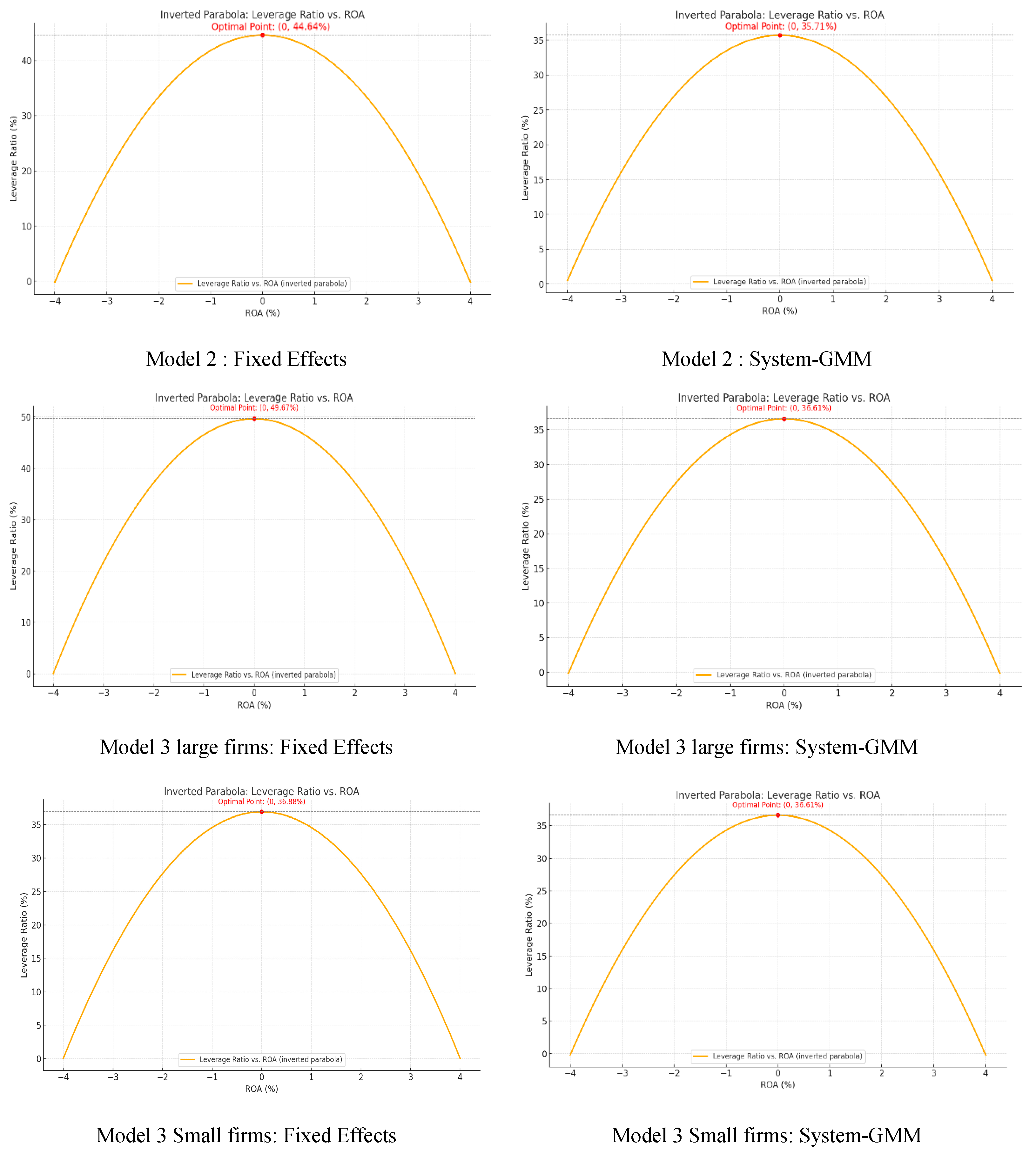
This study investigates the relationship between capital structure and financial performance in South African firms, focusing on the potential non-linear, inverse U-shaped effect of leverage on profitability. Drawing on data from 1548 firm-year observations covering 183 publicly listed South African companies between 2013 and 2022, the analysis employs both Fixed Effects (FE) and System Generalized Method of Moments (System-GMM) models to address endogeneity and capture dynamic adjustments. The findings indicate that moderate levels of debt enhance profitability, but excessive leverage leads to diminishing returns, confirming an inverse U-shaped relationship. System-GMM results further reveal the persistence of past profitability and validate the dynamic nature of capital structure decisions. Larger firms appear more capable of sustaining higher leverage without adverse effects, while smaller firms benefit from maintaining lower debt levels. The study concludes that strategic debt management, tailored to firm size and economic context, is critical for optimizing financial performance in emerging markets like South Africa. The study identifies the optimal leverage ratio for South African firms and shows how firm size moderates the relationship between debt and profitability, offering tailored insights for firms of different sizes. These insights offer valuable guidance for managers, investors, and policymakers aiming to strengthen financial stability and efficiency through informed capital structure choices.
Keywords: capital structure; financial performance; system-GMM; leverage; South African firms; optimal debt ratio capital structure; financial performance; system-GMM; leverage; South African firms; optimal debt ratio