

You are currently viewing a new version of our website. To view the old version click .

Econometrics, Volume 10, Issue 4

December 2022 - 6 articles

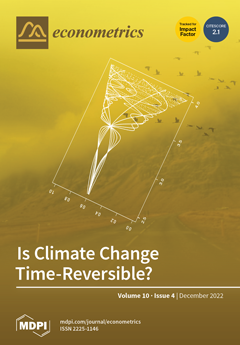
Cover Story: This paper proposes strategies to detect time reversibility in stationary stochastic processes by using the properties of mixed causal and noncausal models. It shows that they can also be used for non-stationary processes when the trend component is computed with the Hodrick–Prescott filter rendering a time-reversible closed-form solution. This paper also links the concept of an environmental tipping point to the statistical property of time irreversibility and assesses fourteen climate indicators. We find evidence of time irreversibility in greenhouse gas emissions, global temperature, global sea levels, sea ice area, and some natural oscillation indices. While not conclusive, our findings urge the implementation of correction policies to avoid the worst consequences of climate change and to not miss the window of opportunity, which might still be available, despite closing quickly. View this paper
  • Issues are regarded as officially published after their release is announced to the table of contents alert mailing list .
  • You may sign up for email alerts to receive table of contents of newly released issues.
  • PDF is the official format for papers published in both, html and pdf forms. To view the papers in pdf format, click on the "PDF Full-text" link, and use the free Adobe Reader to open them.

Articles (6)

  • Article
  • Open Access
4 Citations
2,877 Views
9 Pages

For more than half a century, Manfred Deistler has been contributing to the construction of the rigorous theoretical foundations of the statistical analysis of time series and more general stochastic processes. Half a century of unremitting activity...

  • Article
  • Open Access
4 Citations
5,612 Views
18 Pages

Is Climate Change Time-Reversible?

  • Francesco Giancaterini,
  • Alain Hecq and
  • Claudio Morana

This paper proposes strategies to detect time reversibility in stationary stochastic processes by using the properties of mixed causal and noncausal models. It shows that they can also be used for non-stationary processes when the trend component is...

  • Article
  • Open Access
5 Citations
2,867 Views
26 Pages

Linear System Challenges of Dynamic Factor Models

  • Brian D. O. Anderson,
  • Manfred Deistler and
  • Marco Lippi

A survey is provided dealing with the formulation of modelling problems for dynamic factor models, and the various algorithm possibilities for solving these modelling problems. Emphasis is placed on understanding requirements for the handling of erro...

  • Article
  • Open Access
1 Citations
2,683 Views
24 Pages

Validation of a Computer Code for the Energy Consumption of a Building, with Application to Optimal Electric Bill Pricing

  • Merlin Keller,
  • Guillaume Damblin,
  • Alberto Pasanisi,
  • Mathieu Schumann,
  • Pierre Barbillon,
  • Fabrizio Ruggeri and
  • Eric Parent

In this paper, we present a case study aimed at determining a billing plan that ensures customer loyalty and provides a profit for the energy company, whose point of view is taken in the paper. The energy provider promotes new contracts for residenti...

  • Article
  • Open Access
6 Citations
4,588 Views
27 Pages

Detecting and Quantifying Structural Breaks in Climate

  • Neil R. Ericsson,
  • Mohammed H. I. Dore and
  • Hassan Butt

Structural breaks have attracted considerable attention recently, especially in light of the financial crisis, Great Recession, the COVID-19 pandemic, and war. While structural breaks pose significant econometric challenges, machine learning provides...

  • Article
  • Open Access
3 Citations
4,419 Views
28 Pages

This paper proposes enhanced studies on a model consisting of a finite mixture framework of generalized linear models (GLMs) with gamma-distributed responses estimated using the Bayesian approach coupled with the Markov Chain Monte Carlo (MCMC) metho...

Get Alerted

Add your email address to receive forthcoming issues of this journal.

XFacebookLinkedIn
Econometrics - ISSN 2225-1146