

Shoot Characterization of Isoprene and Ocimene-Emitting Transgenic Arabidopsis Plants under Contrasting Environmental Conditions




Abstract
1. Introduction
2. Materials and Methods
2.1. Plant Materials and Growth Conditions
2.2. Experimental Design and Stress Application
2.3. Gravimetric Assessment of Daily Transpiration
2.4. Imaging Projected Leaf Area
2.5. Leaf number, Leaf Emergence Rate, and Phenology
2.6. Gas-Exchange Measurements
2.7. A/Ci Analysis
2.8. Final Biomass Assessment
2.9. Statistical Analysis
3. Results
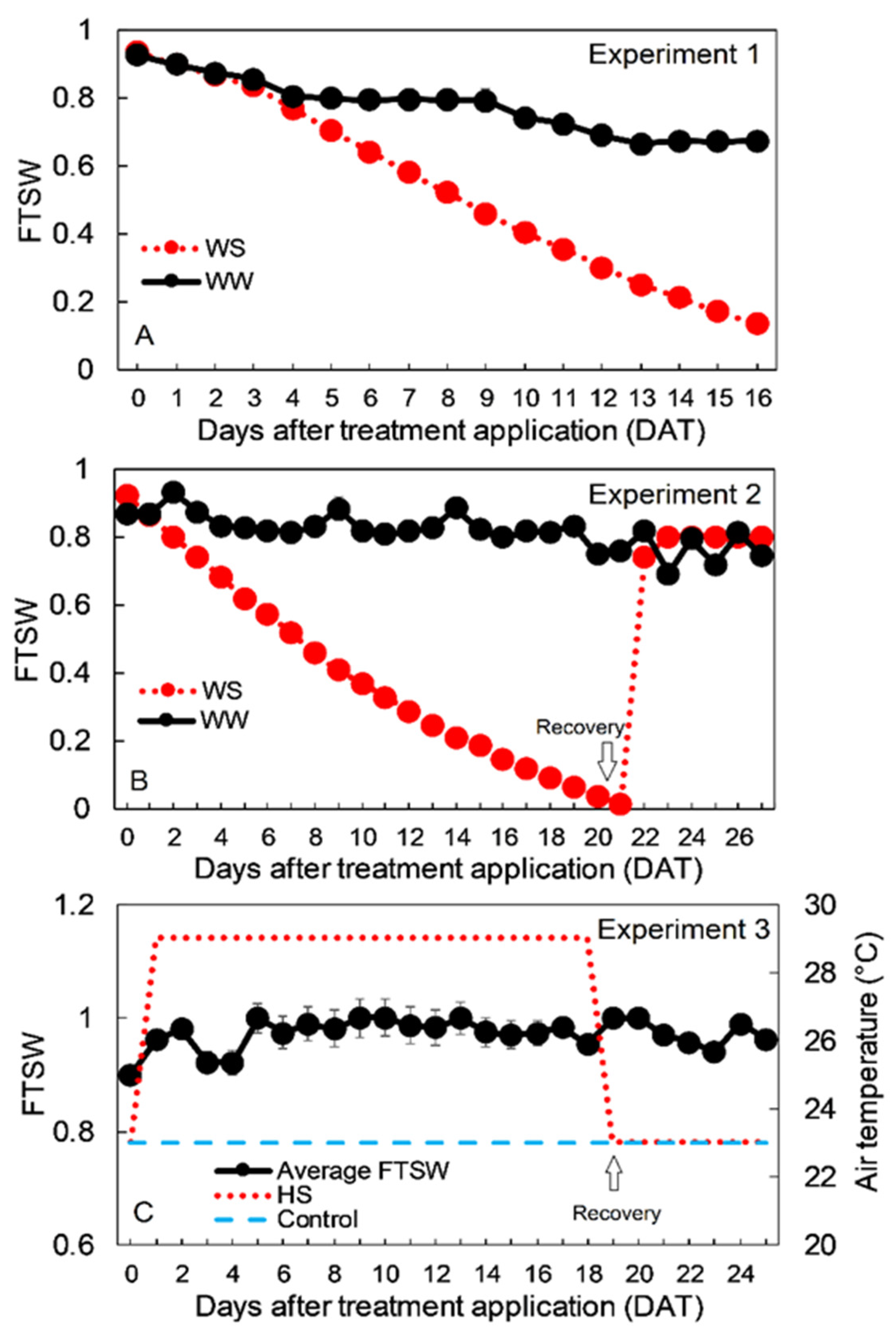
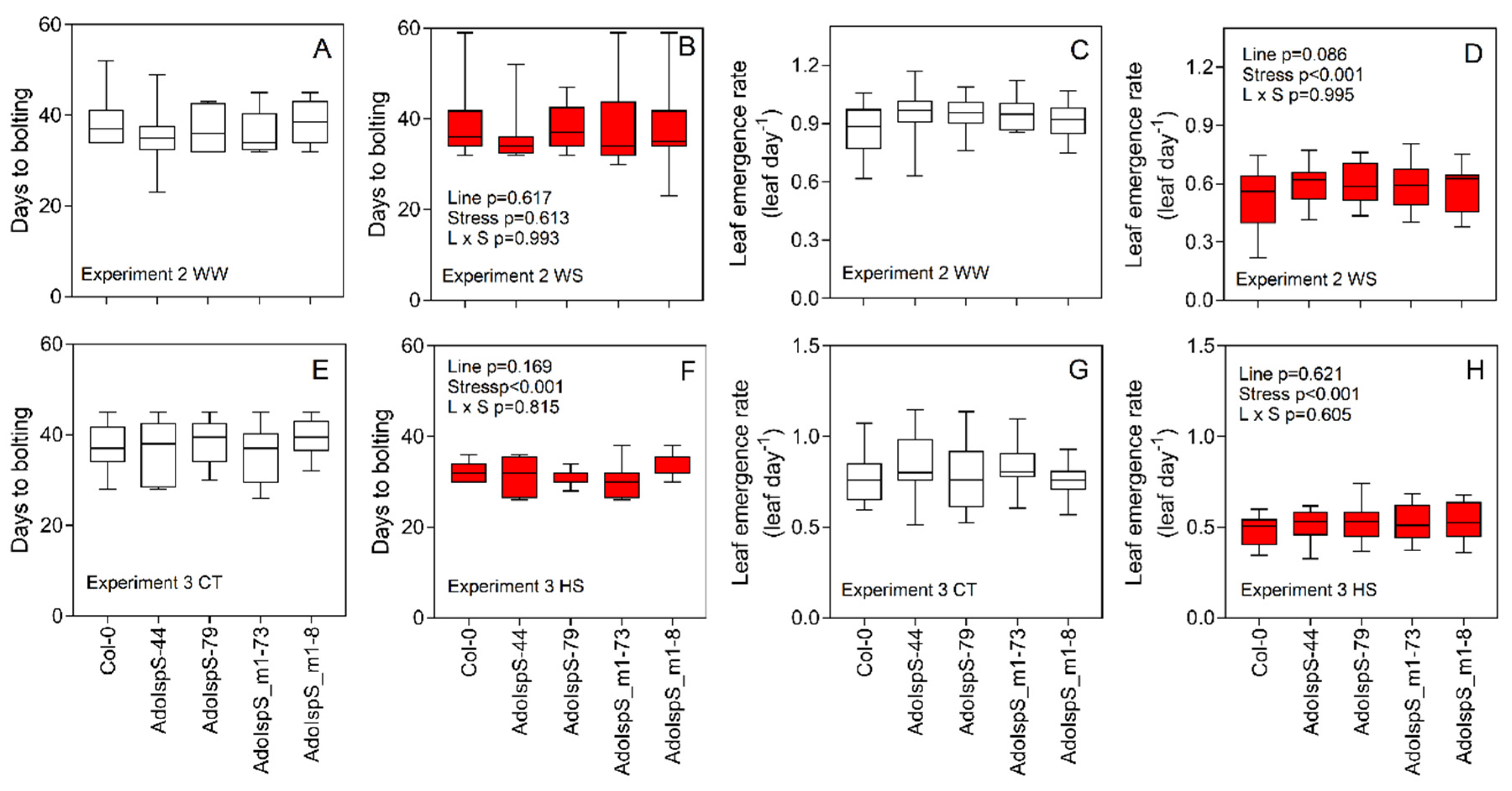
3.1. Stress Application and Phenology
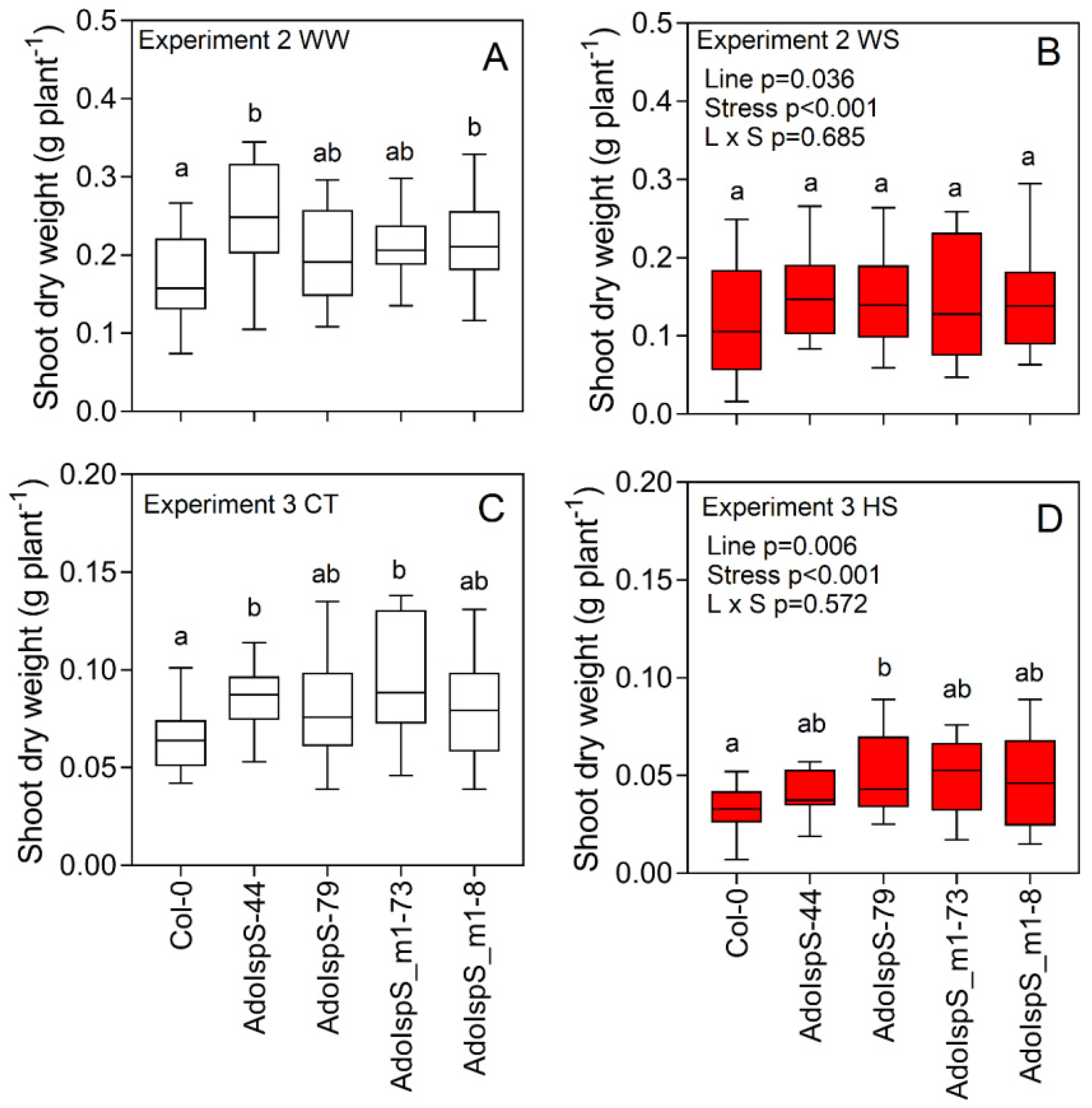
3.2. Shoot Biomass Assessment
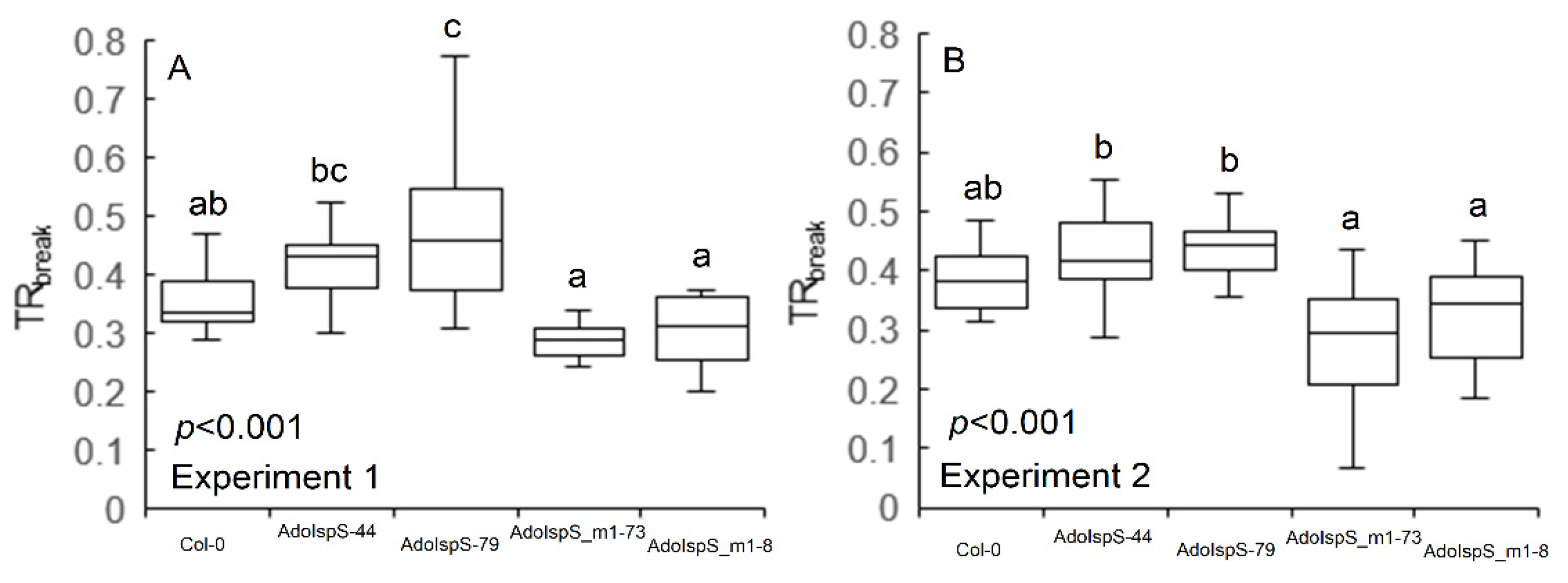
3.3. Water-Use Strategies under Reduced Water Availability
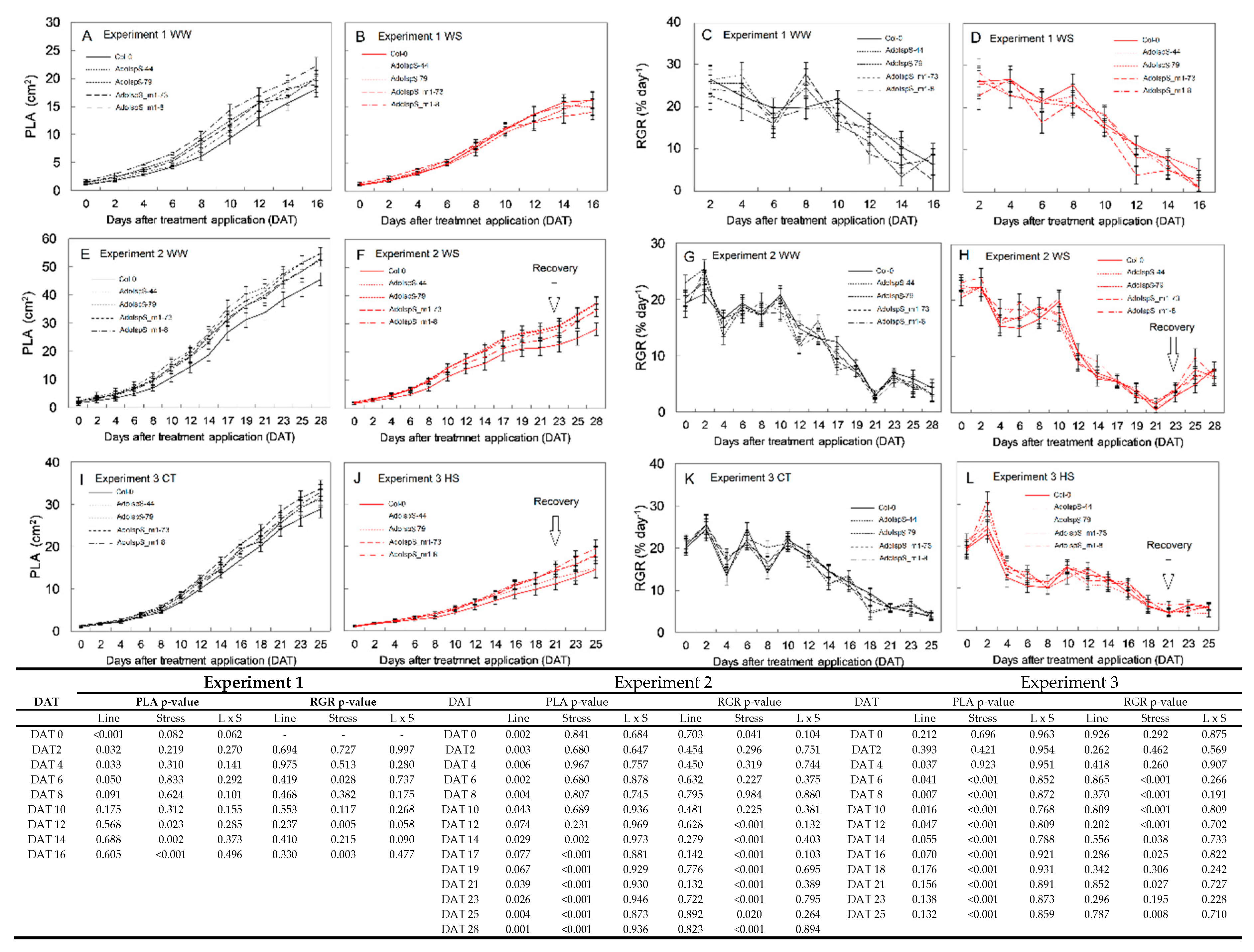
3.4. Projected Leaf Area and Relative Growth Rate
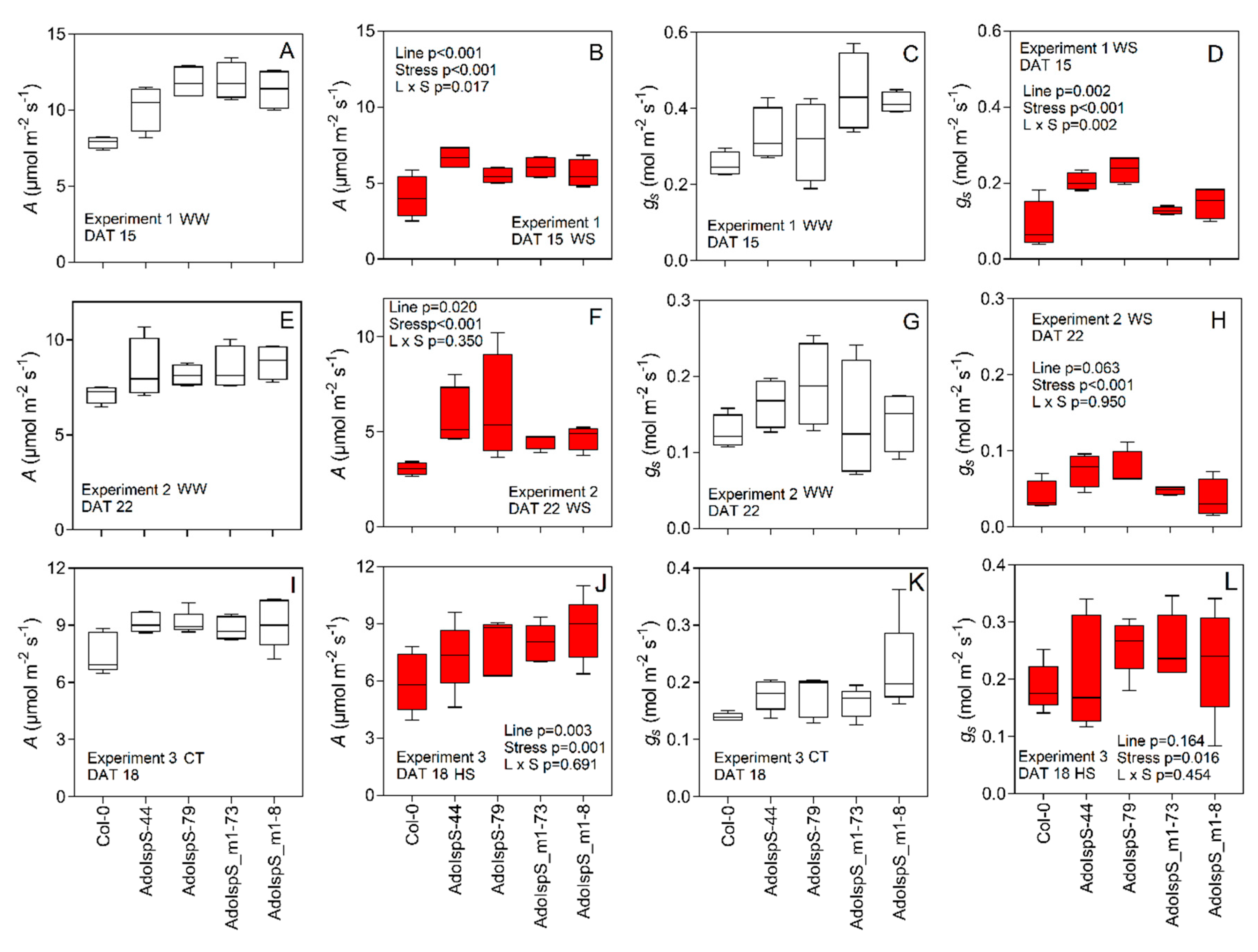
3.5. Gas-Exchange, A/Ci Analysis
4. Discussion
4.1. Hemi- and Mono-Terpene Emission Improves Plant Growth under Optimal Conditions
4.2. Isoprene and Ocimene Emission Resulted in a Moderate Tolerance to Environmental Stresses
4.3. Agricultural and Evolutionary Relevance
5. Conclusions
Supplementary Materials
Author Contributions
Acknowledgments
Conflicts of Interest
References
- Kesselmeier, J.; Ciccioli, P.; Kühn, U.; Stefani, P.; Biesenthal, T.; Rottenberger, S.; Wolf, A.; Vitullo, M.; Valentini, R.; Nobre, A.; et al. Volatile organic compound emissions in relation to plant carbon fixation and the terrestrial carbon budget. Glob. Biogeochem. Cycles 2002, 16, 73-1. [Google Scholar] [CrossRef] [Scilit]
- Spinelli, F.; Cellini, A.; Marchetti, L.; Mudigere, K.; Piovene, C. Emission and function of volatile organic compounds in response to abiotic stress. In Abiotic Stress in Plants—Mechanisms and Adaptations; IntechOpen: London, UK, 2011; pp. 367–394. [Google Scholar]
- Guenther, A.; Karl, T.; Harley, P.; Wiedinmyer, C.; Palmer, P.I.; Geron, C. Estimates of global terrestrial isoprene emissions using MEGAN (Model of Emissions of Gases and Aerosols from Nature). Atmos. Chem. Phys. Discuss. 2006, 6, 107–173. [Google Scholar] [CrossRef] [Scilit]
- Schwender, J.; Zeidler, J.; Gröner, R.; Müller, C.; Focke, M.; Braun, S.; Lichtenthaler, F.W.; Lichtenthaler, H.K. Incorporation of 1-deoxy-D-xylulose into isoprene and phytol by higher plants and algae. FEBS Lett. 1997, 414, 129–134. [Google Scholar] [CrossRef] [Scilit]
- Wiberley, A.E.; Donohue, A.R.; Westphal, M.M.; Sharkey, T.D. Regulation of isoprene emission from poplar leaves throughout a day. Plant Cell Environ. 2009, 32, 939–947. [Google Scholar] [CrossRef] [Scilit] [PubMed]
- Rasulov, B.; Hüve, K.; Bichele, I.; Laisk, A.; Niinemets, Ü. Temperature response of isoprene emission in vivo reflects a combined effect of substrate limitations and isoprene synthase activity: A kinetic analysis1. Plant Physiol. 2010, 154, 1558–1570. [Google Scholar] [CrossRef] [Scilit]
- Ahrar, M.; Doneva, D.; Koleva, D.; Romano, A.; Rodeghiero, M.; Tsonev, T.; Biasioli, F.; Stefanova, M.; Peeva, V.; Wohlfahrt, G.; et al. Isoprene emission in the monocot Arundineae tribe in relation to functional and structural organization of the photosynthetic apparatus. Environ. Exp. Bot. 2015, 119, 87–95. [Google Scholar] [CrossRef] [Scilit]
- Niinemets, Ü.; Sun, Z.; Talts, E. Controls of the quantum yield and saturation light of isoprene emission in different-aged aspen leaves. Plant Cell Environ. 2015, 38, 2707–2720. [Google Scholar] [CrossRef] [Scilit]
- Loreto, F.; Schnitzler, J.-P.; Schnitzler, J.-P. Abiotic stresses and induced BVOCs. Trends Plant Sci. 2010, 15, 154–166. [Google Scholar] [CrossRef] [Scilit]
- Sharkey, T.D.; Monson, R.K. Isoprene research—60 years later, the biology is still enigmatic. Plant Cell Environ. 2017, 40, 1671–1678. [Google Scholar] [CrossRef] [Scilit]
- Sharkey, T.D.; Gray, D.W.; Pell, H.K.; Breneman, S.R.; Topper, L. Isoprene synthase genes form a monophyletic clade of acyclic terpene synthases in the tps-b terpene synthase family. Evolution 2012, 67, 1026–1040. [Google Scholar] [CrossRef] [Scilit]
- Monson, R.K.; Jones, R.T.; Rosenstiel, T.N.; Schnitzler, J.-P.; Schnitzler, J.-P. Why only some plants emit isoprene. Plant Cell Environ. 2012, 36, 503–516. [Google Scholar] [CrossRef] [Scilit] [PubMed]
- Li, M.; Xu, J.; Alarcon, A.A.; Carlin, S.; Barbaro, E.; Cappellin, L.; Velikova, V.; Vrhovsek, U.; Loreto, F.; Varotto, C. In planta recapitulation of isoprene synthase evolution from ocimene synthases. Mol. Boil. Evol. 2017, 34, 2583–2599. [Google Scholar] [CrossRef] [Scilit] [PubMed]
- Loreto, F.; Fineschi, S. Reconciling functions and evolution of isoprene emission in higher plants. New Phytol. 2014, 206, 578–582. [Google Scholar] [CrossRef] [Scilit]
- Sharkey, T.D.; Wiberley, A.E.; Donohue, A.R. Isoprene emission from plants: Why and how. Ann. Bot. 2007, 101, 5–18. [Google Scholar] [CrossRef] [Scilit] [PubMed]
- Sharkey, T.D.; Bernacchi, C.; Farquhar, G.D.; Singsaas, E. Fitting photosynthetic carbon dioxide response curves for C3leaves. Plant Cell Environ. 2007, 30, 1035–1040. [Google Scholar] [CrossRef] [Scilit] [PubMed]
- Singsaas, L.; Lerdau, M.; Winter, K.; Sharkey, T.D. lsoprene lncreases thermotolerance of isoprene-emitting species. Plant Physiol. 1997, 115, 1413–1420. [Google Scholar] [CrossRef] [Scilit] [PubMed]
- Velikova, V.; Várkonyi, Z.; Szabo, M.; Maslenkova, L.; Nogues, I.; Kovács, L.; Peeva, V.; Busheva, M.; Garab, G.; Sharkey, T.D.; et al. Increased thermostability of thylakoid membranes in isoprene-emitting leaves probed with three biophysical techniques. Plant Physiol. 2011, 157, 905–916. [Google Scholar] [CrossRef] [Scilit]
- Vickers, C.E.; Possell, M.; Cojocariu, C.I.; Velikova, V.; Laothawornkitkul, J.; Ryan, A.; Mullineaux, P.M.; Hewitt, C.N. Isoprene synthesis protects transgenic tobacco plants from oxidative stress. Plant Cell Environ. 2009, 32, 520–531. [Google Scholar] [CrossRef] [Scilit]
- Loreto, F.; Velikova, V. Isoprene produced by leaves protects the photosynthetic apparatus against ozone damage, quenches ozone products, and reduces lipid peroxidation of cellular membranes. Plant Physiol. 2001, 127, 1781–1787. [Google Scholar] [CrossRef]
- Loreto, F.; Dicke, M.; Schnitzler, J.-P.; Turlings, T.C.J. Plant volatiles and the environment. Plant Cell Environ. 2014, 37, 1905–1908. [Google Scholar] [CrossRef] [Scilit]
- Llusià, J.; Peñuelas, J.; Sardans, J.; Owen, S.M.; Niinemets, Ü. Measurement of volatile terpene emissions in 70 dominant vascular plant species in Hawaii: Aliens emit more than natives. Glob. Ecol. Biogeogr. 2010, 19, 863–874. [Google Scholar] [CrossRef] [Scilit]
- Fini, A.; Brunetti, C.; Loreto, F.; Centritto, M.; Ferrini, F.; Tattini, M. Isoprene responses and functions in plants challenged by environmental pressures associated to climate change. Front. Plant Sci. 2017, 8, 1–8. [Google Scholar] [CrossRef] [Scilit] [PubMed]
- Loreto, F.; Förster, A.; Dürr, M.; Csiky, O.; Seufert, G. On the monoterpene emission under heat stress and on the increased thermotolerance of leaves of Quercus ilex L. fumigated with selected monoterpenes. Plant Cell Environ. 1998, 21, 101–107. [Google Scholar] [CrossRef] [Scilit]
- Loivamäki, M.; Gilmer, F.; Fischbach, R.J.; Sörgel, C.; Bachl, A.; Walter, A.; Schnitzler, J.-P. Arabidopsis, a model to study biological functions of isoprene emission? Plant Physiol. 2007, 144, 1066–1078. [Google Scholar] [CrossRef] [Scilit] [PubMed]
- Bloom, A.J. Easy leaf area: Automated digital image analysis for rapid and accurate measurement of leaf area. Appl. Plant Sci. 2014, 2, 1400033. [Google Scholar]
- Boyes, U.C.; Zayed, A.M.; Ascenzi, R.; McCaskill, A.J.; Hoffman, N.E.; Davis, K.; Görlach, J. Growth stage –based phenotypic analysis of arabidopsis. Plant Cell 2001, 13, 1499–1510. [Google Scholar] [CrossRef] [Scilit]
- Faralli, M.; Williams, K.S.; Han, J.; Corke, F.M.K.; Doonan, J.H.; Kettlewell, P.S. Water-saving traits can protect wheat grain number under progressive soil drying at the meiotic stage: A phenotyping approach. J. Plant Growth Regul. 2019, 38, 1562–1573. [Google Scholar] [CrossRef] [Scilit]
- Sharkey, T.D.; Yeh, S.; Wiberley, A.E.; Falbel, T.G.; Gong, D.; Fernandez, D.E. Evolution of the isoprene biosynthetic pathway in Kudzu1[w]. Plant Physiol. 2005, 137, 700–712. [Google Scholar] [CrossRef] [Scilit]
- Sasaki, K.; Saito, T.; Lämsä, M.; Oksman-Caldentey, K.-M.; Suzuki, M.; Ohyama, K.; Muranaka, T.; Ohara, K.; Yazaki, K. Plants utilize isoprene emission as a thermotolerance mechanism. Plant Cell Physiol. 2007, 48, 1254–1262. [Google Scholar] [CrossRef] [Scilit]
- Feng, Z.; Yuan, X.; Fares, S.; Loreto, F.; Li, P.; Hoshika, Y.; Paoletti, E. Isoprene is more affected by climate drivers than monoterpenes: A meta-analytic review on plant isoprenoid emissions. Plant Cell Environ. 2019, 42, 1939–1949. [Google Scholar] [CrossRef] [Scilit]
- Nogues, I.; Brilli, F.; Loreto, F. Dimethylallyl diphosphate and geranyl diphosphate pools of plant species characterized by different isoprenoid emissions1. Plant Physiol. 2006, 141, 721–730. [Google Scholar] [CrossRef] [Scilit] [PubMed]
- Owen, S.M.; Peñuelas, J. Volatile isoprenoid emission potentials are correlated with essential isoprenoid concentrations in five plant species. Acta Physiol. Plant. 2013, 35, 3109–3125. [Google Scholar] [CrossRef] [Scilit]
- Zuo, Z.; Weraduwage, S.M.; Lantz, A.T.; Sanchez, L.M.; Weise, S.E.; Wang, J.; Childs, K.L.; Sharkey, T.D. Isoprene acts as a signaling molecule in gene networks important for stress responses and plant growth. Plant Physiol. 2019, 180, 124–152. [Google Scholar] [CrossRef] [Scilit] [PubMed]
- Morfopoulos, C.; Prentice, I.C.; Keenan, T.F.; Friedlingstein, P.; Medlyn, B.E.; Peñuelas, J.; Possell, M. A unifying conceptual model for the environmental responses of isoprene emissions from plants. Ann. Bot. 2013, 112, 1223–1238. [Google Scholar] [CrossRef] [Scilit] [PubMed]
- Sinclair, T.R.; Hammer, G.L.; Van Oosterom, E.J. Potential yield and water-use efficiency benefits in sorghum from limited maximum transpiration rate. Funct. Plant Boil. 2005, 32, 945–952. [Google Scholar] [CrossRef] [Scilit]
- Querejeta, J.I.; Prieto, I.; Torres, M.P.; Campoy, M.; Alguacil, M.D.M.; Roldan, A. Water-spender strategy is linked to higher leaf nutrient concentrations across plant species colonizing a dry and nutrient-poor epiphytic habitat. Environ. Exp. Bot. 2018, 153, 302–310. [Google Scholar] [CrossRef] [Scilit]
- Chesson, P.; Gebauer, R.L.E.; Schwinning, S.; Huntly, N.; Wiegand, K.; Ernest, S.K.M.; Sher, A.; Novoplansky, A.; Weltzin, J.F. Resource pulses, species interactions, and diversity maintenance in arid and semi-arid environments. Oecologia 2004, 141, 236–253. [Google Scholar] [CrossRef] [Scilit]
- Tattini, M.; Loreto, F.; Fini, A.; Guidi, L.; Brunetti, C.; Velikova, V.; Gori, A.; Ferrini, F. Isoprenoids and phenylpropanoids are part of the antioxidant defense orchestrated daily by drought-stressed Platanus × acerifolia plants during Mediterranean summers. New Phytol. 2015, 207, 613–626. [Google Scholar] [CrossRef] [Scilit]
- Velikova, V.; Brunetti, C.; Tattini, M.; Doneva, D.; Ahrar, M.; Tsonev, T.; Stefanova, M.; Ganeva, T.; Gori, A.; Ferini, F.; et al. Physiological significance of isoprenoids and phenylpropanoids in drought response of Arundinoideae species with contrasting habitats and metabolism. Plant Cell Environ. 2016, 39, 2185–2197. [Google Scholar] [CrossRef] [Scilit]
- Harvey, C.; Li, Z.; Tjellström, H.; Blanchard, G.J.; Sharkey, T.D. Concentration of isoprene in artificial and thylakoid membranes. J. Bioenerg. Biomembr. 2015, 47, 419–429. [Google Scholar] [CrossRef] [Scilit]
- Brilli, F.; Loreto, F.; Baccelli, I. Exploiting Plant Volatile Organic Compounds (VOCs) in agriculture to improve sustainable defense strategies and productivity of crops. Front. Plant Sci. 2019, 10, 264. [Google Scholar] [CrossRef] [Scilit] [PubMed]
- Robertson, G.P.; Swinton, S.M. Reconciling agricultural productivity and environmental integrity: A grand challenge for agriculture. Front. Ecol. Environ. 2005, 3, 38–46. [Google Scholar] [CrossRef]
- Porter, J.R.; Semenov, M. Crop responses to climatic variation. Philos. Trans. R. Soc. B Boil. Sci. 2005, 360, 2021–2035. [Google Scholar] [CrossRef] [Scilit] [PubMed]
- Cossani, C.M.; Reynolds, M. Physiological traits for improving heat tolerance in wheat. Plant Physiol. 2012, 160, 1710–1718. [Google Scholar] [CrossRef] [Scilit] [PubMed]
- Lantz, A.T.; Allman, J.; Weraduwage, S.M.; Sharkey, T.D. Isoprene: New insights into the control of emission and mediation of stress tolerance by gene expression. Plant Cell Environ. 2019, 42, 2808–2826. [Google Scholar] [CrossRef] [Scilit] [PubMed]
- Rosenthal, J.P.; Dirzo, R. Effects of life history, domestication and agronomic selection on plant defence against insects: Evidence from maizes and wild relatives. Evol. Ecol. 1997, 11, 337–355. [Google Scholar] [CrossRef] [Scilit]
- Rodriguez-Saona, C.; Vorsa, N.; Singh, A.P.; Johnson-Cicalese, J.; Szendrei, Z.; Mescher, M.C.; Frost, C.J. Tracing the history of plant traits under domestication in cranberries: Potential consequences on anti-herbivore defences. J. Exp. Bot. 2011, 62, 2633–2644. [Google Scholar] [CrossRef] [Scilit]
- Nakhforoosh, A.; Bodewein, T.; Fiorani, F.; Bodner, G. Identification of water use strategies at early growth stages in durum wheat from shoot phenotyping and physiological measurements. Front. Plant Sci. 2016, 7, 925. [Google Scholar] [CrossRef] [Scilit]
- Turner, N.C. Adaptation to water deficits: A changing perspective. Funct. Plant Boil. 1986, 13, 175–190. [Google Scholar] [CrossRef] [Scilit]

| Line | A | Vcmax | Jmax |
|---|---|---|---|
| Col-0 | 8.0 a | 45.2 | 94.4 a |
| AdoIspS-79 | 9.4 b | 49.1 | 102.3 a,b |
| AdoIspS-44 | 9.6 b | 56.6 | 119.6 b |
| AdoIspS_m1-8 | 9.8 b | 55.9 | 114.5 b |
| AdoIspS_m1-73 | 10.2 b | 53.5 | 114.4 b |
| p-value | |||
| 0.045 | 0.321 | 0.041 |
© 2020 by the authors. Licensee MDPI, Basel, Switzerland. This article is an open access article distributed under the terms and conditions of the Creative Commons Attribution (CC BY) license (http://creativecommons.org/licenses/by/4.0/).
Share and Cite
Faralli, M.; Li, M.; Varotto, C. Shoot Characterization of Isoprene and Ocimene-Emitting Transgenic Arabidopsis Plants under Contrasting Environmental Conditions. Plants 2020, 9, 477. https://doi.org/10.3390/plants9040477
Faralli M, Li M, Varotto C. Shoot Characterization of Isoprene and Ocimene-Emitting Transgenic Arabidopsis Plants under Contrasting Environmental Conditions. Plants. 2020; 9(4):477. https://doi.org/10.3390/plants9040477
Chicago/Turabian StyleFaralli, Michele, Mingai Li, and Claudio Varotto. 2020. "Shoot Characterization of Isoprene and Ocimene-Emitting Transgenic Arabidopsis Plants under Contrasting Environmental Conditions" Plants 9, no. 4: 477. https://doi.org/10.3390/plants9040477
APA StyleFaralli, M., Li, M., & Varotto, C. (2020). Shoot Characterization of Isoprene and Ocimene-Emitting Transgenic Arabidopsis Plants under Contrasting Environmental Conditions. Plants, 9(4), 477. https://doi.org/10.3390/plants9040477


