Review

Psophocarpus tetragonolobus: An Underused Species with Multiple Potential Uses


1
Doctoral School of Science and Technology, Research Platform for Environmental Science (PRASE), Lebanese University, Beirut, Lebanon
2
Laboratory of Cancer Biology and Molecular Immunology, Faculty of Sciences, Lebanese University, Hadath-Beirut, Beirut, Lebanon
3
Laboratoire de Chimie Agro-industrielle, LCA, Université de Toulouse, INRA, 31030 Toulouse, France
4
Département Génie Biologique, Université Paul Sabatier, IUT A, 32000 Auch, France
5
Department of Biology, College of Science, Al Mustansiriya University, Baghdad, Iraq
6
Doctoral School of Science and Technology, Lebanese University, EDST, Hadath, Beirut, Lebanon
*
Authors to whom correspondence should be addressed.
Plants 2020, 9(12), 1730; https://doi.org/10.3390/plants9121730
Submission received: 26 October 2020 / Revised: 30 November 2020 / Accepted: 6 December 2020 / Published: 8 December 2020

Abstract

Natural products, particularly those extracted from plants, have been used as therapy for different diseases for thousands of years. The first written records on the plants used in natural medicine, referred to as “medicinal plants”, go back to about 2600 BC. A thorough and complete understanding of medicinal plants encompasses a multiplex of overlapping and integrated sciences such as botany, pharmacognosy, chemistry, enzymology and genetics. Psophocarpus tetragonolobus, a member of Fabaceae family also called winged bean, is a perennial herbaceous plant characterized by its tuberous roots and its winged pod twinning and a perennial legume rich in proteins, oils, vitamins and carbohydrates. Besides nutrients, winged bean also contains bioactive compounds that have therapeutic activities like anti-oxidant, anti-inflammatory, antinociceptive, antibacterial, antifungal, antiproliferative and cytotoxic activity, a few of which already been reported. This plant can also be used as a medicinal plant for future benefits. With this concept in mind, the present review is designed to shed the light on the interests in the various phytochemicals and pharmacological pharmacognostical aspects of Psophocarpus tetragonolobus.
Keywords: winged bean; ethnomedicinal uses; therapeutic activities; anti-inflammatory effect; anti-proliferative activity; nutrients winged bean; ethnomedicinal uses; therapeutic activities; anti-inflammatory effect; anti-proliferative activity; nutrients
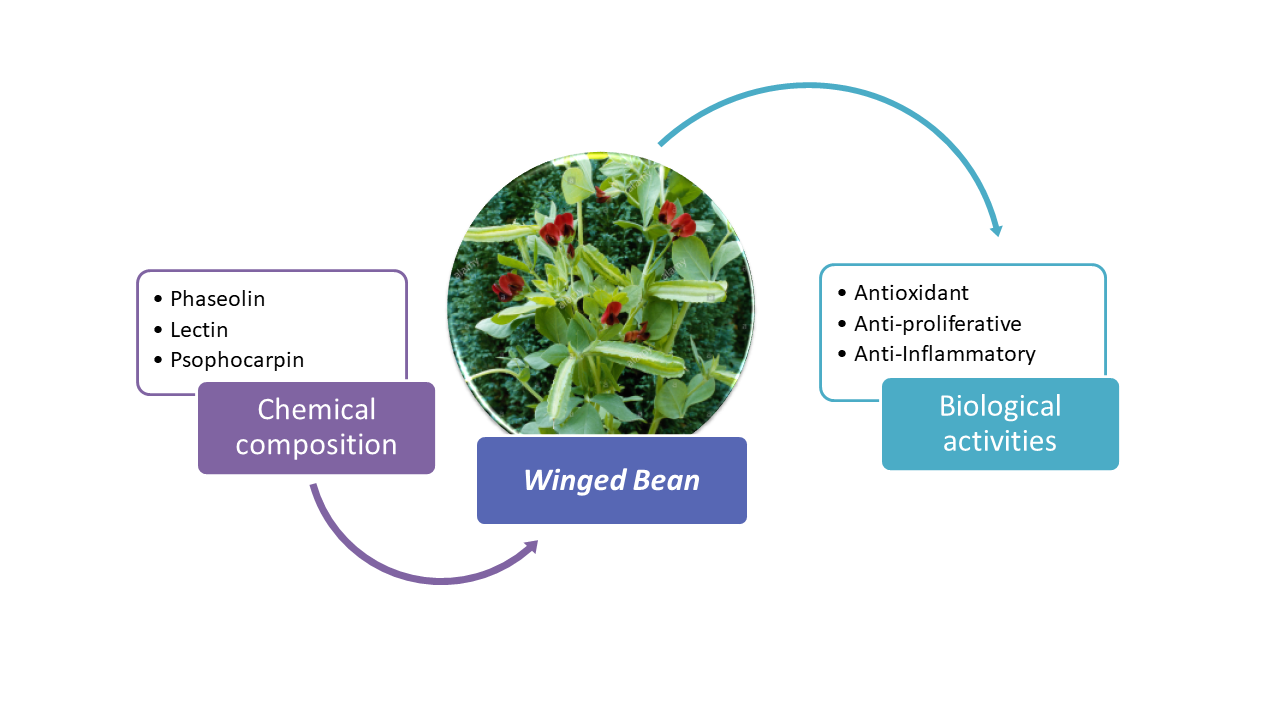
Graphical Abstract