Article

Hierarchical Chemotaxonomic Differentiation in Cannabis Chemovars Using Quantitative HPLC Cannabinoid Profiling and Multivariate Chemometrics


by
Amonrat Mayong
1,2,†,
Tanee Sreewongchai
2,3,
Sasithorn Limsuwan
2,4,† and
Natthasit Tansakul
2,5,*
1
Agricultural Research and Technology Transfer Center, Faculty of Agriculture, Kasetsart University, Bangkok 10900, Thailand
2
Special Research Incubator Unit for Cannabis-Hemp and Phytochemicals in Veterinary Medicine, Faculty of Veterinary Medicine, Kasetsart University, Bangkok 10900, Thailand
3
Department of Agronomy, Faculty of Agriculture, Kasetsart University, Bangkok 10900, Thailand
4
Institute of Food Research and Product Development, Kasetsart University, Bangkok 10900, Thailand
5
Department of Pharmacology, Faculty of Veterinary Medicine, Kasetsart University, Bangkok 10900, Thailand
*
Author to whom correspondence should be addressed.
These authors contributed equally to this work.
Plants 2026, 15(7), 1077; https://doi.org/10.3390/plants15071077

Submission received: 19 February 2026 / Revised: 17 March 2026 / Accepted: 25 March 2026 / Published: 1 April 2026
(This article belongs to the Special Issue Advanced Research in Plant Analytical Chemistry)

Abstract

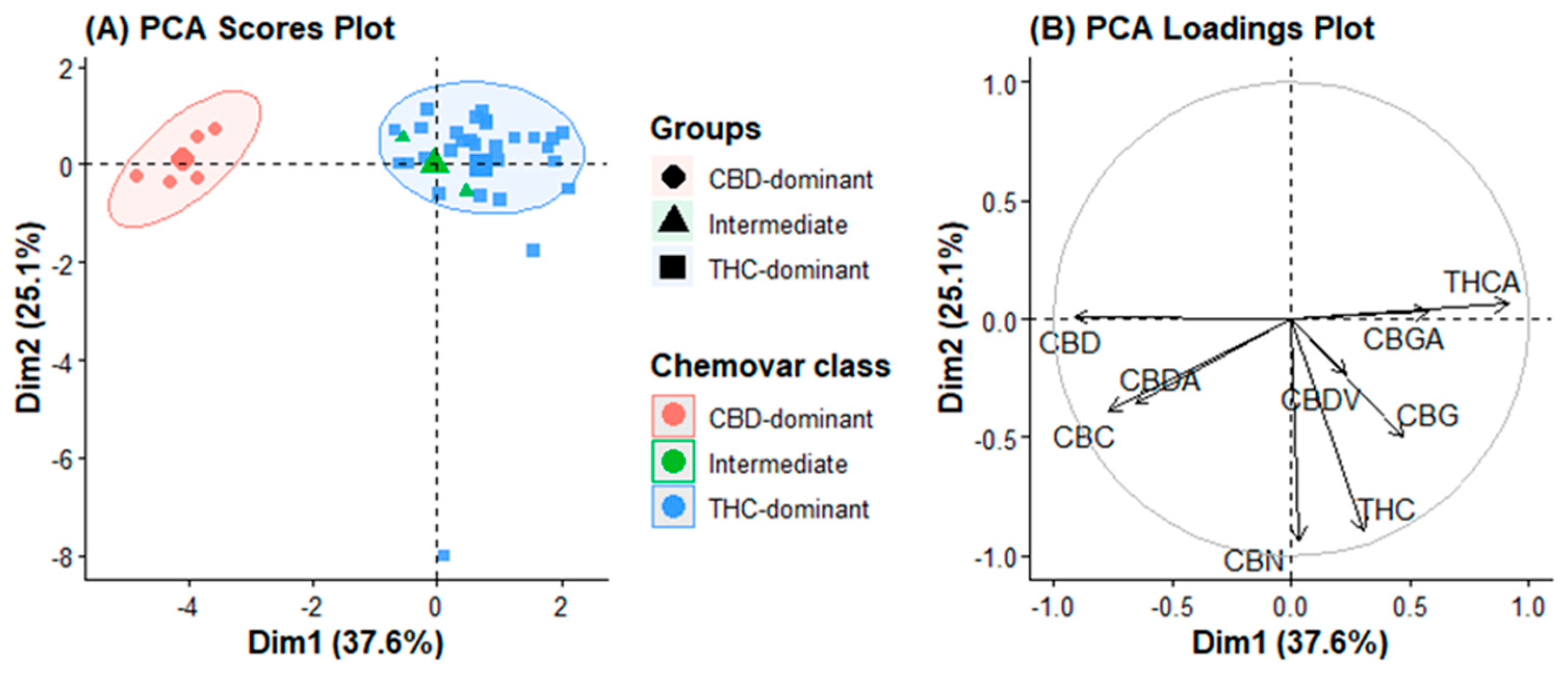
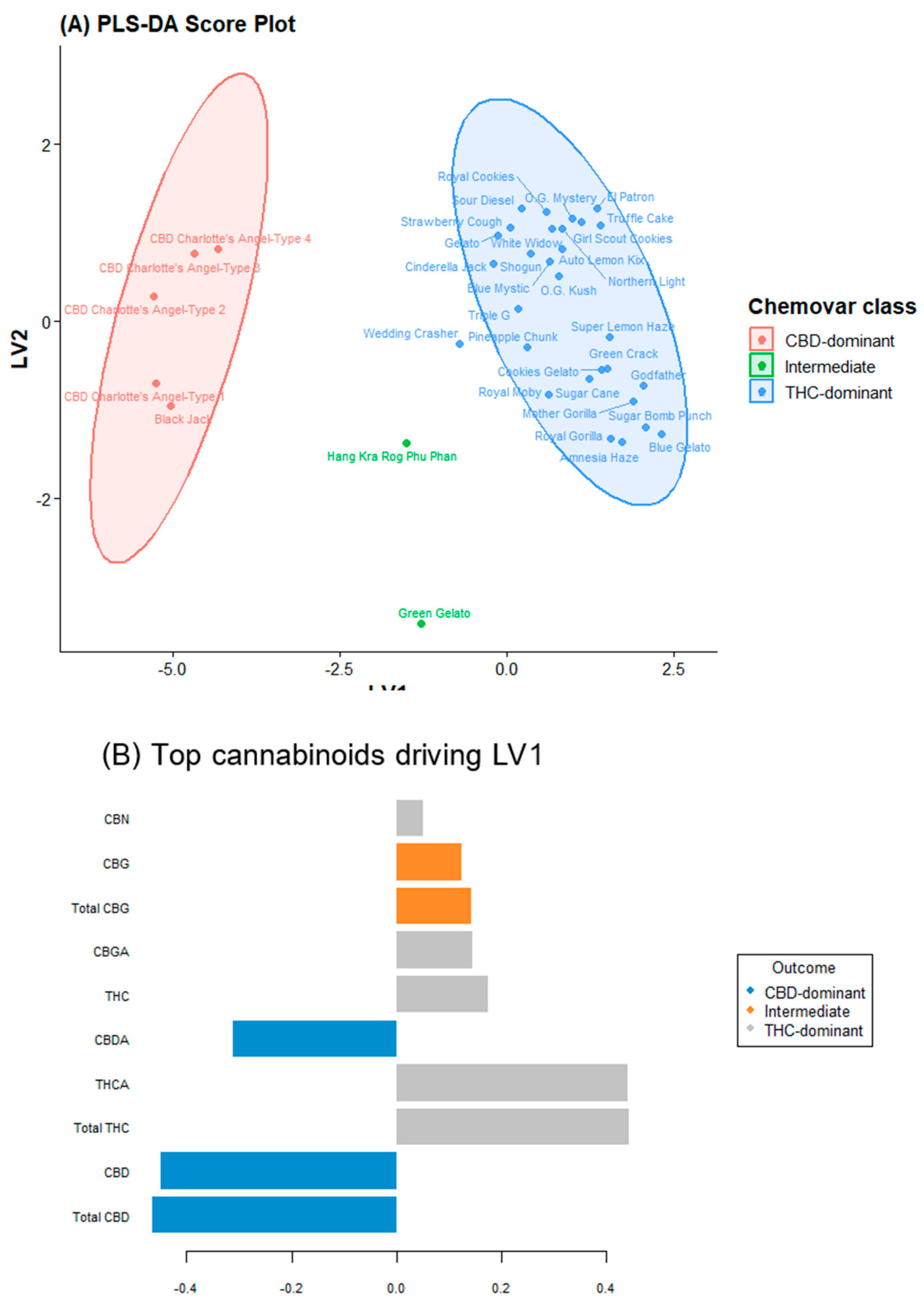
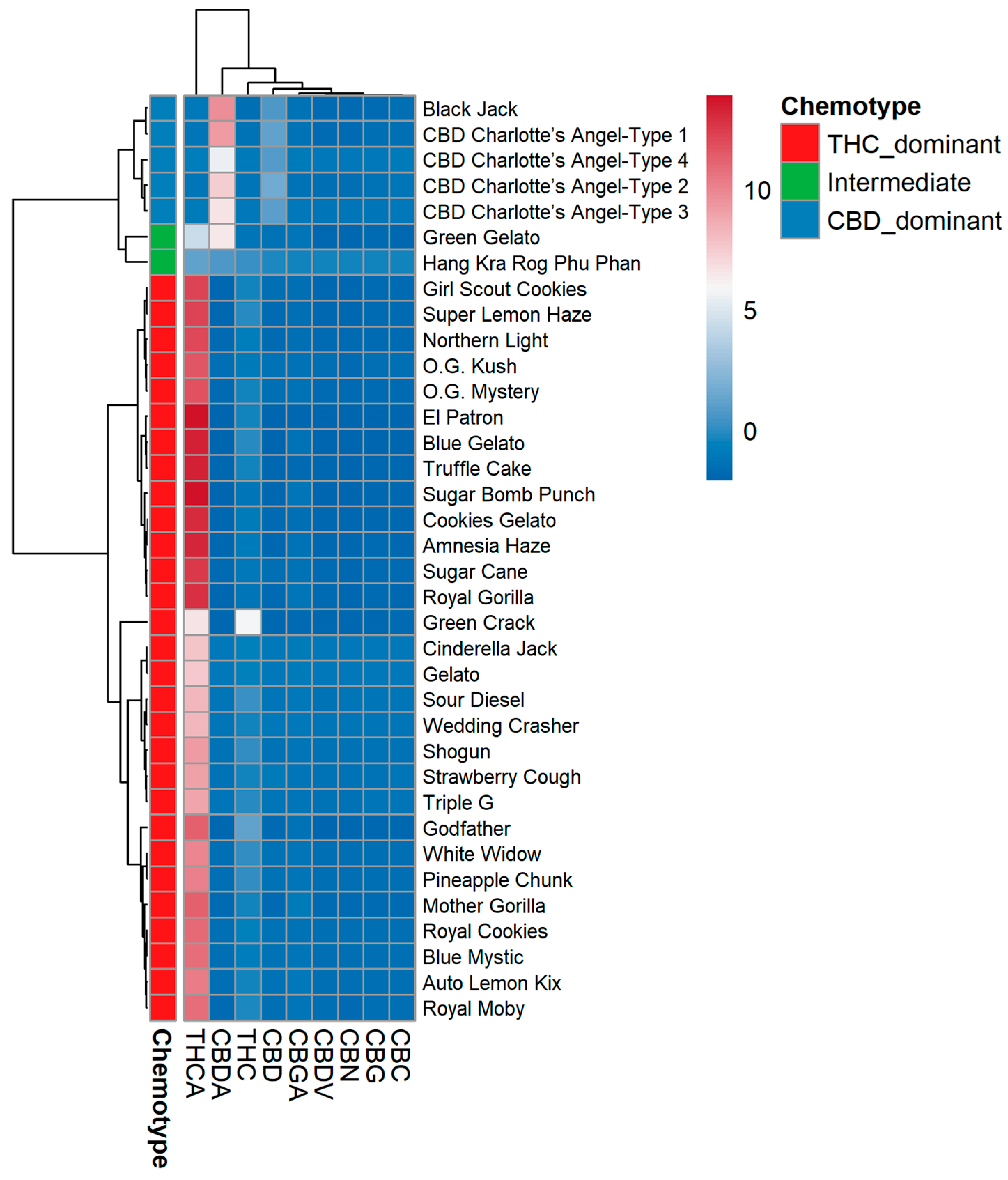
The chemotaxonomic classification of Cannabis sativa L. has historically relied on the Δ9-tetrahydrocannabinol (THC) to cannabidiol (CBD) ratio, yielding canonical chemotypes I, II, and III. However, this binary framework overlooks the chemical diversity contributed by the minor cannabinoids. High-performance liquid chromatography (HPLC) following the AOAC Official Method 2018.10 was employed to quantify nine cannabinoids (THCA, THC, CBDA, CBD, CBGA, CBG, CBC, CBDV, and CBN) across 36 commercially and medicinally relevant cannabis varieties. Quantitative profiling revealed substantial phytochemical heterogeneity, with total THC ranging from 0.41% to 15.64% and total CBD ranging from 0.09% to 12.32% (w/w). Unsupervised principal component analysis (PCA) demonstrated that the first two principal components explained 62.7% of the total variance. PC1 (37.6%) captured the THCA–CBDA polarity axis, while PC2 (25.1%) was dominated by minor cannabinoids (CBC; loading 0.417), CBGA (0.314), and CBG (0.258). Supervised partial least squares discriminant analysis (PLS-DA) using only the nine cannabinoid variables achieved 94.2% cross-validated accuracy and 100% test-set accuracy in predicting the chemotype class, with CBC identified as the third most discriminatory variable (variable importance in projection, VIP = 1.34). Hierarchical clustering resolved three principal clades and further subdivided THC-dominant accessions into CBC-enriched (Sour Diesel, Cinderella Jack) and CBGA-enriched (Mother Gorilla, Auto Lemon Kix) subclusters. A multivariate “metabolic coordinate” system based on PC1/PC2 scores is proposed as a quantitative and reproducible alternative to the traditional Type I/II/III and sativa/indica nomenclatures. This study introduces an empirically grounded framework for variety authentication, quality control, and enhanced precision breeding in the rapidly growing medicinal cannabis sector, for both human and veterinary applications.
Keywords: Cannabis sativa L.; cannabinoids; chemometrics; chemovar; HPLC; variety Cannabis sativa L.; cannabinoids; chemometrics; chemovar; HPLC; variety