Vegetation Structure Drives Seasonal and Diel Dynamics of Avian Soundscapes in an Urban Wetland


Abstract
1. Introduction
2. Results
2.1. Spatial and Temporal Characteristics of Bird Soundscapes
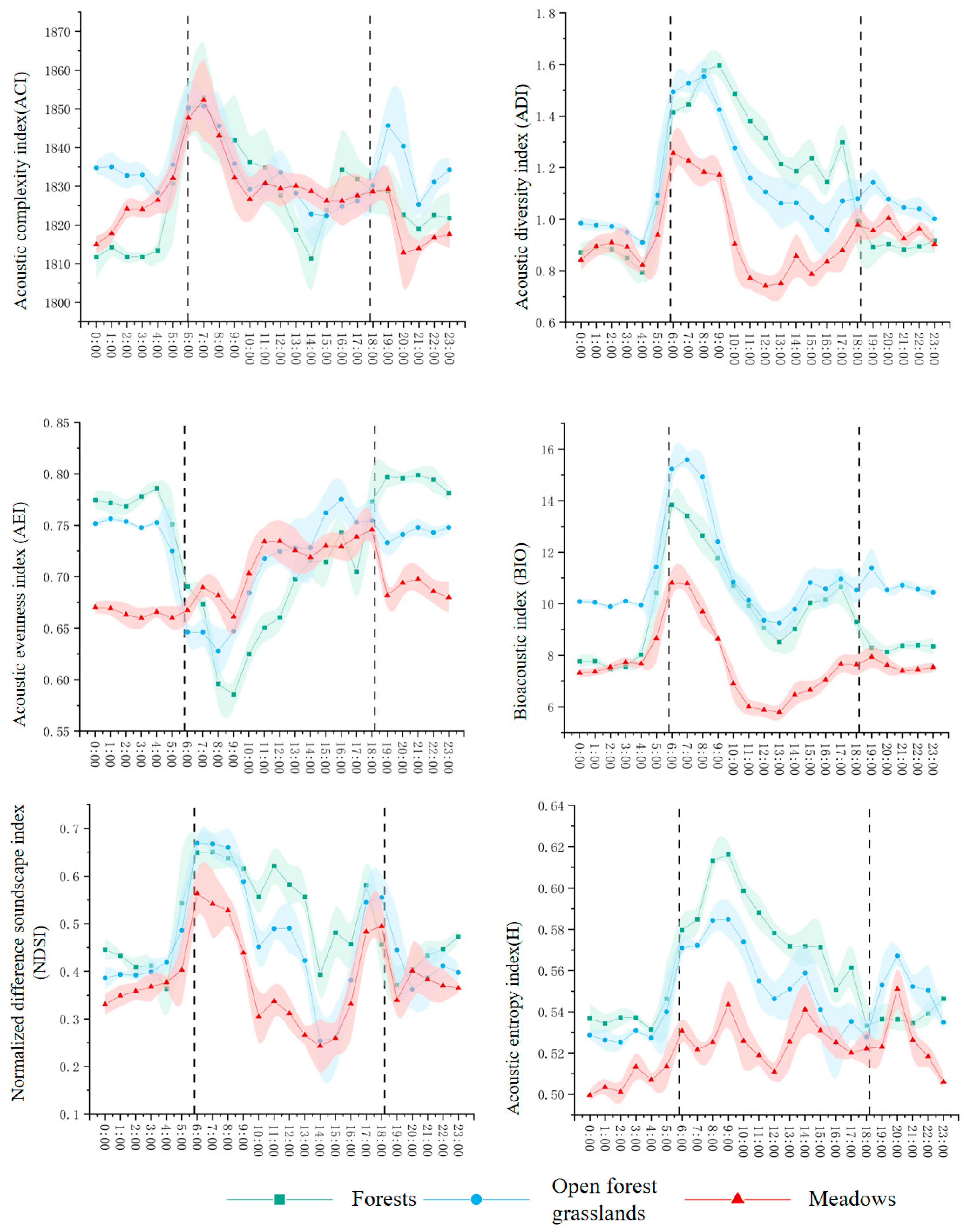
2.1.1. Diurnal Variation in Bird Soundscape Index Across Vegetation Types
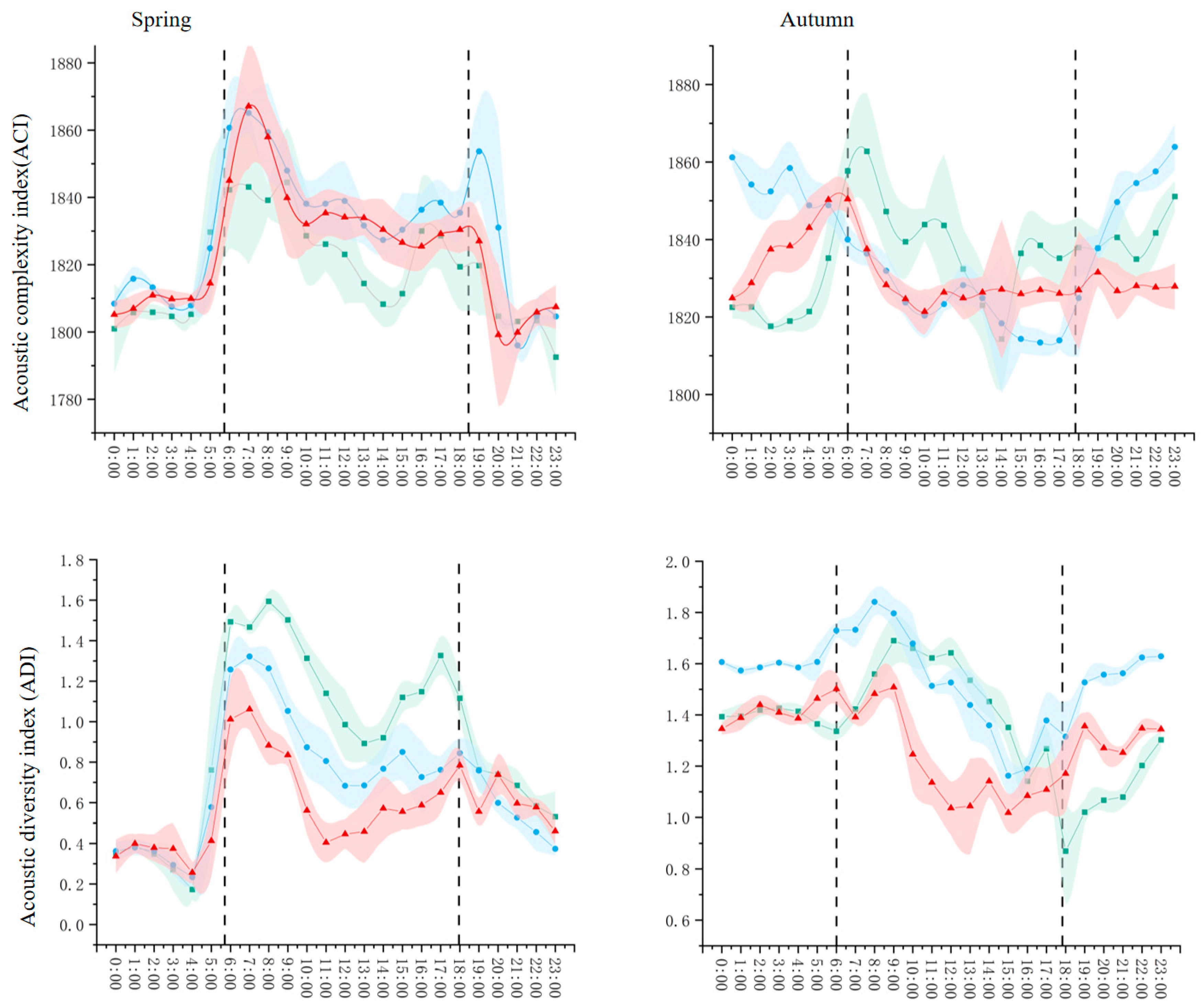
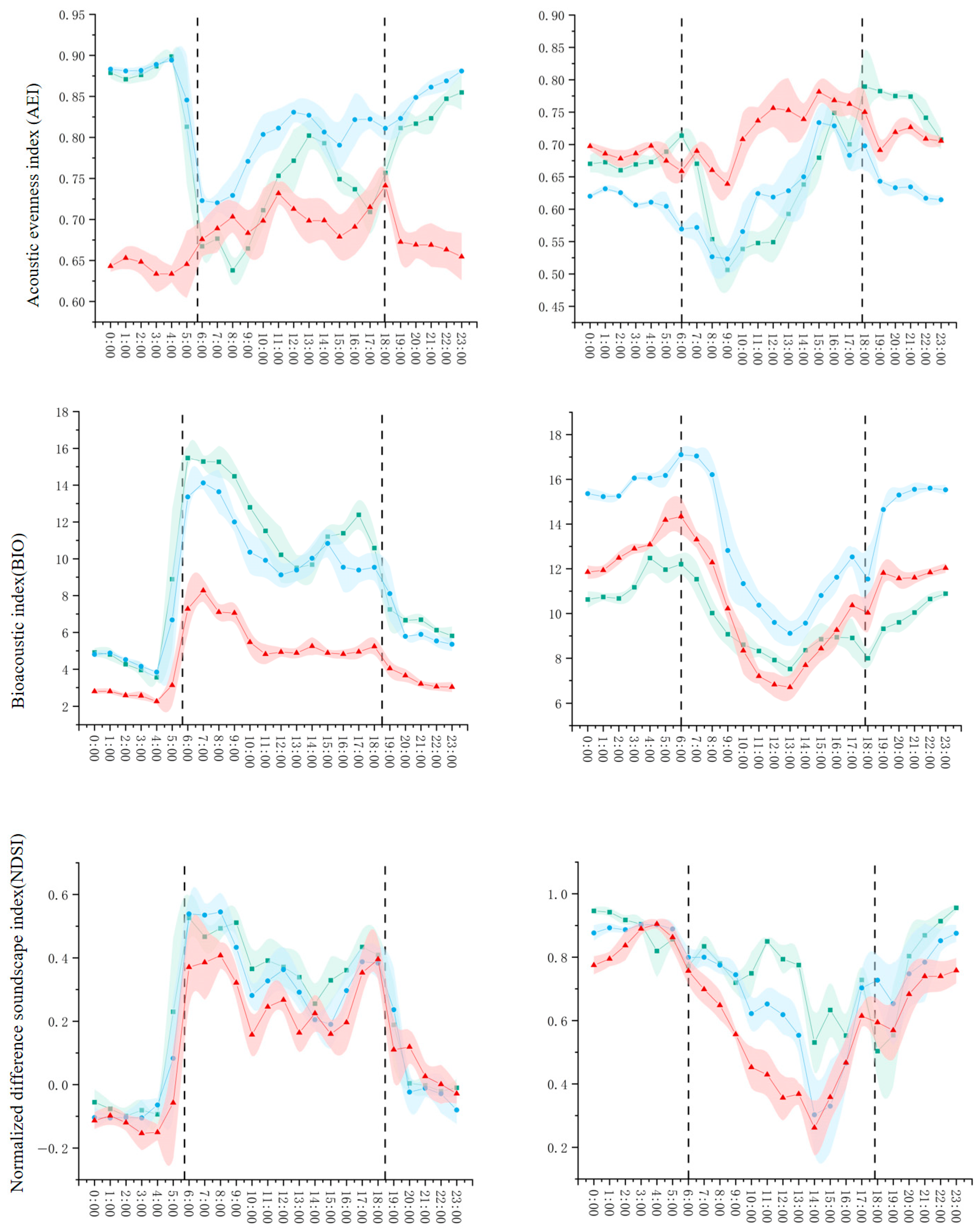
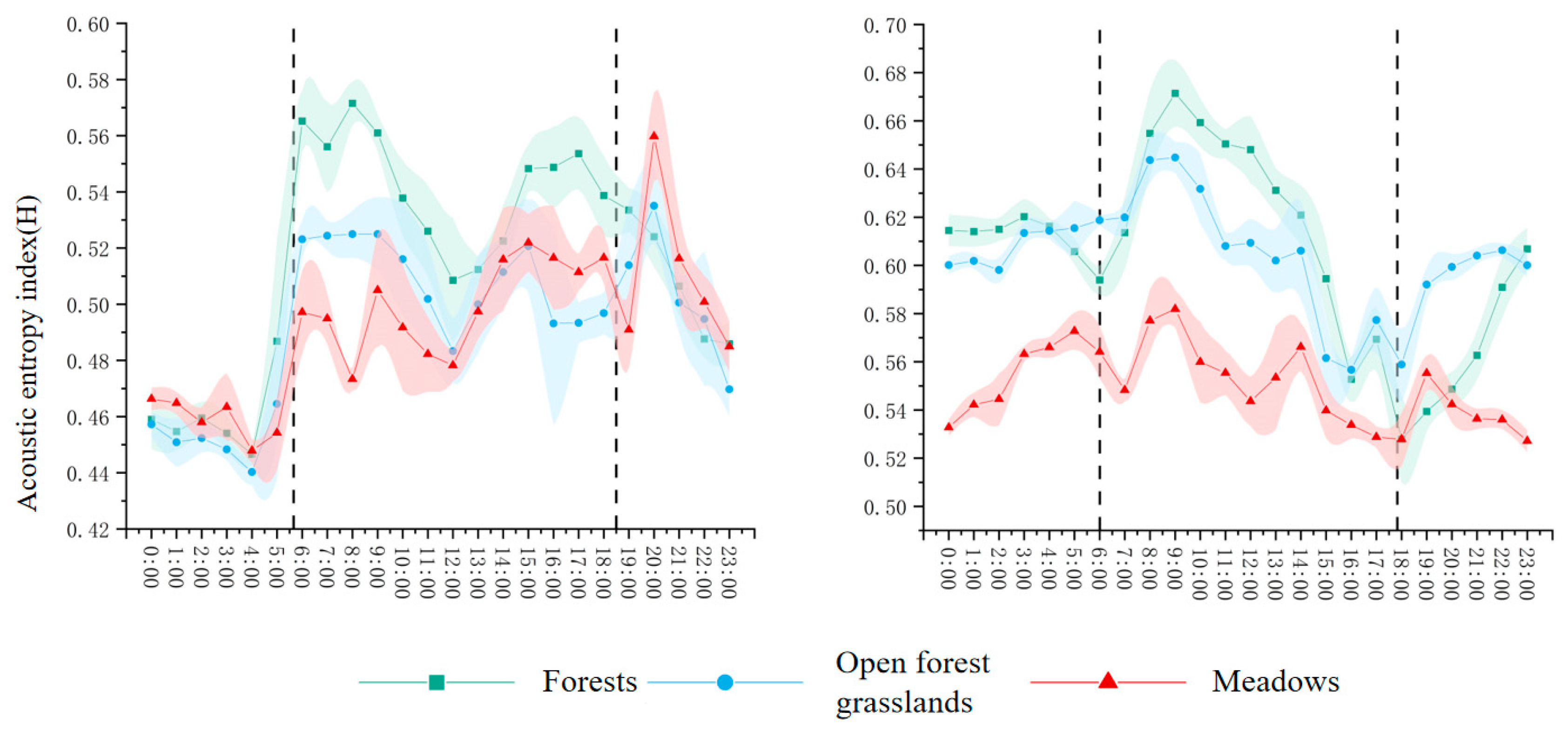
2.1.2. Seasonal Variation Across Vegetation Types
2.1.3. Wind Conditions During Sampling
2.2. Factors Influencing Bird Soundscape Variation
2.2.1. Random Forest Analysis
2.2.2. Redundancy Analysis
2.2.3. Relationship Between Noise Levels and Bird Vocalizations
3. Discussion
3.1. Vegetation Structure Shapes Bird Soundscapes Through Resource Provision and Sound Propagation
3.2. Seasonal Dynamics Reflect Phenological Changes in Vegetation and Bird Behavior
3.3. Anthropogenic Disturbance Suppresses Biological Sounds, but Vegetation Can Buffer Effects
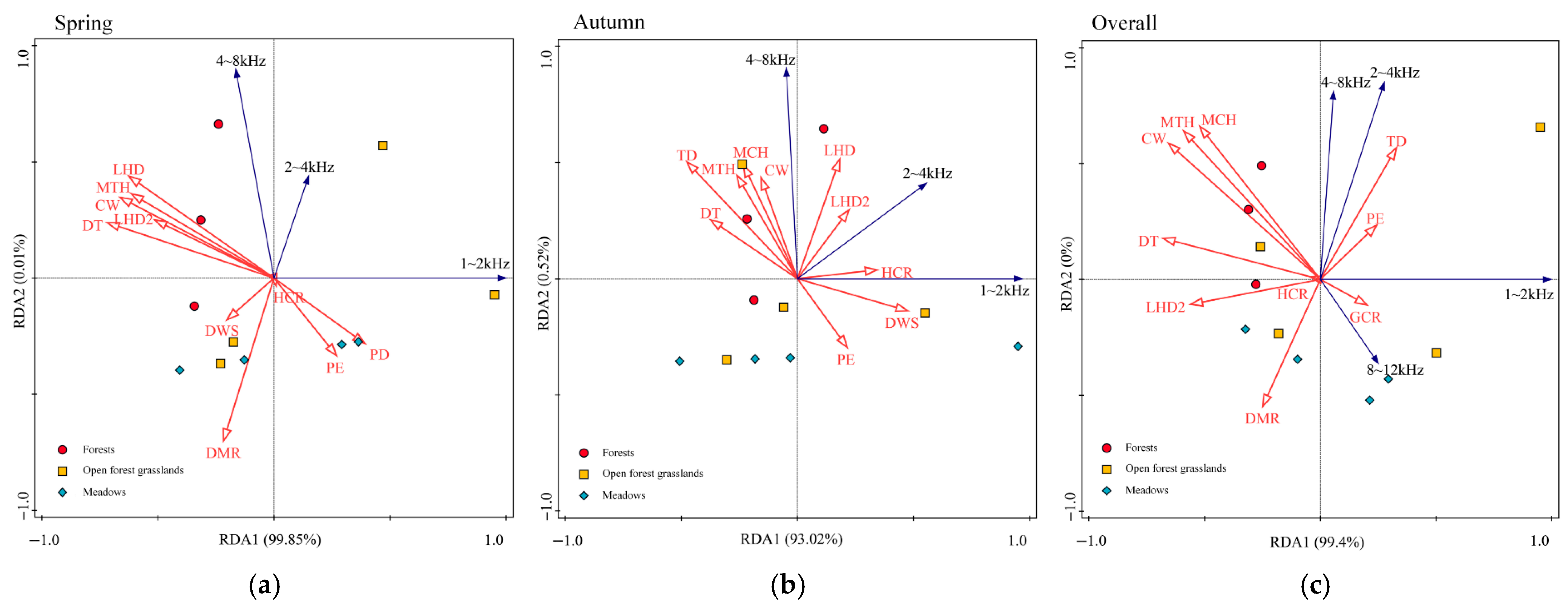
- Maintain buffer zones around core habitat areas, with particular attention to trail and road placement. Our RDA results suggest that even modest increases in DT and DMR can reduce anthropogenic noise in the 1–2 kHz band (Figure 4).
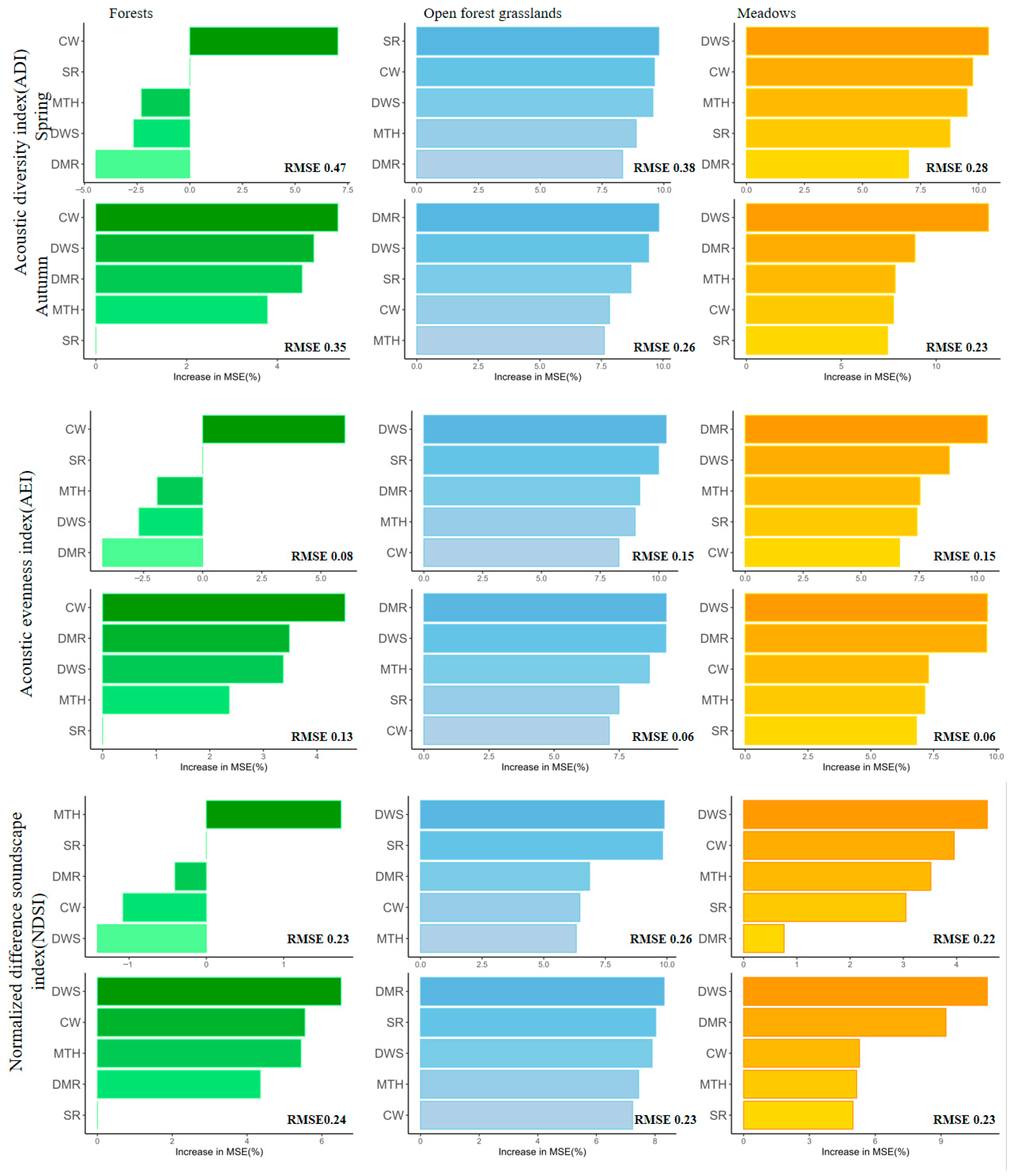
- Prioritize structurally complex vegetation, especially trees with crown width ≥ 4 m, which showed consistent positive effects across multiple acoustic indices (Figure 3).
- Reduce impervious surface coverage (HCR) in and around wetland habitats, as hardness rate showed consistent negative associations with biological sounds.
- Recognize the dual role of water bodies: while they provide valuable habitat and contribute to natural geophony, they may also concentrate human activity; management should balance public access with acoustic refuge preservation.
3.4. Situating Our Findings Within the Broader Soundscape Ecology Literature
3.4.1. Transferability of the Analytical Framework
3.4.2. Ground-Based Vegetation Metrics as LiDAR Surrogates
3.4.3. Cross-Study Comparability of Anthropogenic Noise Effects
3.5. Limitations and Future Directions
4. Material and Method
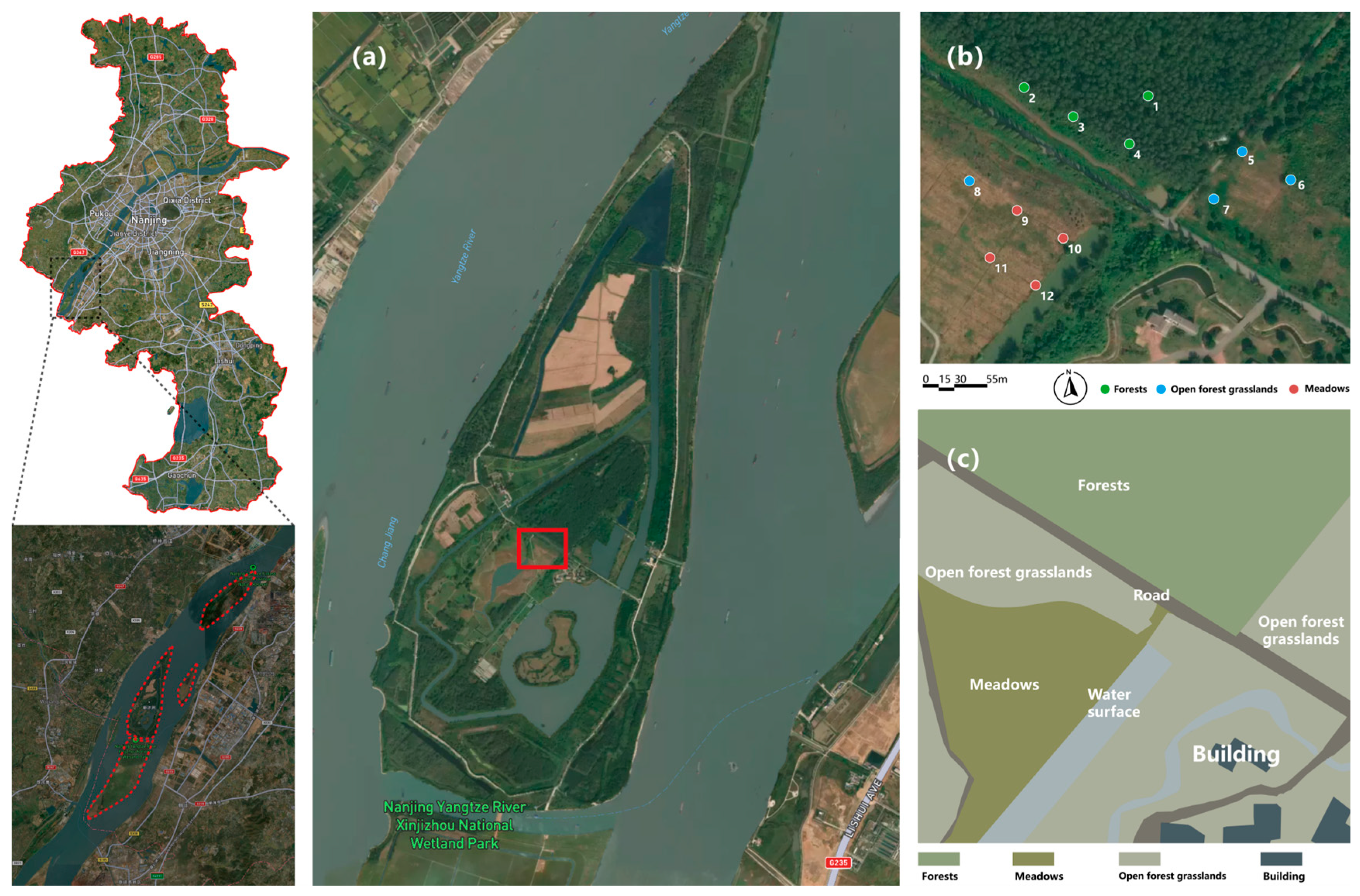
4.1. Study Area
4.1.1. Site Description
4.1.2. Sampling Plot Design and Environmental Variables
- Crown width (CW, m): average of two perpendicular horizontal diameters measured from the same tree crown, following standard forestry measurement protocols
- Mean tree height (MTH, m): average height of all trees > 2 m tall
- Species richness (SR): number of woody plant species
- Tree density (TD, stems/ha): number of trees >2 m tall
- Plant evenness (PE): Pielou’s evenness index based on woody species cover
- Leaf height diversity > 2 m (LHD2): Shannon diversity index of foliage density in vertical strata above 2 m [40]
- Distance to water source (DWS, m): Euclidean distance to the nearest perennial water body (river channel, stream, or permanent pond). Water bodies were identified from 2022 satellite imagery and verified during field surveys. Water bodies contribute natural geophony (flowing water sounds) to the soundscape, independent of human activity [25].
- Distance to trail (DT, m): Euclidean distance to the nearest unpaved pedestrian trail
- Hardness rate (HCR, %): proportion of impervious surface (paved paths, structures) within the 20 m radius plot
- Green space ratio (GCR, %): proportion of vegetated area within the 20 m radius plot
4.2. Acoustic Data Collection and Index Calculation
4.2.1. Field Recording
4.2.2. Audio Preprocessing and Signal Averaging
4.2.3. Acoustic Index Selection and Calculation
- ACI: computed using acoustic_complexity function (soundecology package) with min_freq = 2 kHz, max_freq = 11 kHz
- BIO: computed using bioacoustic_index function (soundecology) with min_freq = 2 kHz, max_freq = 11 kHz
- ADI and AEI: computed using acoustic_diversity and acoustic_evenness functions (soundecology) with max_freq = 11 kHz
- H: computed using H function (seewave) with default parameters
- NDSI: computed using ndsi function (seewave) with anthropogenic frequency range = 1–2 kHz, biological range = 2–11 kHz
4.2.4. Power Spectral Density Analysis
- Audio was segmented into 2-s windows with 50% overlap
- Each window was Hamming-windowed and FFT-computed
- PSD was averaged across windows to obtain the mean spectrum
- Normalized PSD (nPSD) was calculated by dividing each frequency band’s energy by the total energy across 1–12 kHz
- 1–2 kHz: anthropogenic noise (traffic, machinery) [18]
- 2–4 kHz: low-frequency bird vocalizations (many passerines)
- 4–8 kHz: mid-frequency bird vocalizations (warblers, finches)
- 8–12 kHz: high-frequency bird vocalizations (some passerines, insects)
4.3. Statistical Analyses
4.3.1. Random Forest Modeling
- Number of trees: 500 (after testing stability, 200–1000 yielded similar results)
- Number of predictors tried at each split: default (√p ≈ 3)
- Random seed set for reproducibility
4.3.2. Redundancy Analysis
- Response matrix: nPSD values for 1–2, 2–4, 4–8, 8–12 kHz bands at each sampling point
- Predictor matrix: standardized environmental variables (CW, MTH, SR, TD, PE, LHD2, DWS, DMR, DT, HCR)
- Significance of axes and variables was tested using Monte Carlo permutation tests (499 permutations)
- Angles between vectors: acute angles indicate positive correlation, obtuse angles indicate negative correlation
- Vector length: longer vectors indicate a stronger influence
- Sample point positions: proximity indicates similarity in soundscape-energy profiles
5. Conclusions
Author Contributions
Funding
Data Availability Statement
Acknowledgments
Conflicts of Interest
Abbreviations
| ACI | Acoustic Complexity Index |
| ADI | Acoustic Diversity Index |
| NDSI | Normalized Difference Soundscape Index |
| AEI | Acoustic Evenness Index |
| BIO | Bioacoustic Index |
| H | Acoustic Entropy Index |
| PSD | Power Spectral Density |
| CW | Crown width |
| MTH | Mean tree height |
| SR | Species richness |
| TD | Tree density |
| PE | Plant evenness |
| LHD2 | Leaf height diversity > 2 m |
| DWS | Distance to water source |
| DMR | Distance to main road |
| DT | Distance to trail |
| HCR | Hardness rate |
| GCR | Green space ratio |
| RDA | Redundancy Analysis |
References
- Russo, A.; Cirella, G.T. Urban ecosystem services in a rapidly urbanizing world: Scaling up nature’s benefits from single trees to thriving urban forests. Land 2024, 13, 786. [Google Scholar] [CrossRef]
- Gage, S.H.; Axel, A.C. Visualization of temporal change in soundscape power of a Michigan lake habitat over a 4-year period. Ecol. Inform. 2024, 21, 100–109. [Google Scholar] [CrossRef]
- Alikhani, S.; Nummi, P.; Ojala, A. Urban wetlands: A review on ecological and cultural values. Water 2021, 13, 3301. [Google Scholar] [CrossRef]
- Wilford, D.C.; Miksis-Olds, J.L.; Martin, S.B.; Howard, D.R.; Lowell, K.; Lyons, A.P.; Smith, M.J. Quantitative soundscape analysis to understand multidimensional features. Front. Mar. Sci. 2021, 8, 672336. [Google Scholar] [CrossRef]
- Alcocer, I.; Lima, H.; Sugai, L.S.M.; Llusia, D. Acoustic indices as proxies for biodiversity: A meta-analysis. Biol. Rev. 2022, 97, 2209–2236. [Google Scholar] [CrossRef] [PubMed]
- Farina, A. The acoustic complexity index (ACI): Theoretical foundations, applied perspectives and semantics. Oikos 2025, 2025, e10760. [Google Scholar] [CrossRef]
- Hyland, E.B.; Schulz, A.; Quinn, J.E. Quantifying the soundscape: How filters change acoustic indices. Ecol. Indic. 2023, 148, 110061. [Google Scholar] [CrossRef]
- Machado, R.B.; Aguiar, L.; Jones, G. Do acoustic indices reflect the characteristics of bird communities in the savannas of Central Brazil? Landsc. Urban Plan. 2017, 162, 36–43. [Google Scholar] [CrossRef]
- Hong, X.C.; Wang, G.Y.; Liu, J.; Song, L.; Wu, E.T. Modeling the impact of soundscape drivers on perceived birdsongs in urban forests. J. Clean. Prod. 2021, 292, 125315. [Google Scholar] [CrossRef]
- Gil, D.; Llusia, D. The bird dawn chorus revisited. In Coding Strategies in Vertebrate Acoustic Communication; Springer International Publishing: Cham, Switzerland, 2020; pp. 45–90. [Google Scholar]
- Proppe, D.S.; Sturdy, C.B.; St. Clair, C.C. Anthropogenic noise decreases urban songbird diversity and may contribute to homogenization. Glob. Change Biol. 2013, 19, 1075–1084. [Google Scholar]
- Brumm, H.; Zollinger, S.A. Avian vocal production in noise. In Animal Communication and Noise; Springer: Berlin/Heidelberg, Germany, 2009; pp. 187–227. [Google Scholar]
- Slabbekoorn, H.; Peet, M. Birds sing at a higher pitch in urban noise. Nature 2003, 424, 267. [Google Scholar] [CrossRef] [PubMed]
- Bernath-Plaisted, J.S. The Effects of Oil and Gas Development on Songbirds of the Mixed-Grass Prairie: Nesting Success and Identification of Nest Predators. Master’s Thesis, University of Manitoba, Winnipeg, MB, Canada, 2015. [Google Scholar]
- Morton, E.S. Ecological sources of selection on avian sounds. Am. Nat. 1975, 109, 17–34. [Google Scholar] [CrossRef]
- Richards, D.G.; Wiley, R.H. Reverberations and amplitude fluctuations in the propagation of sound in a forest: Implications for animal communication. Am. Nat. 1980, 115, 381–399. [Google Scholar] [CrossRef]
- Farina, A.; Righini, R.; Fuller, S.; Li, P.; Pavan, G. Acoustic complexity indices reveal the acoustic communities of the old-growth Mediterranean forest of Sasso Fratino Integral Natural Reserve (Central Italy). Ecol. Indic. 2021, 120, 106927. [Google Scholar] [CrossRef]
- Parris, K.M. Ecological impacts of road noise and options for mitigation. In Handbook of Road Ecology; Wiley: Hoboken, NJ, USA, 2015; pp. 151–158. [Google Scholar]
- Portaccio, A.; Chianucci, F.; Pirotti, F.; Piragnolo, M.; Sozzi, M.; Zangrossi, A.; Celli, M.; di Bosco, M.M.; Bolognesi, M.; Sella, E.; et al. Linking Acoustic Indices to Vegetation and Microclimate in a Historical Urban Garden: Setting the Stage for a Restorative Soundscape. Land 2025, 14, 1970. [Google Scholar] [CrossRef]
- Zhao, Y.; Sun, Z.; Bai, Z.; Jin, J.; Wang, C. How vegetation structure shapes the soundscape: Acoustic community partitioning and its implications for urban forestry management. Forests 2025, 16, 669. [Google Scholar] [CrossRef]
- Hao, Z.; Wang, C.; Sun, Z.; van den Bosch, C.K.; Zhao, D.; Sun, B.; Xu, X.; Bian, Q.; Bai, Z.; Wei, K.; et al. Soundscape mapping for spatial-temporal estimate on bird activities in urban forests. Urban For. Urban Green. 2021, 57, 126822. [Google Scholar] [CrossRef]
- Somervuo, P.; Roslin, T.; Fisher, B.L.; Hardwick, B.; Kerdraon, D.; Raharinjanahary, D.; Rajoelison, E.T.; Lauha, P.; Griem, L.; Lehikoinen, P.; et al. Human contributions to global soundscapes are less predictable than the acoustic rhythms of wildlife. Nat. Ecol. Evol. 2025, 9, 1585–1598. [Google Scholar] [CrossRef]
- Hao, Z.; Zhang, C.; Li, L.; Sun, B.; Luo, S.; Liao, J.; Wang, Q.; Wu, R.; Xu, X.; Lepczyk, C.A.; et al. Can urban forests provide acoustic refuges for birds? Investigating the influence of vegetation structure and anthropogenic noise on bird sound diversity. J. For. Res. 2024, 35, 33. [Google Scholar] [CrossRef]
- Box, E.O.; Fujiwara, K. Vegetation types and their broad-scale distribution. Veg. Ecol. 2013, 455–485. [Google Scholar]
- Osborne, W.A.; Hodge, R.A.; Love, G.D.; Hawkin, P.; Hawkin, R.E. Babbling brook to thunderous torrent: Using sound to monitor river stage. Earth Surf. Process. Landf. 2021, 46, 2656–2670. [Google Scholar] [CrossRef]
- Müller, S.; Shaw, T.; Güntert, D.; Helmbold, L.; Schütz, N.; Thomas, L.; Scherer-Lorenzen, M. Ecoacoustics of small forest patches in agricultural landscapes: Acoustic diversity and bird richness increase with patch size. Biodiversity 2020, 21, 48–60. [Google Scholar] [CrossRef]
- Philpott, S.M.; Soong, O.; Lowenstein, J.H.; Pulido, A.L.; Lopez, D.T.; Flynn, D.F.; DeClerck, F. Functional richness and ecosystem services: Bird predation on arthropods in tropical agroecosystems. Ecol. Appl. 2019, 19, 1858–1867. [Google Scholar] [CrossRef] [PubMed]
- Warren, P.S.; Katti, M.; Ermann, M.; Brazel, A. Urban bioacoustics: It’s not just noise. Anim. Behav. 2006, 71, 491–502. [Google Scholar] [CrossRef]
- Ow, L.F.; Ghosh, S. Urban cities and road traffic noise: Reduction through vegetation. Appl. Acoust. 2017, 120, 15–20. [Google Scholar] [CrossRef]
- Shaw, T.; Scherer-Lorenzen, M.; Müller, S. Forest structural heterogeneity positively affects bird richness and acoustic diversity in a temperate, central European forest. Front. Ecol. Evol. 2024, 12, 1387879. [Google Scholar] [CrossRef]
- Gill, S.A.; Grabarczyk, E.E.; Potvin, D.A. Human impacts on avian communication. In Songbird Behavior and Conservation in the Anthropocene; CRC Press: Boca Raton, FL, USA, 2021; pp. 191–217. [Google Scholar]
- Engel, M.S.; Young, R.J.; Davies, W.J.; Waddington, D.; Wood, M.D. A systematic review of anthropogenic noise impact on avian species. Curr. Pollut. Rep. 2024, 10, 684–709. [Google Scholar] [CrossRef]
- Gonçalves, F.S.S.R. Acoustic Ecology in Artistic Creation: Re-Discovering Underwater Soundscapes. Doctoral Dissertation, Universidade do Porto, Porto, Portugal, 2022. [Google Scholar]
- Lu, J.; Xiao, Y.; Shao, Y. Research on the comprehensive noise reduction effectiveness of plant communities in urban green spaces. Landsc. Archit. Front. 2025, 13, 76–91. [Google Scholar]
- Turner, A.; Fischer, M.; Tzanopoulos, J. Sound-mapping a coniferous forest—Perspectives for biodiversity monitoring and noise mitigation. PLoS ONE 2018, 13, e0189843. [Google Scholar] [CrossRef]
- Kotian, M.; Biniwale, S.; Mourya, P.; Burivalova, Z.; Choksi, P. Measuring biodiversity with sound: How effective are acoustic indices for quantifying biodiversity in a tropical dry forest? Conserv. Sci. Pract. 2024, 6, e13133. [Google Scholar] [CrossRef]
- Zhu, G.; Niklas, K.J.; Li, M.; Sun, J.; Lyu, M.; Chen, X.; Wang, M.; Zhong, Q.; Cheng, D. “Diminishing Returns” in the scaling between leaf area and twig size in three forest communities along an elevation gradient of Wuyi Mountain, China. Forests 2019, 10, 1138. [Google Scholar] [CrossRef]
- Kath, H.; Serafini, P.P.; Campos, I.B.; Gouvêa, T.S.; Sonntag, D. Leveraging transfer learning and active learning for data annotation in passive acoustic monitoring of wildlife. Ecol. Inform. 2024, 82, 102710. [Google Scholar] [CrossRef]
- Yang, Y.; Chen, Y.; Ye, Z.; Song, Z.; Xiong, Y. Springtime spatio-temporal distribution of bird diversity in urban parks based on acoustic indices. Glob. Ecol. Conserv. 2024, 53, e02995. [Google Scholar] [CrossRef]
- MacArthur, R.H.; MacArthur, J.W. On bird species diversity. Ecology 1961, 42, 594–598. [Google Scholar] [CrossRef]
- Bradfer-Lawrence, T.; Gardner, N.; Bunnefeld, L.; Bunnefeld, N.; Willis, S.G.; Dent, D.H. Guidelines for the use of acoustic indices in environmental research. Methods Ecol. Evol. 2019, 10, 1796–1807. [Google Scholar] [CrossRef]
- Bradfer-Lawrence, T. Avian Communities and Ecoacoustics in a Tropical Human-Modified Landscape. Doctoral Thesis, University of Stirling, Stirling, Scotland, December 2019. [Google Scholar]
- Breiman, L. Random forests. Mach. Learn. 2001, 45, 5–32. [Google Scholar] [CrossRef]





| Variable Name | Explains % | Contribution % | Pseudo-F | p |
|---|---|---|---|---|
| springtime | ||||
| DT (Distance to Trail) | 45.9 | 46.1 | 8.5 | 0.014 * |
| GCR (Greenn Space Ratio) | 36.6 | 36.9 | 18.9 | 0.006 * |
| DMR (distance from main road) | 8.1 | 8.1 | 6.8 | 0.030 * |
| HCR (hardness rate) | 2.6 | 2.6 | 2.6 | 0.110 |
| CW (crown width) | 0.8 | 0.8 | 0.7 | 0.462 |
| TD (tree density) | 0.7 | 0.7 | 0.6 | 0.456 |
| PE (Plant Evenness) | 2.6 | 2.6 | 3.7 | 0.174 |
| MTH (mean tree height) | 1.7 | 1.7 | 4.5 | 0.114 |
| MCH (mean canopy height) | 0.2 | 0.2 | 0.3 | 0.634 |
| LHD2 (Leaf Height Diversity 2) | 0.4 | 0.4 | 0.7 | 0.530 |
| in autumn | ||||
| TD (tree density) | 21.2 | 22.7 | 2.7 | 0.120 |
| DT (Distance to Trail) | 15.4 | 16.5 | 2.2 | 0.186 |
| LHD (Leaf Height Diversity) | 12 | 12.8 | 1.9 | 0.216 |
| HCR (hardness rate) | 16 | 17.1 | 3.2 | 0.128 |
| CW (crown width) | 22.2 | 23.7 | 10.1 | 0.014 * |
| LHD2 (Leaf Height Diversity 2) | 2.7 | 2.9 | 1.3 | 0.346 |
| DWS (distance from water source) | 2.6 | 2.8 | 1.3 | 0.248 |
| MCH (mean canopy height) | 0.8 | 0.9 | 0.3 | 0.578 |
| PE (Plant Evenness) | 0.5 | 0.6 | 0.2 | 0.712 |
| MTH (mean tree height) | 0.1 | 0.1 | <0.1 | 0.962 |
| Overall | ||||
| DT (Distance to Trail) | 51.5 | 51.5 | 10.6 | 0.010 * |
| HCR (hardness rate) | 32.1 | 32.1 | 17.5 | 0.008 * |
| DMR (distance from main road) | 9.1 | 9.1 | 9.9 | 0.016 * |
| LHD (Leaf Height Diversity) | 2.9 | 2.9 | 4.5 | 0.072 |
| PE (Plant Evenness) | 0.8 | 0.8 | 1.2 | 0.306 |
| PD (Plant Diversity) | 1.3 | 1.3 | 2.8 | 0.134 |
| MTH (mean tree height) | 1.1 | 1.1 | 3.2 | 0.166 |
| DWS (distance from water source) | 0.3 | 0.3 | 0.8 | 0.434 |
| LHD2 (Leaf Height Diversity 2) | 0.7 | 0.7 | 4.2 | 0.144 |
| CW (crown width) | 0.2 | 0.2 | 1.4 | 0.190 |
| Index | Abbr. | Calculation Basis | Frequency Focus | Ecological Interpretation |
|---|---|---|---|---|
| Acoustic Complexity Index | ACI | Quantifies temporal variability in sound intensity within frequency bins; computed as the absolute difference in amplitude between consecutive time steps, summed across bins | 2–11 kHz | Higher values indicate greater variability in bird vocalization intensity, often associated with increased vocal activity and species turnover |
| Acoustic Diversity Index | ADI | Shannon diversity applied to sound energy distribution across frequency bins; calculated by dividing the spectrogram into bins and computing the proportion of energy in each | 2–11 kHz | Reflects evenness of acoustic energy distribution; higher values suggest more species contributing across frequency bands |
| Acoustic Evenness Index | AEI | Gini coefficient applied to the proportional energy distribution across frequency bins | 2–11 kHz | Complements ADI; lower values indicate dominance by few frequency bands (potential single-species dominance) |
| Bioacoustic Index | BIO | Area under the mean spectrum curve calculated across frequency bins after subtracting the minimum background noise | 2–11 kHz | Integrates both sound intensity and frequency range; higher values indicate stronger and/or more diverse bird vocal activity |
| Normalised Difference Soundscape Index | NDSI | (Biophony power—Technophony power)/(Biophony power + Technophony power); biophony = 2–11 kHz, technophony = 1–2 kHz | 1–2 kHz vs. 2–11 kHz | Ranges from –1 to +1; positive values indicate biophony dominance (more bird sound), negative values indicate technophony dominance (more anthropogenic noise) |
| Acoustic Entropy Index | H | Combines temporal entropy (Ht) and spectral entropy (Hf) as H = Ht × Hf; temporal entropy measures evenness of amplitude envelope, spectral entropy measures evenness of frequency distribution | 2–11 kHz | Higher values indicate more complex, disordered soundscapes; may reflect diverse bird communities with overlapping vocalizations |
| Power Spectral Density | PSD | Energy per frequency band calculated via Fast Fourier Transform (FFT); normalized to allow cross-sample comparison | 1–2, 2–4, 4–8, 8–12 kHz bands | Quantifies acoustic energy distribution across frequency bands; enables separation of anthropogenic (1–2 kHz) vs. biological (2–11 kHz) contributions |
Disclaimer/Publisher’s Note: The statements, opinions and data contained in all publications are solely those of the individual author(s) and contributor(s) and not of MDPI and/or the editor(s). MDPI and/or the editor(s) disclaim responsibility for any injury to people or property resulting from any ideas, methods, instructions or products referred to in the content. |
© 2026 by the authors. Licensee MDPI, Basel, Switzerland. This article is an open access article distributed under the terms and conditions of the Creative Commons Attribution (CC BY) license.
Share and Cite
Wen, Z.; Ye, Z.; Yang, Y.; Xiong, Y. Vegetation Structure Drives Seasonal and Diel Dynamics of Avian Soundscapes in an Urban Wetland. Plants 2026, 15, 1023. https://doi.org/10.3390/plants15071023
Wen Z, Ye Z, Yang Y, Xiong Y. Vegetation Structure Drives Seasonal and Diel Dynamics of Avian Soundscapes in an Urban Wetland. Plants. 2026; 15(7):1023. https://doi.org/10.3390/plants15071023
Chicago/Turabian StyleWen, Zhe, Zhewen Ye, Yunfeng Yang, and Yao Xiong. 2026. "Vegetation Structure Drives Seasonal and Diel Dynamics of Avian Soundscapes in an Urban Wetland" Plants 15, no. 7: 1023. https://doi.org/10.3390/plants15071023
APA StyleWen, Z., Ye, Z., Yang, Y., & Xiong, Y. (2026). Vegetation Structure Drives Seasonal and Diel Dynamics of Avian Soundscapes in an Urban Wetland. Plants, 15(7), 1023. https://doi.org/10.3390/plants15071023