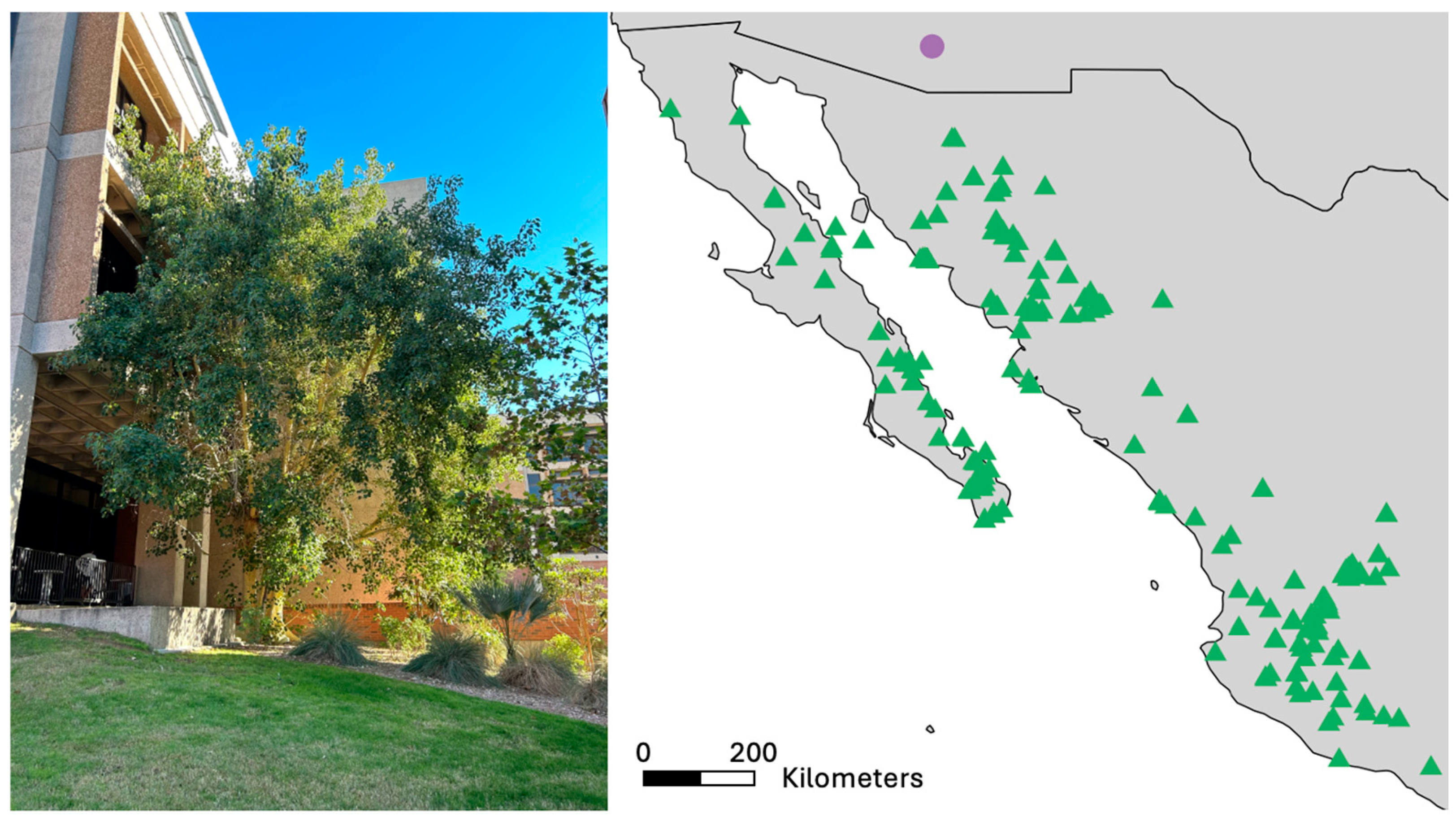
Range Expansion of Obligate Antagonists but Not Mutualists in a Desert Fig (Ficus petiolaris)


Abstract
1. Introduction

2. Results
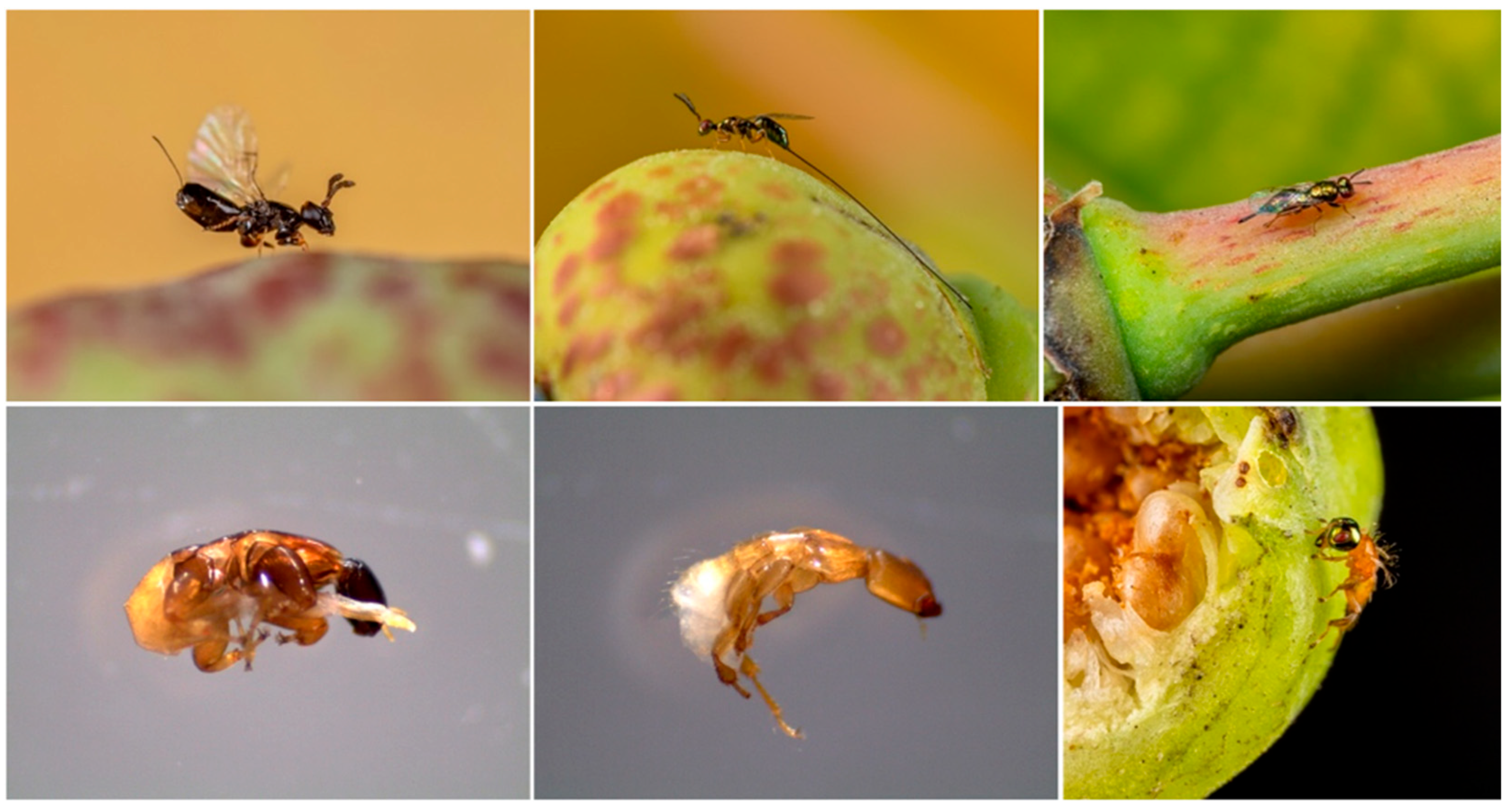
2.1. Identity and Persistence of Wasp Community
2.2. Fig Phenology and Reproductive Asynchrony
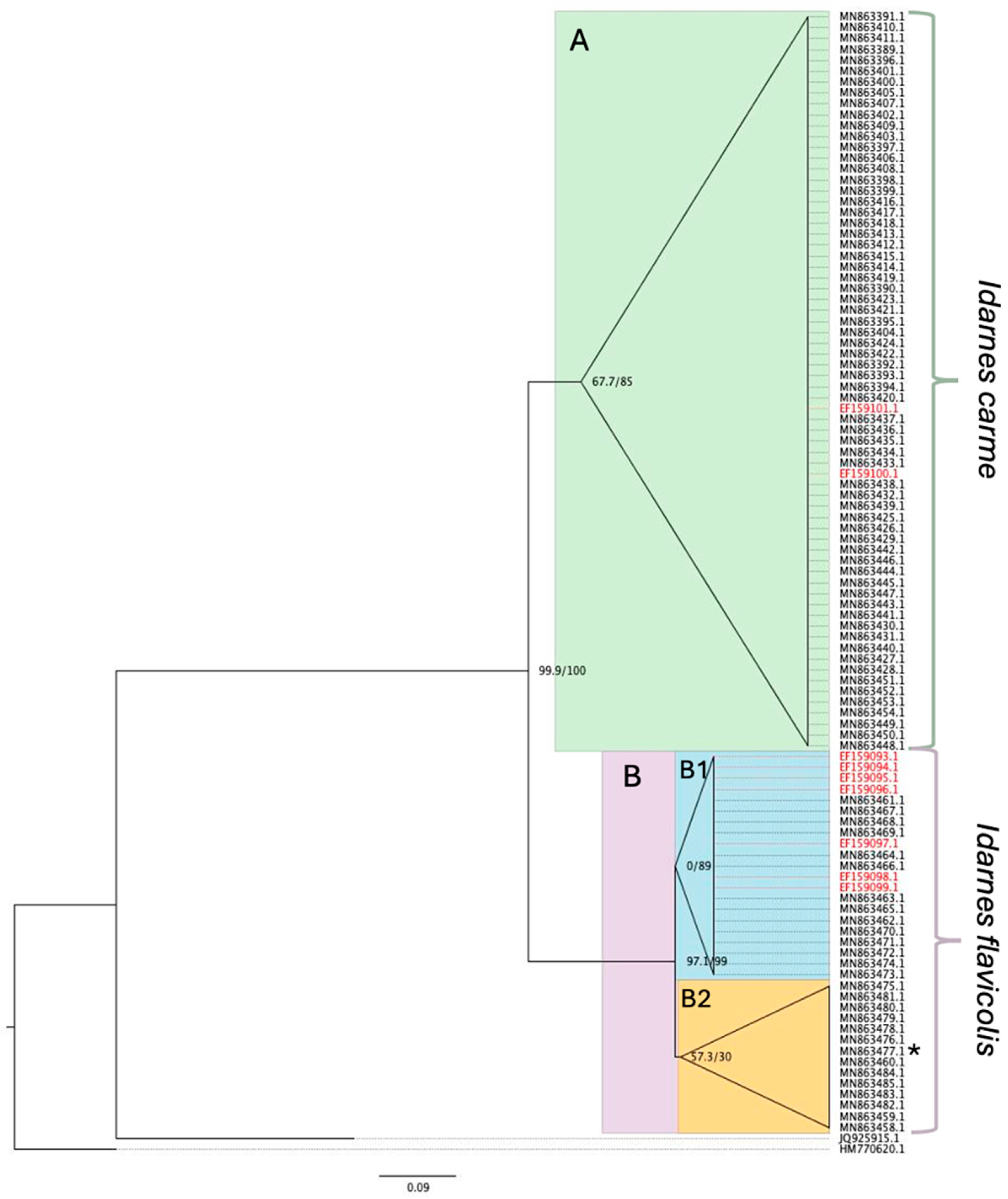
2.3. Idarnes Dispersal from the Native Range
3. Discussion
4. Materials and Methods
4.1. Study System
4.2. Fig Phenology and Fig Wasp Dynamics
4.3. Fig Wasp Biogeography
Supplementary Materials
Author Contributions
Funding
Data Availability Statement
Acknowledgments
Conflicts of Interest
Abbreviations
| NPFW | Non-pollinating fig wasp |
Appendix A
References
- Parmesan, C.; Yohe, G. A Globally Coherent Fingerprint of Climate Change Impacts across Natural Systems. Nature 2003, 421, 37–42. [Google Scholar] [CrossRef] [PubMed]
- Thomas, C.D. Climate, Climate Change and Range Boundaries. Divers. Distrib. 2010, 16, 488–495. [Google Scholar] [CrossRef]
- Corbin, C.; Heyworth, E.R.; Ferrari, J.; Hurst, G.D.D. Heritable Symbionts in a World of Varying Temperature. Heredity 2017, 118, 10–20. [Google Scholar] [CrossRef] [PubMed]
- Early, R.; Keith, S.A. Geographically Variable Biotic Interactions and Implications for Species Ranges. Glob. Ecol. Biogeogr. 2019, 28, 42–53. [Google Scholar] [CrossRef]
- Zhang, B.; Leonard, S.P.; Li, Y.; Moran, N.A. Obligate Bacterial Endosymbionts Limit Thermal Tolerance of Insect Host Species. Proc. Natl. Acad. Sci. USA 2019, 116, 24712–24718. [Google Scholar] [CrossRef]
- Amundrud, S.L.; Srivastava, D.S. Thermal Tolerances and Species Interactions Determine the Elevational Distributions of Insects. Glob. Ecol. Biogeogr. 2020, 29, 1315–1327. [Google Scholar] [CrossRef]
- Hector, T.E.; Hoang, K.L.; Li, J.; King, K.C. Symbiosis and Host Responses to Heating. Trends Ecol. Evol. 2022, 37, 611–624. [Google Scholar] [CrossRef]
- Wang, C.; Zheng, X.; Kvitt, H.; Sheng, H.; Sun, D.; Niu, G.; Tchernov, D.; Shi, T. Lineage-Specific Symbionts Mediate Differential Coral Responses to Thermal Stress. Microbiome 2023, 11, 211. [Google Scholar] [CrossRef]
- Renoz, F.; Pons, I.; Hance, T. Evolutionary Responses of Mutualistic Insect–Bacterial Symbioses in a World of Fluctuating Temperatures. Curr. Opin. Insect Sci. 2019, 35, 20–26. [Google Scholar] [CrossRef] [PubMed]
- Aizen, M.A.; Torres, A. The Invasion Ecology of Mutualism. Annu. Rev. Ecol. Evol. Syst. 2024, 55, 41–63. [Google Scholar] [CrossRef]
- Mestre, A.; Poulin, R.; Hortal, J. A Niche Perspective on the Range Expansion of Symbionts. Biol. Rev. 2020, 95, 491–516. [Google Scholar] [CrossRef] [PubMed]
- Segar, S.T.; Boutsi, S.; Souto-Vilarós, D.; Volf, M.; Dunn, D.W.; Cruaud, A.; Pereira, R.A.S.; Rasplus, J.-Y.; Kjellberg, F. The Diversity of Ficus. Ann. Bot. 2025, mcaf280. [Google Scholar] [CrossRef]
- Mohd Hatta, S.K.; Quinnell, R.J.; Idris, A.G.; Compton, S.G. Making the Most of Your Pollinators: An Epiphytic Fig Tree Encourages Its Pollinators to Roam between Figs. Ecol. Evol. 2021, 11, 6371–6380. [Google Scholar] [CrossRef]
- Ware, A.B.; Kaye, P.T.; Compton, S.G.; Van Noort, S. Fig Volatiles: Their Role in Attracting Pollinators and Maintaining Pollinator Specificity. Plant Syst. Evol. 1993, 186, 147–156. [Google Scholar] [CrossRef]
- Grison-Pigé, L.; Bessière, J.-M.; Hossaert-McKey, M. Specific Attraction of Fig-Pollinating Wasps: Role of Volatile Compounds Released by Tropical Figs. J. Chem. Ecol. 2002, 28, 283–295. [Google Scholar] [CrossRef]
- Cornille, A.; Underhill, J.G.; Cruaud, A.; Hossaert-McKey, M.; Johnson, S.D.; Tolley, K.A.; Kjellberg, F.; van Noort, S.; Proffit, M. Floral Volatiles, Pollinator Sharing and Diversification in the Fig–Wasp Mutualism: Insights from Ficus natalensis, and Its Two Wasp Pollinators (South Africa). Proc. R. Soc. B Biol. Sci. 2011, 279, 1731–1739. [Google Scholar] [CrossRef]
- Bronstein, J.L.; Gouyon, P.; Gliddon, C.; Kjellberg, F.; Michaloud, G. The Ecological Consequences of Flowering Asynchrony in Monoecious Figs: A Simulation Study. Ecology 1990, 71, 2145–2156. [Google Scholar] [CrossRef]
- Anstett, M.-C.; Hossaert-McKey, M.; McKey, D. Modeling the Persistence of Small Populations of Strongly Interdependent Species: Figs and Fig Wasps. Conserv. Biol. 1997, 11, 204–213. [Google Scholar] [CrossRef]
- Ahmed, S.; Compton, S.G.; Butlin, R.K.; Gilmartin, P.M. Wind-Borne Insects Mediate Directional Pollen Transfer between Desert Fig Trees 160 Kilometers Apart. Proc. Natl. Acad. Sci. USA 2009, 106, 20342–20347. [Google Scholar] [CrossRef]
- Bain, A.; Borges, R.M.; Chevallier, M.H.; Vignes, H.; Kobmoo, N.; Peng, Y.Q.; Cruaud, A.; Rasplus, J.Y.; Kjellberg, F.; Hossaert-Mckey, M. Geographic Structuring into Vicariant Species-Pairs in a Wide-Ranging, High-Dispersal Plant–Insect Mutualism: The Case of Ficus racemosa and Its Pollinating Wasps. Evol. Ecol. 2016, 30, 663–684. [Google Scholar] [CrossRef]
- Sutton, T.L.; Riegler, M.; Cook, J.M. One Step Ahead: A Parasitoid Disperses Farther and Forms a Wider Geographic Population than Its Fig Wasp Host. Mol. Ecol. 2016, 25, 882–894. [Google Scholar] [CrossRef] [PubMed]
- Nadel, H.; Frank, J.H.; Knight, R.J. Escapees and Accomplices: The Naturalization of Exotic Ficus and Their Associated Faunas in Florida. Fla. Entomol. 1992, 75, 29–38. [Google Scholar] [CrossRef]
- Wang, R.; Aylwin, R.; Barwell, L.; Chen, X.-Y.; Chen, Y.; Chou, L.-S.; Cobb, J.; Collette, D.; Craine, L.; Giblin-Davis, R.M.; et al. The Fig Wasp Followers and Colonists of a Widely Introduced Fig Tree, Ficus microcarpa. Insect Conserv. Divers. 2015, 8, 322–336. [Google Scholar] [CrossRef]
- Wu, L.-H.; Zou, J.; Jiang, Y.-T.; Lu, L.; Jiang, K.; Zhang, K.-J.; Liu, W.-C.; Xiang, W.-M.; Wang, G.; Segar, S.T.; et al. Demography and Adaptation of a Species Specific Pollinator Associated with an Invasive Fig Tree. Commun. Biol. 2025, 8, 1363. [Google Scholar] [CrossRef] [PubMed]
- Harrison, R.D.; Chong, K.Y.; Pham, N.M.; Yee, A.T.K.; Yeo, C.K.; Tan, H.T.W.; Rasplus, J.-Y. Pollination of Ficus elastica: India Rubber Re-Establishes Sexual Reproduction in Singapore. Sci. Rep. 2017, 7, 11616. [Google Scholar] [CrossRef]
- Bronstein, J.L.; Patel, A. Temperature-Sensitive Development: Consequences for Local Persistence of Two Subtropical Fig Wasp Species. Am. Midl. Nat. 1992, 128, 397–403. [Google Scholar] [CrossRef]
- Compton, S.G.; Thornton, I.W.B.; New, T.R.; Underhill, L. The Colonization of the Krakatau Islands by Fig Wasps and Other Chalcids (Hymenoptera, Chalcidoidea). Philos. Trans. R. Soc. Lond. B Biol. Sci. 1988, 322, 459–470. [Google Scholar] [CrossRef]
- Janzen, D.H. How to Be a Fig. Annu. Rev. Ecol. Syst. 1979, 10, 13–51. [Google Scholar] [CrossRef]
- Burks, R.; Mitroiu, M.-D.; Fusu, L.; Heraty, J.M.; Janšta, P.; Heydon, S.; Papilloud, N.D.-S.; Peters, R.S.; Tselikh, E.V.; Woolley, J.B.; et al. From Hell’s Heart I Stab at Thee! A Determined Approach towards a Monophyletic Pteromalidae and Reclassification of Chalcidoidea (Hymenoptera). J. Hymenopt. Res. 2022, 94, 13–88. [Google Scholar] [CrossRef]
- Cruaud, A.; Rasplus, J.-Y.; Zhang, J.; Burks, R.; Delvare, G.; Fusu, L.; Gumovsky, A.; Huber, J.T.; Janšta, P.; Mitroiu, M.-D.; et al. The Chalcidoidea Bush of Life: Evolutionary History of a Massive Radiation of Minute Wasps. Cladistics 2024, 40, 34–63. [Google Scholar] [CrossRef]
- Borges, R.M. How to Be a Fig Wasp Parasite on the Fig–Fig Wasp Mutualism. Curr. Opin. Insect Sci. 2015, 8, 34–40. [Google Scholar] [CrossRef] [PubMed]
- Borges, R.M. Interactions Between Figs and Gall-Inducing Fig Wasps: Adaptations, Constraints, and Unanswered Questions. Front. Ecol. Evol. 2021, 9, 685542. [Google Scholar] [CrossRef]
- Patel, A. Wasp Composition in Inflorescences of Two Dioecious Fig Species- Implications for the Fig-Wasp Mutualism. Biotropica 1998, 30, 474–480. [Google Scholar] [CrossRef]
- Segar, S.T.; Dunn, D.W.; Darwell, C.T.; Cook, J.M. How to Be a Fig Wasp down under: The Diversity and Structure of an Australian Fig Wasp Community. Acta Oecologica 2014, 57, 17–27. [Google Scholar] [CrossRef]
- Raja, S.; Suleman, N.; Quinnell, R.J.; Compton, S.G. Interactions between Pollinator and Non-Pollinator Fig Wasps: Correlations between Their Numbers Can Be Misleading. Entomol. Sci. 2015, 18, 230–236. [Google Scholar] [CrossRef]
- Wang, R.-W.; Sun, B.-F. Seasonal Change in the Structure of Fig-Wasp Community and Its Implication for Conservation. Symbiosis 2009, 47, 77–83. [Google Scholar] [CrossRef]
- Aung, K.M.M.; Chen, H.-H.; Segar, S.T.; Miao, B.-G.; Peng, Y.-Q.; Liu, C. Changes in Temperature Alter Competitive Interactions and Overall Structure of Fig Wasp Communities. J. Anim. Ecol. 2022, 91, 1303–1315. [Google Scholar] [CrossRef] [PubMed]
- Wang, R.; Compton, S.G.; Quinnell, R.J.; Peng, Y.-Q.; Barwell, L.; Chen, Y. Insect Responses to Host Plant Provision beyond Natural Boundaries: Latitudinal and Altitudinal Variation in a Chinese Fig Wasp Community. Ecol. Evol. 2015, 5, 3642–3656. [Google Scholar] [CrossRef] [PubMed]
- Duthie, A.B.; Nason, J.D. Plant Connectivity Underlies Plant-pollinator-exploiter Distributions in Ficus petiolaris and Associated Pollinating and Non-pollinating Fig Wasps. Oikos 2016, 125, 1597–1606. [Google Scholar] [CrossRef]
- Galil, J.; Copland, J.W. Odontofroggatia Galili Wiebes in Israel, a Primary Fig Wasp of Ficus microcarpa L. with a Unique Ovipositor Mechanism (Epichrysomallinae, Chalcidoidea). Proc. K. Ned. Akad. Van Wet. Ser. C Biol. Med. Sci. 1981, 84, 183–195. [Google Scholar]
- Find Trees & Learn | UA Campus Arboretum. Ficus petiolaris. Available online: https://apps.cals.arizona.edu/arboretum/taxon.aspx?id=412 (accessed on 2 March 2026).
- Marussich, W.A.; Machado, C.A. Host-specificity and Coevolution among Pollinating and Nonpollinating New World Fig Wasps. Mol. Ecol. 2007, 16, 1925–1946. [Google Scholar] [CrossRef]
- Satler, J.D.; Bernhard, K.K.; Stireman, J.O.; Machado, C.A.; Houston, D.D.; Nason, J.D. Community Structure and Undescribed Species Diversity in Non-Pollinating Fig Wasps Associated with the Strangler Fig Ficus petiolaris. Insect Syst. Divers. 2020, 4, 3. [Google Scholar] [CrossRef]
- Maitner, B.S.; Boyle, B.; Casler, N.; Condit, R.; Donoghue, J., II; Durán, S.M.; Guaderrama, D.; Hinchliff, C.E.; Jørgensen, P.M.; Kraft, N.J.B.; et al. The Bien r Package: A Tool to Access the Botanical Information and Ecology Network (BIEN) Database. Methods Ecol. Evol. 2018, 9, 373–379. [Google Scholar] [CrossRef]
- Becker, R.A.; Wilks, A.R.; Brownrigg, R.; Minka, T.P.; Deckmyn, A. Maps: Draw Geographical Maps. 2025. Available online: https://cran.r-project.org/web/packages/maps/index.html (accessed on 4 December 2025).
- Wickham, H. ggplot2; Use R! Springer International Publishing: Cham, Switzerland, 2016; ISBN 978-3-319-24275-0. [Google Scholar]
- R Core Team. R: A Language and Environment for Statistical Computing; R Foundation for Statistical Computing: Vienna, Austria, 2021. [Google Scholar]
- Van Goor, J.; Piatscheck, F.; Houston, D.D.; Nason, J.D. Figs, Pollinators, and Parasites: A Longitudinal Study of the Effects of Nematode Infection on Fig Wasp Fitness. Acta Oecologica 2018, 90, 140–150. [Google Scholar] [CrossRef]
- Duthie, A.B.; Abbott, K.C.; Nason, J.D. Trade-Offs and Coexistence in Fluctuating Environments: Evidence for a Key Dispersal-Fecundity Trade-Off in Five Nonpollinating Fig Wasps. Am. Nat. 2015, 186, 151–158. [Google Scholar] [CrossRef]
- Liu, M.; Zhang, J.; Chen, Y.; Compton, S.G.; Chen, X.-Y. Contrasting Genetic Responses to Population Fragmentation in a Coevolving Fig and Fig Wasp across a Mainland–Island Archipelago. Mol. Ecol. 2013, 22, 4384–4396. [Google Scholar] [CrossRef]
- Tian, E.; Nason, J.D.; Machado, C.A.; Zheng, L.; Yu, H.; Kjellberg, F. Lack of Genetic Isolation by Distance, Similar Genetic Structuring but Different Demographic Histories in a Fig-Pollinating Wasp Mutualism. Mol. Ecol. 2015, 24, 5976–5991. [Google Scholar] [CrossRef] [PubMed]
- Rodriguez, L.J.; Bain, A.; Chou, L.-S.; Conchou, L.; Cruaud, A.; Gonzales, R.; Hossaert-McKey, M.; Rasplus, J.-Y.; Tzeng, H.-Y.; Kjellberg, F. Diversification and Spatial Structuring in the Mutualism between Ficus septica and Its Pollinating Wasps in Insular South East Asia. BMC Evol. Biol. 2017, 17, 207. [Google Scholar] [CrossRef] [PubMed]
- Xu, X.; Wang, B.-S.; Yu, H. Intraspecies Genomic Divergence of a Fig Wasp Species Is Due to Geographical Barrier and Adaptation. Front. Ecol. Evol. 2021, 9, 764828. [Google Scholar] [CrossRef]
- Wang, R.; Yang, C.-H.; Ding, Y.-Y.; Tong, X.; Chen, X.-Y. Weak Genetic Divergence Suggests Extensive Gene Flow at the Northeastern Range Limit of a Dioecious Ficus Species. Acta Oecologica 2018, 90, 12–17. [Google Scholar] [CrossRef]
- Liu, M.; Zhao, R.; Chen, Y.; Zhang, J.; Compton, S.G.; Chen, X.-Y. Competitive Exclusion among Fig Wasps Achieved via Entrainment of Host Plant Flowering Phenology. PLoS ONE 2014, 9, e97783. [Google Scholar] [CrossRef] [PubMed]
- Western Regional Climate Center Climate Data Summary. Available online: https://wrcc.dri.edu/cgi-bin/clilcd.pl?az23160 (accessed on 9 January 2026).
- Bronstein, J.L. A Mutualism at the Edge of Its Range. Experientia 1989, 45, 622–637. [Google Scholar] [CrossRef]
- Smith, C.M.; Bronstein, J.L. Site Variation in Reproductive Synchrony in Three Neotropical Figs. J. Biogeogr. 1996, 23, 477–486. [Google Scholar] [CrossRef]
- Gates, D.J.; Nason, J.D. Flowering Asynchrony and Mating System Effects on Reproductive Assurance and Mutualism Persistence in Fragmented Fig–Fig Wasp Populations. Am. J. Bot. 2012, 99, 757–768. [Google Scholar] [CrossRef] [PubMed]
- Piatscheck, F.; Van Goor, J.; Houston, D.D.; Nason, J.D. Ecological Factors Associated with Pre-Dispersal Predation of Fig Seeds and Wasps by Fig-Specialist Lepidopteran Larvae. Acta Oecologica 2018, 90, 151–159. [Google Scholar] [CrossRef]
- Elias, L.G.; Teixeira, S.D.P.; Kjellberg, F.; Pereira, R.A.S. Diversification in the Use of Resources by Idarnes Species: Bypassing Functional Constraints in the Fig–Fig Wasp Interaction. Biol. J. Linn. Soc. 2012, 106, 114–122. [Google Scholar] [CrossRef]
- Van Noort, S.; Wang, R.; Compton, S.G. Fig Wasps (Hymenoptera: Chalcidoidea: Agaonidae, Pteromalidae) Associated with Asian Fig Trees (Ficus, Moraceae) in Southern Africa: Asian Followers and African Colonists. Afr. Invertebr. 2013, 54, 381–400. [Google Scholar] [CrossRef]
- Pandolfo, T.J.; Kwak, T.J.; Cope, W.G. Thermal Tolerances of Freshwater Mussels and Their Host Fishes: Species Interactions in a Changing Climate. Freshw. Mollusk Biol. Conserv. 2012, 15, 69–82. [Google Scholar] [CrossRef]
- Singer, A.; Travis, J.M.J.; Johst, K. Interspecific Interactions Affect Species and Community Responses to Climate Shifts. Oikos 2013, 122, 358–366. [Google Scholar] [CrossRef]
- Piedra-Malagón, E.M.; Sosa, V.; Ibarra-Manríquez, G. Clinal Variation and Species Boundaries in the Ficus petiolaris Complex (Moraceae). Syst. Bot. 2011, 36, 80–87. [Google Scholar] [CrossRef]
- Bouček, Z. The Genera of Chalcidoid Wasps from Ficus Fruit in the New World. J. Nat. Hist. 1993, 27, 173–217. [Google Scholar] [CrossRef]
- Piedra-Malagón, E.M.; Hernández-Ramos, B.; Mirón-Monterrosas, A.; Cornejo-Tenorio, G.; Navarrete-Segueda, A.; Ibarra-Manríquez, G. Syconium Development in Ficus petiolaris (Ficus, Sect. Americanae, Moraceae) and the Relationship with Pollinator and Parasitic Wasps. Botany 2019, 97, 190–203. [Google Scholar] [CrossRef]
- Galil, J.; Eisikowitch, D. Flowering Cycles and Fruit Types of Ficus sycomorus in Israel. New Phytol. 1968, 67, 745–758. [Google Scholar] [CrossRef]
- Barros, L.O.; Farache, F.H.A.; Pereira, R.A.S. Solving the Trophic Puzzle: Host–Parasite Associations in Neotropical Fig Wasps Associated with Fig Trees of Section Americanae. Ecol. Entomol. 2026, 51, 284–294. [Google Scholar] [CrossRef]
- Katoh, K.; Standley, D.M. MAFFT Multiple Sequence Alignment Software Version 7: Improvements in Performance and Usability. Mol. Biol. Evol. 2013, 30, 772–780. [Google Scholar] [CrossRef]
- Capella-Gutiérrez, S.; Silla-Martínez, J.M.; Gabaldón, T. trimAl: A Tool for Automated Alignment Trimming in Large-Scale Phylogenetic Analyses. Bioinformatics 2009, 25, 1972–1973. [Google Scholar] [CrossRef]
- Gouy, M.; Guindon, S.; Gascuel, O. SeaView Version 4: A Multiplatform Graphical User Interface for Sequence Alignment and Phylogenetic Tree Building. Mol. Biol. Evol. 2010, 27, 221–224. [Google Scholar] [CrossRef] [PubMed]
- Minh, B.Q.; Schmidt, H.A.; Chernomor, O.; Schrempf, D.; Woodhams, M.D.; von Haeseler, A.; Lanfear, R. IQ-TREE 2: New Models and Efficient Methods for Phylogenetic Inference in the Genomic Era. Mol. Biol. Evol. 2020, 37, 1530–1534. [Google Scholar] [CrossRef]



| Phase Name | Description |
|---|---|
| A | Pre-reproductive phase, no sign of wasp activity (ovules are small, stigma surfaces are white) |
| B | Female reproductive phase, pollinator wasp inside fig actively pollinating or ovipositing |
| C | Developmental phase, ovules are enlarged and discolored with wasp larvae or seeds developing inside |
| D | Male reproductive phase, fully developed wasps emerging inside the syconium and dispersing if exit hole present |
| E | Post-reproductive, fig is ripe and inside are seeds or empty ovules where wasps emerged from |
Disclaimer/Publisher’s Note: The statements, opinions and data contained in all publications are solely those of the individual author(s) and contributor(s) and not of MDPI and/or the editor(s). MDPI and/or the editor(s) disclaim responsibility for any injury to people or property resulting from any ideas, methods, instructions or products referred to in the content. |
© 2026 by the authors. Licensee MDPI, Basel, Switzerland. This article is an open access article distributed under the terms and conditions of the Creative Commons Attribution (CC BY) license.
Share and Cite
Gans, M.; Bronstein, J.L. Range Expansion of Obligate Antagonists but Not Mutualists in a Desert Fig (Ficus petiolaris). Plants 2026, 15, 1012. https://doi.org/10.3390/plants15071012
Gans M, Bronstein JL. Range Expansion of Obligate Antagonists but Not Mutualists in a Desert Fig (Ficus petiolaris). Plants. 2026; 15(7):1012. https://doi.org/10.3390/plants15071012
Chicago/Turabian StyleGans, Molly, and Judith L. Bronstein. 2026. "Range Expansion of Obligate Antagonists but Not Mutualists in a Desert Fig (Ficus petiolaris)" Plants 15, no. 7: 1012. https://doi.org/10.3390/plants15071012
APA StyleGans, M., & Bronstein, J. L. (2026). Range Expansion of Obligate Antagonists but Not Mutualists in a Desert Fig (Ficus petiolaris). Plants, 15(7), 1012. https://doi.org/10.3390/plants15071012