Review

Investigating the Biological Effects of Plant Essential Oils on Plant-Decaying Pathogens

Department of Agricultural, Forestry, Food and Environmental Sciences (DAFE), University of Basilicata, 85100 Potenza, Italy
*
Author to whom correspondence should be addressed.
Plants 2026, 15(4), 542; https://doi.org/10.3390/plants15040542
Submission received: 12 January 2026 / Revised: 30 January 2026 / Accepted: 5 February 2026 / Published: 9 February 2026
(This article belongs to the Special Issue Plant Essential Oil with Biological Activity: 3nd Edition)

Abstract

Essential oils (EOs), complex volatile compounds synthesized by plants, represent a vital class of natural products that are increasingly significant in scientific research due to their diverse biological properties and broad-spectrum medicinal applications. This study provides a comprehensive overview of EOs, commencing with a historical perspective and detailing their applications. It systematically catalogs their primary botanical sources, with specific examples of the most common and important plant families, including Lamiaceae (e.g., sage, oregano, thyme), Verbenaceae (vervain), Magnoliaceae (magnolia), Rutaceae (lemon), Myrtaceae (eucalyptus) and Lauraceae (cinnamon). A key focus is their antifungal activity, including the bioactive constituents involved and their mechanisms of action, with particular emphasis on their defense against pathogenic postharvest fungi. This includes an analysis of the key bioactive constituents responsible for these bioeffects and an exploration of their possible mechanisms of action against phytopathogenic fungi, with particular emphasis on postharvest pathogens infecting several crops. The discussion further highlights the role of EOs as sustainable alternatives to synthetic fungicides for controlling plant diseases that avoid the negative ecological and public health impacts associated with conventional agrochemicals. The study addresses these objectives by describing methods for testing antimicrobial efficacy, including kill-time studies, LD50 determination, growth-curve analysis, the poisoned food technique, Spore-germination assays, and metabolic CO2 measurement. The current review also highlights some recent studies reviewing the in vitro and in vivo antifungal performance of specific EOs against postharvest diseases.

1. Introduction

Essential oils (EOs) are concentrated, water-repelling liquids made up of volatile, aromatic molecules produced by plants. They are sometimes called volatile or ethereal oils. The term ‘essential’ refers to the oil’s characteristic plant aroma, not to any medical or culinary significance.
There is no doubt that EOs have important pharmacological properties, which result in their widespread use in pharmaceutical practices. Buchholtz [1] first noted the antimicrobial potential of EOs, showing that thymol inhibited bacterial growth in tobacco extract more effectively than phenol, the standard surgical antiseptic at the time [2]. Since then, extensive studies have been undertaken to evaluate the antimicrobial potential of numerous EOs already recognized within the pharmaceutical field.
EOs’ fungitoxicity is often due to interactions among their constituents, which act more effectively together than alone [3]. Their effectiveness in vapor form has also been highlighted, making EOs promising candidates for protection of stored food [3,4,5,6].
Unlike broader reviews, this review provides a focused analysis of plant EOs’ effects on postharvest and plant-decaying phytopathogenic fungi. This work emphasizes economically important pathogens responsible for crop losses during both pre- and postharvest stages, with particular attention paid to fungi infecting fruits and vegetables. This review links bioactive EOs and their plant sources with current insights into antifungal mechanisms, including membrane disruption, mitochondrial impairment, oxidative stress, spore inhibition, and synergistic effects. Furthermore, the review highlights recent advances in EO-formulations and delivery strategies, such as nanoemulsions and encapsulation systems, and discusses their practical relevance in in vivo, semi-field, and open-field applications. By combining pathogen-oriented analysis, mechanistic understanding, and applied perspectives, this review aims to bridge the gap between laboratory research and sustainable disease management in agriculture.
The present review is organized into a series of thematically structured sections to provide a comprehensive overview of plant EOs and their biological activity. It opens with a general introduction to plant EOs, with particular emphasis on their diverse biological properties. This is followed by an analysis of conventional chemical strategies for controlling plant pathogenic fungi, including commonly used pesticides and their associated ecological and health-related drawbacks. The subsequent section focuses on plant EOs, detailing the principal botanical families that produce them, including Lamiaceae, Verbenaceae, Magnoliaceae, Rutaceae, Myrtaceae, and Lauraceae. A dedicated section addresses the antimicrobial activity of EOs, with a discussion of their antifungal mechanisms and potential synergistic interactions, including some relevant studies illustrating the practical applications of these oils.

2. Conventional Chemical Control of Plant Pathogenic Fungi

Fungi and fungus-like organisms cause more plant diseases than any other pathogen group, with over 8000 infectious species identified. Their roles in plant and human illness, their importance in biotechnology and pharmaceuticals, and their function as decomposers have gained extensive global research attention. Several historical famines and periods of severe human hardship have been linked to destructive fungal pathogens of major crops [7].
Traditional chemical traditional strategies typically depend on compounds that are toxic to target pathogens and operate through specific modes of action, such as commercial fungicides and antibiotics. In an ideal scenario, these chemicals should provide effective control while remaining safe for non-target species and causing minimal disruption to the environment, beneficial microorganisms, and soil ecosystems.
Synthetic fungicides have long been the primary tool for suppressing fungal diseases. Growing awareness of the health and environmental risks of pesticides, along with the loss of key active ingredients, has spurred the search for safer natural alternatives for postharvest disease control [8]. To reduce the likelihood of resistance developing from repeated use of the same chemical class, it has been recommended to rotate fungicides with different modes of action. From the 1980s onward, concerns escalated regarding the hazards posed by agricultural pesticides due to their potential toxicity to humans, beneficial soil organisms, and wildlife, as well as contamination of food crops. These risks arise from dermal absorption, inhalation, or ingestion of pesticide residues. Table 1 outlines the major types of chemical pesticides, as well as their principal plant disease targets, mechanisms of action, and potential adverse effects on human health and the environment.
Mitigating the dangers associated with pesticide use requires careful handling and improved agricultural practices. Environmental concerns have focused on sulfur- and copper-based fungicides, which can harm many organisms when washed into soil or aquatic ecosystems. Many countries have launched farmer training programs aimed at reducing excessive pesticide application and enhancing the production of key crops.
In recent years, there has been growing interest in plant-derived extracts as natural alternatives to synthetic pesticides [3,8]. This trend is largely driven by concerns over environmental contamination and the increasing appearance of pesticide-resistant pests, insects, and fungal pathogens.
Overall, plant EO-based strategies differ fundamentally from chemical fungicides. EOs contain diverse bioactive compounds that target multiple sites in pathogens, such as membranes, enzymes, and signaling pathways. In contrast, chemical fungicides usually act on a single, specific target. This multi-target action of EOs lowers the risk of resistance, whereas pathogens can more easily develop resistance to single-target fungicides. From a sustainability perspective, EOs come from renewable plant sources and are generally biodegradable and pose low environmental and health risks. Although their effectiveness can vary with formulations and conditions, EO-based approaches conceptually support integrated pest management and sustainable agriculture better than conventional chemicals.

3. Plant Essential Oils

EOs are aromatic substances synthesized by many plant species. They are believed to contribute to the plant’s natural defense system by providing protection against pathogenic microbes [29,30,31,32,33]. Over time, these oils have been examined in pharmacological research and subsequently evaluated extensively for their antimicrobial properties.
A variety of laboratory techniques have been employed to assess the antimicrobial activity of EOs. Commonly used approaches include agar diffusion assays, broth or agar dilution methods, and tests that measure activity in the vapor phase [34].
Additional antimicrobial evaluation methods include the following:
  • Phenol coefficient (kill-time) assays:
These tests compare the effectiveness of a compound to that of phenol after a 15 min exposure period.
2.
Determination of lethal exposure time:
This method measures how long a test substance must be in contact with contaminated silk threads to completely eliminate the target organism.
3.
LD50 measurement and growth-curve analysis:
Growth curves are generated to identify the concentration of a compound that suppresses growth in 50% of the microbial population.
4.
Poisoned food method:
Here, the delay or reduction in microbial growth is assessed when the organism is cultured on media containing inhibitory substances.
5.
Spore-germination tests:
Commonly used for fungi, this test evaluates inhibition during early germination, particularly in short-exposure scenarios.
6.
Metabolic CO2 output monitoring:
This technique detects microbial activity—such as yeast growth—by tracking CO2 production or by using color-changing indicators like sulfur salts in supplemented milk or tetrazolium dyes (e.g., TTC or INT).

4. Common Bioactive EOs Used as Natural Defenders Against Plant Diseases

4.1. Family Lamiaceae

4.1.1. Sage

Sage is a prominent genus within the Lamiaceae family, which includes around 900 species distributed across temperate, subtropical, and tropical regions worldwide, with notable concentrations in the Mediterranean, Central Asia, Central and South America, and southern Africa. Among these, Salvia officinalis L., S. fruticosa Mill., and S. divinorum Epling & Játiva, are the most recognized species, widely used in both traditional and modern medicine.
Sage EO exhibits significant antimicrobial activity against several key plant pathogenic fungi responsible for postharvest and field decay. Studies have demonstrated its potent inhibitory effects on mycelial growth and spore germination of fungi such as Botrytis cinerea (gray mold), Aspergillus niger (black mold), and Fusarium oxysporum (vascular wilt). Its antifungal properties are primarily attributed to its high content of bioactive monoterpenes, including 1,8-cineole, camphor, and α-thujone, which disrupt microbial cell membranes and metabolic processes. These findings highlight the potential of sage oil as a natural biocontrol agent for managing plant diseases and reducing reliance on synthetic fungicides [35,36].

4.1.2. Oregano

Oregano is often referred to as wild marjoram, and it is closely related to Origanum majorana L., commonly known as sweet marjoram. Over centuries, numerous varieties and strains have been selected for their distinctive aromas and other desirable traits. The leaves are widely used as a culinary ingredient and are often more aromatic when dried than when fresh. Oregano is known for its warm, slightly bitter flavor, though its intensity can differ across cultivars.
Pavarino et al. [37] documented the antifungal and antibacterial effects of oregano EO on a broad range of plant pathogens. These include Penicillium purpurogenum, Staphylococcus aureus and Salmonella enterica. Its primary fungicidal action is attributed to the high concentration of phenolic compounds, especially carvacrol and thymol, which compromise the integrity and function of microbial cell membranes [38].

4.1.3. Thyme

Thyme is commonly represented by Thymus vulgaris L. It belongs to the genus Thymus within the Lamiaceae family and shares close botanical ties with oregano (Origanum spp.).
T. capitatus (L.) Cav. EO exhibited antifungal properties in stored food products, inhibiting the growth of Botrytis cinerea and Monilinia fructicola [39]. T. vulgaris EO has also demonstrated activity against several postharvest fungal pathogens, including B. cinerea, Penicillium italicum, P. citrophthora, and Rhizopus stolonifer [30]. The dominant bioactive components, thymol and carvacrol, are responsible for severe membrane damage, leading to cellular leakage and death in fungal cells. Thyme EO is considered a suitable candidate for controlling both field and postharvest diseases [40].

4.1.4. Marjoram

In a study on Marjorana hortensis L. (Lamiaceae), known commonly as marjoram, Camele et al. [30] reported that Marjorana hortensis EO exhibited antifungal activity against P. citrophthora and R. stolonifera. M. hortensis EO also suppressed Colletotrichum acutatum and B. cinerea. Its efficacy is largely attributed to its complex chemical profile, where oxygenated monoterpenes like α-pinene, limonene, linalool and terpinene-4-ol act synergistically to disrupt fungal membranes and cellular processes [41]. These findings support the potential of marjoram EO as plant-based alternative for disease management [42].

4.2. Family Verbenaceae

Vervain

Verbena officinalis L., or vervain, has a long history in folk medicine and has recently attracted attention for its potential anticancer properties. Despite its broad use, the underlying mechanisms responsible for its pharmacological activity remain poorly understood.
Elshafie et al. [32] recently demonstrated the antimicrobial effectiveness of thyme and vervain EOs, showing that it significantly reduced brown rot lesions in peaches caused by Monilinia laxa, M. fructicola, and M. fructigena under in vivo conditions.
Other research, including Camele et al. [30], has indicated the inhibitory action of vervain EO against significant agents of crop decay, such as Fusarium graminearum, Aspergillus ochraceus, and Alternaria alternata. Its antifungal mechanism is linked to its major volatile constituents, including citral, geraniol, and limonene, which interfere with fungal cellular integrity and enzymatic activity [43].

4.3. Family Magnoliaceae

Magnolia

The genus Magnolia comprises roughly 210 species of flowering plants within the Magnoliaceae family. These ancient trees have a long history of traditional use, with both their flowers and their EOs valued across many cultures.
EO extracted from M. liliflora Desr. has demonstrated strong antifungal activity in vitro and in vivo against a range of plant pathogens, including B. cinerea, Colletotrichum capisci, Fusarium oxysporum, F. solani, Phytophthora capisci, Rhizoctonia solani, and Sclerotinia sclerotiorum [44]. Its effectiveness against P. capsici in vivo has been attributed to several key constituents, such as β-caryophyllene, α-terpineol, α-humulene, farnesene, β-pinene, and caryophyllene oxide [44].

4.4. Family Rutaceae

Lemon (Citrus limon)

The Rutaceae family, or citrus family, is a major source of EO due to oil glands in its fruit peels, leaves, and flowers.
Citrus limon (L.) Osbeck (lemon) EO, mainly obtained by cold-pressing the peel, is rich in monoterpenes, especially limonene (up to 70%), with β-pinene, γ-terpinene, and citral [45]. The oil exhibits antioxidant, antimicrobial, and anti-inflammatory activity, making it valuable in pharmaceuticals, cosmetics, and food [46]. Its composition varies with cultivar, origin, and extraction method, emphasizing the need for standardization [45]. Limonene contributes to aroma, and also has cytoprotective and chemopreventive effects, supporting its use in aromatherapy and natural preservatives [47].

4.5. Family Myrtaceae

Eucalyptus

Eucalyptus (Eucalyptus spp. L’Hér.) EO is widely recognized for its potent and antimicrobial properties against some plant pathogenic fungi [48]. Studies have reported that its strong inhibitory effects against major decay agents are attributed to its high concentration of 1,8-cineole (eucalyptol), which damages fungal membranes and disrupts cellular respiration [49].

4.6. Family Lauraceae

Cinnamon (Cinnamomum spp.)

Cinnamon (Cinnamomum spp. Schaeff.) EO is one of the most important natural antimicrobial agents, exhibiting potent fungicidal activity against several plant-decaying pathogens, especially against postharvest and soil-borne fungi, including Botrytis cinerea, Rhizoctonia solani, and Penicillium expansum (blue mold). The dominant bioactive component, cinnamaldehyde, is primarily responsible for this strong inhibitory effect, which can damage the fungal cell wall and membrane, leading to cellular leakage and death [50,51].

5. Antimicrobial Activity of Plant EOs

Plant-derived EOs have gained significant attention for their broad antimicrobial potential, notably their antibacterial, antifungal and antiviral activity. For instance, a study screening 21 different plant EOs found that 19 exhibited inhibitory activity against at least one of six bacterial species, including Gram-positive Staphylococcus aureus and Gram-negative Escherichia coli, with oils such as cinnamon, clove, lime, geranium and rosemary being the most effective [52]. Further work demonstrated strong antibacterial performance of oregano, thyme, clove-bud, garlic and other EOs: in one screening across 31 oils, the most potent against S. aureus were oregano, garlic, pelargonium, cinnamon and thyme, and against E. coli, the ranking was oregano, thyme, wild thyme, clove-bud and peppermint [53]. Mechanistic studies suggest that these oils act primarily via disruption of microbial plasma membranes, leakage of ions and cellular contents, and inhibition of respiration and enzyme systems [54,55,56,57,58].
Beyond bacteria, plant EOs show promising antifungal and antiviral activity. Reviews note that EOs such as those from fennel, coriander, anise, geranium, Japanese mint, cinnamon, clove and lemongrass exhibit strong antifungal effects against various yeasts and filamentous fungi (e.g., Candida albicans), even at low concentrations [59]. On the antiviral front, oils from certain Eucalyptus species demonstrated activity in vitro against human pathogens (e.g., Herpes simplex virus 1, Coxsackie B4, and Hepatitis A virus), with IC50 values around 2–6 µg/mL [60]. These findings indicate that plant EOs are a rich source of antimicrobial agents with multi-kingdom activity (bacteria, fungi, viruses) and could serve as key ingredients for novel anti-infective products.
A wide range of EOs have demonstrated strong antifungal activity against major postharvest pathogens, including Botrytis cinerea [61,62,63], species of Aspergillus [64,65,66], Fusarium spp. [67,68], Penicillium spp. [69], Rhizopus stolonifer [70,71], and Colletotrichum gloeosporioides [72]. Their effectiveness is largely attributed to the suppression of mycelial development as well as the prevention of spore germination. This mode of action implies that disease progression can be limited by hindering both the initial infection process and the subsequent expansion of fungal mycelia beyond the primary infection point [73].
Clove EO, derived from Syzygium aromaticum (L.) Merr. & Perry, has demonstrated notable bioactivity, largely due to its major monoterpene, eugenol [74]. This EO has been shown to inhibit the growth of several postharvest pathogens on apples, including Botrytis cinerea, Monilinia fructigena, Penicillium expansum, and Phlyctema vagabunda. Similarly, carvacrol, a phenolic compound abundant in oregano (O. vulgare) EO, has been reported to strongly suppress mycelial growth of Neofabraea alba on apple fruits [75].
Other Mediterranean EOs, such as those obtained from basil (Ocimum basilicum L.), fennel (Foeniculum vulgare Mill.), lavender (Lavandula officinalis Mill.), marjoram (O. majorana L.), peppermint (Mentha piperita L.), rosemary (Rosmarinus officinalis Spenn.), sage (Salvia officinalis L.), savory (Satureja montana L.), thyme (T. vulgaris L.), oregano, and wild mint (Mentha arvensis L.), have also shown considerable antifungal potential, in some cases outperforming conventional chemical treatments, particularly against B. cinerea and P. expansum during postharvest storage of apples [3].
The observed differences in EO effectiveness are primarily attributable to the individual antifungal properties of their chemical constituents, as well as to synergistic interactions among these compounds [3,75]. Some studies suggest that potential phytotoxic effects of EO treatments may arise from the same active molecules responsible for antifungal activity. Additionally, the duration of storage can influence EO efficacy, indicating that EO-based treatments may be most effective over short storage periods or may require repeated applications tailored to the specific fruit cultivar [3]. Selection of an appropriate EO for postharvest use should therefore consider fruit type, storage duration, and the intended control of decay.
Application methods also play a key role in maximizing antifungal performance. Both dipping and spraying techniques have been investigated for delivering EOs onto fruits and vegetables, demonstrating improvements in postharvest disease management [76,77,78]. Combining EO treatments with other postharvest strategies has been shown to enhance overall efficacy against spoilage organisms [73,79,80].
Specific EOs, including thyme (T. capitatus), spearmint (M. spicata L.), and anise (Pimpinella anisum L.), have exhibited inhibition control effects on M. fructicola development [65,66]. Lemon myrtle (Backhousia citriodora F.Muell.) EO has also displayed strong antifungal activity against this pathogen, largely due to its major constituent, citral, which has been identified as a potent fungitoxic agent with potential applications in topical pharmaceuticals and postharvest disease control [39].
Although the antimicrobial activity of many plant EOs is based on controlled in vitro or greenhouse experiments, the direct quantitative comparison of application doses with synthetic fungicides is not the real target at present. These chemical products are highly optimized formulations designed for field use and are effective at low concentrations but have negative impacts on non-target organisms as well as soil and human health, and lead to pathogen resistance development. When synthetic fungicides are prohibited, EOs represent not only alternatives but leading candidates for sustainable crop protection, supporting the reduction in chemical residues, protection of beneficial organisms, and consumer demand for healthy food.

6. Antimicrobial Action of EO-Constituents Against Plant Pathogens

The potent antimicrobial properties of plant EOs against phytopathogens are primarily attributed to a diverse array of secondary metabolites, predominantly belonging to the terpenoid and phenylpropanoid chemical families [39]. These bioactive constituents, which often act in a synergistic way within the whole oil, target fundamental structures and processes in fungal and bacterial cells, leading to growth inhibition, Spore-germination failure, and cell death.
The most common bioactive constituents can be categorized into the following based on their chemical class and primary mode of:

6.1. Phenolic Compounds

Phenolic compounds such as carvacrol and thymol (abundant in oregano and thyme oils) [31,33], and the aldehyde cinnamaldehyde (from cinnamon oil) [38], are among the most powerful compounds. Their antimicrobial action is largely non-specific and concentration-dependent. Their hydroxyl (-OH) or aldehyde (-CHO) groups impart a strong lipophilic character, enabling them to integrate into and disrupt the microbial plasma membrane. This integration increases membrane permeability, leading to the leakage of vital cellular ions (e.g., K+, H+) and ATP, collapse of the proton motive force, and ultimately, cytolysis.

6.2. Monoterpene Hydrocarbons

Monoterpene hydrocarbons like limonene and pinenes contribute to membrane fluidity and disruption, but are generally less potent than their oxygenated derivatives [41]. In contrast, oxygenated monoterpenes, including alcohols (e.g., linalool, terpinen-4-ol in marjoram), aldehydes (e.g., citral in vervain), and ketones (e.g., camphor in sage), exhibit stronger activity. Their mechanism extends beyond membrane disruption to include the inhibition of key enzymes, interference with energy metabolism (e.g., respiration), and the disturbance of ion channel function. A particularly widespread and significant oxygenated monoterpene is the ether 1,8-cineole (eucalyptol), the major component of many eucalyptus oils. It is known to cause extensive membrane damage and is also a potent inhibitor of fungal sporulation and mycotoxin production.
The specific action of these compounds causes a series of problems inside plant pathogens. In fungi, the first effect is damage to the cell membrane, which slows or stops hyphal growth and germ tube development. Importantly, many EOs and their active compounds strongly reduce or completely block spore germination, which is a critical step for the start and spread of plant diseases. Furthermore, certain components, like thymol and cinnamaldehyde, can denature proteins and inhibit enzymes critical for cell wall synthesis (e.g., chitin synthase in fungi) or virulence factor production. The efficacy of a given constituent is influenced by its concentration and the presence of other compounds in the oil, which can create synergistic effects.

7. Mechanism of Antifungal Activity and Synergistic Interactions of EOs

Plant EOs have been extensively studied for their potent antimicrobial properties, which originate from their complex mixture of bioactive compounds, including phenolic compounds, monoterpenes, sesquiterpenes, alcohols, aldehydes, and other small volatile molecules [81,82,83,84]. These molecules act through multi-target mechanisms, simultaneously affecting multiple cellular structures and pathways within fungal pathogens. EOs target multiple cellular sites, unlike conventional fungicides that act on a single site, reducing the likelihood of resistance.
A central antifungal mechanism of EOs involves disruption of the fungal cell wall and plasma membrane. Lipophilic constituents, such as monoterpenes, phenols, and aldehydes, interact with membrane lipids and embedded proteins, with particular affinity for ergosterol, a sterol that is critical for fungal membrane integrity. This interaction alters membrane fluidity, permeability, and overall stability, leading to the leakage of ions, nucleotides, and proteins from the cytoplasm. The resulting disturbance of cellular homeostasis impairs essential physiological processes, including spore germination, hyphal elongation, and nutrient transport, ultimately causing cell death [54,85].
Beyond membrane-targeted effects, EO components can impair mitochondrial function, uncouple oxidative phosphorylation, and deplete intracellular ATP pools, thereby compromising the energy balance of fungal cells. Simultaneously, many EO constituents induce the accumulation of reactive oxygen species (ROS), which damage proteins, lipids, and nucleic acids, resulting in oxidative stress that further enhances antifungal activity [86]. The simultaneous targeting of multiple pathways—membranes, mitochondria, and oxidative homeostasis—reduces the potential for fungal adaptation or resistance, a common drawback of single-site fungicides.
The antifungal activity of EOs is further enhanced by synergistic interactions among their constituent molecules. Combinations of monoterpenes and phenolic compounds often exhibit inhibitory effects that exceed the additive activity of each individual compound [37]. For example, the monoterpene p-cymene, which on its own has relatively weak antifungal activity, can increase the permeability of the fungal membrane, facilitating the cellular uptake of the phenolic compound carvacrol and thereby amplifying its toxicity. Other phenolic and terpenoid constituents, such as thymol, eugenol, and carvone, act cooperatively, targeting both membrane integrity and enzymatic processes within the fungal cell [33]. In addition, EOs can disrupt cell wall enzymes, leading to fragile, thin, and poorly branched hyphae that limit fungal growth [87,88].
Synergistic effects are also observed when whole EOs are blended. In these mixtures, one oil may primarily disrupt membrane integrity while another interferes with enzymatic activity, mitochondrial respiration, or ROS regulation [89,90]. Notable EO combinations—oregano with thyme, and clove with cinnamon—significantly inhibit human and plant pathogens like Candida albicans and Aspergillus spp., often cutting individual MICs by over 50% [91]. Such combinations allow for the use of lower concentrations, reducing potential phytotoxicity, volatility, and organoleptic effects, while maintaining strong antifungal efficacy.
The biochemical composition of EOs is a key determinant of their antifungal potency. Origanum vulgare ssp. hirtum EO, for instance, exhibits a chemotype dominated by the phenolic compounds carvacrol and thymol. This oil demonstrated strong inhibitory activity against Monilinia spp. (M. laxa, M. fructigena, and M. fructicola) at concentrations of 250–1000 ppm in vitro on PDA plates containing 0.2% Tween-20, without inducing phytotoxic effects or hemolysis [31,92]. Beyond oregano, Mediterranean aromatic plants such as thyme (Thymus vulgaris) and vervain (Verbena officinalis) also produce EOs with broad-spectrum antimicrobial properties. These oils have been shown to inhibit multiple bacterial and fungal plant pathogens, including Aspergillus, Fusarium, Penicillium, Pseudomonas aeruginosa, Staphylococcus aureus, Clavibacter michiganensis, Phytophthora infestans, and Sclerotinia sclerotiorum. In particular, O. vulgare and O. syriacum display notable activity against Botrytis cinerea, confirming their potential in postharvest disease management [30,37,76,77].
The antifungal potential of EOs is not limited to in vitro conditions. In vivo studies have demonstrated that thyme and vervain EOs effectively reduce disease severity in postharvest peach fruits. Thyme EO, characterized by high o-cymene content (56.2%), and vervain EO, rich in citral (44.5%) and isobornyl formate (45.4%), significantly reduced the diameters of lesions caused by Monilinia species when applied at 250–500 ppm (thyme) and 500–1000 ppm (vervain), without causing phytotoxic effects [32].
The activity of individual EO constituents has also been extensively evaluated. Studies show that citral exhibits fungicidal activity against P. citrophthora, while carvacrol and thymol primarily act as fungistatic agents against P. citrophthora and R. stolonifer. Thymol additionally inhibits P. italicum, and complete inhibition of B. cinerea is achieved with citral and carvacrol at 250 ppm and thymol at 150 ppm [93]. Further investigations on Monilinia infections in peach fruits confirmed that emulsions of carvacrol and thymol at 150–500 ppm strongly reduce lesion development, demonstrating the practical in vivo antifungal efficacy of these compounds [33].
These findings show that EOs’ broad antifungal activity stems from multiple bioactive molecules targeting membranes, enzymes, mitochondria, and oxidative balance. This multi-target mechanism underlies their effectiveness against major plant pathogens such as Botrytis cinerea, Alternaria spp., and Fusarium spp., while minimizing the risk of resistance development. Although complete mycelial inhibition requires high in vitro EO concentrations (200–500 ppm), modern formulations—nanoencapsulation, emulsions, and EO-based coatings—improve stability, prolong bioactivity, and lower practical doses. By combining chemical profiling, mechanistic understanding, and empirical evaluations of both whole oils and their individual constituents, EOs can be effectively harnessed as sustainable antifungal agents in crop protection.
Recent research under open-field and semi-field conditions (in vivo trials) has increasingly demonstrated the practical efficacy of plant EOs for controlling economically significant plant-decaying pathogens. For instance, in open-field trials against tomato late blight (Phytophthora infestans), thyme and cinnamon EOs applied as foliar sprays significantly reduced disease severity, showcasing performance comparable to some synthetic fungicides [88]. Similarly, semi-field studies on strawberry anthracnose (Colletotrichum spp.) demonstrated that clove and lemongrass oil formulations effectively suppressed fruit rot, highlighting their potential in high-value-crop protection. These studies show that EOs both inhibit pathogens and induce systemic resistance, providing multi-modal defense even under high natural-pathogen pressure.
To address inherent limitations of EOs—such as volatility, photodegradation, and poor water solubility—advanced formulation strategies are essential for enhancing field performance. Nanoemulsions and encapsulation techniques have shown particular promise. For example, encapsulated thyme or garlic oil nanoemulsions demonstrate improved stability, prolonged leaf persistence, and enhanced efficacy against pathogens like Botrytis cinerea in grapevines and Alternaria solani in potatoes [94].
These formulations increase practical utility by enabling controlled release, protecting active compounds from degradation, and improving coverage and uptake, effectively translating in vitro activity into reliable disease management under real-world conditions. Although comprehensive economic assessments are limited, evidence suggests that well-formulated, sustainably sourced plant EOs can provide a competitive and environmentally friendly alternative—or complement—to conventional synthetic fungicides.
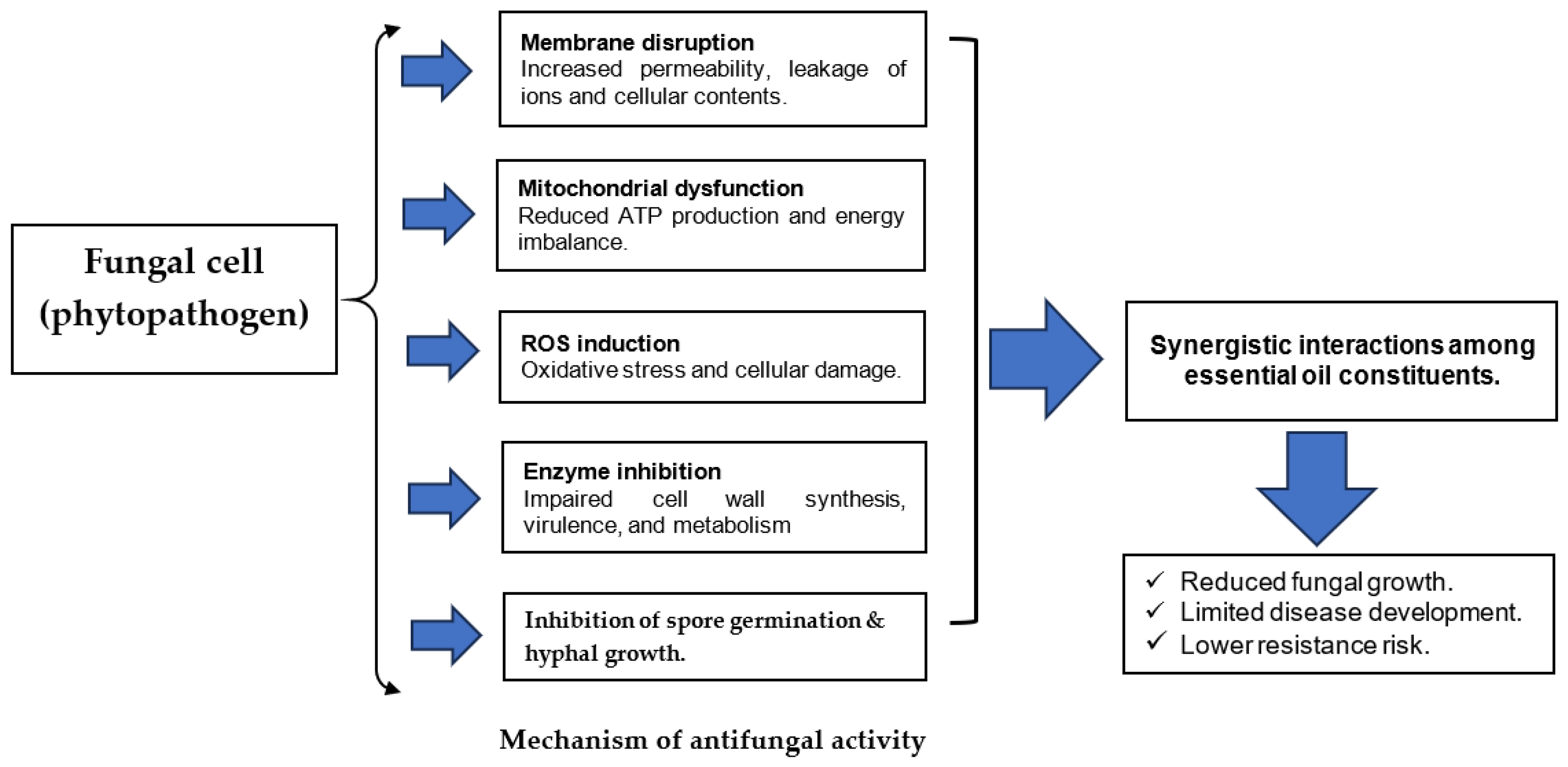
Overall, the antifungal activity of plant EOs and their bioactive constituents results from a coordinated, multi-target mode of action (Figure 1). Key mechanisms include disruption of fungal cell membrane integrity and permeability, leading to leakage of ions and vital cellular components; impairment of mitochondrial function and energy metabolism; induction of oxidative stress through reactive oxygen species (ROS) accumulation; and inhibition of essential enzymatic processes involved in cell wall synthesis, virulence, spore germination, and hyphal development. These effects often act simultaneously and are frequently enhanced by synergistic interactions among individual constituents or between blended EOs. This combined biochemical action disrupts fungal cell balance, slows pathogen growth, and lowers the risk of resistance, thereby supporting the broad-spectrum effectiveness of EOs against plant-decaying and postharvest pathogens.

8. Future Research Perspectives on the Bio-Applications of EOs

Future research on the biological applications of plant EOs should focus on overcoming limitations related to stability, volatility, and delivery while simultaneously enhancing their efficacy and safety in both agricultural and biomedical contexts. Advances in nanoencapsulation, emulsification technologies, and polymer-based coatings offer promising strategies to improve EO persistence, control release rates, and reduce phytotoxicity, enabling more reliable and effective field applications. Integrating chemical profiling with omics technologies—including genomics, transcriptomics, and metabolomics—will help elucidate precise molecular targets, resistance mechanisms, and pathways affected by EO constituents. Further studies should investigate synergistic interactions between EOs, their individual compounds, and conventional antifungal or antibacterial agents, potentially reducing required doses and mitigating resistance development. Expanding in vivo evaluations and field trials remains essential to validate laboratory findings under real environmental conditions, particularly concerning postharvest disease management and crop protection. Comprehensive safety assessments involving toxicology, environmental impact, and non-target effects will also guide regulatory acceptance.
Although comprehensive economic analyses remain limited, existing evidence suggests that plant EOs—especially when locally sourced and appropriately formulated—may represent a competitive, cost-effective, and environmentally sustainable alternative or complement to synthetic fungicides. Their broader adoption has the potential to reduce chemical residues, lower environmental toxicity, and support farm-level circular economies; however, long-term cost–benefit evaluations addressing yield stability, formulation scalability, and production consistency are still required
Finally, systematic exploration of underutilized aromatic plants spices, region-specific chemotypes, and sustainable extraction technologies could expand the diversity and availability of bioactive EO compounds. Collectively, these research directions will facilitate the development of robust, eco-friendly EO-based biopesticides and therapeutic agents with enhanced practical applicability.

9. Conclusions

Plant EOs have emerged as promising, eco-friendly alternatives to synthetic pesticides for managing a broad spectrum of phytopathogenic fungi. As evidenced in this review, a wide range of EOs and their formulations, such as oregano, thyme, vervain, magnolia, lemon, eucalyptus and cinnamon, along with their bioactive constituents (e.g., carvacrol, thymol, linalool, and citral), demonstrate potent antifungal activity both in vitro and in vivo. Their mechanisms, which can interfere with essential fungal processes, enable effective inhibition of mycelial growth and spore germination, often at low concentrations. These findings support their incorporation into practical applications such as seed treatments or soil amendments, thereby protecting crops and reducing postharvest losses. However, translating this promising efficacy to open-field conditions requires addressing critical challenges related to formulation, stability, and optimal application dosage. In summary, the novelty of this review lies in its targeted focus on plant-decaying and postharvest pathogens, its integrated discussion of antifungal mechanisms and synergistic interactions of EO constituents, and its emphasis on formulation strategies and field applicability. By linking chemical composition, biological activity, and practical deployment, this work extends beyond descriptive surveys and provides a comprehensive framework for the development of EO-based tools in sustainable crop protection and postharvest disease management. Future research should, therefore, focus on these aspects, particularly for high-impact fungal pathogens, to enable the effective integration of EOs as reliable tools in organic and integrated pest management programs.

Author Contributions

Conceptualization, H.S.E. and I.C.; data curation, I.C. and A.C.; supervision, I.C.; writing—original draft, H.S.E.; writing—review and editing, H.S.E., A.C. and I.C. All authors have read and agreed to the published version of the manuscript.

Funding

This research received no external funding.

Institutional Review Board Statement

Not applicable.

Informed Consent Statement

Not applicable.

Data Availability Statement

The original contributions presented in this study are included in the article. Further inquiries can be directed to the corresponding author.

Conflicts of Interest

The authors declare no conflicts of interest.

References

  1. Buchholtz, L. Antiseptika und Bakterien. Arch. Exp. Pathol. Pharmakol. 1875, 4, 1–81. [Google Scholar] [CrossRef]
  2. Ashhurst, A.P. The centenary of Lister (1827–1927): A tale of sepsis and anti-sepsis. Ann. Med. Hist. 1927, 9, 205–211. [Google Scholar]
  3. Lopez-Reyes, J.G.; Spadaro, D.; Gullino, M.L.; Garibaldi, A. Efficacy of plant essential oils on post-harvest control of rot caused by fungi on four cultivars of apples in vivo. Flavour Fragr. J. 2010, 25, 171–177. [Google Scholar] [CrossRef]
  4. Hidalgo, P.J.; Ubera, J.L.; Santos, J.A.; LaFont, F.; Castellanos, C.; Palomino, A.; Roman, M. Essential oils in Culamintha sylvatica Bromf. ssp. ascendens (Jordan) P.W. Ball wild and cultivated productions and antifungal activity. J. Essent. Oil Res. 2002, 14, 68–71. [Google Scholar] [CrossRef]
  5. Kordali, S.; Kotan, R.; Mavi, A.; Cakir, A.; Ala, A.; Yildirim, A. Determination of the chemical composition and antioxidant activity of the essential oil of Artemisia dracunculus and of the antifungal and antibacterial activities of Turkish Artemisia absinthium, A. dracunculus, A. santonicum, and A. spicigera essential oils. J. Agric. Food Chem. 2005, 53, 9452–9458. [Google Scholar]
  6. Viuda-Martos, M.; Ruiz-Navajas, Y.; Fernandez-Lopez, J.; Perez-Alvarez, J. Antifungal activity of lemon (Citrus limon L.), mandarin (Citrus reticulata L.), grapefruit (Citrus paradisi L.), and orange (Citrus sinensis L.) essential oils. Food Control 2008, 19, 1130–1138. [Google Scholar] [CrossRef]
  7. Ellis, S.D.; Boehm, M.J.; Mitchell, T.K. Fungal and Fungal-like Diseases of Plants; Fact Sheet, Agriculture and Natural Resources, Ohio State University: Columbus, OH, USA, 2008. [Google Scholar]
  8. Lopez-Reyes, J.G.; Spadaro, D.; Prelle, A.; Garibaldi, A.; Gullino, M.L. Efficacy of plant essential oils on postharvest control of rots caused by fungi on different stone fruits in vivo. J. Food Prot. 2013, 76, 631–639. [Google Scholar] [CrossRef]
  9. Tao, H.; Fang, C.; Xiao, Y.; Jin, Y. The toxicity and health risk of chlorothalonil to non-target animals and humans: A systematic review. Chemosphere 2024, 358, 142241. [Google Scholar] [CrossRef] [PubMed]
  10. Darshika, D.M.; Boyer, I.; Ponton, F. Chlorothalonil exposure impacts larval development and adult reproductive performance in Drosophila melanogaster. R. Soc. Open Sci. 2025, 12, 250136. [Google Scholar] [CrossRef]
  11. Liu, Y.; Liang, G.; Yin, D. Synthesis and antimicrobial activity of novel mancozeb derivatives containing 1,3,4-thiadiazole. Res. Chem. Intermed. 2015, 41, 2019–2024. [Google Scholar] [CrossRef]
  12. Runkle, J.; Flocks, J.; Economos, J.; Dunlop, A.L. A systematic review of mancozeb as a reproductive and developmental hazard. Environ. Int. 2017, 99, 29–42. [Google Scholar] [CrossRef]
  13. Dall’Agnol, J.C.; Ferri Pezzini, M.; Suarez Uribe, N.; Joveleviths, D. Systemic effects of the pesticide mancozeb—A literature review. Eur. Rev. Med. Pharmacol. Sci. 2021, 25, 4113–4120. [Google Scholar]
  14. Xu, Q.; Yang, Q.; Lu, X.; He, S.; Ma, X.; Wu, D.; Meng, Y.; Xu, L. Effects of maturity stage and mancozeb on phyllosphere microbial communities and the plant health potential of silage maize. Front. Plant Sci. 2025, 16, 1581401. [Google Scholar] [CrossRef]
  15. Theerthagiri, A.; Angannan, C.; Pillai, K.S.; Govindasamy, S.; Thiruvengadam, R.; Ramasamy, S. Effectiveness of azoxystrobin in the control of Erysiphe cichoracearum and Pseudoperonospora cubensis on cucumber. J. Plant Prot. Res. 2008, 48, 147–159. [Google Scholar] [CrossRef]
  16. Radwan, M.A.; Gad, A.F.; Abd El-Aziz, A.M.; El-Gendy, K.S. Unveiling the ecotoxicological effects of azoxystrobin-based fungicides at realistic concentrations on the land snail, Theba pisana. Sci. Rep. 2024, 14, 16427. [Google Scholar] [CrossRef] [PubMed]
  17. Zhang, J.; Zhang, B.; Zhu, F.; Fu, Y. Baseline sensitivity and fungicidal action of propiconazole against Penicillium digitatum. Pestic. Biochem. Physiol. 2021, 172, 104752. [Google Scholar] [CrossRef]
  18. Hurst, M.R.R.; Sheahan, D.A. The potential for estrogenic effects of pesticides in headwater streams in the UK. Sci. Total Environ. 2003, 301, 87–96. [Google Scholar] [CrossRef]
  19. Stern, B.R.; Solioz, M.; Krewski, D.; Aggett, P.; Aw, T.-C.; Baker, S.; Crump, K.; Dourson, M.; Haber, L.; Hertzberg, R.; et al. Copper and human health: Biochemistry, genetics, and strategies for modeling dose-response relationships. J. Toxicol. Environ. Health Part B 2007, 10, 157–222. [Google Scholar] [CrossRef] [PubMed]
  20. Salah, I.; Parkin, I.P.; Allan, E. Copper as an antimicrobial agent: Recent advances. RSC Adv. 2021, 11, 18179–18186. [Google Scholar] [CrossRef] [PubMed]
  21. Gao, F.; Yuan, Z.; Zhang, L.; Peng, Y.; Qian, K.; Zheng, M. Toxic effects of copper fungicides on the development and behavior of zebrafish in early-life stages. Nanomaterials 2023, 13, 2629. [Google Scholar] [CrossRef]
  22. Raanan, R.; Gunier, R.B.; Balmes, J.R.; Beltran, A.J.; Harley, K.G.; Bradman, A.; Eskenazi, B. Elemental sulfur use and associations with pediatric lung function and respiratory symptoms in an agricultural community (California, USA). Environ. Health Perspect. 2017, 125, 087007. [Google Scholar] [CrossRef]
  23. Corrêa-Junior, D.; Parente, C.E.T.; Frases, S. Hazards associated with the combined application of fungicides and poultry litter in agricultural areas. J. Xenobiot. 2024, 14, 110–134. [Google Scholar] [CrossRef]
  24. Gordon, E.B. Captan and Folpet. In Handbook of Pesticide Toxicology, 2nd ed.; Makhteshim-Agan of North America, Inc.: Raleigh, NC, USA, 2010; Volume 2, pp. 1915–1949. [Google Scholar]
  25. Song, X. Captan. In Encyclopedia of Toxicology, 3rd ed.; Wexler, P., Ed.; Academic Press: Oxford, UK, 2014; pp. 659–660. [Google Scholar]
  26. European Food Safety Authority (EFSA). Statement on the refined environmental risk assessment and impact of the new classification for captan. EFSA J. 2024, 22, 8576. [Google Scholar] [CrossRef]
  27. Zbozinek, J.V. Environmental transformations of DPA, SOPP, benomyl, and TBZ. Residue Rev. 1984, 92, 113–155. [Google Scholar] [PubMed]
  28. Zhou, J.; Xiong, K.; Yang, Y.; Ye, X.; Liu, J.; Li, F. Deleterious effects of benomyl and carbendazim on human placental trophoblast cells. Reprod. Toxicol. 2015, 51, 64–71. [Google Scholar] [CrossRef] [PubMed]
  29. Liu, W.T.; Chu, C.L. Thymol and acetic acid vapors reduce postharvest brown rot of apricots and plums. HortScience 2002, 37, 151–156. [Google Scholar] [CrossRef]
  30. Camele, I.; De Feo, V.; Altieri, L.; Mancini, E.; De Martino, L.; Rana, G.L. An attempt of post-harvest orange fruit rot control using essential oils from Mediterranean plants. J. Med. Food 2010, 13, 1515–1523. [Google Scholar] [CrossRef]
  31. Mancini, E.; Camele, I.; Elshafie, H.S.; De Martino, L.; Pellegrino, C.; Grulova, D.; De Feo, V. Chemical composition and biological activity of the essential oil of Origanum vulgare ssp. hirtum from different areas in the Southern Apennines (Italy). Chem. Biodivers. 2014, 11, 639–651. [Google Scholar] [CrossRef]
  32. Elshafie, H.S.; Mancini, E.; Camele, I.; De Martino, L.; De Feo, V. In vivo antifungal activity of two essential oils from Mediterranean plants against post-harvest brown rot disease of peach fruit. Ind. Crops Prod. 2015, 66, 11–15. [Google Scholar] [CrossRef]
  33. Elshafie, H.S.; Mancini, E.; De Martino, L.; Pellegrino, C.; De Feo, V.; Camele, I. Antifungal activity of some constituents of Origanum vulgare L. essential oil against post-harvest disease of peach fruit. J. Med. Food 2015, 18, 929–934. [Google Scholar] [CrossRef]
  34. Baser, K.H.C.; Buchbauer, G. (Eds.) Handbook of Essential Oils: Science, Technology, and Applications; CRC Press, Taylor & Francis Group: Boca Raton, FL, USA, 2010. [Google Scholar]
  35. Pitarokili, D.; Tzakou, O.; Loukis, A.; Harvala, C. Volatile Metabolites from Salvia fruticosa as Antifungal Agents in Soilborne Pathogens. J. Agric. Food Chem. 2003, 51, 3294–3301. [Google Scholar] [CrossRef]
  36. Bozin, B.; Mimica-Dukic, N.; Simin, N.; Anackov, G. Characterization of the Volatile Composition of Essential Oils of Some Lamiaceae Spices and the Antimicrobial and Antioxidant Activities of the Entire Oils. J. Agric. Food Chem. 2006, 54, 1822–1828. [Google Scholar] [CrossRef] [PubMed]
  37. Pavarino, M.; Duarte de Oliveira Costa, S.; Galdeano, M.C.; Rubiolo, P.; Tonon, R.V.; Lima, J.P.; Sgorbini, B.; Bizzo, H.R. Antibacterial, antifungal and flavor-enhancing properties of essential oils in tomato sauce: Bio-guided fractionation and microencapsulation of Origanum vulgare L. essential oil. Food Control 2026, 180, 111609. [Google Scholar] [CrossRef]
  38. López, P.; Sánchez, C.; Batlle, R.; Nerín, C. Vapor-Phase Activities of Cinnamon, Thyme, and Oregano Essential Oils and Key Constituents against Foodborne Microorganisms. J. Agric. Food Chem. 2007, 55, 4348–4356. [Google Scholar] [CrossRef] [PubMed]
  39. Tsao, R.; Zhou, T. Antifungal activity of monoterpenoids against post-harvest pathogens Botrytis cinerea and Monilinia fructicola. J. Essent. Oil Res. 2000, 12, 113–121. [Google Scholar] [CrossRef]
  40. de Almeida, R.B.; de Souza, L.K.H.; de Oliveira, C.M.; de Souza, F.H.L.; da Silva, G.C.; Martins, E.R. Atividade antifúngica de óleos essenciais sobre Fusarium solani isolado de quiabeiro. Rev. Ciênc. Agron. 2013, 44, 822–828. [Google Scholar]
  41. Nazzaro, F.; Fratianni, F.; Coppola, R.; De Feo, V. Essential Oils and Antifungal Activity. Pharmaceuticals 2017, 10, 86. [Google Scholar] [CrossRef]
  42. Vitoratos, A.; Bilalis, D.; Karkanis, A.; Efthimiadou, A. Antifungal Activity of Plant Essential Oils against Botrytis cinerea, Penicillium italicum and Penicillium digitatum. Not. Bot. Horti Agrobot. Cluj-Napoca 2013, 41, 86–92. [Google Scholar] [CrossRef]
  43. Kubica, P.; Szopa, A.; Dominiak, J.; Łuczkiewicz, M.; Ekiert, H. Verbena officinalis (Common Vervain)—A Review on the Investigations of This Medicinally Important Plant Species. Planta Med. 2020, 86, 1241–1257. [Google Scholar] [CrossRef]
  44. Bajpai, V.K.; Kang, S.C. In vitro and in vivo inhibition of plant pathogenic fungi by essential oil and extracts of Magnolia liliflora Desr. J. Agric. Sci. Technol. 2012, 14, 845–856. [Google Scholar]
  45. Kačániová, M.; Čmiková, N.; Vukovic, N.L.; Verešová, A.; Bianchi, A.; Garzoli, S.; Ben Saad, R.; Ben Hsouna, A.; Ban, Z.; Vukic, M.D. Citrus limon Essential Oil: Chemical Composition and Selected Biological Properties Focusing on Antimicrobial and Antibiofilm Activity. Plants 2024, 13, 524. [Google Scholar] [CrossRef]
  46. Ben Hsouna, A.; Ben Halima, N.; Smaoui, S.; Hamdi, N. Citrus lemon Essential Oil: Chemical Composition, Antioxidant and Antimicrobial Activities with Preservative Effects. Lipids Health Dis. 2017, 16, 146. [Google Scholar] [CrossRef] [PubMed]
  47. Vieira, A.J.; Beserra, F.P.; Souza, M.C.; Totti, B.M.; Rozza, A.L. Limonene: Aroma of Innovation in Health and Disease. Chem. Biol. Interact. 2018, 283, 97–106. [Google Scholar] [CrossRef]
  48. Ayed, A.; Caputo, L.; De Feo, V.; Elshafie, H.S.; Fratianni, F.; Nazzaro, F.; Hamrouni, L.; Amri, I.; Mabrouk, Y.; Camele, I.; et al. Antimicrobial, Anti-Enzymatic and Antioxidant Activities of Essential Oils from Some Tunisian Eucalyptus Species. Heliyon 2024, 10, e34518. [Google Scholar] [CrossRef] [PubMed]
  49. Sebei, K.; Sakouhi, F.; Herchi, W.; Khouja, M.L.; Boukhchina, S. Chemical Composition and Antibacterial Activities of Seven Eucalyptus Species Essential Oils Leaves. Biol. Res. 2015, 48, 7. [Google Scholar] [CrossRef]
  50. Wang, Y.; Zhang, Y.; Shi, Y.-Q.; Pan, X.-H.; Lu, Y.-H.; Cao, P. Antifungal Activities of Cinnamon Oil against Rhizopus nigricans, Aspergillus flavus and Penicillium expansum in Vitro and in Vivo Test on Fuji Apples. LWT-Food Sci. Technol. 2017, 84, 432–438. [Google Scholar]
  51. Cherif, M.C.; Boughendjioua, H.; Caputo, L.; Camele, I.; Tahraoui, T.; De Feo, V.; Elshafie, H.S. FTIR Characterization and Bioactivity Assessment of Cinnamomum camphora Essential Oil: Antioxidant, Anti-Enzymatic, and Antifungal Properties Against Phytopathogens. Chem. Biodivers. 2025, 22, e00720. [Google Scholar] [CrossRef] [PubMed]
  52. Prabuseenivasan, S.; Jayakumar, M.; Ignacimuthu, S. In vitro antibacterial activity of some plant essential oils. BMC Complement. Altern. Med. 2006, 6, 39. [Google Scholar] [CrossRef]
  53. Mráz, P.; Kopecký, M.; Hasoňová, L.; Hoštičková, I.; Vaníčková, A.; Perná, K.; Žabka, M.; Hýbl, M. Antibacterial activity and chemical composition of popular plant essential oils and their positive interactions in combination. Molecules 2025, 30, 1864. [Google Scholar] [CrossRef]
  54. Swamy, M.K.; Akhtar, M.S.; Sinniah, U.R. Antimicrobial properties of plant essential oils against human pathogens and their mode of action: An updated review. Evid. Based Complement. Alternat. Med. 2016, 2016, 3012462. [Google Scholar] [CrossRef]
  55. Elshafie, H.S.; Camele, I. An overview of the biological effects of some Mediterranean essential oils on human health. Biomed. Res. Int. 2017, 2017, 9268468. [Google Scholar] [CrossRef]
  56. Elshafie, H.S.; Aliberti, L.; Amato, M.; De Feo, V.; Camele, I. Chemical composition and antimicrobial activity of chia (Salvia hispanica L.) essential oil. Eur. Food Res. Technol. 2018, 244, 1675–1682. [Google Scholar] [CrossRef]
  57. Elshafie, H.S.; Gruľová, D.; Baranová, B.; Caputo, L.; De Martino, L.; Sedlák, V.; Camele, I.; De Feo, V. Antimicrobial activity and chemical composition of essential oil extracted from Solidago canadensis L. growing wild in Slovakia. Molecules 2019, 24, 1206. [Google Scholar] [CrossRef]
  58. Della Pepa, T.; Elshafie, H.S.; Capasso, R.; De Feo, V.; Camele, I.; Nazzaro, F.; Scognamiglio, M.R.; Caputo, L. Antimicrobial and phytotoxic activity of Origanum heracleoticum and O. majorana essential oils growing in Cilento (Southern Italy). Molecules 2019, 24, 2576. [Google Scholar] [CrossRef] [PubMed]
  59. Mohamed, A.A.; Alotaibi, B.M. Essential oils of some medicinal plants and their biological activities: A mini review. J. Umm Al-Qura Univ. Appl. Sci. 2023, 9, 40–49. [Google Scholar] [CrossRef]
  60. Fayez, S.; Gamal El-Din, M.I.; Moghannem, S.A.; Azam, F.; El-Shazly, M.; Korinek, M.; Chen, Y.-L.; Hwang, T.-L.; Fahmy, N.M. Eucalyptus-derived essential oils alleviate microbes and modulate inflammation by suppressing superoxide and elastase release. Front. Pharmacol. 2023, 14, 1218315. [Google Scholar] [CrossRef] [PubMed]
  61. Wilson, C.L.; Solar, J.M.; El Ghaouth, A.; Wisniewski, M.E. Rapid evaluation of plant extracts and essential oils for antifungal activity against Botrytis cinerea. Plant Dis. 1997, 81, 204–210. [Google Scholar] [CrossRef]
  62. Walter, M.; Jaspers, M.V.; Frampton, C.M.; Eade, K.; Stewart, A. Control of Botrytis cinerea in grape using thyme oil. Australas. Plant Pathol. 2001, 30, 21–25. [Google Scholar]
  63. Bouchra, C.; Achouri, M.; Idrissi, L.M.; Hmamouchi, M. Chemical composition and antifungal activity of essential oils of seven Moroccan Labiatae against Botrytis cinerea Pers. Fr. J. Ethnopharmacol. 2003, 89, 165–169. [Google Scholar] [CrossRef]
  64. Dubey, N.K.; Kishore, N.; Shing, S.N. Antifungal properties of the volatile fraction of Melaleuca leucodendron. Trop. Agric. 1988, 60, 227–228. [Google Scholar]
  65. Rahman, M.U.; Gul, S. Mycotoxic effects of Thymus serpyllum oil on the asexual reproduction of Aspergillus species. J. Essent. Oil Res. 2003, 15, 166–171. [Google Scholar] [CrossRef]
  66. Shashi, S.K.; Patra, M.; Shukla, A.C.; Dikshit, A. Use of essential oil as botanical pesticides against post-harvest spoilage in Malus pumilo fruits. Biocontrol 2003, 48, 223–232. [Google Scholar] [CrossRef]
  67. Vaughn, F.S.; Spencer, F.G. Antifungal activity of natural compounds against thiabendazole-resistant Fusarium sambucinum strains. J. Agric. Food Chem. 1994, 42, 200–203. [Google Scholar] [CrossRef]
  68. Daferera, D.J.; Ziogas, B.N.; Moschos, G. The effectiveness of plant essential oils on the growth of Botrytis cinerea, Fusarium sp., and Clavibacter michiganensis subsp. michiganensis. Crop Prot. 2003, 22, 39–44. [Google Scholar] [CrossRef]
  69. Arras, G.; Aggabio, M.; Piga, A.; D’Hallewin, G. Fungicide effect of volatile compounds of Thymus capitatus. Acta Hortic. 1995, 379, 593–600. [Google Scholar] [CrossRef]
  70. Thompson, D.P. Effect of essential oils on spore germination of Rhizopus stolonifer and Aspergillus species. Mycologia 1993, 78, 482–485. [Google Scholar] [CrossRef]
  71. Reddy, M.V.B.; Angers, P.; Gosselin, A.; Arul, J. Characterization and use of essential oil from Thymus vulgaris against Botrytis cinerea and Rhizopus stolonifer in strawberry fruits. Phytochemistry 1998, 47, 1515–1520. [Google Scholar] [CrossRef]
  72. Palhano, F.L.; Vilches, T.T.; Santos, R.B.; Orlando, M.T.; Ventura, A.J.; Fernandes, P.M. Inactivation of Colletotrichum gloeosporioides spores by high hydrostatic pressure combined with citral or lemongrass essential oils. Int. J. Food Microbiol. 2004, 95, 61–66. [Google Scholar] [CrossRef]
  73. Lazar-Baker, E.E.; Hetherington, S.D.; Ku, V.V.; Newman, S.M. Evaluation of commercial essential oil samples on the growth of post-harvest pathogen Monilinia fructicola (G. Winter) Honey. Lett. Appl. Microbiol. 2011, 52, 227–232. [Google Scholar] [CrossRef]
  74. Amiri, A.; Dugas, R.; Pichot, A.L.; Bompeix, G. In vitro and in vivo activity of eugenol oil (Eugenia caryophyllata) against four important post-harvest apple pathogens. Int. J. Food Microbiol. 2008, 126, 13–19. [Google Scholar] [CrossRef]
  75. Neri, F.; Mari, M.; Brigati, S.; Bertolini, P. Control of Neofabrea alba by plant volatile compounds and hot water. Postharvest Biol. Technol. 2009, 51, 425–430. [Google Scholar] [CrossRef]
  76. Smid, E.J.; Dewitte, Y.; Gorris, L.G. Secondary plant metabolites as control agents of post-harvest Penicillium rot on tulip bulbs. Postharvest Biol. Technol. 1995, 6, 303–312. [Google Scholar] [CrossRef]
  77. Dixit, S.N.; Chandra, H.; Tiwari, R.; Dixit, V. Development of a botanical fungicide against blue mould of mandarins. J. Stored Prod. Res. 1995, 31, 165–172. [Google Scholar] [CrossRef]
  78. Arrebola, E.; Sivakumar, D.; Bacigalupo, R.; Korsten, L. Combined application of antagonist Bacillus amyloliquefaciens and essential oils for the control of peach post-harvest diseases. Crop Prot. 2010, 29, 369–377. [Google Scholar] [CrossRef]
  79. Feng, W.; Zheng, X.D.; Chen, J.P.; Yang, Y. Combination of cassia oil with magnesium sulphate for control of post-harvest storage rots of cherry tomatoes. Crop Prot. 2008, 27, 112–117. [Google Scholar] [CrossRef]
  80. Dutta, P.K.; Tripathi, G.K.; Mehrotra, J. Perspectives for chitosan-based antimicrobial films in food applications. Food Chem. 2009, 114, 1173–1182. [Google Scholar] [CrossRef]
  81. Elshafie, H.S.; Caputo, L.; De Martino, L.; Sakr, S.H.; De Feo, V.; Camele, I. Study of bio-pharmaceutical and antimicrobial properties of pomegranate (Punica granatum L.) leathery exocarp extract. Plants 2021, 10, 153. [Google Scholar] [CrossRef] [PubMed]
  82. Camele, I.; Gruľová, D.; Elshafie, H.S. Chemical composition and antimicrobial properties of Mentha piperita cv. ‘Kristinka’ essential oil. Plants 2021, 10, 1567. [Google Scholar] [CrossRef]
  83. Elshafie, S.S.; Elshafie, H.S.; El Bayomi, R.M.; Camele, I.; Morshdy, A.E.M.A. Evaluation of the antimicrobial activity of four plant essential oils against some food and phytopathogens isolated from processed meat products in Egypt. Foods 2022, 11, 1159. [Google Scholar] [CrossRef]
  84. Abd-Ellatif, S.; Ibrahim, A.A.; Safhi, F.A.; Abdel Razik, E.S.; Kabeil, S.S.A.; Aloufi, S.; Alyamani, A.A.; Basuoni, M.M.; Alshamrani, S.M.; Elshafie, H.S. Green synthesized Thymus vulgaris chitosan nanoparticles induce relative WRKY-genes expression in Solanum lycopersicum against Fusarium solani, the causal agent of root rot disease. Plants 2022, 11, 3129. [Google Scholar] [CrossRef]
  85. Nazzaro, F.; Fratianni, F.; De Martino, L.; Coppola, R.; De Feo, V. Effect of essential oils on pathogenic bacteria. Pharmaceuticals 2013, 6, 1451–1474. [Google Scholar] [CrossRef]
  86. Hyldgaard, M.; Mygind, T.; Meyer, R.L. Essential oils in food preservation: Mode of action, synergies, and interactions with food matrix components. Front. Microbiol. 2012, 3, 12. [Google Scholar] [CrossRef]
  87. Soylu, S.; Yigitbas, H.; Soylu, E.M.; Kurt, S. Antifungal effects of essential oils from oregano and fennel on Sclerotinia sclerotiorum. J. Appl. Microbiol. 2007, 103, 1021–1030. [Google Scholar] [CrossRef] [PubMed]
  88. Soylu, E.M.; Kurt, S.; Soylu, S. In vitro and in vivo antifungal activities of the essential oils of various plants against tomato grey mould disease agent Botrytis cinerea. Int. J. Food Microbiol. 2010, 143, 183–189. [Google Scholar] [CrossRef]
  89. Elshafie, H.S.; Mang, S.M.; Camele, I. Blended formulations of oregano-sage essential oils: Antimicrobial, phytotoxic and anti-quorum sensing investigations. J. Biol. Res. 2024, 97, 11999. [Google Scholar] [CrossRef]
  90. Bassolé, I.H.N.; Juliani, H.R. Essential oils in combination and their antimicrobial properties. Molecules 2012, 17, 3989–4006. [Google Scholar] [CrossRef]
  91. Bakkali, F.; Averbeck, S.; Averbeck, D.; Idaomar, M. Biological effects of essential oils—A review. Food Chem. Toxicol. 2008, 46, 446–475. [Google Scholar] [CrossRef]
  92. Zygadlo, J.A.; Guzman, C.A.; Grosso, N.R. Antifungal properties of the leaf oils of Tagetes minuta L. and T. filifolia Lag. J. Essent. Oil Res. 1994, 6, 617–621. [Google Scholar] [CrossRef]
  93. Camele, I.; Altieri, L.; De Martino, L.; De Feo, V.; Mancini, E.; Rana, G.L. In vitro control of post-harvest fruit rot fungi by some plant essential oil components. Int. J. Mol. Sci. 2012, 13, 2290–2300. [Google Scholar] [CrossRef]
  94. Dutta, S.; Datta, R.; Kumar, V.; Saha, S. Nano-Formulation of Plant Essential Oils for Sustainable Disease Management in Agriculture: Current Status and Future Perspectives. Front. Plant Sci. 2023, 14, 1118588. [Google Scholar]
Figure 1. Schematic diagram illustrating the main mechanisms of antifungal action of essential oils.
Plants 15 00542 g001
Table 1. Common chemical pesticides for common plant diseases and their negative impacts.
Chemical Pesticide (a) Common Target Plant Diseases/PathogensMechanism of Antimicrobial Effect (Mode of Action)Collateral Negative Impact on Human Health Collateral Negative Impact on the Environment References
Chlorothalonil (e.g., Bravo, Daconil, and Echo)Effective against various fungal plant diseases, including blights, mildews, rusts, and leaf spots.Multi-site inhibitor interfering with fungal enzymes.May be associated with respiratory irritation, skin sensitization, endocrine disruption, and potential carcinogenic risks.Highly toxic to aquatic animals and persistent in soil and water.[9,10]
Mancozeb (e.g., Penncozeb, Trimanoc, and Vondozeb)Controls blight, rust, leaf spot, and scabs across a wide range of fruits, vegetables, nuts, and field crops.Multi-site inhibitor that disrupts multiple enzymes.Causes several health problems, mainly hepatic, renal and genotoxic.Moderately persistent, toxic to aquatic organisms, and capable of affecting soil microflora.[11,12,13,14]
Azoxystrobin (e.g., Amistar, Heritage, and Ortiva)Rusts, mildews, blights, and fruit rots.Inhibits mitochondrial respiration. Exhibits low to moderate toxicity and can induce allergic dermatological reactions.Toxic to non-target organisms, and persistent in soil, affecting microbes and causing oxidative stress in aquatic life.[15,16]
Propiconazole (e.g., Tilt, Banner Maxx II, and Patch Pro)Rusts, powdery mildew, leaf spot, and anthracnose.Inhibits ergosterol synthesis (DMI fungicide).May disrupt hormones, cause skin irritation, and affect reproductive health.Persistent in soil and toxic to aquatic invertebrates and fish.[17,18]
Copper-based fungicides (e.g.,
copper hydroxide, copper sulfate, copper oxychloride, copper oxide, and copper octanoate)
Wide range of plant diseases: downy mildew, powdery mildew, blight, leaf spot and bacterial diseases such as fire blight. Cause cell membrane disruption, produce toxic reactive oxygen species (ROS), and interfere with vital enzymes and nucleic acids. Causes skin and eye irritation, makes it dangerous to swallow, and might affect the liver or kidneys.Persists in soil, accumulates in waterways, and toxic to beneficial soil microbes.[19,20,21]
Sulfur fungicides
(e.g., elemental and lime sulfur)
Powdery mildew on fruit trees (fruits), and other broad-spectrum effect against rusts, molds and scabs. Disrupts fungal respiration.Hinders lung function and causes respiratory symptoms in children and may also cause skin and eye irritation.Excessive application acidifies soil, harms beneficial arthropods, and pollutes air.[22,23]
Captan (e.g., Orthocide, Merpan, and Captan 50 W)Scabs, blights, brown rot, powdery mildew, and gray mold on fruits, vegetables, and ornamentals.Multi-site disruptor affecting enzymes and cell membranes.Leads to skin and eye irritation and is suspected to cause carcinogenicity.Toxic to aquatic organisms, and breaks down into more persistent metabolites.[24,25,26]
Carbendazim/Benomyl (e.g., Samartha, Agrocit, and Benex) Controls powdery mildew, leaf spot, anthracnose, scabs, and Fusarium wilt.Inhibits fungal cell division.Has potential teratogenic effects and causes reproductive toxicity.Persistent, and toxic to earthworms and aquatic life, with rapid resistance development.[27,28]
(a) The names between brackets correspond to the trademarks of active ingredient.
Disclaimer/Publisher’s Note: The statements, opinions and data contained in all publications are solely those of the individual author(s) and contributor(s) and not of MDPI and/or the editor(s). MDPI and/or the editor(s) disclaim responsibility for any injury to people or property resulting from any ideas, methods, instructions or products referred to in the content.