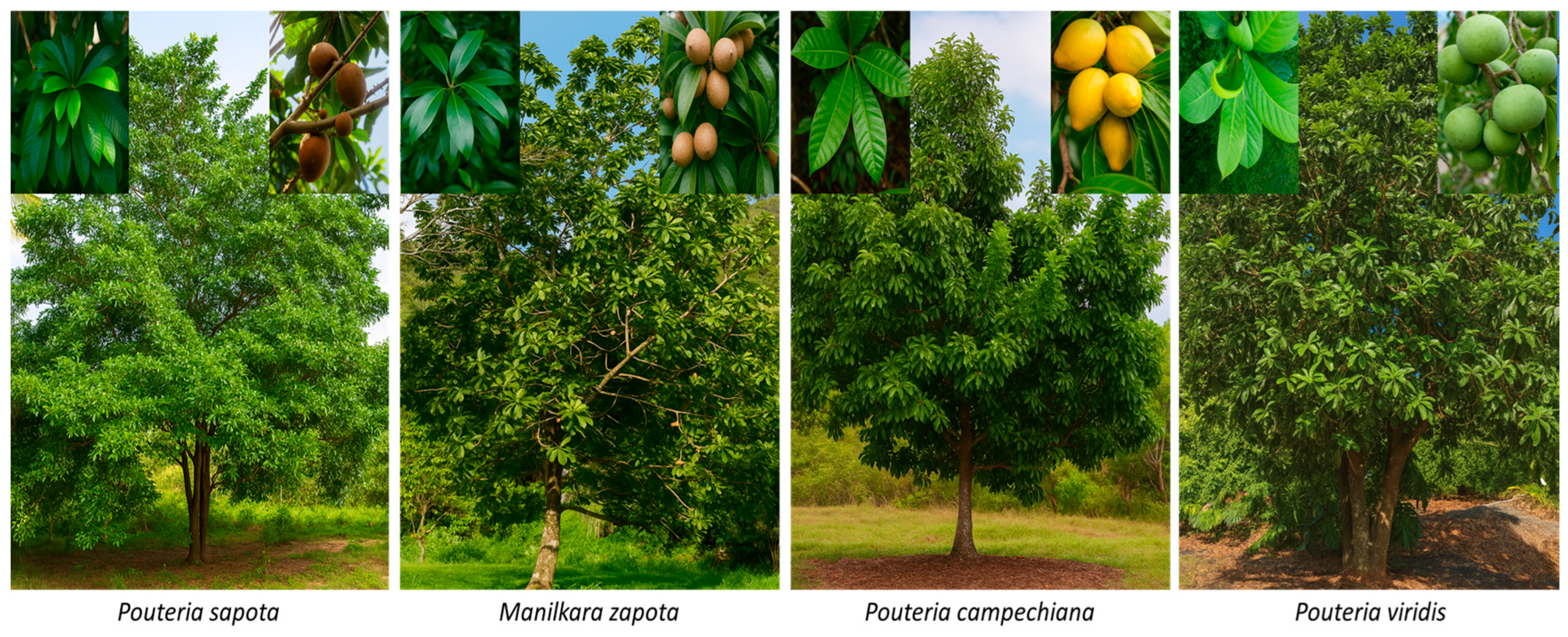
Sapotaceae Family Fruits from Central America: Botanical, Phytochemical and Nutraceutical Insights—A Review
 , , , , , and
Abstract
1. Introduction
2. Data Collection and Search Strategy
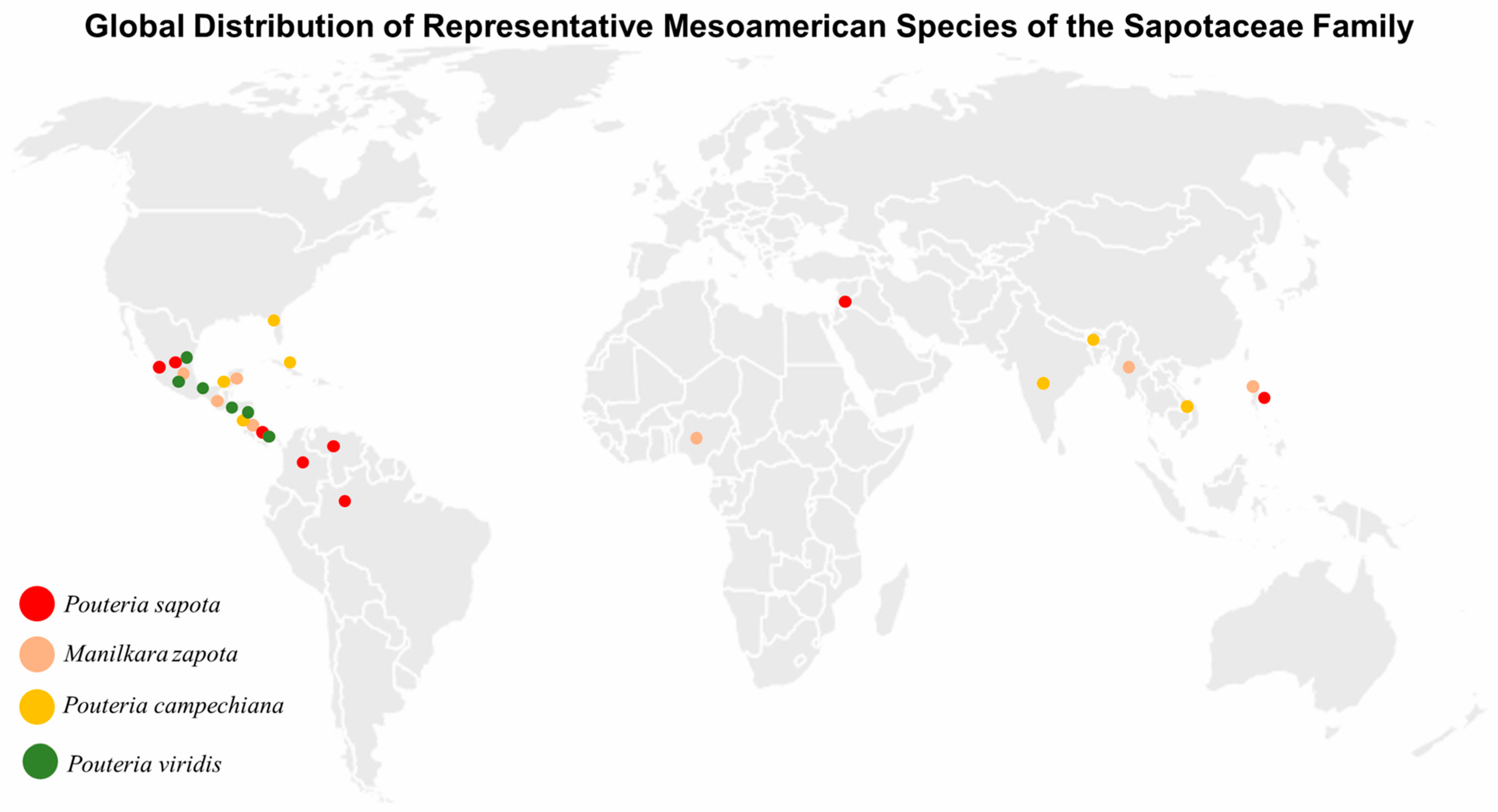
3. Botanical Classification and Geographical Distribution
3.1. Botanical Classification
3.2. Geographical Distribution
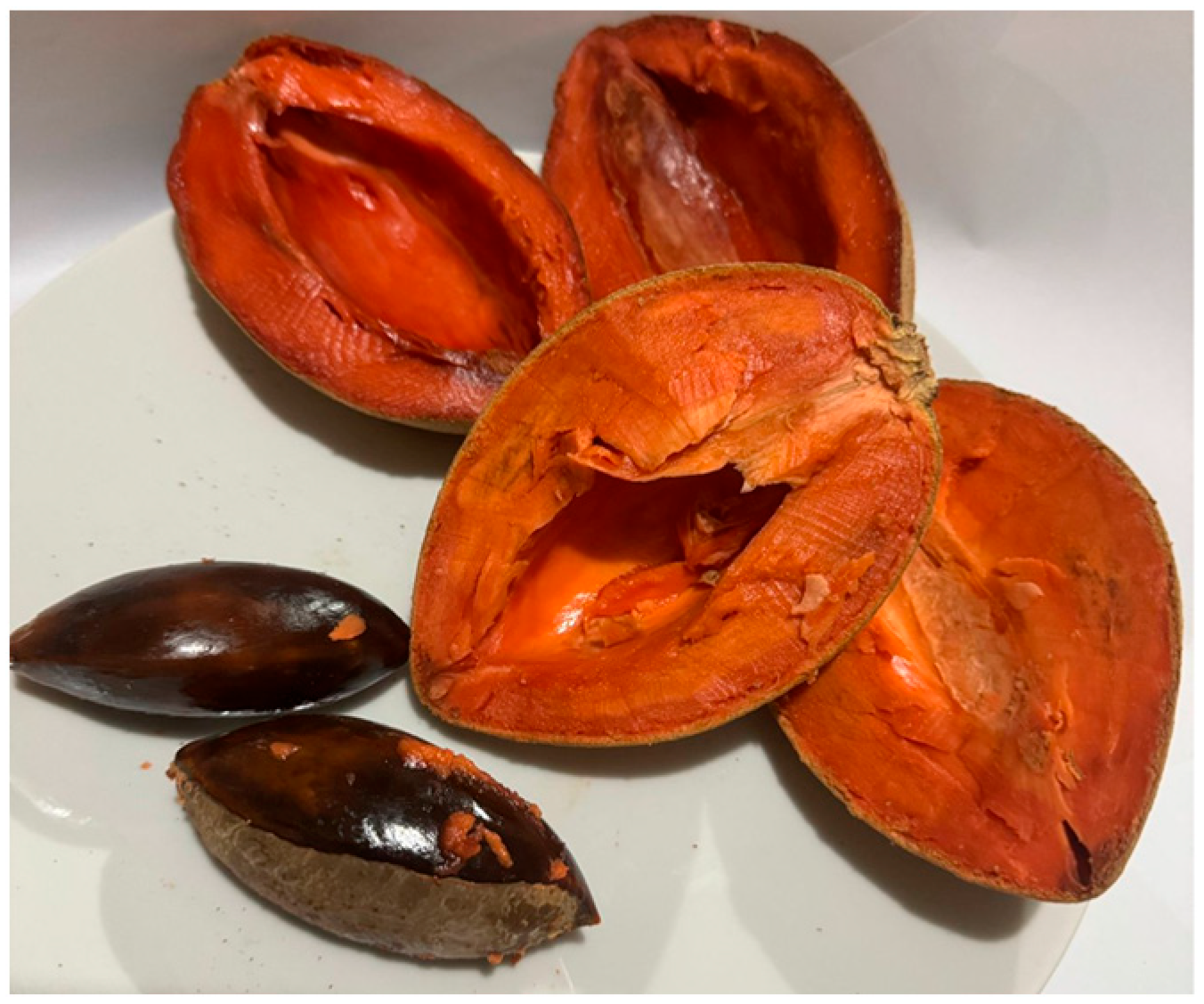
3.2.1. Pouteria sapota (Mamey Sapote)
3.2.2. Manilkara zapota (Sapodilla, Chicozapote)
3.2.3. Pouteria campechiana (Canistel, Yellow Sapote)
3.2.4. Pouteria viridis (Green Sapote)
3.2.5. Manilkara achras
3.2.6. Other Sapotes of Mesoamerica
4. Morphological and Genetic Characterization
4.1. General Morphological Characteristics of the Sapotaceae Family
4.2. Morphological Characterization of the Main Genera
4.2.1. Pouteria Genus
Pouteria sapota
Pouteria campechiana
Pouteria viridis
4.2.2. Manilkara Genus
4.3. Genetic Characteristics of the Main Genera
4.3.1. Pouteria Genus
4.3.2. Manilkara Genus
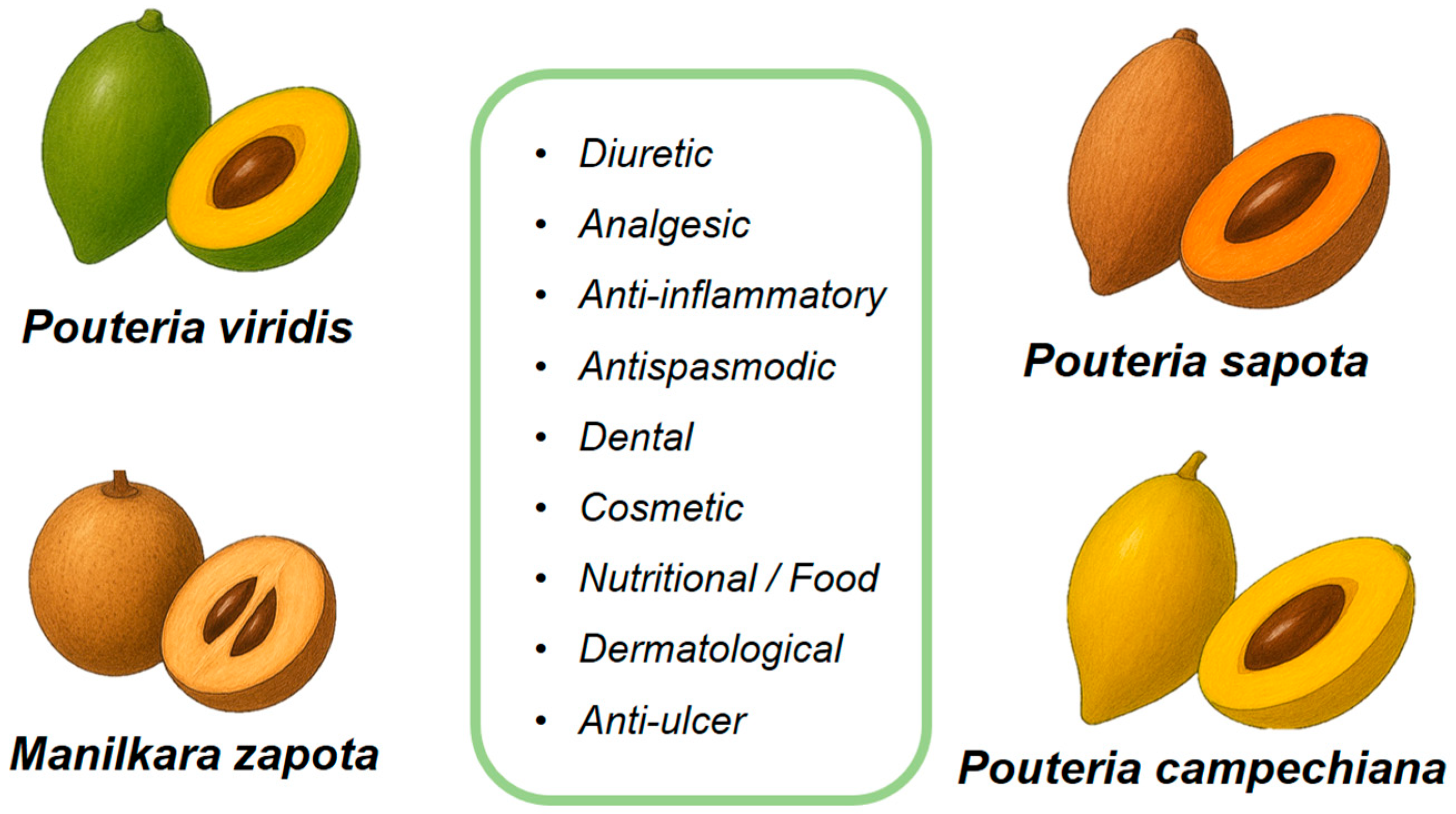
5. Traditional and Contemporary Uses
5.1. Pouteria sapota
5.2. Pouteria campechiana
5.3. Pourteria viridis
5.4. Manilkara zapota
6. Phytochemical Composition
Phytochemical Extraction and Recovery Strategies in Sapotaceae
7. Biological Activities
7.1. Antioxidant Activity
7.2. Anti-Inflammatory and Immunomodulatory Activity
7.3. Antimicrobial and Antifungal Activity
8. Nutraceutical and Industrial Applications
8.1. Applications in the Food Industry
8.1.1. Development of Functional Foods
8.1.2. Ingredient Substitution
8.1.3. Food Preservation
8.2. Applications in the Pharmaceutical Industry and Human Health
8.2.1. Potential Against Metabolic Diseases
8.2.2. Applications in Pain and Inflammation Management
8.2.3. Anti-Infective Agents: Antimicrobial, Antifungal, and Antiviral
8.2.4. Neurological Health and Neuroprotection
8.2.5. Anticancer and Cytotoxic Activity
9. Future Research Perspectives
10. Conclusions
Author Contributions
Funding
Acknowledgments
Conflicts of Interest
References
- Pennington, T.D. Flora Da Reserva Ducke, Amazonas, Brasil: Sapotaceae. Rodriguésia 2006, 57, 251–366. [Google Scholar] [CrossRef] [Scilit]
- Pennington, T.D. Sapotaceae. In Flowering Plants·Dicotyledons; Springer: Berlin/Heidelberg, Germany, 2004; pp. 390–421. ISBN 978-3-662-07257-8. [Google Scholar]
- Baskar, M.; Hemalatha, G.; Muneeshwari, P. Traditional and Medicinal Importance of Sapota—Review. Int. J. Curr. Microbiol. Appl. Sci. 2020, 9, 1711–1717. [Google Scholar] [CrossRef] [Scilit]
- Salleh, R.M.; Ying, T.L.; Mousavi, L. Development of Fruit Bar Using Sapodilla (Manilkara zapota L.). J. Food Process. Preserv. 2017, 41, 12806. [Google Scholar] [CrossRef] [Scilit]
- Evangelista-Lozano, S.; Robles-Jímarez, H.R.; Pérez-Barcena, J.F.; Agama-Acevedo, E.; Briones-Martínez, R.; Cruz-Castillo, J.G. Fruit Characterization of Poueria campechiana ([Kunth] Baehni) in Three Different Stages of Maturity. Fruits 2021, 76, 116–122. [Google Scholar] [CrossRef] [Scilit]
- Solís-Fuentes, J.A.; Ayala-Tirado, R.C.; Fernández-Suárez, A.D.; Durán-De-Bazúa, M.C. Mamey Sapote Seed Oil (Pouteria sapota). Potential, Composition, Fractionation and Thermal Behavior. Grasas Aceites 2015, 66, e056. [Google Scholar] [CrossRef] [Scilit]
- Da Silva, L.M.R.; De Figueiredo, E.A.T.; Ricardo, N.M.P.S.; Vieira, I.G.P.; De Figueiredo, R.W.; Brasil, I.M.; Gomes, C.L. Quantification of Bioactive Compounds in Pulps and By-Products of Tropical Fruits from Brazil. Food Chem. 2014, 143, 398–404. [Google Scholar] [CrossRef] [Scilit] [PubMed]
- Singh, J.P.; Kaur, A.; Shevkani, K.; Singh, N. Composition, Bioactive Compounds and Antioxidant Activity of Common Indian Fruits and Vegetables. J. Food Sci. Technol. 2016, 53, 4056–4066. [Google Scholar] [CrossRef] [Scilit] [PubMed]
- Barbalho, S.M.; Bueno, P.C.D.S.; Delazari, D.S.; Guiguer, E.L.; Coqueiro, D.P.; Araújo, A.C.; De Souza, M.D.S.S.; Farinazzi-Machado, F.M.V.; Mendes, C.G.; Groppo, M. Antidiabetic and Antilipidemic Effects of Manilkara zapota. J. Med. Food 2015, 18, 385–391. [Google Scholar] [CrossRef] [Scilit]
- Mohanapriya, C.; Uma, S.; Nithyalakshmi, V.; Rajmohan, K.S. In Vitro Evaluation of Secondary Metabolites: Characterization and Antimicrobial Activity of Manilkara zapota L. Seed Extract. Proc. Natl. Acad. Sci. India Sect. B Biol. Sci. 2019, 89, 729–738. [Google Scholar] [CrossRef] [Scilit]
- Sangeetha, R.; Pratheeba, T.; Ragavendran, C.; Natarajan, D. Pouteria campechiana Leaf Extract and Its Bioactive Compound Myricitrin Are Mosquitocidal against Aedes Aegypti and Culex Quinquefasciatus. Asian Pac. J. Trop. Med. 2019, 12, 321–328. [Google Scholar] [CrossRef] [Scilit]
- Islam, S.; Alam, M.B.; Ann, H.-J.; Park, J.-H.; Lee, S.-H.; Kim, S. Metabolite Profiling of Manilkara zapota L. Leaves by High-Resolution Mass Spectrometry Coupled with ESI and APCI and In Vitro Antioxidant Activity, α-Glucosidase, and Elastase Inhibition Assays. Int. J. Mol. Sci. 2021, 22, 132. [Google Scholar] [CrossRef] [Scilit] [PubMed]
- Socas-Rodríguez, B.; Torres-Cornejo, M.V.; Álvarez-Rivera, G.; Mendiola, J.A. Deep Eutectic Solvents for the Extraction of Bioactive Compounds from Natural Sources and Agricultural By-Products. Appl. Sci. 2021, 11, 4897. [Google Scholar] [CrossRef] [Scilit]
- Baky, M.H.; Kamal, A.M.; Elgindi, M.R.; Haggag, E.G. A Review on Phenolic Compounds from Family Sapotaceae. J. Pharmacogn. Phytochem. 2016, 5, 280–287. [Google Scholar]
- de Oliveira, A.C.; Mar, J.M.; Correa, R.F.; Sanches, E.A.; Campelo, P.H.; da Silva Ramos, A.; de Araújo Bezerra, J. Pouteria Spp. Fruits: Health Benefits of Bioactive Compounds and Their Potential for the Food Industry. Food Res. Int. 2023, 173, 113310. [Google Scholar] [CrossRef] [Scilit] [PubMed]
- de Almeida, R.; Leonardo Da Silva, L.; Verícimo, M.A. Review on the Therapeutic Activities of the Genus Pouteria. Int. J. Adv. Eng. Res. Sci. 2020, 7, 388–398. [Google Scholar] [CrossRef] [Scilit]
- Belmonte-Herrera, B.H.; Domínguez-Avila, J.A.; Wall-Medrano, A.; Ayala-Zavala, J.F.; Preciado-Saldaña, A.M.; Salazar-López, N.J.; López-Martínez, L.X.; Yahia, E.M.; Robles-Sánchez, R.M.; González-Aguilar, G.A. Lesser-Consumed Tropical Fruits and Their by-Products: Phytochemical Content and Their Antioxidant and Anti-Inflammatory Potential. Nutrients 2022, 14, 3663. [Google Scholar] [CrossRef] [Scilit]
- Aly, M.E.; Nebal, D.E.T.; Sherifa, F.M.; Rabab, M.A.; Sally, A.W.E.A. Chemical Composition and Biological Activities of Pouteria campechiana (Kunth) Baehni. J. Med. Plants Res. 2016, 10, 209–215. [Google Scholar] [CrossRef] [Scilit]
- Konuku, K.; Chaithanya Karri, K.; Kanniappan Gopalakrishnan, V.; Hagos, Z.; Kebede, H.; Naidu, K.; Ponce Noyola, P.; Palleti, J.D.; Duddukuri, R. Anti-Inflamatory Activity of Manilkara zapota Leaf Extract. Int. J. Curr. Pharm. Res. 2017, 9, 130–134. [Google Scholar] [CrossRef] [Scilit]
- Torres-Martínez, A.; Acevedo-Fernández, J.J.; Jiménez-Pérez, N.d.C.; González-Alejo, F.A.; García-Alamilla, P.; Estrada-Botello, M.A.; Araujo-León, J.A.; Carrera-Lanestosa, A. In Vitro Biological Evaluation and In Vivo Anti-Inflammatory Effect of Chicozapote (Manilkara zapota (L.) P. Royen) Leaf Extracts in Mice with Internal Atrial Edema. Pharmacogn. Mag. 2024, 21, 1313–1322. [Google Scholar] [CrossRef] [Scilit]
- Shahraki, S.H.; Javar, F.M.; Rahimi, M. Quantitative and Qualitative Phytochemical Analysis of Manilkara zapota (Sapodilla) Extract and Its Antibacterial Activity on Some Gram-Positive and Gram-Negative Bacteria. Scientifica 2023, 2023, 5967638. [Google Scholar] [CrossRef] [Scilit]
- Tueguem Tagne, J.G.; Nouemsi Kengne, A.P.; Tsafack Doungue, H.; Pegui Kemtsop, M.; Oben Enyong, J. Evaluation of the Effect of Pouteria campechiana’s Fruit Powder and Ethanolic Extract on Aluminum-Chloride Induced Alzheimers Disease. J. Food Sci. Nutr. Res. 2020, 3, 83–91. [Google Scholar] [CrossRef] [Scilit]
- Terra-Araujo, M.H.; Faria, A.D.; Vicentini, A.; Nylinder, S.; Swenson, U. Species Tree Phylogeny and Biogeography of the Neotropical Genus Pradosia (Sapotaceae, Chrysophylloideae). Mol. Phylogenet. Evol. 2015, 87, 1–13. [Google Scholar] [CrossRef] [Scilit]
- Vasconcelos, C.C.; Cláudia, A.; Guedes, L.; Guedes, M.C.; Barbosa, J.; Costa, P. Notes on the Seedling Morphology of Pouteria franciscana Baehni (Sapotaceae). Biota Amaz. 2021, 11, 81–84. [Google Scholar] [CrossRef]
- Martínez-Sovero, G.; Iglesias-Osores, S.; Muñoz-Chavarry, P.; Seminario-Cunya, A.; Alva-Mendoza, D.; Villena-Velásquez, J. Diversidad y Estructura de Sapotaceae En Bosques Amazónicos de Madre de Dios, Perú. Cienc. Amaz. (Iquitos) 2021, 9, 59–72. [Google Scholar] [CrossRef] [Scilit]
- Phang, A.; Niissalo, M.A.; Herrera-Alsina, L.; Pezzini, F.F.; Hollands, R.; Burslem, D.F.R.P.; Ruhsam, M.; Middleton, D.J.; Wilkie, P.; Khew, G.S. Novel Phylogenomic and Biogeographic Insights into Palaquium and Tribe Isonandreae (Sapotaceae). Mol. Phylogenet. Evol. 2025, 212, 108403. [Google Scholar] [CrossRef] [Scilit]
- Silva, C.A.M.; Simeoni, L.A.; Silveira, D. Genus Pouteria: Chemistry and Biological Activity. Braz. J. Pharmacogn. 2009, 19, 501–509. [Google Scholar] [CrossRef] [Scilit]
- Almeida, E.B., Jr.; de Lima, L.F.; Lima, P.B.; Zickel, C. Descrição Morfológica de Frutos e Sementes de Manilkara salzmannii (Sapotaceae). Floresta 2010, 40, 535–540. [Google Scholar] [CrossRef] [Scilit]
- Jordan, M. Pouteria Species. In Biotechnology in Agriculture and Forestry; Bajaj, Y.P.S., Ed.; Springer: Berlin/Heidelberg, Germany, 1996; Volume 35. [Google Scholar]
- Judd, W.S.; Olmstead, R.G. A Survey of Tricolpate (Eudicot) Phylogenetic Relationships. Am. J. Bot. 2004, 91, 1627–1644. [Google Scholar] [CrossRef] [Scilit]
- Pennington, T.D. The Genera of Sapotaceae; Royal Botanic Gardens: Kew, UK, 1991. [Google Scholar]
- Swenson, U.; Bartish, I.V.; Munzinger, J. Phylogeny, Diagnostic Characters and Generic Limitation of Australasian Chrysophylloideae (Sapotaceae, Ericales): Evidence from ITS Sequence Data and Morphology. Cladistics 2007, 23, 201–228. [Google Scholar] [CrossRef] [Scilit]
- Bartish, I.V.; Swenson, U.; Munzinger, J.; Anderberg, A.A. Phylogenetic Relationships among New Caledonian Sapotaceae (Ericales): Molecular Evidence for Generic Polyphyly and Repeated Dispersal. Am. J. Bot. 2005, 92, 667–673. [Google Scholar] [CrossRef] [Scilit] [PubMed]
- Swenson, U.; Munzinger, J.; Bartish, I.V. Molecular Phylogeny of Planchonella (Sapotaceae) and Eight New Species from New Caledonia. Taxon 2007, 56, 329–354. [Google Scholar] [CrossRef] [Scilit]
- Kümpers, B.M.C.; Richardson, J.E.; Anderberg, A.A.; Wilkie, P.; Craene Fls, L.P. The Significance of Meristic Changes in the Flowers of Sapotaceae. Bot. J. 2016, 180, 161–192. [Google Scholar] [CrossRef] [Scilit]
- Christe, C.; Boluda, C.G.; Koubínová, D.; Gautier, L.; Naciri, Y. New Genetic Markers for Sapotaceae Phylogenomics: More than 600 Nuclear Genes Applicable from Family to Population Levels. Mol. Phylogenet. Evol. 2021, 160, 107123. [Google Scholar] [CrossRef] [Scilit] [PubMed]
- Deklerck, V.; Price, E.; Abeele, S.V.; Liévens, K.; Espinoza, E.; Beeckman, H. Timber Identification in the Taxonomically Challenging Sapotaceae Family. Res. Sq. 2021, 17, 64. [Google Scholar] [CrossRef] [Scilit]
- He, W.; Liu, Y.; Gao, R.; Song, Z.; Zhu, W.; Chen, J.; Liang, C.; Wu, S.; Zhai, J. Characterization of the Complete Chloroplast Genomes and Phylogenetic Analysis of Sapotaceae. Horticulturae 2024, 10, 1375. [Google Scholar] [CrossRef] [Scilit]
- Alves-Araújo, A.; Alves, M. Two New Species of Pouteria (Sapotaceae) from the Atlantic Forest in Brazil. Syst. Bot. 2011, 36, 1004–1007. [Google Scholar] [CrossRef] [Scilit]
- Swenson, U.; Anderberg, A.A. Phylogeny, Character Evolution, and Classification of Sapotaceae (Ericales). Cladistics 2005, 21, 101–130. [Google Scholar] [CrossRef] [Scilit]
- Parmar, A.B.; Tandel, Y.N.; Parmar, B.R.; Patel, A.I.; Pandey, A.K. Correlation and Path Coefficient Analysis Studies in Sapota [Manilkara Achras (Mill.) Fosberg] Genotypes. J. Pharmacogn. Phytochem. 2020, 9, 2158–2162. [Google Scholar]
- Reyes-Gómez, S.; Montiel, R.; Tlenkopatchev, M.A. Chicle Gum from Sapodilla (Manilkara zapota) as a Renewable Resource for Metathesis Transformations. Chem. Soc. 2018, 1, 61. [Google Scholar] [CrossRef] [Scilit]
- Alia-Tejacal, I.; Villarreal-Fuentes, J.M.; Martínez-Morales, A.; Lopez-Martinez, V. Zapote Mamey [Pouteria sapota (Jacq.) H.E. Moore & Stearn]. In Postcosecha de Cultivos Nativos Mexicanos Subutilizados con Alto Potencial de Comercialización; Moore, I.S., Rivera-Cabrera, F., Raddatz-Mota, D., Eds.; Universidad Autónoma Metropolitana-Iztapalapa: Ciudad de México, México, 2022; pp. 571–605. ISBN 978-607-28-2727-1. [Google Scholar]
- Triono, T.; Brown, A.H.D.; West, J.G.; Crisp, M.D. A Phylogeny of Pouteria (Sapotaceae) from Malesia and Australasia. Aust. Syst. Bot. 2007, 20, 107–118. [Google Scholar] [CrossRef] [Scilit]
- Pennington, T.D. Flora Neotropica Monograph 52: Sapotaceae; New York Botanical Garden for the Organization for Flora Neotropica: New York, NY, USA, 1990; ISBN 978-0-89327-344-6. [Google Scholar]
- Völtz, R.R.; Alves-Araújo, A.; Goldenberg, R. Native Species of Sapotaceae Juss. in Paraná, Brazil. Phytotaxa 2020, 430, 224–276. [Google Scholar] [CrossRef] [Scilit]
- Arias, R.S.; Martínez-Castillo, J.; Sobolev, V.S.; Blancarte-Jasso, N.H.; Simpson, S.A.; Ballard, L.L.; Duke, M.V.; Liu, X.F.; Irish, B.M.; Scheffler, B.E. Development of a Large Set of Microsatellite Markers in Zapote Mamey (Pouteria sapota (Jacq.) H.E. Moore & Stearn) and Their Potential Use in the Study of the Species. Molecules 2015, 20, 11400–11417. [Google Scholar] [CrossRef] [Scilit]
- Hutabarat, P.W.K.; Wilkie, P. The Sapotaceae of Indonesia and the Potential Role of Botanic Gardens in Their Conservation. Sibbaldia Int. J. Bot. Gard. Hortic. 2018, 16, 141–154. [Google Scholar] [CrossRef] [Scilit]
- Granados-Vega, K.M.; Evangelista-Lozano, S.; Escobar-Arellano, S.L.; Rodríguez-García, T.; Pérez-Bárcena, J.F.; Cruz-Castillo, J.G. Harvest Season and Morphological Variation of Canistel (Pouteria campechiana) Fruit and Leaves Collected in Different Zones of Mexico. Horticulturae 2023, 9, 1214. [Google Scholar] [CrossRef] [Scilit]
- Núñez-Colín, C.A.; Alia-tejacal, I.; Villarreal-fuentes, J.M.; Escobedo-lópez, D.; Rodríguez-núñez, J.R.; Peña-caballero, V. Distribution, Eco-Climatic Characterization and Potential Cultivation Zones of Mamey Sapote in Mexico. Rev. Chapingo Ser. Hortic. 2017, 23, 75–88. [Google Scholar] [CrossRef] [Scilit]
- Paulín, K.V.; Sánchez, B.A.; Munguía, A.R. Historia Del Mamey Pouteria sapota. Rev. Iberoam. Cienc. 2015, 2, 55–63. [Google Scholar]
- Bayuelo-Jiménez, J.S.; Ochoa, I. Caracterización Morfológica de Sapote Mamey [Pouteria sapota (Jacquin) H. E. Moore & Stearn] Del Centro Occidente De Michoacán, México. Rev. Fitotec. Mex. 2006, 29, 9–17. [Google Scholar] [CrossRef] [Scilit]
- Rivas-Gastelum, M.F.; Garcia-Amezquita, L.E.; Garcia-Varela, R.; Sánchez-López, A.L. Manilkara zapota “Chicozapote” as a Fruit Source of Health-Beneficial Bioactive Compounds and Its Effects on Chronic Degenerative and Infectious Diseases, a Review. Front. Nutr. 2023, 10, 1194283. [Google Scholar] [CrossRef] [Scilit] [PubMed]
- Mani, G.; Singh, O.; Rai, R. Sapota: Traditional Uses, Nutritional and Health Importance. Innov. Sustain. Farming 2025, 5, 44–46. [Google Scholar]
- Pennington, T.D.; Sarukhán, J. Árboles Tropicales de México: Manual Para La Identificación de las Principales Especies; UNAM: Mexico City, Mexico, 2005. [Google Scholar]
- Jayachandran, A.; Meghwal, M.L.; Jain, S. Advances in Production Technology of Sapota. In A Textbook on Advances in Production Technology of Tropical and Subtropical Fruits; Kumar, A., Ed.; New Vishal Publication: Delhi, India, 2024; pp. 169–192. [Google Scholar]
- Rafiul Islam, K.; Rezwanul Habib, M.; Shajedur Hossain, M.; Habibur Rahman, M.; Md Habibur Rahman, P. Morphological Characterization of Sapota (Manilkara zapota) Germplasm. Asian Australas. J. Biosci. Biotechnol. 2016, 1, 108–115. [Google Scholar] [CrossRef] [Scilit]
- Bashir, S. Pharmacological Importance of Manilkara zapota and Its Bioactive Constituents. Bol. Latinoam. Caribe Plantas Med. Aromat. 2019, 18, 347–358. [Google Scholar] [CrossRef]
- Royen, P. Manilkara zapota (L). Blumea 1953, 7, 410. [Google Scholar]
- Pérez-Barcena, J.F.; León-Romero, Y.; Castillo, J.G.C.; Solorza-Feria, J.; Tapia-Maruri, D.; Evangelista-Lozano, S. Partial Characterization of the Physical, Chemical, and Morphological Properties of the Seed of Pouteria campechiana (Sapotaceae). Fruits 2021, 76, 201–210. [Google Scholar] [CrossRef] [Scilit]
- De Giosa, M.; de Lillo, E.; Tassi, A.D.; Revynthi, A.M.; de Andrade, D.J.; Ochoa, R.; Yang, X.; Carrillo, D. Eriophyes pouteriae sp. Nov., a New Mite Species Infesting Pouteria sapota. Insects 2024, 15, 972. [Google Scholar] [CrossRef] [Scilit]
- Fasna, A.; Farhana; Duniya Jebin, D.; Aiswarya, G. Pouteria campechiana: A Short Review. World J. Pharm. Pharm. Sci. 2019, 8, 193–201. [Google Scholar] [CrossRef]
- Lim, T.K. Pouteria viridis. Edible Med. Non-Med. Plants 2012, 6, 143–145. [Google Scholar]
- Quesada, P. Distribución y Variabilidad Del Zapotillo (Pouteria campechiana) En Costa Rica. Rev. Agric. Trop. 2003, 33, 1–7. [Google Scholar]
- Mansingh, S. Canopy Management of Sapota. Innov. Sustain. Farming 2023, 3, 6. [Google Scholar]
- Díaz-Pérez, J.C.; Mejía, A.; Bautista, S.; Zavaleta, R.; Villanueva, R.; López Gómez, R. Response of Sapote Mamey [Pouteria sapota (Jacq.) H.E. Moore&Stearn] Fruit to Hot Water Treatments. Postharvest Biol. Technol. 2001, 22, 159–167. [Google Scholar]
- Villegas-Monter, A. Zapote Mamey [Pouteria sapota (Jacq.) Moore & Stearn], Diversidad y Usos. Agro Product. 2016, 9, 47–54. [Google Scholar]
- Villegas, A. Conservación y Aprovechamiento de Los Recursos Fitogenéticos En Las Sapotáceas. In Zapote y Otras Sapotáceas; Espinoza, Z.S., Villegas, A., Avendaño, M.C., López, B.O., Moreno, J.L., Eds.; Editorial Ambiente S.A de C.V.: Tapachula, México, 2012; pp. 39–68. [Google Scholar]
- Rebolledo-Martínez, A.; Peralta-Antonio, N.; Rebolledo-Martínez, L.; Megchun-Garcia, J.V.; Rebolledo-García, R.L.; Montiel-Vicencio, G.; López-Vázquez, M.E. Chicozapote (Manilkara zapota) Opción Para El Desarrollo Del Trópico. In Postcosecha de Cultivos Nativos Mexicanos Con Alto Potencial de Comercialización; Rivera-Cabrera, F., Raddatz-Mota, D., Eds.; Universidad Autónoma Metropolitana-Iztapalapa: Ciudad de México, México, 2022; pp. 171–232. ISBN 978-607-28-2727-1. [Google Scholar]
- Aranguren-González, M.; Pérez-Rodrífguez, J. El Mamey Colorado (Pouteria Sapota Jacq): Generalidades y Aspectos de Su Cultivo; Instituto de Investigaciones en Fruticultura Tropical (IIFT), Unidad Científico Tecnológica de Base Jagüey Grande, Ministerio de la Agricultura, Cuba: Jagüey Grande, Cuba, 2018. [Google Scholar]
- Pérez-Barcena, J.F.; Cruz-Castillo, J.G.; Jesús-Sánchez, A.D.; Jiménez-Aparicio, A.R.; Evangelista-Lozano, S. Germination and Developmental Conditions of Pouteria campechiana (Sapotaceae) Plants. Bot. Sci. 2021, 99, 377–387. [Google Scholar] [CrossRef] [Scilit]
- Do, T.V.T.; Suhartini, W.; Phan, C.U.; Zhang, Z.; Goksen, G.; Lorenzo, J.M. Nutritional Value, Phytochemistry, Health Benefits, and Potential Food Applications of Pouteria campechiana (Kunth) Baehni: A Comprehensive Review. J. Funct. Foods 2023, 103, 105481. [Google Scholar] [CrossRef] [Scilit]
- ICUC. Tres Especies de Zapote en América Tropical: Pouteria Campechiana (Canistel), P. Sapota (Zapote Mamey) y P. Viridis (Zapote Verde); Nava-Cruz, Y., Ricker, M., Eds.; International Centre for Underutilised Crops, Universidad de Southampton: Southampton, UK, 2005; ISBN 085432836X. [Google Scholar]
- Quesada, P.; Vargas, M. Distribución y Variabilidad Del Zapote (Pouteria viridis) En Costa Rica. Rev. Agric. Trop. 2002, 32, 17–28. [Google Scholar]
- Mehnaz, B.; Bilal, A. Manilkara zapota (L.) P.Royen (Sapodilla): A Review. Int. J. Adv. Res. Ideas Innov. Technol. 2017, 3, 1364–1371. [Google Scholar]
- Martínez-Castillo, J.; Blancarte-Jasso, N.H.; Chepe-Cruz, G.; Nah-Chan, N.G.; Ortiz-García, M.M.; Arias, R.S. Structure and Genetic Diversity in Wild and Cultivated Populations of Zapote Mamey (Pouteria sapota, Sapotaceae) from Southeastern Mexico: Its Putative Domestication Center. Tree Genet. Genomes 2019, 15, 61. [Google Scholar] [CrossRef] [Scilit]
- Madani, B.; Mirshekari, A.; Yahia, E.; Golding, J.B. Sapota (Manilkara achras Forb.): Factores Que Influyen En La Calidad de La Fruta Fresca y Procesada. Hortic. Rev. (Am. Soc. Hortic. Sci.) 2018, 545, 105–142. [Google Scholar]
- González-Hernández, D.; García-Pérez, E.; Guntin-Marey, P. Caracterización Genética de Manilkara zapota de Veracruz, México, Con Marcadores SSR. Agrociencia 2012, 46, 663–675. [Google Scholar]
- Waqar, Z.; Moraes, R.C.S.; Benchimol, M.; Morante-Filho, J.C.; Mariano-Neto, E.; Gaiotto, F.A. Gene Flow and Genetic Structure Reveal Reduced Diversity between Generations of a Tropical Tree, Manilkara multifida Penn., in Atlantic Forest Fragments. Genes 2021, 12, 2025. [Google Scholar] [CrossRef] [Scilit] [PubMed]
- Islas-Osuna, M.A.; Tiznado-Hernández, M.E. Biotechnology and Molecular Biology of Tropical and Subtropical Fruits. In Postharvest Biology and Technology of Tropical and Subtropical Fruits; Woodhead Publishing: Sawston, UK, 2011; pp. 315–380. [Google Scholar]
- Moura, B.I.d.V.; de Araújo, B.P.L.; Sá, R.D.; Randau, K.P. Pharmacobotanical Study of Manilkara zapota (L.) P.Royen (Sapotaceae). Braz. J. Pharm. Sci. 2019, 55, e17227. [Google Scholar] [CrossRef] [Scilit]
- Sharma, P.; Deep, A.; Kumar, H.; Bansal, N.; Kumar, S.; Arun; Kumar, D. Pharmacological Potential of Manilkara zapota (L.) P. Royen (Sapodilla): A Narrative Review. J. Tradit. Chin. Med. 2024, 44, 403. [Google Scholar] [CrossRef] [Scilit]
- Hernández-Santos, B.; Sánchez-Ortega, E.; Herman-Lara, E.; Rodríguez-Miranda, J.; Gómez-Aldapa, C.A.; Peryronel, F.; Marangoni, A.G.; Martínez-Sánchez, C.E. Physicochemical and Thermal Characterization of Seed Oil from Mexican Mamey Sapote (Pouteria sapota). JAOCS J. Am. Oil Chem. Soc. 2017, 94, 1269–1277. [Google Scholar] [CrossRef] [Scilit]
- Tacias-Pascacio, V.G.; Rosales-Quintero, A.; Rodrigues, R.C.; Castañeda-Valbuena, D.; Díaz-Suarez, P.F.; Torrestiana-Sánchez, B.; Jiménez-Gómez, E.F.; Fernandez-Lafuente, R. Aqueous Extraction of Seed Oil from Mamey Sapote (Pouteria sapota) after Viscozyme L Treatment. Catalysts 2021, 11, 748. [Google Scholar] [CrossRef] [Scilit]
- Prabhu, D.S.; Selvam, A.P.; Rajeswari, V.D. Effective Anti-Cancer Property of Pouteria sapota Leaf on Breast Cancer Cell Lines. Biochem. Biophys. Rep. 2018, 15, 39–44. [Google Scholar] [CrossRef] [Scilit]
- Déciga-Campos, M.; Ortiz-Andrade, R.; Sanchez-Recillas, A.; Flores-Guido, J.S.; Ramírez Camacho, M.A. Antinociceptive and Antihyperalgesic Activity of a Traditional Maya Herbal Preparation Composed of Pouteria campechiana, Chrysophyllum Cainito, Citrus Limonum, and Annona Muricata. Drug Dev. Res. 2017, 78, 91–97. [Google Scholar] [CrossRef] [Scilit]
- Chan-Zapata, I.; Canul-Canche, J.; Fernández-Martín, K.; Martín-Quintal, Z.; Torres-Romero, J.C.; Lara-Riegos, J.C.; Ramírez-Camacho, M.A.; Arana-Argáez, V.E. Immunomodulatory Effects of the Methanolic Extract from Pouteria campechiana Leaves in Macrophage Functions. Food Agric. Immunol. 2018, 29, 386–399. [Google Scholar] [CrossRef] [Scilit]
- Growables Green Sapote-Pouteria viridis. Available online: https://www.growables.org/information/TropicalFruit/GreenSapote.htm (accessed on 30 September 2025).
- Murnisyazwani, J.; Rabeta, M.S. Antioxidant and Antimicrobial Activity of Sapodilla (Manilkara zapota L.) Fresh, Juice and Bar. Food Res. 2019, 3, 400–406. [Google Scholar] [CrossRef] [Scilit]
- Tulloch, A.; Goldson-Barnaby, A.; Bailey, D.; Gupte, S. Manilkara zapota (Naseberry): Medicinal Properties and Food Applications. Int. J. Fruit Sci. 2020, 20, S1–S7. [Google Scholar] [CrossRef] [Scilit]
- Shinwari, K.J.; Rao, P.S. Development of a Reduced-Calorie High Pressure Processed Sapodilla (Manilkara zapota L.) Jam Based on Rheological, Textural, and Sensory Properties. J. Food Sci. 2020, 85, 2699–2710. [Google Scholar] [CrossRef] [Scilit] [PubMed]
- Kaur, J.; Singh, A.; Singh, B.; Sharma, S. Sapota. In Antioxidants in Fruits: Properties and Health Benefits; Nayik, G.A., Gull, A., Eds.; Springer: Singapore, 2020; pp. 181–199. ISBN 978-981-15-7285-2. [Google Scholar]
- Costa, L.N.; Souza Freitas, W.E.; Morais, P.L.; Morais, D.L.; Mendonça, V. Effect of Nitrogen Fertilization on the Physical and Physicochemical Characteristics and Antioxidant Potential of Sapodilla (Manilkara zapota L.P Royen) at Different Stages of Development. Acta Agron. 2017, 66, 480–485. [Google Scholar] [CrossRef] [Scilit]
- Ehteshami, S.; Dastjerdi, A.M.; Etemadipoor, R.; Ramezanian, A.; Salari, M. Enhancing Postharvest Quality of Sapota Fruit Using Edible Coatings and Malic Acid. Sci. Hortic. 2024, 337, 113466. [Google Scholar] [CrossRef] [Scilit]
- Khaliq, G.; Ramzan, M.; Baloch, A.H. Effect of Aloe Vera Gel Coating Enriched with Fagonia Indica Plant Extract on Physicochemical and Antioxidant Activity of Sapodilla Fruit during Postharvest Storage. Food Chem. 2019, 286, 346–353. [Google Scholar] [CrossRef] [Scilit]
- Mercado-Camargo, J.; Taron-Dunoyer, A.; García-Zapateiro, L.A. The Effect of Storage Temperature and Time on Total Phenolics and Enzymatic Activity of Sapodilla (Achras sapota L.). Rev. Fac. Nac. Agron. 2016, 69, 7955–7963. [Google Scholar] [CrossRef] [Scilit]
- Punia Bangar, S.; Sharma, N.; Kaur, H.; Kaur, M.; Sandhu, K.S.; Maqsood, S.; Ozogul, F. A Review of Sapodilla (Manilkara zapota) in Human Nutrition, Health, and Industrial Applications. Trends Food Sci. Technol. 2022, 127, 319–334. [Google Scholar] [CrossRef] [Scilit]
- Rajesh, M.; Kumar, S.R. GC–MS Metabolic Profiling of Manilkara zapota and in Vitro Investigation of Their Anti-Diabetic Activity Supported with Molecular Docking Studies. Discov. Appl. Sci. 2025, 7, 400. [Google Scholar] [CrossRef] [Scilit]
- Saha, S.K.; Chakraborty, R. Effect of Deep Eutectic Solvent’s Characteristics on Extraction and Bioactivity of Polyphenols from Sapodilla Pulp. Chem. Pap. 2021, 75, 691–702. [Google Scholar] [CrossRef] [Scilit]
- Rivas-Gastélum, M.F.; Galindo-Castillo, P.A.; Esparza-Sánchez, J.; Jiménez-Pérez, M.I.; Perfecto-Avalos, Y.; Garcia-Amezquita, L.E.; Navarro-López, D.E.; López-Mena, E.R.; Sánchez-Arreola, E.; Tamayo-Martínez, J.P.; et al. Lyophilized and Oven-Dried Manilkara zapota Extracts: Characterization and In Vitro, In Vivo, and In Silico Analyses. Plants 2025, 14, 216. [Google Scholar] [CrossRef] [Scilit] [PubMed]
- Mourão Mulvaney, L.C.; Xavier-Júnior, F.H.; Rodrigues, A.M.S.; Stien, D.; Allegretti, S.M.; Garcia, V.L. Antimicrobial and Anthelmintic Activities of the Ethanolic Extract, Fractions and Isolated Compounds from Manilkara zapota L. P. Royen (Sapotaceae). J. Pharm. Pharmacol. 2021, 73, 377–387. [Google Scholar] [CrossRef] [Scilit] [PubMed]
- Chunhakant, S.; Chaicharoenpong, C. Antityrosinase, Antioxidant, and Cytotoxic Activities of Phytochemical Constituents from Manilkara zapota L. Bark. Molecules 2019, 24, 2798. [Google Scholar] [CrossRef] [Scilit]
- Ma, J.; Yang, H.; Basile, M.J.; Kennelly, E.J. Analysis of Polyphenolic Antioxidants from the Fruits of Three Pouteria Species by Selected Ion Monitoring Liquid Chromatography-Mass Spectrometry. J. Agric. Food Chem. 2004, 52, 5873–5878. [Google Scholar] [CrossRef] [Scilit]
- Rodríguez, C.; Durant-Archibold, A.A.; Santana, A.; Murillo, E.; Franco Abuín, C.M. Analysis of the Volatile Components of Pouteria sapota (Sapote Mamey) Fruit by HS-SPME-GC-MS. Nat. Prod. Commun. 2018, 13, 1027–1030. [Google Scholar] [CrossRef] [Scilit]
- Torres-Rodríguez, A.; Salinas-Moreno, Y.; Valle-Guadarrama, S.; Alia-Tejacal, I. Soluble Phenols and Antioxidant Activity in Mamey Sapote (Pouteria sapota) Fruits in Postharvest. Food Res. Int. 2011, 44, 1956–1961. [Google Scholar] [CrossRef] [Scilit]
- Aduloju, E.I.; Yahaya, N.; Mohammad Zain, N.; Anuar Kamaruddin, M.; Ariffuddin Abd Hamid, M. An Overview on the Use of DEEP Eutectic Solvents for Green Extraction of Some Selected Bioactive Compounds from Natural Matrices. Adv. J. Chem. Sect. A 2023, 6, 253–300. [Google Scholar] [CrossRef]
- Yahia, E.M.; Gutiérrez-Orozco, F.; Arvizu-de Leon, C. Phytochemical and Antioxidant Characterization of Mamey (Pouteria sapota Jacq. H.E. Moore & Stearn) Fruit. Food Res. Int. 2011, 44, 2175–2181. [Google Scholar] [CrossRef] [Scilit]
- Hidayah, N.; Fitriansyah, S.N.; Aulifa, D.L.; Dewi, S.; Barkah, W. Determination of Total Phenolic, Flavonoid Content and Antioxidant Activity of Campolay (Pouteria campechiana (Kunth) Baehni) Extract. Adv. Health Sci. Res. 2020, 26, 107–110. [Google Scholar] [CrossRef] [Scilit]
- Aseervatham, G.S.B.; Manthra, V.; Ireen, C.; Thilagameena, S.; Akshaya, S.; Clara Mary, A.; Giriprashanthini, S.; Sivasudha, T. Free Radical Scavenging Potential and Antihaemolytic Activity of Methanolic Extract of Pouteria campechiana (Kunth) Baehni. and Tricosanthes tricuspidata Linn. Biocatal. Agric. Biotechnol. 2019, 18, 101031. [Google Scholar] [CrossRef] [Scilit]
- George, M.; Joseph, L.; Sincy, V.J.; Thanveera, F.; Varnana, P.P. Pharmacological Review of Pouteria campechiana. Int. J. Progress. Res. Sci. Eng. 2025, 6, 5–7. [Google Scholar]
- Brintha, M.; Prabha, M.; Lawrence, B. Screening And Characterization Of Bioactive Principles from Manilkara zapota (L.) P. Royen Fruits. Nat. Volatiles Essent. Oils 2021, 8, 8540–8557. [Google Scholar]
- El-Din, M.M.E. Comparative Studies on Antioxidant and Anticancer Activities of Leaves and Fruit’s Manilkara zapota (L.). EKB J. Manag. Syst. 2025, 11, 355–369. [Google Scholar] [CrossRef] [Scilit]
- Senaweera, Y.T.; Dharmasiri, P.G.N.H.; Ranasighe, P.; Molagoda, I.M.N.; Jayasooriya, P.T.; Samarakoon, K.W. Antioxidant Activity of the Fruit and Seed Extract of Manikara zapota (Sapodilla). In Proceedings of the 12th YSF Symposium, Battaramulla, Sri Lanka, 26 January 2024; pp. 233–240. [Google Scholar]
- Leelarungrayub, J.; Sriboonreung, T.; Pothasak, Y.; Kaju, J.; Puntumetakul, R. Anti-Oxidant and Anti-Inflammatory Activities of Manilkara zapota (Sapodilla) In Vitro and Efficiency in Healthy Elderly Persons. Biomed. J. Sci. Tech. Res. 2019, 15, 1–12. [Google Scholar] [CrossRef] [Scilit]
- Ambriz-Pérez, D.L.; Leyva-López, N.; Gutierrez-Grijalva, E.P.; Heredia, J.B. Phenolic Compounds: Natural Alternative in Inflammation Treatment. A Review. Cogent Food Agric. 2016, 2, 1131412. [Google Scholar] [CrossRef] [Scilit]
- Hadad, N.; Levy, R. The Synergistic Anti-Inflammatory Effects of Lycopene, Lutein, β-Carotene, and Carnosic Acid Combinations via Redox-Based Inhibition of NF-ΚB Signaling. Free Radic. Biol. Med. 2012, 53, 1381–1391. [Google Scholar] [CrossRef] [Scilit]
- Wu, S.; Chen, R.; Chen, J.; Yang, N.; Li, K.; Zhang, Z.; Zhang, R. Study of the Anti-Inflammatory Mechanism of β-Carotene Based on Network Pharmacology. Molecules 2023, 28, 7540. [Google Scholar] [CrossRef] [Scilit] [PubMed]
- Nur, M.A.; Khan, M.; Biswas, S.; Hossain, K.M.D.; Amin, M.Z. Nutritional and Biological Analysis of the Peel and Pulp of Pouteria campechiana Fruit Cultivated in Bangladesh. J. Agric. Food Res. 2022, 8, 100296. [Google Scholar] [CrossRef] [Scilit]
- Valencia-Gutiérrez, M.d.C.; García-Ramírez, M.d.J.; López-Méndez, M.d.R.; Duarte-Ubaldo, I.E. Caracterización de Metabolitos Secundarios de Pouteria campechiana (H.B.K. 1942). In Mujeres en la Ciencia Biología; ECOFRAN: Ecatepec, México, 2020; pp. 77–85. [Google Scholar]
- Moustafa, S.F.; Abdou, R.M.; El-Tanbouly, N.D.; Elsayed, A.M. Metabolites Profiling of Pouteria campechiana (Kunth) Baehni Different Organs Using UPLC-PDA-MS and Its Biological Activities. Egypt. J. Chem. 2023, 66, 167–176. [Google Scholar] [CrossRef] [Scilit]
- Dzotam, J.K.; Kuete, V. Antibacterial and Antibiotic-Modifying Activity of Methanol Extracts from Six Cameroonian Food Plants against Multidrug-Resistant Enteric Bacteria. BioMed Res. Int. 2017, 2017, 1583510. [Google Scholar] [CrossRef] [Scilit] [PubMed]
- Abu Osman, M.; Abdul Aziz, M.; Rowshanul Habib, M.; Rezaul Karim, M. Antimicrobial Investigation on Manilkara zapota (L.) P. Royen. Int. J. Drug Dev. Res. 2011, 3, 185–190. [Google Scholar]
- Muthulakshmi, A.; Jothibai Margret, R.; Mohan, V.R. GC-MS Analysis of Bioactive Components of Feronia elephantum Correa (Rutaceae). J. Appl. Pharm. Sci. 2012, 2, 69–74. [Google Scholar]
- Podder, M.K.; Hossain, M.M.; Kabir, S.R.; Asaduzzaman, A.K.M.; Hasan, I. Antimicrobial, Antioxidant and Antiproliferative Activities of a Galactose-Binding Seed Lectin from Manilkara zapota. Heliyon 2024, 10, e24592. [Google Scholar] [CrossRef] [Scilit]
- Ngongang, F.C.M.; Fankam, A.G.; Mbaveng, A.T.; Wamba, B.E.N.; Nayim, P.; Beng, V.P.; Kuete, V. Methanol Extracts from Manilkara zapota with Moderate Antibacterial Activity Displayed Strong Antibiotic-Modulating Effects against Multidrug-Resistant Phenotypes. Investig. Med. Chem. Pharmacol. 2020, 3, 37. [Google Scholar] [CrossRef] [Scilit]
- Romero-Martínez, M.; Andrade-Pizarro, R.; De Paula, C. Functional Compounds in Tropical Fruit Processing By-Products and Intrinsic Factors Affecting Their Composition: A Review. Curr. Res. Food Sci. 2025, 10, 101028. [Google Scholar] [CrossRef] [Scilit]
- Dixit, V.; Joseph Kamal, S.W.; Bajrang Chole, P.; Dayal, D.; Chaubey, K.K.; Pal, A.K.; Xavier, J.; Manjunath, B.T.; Bachheti, R.K. Functional Foods: Exploring the Health Benefits of Bioactive Compounds from Plant and Animal Sources. J. Food Qual. 2023, 2023, 5546753. [Google Scholar] [CrossRef] [Scilit]
- Domínguez Díaz, L.; Fernández-Ruiz, V.; Cámara, M. The Frontier between Nutrition and Pharma: The International Regulatory Framework of Functional Foods, Food Supplements and Nutraceuticals. Crit. Rev. Food Sci. Nutr. 2020, 60, 1738–1746. [Google Scholar] [CrossRef] [Scilit]
- Enríquez-Valencia, S.A.; Gonzalez-Aguilar, G.A.; López-Martínez, L.X.; Enríquez-Valencia, S.A.; Gonzalez-Aguilar, G.A.; López-Martínez, L.X. Tropical Fruits and By-Products as a Potential Source of Bioactive Polysaccharides. Biotecnia 2021, 23, 125–132. [Google Scholar] [CrossRef] [Scilit]
- Allaqaband, S.; Dar, A.H.; Patel, U.; Kumar, N.; Nayik, G.A.; Khan, S.A.; Ansari, M.J.; Alabdallah, N.M.; Kumar, P.; Pandey, V.K.; et al. Utilization of Fruit Seed-Based Bioactive Compounds for Formulating the Nutraceuticals and Functional Food: A Review. Front. Nutr. 2022, 9, 902554. [Google Scholar] [CrossRef] [Scilit]
- Morales-Castro, J.; Langyan, S.; Moreno, D.A.; Fernando Ayala-Zavala, J.; Redzwan Sabran, M.; Qi Lau, K.; Raihanah Shafie, S. Utilization of Vegetable and Fruit By-Products as Functional Ingredient and Food. Front. Nutr. 2021, 8, 661693. [Google Scholar] [CrossRef] [Scilit]
- Butnariu, M.; Sarac, I. Functional Food. Int. J. Nutr. 2019, 3, 7–16. [Google Scholar] [CrossRef] [Scilit]
- Hossain, M.S.; Wazed, M.A.; Das Shuvo, S.; Sultana, Z.; Akhter Preya, M.S.; Khanom, H.; Asha, S.; Kamal, M.M.; Mondal, B.K.; Ahmad, T. Fortified and Functional Foods: Trends, Innovations, and Their Public Health Impact for Future Nutrient Enrichment. J. Agric. Food Res. 2025, 23, 102275. [Google Scholar] [CrossRef] [Scilit]
- Khani, N.; Ashkezary, M.R.; Hosseinzadeh, N.; Aghapour, B.; Hosseini, A.; Abedi Soleimani, R.; Houshmandi, S.; Shokouhian, S.m.j.; Homayouni-Rad, A. The Role of Functional Foods Based on Probiotics in Improving Fertility: A Review. J. Funct. Foods 2025, 129, 106871. [Google Scholar] [CrossRef] [Scilit]
- Belmonte-Herrera, B.H.; Domínguez-Avila, J.A.; Ayala-Zavala, J.F.; Valenzuela-Melenderes, M.; Tortoledo-Ortiz, O.; González-Aguilar, G.A. Optimization and In Vitro Digestion of a Guava (Psidium guajava), Mamey (Pouteria sapota) and Stevia (Stevia rebaudiana) Functional Beverage. Foods 2024, 13, 142. [Google Scholar] [CrossRef] [Scilit]
- Pertiwi, S.R.R.; Novidahlia, N.; Rohmanto, F.L. Aminullah Sensory Evaluation of Cold Coffee Drink with Addition of Canistel (Pouteria campechiana) Fruit Powder. Coffee Sci. 2023, 18, e182109. [Google Scholar] [CrossRef] [Scilit]
- Anjali, N.V.P.; Mudannayake, D.C. Egg-Based Mousse Ice Cream Incorporated with Lavulu [Pouteria campechiana (Kunth) Baehni] Flour as a Colorant and an Antioxidant. J. Agric. Value Addit. 2024, 7, 1–19. [Google Scholar] [CrossRef] [Scilit]
- Anggraini, S.; Widayat, H.P. Studi Pembuatan Es Krim Dengan Penambahan Ekstrak Bunga Telang (Clitoria ternateae L.) Dan Buah Sawo Manila (Manilkara zapota). J. Ilm. Mhs. Pertan. 2024, 9, 416–427. [Google Scholar] [CrossRef] [Scilit]
- Rahimah, S.; Arbaia, R.; Andoyo, R.; Lembong, E.; Setiawati, T.A. Effect of Particle Size on Sensory Attributes of Sapodilla Tea (Manilkara zapota) Using E-Tongue. IOP Conf. Ser. Earth Environ. Sci. 2020, 443, 012101. [Google Scholar] [CrossRef] [Scilit]
- Madhubhashini, R.M.S.; Mangalika, U.L.P.; Nayananjalie, W.A.; Weeragalle, W.A.P.P.; Kumari, M.V.I. Evaluation of Nutritional, Physio-Chemical and Sensory Properties of Sapodilla (Manilkara zapota) Pulp Incorporated Set Yoghurt. Asian J. Dairy Food Res. 2018, 37, 261–266. [Google Scholar] [CrossRef] [Scilit]
- Konfo, C.T.R.; Aïssi, M.V.; Koudoro, Y.A.; Bocoga, G.M.; Dahouénon-Ahoussi, E.; Sohounhloué, D.C.K. Formulation of a Flavored Drink Based on Sapodilla Puree, Pineapple Juice and Lemongrass Essential Oil. Int. J. Biochem. Res. Rev. 2022, 31, 38–48. [Google Scholar] [CrossRef] [Scilit]
- Thomsen, P.T.; Nielsen, S.R.; Borodina, I. Recent Advances in Engineering Microorganisms for the Production of Natural Food Colorants. Curr. Opin. Chem. Biol. 2024, 81, 102477. [Google Scholar] [CrossRef] [Scilit]
- Huynh, D.B.T.; Nguyen, H.V.H. The Quality of Natural Pigment Isolated from Canistel Fruits (Pouteria campechiana (Kunth) Baehni.) Grown in Vietnam as Affected by Extraction Solvents, PH and Cooking Temperatures. J. Food Meas. Charact. 2022, 16, 2676–2684. [Google Scholar] [CrossRef] [Scilit]
- Jiang, Y.; Ye, J.; Hu, Y.; Zhang, J.; Li, W.; Zhou, X.; Yu, M.; Yu, Y.; Yang, J.; Yang, W.; et al. Extraction and Synthesis of Typical Carotenoids: Lycopene, β-Carotene, and Astaxanthin. Molecules 2024, 29, 4549. [Google Scholar] [CrossRef] [Scilit]
- Abdul Majeed, U.; Madushani, A.H.K.L.; Asmath, A.M.M. Physical, Nutritional and Organoleptic Properties of Muffins Prepared with Canistel Fruit Flour (Pouteria campechiana). Food Res. 2025, 9, 302–308. [Google Scholar] [CrossRef] [Scilit]
- Asadi, S.Z.; Khan, M.A.; Chamarthy, R.V. Development and Quality Evaluation of Cookies Supplemented with Concentrated Fiber Powder from Chiku (Manilkara zapota L.). J. Food Sci. Technol. 2021, 58, 1839–1847. [Google Scholar] [CrossRef] [Scilit]
- Liu, R.; Chen, Z.; Li, Y.; Zhang, L.; Wang, S.; Huang, C. Recycling of Pouteria campechiana Pericarp Waste for Production of Edible Fresh-Keeping Film and Its Preservation Effect on Tilapia Meat. J. Clean. Prod. 2024, 452, 142146. [Google Scholar] [CrossRef] [Scilit]
- Liu, R.; Li, K.; Fang, L.; Luo, W.; Wang, S.; Huang, C. Edible Freshness-Keeping Film Prepared by Pouteria campechiana Pericarp Residue and Applied to the Preservation of Duck Breast Meat. Food Packag. Shelf Life 2024, 42, 101268. [Google Scholar] [CrossRef] [Scilit]
- Hinad, I.; S’hih, Y.; Elhessni, A.; Mesfioui, A.; Ouahidi, M.L. Medicinal Plants Used in the Traditional Treatment of Diabetes in Ksar Elkebir Region (North-Western Morocco). Pan Afr. Med. J. 2022, 42, 319. [Google Scholar] [CrossRef] [Scilit]
- Pai, A.; Chandrakala Shenoy, K. In-Vitro Antidiabetic Activity of Methanolic Extract of Leaves and Fruits of Pouteria campechiana (Kunth) Baehni. Biomedicine 2021, 41, 756–762. [Google Scholar] [CrossRef] [Scilit]
- Karle, P.P.; Dhawale, S.C.; Navghare, V.V. Amelioration of Diabetes and Its Complications by Manilkara zapota (L) P. Royen Fruit Peel Extract and Its Fractions in Alloxan and STZ-NA Induced Diabetes in Wistar Rats. J. Diabetes Metab. Disord. 2022, 21, 493–510. [Google Scholar] [CrossRef] [Scilit]
- Karle, P.P.; Dhawale, S.C.; Mandade, R.J.; Navghare, V.V. Screening of Manilkara zapota (L) P. Royen Stem Bark Ethanolic Extract for in Vitro α-Glucosidase Inhibition, Preliminary Antidiabetic Effects, and Improvement of Diabetes and Its Complications in Alloxan-Induced Diabetes in Wistar Rats. Bull. Natl. Res. Cent. 2022, 46, 110. [Google Scholar] [CrossRef] [Scilit]
- Solikhah, T.I.; Wijaya, T.A.; Salsabila; Pavita, D.A.; Miftakhurrozaq, R.K.; Raharjo, H.M.; Yunita, M.N.; Fikri, F. The Effect of Sapodilla Leaf Extract (Manilkara zapota L.) on Lipid Profiles of Alloxan-Induced Diabetic Mice. Pharmacogn. J. 2023, 15, 286–289. [Google Scholar] [CrossRef] [Scilit]
- Liu, Y.-P.; Yan, G.; Guo, J.-M.; Liu, Y.-Y.; Li, Y.-J.; Zhao, Y.-Y.; Qiang, L.; Fu, Y.-H. Prenylated Coumarins from the Fruits of Manilkara zapota with Potential Anti-Inflammatory Effects and Anti-HIV Activities. J. Agric. Food Chem. 2019, 67, 11942–11947. [Google Scholar] [CrossRef] [Scilit]
- Freitas, T.S.; Campina, F.F.; Costa, M.S.; Rocha, J.E.; Cruz, R.P.; Pinheiro, J.C.A.; Pereira-Júnior, F.N.; Lima, M.A.; de Sá, M.F.C.P.; Teixeira, A.M.R.; et al. UPLC-QTOF-MS/MS Analysis and Antibacterial Activity of the Manilkara zapota (L.) P. Royen against Escherichia Coli and Other MDR Bacteria. Cell. Mol. Biol. 2021, 67, 116–124. [Google Scholar] [CrossRef] [Scilit]
- Parashar, S.; Garg, M. Optimized Green Synthesis of Manilkara zapota Capped Silver Nanoparticles and Their Antimicrobial Application Through Formulation of Nano-Gel Systems. Nano Biomed. Eng. 2023, 15, 262–277. [Google Scholar] [CrossRef] [Scilit]
- Ayodhya, D.; Ambala, A.; Balraj, G.; Pradeep Kumar, M.; Shyam, P. Green Synthesis of CeO2 NPs Using Manilkara zapota Fruit Peel Extract for Photocatalytic Treatment of Pollutants, Antimicrobial, and Antidiabetic Activities. Results Chem. 2022, 4, 100441. [Google Scholar] [CrossRef] [Scilit]
- Russo, C.; Valle, M.S.; D’Angeli, F.; Surdo, S.; Giunta, S.; Barbera, A.C.; Malaguarnera, L. Beneficial Effects of Manilkara zapota-Derived Bioactive Compounds in the Epigenetic Program of Neurodevelopment. Nutrients 2024, 16, 2225. [Google Scholar] [CrossRef] [Scilit] [PubMed]
- Pramod, C.; Ratheesh, M.; Jose, S.P.; Sumi, S. In-Vitro Evaluation of Antioxidant and Cytotoxic Activity of Ethanolic Extract of Pouteria campechiana (Kunth) Baehni. Bark. World J. Pharm. Pharm. Sci. 2020, 9, 1742–1760. [Google Scholar] [CrossRef]
- Rani, A.; Gupta, T.; Kangra, K.; Garg, V.; Dutt, R. Evaluation of Antioxidant, Antibacterial and Anticancer Activity of Fruits and Leaves Extract of Manilkara zapota against A431 Skin Cancer Cell Lines. S. Afr. J. Bot. 2023, 153, 219–226. [Google Scholar] [CrossRef] [Scilit]
- Sayma, S.; Revad, T.; Pandya, H.; Solanki, H. Sapotaceae Family as A Source of Natural Therapeutics: A Review on Bioactive Compounds and Medicinal Potential. Int. J. Sci. Res. Technol. 2025, 2, 365–371. [Google Scholar]
- de Oliveira, A.C.; dos Anjos Cruz, J.M.; Mar, J.M.; Corrêa, R.F.; da Silva Rodrigues, J.V.; de Oliveira Mendes, T.A.; de Araújo Bezerra, J. Abiu-Do-Mato (Pouteria caimito, Sapotaceae): A Promising Amazonian Fruit with Rich Chemical Composition, Antioxidant Potential, and Cytotoxic Safety. Food Res. Int. 2025, 205, 115984. [Google Scholar] [CrossRef] [Scilit]
- Abreu, M.M.; De Nobrega, P.A.; Sales, P.F.; De Oliveira, F.R.; Nascimento, A.A. Antimicrobial and Antidiarrheal Activities of Methanolic Fruit Peel Extract of Pouteria caimito. Pharmacogn. J. 2019, 11, 944–950. [Google Scholar] [CrossRef] [Scilit]
- Monroy-García, I.N.; Carranza-Torres, I.E.; Carranza-Rosales, P.; Oyón-Ardoiz, M.; García-Estévez, I.; Ayala-Zavala, J.F.; Morán-Martínez, J.; Viveros-Valdez, E. Phenolic Profiles and Biological Activities of Extracts from Edible Wild Fruits Ehretia Tinifolia and Sideroxylon Lanuginosum. Foods 2021, 10, 2710. [Google Scholar] [CrossRef] [Scilit]
- Bhajan, C.; Soulange, J.G.; Ranghoo-Sanmukhiya, V.M.; Olędzki, R.; Ociński, D.; Jacukowicz-Sobala, I.; Zając, A.; Howes, M.J.R.; Harasym, J. Nutraceutical Potential of Sideroxylon cinereum, an Endemic Mauritian Fruit of the Sapotaceae Family, Through the Elucidation of Its Phytochemical Composition and Antioxidant Activity. Molecules 2025, 30, 3041. [Google Scholar] [CrossRef] [Scilit]
- Prashith-Kekuda, T.R.; Raghavendra, H.L.; Mallikarjun, N.; Swathi, D.; Suchitha, Y.; Anil, K.H.S.; Vinayaka, K.S. Elemental Analysis and Biological Activities of Chrysophyllum roxburghii G. Don (Sapotaceae) Leaves. Sci. Technol. Arts Res. J. 2014, 3, 14–20. [Google Scholar] [CrossRef] [Scilit]
- Fitriansyah, S.N.; Fidrianny, I.; Hartati, R. Pharmacological Activities and Phytochemical Compounds: Overview of Pouteria Genus. Pharmacogn. J. 2021, 13, 577–584. [Google Scholar] [CrossRef] [Scilit]
- Brintha, M.; Prabha, M.; Thampiraj, S.; Lawrence, B. Evaluation of Antimicrobial Properties of Manilkara zapota (L) Royen. Fruit. Int. Res. J. Plant Sci. 2023, 14, 046. [Google Scholar] [CrossRef]
- Hegde, M.M.; Lakshman, K. Phyto-Pharmacological Review of Genus Manilkara. Int. J. Herb. Med. 2023, 11, 01–13. [Google Scholar] [CrossRef] [Scilit]



| Species | Plant Segment | Phytochemicals | Analytical Technique | References |
|---|---|---|---|---|
| Manilkara zapota | Fruit pulp | Flavonoids Rutin, catechin, quercetin and kaempferol. Phenolic acids Gallic acid, protocatechuic acid, vanillic acid, chlorogenic acid, caffeic acid, p-coumaric acid, ferulic acid. Carbohydrates and derivatives α-D-glucopyranose, α-L-ramnopyranose, L-galactose, L-lyxose, xylose, sucrose, 3-deoxy-D-mannonic acid, 3-deoxy-D-mannoic lactone, inositol-L-dexy, muccic acid. Fatty acids and derivatives Dodecanoic acid, n-hexadecanoic acid, 9,12-octadecanoic acid. Various Amyrin, trioxsalen, thymine, tryptamine, diisooctyl phthalate. | GC-MS; HPLC | [98,99] |
| Fruit peel | Phenolic acids Gallic acid. Flavonoids Catechin, quercetin, kaempferol. Fatty acids and derivatives Palmitic acid, heptadecanoic acid, stearic acid, oleic acid, linoleic acid, arachidic acid, linolenic acid | HPLC-DAD; GC-FID | [8,100] | |
| Leaves | Flavonoids and derivatives Afzelechin, epicatechin, epigallocatechin, myricetin, ampelopsin, laricitrin, myricetin-3-O-rhamnoside, laricitrin-3-O-rhamnoside, myricetin-3-O-β-D-glucopyranoside, mearnsetin-3-O-α-L-rhamnopyranoside, apigenin-7-O-β-D-glucuronide methyl ester, leucodelphinidin. Phenolic acids and derivatives 3,4-dihydroxybenzoic acid, salicylic acid, vanillic acid, ferulic acid, syringic acid, gallic acid, caffeic acid, chlorogenic acid, 3-O-galloylquinic acid, 3-glucogallic acid, 3-p-coumaroylquinic acid. Triterpenoids and derivatives Germanicol, β-amyrin, α-amyrin, germanicol acetate, α-amyrin acetate, lupeol acetate. Various 2-hydroxybenzaldehyde, threonic acid, pyroglutamic acid, esculetin, hydroquinone glucuronide. | APCI/ESI-MS/MS; LC-MS; TLC-UV; GC-MS; HPLC-DAD/CAD; NMR | [12,19,101] | |
| Seeds | Fatty acids and derivatives Palmitic acid, oleic acid, heptadecanoic acid, stearic acid, linoleic acid, arachidic acid, linolenic acid, myristic acid, pentadecanoic acid, glycidol stearate, 15-hydroxypentadecanoic acid, (9E)-9-octadecenoic acid, methyl hexadecanoate. Hydrocarbons 1-hexadecene, 1-octadecene octadecane, nonadecane, dodecane, n-tetradecane. Various Phenol,2,4-bis(1,1-dimethylethyl), dibutyl phthalate, 5-oxotetrahydro-2-furancarboxylic acid. | TLC-UV; GC-MS; GC-FID | [10,100] | |
| Bark | Flavonoids 6-Hydroxyflavanone, (+)-Dihydrokaempferol Phenolic acids 3,4-Dihydroxybenzoic acid Triterpenoids and derivatives Taraxerol methyl ether, taraxerol, taraxerone, lupeol acetate. Sterols Spinasterol | TLC-UV; HR-ESI-MS; NMR; HPLC-UV | [102] | |
| Pouteria campechiana | Whole fruit | Phenolic acids Gallic acid. Flavonoids and derivatives (+)-Catechin, (+)-gallocatechin, myricitrin | TLC; LC-ESI-MS; NMR | [103] |
| Leaf | Flavonoids Gallocatechin, catechin, epicatechin, dihydromyricetin. Hydrocarbons Octacosane, hexatriacontane, tetracosane. | GC-MS; FTIR; TLC-UV; NMR | [11] | |
| Pouteria sapota | Fruit pulp | Terpenes and terpenoids α-pinene, 4-terpineol, α-cedrene, thujopsene, β-cadinene, δ-cadinene, β-ionone, cedrol, dihydroactinidiolide, cadalene. Fatty acid esters Methyl isomyristate, methyl myristate, methyl palmitate, ethyl palmitate, isopropyl palmitate, methyl oleate. Various Benzaldehyde, naphthalene, azulene, benzophenone. Phenolic acids Gallic acid Protocatechuic acid p-hydroxybenzoic acid Flavonoids Epicatechin Catechin Rutin | HS-SPME-GC-MS HPLC-DAD-MS | [17,104,105] |
| Pouteria viridis | Whole fruit | Phenolic acids Gallic acid. Flavonoids and derivatives (+)-Catechin-3-O-gallate, (+)-catechin, (−)-epicatechin, (+)-gallocatechin, dihydromyricetin, myricitrin. | TLC; LC-ESI-MS; NMR | [103] |
Disclaimer/Publisher’s Note: The statements, opinions and data contained in all publications are solely those of the individual author(s) and contributor(s) and not of MDPI and/or the editor(s). MDPI and/or the editor(s) disclaim responsibility for any injury to people or property resulting from any ideas, methods, instructions or products referred to in the content. |
© 2025 by the authors. Licensee MDPI, Basel, Switzerland. This article is an open access article distributed under the terms and conditions of the Creative Commons Attribution (CC BY) license (https://creativecommons.org/licenses/by/4.0/).
Share and Cite
Ibarra-Manzanares, Z.G.; Ibarra-Manzanares, A.G.; Soriano-Melgar, L.d.A.A.; Orozco-Sifuentes, M.M.; Salas-Tovar, J.A.; Rangel-Ortega, S.d.C.; Rodríguez-Herrera, R. Sapotaceae Family Fruits from Central America: Botanical, Phytochemical and Nutraceutical Insights—A Review. Plants 2025, 14, 3297. https://doi.org/10.3390/plants14213297
Ibarra-Manzanares ZG, Ibarra-Manzanares AG, Soriano-Melgar LdAA, Orozco-Sifuentes MM, Salas-Tovar JA, Rangel-Ortega SdC, Rodríguez-Herrera R. Sapotaceae Family Fruits from Central America: Botanical, Phytochemical and Nutraceutical Insights—A Review. Plants. 2025; 14(21):3297. https://doi.org/10.3390/plants14213297
Chicago/Turabian StyleIbarra-Manzanares, Zaira Guadalupe, Alayla Guadalupe Ibarra-Manzanares, Lluvia de Abril Alexandra Soriano-Melgar, Martha Monzerrath Orozco-Sifuentes, Jesús Andrés Salas-Tovar, Sarahí del Carmen Rangel-Ortega, and Raúl Rodríguez-Herrera. 2025. "Sapotaceae Family Fruits from Central America: Botanical, Phytochemical and Nutraceutical Insights—A Review" Plants 14, no. 21: 3297. https://doi.org/10.3390/plants14213297
APA StyleIbarra-Manzanares, Z. G., Ibarra-Manzanares, A. G., Soriano-Melgar, L. d. A. A., Orozco-Sifuentes, M. M., Salas-Tovar, J. A., Rangel-Ortega, S. d. C., & Rodríguez-Herrera, R. (2025). Sapotaceae Family Fruits from Central America: Botanical, Phytochemical and Nutraceutical Insights—A Review. Plants, 14(21), 3297. https://doi.org/10.3390/plants14213297