Article

Influence of Cushion Plant Androsace tapete on Nitrogen Uptake Strategies of Associated Alpine Plants


1
Lhasa Plateau Ecosystem Research Station, Key Laboratory of Ecosystem Network Observation and Modeling, Institute of Geographic Sciences and Natural Resources Research, Chinese Academy of Sciences, Beijing 100101, China
2
University of Chinese Academy of Sciences, Beijing 100049, China
3
College of Resources and Environment, University of Chinese Academy of Sciences, Beijing 100190, China
4
Key Laboratory of Ecosystem Network Observation and Modeling, Institute of Geographic Sciences and Natural Resources Research, Chinese Academy of Sciences, Beijing 100101, China
*
Author to whom correspondence should be addressed.
Plants 2025, 14(20), 3232; https://doi.org/10.3390/plants14203232

Submission received: 22 September 2025 / Revised: 10 October 2025 / Accepted: 18 October 2025 / Published: 21 October 2025

Abstract

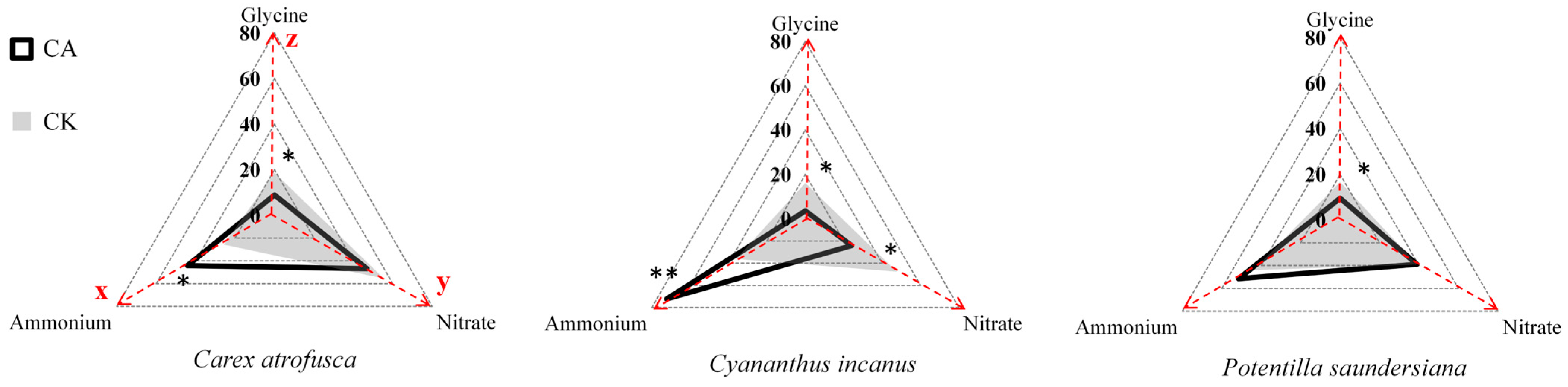
In alpine ecosystems, plant growth is often constrained by multiple environmental factors, especially the infertile soils with lower temperature that decelerate the rate of nutrient turnover, thus leading to a diminished availability of nutrients in the soil, notably nitrogen (N), and its different forms, which is a pivotal factor for limiting plant growth and species coexistence in these alpine areas. Androsace tapete (A. tapete) is an endemic species and the most widely distributed cushion plant on the Qinghai–Tibet Plateau (QTP). Its positive interactions can facilitate other associated plants to deal with severe environmental conditions in the alpine grassland ecosystem. The change in soil nutrient availability is one of the main positive interactions, but little is known about how A. tapete changes soil nutrient availability and affects the N uptake pattern of associated plants. This study investigated the N utilization patterns of three associated plant species —Carex atrofusca (C. atrofusca), Cyananthus incanus (C. incanus), and Potentilla saundersiana (P. saundersiana)— growing inside the cushion area A. tapete (CA) and the ambient grassland without cushion plants (CK), using a 15N labeling method to clarify the effect of A. tapete on the N uptake strategies with NH4+, NO3, and organic N of its associated species. The results showed the following: (1) compared to CK, the soil total C, total N, and available NH4+ contents under the A. tapete showed a significant 47.82%, 40.96%, and 47.33% increase, respectively; (2) A. tapete showed a stronger preference for NH4+ (>80%), whereas the associated species in CK exhibited a more balanced uptake, deriving 39.29–55.59% of N from NO3, 25.72–44.00% from NH4+, and 16.15–18.69% from glycine. (3) The three associated plants possessing A. tapete significantly reduced their uptake of glycine by 9.76%, 12.55%, and 7.15%, respectively, while the absorption of NH4+ by C. atrofusca and C. incanus increased by 18.46% and 36.11%; meanwhile, NO3 uptake decreased by 8.70% in C. atrofusca and 23.55% in C. incanus. These findings indicated that the A. tapete can change the N uptake pattern of the associated plants growing inside the cushion body, such as enhancing the absorption of inorganic N and decreasing the organic N. This adaptive strategy of the associated plants with cushion plant enables them to counteract the N-limited conditions prevalent in alpine environments, and, as a consequence, facilitates their growth and promotes local plant community diversity in the alpine environment.
Keywords: Androsace tapete; facilitation; 15N labeling; N uptake pattern; Qinghai–Tibet Plateau Androsace tapete; facilitation; 15N labeling; N uptake pattern; Qinghai–Tibet Plateau