Article

Spatial Patterns of Childhood Obesity Prevalence in Relation to Socioeconomic Factors across England


1
School of Geography and Planning, Sun Yat-sen University, Guangzhou 510275, China
2
Department of Geography, College of Science, Swansea University, Swansea SA28PP, UK
3
Institute of Data Science, German Aerospace Center (DLR), 07745 Jena, Germany
*
Author to whom correspondence should be addressed.
ISPRS Int. J. Geo-Inf. 2020, 9(10), 599; https://doi.org/10.3390/ijgi9100599
Submission received: 27 August 2020 / Revised: 5 October 2020 / Accepted: 9 October 2020 / Published: 11 October 2020

Abstract

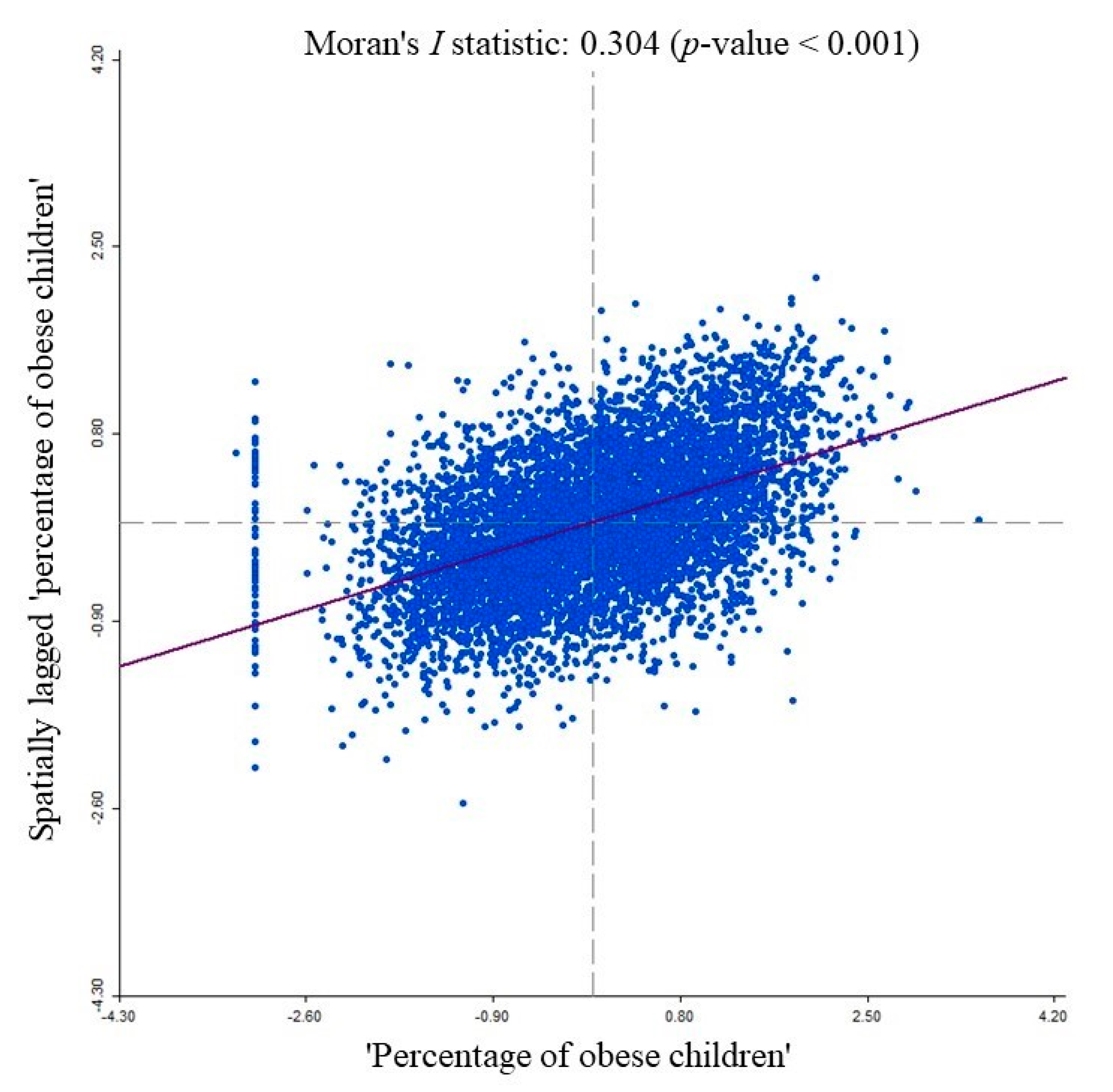
To examine to what extent spatial inequalities in childhood obesity are attributable to spatial inequalities in socioeconomic characteristics across a country, we aimed to investigate the spatial associations of socioeconomic characteristics and childhood obesity. We first explored spatial patterns of childhood obesity prevalence, and subsequently investigated the spatial associations of socioeconomic factors and childhood obesity prevalence across England by selecting and estimating appropriate spatial regression models. As the data used are geospatial data, we used two newly developed specifications of spatial regression models to investigate the spatial association of socioeconomic factors and childhood obesity prevalence. As a result, among the two newly developed specifications of spatial regression models, the fast random effects specification of eigenvector spatial filtering (FRES-ESF) model appears to outperform the matrix exponential spatial specification of spatial autoregressive (MESS-SAR) model. Empirical results indicate that positive spatial dependence is found to exist in childhood obesity prevalence across England; and that socioeconomic factors are significantly associated with childhood obesity prevalence across England. In England, children living in areas with lower socioeconomic status are at higher risk of obesity. This study suggests effectively reducing spatial inequalities in socioeconomic status will plays a vital role in mitigating spatial inequalities in childhood obesity prevalence.
Keywords: childhood obesity; socioeconomic disadvantage; spatial regression model; matrix exponential spatial specification model; eigenvector spatial filtering model childhood obesity; socioeconomic disadvantage; spatial regression model; matrix exponential spatial specification model; eigenvector spatial filtering model