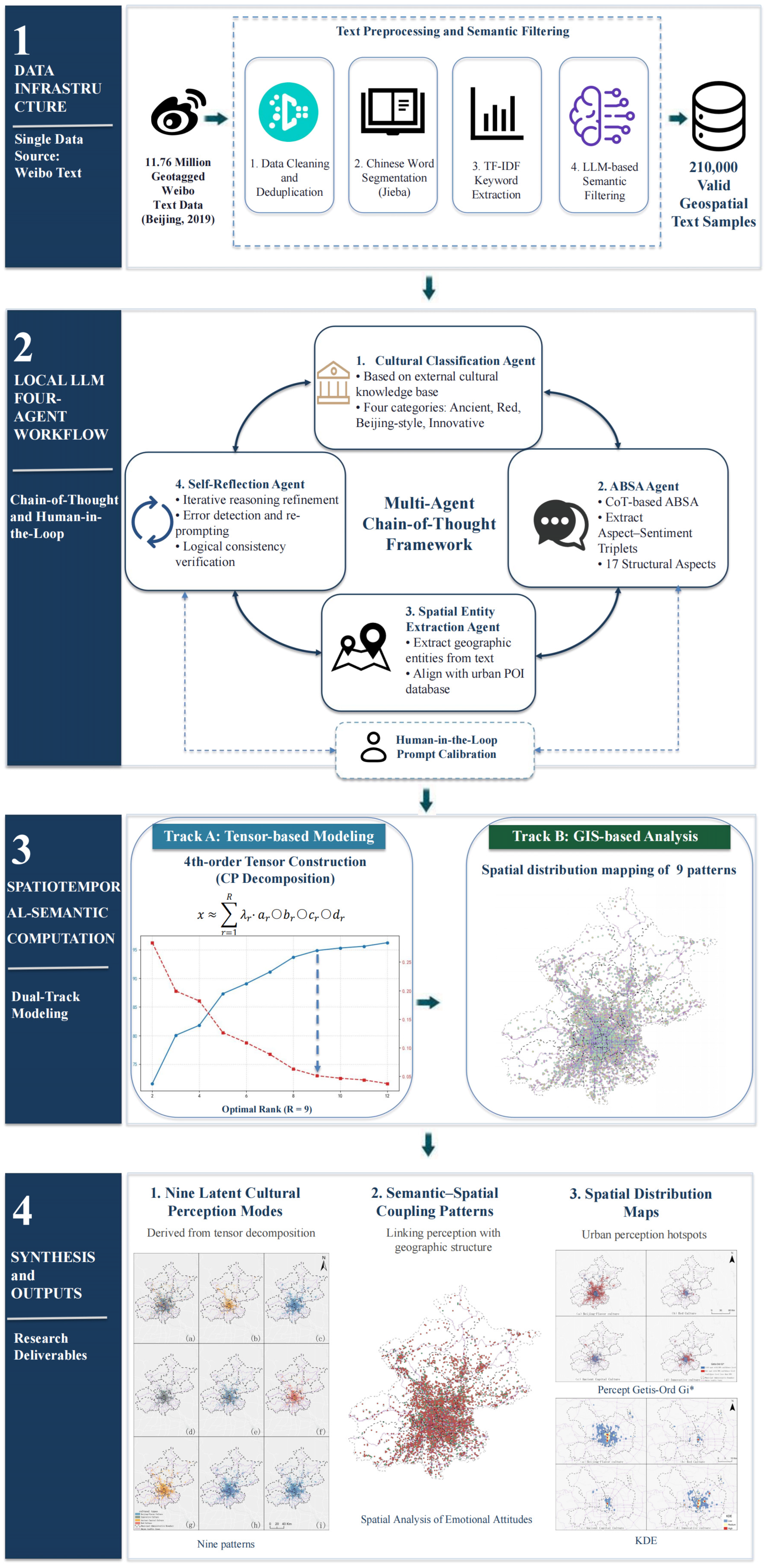




Fine-Grained Cultural Perception and Evaluation of Beijing’s Capital Culture Integrating Large Language Models with Higher-Order Tensor Decomposition


Abstract
1. Introduction
1.1. Research Background and Significance
1.2. Literature Review
1.2.1. Social Media-Based Cultural Perception and Aspect-Level Analysis
1.2.2. LLMs in Aspect-Based Sentiment Analysis
1.3. Research Questions
1.4. Research Content and Innovations
2. Data and Methods
2.1. Study Data
2.2. Research Methods
2.2.1. Agentic Workflow
2.2.2. Local Deployment of Large Language Models
2.2.3. TF-IDF-Based Text Semantic Analysis
2.2.4. Sentiment Score Calculation
2.2.5. Tensor Decomposition
3. Results
3.1. Analysis of Capital Cultural Perception Results
3.1.1. Statistical Analysis of Data Processing Results
3.1.2. Cross-Analysis of Cultural Types and Evaluation Aspects
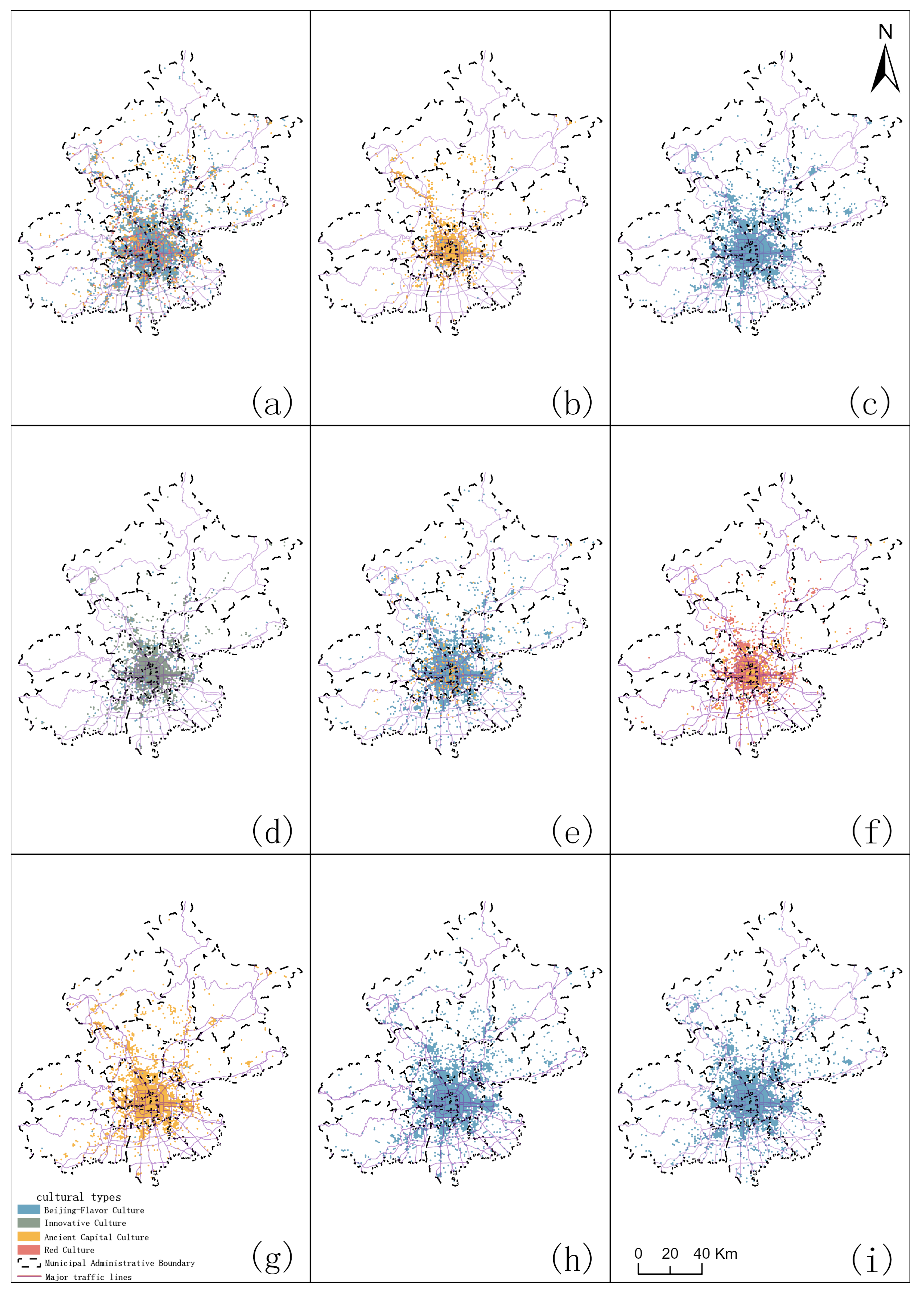
3.1.3. Spatial Distribution Characteristics of Capital Cultural Perception
3.2. Analysis of Capital Cultural Evaluation Results
3.2.1. Multi-Dimensional Perception and Spatial Differentiation Characteristics
3.2.2. Spatial Distribution of Composite Sentiment Scores
3.2.3. Cultural Perception Pattern Recognition and Spatial Representation Based on Tensor Decomposition
3.3. Comprehensive Evaluation and Policy Guidance
4. Discussion
4.1. Key Research Findings
4.2. Methodological Contributions
4.3. Statistical Validation of Tensor Decomposition
4.4. Limitations and Future Prospects
5. Conclusions
Author Contributions
Funding
Data Availability Statement
Conflicts of Interest
Appendix A. Complete Prompt Templates for the LLM-Based Agentic Workflow
Appendix A.1. Cultural Classification Agent
Appendix A.1.1. Ancient Capital Culture—Classification and Carrier Extraction
Appendix A.1.2. Red Culture—Classification and Carrier Extraction
Appendix A.1.3. Beijing-Flavor Culture—Classification and Carrier Extraction
Appendix A.1.4. Innovation Culture—Classification and Carrier Extraction
Appendix A.2. Aspect-Based Sentiment Analysis (ABSA) Agent
Appendix A.3. Spatial Entity Extraction Agent
Appendix A.3.1. Spatial Entity Detection
Appendix A.3.2. Toponymic Normalization/Name Alignment
Appendix A.3.3. Site/Sub-Site Classification and Containment Check
Appendix A.3.4. Ancient Capital Culture Carrier Re-Screening
Appendix A.3.5. Material Cultural Carrier Typology Standardization
Appendix A.4. Self-Correction and Reflection Agent
Appendix A.4.1. Consistency Check and Re-Reasoning Prompt
Appendix A.4.2. Human-in-the-Loop Calibration Mechanism
Appendix B. Operational Definitions of Evaluation Dimensions, Weights by Entropy Weight Method and Algorithm Details

| No. | Evaluation Aspect | Evaluation Dimension | Operational Definition | Typical Trigger Words | Cross-Cultural Applicability |
|---|---|---|---|---|---|
| 1 | Cultural Experience | Cultural Value and Heritage | It refers to the public’s evaluation of the overall experience quality generated by participating in or perceiving cultural activities, venues and projects, which encompasses the sense of acquisition, immersion and satisfaction with cultural contents. | Experience, perception, visit, sightseeing, appreciate, view, experience, impression, atmosphere, immersion | Applicable to all four categories of culture, this is a universal dimension with the highest evaluation frequency. Ancient Capital Culture highlights heritage tour experiences, whereas Innovative Culture lays emphasis on interactive participation experiences, which should be differentiated in light of the context. |
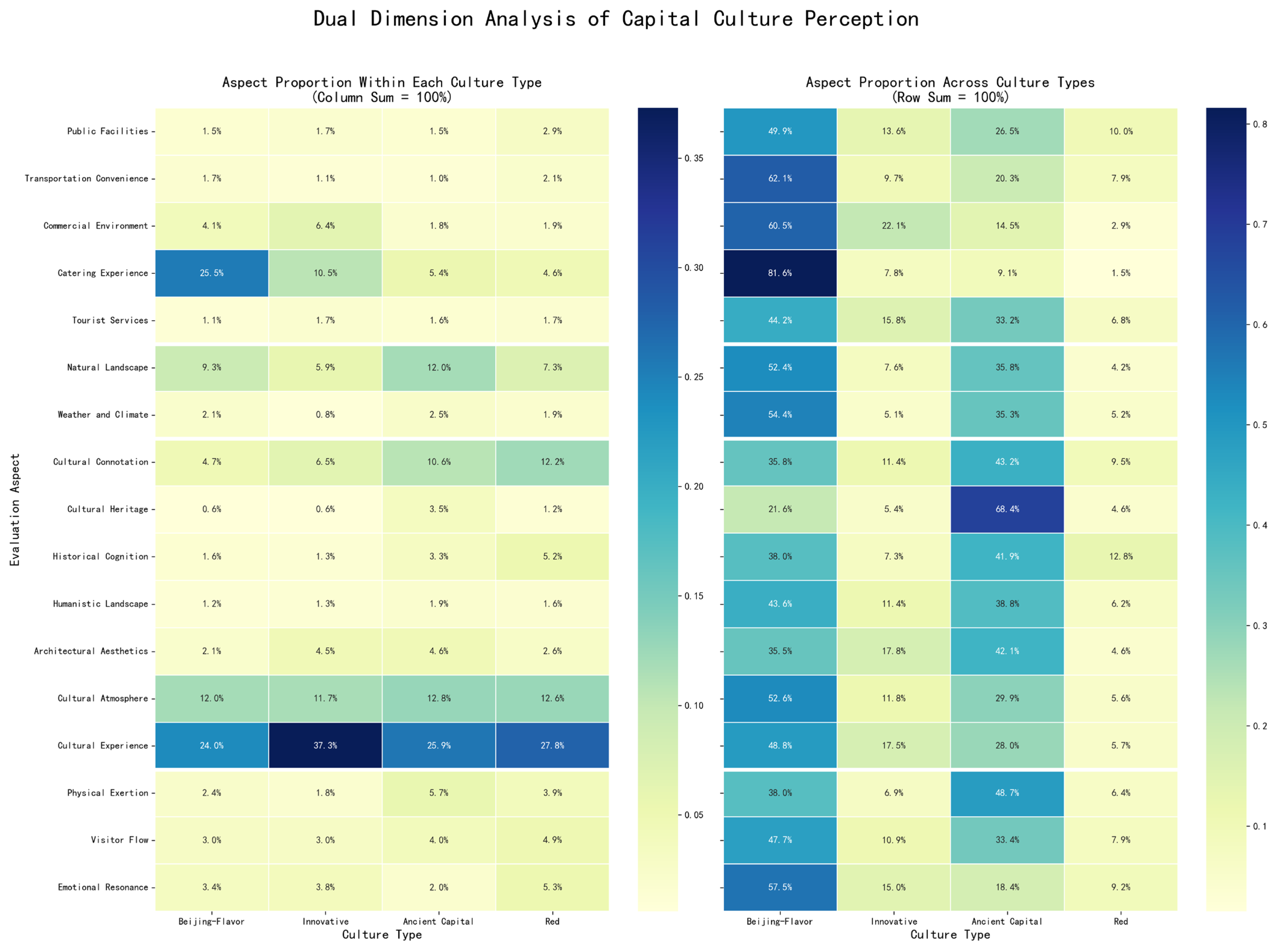
| 2 | Culinary Experience | Service Facilities and Convenience | It represents the public’s perception and evaluation of Beijing’s distinctive cuisines, catering venues and food cultural customs, covering food taste, dining environment, service quality and identification with food culture. | Delicacies, Peking duck, noodles with soy bean paste, Luzhu, Douzhi, restaurants, snacks, time-honored brands, food, delicious, unpalatable | It is mainly concentrated in Beijing-Flavor Culture, accounting for 81.6%, and occasionally appears in Ancient Capital Culture and Innovative Culture. Dialectal food terms such as “Erguotou” and “Baodu” are strong indicators of Beijing-Flavor Culture. |
| 3 | Cultural Atmosphere | Cultural Value and Heritage | It refers to the public’s perception of the overall cultural atmosphere, historical ambience, regional characteristics or contemporary spirit prevailing in specific cultural spaces, highlighting the appeal of the intangible cultural traits and genius loci of the spaces. | Atmosphere, ambience, feeling, charm, heritage, primitive simplicity, sense of history, cultural vibe, style, distinctive appeal | It is distributed across all four types of culture. Ancient Capital Culture leans toward “historical atmosphere”, Red Culture toward “spiritual atmosphere”, and Innovative Culture toward “modern creative atmosphere”. Neutral scores are difficult to attribute, so reference to cultural type labels is required. |
| 4 | Natural Landscape | Natural Landscape and Environment | It refers to the public’s aesthetic perception and evaluation of natural environmental elements inside and around cultural spaces, such as mountains, waters, vegetation and weather, which reflects the contribution of natural ecology to the overall quality of cultural sites. | Scenery, landscape, greening, mountains and rivers, lakes, trees, flowers, mountain scenery of the Great Wall, lake surface of the Summer Palace, natural scenery | It occurs frequently in Ancient Capital Culture (imperial gardens) and Red Culture (mountain landmarks). Descriptions of natural elements shall be distinguished from those of cultural elements, and purely natural descriptions are classified into this category. |
| 5 | Cultural Connotation | Cultural Value and Heritage | It refers to the public’s cognition and evaluation of the spiritual core, historical significance, cultural value and knowledge depth embodied by a certain cultural type, emphasizing the understanding and appreciation of the in-depth implications of cultural objects. | Connotation, spirit, significance, value, cultural heritage, inheritance, historical mission, essence, intrinsic value | It is frequently adopted in Red Culture (ideological connotation) and Ancient Capital Culture (historical civilization connotation). It should not be confused with “cultural experience”, as the former emphasizes cognitive understanding while the latter focuses on experiential feelings. |
| 6 | Commercial Environment | Service Facilities and Convenience | It refers to the public’s evaluation of commercial facilities, consumption environment, business formats and commercialization degree surrounding cultural venues, including negative feedback on the erosion of cultural authenticity caused by excessive commercialization. | Commerce, consumption, shopping, shops, vendors, over-development, scenic commodification, commercialization, souvenir selling | Negative emotions are mostly found in Ancient Capital Culture (commercialization of scenic areas) and Beijing-Flavor Culture (excessive commercialization of traditional blocks), while positive emotions appear in Innovative Culture (modern commercial supporting facilities). |
| 7 | Pedestrian flow | Experience Quality and Comfort | It refers to the public’s perception of pedestrian density in cultural spaces, which mainly reflects the impact of crowding on touring experience, and most related feedback is negative. | Overcrowded, crowded, a sea of people, queuing, congested, dense pedestrian flow, no standing space, full of visitors during holidays | It mainly occurs at popular scenic spots of Ancient Capital Culture such as the Forbidden City and the Great Wall, and occasionally appears in holiday scenarios of Beijing-Flavor Culture. The vast majority of its emotional polarity is negative (over 85%). |
| 8 | Physical Exertion | Experience Quality and Comfort | It refers to the public’s perception of physical strength consumption and fatigue caused by walking distance, climbing height, touring duration and other factors during visits to cultural sites, which is generally correlated with negative emotions. | Tired, long walks, mountain climbing, sore feet, too far, physical strength, exhausted, sore legs, lengthy walking, high physical exertion | It frequently occurs at landmarks of Ancient Capital Culture such as the Great Wall (high physical exertion from climbing), the Palace Museum (large area) and the Summer Palace, and also appears in hutong touring scenarios of Beijing-Flavor Culture. |
| 9 | Emotional Resonance | Experience Quality and Comfort | It refers to the emotional projection, spiritual inspiration and value recognition generated during people’s visits to cultural venues, including in-depth emotional experiences such as patriotism, nostalgic memories and cultural pride. | Moving, stunning, resonance, proud, patriotic, tearful, touched, recollection, patriotism, emotional connection | This dimension accounts for the largest proportion in Red Culture, manifested as patriotic sentiments. It is reflected as regional nostalgia in Beijing-Flavor Culture, and as cultural identity and profound historical sentiment in Ancient Capital Culture. |
| 10 | Architectural Aesthetics | Cultural Value and Heritage | It refers to the public’s aesthetic evaluation of the architectural form, spatial layout, decorative art and visual beauty of cultural venues, emphasizing the artistic value of buildings as cultural carriers. | Architecture, palaces, temples, design, appearance, ancient buildings, carvings, painted decorations, architectural style, magnificent, exquisite | It is mainly reflected in Ancient Capital Culture (imperial architecture) and Red Culture (memorial architecture). The aesthetics of modern architecture can also be found in Innovative Culture, such as the National Centre for the Performing Arts. |
| 11 | Historical Cognition | Cultural Value and Heritage | It refers to the public’s cognitive perception of specific historical events, figures and backgrounds embodied in cultural venues, emphasizing the acquisition and learning of historical knowledge. | History, dynasties, emperors, eras, historical records, ancient times, historical events, the Qing Dynasty, the Ming Dynasty, modern history | This dimension occurs most frequently in Ancient Capital Culture (imperial history) and Red Culture (modern revolutionary history). A distinction should be made between the learning of historical knowledge (this dimension) and historical emotional identification (emotional resonance dimension). |
| 12 | Weather and Climate | Experience Quality and Comfort | It refers to the public’s perception and evaluation of weather conditions (temperature, precipitation, wind and sand, haze, etc.) during visits, reflecting the impact of Beijing’s specific climatic conditions on cultural experiences. | Weather, rain, wind, sandstorm, haze, too hot, too cold, temperature, intense sunlight, cold weather | It exists across all four types of culture and mainly appears at outdoor cultural sites. Sand and dust in spring and high temperature in summer in Beijing are frequent triggers for negative experiences. |
| 13 | Public Facilities | Service Facilities and Convenience | It refers to the public’s evaluation of public infrastructure inside and around cultural venues, including restrooms, lounge areas, signage systems, barrier-free facilities and charging facilities. | Toilets, restrooms, lounge areas, seats, signs, signboards, barrier-free access, facilities, basic supporting amenities | This dimension is reflected in all four types of culture. Negative comments mainly focus on core scenic spots of Ancient Capital Culture due to insufficient restrooms and lounge areas, while public facilities in venues of Innovative Culture receive generally favorable evaluations. |
| 14 | Cultural Heritage | Cultural Value and Heritage | It refers to the public’s perception, evaluation and awareness of inheritance regarding tangible cultural heritage (architecture, cultural relics, historical sites, etc.) and intangible cultural heritage (crafts, folk customs, etc.). | Heritage, cultural relics, historic sites, ruins, world heritage, traditional crafts, intangible cultural heritage, inheritance, historical remains | This dimension is highly concentrated in Ancient Capital Culture, accounting for 68.4%. Different from “cultural connotation”, this dimension focuses more on the perception of physical relics rather than the understanding of the spirits they embody. |
| 15 | Transportation Convenience | Service Facilities and Convenience | It refers to the public’s evaluation of the accessibility (subway, bus, parking, roads) of cultural venues, as well as perceptions of internal traffic organization within scenic areas. | Subway, bus, parking, traffic jam, transportation, accessible, taxi ride, distance, far or not | It appears in all four categories of culture. Negative traffic evaluations are relatively high for suburban cultural sites (e.g., Zhoukoudian, remote sections of the Great Wall); accessibility evaluations for Ancient Capital Culture and Red Culture venues in urban core areas are generally favorable. |
| 16 | Human Landscape | Natural Landscape and Environment | It refers to the public’s overall perception of cultural landscapes shaped jointly by human historical activities and natural environments, such as ancient villages, historical streets, traditional settlements and ancient and famous trees. | Hutongs, ancient streets, ancient villages, lanes and alleys, residential houses, old streets, courtyard layout, humanistic landform, historical texture | It mainly appears in Beijing-Flavor Culture (historical blocks) and Ancient Capital Culture (imperial city texture). As a composite dimension of “architectural aesthetics” and “natural landscape”, it emphasizes the spatial pattern evolved by the interaction between human and nature. |
| 17 | Tourist Services | Service Facilities and Convenience | It refers to the public’s evaluation of the quality of various services provided by cultural venues, including service procedures and quality such as guided tours, ticket management, complaint handling and security management. | Services, tour guides, explanations, staff, ticket sales, ticket checking, service attitude, complaints, management level | This dimension can be found in all four types of culture. Venues of Innovative Culture such as museums and theatres generally receive better service evaluations than traditional scenic spots. A distinction shall be made between “public facilities” (hardware) and “tourist services” (software services). |
| No. | Evaluation Aspect | Actual Frequency ni | Frequency Ratio pi | Information Entropy ei | Differentiation Coefficient di | Weight wi | Evaluation Dimension |
|---|---|---|---|---|---|---|---|
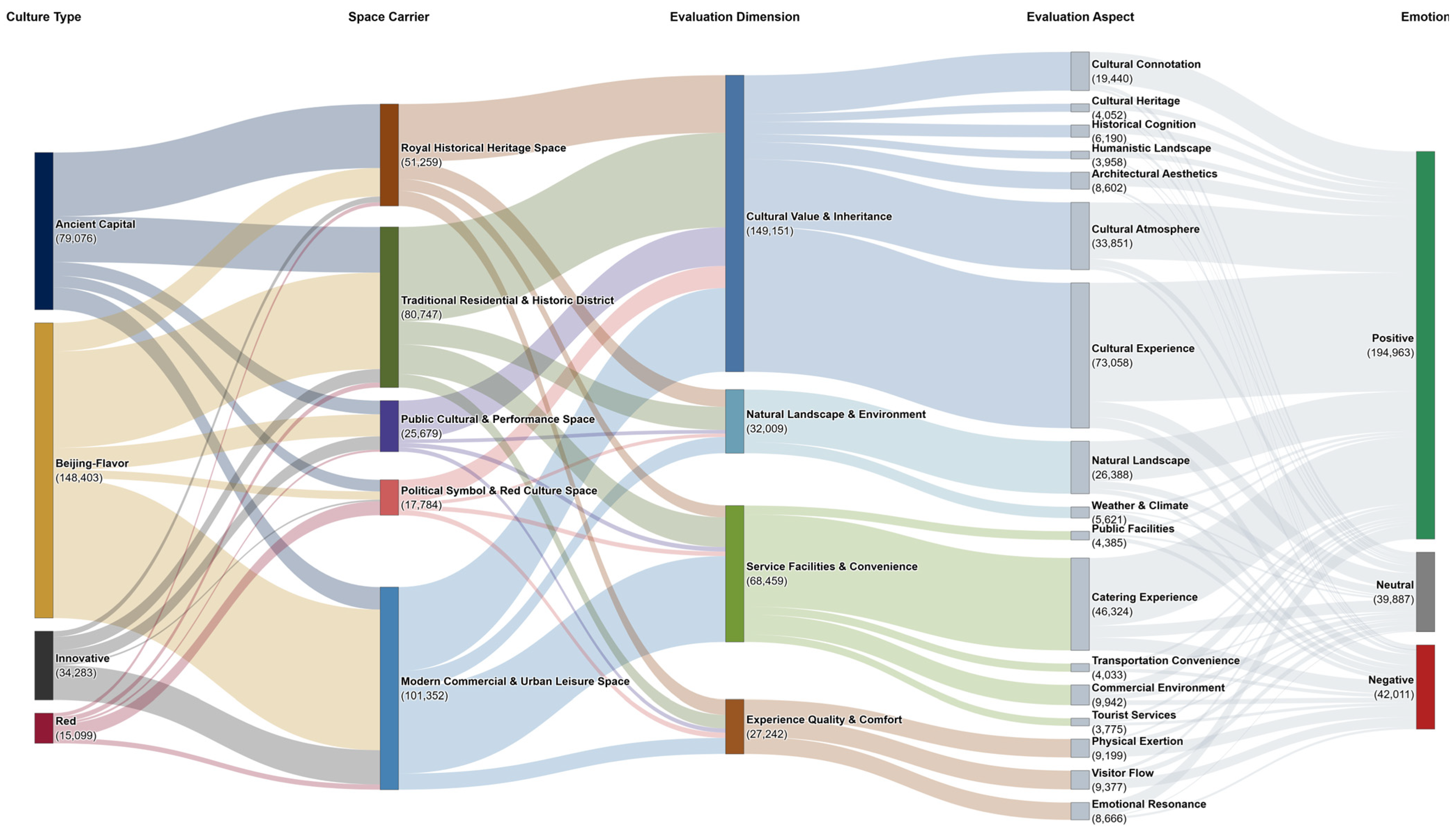
| 1 | Cultural Experience | 73,058 | 26.388% | 0.1241 | 0.8759 | 0.0542 | Cultural Value and Heritage |
| 2 | Culinary Experience | 46,324 | 16.732% | 0.1056 | 0.8944 | 0.0553 | Service Facilities and Convenience |
| 3 | Cultural Atmosphere | 33,851 | 12.227% | 0.0907 | 0.9093 | 0.0562 | Cultural Value and Heritage |
| 4 | Natural Landscape | 26,388 | 9.531% | 0.0791 | 0.9209 | 0.0570 | Natural Landscape and Environment |
| 5 | Cultural Connotation | 19,440 | 7.022% | 0.0658 | 0.9342 | 0.0578 | Cultural Value and Heritage |
| 6 | Commercial Environment | 9942 | 3.591% | 0.0422 | 0.9578 | 0.0592 | Service Facilities and Convenience |
| 7 | Visitor flow | 9377 | 3.387% | 0.0405 | 0.9595 | 0.0593 | Experience Quality and Comfort |
| 8 | Physical Exertion | 9199 | 3.323% | 0.0399 | 0.9601 | 0.0594 | Experience Quality and Comfort |
| 9 | Emotional Resonance | 8666 | 3.130% | 0.0383 | 0.9617 | 0.0595 | Experience Quality and Comfort |
| 10 | Architectural Aesthetics | 8602 | 3.107% | 0.0381 | 0.9619 | 0.0595 | Cultural Value and Heritage |
| 11 | Historical Cognition | 6190 | 2.236% | 0.0300 | 0.9700 | 0.0600 | Cultural Value and Heritage |
| 12 | Weather and Climate | 5621 | 2.030% | 0.0279 | 0.9721 | 0.0601 | Experience Quality and Comfort |
| 13 | Public Facilities | 4385 | 1.584% | 0.0232 | 0.9768 | 0.0604 | Service Facilities and Convenience |
| 14 | Cultural Heritage | 4052 | 1.464% | 0.0218 | 0.9782 | 0.0605 | Cultural Value and Heritage |
| 15 | Transportation Convenience | 4033 | 1.457% | 0.0217 | 0.9783 | 0.0605 | Service Facilities and Convenience |
| 16 | Human Landscape | 3958 | 1.430% | 0.0214 | 0.9786 | 0.0605 | Natural Landscape and Environment |
| 17 | Tourist Services | 3775 | 1.364% | 0.0207 | 0.9793 | 0.0606 | Service Facilities and Convenience |
| total | 276,861 | 100.000% | 1.0000 |
| Parameter Category | Parameter Value | Description |
|---|---|---|
| Tensor Dimensions | 4 × 17 × 3 × 5 | Fourth-order tensor: Cultural Category (four) × Evaluation Aspect (17) × Sentiment Polarity (three) × Spatial Carrier Type (five) |
| Decomposition Method | Non-negative CP decomposition (NN-CP) | Non-negativity constraints are implemented via Multiplicative Update Rules (MUR), ensuring all elements in factor matrices are ≥0 and enhancing result interpretability. |
| Rank R for Decomposition | Rank R = 9 | The rank is determined using the Elbow Method: the reconstruction error decreases significantly when R increases from eight to nine, while the reduction rate plateaus when R ≥ 10. At R = 9, the model achieves an explained variance of 94.87% with optimal robustness. |
| Initialization Strategy | Random non-negative initialization (50 trials) | Factor matrices are initialized with 50 random non-negative initializations, and the initialization with the minimum reconstruction error is selected as the final optimization starting point to effectively avoid local optima. |
| Convergence Criterion | Relative residual decrease < 1 × 10⁻⁶ | Convergence is determined when the relative decrease in reconstruction error between two consecutive iterations is less than 1 × 10⁻⁶; a maximum iteration limit of 500 is set to prevent overfitting. |
| Regularization Method | L2 regularization (λ = 0.001) | L2 regularization is applied to factor matrices to constrain excessive coefficients, with the regularization strength (λ = 0.001) determined via five-fold cross-validation. |
| Numerical Stability Processing | Small offset (ε = 1 × 10⁻¹⁰) | A small positive value ε = 1 × 10⁻¹⁰ is added to the denominator during multiplicative updates to prevent numerical instability caused by division by zero. |
| Sparsity Processing | Zero-filling strategy | Missing values in the tensor (cells with zero frequency for partial cultural category–aspect–polarity–carrier combinations) are filled with zeros instead of mean imputation to preserve sparse structural information. |
| Implementation Tool | Python 3.10 + tensorly 0.8.1 | The implementation relies on the open-source tensor decomposition library TensorLy. A single complete decomposition takes approximately 3.2 min on a high-performance computing server. |
| Comparison Dimension | CP Decomposition (This Study) | LDA Topic Model | NMF Non-Negative Matrix Factorization |
|---|---|---|---|
| Comparison Dimension | It natively supports N-order tensors (4th-order in this study) and models multi-dimensional interactions without dimension reduction. | It only supports two-dimensional document-term matrices. The data of this study has to be flattened into such matrices, which leads to the loss of information about cultural categories and spatial carriers. | It only supports two-dimensional non-negative matrices. Similar to LDA, it requires information compression for high-order data. |
| Data Structure Adaptation | It fully retains the four-dimensional interactive structure: four cultural categories × 17 evaluation aspects × three sentiment polarities × five carriers. Each latent pattern corresponds to an interpretable four-dimensional joint distribution. | It generates two matrices: document-topic distribution and topic-word distribution, and cannot distinguish the independent contributions of sentiment polarity and spatial carriers. | It produces a basis matrix (W) and a coefficient matrix (H), which can only partially approximate high-order structures and thus have limited semantic interpretability. |
| Dimension Fidelity | Equipped with native non-negativity constraint (NN-CP), all elements of factor vectors are non-negative. The results carry clear physical implications and can be interpreted as the intensity of cultural perception patterns. | The Dirichlet prior implicitly ensures non-negative distributions, yet it cannot guarantee the full additivity of factors. | It adopts native non-negativity constraints. The basis matrix can be interpreted as “components”, yet its additive interpretability degrades when handling data with more than four dimensions. |
| Non-negativity Constrain | Sentiment polarity is treated as an independent tensor dimension for joint decomposition, which directly generates coupled patterns of “specific cultural category—evaluation aspect—sentiment polarity”. | Standard LDA fails to identify sentiment polarity. Additional sentiment analysis modules such as the JST model are required, which increases the methodological complexity. | NMF can incorporate polarity information indirectly via feature expansion, but it cannot directly model the joint distribution of polarity and evaluation aspects during decomposition. |
| Spatial Carrier Modeling | Spatial carriers act as the fourth dimension in tensor decomposition, enabling the identification of perception patterns linked to specific carrier types (e.g., perception oriented to imperial heritage). | Spatial information is imported indirectly through metadata and cannot be natively modeled within the topic decomposition framework. | Data processing relies on matrix expansion, such as appending spatial labels to matrix rows, resulting in limited spatial interpretability of decomposition outputs. |
| Interpretability | Each rank-one component can be directly defined as a cultural perception pattern, which corresponds to specific preferences for cultural categories, combinations of evaluation aspects, sentiment tendencies and carrier types. | The topic-word probability distribution is highly interpretable, whereas multi-dimensional coupling relationships need to be inferred via post-processing. | The local features of the basis matrix are highly interpretable, but data compression undermines its performance in this multi-dimensional research context. |
| Computational Complexity | Its computational complexity is . A single decomposition takes about 3.2 min with GPU acceleration based on the dataset of this study. | It has a computational complexity of . Despite fast convergence, it cannot model multi-dimensional structures. | It has a computational complexity of and achieves high efficiency, but is restricted to two-dimensional structures. |
| Basis for Method Selection | Given the need to preserve the integrity of the fourth-order data structure and jointly model sentiment polarity as well as spatial carriers in this research, CP decomposition presents unique methodological advantages. | It is applicable to topic detection for large-scale unlabeled texts, but not for scenarios with a standardized evaluation aspect system and the demand for multi-dimensional joint modeling. | It is suitable for local feature extraction from two-dimensional feature matrices, rather than multi-dimensional semantic coupling analysis. |
| Evaluation Aspect | Sample Size | Accuracy | Precision | Recall | F1-Score | Cohen’s κ | Quality Grade |
|---|---|---|---|---|---|---|---|
| Cultural Experience | 435 | 0.8736 | 0.6974 | 0.8851 | 0.7616 | 0.6385 | Good (0.60–0.80) |
| Culinary Experience | 312 | 0.8718 | 0.7660 | 0.8619 | 0.8046 | 0.7239 | Good (0.60–0.80) |
| Cultural Atmosphere | 274 | 0.8796 | 0.7092 | 0.8891 | 0.7612 | 0.6564 | Good (0.60–0.80) |
| Natural Landscape | 250 | 0.8680 | 0.7396 | 0.8425 | 0.7797 | 0.6872 | Good (0.60–0.80) |
| Cultural Connotation | 173 | 0.8497 | 0.6728 | 0.8779 | 0.7218 | 0.6259 | Good (0.60–0.80) |
| Commercial Environment | 71 | 0.8028 | 0.7881 | 0.8005 | 0.7929 | 0.6942 | Good (0.60–0.80) |
| Visitor Flow | 67 | 0.7910 | 0.7856 | 0.7978 | 0.7912 | 0.6695 | Good (0.60–0.80) |
| Physical Exertion | 66 | 0.9091 | 0.8873 | 0.9346 | 0.9080 | 0.8388 | Excellent (>0.80) |
| Emotional Resonance | 62 | 0.8387 | 0.6896 | 0.8014 | 0.7323 | 0.6187 | Good (0.60–0.80) |
| Architectural Aesthetics | 62 | 0.8710 | 0.6597 | 0.9012 | 0.7377 | 0.5811 | Fair (0.40–0.60) |
| Historical Cognition | 44 | 0.8182 | 0.7417 | 0.7940 | 0.7515 | 0.6771 | Good (0.60–0.80) |
| Weather and Climate | 40 | 0.8000 | 0.6417 | 0.8395 | 0.6383 | 0.6126 | Good (0.60–0.80) |
| Public Facilities | 31 | 0.9355 | 0.9407 | 0.9407 | 0.9407 | 0.8977 | Excellent (>0.80) |
| Cultural Heritage | 29 | 0.7241 | 0.8004 | 0.6549 | 0.6993 | 0.4727 | Fair (0.40–0.60) |
| Transportation Convenience | 29 | 0.8966 | 0.8704 | 0.9412 | 0.8958 | 0.8294 | Excellent (>0.80) |
| Human Landscape | 28 | 0.7857 | 0.5529 | 0.5079 | 0.5287 | 0.5294 | Fair (0.40–0.60) |
| Tourist Services | 27 | 0.9259 | 0.9148 | 0.9148 | 0.9074 | 0.8521 | Excellent (>0.80) |
| Total/Weighted Mean | 2000 | 0.8495 | 0.7563 | 0.8344 | 0.7737 | 0.6827 | Weighted Mean |
Appendix C. Marginal Frequency Dissolution and Stability Analysis Results
| Component | Description | Sum of Squares | Proportion |
|---|---|---|---|
| Marginal Frequencies (Independence Model) | Variance explained by the outer product of four marginal probability distributions: | 714,284,453.05 | 65.5% |
| Multi-way Interaction Residual | Variance arising exclusively from higher-order interactions among cultural type, evaluation aspect, sentiment polarity, and spatial carrier: | 376,512,737.95 | 34.5% |
| Total | Total sum of squares of the observed fourth-order count tensor (4 × 17 × 3 × 5 = 1020 cells) | 1,090,797,191.00 | 100.0% |
| Statistic | Value | Interpretation |
|---|---|---|
| Total observations (N) | 276,821 | Number of valid geotagged social media posts |
| Tensor dimensions | 4 × 17 × 3 × 5 | Cultural Type × Evaluation Aspect × Sentiment Polarity × Spatial Carrier |
| Non-zero cell proportion | 99.6% | 1016 of 1020 cells are non-zero |
| Independence model fit | 41.25% | Frobenius-norm fit of T_indep to T_observed |
| Pearson χ2 | 386,326 | df = 994, p < 0.001 |
| Likelihood-ratio G2 | 211,872 | df = 994, p < 0.001 |
| Cramér’s V | 0.8353 | Large effect size (V > 0.50) |
| (a) | |||
| Metric | Original Tensor | Residual Tensor | |
| Best Fit (%) | 95.73 | 93.04 | |
| Mean Fit (%) | 93.21 | 92.66 | |
| Std (%) | 1.90 | 0.31 | |
| Coefficient of Variation (%) | 2.04 | 0.33 | |
| Stability FMS (mean ± std) | 0.666 ± 0.092 | 0.706 ± 0.084 | |
| (b) | |||
| Original CP Factor | Matched Residual CP Factor | FMS | Corresponding Pattern |
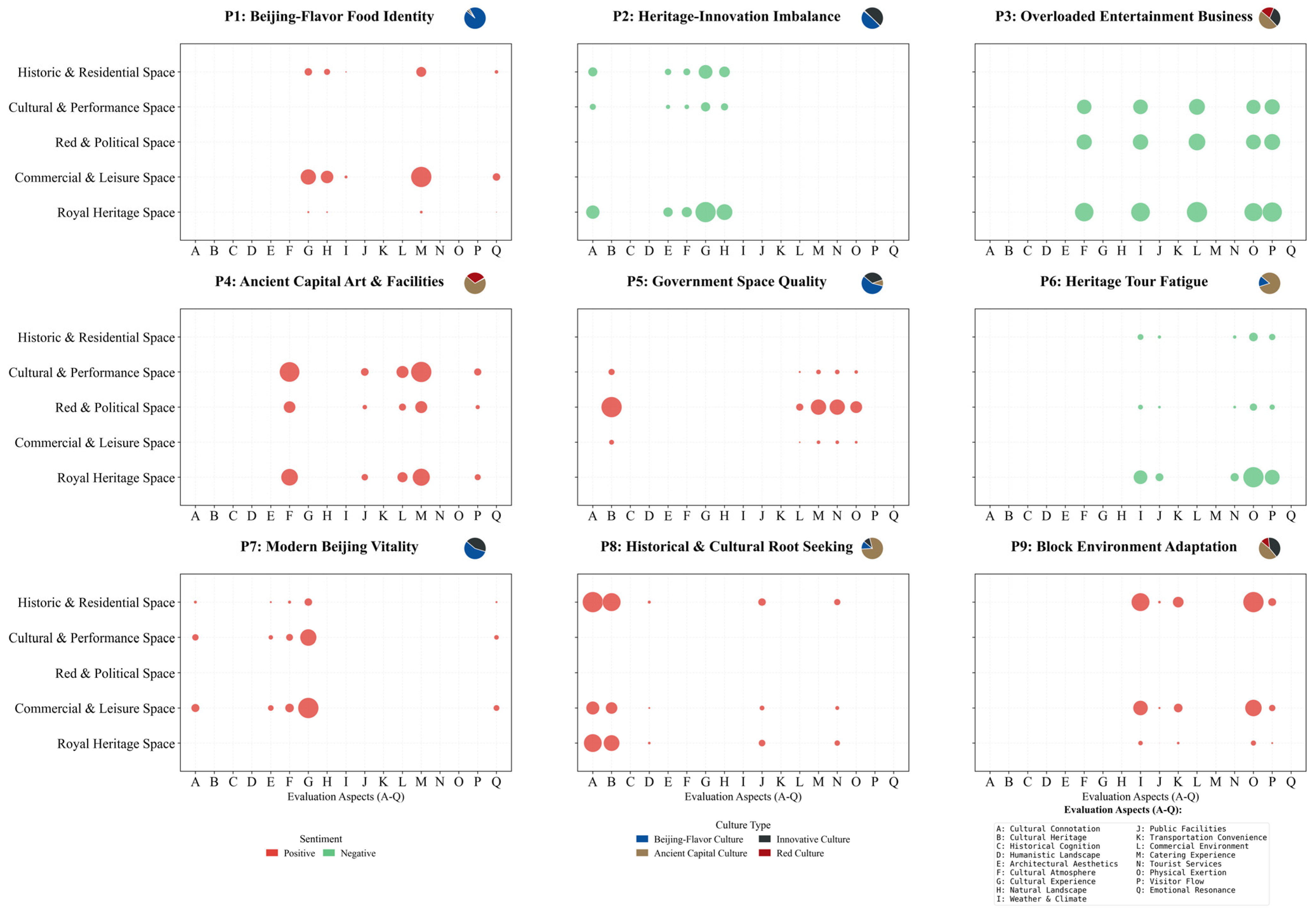
| Factor 1 | Factor 9 | 0.985 | Pattern 1: Beijing-Flavor Culinary Identification |
| Factor 2 | Factor 6 | 0.081 | — |
| Factor 3 | Factor 2 | 0.905 | Pattern 3: Performance–Commercial Overload |
| Factor 4 | Factor 5 | 0.274 | — |
| Factor 5 | Factor 1 | 0.631 | — |
| Factor 6 | Factor 8 | 0.790 | — |
| Factor 7 | Factor 4 | 0.498 | — |
| Factor 8 | Factor 3 | 0.987 | Pattern 8: Historical–Cultural Root-Seeking |
| Factor 9 | Factor 7 | 0.283 | — |
| Mean FMS | — | 0.604 | — |
| Rank R | Original Tensor Fit (%) | Residual Tensor Fit (%) | Δ Fit (Orig. − Resid.) | Incremental Gain (Original) |
|---|---|---|---|---|
| 3 | 80.26 | 66.12 | 14.14 | — |
| 5 | 82.47 | 78.70 | 3.77 | +2.21 |
| 7 | 91.71 | 84.88 | 6.83 | +9.24 |
| 9 | 94.32 | 91.02 | 3.30 | +2.61 |
| 11 | 96.39 | 94.95 | 1.44 | +2.07 |
| 13 | 96.30 | 95.38 | 0.92 | −0.09 |
| 15 | 95.19 | 96.43 | −1.24 | −1.11 |
References
- Communist Party of China Beijing Municipal Committee. Opinions of the CPC Beijing Municipal Committee on Flourishing and Developing Capital Culture in the New Era. Beijing Daily, 10 April 2020; p. 4.
- Li, J.G.; Tang, Y.; Yao, L.C.; Zhang, W.; Fang, W. Research and application of perception technology in social networks. Comput. Sci. 2009, 36, 114–118. [Google Scholar]
- Wang, J.; Meng, B.; Zhang, J.Q.; Li, C.; Zou, B.X. Application and prospect of sensing technology in cultural heritage research. Prog. Geogr. 2017, 36, 1092–1098. [Google Scholar] [CrossRef][Green Version]
- Liu, Y.; Liu, X.; Gao, S.; Gong, L.; Kang, C.; Zhi, Y.; Chi, G.; Shi, L. Social sensing: A new approach to understanding our socioeconomic environments. Ann. Assoc. Am. Geogr. 2015, 105, 512–530. [Google Scholar] [CrossRef]
- Hu, S.; Gu, J.; Liu, H.; Huang, Q. The moderating role of social media usage in the relationship among multicultural experiences, cultural intelligence, and individual creativity. Inform. Technol. People 2017, 30, 264–281. [Google Scholar] [CrossRef]
- Malekzadeh, M.; Willberg, E.; Torkko, J.; Toivonen, T. Urban attractiveness according to ChatGPT: Contrasting AI and human insights. Comput. Environ. Urban Syst. 2025, 117, 102243. [Google Scholar] [CrossRef]
- Azgomi, H.; Shahrestani, M.R. A review of efficient approaches for sentiment analysis and opinion mining. Multimed. Tools Appl. 2026, 85, 127. [Google Scholar] [CrossRef]
- Zhang, W.; Li, X.; Deng, Y.; Bing, L.; Lam, W. A survey on aspect-based sentiment analysis: Tasks, methods, and challenges. IEEE Trans. Knowl. Data Eng. 2022, 35, 11019–11038. [Google Scholar]
- Wang, H.S.; Li, J.Z.; Zeng, B.Q. A review of research on text aspect-level sentiment analysis methods. Softw. Guide 2023, 22, 1–8. [Google Scholar] [CrossRef]
- Hu, M.; Liu, B. Mining and summarizing customer reviews. In Proceedings of the Tenth ACM SIGKDD International Conference on Knowledge Discovery and Data Mining, Seattle, WA, USA, 22–25 August 2004; pp. 168–177. [Google Scholar]
- Poria, S.; Cambria, E.; Gelbukh, A. Aspect Extraction for Opinion Mining with a Deep Convolutional Neural Network. Knowl.-Based Syst. 2016, 108, 42–49. [Google Scholar] [CrossRef]
- Ki, D.; Lee, H.; Park, K.; Ha, J.; Lee, S. Measuring nuanced walkability: Leveraging ChatGPT’s vision reasoning with multisource spatial data. Comput. Environ. Urban Syst. 2025, 121, 102319. [Google Scholar] [CrossRef]
- Alam, M.H.; Ryu, W.J.; Lee, S.K. Joint multi-grain topic sentiment: Modeling semantic aspects for online reviews. Inf. Sci. 2016, 339, 206–223. [Google Scholar] [CrossRef]
- Garcia-Pablos, A.; Cuadros, M.; Rigau, G. W2VLDA: Almost Unsupervised System for Aspect Based Sentiment Analysis. Expert Syst. Appl. 2018, 91, 127–137. [Google Scholar] [CrossRef]
- Hussain, A.; Samant, S.; Singh, A.; Chhabra, R.; Arora, V.; Kapoor, A. Aspect-based sentiment analysis (ABSA): A review of techniques and applications. In Proceedings of the 2025 1st IEEE Uttar Pradesh Section Women in Engineering International Conference on Electrical, Electronics and Computer Engineering (UPWIECON), Roorkee, India, 30–31 October 2025; pp. 148–153. [Google Scholar]
- Brun, C.; Perez, J.; Roux, C. XRCE at SemEval-2016 Task 5: Feedbacked ensemble modeling on syntactico-semantic knowledge for aspect based sentiment analysis. In Proceedings of the 10th International Workshop on Semantic Evaluation (SemEval-2016), San Diego, CA, USA, 16–17 June 2016; pp. 277–281. [Google Scholar]
- San Vicente, I.; Saralegi, X.; Agerri, R. Elixa: A modular and flexible ABSA platform. In Proceedings of the 9th International Workshop on Semantic Evaluation (SemEval-2015), Denver, CO, USA, 4–5 June 2015; pp. 748–752. [Google Scholar]
- Zhu, L.; Xu, M.; Bao, Y.; Xu, Y.; Kong, X. Deep learning for aspect-based sentiment analysis: A review. PeerJ Comput. Sci. 2022, 8, e1044. [Google Scholar] [CrossRef] [PubMed]
- Toh, Z.; Su, J. NLANGP at SemEval-2016 Task 5: Improving Aspect Based Sentiment Analysis Using Neural Network Features. In Proceedings of the 10th International Workshop on Semantic Evaluation (SemEval-2016), San Diego, CA, USA, 16–17 June 2016; pp. 282–288. [Google Scholar]
- Du, H.; Xu, X.K.; Cheng, X.Q.; Wu, D.; Liu, Y.; Yu, Z. Aspect-specific sentimental word embedding for sentiment analysis of online reviews. In Proceedings of the 25th International Conference Companion on World Wide Web (WWW Companion), Montreal, QC, Canada, 11–15 April 2016; pp. 29–30. [Google Scholar]
- He, Z.H. Aspect-level sentiment analysis based on aspect semantics and gated filtering network. Comput. Sci. 2023, 50, 193–200. [Google Scholar]
- Li, Y.C.; Wang, F.; Zhong, S.H. A more fine-grained aspect-sentiment-opinion triplet extraction task. Mathematics 2023, 11, 3165. [Google Scholar] [CrossRef]
- Berragan, C.; Singleton, A.; Calafiore, A.; Morley, J. Mapping Great Britain’s semantic footprints through a large language model analysis of Reddit comments. Comput. Environ. Urban Syst. 2024, 110, 102121. [Google Scholar] [CrossRef]
- Zhang, J.; Li, Y. Urban safety perception assessments via integrating multimodal large language models with street view images. Cities 2025, 165, 106122. [Google Scholar] [CrossRef]
- Chen, S.W.; Wang, Y.; Liu, J.; Wang, Y. Bidirectional Machine Reading Comprehension for Aspect Sentiment Triplet Extraction. In Proceedings of the AAAI Conference on Artificial Intelligence, Online, 2–9 February 2021; pp. 12666–12674. [Google Scholar]
- Zhao, A.P.; Yu, Y. Knowledge-Enabled BERT for Aspect-Based Sentiment Analysis. Knowl.-Based Syst. 2021, 227, 107220. [Google Scholar] [CrossRef]
- Van de Weghe, N.; De Sloover, L.; Cohn, A.G.; Huang, H.; Scheider, S.; Sieber, R.; Timpf, S.; Claramunt, C. Opportunities and challenges of integrating geographic information science and large language models. J. Spat. Inf. Sci. 2025, 30, 93–116. [Google Scholar] [CrossRef]
- Brown, T.; Mann, B.; Ryder, N.; Subbiah, M.; Kaplan, J.D.; Dhariwal, P.; Neelakantan, A.; Shyam, P.; Sastry, G.; Askell, A.; et al. Language Models Are Few-Shot Learners. Adv. Neural Inf. Process. Syst. 2020, 33, 1877–1901. [Google Scholar]
- Lu, K.; Zhao, X.; Li, M.; Wang, Z.; Zhou, Y.; Wang, J. StreetSenser: A novel approach to sensing street view via a fine-tuned multimodal large language model. Int. J. Geogr. Inf. Sci. 2025, 40, 1547–1575. [Google Scholar] [CrossRef]
- Wang, S.; Hu, T.; Xiao, H.; Li, Y.; Zhang, C.; Ning, H.; Zhu, R.; Li, Z.; Ye, X. GPT, LLMs and GAI models in geospatial science: A systematic review. Int. J. Digit. Earth 2024, 17, 2353122. [Google Scholar] [CrossRef]
- Lewis, P.; Perez, E.; Piktus, A.; Petroni, F.; Karpukhin, V.; Goyal, N.; Küttler, H.; Lewis, M.; Yih, W.T.; Rocktäschel, T.; et al. Retrieval-Augmented Generation for Knowledge-Intensive NLP Tasks. Adv. Neural Inf. Process. Syst. 2020, 33, 9459–9474. [Google Scholar]
- Zhu, H.; Tan, Y.W.; Wei, W.T. Research on few-shot aspect-level sentiment analysis based on fine-tuning of large language models. Mod. Inform. 2025, 45, 3–13. [Google Scholar]
- Wu, T.; Cao, C.P. Aspect-based sentiment analysis model of long short-term memory fusing position weight based on attention and cross-attention. J. Comput. Appl. 2019, 39, 2198–2203. [Google Scholar]
- Zhong, W.; Shao, T.; Wang, L.; Guo, J. Research on street space perception evaluation and semantic mining methods driven by large language models. J. Geo-Inf. Sci. 2026, 28, 605–622. [Google Scholar]
- Wei, J.; Wang, X.; Schuurmans, D.; Bosma, M.; Ichter, B.; Xia, F.; Chi, E.; Le, Q.V.; Zhou, D. Chain-of-Thought Prompting Elicits Reasoning in Large Language Models. Adv. Neural Inf. Process. Syst. 2022, 35, 24824–24837. [Google Scholar] [CrossRef]
- Wang, D.Q.; Lu, F.; Zhang, B.H.; Li, D.; Peng, J.; Wang, B.; Yao, F.; Ai, S. A review of prompt engineering in large language models. Comput. Syst. Appl. 2025, 34, 1–10. [Google Scholar] [CrossRef]
- Wu, H.Y.; Shen, Z.X.; Hou, S.Y.; Liang, J.Y.; Zhao, A.Q.; Jiao, H.Y.; Gui, Z.P.; Guan, X.F. Large language model driven GIS analysis: Methods, applications and prospects. Acta Geod. Cartogr. Sin. 2025, 54, 621–635. [Google Scholar]
- Li, Z.; Ning, H.; Gao, S.; Janowicz, K.; Li, W.; Arundel, S.T.; Yang, C.; Bhaduri, B.; Wang, S.; Zhu, A.-X.; et al. GIScience in the era of artificial intelligence: A research agenda towards autonomous GIS. Ann. GIS 2025, 31, 501–536. [Google Scholar] [CrossRef]
- Hou, C.; Zhang, F.; Li, Y.; Li, H.; Mai, G.; Kang, Y.; Yao, L.; Yu, W.; Yao, Y.; Gao, S.; et al. Urban sensing in the era of large language models. Innov. 2025, 6, 100749. [Google Scholar] [CrossRef] [PubMed]
- Kang, Y.; Zhang, F.; Gao, S.; Lin, H.; Liu, Y. A review of urban physical environment sensing using street view imagery in public health studies. Ann. GIS 2020, 26, 261–275. [Google Scholar] [CrossRef]
- Li, L.; Hu, S.; Dai, Y.; Deng, M.; Momeni, P.; Laverghetta, G.; Fan, L.; Ma, Z.; Wang, X.; Ma, S.; et al. Toward satisfactory public accessibility: A crowdsourcing approach through online reviews to inclusive urban design. Comput. Environ. Urban Syst. 2025, 122, 102329. [Google Scholar] [CrossRef]
- Sherman, Z.; Sharma Dulal, S.; Cho, J.H.; Zhang, M.; Kim, J. Generative AI for geospatial analysis: Fine-tuning ChatGPT to convert natural language into Python-based geospatial computations. ISPRS Int. J. Geo-Inf. 2025, 14, 314. [Google Scholar] [CrossRef]
- Xu, P.; Li, X.; Hui, Y.; Zhang, G. Research and Implementation of Chinese Text Classification Related Algorithms. J. Jilin Univ. (Sci. Ed.) 2009, 47, 516–520. [Google Scholar]
- Gugulica, M.; Burghardt, D. Mapping Indicators of Cultural Ecosystem Services Use in Urban Green Spaces Based on Text Classification of Geosocial Media Data. Ecosyst. Serv. 2023, 60, 101508. [Google Scholar] [CrossRef]
- Ji, H.; Wang, J.; Meng, B.; Cao, Z.; Yang, T.; Zhi, G.; Chen, S.; Wang, S.; Zhang, J. Research on Adaptation to Air Pollution in Chinese Cities: Evidence from Social Media-based Health Sensing. Environ. Res. 2022, 210, 112762. [Google Scholar] [CrossRef] [PubMed]
- Peng, X.; Li, Y.; Si, Y.; Xu, L.; Liu, X.; Li, D.; Liu, Y. A Social Sensing Approach for Everyday Urban Problem-Handling with the 12345-Complaint Hotline Data. Comput. Environ. Urban Syst. 2022, 94, 101790. [Google Scholar] [CrossRef]
- Oh, H.; Fiore, A.M.; Jeoung, M. Measuring experience economy concepts: Tourism applications. J. Travel Res. 2007, 46, 119–132. [Google Scholar] [CrossRef]
- Kim, J.H.; Ritchie, J.R.B.; McCormick, B. Development of a scale to measure memorable tourism experiences. J. Travel Res. 2012, 51, 12–25. [Google Scholar] [CrossRef]
- Tung, V.W.S.; Ritchie, J.R.B. Exploring the essence of memorable tourism experiences. Ann. Tour. Res. 2011, 38, 1367–1386. [Google Scholar] [CrossRef]
- Sthapit, E.; Coudounaris, D.N. Memorable tourism experiences: Antecedents and outcomes. Scand. J. Hosp. Tour. 2018, 18, 72–94. [Google Scholar] [CrossRef]
- Norberg-Schulz, C. Genius Loci: Towards a Phenomenology of Architecture, 1st ed.; Rizzoli: New York, NY, USA, 1980; pp. 1–150. [Google Scholar]
- Tuan, Y.F. Space and Place: The Perspective of Experience, 1st ed.; University of Minnesota Press: Minneapolis, MN, USA, 1977; pp. 1–200. [Google Scholar]
- Relph, E. Place and Placelessness, 1st ed.; Pion: London, UK, 1976; pp. 1–180. [Google Scholar]
- Cohen, E. Authenticity and commoditization in tourism. Ann. Tour. Res. 1988, 15, 371–386. [Google Scholar] [CrossRef]
- Poria, Y.; Butler, R.; Airey, D. The core of heritage tourism. Ann. Tour. Res. 2003, 30, 237–254. [Google Scholar] [CrossRef]
- Throsby, D. Economics and Culture, 1st ed.; Cambridge University Press: Cambridge, UK, 2001; pp. 1–180. [Google Scholar]
- Kaplan, R.; Kaplan, S. The Experience of Nature: A Psychological Perspective, 1st ed.; Cambridge University Press: Cambridge, UK, 1989; pp. 1–200. [Google Scholar]
- Lew, A.A. A framework of tourist attraction research. Ann. Tour. Res. 1987, 14, 554–575. [Google Scholar] [CrossRef]
- Beerli, A.; Martín, J.D. Factors influencing destination image. Ann. Tour. Res. 2004, 31, 657–681. [Google Scholar] [CrossRef]
- Ashworth, G.J.; Tunbridge, J.E. The Tourist-Historic City: Retrospect and Prospect of Managing the Heritage City, 1st ed.; Pergamon/Elsevier: Amsterdam, The Netherlands, 2000; pp. 1–250. [Google Scholar]
- Apostolakis, A. The convergence process in heritage tourism. Ann. Tour. Res. 2003, 30, 795–812. [Google Scholar] [CrossRef]
- Lowenthal, D. The Past Is a Foreign Country, 1st ed.; Cambridge University Press: Cambridge, UK, 1985; pp. 1–300. [Google Scholar]
- Timothy, D.J.; Boyd, S.W. Heritage Tourism, 1st ed.; Pearson Education: London, UK, 2003; pp. 1–200. [Google Scholar]
- Poria, Y.; Reichel, A.; Biran, A. Heritage site management: Motivations and expectations. Ann. Tour. Res. 2006, 33, 162–178. [Google Scholar]
- Swanson, K.K.; Horridge, P.E. Travel motivations as souvenir purchase indicators. Tour. Manag. 2006, 27, 671–683. [Google Scholar] [CrossRef]
- Marrocu, E.; Paci, R. Different tourists to different destinations: Evidence from spatial interaction models. Tour. Manag. 2011, 32, 312–324. [Google Scholar]
- Chang, R.C.Y.; Kivela, J.; Mak, A.H.N. Attributes that influence the evaluation of travel dining experience: When East meets West. Tour. Manag. 2011, 32, 307–316. [Google Scholar] [CrossRef]
- Kivela, J.; Crotts, J.C. Tourism and gastronomy: Gastronomy’s influence on how tourists experience a destination. J. Hosp. Tour. Res. 2006, 30, 354–377. [Google Scholar] [CrossRef]
- Okumus, B. Food tourism research: A perspective article. Tour. Rev. 2021, 76, 38–42. [Google Scholar] [CrossRef]
- Bi, J.W.; Liu, Y.; Fan, Z.P.; Zhang, J. Wisdom of crowds: Conducting importance-performance analysis (IPA) through online reviews. Tour. Manag. 2020, 81, 104135. [Google Scholar] [CrossRef]
- Assiouras, I.; Skourtis, G.; Giannopoulos, A.; Buhalis, D.; Koniordos, M. Value co-creation and customer citizenship behaviour. Tour. Manag. 2019, 72, 131–141. [Google Scholar]
- Yoon, Y.; Uysal, M. An examination of the effects of motivation and satisfaction on destination loyalty: A structural model. Tour. Manag. 2005, 26, 45–56. [Google Scholar] [CrossRef]
- Parasuraman, A.; Zeithaml, V.A.; Berry, L.L. SERVQUAL: A multiple-item scale for measuring consumer perceptions of service quality. J. Retail. 1988, 64, 12–40. [Google Scholar]
- Brady, M.K.; Cronin, J.J., Jr. Some new thoughts on conceptualizing perceived service quality: A hierarchical approach. J. Mark. 2001, 65, 34–49. [Google Scholar] [CrossRef]
- Khadaroo, J.; Seetanah, B. Transport infrastructure and tourism development. Ann. Tour. Res. 2007, 34, 1021–1032. [Google Scholar] [CrossRef]
- Khadaroo, J.; Seetanah, B. The role of transport infrastructure in international tourism development: A gravity model approach. Tour. Manag. 2008, 29, 831–840. [Google Scholar] [CrossRef]
- Ballantyne, R.; Packer, J.; Hughes, K. Tourists’ support for conservation messages and sustainable management practices in wildlife tourism experiences. Tour. Manag. 2009, 30, 658–664. [Google Scholar] [CrossRef]
- Seraphin, H.; Sheeran, P.; Pilato, M. Over-tourism and the fall of Venice as a destination. J. Destin. Mark. Manag. 2018, 9, 374–376. [Google Scholar] [CrossRef]
- Neuts, B.; Nijkamp, P. Tourist crowding perception and acceptability in city tourism: An applied modelling study on Bruges. Tour. Manag. 2012, 33, 1473–1481. [Google Scholar]
- Arnberger, A.; Haider, W. Would you displace? A multivariate conceptual framework for understanding visitor displacement. Tour. Manag. 2007, 28, 1552–1561. [Google Scholar]
- Prayag, G.; Hosany, S.; Muskat, B.; Del Chiappa, G. Understanding the relationships between tourists’ emotional experiences, perceived overall image, satisfaction, and intention to recommend. J. Travel Res. 2017, 56, 41–54. [Google Scholar] [CrossRef]
- Ramkissoon, H.; Smith, L.D.G.; Weiler, B. Testing the dimensionality of place attachment and its relationships with place satisfaction and pro-environmental behaviours: A structural equation modelling approach. Tour. Manag. 2013, 36, 552–566. [Google Scholar] [CrossRef]
- Hosany, S.; Witham, M. Dimensions of cruisers’ experiences, satisfaction, and intention to recommend. J. Travel Res. 2010, 49, 351–364. [Google Scholar] [CrossRef]
- Hewer, M.; Scott, D.; Gough, W.A. 100 years of tourism climatology: A bibliometric analysis and systematic review. Tour. Geogr. 2020, 24, 198–227. [Google Scholar]
- de Freitas, C.R. Tourism climatology: Evaluating environmental information for decision making and business planning in the recreation and tourism sector. Int. J. Biometeorol. 2003, 48, 45–54. [Google Scholar]
- Scott, D.; Lemieux, C. Weather and climate information for tourism. Procedia Environ. Sci. 2010, 1, 146–183. [Google Scholar] [CrossRef]


| Cultural Type | Core Definition | Total Frequency | Proportion (%) | Accuracy | Precision | Recall | F1 Score |
|---|---|---|---|---|---|---|---|
| Ancient Capital Culture | As the national capital and a renowned historical and cultural city, Beijing boasts culturally precious heritage accumulated over a long period, standing as a remarkable testimony to the time-honored Chinese civilization. | 148,403 | 53.60 | 0.918 | 0.869 | 0.809 | 0.838 |
| Beijing-Flavor Culture | The customs and humanistic spirits nurtured by Beijing residents in long-term production and daily life embody local nostalgia and regional characteristics. | 79,076 | 28.56 | 0.960 | 0.973 | 0.802 | 0.880 |
| Red Culture | The culture forged by the Chinese people under the leadership of the Communist Party of China during revolution, construction and reform embodies the original aspiration and mission of Communists. | 34,283 | 12.38 | 0.960 | 0.913 | 0.895 | 0.904 |
| Innovative Culture | The culture cultivated amid the integrated development of technology, industry and culture in the new era represents the vivid practice of advanced socialist culture in the capital. | 15,099 | 5.45 | 0.972 | 0.844 | 0.970 | 0.903 |
| Evaluation Dimension | Evaluation Aspects and Supporting Literature |
|---|---|
| Cultural Value and Inheritance | Cultural experience [47,48,49,50], cultural atmosphere [51,52,53], cultural connotation [54,55,56,57], architectural aesthetics [58,59,60], historical cognition [61,62,63], cultural heritage [64,65,66] |
| Service Facilities and Convenience | Catering experience [67,68,69], business environment [70,71,72], public facilities [73,74], transportation convenience [75,76], tourist services [77,78] |
| Experience Quality and Comfort Level | Visitor flow [78,79,80], physical Exertion [81], emotional resonance [82,83,84], weather and climate [85,86] |
| Natural Landscape and Environment | Natural landscape [57,85], cultural landscape [56,62] |
Disclaimer/Publisher’s Note: The statements, opinions and data contained in all publications are solely those of the individual author(s) and contributor(s) and not of MDPI and/or the editor(s). MDPI and/or the editor(s) disclaim responsibility for any injury to people or property resulting from any ideas, methods, instructions or products referred to in the content. |
© 2026 by the authors. Published by MDPI on behalf of the International Society for Photogrammetry and Remote Sensing. Licensee MDPI, Basel, Switzerland. This article is an open access article distributed under the terms and conditions of the Creative Commons Attribution (CC BY) license.
Share and Cite
Xi, S.; Ou, Z.; Meng, B.; Li, X. Fine-Grained Cultural Perception and Evaluation of Beijing’s Capital Culture Integrating Large Language Models with Higher-Order Tensor Decomposition. ISPRS Int. J. Geo-Inf. 2026, 15, 350. https://doi.org/10.3390/ijgi15080350
Xi S, Ou Z, Meng B, Li X. Fine-Grained Cultural Perception and Evaluation of Beijing’s Capital Culture Integrating Large Language Models with Higher-Order Tensor Decomposition. ISPRS International Journal of Geo-Information. 2026; 15(8):350. https://doi.org/10.3390/ijgi15080350
Chicago/Turabian StyleXi, Shihao, Zhiyuan Ou, Bin Meng, and Xiaohang Li. 2026. "Fine-Grained Cultural Perception and Evaluation of Beijing’s Capital Culture Integrating Large Language Models with Higher-Order Tensor Decomposition" ISPRS International Journal of Geo-Information 15, no. 8: 350. https://doi.org/10.3390/ijgi15080350
APA StyleXi, S., Ou, Z., Meng, B., & Li, X. (2026). Fine-Grained Cultural Perception and Evaluation of Beijing’s Capital Culture Integrating Large Language Models with Higher-Order Tensor Decomposition. ISPRS International Journal of Geo-Information, 15(8), 350. https://doi.org/10.3390/ijgi15080350