
Article

Beyond the 3-30-300 Rule: Construction of a Scalable Composite Index for the Evaluation of Urban Green—The Ferrara Case Study

by
Giovanna Galeota Lanza
1,2,*,
Piergiorgio Cipriano
3,
Marika Ciliberti
3,
Salvatore Eugenio Pappalardo
4 and
Massimo De Marchi
1
1
Department of Civil, Environmental and Architectural Engineering, University of Padua, Via Francesco Marzolo 9, 35131 Padua, Italy
2
LUPT Interdepartmental Research Center, University of Naples Federico II, Via Toledo 402, 80134 Naples, Italy
3
Deda Next, Via di Spini, 50, 38121 Trento, Italy
4
Laboratory GIScience and Drones for Good (D4G), Department of Civil, Environmental and Architectural Engineering, University of Padua, Via Francesco Marzolo 9, 35131 Padua, Italy
*
Author to whom correspondence should be addressed.
ISPRS Int. J. Geo-Inf. 2026, 15(6), 256; https://doi.org/10.3390/ijgi15060256 (registering DOI)
Submission received: 8 April 2026 / Revised: 14 May 2026 / Accepted: 30 May 2026 / Published: 9 June 2026
(This article belongs to the Special Issue Spatial Information for Improved Living Spaces (2nd Edition))

Abstract

The 3-30-300 rule, proposed by Cecil Konijnendijk, is oriented towards the design of greener cities. However, subsequent literature has revealed some application limits due to overly simple definitions (visibility of 3 trees), fixed thresholds (30% tree cover) and theoretical distances (300 m to the park) that do not consider ecological quality, real green area proximity and possible socio-demographic differences. The present research attempts to overcome these limitations through the elaboration of a scalable composite index that, starting from the original rule, integrates ecological, infrastructural and population variables to give a more robust measure of the availability and usability of urban green. The index was tested in the study area of the urban centre of Ferrara (Italy). Three sub-indices were calculated for each building: Indicator 3—Visibility (I3), Indicator 30—Tree cover (I30), and Indicator 300—Green area proximity (I300). Once normalized and weighted, the three indicators were aggregated into a composite index conceived as a scalable and replicable framework adaptable to diverse urban settings. By spatially integrating population data, the methodology explicitly embeds the distributional dimension of climate justice, supporting evidence-based adaptation strategies and equitable urban regeneration policies. Moving beyond the binary logic of the original 3-30-300 rule, the approach provides an operational decision-support tool to detect intra-urban inequalities, to address just green transitions and to monitor urban greening interventions over time.

1. Introduction

Increasing urbanisation globally has prompted renewed scientific and policy interest in the multifunctional role of Urban Green Spaces (UGS), especially in promoting the resilient development, social well-being and sustainability of contemporary cities. In this context, the strategic planning and management of UGS have become categorical imperatives for urban administrations and the research community, given their inherent ability to mitigate and to adapt to climate change, improve air quality, support biodiversity and offer tangible benefits to the physical and mental health of citizens [1,2,3,4]. The scientific literature on the topic has extensively documented how exposure to nature in the urban environment is correlated with reduced psychological stress, improved cognitive function and decreased incidence of chronic diseases, underlining the urgency of integrating the ecological dimension into the design and management of human settlements [5]; In this study, we adopt the SDG 11.7-oriented definition of Urban Green Spaces (UGS) as publicly accessible and inclusive green public spaces within the urban fabric, following Cimini et al. (2024) [6].
In this context of increasing attention towards UGS, ‘Rule 3-30-300’, formulated by Cecil Konijnendijk, has emerged as a conceptual strategy of considerable resonance, proposing a simplified framework for the evaluation and promotion of urban green infrastructure. It postulates three basic criteria for the optimal configuration of green space in urban contexts: (1) the visibility of at least three trees from each window of homes, schools or workplaces; (2) a minimum tree cover of 30% at the neighbourhood level; and (3) proximity (In the context of the “3-30-300 Rule”, proximity to green urban areas is considered as the “physical distance” between points of origin (e.g., residential addresses or buildings) and access points of public green areas: the reason of this choice is strictly related to the actual availability of detailed, high resolution data regarding important factors like socio-demographics, urban patterns, quality of paths [7]) to a public green space of at least 500 ha within a walking distance of 300 metres [8]. Its accessible and communicative formulation has facilitated rapid dissemination among policymakers and urban planners, acting as a catalyst for initiatives aimed at increasing urban green space and raising awareness of its multiple benefits [1,8]. The rationale behind this rule lies in the conviction that a daily and widespread exposure to nature, even in minimal forms, can significantly contribute to the psychophysical well-being of individuals and the overall ecological quality of the urban environment [9,10].
However, despite its undoubted effectiveness as an advocacy and awareness-raising tool, the application of Rule 3-30-300 in heterogeneous urban contexts has revealed different critical issues and methodological limitations that compromise its full scientific validity and universal applicability [11]. These problems emerge mainly from the simplified nature of the criteria, which often fail to capture the complexity of interactions between green infrastructure, the built environment and socio-spatial dynamics [12]. A thorough review of the literature reveals how each of the rule’s three pillars has come under critical scrutiny, highlighting the need for more sophisticated and contextualised metrics. Recent operational implementations show the feasibility of measuring 3-30-300 at the building scale using open data, such as the DataLab 3-30-300 mapping workflow [13] and methodological reviews that compare measurement options [11,14,15]. In this perspective, the proposed composite index does not simply identify areas that fail to meet fixed thresholds, but rather captures the qualitative dimension of urban green, highlighting the presence of “quality tree capital” even in contexts that do not fully comply with the 3-30-300 rule. This allows a more nuanced interpretation of urban green conditions and supports more targeted and incremental planning strategies [16,17].
The first Criterion, requiring the visibility of at least three trees from every building window (home, school, workplace), is based on an intuitive assumption of visual connection with nature. However, its correlation with real benefits for health and well-being has been questioned. Nieuwenhuijsen et al. (2022) [18], in a large study conducted in Barcelona on a sample of 3163 residents, employed Normalised Difference Vegetation Index (NDVI) satellite data, high-resolution thematic maps and mental health surveys to explore the relationship between Rule compliance and various psychological indicators. The results of this study revealed that, contrary to what was claimed in the Rule itself, the visibility of three trees was not significantly correlated with a reduction in self-reported mental disorders or antidepressant use. This evidence suggests that the Criterion, when applied in isolation and without considering the overall quality or quantity of the surrounding greenery, may be methodologically weak and not sufficiently robust to capture the expected benefits [19,20].
Further complexities arise from the dynamic and subjective nature of tree visibility. Mitelsztedt et al. (2025) [21], through an analysis based on LiDAR surveys in five Polish municipalities, demonstrated that the determination of the three visible trees is strongly influenced by contextual variables such as the height of the observation point and seasonality. The presence of foliage, crown density and tree morphology can significantly alter visual perception at different times of the year. Such a study emphasises the need for a standardised technical definition for threshold ‘3’, specifying not only the number but also the type of tree (e.g., species, maturity, canopy size) and the reference season for assessment [22,23]. The original rule, in its simplified formulation, does not distinguish between these crucial variables, nor does it consider the density or health status of the trees, factors that are instead decisive for the ecological and well-being benefits that urban greenery can offer [24]. For example, five mature maritime pines planted in a paved parking area may score well on visibility yet provide limited comfort and ecological functions compared to a single large magnolia in a permeable, well-designed green lawn; this highlights the importance of context and quality beyond simple counts [25].
The second Criterion of the Rule, which prescribes a minimum tree cover of 30% at the neighbourhood level, is proposed as a quantitative indicator of the presence of greenery. However, its application has revealed significant challenges and limitations, particularly about its ability to reflect the ecological quality and functionality of urban greenery. Croeser et al. (2024) [26] conducted a large-scale analysis, applying the Rule to a global dataset of over 2.5 million buildings in eight reference cities (including Seattle, Singapore, Buenos Aires, Sydney and Melbourne). The results showed that the 30% tree cover Criterion was frequently disregarded, even in metropolises generally perceived as green. This discrepancy suggests that the prevailing urban morphology, characterised by high building density and limited availability of permeable soil, often does not support sufficient tree canopy growth or allow for adequate allocation of green space [27]. The finding that most buildings in these cities do not meet the 30% threshold is particularly worrying, considering that this percentage is proposed as a minimum requirement for human well-being and that empirical studies indicate the need for more than 40 per cent canopy cover to achieve significant urban temperature mitigation [26,28].
Furthermore, the percentage of tree cover alone does not appear sufficient to assess the ecological quality of green spaces, the diversity of tree species (e.g., evergreen or deciduous), their maturity or the actual usability of green spaces. Battisti et al. (2024) [29], in their case study on Asti, showed how the presence of young trees or the application of excessive pruning can compromise the expected climatic benefits, emphasising the importance of canopy size, tree development stage and species selection. This implies that a purely quantitative approach, based on percentage cover, is not sufficient to guarantee the desired benefits if it is not accompanied by a qualitative assessment and careful management of the green areas. It seems clear, therefore, that plant biodiversity and ecological continuity are fundamental elements for the resilience of urban ecosystems and do not seem adequately captured by this single value [29,30].
The third Criterion, setting a maximum distance of 300 metres from a park or public green space, is often the most easily met of the three, as highlighted by Croeser et al. (2024) [26]. However, even this parameter has significant limitations, particularly when considering the actual green area proximity, accessibility, and quality of the green experience. The linear distance does not consider physical obstacles, infrastructural barriers, topographical differences in height or the quality of the pedestrian path. Robitaille and Douyon (2025) [31], in a survey conducted on a metropolitan scale in Montréal, calculated that only 19.4 per cent of neighbourhoods met all the criteria of the Rule. Their analysis revealed that, in suburban and socio-economically disadvantaged areas, the actual distances calculated along pedestrian routes frequently exceeded 300 metres, even in the presence of green areas visible as the crow flies. This finding underlines the importance of considering actual green area proximity, which includes walkability, route safety and travel time, rather than a simple Euclidean distance [32,33].

Research Objectives

This study aims to overcome the limitations of the standard 3-30-300 rule by developing a scalable and replicable composite index. The objective is to create a multi-variable assessment tool that integrates qualitative and contextual variables for a more nuanced evaluation of urban green spaces, using the city of Ferrara, Italy, as a case study. The resulting index is intended to provide a scientifically robust and operationally effective framework to support urban planning and environmental justice.

2. Materials and Methods

Input Data and Methodological Approach

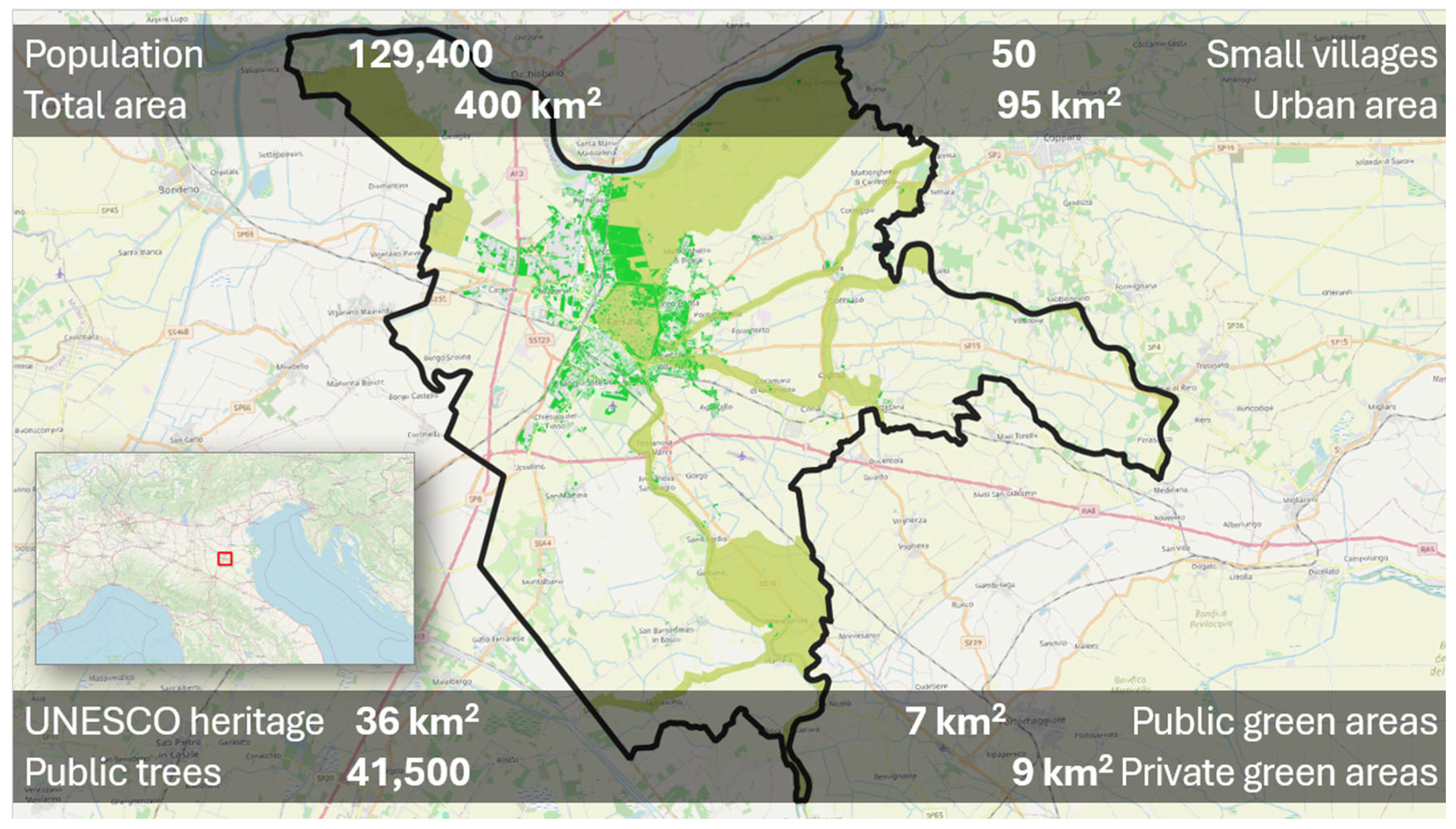
This study focuses on the municipality of Ferrara, selected as a representative case study for testing the extended application of the 3-30-300 rule through the construction of a scalable composite index for urban green assessment. Ferrara is a medium-sized city located in the Emilia-Romagna region in northern Italy (Figure 1), with a municipal population of approximately 129,708 inhabitants. The city is characterized by a predominantly flat topography and a relatively homogeneous urban fabric, conditions that facilitate the analysis of visibility, accessibility and tree-cover distribution at the building scale. Ferrara also presents a historically stratified urban structure, combining a compact historic centre with more recent residential expansions and a widespread system of public green spaces. In addition, the availability of open geospatial datasets and municipal GIS databases makes the city particularly suitable for the implementation and testing of spatially explicit urban green indicators.
The analysis for the extended application of the 3-30-300 rule to the territory of Ferrara was conducted, as specified, through the construction of a scalable composite index that involved 18,077 georeferenced buildings within the urban centre. The unit of analysis is the single building, for which three sub-indices were calculated (tree visibility, tree coverage, UGS proximity) corresponding to the components of the 3-30-300 rule. The dataset contains 18,077 georeferenced residential addresses within the study area [34].
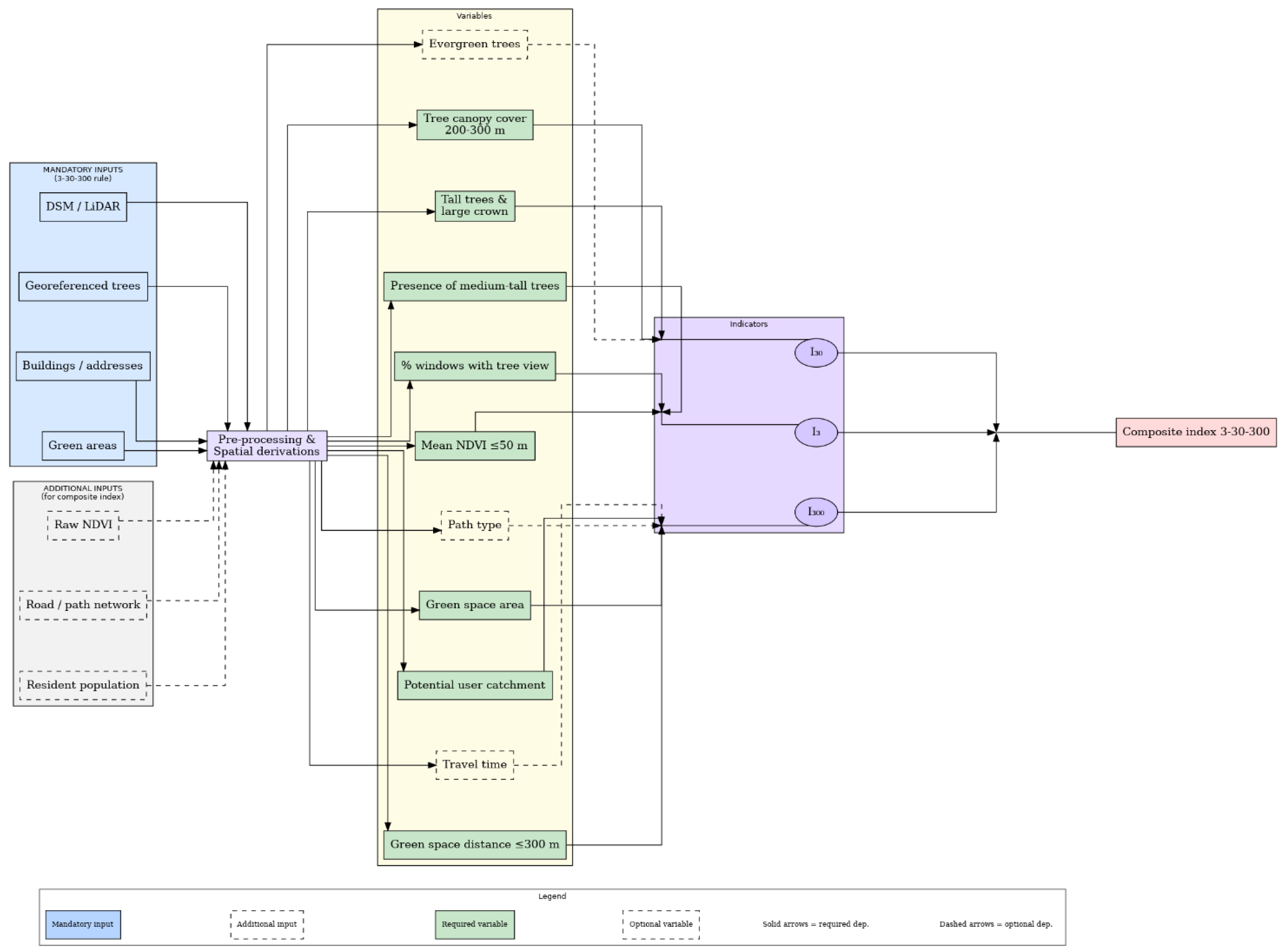
The input data come from open sources and GIS databases of the Municipality of Ferrara and, to a large extent, are based on the previous calculation of the same Rule in the city: the surveys on the visibility of trees; the percentage of tree cover within 200 metres and the distance of buildings from the entrances of the green area. In order to implement the index, a set of addresses (or, alternatively, of residential buildings), a digital surface model of the study area—necessary in particular to estimate the heights in the visibility analysis—a dataset of tree cover, a dataset of municipal green areas, the typological classification of green areas and their surface area, as well as the data on the resident population were essential. These data represent the indispensable information core for the calculation of the 3-30-300 rule and, consequently, for the elaboration of the composite index illustrated in this study (Figure 2). The address-level indicators are made available through the Comune di Ferrara open-data portal [34].
It should be specified that indicator 3—Visibility was calculated only on the area covered by the aerial surveys undertaken in 2022, which coincides exactly with the extent of the Digital Surface Model (DSM) (It must be said that this area represents the bulk of the urban centre). The data for tree cover and green area proximity (30 and 300), on the other hand, cover the largest urban area of the Municipality of Ferrara. For methodological consistency and internal comparability between indicators, all the results of both the three indicators and the final composite index were restricted to the urban area covered by aerial surveys (95 km2 out of 404 km2 of the whole municipality).
For each component of the rule, therefore, several variables were considered. The weights to be assigned to each variable were defined through the Delphi method. The variables were then normalised in the range -0, 1- and combined to calculate the indicator in each address.
For Indicator 3—Visibility, four variables were therefore used:
  • I3_V1: percentage of windows with a tree view, normalised on the interval 0–1. The weight assigned to the variable has a value of 1.5.
  • I3_V2: presence of trees ≥ 15 m within 50 m, normalised with min-max scaling:
I 3 , V 2 = I 3 , V 2 n M I N 50 M A X 50 M I N 50
The weight assigned to the variable has a value of 1.5.
  • I3_V3: the NDVI index in a 50 m buffer of the building. The weight assigned to the variable has a value of 0.5.
The final indicator is given by:
I 3 = 1.5 I 3 , V 1 n + 1.5 I 3 , V 2 n + 0.5 I 3 , V 3 n 3.5
The variable I3_V1 was derived from a dataset of points simulating the random position of windows on building façades. These points were generated by converting building polygons into façade lines and creating random points along them to represent potential observation locations. Each point indicates whether, within a 50 m radius, trees are visible.
Given the relatively homogeneous urban fabric of Ferrara (average building height: 13.9 m; median: 13.6 m), façade points representing virtual windows were generated at a uniform reference height. This choice was adopted because detailed information on the actual position of window openings for each floor was not available.
The visibility analysis (viewshed) was performed in QGIS using a Digital Surface Model (DSM) of the study area, which represents elevation, including buildings and vegetation. This allowed the analysis to account for the three-dimensional configuration of the urban environment, ensuring that visibility varies according to building height and vertical obstructions.
The analysis was based on three main datasets: the tree cover dataset, which contains the positions and heights of individual trees used as observation sources; the DSM, used as the reference surface for line-of-sight calculations; and the building dataset, from which façade-based points representing fictitious windows were derived and used as targets in the visibility analysis. The result of the analysis (Tool QGIS Visibility Analysis-Viewshed Analysis) is a binary image in which each pixel takes on the value 0 or 1. The value 0 indicates an area not visible to the observer points, while the value 1 represents a visible area. The raster thus represents the overall visibility map and forms the basis for the subsequent sampling of the visibility points associated with the virtual windows.
In order to link the visibility to the individual building units, the percentage of window points with a free view was calculated for each building (Subsequently normalised on the interval 0–1). In this way, the binary logic is overcome, and buildings with a higher number of points with potential tree views are valued.
In order to assess not only the quantity, but also the relevance of trees observable from buildings’ façades, the variable I3_V2 was defined, designed to estimate the proportion of the largest trees—i.e., with a height of 15 m or more—actually visible from each building.
The calculation is derived from the integration of two sources: a polygonal dataset (Single Tree Canopies), which records the position and height of each tree, and the overall visibility raster obtained from the previous viewshed analysis. In QGIS, only trees with a height of 15 m or more were considered, a value coinciding with the average height of the tree stand and chosen to identify specimens capable of emerging above fences, vehicles and low-lying infrastructure. The number of these tall trees was then sampled on the visibility raster and, to allow a comparison on an urban scale, normalised with a min-max scaling according to the min-max scaling formula:
I 3 , V 2 n = I 3 , V 2 M I N 50 M A X 50 M I N 50
where MIN550 and MAX50 represent the minimum and maximum number of tall trees detected in the 50 m buffers of the raster. The result thus obtained assumes values between 0 and 1: figures close to 0 denote buildings almost devoid of large trees in their field of view, while values close to 1 identify buildings surrounded by a particularly high density of tall trees, with obvious advantages in terms of visual comfort, summer cooling, dust capture and aesthetic quality of the urban environment.
The variable I3_V3 refers to the NDVI index calculated in the immediate surroundings of the building (within a radius of 50 m). To calculate the variable, the NDVI index in the area of the administrative limits of Ferrara was generated in Google Earth Engine using a selection of images from the COPERNICUS/S2_SR_HARMONIZED collection, then, in the QGIS environment, a buffer of 50 metres was calculated around the centroids of the buildings and, starting from the total NDVI raster, the average of the buffers around the buildings was calculated.
The normalised variables—I3_V1 (percentage of windows with visibility); I3_V2 (presence of trees ≥15 m within 50 m), I3_V3 (NDVI index in a 50 m buffer of the building)—were linked directly to the dataset of buildings (“USAGE” Buildings) through a spatial join (Join attributes by location), so as to concentrate all the attributes referring to each building (Next, in editing mode, a new numeric field of float type named I3 was created; in the Field Calculator, the expression for calculating the indicator was entered as described above) in a single table. The result is a single-point dataset showing the score obtained in each variable and the indicator score.
For Indicator 30—Tree cover, the variables used are:
  • I30_V1: % tree cover within 200 m of the addresses. The weight assigned to this variable is 2;
  • I30_V2: presence of tall trees (≥15 m) and with a crown diameter ≥ 24 (average of the dataset) in the 200 m buffer. The weight assigned to this variable is 2;
  • I30_V3: presence of evergreen trees within 200 m of the house. The weight assigned to this variable is 0.5.
The index is calculated according to:
I 30 = 2 I 30 , V 1 n + 2 I 30 , V 2 n + 0.5 I 30 , V 3 n 4.5
The variable I30_V1 was processed in QGIS by means of a workflow constructed with Model Designer: a buffer of 200 m was associated with each house number, within which the percentage of tree cover was calculated. The percentage value obtained was then divided by 100, returning a normalised indicator on a 0–1 scale.
The variable I30_V2 quantifies the presence of mature trees—height ≥ 15 m and crown diameter ≥ 24 m (corresponding to the average values observed in the Ferrara tree dataset, which is characterized by the presence of relatively large and mature urban trees)—in order to distinguish high from low tree cover and to go beyond the simple percentage figure of trees within a radius of 200 m.
To construct the variable I30_V2, reference was made to the tree cover dataset, which contains the height, crown area and planimetric coordinates for each tree. Trees classifiable as mature were selected, defined by two simultaneous conditions: height ≥ 15 m and crown diameter ≥ 24 m (values corresponding to the dataset averages).
Building centroids were extracted from the dataset of the Municipality of Ferrara. A 200 m buffer was generated around each centroid to represent the assumed ecosystem proximity area. For each buffer, the number of trees satisfying the above-mentioned dendrometric criteria was counted. The counts obtained were finally transformed on a dimensionless scale by min-max scaling, so as to obtain values between 0 and 1 and make them directly comparable with the other variables used in the indicator. The same methodology was implemented for the construction of the variable I30_V3, selecting, in this case, only the trees belonging to the evergreen species in the dataset.
To Indicator 300—Green area proximity, the following variables were associated:
  • I300_V1: distance (m) of each house number to the nearest green area access ≥ 300 m (excluding street furniture, cemeteries, school gardens, private green areas), the weight assigned to the variable is 1.5;
  • I300_V2: type of green area (e.g., historical park, equipped green area), the weight assigned to the variable is 1;
  • I300_V3: surface area of the green area (m2), the weight assigned to the variable is 0.5;
  • I300_V4: potential catchment area (defined as the population potentially served by a green area within a 300 m buffer. Calculated in QGIS considering the population living in a buffer of 300 m from the green area), the weight assigned to the variable is 0.5;
  • I300_V5: travel time from the building to the green area. In relation to orography, it is not considered in the analysis of Ferrara (completely flat). The weight assigned to the variable is 0.5;
  • I300_V6: type of route (scores 1 for pedestrian routes and 0 for vehicular routes), the weight assigned to the variable is 0.5. The variable is optional, related to the availability of data. In the case of Ferrara, it was not taken into account precisely because of the unavailability of precise data.
The formula for Indicator 300 results—used in the case of Ferrara—is therefore:
I 300 = 1.5 I 300 , V 1 n + 1 I 300 , V 2 n + 0.5 I 300 , V 3 n + 0.5 I 300 , V 4 n 3.5
The variable I3300_V1 indicates the distance in metres of each house number to the nearest green area access. A Euclidean buffer of 300 m was constructed for each house number; only if this intercepted at least one usable green area (excluding cemeteries, school gardens and private areas) was the route to the entrance calculated via network routing and the distance recorded. The distance range was normalised on a 0–1 scale using the formula:
I300_V1 takes the value:
-
1—(distance/300) if the distance to the entrance of the green area is ≤300 m;
-
0 if the distance is >300 m;
where 300 m represents the threshold for urban green area proximity, in line with the standard indicated in rule 3-30-300. The weight assigned is 1.5.
The variable I3300_V2 was calculated from the classification of green areas carried out by the Italian National Institute of Statistics (ISTAT). Seven categories of green areas—also used in the calculation of the variable I300_V1—were selected, excluding those that were not significant for the analysis (For example, cemeteries or private green areas). A qualitative score (on the 0–1 scale) was assigned according to type, as follows:
  • Urban parks: 1;
  • Equipped green areas 5000–8000 sqm: 0.90;
  • Equipped green areas 0–5000 square metres: 0.75;
  • Outdoor sports areas: 0.70;
  • Green areas of historical interest: 0.60;
  • Urban forestation: 0.50;
  • Urban gardens: 0.40;
  • Wooded areas: 0.30.
The value was then associated with the house number according to the green area closest to it.
In relation to the variable I300_V3, having data on the surface area of the green areas selected for analysis, normalisation was carried out using the min-max method.
Finally, for the variable I300_V4, the ratio of surface area to population living in the 300 m buffer was calculated for each green area.
c a t c h m e n t   a r e a = surface   area P o p u l a t i o n  
Due to the high variance and presence of outliers (Maximum value: 21,696, mean: 83.8, median: 1.29, CV > 12), the data were transformed by decimal logarithm:
l o g 10   c a t c h m e n t   a r e a =   log 10 c a t c h m e n t   a r e a + 1
and subsequently normalised:
l o g 10   c a t c h m e n t   a r e a = l o g 10   c a t c h m e n t   a r e a min l o g 10   c a t c h m e n t   a r e a max l o g 10   c a t c h m e n t   a r e a min l o g 10   c a t c h m e n t   a r e a
The values were then matched to the house numbers according to the nearest green area.
The final composite index is calculated as a weighted average over the sum of the weights of each indicator:
Composite   Index = I 3 + I 30 + I 300 3.5 + 4.5 + 3.5
The variables I30_V3, I300_V5 and I300_V6—indicating, respectively, the presence of evergreen trees within 200 m from the buildings; the travel time from the building to the green area and the type of path—should be considered optional, as will be further clarified later.
When optional variables are not included due to data unavailability, their corresponding weights are excluded from the denominator of the index calculation. This ensures that the final composite score is not artificially reduced and remains comparable across different data conditions.
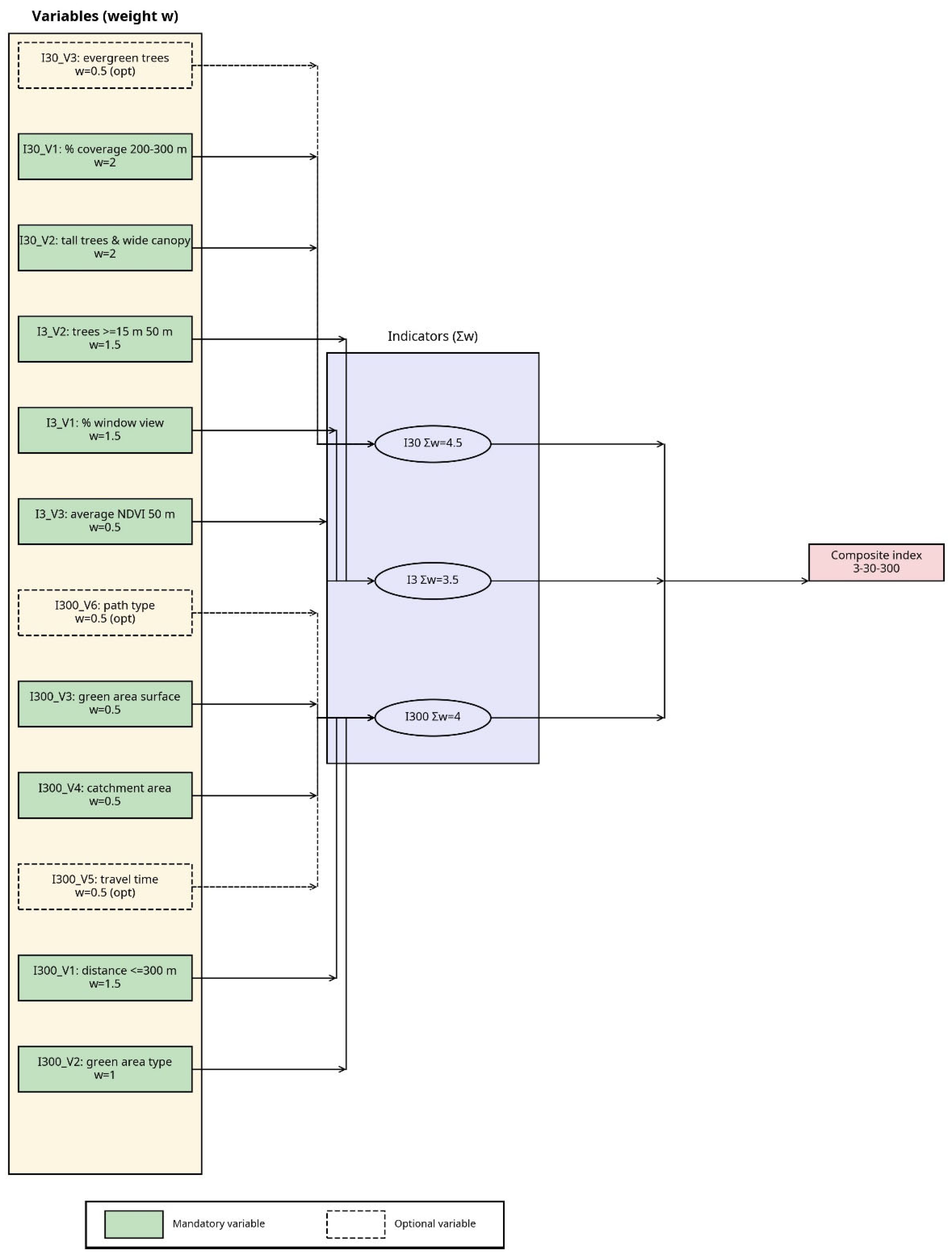
The workflow of the Composite Index calculation is illustrated in Figure 3.
To avoid overlapping anthropic pressure and ecological endowment, which respond to different logics, population was not added as a variable within the indicators but was considered after indexing. Once the value of the composite index had been determined for each address, the population figure was used exclusively as an interpretative key and metric of distributive justice.
To this end, a threshold of adequacy was identified—for Ferrara equal to 0.193, corresponding to the 10° percentile of the index distribution. Buildings with lower values were classified as ‘out of threshold’ and, by summing up their residents, it was possible to quantify the population exposed to a critical lack of green infrastructure, thus identifying where there is a need and priority for intervention.
This methodological approach allows an integrated assessment of the quality and accessibility of urban green, considering quantitative, ecological, infrastructural and demographic dimensions that can be replicated in other urban contexts.
All cartographic representations use metric scale bars expressed in meters, consistently across all figures.

3. Results and Discussion

The results presented in this section stem from the application of the composite index detailed in the methodology. This approach was designed to overcome the limitations of the standard 3-30-300 rule by integrating a series of additional variables for each of the three core indicators (Visibility, Tree Cover, and Proximity). Each variable was normalised and weighted using the Delphi method to produce a final, scalable indicator. Furthermore, the demographic component was used post-indexing as an interpretative key for assessing distributive justice. This framework provides a nuanced, multi-variable assessment of urban green quality, the results of which are now discussed.
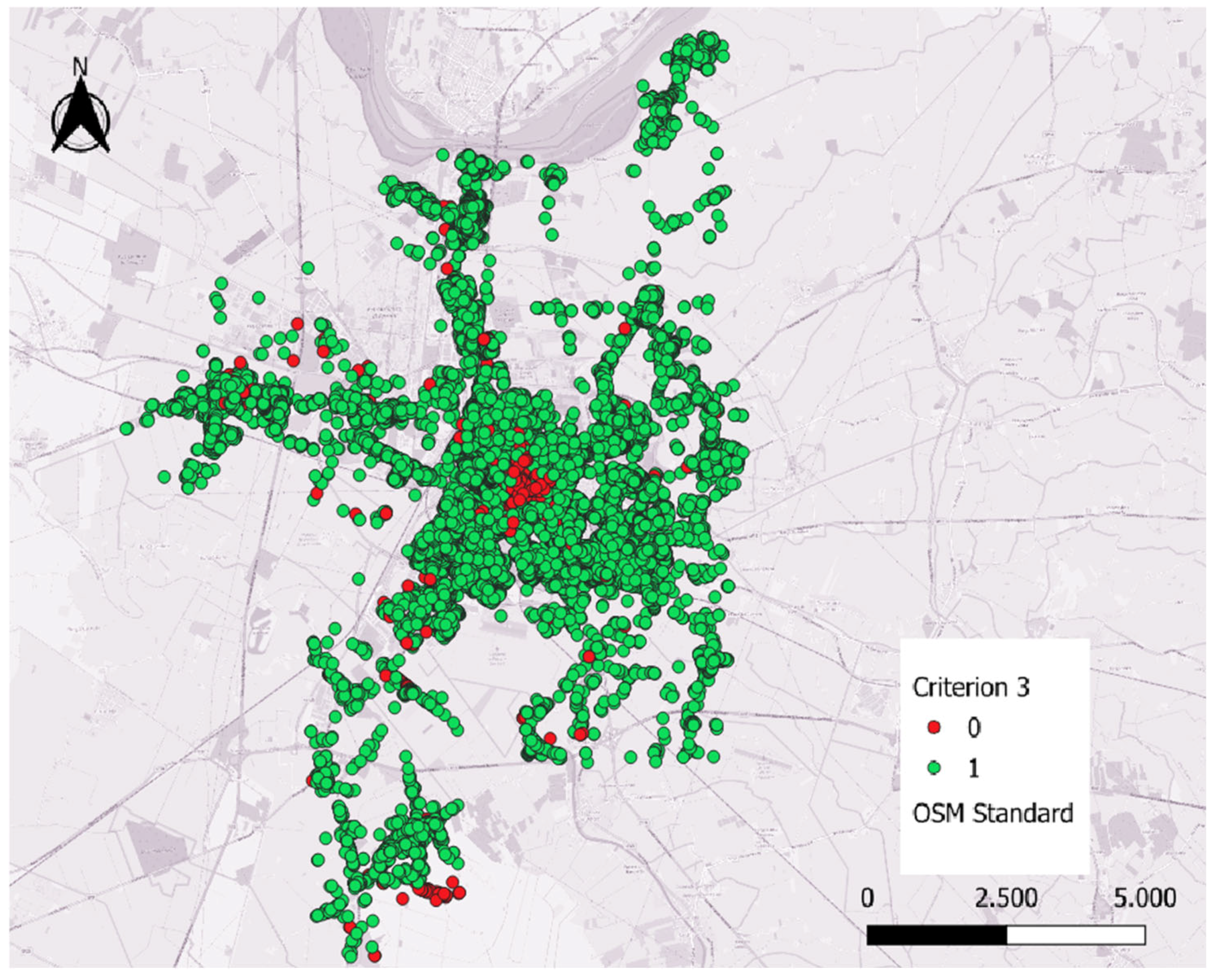
A comparison between the binary map derived from the direct application of the tree visibility Criterion and Indicator 3—Visibility highlights how the dry threshold of Criterion 3 tends to return a strongly dichotomous picture and, for Ferrara, is largely dominated by the colour green: many houses exceed the visibility threshold and are therefore “compliant” (Figure 4). However, this apparent abundance of visibility may be misleading. The Rule, in its original formulation, does not specify the size of the trees and does not distinguish between isolated, compound or fragmented crowns; when working on crown datasets, the distinction between the three actual trees and the contiguous plant masses becomes operationally uncertain.
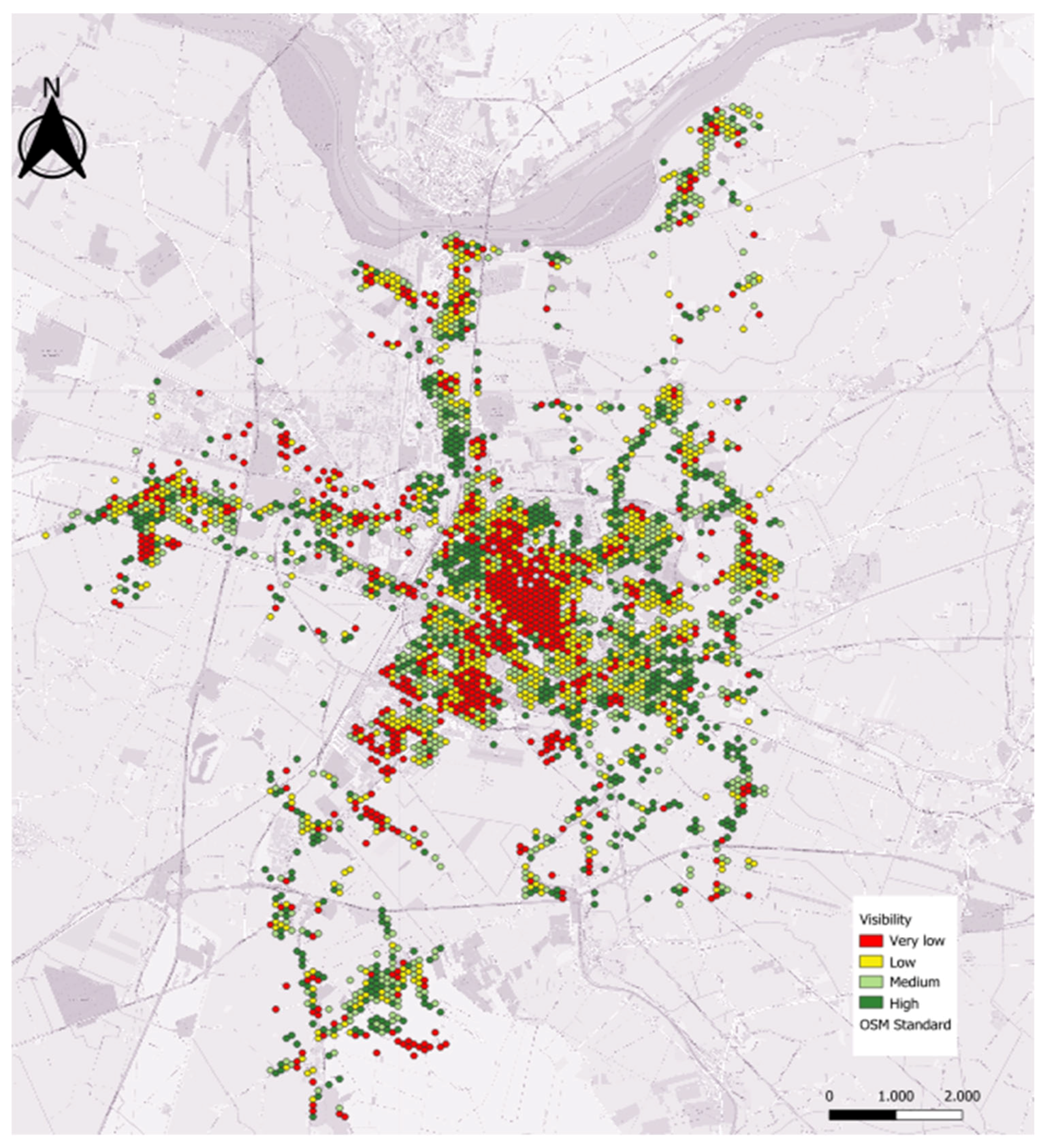
In the approach used in this work, Indicator 3 integrates the percentage of windows with a view of vegetation within 50 m, the visibility of average tall trees (≥15 m) within the same radius, and the interstitial vegetation (NDVI) in the immediate surroundings of the building, producing a continuous normalised 0–1 score. This integration allows us to capture gradations: the historic centre and the main tree-lined axes show medium-high values, while peri-urban sectors and building districts with sparse trees are in the low classes (Figure 5). The inclusion of tree height and scattered vegetation allows neighbourhoods with few but large trees, or with non-trees, to stand out from the purely binary classification, suggesting more targeted intervention priorities.
It should be emphasised that, although the verification of the ‘3 visible trees’ requirement may appear methodologically fragile, in order to safeguard the communicative value of the rule without inheriting its ambiguities, the weighting of the indicator assigns a priority weight to the share of windows that see trees (1.5), flanked by the information on average trees ≥ 15 m tall (1.5) and completed by the interstitial NDVI (0.5). In this way, the indicator distinguishes mere presence (visible/not visible) from qualitative degrees of tree visibility.
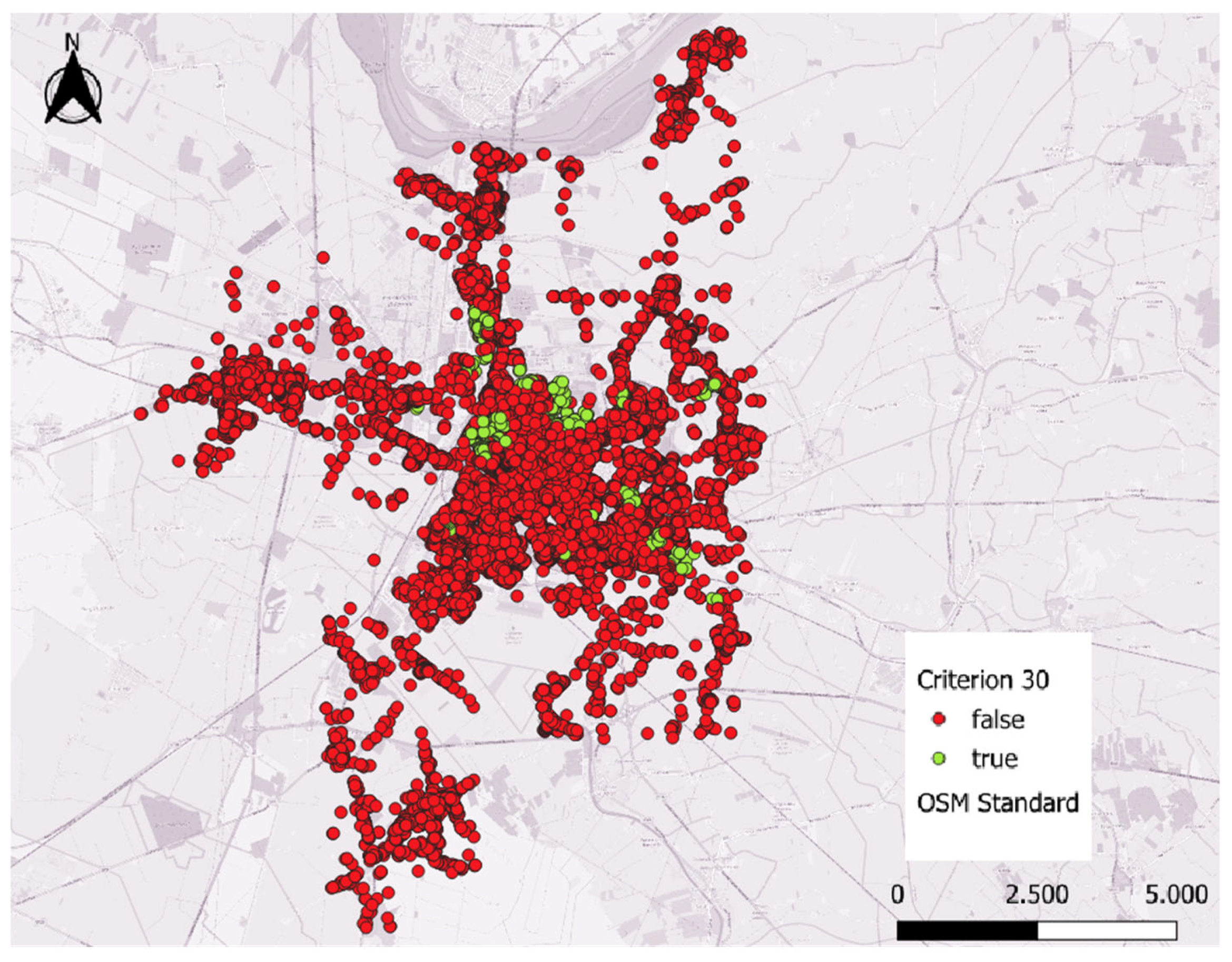
In relation to Criterion 30, although it proposes an intuitive objective—to have at least 30% tree cover around a house—its application in Ferrara produces a map almost entirely ‘below the threshold’ (Figure 6). This reflects what has been observed in multi-city studies: reaching 30 per cent is difficult in compact urban fabrics and, in some climates, it is even necessary to exceed 40 per cent to achieve significant cooling benefits.
However, the threshold does not distinguish whether trees are young or mature. The height and width of the canopy, however, directly affect the shaded area and thus summer cooling: taller trees intercept a greater proportion of solar radiation, reducing the temperatures of the ground and building façades. In experimental tests on identical buildings, the presence of tall trees lowered wall surface temperatures by up to 9 °C, while smaller trees produced negligible effects [35]. A meta-analysis of 182 case studies conducted in 110 cities confirms that tree morphological traits—in particular height and crown width—are among the main determinants of urban cooling, with decreases in pedestrian-level air temperatures of up to 12 °C [36]. Research in courtyards in arid climates also shows that around 80% of the summer cooling effect is attributable to the shade produced by the canopy alone, especially when large trees are involved [37,38].
Having punctual dendrometric data (as in the case of Ferrara), therefore, makes it possible to calculate the share of cover due to these mature canopies within the buffer, highlighting the contribution of the trees most effective in providing shade and mitigating summer heat [39,40,41].
In order to maintain the communicative value of Criterion 30 but give operational indications, Indicator 30 weights the percentage of canopy within 200 m (weight 2) and combines it with the presence of mature trees (height ≥ 15 m; canopy diameter ≥ 24 m, weight 2) and an evergreen component (weight 0.5) that signals seasonally persistent cover.
This approach reveals that many areas apparently in deficit according to the 30% threshold actually have quality tree capital to build on: in the composite map, these areas are placed in Medium classes (Figure 7), suggesting that campaigns to strengthen street trees or manage crown maturation could rapidly improve local microclimatic conditions.
With a view to index scalability, the variable I30_V3, indicating the presence of evergreen trees within a radius of 200 m from the building, can be considered optional, as it requires a level of detail that is not always available.
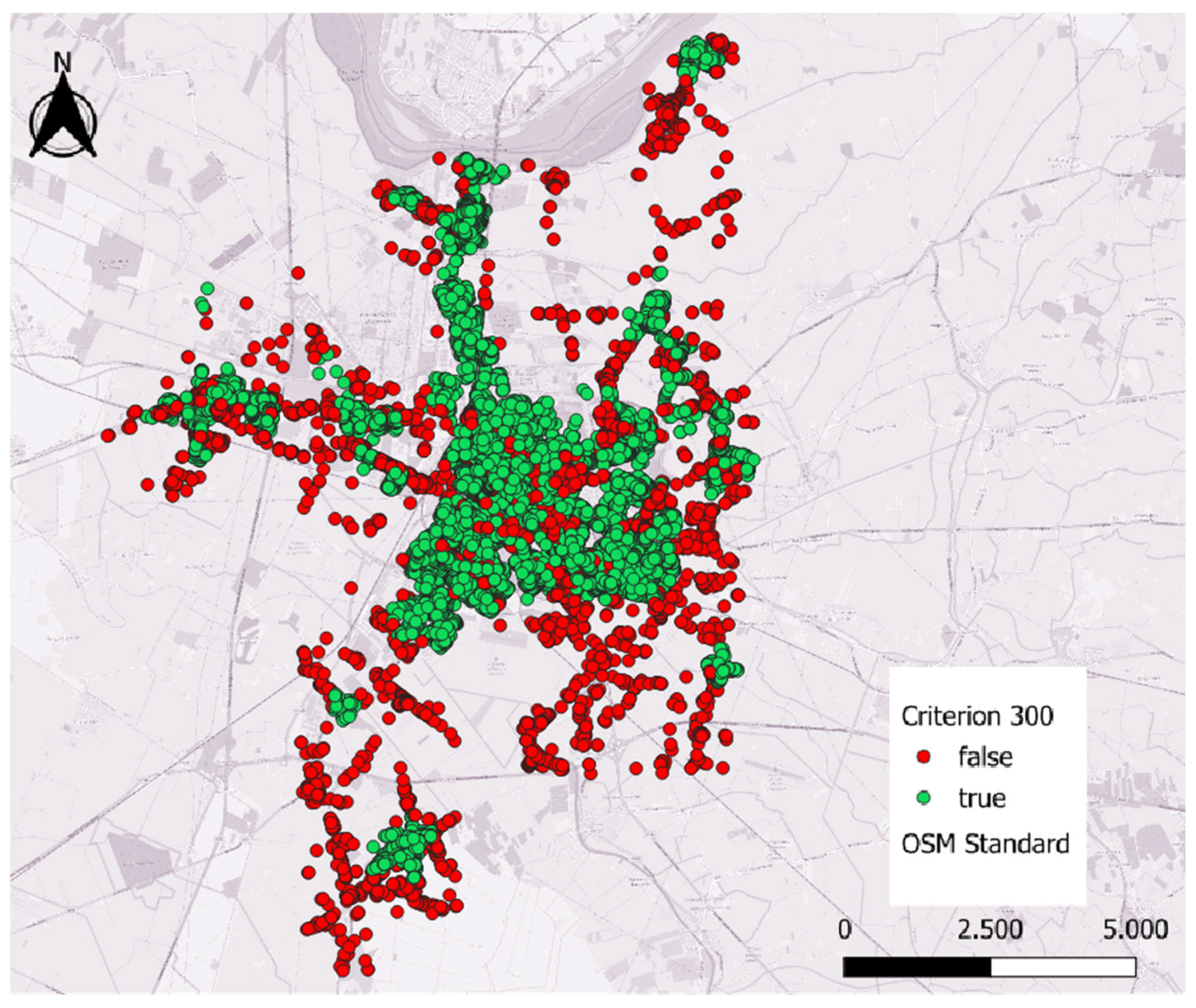
The comparison between the binary representation of the rule and Indicator 300—Green area proximity shows how the shift from a threshold-based approach (within/beyond 300 m to the park) to a weighted score allows a more realistic and planning-oriented interpretation of access to urban green spaces.
In the Rule 300 map for Ferrara, the numerous null values are not random missing data but the result of the operational workflow: a Euclidean buffer of 300 m was constructed for each house; only if this intercepted at least one green area was the path to the entrance calculated using network routing and the distance recorded. In the absence of an intersection, no path was estimated, and the field remained empty, indicating houses without green within 300 m and therefore in probable severe deficit.
For the purpose of the composite index calculation, these null values were reclassified as 0, ensuring that buildings without access to green areas within the defined threshold are explicitly represented as deficit conditions in the final assessment.
A further proportion of cells lacking values derives from the fact that, in order to ensure consistency and comparability between the three sub-indices, the final results of the analysis were restricted to the area covered by DSM, reducing the spatial extent of the indicator where the base data were not homogeneous.
The intrinsic limitation of the 300 m criterion—already highlighted in the literature for its dependence on theoretical distances that ignore barriers, route quality, size and capacity of the park—motivated the development of the composite Indicator 300. In this formulation, the distance to the entrance of the green area remains central and receives the highest weight (1.5), in order to preserve the conceptual structure of the original Rule. However, it is modulated by additional variables, including the type of green area (qualitative score, weight 1), its surface area (weight 0.5) and the potential catchment area (surface/population ratio, weight 0.5).
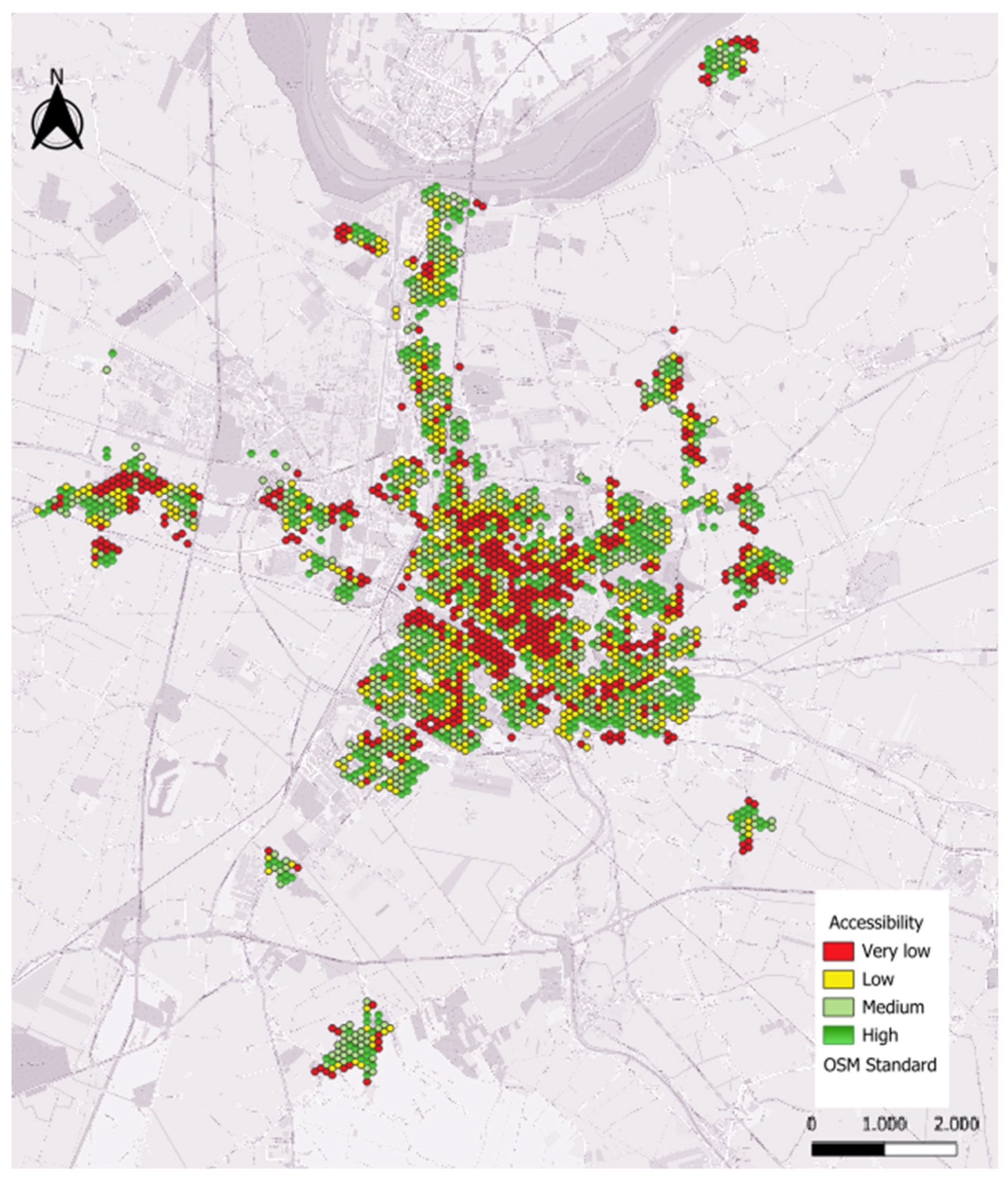
All variables are normalised and combined at the address scale to return a continuous gradient of functional proximity to green areas, rather than a purely geometric measure. As shown in Figure 8 and Figure 9, this conceptual shift is evident: large null or red areas in the Rule 300 map (Figure 8) may correspond to Medium or High values in the composite indicator (Figure 9) when the nearest green area, although beyond the threshold, is large or of high quality. Conversely, areas formally within 300 m but served by small or overcrowded green spaces may show low values, suggesting priorities for expansion or new green provision.
This is precisely the type of nuanced information that the composite index, designed to overcome the binary assessment of the 3-30-300 rule, aims to provide in support of targeted planning decisions.
It should be added that the variables I3300_V5 and I300_V6—indicating, respectively, the travel time from the building to the green area and the type of route—should be considered optional.
The former is optional because the incidence of travel time varies with the local orography. In the case of Ferrara, the absence of steep slopes makes the routes almost linear and, consequently, the travel time is insignificant, so it was not included in the index calculation. The second variable indicates the type of path (pedestrian/carriageway) that links the house to the green area; having the possibility of walking along a pedestrian path to reach the nearest green area can take on added value compared to having to walk along a busy road; therefore, the score assumed by the pedestrian path is 1, and for the carriageway it is 0. However, this type of analysis is closely linked to the availability of precise route type data, which is often available in OSM, but not accurate everywhere. In addition, this information must be reconnected within the calculation of the distance between the house and the green area, and this is not always possible. Due to the unavailability of precise information in the case of Ferrara, the variable was not included in the index.
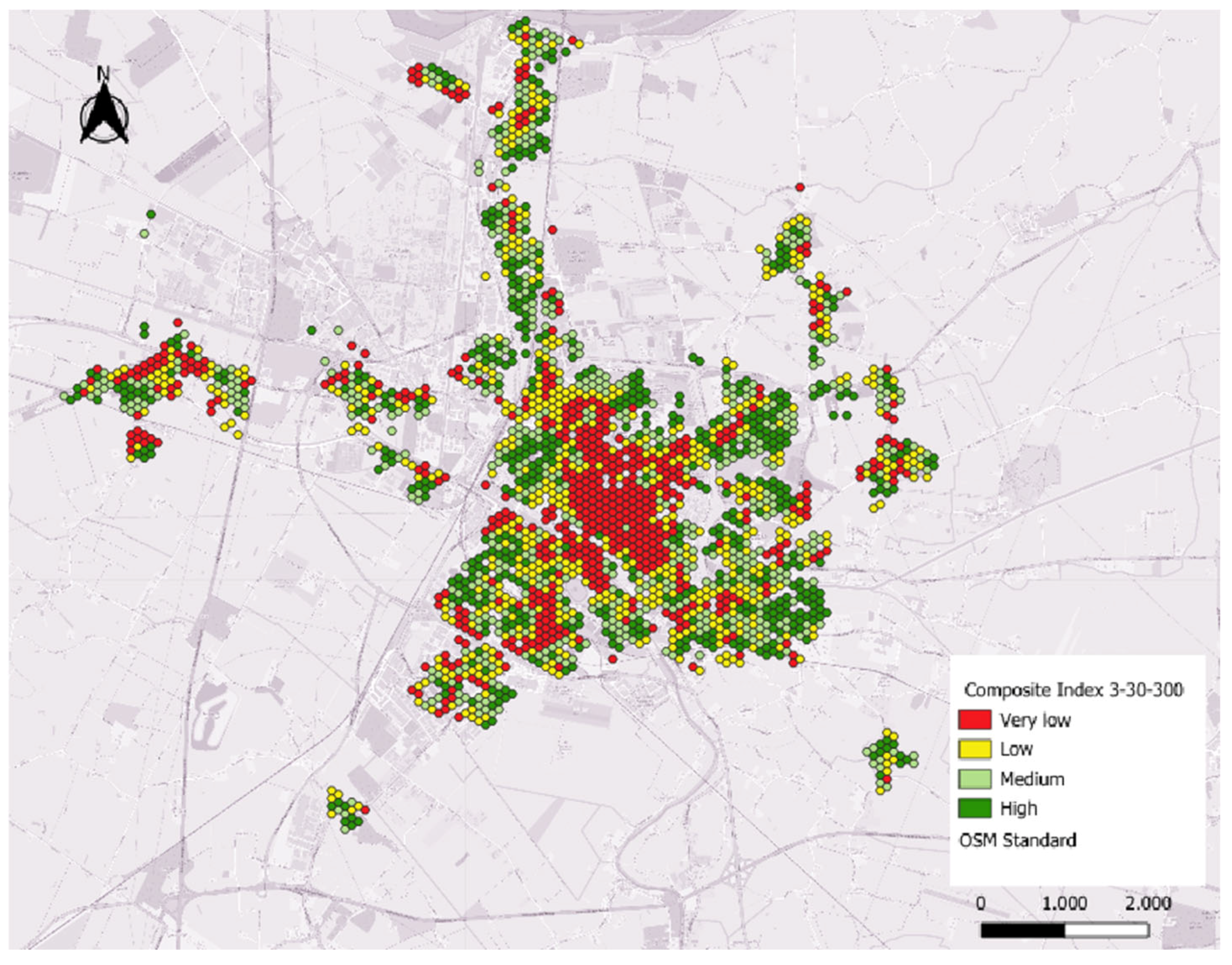
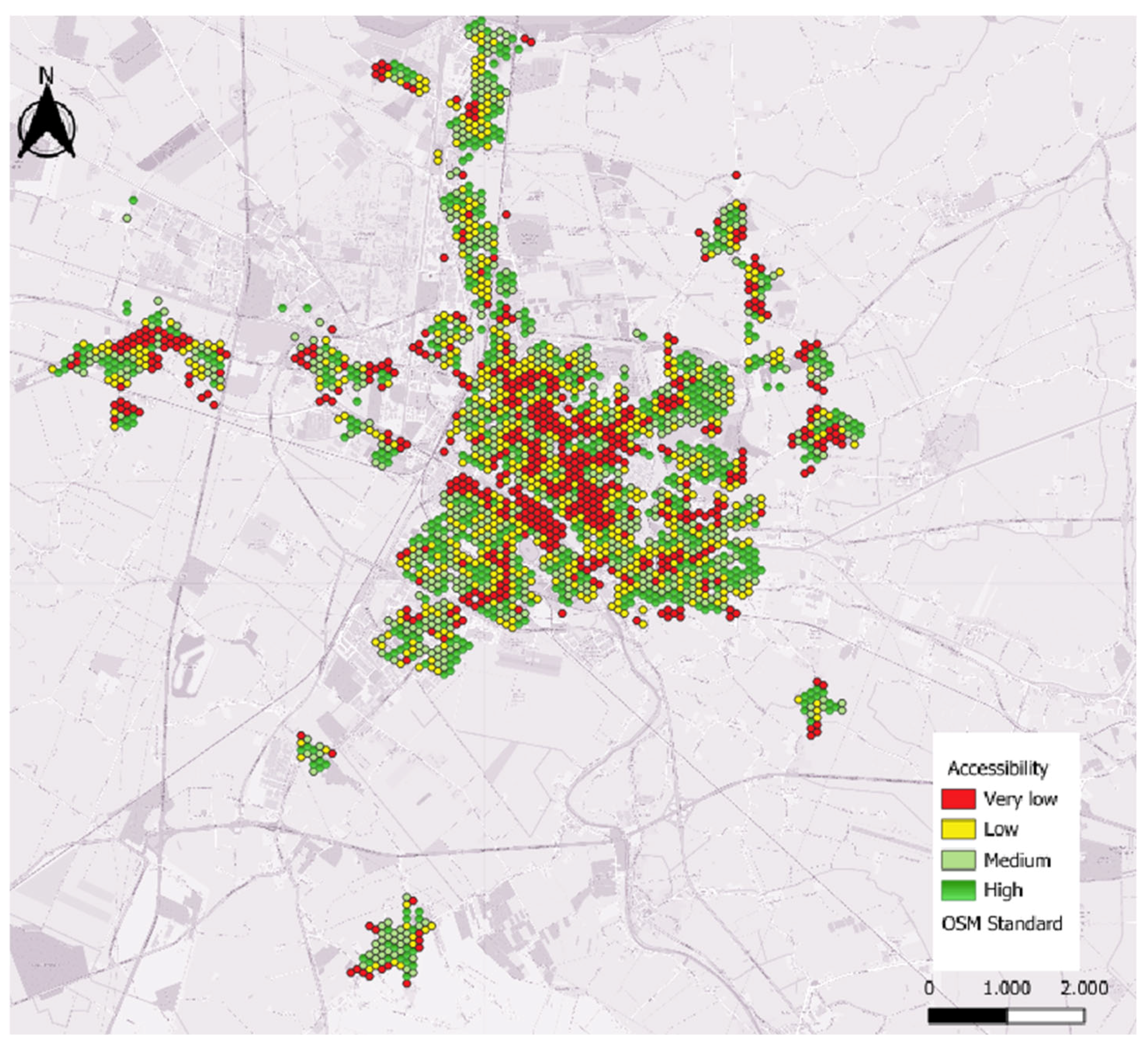
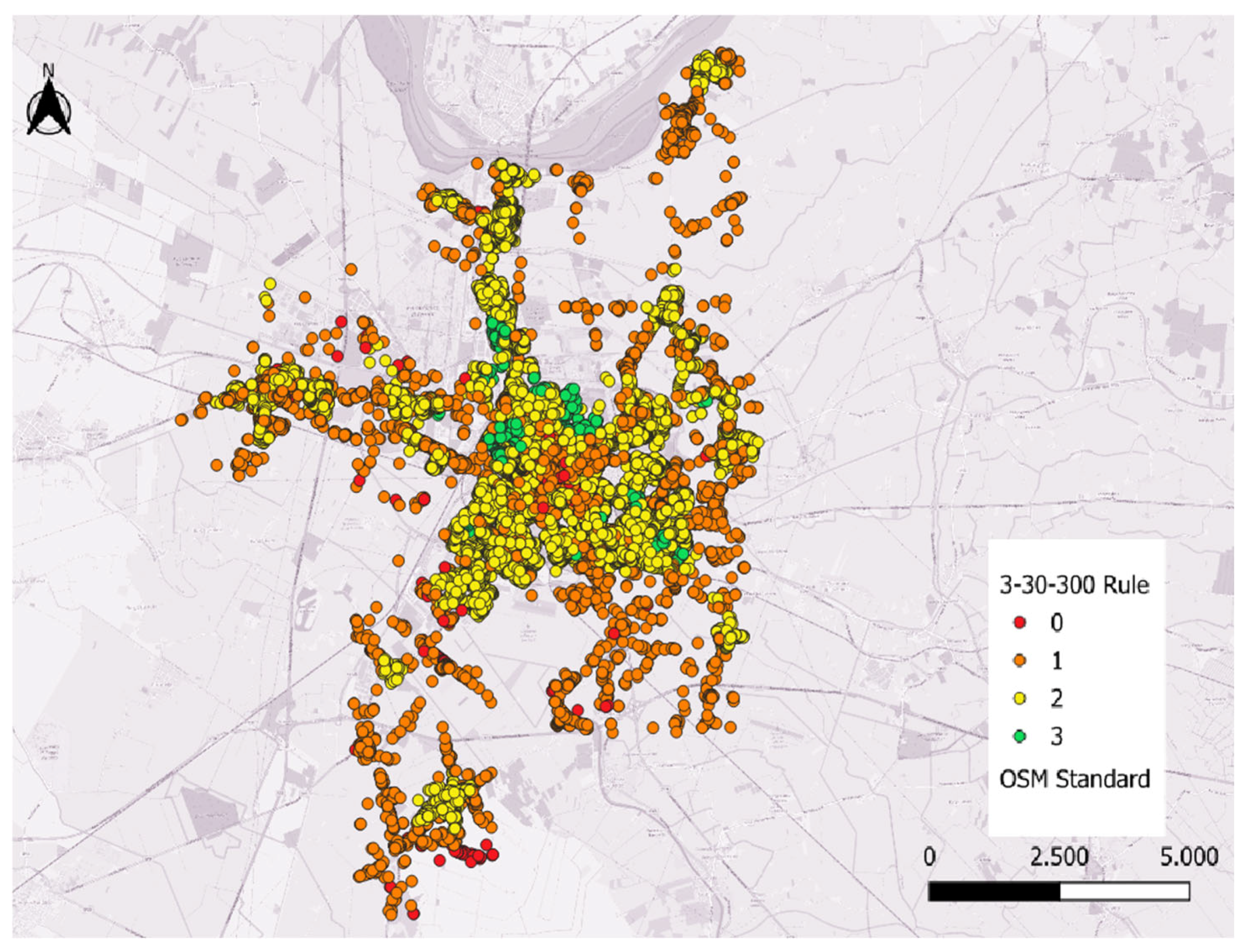
A comparison of the map of the union of the three criteria of Rule 3-30-300 (Figure 10) with that of the final Composite Index (Figure 11) shows very clearly why it is necessary to go beyond a separate threshold reading: when the three criteria are applied in a dichotomous form (see ≥3 trees, ≥30% tree cover, ≤300 m to a green area) and then crossed, a large part of the building fabric is non-compliant as it is enough to fail even one of the parameters to fall outside the standard; the cartographic result is a fragmented mosaic, dominated by large areas that do not meet at least one component (often 30% coverage or real distance to green), interrupted by more limited clusters where the three requirements coexist, making it difficult to establish operational priorities and underestimating the partial green capital already present in neighbourhoods that fail only marginally one of the criteria. The grid-based representation aggregates building-level index values and therefore expresses local patterns of green endowment and usability rather than individual building compliance. This condition is reflected by the predominance of low-value grid cells in the merged binary representation.
Observing, therefore, the mapping of Rule 3-30-300 (where each neighbourhood is either ‘in’ or ‘out’ depending on whether it meets all three minimum thresholds: see 3 trees, ≥30% tree cover and ≤300 m from a green space) and the map of the Composite Index, the most evident difference is the shift from a fragmented and strongly penalising mosaic to a continuous gradient that returns the different levels of endowment and usability of urban green space; in the representation of Rule 3-30-300 it is enough to fail just one of the three requirements to classify a building as non-compliant, so that multiple addresses buildings appear red even though they miss the threshold only marginally (e.g., 28% canopy or 320 m at the park), thus ending up hiding the partial green capital already present and the qualitative differences between neighbourhoods, a problem that derives directly from the simplicity of the definitions (“three trees”, “30%”, “300 m”) and their lack of sensitivity to tree maturity. In the composite index, each pillar of the rule has been transformed into a multi-variable sub-index, the weighted aggregation allowing a low score in one component to be partially offset by better performance in the others, thus revealing intermediate areas that the rule labelled as deficits. This gradient is made more legible by grid aggregation, which improves the interpretability of spatial patterns without altering the underlying index values.
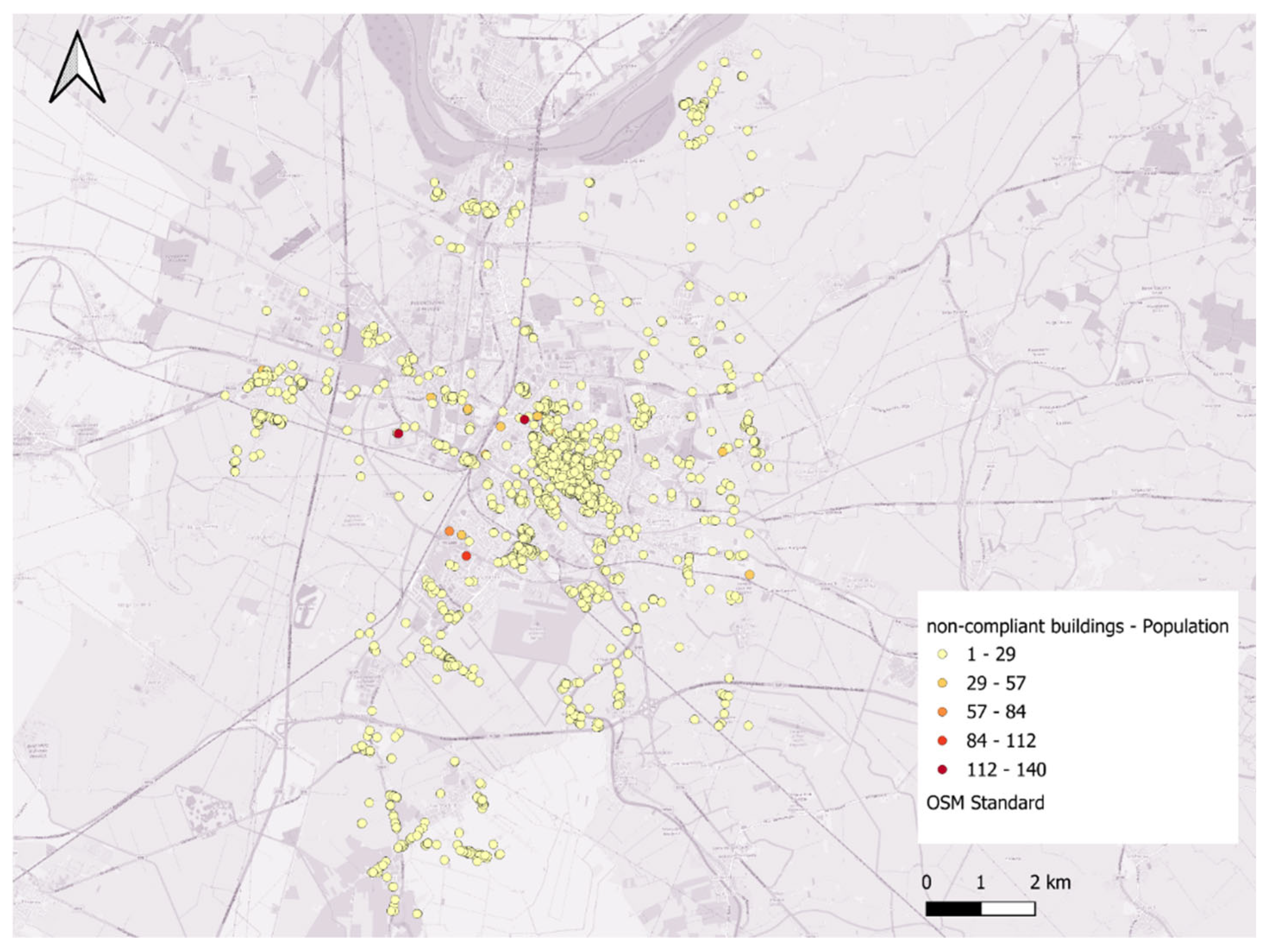
As already mentioned, population was not added as a variable within the indicators but was considered after indexing. Once the value of the composite index had been determined for each address, the population dimension was used exclusively as an interpretative key and metric of distributive justice. Applying an adequacy threshold of 0.193 to the entire building stock, 2417 were identified with index values below the threshold and therefore classified as ‘out of threshold’. These buildings house a total of 10,587 residents, equivalent to approximately 8.2% of the municipal population (129,708 inhabitants). The median building in deficit accommodates 3 residents (IQR = 2–5), compared to the median 2 residents (IQR = 2–4) observed on the entire dataset: the lack of green infrastructure tends, therefore, to weigh on slightly more populated buildings, amplifying the social impact of the phenomenon (Figure 12).
The composite index was tested in the case study of Ferrara, where it demonstrated its ability to provide a more nuanced and continuous interpretation of urban green conditions compared to the binary application of the original 3-30-300 rule. However, this validation remains limited to a single urban context. Although the methodology is designed to be scalable and adaptable, further applications in different cities, characterized by varying urban density, morphology, and data availability, are necessary to confirm its robustness and general applicability.
Future research should therefore extend the use of the index to additional case studies and compare the results with other urban green assessment methods to strengthen its external validity.

Beyond the 3-30-300 Rule

Considering the critical issues and methodological limitations outlined in the scientific literature for the 3-30-300 standard Rule, our composite Index—while recognising the heuristic and communicative value of the original rule—intended to overcome the simplifications through the integration of a broader and more diversified set of variables, which took into account the contextual specificities and the multiple ecological and social functions of green. The main critical studies [9,12] have unequivocally highlighted how the rule’s three criteria are often excessively generic or difficult to apply uniformly, due to methodological constraints, the lack of up-to-date geospatial data and the profound morphological, climatic and socio-cultural differences between urban contexts [42,43]. Furthermore, the scientific literature on urban green indices has progressively evolved its perspective, recognising the need for more sophisticated metrics that transcend mere quantification or measurement of linear distances. For example, models such as the Building Neighbourhood Green Index (BNGI), proposed by ref. [44], have introduced a building-oriented approach to analysing the spatial configuration of built-up areas and vegetation. This model integrates parameters such as green index (GI), proximity to green, building dispersion and building height, demonstrating how a multidimensional approach is essential to capture the complexity of interactions between the built environment and green infrastructure. Similarly, Jang et al. (2020) [45] developed the Urban Green Accessibility (UGA) Index, an indicator that measures pedestrian accessibility to all green spots in an urban area by integrating the NDVI with values derived from angle segment analysis. This approach highlighted how green accessibility is not only a function of physical distance but is closely linked to the connectivity of the pedestrian network and the spatial perception of users [46,47,48,49]. Hence, the present study moved towards the integration of this parameter with more robust measures, through the inclusion of variables such as the percentage of windows with a view of trees in general, as well as the presence of tall trees in the immediate vicinity of buildings, also considering the presence of interstitial vegetation in the immediate surroundings of buildings [50,51,52]. By considering the criterion of 30% tree cover, the need emerged for an assessment that goes beyond the simple percentage of cover, including qualitative aspects such as the height of the trees and the diameter of the crowns, and the diversity of tree species (distinguishing between evergreens and deciduous due to their different ecological and perceptual functions). Finally, for the 300-metre distance parameter, it is crucial to adopt an approach that considers, in addition to the actual access modes (pedestrian, cycle-pedestrian, driveway) and the actual time needed to reach the green area, the area’s surface area, type (e.g., urban park, historical garden, equipped green area, etc.) and potential overcrowding [53,54].
The applicability of the proposed methodology to other urban contexts requires careful consideration. The case study of Ferrara is characterized by flat topography, medium urban density, and relatively high availability of detailed geospatial data. These conditions facilitate the implementation of visibility analysis, proximity calculations, and the integration of multiple environmental variables.
In cities with more complex morphology, such as hilly or mountainous environments, visibility analysis may be significantly affected by elevation differences, requiring more advanced modelling approaches [55,56,57]. Similarly, in highly dense urban areas, the availability of open space and tree canopy may be structurally limited, potentially influencing the distribution and interpretation of the indicators [58].
Furthermore, in contexts with limited or low-quality data availability, the applicability of the full composite index may be constrained, requiring the use of simplified or partial versions of the methodology [59,60,61]. For this reason, the scalability of the index should be understood as methodological flexibility rather than direct transferability, allowing adaptation to different data conditions and urban characteristics [62].

4. Conclusions

The goal of this work has been the effort to translate Rule 3-30-300 from a “communicative slogan” to a multi-variable operative tool applied at single address/buildingscale for the entire municipal territory (in the available extension of the area covered by aerial surveys), showing how a composite approach allows us to overcome the rigid dichotomy of the three thresholds and to return spatial gradients of endowment, quality and usability of urban green spaces useful for targeted planning [35,36]. Where the binary representation classifies a large part of the built fabric as ‘non-compliant’ because it fails even one of the three requirements, the composite index better detects intermediate situations and latent green capitals: addresses areas with trees but of poor quality, compartments with coverage close to 30% to be strengthened, and areas at a distance of more than 300 m but served by large and typologically relevant parks [63]. The construction of the three sub-indices integrated variables designed to maintain the conceptual core of the rule (visibility from windows, percentage of canopy, distance to green) and, at the same time, to qualify it (maturity and seasonal persistence of trees, type and area of green spaces, catchment area), with weights derived from the Delphi procedure to ensure consistency, transparency and traceability in the absence of unambiguous experimental evidence; multiple anonymous rounds of consultation reduce the influence of the most authoritative participants, document each step and make the weights verifiable and replicable, a practice now widespread in European studies on green infrastructure [64,65] and particularly suitable for adapting the parameters to local specificities (Ferrara’s historical morphology, the existing network of green spaces, the Po Valley’s climatic conditions) while maintaining comparability. The harmonisation of the data on the common domain of the area covered by aerial surveys avoided distortions due to heterogeneous coverage (e.g., visibility available only where high-resolution DSMs were present) and made it possible to derive a final score for the covered residential addresses, with the further identification of 2.417 addresses/buildings below the adequacy threshold set at the 10th percentile (0.193), corresponding to 10,587 residents, i.e., 8.2%, a summary measure of the inequality in the distribution of green spaces [66,67] that the dichotomous application of the rule alone would not have made evident. The quality of the input data remains a critical issue [68]. Tree canopy datasets, used as a proxy for the number of trees, may include cases of canopy merging, where adjacent trees are represented as a single polygon. This can lead to an overestimation of canopy continuity (affecting Indicator 30) and a potential underestimation of the actual number of visible trees (affecting Indicator 3).
In addition, the visibility analysis relies on DSM data, which may introduce elevation inaccuracies in representing buildings and vegetation. These errors can alter line-of-sight calculations, leading to either overestimation or underestimation of visible green elements, particularly in dense urban areas, thus directly impacting Indicator 3.
For Indicator 300, the calculation of proximity depends on the availability and completeness of network data. Paths to green areas were computed only where data were available, and some spatial gaps remain outside the analysed buffer, potentially leading to an underrepresentation of accessibility deficits. Furthermore, the use of open data sources implies possible temporal inconsistencies between datasets (e.g., tree inventories, green areas, population), which may not fully capture recent changes in urban green infrastructure.
These sources of uncertainty may influence the final composite index, particularly for buildings with values close to the adequacy threshold. Nevertheless, the framework remains scalable: future developments include the integration of optional variables (e.g., travel time and path quality), the periodic updating of urban datasets, and sensitivity analyses varying the weights (±20%) to test the robustness of the index with respect to expert-defined preferences.
From a planning perspective, the composite index enables differentiated intervention strategies, such as reinforcing tree maturity where canopy cover is already present, prioritizing new green provision in proximity-deficit areas, and improving usability where green spaces exist but are overcrowded or poorly connected.

Author Contributions

Conceptualization, Giovanna Galeota Lanza and Piergiorgio Cipriano; methodology, Giovanna Galeota Lanza and Marika Ciliberti; investigation, Giovanna Galeota Lanza and Marika Ciliberti; supervision, Piergiorgio Cipriano, Salvatore Eugenio Pappalardo and Massimo De Marchi. All authors have read and agreed to the published version of the manuscript.

Funding

This research received no external funding.

Data Availability Statement

The address-level indicators are made available through the Comune di Ferrara open-data portal. Available online: https://dati.comune.fe.it/dataset/regola-3-30-300 (accessed on 29 December 2025).

Acknowledgments

The authors thank the Municipality of Ferrara for making the geospatial datasets publicly available.

Conflicts of Interest

Piergiorgio Cipriano and Marika Ciliberti are affiliated with Dedagroup. The authors declare that the research was conducted in the absence of any commercial or financial relationships that could be construed as a potential conflict of interest.

References

  1. Browning, M.H.E.M.; Locke, D.H.; Konijnendijk, C.; Labib, S.M.; Rigolon, A.; Yeager, R.; Bardhan, M.; Berland, A.; Dadvand, P.; Helbich, M.; et al. Measuring the 3-30-300 Rule to Help Cities Meet Nature Access Thresholds. Sci. Total Environ. 2024, 907, 167739. [Google Scholar] [CrossRef]
  2. Frumkin, H.; Bratman, G.N.; Breslow, S.J.; Cochran, B.; Kahn, P.H., Jr.; Lawler, J.J.; Levin, P.S.; Tandon, P.S.; Varanasi, U.; Wolf, K.L.; et al. Nature Contact and Human Health: A Research Agenda. Environ. Health Perspect. 2017, 125, 075001. [Google Scholar]
  3. Mwendwa, P.; Giliba, R.A. Benefits and Challenges of Urban Green Spaces. Chin. J. Popul. Resour. Environ. 2012, 10, 73–79. [Google Scholar] [CrossRef]
  4. Liu, Y.; Meng, Q.; Zhang, J.; Zhang, L.; Jancso, T.; Vatseva, R. An Effective Building Neighborhood Green Index Model for Measuring Urban Green Space. Int. J. Digit. Earth 2016, 9, 387–409. [Google Scholar] [CrossRef]
  5. Verma, A.; Kamat, S. Addressing Spatial Inequality of Green Spaces in Indian Cities Using Urban Green Index (UGI): A Geospatial Approach. ISOCARP Congr. Proc. 2022, 58. [Google Scholar]
  6. Cimini, A.; De Fioravante, P.; Marinosci, I.; Congedo, L.; Cipriano, P.; Dazzi, L.; Marchetti, M.; Scarascia Mugnozza, G.; Munafò, M. Green Urban Public Spaces Accessibility: A Spatial Analysis for the Urban Area of the 14 Italian Metropolitan Cities Based on SDG Methodology. Land 2024, 13, 2174. [Google Scholar] [CrossRef]
  7. Koeser, A.K.; Hauer, R.J.; Andreu, M.G.; Northrop, R.; Clarke, M.; Diaz, J.; Hilbert, D.R.; Konijnendijk, C.C.; Landry, S.M.; Thompson, G.L.; et al. Using the 3-30-300 Rule to Assess Urban Forest Access and Preferences in Florida (United States). Arboric. Urban For. 2024, 50, 241–257. [Google Scholar] [CrossRef]
  8. Konijnendijk, C.C. Evidence-Based Guidelines for Greener, Healthier, More Resilient Neighbourhoods: Introducing the 3-30-300 Rule. J. For. Res. 2022, 34, 821–830. [Google Scholar] [CrossRef]
  9. Hegetschweiler, K.T.; Wartmann, F.M.; Dubernet, I.; Fischer, C.; Hunziker, M. Urban Forest Usage and Perception of Ecosystem Services-A Comparison between Teenagers and Adults. Urban For. Urban Green. 2022, 74, 127624. [Google Scholar]
  10. Calogiuri, G.; Chroni, S. The Impact of the Natural Environment on the Promotion of Active Living: An Integrative Systematic Review. BMC Public Health 2014, 14, 873. [Google Scholar] [CrossRef]
  11. Pace, R.; Churkina, G.; Rivera, M.A. How Green Is a “Green City”? A Review of Existing Indicators and Approaches; IASS Working Paper; Institute for Advanced Sustainability Studies: Potsdam, Germany, 2016. [Google Scholar]
  12. Astell-Burt, T.; Feng, X. Association of Urban Green Space with Mental Health and General Health among Adults in Australia. JAMA Netw. Open 2019, 2, e198209. [Google Scholar] [CrossRef]
  13. The DataLab. 3-30-300: Methodology. Available online: https://thedatalab.be/330300/methodology.html (accessed on 29 December 2025).
  14. Galle, N.J.; Halpern, D.; Nitoslawski, S.; Duarte, F.; Ratti, C.; Pilla, F. Mapping the Diversity of Street Tree Inventories across Eight Cities Internationally Using Open Data. Urban For. Urban Green. 2021, 61, 127099. [Google Scholar] [CrossRef]
  15. Das, P.; Horton, R. Physical Activity-Time to Take It Seriously and Regularly. Lancet 2016, 388, 1254–1255. [Google Scholar]
  16. Pappalardo, V.; La Rosa, D.; Campisano, A.; La Greca, P. The Potential of Green Infrastructure Application in Urban Runoff Control for Land Use Planning: A Preliminary Evaluation from a Southern Italy Case Study. Ecosyst. Serv. 2017, 26, 345–354. [Google Scholar] [CrossRef]
  17. Olivari, B.; Cipriano, P.; Napolitano, M.; Giovannini, L. Are Italian cities already 15-minute? Presenting the Next Proximity Index: A novel and scalable way to measure it, based on open data. J. Urban Mobil. 2023, 4, 100057. [Google Scholar] [CrossRef]
  18. Nieuwenhuijsen, M.J.; Dadvand, P.; Márquez, S.; Bartoll, X.; Barboza, E.P.; Cirach, M.; Borrell, C.; Zijlema, W.L. The Evaluation of the 3-30-300 Green Space Rule and Mental Health. Environ. Res. 2022, 215, 114387. [Google Scholar] [CrossRef] [PubMed]
  19. Hartig, T.; Mitchell, R.; de Vries, S.; Frumkin, H. Nature and Health. Annu. Rev. Public Health 2014, 35, 207–228. [Google Scholar] [CrossRef] [PubMed]
  20. Shanahan, D.F.; Bush, R.; Gaston, K.J.; Lin, B.B.; Dean, J.; Barber, E.; Fuller, R.A. Health Benefits from Nature Experiences Depend on Dose. Sci. Rep. 2016, 6, 28551. [Google Scholar] [CrossRef] [PubMed]
  21. Mitelsztedt, K.; Ciesielski, M.; Hycza, T.; Lisańczuk, M.; Guderski, K.; Kurpiewska, S.; Korzeniewski, K. Exploring the Possibilities of Implementing the ALS-Based 3-30-300 Concept for Urban Green Space Management in Small Municipalities. Land 2025, 14, 358. [Google Scholar] [CrossRef]
  22. Szota, C.; Coutts, A.M.; Thom, J.K.; Virahsawmy, H.K.; Fletcher, T.D.; Livesley, S.J. Street Tree Stormwater Control Measures Can Reduce Runoff but May Not Benefit Established Trees. Landsc. Urban Plan. 2019, 182, 144–155. [Google Scholar] [CrossRef]
  23. Chi, D.; Degerickx, J.; Yu, K.; Somers, B. Urban Tree Health Classification across Tree Species by Combining Airborne Laser Scanning and Imaging Spectroscopy. Remote Sens. 2020, 12, 2435. [Google Scholar] [CrossRef]
  24. Sturiale, L.; Scuderi, A.; Timpanaro, G. A Multicriteria Decision-Making Approach to the “Tree” Meaning in the New Urban Context. Sustainability 2022, 14, 2902. [Google Scholar] [CrossRef]
  25. Ulrich, R.S. View through a Window May Influence Recovery from Surgery. Science 1984, 224, 420–421. [Google Scholar] [CrossRef] [PubMed]
  26. Croeser, T.; Sharma, R.; Weisser, W.W.; Bekessy, S.A. Acute Canopy Deficits in Global Cities Exposed by the 3-30-300 Benchmark for Urban Nature. Nat. Commun. 2024, 15, 9333. [Google Scholar] [CrossRef]
  27. Croeser, T.; Garrard, G.E.; Visintin, C.; Kirk, H.; Ossola, A.; Furlong, C.; Clements, R.; Butt, A.; Taylor, E.; Bekessy, S.A. Finding Space for Nature in Cities: The Considerable Potential of Redundant Car Parking. npj Urban Sustain. 2022, 2, 27. [Google Scholar] [CrossRef]
  28. Sun, R.; Chen, L. Effects of Green Space Dynamics on Urban Heat Islands: Mitigation and Diversification. Ecosyst. Serv. 2017, 23, 38–46. [Google Scholar] [CrossRef]
  29. Battisti, L.; Giacco, G.; Moraca, M.; Pettenati, G.; Dansero, E.; Larcher, F. Spatializing Urban Forests as Nature-Based Solutions: A Methodological Proposal. Cities 2024, 144, 104629. [Google Scholar] [CrossRef]
  30. Kirk, H.; Garrard, G.E.; Croeser, T.; Backstrom, A.; Berthon, K.; Furlong, C.; Hurley, J.; Thomas, F.; Webb, A.; Bekessy, S.A. Building Biodiversity into the Urban Fabric: A Case Study in Applying Biodiversity-Sensitive Urban Design (BSUD). Urban For. Urban Green. 2021, 62, 127176. [Google Scholar] [CrossRef]
  31. Robitaille, É.; Douyon, C. Using the 3-30-300 Indicator to Evaluate Green Space Accessibility and Inequalities: A Case Study of Montreal, Canada. Geographies 2025, 5, 6. [Google Scholar] [CrossRef]
  32. Chen, Y.; Yue, W.; La Rosa, D. Which Communities Have Better Accessibility to Green Space? An Investigation into Environmental Inequality Using Big Data. Landsc. Urban Plan. 2020, 204, 103919. [Google Scholar] [CrossRef]
  33. Yin, H.; Zhang, X.; Yin, J. Measuring the Spatial Accessibility of Urban Green Space: A Review of Methods and Perspectives. ISPRS Int. J. Geo-Inf. 2020, 9, 586. [Google Scholar]
  34. Comune di Ferrara Open Data. Regola 3 30 300 (Dataset). Available online: https://dati.comune.fe.it/dataset/regola-3-30-300 (accessed on 29 December 2025).
  35. Litleskare, S.; Calogiuri, G. Nature Visits during the COVID-19 Pandemic in Norway: Facilitators, Motives and Associations with Sociodemographic Characteristics. Front. Public Health 2023, 11, 1138915. [Google Scholar] [CrossRef]
  36. Liang, D.; Huang, G. Influence of Urban Tree Traits on Their Ecosystem Services: A Literature Review. Land 2023, 12, 1699. [Google Scholar] [CrossRef]
  37. Ziter, C.D.; Pedersen, E.J.; Kucharik, C.J.; Turner, M.G. Scale-Dependent Interactions between Tree Canopy Cover and Impervious Surfaces Reduce Daytime Urban Heat during Summer. Proc. Natl. Acad. Sci. USA 2019, 116, 7575–7580. [Google Scholar] [CrossRef]
  38. Ossola, A.; Hoeppner, M.J.; Burley, H.M.; Gallagher, R.V.; Beaumont, L.J.; Leishman, M.R. The Global Urban Tree Inventory: A Database of the Diverse Tree Flora That Inhabits the World’s Cities. Glob. Ecol. Biogeogr. 2020, 29, 1907–1919. [Google Scholar] [CrossRef]
  39. Vuckovic, M.; Schmidt, J.; Cornel, D. Nature-Based Solutions Analytical Assessment of Street-Level Tree Canopy in Austrian Cities: Identification of Re-Naturalisation Potentials of the Urban Fabric. Nat. Based Solut. 2023, 3, 100062. [Google Scholar] [CrossRef]
  40. Nastran, M.; Pintar, M.; Železnikar, Š.; Cvejić, R. Stakeholders’ Perceptions on the Role of Urban Green Infrastructure in Providing Ecosystem Services for Human Well-Being. Land 2022, 11, 299. [Google Scholar] [CrossRef]
  41. Nieuwenhuijsen, M.J. New Urban Models for More Sustainable, Liveable and Healthier Cities Post COVID-19; Reducing Air Pollution, Noise and Heat Island Effects and Increasing Green Space and Physical Activity. Environ. Int. 2021, 147, 106850. [Google Scholar] [CrossRef] [PubMed]
  42. Karaczun, Z.M.; Michalak, W. Wpływ Zmiany Klimatu i Zanieczyszczenia Powietrza na Zdrowie Mieszkańców Warszawy; Polish Ecological Club Report: Warsaw, Poland, 2019. [Google Scholar]
  43. Zheng, Y.; Lin, T.; Hamm, N.A.S.; Liu, J.; Zhou, T.; Geng, H.; Zhang, J.; Ye, H.; Zhang, G.; Wang, X.; et al. Quantitative Evaluation of Urban Green Exposure and Its Impact on Human Health: A Case Study on the 3-30-300 Green Space Rule. Sci. Total Environ. 2024, 924, 171461. [Google Scholar] [CrossRef] [PubMed]
  44. Gupta, K.; Kumar, P.; Pathan, S.K.; Sharma, K.P. Urban Neighbourhood Green Index-A Measure of Green Spaces in Urban Areas. Landsc. Urban Plan. 2012, 105, 325–335. [Google Scholar] [CrossRef]
  45. Jang, S.; Lee, J.; Kim, Y. Development of an Urban Green Accessibility Index (UGAI) Considering Transportation Networks. Sustainability 2020, 12, 3254. [Google Scholar]
  46. Gołos, P. Społeczne i Ekonomiczne Aspekty Pozaprodukcyjnych Funkcji Lasu i Gospodarki Leśnej-Wyniki Badań Opinii Społecznej; Instytut Badawczy Leśnictwa: Sękocin Stary, Poland, 2018. [Google Scholar]
  47. Gutierrez, C.A.M.; Manta, M.I.; Marques, T.H.N. 3-30-300 Rule: Adaptation to a Peruvian Coastal Desert City. Floresta 2024, 54, e88993. [Google Scholar] [CrossRef]
  48. Labib, S.M.; Lindley, S.; Huck, J.J. Spatial Dimensions of the Influence of Urban Green-Blue Spaces on Human Health: A Systematic Review. Environ. Res. 2020, 180, 108869. [Google Scholar] [CrossRef]
  49. Nazarkulova, A.; Strobl, J.; Hofmann, P. Green Spaces in Bishkek-A Satellite Perspective. In Proceedings of the 4th Central Asia GIS Conference—GISCA’10; Austria-Central Asia Centre for GIScience location: Bishkek, Kyrgyzstan, 2010; pp. 27–28. [Google Scholar]
  50. O’Neil-Dunne, J.P.M.; MacFaden, S.W.; Royar, A.R.; Pelletier, K.C. An Object-Based System for LiDAR Data Fusion and Feature Extraction. Geocarto Int. 2012, 28, 227–242. [Google Scholar] [CrossRef]
  51. O’Neil-Dunne, J.; MacFaden, S.; Royar, A. A Versatile, Production-Oriented Approach to High-Resolution Tree-Canopy Mapping in Urban and Suburban Landscapes Using GEOBIA and Data Fusion. Remote Sens. 2014, 6, 12837–12865. [Google Scholar] [CrossRef]
  52. Carmen, R.; Jacobs, S.; Leone, M.; Palliwoda, J.; Pinto, L.V.; Misiune, I.; Priess, J.A.; Pereira, P.A.d.S.; Wanner, S.; Ferreira, C.S.S.; et al. Keeping It Real: Selecting Realistic Sets of Urban Green Space Indicators. Environ. Res. Lett. 2020, 15, 094020. [Google Scholar] [CrossRef]
  53. Wu, W.; Tan, W.; Wang, R.; Chen, W.Y. From Quantity to Quality: Effects of Urban Greenness on Life Satisfaction and Social Inequality. Landsc. Urban Plan. 2023, 238, 104843. [Google Scholar] [CrossRef]
  54. Wyrzykowski, B.; Mościcka, A. Implementation of the 3-30-300 Green City Concept: Warsaw Case Study. Appl. Sci. 2024, 14, 10566. [Google Scholar] [CrossRef]
  55. Vesuviano, G.; Fitch, A.; Owen, D.; Fletcher, D.; Jones, L. How Well Does the 3-30-300 Rule Mitigate Urban Flooding? Urban For. Urban Green. 2025, 104, 128661. [Google Scholar] [CrossRef]
  56. Baró, F.; Gómez-Baggethun, E.; Haase, D. Ecosystem Service Bundles along the Urban-Rural Gradient: Insights for Landscape Planning and Management. Ecosyst. Serv. 2017, 24, 147–159. [Google Scholar] [CrossRef]
  57. IUCN. Promoting Health and Wellbeing through Urban Forests-Introducing the 3-30-300 Rule; IUCN Urban Alliance Report 2021; IUCN: Gland, Switzerland, 2021. [Google Scholar]
  58. Kirk, H.; Soanes, K.; Amati, M.; Bekessy, S.; Harrison, L.; Parris, K.; Ramalho, C.; van de Ree, R.; Threlfall, C. Ecological Connectivity as a Planning Tool for the Conservation of Wildlife in Cities. MethodsX 2023, 10, 101989. [Google Scholar] [CrossRef] [PubMed]
  59. Li, X.J. Study on Urban Green Space Indices Based on Multi-Source Remotely Sensed Data. Master’s Thesis, Chinese Academy of Sciences, Beijing, China, 2013. [Google Scholar]
  60. Fagerholm, N.; Eilola, S.; Arki, V. Outdoor Recreation and Nature’s Contribution to Well-Being in a Pandemic Situation-Case Turku, Finland. Urban For. Urban Green. 2021, 64, 127257. [Google Scholar] [CrossRef] [PubMed]
  61. Markevych, I.; Schoierer, J.; Hartig, T.; Chudnovsky, A.; Hystad, P.; Dzhambov, A.M.; de Vries, S.; Triguero-Mas, M.; Brauer, M.; Nieuwenhuijsen, M.J.; et al. Exploring Pathways Linking Greenspace to Health: Theoretical and Methodological Guidance. Environ. Res. 2017, 158, 301–317. [Google Scholar] [CrossRef]
  62. Battisti, L.; Aimar, F.; Giacco, G.; Devecchi, M. Urban Green Development and Resilient Cities: A First Insight into Urban Forest Planning in Italy. Sustainability 2023, 15, 12085. [Google Scholar] [CrossRef]
  63. Mushangwe, S.; Astell-Burt, T.; Steel, D.; Feng, X. Ethnic Inequalities in Green Space Availability: Evidence from Australia. Urban For. Urban Green. 2021, 63, 127235. [Google Scholar]
  64. Nieuwenhuijsen, M.J. Urban and Transport Planning Pathways to Carbon Neutrality and Healthy Living. Environ. Res. 2024, 241, 117958. [Google Scholar]
  65. Zhang, M.; Kukadia, N. Metrics of Urban Form and the Modifiable Areal Unit Problem. Transp. Res. Rec. 2005, 1902, 71–79. [Google Scholar]
  66. Zhou, X.; Zhang, T.; Su, Y. Evaluating Green Space Distribution and Accessibility with Social Equity Perspectives. Land 2024, 14, 358. [Google Scholar]
  67. Brooks, S.K.; Webster, R.K.; Smith, L.E.; Woodland, L.; Wessely, S.; Greenberg, N.; Rubin, G.J. The Psychological Impact of Quarantine and How to Reduce It: Rapid Review of the Evidence. Lancet 2020, 395, 912–920. [Google Scholar] [CrossRef] [PubMed]
  68. QGIS Documentation. The Model Designer (Processing). Available online: https://docs.qgis.org/latest/en/docs/user_manual/processing/modeler.html (accessed on 29 December 2025).
Figure 1. Location of the study area. The figure shows the municipality of Ferrara within the Emilia-Romagna region and its position in northern Italy.
Ijgi 15 00256 g001
Figure 2. Methodological workflow for the application of the 3-30-300 Rule and the construction of the Composite Index, showing input data sources and processing steps.
Ijgi 15 00256 g002
Figure 3. Flow chart of the Composite Index calculation, detailing the variables, normalisation procedures, and weights assigned to each sub-indicator through the Delphi method.
Ijgi 15 00256 g003
Figure 4. Binary map of Criterion 3 (Tree Visibility). Values equal to 1 indicate compliance with the requirement of visibility of at least three trees, while values equal to 0 indicate non-compliance.
Ijgi 15 00256 g004
Figure 5. Map of Indicator 3 (Tree Visibility) with continuous normalised values, integrating window-level visibility, tall tree presence, and NDVI index within a 50 m buffer.
Ijgi 15 00256 g005
Figure 6. Binary map of Criterion 30 (Tree Canopy Cover). Values equal to 1 indicate compliance with the 30% canopy cover threshold, while values equal to 0 indicate non-compliance.
Ijgi 15 00256 g006
Figure 7. Map of Indicator 30 (Tree Canopy Cover) with normalised values, combining tree cover percentage, presence of tall trees, and NDVI within a 200 m buffer.
Ijgi 15 00256 g007
Figure 8. Binary map of Criterion 300 (Proximity to Green Areas). Values equal to 1 indicate compliance with the 300 m proximity threshold to public green spaces, while values equal to 0 indicate non-compliance.
Ijgi 15 00256 g008
Figure 9. Map of Indicator 300 (Proximity to Green Areas) with normalised values, integrating distance, travel time, and qualitative attributes of accessible green spaces.
Ijgi 15 00256 g009
Figure 10. Composite map of the 3-30-300 Rule derived from the union of the three binary criteria, highlighting areas that simultaneously meet all three minimum thresholds.
Ijgi 15 00256 g010
Figure 11. Map of the final Composite Index, aggregating the three normalised indicators and the demographic component, providing a multidimensional assessment of urban green quality.
Ijgi 15 00256 g011
Figure 12. Map of outlier addresses, identifying buildings with anomalously low Composite Index values that may require targeted planning interventions.
Ijgi 15 00256 g012
Disclaimer/Publisher’s Note: The statements, opinions and data contained in all publications are solely those of the individual author(s) and contributor(s) and not of MDPI and/or the editor(s). MDPI and/or the editor(s) disclaim responsibility for any injury to people or property resulting from any ideas, methods, instructions or products referred to in the content.