
Article

Fifteen Years of Cleaner Air in New York City: Spatial Convergence, Childhood Asthma Burden, and the Equity Implications of Neighborhood-Scale Exposure Integration

Department of Earth Sciences, University of South Alabama, Mobile, AL 36688, USA
*
Author to whom correspondence should be addressed.
ISPRS Int. J. Geo-Inf. 2026, 15(5), 216; https://doi.org/10.3390/ijgi15050216
Submission received: 16 April 2026 / Revised: 13 May 2026 / Accepted: 18 May 2026 / Published: 19 May 2026

Abstract

Translating fine-resolution air pollution surfaces into health equity assessments requires aggregating exposure to administrative units, yet the equity implications of this choice are rarely tested. This study links annual 300 m nitrogen dioxide (NO2) surfaces from the New York City Community Air Survey (2009–2023) with childhood asthma emergency department (ED) visit rates across 42 neighborhoods, comparing area-weighted, population-weighted, and residential-weighted aggregation throughout. Strong spatial convergence was observed in both NO2 and ED burden (Pearson correlations between 2009 baseline levels and Theil–Sen slopes of −0.96 and −0.95). Panel first-difference estimation yielded a significant within-neighborhood association between NO2 decline and ED rate decline (coefficient 0.022, p-value below 0.05). The most deprived fifth of neighborhoods received 47% of the total avoided ED burden, four times the share of the least deprived fifth. However, NO2 reductions were nearly equal across poverty quintiles. The pro-poor distribution of health benefits was driven by baseline health inequality, not by differential pollution reduction. The three aggregation methods produced near-identical results for all metrics because within-neighborhood exposure variability was uncorrelated with poverty (r = −0.14). In cities where baseline disease burden is concentrated in disadvantaged communities, broad-based air quality improvement may contribute to pro-poor health gains without targeted intervention.

1. Introduction

Childhood asthma is one of the most common chronic diseases experienced by children in the United States and a major reason for pediatric ED visits [1,2]. The burden of childhood asthma among children living in the U.S. is not spatially distributed equally across urban neighborhoods. For example, asthma ED rates in specific neighborhoods of New York City (NYC) are reported to be over 500 per 10,000 children in certain neighborhoods such as Hunts Point-Mott Haven in the South Bronx but less than 50 per 10,000 in neighborhoods such as those in Lower Manhattan [3,4]. This disparity echoes the spatial co-location of increased ambient air pollution, poverty, poor housing conditions and communities of color in studies of multiple cities across the U.S. [5,6,7].
Epidemiological evidence supports a relationship between ambient nitrogen dioxide (NO2) exposure and childhood asthma. For instance, Khreis et al. [8] conducted a meta-analysis showing an association between traffic-related NO2 and the development of childhood asthma, as well as Orellano et al. [9] demonstrating an association between short-term exposure to NO2 and asthma exacerbations with a relative risk on the order of approximately 1.02 to 1.05 per 10 ppb increment in NO2 and ED visits. Furthermore, time-series and case-crossover studies of urban cities in the US have confirmed the association of short-term elevations in NO2 and pediatric asthma ED visits [10,11]. At the community level, higher levels of traffic-related air pollution have been associated with higher childhood asthma prevalence and exacerbations [12,13].
Over the last 20 years, ambient air quality has improved markedly in New York City. Implementing the NYC Clean Heat Act in 2011 led to the phaseout of residual heating oils, reducing building-sector emissions [14]. Federal Tier 2 and Tier 3 vehicle emission standards steadily lowered on-road NOx emissions [15], and contributions of motor vehicles to ambient PM2.5 in NYC have decreased substantially over the past 20 years [16]. The New York City Community Air Survey (NYCCAS), initiated in 2008, has generated annual land-use regression (LUR) surfaces at a resolution of approximately 300 m that track these changes with high spatial specificity [17,18]. From 2009 to 2023, citywide NO2 decreased by about 35% and fine particulate matter (PM2.5) by approximately 29% [19]. Whether these changes have been equitably distributed across neighborhoods has not been evaluated over the full 15-year period. In particular, whether the pattern of improvement exhibits spatial convergence, with the most polluted neighborhoods improving fastest, has never been examined.
Most environmental justice studies of pollution and health use a cross-sectional design, comparing levels of exposure or outcomes across neighborhoods at a single time point [20,21,22]. Cross-sectional designs can elucidate disparities but cannot assess whether longitudinal improvements reach the neighborhoods that most need them. Longitudinal designs that track neighborhood-level changes in exposure and outcomes are better suited, but remain rare [23,24]. Panel fixed-effects models, increasingly used in environmental health and common in economics, offer a means to estimate within-neighborhood associations while absorbing time-invariant confounders [25,26].
Another methodological concern pertains to situations where fine-resolution exposure surfaces must be aggregated to administrative neighborhoods in order to be linked to health records. The method of aggregation can affect estimated exposures and, consequently, the conclusions of equity [27]. This concern is tightly linked to the modifiable areal unit problem (MAUP) [28,29] that has been well studied in geography but rarely investigated in the context of environmental health equity. If within-neighborhood exposure heterogeneity is systematically associated with neighborhood socioeconomic composition, area-weighted aggregation may mask disparities that population-weighted methods reveal [30].
The two questions often considered in the assessment of health equity in an environmental context are whether dose–response slopes differ across groups differentiated by socioeconomic conditions or how a suite of regulatory benefits are distributed across the population [31,32]. These two questions are not always formally distinguished but can result in different answers. If dose–response slopes are the same in both economically advantaged and disadvantaged neighborhoods (i.e., dose–response heterogeneity is absent), but economically disadvantaged neighborhoods have correspondingly larger reductions in exposure from higher baselines, then they will experience disproportionately large health benefits. Thus, the two questions are actually separable, and, when their answers are distinguished, a more comprehensive understanding is created that can be useful for policy evaluation [33]. This reasoning assumes that the most polluted neighborhoods are also the poorest. Where pollution and poverty are not spatially aligned, pollution convergence does not automatically produce pro-poor health gains.
This study addresses three questions. First, we characterize the spatial heterogeneity of air quality improvement across NYC’s 42 United Hospital Fund (UHF42) neighborhoods for the period 2009–2023 and test for the presence of spatial convergence. Second, we estimate the within-neighborhood association between NO2 change and childhood asthma ED burden change with panel fixed-effects models. Third, we explore whether the estimated health benefits were equitably distributed, distinguishing dose–response heterogeneity from distributional consequence. Throughout the analysis, we compare three approaches to exposure aggregation to investigate whether the choice of aggregation method affects substantive or equity conclusions.
This study makes three contributions. Firstly, it compiled a 15-year neighborhood-scale panel that links fine-resolution air quality, health outcomes, and socioeconomic data for a major US city that will allow us to examine longitudinal exposure trends and health equity. Secondly, the analysis adopted an equity framework that decomposes dose–response heterogeneity and the distribution of absolute health gains as two separate dimensions, which are sometimes conflated in environmental health equity analysis. Finally, we systematically compared three methods for aggregating exposure to determine if the choice of aggregation method affects equity conclusions at this spatial scale.

2. Materials and Methods

2.1. Study Area

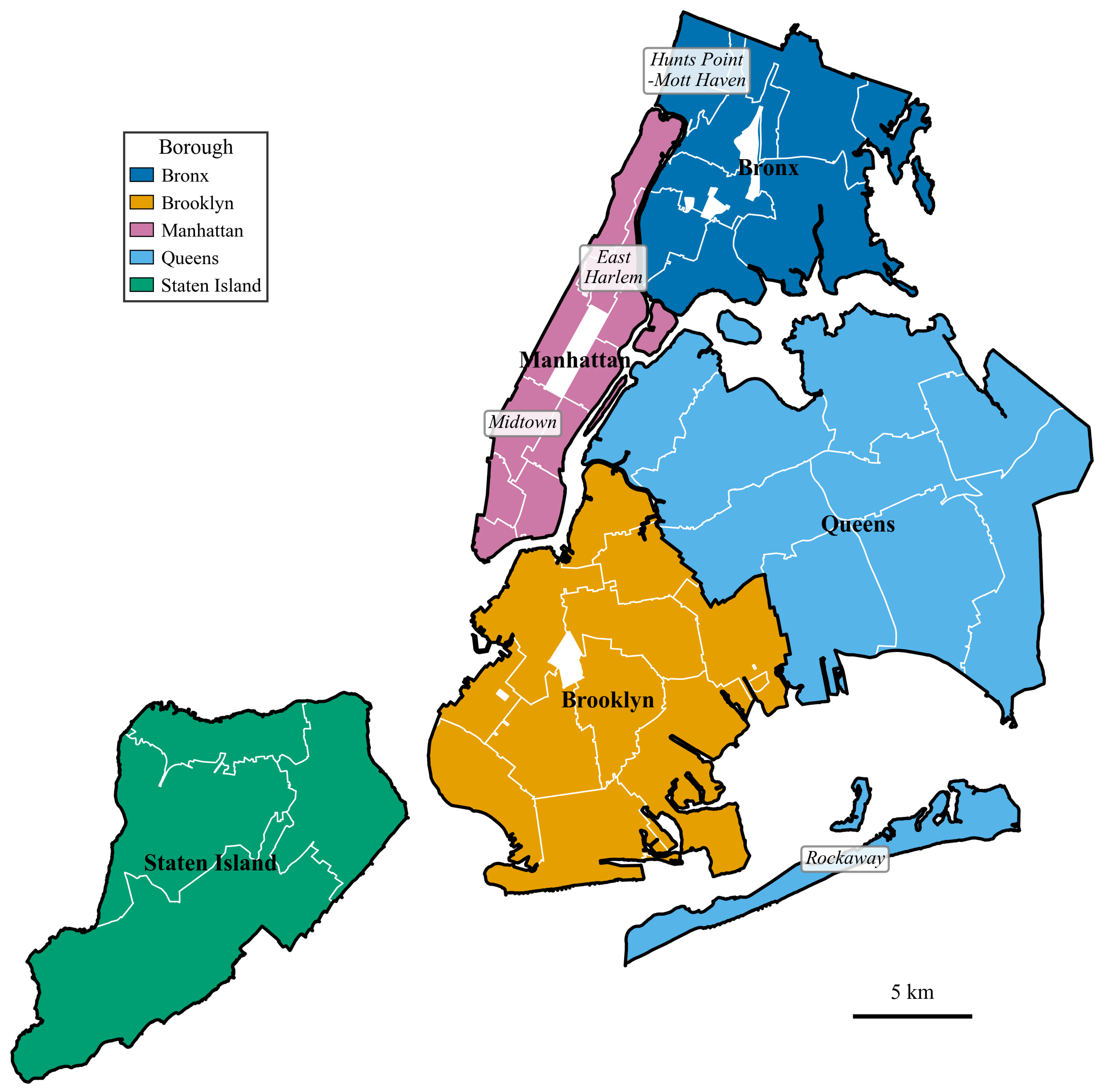
New York City has a total population of around 8.6 million people across its five boroughs (Bronx, Brooklyn, Manhattan, Queens, and Staten Island). The five boroughs are divided into 42 United Hospital Fund (UHF42) neighborhoods, an extant spatial geographic scheme maintained by the New York City (NYC) Department of Health and Mental Hygiene for health surveillance in the city [3]. The UHF42 boundaries are defined as aggregations of ZIP Code Tabulation Areas that are intended to produce stable health statistics while maintaining meaningful sociodemographic variation. Each neighborhood includes roughly 100,000 to 300,000 people. UHF42 is the finest spatial scale at which there is a consistent collection of publicly available childhood asthma emergency department (ED) data for New York City for the full period of 2009–2023. In past NYC health research, UHF42 was used as the spatial framework for analyzing health-related processes [4,16,34]. We utilize UHF42 as the common geographic denominator to relate exposure, health, and socioeconomic data as they are available within the context of this analysis (Figure 1).

2.2. Air Quality Data

Annual average NO2 concentrations were obtained from the New York City Community Air Survey (NYCCAS), which has operated a dense street-level monitoring network across NYC since December 2008 [17,18]. NYCCAS produces annual land-use regression surfaces at a 300 m resolution in the NAD83 New York State Plane coordinates (EPSG:2263). LUR predicts pollution concentrations as a function of local land use, traffic, building density, and meteorological variables, and has been validated with independent monitoring data [17]. We used 15 annual rasters spanning NYCCAS monitoring years 1 through 15, mapped to calendar years 2009 through 2023 based on predominant temporal overlap.
Four pollutants from NYCCAS were available: NO2 (ppb), PM2.5 (micrograms per cubic meter; μg/m3), black carbon (BC), and nitric oxide (NO). We chose NO2 as the primary exposure variable because it has the strongest intra-urban spatial gradient across the four pollutants, is widely used as an indicator of combustion-source emissions in urban environments [17,18], and has consistent epidemiological evidence of associations with pediatric asthma development [8] and exacerbation [9]. Results for PM2.5 and BC are reported in Supplementary Table S1. NO was not analyzed separately because NO and NO2 are co-emitted from combustion sources and interconvert rapidly in the atmosphere, providing relatively redundant spatial information [17,18]. Existing meta-analyses have also focused on NO2 rather than NO as the primary indicator with independent health evidence [8,9]. Throughout this study, NO2 is interpreted as an indicator of the neighborhood-level combustion-related air quality mix rather than as an isolated toxicological agent.

2.3. Exposure Aggregation Framework

Converting 300 m raster pixels into neighborhood-level exposure estimates requires a process of aggregation, the implications of which for equity inferences are not often scrutinized [27]. Evidence in the MAUP literature shows that both the zoning schema and aggregation function can influence analytical conclusions [28,29], yet most studies of air pollution and health employ a single type of aggregation without sensitivity analysis. We employed three different methods and applied them to all 60 pollutant-year raster layers and compared results throughout the analysis.
The area-weighted mean computes the unweighted zonal mean over all pixels within each UHF42 polygon. This is the default approach in studies using LUR surfaces for health assessment [35]. It provides equal weight to all land areas including parks, industrial zones, and highways.
The population-weighted mean weights each 300 m pixel by the estimated residential population from the Global Human Settlement Layer Population Grid (GHS-POP R2023A, Epoch 2020) [36], resampled from its native 100 m resolution to the NYCCAS 300 m grid. Population-weighted exposure has been recommended in the exposure assessment literature as a more relevant measure of residential exposure, especially in areas where the land-use layout is more heterogeneous [27,30].
The residential land-use-weighted mean weights each 300 m pixel by a binary residential indicator derived from NYC’s MapPLUTO tax lot database (version 25v4, January 2026) [37]. Land-use categories 01 through 04 (one- and two-family, multi-family walk-up, multi-family elevator, and mixed residential-commercial) were set to residential. This includes 767,494 of 856,670 lots. Land-use masking has been recommended in the literature as a simpler alternative to population weighting for eliminating non-residential areas [30].
We also calculated the coefficient of variation (CV) of pixel values within each UHF42 zone for each year as a diagnostic of within-neighborhood exposure heterogeneity. Higher CVs represent greater potential for sensitivity to the method of aggregation. Whether the three methods produce different equity conclusions depends on the spatial scale and the correlation between within-unit exposure heterogeneity and neighborhood socioeconomic status.

2.4. Health Outcome Data

Childhood asthma ED visit rates were obtained from the NYC Environment and Health Data Portal [3], which reports indicators derived from the New York State SPARCS deidentified hospital discharge records [38]. These measures reflect the annual estimated rate of asthma-related ED visits per 10,000 children aged 5–17 at the UHF42 level. We chose this age group as the aggregate diagnostic boundary for childhood asthma remained stable across the ICD-9 to ICD-10 coding transition in October 2015. Primary asthma codes (ICD-9: 493, ICD-10: J45) capture the same clinical population in children, as opposed to adults, where there is a reclassification of COPD-asthma overlap codes during the transition [39]. The dataset comprises 630 observations (42 neighborhoods over 15 years) with no missing or suppressed values. ED visits are less sensitive than hospitalizations to changes in preventive care and clinical management, and thus a more direct reflection of acute exacerbation burden [40]. This outcome captures neighborhood-level childhood asthma burden as reflected in ED utilization, while incorporating underlying respiratory morbidity, severity of exacerbation, healthcare access, and decision-making of caregivers.

2.5. Socioeconomic Data

Neighborhood socioeconomic characteristics were derived from the American Community Survey (ACS) 5-year estimates at the census tract scale, via the US Census Bureau API [41]. Seven periods (ending years 2011 through 2023) were downloaded, providing tract-level poverty rates, racial and ethnic composition, and total tract populations. Tract-level data were aggregated to UHF42 using a population-weighted spatial crosswalk. Each of 2225 New York City census tracts (2020 boundaries) was then assigned to a UHF42 zone according to the tract centroid location. The final distribution of 42 zones received tract assignments. The ACS values were then linearly interpolated to annual frequency for 2009–2023. Poverty rate is the key deprivation indicator here.

2.6. Spatiotemporal Trend Analysis

For each UHF42 neighborhood, we estimated the Theil–Sen median slope [42,43] of annual NO2 concentration and asthma ED visit rate over 2009–2023. Spatial convergence was assessed by computing the Pearson correlation between the 2009 baseline value and Theil–Sen slope for all 42 neighborhoods. The strong negative correlation indicates that neighborhoods with higher initial values improved faster, known as spatial convergence [44].

2.7. Panel Fixed-Effects Model

The within-neighborhood association between NO2 and childhood asthma ED burden was estimated using a two-way fixed-effects panel model:
log ( ED _ rate ) i t = β NO 2 i t + α i + δ t + ε i t
where i indexes the 42 UHF42 neighborhoods and t indexes the 15 study years (2009–2023). The dependent variable log ( ED _ rate ) i t is the natural logarithm of the asthma ED visit rate per 10,000 children aged 5–17 in neighborhood i in year t . NO 2 i t is the annual mean nitrogen dioxide concentration (ppb) in neighborhood i in year t , computed using one of the three aggregation methods described above. The coefficient β represents the semi-elasticity: a one-ppb change in NO2 is associated with a 100 times β percent change in the ED visit rate. The term α i represents neighborhood fixed effects that absorb all time-invariant characteristics of each neighborhood, including geography, housing stock, and baseline sociodemographic composition. The term δ t represents year fixed effects that absorb citywide annual shocks common to all neighborhoods, such as influenza seasons, policy changes, or economic fluctuations. The term ε i t is the idiosyncratic error. Standard errors are clustered at the UHF42 level to account for serial correlation within neighborhoods [25,26]. The coefficient β is identified from within-neighborhood, within-year deviations: after removing each neighborhood’s temporal mean and each year’s cross-sectional mean, β captures whether a neighborhood’s ED rate deviates when its NO2 concentration deviates from its expected trajectory [45].
Five specifications were estimated to assess robustness. The baseline specification includes two-way fixed effects. The second excludes COVID-disrupted years 2020–2021 [46]. The third adds borough-specific linear time trends. The fourth implements a lead test using NO2 at time t + 1 to predict the ED rate at time t . This serves as a placebo test, because future pollution should not predict current health if the model is correctly specified [47]. The fifth estimate first-differences (FDs), where year-to-year changes in log ( ED _ rate ) are regressed on year-to-year changes in NO2 with year fixed effects. FD directly exploits annual increments and is more robust to serial correlation in levels [25]. All five specifications were repeated using each of the three aggregation methods.
We also computed Moran’s I [48] on the pooled two-way fixed-effects residuals using Queen contiguity spatial weights across the 42 UHF42 zones to test for residual spatial autocorrelation. UHF42 zone 410 (Rockaway) is a geographic island with no contiguous neighbors. Significant spatial autocorrelation would suggest that spatially correlated omitted variables may bias inference [49].

2.8. Health Equity Assessment

Health equity was evaluated along two dimensions [31,33]. To assess whether the dose–response relationship varies by neighborhood deprivation (slope equity), we estimated an interaction model:
log ( ED _ rate ) i t = β 1 NO 2 i t + β 2 NO 2 i t × Poverty _ z i + α i + δ t + ε i t
All variables are defined in Equation (1). The additional term Poverty _ z i is the neighborhood’s time-averaged poverty rate for neighborhood i , standardized to a mean of 0 and standard deviation of 1 over the 42 neighborhoods. The interaction term NO 2 i t × Poverty _ z i tests whether the NO2-ED association differs by neighborhood poverty level. The coefficient β 1 represents the NO2-ED association for a neighborhood with a poverty level at the distribution mean (where Poverty _ z i = 0). The coefficient β 2 represents how much that association changes as poverty increases by 1 standard deviation. The effect of a negative β 2 is that higher-poverty neighborhoods experience a larger rate of ED visits avoided per unit of NO2 decrease. Because α i already absorbs the time-invariant main effect of poverty on ED rates, the main effect of Poverty _ z i cannot be separately estimated. Only the interaction between poverty and the time-varying NO2 variable is identified.
To assess how the absolute health gains are distributed across neighborhoods (burden equity), we computed the fitted avoided ED burden per neighborhood as the product of the regression coefficient, the neighborhood’s NO2 change, and the baseline ED rate. Concentration curves were constructed by ranking neighborhoods from least to most deprived and plotting cumulative avoided burden against cumulative neighborhood share [33,50]. The concentration index summarizes whether gains are pro-poor (negative) or pro-rich (positive) [51]. Avoided burden was computed using both the internal panel coefficient and a literature-based concentration-response function of 0.005 per ppb, corresponding to the upper end of meta-analytic estimates for short-term NO2 exposure and asthma ED visits [9]. This is a literature estimate based on daily exposure metrics and is not directly comparable to annual neighborhood-level averages used in our panel, but it is still useful to compare relative to our results in the distributional analysis. In both analyses, the three different aggregation methods were tested. To decompose the sources of the pro-poor distribution, we constructed a counterfactual scenario in which each neighborhood’s actual NO2 decline was replaced with the citywide mean decline. The baseline ED rate and the regression coefficient were constant. The fitted avoided burden was then recomputed and aggregated by poverty quintile. If the observed and counterfactual quintile shares are similar, the pro-poor pattern is driven by baseline rate inequality. Otherwise, differential pollution reduction is a factor as well.

3. Results

3.1. Descriptive Overview

The analysis panel includes 630 observations (42 neighborhoods × 15 years) with no missing values on key variables. Table 1 shows the descriptive statistics. Citywide mean NO2 fell from 25.6 ppb in 2009 to 16.7 ppb in 2023, a decrease of 8.9 ppb (35%). The ED rates of childhood asthma (5–17-year-olds) fell from 187.8 to 133.1 per 10,000, a 29% reduction, during the study period. Cross-sectional within-city variation was substantial in each year. In 2009, neighborhood NO2 ranged from 14.0 ppb in southern Staten Island to 43.4 ppb in Midtown Manhattan, and ED rates ranged from 3.7 in Greenwich Village to 610.9 per 10,000 in Hunts Point-Mott Haven. Poverty rates ranged from 5.1% to 43.3% across UHF42 zones.
The three NO2 aggregation methods produced nearly identical values throughout the panel. The mean within-UHF42 coefficient of variation for NO2 declined from 0.105 in 2009 to 0.088 in 2023, indicating moderate and slightly decreasing intra-neighborhood exposure heterogeneity.

3.2. Spatial Convergence in Air Quality and Health Outcomes

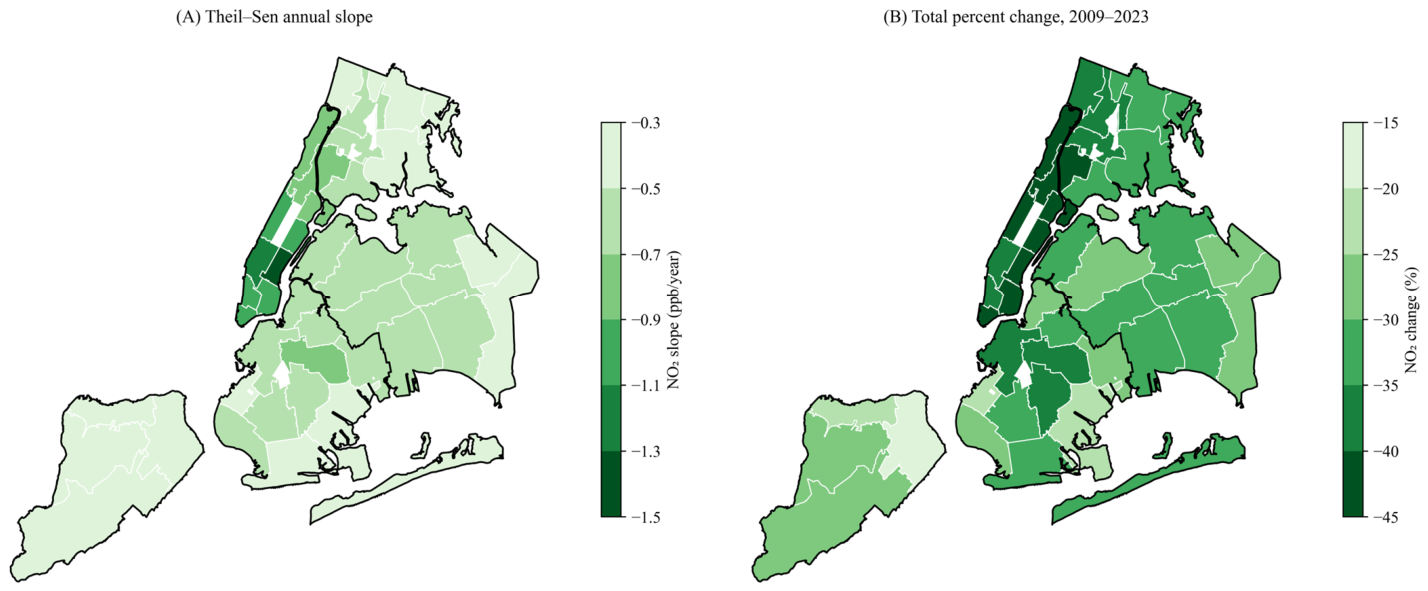
All 42 neighborhoods exhibited NO2 decline over the 2009–2023 period of record. Manhattan experienced the largest mean decline (14.3 ppb, from 34.0 to 19.7), followed by the Bronx (9.1 ppb), Brooklyn (7.6 ppb), Queens (6.6 ppb), and Staten Island (4.2 ppb) (Figure 2). This spatial pattern reflects the high baseline concentrations in Manhattan, which were driven by traffic density and commercial building heating [17,18].
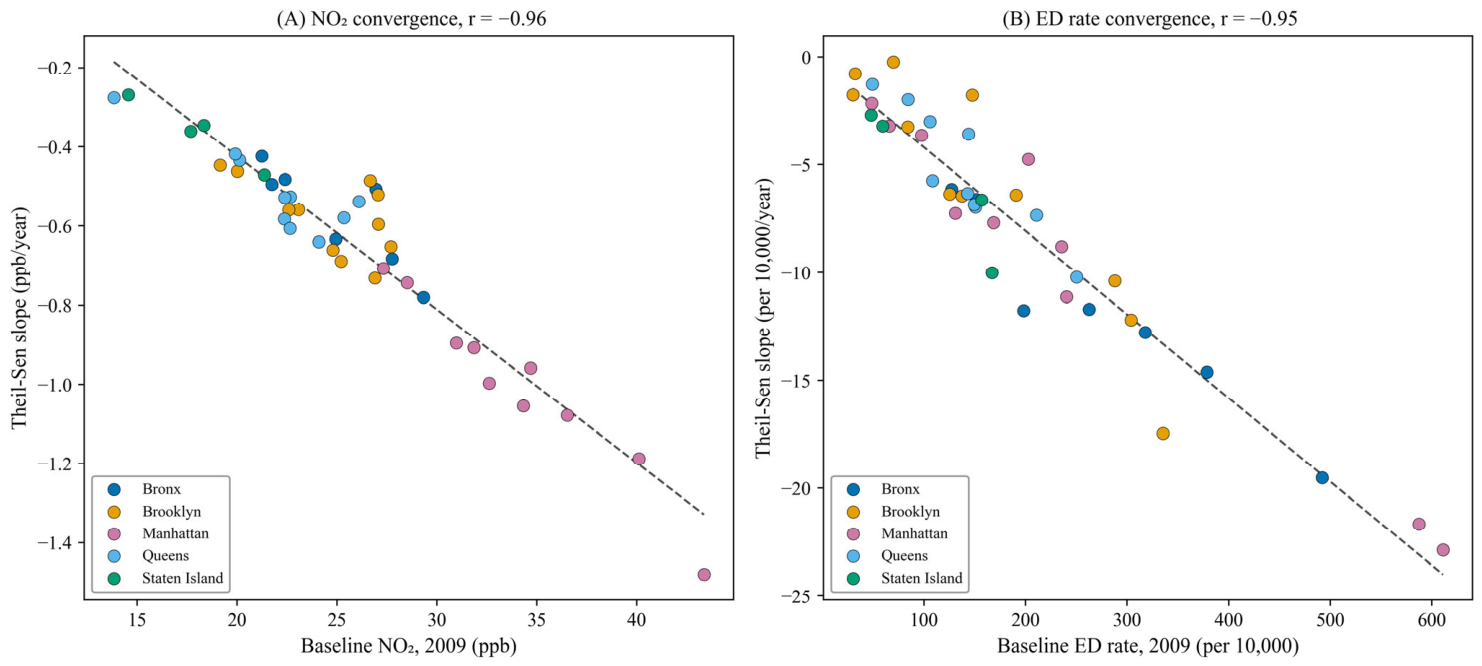
The Pearson correlation between baseline NO2 (2009) and the Theil–Sen slope was −0.96 (Figure 3A). This indicates strong spatial convergence that neighborhoods which started with the highest concentrations improved the fastest. Parallel convergence was also found in the childhood asthma ED visit rate, with a baseline-versus-slope correlation of −0.95 (Figure 3B). The neighborhoods with the worst burden in the South Bronx, East Harlem, and Central Brooklyn experienced the steepest declines. By 2023, the interquartile range of NO2 across neighborhoods had narrowed from 10.5 ppb to 4.3 ppb. This compression of the spatial exposure gap is more than half the original difference.
Dual convergence of air quality and health outcomes has been observed. It does not depend on any of the identification assumptions required for regression. Hence, this outcome does not rely on any particular approach to estimating trends.

3.3. Within-Neighborhood Association Between Air Quality and ED Burden

Table 2 contains the panel fixed-effects results in five specifications. The first-difference estimate was statistically significant (coefficient 0.022, standard error 0.011, 95% CI 0.0004 to 0.0436, p-value 0.046). This suggests that a 1 ppb drop in neighborhood NO2 is associated with a 2.2% decline in the asthma ED visit rate for children aged 5–17 years. The direction of the association was consistent and positive across all five specifications, varying between 0.006 and 0.022. Only the first-difference estimate reached conventional significance. The levels fixed-effects estimates were attenuated because year fixed effects absorb the dominant common temporal decline, leaving relatively little residual within-neighborhood variation for identification [25,45]. FD can amplify measurement error, which would bias the coefficient toward zero [25].
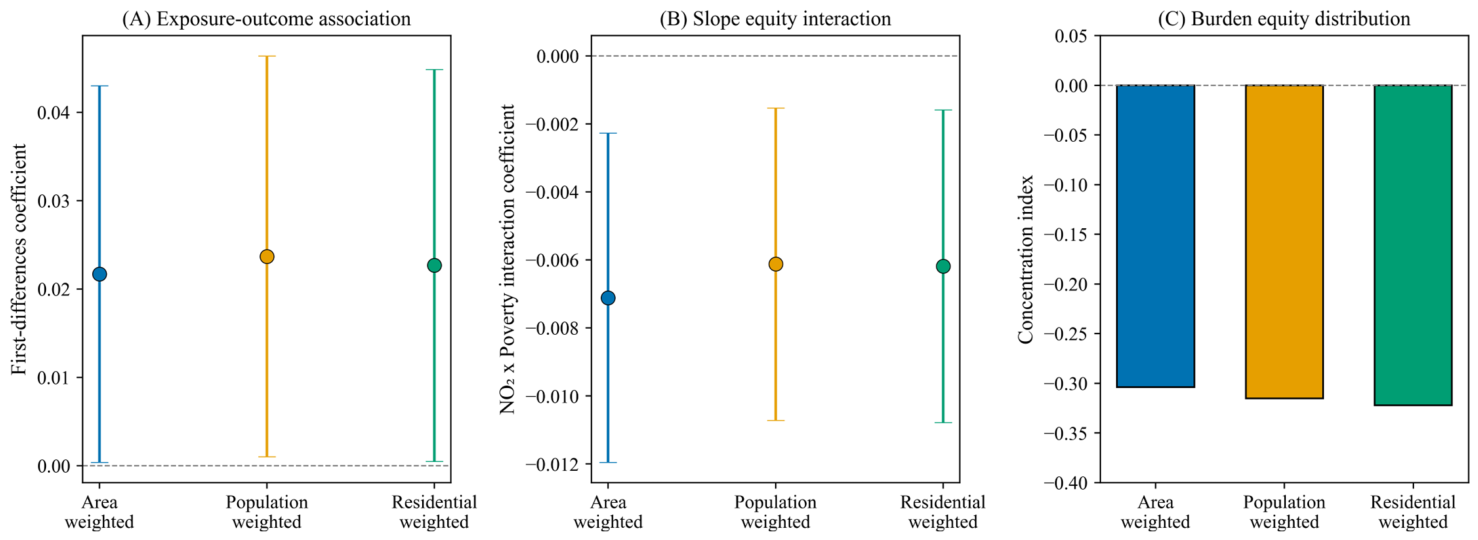
The lead test confirmed that future NO2 does not predict current ED rates (p-value 0.48), supporting the expected temporal ordering. Adding a time-varying covariate, poverty rate, changed the coefficient on NO2 by approximately 6% (Table S2), suggesting that the association is not confounded by concurrent socioeconomic changes. Among the four alternative childhood outcomes (Table S3), the three showed the same consistent positive direction as in Table 2. The first-difference estimate was consistent across all three aggregation methods (area-weighted 0.022, population-weighted 0.024, residential-weighted 0.023), all statistically significant and all within 10% of each other.
The FD estimate based on the 8.9 ppb citywide NO2 decline would imply an equivalent ~20% ED rates reduction, comparable in magnitude to roughly two-thirds of the observed 29% decline. The remainder of the decline is likely due in large part to concurrent changes in medical and healthcare management, housing conditions, and other factors [2].

3.4. Distribution of Health Benefits Across Neighborhoods

The most deprived neighborhoods benefited proportionately more from avoided burden than the least deprived. This is the main finding for equity.

3.4.1. Burden Equity

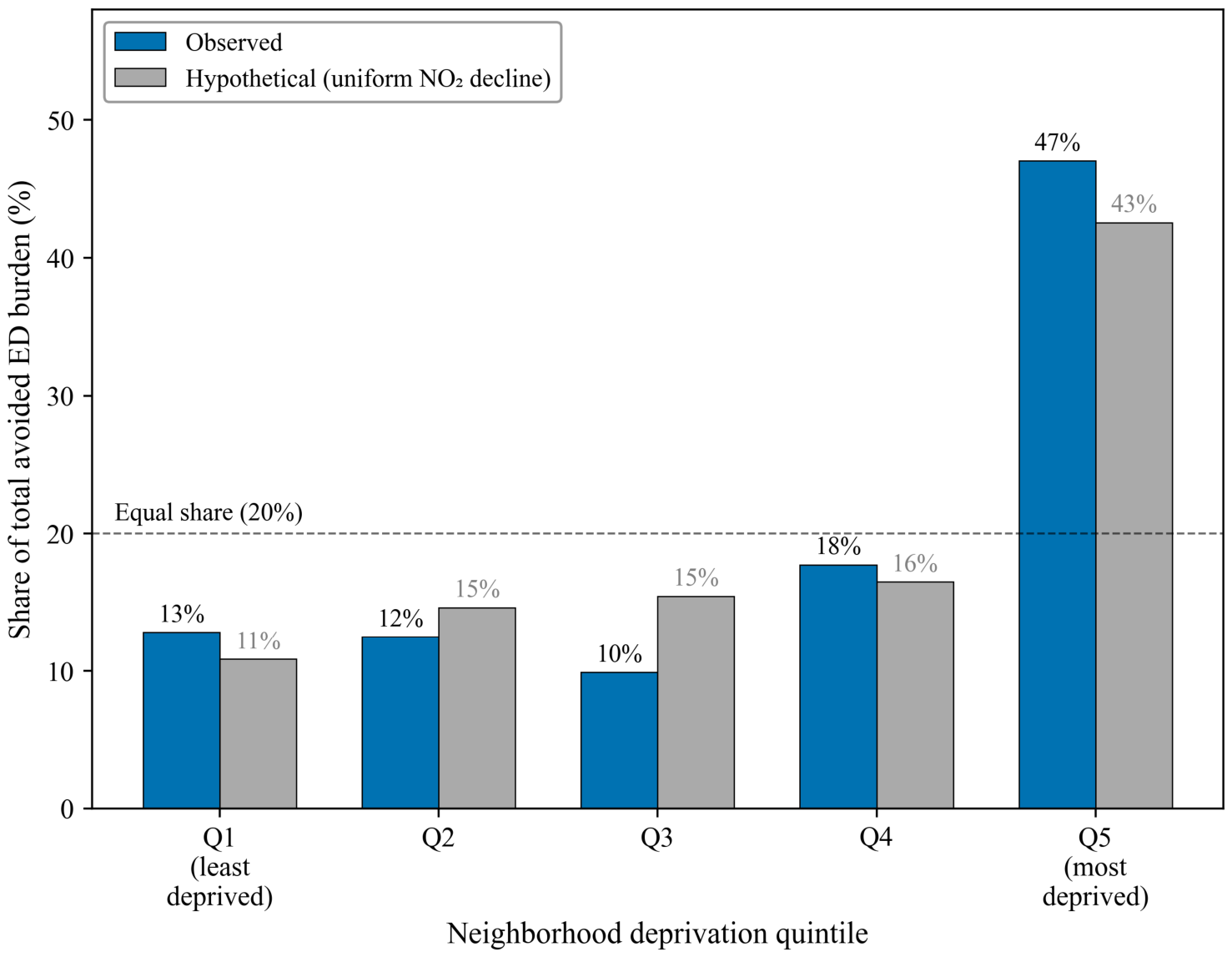
Using the first-difference estimate (coefficient 0.022), we compute the fitted avoided ED burden for each neighborhood. We present the distribution of avoided burden across deprivation quintiles in Figure 4. The distribution is strongly pro-poor: concentration index −0.30.
We decompose the avoided burden by poverty quintiles in Table 3. The most deprived quintile (Q5, mean poverty 31.8%) received 47% of the total avoided burden, about 4 times the share of the least deprived quintile (Q1: 9% poverty, share 13%).
The pro-poor distribution in disease burden that we find is primarily driven by baseline inequality. The ratio of mean baseline ED rates between the most and least deprived quintiles is about 3.9 (373 per 10,000 compared with 95 per 10,000). Mean NO2 decline was almost identical across quintiles (9.9 ppb in Q5 compared with 10.1 ppb in Q1), so that convergence in NO2 does not occur along the poverty gradient. This is because NO2 convergence occurs along the pollution gradient rather than the poverty gradient. For example, Manhattan neighborhoods are among the wealthiest but have the highest baseline NO2 and the largest absolute reduction in NO2. As a result, the approximately fourfold ratio of avoided burden between the most and least deprived quintiles is nearly completely explained by a fourfold difference in baseline asthma rates, rather than through differential improvement in air quality.
We also find the result is robust to which the concentration-response function we use to calculate individual burden. Applying the literature-based estimate (0.005) in place of the internal coefficient produces an identical distributional pattern across quintiles. And burden equity was also stable across all three aggregation methods, with concentration indices of −0.30, −0.32, and −0.32.

3.4.2. Slope Equity

The interaction model yields a coefficient of −0.007 on the NO2-poverty interaction (p-value 0.004), indicating that the high-deprivation neighborhoods have a stronger dose–response to air quality improvement. The findings are stable under all three aggregation methods (all significant at the 0.01 level). But the interaction was not replicated in the FD specification (p-value 0.40), and stratified regressions by poverty group give mostly non-significant results with only 14 neighborhoods per group. The levels FE interaction draws on both within- and between-neighborhood variation, while FD uses only year-to-year changes, which is a more demanding test with less statistical power. Hence, the slope equity finding should be considered exploratory. The burden equity conclusion does not depend on this interaction. Even if dose–response slopes were identical across neighborhoods, we would find a pro-poor distribution of avoided burden as an implication of higher baseline rates in the poorer neighborhoods.

3.5. Sensitivity of Results to Exposure Aggregation

At the UHF42 spatial resolution in NYC, the three methods of aggregation produced near-identical inferences for all measures of interest. The results across these three aggregation methods are shown in Figure 5.
The within-UHF42 CV for NO2 strongly predicted the divergence between area-weighted and population-weighted estimates (Pearson correlation 0.87). Zones with more heterogeneous land use were more likely to diverge between methods. This confirms that aggregation method sensitivity is a real, measurable phenomenon at this resolution. The critical finding, however, is that this heterogeneity was not correlated with neighborhood deprivation (Pearson correlation −0.14; Figure S1). The neighborhoods where methods diverge most are not systematically the poorest or the richest. This decoupling of exposure heterogeneity and socioeconomic status is what leads the three methods to converge on the same conclusion concerning equity. The divergence between methods is real, but because it is not concentrated in either high-poverty or low-poverty neighborhoods, it does not shift the equity gradient in any particular direction. If CV were positively correlated with deprivation, population-weighted estimates would systematically differ in deprived neighborhoods from area-weighted estimates and could shift the equity gradient.
These results are specific to the UHF42 spatial resolution in a densely built city. Aggregation would likely matter more in settings with larger administrative units, greater within-unit land-use heterogeneity, and greater correlation between that heterogeneity and socioeconomic composition [28,29,30]. Pooled Moran’s I on 2-way fixed-effects residuals was 0.155 (p-value 0.071), marginally non-significant under permutation-based inference. It is also worth noting that Rockaway (Zone 410) was treated as an island with no contiguous neighbors in the spatial weights matrix in this study. However, it is connected by the Marine Parkway Bridge to Coney Island-Sheepshead Bay (Zone 210) and by the Cross Bay Bridge to Southwest Queens (Zone 407) in real life. We tested an alternative weights matrix that included these bridge connections. The pooled Moran’s I changed from 0.155 to 0.154, and no year-level result changed in significance or direction.

4. Discussion

4.1. Dual Convergence as an Empirical Foundation

Both NO2 and childhood asthma ED burden showed strong spatial convergence across the 2009–2023 study period (Pearson correlations of −0.96 and −0.95). Neighborhoods with initially the worst conditions improved at the fastest rate and reduced their spatial inequality gap by more than half in 15 years.
Panel fixed-effects estimations provide additional longitudinal evidence for the exposure-outcome link. The first-difference estimate (coefficient 0.022, p-value below 0.05) has a direction of association consistent across all specifications, is insensitive to the addition of time-varying poverty rate and racial composition and is stable across aggregation methods. Considering the ecological nature of the design, the coefficient takes into account neighborhood-level associations rather than individual-level effects [52,53], and this is reflected in the marginal p-value, as limited within-neighborhood variation is available for identification once the common year trends are absorbed. The FD and two-way FE specifications yield different estimates (0.022 and 0.009, respectively) because they exploit different sources of variation. Two-way FE relies on deviations from neighborhood and year means, but when all neighborhoods share a common decline, year effects absorb most of the identifying variation. FD eliminates neighborhood-specific levels and picks out year-to-year co-movements in NO2 and ED rates, which represent a different and more informative source of variation in this context. That the FD estimate is larger than the two-way FE estimate is thus not consistent with noise-driven inflation. For data with strong shared trends, as in this study, we therefore rely on the FD estimate as the primary specification.

4.2. Convergence, Baseline Inequality, and the Distribution of Health Gains

Environmental justice research has extensively documented that pollution burdens are disproportionately concentrated in disadvantaged communities [5,6,20,21,22]. When regulatory benefits are assessed, the distributional question is typically framed in terms of exposure reduction: did disadvantaged communities receive larger pollution decreases [32,54]? Less attention has been given to a distinct question: how the distribution of baseline health burden shapes the equity profile of health benefits, independent of differential pollution reduction. In NYC, these two questions yield different answers. Pollution reduction was not pro-poor, but health benefit distribution was.
Across poverty quintiles, NO2 reductions were nearly identical, with 9.9 ppb in the most deprived quintile compared with 10.1 ppb in the least deprived. There is no evidence that the most deprived neighborhoods received more air quality improvement. They nonetheless received 47% of the total avoided asthma ED burden, approximately four times the share of the least deprived quintile. Baseline asthma ED rates in the most deprived neighborhoods were four times higher than in the least deprived (373 compared with 95 per 10,000). Equal percentage reductions applied to a fourfold higher baseline produce fourfold larger absolute gains.
It is worth pointing out that the pro-poor concentration of avoided burden reflects larger absolute gains in high-burden neighborhoods, but it does not close the underlying health disparity. If both groups experience similar percentage reductions, the ratio of ED rates between the most and least deprived quintiles remains approximately the same after the improvement, while the air quality gains are distributed progressively in absolute terms and the relative gap in health outcomes persists.
Manhattan illustrates this disconnect. Manhattan is one of the wealthiest areas in NYC, but it also has the highest baseline NO2 concentrations and the biggest absolute reductions over 2009–2023, largely driven by commercial building density and traffic. If the equity assessment were restricted to pollution reduction, Manhattan would appear to be the biggest beneficiary of citywide regulation. And Manhattan’s childhood asthma ED rate was among the lowest in the city. But the large pollution reductions there translated into modest health gains. In contrast, South Bronx neighborhoods experienced average NO2 reductions but asthma ED rates that were 5–6 times higher than in Manhattan and thus received a much larger share of the avoided health burden.
NO2 convergence is real (with a Pearson correlation between baseline and slope of −0.96), and convergence represented a real narrowing of the exposure gap. But it operated along the pollution gradient, not the poverty gradient. These two gradients overlap in many NYC neighborhoods but diverge in sharp fashion in Manhattan. This divergence indicates that the conventional framing of environmental equity assessment, which asks whether pollution improvements were pro-poor, misses the dominant driver of the distribution of health benefits in this setting. The more relevant question is whether baseline health burden is concentrated in disadvantaged communities, because that concentration determines how evenly or unevenly a uniform environmental improvement translates into health gains.
For regulatory evaluation, this means that citywide emission standards producing the same level or proportion of pollution reductions could still result in pro-poor distributions of health benefits, as long as health disparities are large enough in the baseline distribution. Where baseline health disparities are small or where pollution reduction is strongly correlated with poverty, the distributional outcome would differ. In NYC, the fourfold difference in the baseline asthma ED rate between the most and least deprived quintiles translated to a nearly fourfold concentration in avoided burden, even with no differential pollution reduction. This pattern may exist in other US cities where the disease burden is concentrated in disadvantaged communities [20,22,55], but has seen limited focus in environmental benefit assessment. At the same time, air quality improvements alone do not directly address the drivers of health disparities behind these differences, such as housing quality, exposure to indoor allergen sources, and lack or limited access to healthcare [56,57].

4.3. When Exposure Aggregation Matters for Equity Inference

The discovery of identical results for three different aggregation approaches identifies the conditions where this choice does not affect the equity conclusion. The observation of real, within-UHF42 exposure heterogeneity with measurable method divergence (positive correlation between coefficient of variation and method divergence of 0.87) confirms that this methodological concern is far from purely theoretical. That heterogeneity is not associated with neighborhood socioeconomic status (negative correlation of −0.14), so it does not bring systematic bias in the equity gradient. UHF42 zones are quite small in size (averaging around 20 km2 with around 119 raster pixels each), so residential populations are spread over most of the zone area, leaving little scope for aggregation choice to shift the results.
Sensitivity to exposure aggregation would likely be relevant in settings with larger administrative units, greater within-unit land-use heterogeneity, and stronger correlations between this heterogeneity and neighborhood poverty [28,29]. In these cases, studies should not rely on the same observed robustness. The diagnostic approach proposed in this study, comparing within-unit exposure variability to neighborhood deprivation for assessing whether aggregation choice could induce systematic bias in equity conclusions, is applicable in other urban settings. The insensitivity of equity conclusions to aggregation method is specific to contexts where exposure heterogeneity is not aligned with socioeconomic gradients. Researchers applying this framework elsewhere should first test the correlation between within-unit exposure variability and neighborhood poverty.

4.4. Ecological Effect Estimates and the Role of Correlated Improvements

The internal coefficient (0.022, or 2.2% per ppb) exceeds the literature-based concentration-response function (0.005) by approximately a factor of four. We discuss two factors which may contribute to this finding. First, ecological approaches can yield different coefficients from those at the individual level because the neighborhood-level exposure-outcome association reflects between-group variation, which may not correspond to within-individual effects [52,53]. The exposure metric may also be different: our estimated coefficient can be thought of as relating annual neighborhood-mean NO2 to annual ED rates, while the literature-based concentration-response estimates that underlie our external effects relate daily individual-level concentrations to short-term health outcomes. The neighborhood-level NO2 change also captures correlated improvements to the entire combustion source mix, and is not limited to the effects of NO2 in isolation [18].
This study extends prior NYCCAS health burden assessments [4,16] in three ways. First, a 15-year panel replaces cross-sectional snapshots. Second, an internal exposure-response estimate supplementing external literature-based functions is utilized. Finally, aggregation sensitivity is explicitly tested. The equity framework applied in this study builds upon advances in health inequality measurement [33,51,58] that have not been widely employed in air quality health assessments.

4.5. Limitations

This is an ecological study with both exposure and outcome measured at the neighborhood level. Individual-level causal inference cannot be performed [52,53]. Selective migration may also introduce bias if families with asthmatic children move to lower-pollution neighborhoods over time. Entity fixed effects absorb time-invariant neighborhood characteristics but not compositional changes within neighborhoods. The ED visit rate is a measure of underlying morbidity and healthcare utilization patterns. Temporal changes in urgent care availability, insurance coverage, or care-seeking behavior could affect the study outcome independent of air quality [40]. More broadly, changes in housing conditions, indoor allergen remediation programs, and healthcare accessibility over the 15-year study period may co-vary with air quality improvements and cannot be ruled out as confounders. NO2 is an indicator of combustion-source exposure, and the coefficient captures the association with the correlated exposure bundle [18]. The sample size only consists of 42 spatial units for 15 time periods, and power for within-neighborhood fixed-effects identification is limited. The slope equity finding is specification-dependent, where the significant result is found in levels fixed effects but not in first-differences. The aggregation robustness finding is specific to the NYC UHF42 geography at the 300 m resolution and does not necessarily generalize to other spatial scales and urban forms [28]. The NYCCAS monitoring network covers New York City only. Neighborhoods at the city boundary may be influenced by pollution sources in adjacent jurisdictions that are not fully captured by the land-use regression model. Excluding the COVID-era (2020–2021) period for sensitivity analysis yields stable results; however, post-pandemic rebound effects in the morbidity and healthcare utilization patterns cannot be entirely ruled out [46].

4.6. Future Directions

Finer spatial units such as Neighborhood Tabulation Areas would increase sample size and spatial resolution. Health data availability at this scale remains limited for childhood asthma. Individual-level record linkage between geocoded discharge data and exposure models would address the ecological design limitation. Multi-city replication would test whether the relationships observed in NYC between air quality convergence, baseline health inequality, and the distribution of health benefits hold in other urban settings [59]. Future studies could test aggregation sensitivity at different spatial scales. This would help determine when aggregation choices begin to affect equity conclusions.

5. Conclusions

NYC showed robust spatial convergence in both NO2 concentrations and childhood asthma ED burden over 2009–2023. Neighborhoods that endured the poorest initial conditions saw the fastest improvements (baseline-to-trend correlations of −0.96 and −0.95). Longitudinal evidence for the exposure-outcome link is provided through panel fixed-effects. The first-difference estimate (coefficient 0.022, p-value less than 0.05) is directionally robust across all specifications, insensitive to the socioeconomic covariates considered, and stable across three aggregation methods.
Health benefits were concentrated in the most deprived neighborhoods. The most deprived quintile received nearly half the total avoided ED burden, about four times the share of that avoided by the least deprived quintile. This pattern of distributional results holds regardless of how exposure was aggregated, which concentration-response function was implemented, or which measure of deprivation was employed. It stems primarily from inequality in baseline disease burden. Neighborhoods with higher poverty rates witnessed higher rates of asthma ED. When the same percent reduction was applied to a larger baseline, it resulted in a larger absolute benefit. NO2 convergence was along the pollution gradient rather than the poverty gradient. As such, the pro-poor distribution of health gains primarily reflects inequality in health pre-regulation, rather than differential improvement in air quality across social strata.
At the UHF42 spatial scale in NYC, the three aggregation approaches (area-weighted, population-weighted, and residential-weighted) lead to nearly identical findings. The reassuring consistency of conclusions here has implications for the present assessment but is not generalizable without due testing. The three-method comparison framework is a readily transferable diagnostic for future geospatial health equity assessments.
These findings reflect the specific spatial structure of NYC, where baseline disease burden is concentrated in high-poverty neighborhoods and pollution reduction was not correlated with poverty. Cities with different spatial patterns may show different distributional outcomes. Citywide environmental policies may be associated with health benefits that go mostly to disadvantaged communities. This is not because these communities see bigger drops in pollution. It is because they start with higher disease rates. This finding matters for how we evaluate who benefits from environmental regulations. It also helps us understand how existing health gaps affect who gains the most from environmental improvements.

Supplementary Materials

The following supporting information can be downloaded at: https://www.mdpi.com/article/10.3390/ijgi15050216/s1, Table S1: Complementary pollutants: black carbon (BC) and PM2.5 single-pollutant panel regression estimates; Table S2: Confounder sensitivity: NO2 first-difference coefficient with and without time-varying poverty rate and racial composition; Table S3: Alternative health outcomes: panel fixed-effects (FE) and first-difference (FD) estimates; Figure S1: Diagnostic scatterplots of within-neighborhood NO2 coefficient of variation versus method divergence and baseline asthma ED rate.

Author Contributions

Conceptualization, Hai Lan and Frances Currin-Brinkman; methodology, Hai Lan; validation, Hai Lan and Frances Currin-Brinkman; formal analysis, Hai Lan; investigation, Hai Lan; data curation, Hai Lan; writing—original draft preparation, Hai Lan; writing—review and editing, Hai Lan and Frances Currin-Brinkman; visualization, Hai Lan; supervision, Hai Lan All authors have read and agreed to the published version of the manuscript.

Funding

This research received no external funding.

Data Availability Statement

All data used in this study are publicly available. Annual NO2 land-use regression surfaces (300 m resolution) are available from the New York City Community Air Survey (NYCCAS) through the NYC Department of Health and Mental Hygiene (https://nyc.gov/health/nyccas) (accessed on 15 January 2026). Childhood asthma emergency department visit rates at the UHF42 level are available from the NYC Environment and Health Data Portal (https://a816-dohbesp.nyc.gov/IndicatorPublic/data-explorer/asthma) (accessed on 15 January 2026). Poverty rates and demographic indicators are available from the American Community Survey through the US Census Bureau (https://data.census.gov) (accessed on 15 January 2026). The GHS-POP population raster is available from the European Commission Joint Research Centre (https://ghsl.jrc.ec.europa.eu/ghs_pop2023.php) (accessed on 15 January 2026). MapPLUTO land use data are available from the NYC Department of City Planning (https://www.nyc.gov/content/planning/pages/resources/datasets/mappluto-pluto-change) (accessed on 15 January 2026). UHF42 neighborhood boundary shapefiles are available from the NYC Environment & Health Data Portal.

Conflicts of Interest

The authors declare no conflicts of interest.

References

  1. Akinbami, L.J.; Moorman, J.E.; Bailey, C.; Zahran, H.S.; King, M.; Johnson, C.A.; Liu, X. Trends in Asthma Prevalence, Health Care Use, and Mortality in the United States, 2001–2010; US Department of Health and Human Services, Centers for Disease Control and Prevention: Atlanta, GA, USA, 2012. [Google Scholar]
  2. Pate, C.A.; Zahran, H.S.; Qin, X.; Johnson, C.; Hummelman, E.; Malilay, J. Asthma surveillance—United States, 2006–2018. MMWR Surveill. Summ. 2021, 70, 1–32. [Google Scholar] [CrossRef]
  3. NYC Department of Health and Mental Hygiene. Environment & Health Data Portal. Available online: https://a816-dohbesp.nyc.gov/IndicatorPublic/ (accessed on 15 January 2026).
  4. Kheirbek, I.; Wheeler, K.; Walters, S.; Kass, D.; Matte, T. PM2.5 and ozone health impacts and disparities in New York City: Sensitivity to spatial and temporal resolution. Air Qual. Atmos. Health 2013, 6, 473–486. [Google Scholar] [CrossRef]
  5. Mohai, P.; Pellow, D.; Roberts, J.T. Environmental justice. Annu. Rev. Environ. Resour. 2009, 34, 405–430. [Google Scholar] [CrossRef]
  6. Bullard, R.D. Dumping in Dixie: Race, Class, and Environmental Quality, 3rd ed.; Routledge: Abingdon, UK, 2018. [Google Scholar]
  7. Morello-Frosch, R.; Pastor, M.; Sadd, J. Environmental justice and Southern California’s “riskscape” the distribution of air toxics exposures and health risks among diverse communities. Urban Aff. Rev. 2001, 36, 551–578. [Google Scholar] [CrossRef]
  8. Khreis, H.; Kelly, C.; Tate, J.; Parslow, R.; Lucas, K.; Nieuwenhuijsen, M. Exposure to traffic-related air pollution and risk of development of childhood asthma: A systematic review and meta-analysis. Environ. Int. 2017, 100, 1–31. [Google Scholar] [CrossRef] [PubMed]
  9. Orellano, P.; Quaranta, N.; Reynoso, J.; Balbi, B.; Vasquez, J. Effect of outdoor air pollution on asthma exacerbations in children and adults: Systematic review and multilevel meta-analysis. PLoS ONE 2017, 12, e0174050. [Google Scholar] [CrossRef] [PubMed]
  10. Strickland, M.J.; Darrow, L.A.; Klein, M.; Flanders, W.D.; Sarnat, J.A.; Waller, L.A.; Sarnat, S.E.; Mulholland, J.A.; Tolbert, P.E. Short-term associations between ambient air pollutants and pediatric asthma emergency department visits. Am. J. Respir. Crit. Care Med. 2010, 182, 307–316. [Google Scholar] [CrossRef]
  11. Alhanti, B.A.; Chang, H.H.; Winquist, A.; Mulholland, J.A.; Darrow, L.A.; Sarnat, S.E. Ambient air pollution and emergency department visits for asthma: A multi-city assessment of effect modification by age. J. Expo. Sci. Environ. Epidemiol. 2016, 26, 180–188. [Google Scholar] [CrossRef]
  12. Brauer, M.; Hoek, G.; Smit, H.; De Jongste, J.; Gerritsen, J.; Postma, D.S.; Kerkhof, M.; Brunekreef, B. Air pollution and development of asthma, allergy and infections in a birth cohort. Eur. Respir. J. 2007, 29, 879–888. [Google Scholar] [CrossRef]
  13. Guarnieri, M.; Balmes, J.R. Outdoor air pollution and asthma. Lancet 2014, 383, 1581–1592. [Google Scholar] [CrossRef]
  14. Hernández, D. Clean heat: A technical response to a policy innovation. Cityscape 2016, 18, 277. [Google Scholar] [PubMed]
  15. US Environmental Protection Agency. Regulations for Emissions from Vehicles and Engines. Available online: https://www.epa.gov/regulations-emissions-vehicles-and-engines (accessed on 15 January 2026).
  16. Kheirbek, I.; Haney, J.; Douglas, S.; Ito, K.; Matte, T. The contribution of motor vehicle emissions to ambient fine particulate matter public health impacts in New York City: A health burden assessment. Environ. Health 2016, 15, 89. [Google Scholar] [CrossRef] [PubMed]
  17. Clougherty, J.E.; Kheirbek, I.; Eisl, H.M.; Ross, Z.; Pezeshki, G.; Gorczynski, J.E.; Johnson, S.; Markowitz, S.; Kass, D.; Matte, T. Intra-urban spatial variability in wintertime street-level concentrations of multiple combustion-related air pollutants: The New York City Community Air Survey (NYCCAS). J. Expo. Sci. Environ. Epidemiol. 2013, 23, 232–240. [Google Scholar] [CrossRef]
  18. Matte, T.D.; Ross, Z.; Kheirbek, I.; Eisl, H.; Johnson, S.; Gorczynski, J.E.; Kass, D.; Markowitz, S.; Pezeshki, G.; Clougherty, J.E. Monitoring intraurban spatial patterns of multiple combustion air pollutants in New York City: Design and implementation. J. Expo. Sci. Environ. Epidemiol. 2013, 23, 223–231. [Google Scholar] [CrossRef]
  19. NYC Department of Health and Mental Hygiene. New York City Community Air Survey. Available online: https://nyc.gov/health/nyccas (accessed on 15 January 2026).
  20. Hajat, A.; Hsia, C.; O’Neill, M.S. Socioeconomic disparities and air pollution exposure: A global review. Curr. Environ. Health Rep. 2015, 2, 440–450. [Google Scholar] [CrossRef]
  21. Clark, L.P.; Millet, D.B.; Marshall, J.D. National patterns in environmental injustice and inequality: Outdoor NO2 air pollution in the United States. PLoS ONE 2014, 9, e94431. [Google Scholar] [CrossRef]
  22. Tessum, C.W.; Apte, J.S.; Goodkind, A.L.; Muller, N.Z.; Mullins, K.A.; Paolella, D.A.; Polasky, S.; Springer, N.P.; Thakrar, S.K.; Marshall, J.D. Inequity in consumption of goods and services adds to racial–ethnic disparities in air pollution exposure. Proc. Natl. Acad. Sci. USA 2019, 116, 6001–6006. [Google Scholar] [CrossRef]
  23. Currie, J.; Neidell, M.; Schmieder, J.F. Air pollution and infant health: Lessons from New Jersey. J. Health Econ. 2009, 28, 688–703. [Google Scholar] [CrossRef] [PubMed]
  24. Sanders, N.J. What doesn’t kill you makes you weaker: Prenatal pollution exposure and educational outcomes. J. Hum. Resour. 2012, 47, 826–850. [Google Scholar] [CrossRef]
  25. Wooldridge, J.M. Econometric Analysis of Cross Section and Panel Data, 2nd ed.; MIT Press: Cambridge, MA, USA, 2010. [Google Scholar]
  26. Angrist, J.D.; Pischke, J.-S. Mostly Harmless Econometrics: An Empiricist’s Companion; Princeton university press: Princeton, NJ, USA, 2009. [Google Scholar]
  27. Jerrett, M.; Arain, A.; Kanaroglou, P.; Beckerman, B.; Potoglou, D.; Sahsuvaroglu, T.; Morrison, J.; Giovis, C. A review and evaluation of intraurban air pollution exposure models. J. Expo. Sci. Environ. Epidemiol. 2005, 15, 185–204. [Google Scholar] [CrossRef]
  28. Openshaw, S. The modifiable areal unit problem. In Concepts and Techniques in Modern Geography; Modern Geography; Geo Books: Norwich, UK, 1984. [Google Scholar]
  29. Fotheringham, A.S.; Wong, D.W. The modifiable areal unit problem in multivariate statistical analysis. Environ. Plan. A 1991, 23, 1025–1044. [Google Scholar] [CrossRef]
  30. Marshall, J.D.; Nethery, E.; Brauer, M. Within-urban variability in ambient air pollution: Comparison of estimation methods. Atmos. Environ. 2008, 42, 1359–1369. [Google Scholar] [CrossRef]
  31. O’Neill, M.S.; Jerrett, M.; Kawachi, I.; Levy, J.I.; Cohen, A.J.; Gouveia, N.; Wilkinson, P.; Fletcher, T.; Cifuentes, L.; Schwartz, J. Health, wealth, and air pollution: Advancing theory and methods. Environ. Health Perspect. 2003, 111, 1861. [Google Scholar] [CrossRef] [PubMed]
  32. US Environmental Protection Agency. Guidelines for Preparing Economic Analyses, 3rd ed. Available online: https://www.epa.gov/environmental-economics/guidelines-preparing-economic-analyses-3rd-edition (accessed on 18 February 2026).
  33. Wagstaff, A.; Paci, P.; Van Doorslaer, E. On the measurement of inequalities in health. Soc. Sci. Med. 1991, 33, 545–557. [Google Scholar] [CrossRef] [PubMed]
  34. Kheirbek, I.; Ito, K.; Neitzel, R.; Kim, J.; Johnson, S.; Ross, Z.; Eisl, H.; Matte, T. Spatial variation in environmental noise and air pollution in New York City. J. Urban Health 2014, 91, 415–431. [Google Scholar] [CrossRef]
  35. Hoek, G.; Beelen, R.; De Hoogh, K.; Vienneau, D.; Gulliver, J.; Fischer, P.; Briggs, D. A review of land-use regression models to assess spatial variation of outdoor air pollution. Atmos. Environ. 2008, 42, 7561–7578. [Google Scholar] [CrossRef]
  36. Carioli, A.; MacManus, K.; Schiavina, M.; Freire, S. GHS-POP R2023A—GHS Population Grid Multitemporal (1975–2030). 2023. Available online: http://data.europa.eu/89h/2ff68a52-5b5b-4a22-8f40-c41da8332cfe (accessed on 15 January 2026).
  37. NYC Department of City Planning. MapPLUTO. 2026. Available online: https://www.nyc.gov/content/planning/pages/resources/datasets/mappluto-pluto-change (accessed on 15 January 2026).
  38. New York State Department of Health. Statewide Planning and Research Cooperative System (SPARCS). Available online: https://www.health.ny.gov/statistics/sparcs/ (accessed on 15 January 2026).
  39. Centers for Disease Control and Prevention. ICD-9-CM to ICD-10-CM Conversion: Asthma. Available online: https://www.cdc.gov/asthma/data-analysis-guidance/ICD-9-CM-ICD-10-CM.htm (accessed on 20 January 2026).
  40. Hasegawa, K.; Tsugawa, Y.; Brown, D.F.; Camargo, C.A., Jr. Childhood asthma hospitalizations in the United States, 2000–2009. J. Pediatr. 2013, 163, 1127–1133.e3. [Google Scholar] [CrossRef]
  41. US Census Bureau. American Community Survey (ACS). 2026. Available online: https://www.census.gov/programs-suveys/acs (accessed on 15 January 2026).
  42. Theil, H. A rank-invariant method of linear and polynomial regression analysis. Indag. Math. 1950, 12, 173. [Google Scholar]
  43. Sen, P.K. Estimates of the regression coefficient based on Kendall’s tau. J. Am. Stat. Assoc. 1968, 63, 1379–1389. [Google Scholar] [CrossRef]
  44. Barro, R.J.; Sala-i-Martin, X. Convergence. J. Political Econ. 1992, 100, 223–251. [Google Scholar] [CrossRef]
  45. Allison, P.D. Fixed Effects Regression Models; SAGE Publications: Thousand Oaks, CA, USA, 2009. [Google Scholar]
  46. Venter, Z.S.; Aunan, K.; Chowdhury, S.; Lelieveld, J. COVID-19 lockdowns cause global air pollution declines. Proc. Natl. Acad. Sci. USA 2020, 117, 18984–18990. [Google Scholar] [CrossRef]
  47. Granger, C.W. Investigating causal relations by econometric models and cross-spectral methods. Econom. J. Econom. Soc. 1969, 37, 424–438. [Google Scholar] [CrossRef]
  48. Moran, P.A. Notes on continuous stochastic phenomena. Biometrika 1950, 37, 17–23. [Google Scholar] [CrossRef]
  49. Conley, T.G. GMM estimation with cross sectional dependence. J. Econom. 1999, 92, 1–45. [Google Scholar] [CrossRef]
  50. Wagstaff, A.; O’Donnell, O.; Van Doorslaer, E.; Lindelow, M. Analyzing Health Equity Using Household Survey Data: A Guide to Techniques and Their Implementation; World Bank Publications: Washington, DC, USA, 2007. [Google Scholar]
  51. Erreygers, G. Correcting the concentration index. J. Health Econ. 2009, 28, 504–515. [Google Scholar] [CrossRef]
  52. Morgenstern, H. Ecologic studies in epidemiology: Concepts, principles, and methods. Annu. Rev. Public Health 1995, 16, 61–81. [Google Scholar] [CrossRef] [PubMed]
  53. Greenland, S. Ecologic versus individual-level sources of bias in ecologic estimates of contextual health effects. Int. J. Epidemiol. 2001, 30, 1343–1350. [Google Scholar] [CrossRef] [PubMed]
  54. Banzhaf, S.; Ma, L.; Timmins, C. Environmental justice: The economics of race, place, and pollution. J. Econ. Perspect. 2019, 33, 185–208. [Google Scholar] [CrossRef]
  55. Mikati, I.; Benson, A.F.; Luben, T.J.; Sacks, J.D.; Richmond-Bryant, J. Disparities in distribution of particulate matter emission sources by race and poverty status. Am. J. Public Health 2018, 108, 480–485. [Google Scholar] [CrossRef]
  56. Northridge, J.; Ramirez, O.F.; Stingone, J.A.; Claudio, L. The role of housing type and housing quality in urban children with asthma. J. Urban Health 2010, 87, 211–224. [Google Scholar] [CrossRef]
  57. Rosenstreich, D.L.; Eggleston, P.; Kattan, M.; Baker, D.; Slavin, R.G.; Gergen, P.; Mitchell, H.; McNiff-Mortimer, K.; Lynn, H.; Ownby, D. The role of cockroach allergy and exposure to cockroach allergen in causing morbidity among inner-city children with asthma. N. Engl. J. Med. 1997, 336, 1356–1363. [Google Scholar] [CrossRef]
  58. Harper, S.; King, N.B.; Meersman, S.C.; Reichman, M.E.; Breen, N.; Lynch, J. Implicit value judgments in the measurement of health inequalities. Milbank Q. 2010, 88, 4–29. [Google Scholar] [CrossRef]
  59. Tonne, C.; Beevers, S.; Armstrong, B.; Kelly, F.; Wilkinson, P. Air pollution and mortality benefits of the London Congestion Charge: Spatial and socioeconomic inequalities. Occup. Environ. Med. 2008, 65, 620–627. [Google Scholar] [CrossRef]
Figure 1. Study area showing 42 United Hospital Fund (UHF42) neighborhoods in New York City, colored by borough. Major neighborhoods referenced in the text are labeled.
Ijgi 15 00216 g001
Figure 2. Spatial distribution of NO2 trends across 42 UHF42 neighborhoods, 2009–2023. (A) Theil–Sen annual slope (ppb/year). Darker green indicates faster decline. (B) Total percent change. Darker green indicates larger relative improvement. All neighborhoods declined, with Manhattan experiencing the largest absolute reductions and outer boroughs experiencing smaller declines from lower baselines.
Ijgi 15 00216 g002
Figure 3. Convergence of NO2 and childhood asthma ED burden across 42 UHF42 neighborhoods. (A) Baseline NO2 (2009) vs. Theil–Sen slope, r = −0.96. (B) Baseline ED rate (2009) versus Theil–Sen slope, r = −0.95. Points are colored by borough. The strong negative correlations indicate that neighborhoods with the worst initial conditions improved fastest.
Ijgi 15 00216 g003
Figure 4. Share of total avoided childhood asthma ED burden by neighborhood poverty quintile. Blue bars show the observed distribution. Gray bars depict a hypothetical distribution that would exist if all neighborhoods had experienced the same NO2 decline (the citywide mean of 8.9 ppb), isolating the contribution in the pro-poor distribution that is due to baseline health inequality alone. The similarity of the two bar series shows that the distribution is driven mainly by differences in baseline inequality rather than by differential pollution reduction across poverty groups. The dashed line shows equal distribution (20% each quintile).
Ijgi 15 00216 g004
Figure 5. Aggregation sensitivity across three exposure aggregation methods (area-weighted, population-weighted, residential-weighted). (A) First-difference coefficient with 95% confidence intervals. All three estimates are significant and within 10% of each other. (B) Equity interaction coefficient with 95% confidence intervals. All three are significantly negative. (C) Concentration index of avoided burden. All three are pro-poor and within 0.02 of each other.
Ijgi 15 00216 g005
Table 1. Descriptive statistics for key variables at the start and end years of the study across the 42 UHF42 neighborhoods.
Variable20092023Change
MeanRangeMeanRange
NO2, area-weighted (ppb)25.614.0–43.416.79.3–25.1−8.9 (−35%)
NO2, population-weighted (ppb)25.814.2–44.116.99.5–25.4−8.9 (−35%)
NO2, residential-weighted (ppb)25.714.1–43.816.89.4–25.3−8.9 (−35%)
ED visit rate, age 5–17 (per 10,000)187.83.7–610.9133.12.1–421.3−54.7 (−29%)
Poverty rate (%)17.95.1–40.218.85.4–43.3+0.9
Within-UHF42 CV (NO2)0.1050.03–0.260.0880.03–0.22−0.017
Mean and range are computed across the 42 UHF42 neighborhoods in each year. The three NO2 aggregation methods produced near-identical values throughout the panel (pairwise correlations > 0.99 across the full panel).
Table 2. Panel fixed-effects regression results for the association between NO2 and log(ED visit rate), children aged 5–17.
Specificationβ (NO2)SE95% CIp-Valuen
Baseline two-way FE0.0090.010[−0.010, 0.028]0.33630
Excluding 2020–20210.0060.010[−0.014, 0.027]0.54546
Two-way FE with borough trends0.0160.011[−0.005, 0.037]0.13630
Lead test (NO2 at t + 1)0.0080.012[−0.015, 0.031]0.48588
First-differences0.0220.011[0.000, 0.043]0.046588
All specifications use clustered standard errors at the UHF42 level. The dependent variable is log(asthma ED visit rate per 10,000, children aged 5–17). The lead test uses NO2 at t + 1 as the exposure. A non-significant result supports the temporal ordering of the association.
Table 3. Avoided childhood asthma ED rate and avoided burden by poverty quintile, using the internal first-difference coefficient (0.022) and the literature-based concentration-response function (0.005).
QuintilenMean Poverty (%)Mean Baseline ED RateMean ΔNO2 (ppb)Avoided Rate (Internal)Share (%)Avoided Rate (Literature CRF)Share (%)
Q1 (least deprived)98.995−10.1214134913
Q2813.4144−8.1208124712
Q3816.3152−6.3165103710
Q4821.8163−9.9296186718
Q5 (most deprived)931.8373−9.97844717847
Total4218.5165−8.91667100378100
Quintiles are ordered by time-averaged poverty rate. Mean baseline ED rate is the average 2009 asthma ED visit rate per 10,000 children aged 5–17 across neighborhoods in each quintile. Avoided rate is the sum of fitted avoided ED visits per 10,000 across neighborhoods in each quintile, computed as the coefficient times the absolute NO2 change times the baseline ED rate for each neighborhood.
Disclaimer/Publisher’s Note: The statements, opinions and data contained in all publications are solely those of the individual author(s) and contributor(s) and not of MDPI and/or the editor(s). MDPI and/or the editor(s) disclaim responsibility for any injury to people or property resulting from any ideas, methods, instructions or products referred to in the content.