

Addressing GeoAI Governance: An Automated Gatekeeper for Building Outlines in OpenStreetMap



Abstract
1. Introduction
1.1. The GeoAI Revolution and Its Discontents
1.2. The “AI Slop” Problem
1.3. Research Contribution
- 1.
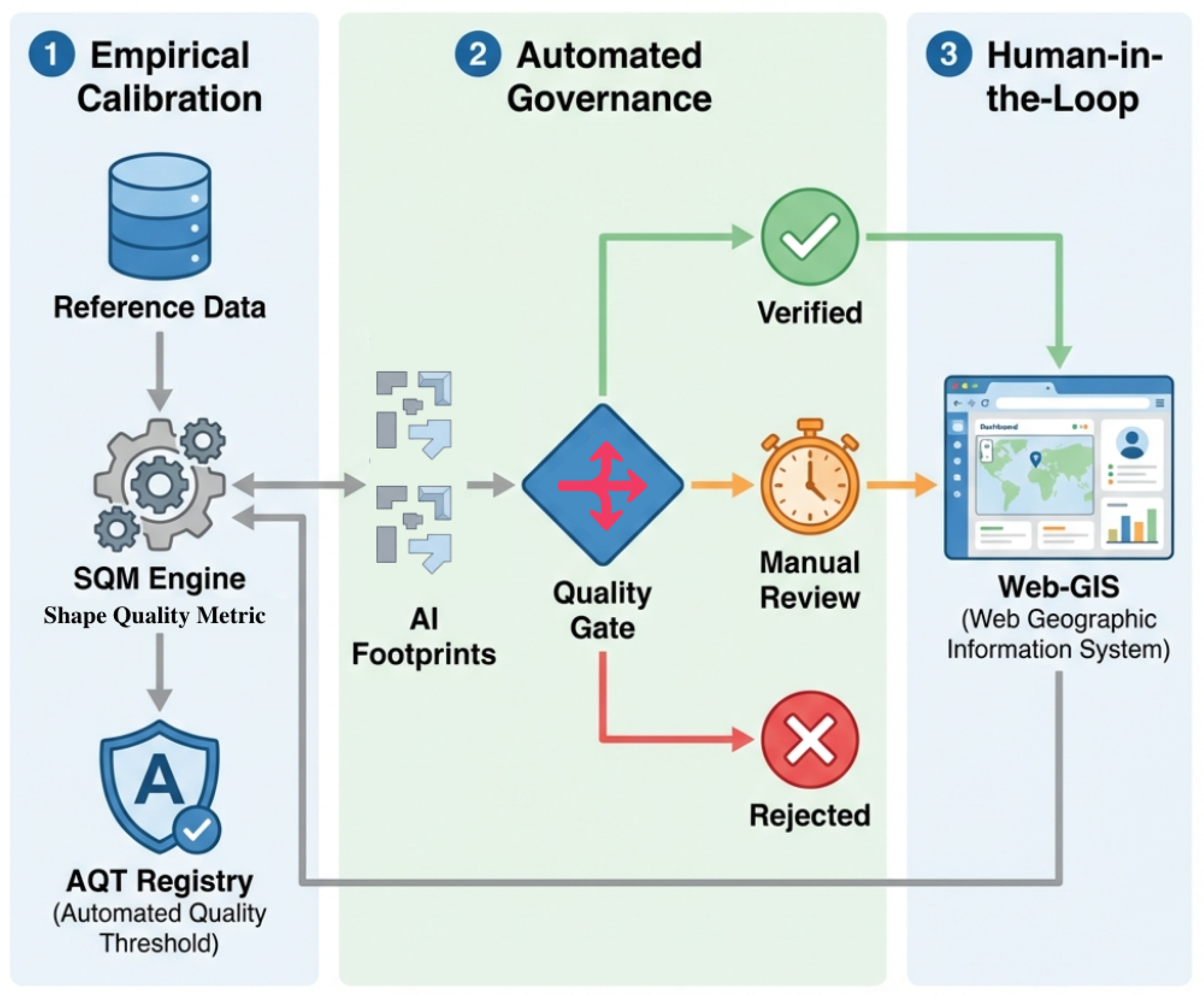
- Empirical Threshold Derivation: Using the 95th percentile of Shape Quality Metric (SQM) scores from high-quality reference (ground truth) data to establish building type specific Acceptable Quality Thresholds (AQT).
- 2.
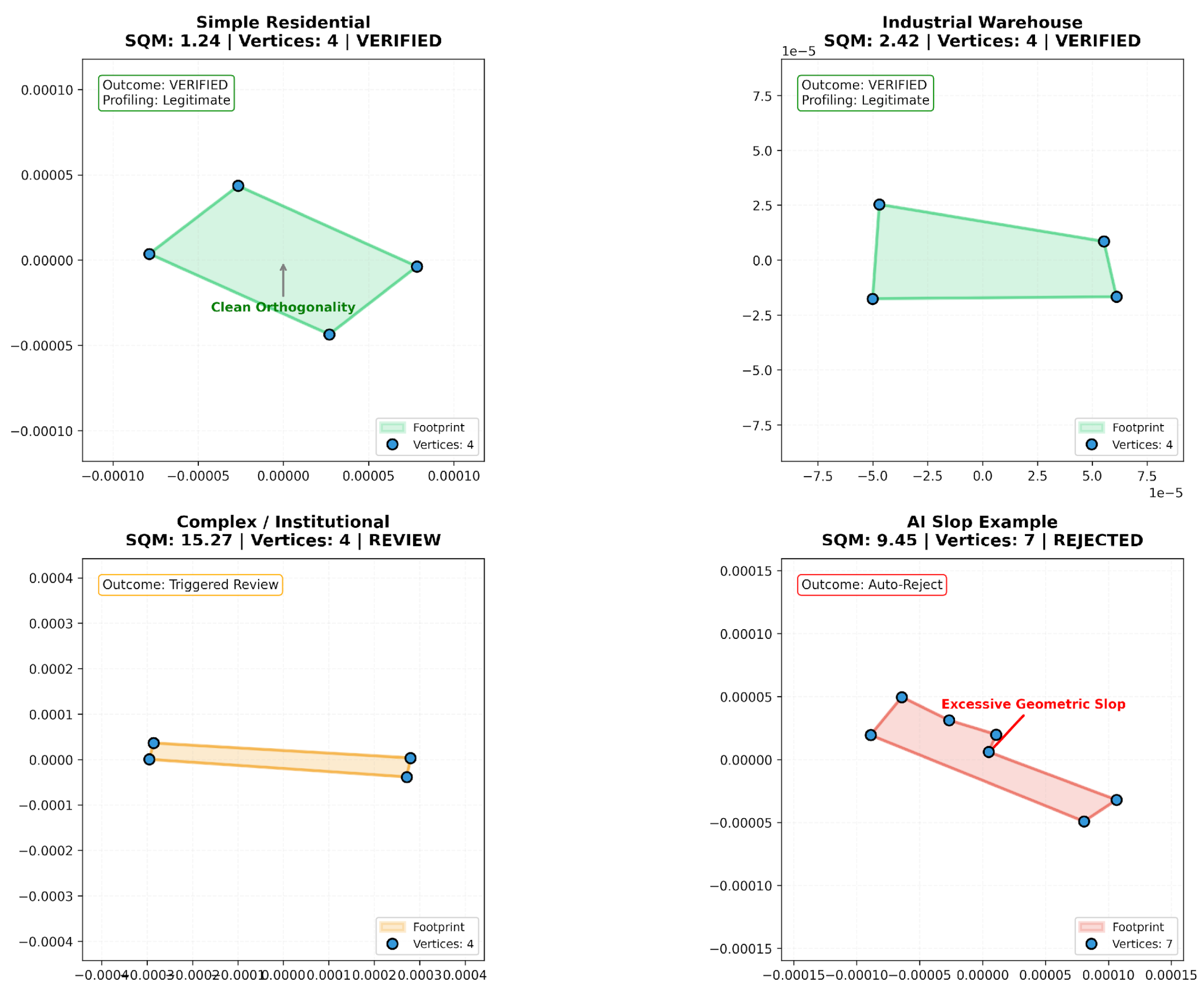
- The Three-Tier Triage System: Automatically classifies features into Tier 1 (auto-accept, ), Tier 2 (manual review, ), and Tier 3 (reject, ).
- 3.
- Metric-Aware Processing: Ensuring all geometric calculations use Universal Transverse Mercator (UTM) coordinates (x,y) to manage distortions when projecting spherical 3D geographic coordinates (lat/long) onto a 2D plane.
- 4.
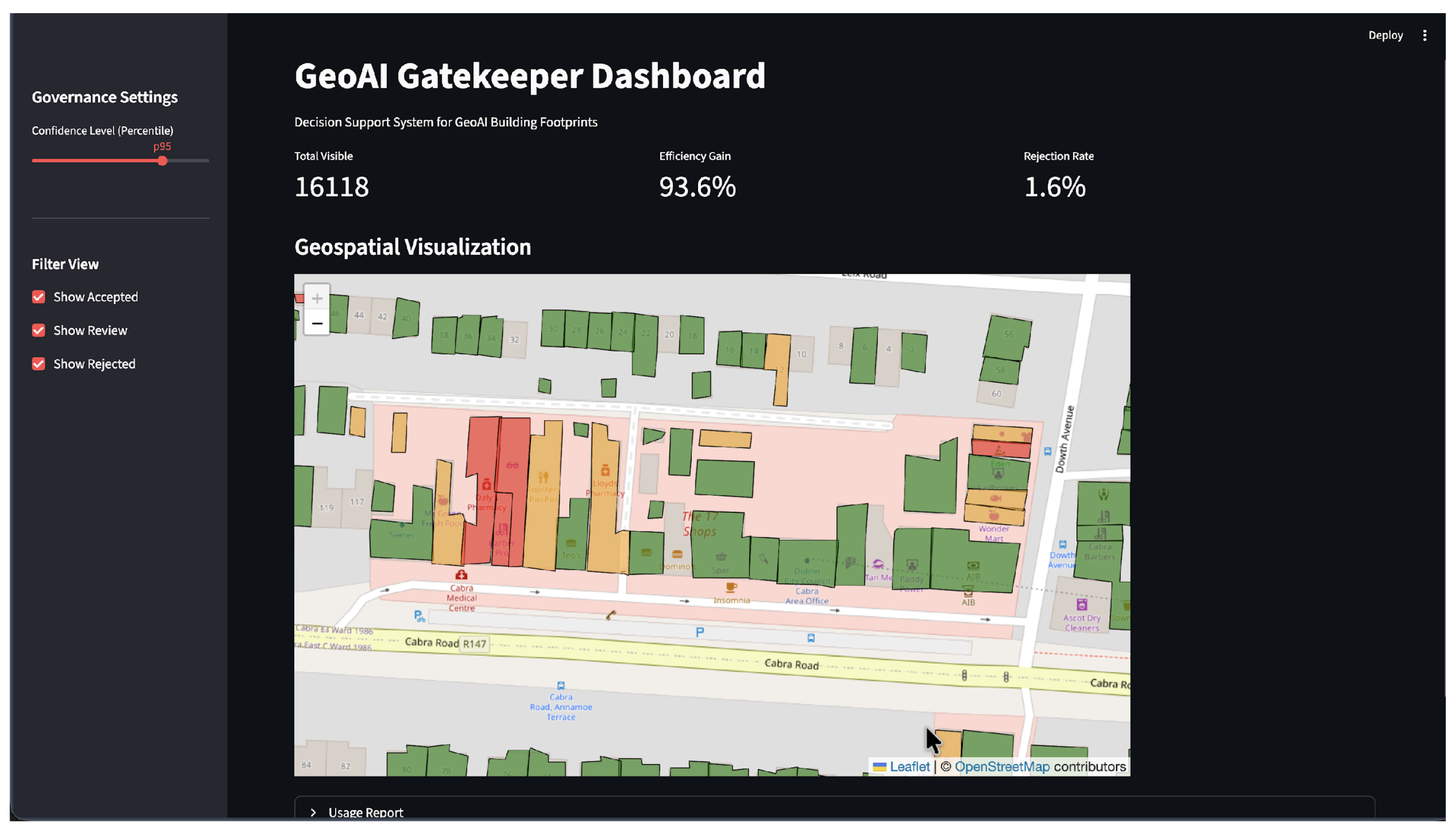
- Interactive Dashboard: Providing VGI mappers with a Web-GIS interface to visualise triage decisions and adjust confidence thresholds based on local context.
1.4. Introduction to the Shape Quality Metric (SQM)
- Perimeter () and Area (): Fundamental dimensions used to calculate dimensionless ratios.
- Convexity: The ratio of the polygon area to its convex hull area. This is highly sensitive to shape irregularity and non-orthogonal “stair-like” edges often found in over-segmented GeoAI outputs.
- Solidity: Measures the density of the shape. A low solidity often indicates fragmented predictions or “hallucinated” holes within a building roofline.
- Compactness: Calculated as . This identifies unnaturally thin or elongated artifacts that can occur when an AI model incorrectly merges adjacent buildings or follows shadow projections.
- Elongation: Derived from the oriented bounding box, helping to distinguish between residential dwellings and larger industrial sheds or warehouses.
2. Background
2.1. The Quality Gap in GeoAI and VGI
2.2. The OSM Code of Conduct and the Scalability Crisis
2.3. The Role of SQM
2.4. Governance Through Triage: The Three-Tier Model
3. Methodology
3.1. Study Area and Baseline Calibration
Reference Dataset Profile
3.2. Data and Resources
3.2.1. Reference VGI Data
- Temporal filter: Only features with a last_edit timestamp after 1 January 2023, were included. This ensures the data was mapped or validated against the most recent high-resolution aerial imagery available in the region.
- Integrity filter: Features flagged with active “OSM Notes” or those lacking a primary building tag were excluded.
- Volume: This resulted in a reference set of 52,487 building footprints, providing a statistically significant sample size for urban morphology analysis.
3.2.2. GeoAI Experimental Data
- OSM-GAN and Poly-GAN: A Generative Adversarial Network optimized for generating sharp, rectilinear building edges by learning from OSM structural patterns [36].
3.3. Scope and Geometric Focus
3.4. Empirical Threshold Derivation (AQT Discovery)
3.4.1. Stratification by Typology
3.4.2. Statistical Calibration
3.5. The Three-Tier Triage System
- Tier 1: Auto-Accept ()Features in this tier are geometrically indistinguishable from high-quality human mapping. These are accepted without human intervention, significantly reducing reviewer burden.
- Tier 2: Manual Review ()Features exhibiting borderline quality are flagged for mapper inspection. This tier captures features that are either valid complex architectures or “near-miss” AI artifacts. The context-sensitive nature of these shapes requires the “eye-test” of a human editor to determine their suitability for upload to the online database.
- Tier 3: Reject/AI Slop ()Automatic rejection is triggered for features that deviate so significantly from the community norm that their ingestion would degrade the integrity of the online map. This tier identifies systemic ‘AI slop’ such as buildings with irregular perimeters or shadow-hallucinated extensions.
3.6. Human-in-the-Loop: The Web-GIS Decision Interface
- Visualizing uncertainty—Features flagged as Tier 2 are presented to the user in a specialized validation environment. Unlike standard GIS editors, this interface overlays the Geometric Signature (vertex distribution) of the GeoAI footprint against the underlying high-resolution imagery. Visual cues, such as color-coded vertices, highlight the areas where the detected “anomalies” or “non-convexity,” allowing VGI mappers to quickly identify the failure mode (e.g., a shadow-distorted edge).
- Adjustable confidence governance—A core feature of the HITL interface is the Confidence Slider. Recognizing that different mapping campaigns have different risk tolerances, mappers can dynamically adjust the percentile (e.g., from the conservative to a more permissive ). As the slider moves, the map updates in real-time, re-classifying features between Auto-Accept and Manual Review. This empowers local OSM chapters to “tune” the gatekeeper based on the specific urban morphology or the intended use-case of the data.
- Feedback loop for semantic enrichment—As users validate Tier 2 geometries, the interface facilitates the transition from Geometry to Semantics. Once a shape is “Accepted” by the user, the interface prompts for basic semantic tagging (e.g., building=yes), ensuring that while the geometry was AI-generated, the final feature enters the OSM database with a “human-verified” seal of approval.
4. Experimental Results
4.1. Processing Results and Triage Performance
4.2. Diagnostic Accuracy and Rejection Case Studies
- 1.
- Irregular edges (76%): 38 cases featured simple rectangular structures characterized by geometric artifacts. These edges were corrupted by over 100 redundant vertices resulting from high-frequency spatial noise (“stair-like” edges). The effectively identified these errors by penalizing the resulting high perimeter-to-area ratio, which deviates significantly from the expected form of a standard (rectangular) building footprint.
- 2.
- Structural merging (18%): 9 cases showed extreme elongation (aspect ratios > 10:1) where the “AI” (simulated jitter/overlap) appeared to merge adjacent buildings into a single distorted polygon.
- 3.
- False rejections (6%): 3 cases were identified as legitimate, highly irregular courtyard apartments. Their natural convexity deviations caused them to exceed the .
4.3. Threshold Sensitivity Analysis
4.4. Comparison to Existing Workflows
- Scenario A (total manual review): Inspecting all 16,118 features at 30 s/feature would require 134 h (3+ weeks) of volunteer labour.
- Scenario B (one-click confirmation—e.g., RapiD [39]): Confirming features at 5 s/feature still requires 22+ h (~3 days) of active manual attention.
- Scenario C (GeoAI-Gatekeeper): With 93.6% auto-accepted, humans only need review 775 features at 30 s/feature. Total time: ~6.5 h.
5. Discussion and Future Research Directions
5.1. Governance Implications for OSM
- Empirical standards: The calibration phase encodes local community norms into statistical distributions (), ensuring AI data is judged by the same standard as human mappers.
- Graduated response: The three-tier triage replaces binary “all-or-nothing” imports with a nuanced workflow that defaults to acceptance only for high-confidence features.
- Algorithmic accountability: Through the audit log, every automated decision is transparent and reproducible, satisfying the need for accountability in VGI mapping ecosystems.
5.2. Limitations and Morphological Edge Cases
- Complexity vs. slop: Highly irregular heritage buildings, courtyard structures, and L-shaped apartments often exhibit convexity defects similar to AI slop.
- Semantic orthogonality: We suggest that geometric governance can be set apart from semantic validation. While SQM can confidently measure that the “container” is cartographically sound, mappers retain the essential responsibility for thematic accuracy (e.g., distinguishing a church from a house).
- Regional generalization: Dublin’s relatively homogeneous building stock (e.g., Victorian rows) allows for stable AQT benchmarks. Applying this framework to informal settlements or rural traditional architectures will require finer-grained stratification and local re-calibration.
5.3. Future Work: Toward a Multi-Modal Gatekeeper
- 1.
- Integration into OSM Production: Beyond technical enhancements, a key next step involves investigating the practical integration of the GeoAI-Gatekeeper into the online OSM mapping ecosystem. While a full integration roadmap is beyond the scope of this paper and would require close collaboration with OSM core developers, future research should explore the socio-technical challenges of such a rollout. This includes analysing the trade-offs between centralized quality gating and the decentralized nature of OSM, as well as gauging the reactions of the diverse contributor base. For instance, corporate contributors, who often handle large-scale data imports, might welcome the efficiency of an automated gatekeeper, whereas individual ’craft’ mappers may harbour concerns regarding the erosion of manual editorial control. Evaluating how to implement this framework as a standard ’pre-ingest’ plugin for editors like iD or JOSM remains an open problem for future study.
- 2.
- Pixel-level fusion [40]: Integrating AI-model confidence maps (probability scores) with SQM metrics to identify “hallucinated” features that might otherwise appear geometrically plausible.
- 3.
- Adaptive learning [41]: Transitioning from static percentiles to an active learning loop. By tracking mapper acceptance rates in Tier 2, the system could dynamically adjust the AQT by lowering thresholds if manual reviews consistently result in acceptance.
- 4.
- Cross-domain expansion: Extending the SQM logic to other OSM feature types, such as road/cycle networks and land-use boundaries (e.g., parks), to provide a more comprehensive “Quality Gate” for all automated map feature imports.
- 5.
- Semantic validation via Multimodal LLMs (MLLMs) [37,42,43]: While the current framework excels at geometric gatekeeping, it remains “thematically blind.” A future iteration could integrate Multimodal Large Language Models (MLLMs) to perform cross-modal semantic validation. By feeding the model both the AI-generated polygon and corresponding high-resolution or street-level imagery, the system could verify if the assigned tags (e.g., building = retail) are visually consistent with the structure’s appearance (e.g., presence of signage, storefronts, or parking lots). This would help to address the Semantic attribution gap identified in this study, ensuring that a building is not only the right shape but also carries the correct functional attributes.
- 6.
- Threshold Sensitivity and Transferability: Another key area for future investigation is the empirical sensitivity analysis of the tiered pipeline across diverse geographic contexts. While the current thresholds were derived from the morphological signatures of a European city (Dublin), further research is required to determine if this holds true for informal settlements, high-density megacities, or traditional rural architectures. Future studies could focus on ‘Cross-Context Calibration,’ testing how thresholds must be adjusted to accommodate different urban forms and whether a global universal threshold is even achievable or if local re-calibration remains a prerequisite for deployment in new regions.
6. Conclusions
- 1.
- A geometry-first Gatekeeper framework: We developed and implemented an AI model-agnostic validation pipeline that successfully decouples geometric fidelity from semantic attribution. This framework ensures that the “cartographic container” of a building meets local VGI community mapping standards before human mappers invest effort in thematic enrichment.
- 2.
- Empirical AQT derivation via the 95% confidence principle: This study moved beyond arbitrary quality metrics by introducing a reference-driven calibration method. Using a “benchmark” dataset of over 52,000 human-verified (OSM) footprints in Dublin, we demonstrated that an automated system could derive local, culturally relevant Acceptable Quality Thresholds (AQT) that reflect actual community driven map accuracy standards.
- 3.
- The three-tier triage system: We propose and validate an automated triage logic approach—comprising Auto-Accept, Manual Review, and Rejection tiers—that successfully distinguishes between legitimate architectural complexity and ‘AI slop’. This mechanism provides a scalable solution for managing the influx of huge GeoAI generated datasets while still maintaining a high level of individual feature and overall map integrity.
- 4.
- A Human-in-the-Loop (HITL) governance bridge: Through the development of a Web-GIS mapping interface, we demonstrate that automated gatekeeping does not necessitate the removal of human agency. Instead, it empowers the community by providing visual “quality signatures,” allowing mappers to act as high-level auditors rather than manual digitizers.
Author Contributions
Funding
Data Availability Statement
Acknowledgments
Conflicts of Interest
References
- Janowicz, K.; Gao, S.; McKenzie, G.; Hu, Y.; Bhaduri, B. GeoAI: Spatially explicit artificial intelligence techniques for geographic knowledge discovery and beyond. Int. J. Geogr. Inf. Sci. 2020, 34, 625–636. [Google Scholar] [CrossRef]
- Zhu, X.X.; Tuia, D.; Mou, L.; Xia, G.S.; Zhang, L.; Xu, F.; Fraundorfer, F. Deep Learning in Remote Sensing: A Comprehensive Review and List of Resources. IEEE Geosci. Remote Sens. Mag. 2017, 5, 8–36. [Google Scholar] [CrossRef]
- Li, W.; Hsu, C.Y. GeoAI for Large-Scale Image Analysis and Machine Vision: Recent Progress of Artificial Intelligence in Geography. ISPRS Int. J. Geo-Inf. 2022, 11, 385. [Google Scholar] [CrossRef]
- Microsoft. Microsoft Building Footprints. 2026. Available online: https://planetarycomputer.microsoft.com/dataset/ms-buildings (accessed on 1 March 2026).
- Sirko, W.; Kashubin, S.; Ritter, M.; Annkah, A.; Bouchareb, Y.S.E.; Dauphin, Y.; Keysers, D.; Neumann, M.; Cisse, M.; Quinn, J. Continental-Scale Building Detection from High Resolution Satellite Imagery. arXiv 2021, arXiv:2107.12283. [Google Scholar] [CrossRef]
- Neptune AI. Open Solution to the AI Mapping Challenge. 2026. Available online: https://github.com/neptune-ai/open-solution-mapping-challenge (accessed on 20 February 2026).
- Verplanke, J.; McCall, M.K.; Uberhuaga, C.; Rambaldi, G.; Haklay, M. A Shared Perspective for PGIS and VGI. Cartogr. J. 2016, 53, 308–317. [Google Scholar] [CrossRef]
- Haklay, M. How good is volunteered geographical information? A comparative study of OpenStreetMap and Ordnance Survey datasets. Environ. Plan. B Plan. Des. 2010, 37, 682–703. [Google Scholar] [CrossRef]
- OpenStreetMap. Automated Edits Code of Conduct. 2022. Available online: https://wiki.openstreetmap.org/wiki/Automated_Edits_code_of_conduct (accessed on 15 February 2026).
- Barrington-Leigh, C.; Millard-Ball, A. The world’s user-generated road map is more than 80% complete. PLoS ONE 2017, 12, e0180698. [Google Scholar] [CrossRef] [PubMed]
- Vijendran, M.; Deng, J.; Chen, S.; Ho, E.S.L.; Shum, H.P.H. Artificial intelligence for geometry-based feature extraction, analysis and synthesis in artistic images: A survey. Artif. Intell. Rev. 2024, 58, 64. [Google Scholar] [CrossRef]
- Wei, S.; Zhang, T.; Ji, S.; Luo, M.; Gong, J. BuildMapper: A Fully Learnable Framework for Vectorized Building Contour Extraction. arXiv 2022, arXiv:2211.03373. [Google Scholar] [CrossRef]
- Kania, K. Closing the Geometry Gap in Building Footprint Extraction—Our First Look at HiSup. 2025. Available online: https://spyro-soft.com/blog/geospatial/closing-the-geometry-gap-in-building-footprint-extraction-our-first-look-at-hisup (accessed on 17 May 2026).
- Huang, X.; Zhang, L. Morphological Building/Shadow Index for Building Extraction From High-Resolution Imagery Over Urban Areas. IEEE J. Sel. Top. Appl. Earth Obs. Remote Sens. 2012, 5, 161–172. [Google Scholar] [CrossRef]
- Zhao, K.; Kamran, M.; Sohn, G. Boundary Regularized Building Footprint Extraction From Satellite Images Using Deep Neural Network. arXiv 2020, arXiv:2006.13176. [Google Scholar] [CrossRef]
- Yoo, S. An Operational Ethical Framework for GeoAI: A PRISMA-Based Systematic Review of International Policy and Scholarly Literature. ISPRS Int. J. Geo-Inf. 2026, 15, 51. [Google Scholar] [CrossRef]
- Young, B.; Anderson, D.T.; Keller, J.; Petry, F.; Michael, C.J. SPARC: A Human-in-the-Loop Framework for Learning and Explaining Spatial Concepts. Information 2025, 16, 252. [Google Scholar] [CrossRef]
- Niroshan, L.; Carswell, J. A Comprehensive Shape Quality Metric to Evaluate AI-Generated Building Footprints. Submitted to State of the Map 2026 (Academic Track), Under Review. Available online: https://pretalx.com/sotm2026-osm-science/talk/review/G3ZMCTXDN7JAJ3KWYDNQUW3BYGNKA7FD (accessed on 17 May 2026).
- Everingham, M.; Van Gool, L.; Williams, C.K.I.; Winn, J.; Zisserman, A. The Pascal Visual Object Classes (VOC) Challenge. Int. J. Comput. Vis. 2010, 88, 303–338. [Google Scholar] [CrossRef]
- Naidu, G.; Zuva, T.; Sibanda, E.M. A Review of Evaluation Metrics in Machine Learning Algorithms. In Artificial Intelligence Application in Networks and Systems; Silhavy, R., Silhavy, P., Eds.; Lecture Notes in Networks and Systems; Springer International Publishing: Cham, Switzerland, 2023; Volume 724, pp. 15–25. [Google Scholar] [CrossRef]
- Niroshan, L.; Carswell, J.D. Evaluating GeoAI-Generated Data for Maintaining VGI Maps. Land 2025, 14, 1978. [Google Scholar] [CrossRef]
- Mooney, P.; Corcoran, P.; Winstanley, A.C. Towards quality metrics for OpenStreetMap. In Proceedings of the 18th SIGSPATIAL International Conference on Advances in Geographic Information Systems, San Jose, CA, USA, 2–5 November 2010; pp. 514–517. [Google Scholar] [CrossRef]
- Goodchild, M.F.; Li, L. Assuring the quality of volunteered geographic information. Spat. Stat. 2012, 1, 110–120. [Google Scholar] [CrossRef]
- Emelyanov, A.; Knyaz, V.; Kniaz, V.; Artist, D. Pixels relationship analysis for extracting building footprints. Int. Arch. Photogramm. Remote Sens. Spat. Inf. Sci. 2024, XLVIII-3-2024, 141–146. [Google Scholar] [CrossRef]
- Goodfellow, I.J.; Pouget-Abadie, J.; Mirza, M.; Xu, B.; Warde-Farley, D.; Ozair, S.; Courville, A.; Bengio, Y. Generative Adversarial Nets. In Proceedings of the Advances in Neural Information Processing Systems; Ghahramani, Z., Welling, M., Cortes, C., Lawrence, N., Weinberger, K.Q., Eds.; Curran Associates, Inc.: Red Hook, NY, USA, 2014; Volume 27. [Google Scholar]
- He, K.; Gkioxari, G.; Dollar, P.; Girshick, R. Mask R-CNN. In Proceedings of the IEEE International Conference on Computer Vision (ICCV), Venice, Italy, 22–29 October 2017. [Google Scholar]
- Everingham, M.; Eslami, S.M.A.; Van Gool, L.; Williams, C.K.I.; Winn, J.; Zisserman, A. The Pascal Visual Object Classes Challenge: A Retrospective. Int. J. Comput. Vis. 2015, 111, 98–136. [Google Scholar] [CrossRef]
- Cheng, B.; Girshick, R.; Dollar, P.; Berg, A.C.; Kirillov, A. Boundary IoU: Improving Object-Centric Image Segmentation Evaluation. In Proceedings of the IEEE/CVF Conference on Computer Vision and Pattern Recognition (CVPR), Nashville, TN, USA, 20–25 June 2021; pp. 15334–15342. [Google Scholar]
- Yin, J.; Carswell, J. Spatial Search Techniques for Mobile 3D Queries in Sensor Web Environments. ISPRS Int. J. Geo-Inf. 2013, 2, 135–154. [Google Scholar] [CrossRef]
- Vargas-Munoz, J.E.; Srivastava, S.; Tuia, D.; Falcao, A.X. OpenStreetMap: Challenges and Opportunities in Machine Learning and Remote Sensing. IEEE Geosci. Remote Sens. Mag. 2021, 9, 184–199. [Google Scholar] [CrossRef]
- ISO 19157–1:2023; Geographic Information—Data Quality — Part 1: General Requirements. Standard, International Organization for Standardization: Geneva, Switzerland, 2023.
- European Parliament and Council of the European Union. Regulation (EU) 2024/1689 laying down harmonised rules on artificial intelligence (Artificial Intelligence Act). Technical Report OJ L 2024/1689. Off. J. Eur. Union 2024. [Google Scholar]
- Davis, J.L. Elevating humanism in high-stakes automation: Experts-in-the-loop and resort-to-force decision making. Aust. J. Int. Aff. 2024, 78, 200–209. [Google Scholar] [CrossRef]
- Van Rooy, D. Human–machine collaboration for enhanced decision-making in governance. Data Policy 2024, 6, e60. [Google Scholar] [CrossRef]
- Niroshan, L. Operationalizing GeoAI Governance: An Automated Gate-keeper Framework for Integrating Building Outlines into OpenStreetMap. Zenodo 2026. [Google Scholar] [CrossRef]
- Niroshan, L.; Carswell, J.D. DeepMapper: A GeoAI Approach to Automate the VGI Mapping Workflow. IEEE J. Sel. Top. Appl. Earth Obs. Remote Sens. 2025, 18, 16162–16175. [Google Scholar] [CrossRef]
- Holzinger, A.; Malle, B.; Saranti, A.; Pfeifer, B. Towards multi-modal causability with Graph Neural Networks enabling information fusion for explainable AI. Inf. Fusion 2021, 71, 28–37. [Google Scholar] [CrossRef]
- Bielik, M.; Schneider, S.; Kuliga, S.; Griego, D.; Ojha, V.; König, R.; Schmitt, G.; Donath, D. Examining Trade-Offs between Social, Psychological, and Energy Potential of Urban Form. ISPRS Int. J. Geo-Inf. 2019, 8, 52. [Google Scholar] [CrossRef]
- Gao, X.; Klaiber, C.; Underwood, J. AI Is Supercharging the Creation of Maps Around the World. 2019. Available online: https://tech.facebook.com/artificial-intelligence/2019/7/ai-is-supercharging-the-creation-of-maps-around-the-world/ (accessed on 20 February 2026).
- Solanky, V.; Katiyar, S.K. Pixel-level image fusion techniques in remote sensing: A review. Spat. Inf. Res. 2016, 24, 475–483. [Google Scholar] [CrossRef]
- Gligorea, I.; Cioca, M.; Oancea, R.; Gorski, A.T.; Gorski, H.; Tudorache, P. Adaptive Learning Using Artificial Intelligence in e-Learning: A Literature Review. Educ. Sci. 2023, 13, 1216. [Google Scholar] [CrossRef]
- Wu, T.; Li, M.; Chen, J.; Ji, W.; Lin, W.; Gao, J.; Kuang, K.; Zhao, Z.; Wu, F. Semantic Alignment for Multimodal Large Language Models. In Proceedings of the 32nd ACM International Conference on Multimedia, Melbourne, VIC, Australia, 28 October–1 November 2024; pp. 3489–3498. [Google Scholar] [CrossRef]
- Juhász, L.; Mooney, P.; Hochmair, H.H.; Guan, B. ChatGPT as a mapping assistant: A novel method to enrich maps with generative AI and content derived from street-level photographs. Spat. Data Sci. Symp. 2023. [Google Scholar] [CrossRef]



| Geometric Signature | P99 Threshold | Mean SQM (AQT) | Count | Building Type |
|---|---|---|---|---|
| Standard orthogonal/rectangular | 1.26 | 0.52 | 31,204 | Residential |
| High compactness, large area | 1.05 | 0.48 | 8913 | Commercial |
| Variable elongation | 1.89 | 0.63 | 1247 | Industrial |
| Multi-unit clusters | 1.34 | 0.55 | 2856 | Apartments |
| Tightly bound, compact | 0.98 | 0.46 | 987 | Retail |
| Highly elongated, large perimeter | 2.14 | 0.71 | 342 | Warehouse |
| Percentage | Count | Action | Triage Tier |
|---|---|---|---|
| 93.6% | 15,080 | Auto-Accept | Tier 1 |
| 4.8% | 775 | Manual Review | Tier 2 |
| 1.6% | 263 | Rejected (Slop) | Tier 3 |
| Tier 3 (Reject) | Tier 2 (Review) | Tier 1 (Accept) | AQT (Avg) | Confidence |
|---|---|---|---|---|
| 0.7% | 2.1% | 97.2% | 0.42 | |
| 1.1% | 3.8% | 95.1% | 0.48 | |
| 1.6% | 4.8% | 93.6% | 0.52 | (Baseline) |
| 3.5% | 8.2% | 88.3% | 0.64 |
Disclaimer/Publisher’s Note: The statements, opinions and data contained in all publications are solely those of the individual author(s) and contributor(s) and not of MDPI and/or the editor(s). MDPI and/or the editor(s) disclaim responsibility for any injury to people or property resulting from any ideas, methods, instructions or products referred to in the content. |
© 2026 by the authors. Published by MDPI on behalf of the International Society for Photogrammetry and Remote Sensing. Licensee MDPI, Basel, Switzerland. This article is an open access article distributed under the terms and conditions of the Creative Commons Attribution (CC BY) license.
Share and Cite
Niroshan, L.; Carswell, J.D. Addressing GeoAI Governance: An Automated Gatekeeper for Building Outlines in OpenStreetMap. ISPRS Int. J. Geo-Inf. 2026, 15, 217. https://doi.org/10.3390/ijgi15050217
Niroshan L, Carswell JD. Addressing GeoAI Governance: An Automated Gatekeeper for Building Outlines in OpenStreetMap. ISPRS International Journal of Geo-Information. 2026; 15(5):217. https://doi.org/10.3390/ijgi15050217
Chicago/Turabian StyleNiroshan, Lasith, and James D. Carswell. 2026. "Addressing GeoAI Governance: An Automated Gatekeeper for Building Outlines in OpenStreetMap" ISPRS International Journal of Geo-Information 15, no. 5: 217. https://doi.org/10.3390/ijgi15050217
APA StyleNiroshan, L., & Carswell, J. D. (2026). Addressing GeoAI Governance: An Automated Gatekeeper for Building Outlines in OpenStreetMap. ISPRS International Journal of Geo-Information, 15(5), 217. https://doi.org/10.3390/ijgi15050217