
Article

Impact of Multidimensional Urban Expansion on Thermal Environment Supported by Refined Population Spatial Distribution in Pearl River Delta

School of Environment and Spatial Informatics, China University of Mining and Technology, Xuzhou 221116, China
*
Author to whom correspondence should be addressed.
ISPRS Int. J. Geo-Inf. 2026, 15(5), 189; https://doi.org/10.3390/ijgi15050189
Submission received: 13 February 2026 / Revised: 26 April 2026 / Accepted: 27 April 2026 / Published: 30 April 2026
(This article belongs to the Special Issue Spatial Data Science and Knowledge Discovery)

Abstract

The urban heat island effect, a typical rapid urbanization issue, arises from natural surfaces covered by impermeable layers via urban sprawl. To clarify its unclear response to urban expansion under human–land synergy, this paper proposes a multidimensional urban expansion model and a random forest–intelligence integrated method for high-precision large-region population mapping. Taking the Pearl River Delta urban agglomeration as a sample, its urban expansion is divided into five modes to explore thermal environment impacts. The results show: (1) The proposed random forest–intelligence method achieves 84% overall accuracy in 30 m resolution population mapping. (2) The Pearl River Delta urban agglomeration is dominated by vertical expansion, but all cities have population-shrinking regions, especially around Guangzhou and Shenzhen. (3) From 2010 to 2020, Pearl River Delta urban agglomeration impervious surface expansion and population growth were mismatched: impervious surface extended to fringes, while population grew in core areas. (4) The expansion of impervious surface does not always exacerbate the urban heat island effect; when the per-capita land area is less than 1.8 m2, it can actually mitigate the effect. (5) Guangzhou–Foshan–Zhaoqing and Shenzhen–Dongguan–Huizhou integration reduces heat island intensity. Core cities driving surrounding areas via clustered, interconnected development alleviates this effect.

1. Introduction

Under the background of global warming, the problem of urban heat island (UHI) has become one of the “urban diseases” that cannot be ignored, which not only increases the energy consumption and carbon emissions of cities [1,2,3], but also seriously affects the health of residents [4,5,6]. With the rapid progression of urbanization, urban agglomerations have become an important form of regional spatial organization. However, high-intensity human activities in urban agglomerations and large areas of impervious surface have exacerbated the heat island effect and increased extreme climate events [7,8,9,10,11]; then, it is of great practical significance to study how the expansion of urban agglomerations affects the thermal environment.
Urban expansion has two main characteristics; one is the expansion of built-up land, which has been found to be an important factor affecting the urban thermal environment [12,13,14]. For example, Xu Hanqiu found that Land Surface Temperature (LST) increases exponentially with the increase in built-up area [15], and Li Xiaoma showed that the size of the city area explains 87% of the variation in the UHI between cities, with a large spatial and temporal variability [16]. Specially, Li Fei found that the direction of the movement of the high-LST clusters is consistent with the direction of the urban expansion [17]. To be specific, there is a significant strong positive correlation between impervious surface (IS) density and LST, and the LST in very high-density areas of IS is about 2.85 °C higher than that in very low-density areas [18]. Moreover, the IS expansion area caused greater LST changes than the original IS area [19].
Another characteristic of urban expansion is population increase, and studies have shown that population increase is closely related to the heat island effect [20,21,22]; for example, population size has a significant correlation with the intensity of the heat island effect [23]. Furthermore, urbanization contributes little to global warming but substantially intensifies local and regional land surface warming [24]. Moreover, a spatial coupling relationship between urban form and thermal environment exists [25]. However, there is a lack of refined population spatial distribution data to explore how population increase affects the thermal environment within urban agglomerations. In response to this problem, studies have been conducted that can spatially decompose the census data into grid cells. And, many methods are proposed, such as area weighting [26], geographically weighted regression [27], and partitioned density mapping, but the accuracy of the above methods is largely dependent on auxiliary variables. In recent years, the rapid development of mobile location services has generated massive geospatial big data, which provides a new data source for population spatialization simulation [28,29] and makes up for the lack of remote sensing data in densely populated areas under complex environments. However, there is still difficulty in obtaining basic data and a low efficiency in mapping the refined population distribution at the scale of urban agglomerations.
Currently, there is various and profound research on the impacts of urban expansion on the thermal environment, but the response relationship between urban expansion and the thermal environment under the synergy of people and land is still unclear, and there is a lack of refined spatial distribution data of populations in urban agglomerations [30]. Therefore, this paper adopts a multidimensional urban expansion analysis model under the synergy of people and land, and proposes a simulation method for the population distribution integrating the random forest (RF) and the Multi-Agent System (MAS). Among them, the multidimensional urban expansion analysis model is applicable to the analysis of urban expansion in the context of the coexistence of construction land expansion and urban contraction [31]. Furthermore, the population distribution simulation method proposed in this paper is used to map the population distribution at 30 m spatial resolution, and the accuracy can reach 84%. The results show that the urban agglomeration is dominated by vertical expansion, and contraction-type areas still exist, especially in the cities around Guangzhou and Shenzhen. Moreover, the direction of impervious expansion and population growth is not the same, with the impervious surface mostly expanding in the edge of the city, and the population growth occurring mainly in the core of the city where the population is concentrated. Especially, when the per-capita land area is less than 1.8 m2, the expansion of impervious surface can play a role in mitigating the heat island effect. Importantly, the integrated development model, core city radiation driven by the surrounding cities, the formation of clusters, division of labor and collaboration, and interconnection between the clusters are conducive to the mitigation of heat island intensity; for example, the crosstown development of Guangzhou–Foshanat at the same time drives the synergistic development of Zhaoqing–Shenzhen–Dongguan and linkage with Huizhou development.

2. Study Area and Data Preprocessing

2.1. Research Area Overview

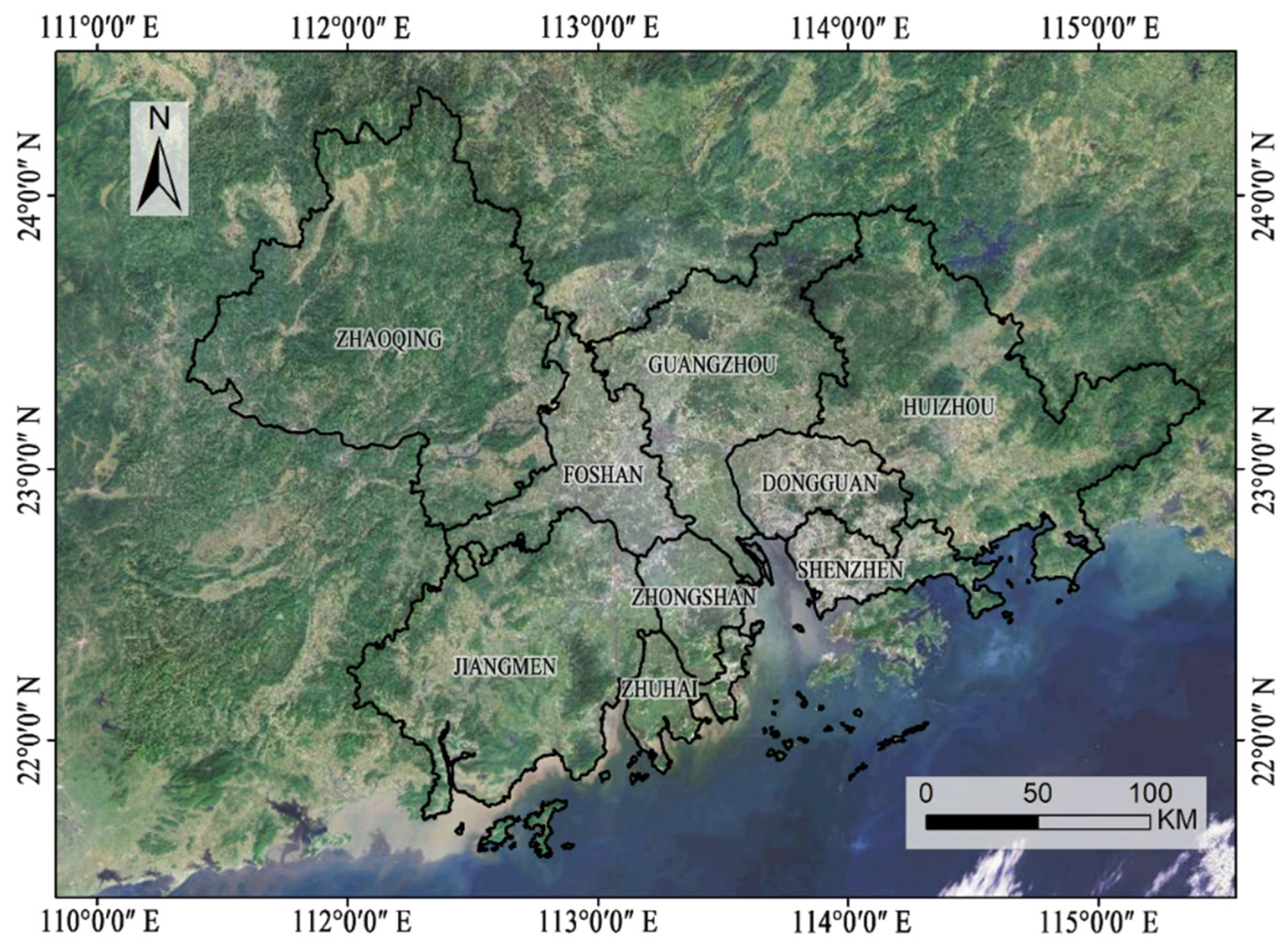
The Pearl River Delta urban agglomeration, located in the south–central region of Guangdong Province, China, downstream of the Pearl River (Figure 1), is one of the three major urban agglomerations in China, along with the Yangtze River Delta urban agglomeration and the Beijing–Tianjin–Hebei urban agglomeration. It includes nine cities, including Guangzhou, Foshan, Zhaoqing, Shenzhen, Dongguan, Huizhou, Zhuhai, Zhongshan and Jiangmen. The vast majority of the area is tropical, with a southern subtropical monsoon climate and high temperatures and rainfall all year round. Its area accounts for less than 1/3 of the land area of Guangdong Province, gathering 53.35% of the population and 79.67% of the total economy of the largest province in China. As the core urban agglomeration of China, the Pearl River Delta (PRD) has the advantage of development. With the rapid development of social economy, it has been characterized by accelerated urbanization and a high degree of rural industrialization in recent years, which has led to the obvious phenomenon of the urban heat island.

2.2. Data and Preprocessing

Point of interest (POI), land cover, road network, house price, building, Landsat image, DEM, and demographic data were used in this study, which are described in detail in Table 1. Among them, POI was preprocessed with de-emphasis, deskewing, and spatial coordinate transformation; land cover data, which had an overall accuracy of 82%, was preprocessed with merging and cropping; Landsat image was preprocessed with radiometric calibration, atmospheric correction, and so on; DEM data were preprocessed by splicing, cropping, and so on.
In particular, to use POI data to measure the complexity of functional types within buildings, we retained POI data across all categories. Meanwhile, the Tuli dataset was used to extract impervious surface. In the PRD urban agglomeration, residential communities with housing price data account for approximately 45–60% of all communities. Among these, the mainstream platforms used in this study cover about 40–55%, and when combined with platforms such as Anjuke and Lianjia, the overall coverage rate reaches approximately 55–65%.
One point worth noting is that the Pearl River Delta urban cluster is characterized by high-density built-up areas, mixed commercial and residential development, and the continuous expansion of urban and rural settlements. Residential land occupies an extremely high proportion of the region’s total construction land, with widespread mixing of commercial and residential functions and extensive urbanization of villages and towns; in contrast, dedicated industrial land and large-scale independent commercial plots are mostly concentrated in limited industrial parks and core business districts, leading to spatial fragmentation and a low overall proportion in the regional land structure. Meanwhile, a major part of the urban and rural built environment in this region is dominated by residential functions, and residential housing prices cover the most extensive spatial samples. Unlike the scarce and scattered listing and transaction data of industrial and commercial land, housing price data are more applicable to comprehensive and refined spatial interpolation, which can satisfy the demand for continuous land value assessment across the metropolitan area.

3. Research Methods

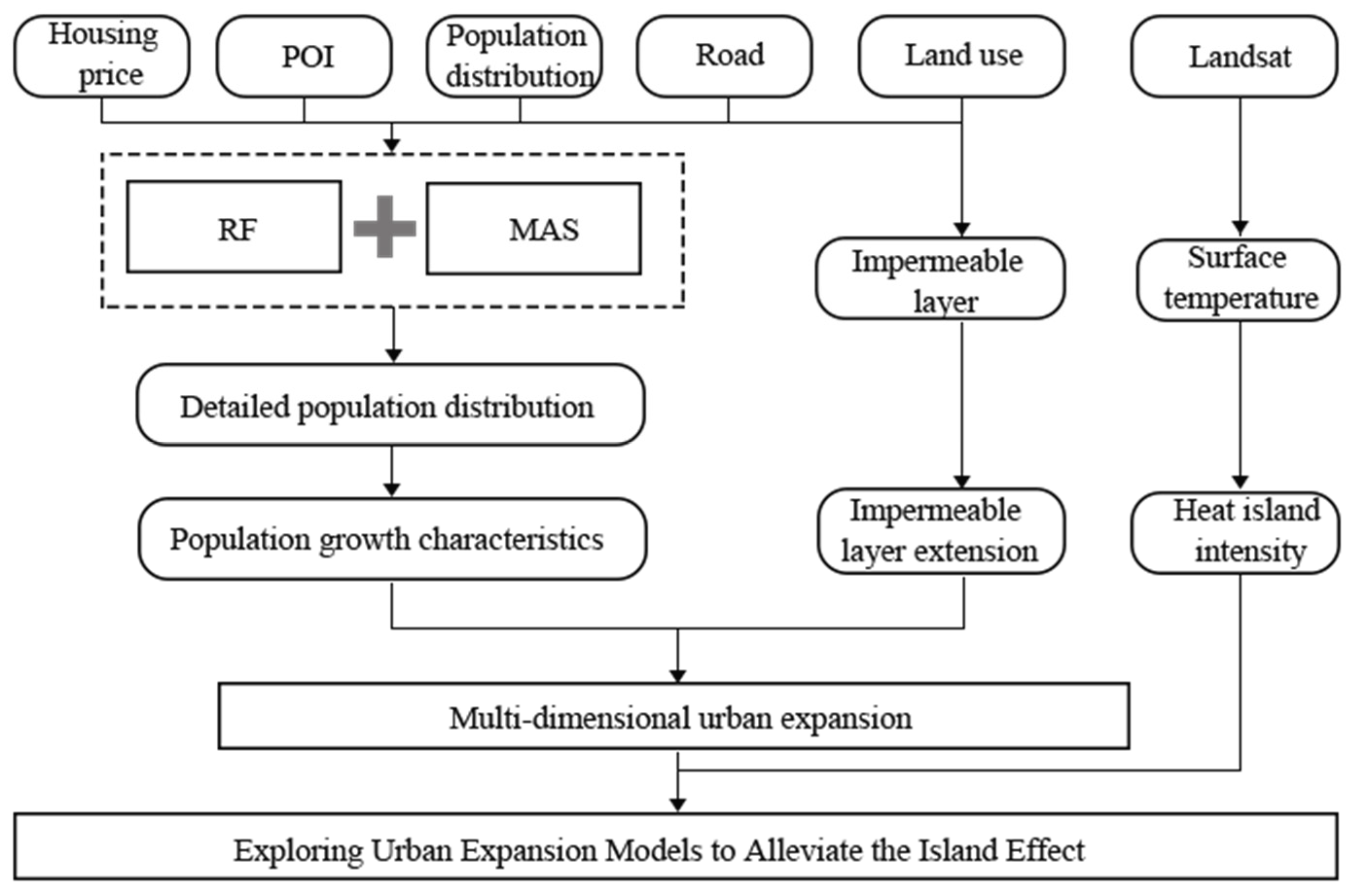
This paper delineates the types of urban expansion in the Pearl River Delta (PRD) urban agglomeration under the perspective of human–land synergy, summarizes the spatial distribution characteristics of different types of urban expansion, reveals the law of synergistic development of urban agglomeration, and analyzes the correlation between multidimensional urban expansion and the urban heat island in order to provide references to mitigate the heat island effect. The overall framework is shown in Figure 2, which is divided into three parts: First, fusing the random forest (RF) and Multi-Agent System (MAS) to simulate the population distribution in 2010, 2015 and 2020 in three periods based on the demographic data, POI, OSM, second-hand house transactions and land cover; based on the human–land synergy perspective, the PRD urban agglomeration is categorized into different types of urban expansion, and the law of synergistic development of the urban agglomeration is explored. Second, the single-window algorithm is used to invert the surface temperature for the three periods of 2010, 2015 and 2020, and to classify the urban heat island intensity. Third, the response relationship between multidimensional urban expansion and the thermal environment is investigated to explore the urban expansion model to mitigate the heat island effect.

3.1. Multidimensional Representation of Urban Expansion

3.1.1. High-Resolution Population Distribution Simulation Integrating Random Forests and Agents

(1) Building Functional Complexity Calculation
Considering the K-means algorithm’s advantages of high efficiency and easy implementation, this paper uses it to reclassify POIs for inferring building function complexity. During clustering, the center of each cluster is recalculated (updated) after each iteration as the mean of all data objects in that cluster. Defining the kth cluster’s center as C e n t e r k , its update formula is as follows:
C e n t e r k = 1 C k x i C k d i s t x i , C e n t e r k
where k denotes the number of POI clusters. When the difference between two iterations j falls below a certain threshold, the iteration process terminates. The resulting clusters at this point constitute the final clustering outcome.
After reclassifying the POIs, the ratio of the number of POIs of a category within a building to the proportion of the number of POI categories within the transportation unit in which it is located to the proportion of the category to the number of all POI categories within the transportation unit was used as a measure of the complexity of the type of function within the building.
(2) High-Precision Population Distribution Simulation of RF Coupled Multi-Agent Systems
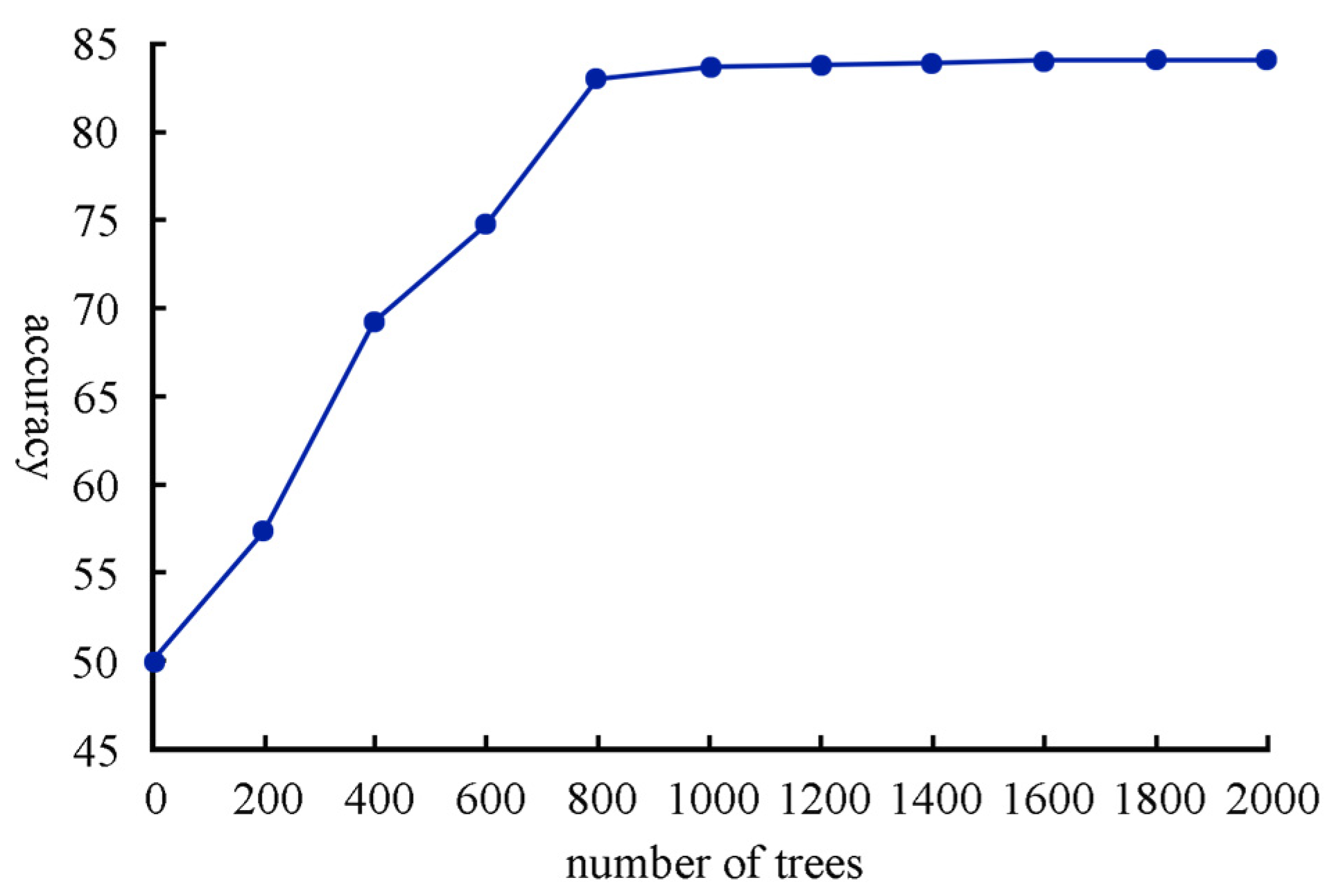
Second-hand housing transaction prices are used to represent land prices. However, as they only reflect residential transactions and lack industrial and commercial data with numerous missing values, the RF algorithm is employed for spatial interpolation to fill the gaps. To ensure the transparency and reproducibility of the RF model, detailed parameters and training strategies are specified as follows: the number of decision trees is set to 800, which is determined by grid search with cross-validation. As shown in Figure 3, the simulation accuracy stabilizes after 800 trees; the maximum depth of each decision tree is 15 to avoid overfitting; the minimum number of samples required to split an internal node is 5; and the minimum number of samples required at a leaf node is 2. For feature importance evaluation, the Gini impurity reduction method is adopted, where the top three contributing features are housing transaction area (importance weight: 0.32), distance to the nearest subway station (0.28), and surrounding commercial POI density (0.21). The training strategy uses a 5-fold cross-validation approach, with 70% of the data as the training set and 30% as the test set, and the training process terminates when the cross-validation error converges (variance ≤ 0.01).
Let R =   {   x 1 ,   x 2 , , x n } denote a set of used housing transaction time series with a missing value window size of n . By partitioning the input space R into M subspaces and assigning a fixed output value y ¯ m to each subspace R m , the regression tree model for used housing transactions can be expressed as follows:
f x = m = 1 M y ¯ m I x R m
where I represents the transaction mean function; y ¯ m denotes the average value of the output variable y across all samples within each subspace.
The subspace corresponding to the current parent node is R m . Based on the threshold, it is partitioned into four parts: R u x i * , R d x i * , R l x i * and R r x i * . For this partitioning problem, an optimal partition exists that minimizes I x i * . Following this segmentation method, R u and R d , as well as R l and R r , are treated as parent nodes for recursive segmentation until the variance of the y values in the samples within the current parent node falls below a specified variance threshold.
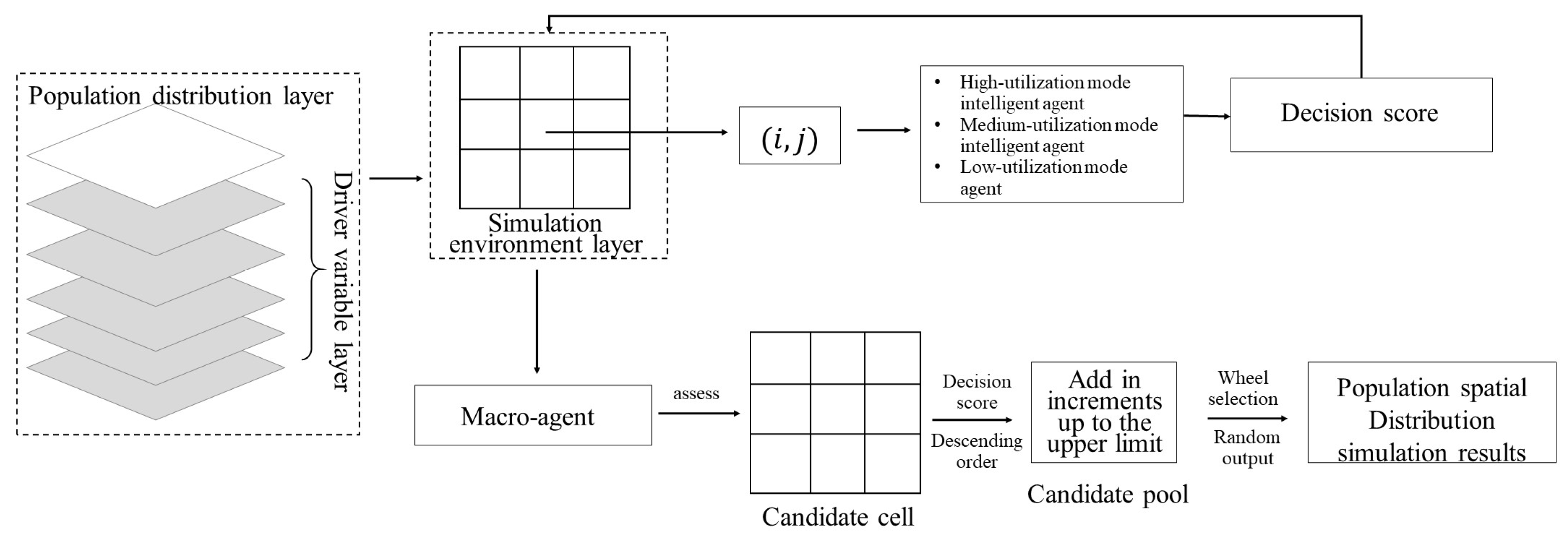
After data interpolation, MAS simulates population spatial distribution (Figure 4). Two agent types are included: macro-agents (land cover, housing transaction prices, representing government’s land-use planning and housing price control) and micro-agents (business distribution, housing use, transportation accessibility, reflecting residents’ wishes). A 3 × 3 Moore neighborhood is used, with a roulette wheel selection mechanism constructed by population decreasing and increasing tuples for mode competition.
To quantitatively evaluate the reliability of the high-resolution population distribution simulation results generated by the proposed model, this study selects the WorldPop global population grid dataset (100 m resolution, 2020) as the benchmark reference data for cross-validation. WorldPop is recognized as one of the most authoritative open-access high-resolution population datasets worldwide, which has been widely applied in urban population spatialization verification. The validation covers spatial consistency evaluation, statistical error analysis and local accuracy comparison, aiming to confirm that the simulated population distribution in this paper is more consistent with the actual population agglomeration characteristics of the study area. However, it should be noted that the current validation strategy is insufficient: although the simulated population estimates are compared with the WorldPop dataset and acceptable statistical indicators are reported, the validation remains limited to a single benchmark dataset.
To overcome this limitation and establish a more rigorous validation framework to support the claimed accuracy and reliability of the simulation results, additional validation steps are required. First, field survey data from representative regions should be incorporated for further validation to directly verify the consistency of the simulation results with actual population distributions. Second, an uncertainty analysis should be conducted to quantify potential errors arising from data inputs, model structure, and parameter settings, thereby clarifying the range of reliability of the simulation results. Third, a parameter sensitivity analysis should be conducted to assess the sensitivity of the simulation results to parameter choices in the RF and MAS models(Table 2 ). This can provide a basis for optimizing model parameters and can improve the stability of the simulation results.
The above validation framework, combining single benchmark dataset comparison, independent ground-truth validation, uncertainty analysis and parameter sensitivity analysis, can comprehensively and rigorously evaluate the accuracy and reliability of the simulated population distribution results, thus effectively supporting the validity of the research conclusions.

3.1.2. Types of Urban Expansion

From the perspective of human–land synergy, this paper characterizes urban expansion by combining two indicators: impervious surface—the core characteristic of urban built-up areas—and population—the primary vehicle of human activity. Based on the combinations of changes in these two indicators, urban expansion is classified into five types (Table 3), among which comprehensive, horizontal, and vertical expansion are the primary forms. The following sections focus on these three types, laying the groundwork for exploring their impact on the urban thermal environment.
Comprehensive expansion is a typical pattern of healthy urban development, characterized by the synchronous growth of impervious surface and population, reflecting a positive synergy between people and land. Under this model, the expansion of urban construction land aligns closely with population growth; the expansion of impervious surface is accompanied by the rational layout of various supporting facilities to meet population needs, while population growth provides the driving force for urban development. This model is commonly observed during the rapid development phase of cities and represents an ideal state of harmony between people and land.
Horizontal expansion is a form of outward expansion characterized by the expansion of impervious surface while the population remains constant or declines, representing a non-synergistic expansion between people and land. It manifests as a “sprawling” outward expansion of urban space without corresponding population growth. This stems from some cities’ blind land expansion and the functional decline of old urban areas, leading to land waste, an imbalance between people and land, and potentially exacerbating urban thermal environmental disparities.
Vertical expansion is an intensive expansion model characterized by stable impervious surface and population growth, embodying the principle of efficient land use. By developing vertical space to increase population carrying capacity without requiring outward expansion, this model is commonly found in land-scarce urban core areas. It conserves land, alleviates the conflict between people and land, and has a significantly different impact on the urban thermal environment compared to horizontal expansion.
Additionally, the contraction model—characterized by a decrease in both impervious surface and population—and the stabilization model—serving as a supplementary category—reflect specific states of urban development. Together, they form a comprehensive system of urban expansion types, providing a classification framework for related research.

3.1.3. Multidimensional Urban Expansion Intensity

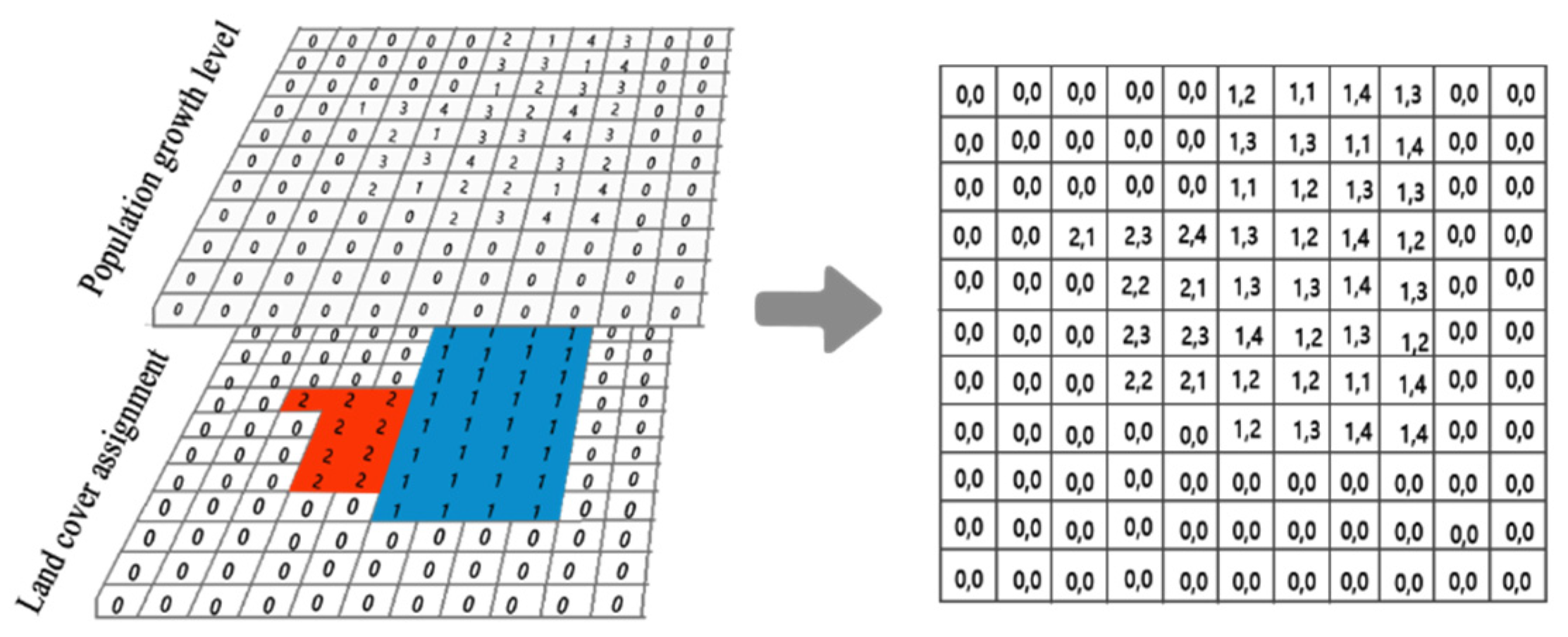
In order to quantitatively analyze the intensity of multidimensional urban sprawl, this paper divides the study area into a grid of 30 × 30 m and divides the surface cover into impervious surface and others, assigning values to the original impervious surface, the new impervious surface, and the other grids, respectively; then, it classifies the value of the population growth into grades, and then forms a pair of the two values mentioned above to represent the intensity of multidimensional urban sprawl (Figure 5), with the following rules for assigning values.
x a i = 0
x b i = 1
x c i = 1 + n
y i = m
U E i = ( x i , y i )
where x a i denotes grid values where land cover is other than the original impervious surface; x b i denotes grid values where land cover is the original impervious surface; x c i denotes grid values where land cover is newly added impervious surface; n represents the grade of newly added impervious surface grid count, ranging from 1 to 5, indicating impervious surface expansion intensity; y i denotes population growth grade; x i denotes land cover grid value; U E i denotes the multidimensional urban expansion intensity. m represents the classification level of population growth according to a unified standard, with values ranging from −5 to 5, where positive and negative values indicate increase or decrease respectively; the greater the absolute value, the more significant the population increase or decrease.

3.2. Heat Island Intensity Classification

In this paper, a single-window algorithm is used for temperature inversion and thus heat island intensity classification. In view of studying the impact of urban sprawl on the urban thermal environment, the influence of topographic relief on the surface temperature inversion results is ignored, and the anomalies in the mountainous part are substituted as the average values of the nearby rasters. In response to the phenomenon that the surface temperature inversion results of the spliced multiview remote sensing images have anomalies due to the different image acquisition times in the large study area, this paper utilizes the sliding-window method for data smoothing. In order to eliminate the influence of different seasons and years, this paper adopts the mean standard deviation method [20] to classify the heat island intensity, and its classification thresholds are as follows:
T i = T ¯ ± n × S D
In the formula, T i denotes the classification threshold for the i class; n represents the multiple of the standard deviation, with values of 1 or 0.5; S D indicates the standard deviation of LST; T ¯ signifies the mean LST value of the study area. Considering the influence of water bodies and topography [31], areas with significant water bodies or pronounced terrain undulations are excluded when calculating the mean LST value.
Based on full-coverage DEM statistics of the Pearl River Delta, 92% of regional construction land lies on flat alluvial plains with slopes below 3°, where terrain elevation remains stable and overall relief is generally less than 20 m. The PRD presents integrated delta plain landforms without large undulating mountains or complex terrain disrupting urban built-up areas, resulting in extremely weak terrain-driven spatial heterogeneity of construction land; thus, topographic impacts are marginal and can be reasonably neglected in this regional analysis.

4. Results

4.1. Characteristics of Urban Expansion

4.1.1. Spatio-Temporal Distribution Characteristics of the Pearl River Delta Population

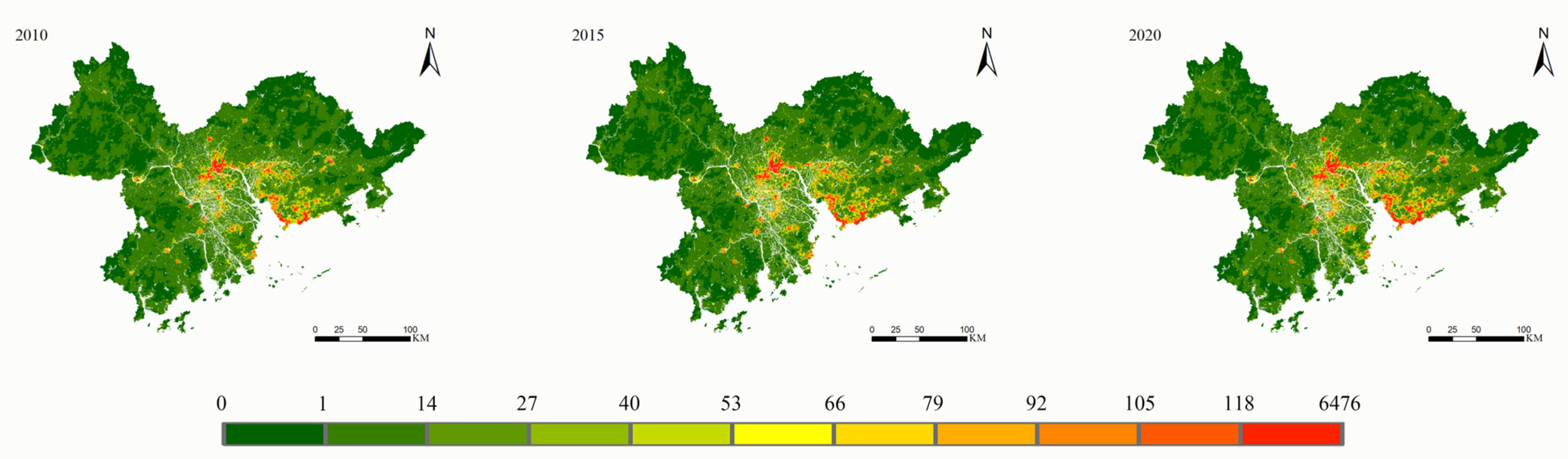
In this paper, multi-source heterogeneous data are used as to carry out large-area high-resolution population distribution simulation. And, a population spatial distribution mapping method based on the RF model and intelligent agent technology is proposed (Figure 6), with an overall accuracy of 84%, which is 7.02% higher than the RF model and 9.41% higher than the intelligent agent model. From the perspective of population distribution, the spatial distribution characteristics of the population in 2010, 2015 and 2020 are similar, and population agglomeration shows the characteristics of radioactive expansion with Guangzhou and Shenzhen as the twin centers. Especially, in the five-year period from 2015 to 2020, population distribution clusters have been formed for “Guang-Fo-Zhao” and “Shen-Dong-Hui”. In terms of population size, the population of the PRD urban agglomeration has continued to grow and develop in tandem, showing an “n”-shaped distribution and an overall expansion trend. Specifically, the population attractiveness of Foshan and Dongguan has increased, and they are still maintaining a continuous expansion of the permanent population increment, while Guangzhou and Shenzhen have seen a slowdown in the incremental resident population. In particular, due to the radiation drive of Shenzhen, the population attractiveness of Huizhou has increased, with a significant increase in population.

4.1.2. Expansion Direction Characteristics

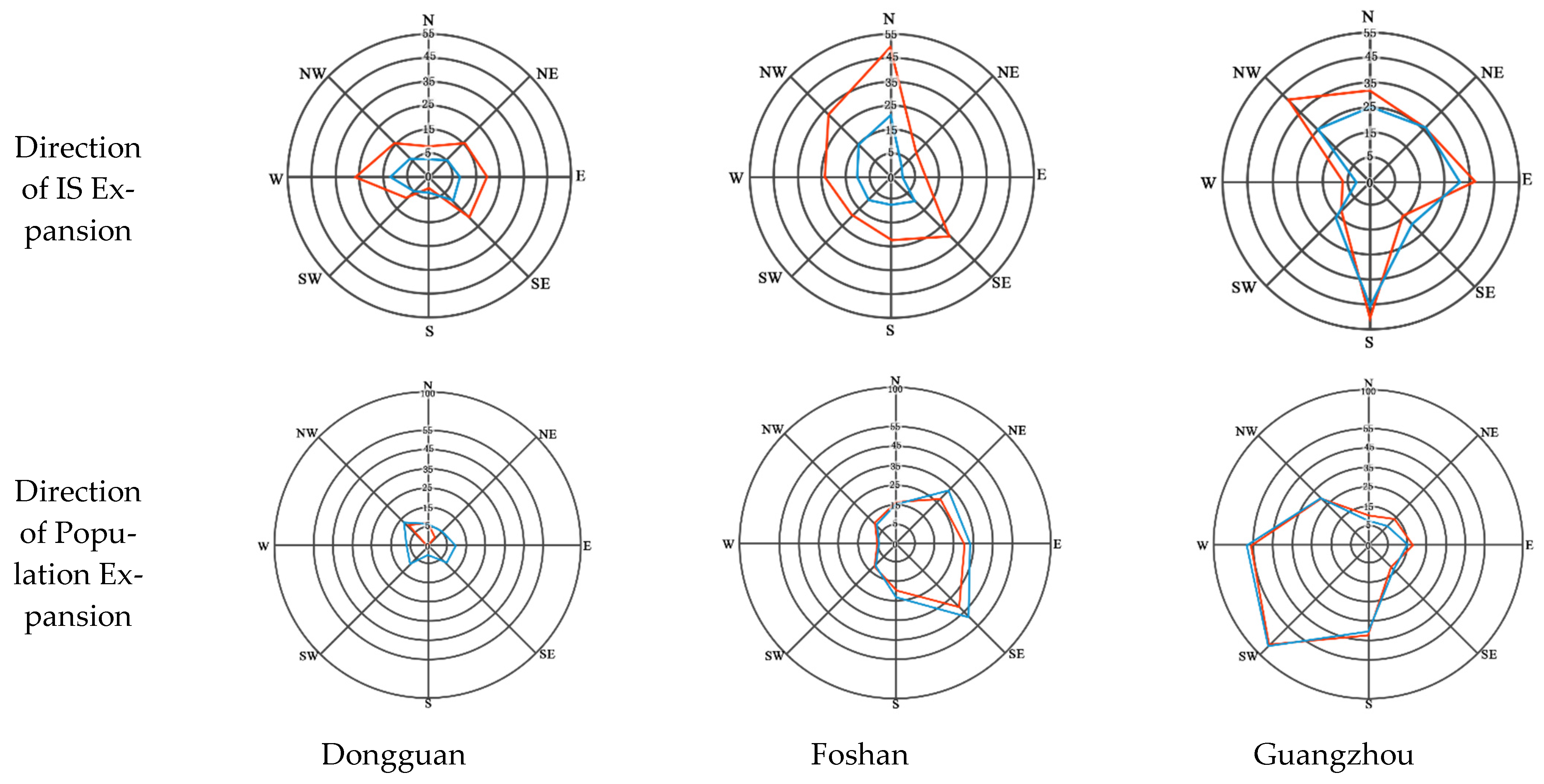
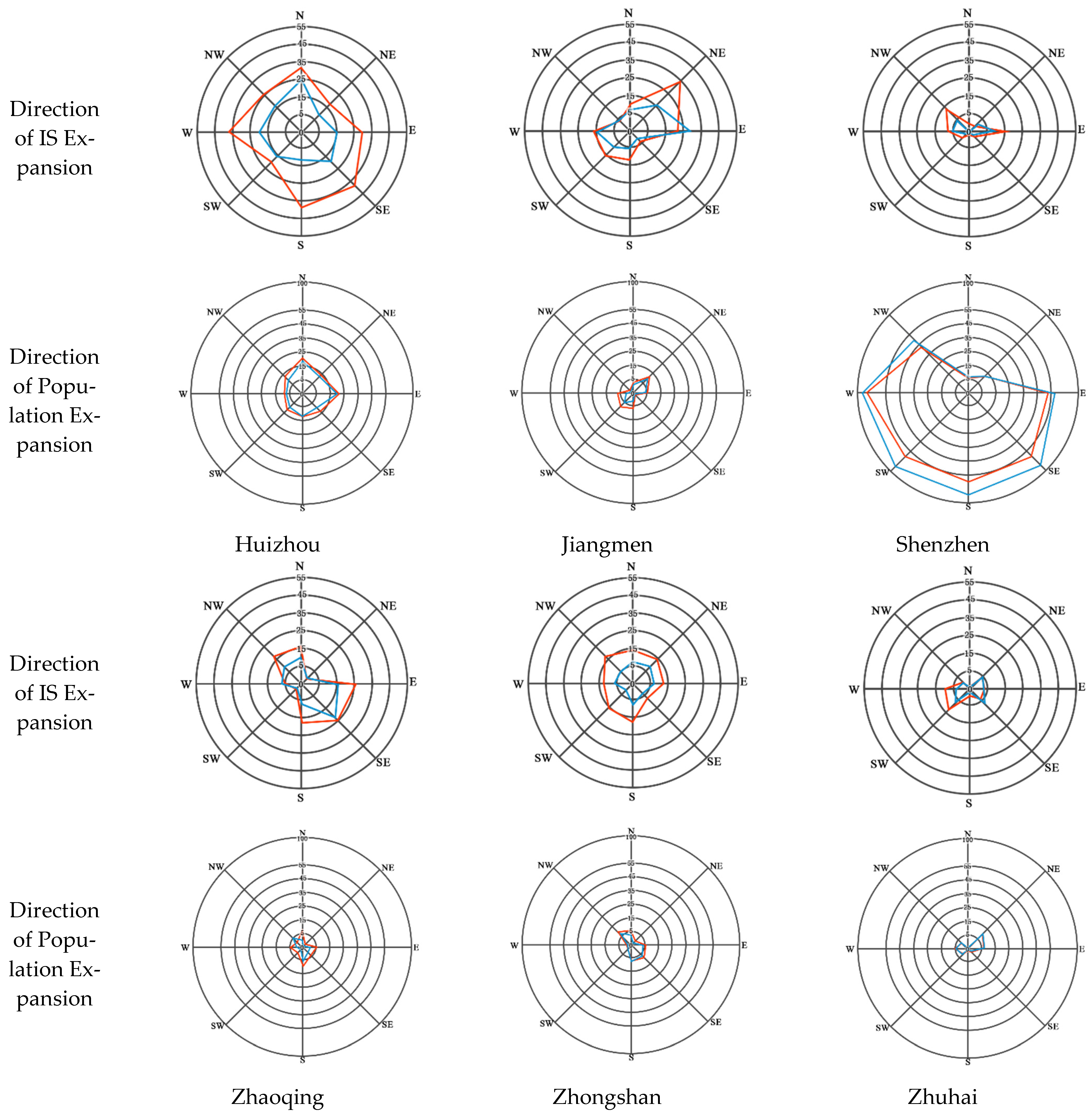
In this paper, this article takes the centroids of the IS of the nine cities in the PRD urban agglomeration in 2010 as the origin, and divides the nine cities into eight directions at 45 ° intervals. Then, the proportion of the new IS expansion area and population growth in each direction in 2015 and 2020 to the total IS and population in 2010 is calculated, and the characteristics of the expansion of the IS and the population growth in each direction in each city are quantitatively analyzed (Figure 7). From the direction of IS expansion, Guangzhou mainly develops to the northwest and south, gradually crosses the administrative boundary with Foshan, and radiates to influence the development of Zhaoqing in the southeast direction. Simultaneously, Shenzhen shifts from northwestern and eastward to east–west, and Dongguanmainly expands east–west, and the development of the two cities shows a linkage trend. This is related to the industrial cooperation between the two cities and the shift from industrial synergy to source innovation orientation, as well as the radiation-driven development of Huizhou in the north and south directions. In addition, Foshan is expanding in the north, northwest and southeast directions, and is developing in tandem with Zhaoqing and Jiangmen. And Zhuhai is shifting from southwest to east–west development, and is playing the role of an important transportation hub to strengthen the links with Hong Kong and Macao. Furthermore, Zhongshan is being driven by the dual radiation of Foshan and Zhuhai, with the development of the cities in each direction relatively balanced. Overall, the expansion of the PRD urban agglomeration is characterized by contiguity and interaction, and the main spatial characteristics are formed, with Guangzhou, Shenzhen, and Zhuhai as the core, radiating and driving the cluster development of surrounding cities, and coordinating and interconnecting the development of clusters.
In terms of the direction of population expansion, except for Zhaoqing and Jiangmen, the expansion of impervious surface does not have the same main direction of population expansion. In fact, population growth is mainly in the urban core areas with concentrated population, probably due to the greater proportion of immigrants in the PRD urban agglomeration. The reason for the migration is mainly for employment, and migrants are mainly concentrated in the urban areas and other economically developed areas. However, the expansion of the impervious surface is mainly of the type of industrial and residential land, and is mostly located in the periphery of the cities, which is less attractive to the population. The expansion of impervious surface is mainly industrial and residential land, and mostly located in the periphery of the city, which is less attractive to the population. Generally, the difference in the direction of human–land expansion also indicates that the expansion of impervious surface alone cannot fully characterize the direction of urban agglomeration expansion.

4.1.3. Characteristics of Multidimensional Urban Expansion

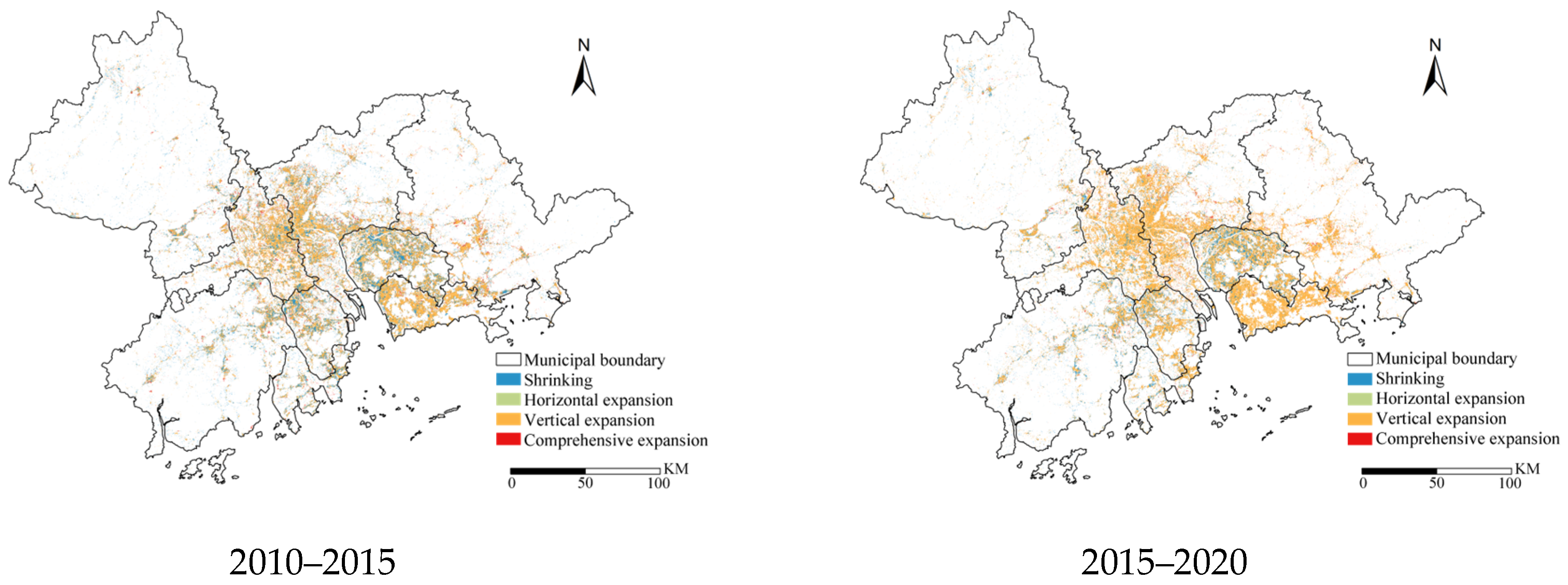
From the perspective of expansion types, the types of urban expansion in the PRD urban agglomeration in 2015 and 2020 are both dominated by vertical expansion(Figure 8). Specifically, the diffusion of industries centered on Guangzhou to Foshan, as well as the diffusion of population to Foshan in the latter stage, has promoted the shaping of the Guangzhou–Foshan metropolitan circle. In addition, with the construction of transportation and the difference in housing prices, the diffusion of residential areas of Shenzhen to Dongguan and Huizhou began to appear, and the morphological structure of the metropolitan circle centered on Shenzhen gradually unfolded. Due to the relationship of location, Hong Kong, Macao and the two central cities of the PRD, Guangzhou and Shenzhen, all had a role to play in the three cities, Zhuhai, Zhongshan and Jiangmen, and these three cities actively dovetailed with those four core cities in terms of spatial development. Then, the three major metropolitan areas, Guang-Fo-Zhao, Shen-Dong-Hui and Zhu-Zhong, were all developed to varying degrees, and a multi-core and strongly connected urban agglomeration was gradually formed to strengthen the comprehensive strength of the PRD urban agglomeration. In particular, each city has seen contraction-type areas, especially Dongguan. Due to the introduction of corporate governance policies in 2015, a group of backward production capacity enterprises were eliminated, resulting in a significant contraction in Dongguan’s development, and a certain degree of urban contraction due to the impact of industrial restructuring in 2020. Especially, the PRD urban agglomeration has strengthened the governance of the ecological environment, optimized the spatial development pattern, and strictly controlled new construction land, so there are fewer comprehensive expansion and horizontal expansion types.

4.2. Patterns of Thermal Environmental Change

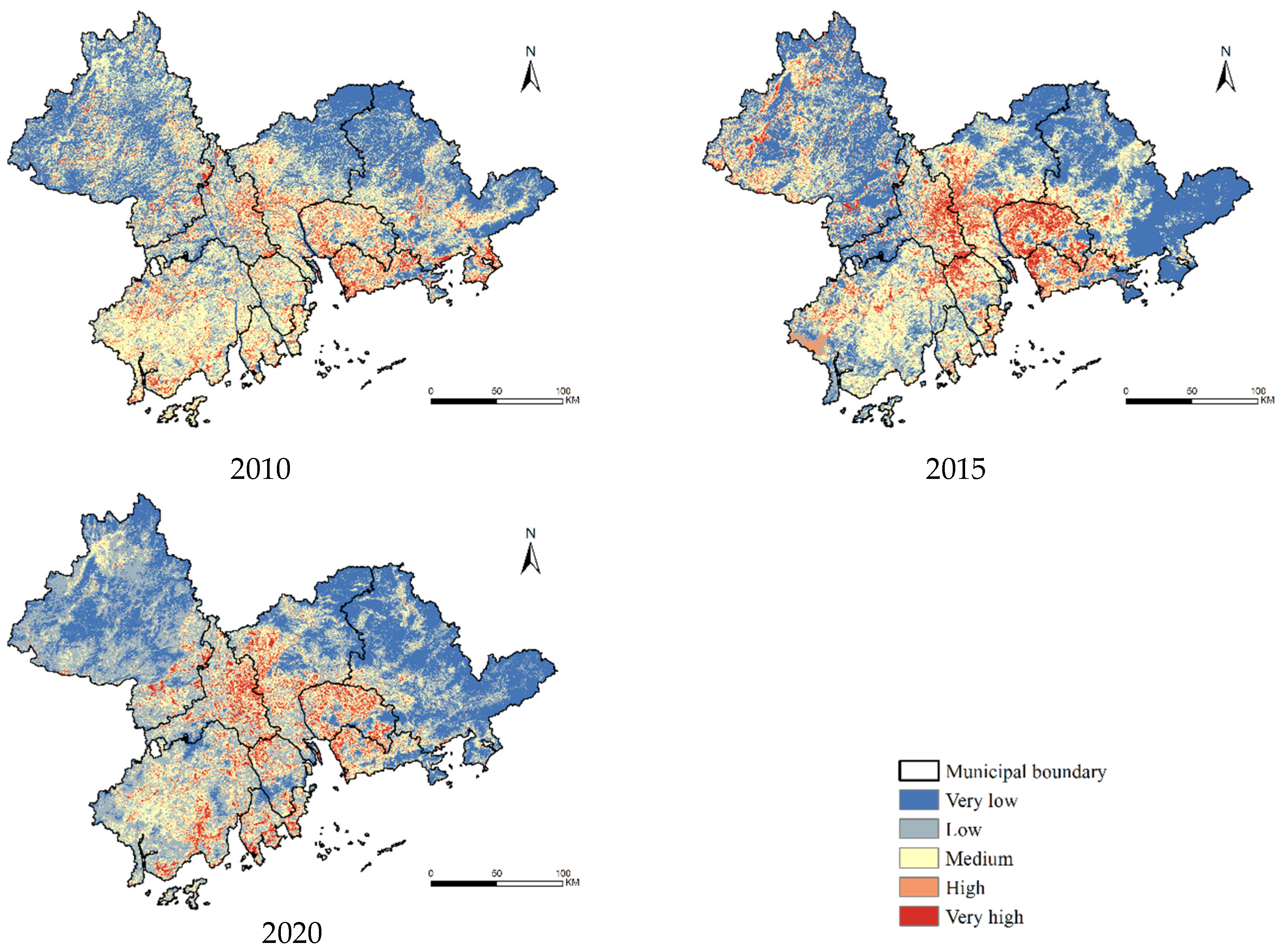
Combined with the development status, in 2010, the strong heat islands were mainly distributed in Guangzhou, Foshan, Dongguan and Shenzhen, which are relatively economically developed and dominated by labor-intensive processing and manufacturing industries, attracting a large number of migrant populations, with the area of impervious surface and the number of populations at the forefront of the city cluster(Figure 9). In 2015, the heat island intensity of Guangzhou and Shenzhen increased significantly, especially in Foshan and Dongguan, which are adjacent to the core cities of the PRD urban agglomeration. The heat island intensity of Foshan and Dongguan, which are adjacent to the core cities of Guangzhou and Shenzhen, reaches 1.5–2.5 °C (medium intensity), which is probably due to the impact of the El Niño phenomenon and the synergistic development of cities, which results in the trans-regional mobility of populations and the imperfect construction of infrastructure, and increases the intensity of the heat island. In 2020, with the further development of Guang-Fo and Shen-Guan-Hui, the construction of interconnected transportation facilities has promoted the formation of the living circle. And, labor-intensive industries transformed and upgraded to modern manufacturing and service industries. As a result, heat island intensity has also been greatly alleviated. In general, the heat island intensity of the city cluster has a tendency to increase first and then decrease.

4.3. The Impact of Urban Expansion on Heat Island Intensity

4.3.1. The Impact of Urban Expansion Patterns on the Urban Heat Island Effect

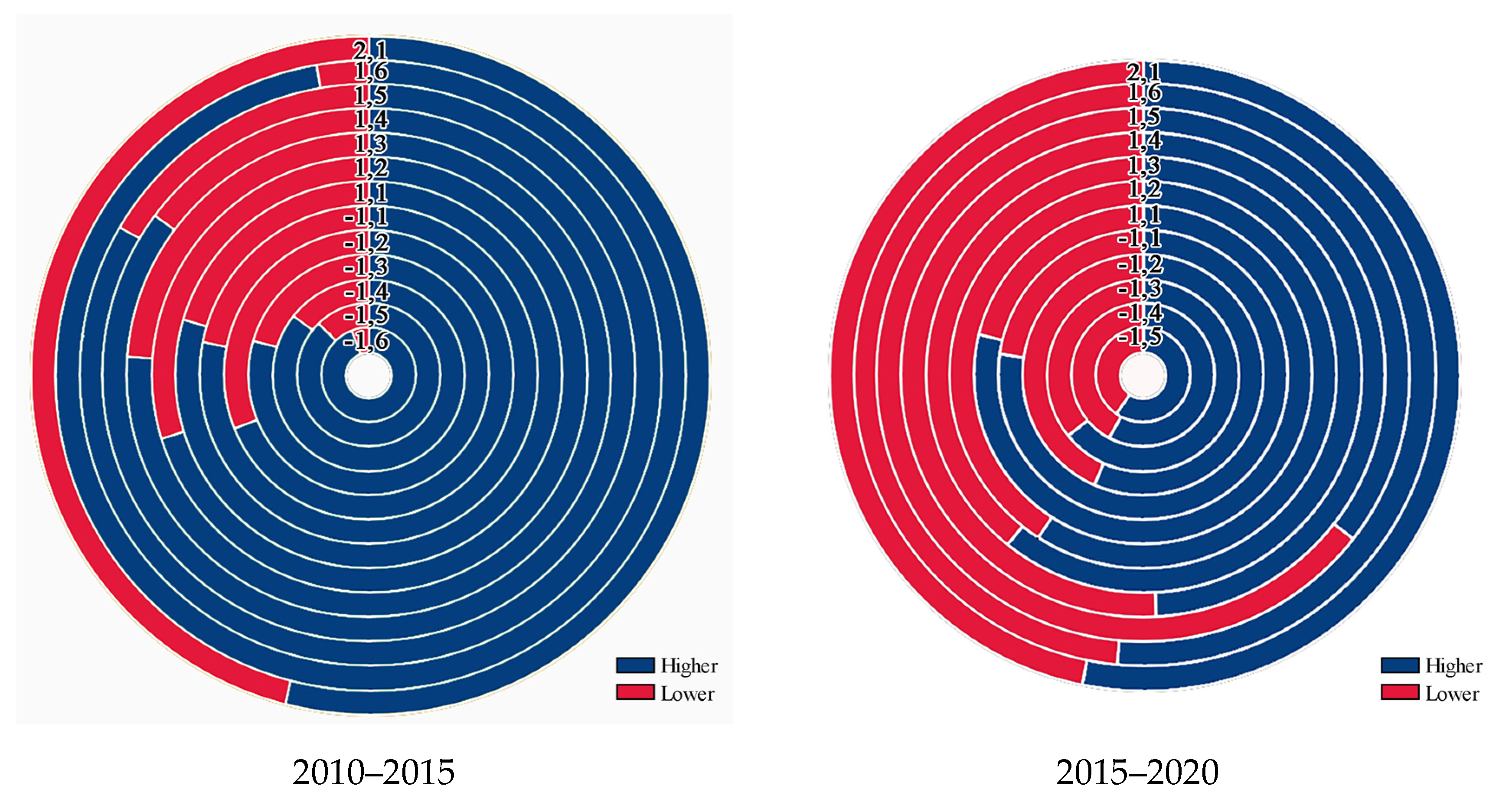
Referring to the mean standard deviation method, the values of different grids of LST in 2010, 2015 and 2020 were used to subtract the mean value of the study area (areas with water and large topographic relief are excluded); then, the difference was made in two years to obtain the degree of increase and decrease in heat island intensity in 2010–2015 and 2015–2020. Finally, statistics were made for the increase and decrease in heat island intensity with different multidimensional urban sprawl intensities (Figure 10). As can be seen from Figure 10, from 2010 to 2015, the proportion of heat island intensity decrease in multidimensional urban expansion intensity of (2, 1) is much larger than the proportion of increase; that is to say, the multidimensional urban expansion intensity of (2, 1) is more likely to mitigate the heat island effect. However, with the multidimensional urban expansion intensity of (1, 1), the center of both upward and downward showed a trend of a proportion of decrease in the heat island effect, which shows the heat island effect is weakened. In other words, the expansion of impervious surface will strengthen the heat island effect regardless of the increase or decrease in population. It indicates that a small increase in population in the original impervious surface is more beneficial to heat island mitigation than crude, low-utilization impervious surface expansion. In particular, in 2015–2020, both upward and downward centered on the multidimensional urban sprawl intensity of (1, 1), showing a trend of increasing the proportion of reduction in heat island effect, which illustrates a trend of incremental mitigation of the heat island effect and that the expansion of impervious surface is more conducive to mitigating the heat island effect when the population gathers to a certain extent.
In order to investigate the reason why the expansion of impervious surface is beneficial to mitigate the heat island effect, this paper measures the increase and decrease in heat island effect and the corresponding population distribution in different cities, and finds that the population size of the areas with mitigated heat island is generally below 500, while most of the areas with an enhanced heat island have a population of more than 500. In addition, the impervious surface of Shenzhen and Pearl River shows a tendency of expansion, but the intensity of the heat island is mainly decreasing. Namely, the original impervious surface may become the key area of heat island intensity increase due to the increase in energy consumption as the original impervious surface is overpopulated. And after the expansion of the IS, the evacuation of the population and reasonable urban planning and design can achieve the mitigation of the heat island effect. In general, the expansion of IS does not necessarily lead to the enhancement of the heat island effect; when the per-capita land area is below 1.8 m2 and the population is too concentrated, the expansion of impervious surface can alleviate the heat island effect.

4.3.2. The Impact of Urban Expansion Direction on the Urban Heat Island Effect

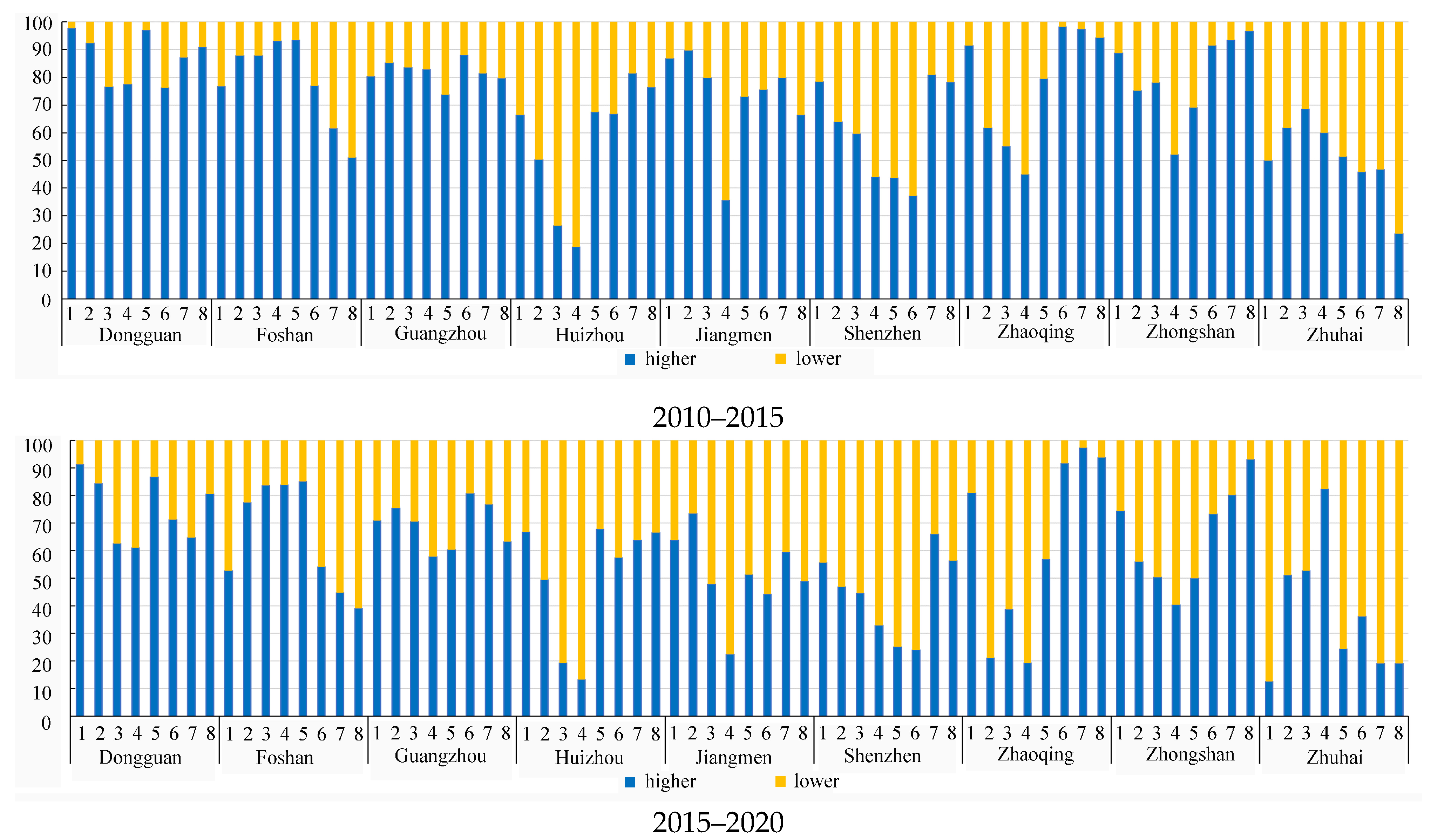
In order to investigate the impact of the synergistic development of urban agglomerations on the urban thermal environment, this paper measures the increase and decrease in heat island intensity as a percentage of the IS in different expansion directions (Figure 11). As can be seen from Figure 11, from 2010 to 2015, the IS expansion of the east and southeast of Huizhou, southeast of Jiangmen, and southeast, south and southwest of Shenzhen has a significant mitigating effect on the heat island. Furthermore, these directions are mainly oriented toward waters or forests, which mainly utilize the cold island effect of water bodies and vegetation to mitigate the heat island effect. In particular, the expansion of IS in the southeast of Zhaoqing and the northwest of Zhuhai is also relatively significant in mitigating the heat island effect, and these directions point to Foshan City, Jiangmen City, and Zhongshan City, respectively, and there is a trend of mitigating the heat island effect in the relative directions of these cities as well.
It is worth noting that in the period from 2015 to 2020, the mitigation of the heat island effect in each direction has a tendency to be enhanced, especially in the east, southeast, and west of Dongguan, the north, southwest, west, and northwest of Foshan, the southeast and south of Guangzhou, the northeast and southwest of Huizhou, the east of Jiangmen, the northeast and east of Shenzhen, the east and southeast of Zhaoqing, the east, southeast and south of Zhongshan, and the west and northwest of Zhuhai. These directions are precisely the development directions of the three major metropolitan areas of Guangzhou, Shenzhen, and the western port of the Pearl River. Overall, it indicates that the cluster development model of core cities and surrounding cities, and the interconnectivity between urban clusters, is conducive to alleviating the heat island effect.

4.4. Heat Island Mitigation Strategies

(1) One point with multi-point development within city clusters.
Adopt one point with multiple-point radial linkage mode to promote interconnected development among clusters, promote industrial synergy and accelerate transportation interconnection. More specifically, carry out a good positioning analysis for each city in the city cluster, highlighting the city’s advantages. Strengthen the division of labor and collaboration and complementary advantages of cities in the city cluster through the driving and radiating role of the core city, mobilize the vitality of the city, and promote the transformation and upgrading of industries. In addition, build a single network of transportation, forming a modern comprehensive and three-dimensional transportation network that is convenient, smooth, economically efficient, green and intensive.
(2) Construction of ventilation corridors.
Provide reasonable planning of urban ventilation corridors to draw wind into the city. Dense building complexes in urban areas cause the roughness of the urban subsurface to increase, increasing the resistance to wind, making it difficult for heat to be dissipated in urban areas. Therefore, for the central urban areas with strong urban heat island intensity, the main ventilation corridors should be constructed in accordance with the prevailing winds and ecological cooling sources in the suburbs. And at the same time, attention should be paid to the planning of secondary ventilation corridors within the urban areas.
(3) Promotion of the construction of wide-area garden cities.
Strengthen urban gardening and greening, promote building energy conservation, and regulate the local microclimate. Specifically, improve the thermodynamic properties of the urban underlayment by using high-reflectivity surface materials, landscaping, new bodies of water, and green roofs, which can improve the urban heat island effect.

5. Conclusions and Discussion

5.1. Conclusions

The emergence of “empty cities” and “shrinking cities” indicates obvious population loss in some cities, and impermeable surface expansion fails to fully reflect urban development status. Thus, we adopted a multidimensional urban expansion analysis model to explore its impact on the thermal environment from a human–land synergy perspective, proposing a population distribution simulation method integrating RF and MAS to solve refined population data shortage. The main conclusions are as follows:
(1) The proposed method integrating RF and MAS for 30 m spatial resolution population mapping achieves 84% accuracy, 7.02% higher than the single RF model and 9.41% higher than the single intelligent agent model. It accurately reveals intra-agglomeration population distribution differences, providing a data basis for multidimensional urban expansion quantitative analysis.
(2) PRD urban agglomeration population continues to grow, with an “n”-shaped spatial distribution and a coordinated development tendency with neighboring cities. Despite interactive development among Guangzhou, Shenzhen and western Pearl River Estuary ports, population growth and impermeable surface expansion directions differ: populations concentrate in dense core areas, while impermeable surfaces expand at urban edges. Despite mainly vertically expanding, there are many shrinking areas, especially in Guangzhou and Shenzhen’s peripheral cities.
(3) PRD heat island intensity first increases then decreases; impermeable surface expansion does not necessarily enhance it. When per-capita land area is greater than 1.8 m2, vertical expansion alleviates heat islands; when per-capita land area is less than 1.8 m2, impermeable surface expansion also mitigates it. This may result from excessive population concentration increasing anthropogenic heat; impermeable surface expansion with rational population evacuation and planning can mitigate heat islands.
(4) We should give full play to the radiation role of core cities (Guangzhou, Shenzhen, Zhuhai), promote coordinated development of peripheral cities (Foshan, Zhaoqing, etc.), clarify functional layout and division of labor, strengthen inter-agglomeration infrastructure and transportation networks, and promote integration to alleviate heat islands.

5.2. Discussion

This paper proposes a multidimensional urban expansion analysis model for the coexistence of construction land expansion and urban shrinkage, exploring their thermal environment impact from a human–land synergy perspective. The RF-MAS model achieves 84% accuracy in 30 m population mapping, providing reliable technical support for quantitative human–land synergy analysis in urban thermal environment research. Our findings align with core research on urban heat islands and urban expansion, enriching the human–land synergy perspective. The RF-MAS model’s 30 m high-precision population mapping solves the long-standing difficulty in quantitative human–land synergy analysis, offering a new technical approach for related studies.
Taking the Pearl River Delta as the case study, our 2010–2020 data reflects key-period urban expansion and thermal environment characteristics. The research design considers construction land expansion/shrinkage, ensuring result authenticity. The 1.8 m2 per-capita land area threshold provides a reference for impermeable surface-related heat island mitigation in the study area. Regarding the mitigation effect of impermeable surface expansion combined with population evacuation and planning on heat islands, this study puts forward a preliminary exploration based on the actual data of the study area. This viewpoint is based on the comprehensive analysis of urban expansion, population distribution and thermal environment data in the Pearl River Delta region, and its rationality is supported by the actual data of the study area. The applicable conditions of this viewpoint are closely related to the urban development characteristics, population distribution pattern and planning layout of the Pearl River Delta region, which can provide a reference for the exploration of heat island mitigation strategies in regions with similar urban development characteristics.
Future research should refine urban functions using high-resolution remote sensing and POI data, comprehensively consider population, land and urban functions, and propose multi-perspective heat island mitigation strategies. At the same time, the discussion part should be further revised and expanded, and supplemented with comparisons with other studies, to improve the depth and scientificity of the research discussion. A per-capita land area threshold (1.8 m2) below which the expansion of impervious surfaces may mitigate the urban heat island effect should be considered, which is based on an analysis of data from the study area for the years 2010, 2015, and 2020. It should not be treated as standard data for other regions or years. Future research will expand the study area and time frame to identify a threshold with greater universality.

Author Contributions

Conceptualization, project support and writing—review and editing, Qianxin Wang; data acquisition, data modeling, algorithm and writing—original draft preparation, Yun Qiu and Fangjie Cao. All authors have read and agreed to the published version of the manuscript.

Funding

This research received no external funding.

Data Availability Statement

The original data presented in this study are openly available in the corresponding public platforms and official resources. POI data and building data for 2010, 2015 and 2020 are openly available at https://lbs.amap.com/. Road data in 2010, 2015 and 2020 are openly available at https://www.openhistoricalmap.org/. Housing price data covering 2010, 2015 and 2020 are openly available at https://xz.sofang.com/. Demographic data from 2010 to 2020 are available in the official statistical yearbooks. Land use data of 2010, 2015 and 2020 are openly available at https://data.casearth.cn/sdo/detail/6123651428a58f70c2a51e48. Landsat-5 and Landsat-8 remote sensing images during 2009–2019 are openly available at https://earthexplorer.usgs.gov/. The 2019 DEM data are openly available at http://www.gscloud.cn. All datasets are accessible for non-commercial scientific research with compliance to the relevant usage regulations of each platform.

Conflicts of Interest

The authors declare no conflict of interest.

References

  1. Li, X.; Zhou, Y.; Yu, S.; Jia, G.; Li, H.; Li, W. Urban heat island impacts on building energy consumption: A review of approaches and findings. Energy 2019, 174, 407–419. [Google Scholar] [CrossRef]
  2. Zhou, X.; Wu, B.; Liu, Y.; Zhou, Q.; Cheng, W. Synergistic effects of heat and carbon on sustainable urban development: Case study of the Wuhan Urban Agglomeration. J. Clean. Prod. 2023, 425, 138971. [Google Scholar] [CrossRef]
  3. Eyni, A.; Zaitchik Benjamin, F.; Hobbs Benjamin, F.; Hadjimichael, A.; Shi, R. Distributional outcomes of urban heat island reduction pathways under climate extremes. Sci. Rep. 2025, 15, 9594. [Google Scholar] [CrossRef]
  4. Yue, W.; Qiu, S.; Xu, H.; Xu, L.; Zhang, L. Polycentric urban development and urban thermal environment: A case of Hangzhou, China. Landsc. Urban Plan. 2019, 189, 58–70. [Google Scholar] [CrossRef]
  5. Huang, H.; Deng, X.; Yang, H.; Li, S.; Li, M. Spatial Evolution of the Effects of Urban Heat Island on Residents’ Health. Teh. Vjesn. 2020, 27, 1427–1435. [Google Scholar]
  6. Chen, S.; Bao, Z.; Ou, Y.; Chen, K. The synergistic effects of air pollution and urban heat island on public health: A gender-oriented nationwide study of China. Urban Clim. 2023, 51, 101671. [Google Scholar] [CrossRef]
  7. Lin, L.; Gao, T.; Luo, M.; Ge, E.; Yang, Y.; Liu, Z.; Zhao, Y.; Ning, G. Contribution of urbanization to the changes in extreme climate events in urban agglomerations across China. Sci. Total Environ. 2020, 744, 140264. [Google Scholar] [CrossRef] [PubMed]
  8. Hedeya, Y.; Merabtine, A.; Maref, W. Evaluating the Urban Heat Island Effect in Montreal: Urban Density, Vegetation, Demographic, and Thermal Landscape Analysis. Buildings 2025, 15, 1562. [Google Scholar] [CrossRef]
  9. Jaber Salahuddin, M.; Sengupta, R. Spatial and temporal variabilities in land surface temperatures and near-surface air temperatures in an arid to semiarid urban region: Implications for urban heat island research. Geo-Spat. Inf. Sci. 2024, 27, 2137–2161. [Google Scholar] [CrossRef]
  10. Kavathekar, V.; Tripathy, A.K.; Chettri, S.K.; Bhanage, V. Evaluation of land use land cover dynamics and urban heat island effects over Mumbai metropolitan Region, India. Int. J. Environ. Sci. Technol. 2025, 22, 11345–11368. [Google Scholar] [CrossRef]
  11. Wang, C.; Ren, Z.; Dong, Y.; Zhang, P.; Guo, Y.; Wang, W.; Bao, G. Efficient cooling of cities at global scale using urban green space to mitigate urban heat island effects in different climatic regions. Urban For. Urban Green. 2022, 74, 127635. [Google Scholar] [CrossRef]
  12. Wang, J.; Huang, B.; Fu, D.; Atkinson Peter, M.; Zhang, X. Response of urban heat island to future urban expansion over the Beijing–Tianjin–Hebei metropolitan area. Appl. Geogr. 2016, 70, 26–36. [Google Scholar] [CrossRef]
  13. Yin, C.; Yan, J.; Yuan, M.; Tian, G.; Wen, Q.; Wang, L.; Li, L. How does built environment affect the urban heat Island effect? a systematic framework integrating land use, building form, and road network. Environ. Dev. Sustain. 2025, 27, 1–27. [Google Scholar] [CrossRef]
  14. Xu, J.; Liu, Y.; Cao, J. Exploring the Configurational Relationships between Urban Heat Island Patterns and the Built Environment: A Case Study of Beijing. Atmosphere 2024, 15, 1200. [Google Scholar] [CrossRef]
  15. Xu, H.; Ding, F.; Wen, X. Urban Expansion and Heat Island Dynamics in the Quanzhou Region, China. IEEE J. Sel. Top. Appl. Earth Obs. Remote Sens. 2009, 2, 74–79. [Google Scholar] [CrossRef]
  16. Li, X.; Zhou, Y.; Asrar, G.R.; Imhoff, M.; Li, X. The surface urban heat island response to urban expansion: A panel analysis for the conterminous United States. Sci. Total Environ. 2017, 15, 426–435. [Google Scholar] [CrossRef]
  17. Li, F.; Sun, W.; Yang, G.; Weng, Q. Investigating spatiotemporal patterns of surface urban heat islands in the Hangzhou Metropolitan area, China, 2000–2015. Remote Sens. 2019, 11, 1553. [Google Scholar] [CrossRef]
  18. Ma, Y.; Zhang, S.; Yang, K.; Li, M. Influence of spatiotemporal pattern changes of impervious surface of urban megaregion on thermal environment: A case study of the Guangdong—Hong Kong—Macao Greater Bay Area of China. Ecol. Indic. 2021, 121, 107106. [Google Scholar] [CrossRef]
  19. Wang, Y.; Li, X.; Zhang, C.; He, W. Influence of spatiotemporal changes of impervious surface on the urban thermal environment: A case of Huai’ an central urban area. Sustain. Cities Soc. 2022, 79, 103710. [Google Scholar] [CrossRef]
  20. Mansouri, A.; Erfani, A. Machine Learning Prediction of Urban Heat Island Severity in the Midwestern United States. Sustainability 2025, 17, 6193. [Google Scholar] [CrossRef]
  21. Assaf, G.; Hu, X.; Assaad Rayan, H. Predicting Urban Heat Island severity on the census-tract level using Bayesian networks. Sustain. Cities Soc. 2023, 97, 104756. [Google Scholar] [CrossRef]
  22. Liu, Y.; Li, H.; Li, C.; Zhong, C.; Chen, X. An Investigation on Shenzhen Urban Green Space Changes and Their Effect on Local Eco-Environment in Recent Decades. Sustainability 2021, 13, 12549. [Google Scholar] [CrossRef]
  23. Cui, Y.; Xu, X.; Dong, J.; Qin, Y. Influence of Urbanization Factors on Surface Urban Heat Island Intensity: A Comparison of Countries at Different Developmental Phases. Sustainability 2016, 8, 706. [Google Scholar] [CrossRef]
  24. Zhou, D.; Xiao, J.; Frolking, S.; Zhang, L.; Zhou, G. Urbanization contributes little to global warming butsubstantially intensifies local and regional land surface warming. Earth’s Future 2022, 10, e2021EF002401. [Google Scholar] [CrossRef]
  25. Chen, Y.; Shan, B.; Yu, X. Study on the spatial heterogeneity of urban heat islands and influencing factors. Build. Environ. 2022, 208, 108604. [Google Scholar] [CrossRef]
  26. Robin, F.; Mick, G. Developments in areal interpolation methods and GIS. Ann. Reg. Sci. 1992, 26, 67–78. [Google Scholar] [CrossRef]
  27. Song, J.; Tong, X.; Wang, L.; Zhao, C.; Prishchepov Alexander, V. Monitoring finer-scale population density in urban functional zones: A remote sensing data fusion approach. Landsc. Urban Plan. 2019, 190, 103580. [Google Scholar] [CrossRef]
  28. Zhang, J.; Zhao, X. Using POI and multisource satellite datasets for mainland China’s population spatialization and spatiotemporal changes based on regional heterogeneity. Sci. Total Environ. 2024, 912, 169499. [Google Scholar] [CrossRef] [PubMed]
  29. Song, Y.; Wu, S.; Chen, B.; Bell Michelle, L. Unraveling near real-time spatial dynamics of population using geographical ensemble learning. Int. J. Appl. Earth Obs. Geoinf. 2024, 130, 103882. [Google Scholar] [CrossRef] [PubMed]
  30. Yu, C.; Hu, D. Modeling the Heat Island Intensity (HII) Based on Distance Diffusion and Typical Ground Feature Types in Beijing Downtown. In IGARSS 2018—2018 IEEE International Geoscience and Remote Sensing Symposium; IEEE: Piscataway, NJ, USA, 2018; pp. 838–841. [Google Scholar]
  31. Liu, H.; Huang, B.; Zhan, Q.; Gao, S.; Li, R.; Fan, Z. The influence of urban form on surface urban heat island and its planning implications: Evidence from 1288 urban clusters in China. Sustain. Cities Soc. 2021, 71, 102987. [Google Scholar] [CrossRef]
Figure 1. Location map of the study area.
Ijgi 15 00189 g001
Figure 2. Technical framework diagram.
Ijgi 15 00189 g002
Figure 3. Accuracy distribution map after RF interpolation.
Ijgi 15 00189 g003
Figure 4. Schematic diagram of population distribution simulation based on agents.
Ijgi 15 00189 g004
Figure 5. Schematic diagram of multidimensional urban expansion intensity. (Blue areas indicate existing impervious surface; red areas indicate newly added impervious surface).
Ijgi 15 00189 g005
Figure 6. Spatial distribution map of population refinement.
Ijgi 15 00189 g006
Figure 7. Schematic diagram of urban expansion direction. Note: Red line indicates the direction of urban expansion from 2010 to 2015, blue line indicates the direction of urban expansion from 2015 to 2020, N indicates north, NE indicates northeast, E indicates east, SE indicates southeast, S indicates south, SW indicates southwest, W indicates west, and NW indicates northwest.
Ijgi 15 00189 g007aIjgi 15 00189 g007b
Figure 8. Types of urban expansion.
Ijgi 15 00189 g008
Figure 9. Heat island intensity classification for 2010, 2015, and 2020.
Ijgi 15 00189 g009
Figure 10. Statistical chart of heat island increase and decrease in different multidimensional urban expansion intensities (unit: %).
Ijgi 15 00189 g010
Figure 11. Statistical chart of the increase and decrease in heat island under different expansion directions. (1, 2, 3, 4, 5, 6, 7 and 8 denote the N, NE, E, SE, S, SW, W and NW directions, respectively).
Ijgi 15 00189 g011
Table 1. List of data sources.
DataYearSourceTimeResolution
POI2010, 2015, 2020https://lbs.amap.com/8 November 2021
Building2010, 2015, 2020https://lbs.amap.com/8 November 2021
Road2010, 2015, 2020https://www.openhistoricalmap.org/8 November 2021
Housing price data2010, 2015, 2020https://xz.sofang.com/8 November 2021
Demographic data2010, 2015, 2020Statistical Yearbook8 November 2021
Land use2010, 2015, 2020https://data.casearth.cn/sdo/detail/6123651428a58f70c2a51e488 November 202130 m
Landsat-5, 82009–2019https://earthexplorer.usgs.gov/8 November 2021Thermal infrared band 120 m, 100 m
DEM2019http://www.gscloud.cn8 November 202130 m
Table 2. Comparison of accuracy between simulated population and WorldPop dataset.
IndicatorValuePerformance Evaluation
R20.84High spatial fitting degree
MAE12.39Low absolute deviation
RMSE18.44Small overall error
MRE9.57High relative accuracy
Table 3. Types of urban expansion.
Types of Urban ExpansionDescriptionMeasurable Indicators
Comprehensive expansion typeImpermeable layer expansion, population growth x b i > 1 , y i 1
Horizontal expansion typeImpermeable layer expansion, population decrease/unchanged x b i > 1 , y i < 0   o r   y i = 0
Vertical expansion typeThe impermeable layer remains unchanged, while the population continues to grow x b i = 1 , y i 1
Contractile typeThe impermeable layer remains unchanged, while the population has decreased x b i = 1 , y i < 0
Stable typeThe impermeable layer remains unchanged, and the population remains unchanged x b i = 1 , y i = 0
Disclaimer/Publisher’s Note: The statements, opinions and data contained in all publications are solely those of the individual author(s) and contributor(s) and not of MDPI and/or the editor(s). MDPI and/or the editor(s) disclaim responsibility for any injury to people or property resulting from any ideas, methods, instructions or products referred to in the content.