1. Introduction
Tourist maps today require balancing between functional accuracy and visual clarity to facilitate an intuitive search for points of interest (POIs) which are directly relevant to tourists’ specific interests. A well-designed map should allow them to find POIs quickly and efficiently while presenting visually structured and comprehensible content designed by cartographers or graphic designers. Thus, an effective tourist map is not solely a matter of precise geographical representation; it must also provide a fluid and visually pleasant navigation experience. To achieve this, it can be highly beneficial to apply design approaches that combine usability with aesthetics. Therefore, this study examines map designs that enhance both the visual search for, and visual format of POIs with a focus on comparing textual and pictographic POI representations. A primary objective is to examine how effective they are within the context of tourist map use.
The decision regarding what will be displayed on a map, as well as the presentation format of a POI, is often influenced by the aspects a graphic designer intends to highlight [
1]. This could result in incorrect assumptions about map effectiveness. The problem of tourist maps which do not fully meet user needs is common in everyday life and is further supported by research evidence. For example, a recent study on user preferences in national park cartography shows these particular maps are not sufficiently engaging to attract and retain a broad range of tourists [
2]. The goal of testing our hypotheses (which are defined at the end of this section) is to offer map designers evidence-based recommendations for the use of specific visual styles in map design. Eye-tracking technology was selected as a tool for this purpose. This method has previously been used in the assessment of visual attractiveness, aiming to better capture tourist visual attention and stimulate greater interest [
3]. It is also commonly used in the analyses of visual search tasks [
4,
5,
6,
7,
8]. There are several reasons why eye-tracking can provide valuable insights into map-reading behaviour. First, it is an objective and direct method used to quantify the allocation of visual attention. Second, when only reaction time (RT) is measured, it tells us how fast participants respond, but it does not show how they looked at the map. Eye-tracking data can reveal how participants approach the task by capturing viewing strategies and fixation patterns. Third, different phases of visual search can be examined, such as the initial distribution of attention before target detection and the subsequent maintenance of attention on the target. Taken together, these data can offer a more detailed understanding of the user experience with maps.
1.1. Visual Appeal
The increasing availability of city maps has led cartographers to pay more attention to their design, emphasizing aesthetics and visual appeal [
9]. Visual appeal can significantly affect how people perceive and engage with visual content, which often results in both enhanced perceptual pleasure and positive emotional arousal [
10]. It is to be expected that it strongly influences the perceived attractiveness of the content [
11]. In tourism-related cartographic practice, maps with strong aesthetic qualities can increase the desirability of the region presented [
12]. A recent study [
13] points out that effective visual design and the induction of positive emotions are highly relevant for designers of environmental applications aiming to encourage sustainable user behaviour.
Although precisely quantifying visual appeal remains challenging, several studies have successfully investigated related aspects, such as the correlation between image features and attractiveness [
14]. While the effects of image aesthetics have been studied in areas of visual communication [
15,
16] and online reviews [
17], little is known about their role in maps and related geospatial visualizations. One study did include assessments of cycle street designs [
18]; however, it did not address the visual appeal of the map itself. Therefore, map visual appeal is included as one of the aspects considered in our study.
This study focuses on representations of sustainable local services (such as services supporting repair and plant-based health products) as POIs in a map designed for tourists. Findings from earlier studies suggest that the effectiveness of sustainability messages is influenced both by how the message is presented and by the nature of the destination type [
19]. Many modern practices are directed towards designing offerings for specific populations and their well-being [
20], which often emphasizes focus on promoting specific local and sustainable choices. Maps, especially in their digital form, have proven quite effective in guiding users to these locations [
21]. Therefore, POIs representing a cobbler and an herbal pharmacy were selected for our study. As health tourism grows [
22,
23], the visibility of pharmacies becomes an important part of the offer in tourist destinations. Good visibility of cobbler services may also reflect consumer practices that support circular economy principles, as a significant number of environmentally oriented people choose to repair footwear rather than replace it.
1.2. Typography Versus Pictogram
Studies in the field of tourism advertising confirm that typography influences information processing [
24]. Still, it should be taken into account that typography in cartographic contexts differs significantly from traditional type-design intended for continuous reading [
25], and therefore deserves particular attention in our research. According to Bartz [
26], the evaluation of typography in cartography requires methodological approaches distinct from those used in standard text legibility studies, given that traditional measures such as reading speed and comprehension [
27,
28] are not directly applicable. In the field of map typography, one study [
29] investigated how children searched map areas for place names presented in various typefaces and type sizes. The findings indicated that both typeface and type size influence children’s perceptions and preferences. In contrast, an earlier study [
30] on the influence of typographic factors in maps on adults’ performance suggested that typeface seems to have a limited impact on legibility. Therefore, based on the existing literature, it is difficult to determine the exact extent to which typography contributes to the effectiveness of a tourist map.
It is known that graphic and sign designing can positively impact human-web interaction [
31], something that can be regarded as beneficial in the field of cartography, especially considering its expanding presence in web-based formats. When it comes to sign design, the use of pictorial signs is often more preferable, as they tend to communicate meaning more efficiently than abstract or geometric forms [
32]. Previous research suggests that pictograms can be identified quite easily, even in cases when they are partially occluded [
33]. Positive outcomes associated with the use of pictograms have also been demonstrated in studies of visual search. For example, it has been found in prior studies that pictorial symbols, due to the visual advantages of their design, can facilitate more efficient visual search, particularly in industrial settings [
34]. Moreover, when pharmaceutical pictograms were applied to drug boxes, it was observed that pictograms have the potential to influence search guidance [
35]. Their effectiveness has also been confirmed in the design of content with greater informational load. A study on the inclusion of pictograms to support quicker identification of relevant information [
8] showed that improved visual search performance was observed among participants who used pictograms, in contrast to those who depended exclusively on text-based cues.
When examining more recent research, inconsistencies can be noted in findings related to text labels. The results of a study on visual signs (i.e., icons) from common images in people’s lives [
6] indicated that the absence of text labels could potentially reduce visual search efficiency. In contrast, a study [
36] suggested that text labels could improve icon identification when it comes to older adults. Similar findings were reported in the study on symbolic signs taken from real-world subway cabin environments which explored the differences in cognitive processing difficulties between symbols and text [
37]. The study suggested that processing symbols requires more cognitive effort than processing text. The authors also found that adding text to symbols leads to a noticeable decrease in reaction time and a significant increase in comprehension accuracy compared to using symbols alone. The advantages of the textual format were also identified in a previous investigation examining whether text messages can outperform pictograms in variable message signs. Text proved to be more effective, but only in specific cases, namely, when messages consisted of a single word and were displayed on screens with a high aspect ratio [
38].
As the reviewed literature demonstrates, findings related to pictograms and typography remain inconsistent. It is difficult to predict which of these two information presentation formats will be more effective in the context of tourist maps. Therefore, the present study aims to compare pictorial-based and typography-based designs with respect to their impact on visual search performance and visual appeal in the context of tourist maps. From this, two hypotheses were formulated.
H1. There is a significant difference in visual search time between pictorial-based and typography-based representations of POIs on tourist maps.
H2. There is a significant difference in visual appeal between a pictorial-based and a typography-based tourist map.
2. Methodology
2.1. Visual Stimuli
In this paper, “map” is used as an umbrella term for cartographic depictions of the central city area intended for spatial communication and navigation rather than urban planning. Tourist maps are thematic maps intended for visitors in a destination area. They are characterized by an emphasis on the thematic layer, which selectively highlights features of tourist relevance (e.g., attractions and services), while the base layer primarily provides spatial context. To isolate the effect of thematic layer design, we kept the base layer constant throughout the experiment and varied only the visual representation of the thematic layer.
The maps used as stimuli were specifically designed for the purposes of this study, guided by design recommendations found in relevant literature. In some types of search tasks, prior findings have suggested that low background complexity may support better performance [
39]. Therefore, a simplified version of maps was used so that the POIs would not be presented in an unnecessarily complex visual structure. A border was used to enclose each POI. Service types represented by the POI were selected based on our previous study on travellers’ use of sustainable services and their perception of related signage. Based on those results, we selected the target POIs that led to the highest rate of correct interpretation: A cobbler and an herbal pharmacy [
40]. The POIs were approximately evenly distributed across all stimuli. Both target points were positioned at approximately the same distance from the centre of the screen. To standardize gaze position at trial onset, we placed the text label “You are here” at the centre of the stimulus. While this central element may have affected early perceptual processing, it was held constant across all experimental conditions (same location, size, and colour), thereby minimizing the likelihood that it differentially impacted comparisons between the map variants.
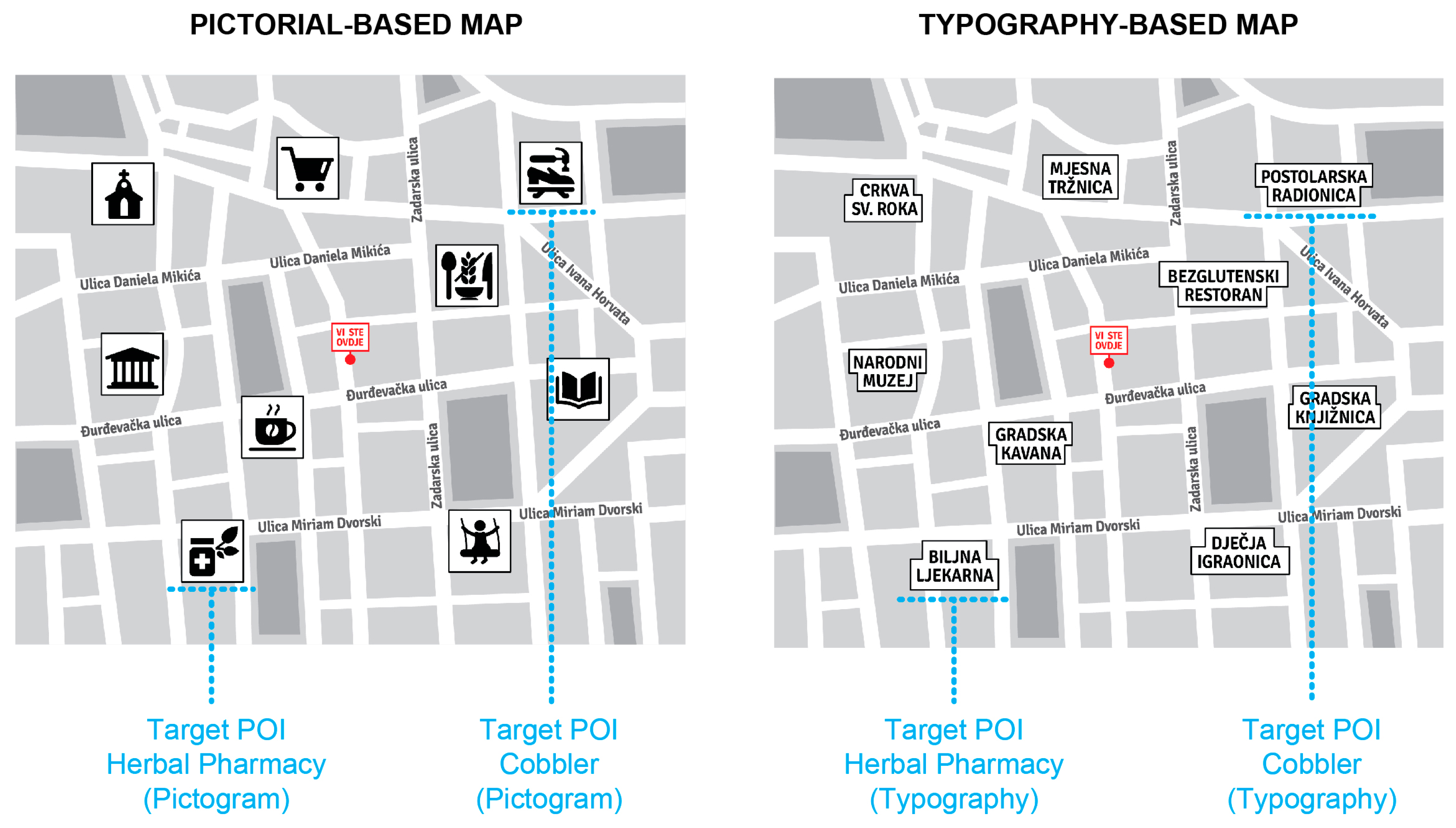
Two versions of thematic layers on tourist maps were created for the purpose of the study (
Figure 1). In one version, POIs were presented using pictograms (pictorial-based map design). The second version presented the same POIs with typography (typography-based map design). Although one could suggest a solution in which pictograms are presented together with text labels, we did not apply this solution in our design. As noted by Jin et al. [
41], the simultaneous processing of icon and text information leads to greater dispersion of attention and this may result in a longer reaction time. Including a combined condition would therefore change the cognitive demands of the task.
For the pictorial-based map, only the POI pictograms that had undergone standardized testing to confirm adequate levels of recognisability were included as targets. As confirmed by existing literature, when the map is expected to be used by non-native users, the clarity of cartographic symbols becomes especially significant [
42]. Accordingly, our study relied on pictograms that are correctly interpreted by users from diverse national backgrounds [
40]. According to suggestions by Su et al. no colour was applied to POIs in order to prevent confusion about the focus [
43]. They were shown using a uniform black tone, consistent with earlier research on pictograms [
44] and icons [
6,
41]. In designing the POI pictograms, preference was given to representations that reflected objects and signs commonly encountered in everyday, non-cartographic contexts. Highly abstract or overly schematic forms, even when depicting familiar items, were considered less intuitive [
45].
For the typography-based map, POIs were presented by capital letters in a sans-serif typeface and bold style, all of which are considered best practice for effective typography in a cartographic representation [
12]. The maps were designed so that all textual POIs were split into two lines, maintaining uniformity in text layout.
2.2. Data Collection
In order to collect objective measures of attentional processing during visual search on a map, the eye-tracking method was applied. To assess the map’s visual appeal, a questionnaire was incorporated as part of the eye-tracking method. Questionnaires are a standard approach in studies examining attractiveness in the geospatial domain [
11]. Based on the methodology adopted in an earlier study of natural landscapes [
46], participants were asked to rate their subjective perception of map aesthetics. The evaluation procedure is described in detail in
Section 2.5.
2.3. Participants
The study included 50 individuals varying in age, gender, and educational background. The sample consisted of 62% women and 38% men, with age ranging from 21 to 50 years (M = 30.74, SD = 8.28). Participants also represented a range of educational levels: 36% had finished high school, 24% had completed undergraduate studies, 28% had a master’s degree, and 12% reported a doctoral degree. All were Croatian nationals with regular experience travelling abroad and met the inclusion criterion of having travelled to at least one new city per year.
2.4. Equipment
Data were collected using the Tobii Eye Tracker X60 (Tobii Technology, Stockholm, Sweden), mounted below the monitor. The eye tracker operated at a sampling rate of 60 Hz and provided an accuracy of 0.5 degrees. A monitor used for stimulus presentation was Lenovo L1900pA (Lenovo, Morrisville, NC, USA) with a resolution of 1280 × 1024 pixels. Both stimulus presentation and randomization were controlled using the Tobii Studio 3.2.1 software. The participants indicated their response by clicking a standard computer mouse, upon which the software recorded the corresponding reaction time.
2.5. Procedure
Prior to any other procedures, the study was approved by the Institutional Ethics Committee of the University of Zagreb, Faculty of Graphic Arts. All participants provided informed consent before taking part in the study.
The study was conducted in a user experience lab equipped with sound insulation and controllable lighting conditions. Each participant took part in the experiment individually. To minimize bias, the participants were provided with only a general overview of the task, without being informed of the study’s actual purpose. During the experiment, the monitor was positioned at a distance of 60 cm (±1 cm) from eye level to ensure consistent viewing conditions. The experiment proceeded once a five-point calibration of the eye-tracking system had been successfully completed. Before the main task, participants were presented with one example map (showing a different area than the test maps) to familiarize themselves with the task requirements. The following procedure was used to test visual search performances. The participants were presented with one of the tourist map designs (pictorial-based or typography-based) and were instructed to locate a POI, which was either an herbal pharmacy or a cobbler, depending on the assigned condition. There was no time limit for the task. Then, a second version of the map was presented, on which they were asked to locate a POI that differed from the one presented in the previous condition. A successful search was confirmed when the participant clicked on the designated POI. In accordance with the design of a previous visual search study on city maps [
47], our experiment did not include target-absent trials. The duration between the moment the map appeared on screen and the participant’s click on the relevant POI was used as a measure of visual search time.
Following the visual search task, the procedure continued with the evaluation of the maps’ visual appeal. The participants were presented with one of the tourist map designs again, this time for the purpose of evaluating its visual appeal. The participants evaluated visual appeal using a 5-point rating scale, where 1 indicated the lowest and 5 indicated the highest level of appeal. The participants could take as much time as needed to complete their rating. After completing the task for the first map, participants repeated the same procedure for the second map. The presentation order of the two maps was counterbalanced between participants. During the rating process, eye-tracking measures on the map were simultaneously recorded.
2.6. Variables
The study included two independent variables: Map design (pictorial-based versus typography-based), and target point (cobbler versus herbal pharmacy). Target point referred to the specific POI which participants were instructed to locate. Visual search time served as the primary dependent variable, which was measured from the onset of the map display to the moment of participant’s mouse click on the POI. Eye-tracking data during visual search were collected to provide objective indicators of visual attention throughout the task. The evaluation of map visual appeal was another dependent variable measured through participant ratings following the visual search task. Eye-tracking data during visual appeal evaluation were also recorded in order to explore visual attention during the subjective assessment of the maps.
3. Results
The dependent variables were visual search time, map visual appeal, and the following eye-tracking metrics: Fixation Before (FB), Time to First Fixation (TFF), Fixation Count (FC), Total Fixation Duration (TFD), and Total Visit Duration (TVD). For ease of interpretation, means and standard deviations (M, SD) were provided as descriptive statistics (computed directly from the observed data), whereas inferential conclusions were based on the models and tests specified below. Prior to testing, visual search time and TFD were transformed to better meet distributional assumptions. Unless stated otherwise, all tests were two-tailed with the level of significance set at 0.05. All statistical analyses were conducted using SPSS statistics 17 (SPSS, Chicago, IL, USA).
3.1. Target Point Detection
3.1.1. Visual Search Time
Data for the visual search time were ln-transformed prior to analysis. After transformation, the Kolmogorov–Smirnov test indicated no significant deviation from normality (
p = 0.20). We analyzed search time with a linear mixed-effects model (LMM), specifying map design (pictorial-based versus typography-based), target point (cobbler versus herbal pharmacy), their interaction, and presentation order as fixed effects, with a random intercept for participants. Presentation order did not have a significant effect on visual search time,
F(1, 47.05) = 0.78,
p = 0.38. The analysis revealed a statistically significant main effect of map design on visual search time (
F(1, 46.99) = 51.38,
p < 0.001), suggesting that the typography-based city map facilitated faster detection (
M = 4.49,
SD = 1.26) of the target point than the pictorial-based map (
M = 5.89,
SD = 1.52).
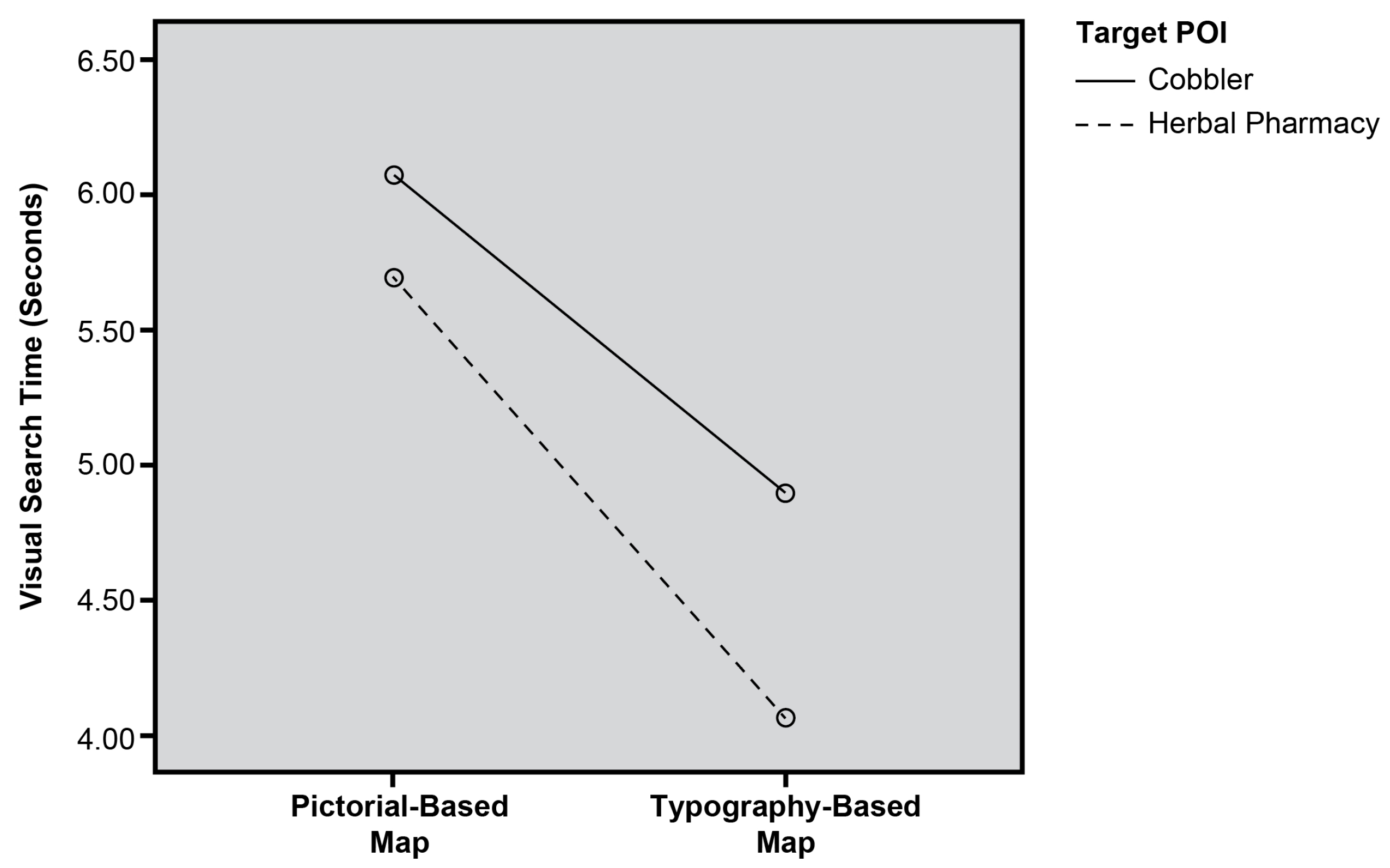
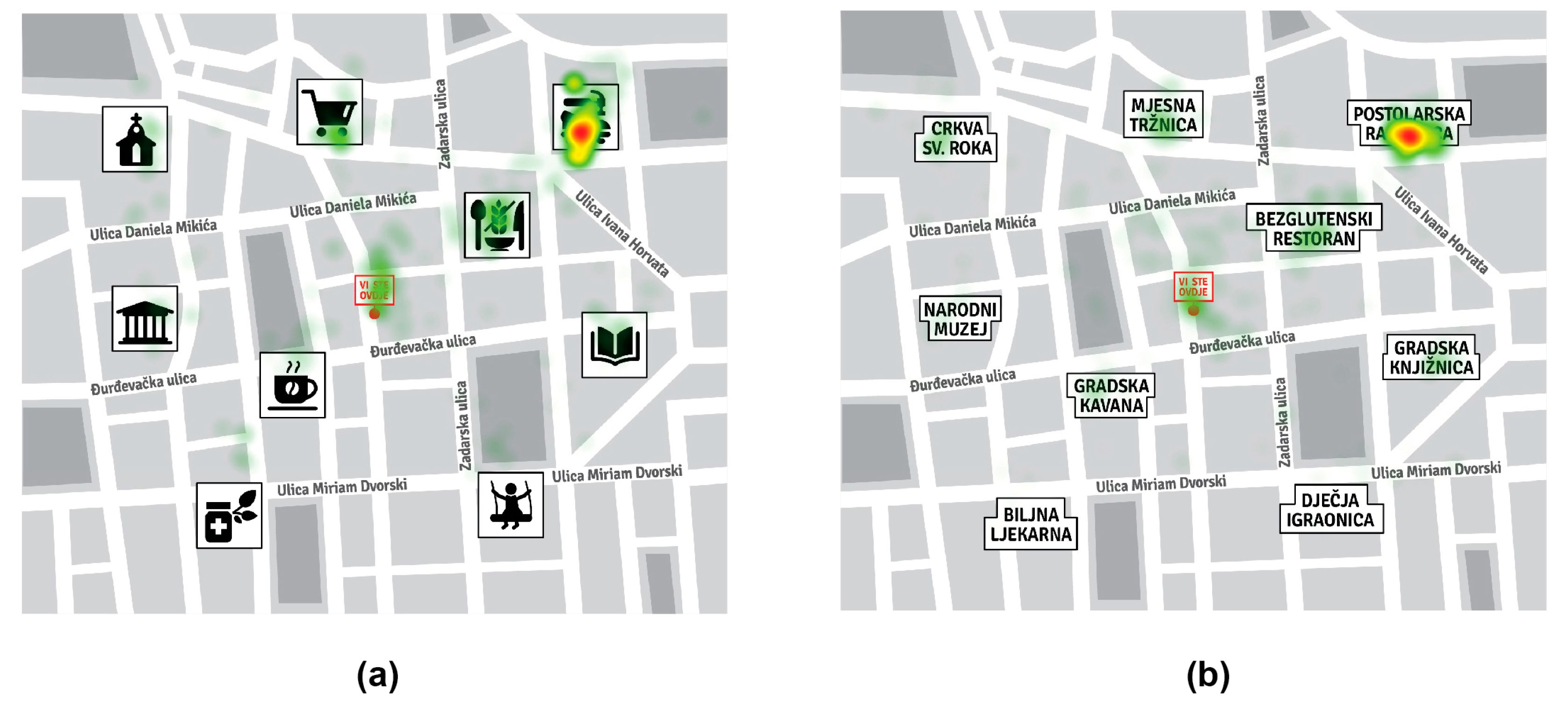
Figure 2 and the heatmaps presented in
Figure 3 illustrate this result. A significant main effect of the target was also observed,
F(1, 46.98) = 11.74,
p < 0.005, indicating that the target significantly influenced the search time. The participants were faster in finding an herbal pharmacy (
M = 4.89,
SD = 1.39) than a cobbler (
M = 5.50,
SD = 1.69). The analysis did not reveal a significant interaction effect of map design and target (
F(1, 47.95) = 0.95,
p = 0.33), suggesting that their effects on visual search time were independent.
3.1.2. Eye-Tracking Data During Visual Search
FB was analyzed using generalized estimating equations (GEE) with participant ID as the clustering variable, an independent working correlation structure, and robust (sandwich) standard errors. The model included the main effects of map design, target point, and presentation order, as well as the map design × target point interaction. Type III Wald χ
2 tests showed a significant main effect of map design,
χ2(1) = 8.67,
p < 0.05, with pictorial-based design (
M = 9.46,
SD = 4.79) showing higher values compared to typography-based design (
M = 7.48,
SD = 3.76). Neither target nor presentation order showed a significant main effect,
χ2(1) = 2.23,
p = 0.14, and
χ2(1) = 0.07,
p = 0.78, respectively. However, the interaction between map design and target was significant,
χ2(1) = 13.85,
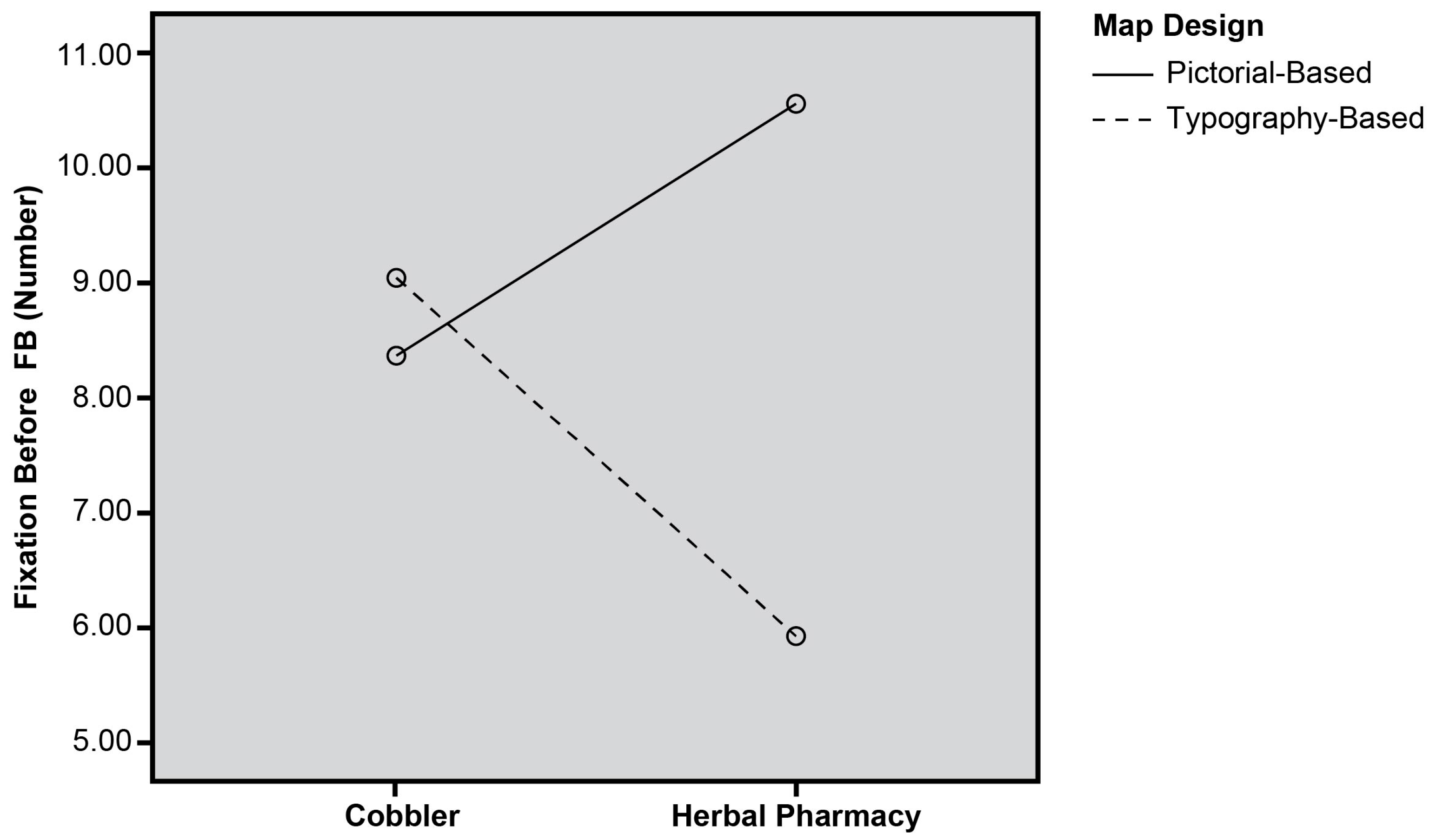
p < 0.001, suggesting that the relationship between map design and FB varied across the two different targets. The typography-based map slightly increased the number of fixations before detecting a cobbler, while it significantly decreased the number of fixations before detecting an herbal pharmacy. The interaction is shown in
Figure 4.
For TFF, the Kolmogorov–Smirnov test indicated no significant deviation from normality (p = 0.16). TFF was analyzed using a linear mixed-effects model (LMM) with map design, target point, their interaction, and presentation order as fixed effects, and a random intercept for the participant. Map design had a significant main effect on TFF (F(1, 35.62) = 7.65, p < 0.05). Neither the target effect (F(1, 35.01) = 0.08, p = 0.78) nor the interaction effect (F(1, 39.06) = 0.23, p = 0.63) were found to be statistically significant. Furthermore, presentation order did not have a significant effect on TFF, F(1, 33.31) = 0.001, p = 0.97.
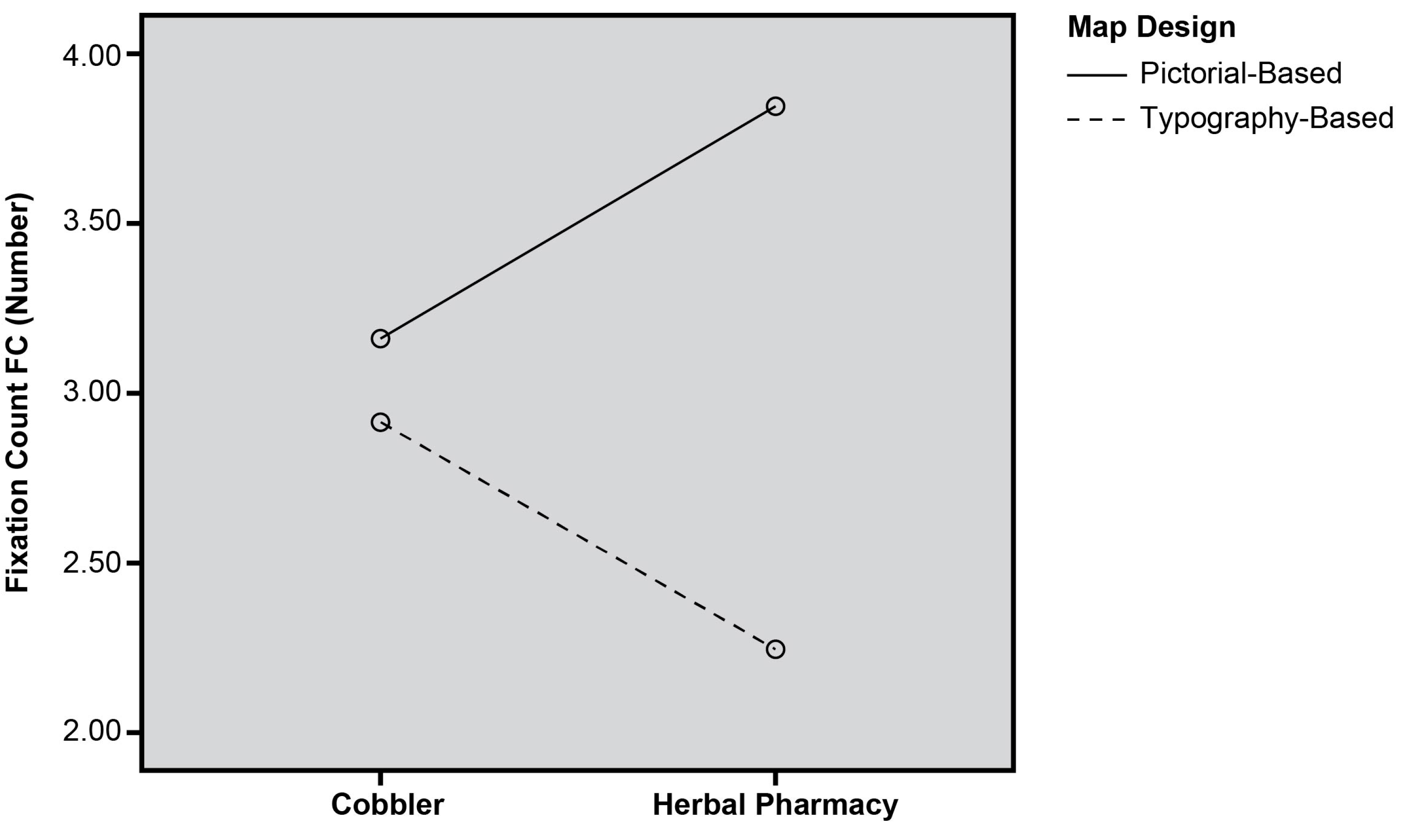
FC was analyzed using generalized estimating equations (GEE) with participant ID as the clustering variable, an independent working correlation structure, and robust (sandwich) standard errors. The model included the main effects of map design, target, and presentation order, as well as the map design × target point interaction. Type III Wald χ
2 tests showed a significant main effect of map design on FC (
χ2(1) = 7.45,
p < 0.05), with typography-based design (
M = 2.58,
SD = 1.20) resulting in less fixations on the target compared to pictorial-based design (
M = 3.50,
SD = 1.94). No significant main effect of target was found (
p = 0.79). However, the interaction between map design and target was significant (
χ2(1) = 8.22,
p < 0.05). The typography-based map slightly decreased the number of fixations on a cobbler’s location, while it significantly decreased the number of fixations on location for an herbal pharmacy.
Figure 5 illustrates this interaction. Presentation order did not have a significant effect on FC (
χ2(1) = 2.84,
p = 0.09).
TFD was square root transformed prior to analysis to reduce skewness. After transformation, the Kolmogorov–Smirnov test was non-significant, indicating no deviation from normality (
p = 0.20). We analyzed TFD with a linear mixed-effects model (LMM), including map design, target, their interaction, and presentation order as fixed effects, with a random intercept for the participant. There was no significant main effect of presentation order on TFD (
F(1, 37.22) = 1.30,
p = 0.26). The main effect of map design was not significant, (
F(1, 38.02) = 0.01,
p = 0.94), but the target was found to have a significant effect (
F(1, 37.81) = 29.74,
p < 0.001). Total duration of fixations was longer on a cobbler’s location (
M = 1.01,
SD = 0.57) than on location for an herbal pharmacy (
M = 0.49,
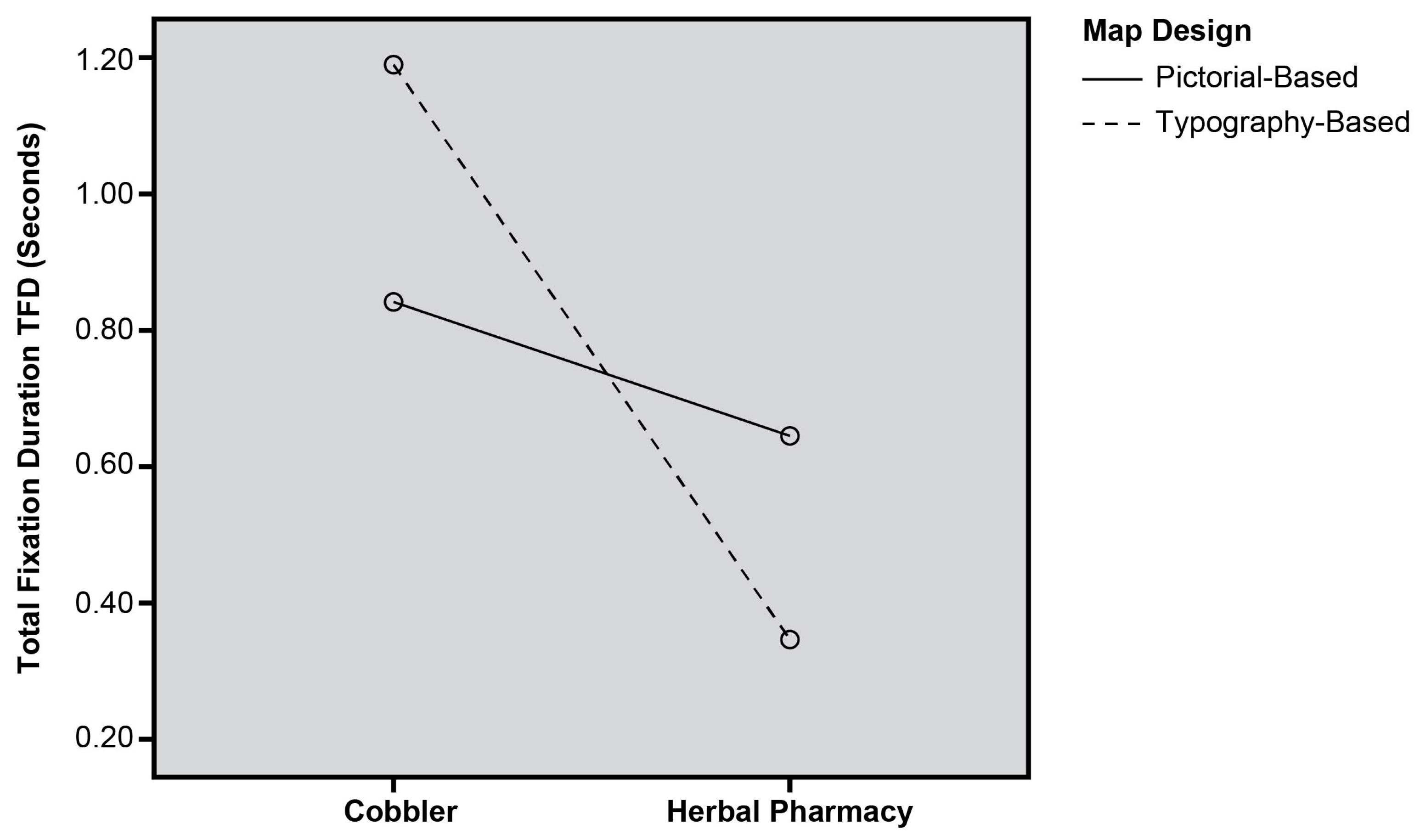
SD = 0.38). The interaction between map design and target was significant (
F(1, 43.05) = 6.38,
p < 0.05). However, in comparison to the map design × target interaction observed for FC, this one revealed results that varied in certain aspects (
Figure 6). In particular, the typography-based map increased the duration of fixations on a cobbler’s location, while it decreased the duration of fixations on the location of an herbal pharmacy.
3.2. Map Visual Appeal
A 2 × 2 mixed repeated-measures ANOVA examined the effects of map design and presentation order on the following eye-tracking metrics during the observers’ evaluation of the map appeal: Response time (the time participants needed to make a decision about the evaluation of visual appeal), FC, TVD, and TFD.
The response time for the visual appeal rating was log-transformed to reduce skewness. The normality of the transformed data was supported by a non-significant Kolmogorov–Smirnov test (p = 0.20). The analysis revealed a statistically significant main effect of map design on the response time (F(1, 48) = 7.65, p < 0.05); the participants took longer to complete the evaluation of the typography-based map appeal (M = 6.57, SD = 1.82) compared to the pictorial-based map (M = 5.68, SD = 1.95). The main effect of presentation order was not significant, F(1, 48) = 3.44, p = 0.07. Furthermore, map design had a significant effect on FC recorded across the entire map (F(1, 48) = 7.45, p < 0.05), indicating that the typography-based design led to a higher number of fixations (M = 13.26, SD = 6.12) than the pictorial-based design (M = 10.68, SD = 5.55). Presentation order did not significantly affect FC, F(1, 48) = 1.59, p = 0.21. Map design also had a significant effect on TVD recorded across the entire map (F(1, 48) = 12.79, p < 0.05). A higher TVD was recorded for the typography-based design (M = 4.72, SD = 2.10), suggesting prolonged engagement compared to the pictorial-based design (M = 3.59, SD = 1.77). The main effect of presentation order was not significant, F(1, 48) = 0.46, p = 0.50. Neither map design nor presentation order showed a significant main effect on TFD, F(1, 48) = 3.42, p = 0.07 and F(1, 48) = 2.52, p = 0.12, respectively.
Given the ordinal nature of the dependent variable, a nonparametric Wilcoxon signed-rank test was used to assess differences in evaluation of the map appeal between typography-based and pictorial-based design. The analysis revealed no significant difference, Z = −0.89, p = 0.37, indicating that participants responded similarly to the typography-based map (Mdn = 4.0, IQR = 4.0–5.0) and the pictorial-based map (Mdn = 4.0, IQR = 3.0–5.0).
4. Discussion
Our study explored the role of visual design in affecting the way people use and evaluate tourist maps. Two specific hypotheses were tested: That there is a significant difference in visual search time (H1) and in visual appeal (H2) between pictorial-based and typography-based maps. H1 was supported by the results, while H2 was not confirmed.
Regarding H1, the pictorial-based city map resulted in slower detection of the target point than the typography-based map. This was indicated by measurements of both the visual search time and the time required for the first fixation on the target (TFF). When comparing our findings with previous studies, our result differs from reports indicating that the use of pictograms can improve the efficiency of visual search, especially in tasks involving complex or dense informational content [
8,
34]. The value of pictograms was further supported by findings from a recent study, which explored the effect of the similarity level of cartographic point symbols on the effectiveness of visual search [
48]. Moreover, one practical advantage of pictograms is that it is not necessary to master the language to understand their meaning [
49]. Despite these positive aspects of pictograms, our result was unexpected. To some degree, this may be attributed to the characteristics of the sample group in our experiment. Ideally, demographic variables should be considered as well, given that prior studies have demonstrated that the national background of the subjects appeared to influence symbol ratings [
50]. One potential reason contributing to the superiority of the typography-based map may be that participants first had to interpret the meaning of the pictorial target POIs based solely on the oral explanation, which could have affected the time required to complete the search. Another explanation may be found in the fact that other aspects, such as practice and repetition, may have a greater influence on the successful following of navigation instructions than the way in which those instructions are presented [
51]. Even so, the outcome of our study highlights that typography is one of the cartography components that may carry more weight than we previously assumed. Supporting evidence for the significant role of typography can also be found in earlier research. Findings [
37] suggest that text-only formats are cognitively less demanding than symbol-only signs. Compared to other formats, text often allows for more explicit and unambiguous communication [
41]. It is therefore plausible to assume that similar positive effects may extend to the domain of tourist maps.
Improved performance in the typography-based condition was further confirmed through a more detailed analysis of our eye-tracking data. It revealed that, in comparison with the pictorial-based design, the typography-based map resulted in fewer fixations which participants made before finding a target, reduced time until the first fixation on a target, and a decreased number of fixations on the map during visual search task. This may suggest lower cognitive demands. As higher fixation counts in visual search have been associated with increased cognitive load [
52], the fewer fixations recorded on typography-based maps may also reflect a less demanding search than in pictorial-based maps. The analysis of eye-tracking data also showed that typography reduced the number of fixations made before noticing the pharmacy POI and had an even stronger suppressive effect on the number of fixations on the map during a visual search for the cobbler POI. Symbols presented in a larger size and darker colour are generally perceived as more important than those that are smaller and lighter [
53]. It is reasonable to assume that the visual salience of an object with high colour contrast would direct observers’ attention to its location on the map shortly after the stimulus is presented [
44]. It is therefore surprising that participants in our study detected textual POIs faster than pictorial ones, which took up more space and included a greater amount of black colour. Despite its inconsistency with the expectations, the result offers a new perspective on the benefits of cartographic typography and invites further inquiry into its role for tourist maps. Meanwhile, it is worth noting the following recommendation outlined in the existing literature: While some forms of maps may be more efficient, the thematic variability of maps remains important and should be addressed through the use of different types based on contextual demands [
54]. Alongside these contextual considerations, perceptual factors may also contribute to differences in task efficiency across map designs. Changing the visual design of POIs may affect effective spacing between map elements and modulate perceptual grouping, which may be relevant for differences in visual attention between the two maps. Those selecting an appropriate map format for practical use should therefore consider such design effects when deciding which type of POI representation to adopt.
When comparing POI categories based on thematic content (a cobbler vs. a pharmacy), our results showed the participants found the pharmacy POI faster than the cobbler POI. The result aligns with expectations given that pharmacy signage is more prevalent in daily environments and tends to be associated with more frequently used services compared to cobblers. As reported in an earlier study, the more familiar participants are with the visual representation’s intended meaning, the quicker their responses tend to be [
41]. Our finding is also in line with other studies which have shown that both the shape and the topic of a map symbol may significantly influence individuals’ responses to the information it conveys [
55,
56].
The second part of our study explored the hypothesis H2 which tested difference in visual appeal between pictorial-based and typography-based map designs. We found that the participants responded similarly to the evaluation of both types of maps, which led to the rejection of the hypothesis. It is important to note that, to the best of our knowledge, this is the first study to examine this specific comparison. As such, further research is needed to validate these findings and explore potential moderating factors (e.g., variations in map format, including larger web-based typography maps) that may influence the relationship between map design and its perceived visual appeal. Nevertheless, the current results provide a valuable starting point. In practical terms, they imply that designers can use a typography-based map design without compromising the visual appeal of the map.
While the design of maps did not appear to influence perceived visual appeal, a more detailed analysis of the eye-tracking data recorded during the appeal evaluation revealed some interesting outcomes. We found that the participants distributed their visual attention with a clear preference, dedicating significantly more to the typography-based version than to the pictorial-based version. Given the minor design differences between the borders in the map design variants, we also considered whether the border shape could have contributed to this effect. Border geometry may influence eye-tracking metrics because corners can attract attention and slightly redistribute fixations. However, in our sample, the eye-tracking heatmaps provided no clear evidence of such redistribution.
The typography-based map was associated with a higher number of fixations (FC) and a longer total fixation duration (TFD) compared to the design based on pictorial POIs. Evidence from previous eye-tracking research [
57] suggests that longer total fixation durations are associated with greater visual interest. This implies that the more engaging a stimulus is, the longer participants tend to fixate on it. This may be particularly effective in contexts where promoting users’ recognition of particular services on a map is desired. Our findings suggest that typography-based map design, which received a larger portion of participants’ visual attention, may therefore be more effective in supporting users’ navigation toward specific services such as herbal pharmacy and cobbler. Directing attention through carefully considered visual design can positively influence users’ overall navigational experiences with a map.
5. Conclusions
Our study focused on the effects of tourist map graphic design, considering its connection to easy access to local services. To address this, we designed one pictorial-based map and one typography-based map with POIs representing specific local services. We hypothesized that there would be a significant difference in the time required to find POIs between the pictorial-based and the typography-based map (H1), as well as in visual appeal (H2). We tested 50 adults with an eye-tracking device. The results showed that the typography-based map had an advantage in the speed of finding the target location over the pictorial-based map. On the other side, the results showed that we cannot confirm the visual appeal advantage of typography-based over the pictorial-based solution.
Still, further research is needed to expand and strengthen our findings. An important limitation of our study could be the demographic profile of the participants, which may not fully represent the experiences and perceptions of the wider population, and this could reduce the generalizability of the results. Another limitation could be that the typography-based map was created in the native language of the tested individuals. For useful tourist maps, future studies should be conducted where the typography-based locations are in one of the so-called world languages. If different groups of tourists who are not native speakers of a particular world language are tested, the results could provide a broader understanding of the usability of pictorial-based maps. Future studies should recruit participants who match the intended target group (e.g., environmentally conscious users) and include a greater diversity of individual user characteristics to fully understand the global usability of pictograms in tourist maps. This has practical importance because the application of pictograms instead of typography-based POIs in tourist maps may lower the overall effort associated with the multilingual production of maps, such as translation updates aligned with UI and content changes. Future work should also examine additional attributes of pictorial-based and typography-based POIs, with particular attention to colour. In this study, colour was controlled and reduced to a single level, but it may be considered to support more effective practical use.