
Article

Integrating Health Status Transitions and Service Demands: A Spatial Framework for Elderly Care Service Resource Allocation


1
School of Architecture, Southeast University, Nanjing 210096, China
2
Ageing-Responsive Civilization Think Tank Academic Committee, Nanjing 210096, China
*
Author to whom correspondence should be addressed.
ISPRS Int. J. Geo-Inf. 2026, 15(2), 83; https://doi.org/10.3390/ijgi15020083
Submission received: 11 December 2025 / Revised: 12 February 2026 / Accepted: 13 February 2026 / Published: 15 February 2026

Abstract

With the deepening of population ageing, the spatial planning of an elderly care service system faces unprecedented challenges. Building an elderly care service network that aligns with the pace of population ageing has become increasingly important and urgent. Based on annual longitudinal data on older adults’ health status and care service utilization from Japan’s Long-Term Care Insurance (LTCI) system, this study quantifies the relationship between changes in health status and elderly care service demand using a discrete time homogeneous Markov model and Poisson regression analysis. Subsequently, Geographic Information System (GIS) techniques are applied to conduct spatial analysis of the urban built environment to identify living service centres for older adults. Indicators including distance, supply–demand balance, and service capacity are then integrated through multi-objective clustering optimization to construct a multi-level elderly care service network system, achieving a quantitative linkage between elderly health status and spatial demand-oriented planning. Finally, the proposed integrated framework, which combines health status transitions, service demand estimation, and spatial allocation, is applied to Qinhuai district in Nanjing, China, generating practical policy recommendations that promote the integration of healthy ageing and precision service delivery.

1. Introduction

With the development of the economy and the rise in medical knowledge, the population ageing has become a global trend in the 21st century [1]. Japan, the most aged society in the world, has witnessed a growing number of older people requiring daily living support and long-term care. In response to these challenges, Japan introduced the Long-Term Care Insurance (LTCI) system in 2000 [2]. Concurrently, China entered an ageing society in 2000, with its proportion aged 65 and above exceeding 7%, and it has transitioned into a moderately aged society in 2021. This leads to high demands for elderly care services. However, the mismatches between supply and demand as well as the disparities in service quality are emerging simultaneously. For example, studies have shown that the existing care systems inadequately meet the demands of the elderly in need [3,4].
Therefore, constructing a multi-level and hierarchical regional elderly care service network system is of great practical significance. Various factors, including the number of elderly individuals and the types of required services, subjective willingness for the care, and physical health status, have been demonstrated to influence their demands for such care services [5]. Among these, health status is a significant predictor, indicative of the future service utilization [6,7]. Internationally, the classification and definition of health status and long-term care needs vary across countries. For example, in the Germany’s statutory long-term care insurance (SLCI) system, the individuals in need of care have been classified into three levels, including patients in need of primary care, patients in desperate need of care, and those requiring more serious care [8]. The United States also adopted such classification strategy, including broadly defined population, intermediate population, and narrowly defined population [9]. However, In Japan, the LTCI system provides a more comprehensive classification and definition. It assesses both physical and mental conditions across seven dimensions, including support levels of 1 to 2 and intervention levels of 1 to 5, possibly enabling a more accurate and multi-level understanding of health status transitions among the elderly [10].
However, previous studies primarily adopted qualitative approaches investigating the dynamic changes in the supply and demand of elderly care services [11,12], while quantitative research remains relatively limited [13,14]. To date, there is a lack of quantitative research on estimating elderly care service demand based on the health status of the elderly. Markov approach has been applied to predict long-term care demand based on health status transition patterns in previous studies [15,16,17]. The Markov model assumes that individuals occupy one of a finite number of discrete health status and can transition between this status over time, making it a robust framework for forecasting population health dynamics and supporting policy and resource allocation decisions [18].
On the other hand, how to achieve the balance of spatial allocation between various demands of old adults in different health status and service resources and construct sustainable elderly care service network are more significant. In the traditional planning approach of the elderly care service system, elderly care services often simply equated with the construction of elderly care facilities [19]. Planning targets were frequently set as quantitative indicators such as the number of beds per thousand elderly people, reducing the supply of elderly care services to simply increasing the number of beds. Consequently, the distribution of facilities often suffered from a mismatch between the actual living habits and community life of the elderly, resulting in a contradiction between the existence of facilities without services or underutilized facilities and a demand gap [20]. These studies focus more on the distribution, quantity, and scale of facilities, while relatively neglecting the resource allocation methods of systemic factors such as service content, the living habits of the elderly, their living areas, and the actual needs of the elderly.
Therefore, this study aims to establish a quantitative model of the relationship between the health status of the elderly and their corresponding care service needs, capturing the dynamic and heterogeneous service needs of the elderly under different health conditions. Based on this, a bottom-up planning approach is adopted, using spatial analysis methods to identify elderly living service centres. These centres are then distinguished from administrative boundaries, constructing a basic elderly care service network centred on the daily lives of the elderly. A multi-objective optimization decision-making model for the elderly care service network is then built based on their dynamically changing service needs. By establishing a structural correspondence between health data needs and spatial planning through Geographic Information System (GIS), the study aims to construct a demand-oriented elderly care service network system, while improving the efficiency and accuracy of elderly care resource allocation, and providing a new paradigm for health-oriented spatial planning.

2. Materials and Methods

2.1. Research Framework

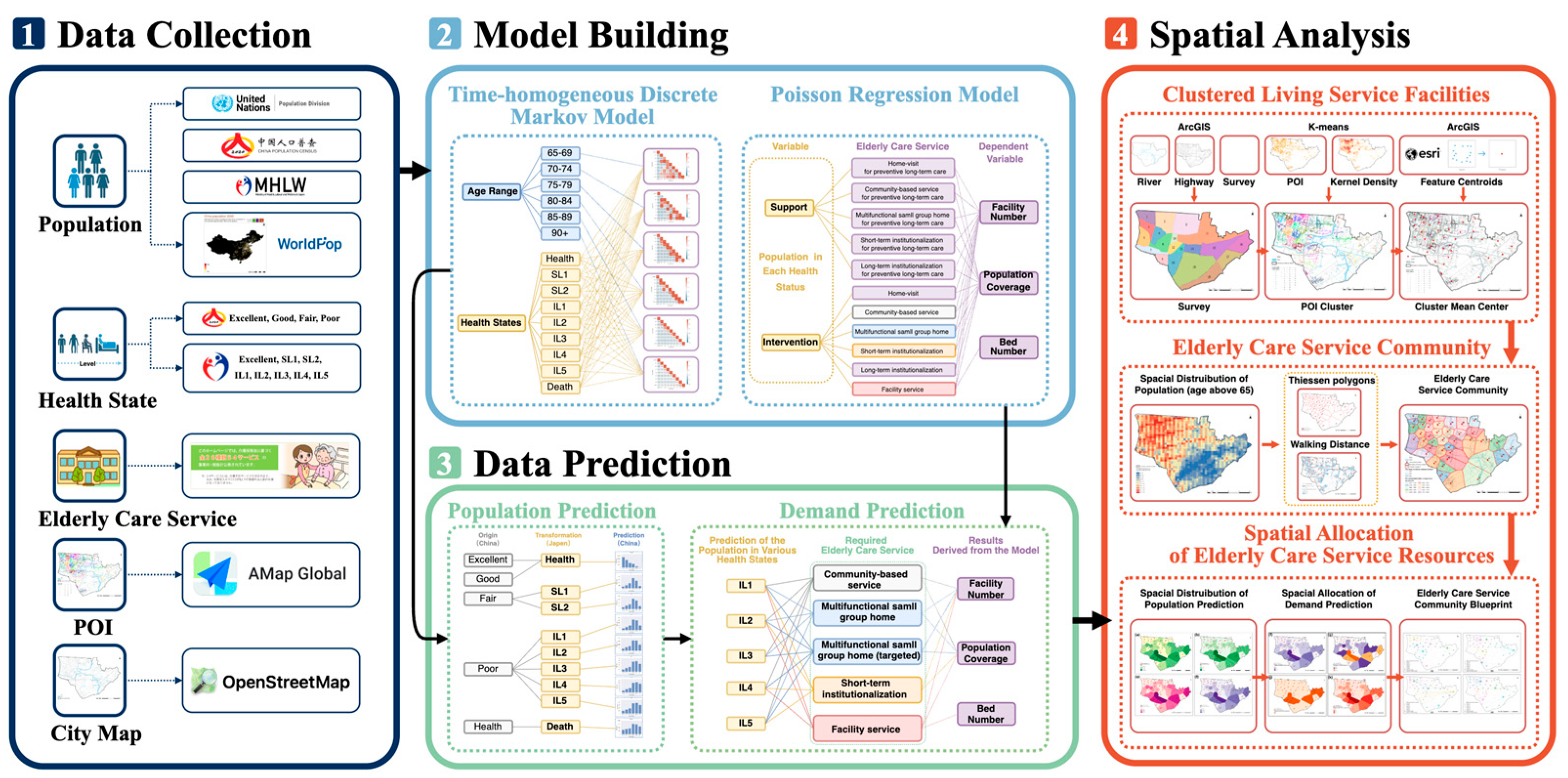
To address the challenge of coordinating the dynamic changes in the health status of the elderly population with the planning of elderly care service resources, this study constructs a transition matrix covering different health status of the elderly, enabling dynamic calculation of the elderly population structure and its health status. Subsequently, this study explores the quantitative relationship between the number of elderly people in different health status and the demand for various elderly care services, thereby estimating the required coverage of elderly care services and the number of elderly care facilities for each health status. Based on this, through GIS analysis, daily living service centres for the elderly are identified, a basic elderly care service network is determined, and a multi-level elderly care service network system is constructed. This achieves precise allocation, efficient deployment, and coordinated regional development of elderly care resources, enhancing the adaptability and sustainability of the elderly care service system. In summary, this study proposes a dynamic linkage allocation method for elderly care service resources based on health status, service demand, and spatial response (Figure 1).

2.2. Data Collection

In this study, five types of data were utilized, including population data, health status tracking data, elderly care service utilization data, Points of Interest (POI) data, and urban administrative boundary data, as shown in Table 1.
Regarding population structure data, this study primarily involves two types of datasets: (1) basic demographic data (China and Japan) used for predicting elderly populations in different health status, and (2) gridded population data (China) used for GIS-based spatial analysis. The World Population Prospects 2024 Revision, prepared by the United Nations Department of Economic and Social Affairs, Population Division, provides estimates of population trends for 237 countries and regions from 1950 to 2023 (https://population.un.org/wpp/, accessed on 6 October 2025). This study adopted a population projection dataset of a 5-year interval from this source as the baseline for population forecasting.
Elderly population data for China were obtained from the National Population Census Yearbooks published by the National Bureau of Statistics of China, while elderly population data for Japan were sourced from the Statistics and Information Department of the Ministry of Health, Labor and Welfare, Japan. The gridded population data were derived from the WorldPop 2020 dataset, with a spatial resolution of 3 arc-seconds (approximately 100 m at the equator) (https://hub.worldpop.org/geodata/summary?id=49730, accessed on 6 October 2025). To ensure accuracy, the WorldPop data were adjusted using the results of the Seventh National Population Census of Nanjing, China (https://tjj.nanjing.gov.cn/bmfw/njsj/202105/t20210524_2945571.html, accessed on 6 October 2025).
Health status transition data were obtained from the LTCI Project Status Report released by the Ministry of Health, Labour and Welfare of Japan. Health status transition matrices were constructed based on the Japanese LTCI dataset. The dataset records individuals aged 65 and above across multiple age ranges (65–69, 70–74, 75–79, 80–84, 85–89, and 90+) and health status, including health, support level 1–2, intervention level 1–5, and death.
In contrast, China is currently at an early pilot stage of its long-term care insurance system, lacking a continuous and systematic longitudinal dataset, and has not yet established a fully developed elderly care service system. However, China’s population census data are relatively comprehensive and large in scale, providing a reliable representation of the health status structure of the elderly population. Therefore, this study draws on the hierarchical classification of elderly health status and transition patterns observed in Japan and integrates them with health status data from China’s population census to construct a predictive model of elderly health state transitions for the Chinese context.
A comparison of health status classification indicators for older adults in China and Japan shows that both countries primarily assess elderly health based on activities of daily living (ADLs) and instrumental activities of daily living (IADLs). Japan applies a more detailed classification system for disabled older adults, with more comprehensive assessment criteria, whereas the health status classification used in China’s population census is relatively simple and broad. A further comparison of levels of unhealthy status and corresponding care needs indicates that the category of unhealthy status (“unhealthy but self-sufficient” and “unhealthy and dependent”) in China’s census classification roughly corresponds to the unhealthy status category (“SL1–2” and “IL1–5”) under Japan’s LTCI (Table 2).
In the case study application, it is necessary to conduct an analytical and assumption-based reconstruction of elderly health status data in the study area. Based on the assumption that older adults with similar levels of functional dependency exhibit comparable health status structures, this study applies a proportional mapping approach to reclassify the unhealthy elderly population in Qinhuai district. To examine the validity of this assumption, the age-structured distributions of unhealthy older adults in China and Japan in 2020 were compared (Table S1). The results show that differences in the proportions of unhealthy populations in lower age ranges are less than 0.1, while slightly larger discrepancies are observed among those aged 85 and above, which is consistent with the inherent instability of higher-age populations.
Given the relative differences in the evaluation standards for unhealthy conditions among older adults in China and Japan, an optimal mapping scheme was selected by comparing the possible combinations of SL/IL categories. Based on the 2020 data on older populations in unhealthy status in China and Japan, six possible combinations were generated by sequentially partitioning unhealthy status from mild to severe. As shown in the Table S2, the average structural differences in population distribution indicate that the mapping of “unhealthy but self-sufficient” to “SL1–2 and IL1–3,” and “unhealthy and dependent” to “IL4–5” represents the optimal correspondence (Table S2).
The elderly care service utilization data were obtained from the Status Report on Long-Term Care Insurance Projects published by the Ministry of Health, Labor and Welfare of Japan. The functional characteristics of service types were categorized into home visit service, community-based service, multifunctional small group home service, short-term institutionalization service, long-term institutionalization service, and facility service, as shown in Table 3.
The POI data for living service facilities were collected from the Amap API in August 2023. According to the Statistical Classification of Life-Related Service Industries (2019) published by the National Bureau of Statistics of China, life-related services refer to service activities that meet residents’ final consumption needs. This cla-ssification covers twelve major categories: household services, healthcare services, elderly care services, tourism and leisure services, sports services, cultural services, retail and online sales services, transportation services, accommodation and catering services, education and training services, housing services, and other life-related services (https://www.gov.cn/zhengce/zhengceku/2019-09/03/content_5426962.htm, accesse-d on 15 August 2025). Li and co-authors found a significant association between the urban built environment and the utilization rate of care facilities. Specifically, care facilities located near more shops and stores, within residential areas, or along major arterial streets of the city exhibited higher utilization rates [21].
Accordingly, this study selects eight relevant industry categories from the Amap Point of Interest (POI) classification system: daily life service, sports & recreation, food & beverages, commercial house, shopping, financial & insurance service, accommodation service, and medical service. Subcategories within these eight categories are further defined and filtered to exclude urban-scale service facilities, such as large sports venues, tertiary hospitals, and commercial complexes, and to retain community-level service subcategories that are closely related to older adults’ daily living needs (Table 4).
A total of 16,128 POIs representing life service facilities were collected within the case study area. After data cleaning and deduplication using Python (Version 3.12.0), the geographic coordinates (longitude and latitude) were converted into a projected coordinate system using the ArcGIS (Version 10.8) platform for subsequent spatial analysis.

2.3. Research Methods

In this study, the dynamic estimation of the elderly population structure and their health status consists of two main steps: (1) calculating the annual health status transition matrices of the elderly using a discrete time homogeneous Markov model; (2) constructing prediction models for elderly populations of different age ranges and health status based on the transition matrices (Figure S1a).
The estimation of elderly care service resources involves two main steps: (1) analyzing the quantitative relationship between the number of elderly individuals in different health status and the demand for various types of elderly care services using a Poisson regression model; (2) estimating the scale and number of facilities required for elderly populations in different health status based on the Poisson regression relationship model and the predicted elderly population results (Figure S1b).
By leveraging the ArcGIS platform and a decision-making model for elderly care service networks, a dynamic supply and demand matching mechanism based on the health status of the elderly is established to achieve effective allocation of elderly care resources. Specifically, this method includes three steps: (1) applying the K-means clustering method to analyze the spatial clustering patterns of living service POIs and identify the living service centres; (2) allocating elderly care services based on the dynamic changes in the elderly population and health status; (3) using decision-making model for elderly care services networks to optimize the spatial distribution and allocation of elderly care services (Figure S1c).

2.3.1. Health Status Transition Model

The discrete time homogeneous Markov model represents a fundamental form of the Markov chain, characterized by transition probabilities that remain constant over time. In this model, discrete time indicates that state transitions occur only at specific time intervals (e.g., per second, per day, or per year), while discrete status imply that the system’s possible status is countable and finite (e.g., health, support, intervention, death). Therefore, the discrete time homogeneous Markov model can be effectively used to simulate the annual transition probabilities of elderly health status.
Although the health status of the elderly is influenced by various demographic and socioeconomic factors, it largely depends on their previous health condition. This study assumes that the transition of health status follows a discrete time homogeneous Markov process, where the current health status depends only on the status of the previous period. Considering the variability of transition probabilities across age ranges, a hierarchical discrete Markov chain is employed to capture the distinct health status transition patterns among different age ranges.
First, define the discrete health status set S = { s 1 , s 2 , , s 9 } , where s 1 denotes the health status and s 9 is the absorbing state (death). The intermediate status s 2 to s 8 correspond sequentially to support levels 1 to 2 and intervention levels 1 to 5. Age ranges are standardized by five-year intervals, with the open interval “90+” mapped to “90–94.” Construct an equal-width 5-year age range set A = { a k } k = 1 K , where a k = [ 65 + 5 k 1 , 69 + 5 ( k 1 ) ] . This yields six age ranges: “65–69, 70–74, 75–79, 80–84, 85–89, and 90–94”.
For each age range a ϵ A, define the transition matrix:
P ( a ) = [ P i j ( a ) ] 9 × 9
where P i j a = P X t + m = s j X t = s i , a , P i j a   represents the probability that an individual in status s i   at time t transitions to status s j at time t + m after m discrete steps.
It is assumed that status transitions are only allowed to remain in the current status or move to a worse status (including death), with death defined as an absorbing status. The transition probability matrix P ( a ) is estimated using an optimization algorithm. The matrix satisfies the constraints that each row sums to 1, all elements are non-negative, and transitions between status are irreversible.
If the initial and final status distributions are known, the transition probabilities can be computed. However, due to the high dimensionality of the matrix equation, the estimation of the transition matrix can be reformulated as an optimization problem that minimizes the prediction error. The Sequential Least Squares Programming (SLSQP) algorithm is employed to estimate the transition matrix by minimizing the prediction error over historical years. Model accuracy is validated using historical data, and the Mean Absolute Error (MAE) is calculated as the evaluation metric. Multiple simulation-based projections were conducted by introducing an age-specific perturbation function into the transition matrix. The objective function is defined as follows:
min t 1 T 1 s = 1 9 Y ^ t + 1 , s Y t + 1 , s Y t + 1 , s + ϵ 2 + λ P I F 2
where Y ^ t + 1 = Y t P ,   ϵ is a small constant to prevent division by zero, and λ is the regularization coefficient.
Finally, based on the age range transition matrices and the initial status distribution, population projections are carried out using the 2024 Revision of World Population Prospects as the baseline. The projection formula is as follows:
n t + 1 ( a ) = n t ( a ) N t ( a ) × P ( a ) × N t + 1 ( a )
where n t ( a ) is the vector of population counts in each health status for age range a in year t , N t ( a ) is the total population of age range a in year t as projected by the United Nations, P ( a ) is the transition probability matrix for age range a , and n t + 1 ( a ) is the predicted vector of population counts in each health status for age range a in year t + 1 .

2.3.2. Service Demand Estimation

Poisson regression assumes that the dependent variable follows a Poisson distribution, with the probability mass function (PMF) given by:
P ( Y = y ) = e λ λ y y ! , y = 0,1 , 2 ,
Here, λ is the expected number of occurrences of the event (mean), with λ > 0 . In the regression model, λ is linked to a linear combination of explanatory variables through a link function, and the regression coefficients β are estimated using maximum likelihood estimation (MLE). The model equation is specified as:
log ( λ ) = β 0 + β 1 X 1 + β 2 X 2 + + β p X p
Since the supply of elderly care facilities includes both the number of institutional beds and the number of facilities of different scales, their count nature is discrete, making Poisson regression suitable for statistical analysis. Based on the Poisson regression model, covariance matrix–adjusted standard errors are applied to institution size categories exhibiting overdispersion. In this study, we use nationwide data (2017–2021) from Japan on the scale and number of various elderly care facilities, along with health status data, to analyze the quantitative relationship between health status and facility scale and quantity through a Poisson regression model, thereby constructing a demand prediction model for elderly care services.
In the model specification, the number of people in each health status is treated as the main independent variable, focusing on support levels 1 to 2 and intervention levels 1 to 5. The dependent variables are the counts of facilities of different scales. Facility scale is defined in ranges: 1–9, 10–19, 20–29, 30–39, 40–49, 50–59, 60–69, 70–79, 80–89, 90–99, 100+, with capacity measured in number of people.
In the model computation, to account for the numerical differences between the population in each health status and the number of service facilities, the independent variable (i.e., the number of people in each health status) is converted into health status density (i.e., density). Specifically, for intervention levels 1 to 5 and support levels 1 to 2, the density is defined as the proportion of each subgroup relative to the total intervention or support population nationwide. Additionally, the regional elderly population is log-transformed and included as an offset to control for population size, and the elderly population growth rate is included as a control variable to improve model robustness. The calculation formula is as follows:
log ( E ( Y d k ) ) = β 0 k + i = 1 5 β i k D p i + β R k R d t + o f f s e t d t
where Y d k denotes the number of facilities of scale k in region d ; β i k represents the effect coefficient of intervention level p on facility scale k ; β s k represents the effect coefficient of Support Required level p on facility scale k ; D p i is the density of health status i (intervention) at level p ; D p s is the density of health status s (support) at level p ; R d t is the elderly population growth rate in region d at year t ; β R k is the coefficient for elderly population growth rate; and o f f s e t d t = log P d t is the logarithm of the total elderly population P d t in region d .
Based on the results of the Poisson regression analysis, parameters are estimated using iteratively reweighted least squares (IRLS) to construct a health status-based elderly care service demand prediction model. The prediction formula is as follows:
Y ^ i j k = exp β 0 ( i j k ) + β 1 ( i j k ) × D ~ i j k + ln ( P )
where i denotes the service category, j denotes the health status, k denotes the facility scale, Y ^ i j k is the predicted number of facilities, β 0 is the baseline demand level for each facility scale (i.e., the facility count when the standardized density is 0), β 1 is the marginal effect coefficient of demand density, D ~ i j k is the standardized demand density indicator, and ln ( P ) is the logarithm of the elderly population baseline.

2.3.3. Spatial Allocation and Optimization

K-means is a centroid-based partitioning clustering method whose core objective is to divide a set of n observations into k clusters, such that each observation belongs to the cluster with the nearest centroid. This process minimizes the within-cluster sum of squares (WCSS) [22]. The algorithm iteratively optimizes the following objective function:
a r g m i n s i = 1 k x S i | | x μ i | | 2
where S i denotes the i -th cluster and μ i represents the centroid of cluster S i .
Considering the characteristics of geospatial data, longitude and latitude coordinates are converted into radians to accurately compute the Haversine distance. Longitude and latitude are used as the clustering features.
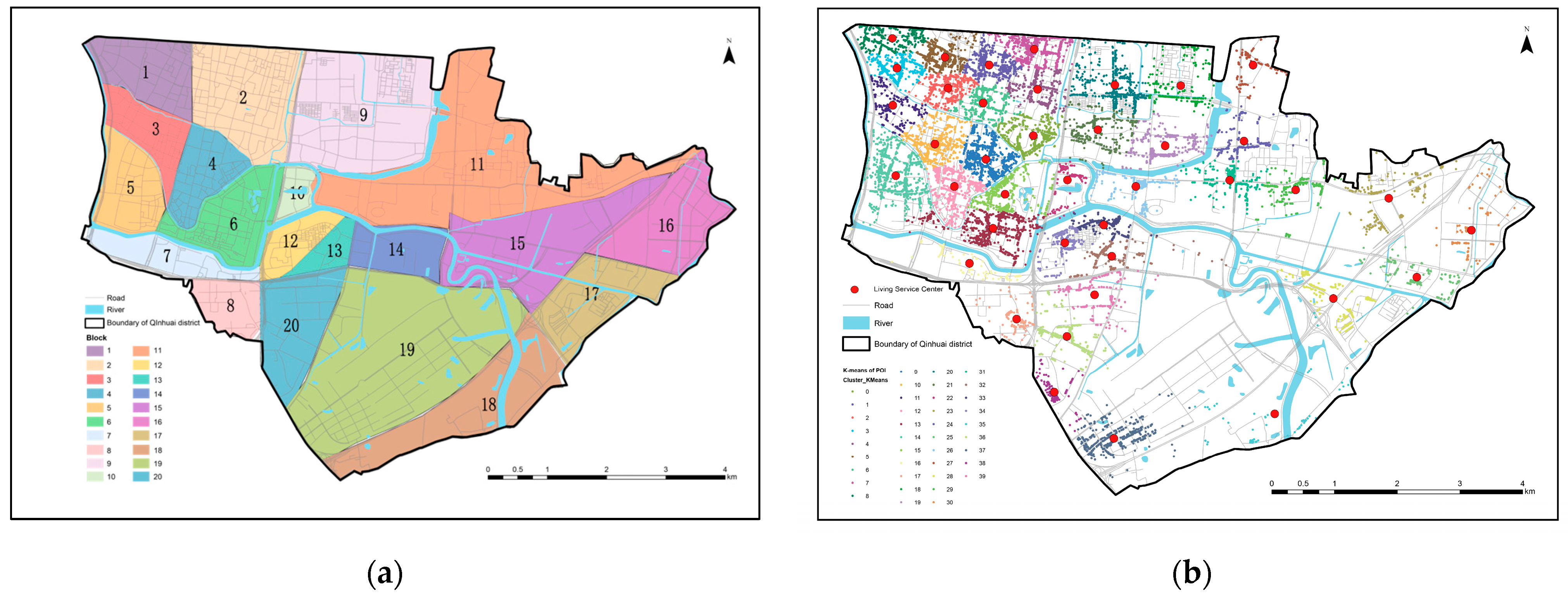
This study primarily applied the K-means clustering algorithm to conduct spatial clustering analysis of urban life service POI data. Firstly, fragmented spaces caused by water systems and urban overpasses were manually identified, and the study area was subdivided accordingly. Then, K-means clustering was applied independently to the life service POIs within each subdivided area to identify their spatial clustering characteristics. Finally, the mean centre of each cluster was calculated based on the average x and y coordinates of its centroids, which were subsequently defined as the life service centres of the study area.
In GIS analysis, spatial autocorrelation (Global Moran’s I) measures the degree of spatial dependence by simultaneously considering both the spatial location and attribute values of features. Given a set of spatial features and their associated attributes, it evaluates whether the spatial pattern is clustered, dispersed, or random. Incremental Spatial Autocorrelation extends this approach by calculating spatial autocorrelation across a series of increasing distance thresholds, thereby measuring the degree of spatial clustering at each distance. The clustering intensity is represented by the resulting z-scores. Statistically significant peak z-scores indicate the distances at which spatial clustering is most prominent. These peak distances are often suitable values for tools that require parameters such as a “distance band” or “distance radius”.
The Moran’s I statistic for spatial autocorrelation can be expressed as:
I =   n S 0 i = 1 n j = 1 n w i , j z i z j i = 1 n z i 2
where z i represents the deviation of the attribute value of feature i from its mean x i x ¯ ; w i , j is the spatial weight between features i and j ; n denotes the total number of features; and S 0 is the sum of all spatial weights, defined as:
S 0 =   i = 1 n j = 1 n w i , j
Based on the Thiessen polygons theory, the boundary of the elderly care service network is constructed using the perpendicular bisectors of line segments connecting adjacent service centres, which is defined as the basic unit of the network. Multidimensional clustering analysis is then employed to establish a regional elderly care service network decision model. This model encompasses the spatial distribution characteristics of service supply and demand within each basic network unit. A multi-level network partitioning is achieved through adopting different evaluation indicators, including geographical distance, supply capacity, and supply–demand balance. Specifically, a set of points S = s 1 , s 2 , , s n is given, where n is the number of network centres. S is then divided into k clusters C = { C 1 , C 2 , , C k } , and secondary centres c j C j are selected. The geographical compactness is achieved through minimizing the weighted geographical distance:
min j = 1 k s i C j w d × d ( s i ,   c j )
where d ( s i , c j ) is the Euclidean distance, with distance weight w d = 1 , feature vector f i = [ x i , y i ] R 2 , standardized x i = x i μ i σ x , y i = y i μ y σ y .
The criteria of secondary centres selection are as follows:
c j = a r g min s i C j d ( s i ,   μ j )
where μ j is the geographic centroid of cluster C j .
The objective function is established mainly based on supply capacity, with maximizing the similarity of supply capacity within a cluster while controlling geographical distance:
min j = 1 k α × 1 C j s i C j d s i ,   c j + β × V a r s i C j ( S i )
The supply capacity balance constraint is: max j S ¯ j min j S ¯ j τ s , where S ¯ j is the average supply capacity of cluster j . α is the weighting coefficient for geographical compactness, and β is the weighting coefficient for supply capacity similarity. An approximate solution is obtained using a feature-weighted algorithm. The feature vector: f i = [ x i , y i , S i ] R 3 . Each feature is standardized with a mean of 0 and a variance of 1. After standardization, the weights are set w = w x , w y , w S = [ 1,1 , 3 ] , w S = β α , ( α + β = 1 ) . Supply capacity calculation:
S i = t = 1 5 w t × C o v e r a g e i , t
w t = 0.3 , 0.8 , 0.6 , 0.7 , 0.2 represents facility service, community-based service, community-based service (small-scale), short-term institutionalization service, multifunctional small group home service, respectively. (The service type weighting standards are based on the selection and comparison of ideal elderly care methods for Chinese seniors in the 2023 China Aging Civilization Blue Book).
The rules of secondary centre selection (for supply capacity objective):
c j = a r g max s i C j S i  
The objective function is established mainly based on supply and demand balance, with minimizing the variance of the intra-cluster balance index while controlling geographical distance. The balance constraint is: max i C j B i 1 ϵ , calculated as follows:
min j = 1 k α × 1 C j s i C j d s i ,   c j + β × V a r s i C j ( B i )
Wherein, α is the weighting coefficient for geographical compactness, and β is the weighting coefficient for balance index similarity. An approximate solution is obtained using a feature-weighted algorithm. The feature vector f i = [ x i , y i , B i ] R 3 , the standardized weights are set w = w x , w y , w B = [ 1,1 , 3 ] , w B = β α , ( α + β = 1 ) . Balance index calculation: B i = D i S i , demand score:
D i = h = 1 5 w h × P o p u l a t i o n i , h
Wherein, the weights w h = 1.0 , 1.5 , 2.0 , 2.5 , 3.0 correspond to the five status IL1–5, respectively.
The rules of secondary centre selection (for supply and demand balance objective):
c j = a r g m in s i C j B j 1  
A comprehensive clustering objective function is established as follows:
min F = λ 1 f 1 + λ 2 f 2 + λ 3 f 3
Wherein, the weight vector λ = 0.3 , 0.3 , 0.4 is defined based on the principle of supply and demand balance, considering geographical distance and supply capacity, respectively, corresponding to geographical compactness, supply capacity and supply and demand balance. f 1 is shown in Equation (11), f 2 in Equation (13), f 3 in Equation (16), and the feature vector f i = [ x i , y i , D i , S i , B i ] R 5 . After standardization of each feature, equal weight processing is adopted to ensure the observability of clustering. The weight is set w = [ 1,1 , 1,1 , 1 ] .
The rules of secondary centre selection (for comprehensive objective):
c j = a r g max s i C j S c o r e i
The overall score is calculated as follows:
S c o r e i = α 1 × S ~ i + α 2 × ( 1 B ~ i 1 ) + α 3 × ( 1 d ~ i )
Wherein, the weights α = [ 0.4 , 0.3 , 0.3 ] correspond to supply capacity, supply–demand balance, and geographical distance, respectively. Both S ~ i and d ~ are standardized.
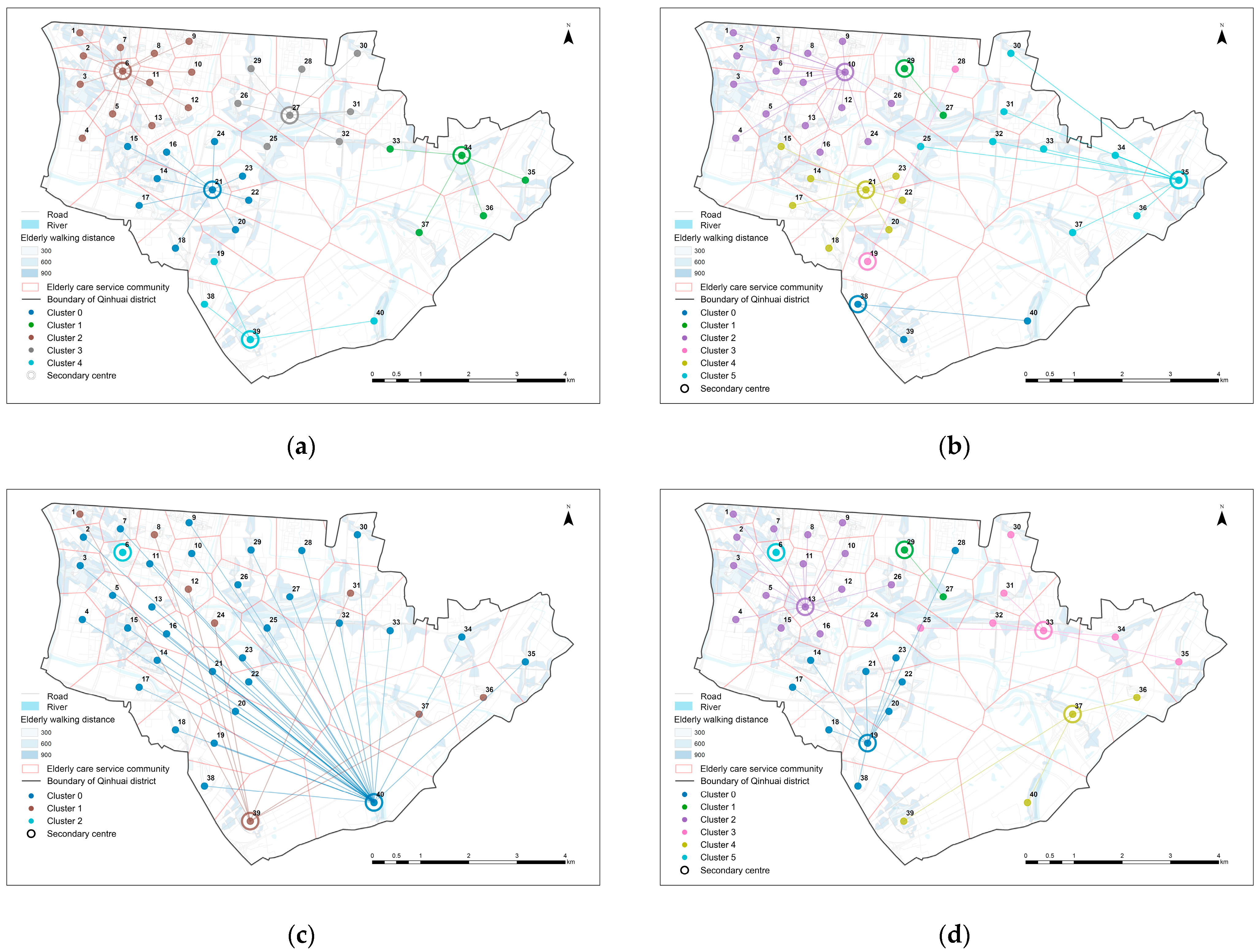
This study adopted four distinct clustering strategies to support elderly care service resource allocation: distance-oriented clustering, which prioritizes the geographic distance between service centres; supply capacity-oriented clustering, which emphasizes the balance of service provision within basic elderly service network units; balance-oriented clustering, which focuses on the alignment between service demand and supply; and comprehensive-oriented clustering, which integrates geographic distance, service supply balance, and demand–supply balance as combined features. By systematically comparing the performance of these four clustering approaches across multiple evaluation metrics, the study provides multi-scenario decision support for optimizing the spatial distribution and allocation of elderly care services.

2.4. Case Study

This study selects Qinhuai district, Nanjing, China, as the research objective. Located in the central area of Nanjing, Jiangsu Province, it covers a total area of 49.11 square kilometres. As one of the central areas for economic activities and social life in the city, Qinhuai district administers 12 subdistricts. According to the Seventh National Census, the proportion of elderly individuals aged 65 and above in Qinhuai district is as high as 18.7%, significantly higher than the overall level of Nanjing (which stood at 13.7% for individuals aged 65 and above in 2020). The ageing situation in Qinhuai district is characterized by a high degree of ageing, rapid growth, significant elderly population, and increasing levels of “empty nest” households. By the end of 2020, the proportion of elderly individuals aged 80 and above in Qinhuai district was 17.45%, the highest in the city. The proportion of “empty nest” elderly individuals was 12.89%, and the proportion of elderly individuals living alone was 3.2%.
With the intensification of population ageing, Qinhuai district’s elderly care facilities are facing increasingly complex demands and pressures. The health status and care demand of the elderly have become increasingly diverse, with a portion of older adults entering status of disability, semi-disability, or severe dependency, urgently requiring more specialized nursing services. During the 14th Five-Year Plan period, the pace of population ageing in the district is expected to accelerate further, increasing the social burden of elderly care. Under the context of shrinking family structures, the demand for elderly care facilities and social care services is rising sharply. These characteristics make Qinhuai district a suitable case study for this research.
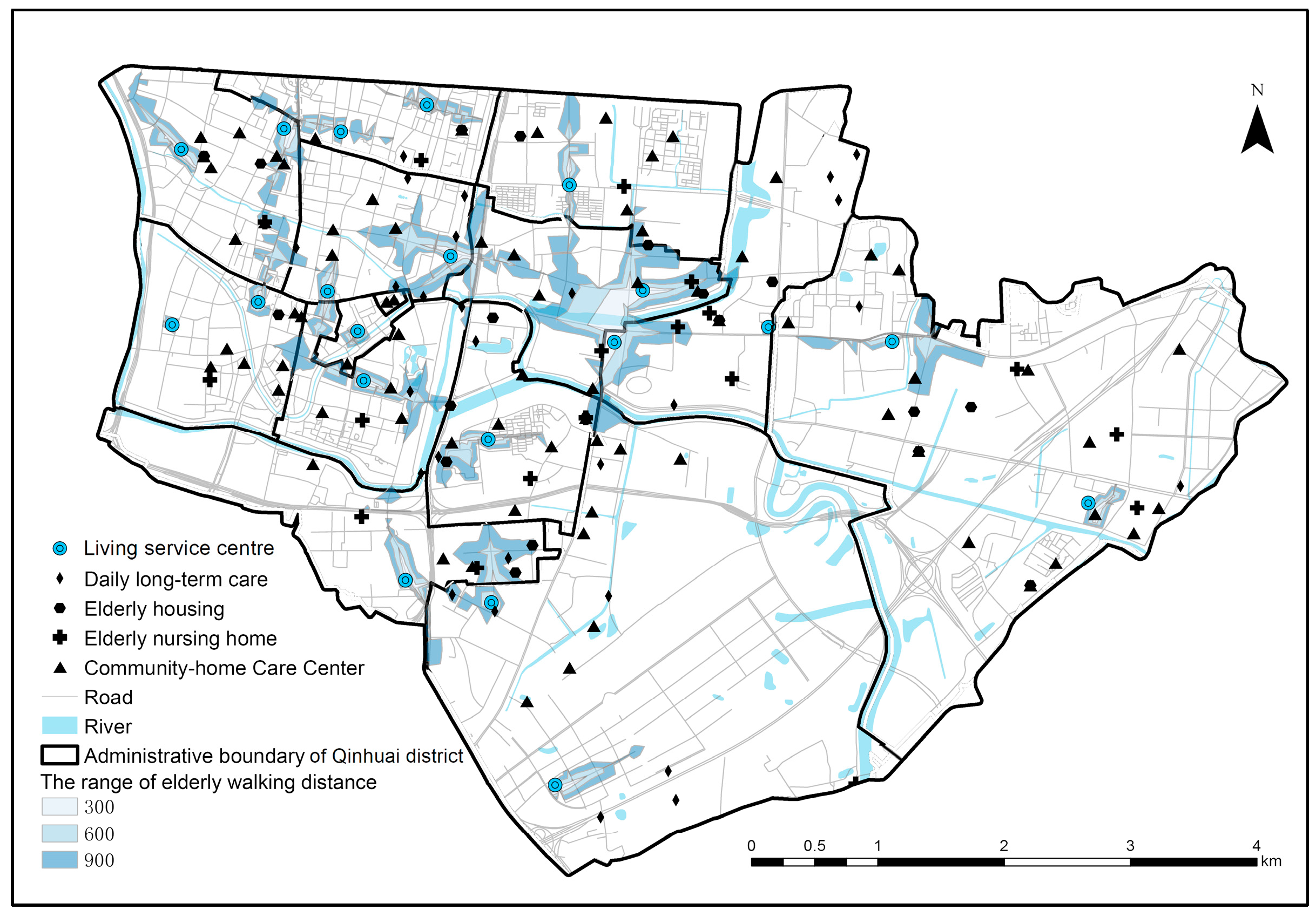
According to official statistics from the Qinhuai District Civil Affairs Bureau, existing elderly care facilities mainly comprise four types: day care centres, home-based elderly care service centres, nursing homes, and elderly housing. When facilities are allocated according to administrative street boundaries, substantial disparities in service provision across streets can be observed. Based on the geographic coordinates of existing elderly care facilities, this study identified a life service centre (i.e., the clustering centre of life service POIs) for each street using administrative boundaries as spatial units. Taking each centre as an origin, network-based service areas with radii of 300, 600, and 900 m were generated along the road network to evaluate accessibility and facility coverage.
The results indicate a clear spatial mismatch between elderly care facilities and life service centres, with some facilities located beyond the 15 min walking catchment of older adults. Under the current street-level administrative framework, cross-street service provision remains difficult, leading to weak service connectivity across adjacent street boundaries. These findings further reveal a pronounced inconsistency between the existing allocation of elderly care resources and the daily mobility patterns and living habits of older adults (Figure 2).

3. Results

This study uses a discrete time homogeneous Markov model to calculate the health status transition matrix for different age ranges of the elderly, predicting the future number of elderly people in different health status. Based on these population projections and the quantitative relationship between the elderly population in different health status and service demand derived from Poisson regression analysis, the future care resource needs of the elderly in different health status are estimated. Based on these data, the spatial allocation and optimization of elderly care service resources are achieved according to the constructed multi-level elderly care service network system.

3.1. Health Status Transition Probabilities of the Elderly

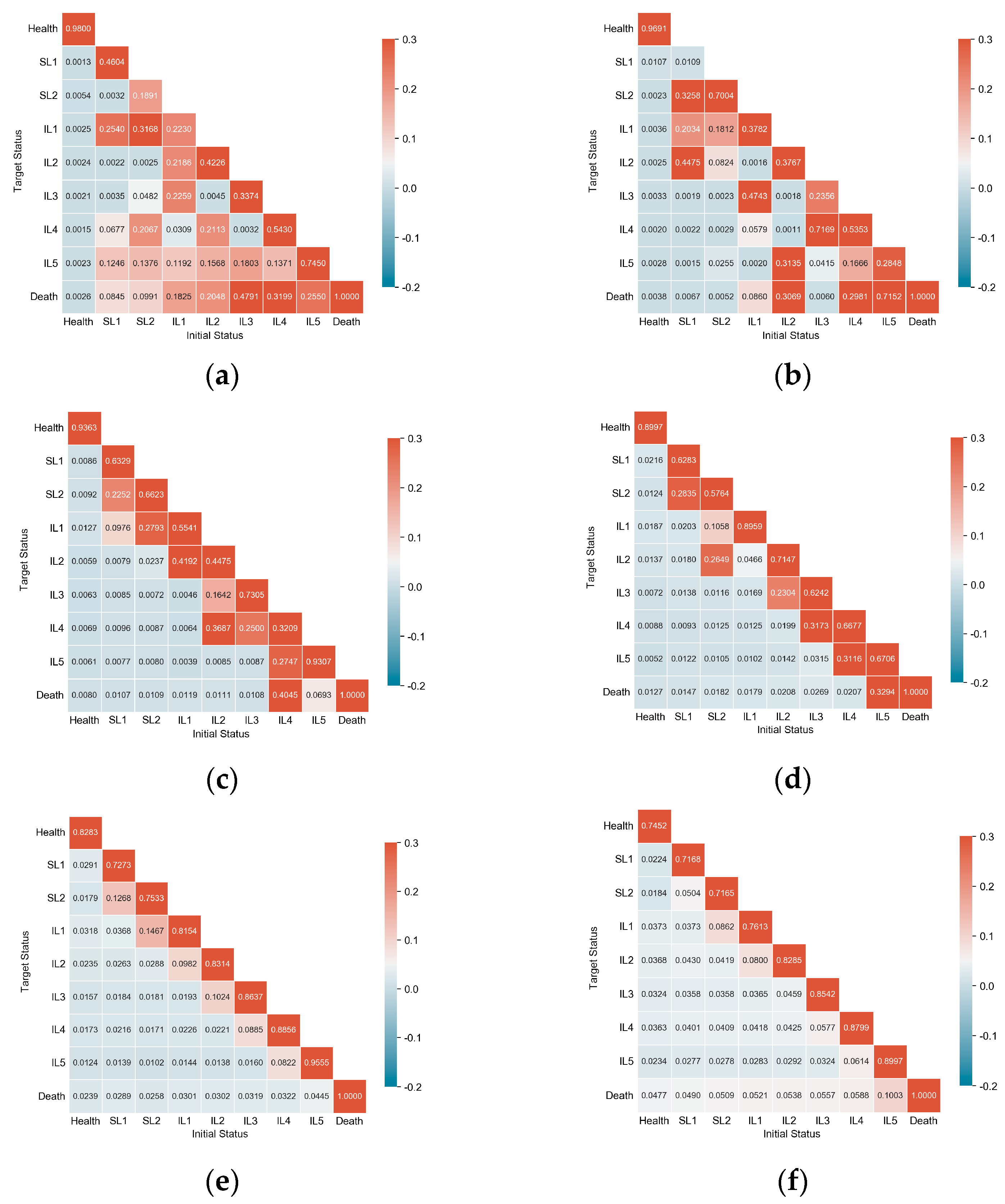
This study analyzed the health status transition patterns of six age ranges of older adults (65–69, 70–74, 75–79, 80–84, 85–89, and 90+) under Japan’s LTCI system from 2015 to 2020. The input data consist of population figures for nine health status categories across different age range from 2015 to 2020 in Japan, as shown in Table S3. These data are derived from the annual LTCI Status of Care Insurance Services Report (National) and are based on health status information for Category I insured persons (older adults aged 65 and above).
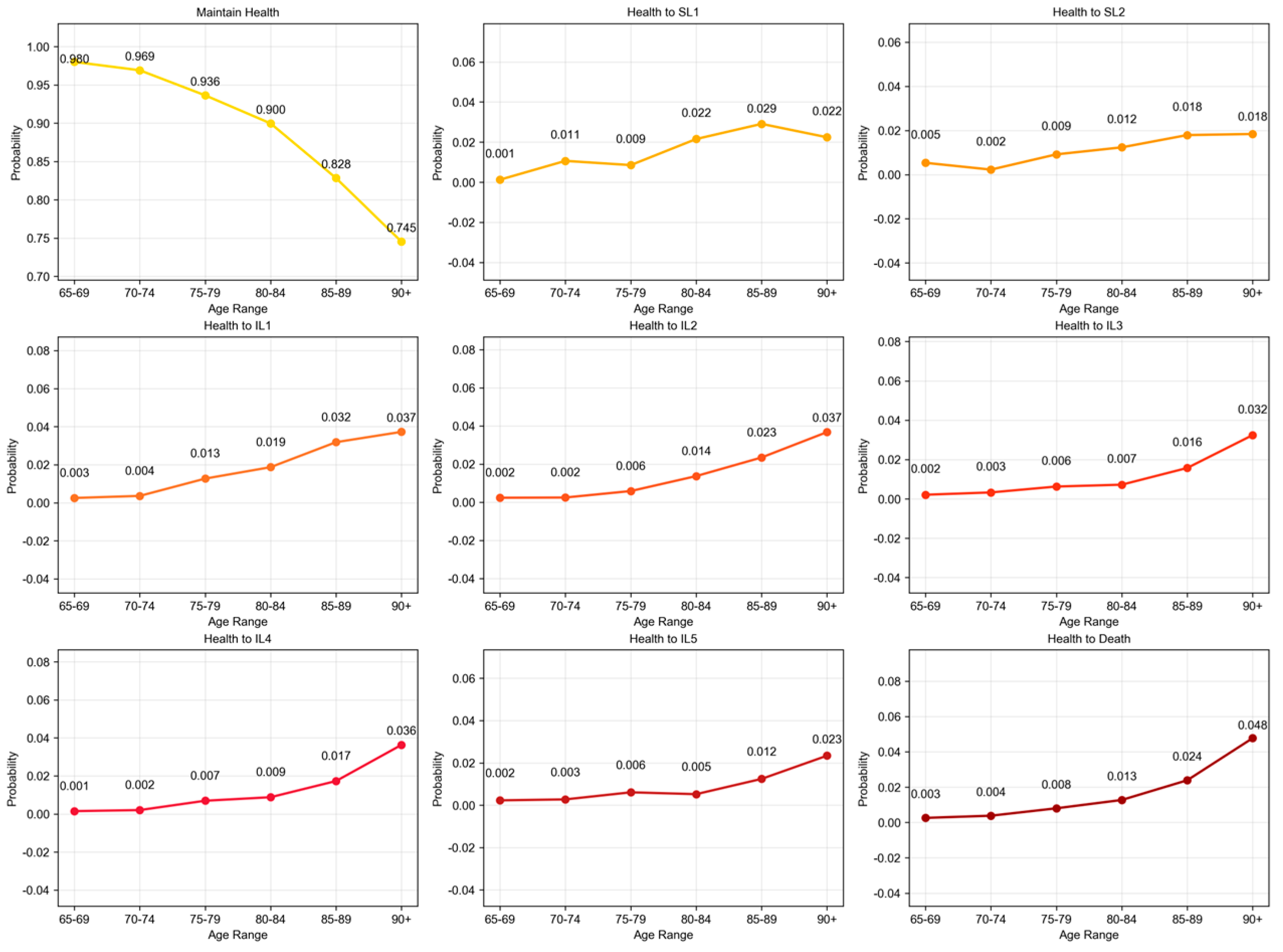
The results, as shown in Figure 3, reveal distinct patterns of health status transitions across age ranges. Specifically, the ability to maintain a healthy status declines with age. Older adults aged 65–79 (Figure 3a–c) exhibit relatively high health maintenance rates (0.936–0.980), whereas this ability declines more rapidly among those aged 80 and above (Figure 3d–f). The 90+ group shows the lowest health maintenance rate (0.745).
Significant heterogeneity exists in the cross-state transition probabilities across different age ranges. The transition trends from the health status to higher care demand status (SL1–2, IL1–5, and death) are illustrated in Figure 4. With advancing age, individuals face a markedly higher risk of health deterioration and mortality. The transition probabilities from health to SL1 and SL2 first increase and then tend to stabilize or slightly decline, peaking in the 85–89 age range. In contrast, the transition probabilities from Healthy to IL1–IL5 show a steady upward trend with age, indicating that older adults aged 85 and above are significantly more likely to require various levels of support and long-term care.
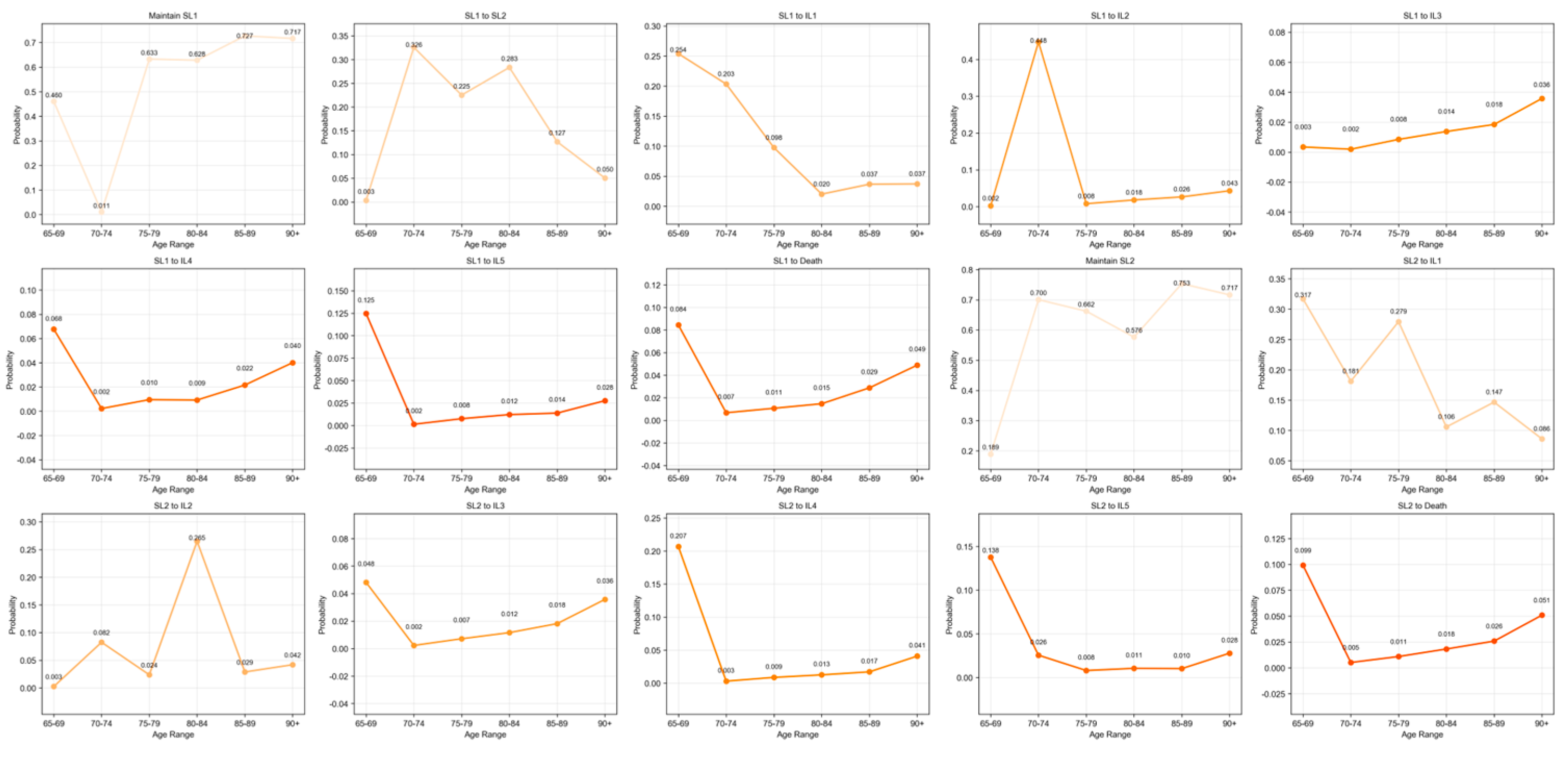
The trends of cross-state transition probabilities for elderly individuals in the support required (SL1–2) status across different age ranges are shown in Figure 5. For those in the SL1 status, the probability of remaining in the same status fluctuates and increases with age while decreasing significantly in the 70–74 age range. The probability of transitioning from SL1 to SL2 first increases and then decreases with age, reaching its peak in the 70–74 age range, indicating that elderly individuals in the SL1 status are more likely to experience health status changes during this period. Notably, in the 65–69 age range, the probability of transitioning from SL1 to IL1–5 reaches its highest point, but continues to show a steady upward trend with increasing age after 70, reflecting the interaction between age and initial health status. Individuals’ initial health status has a significant influence on their subsequent health trajectories. For elderly individuals in the SL2 status, the probability of remaining in the same status shows a fluctuating upward trend with age but decreases significantly in the 70–74 age range. The probability of transitioning from SL1 to SL2 first increases and then decreases with age, peaking in the 85–89 age range. The transition probability from SL2 to IL1–5 exhibits notable fluctuations, suggesting a stronger interaction between age and initial health status. Relatively younger elderly individuals with poorer initial health conditions are more likely to experience deterioration in their subsequent health status.
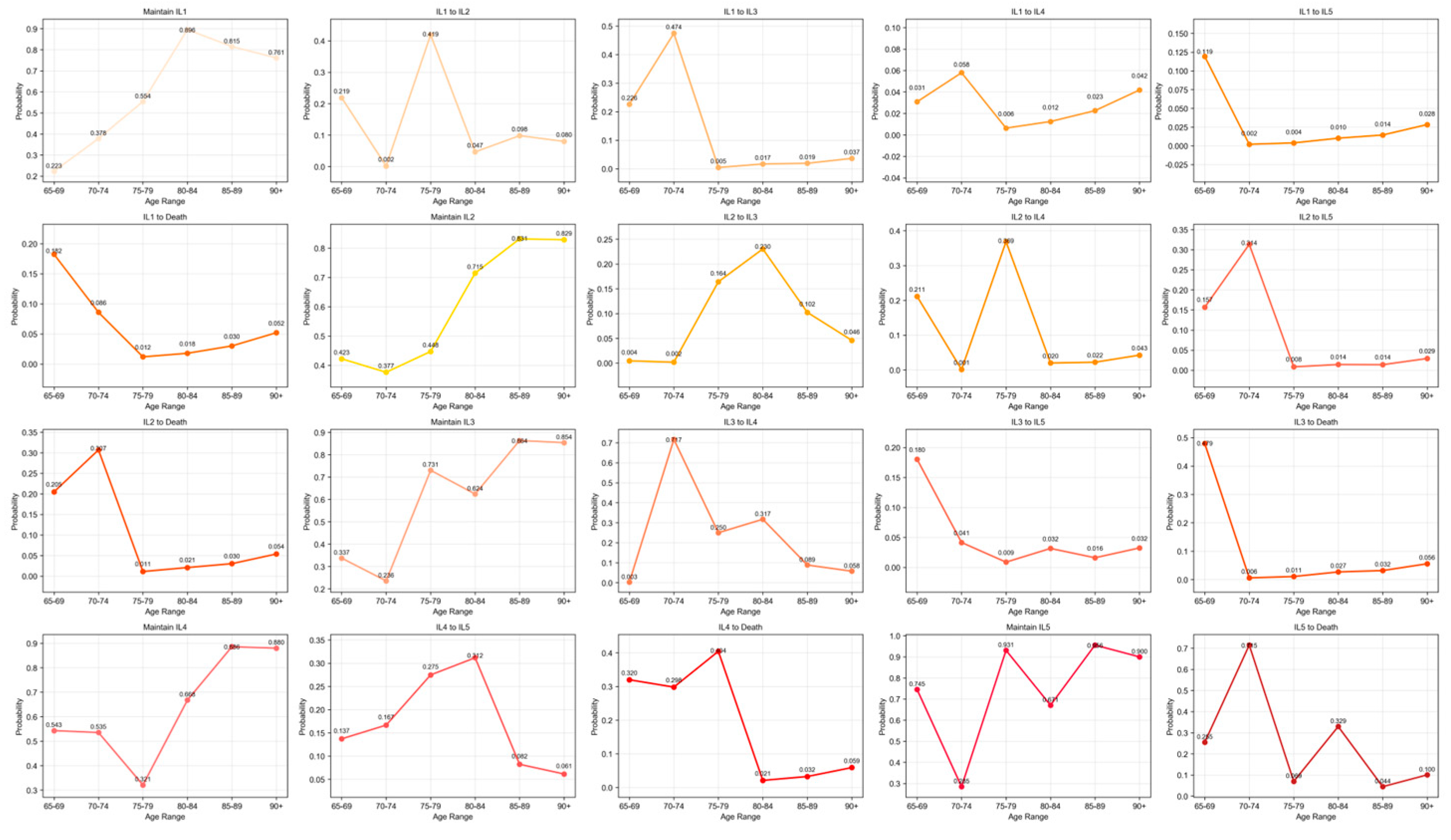
The trends of cross-state transition probabilities for elderly individuals in the care intervention status (IL1–5) across different age ranges are shown in Figure 6. The probability of maintaining the same care level varies across age ranges and fluctuates among different care grades. Interestingly, in some status, older elderly individuals exhibit a higher probability of remaining in the same status, a phenomenon known in gerontology and epidemiology as the survivor effect. This indicates that the health status itself is not a homogeneous category; rather, there exists a selection bias among individuals entering the same status at different age ranges. The underlying health status and survival ability of elderly individuals in the intervention status are among the key factors influencing their subsequent health transitions.

3.2. Estimation Results of Elderly Population in Different Health Status and Their Corresponding Elder Care Service Demands

Based on the proportions of older adults in SL1–2 and IL1–5 health status across different age ranges in Japan, this study reclassified the elderly population of Qinhuai district using data obtained from China’s Seventh National Population Census (2020). The reclassified population was used as the initial status for population projection. By applying annual health status transition matrices, we projected the range of elderly populations in different health status across age range in Qinhuai district for the year 2035. The timeline correspondence of the case studies is shown in Figure S2.
The projection results are presented in Table 5. With the deepening degree of population ageing, the number of healthy older adults decreases sharply with age. Older adults in the SL1–2 status are mainly concentrated in the 70–84 age range, while those in the IL1–5 status increase significantly with advancing age. The demand for long-term care among the elderly aged 80 and above rises markedly, providing important implications for future policy formulation and the spatial allocation of elderly care resources.
This study is based on data collected from the Japanese LTCI system (2017–2021), including the number of users in different health status, the types of elderly care services utilized, and the corresponding service capacities. Poisson regression was employed to quantify the relationship between populations in different health status and service utilization rates. These regression results were then combined with the projected mean values of the elderly population in Qinhuai district by health status in 2035 to estimate the demand for elderly care services in the district (Table 6).

3.3. Spatial Allocation Characteristics of Elderly Population and Service Resources

3.3.1. Clustered Living Service Facilities

Existing elderly care facility planning is largely based on administrative units or facility types, which often do not align with older adults’ daily activity spaces and therefore hard to reflect changes in health status and the spatiotemporal heterogeneity of service demand. Accordingly, this study focuses on older adults’ daily living areas. First, the road network and water resources within the Qinhuai district, including urban arterial roads, elevated highways, and major natural waterways that act as barriers to movement, are identified as boundary elements. Using ArcGIS, primary trunk roads and water systems are extracted and treated as segmentation boundaries to partition the entire study area. Small fragmented areas are then manually merged to achieve a fragmented spatial division (Figure 7a). Building upon the fragmented spatial partitioning, K-means clustering was employed to perform spatial clustering of living service POIs within each partition. The centroid of each cluster was subsequently computed to represent the living service centre (Figure 7b).

3.3.2. Elderly Care Service Community

To determine appropriate walking service radii, this study applies Incremental Spatial Autocorrelation analysis for quantitative identification. This method systematically calculates spatial autocorrelation indicators, such as Moran’s I, across a series of increasing distance thresholds, thereby revealing the clustering characteristics of life service facilities at different spatial scales. It allows for the identification of statistically significant clustering ranges and provides an objective basis for defining service radii.
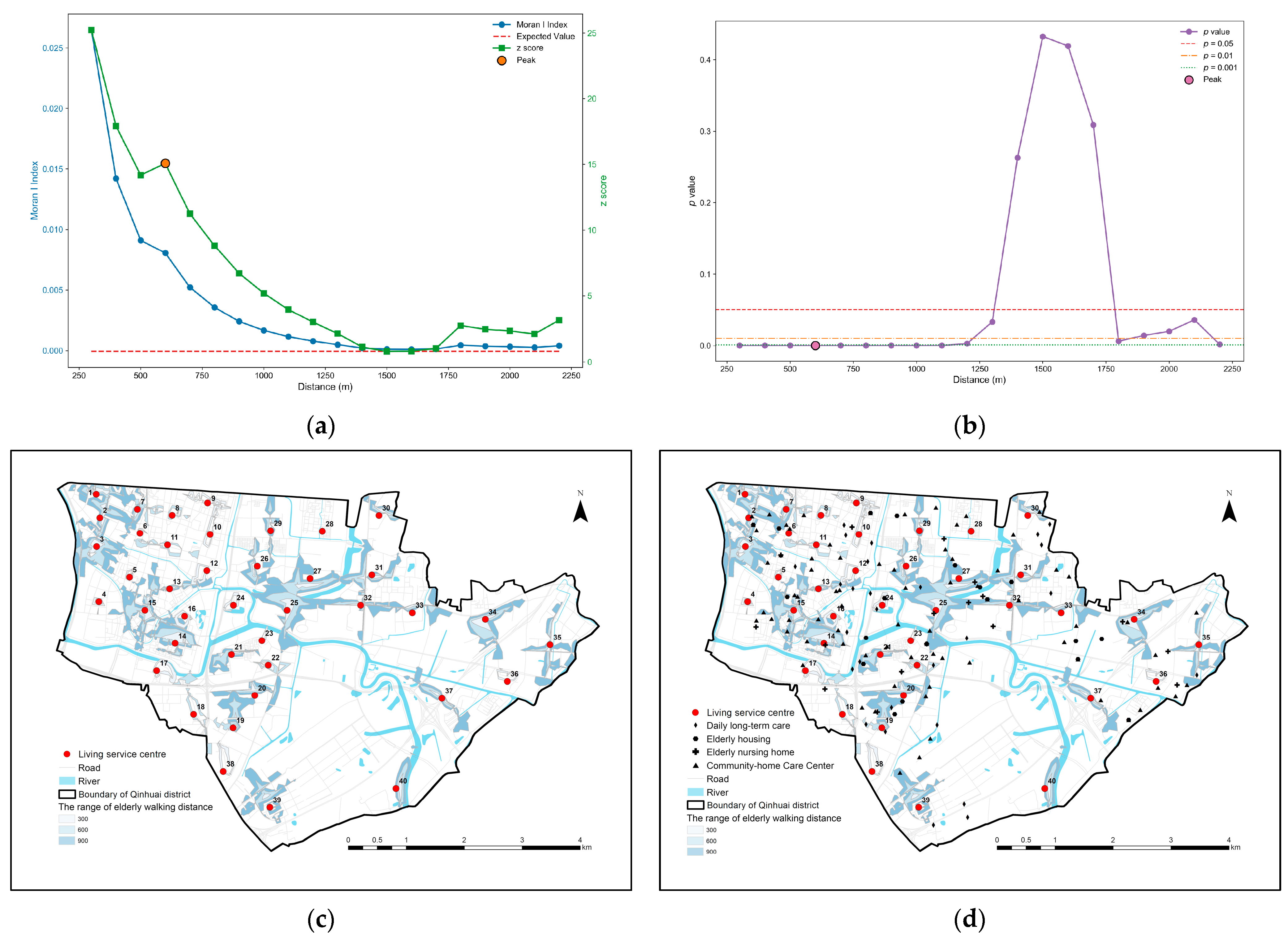
Parameter settings in the analysis were designed to reflect older adults’ mobility characteristics. The initial distance was set at 300 m, corresponding to the distance an older adult can reach within approximately 5 min at a comfortable walking speed (about 0.5–1.2 m/s), which is consistent with daily activity patterns. A distance increment of 100 m was adopted to balance analytical resolution and coverage of typical walking scales. A total of 20 iterations were performed, extending the analysis range from 300 to 2200 m. The results show that the spatial autocorrelation index reaches a peak at approximately 600 m (Figure 8a,b), indicating that the spatial clustering of life service facilities is most pronounced at this distance. This suggests that 600 m represents a critical spatial scale for the functional catchment of life service centres.
Based on these findings, and in consideration of older adults’ walking capacity and daily living habits, this study uses the ArcGIS platform to conduct road network analysis. Taking living service centres as origin points, service areas reachable within walking distances of 300, 600, and 900 m are delineated. These areas are identified as potential zones suitable for the spatial allocation of elderly care service facilities (Figure 8c).
Under the walking network planning framework radiating from living service centres, existing elderly care facilities exhibit a relatively high level of compatibility with the network in terms of accessibility and coverage (Figure 8d). This finding also provides multiple possibilities for proposing improvement strategies based on current conditions. Furthermore, it confirms that a planning approach concentrated on older adults’ daily living service areas, rather than constrained by administrative boundaries, plays an important role in addressing existing shortcomings and in establishing an effective elderly care service network.
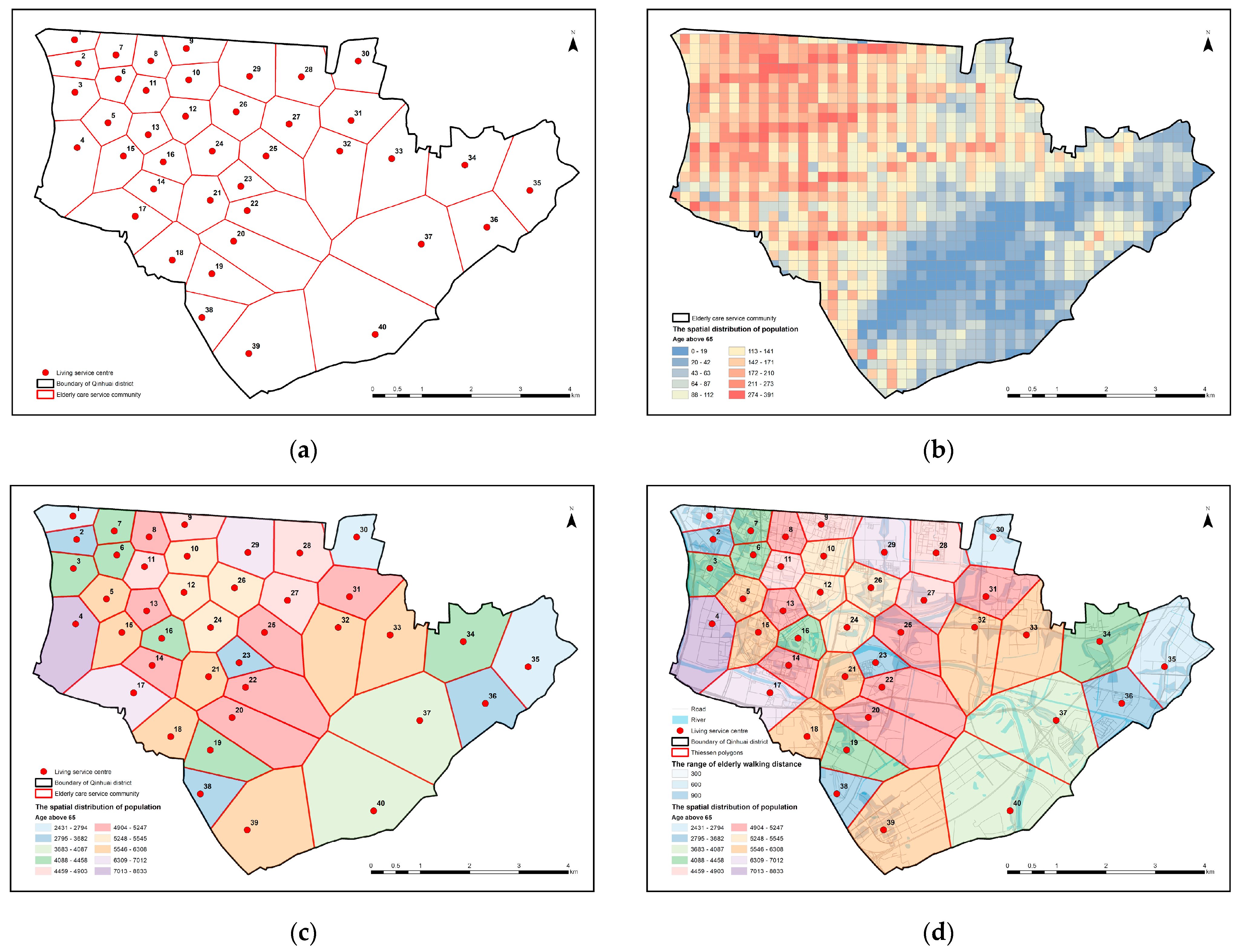
Therefore, this study connects multiple life service centres using a nearest-neighbour principle and delineates them into continuous spatial areas, with each area defined as a basic elderly care service network unit, thereby breaking away from the constraints of traditional administrative boundaries (Figure 9a). Furthermore, the 2020 China population density dataset provided by WorldPop was integrated with the proportion of residents aged 65 and above in Qinhuai district from the Seventh National Population Census. Through spatial overlay analysis in ArcGIS, the elderly population was allocated to 40 basic elderly care service network units, each assigned a unique identifier (Figure 9b,c). Based on the elderly walking network, an integrated elderly care service network system was then constructed to accommodate the service needs of older adults with different health conditions (Figure 9d).

3.3.3. Spatial Allocation of Elderly Care Service Resources

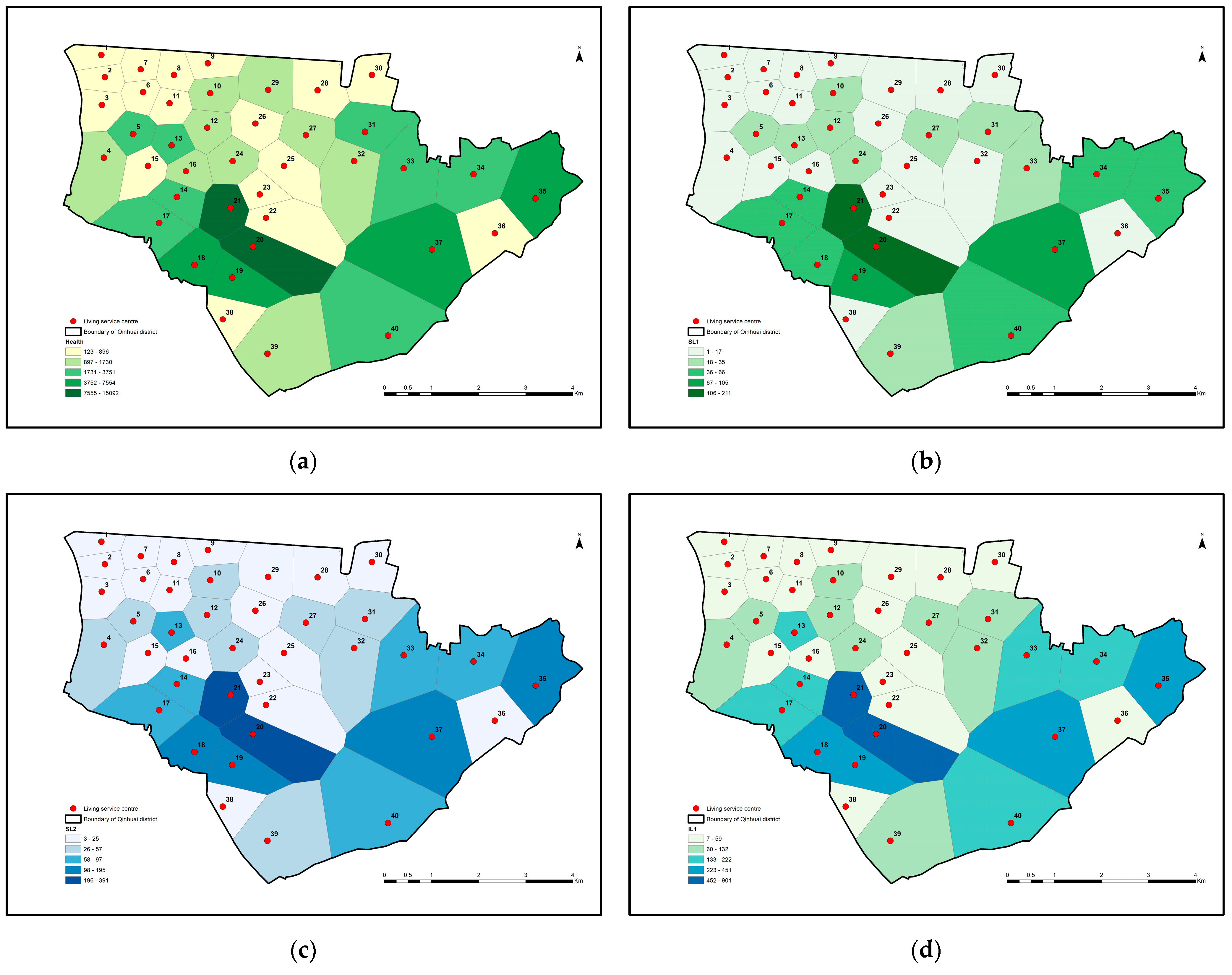
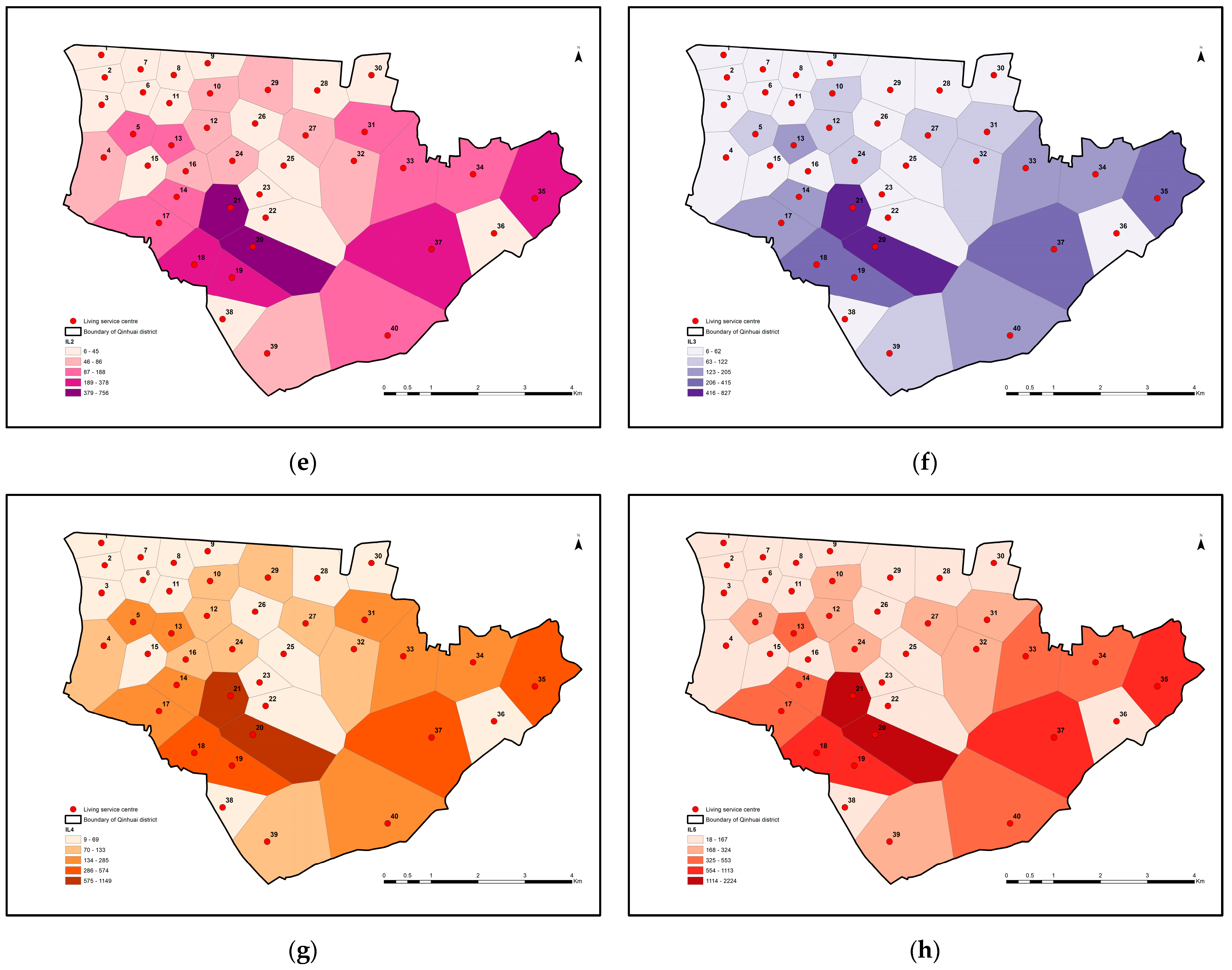
The spatial allocation of the predicted number of elderly individuals in different health status and their corresponding care service resource demands in Qinhuai district by 2035 is illustrated in Figure 10 and Figure 11. Significant spatial disparities in the health status of the elderly population are observed across the district. High-value areas are mainly concentrated in the central–southern and eastern parts, particularly in Network 18 of Zhonghuamen subdistrict, Network 19 of Honghua subdistrict, Networks 20 and 21 of Qinhong subdistrict, and Networks 35 and 37 of Guanghua Road subdistrict, where the proportion of elderly individuals requiring intensive care (IL levels) is relatively higher. In addition, certain clustering characteristics are also evident in the northwestern and northeastern areas, including Network 4 of Shuangtang subdistrict, Network 5 of Chaotiangong subdistrict, Network 13 of Hongwu Road subdistrict, Network 31 of Yueya Lake subdistrict, and Networks 33 and 34 of Guanghua Road subdistrict (Figure 10).
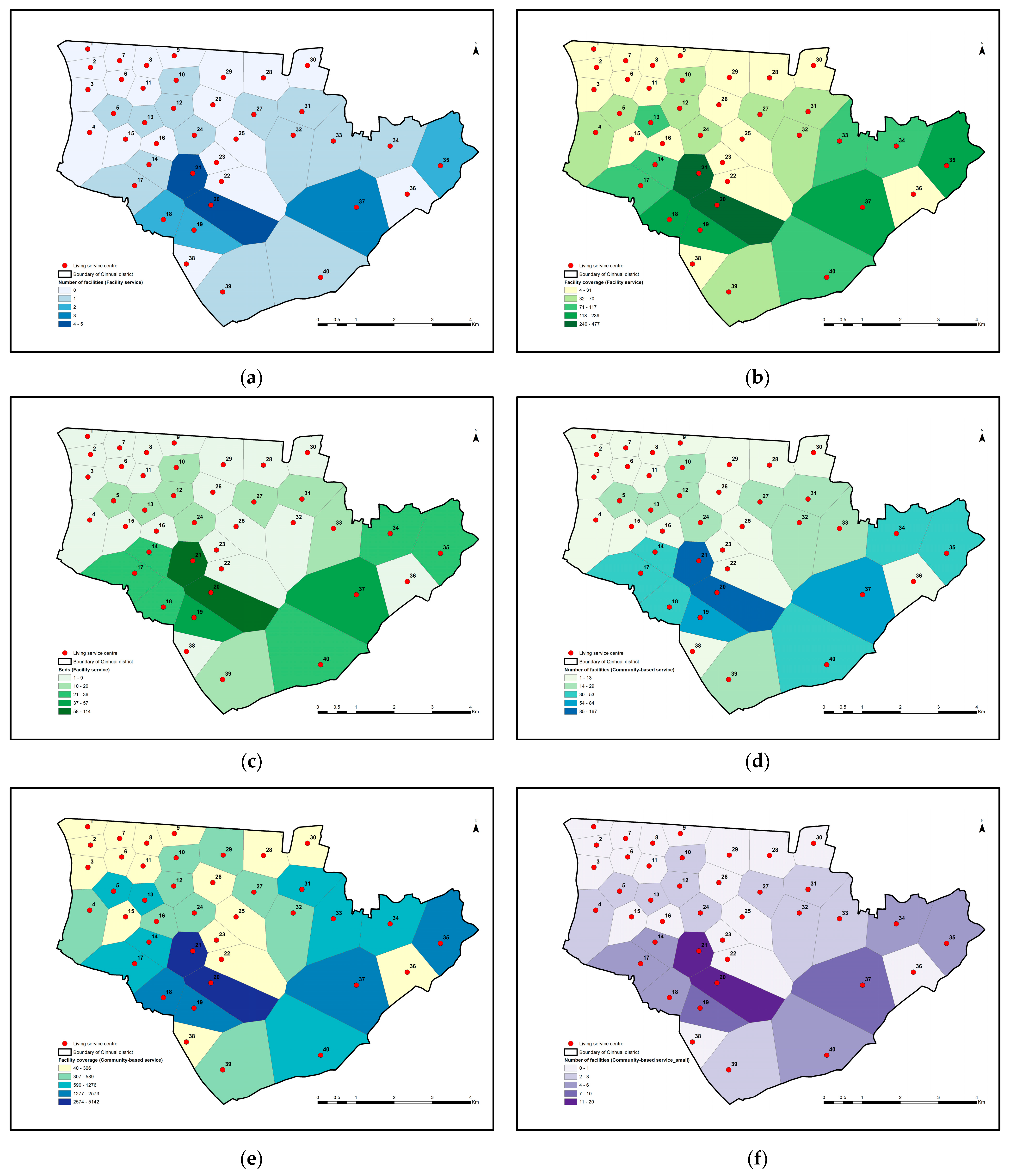
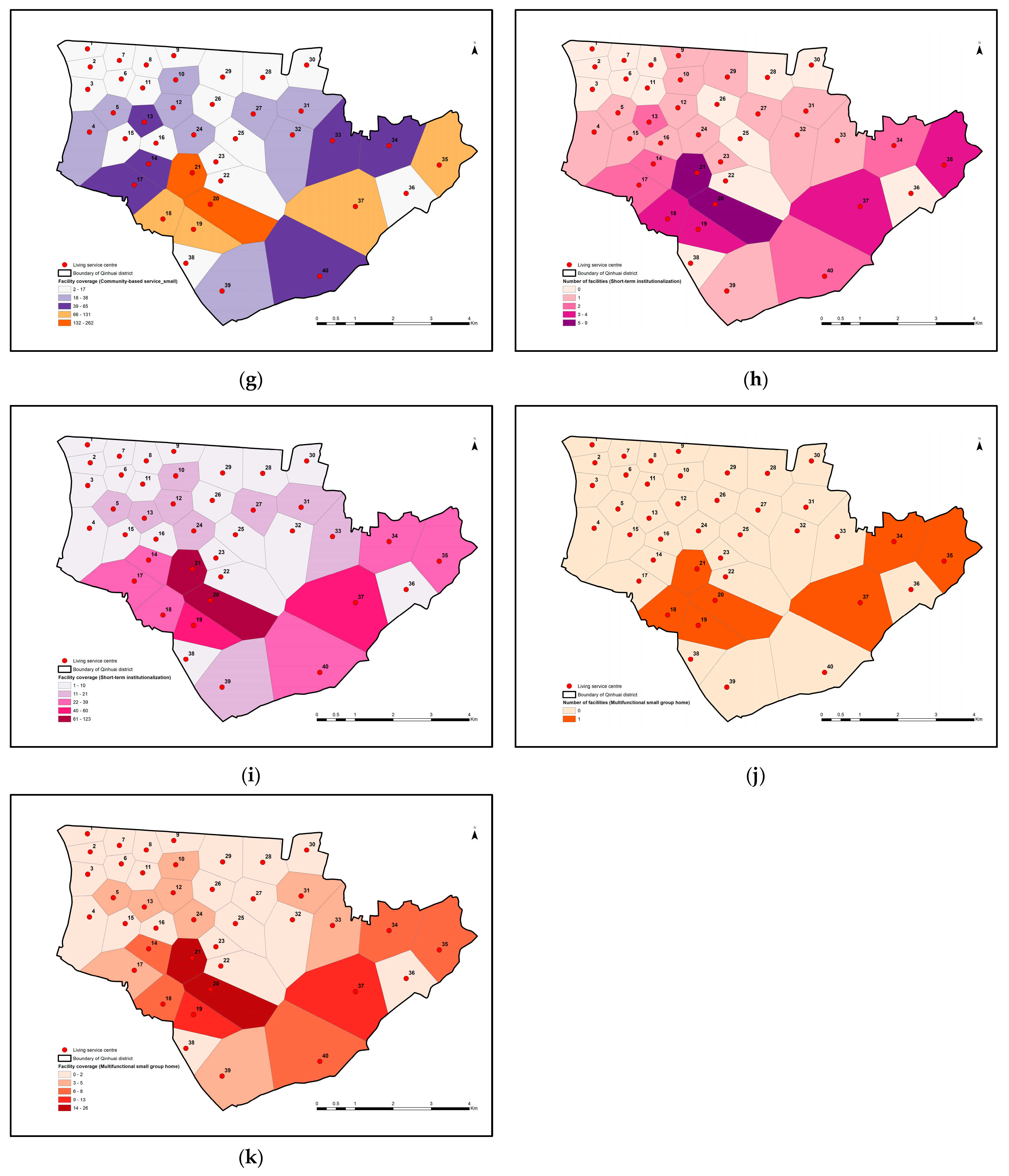
As shown in Figure 11, the spatial layout of elder care services in Qinhuai district constructed on the distribution of the population in IL health status, reveals clear spatial heterogeneity in both service types and service scales required by different health status groups. Elderly individuals across all levels of care dependence show a relatively high demand for community-based services. As the degree of care need and the size of the elderly population increase, the demand for various types and scales of services, including facility service, small-scale community-based service, and short-term institutionalization service, also rises accordingly. The multifunctional small group home type of integrated care service shows moderate demand in areas with both high dependency levels and large elderly populations. For example, Networks 20 and 21 in Qinhong subdistrict exhibit the highest demand for facility service, community-based service, and short-term institutionalization service, while community-based (small-scale) service also show a strong upward demand trend. Similarly, Networks 13 and 14 in Fuzimiao subdistrict, Network 17 in Zhonghuamen subdistrict, and Network 34 in Guanghua Road subdistrict demonstrate relatively high demand for short-term institutionalization services.

3.3.4. Elderly Care Service Networks

Based on the projected 2035 distribution of elderly populations in Qinhuai district by health status and their corresponding spatial service demand, a multi-objective clustering decision model was applied. Secondary clustering was conducted using the following features: the geographical distance between living service centres (D), the service and population balance within each basic elderly care service network unit (S), the supply–demand equilibrium between service capacity and population needs (B), and a composite measure integrating the three indicators. The multi-objective decision model aggregated population demand and resources across adjacent network units to form a hierarchical elderly care service network.
In the secondary clustering stage, different values of k (≤ 10) were evaluated for each of the four clustering objectives. The optimal k for each objective was determined by jointly considering the Elbow Method, Silhouette Coefficient, Davies–Bouldin Index, and Calinski–Harabasz Index. The results indicate that when k = 5, clustering based on the distance objective performs best, producing the most geographically compact network while maintaining reasonable supply–demand balance; when k = 6, clustering based on the supply capacity objective performs best, improving the balance between resources and population distribution, although the overall supply capacity is relatively lower; when k = 3, clustering based on the balance objective performs best, but with a reduction in geographic compactness; and when k = 6, clustering based on the composite objective performs best, with moderate improvements in geographic compactness compared to the supply capacity and balance objectives, though its supply capacity remains relatively weaker (Table 7). Overall, the multi-level elderly care service network optimized for distance demonstrates the best overall performance (Figure 12).
To assess the impact of health status deterioration on clustering outcomes, additional sensitivity analysis was conducted by increasing the health deterioration rate by 5%, 10%, and 20%. The results indicate that clustering outcomes based on distance and supply capacity objectives are relatively stable, whereas clustering based on the supply–demand balance objective shows a certain degree of sensitivity to health deterioration. The composite clustering results are the most affected by changes in the health deterioration rate (Table 8).

3.4. Model Validation and Uncertainty

3.4.1. Discrete Time Homogeneous Markov Model

The model uses data from 2015–2018 as the training set and data from 2019–2020 as the test set. For each age range, multiple values of λ (0.01, 0.05, 0.1, 0.5, 1.0, and 2.0) were evaluated. For each λ, the mean absolute error (MAE) was calculated for both the training and test sets, and the difference between the transition matrix and the identity matrix was measured using the Frobenius norm, together with the model’s overall prediction error (total error).
The results show that as λ increases, the Frobenius norm decreases monotonically, while the MAE remains below 5% and the overall prediction error stays below 8% (Table S4). When λ = 2, the prediction error approaches its optimal level, the MAE is relatively small, and the Frobenius norm still preserves a certain degree of model dynamics. Overall, this parameter setting achieves a balanced and robust model performance (Table S5).
Disturbance functions were applied to the transition matrix by age range, with perturbation magnitudes ranging from ±5% to ±20%, followed by multiple simulation-based predictions. Sensitivity analysis was conducted to validate the reliability of the projection results by calculating the Coefficient of Variation (CV), Confidence Interval (CI), and Relative Change (RC) for populations in each health status across different age ranges. The 2035 projections indicate that CV values vary by age range and health status; however, all CV remain below 5%, and RC fluctuate within ±5%. No highly sensitive combinations were identified, suggesting that the results are robust and suitable for subsequent projection and planning applications (Table S6).

3.4.2. Poisson Regression Model

A dispersion analysis was conducted on data across different institution size categories. The results (Table S7) indicate the presence of overdispersion in the 10–19 and 30–39 size categories. Accordingly, this study employs a Poisson regression model and applies a covariance matrix–based adjustment to the standard errors for those size categories exhibiting overdispersion.
This study employs Poisson regression to examine the quantitative relationship between populations in different health status and utilization rates of institutions of various sizes across different service types, thereby constructing a demand forecasting model for elderly care services. The model estimation results are presented in Table S8.
The participation rate of individuals in SL1–2 in preventive services is substantially lower than that of individuals in IL1–5 in long-term care services. During model estimation, the density of health status was found to have a negative effect, and the Adj. R2 values were relatively low or, in some cases, indicated overfitting (Table S9).

3.4.3. Multi-Objective Clustering Model

The impact of different weight configurations on the composite clustering objective was examined, and the results are presented in Table 9. The composite score reflects the overall performance of supply capacity, supply–demand balance, and geographic distance under each weight scheme. The analysis shows that geographic distance is the most sensitive to changes in weights, whereas supply–demand balance has the smallest effect. Based on the ranking of composite scores and the principle of balance, the weight vector α = [0.4,0.3,0.3] was selected for the calculation of the composite clustering objective.

4. Discussion

With the deepening of population ageing in China, the construction of elderly care service networks that meet the differentiated needs of older adults has become an increasingly important topic. In this study, the transition patterns among health, SL1–2, IL1–5, and death status under Japan’s LTCI system reveal significant heterogeneity in cross-status transition probabilities across age ranges. Numerous studies have examined the impact of ageing, chronic diseases, multimorbidity, and frailty on health outcomes and show that medical care alone may partially mitigate underlying health deterioration [23,24,25]. Longitudinal evidence on frailty suggests that while it may be improved temporarily on some older individuals, many experience worsening or persistent frailty over time—an indicator of deteriorating health that often continues despite care [26]. Therefore, this study adopts an irreversible transition assumption for constructing the health status transition matrix, whereby health status is allowed to deteriorate but not improve. While prior studies (e.g., Diehr & Patrick, 2001) documented health transition heterogeneity [27], our analysis under Japan’s LTCI system uniquely quantifies how age modifies these transitions, revealing an interaction between age and initial health status, where an individual’s initial condition has a more substantial influence on subsequent health trajectories. This suggests that health status itself is not homogeneous groups; individuals entering the same state at different ages exhibit selective bias. In some cases, older individuals show a higher probability of maintaining their current status, aligning with the survivor effect observed in gerontology and epidemiology [28,29]. These results collectively demonstrate substantial variation in health status across age ranges, reinforcing the need to account for dynamic and differentiated health characteristics. By tailoring elderly care services to these specific health trajectories, resource planning can shift from a facility-oriented model to a dynamic and population health-oriented planning paradigm.
Building on the quantified linkage between health transitions and service demand, this study identifies a clear association between IL1–5 status levels and the utilization of care services. This indicates that elderly care systems should be structured hierarchically according to differences in health status, providing adaptive services in response to changing needs, an essential approach for meeting individualized care demands [30,31]. In terms of service types, demand for community-based service has increased significantly, and the service scale has become more diverse. While facility service emphasizes concentrated bed allocation, small-scale and flexible community-based service has also grown rapidly in demand. Overall, the elderly care system is shifting from a traditional, centralized institutional model toward a diversified, home- and community-based care model. de Meijer and co-authors also highlighted the global transition of long-term care from institutional to home and community settings. Based on the quantitative relationship between older adults’ health status transition patterns and changes in demand for elderly care services, this study achieves a transformation from population health characteristics to service demand [11].
As China’s ageing population continues to grow and the demand for elderly care resources intensifies, one of the key challenges facing policymakers is developing an effective system for allocating these resources. For instance, the distribution of elderly care resources remains uneven across regions. A common issue is the mismatch between the availability of services and the accessibility of these services. Many elderly people, especially those in older communities or those who are disabled, face significant barriers to accessing services due to spatial distance. To address these challenges, policymakers must focus on decentralizing elder care infrastructure, incentivizing the construction of facilities, and ensuring the proper allocation of resources [32]. This study innovatively integrates health status considerations into the spatial allocation model, combining dynamic health status changes with service demand patterns to delineate basic elderly care service units and district-level service networks. The model enhances the system responsiveness and operational efficiency, promotes demand-driven resource allocation, and improves the capacity of the service system to accommodate increasingly diverse and stratified needs among older adults. Through a comparative multi-objective clustering decision analysis during the establishment of the elderly care service network, we find that the clustering scheme optimized for the geographical distance between living service centres performs best overall. This scheme achieves strong geographic compactness in the allocation of elderly care resources, ensuring that older adults with different health status can access required services within the smallest possible daily activity radius. At the same time, it effectively balances service supply and demand and demonstrates good adaptability to increasing levels of health deterioration. In contrast, the clustering scheme optimized for supply–demand balance remains suboptimal in terms of geographic compactness and exhibits insufficient stability when health conditions deteriorate. The scheme optimized for service capacity shows relatively strong stability under worsening health conditions, while performing poorly in both overall supply capacity and geographic compactness. The composite clustering scheme exhibits weaker performance in terms of service capacity and stability under health deterioration.
Unlike traditional planning approaches that rely on administrative boundaries and facility-centred layouts, our model integrates dynamic health status transitions with spatial configuration to construct a multi-level elderly care service network. The basic network units are spatially contiguous and can be flexibly combined according to demand to form higher-level inter-regional service networks. This enables coordinated resource sharing across areas, improves service efficiency, and promotes a better balance between supply and demand. By embedding health dynamics into spatial planning, this study proposes a health-oriented planning paradigm that simultaneously addresses individual needs and enhances overall system efficiency.

5. Conclusions

This study constructs a theoretically sound and practically applicable predictive analysis and resource allocation model. By analyzing the quantitative relationship between the changing patterns of elderly people’s health status and their service needs, it provides a data-driven supply–demand matching method. Finally, through GIS spatial analysis, it constructs a correspondence between data and spatial allocation, thereby building a multi-level elderly care service network system to achieve a balance between supply and demand in the spatial allocation of elderly care service resources. The main conclusions are as follows:
First, with increasing age, the stability of health status decreases significantly, especially among the very elderly, whose health status fluctuates more dramatically and whose probability of transitioning between status is higher. Furthermore, health status itself is not a homogeneous category; individuals of different age ranges entering the same health status exhibit selective bias. A significant interaction exists between age and initial health status, indicating that an individual’s initial health status plays a crucial role in their subsequent health trajectory.
Second, a structural correspondence exists between health status and the demand for elderly care services. This study reveals that the elderly care system should adopt differentiated service configurations based on health status to achieve precise resource allocation and maximize efficiency. In terms of service type, the demand for home care and community-integrated care has increased significantly. The diversification and streamlining of service coverage reflect a shift from traditional institutional care to a community-based care model.
Finally, this study takes Qinhuai district, Nanjing, China, as an example, integrating health status, service demand, and spatial distribution into a unified model for elderly care resource allocation. The study proposes a health-oriented allocation strategy, which, unlike traditional administrative units, constructs an elderly care service network centred on daily living service areas for the elderly, achieving a bottom-up balance between supply and demand in the distribution of elderly care service resources.
In summary, the theoretical contribution of this study lies in proposing a framework for analyzing the spatial allocation of elderly care services based on health status, identifying the structural correspondence between health status and spatial demand planning; the methodological contribution lies in providing a data-driven supply–demand matching method, offering a new paradigm for health-oriented spatial planning, and this integrated model can be extended to various public service areas such as urban healthcare and childcare; the practical contribution lies in providing a multi-tiered supply logic based on health status for urban district-level elderly care service network planning, emphasizing strategies such as community embedding, on-demand supply, and layered optimization, supporting the policy transformation from facility-oriented to population health-oriented.
This study has several limitations. First, the model adopts an irreversible health status transition assumption, under which individuals’ health conditions are not allowed to recover or improve through medical care. Although ignoring a small number of health improvement cases enhances model robustness, this assumption leads to relatively conservative estimates and may slightly overestimate future demand for intensive care services. Future research could incorporate reversible transition probabilities for specific subgroups, such as relatively younger older adults, to improve the model’s granularity and flexibility. Second, to address the tension between spatial clustering and topological constraints, this study employs a staged strategy. Specifically, fragmented spatial units are first identified based on the road network, followed by continuous spatial clustering. However, the geometric centres generated by K-means clustering may locate service centres in areas that are difficult to access in practice. Future studies could improve the clustering component by embedding network-based calculations directly into the clustering algorithm, enabling more accurate identification of service centres during the clustering stage. In addition, the model relies on high-quality, high-resolution POI and population data. In rural or resource constrained areas, such data are often unavailable or incomplete, which may limit the model’s applicability and estimation accuracy in these contexts. Moreover, the POI data used in this study represent a static snapshot and cannot fully capture dynamic changes in infrastructure, population distribution, or road networks, potentially leading to discrepancies between long-term planning outcomes and actual development trajectories. Finally, the current model does not explicitly account for dynamic changes in population size, structure, or spatial distribution, which exclude migration or unexpected events, possibly limiting its ability to simulate long-term scenarios accurately.

Supplementary Materials

The following supporting information can be downloaded at: https://www.mdpi.com/article/10.3390/ijgi15020083/s1, Figure S1: Flowcharts. (a) Demographic projection methodology flowchart; (b) Poisson regression model, and (c) Clustering strategies for elderly care optimisation; Figure S2. Case study timeline; Table S1. Verification of structural differences in the unhealthy status population in 2020; Table S2. Verification of average structural differences after sequential combination of unhealthy status in China and Japan (2020); Table S3. Health status population data by age range in Japan, 2015–2020; Table S4. Validation results for different λ values by age range; Table S5. Validation results by age range and health status (λ = 2); Table S6. Sensitivity analysis of health status projections by age range in China, 2035; Table S7. Dispersion analysis by institution size; Table S8. Regression analysis results of different health status groups by service type and institutional capacity; Table S9. Poisson regression results for the SL1–2 health status population.

Author Contributions

Zhe Wang: Conceptualization, Data curation, Formal analysis, Investigation, Methodology, Visualization, Writing—original draft. Ying Zhou: Conceptualization, Funding acquisition, Project administration, Supervision, Validation, Writing—review & editing. All authors have read and agreed to the published version of the manuscript.

Funding

This work was financially supported by the National Key R&D Program of China (grant number: 2022YFF0607003; 2023YFC3605803) and the Ageing-Responsive Civilization Think Tank (grant number: 25LLWM20).

Data Availability Statement

The original contributions presented in this study are included in the article/Supplementary Material. Further inquiries can be directed to the corresponding author(s).

Conflicts of Interest

The authors declare no competing financial interest.

References

  1. He, Z.; Lu, D.; Yang, Y.; Gao, M. An elderly care system based on multiple information fusion. J. Healthc. Eng. 2018, 2018, 4098237. [Google Scholar] [CrossRef]
  2. Marukawa, T. The demand for and supply of elderly care in Japan. Jpn. Political Econ. 2022, 48, 8–26. [Google Scholar] [CrossRef]
  3. Huang, G.; Guo, F.; Chen, G. Utilization of home-/community-based care services: The current experience and the intention for future utilization in urban China. Popul. Res. Policy Rev. 2023, 42, 61. [Google Scholar] [CrossRef]
  4. Huang, G.; Guo, F.; Cheng, Z.; Tani, M.; Chen, G. Projections of future demand and costs of aged care services in China. Popul. Res. Policy Rev. 2023, 42, 56. [Google Scholar] [CrossRef]
  5. Wang, C.; Zhang, F.; Pan, C.; Guo, S.; Gong, X.; Yang, D. The willingness of the elderly to choose nursing care: Evidence from in China. Front. Psychol. 2022, 13, 865276. [Google Scholar] [CrossRef]
  6. Fernández-Olano, C.; Hidalgo, J.D.L.-T.; Cerdá-Díaz, R.; Requena-Gallego, M.; Sánchez-Castaño, C.; Urbistondo-Cascales, L.; Otero-Puime, A. Factors associated with health care utilization by the elderly in a public health care system. Health Policy 2006, 75, 131–139. [Google Scholar] [CrossRef]
  7. Wan, T.T.; Odell, B.G. Factors affecting the use of social and health services among the elderly. Ageing Soc. 1981, 1, 95–115. [Google Scholar] [CrossRef]
  8. Liu, T. Nursing care for elderly people in Germany and China: A bilateral comparison and exploration of policy transfer. J. Nurs. Care 2014, 3, 1–4. [Google Scholar]
  9. Kaye, H.S.; Harrington, C.; LaPlante, M.P. Long-term care: Who gets it, who provides it, who pays, and how much? Health Aff. 2010, 29, 11–21. [Google Scholar] [CrossRef] [PubMed]
  10. Yamada, M.; Arai, H. Long-term care system in Japan. Ann. Geriatr. Med. Res. 2020, 24, 174. [Google Scholar] [CrossRef]
  11. de Meijer, C.; Bakx, P.; van Doorslaer, E.; Koopmanschap, M. Explaining declining rates of institutional LTC use in the netherlands: A decomposition approach. Health Econ. 2015, 24, 18–31. [Google Scholar] [CrossRef] [PubMed]
  12. Goharinezhad, S.; Maleki, M.; Baradaran, H.R.; Ravaghi, H. A qualitative study of the current situation of elderly care in Iran: What can we do for the future? Glob. Health Action 2016, 9, 32156. [Google Scholar] [CrossRef] [PubMed]
  13. Zhang, Y.; Zhang, M.; Hu, H.; He, X. Research on supply and demand of aged services resource allocation in China: A system dynamics model. Systems 2022, 10, 59. [Google Scholar] [CrossRef]
  14. Zhou, W.; Jiang, B.; Yu, L.; Dai, W. Measuring demand and supply of community care services for older people healthy ageing in rural Zhejiang Province. BMC Geriatr. 2022, 22, 286. [Google Scholar] [CrossRef]
  15. Chahed, S.; Chaussalet, T.; Millard, P.; Toffa, S. Measuring and modelling occupancy time in NHS continuing healthcare. BMC Health Serv. Res. 2011, 11, 155. [Google Scholar] [CrossRef]
  16. Rickayzen, B.; Walsh, D.E.P. A multi-state model of disability for the United Kingdom: Implications for future need for long-term care for the elderly. Br. Actuar. J. 2002, 8, 341–393. [Google Scholar] [CrossRef]
  17. Yuan, M.; Xu, C.; Fang, Y. The transitions and predictors of cognitive frailty with multi-state Markov model: A cohort study. BMC Geriatr. 2022, 22, 550. [Google Scholar] [CrossRef]
  18. Geman, O. A Markov model for analyzing the health status of the Romanian population until 2020. In Proceedings of the 2013 E-Health and Bioengineering Conference (EHB), Iasi, Romania, 21–23 November 2013; pp. 1–4. [Google Scholar]
  19. Huang, J.; Zhang, R.; Hu, G. Research on the Daily Life Circle of the Elderly Based on Spatiotemporal Behavior-Spatial Identification and Feature Analysis. Urban Plan 2019, 87–95. [Google Scholar]
  20. Yang, Y.; Li, C.; Zhou, D. Study on the Characteristics of Community Elderly Care Service Facilities Usage and Optimization Design Based on Life Cycle Theory. Buildings 2024, 14, 3003. [Google Scholar] [CrossRef]
  21. Li, X.; Li, X. Investigating the impacts of urban built environments on users of multiple services in elderly care facilities. Front. Archit. Res. 2023, 12, 999–1010. [Google Scholar] [CrossRef]
  22. Lloyd, S. Least squares quantization in PCM. IEEE Trans. Inf. Theory 1982, 28, 129–137. [Google Scholar] [CrossRef]
  23. Guo, J.; Huang, X.; Dou, L.; Yan, M.; Shen, T.; Tang, W.; Li, J. Aging and aging-related diseases: From molecular mechanisms to interventions and treatments. Signal Transduct. Target. Ther. 2022, 7, 391. [Google Scholar] [CrossRef]
  24. Yang, S.; Gao, T.; Li, J.; Fu, P.; Dan, Z.; Wang, Y.; Zhou, C. Chronic condition change and its longitudinal association with health care utilization among rural older adults: Intergenerational financial support as a possible moderator? BMC Geriatr. 2024, 24, 837. [Google Scholar] [CrossRef]
  25. Salive, M.E. Multimorbidity in older adults. Epidemiol. Rev. 2013, 35, 75–83. [Google Scholar] [CrossRef]
  26. Lu, S.H.; Chan, H.J.; Lin, Y.P.; To, T.L.; Yeh, C.J.; Lee, M.C.; Liao, W.C. Chronic diseases and frailty transitions in community-dwelling older adults: Evidence from a national longitudinal cohort study. BMC Geriatr. 2025, 25, 805. [Google Scholar] [CrossRef]
  27. Diehr, P.; Patrick, D.L. Probabilities of transition among health status for older adults. Qual. Life Res. 2001, 10, 431–442. [Google Scholar] [CrossRef]
  28. Crimmins, E.M.; Hayward, M.D.; Saito, Y. Changing mortality and morbidity rates and the health status and life expectancy of the older population. Demography 1994, 31, 159–175. [Google Scholar] [CrossRef] [PubMed]
  29. Johnson, R.E.; Mullooly, J.P.; Greenlick, M.R. Morbidity and medical care utilization of old and very old persons. Health Serv. Res. 1990, 25, 639. [Google Scholar] [PubMed]
  30. Bell, C.J.; Applegate, A.; Carrera, L.; Lustig, T.; Berkower, C. (Eds.) Mechanisms for organizational behavior change to address the needs of people living with alzheimer’s disease and related dementias. In The National Academies Collection: Reports Funded by National Institutes of Health; National Academies Press: Cambridge, MA, USA, 2022. [Google Scholar] [CrossRef]
  31. Yu, Y.; Zhang, J.; Petrovic, M.; Zhang, X.; Zhang, W.H. Utilization of home- and community-based services among older adults worldwide: A systematic review and meta-analysis. Int. J. Nurs. Stud. 2024, 155, 104774. [Google Scholar] [CrossRef]
  32. Krings, M.F.; van Wijngaarden, J.D.; Yuan, S.; Huijsman, R. China’s elder care policies 1994–2020: A narrative document analysis. Int. J. Environ. Res. Public Health 2022, 19, 6141. [Google Scholar] [CrossRef]
Figure 1. Research framework.
Ijgi 15 00083 g001
Figure 2. Spatial accessibility analysis of existing elderly care service facilities in Qinhuai district, China.
Ijgi 15 00083 g002
Figure 3. Annual transition matrices of elderly health status by age range. (a) 65–69; (b) 70–74; (c) 75–79; (d) 80–84; (e) 85–89; and (f) 90+.
Ijgi 15 00083 g003
Figure 4. Transition probability trends of health status elderly across different age ranges.
Ijgi 15 00083 g004
Figure 5. Trend of cross-state transition probabilities for elderly individuals in support levels 1–2 (SL1–2) across different age ranges.
Ijgi 15 00083 g005
Figure 6. Trend of cross-state transition probabilities for elderly individuals in intervention levels 1–5 (IL1–5) across different age ranges.
Ijgi 15 00083 g006
Figure 7. Cluster living service facilities in Qinhuai district, Nanjing, China. (a) block; (b) living service centre based on K-means clustered POI.
Ijgi 15 00083 g007
Figure 8. Spatial statistics. (a) Moran I analysis; (b) p value; (c) the range of elderly walking distance; and (d) Spatial relationship between existing elderly care service facilities and elderly care service network. Note: (c,d) each number represents each individual living service center.
Ijgi 15 00083 g008
Figure 9. Elderly care service network of Qinhuai district, Nanjing, China (2020). (a) Elderly care service community (Thiessen polygon-based); (b) the spatial distribution of the elderly (aged above 65); (c) the spatial distribution of the elderly (aged above 65) (Thiessen polygon-based); and (d) the combination of (ac). Note: (a,c,d) each number represents each individual living service center.
Ijgi 15 00083 g009
Figure 10. Spatial distribution of elderly population by health status in Qinhuai district, Nanjing, China (2035). (a) health; (b) support level 1 (SL1); (c) support level 2 (SL2); (d) intervention level 1 (IL1); (e) intervention level 2 (IL2); (f) intervention level 3 (IL3); (g) intervention level 4 (IL4); and (h) intervention level 5 (IL5). Note: each number represents each individual living service center.
Ijgi 15 00083 g010aIjgi 15 00083 g010b
Figure 11. Spatial distribution of elder care service resources in Qinhuai district, Nanjing, China (2035). (a) number of facilities (facility service); (b) facility coverage (facility service); (c) beds (facility service); (d) number of facilities (community-based service); (e) facility coverage (community-based service); (f) number of facilities (community-based service, small); (g) facility coverage (community-based service, small); (h) number of facilities (short-term institutionalization service); (i) facility coverage (short-term institutionalization service); (j) number of facilities (multifunctional small group home service); and (k) facility coverage (multifunctional small group home service). Note: each number represents each individual living service center.
Ijgi 15 00083 g011aIjgi 15 00083 g011b
Figure 12. Zonal-level division of elderly care service networks in Qinhuai district, Nanjing, China (2035). (a) distance objective (k = 5); (b) supply capacity objective (k = 6); (c) balance objective (k = 3); and (d) comprehensive objective (k = 6).
Ijgi 15 00083 g012
Table 1. Data sources.
DataSources
Population data2024 Revision of World Population Prospects
National Bureau of Statistics of China
Ministry of Health, labour and welfare (Japan)
WorldPop dataset
Health status dataChina Population Census Yearbook
Annual Report on the Status of the Long-term Care Insurance Project, Health and Welfare Bureau for the Elderly, MHLW
Elderly care service dataAnnual Report on the Status of the Long-term Care Insurance Project, Health and Welfare Bureau for the Elderly, MHLW
POI dataAmap
City mapOpenStreetMap
Table 2. Comparative analysis of health status categories of the elderly in China and Japan.
CategoryNational Bureau of Statistics of ChinaHealth Feature
(China)
Japan LTCIDemand for Nursing
(Japan)
Healthy statusHealthRefers to having been in good health over the past month and fully able to manage daily life.--
Basic healthRefers to having been in average health over the past month and able to manage daily life.--
Unhealthy statusUnhealthy but self-sufficientRefers to having been in somewhat poor health during the month prior to the census reference date, but still basically able to live a normal daily life.SL1Preventive long-term care
(getting out of bed, standing up from a seated position, standing on one leg, making everyday decisions, shopping, etc.)
SL2
Unhealthy and dependentRefers to having been in poor health during the month prior to the census reference date and being unable to take care of daily activities, such as eating, dressing, or moving around independently.IL1Long-term care
(standing, washing and grooming, taking medication, turning over in bed, dressing and undressing, etc.)
IL2
IL3
IL4
IL5
Source: Ministry of Health, labour and welfare (Japan) and National Bureau of Statistics of China.
Table 3. Health status and types of service.
Health StatusTypes of ServiceNotes
Support (SL1–2)Home visit service for preventive long-term carePreventive long-term care
Community-based service for preventive long-term care
Multifunctional small group home service for preventive long-term care
Short-term institutionalization service for preventive long-term care
Long-term institutionalization service for preventive long-term care
Intervention (IL1–5)Home visit serviceLong-term care
Community-based service
Multifunctional small group home service
Short-term institutionalization service
Long-term institutionalization service
Facility service
Source: “Annual Report on the Status of the Long-term Care Insurance Project”, Health and Welfare Bureau for the Elderly, Ministry of Health, Labor and Welfare, Japan.
Table 4. POI industry classification framework.
Big CategoryMid CategoryCommunity Category
Daily life serviceTravel agency, information centre, ticket office, post office, logistics service, telecom office, professional service firm, job centre, water supply service office, electric supply service office, beauty and hairdressing store, repair store, photo finishing, bath & massage centre, laundry, agency, move service, lottery store, funeral facilities, baby service place, shared device.Lottery store, telecom office, beauty and hairdressing store, photo finishing, bath & massage centre, laundry, logistics service, agency.
Sports & recreationSports stadium, golf related, recreation centre, holiday & nursing resort, recreation place, theatre & cinema.Recreation centre (card & chess room)
Food & beveragesChinese Food Restaurant, Foreign Food Restaurant, Fast Food Restaurant, Coffee House, Tea House, Ice-cream Shop, Bakery, Dessert House.Chinese Food Restaurant, Fast Food Restaurant, Tea House, Bakery, Dessert House.
Commercial houseIndustrial Park, Building, Residential Area.Residential area (community centre, residential quarter).
ShoppingShopping plaza, convenience store, home electronics hypermarket, supermarket, plants & pet market, home building materials market, comprehensive market, stationary store, sports store, commercial street, clothing store, franchise store, special trade house, personal care items shop.Convenience store, supermarket.
Finance & insurance serviceBank, ATM, insurance company, securities company, finance company.-
Accommodation serviceHotel, hostel.-
Medical serviceHospital, special hospital, clinic, emergency centre, disease prevention institution, pharmacy, veterinary hospital,Pharmacy, clinic.
Table 5. Projected ranges of the elderly population by health status and age range in Qinhuai district in 2035.
Age RangeHealth StatusBaselineMean5th Percentile95th Percentile
65–69Health50,03149,28447,92950,031
SL1121126121133
SL2340352340373
IL1350362350384
IL2351363351386
IL3317329317349
IL4546567546603
IL51742180717421925
Death21,05521,66621,05522,773
70–74Health30,22029,62128,44830,220
SL1336343336358
SL2667684667718
IL1505518505543
IL2474486474509
IL3467479467502
IL499410229941074
IL5638655638688
Death22,71523,20922,71524,177
75–79Health11,18410,94010,24411,184
SL1316317316320
SL2637641637650
IL1920925920940
IL2960967960987
IL31123113311231160
IL41173118311731211
IL55367537153675380
Death16,81617,01916,81617,614
80–84Health5473541050815473
SL1434433428434
SL2589588584589
IL13088307630053088
IL21793179617931811
IL31654165816541678
IL42329233623292368
IL52946295529463000
Death20,72520,78120,72521,076
85–89Health661661661661
SL1170170170170
SL2306306306306
IL1900900900900
IL21232123212321232
IL31651164916411651
IL42206220021592206
IL53520348534233520
Death8344838683448497
90+Health4444
SL12222
SL22222
IL17777
IL221212121
IL331313131
IL464646364
IL590898790
Death504504504508
Table 6. Estimated demand for elder care services in Qinhuai district by health status (2035).
Types of ServiceHealth StatusNumber of People in This StatusFacility Scale (Population)Number of Facilities (Lower Bound)Number of Facilities (Upper Bound)Facility Coverage (Maximum Population)Beds
Facility serviceIL1578820–29, 100+6181647395
IL2486520–29, 100+39971233
IL3527780–89, 90–99, 100+27642154
IL4735120–29, 60–69, 70–79, 90–99, 100+38597143
IL514,36290–99, 100+27755181
Community-based serviceIL157881–9, 30–39, 50–59, 60–69, 80–89, 90–99, 100+9281680-
IL248651–9, 20–29, 30–39, 40–49, 50–59, 80–89, 90–99, 100+16850415,910-
IL514,36210–19, 20–29, 30–39, 40–49, 50–59, 90–99, 100+361108432,185-
Community-based service
(small-scale)
IL157881–9, 10–19, 20–2931088-
IL248651–9, 10–19, 20–29514137-
IL352771–9, 10–19, 20–29461382030-
IL473511–9, 10–19, 20–29411103-
IL514,3621–9, 10–19, 20–29618179-
Short-term institutionalization serviceIL157881–9, 10–19, 20–29927342-
IL473511–9, 10–19, 20–291751813-
IL514,3621–9, 10–19, 20–292736-
Multifunctional small group home serviceIL157881–9, 10–19, 20–291130-
IL473511–9, 10–19, 20–2939225-
Note: Certain status did not show significant correlations and were therefore not included in the above estimation results.
Table 7. Evaluation metrics for the four clustering objectives.
Clustering ObjectivekSupply Capacity (S)Balance Deviation (B)Distance (D) (m)
Distance50.8670.721975
Supply capacity60.4100.7211636
Balance30.8600.7291348
Comprehensiveness60.4570.7251160
Note: the higher S value and lower B and D value indicate that the elder care resources are more accessible.
Table 8. Sensitivity analysis of the impact of health deterioration on multi-objective clustering results.
Clustering ObjectiveDeterioration RateOptimal kSecondary Clustering NumberJaccard SimilarityStability Score
Distance0%5[6,27,21,34,39]1.0001.000
5%
10%
20%
Supply Capacity0%6[10,19,21,29,35,38]1.0001.000
5%
10%
20%
Balance0%3[6,39,40]1.0000.512
5%2[5,39]0.250
10%3[6,34,39]0.500
20%3[6,10,37]0.200
Comprehensiveness0%6[6,13,19,29,33,37]1.0000.360
5%10[5,6,11,19,21,28,29,32,35,39]0.231
10%10[5,6,7,13,21,28,29,32,35,38]0.231
20%7[6,15,21,29,32,35,38]0.182
Table 9. Different weight configurations on the composite clustering objective (Top 10 by total score).
α Weight
[S, B, D]
Total ScoreAverage Supply Capacity (S)Average Balance Deviation (B)Average Distance (D)
(m)
[0.3, 0.3, 0.4]0.7041304.5170.727666
[0.2, 0.5, 0.3]0.7041304.5170.727666
[0.1, 0.1, 0.8]0.6991102.9000.729412
[0.1, 0.2, 0.7]0.6991102.9000.729412
[0.1, 0.3, 0.6]0.6991102.9000.729412
[0.1, 0.4, 0.5]0.6991102.9000.729412
[0.4, 0.1, 0.5]0.6971347.1830.728746
[0.1, 0.5, 0.4]0.6921119.5330.727461
[0.1, 0.6, 0.3]0.6921119.5330.727461
[0.1, 0.7, 0.2]0.6921119.5330.727461
Note: the higher S value and lower B and D value indicate that the elder care resources are more accessible.
Disclaimer/Publisher’s Note: The statements, opinions and data contained in all publications are solely those of the individual author(s) and contributor(s) and not of MDPI and/or the editor(s). MDPI and/or the editor(s) disclaim responsibility for any injury to people or property resulting from any ideas, methods, instructions or products referred to in the content.