


Safe or Unsafe? A Street-Level Analysis of the (Mis)Match Between Perceived and Objective Safety in Chaoyang District, Beijing
Abstract
1. Introduction
2. Related Work
2.1. Research on Urban Environment and Crime
2.2. Research on Crime and Safety Perception
3. Study Area and Data
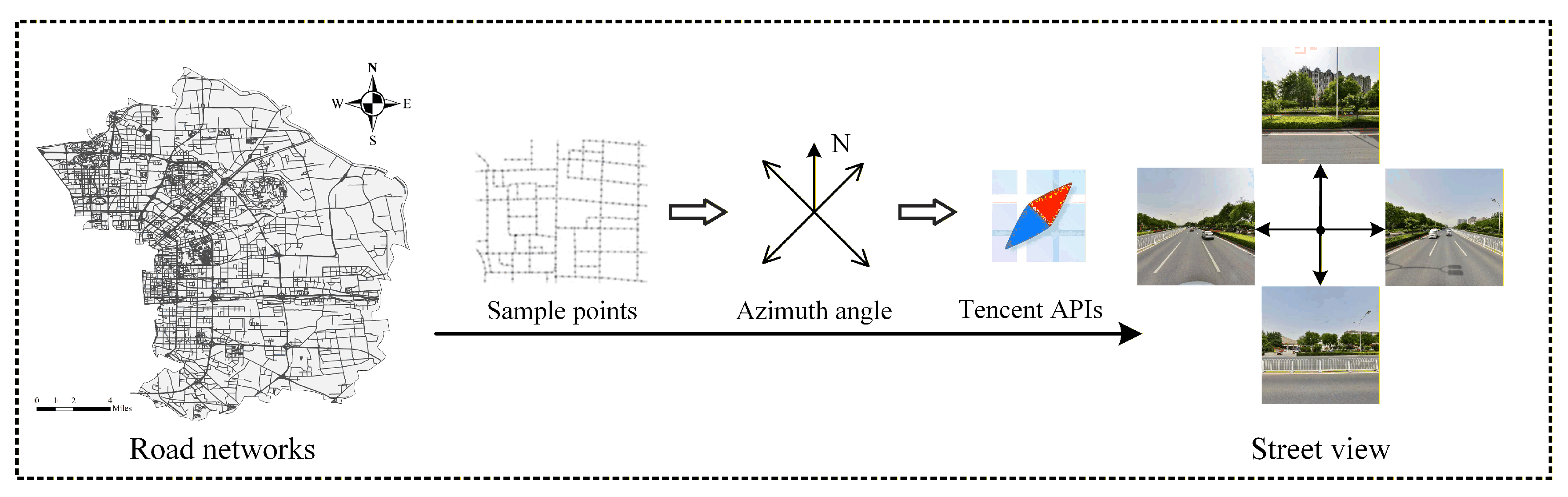
3.1. Street Network and SVI
3.2. Crime and Population Data
3.3. Points of Interest (POI) Data
- (1)
- (2)
- Crime attractor: Locations offering environments rich in opportunities, often becoming hotspots for repeat offenses by motivated offenders [45].
- (3)
4. Methodology
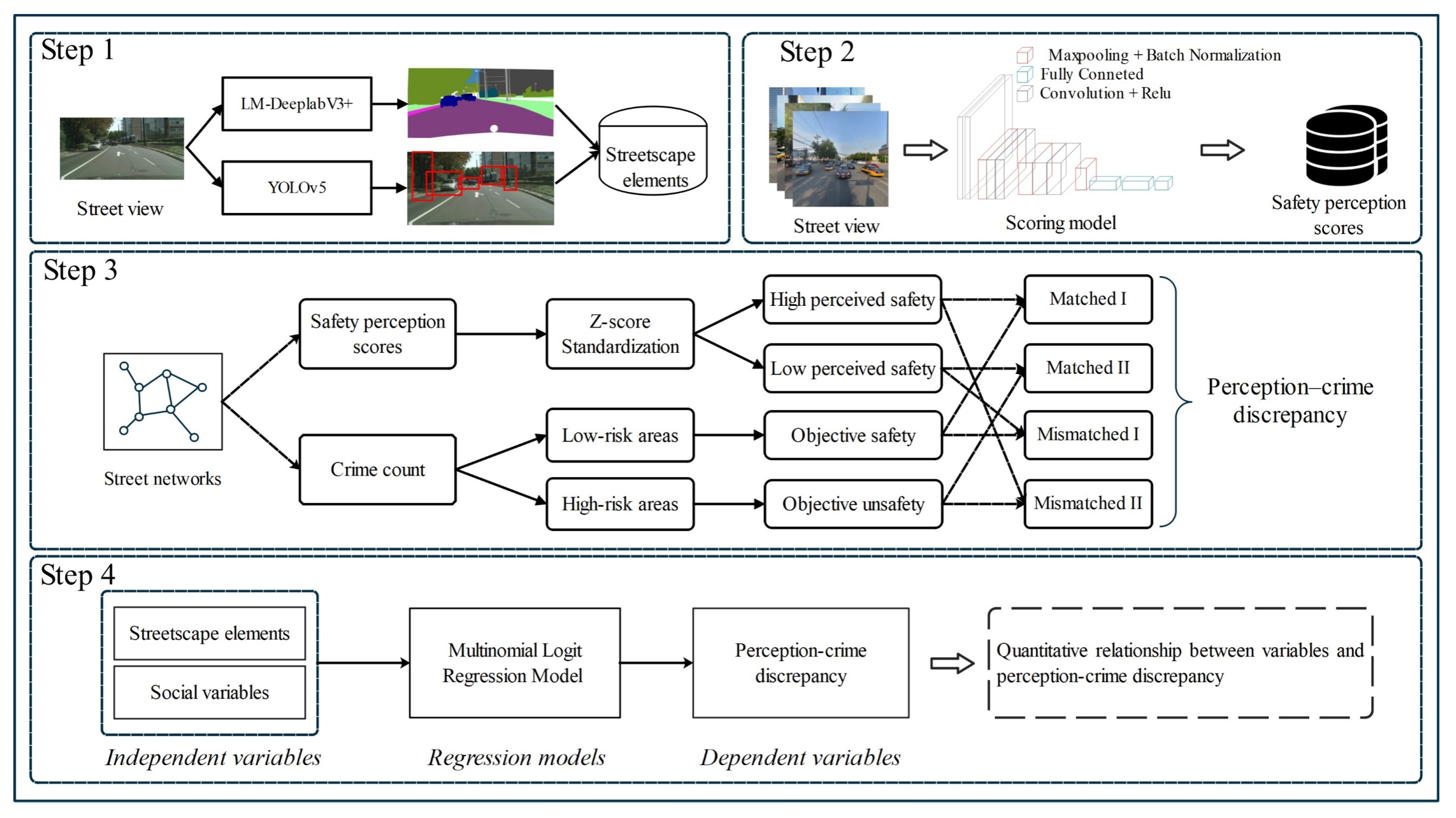
- (1)
- Extraction of streetscape elements: Semantic segmentation and object detection techniques were applied to SVI to identify and quantify streetscape features.
- (2)
- Computation of safety perception scores: A deep learning–based perception assessment model was used to estimate safety perception for each street segment.
- (3)
- Integration with crime data: Safety perception scores and actual crime occurrences were embedded into the street network, allowing each segment to be classified into one of four perception–crime discrepancy types.
- (4)
- Modeling relationships: Multinomial logit regression was developed to examine the associations between independent variables (streetscape elements and surrounding social factors) and dependent variables, namely perception–crime discrepancies.
4.1. Extraction of Streetscape Elements
- (1)
- Non-discrete, large-area elements: LM-DeeplabV3+ [51] was used to extract the proportional area of each element in the images.
- (2)
- Discrete, easily quantifiable elements: Both semantic segmentation (LM-DeeplabV3+) and object detection (YOLOv5 [52]) were applied to extract these streetscape features.
4.2. Safety Perception Scores and Perception-Crime Discrepancy
4.3. Modeling for Crime, Safety Perception, and Their Discrepancy
5. Results
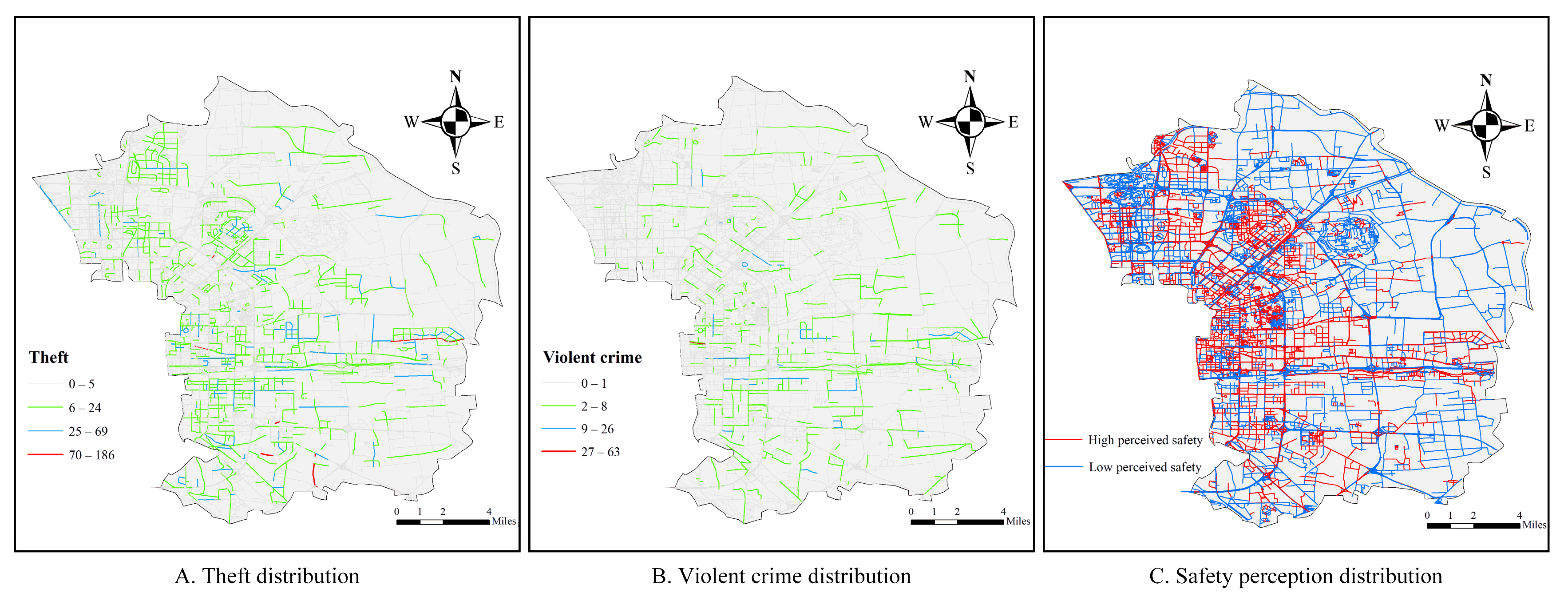
5.1. Spatial Distribution of Crime and Safety Perception
5.2. Independent Variables
5.3. Regression Results
- (1)
- Objective safety with low perceived safety
- (2)
- Objective unsafety with high perceived safety
6. Discussion
7. Conclusions
7.1. Key Findings
- (1)
- Matched II (Objective unsafety, perceived unsafety): Key contributing streetscape elements include walls, fences, and terrain. In addition, social variables such as street length, population density, crime generators, crime attractors, and crime suppressors are all positively associated with this pattern.
- (2)
- Mismatched I (Objective safety, perceived unsafety): This pattern is primarily driven by walls and terrain in the streetscape. With respect to social variables, population size and street length emerge as the main drivers of discrepancy between actual and perceived safety.
- (3)
- Mismatched II (Objective unsafety, perceived safety): No streetscape elements are significantly associated with this pattern. However, several social variables, including population size, street length, population density, crime generators, and crime attractors, exert significant influence.
7.2. Policy Implications
8. Limitations
Author Contributions
Funding
Data Availability Statement
Conflicts of Interest
References
- Knipprath, K.; Crul, M.; Waldring, I.; Bai, X. Urban Space and Social Cognition: The Effect of Urban Space on Intergroup Perceptions. Ann. Am. Acad. Political Soc. Sci. 2021, 697, 192–206. [Google Scholar] [CrossRef]
- Andersson, V.O.; Birck, M.A.F.; Araújo, R.M.; Cechinel, C. Towards crime rate prediction through street-level images and siamese convolutional neural networks. ENIAC—Encontro Nac. De Inteligência Artif. Comput. 2017, 12, 448–459. [Google Scholar]
- Biljecki, F.; Ito, K. Street view imagery in urban analytics and GIS: A review. Landsc. Urban Plan. 2021, 215, 104217. [Google Scholar] [CrossRef]
- Ito, K.; Zhu, Y.; Abdelrahman, M.; Liang, X.; Fan, Z.; Hou, Y.; Zhao, T.; Ma, R.; Fujiwara, K.; Ouyang, J.; et al. ZenSVI: An open-source software for the integrated acquisition, processing and analysis of street view imagery towards scalable urban science. Comput. Environ. Urban Syst. 2025, 119, 102283. [Google Scholar] [CrossRef]
- Wang, S.; Huang, X.; Liu, P.; Zhang, M.; Biljecki, F.; Hu, T.; Fu, X.; Liu, L.; Liu, X.; Wang, R.; et al. Mapping the landscape and roadmap of geospatial artificial intelligence (GeoAI) in quantitative human geography: An extensive systematic review. Int. J. Appl. Earth Obs. Geoinf. 2024, 128, 103734. [Google Scholar] [CrossRef]
- Harvey, C.; Aultman-Hall, L.; Hurley, S.E.; Troy, A. Effects of skeletal streetscape design on perceived safety. Landsc. Urban Plan. 2015, 142, 18–28. [Google Scholar] [CrossRef]
- Tang, F.; Zeng, P.; Wang, L.; Zhang, L.; Xu, W. Urban Perception Evaluation and Street Refinement Governance Supported by Street View Visual Elements Analysis. Remote Sens. 2024, 16, 3661. [Google Scholar] [CrossRef]
- Zhang, F.; Zhang, D.; Liu, Y.; Lin, H. Representing place locales using scene elements. Comput. Environ. Urban Syst. 2018, 71, 153–164. [Google Scholar] [CrossRef]
- Pánek, J.; Ivan, I.; Macková, L. Comparing Residents’ Fear of Crime with Recorded Crime Data—Case Study of Ostrava, Czech Republic. ISPRS Int. J. Geo-Inf. 2019, 8, 401. [Google Scholar] [CrossRef]
- Xia, C.; Zhang, A.; Yeh, A.G.O. The Varying Relationships between Multidimensional Urban Form and Urban Vitality in Chinese Megacities: Insights from a Comparative Analysis. Ann. Am. Assoc. Geogr. 2021, 112, 141–166. [Google Scholar] [CrossRef]
- Liu, L.; Xie, H.; Yue, H. A Comparative Study of Different Street View Image Micro-environment Extraction Methods for Explaining Street Property Crimes. J. Geo-Inf. Sci. 2023, 25, 1432–1447. [Google Scholar] [CrossRef]
- Zhou, H.; Liu, L.; Wang, J.; Wilson, K.; Lan, M.; Gu, X. A Multiscale Assessment of the Impact of Perceived Safety from Street View Imagery on Street Crime. Ann. Am. Assoc. Geogr. 2024, 114, 69–90. [Google Scholar] [CrossRef]
- Kang, Y.; Abraham, J.; Ceccato, V.; Duarte, F.; Gao, S.; Ljungqvist, L.; Zhang, F.; Näsman, P.; Ratti, C. Assessing differences in safety perceptions using GeoAI and survey across neighbourhoods in Stockholm, Sweden. Landsc. Urban Plan. 2023, 236, 104768. [Google Scholar] [CrossRef]
- Zhang, F.; Liu, Y. Street view imagery: Methods and applications based on artificial intelligence. Natl. Remote Sens. Bull. 2021, 25, 1043–1054. [Google Scholar] [CrossRef]
- Zhang, F.; Zhou, B.; Ratti, C.; Liu, Y. Discovering place-informative scenes and objects using social media photos. R. Soc. Open Sci. 2019, 6, 181375. [Google Scholar] [CrossRef]
- Brunton-Smith, I.; Sturgis, P. Do neighborhoods generate fear of crime? An empirical test using the British Crime Survey. Criminology 2011, 49, 331–369. [Google Scholar] [CrossRef]
- Hanslmaier, M. Crime, fear and subjective well-being: How victimization and street crime affect fear and life satisfaction. Eur. J. Criminol. 2013, 10, 515–533. [Google Scholar] [CrossRef]
- Zhang, F.; Fan, Z.; Kang, Y.; Hu, Y.; Ratti, C. “Perception bias”: Deciphering a mismatch between urban crime and perception of safety. Landsc. Urban Plan. 2021, 207, 104003. [Google Scholar] [CrossRef]
- Yanji, Z.; Jialing, H.; Yongyi, Y. Spatial pattern and influencing factors of fear of crime and their differences with those of criminal activities: Application of deep learning algorithm to street view images in Beijing. Prog. Geogr. 2024, 43, 2271–2283. [Google Scholar] [CrossRef]
- Cozens, P.M.; Saville, G.; Hillier, D. Crime prevention through environmental design (CPTED): A review and modern bibliography. Prop. Manag. 2005, 23, 328–356. [Google Scholar] [CrossRef]
- Brantingham, P.L.; Brantingham, P.J. Nodes, paths and edges: Considerations on the complexity of crime and the physical environment. J. Environ. Psychol. 1993, 13, 3–28. [Google Scholar] [CrossRef]
- Kim, Y.-A.; Hipp, J.R. Density, diversity, and design: Three measures of the built environment and the spatial patterns of crime in street segments. J. Crim. Justice 2021, 77, 101864. [Google Scholar] [CrossRef]
- Felson, M.; Boivin, R. Daily crime flows within a city. Crime Sci. 2015, 4, 31. [Google Scholar] [CrossRef]
- Lee, S.; Lee, C.; Won Nam, J.; Vernez Moudon, A.; Mendoza, J.A. Street environments and crime around low-income and minority schools: Adopting an environmental audit tool to assess crime prevention through environmental design (CPTED). Landsc. Urban Plan. 2023, 232, 104676. [Google Scholar] [CrossRef] [PubMed]
- Su, N.; Li, W.; Qiu, W. Measuring the associations between eye-level urban design quality and on-street crime density around New York subway entrances. Habitat Int. 2023, 131, 102728. [Google Scholar] [CrossRef]
- Wang, Z.; Liu, L.; Haberman, C.; Lan, M.; Yang, B.; Zhou, H. Burglaries and entry controls in gated communities. Urban Stud. 2021, 58, 2920–2932. [Google Scholar] [CrossRef]
- Zeng, M.; Mao, Y.; Wang, C. The relationship between street environment and street crime: A case study of Pudong New Area, Shanghai, China. Cities 2021, 112, 103143. [Google Scholar] [CrossRef]
- Deng, M.; Yang, W.; Chen, C.; Liu, C. Exploring associations between streetscape factors and crime behaviors using Google Street View images. Front. Comput. Sci. 2022, 16, 164316. [Google Scholar] [CrossRef]
- Hipp, J.R.; Lee, S.; Ki, D.; Kim, J.H. Measuring the Built Environment with Google Street View and Machine Learning: Consequences for Crime on Street Segments. J. Quant. Criminol. 2022, 38, 537–565. [Google Scholar] [CrossRef]
- He, L.; Páez, A.; Liu, D. Built environment and violent crime: An environmental audit approach using Google Street View. Comput. Environ. Urban Syst. 2017, 66, 83–95. [Google Scholar] [CrossRef]
- Troy, A.; Nunery, A.; Grove, J.M. The relationship between residential yard management and neighborhood crime: An analysis from Baltimore City and County. Landsc. Urban Plan. 2016, 147, 78–87. [Google Scholar] [CrossRef]
- Donovan, G.H.; Prestemon, J.P. The Effect of Trees on Crime in Portland, Oregon. Environ. Behav. 2012, 44, 3–30. [Google Scholar] [CrossRef]
- Jing, F.; Liu, L.; Zhou, S.; Song, J.; Wang, L.; Zhou, H.; Wang, Y.; Ma, R. Assessing the Impact of Street-View Greenery on Fear of Neighborhood Crime in Guangzhou, China. Int. J. Environ. Res. Public Health 2021, 18, 311. [Google Scholar] [CrossRef]
- Locke, D.H.; Han, S.; Kondo, M.C.; Murphy-Dunning, C.; Cox, M. Did community greening reduce crime? Evidence from New Haven, CT, 1996–2007. Landsc. Urban Plan. 2017, 161, 72–79. [Google Scholar] [CrossRef]
- Zhou, H.; Liu, L.; Lan, M.; Zhu, W.; Song, G.; Jing, F.; Zhong, Y.; Su, Z.; Gu, X. Using Google Street View imagery to capture micro built environment characteristics in drug places, compared with street robbery. Comput. Environ. Urban Syst. 2021, 88, 101631. [Google Scholar] [CrossRef]
- Dakin, K.; Xie, W.; Parkinson, S.; Khan, S.; Monchuk, L.; Pease, K. Built environment attributes and crime: An automated machine learning approach. Crime Sci. 2020, 9, 12. [Google Scholar] [CrossRef]
- Liu, Y.; Chen, M.; Wang, M.; Huang, J.; Thomas, F.; Rahimi, K.; Mamouei, M. An interpretable machine learning framework for measuring urban perceptions from panoramic street view images. iScience 2023, 26, 106132. [Google Scholar] [CrossRef]
- Liu, K.; Zhang, L.; Tsou, S.; Wang, L.; Hu, Y.; Yang, K. Exploring the Complex Association Between Urban Built Environment, Sociodemographic Characteristics and Crime: Evidence from Washington, D.C. Land 2024, 13, 1886. [Google Scholar] [CrossRef]
- Ratcliffe, J.H. Geocoding crime and a first estimate of a minimum acceptable hit rate. Int. J. Geogr. Inf. Sci. 2004, 18, 61–72. [Google Scholar] [CrossRef]
- Rosser, G.; Davies, T.; Bowers, K.J.; Johnson, S.D.; Cheng, T. Predictive Crime Mapping: Arbitrary Grids or Street Networks? J. Quant. Criminol. 2017, 33, 569–594. [Google Scholar] [CrossRef] [PubMed]
- Groff, E.R. Informal Social Control and Crime Events. J. Contemp. Crim. Justice 2015, 31, 90–106. [Google Scholar] [CrossRef]
- Kurland, J.; Johnson, S.D.; Tilley, N. Offenses around Stadiums: A Natural Experiment on Crime Attraction and Generation. J. Res. Crime Delinq. 2014, 51, 5–28. [Google Scholar] [CrossRef]
- Long, D.; Liu, L.; Xu, M.; Feng, J.; Chen, J.; He, L. Ambient population and surveillance cameras: The guardianship role in street robbers’ crime location choice. Cities 2021, 115, 103223. [Google Scholar] [CrossRef]
- Song, G.; Liu, L.; Bernasco, W.; Xiao, L.; Zhou, S.; Liao, W. Testing Indicators of Risk Populations for Theft from the Person across Space and Time: The Significance of Mobility and Outdoor Activity. Ann. Am. Assoc. Geogr. 2018, 108, 1370–1388. [Google Scholar] [CrossRef]
- Kinney, J.B.; Brantingham, P.L.; Wuschke, K.; Kirk, M.G.; Brantingham, P.J. Crime Attractors, Generators and Detractors: Land Use and Urban Crime Opportunities. Built Environ. 2008, 34, 62–74. [Google Scholar] [CrossRef]
- Bernasco, W.; Block, R.; Ruiter, S. Go where the money is: Modeling street robbers’ location choices. J. Econ. Geogr. 2013, 13, 119–143. [Google Scholar] [CrossRef]
- Luo, L.; Deng, M.; Shi, Y.; Gao, S.; Liu, B. Associating street crime incidences with geographical environment in space using a zero-inflated negative binomial regression model. Cities 2022, 129, 103834. [Google Scholar] [CrossRef]
- Yue, H.; Xie, H.; Liu, L.; Chen, J. Detecting People on the Street and the Streetscape Physical Environment from Baidu Street View Images and Their Effects on Community-Level Street Crime in a Chinese City. ISPRS Int. J. Geo-Inf. 2022, 11, 151. [Google Scholar] [CrossRef]
- Xie, H.; Liu, L.; Yue, H. Modeling the Effect of Streetscape Environment on Crime Using Street View Images and Interpretable Machine-Learning Technique. Int. J. Environ. Res. Public Health 2022, 19, 13833. [Google Scholar] [CrossRef]
- Zhang, W.; Witharana, C.; Li, W.; Zhang, C.; Li, X.; Parent, J. Using Deep Learning to Identify Utility Poles with Crossarms and Estimate Their Locations from Google Street View Images. Sensors 2018, 18, 2484. [Google Scholar] [CrossRef]
- Hou, X.; Chen, P.; Gu, H. LM-DeeplabV3+: A Lightweight Image Segmentation Algorithm Based on Multi-Scale Feature Interaction. Appl. Sci. 2024, 14, 1558. [Google Scholar] [CrossRef]
- Jocher, G.; Chaurasia, A.; Stoken, A.; Borovec, J.; Kwon, Y.; Michael, K.; TaoXie; Fang, J.; Imyhxy; Lorna; et al. Ultralytics/yolov5: V7.0—YOLOv5 SOTA Realtime Instance Segmentation (Version v7.0) [Computer software]. Zenodo 2022. [Google Scholar] [CrossRef]
- Cordts, M.; Omran, M.; Ramos, S.; Rehfeld, T.; Enzweiler, M.; Benenson, R.; Franke, U.; Roth, S.; Schiele, B. The Cityscapes Dataset for Semantic Urban Scene Understanding. arXiv 2016, arXiv:1604.01685. [Google Scholar] [CrossRef]
- Wang, R.; Ren, S.; Zhang, J.; Yao, Y.; Wang, Y.; Guan, Q. A comparison of two deep-learning-based urban perception models: Which one is better? Comput. Urban Sci. 2021, 1, 3. [Google Scholar] [CrossRef]
- Simonyan, K.; Zisserman, A. Very deep convolutional networks for large-scale image recognition. arXiv 2014, arXiv:1409.1556. [Google Scholar]
- Ordonez, V.; Berg, T.L. Learning High-Level Judgments of Urban Perception. In Computer Vision—ECCV 2014, 13th European Conference, Zurich, Switzerland, 6–12 September 2014, Proceedings, Part VI; Fleet, D., Pajdla, T., Schiele, B., Tuytelaars, T., Eds.; Springer International Publishing: Cham, Switzerland, 2014; pp. 494–510. [Google Scholar]
- Porzi, L.; Rota Bulò, S.; Lepri, B.; Ricci, E. Predicting and Understanding Urban Perception with Convolutional Neural Networks. In Proceedings of the 23rd ACM International Conference on Multimedia, Brisbane, Australia, 26–30 October 2015; pp. 139–148. [Google Scholar] [CrossRef]
- Zhang, Y.; You, Y.; Zhu, C.; Guo, H. Spatial Matching Relationship Between Criminal Activities and Fear of Crime and Its Influential Factors: A Case of Beijing. Geogr. Sci. 2022, 42, 1024–1033. [Google Scholar] [CrossRef]
- McFadden, D. Conditional Logit Analysis of Qualitative Choice Behavior. 1972. Available online: https://escholarship.org/uc/item/61s3q2xr (accessed on 18 October 2025).
- Lu, X.; Li, Q.; Ji, X.; Sun, D.; Meng, Y.; Yu, Y.; Lyu, M. Impact of streetscape built environment characteristics on human perceptions using street view imagery and deep learning: A case study of Changbai Island, Shenyang. Buildings 2025, 15, 1524. [Google Scholar] [CrossRef]
- Hinkle, J.C.; Yang, S.-M. A New Look into Broken Windows: What Shapes Individuals’ Perceptions of Social Disorder? J. Crim. Justice 2014, 42, 26–35. [Google Scholar] [CrossRef]
- Lei, Y.; Zhou, H.; Xue, L.; Yuan, L.; Liu, Y.; Wang, M.; Wang, C. Evaluating and Comparing Human Perceptions of Streets in Two Megacities by Integrating Street-View Images, Deep Learning, and Space Syntax. Buildings 2024, 14, 1847. [Google Scholar] [CrossRef]
- Adachi, H.M.; Nakaya, T. Analysis of the risk of theft from vehicle crime in Kyoto, Japan using environmental indicators of streetscapes. Crime Sci. 2022, 11, 13. [Google Scholar] [CrossRef]
- Row, A.T.; Jacobs, J. The Death and Life of Great American Cities. Yale Law J. 1962, 71, 1597–1602. [Google Scholar] [CrossRef]
- Kuo, F.E.; Sullivan, W.C. Environment and Crime in the Inner City: Does Vegetation Reduce Crime? Environ. Behav. 2001, 33, 343–367. [Google Scholar] [CrossRef]
- Bowen, D.A.; Anthony, K.M.; Sumner, S.A. Business and property types experiencing excess violent crime: A micro-spatial analysis. J. Inj. Violence Res. 2022, 14, 1–10. Available online: https://jivresearch.org/jivr/index.php/jivr/article/view/1566 (accessed on 18 October 2025). [PubMed]



| POI Category | Description | Count |
|---|---|---|
| Crime generator | Restaurants, shopping venues, commercial-residential buildings, scenic spots, healthcare facilities, transportation hubs, and public amenities. | 54,555 |
| Crime attractor | Financial and insurance services, lifestyle services, sports and recreational facilities, and educational or cultural centers. | 24,229 |
| Crime inhibitor | Corporate offices, government agencies, and social organizations. | 59,572 |
| Streetscape Element | Mean | Std. Dev. | Min | Max |
|---|---|---|---|---|
| Road (%) | 0.30 | 6.74 × 10⁻² | 1.73 × 10⁻² | 0.54 |
| Sidewalk (%) | 1.58 × 10⁻² | 1.78 × 10⁻² | 0 | 0.15 |
| Building (%) | 0.19 | 0.15 | 0 | 0.89 |
| Wall (%) | 7.20 × 10⁻³ | 1.67 × 10⁻² | 0 | 0.29 |
| Fence (%) | 3.32 × 10⁻² | 3.19 × 10⁻² | 0 | 0.45 |
| Pole (%) | 3.58 × 10⁻³ | 3.46 × 10⁻³ | 0 | 3.87 × 10⁻¹ |
| Traffic Light (%) | 4.20 × 10⁻⁵ | 1.42 × 10⁻⁴ | 0 | 3.01 × 10⁻³ |
| Traffic Sign (%) | 8.41 × 10⁻⁴ | 1.64 × 10⁻³ | 0 | 2.85 × 10⁻² |
| Vegetation (%) | 0.21 | 0.14 | 0 | 0.77 |
| Terrain (%) | 1.44 × 10⁻² | 2.88 × 10⁻² | 0 | 0.32 |
| Sky (%) | 0.17 | 0.10 | 0 | 0.48 |
| Person (%) | 2.61 × 10⁻³ | 7.72 × 10⁻³ | 0 | 0.25 |
| Motorcycle (%) | 5.29 × 10⁻² | 4.89 × 10⁻² | 0 | 0.29 |
| Bicycle (%) | 4.84 × 10⁻⁴ | 1.47 × 10⁻³ | 0 | 2.85 × 10⁻² |
| Pedestrian Count (per 100 persons) | 3.13 | 4.25 | 0 | 60 |
| Bicycle Count (per 100 units) | 0.41 | 1.16 | 0 | 17 |
| Traffic Light Count (per 100 units) | 0.24 | 0.78 | 0 | 10.50 |
| Motor Vehicle Count (per 100 units) | 0.38 | 0.61 | 0 | 11.55 |
| Types | Description | Count | |
|---|---|---|---|
| Theft | Violent Crime | ||
| Matched I | Objective safety and high perceived safety | 3353 (34.7%) | 4176 (43.26%) |
| Matched II | Objective unsafety and low perceived safety | 1111 (11.5%) | 398 (4.12%) |
| Mismatched I | Objective safety and low perceived safety | 3911 (40.5%) | 4596 (47.61%) |
| Mismatched II | Objective unsafety and high perceived safety | 1279 (13.2%) | 484 (5.01%) |
| Variable | Mean | Std. | Min | Max |
|---|---|---|---|---|
| Number of theft cases (per unit) | 1.45 | 5.55 | 0 | 186 |
| Number of violent cases (per unit) | 0.20 | 1.17 | 0 | 63 |
| Safety perception score | 2.87 | 0.29 | 1.735 | 4.07 |
| Road area ratio (%) | 0.30 | 6.74 × 10⁻² | 1.73 × 10⁻² | 0.53 |
| Sidewalk area ratio (%) | 1.58 × 10⁻² | 1.78 × 10⁻² | 0 | 0.15 |
| Building area ratio (%) | 0.19 | 0.15 | 0 | 0.89 |
| Wall area ratio (%) | 7.20 × 10⁻³ | 1.67 × 10⁻² | 0 | 0.29 |
| Fence area ratio (%) | 3.32 × 10⁻² | 3.19 × 10⁻² | 0 | 0.44 |
| Vegetation ratio (%) | 0.21 | 0.14 | 0 | 0.77 |
| Terrain area ratio (%) | 1.44 × 10⁻² | 2.88 × 10⁻² | 0 | 0.32 |
| Number of traffic lights (per 100 units) | 5.71 × 10⁻³ | 2.11 × 10⁻² | 0 | 0.68 |
| Population (per 100 persons) | 2.49 | 4.36 | 0 | 70.31 |
| Population density (per 100 persons/km2) | 0.69 | 0.75 | 0.02 | 11.86 |
| Street length (km) (per 100 units) | 0.34 | 0.47 | 0.01 | 6.71 |
| Crime generator density (per 100 units) | 5.57 × 10⁻² | 0.14 | 0 | 2.62 |
| Crime attractor density (per 100 units) | 4.02 × 10⁻² | 0.12 | 0 | 2.34 |
| Crime inhibitor density (per 100 units) | 4.66 × 10⁻² | 0.17 | 0 | 5.63 |
| Explanatory Variables | Theft (Multi-Logit Regression Results) | Violent Crime (Multi-Logit Regression Results) | ||||
|---|---|---|---|---|---|---|
| Objective Unsafety, Low Perceived Safety | Objective Safety, Low Perceived Safety | Objective Unsafety, High Perceived Safety | Objective Unsafety, Low Perceived Safety | Objective Safety, Low Perceived Safety | Objective Unsafety, High Perceived Safety | |
| Streetscape elements | ||||||
| Street area ratio | −0.948 | 0.658 | −0.052 | 2.141 | 0.555 | −4.152 |
| Sidewalk area ratio | −8.721 ** | −10.338 *** | −3.302 | −11.121 | −8.773 *** | 2.825 |
| Building area ratio | −6.519 *** | −5.567 *** | −0.881 | −5.602 *** | −5.501 *** | 2.740 |
| Wall area ratio | 39.367 *** | 37.809 *** | −18.554 ** | 43.371 *** | 41.615 *** | 0.712 |
| Fence area ratio | 1.179 | −2.454 | 1.228 | 3.268 | −2.110 | −13.908 |
| Vegetation ratio | 2.866 *** | 1.732 *** | −1.241 | 0.651 | 2.089 *** | 2.314 *** |
| Terrain area ratio | 18.626 *** | 22.832 *** | 8.108 * | 18.965 *** | 20.204 *** | −2.732 |
| Number of traffic lights | −3.447 | 1.560 | −3.844 | 1.893 | −0.896 | −1.431 |
| Social variables | ||||||
| Population | 0.103 ** | −0.024 | 0.098 ** | 0.030 | 0.000 | 0.030 |
| Population density | 0.078 | −0.214 * | 0.026 | 0.111 | −0.162 | 0.164 |
| Street length | 1.796 *** | 1.500 *** | 1.369 *** | 2.009 *** | 1.108 *** | 1.944 *** |
| Crime generator density | 15.632 *** | −1.416 | 15.222 *** | 2.826 ** | −1.077 | 2.202 ** |
| Crime attractor density | 3.840 | 0.619 | 7.403 ** | −2.789 | −2.729 | −0.350 |
| Crime inhibitor density | 1.898 * | −4.683 | 2.018 ** | −0.296 | −0.865 | 0.424 |
| Constant | −2.673 *** | 0.171 *** | −2.141 | −4.250 *** | 0.045 | −4.152 *** |
Disclaimer/Publisher’s Note: The statements, opinions and data contained in all publications are solely those of the individual author(s) and contributor(s) and not of MDPI and/or the editor(s). MDPI and/or the editor(s) disclaim responsibility for any injury to people or property resulting from any ideas, methods, instructions or products referred to in the content. |
© 2025 by the authors. Published by MDPI on behalf of the International Society for Photogrammetry and Remote Sensing. Licensee MDPI, Basel, Switzerland. This article is an open access article distributed under the terms and conditions of the Creative Commons Attribution (CC BY) license.
Share and Cite
Gu, H.; Sui, J.; Chen, P.; Shan, M.; Hou, X. Safe or Unsafe? A Street-Level Analysis of the (Mis)Match Between Perceived and Objective Safety in Chaoyang District, Beijing. ISPRS Int. J. Geo-Inf. 2026, 15, 13. https://doi.org/10.3390/ijgi15010013
Gu H, Sui J, Chen P, Shan M, Hou X. Safe or Unsafe? A Street-Level Analysis of the (Mis)Match Between Perceived and Objective Safety in Chaoyang District, Beijing. ISPRS International Journal of Geo-Information. 2026; 15(1):13. https://doi.org/10.3390/ijgi15010013
Chicago/Turabian StyleGu, Haishuo, Jinguang Sui, Peng Chen, Miaoxuan Shan, and Xinyu Hou. 2026. "Safe or Unsafe? A Street-Level Analysis of the (Mis)Match Between Perceived and Objective Safety in Chaoyang District, Beijing" ISPRS International Journal of Geo-Information 15, no. 1: 13. https://doi.org/10.3390/ijgi15010013
APA StyleGu, H., Sui, J., Chen, P., Shan, M., & Hou, X. (2026). Safe or Unsafe? A Street-Level Analysis of the (Mis)Match Between Perceived and Objective Safety in Chaoyang District, Beijing. ISPRS International Journal of Geo-Information, 15(1), 13. https://doi.org/10.3390/ijgi15010013