




GIS-Based Analysis of Retail Spatial Distribution and Driving Mechanisms in a Resource-Based Transition City: Evidence from POI Data in Taiyuan, China

Abstract
1. Introduction
2. Literature Review and Theoretical Framework
3. Research Methods and Data
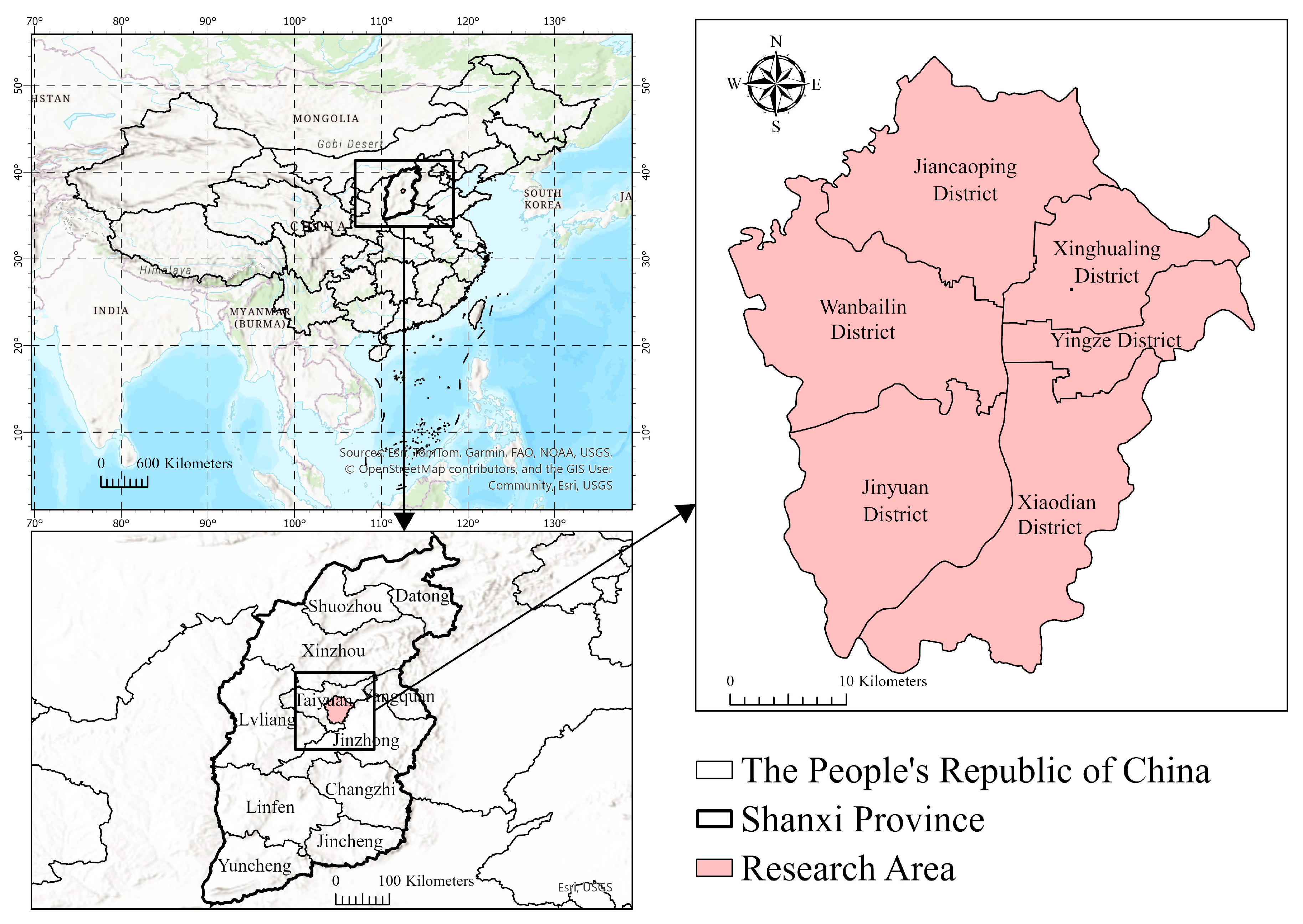
3.1. Research Area and Research Object
3.2. Data Sources and Pre-Processing
3.3. Spatial Analysis Methods
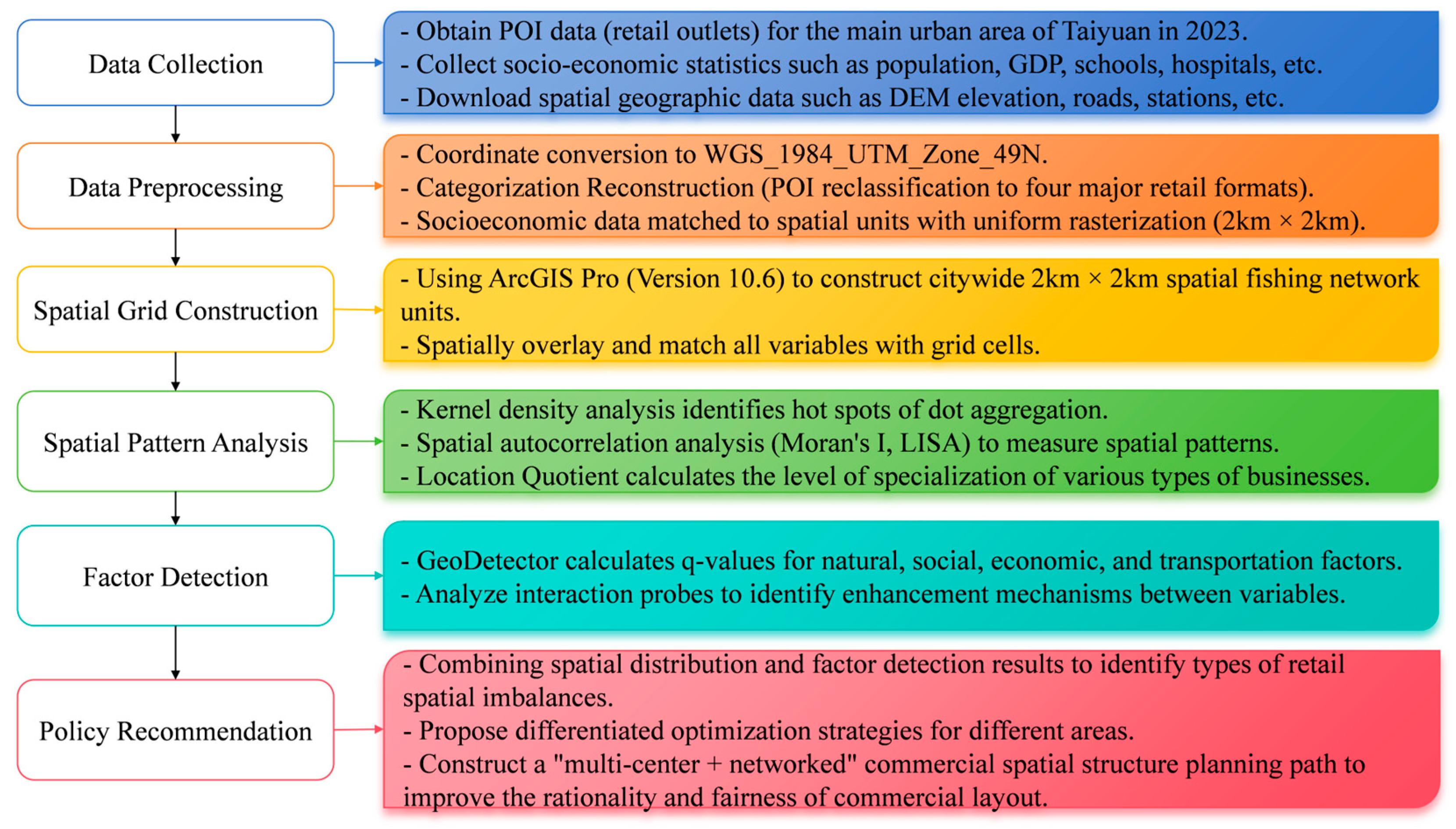
3.4. Research Process
4. Characterization of Spatial Distribution
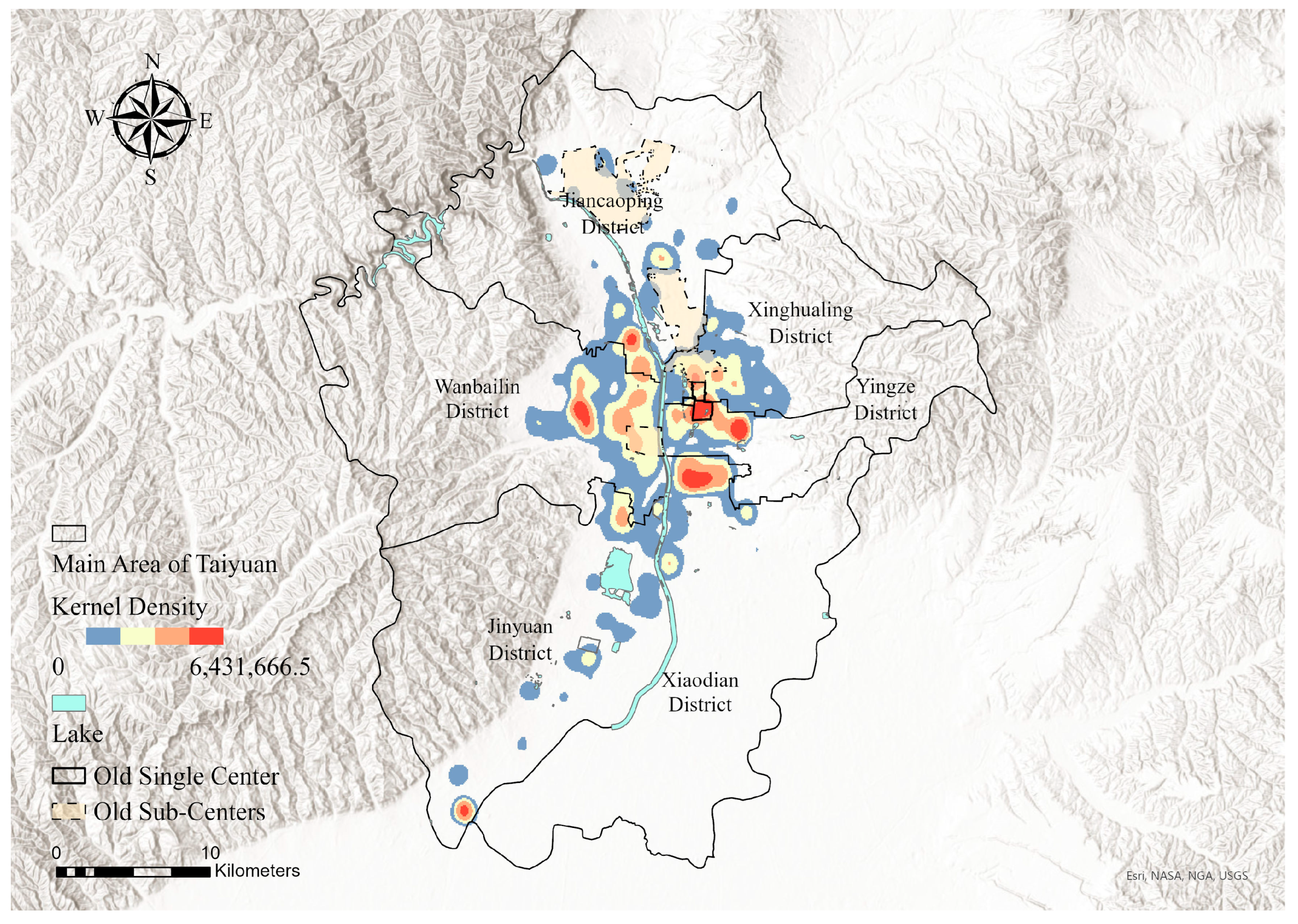
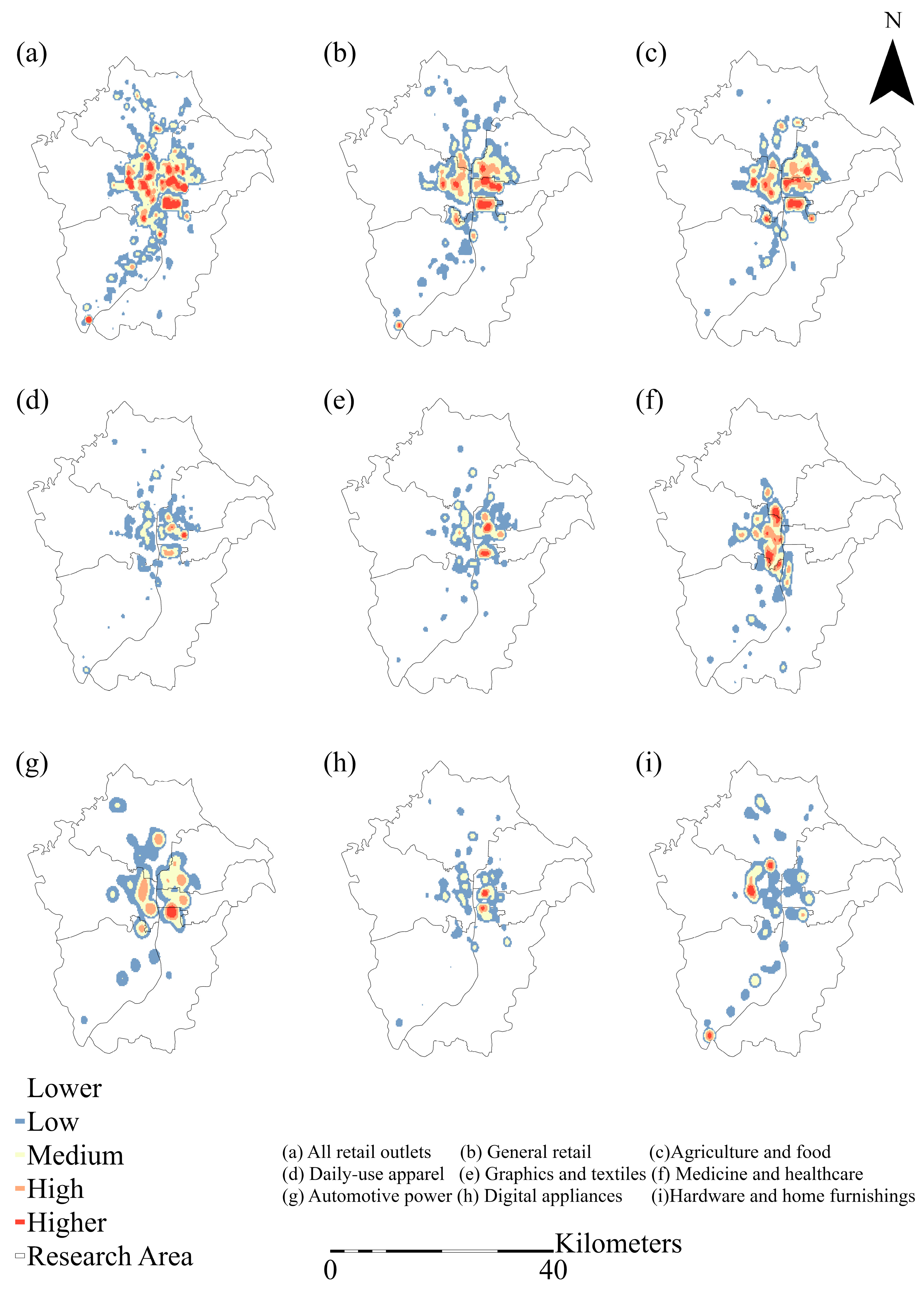
4.1. Overall Spatial Patterns
4.2. Analysis of Spatial Agglomeration and Location Advantages of Retail Sub-Industries
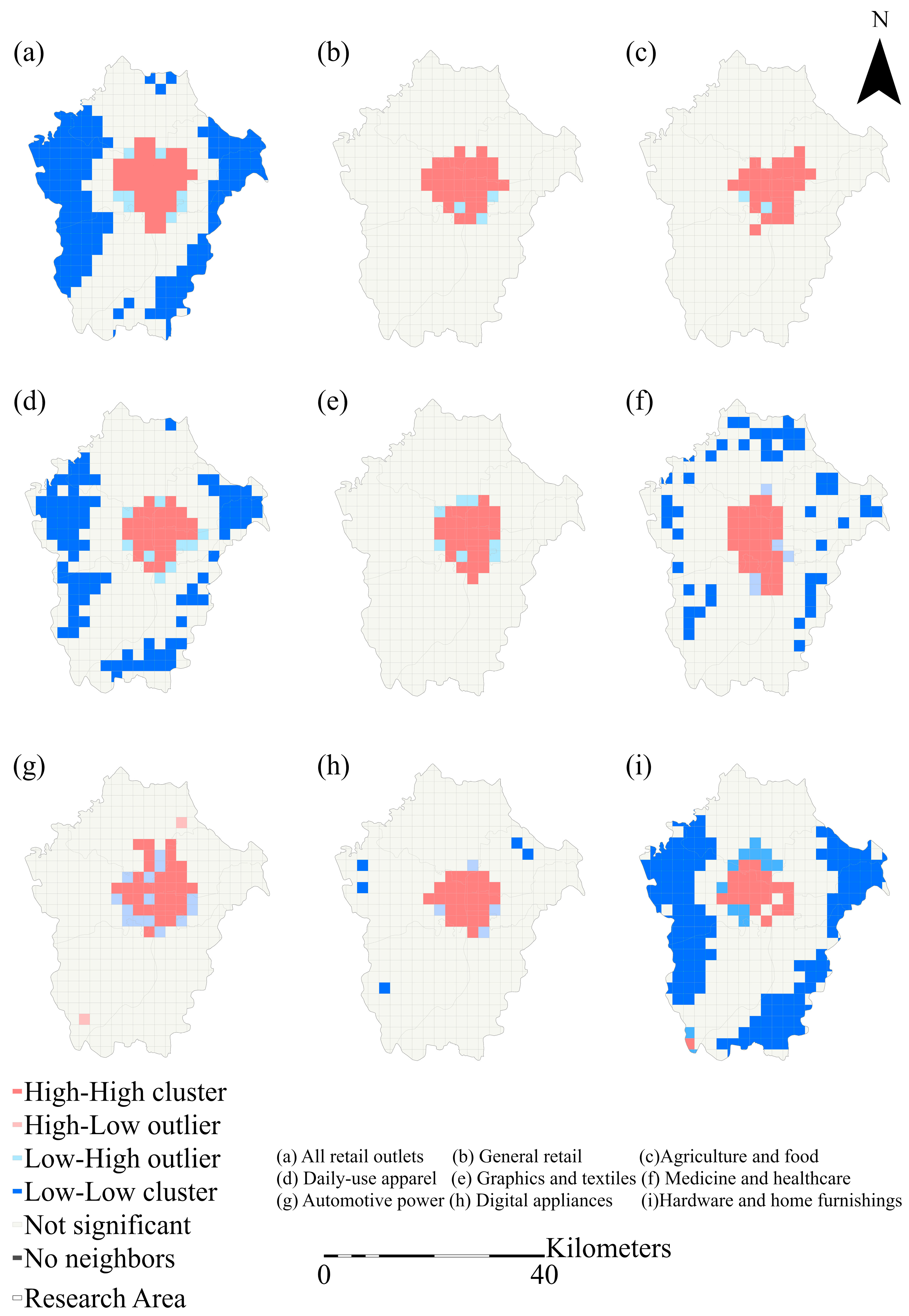
4.3. Spatial Autocorrelation Feature Recognition
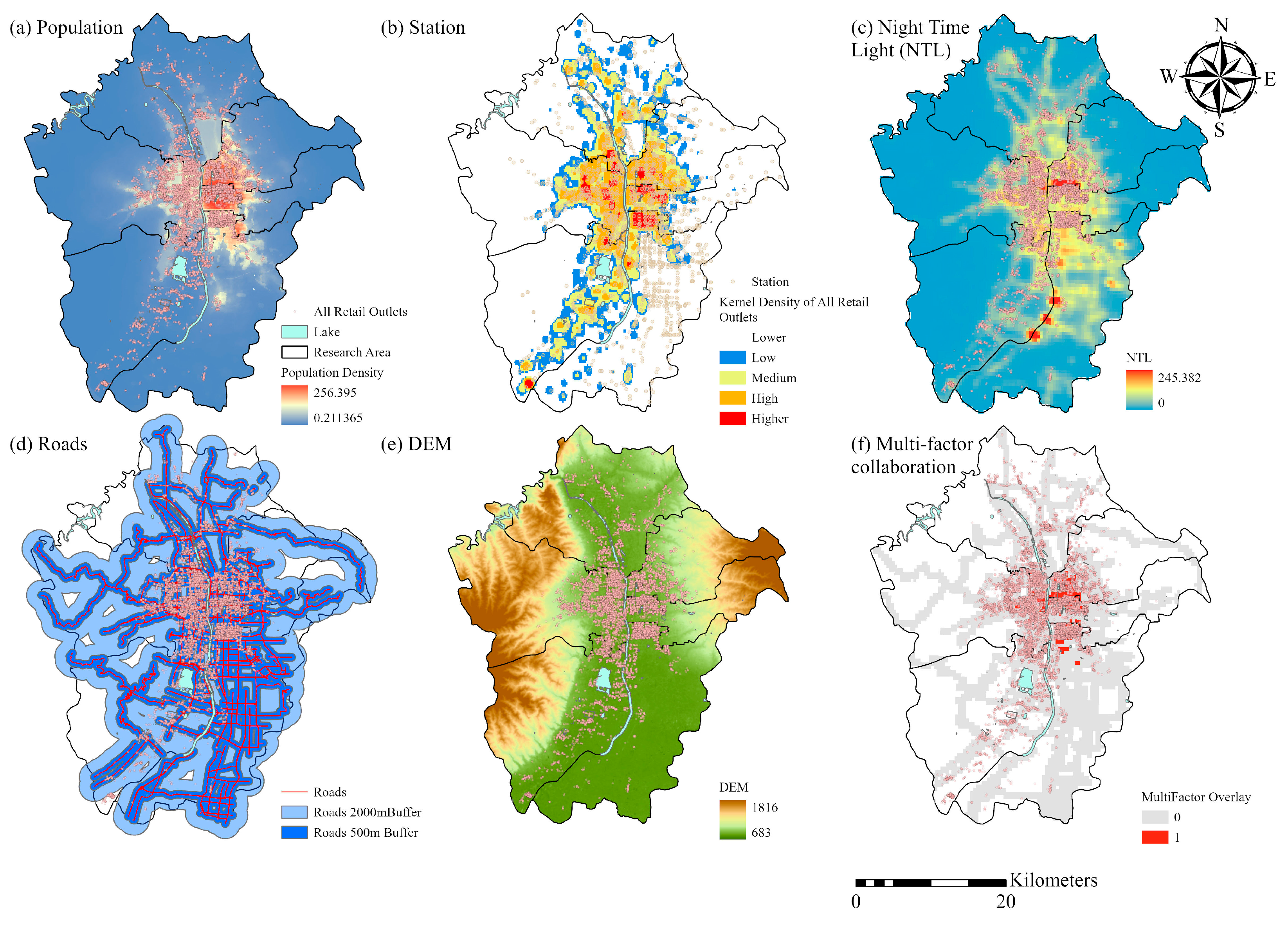
4.4. Preliminary Study on Factors Influencing Spatial Patterns
5. Drivers of Retail Spatial Distribution
5.1. Factor Construction and Data Processing
5.1.1. Natural Factors
5.1.2. Social Factors
5.1.3. Economic Factors
5.1.4. Transportation Factors
5.2. Single-Factor Detection Results
5.3. Interaction Detection Results
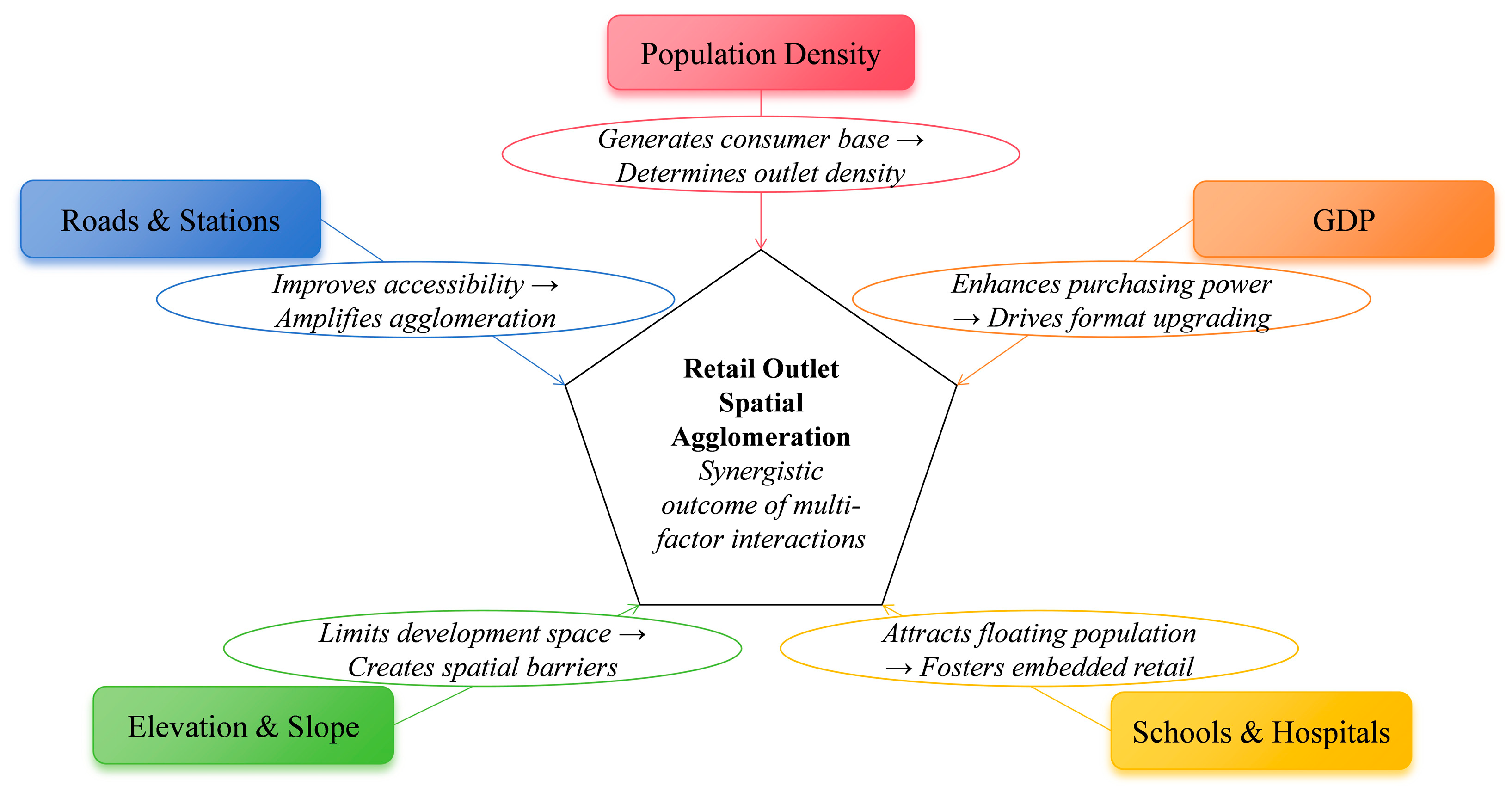
5.4. Multi-Dimensional Mechanisms of Influence
5.4.1. Socio-Demographic Foundations
5.4.2. Economic Vitality and Format Upgrading
5.4.3. Social Infrastructure as Catalysts
5.4.4. Natural Constraints
5.4.5. Transportation Accessibility
5.4.6. Institutional and Planning Factors
6. Conclusions and Research Limitations
6.1. Research Conclusions and Policy Implications
6.2. Research Innovations and Theoretical Contributions
6.3. Research Limitations and Future Prospects
7. Discussion
Author Contributions
Funding
Data Availability Statement
Conflicts of Interest
Abbreviations
| GIS | Geographic Information System |
| POI | Point of Interest |
| UKM | Universiti Kebangsaan Malaysia |
| GDP | Gross Domestic Product |
| LISA | Local Indicators of Spatial Association |
| API | Application Programming Interface |
| GB/T | National Standard of the People’s Republic of China (GB/T 4754-2017) |
| DEM | Digital Elevation Model |
| LQ | Location Quotient |
| ASTER GDEM | Advanced Spaceborne Thermal Emission and Reflection Radiometer Global Digital Elevation Model |
| NTL | Nighttime Light |
| VIIRS | Visible Infrared Imaging Radiometer Suite |
| CNY | Chinese Yuan |
| BH-FDR | Benjamini–Hochberg False Discovery Rate |
Appendix A

| Criterion | 1 km Grid | 2 km Grid (Final) | 3 km Grid |
|---|---|---|---|
| Empty-cell rate | High (~35–40%) | Low (~10%) | Medium (~20–25%) |
| Detail level | Very high (fragmented) | Balanced | Low (over-smoothed) |
| Variance explained (density vs. drivers) | Low | Highest | Moderate |
| Computation time | Slow | Moderate | Fast |
| KDE/LISA clarity | Fragmented, noisy | Clear polycentric pattern | Excessively smooth |
| Suitability | Too fine | Optimal | Too coarse |
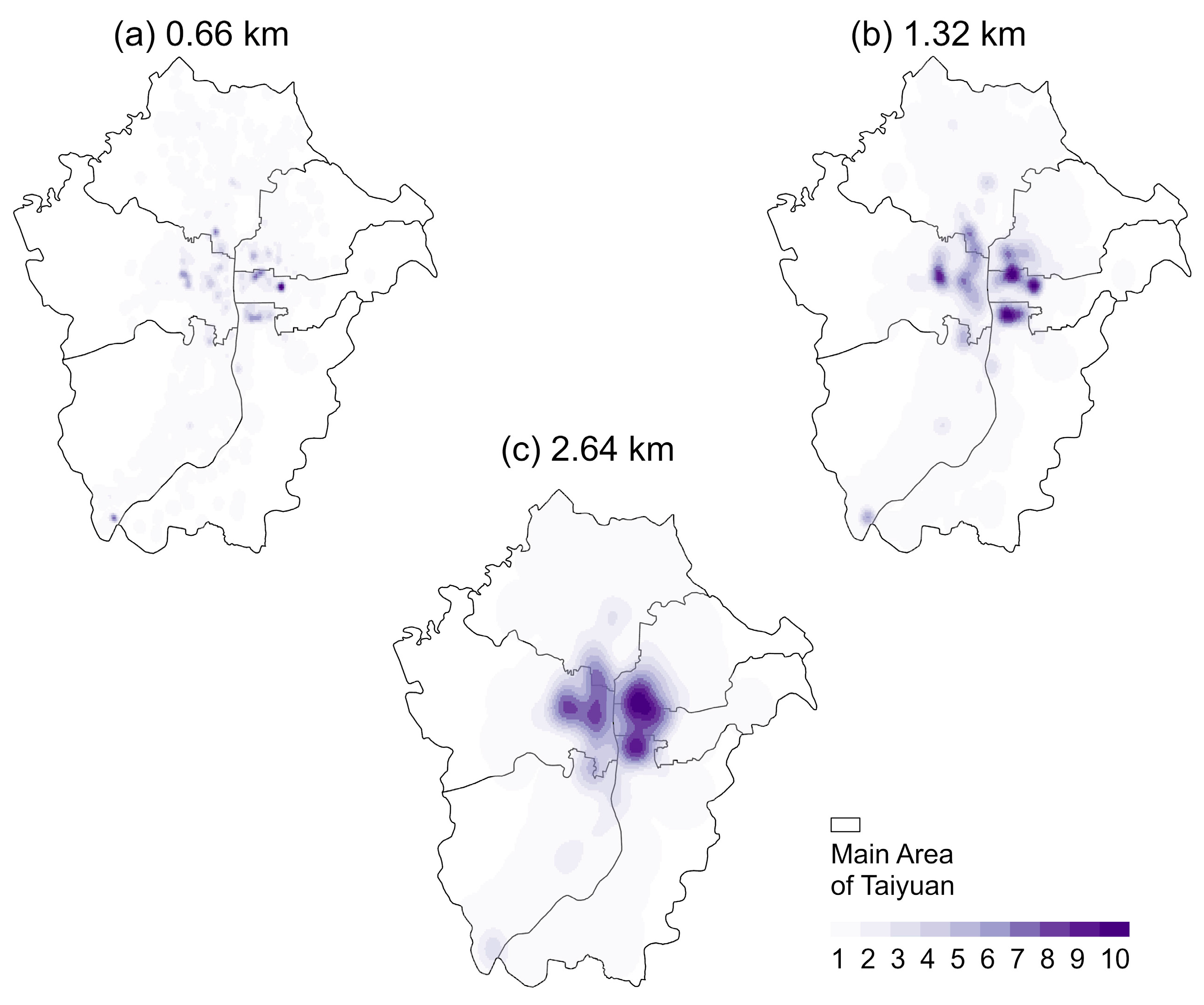
| Bandwidth (Kilometer) | Hotspot Pattern | Interpretation |
|---|---|---|
| 0.66 | Hotspots fragmented | Under-smoothed (unstable) |
| 1.32 | Clear, well-defined clusters | Optimal bandwidth used in main analysis |
| 2.64 | Over-smoothed; hotspots merge | Not suitable |
| Variable | Type | Discretization Method | Number of Bins |
|---|---|---|---|
| Elevation (DEM) | Natural | Jenks natural breaks | 5 |
| Slope | Natural | Jenks natural breaks | 5 |
| Terrain ruggedness | Natural | Jenks natural breaks | 5 |
| Population density | Social | Quantiles (equal-frequency) | 5 |
| School density | Social | Quantiles | 5 |
| Medical density | Social | Quantiles | 5 |
| Housing prices | Economic | Quantiles | 5 |
| NTL intensity | Economic | Quantiles | 5 |
| Company density | Economic | Quantiles | 5 |
| Station density | Transport | Quantiles | 5 |
| Road density | Transport | Quantiles | 5 |
| Parking density | Transport | Quantiles | 5 |
| District | Retail Categories | Outlet Count | Proportion (%) | Location Quotient (LQ) | Specialization Interpretation |
|---|---|---|---|---|---|
| Xiaodian District | General retail | 814 | 2.76 | 0.97 | Balanced distribution |
| Agriculture and food | 570 | 1.93 | 1.04 | Mild specialization in daily food services | |
| Daily-use apparel | 751 | 2.55 | 1.32 | Moderate specialization in apparel retail | |
| Graphics and textiles | 201 | 0.68 | 1.48 | Strong specialization near educational areas | |
| Medicine and healthcare | 267 | 0.91 | 0.73 | Below-average medical resource presence | |
| Automotive power | 55 | 0.19 | 1.18 | Slight concentration near peripheral roadways | |
| Digital appliances | 236 | 0.80 | 1.76 | High specialization in electronics retail | |
| Hardware and home furnishings | 276 | 0.94 | 0.52 | Underrepresented in home-related sectors | |
| Wanbailin District | General retail | 1312 | 4.30 | 0.85 | General retail moderately dispersed |
| Agriculture and food | 914 | 3.00 | 0.91 | Slightly underrepresented in food services | |
| Daily-use apparel | 673 | 2.21 | 0.64 | Weak apparel presence | |
| Graphics and textiles | 164 | 0.54 | 0.66 | Limited educational retail linkage | |
| Medicine and healthcare | 1394 | 4.57 | 2.06 | Strong specialization in healthcare facilities | |
| Automotive power | 77 | 0.25 | 0.90 | Moderate presence near transport corridors | |
| Digital appliances | 169 | 0.55 | 0.69 | Low concentration of electronics outlets | |
| Hardware and home furnishings | 1123 | 3.68 | 1.15 | Mild specialization in home improvement retail | |
| Yingze District | General retail | 827 | 7.07 | 0.98 | Balanced and central general retail distribution |
| Agriculture and food | 549 | 4.69 | 1.00 | Standard presence in food-related retail | |
| Daily-use apparel | 1123 | 9.60 | 1.96 | Strong specialization in apparel and fashion retail | |
| Graphics and textiles | 241 | 2.06 | 1.76 | Significant cluster of education-linked retail | |
| Medicine and healthcare | 11 | 0.09 | 0.03 | Severely underrepresented in medical retail | |
| Automotive power | 31 | 0.26 | 0.66 | Weak automotive service presence | |
| Digital appliances | 215 | 1.84 | 1.60 | Strong electronics retail specialization | |
| Hardware and home furnishings | 192 | 1.64 | 0.36 | Low specialization in home goods | |
| Xinghualing District | General retail | 1081 | 6.35 | 1.33 | Clear specialization in general retail |
| Agriculture and food | 786 | 4.62 | 1.49 | Strong specialization in residential food services | |
| Daily-use apparel | 540 | 3.17 | 0.98 | Balanced apparel retail presence | |
| Graphics and textiles | 152 | 0.89 | 1.15 | Slightly elevated educational retail linkage | |
| Medicine and healthcare | 16 | 0.09 | 0.04 | Very limited healthcare retail | |
| Automotive power | 62 | 0.36 | 1.37 | Specialization in edge-located vehicle services | |
| Digital appliances | 101 | 0.59 | 0.78 | Below-average electronics retail presence | |
| Hardware and home furnishings | 333 | 1.96 | 0.65 | Underdeveloped in home-related retail | |
| Jiancaoping District | General retail | 838 | 2.93 | 1.00 | Typical general retail distribution |
| Agriculture and food | 454 | 1.59 | 0.83 | Slight underrepresentation in food retail | |
| Daily-use apparel | 456 | 1.60 | 0.80 | Weak apparel market presence | |
| Graphics and textiles | 87 | 0.30 | 0.64 | Limited educational retail | |
| Medicine and healthcare | 293 | 1.03 | 0.80 | Below-average healthcare outlet density | |
| Automotive power | 54 | 0.19 | 1.16 | Peripheral vehicle services specialization | |
| Digital appliances | 115 | 0.40 | 0.86 | Modest electronics retail presence | |
| Hardware and home furnishings | 869 | 3.04 | 1.64 | Strong specialization in home improvement retail | |
| Jinyuan District | General retail | 773 | 2.67 | 1.00 | Standard general retail distribution |
| Agriculture and food | 402 | 1.39 | 0.80 | Underdeveloped food service sector | |
| Daily-use apparel | 288 | 1.00 | 0.55 | Weak specialization in apparel | |
| Graphics and textiles | 70 | 0.24 | 0.56 | Very low educational retail presence | |
| Medicine and healthcare | 495 | 1.71 | 1.46 | Moderate specialization in medical retail | |
| Automotive power | 36 | 0.12 | 0.84 | Modest automotive retail share | |
| Digital appliances | 65 | 0.22 | 0.53 | Sparse electronics distribution | |
| Hardware and home furnishings | 784 | 2.71 | 1.61 | High specialization in home & construction retail |
| DEM | Slo | Flu | Pop | Sch | Hos | NTL | Pri | Com | Roa | Par | Sta | |
|---|---|---|---|---|---|---|---|---|---|---|---|---|
| DEM | 1 | 0.76 | 0.53 | −0.32 | −0.36 | −0.22 | −0.56 | −0.07 | −0.35 | −0.39 | −0.12 | −0.44 |
| Slo | 0.76 | 1 | 0.79 | −0.33 | −0.37 | −0.2 | −0.58 | −0.08 | −0.37 | −0.38 | −0.14 | −0.47 |
| Flu | 0.53 | 0.79 | 1 | −0.23 | −0.27 | −0.06 | −0.43 | −0.1 | −0.29 | −0.24 | −0.15 | −0.35 |
| Pop | −0.32 | −0.33 | −0.23 | 1 | 0.81 | 0.3 | 0.78 | 0.1 | 0.67 | 0.48 | 0.39 | 0.78 |
| Sch | −0.36 | −0.37 | −0.27 | 1 | 1 | 0.44 | 0.76 | 0.28 | 0.71 | 0.49 | 0.31 | 0.8 |
| Hos | −0.22 | −0.2 | −0.06 | 0.3 | 0.44 | 1 | 0.51 | −0.03 | 0.42 | 0.45 | 0.03 | 0.49 |
| NTL | −0.56 | −0.58 | −0.43 | 0.78 | 0.76 | 0.51 | 1 | 0.09 | 0.7 | 0.66 | 0.29 | 0.81 |
| Pri | −0.07 | −0.08 | −0.1 | 0.1 | 0.28 | −0.03 | 0.09 | 1 | 0.16 | 0.27 | 0.1 | 0.07 |
| Com | −0.35 | −0.37 | −0.29 | 0.67 | 0.71 | 0.42 | 0.7 | 0.16 | 1 | 0.43 | 0.3 | 0.72 |
| Roa | −0.39 | −0.38 | −0.24 | 0.48 | 0.49 | 0.45 | 0.66 | 0.27 | 0.43 | 1 | 0.22 | 0.58 |
| Par | −0.12 | −0.14 | −0.15 | 0.39 | 0.31 | 0.03 | 0.29 | 0.1 | 0.3 | 0.22 | 1 | 0.46 |
| Sta | −0.44 | −0.47 | −0.35 | 0.78 | 0.8 | 0.49 | 0.81 | 0.07 | 0.72 | 0.58 | 0.46 | 1 |
| DEM | Slo | Flu | Pop | Sch | Hos | NTL | Pri | Com | Roa | Par | Sta | |
|---|---|---|---|---|---|---|---|---|---|---|---|---|
| DEM | 1 | 0.86 | 0.62 | −0.5 | −0.55 | −0.44 | −0.74 | −0.22 | −0.7 | −0.42 | −0.13 | −0.52 |
| Slo | 0.86 | 1 | 0.81 | −0.55 | −0.6 | −0.4 | −0.76 | −0.2 | −0.75 | −0.42 | −0.21 | −0.59 |
| Flu | 0.62 | 0.81 | 1 | −0.41 | −0.44 | −0.18 | −0.61 | −0.1 | −0.56 | −0.27 | −0.23 | −0.47 |
| Pop | −0.5 | −0.55 | −0.41 | 1 | 0.7 | 0.34 | 0.86 | 0.03 | 0.76 | 0.55 | 0.36 | 0.72 |
| Sch | −0.55 | −0.6 | −0.44 | 0.7 | 1 | 0.51 | 0.81 | 0.11 | 0.83 | 0.53 | 0.36 | 0.82 |
| Hos | −0.44 | −0.4 | −0.18 | 0.34 | 0.51 | 1 | 0.48 | 0.02 | 0.46 | 0.4 | 0.02 | 0.42 |
| NTL | −0.74 | −0.76 | −0.61 | 0.86 | 0.81 | 0.48 | 1 | 0.21 | 0.88 | 0.61 | 0.33 | 0.8 |
| Pri | −0.22 | −0.2 | −0.1 | 0.03 | 0.11 | 0.02 | 0.21 | 1 | 0.3 | 0.27 | −0.03 | 0.17 |
| Com | −0.7 | −0.75 | −0.56 | 0.76 | 0.83 | 0.46 | 0.88 | 0.3 | 1 | 0.56 | 0.35 | 0.82 |
| Roa | −0.42 | −0.42 | −0.27 | 0.55 | 0.53 | 0.4 | 0.61 | 0.27 | 0.56 | 1 | 0.24 | 0.53 |
| Par | −0.13 | −0.21 | −0.23 | 0.36 | 0.36 | 0.02 | 0.33 | −0.03 | 0.35 | 0.24 | 1 | 0.37 |
| Sta | −0.52 | −0.59 | −0.47 | 0.72 | 0.82 | 0.42 | 0.8 | 0.17 | 0.82 | 0.53 | 0.37 | 1 |
References
- Khazael, S.M.; Maulud, K.N.A.; Karim, O.A. Geospatial planning strategies for agrivoltaic systems: A review of criteria, decision models and emerging challenges. Sustain. Energy Technol. Assess. 2025, 81, 104444. [Google Scholar] [CrossRef]
- Batty, M. The New Science of Cities; MIT Press: Cambridge, MA, USA, 2013. [Google Scholar]
- Meijers, E. From central place to network model: Theory and evidence of a paradigm change. Tijdschr. Econ. Soc. Geogr. 2007, 98, 245–259. [Google Scholar] [CrossRef]
- Hatta Antah, F.; Khoiry, M.A.; Abdul Maulud, K.N.; Ibrahim, A.N.H. Factors influencing the use of geospatial technology with LiDAR for road design: Case of Malaysia. Sustainability 2022, 14, 8977. [Google Scholar] [CrossRef]
- Tew, M.M.; Hatah, E.; Arif, F.; Abdul Wahid, M.A.; Makmor-Bakry, M.; Abdul Maulad, K.N. Geospatial analysis of distribution of community pharmacies and other health care facilities providing minor ailments services in Malaysia. J. Pharm. Policy Pract. 2021, 14, 24. [Google Scholar] [CrossRef] [PubMed]
- Ishak, Z.H.B.; Haris, S.M.; Long, W. Geospatial information system based on indoor plan UKM (FKAB). J. Kejuruter. 2020, 32, 539–549. [Google Scholar] [CrossRef]
- Han, Z.; Cui, C.; Miao, C.; Wang, H.; Chen, X. Identifying spatial patterns of retail stores in road network structure. Sustainability 2019, 11, 4539. [Google Scholar] [CrossRef]
- Lu, C.; Yu, C.; Xin, Y.; Zhang, W. Spatial distribution characteristics and influencing factors of the retail industry in Lanzhou City at the scale of daily living circles. ISPRS Int. J. Geo-Inf. 2023, 12, 344. [Google Scholar] [CrossRef]
- Su, H.; Damian, M.A.E. Spatial distribution analysis of urban retail industry using POI big data. Int. J. Emerg. Technol. Adv. Appl. 2024, 1, 1–7. [Google Scholar] [CrossRef]
- Yao, Y.; Li, X.; Liu, X.; Liu, P.; Liang, Z.; Zhang, J.; Mai, K. Sensing spatial distribution of urban land use by integrating points-of-interest and Google Word2Vec model. Int. J. Geogr. Inf. Sci. 2017, 31, 825–848. [Google Scholar] [CrossRef]
- Christaller, W. Central Places in Southern Germany; Original work published 1933; Baskin, C.W., Translator; Prentice Hall: Englewood Cliffs, NJ, USA, 1966. [Google Scholar]
- Lin, K.; Li, H. Identification and evolution of urban commercial centers based on POI data: A case study of Wuhan. Geogr. Res. 2020, 39, 138–150. (In Chinese) [Google Scholar]
- Shi, Y.; Wang, Y.; Ren, Y.; Zhou, C.; Hu, X. Scale distribution of retail formats in the central districts of Chinese cities: A study analysis of ten cities. ISPRS Int. J. Geo-Inf. 2024, 13, 136. [Google Scholar] [CrossRef]
- Du, J.; Thill, J.C.; Peiser, R.B.; Feng, C. Urban land market and land-use changes in post-reform China: A case study of Beijing. Landsc. Urban Plan. 2014, 124, 118–128. [Google Scholar] [CrossRef]
- Kloosterman, R.C.; Lambregts, B. Clustering of economic activities in polycentric urban regions: The case of the Randstad. Urban Stud. 2001, 38, 717–732. [Google Scholar] [CrossRef]
- Zhou, J.; Zhang, Z.; Xu, X.; Chang, D. Does the transformation of resource-dependent cities promote the realization of the carbon-peaking goal? An analysis based on typical resource-dependent city clusters in China. J. Clean. Prod. 2022, 365, 132731. [Google Scholar] [CrossRef]
- Qiao, R.; Chen, W.; Qiao, Y. Sustainable development path of resource-based cities—Taking datong as an example. Sustainability 2022, 14, 14474. [Google Scholar] [CrossRef]
- Fang, Y.; Yu, H.; Chen, Y.; Fu, X. Spatial Distribution Characteristics and Influencing Factors of the Retail Industry in Ningbo City in Eastern China Based on POI Data. Sustainability 2024, 16, 7525. [Google Scholar] [CrossRef]
- Wang, J.F.; Zhang, T.L.; Fu, B.J. A measure of spatial stratified heterogeneity. Ecol. Indic. 2016, 67, 250–256. [Google Scholar] [CrossRef]
- Goodchild, M.F.; Haining, R.P. GIS and spatial data analysis: Converging perspectives. Pap. Reg. Sci. 2004, 83, 363–385. [Google Scholar] [CrossRef]
- Aboulola, O.I. GIS Spatial Analysis: A New Approach to Site Selection and Decision Making for Small Retail Outlets. Ph.D. Dissertation, Claremont Graduate University, Claremont, CA, USA, 2018. Available online: https://www.proquest.com/docview/2046417900/ (accessed on 30 September 2025).
- Benoit, D.; Clarke, G.P. Assessing GIS for retail location planning. J. Retail. Consum. Serv. 1997, 4, 239–258. [Google Scholar] [CrossRef]
- Wrigley, N.; Dolega, L. Resilience, fragility, and adaptation: New evidence on the performance of UK high streets during global economic crisis and its policy implications. Environ. Plan. A 2011, 43, 2337–2363. [Google Scholar] [CrossRef]
- Zhou, L.; Wang, C. Detecting the spatial association between commercial sites and residences in Beijing on the basis of the colocation quotient. ISPRS Int. J. Geo-Inf. 2023, 13, 7. [Google Scholar] [CrossRef]
- Lösch, A. The Economics of Location; Woglom, W.H.; Stolper, W.F., Translators; Yale University Press: New Haven, CT, USA, 1954. [Google Scholar]
- Krugman, P. Increasing returns and economic geography. J. Political Econ. 1991, 99, 483–499. [Google Scholar] [CrossRef]
- Tobler, W.R. A computer movie simulating urban growth in the Detroit region. Econ. Geogr. 1970, 46 (Suppl. S1), 234–240. [Google Scholar] [CrossRef]
- Chen, S.; Tao, H.; Li, X.; Zhuo, L. Detecting urban commercial patterns using a latent semantic information model: A case study of spatial-temporal evolution in Guangzhou, China. PLoS ONE 2018, 13, e0202162. [Google Scholar] [CrossRef]
- Fotheringham, A.S. Location Strategies for Retail and Service Firms; Ballinger Publishing Company: Cambridge, MA, USA, 1988. [Google Scholar]
- Zhang, Y.; Zhang, L.; Zhang, X. The spatial distribution of retail outlets in Urumqi: The application of points of interest. Open Geosci. 2020, 12, 1541–1556. [Google Scholar] [CrossRef]
- Zhang, Z.; Ghosh, D. Spatial analysis of retail concentration in China: A GIS-based study. Appl. Geogr. 2020, 120, 102228. [Google Scholar]
- Du, D.; Ma, X. Evolution and spatial restructuring of central business districts in cities: A case of Shanghai. Urban Plan. Forum 2014, 38, 59–66. (In Chinese) [Google Scholar]
- Zhang, W.; Chong, Z.; Li, X.; Nie, G. Spatial patterns and determinants of population flow networks in China: Based on four types of population flows. Popul. Res. 2024, 48, 118. (In Chinese) [Google Scholar]
- Soja, E.W. Seeking Spatial Justice; University of Minnesota Press: Minneapolis, MN, USA, 2013. [Google Scholar]
- Tsou, M.H.; Cheng, C.H. Retail location analysis: A review of spatial approaches. J. Retail. Consum. Serv. 2013, 20, 489–496. [Google Scholar]
- Reilly, W.J. The Law of Retail Gravitation; University of California: Berkeley, CA, USA, 1931. [Google Scholar]
- Zukin, S. Naked City: The Death and Life of Authentic Urban Places; Oxford University Press: New York, NY, USA, 2018. [Google Scholar]
- Wang, B.; Zhen, F.; Wei, Z.; Guo, S.; Chen, T. A theoretical framework and methodology for urban activity spatial structure in e-society: Empirical evidence for Nanjing City, China. Chin. Geogr. Sci. 2015, 25, 672–683. [Google Scholar] [CrossRef]
- Lin, G.; Chen, X.; Liang, Y. The location of retail stores and street centrality in Guangzhou, China. Appl. Geogr. 2018, 100, 12–20. [Google Scholar] [CrossRef]
- Chen, Y.; Lin, J. Spatial distribution of urban retail outlets from the perspective of spatial agglomeration: A case study of Hangzhou. Sci. Geogr. Sin. 2017, 37, 521–528. (In Chinese) [Google Scholar]
- Miao, R.; Wang, Y.; Li, S. Analyzing urban spatial patterns and functional zones using Sina Weibo POI data: A case study of Beijing. Sustainability 2021, 13, 647. [Google Scholar] [CrossRef]
- Jiang, B.; Yao, X. (Eds.) Geospatial Analysis and Modelling of Urban Structure and Dynamics; Springer: Dordrecht, The Netherlands, 2010. [Google Scholar]
- Taiyuan Statistical Yearbook Committee. Taiyuan Statistical Yearbook 2024; China Statistics Press: Taiyuan, China, 2024. [Google Scholar]
- GB/T 4754-2017; National Standard for Industrial Classification of the National Economy. China Standard Press: Beijing, China, 2017.
- Yin, R.; He, G.; Jiang, W.; Peng, Y.; Zhang, Z.; Li, M.; Gong, C. Night-time light imagery reveals China’s city activity during the COVID-19 pandemic period in early 2020. IEEE J. Sel. Top. Appl. Earth Obs. Remote Sens. 2021, 14, 5111–5122. [Google Scholar] [CrossRef]
- Sansone, M.; Colamatteo, A. Trends and dynamics in retail industry: Focus on relational proximity. Int. Bus. Res. 2017, 10, 169. [Google Scholar] [CrossRef]
- Henderson, J.V.; Storeygard, A.; Weil, D.N. Measuring economic growth from outer space. Am. Econ. Rev. 2012, 102, 994–1028. [Google Scholar] [CrossRef] [PubMed]
- Hair, J.F.; Black, W.C.; Babin, B.J.; Anderson, R.E.; Tatham, R.L. Multivariate Data Analysis; Cengage Learning: Hampshire, UK, 2019; Volume 633, pp. 321–344. [Google Scholar]
- Wang, X.; Zhang, Y.; Yu, D.; Qi, J.; Li, S. Investigating the spatiotemporal pattern of urban vibrancy and its determinants: Spatial big data analyses in Beijing, China. Land Use Policy 2022, 119, 106162. [Google Scholar] [CrossRef]
- Zhang, W.; Chong, Z.; Li, X.; Nie, G. Spatial patterns and determinant factors of population flow networks in China: Analysis on Tencent Location Big Data. Cities 2020, 99, 102640. [Google Scholar] [CrossRef]
- Castillo-Manzano, J.I.; López-Valpuesta, L. Urban retail gravity models: A European perspective. J. Transp. Geogr. 2009, 17, 95–101. [Google Scholar]
- Wang, Y.; Duan, Y. Education and retail integration in Chinese cities: A spatial study. Urban Stud. 2021, 58, 1821–1838. [Google Scholar]
- Zhang, Q.; Seto, K.C. Mapping urbanization dynamics at regional and global scales using multi-temporal DMSP/OLS nighttime light data. Remote Sens. Environ. 2011, 115, 2320–2329. [Google Scholar] [CrossRef]
- North, D.C. Location theory and regional economic growth. J. Political Econ. 1955, 63, 243–258. [Google Scholar] [CrossRef]
| Cleaning Step | Description | Number of Records Removed | Remaining POIs |
|---|---|---|---|
| Duplicate removal | Identical or near-identical name–address–coordinate combinations | 512 | 21,350 |
| Coordinate validation | Records with missing or invalid coordinates (e.g., outside boundary) | 4 | 21,346 |
| Attribute sanity checks | Records with incomplete or placeholder names | 11 | 21,335 |
| Category harmonization | Reclassified according to the National Economy Industry Classification Standard (GB/T 4754-2017) | - | 21,335 |
| Data Type | Variable Name | Description | Source |
|---|---|---|---|
| Retail POI Data | Retail location | Geographic coordinates and classification of retail stores | Amap (Gaode) Open Platform (Version 2023) |
| Retail category | Reclassified into: food & beverage, apparel, electronics, supermarkets | National Economy Industry Classification Standard (GB/T 4754-2017) | |
| Socioeconomic | Population density (POP) | Population per km2 in each 2 km × 2 km grid | Taiyuan Statistical Yearbook 2024; Census data |
| School density (Sch) | Number of schools per km2 | Taiyuan Municipal Education Bureau | |
| Hospital density (Hos) | Number of hospitals/clinics per km2 | Taiyuan Health Commission; OpenMap | |
| Nighttime Light Intensity (NTL) | Average visible light radiance derived from VIIRS 2023 composite imagery, used as a proxy for economic activity | National Oceanic and Atmospheric Administration (NOAA) | |
| Housing price (Hou) | Average real estate price (CNY/m2) by community | Taiyuan Housing Market Report; Anjuke.com | |
| Company and enterprise density (Com) | Number of registered companies per km2 | Fifth National Economic Census | |
| Transport | Road density (Roa) | Total road length per km2 | OpenStreetMap; Taiyuan Transport Bureau |
| Transit station density (Sta) | Number of bus/subway stations per km2 | OpenStreetMap; Amap (Gaode) Open Platform | |
| Parking lot density (Par) | Number of parking facilities per km2 | OpenStreetMap; Amap (Gaode) Open Platform | |
| Natural | Elevation (DEM) | Average elevation in meters per grid cell | ASTER Global Digital Elevation Model (GDEM) |
| Slope (Slp) | Average slope in degrees per grid cell | Derived from DEM using ArcGIS Pro (Version 10.6) Spatial Analyst | |
| Terrain ruggedness (Flu) | Relative elevation difference within grid (ruggedness index) | Computed using ArcGIS Pro (Version 10.6) neighborhood analysis |
| Retail Formats | Average Nearest Neighbor Distance (d1, m) | Expected Average Nearest Neighbor Distance (d2, m) | Nearest Neighbors Index (R) | Z-Score | p-Value |
|---|---|---|---|---|---|
| All retail outlets | 26.442 | 122.716 | 0.215 | −219.223 | 0.000 |
| District | Dominant Retail Category | LQ | Interpretation |
|---|---|---|---|
| Yingze | Daily-use apparel | 1.96 | Strong specialization in fashion retail |
| Xinghualing | Agriculture and food | 1.49 | Food retail concentration in residential zones |
| Wanbailin | Medicine and healthcare | 2.06 | Healthcare facilities cluster |
| Xiaodian | Digital appliances | 1.76 | High-tech and electronics specialization |
| Jiancaoping | Hardware and home furnishings | 1.64 | Strong home-improvement orientation |
| Jinyuan | Hardware and home furnishings | 1.61 | Suburban hardware and construction retail focus |
| Retail Formats | Global Moran’s I | Z-Score | p-Value | Description of the Space Model |
|---|---|---|---|---|
| All retail outlets | 0.578 | 27.849 | 0.000 | Overall significant spatial clustering distribution |
| General retail | 0.593 | 28.625 | 0.000 | Highly concentrated, showing the characteristics of multi-center layout |
| Agriculture and food | 0.567 | 27.398 | 0.000 | Significant clustering, tending to be distributed around residential areas |
| Daily-use apparel | 0.395 | 20.156 | 0.000 | Medium agglomeration, mainly in street-level commercial nodes |
| Graphics and textiles | 0.472 | 23.422 | 0.000 | Medium intensity agglomeration, favoring cultural or school neighborhoods |
| Medicine and healthcare | 0.522 | 25.509 | 0.000 | Stronger agglomeration, clearly dependent on large neighborhoods and hospital distribution |
| Automotive power | 0.312 | 15.449 | 0.000 | Weakly clustered, with distribution more dispersed along major transportation arteries |
| Digital appliances | 0.390 | 21.491 | 0.000 | Medium agglomeration, tends to be concentrated in large shopping areas or central districts |
| Hardware and home furnishings | 0.190 | 9.711 | 0.000 | Weak spatial agglomeration and loose layout |
| Factor Type | Classification Interval/Range Interval | Class 1 | Class 2 | Class 3 | Class 4 | Class 5 |
|---|---|---|---|---|---|---|
| DEM/m | Elevation Interval (m) | 683–855 | 855–1011 | 1011–1182 | 1182–1359 | 1359–1816 |
| Area Proportion (%) | 49.57 | 16.12 | 12.83 | 14.81 | 6.68 | |
| Retail Outlets Proportion (%) | 95.04 | 4.91 | 0.04 | 0.01 | 0 | |
| Slope/° | Slope Interval (°) | 0–4.89 | 4.89–10.51 | 10.51–17.35 | 17.35–26.88 | 26.88–62.31 |
| Area Proportion (%) | 46.9 | 23.38 | 17.09 | 10.21 | 2.42 | |
| Retail Outlets Proportion (%) | 74.7 | 22.17 | 2.81 | 0.28 | 0.05 | |
| Fluctuation/m | Terrain Ruggedness Interval (m) | 0–8 | 8–17 | 17–29 | 29–48 | 48–154 |
| Area Proportion (%) | 53.73 | 23.29 | 15.97 | 6.03 | 0.97 | |
| Retail Outlets Proportion (%) | 84.76 | 13.89 | 1.2 | 0.14 | 0.01 | |
| POP/(103 person/km2) | Population Density Interval | 0.21–22.31 | 22.31–65.51 | 65.51–114.74 | 114.74–179.04 | 179.04–256.40 |
| Number of Outlets | 4382 | 4501 | 3003 | 4771 | 4678 | |
| Outlet Density (unit/km2) | 3.91 | 28.64 | 51.57 | 105.81 | 162.24 | |
| Sch/(unit/km2) | School Density Interval (unit/km2) | 0–1 | 1–2 | 2–3 | 3–7 | 7–13 |
| Number of Outlets | 2488 | 2960 | 599 | 11,216 | 4072 | |
| Outlet Density (unit/km2) | 0.52 | 1.38 | 2.4 | 4.98 | 9.24 | |
| Hos/(unit/km2) | Hospital Density Interval (unit/km2) | 0–1 | 1–5 | 5–12 | 12–25 | 25–47 |
| Number of Outlets | 8667 | 3098 | 2533 | 3772 | 3265 | |
| Outlet Density (unit/km2) | 0.09 | 2.31 | 7.39 | 18.76 | 35.84 | |
| NTL/(nW/cm−2/sr−1/km2) | NTL Density Interval (nW/cm−2/sr−1/km2) | 0–7.77 | 7.77–20.20 | 20.20–36.85 | 36.85–59.86 | 59.86–118.69 |
| Number of Outlets | 335 | 1149 | 1695 | 4651 | 13,503 | |
| Outlet Density (unit/km2) | 0.47 | 4.71 | 10.95 | 27.75 | 93.78 | |
| Hou/(103 CNY/km2) | Housing Price Interval (103 CNY/km2) | 3.25–5.23 | 5.23–6.97 | 6.97–8.94 | 8.94–14.16 | 14.16–27.18 |
| Number of Outlets | 4572 | 2921 | 7749 | 5198 | 895 | |
| Outlet Density (unit/km2) | 4.43 | 47.85 | 52.51 | 36.42 | 27.97 | |
| Com/(unit/km2) | company and enterprise Density Interval (unit/km2) | 0–12 | 12–40 | 40–94 | 94–188 | 188–387 |
| Number of Outlets | 903 | 3928 | 3620 | 9027 | 3857 | |
| Outlet Density (unit/km2) | 1.1 | 10.9 | 45.59 | 83.59 | 80.35 | |
| Distance to Roads | Distance Interval (m) | ≤500 | ≤1000 | ≤1500 | ≤2000 | >2000 |
| Number of Outlets | 13,557 | 15,064 | 15,466 | 20,669 | 21,335 | |
| Outlet Proportion (%) | 63.54 | 70.61 | 72.49 | 96.88 | 100 | |
| Par/(unit/km2) | Parking Density Interval (unit/km2) | 0–1.12 | 1.12–2.75 | 2.75–7.50 | 7.50–15.00 | 15.00–42.50 |
| Number of Outlets | 15,361 | 1015 | 1629 | 1601 | 1729 | |
| Outlet Density (unit/km2) | 11.66 | 25.38 | 104.22 | 50.05 | 144.08 | |
| Sta/(unit/km2) | Station Density Interval (unit/km2) | 0–0.36 | 0.36–1.11 | 1.11–2.25 | 2.25–4.50 | 4.50–8.26 |
| Number of Outlets | 836 | 663 | 1703 | 7082 | 11,051 | |
| Outlet Density (unit/km2) | 1.29 | 2.49 | 8.4 | 40.8 | 89.13 |
| Dimension | Factor Name | q-Value | Rank |
|---|---|---|---|
| Social | Population density | 0.59 | 1 |
| Economic | NTL density | 0.51 | 2 |
| Social | School density | 0.50 | 3 |
| Natural | Elevation (DEM) | 0.44 | 4 |
| Transportation | Transportation station density | 0.42 | 5 |
| Economic | Housing price | 0.39 | 6 |
| Social | Medical facility density | 0.32 | 7 |
| Transportation | Road density | 0.29 | 8 |
| Natural | Slope | 0.27 | 9 |
| Transportation | Parking lot density | 0.26 | 10 |
| Natural | Terrain ruggedness | 0.24 | 11 |
| Economic | Company and enterprise density | 0.23 | 12 |
| Factor A | Factor B | Combined q-Value | Interaction Type |
|---|---|---|---|
| Population Density | NTL density | 0.72 | Bivariate enhancement |
| School Density | Transportation Station Density | 0.68 | Bivariate enhancement |
| Elevation (DEM) | Road Density | 0.61 | Bivariate enhancement |
| Housing Price | Company and Enterprise Density | 0.54 | Weak enhancement |
| Slope | Terrain Ruggedness | 0.37 | No interaction |
Disclaimer/Publisher’s Note: The statements, opinions and data contained in all publications are solely those of the individual author(s) and contributor(s) and not of MDPI and/or the editor(s). MDPI and/or the editor(s) disclaim responsibility for any injury to people or property resulting from any ideas, methods, instructions or products referred to in the content. |
© 2025 by the authors. Published by MDPI on behalf of the International Society for Photogrammetry and Remote Sensing. Licensee MDPI, Basel, Switzerland. This article is an open access article distributed under the terms and conditions of the Creative Commons Attribution (CC BY) license (https://creativecommons.org/licenses/by/4.0/).
Share and Cite
Luo, X.; Rose, R.A.C.; Awang, A. GIS-Based Analysis of Retail Spatial Distribution and Driving Mechanisms in a Resource-Based Transition City: Evidence from POI Data in Taiyuan, China. ISPRS Int. J. Geo-Inf. 2025, 14, 483. https://doi.org/10.3390/ijgi14120483
Luo X, Rose RAC, Awang A. GIS-Based Analysis of Retail Spatial Distribution and Driving Mechanisms in a Resource-Based Transition City: Evidence from POI Data in Taiyuan, China. ISPRS International Journal of Geo-Information. 2025; 14(12):483. https://doi.org/10.3390/ijgi14120483
Chicago/Turabian StyleLuo, Xinrui, Rosniza Aznie Che Rose, and Azahan Awang. 2025. "GIS-Based Analysis of Retail Spatial Distribution and Driving Mechanisms in a Resource-Based Transition City: Evidence from POI Data in Taiyuan, China" ISPRS International Journal of Geo-Information 14, no. 12: 483. https://doi.org/10.3390/ijgi14120483
APA StyleLuo, X., Rose, R. A. C., & Awang, A. (2025). GIS-Based Analysis of Retail Spatial Distribution and Driving Mechanisms in a Resource-Based Transition City: Evidence from POI Data in Taiyuan, China. ISPRS International Journal of Geo-Information, 14(12), 483. https://doi.org/10.3390/ijgi14120483