
Immersive Teleoperation of Adaptive Mobile Robots: Evaluating Human Factors and Network Resilience in Mixed Reality




Abstract
1. Introduction
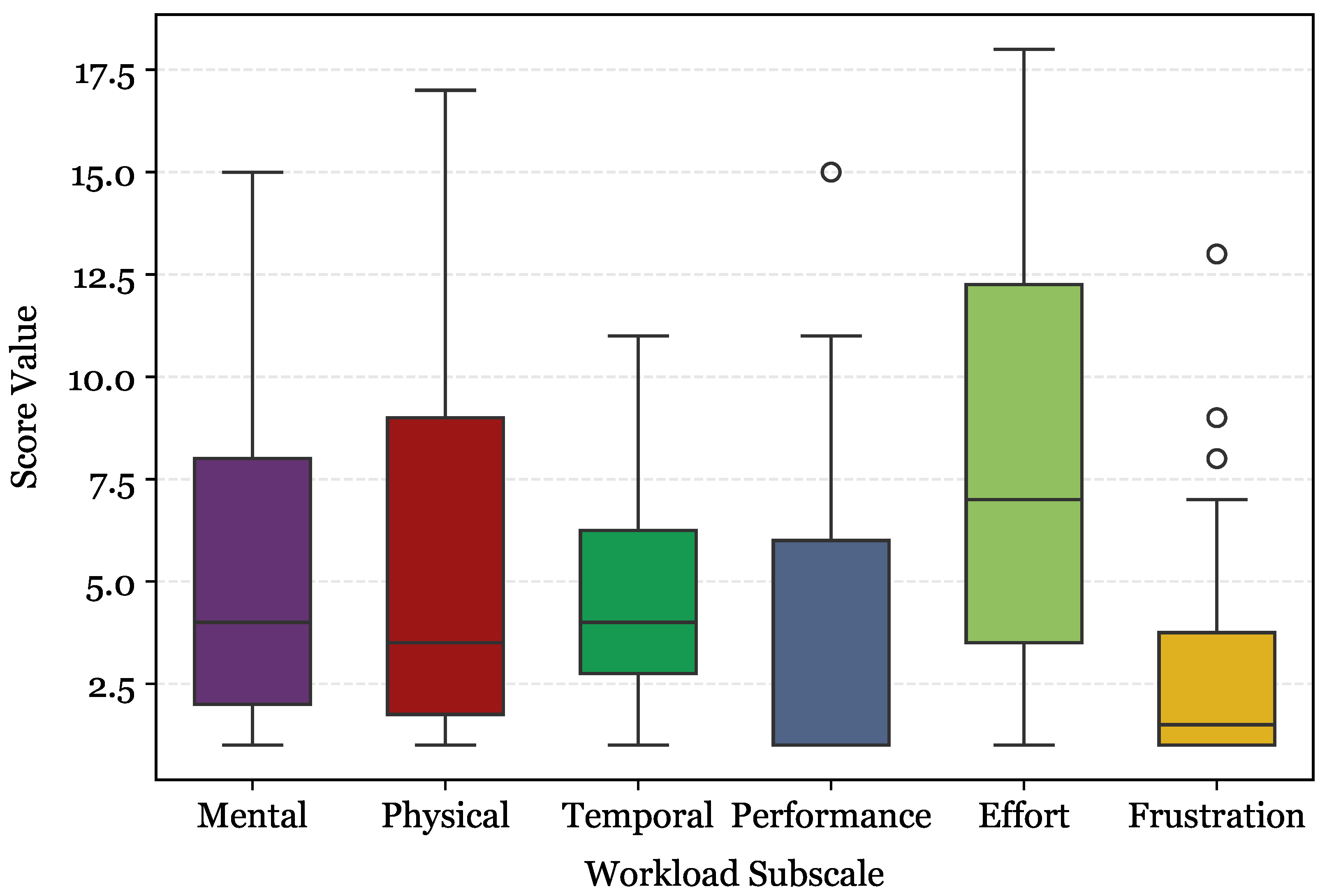
- RQ1: How does a customizable and fully immersive MR environment influence system usability and operator cognitive load during teleoperation of an adaptive inspection robot capable of dynamically changing its wheel diameter?
- RQ2: Can the QoS of an MR-based teleoperation system maintain sufficient operational stability to complete inspection tasks under highly variable network conditions?
- Customizable Immersive MR Environment: The design of a fully immersive and customizable MR workspace that enables natural bare-hand interaction and reproduces a virtual inspection cockpit for adaptive robot teleoperation.
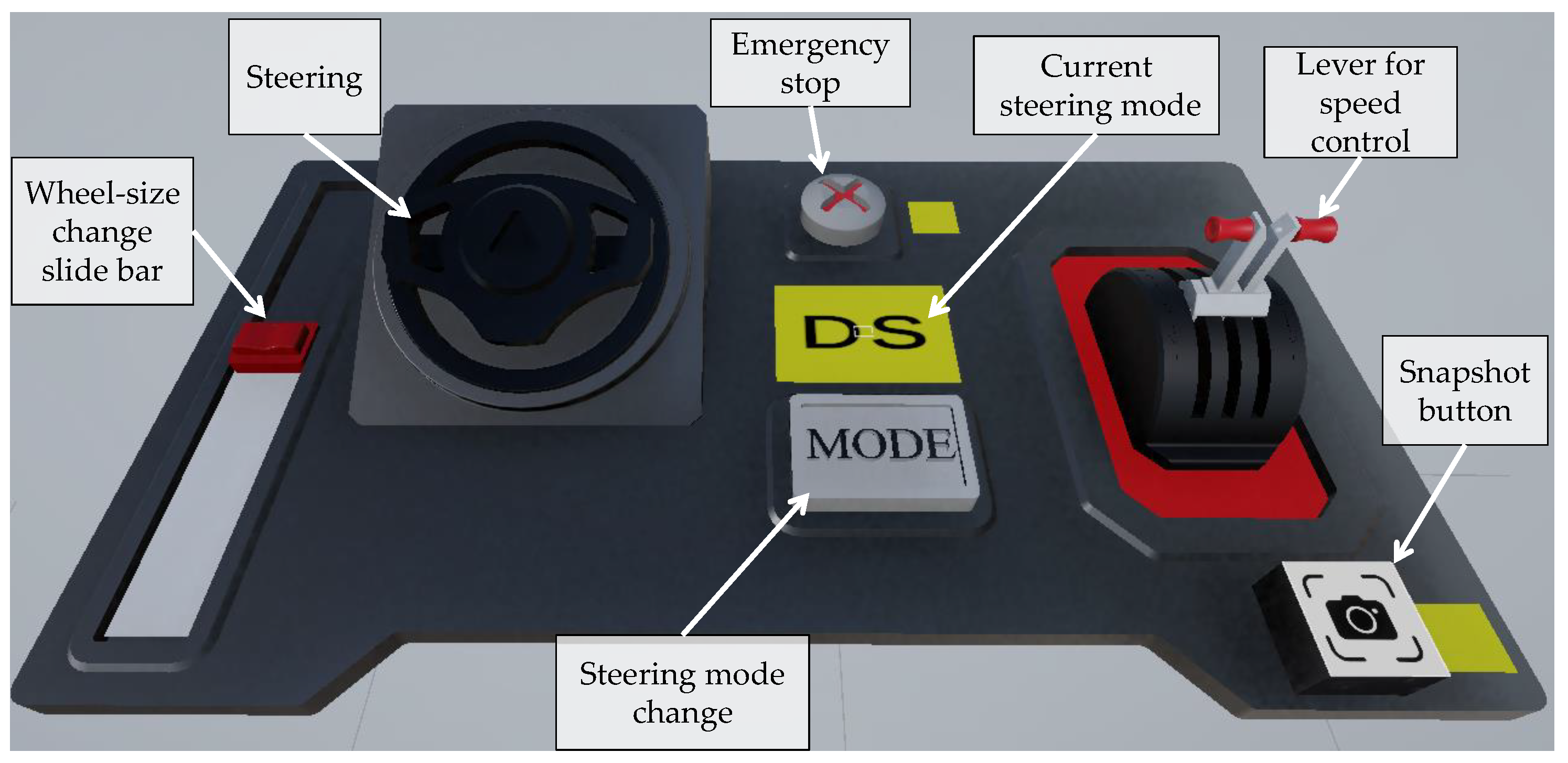
- Adaptive Locomotion Interface: The design of a usable and efficient MR interaction technique for wheel-size adjustment and adaptive steering, allowing the robot to dynamically reconfigure its locomotion for inspection tasks in complex, geometrically constrained environments.
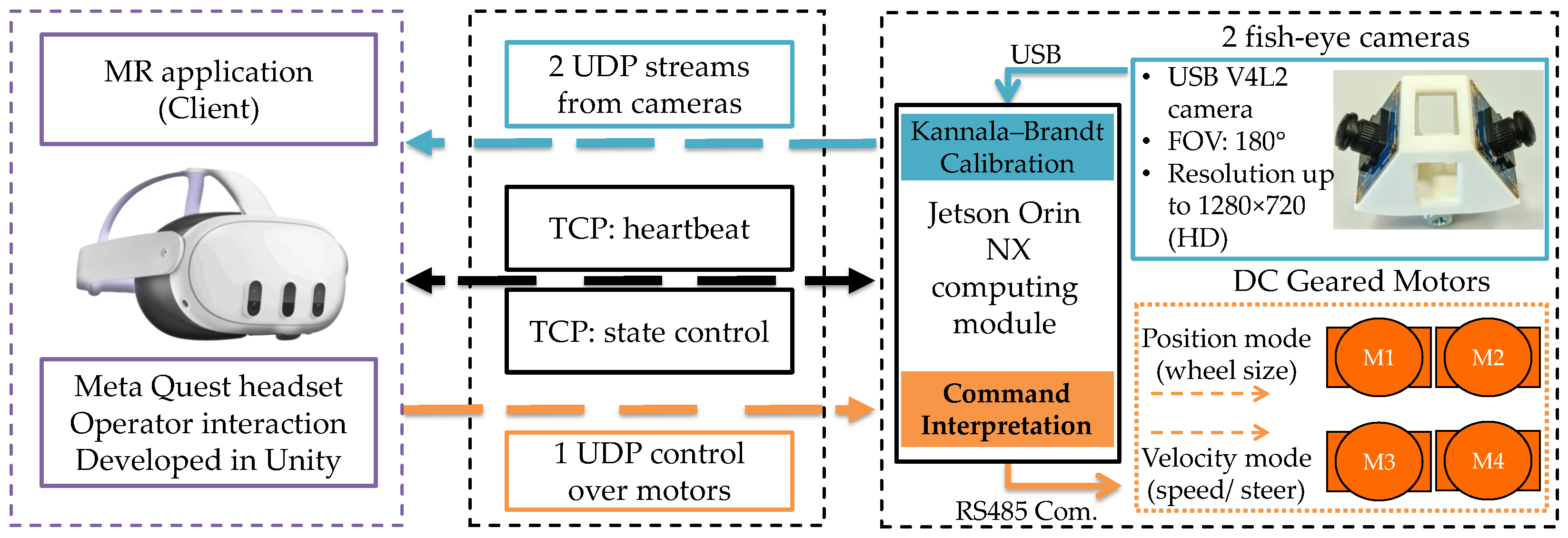
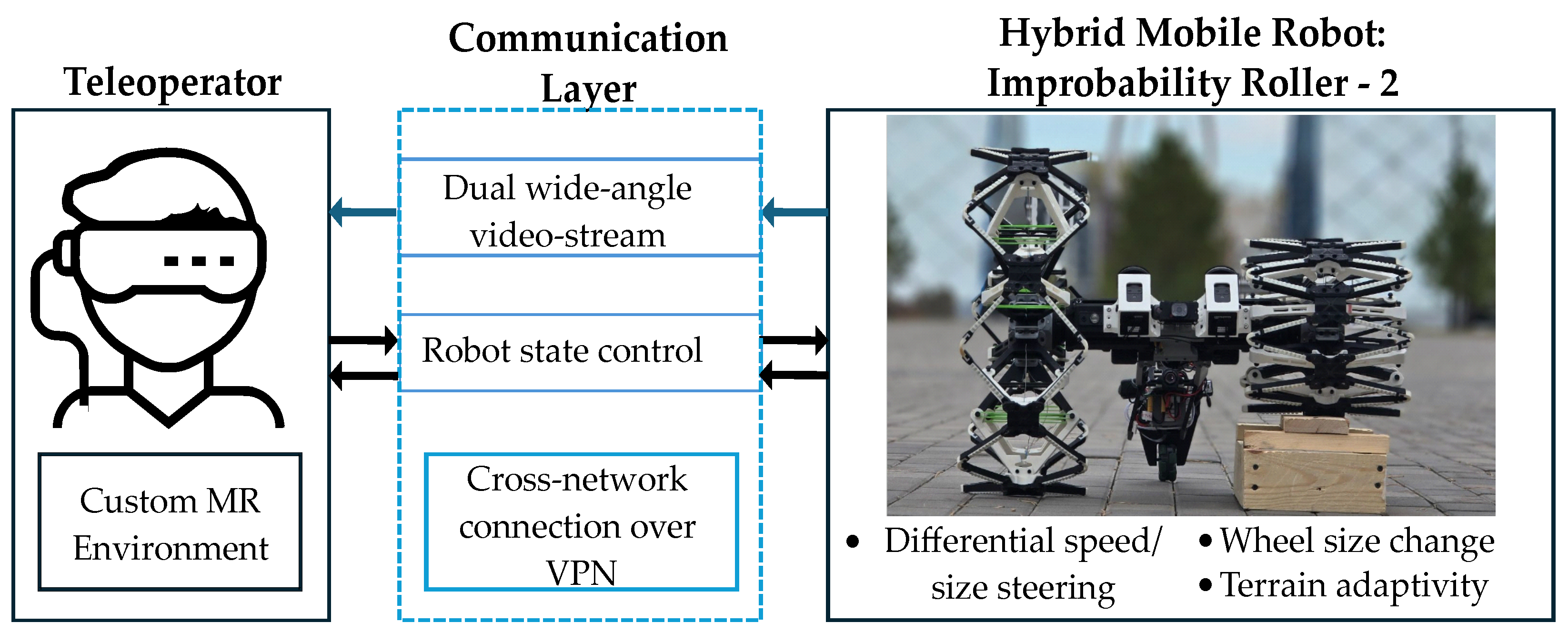
- Low-Level Communication Architecture: The design and implementation of a direct, secure one-to-one communication framework between the robot and the MR application utilizing low-level TCP/UDP socket streaming over a Virtual Private Network (VPN).
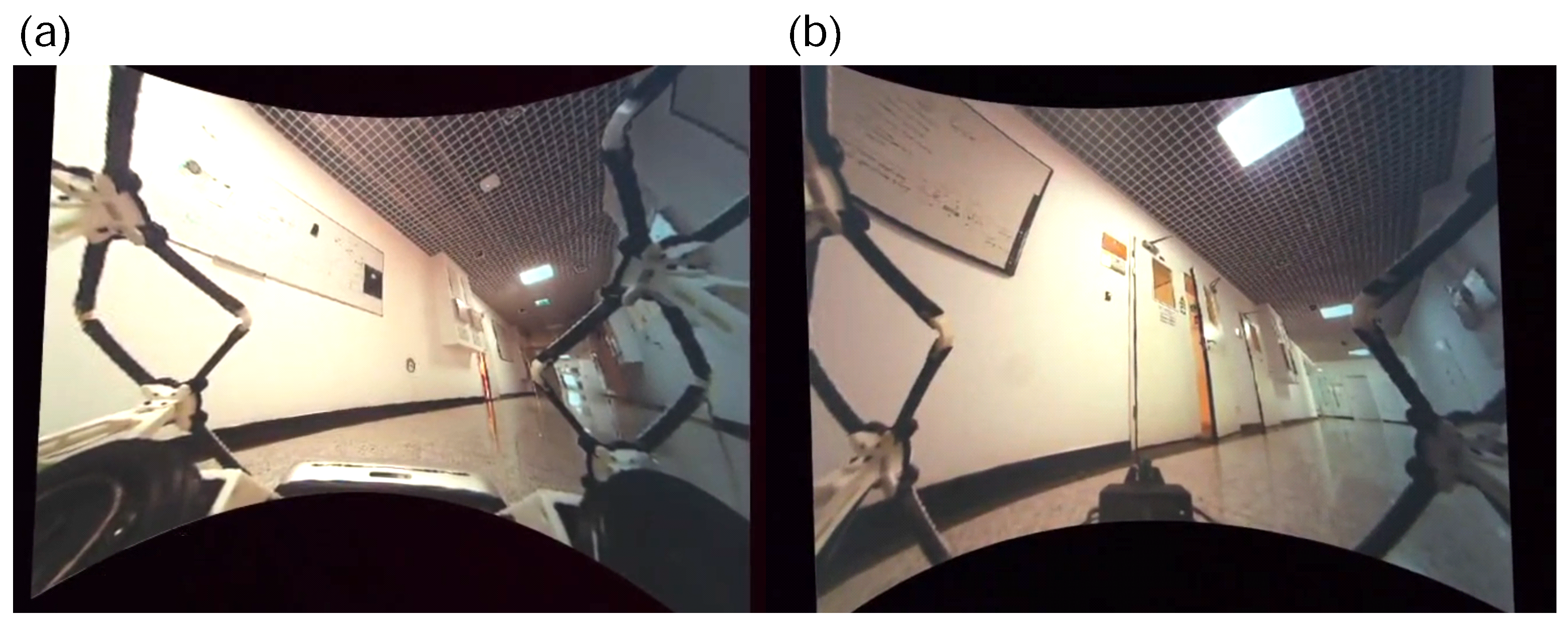
- Linearized Visual Feedback System: The development and evaluation of a linearized, pseudo-360-degree video streaming module utilizing a low-latency capture pipeline and Kannala–Brandt distortion correction to optimize situational awareness.
- System and Human-Factors Evaluation: A dual-method experimental evaluation quantifying both network communication performance (QoS metrics across LAN, WAN, and cloud VPN architectures) and human factor outcomes (usability by SUS, workload index via NASA-TLX, and user profile impact) across 20 participants.
2. Materials and Methods
2.1. System Design
2.2. Adaptive Robot Control Framework
2.3. Mixed Reality User Interface and Operator Workflow
2.4. Dual-Protocol Communication Architecture
2.5. Video Streaming and Rectification
2.6. Safety and Fault Handling
3. Experimental Setup
3.1. Qos Evaluation Under Diverse Network Conditions
3.2. User Study and Usability Evaluation
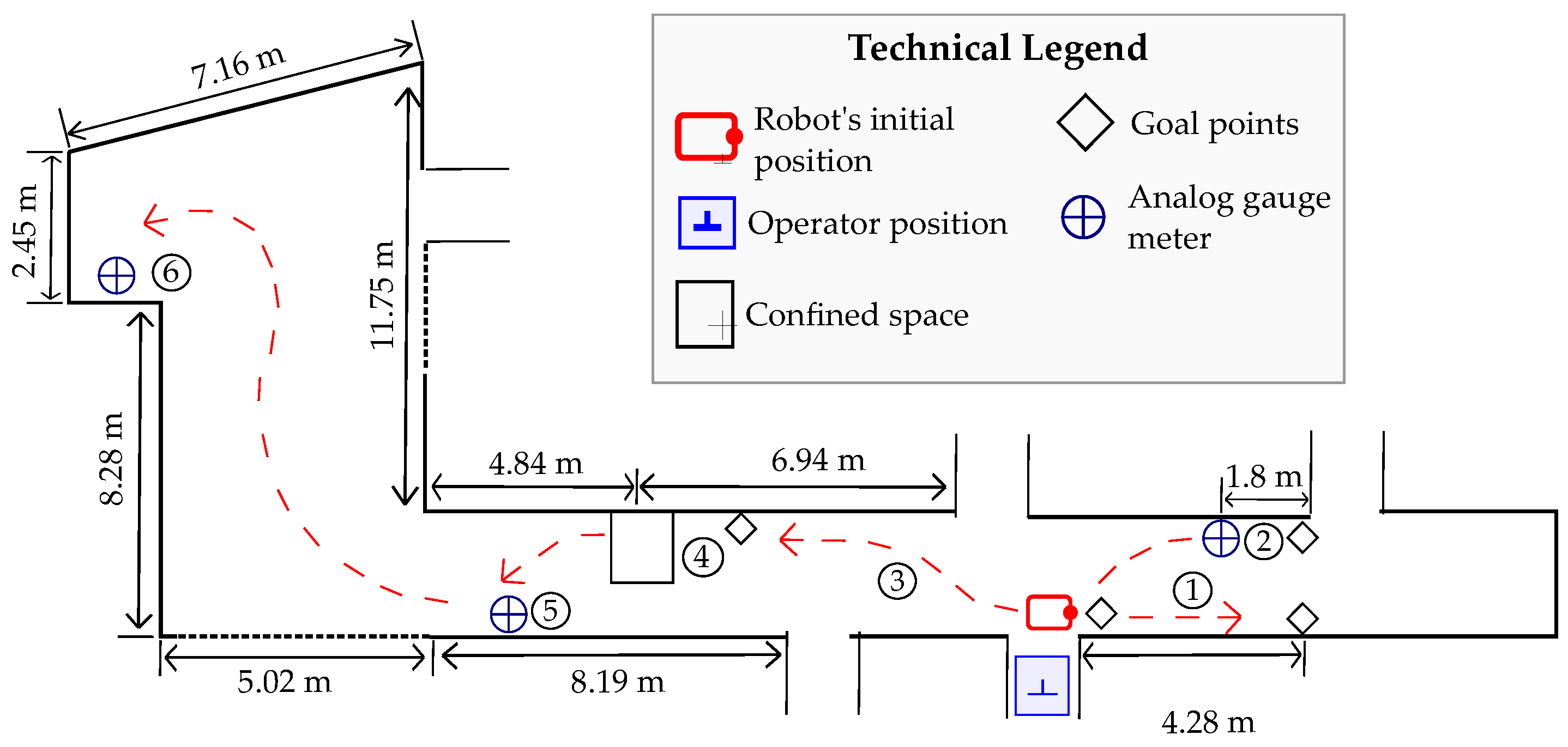
- Basic Locomotion: Translating the robot longitudinally along a straight path using the virtual control lever.
- Path Navigation: Steering the chassis through a structured corridor layout utilizing a combination of progressive differential velocity steering and stationary, in-place rotations.
- Geometric Adaptation: Negotiating a low-clearance structural barrier by symmetrically reducing the diameter of the wheel from to through the virtual console controls.
- Remote Industrial Inspection: Three tasks involving navigating the robot to locate, read, and photograph three analog gauge meter visual targets positioned throughout the environment. To evaluate situational awareness, these targets were distributed across three distinct accessibility tiers: low-difficulty (affixed openly to a corridor wall), intermediate-difficulty (placed beneath an office table), and high-difficulty (situated at the terminus of the corridor above a heating radiator, matching the maximum viewing height of the onboard cameras).
4. Results
4.1. Qos Evaluation Under Diverse Network Conditions
4.2. User Study and Usability Evaluation
4.2.1. Task Completion Analysis
4.2.2. Subjective Usability and Workload
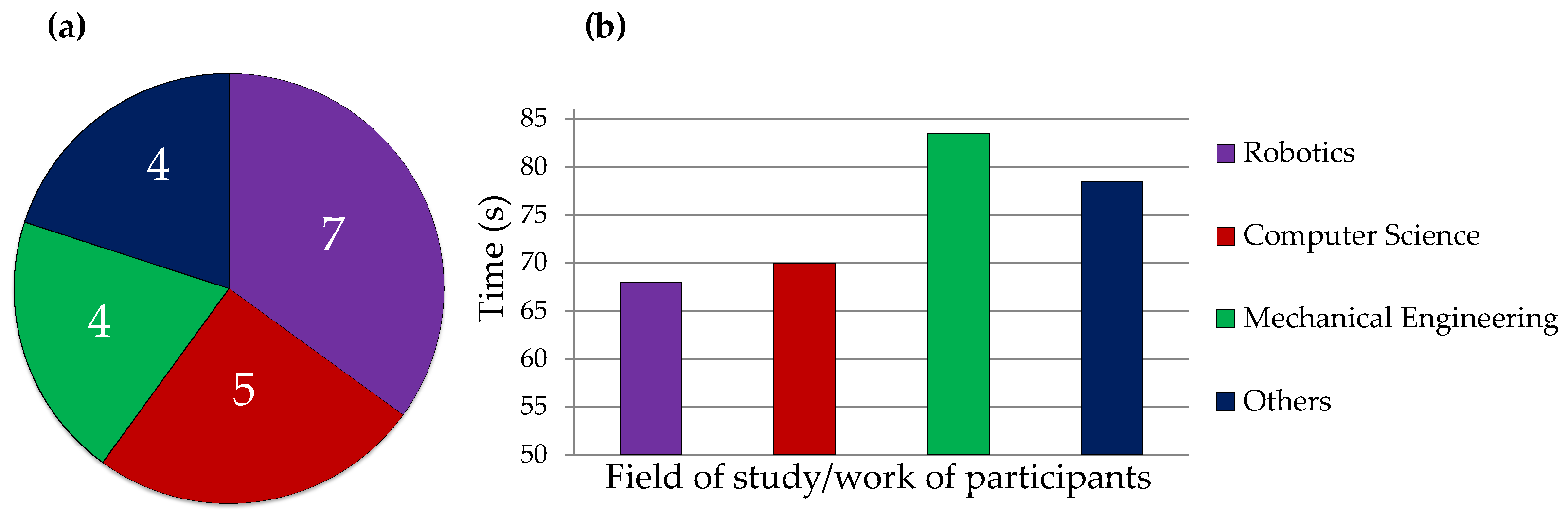
4.2.3. User Profile Impact
5. Discussion
6. Conclusions
Supplementary Materials
Author Contributions
Funding
Institutional Review Board Statement
Informed Consent Statement
Data Availability Statement
Conflicts of Interest
Abbreviations
| MR | Mixed Reality |
| VR | Virtual Reality |
| AR | Augmented Reality |
| XR | Extended Reality |
| SUS | System Usability Scale |
| NASA-TLX | NASA Task Load Index |
| FoV | Field of View |
| ROS | Robot Operating System |
| TCP | Transmission Control Protocol |
| UDP | User Datagram Protocol |
| LAN | Local Area Network |
| MAN | Metropolitan Area Network |
| WAN | Wide Area Network |
| VPN | Virtual Private Network |
| VLAN | Virtual Local Area Network |
| SLAM | Simultaneous Localization and Mapping |
| VSLAM | Virtual Simultaneous Localization and Mapping |
| SDK | Software Development Kit |
| DERP | Designated Encrypted Relay for Packets |
| QoS | Quality of Service |
| HRI | Human–Robot Interaction |
| UI | User Interface |
| GPU | Graphics Processing Unit |
| SSH | Secure Shell |
| FPS | Frames Per Second |
| RTT | Round Trip Time |
References
- Yu, J.; Wang, T.; Shi, Y.; Yang, L. MR Meets Robotics: A Review of Mixed Reality Technology in Robotics. In Proceedings of the 2022 6th International Conference on Robotics, Control and Automation (ICRCA), Xiamen, China, 26–28 February 2022; pp. 11–17. [Google Scholar] [CrossRef] [Scilit]
- Makhataeva, Z.; Varol, H.A. Augmented Reality for Robotics: A Review. Robotics 2020, 9, 21. [Google Scholar] [CrossRef] [Scilit]
- Akhmetov, T.; Moger, G.D.; Varol, H.A. Augmented Reality Multistation Warning System Using Wearable Artificial Intelligence. In Proceedings of the 2025 11th International Conference on Control, Automation and Robotics (ICCAR), Kyoto, Japan, 18–20 April 2025; pp. 483–492. [Google Scholar] [CrossRef] [Scilit]
- Akhmetov, T.; Moger, G.; Tursynbek, I.; Varol, H.A. Thermal Perception Using Augmented Reality for Industrial Safety. In Proceedings of the 2023 3rd International Conference on Robotics, Automation and Artificial Intelligence (RAAI), Singapore, 14–16 December 2023; pp. 91–96. [Google Scholar] [CrossRef] [Scilit]
- Rosa-Garcia, A.D.L.; Marrufo, A.I.S.; Luviano-Cruz, D.; Rodriguez-Ramirez, A.; Garcia-Luna, F. Bridging Remote Operations and Augmented Reality: An Analysis of Current Trends. IEEE Access 2025, 13, 36502–36526. [Google Scholar] [CrossRef] [Scilit]
- Ai, L.; Kazanzides, P.; Azimi, E. Mixed reality based teleoperation and visualization of surgical robotics. Healthc. Technol. Lett. 2024, 11, 179–188. [Google Scholar] [CrossRef] [Scilit] [PubMed]
- Wang, Q.; Cheng, Y.; Jiao, W.; Johnson, M.T.; Zhang, Y. Virtual reality human-robot collaborative welding: A case study of weaving gas tungsten arc welding. J. Manuf. Process. 2019, 48, 210–217. [Google Scholar] [CrossRef] [Scilit]
- Franco, O.A.M.; Giurin, G.; Tefera, Y.T.; Di Natali, C.; Monica, L.; Caldwell, D.G.; Ortiz, J. Integrating Automatic Force Assistance Configuration with Mixed Reality for Active Exoskeletons. In Proceedings of the 2026 IEEE/SICE International Symposium on System Integration (SII), Cancun, Mexico, 11–14 January 2026; pp. 1054–1060. [Google Scholar] [CrossRef] [Scilit]
- Dalabekov, A.; Akimbay, D.; Akhmetov, T.; Zholtayev, D.; Yeshmukhametov, A. Mixed reality based in-pipe inspection. Front. Virtual Real. 2026, 7, 1693545. [Google Scholar] [CrossRef] [Scilit]
- Xu, S.; Wu, L.; Liao, W.; Fujimura, S. Incorporating Drone Into Mixed Reality for Enhanced Remote Collaboration: A User Study on Inspection Task. IEEE Trans. Vis. Comput. Graph. 2026, 32, 2741–2757. [Google Scholar] [CrossRef] [Scilit] [PubMed]
- Salunkhe, S.A.; Nedunghat, P.; Morando, L.; Bobbili, N.; Li, G.; Loianno, G. Intuitive Human-Drone Collaborative Navigation in Unknown Environments Through Mixed Reality. In Proceedings of the 2025 International Conference on Unmanned Aircraft Systems (ICUAS), Charlotte, NC, USA, 14–17 May 2025; pp. 862–868. [Google Scholar] [CrossRef] [Scilit]
- Fan, W.; Guo, X.; Feng, E.; Lin, J.; Wang, Y.; Liang, J.; Garrad, M.; Rossiter, J.; Zhang, Z.; Lepora, N.; et al. Digital Twin-Driven Mixed Reality Framework for Immersive Teleoperation with Haptic Rendering. IEEE Robot. Autom. Lett. 2023, 8, 8494–8501. [Google Scholar] [CrossRef] [Scilit]
- Livatino, S.; Guastella, D.C.; Muscato, G.; Rinaldi, V.; Cantelli, L.; Melita, C.D.; Caniglia, A.; Mazza, R.; Padula, G. Intuitive Robot Teleoperation Through Multi-Sensor Informed Mixed Reality Visual Aids. IEEE Access 2021, 9, 25795–25808. [Google Scholar] [CrossRef] [Scilit]
- Szczurek, K.A.; Prades, R.M.; Matheson, E.; Rodriguez-Nogueira, J.; Castro, M.D. Mixed Reality Human–Robot Interface with Adaptive Communications Congestion Control for the Teleoperation of Mobile Redundant Manipulators in Hazardous Environments. IEEE Access 2022, 10, 87182–87216. [Google Scholar] [CrossRef] [Scilit]
- Li, S.; Gao, P.; Chen, Y. A Bilateral Teleoperation Strategy Augmented by EMGP-VH for Live-Line Maintenance Robot. IEEE Trans. Hum.-Mach. Syst. 2024, 54, 362–374. [Google Scholar] [CrossRef] [Scilit]
- Sun, P.; Li, W.; Li, J.; Liu, Y.; Wang, J.; Ding, L.; Zhou, C. More Precise and Faster: Dual-Scale Teleoperation for Manipulator in Large Workspace. IEEE Trans. Fuzzy Syst. 2026, 34, 27–40. [Google Scholar] [CrossRef] [Scilit]
- Rastegarpanah, A.; Mineo, C.; Contreras, C.A.; Shaarawy, A.; Paragliola, G.; Stolkin, R. Haptic Teleoperation in Extended Reality for Electric Vehicle Battery Disassembly Using Gaussian Mixture Regression. J. Field Robot. 2026, 43, 1130–1151. [Google Scholar] [CrossRef] [Scilit]
- Penco, L.; Momose, K.; McCrory, S.; Anderson, D.; Kitchel, N.; Calvert, D.; Griffin, R.J. Mixed Reality Teleoperation Assistance for Direct Control of Humanoids. IEEE Robot. Autom. Lett. 2024, 9, 1937–1944. [Google Scholar] [CrossRef] [Scilit]
- SharafianArdakani, P.; Hanafy, M.A.; Kondaurova, I.; Ashary, A.; Rayguru, M.M.; Popa, D.O. Adaptive User Interface with Parallel Neural Networks for Robot Teleoperation. IEEE Robot. Autom. Lett. 2025, 10, 963–970. [Google Scholar] [CrossRef] [Scilit]
- De Ocampo, F.O.; Hernández-Melgarejo, G.; Ramírez-Treviño, A.; Fuentes-Aguilar, R.Q. Presence Assessment in Virtual Reality: A Systematic Literature review. Appl. Sci. 2026, 16, 3102. [Google Scholar] [CrossRef] [Scilit]
- Hetrick, R.; Amerson, N.; Kim, B.; Rosen, E.; Visser, E.J.D.; Phillips, E. Comparing Virtual Reality Interfaces for the Teleoperation of Robots. In Proceedings of the 2020 Systems and Information Engineering Design Symposium (SIEDS), Charlottesville, VA, USA, 24 April 2020; pp. 1–7. [Google Scholar] [CrossRef] [Scilit]
- Criollo, E.; Oñate, W.; Caiza, G.; Andaluz, V.H.; Varela-Aldás, J. Immersive AR–ROS 2 Teleoperation Architecture for a Physical Quadruped Robot. Robotics 2026, 15, 134. [Google Scholar] [CrossRef] [Scilit]
- Batistute, A.; Santos, E.; Takieddine, K.; Lazari, P.M.; Giane Da Rocha, L.; Teixeira Vivaldini, K.C. Extended Reality for Teleoperated Mobile Robots. In Proceedings of the 2021 Latin American Robotics Symposium (LARS), 2021 Brazilian Symposium on Robotics (SBR), and 2021 Workshop on Robotics in Education (WRE), Natal, Brazil, 11–15 October 2021; pp. 19–24. [Google Scholar] [CrossRef] [Scilit]
- Hernandez, M.N.; de Miranda, N.C.; Domingues, B.H.R.; Negri, D.; de Souza, D.; Secco, I.; Trabasso, L.G.; Simoni, R. Influence of User Profiles on Usability Perception in Virtual Reality-Based Robotic Teleoperation. In Proceedings of the 2025 27th Symposium on Virtual and Augmented Reality (SVR), Salvador, Brazil, 30 September–3 October 2025; pp. 156–164. [Google Scholar] [CrossRef] [Scilit]
- Black, D.G.; Andjelic, D.; Salcudean, S.E. Evaluation of Communication and Human Response Latency for (Human) Teleoperation. IEEE Trans. Med. Robot. Bionics 2024, 6, 53–63. [Google Scholar] [CrossRef] [Scilit]
- Noguera Cundar, A.; Fotouhi, R.; Ochitwa, Z.; Obaid, H. Quantifying the Effects of Network Latency for a Teleoperated Robot. Sensors 2023, 23, 8438. [Google Scholar] [CrossRef] [Scilit] [PubMed]
- Stotko, P.; Krumpen, S.; Schwarz, M.; Lenz, C.; Behnke, S.; Klein, R.; Weinmann, M. A VR System for Immersive Teleoperation and Live Exploration with a Mobile Robot. In Proceedings of the 2019 IEEE/RSJ International Conference on Intelligent Robots and Systems (IROS), Macau, China, 4–8 November 2019; pp. 3630–3637. [Google Scholar] [CrossRef] [Scilit]
- De La Rosa-Garcia, A.; Rodriguez-Ramirez, A.G.; Robles, B.A.; Soto-Marrufo, I.; Ortiz-Muñoz, D.; Alonso-Mendoza, V.M.; Luviano-Cruz, D.; Garcia-Luna, F. AR-Based teleoperation of an omnidirectional mobile robot for UV-C disinfection. Robotics 2026, 15, 94. [Google Scholar] [CrossRef] [Scilit]
- Walker, M.E.; Gramopadhye, M.; Ikeda, B.; Burns, J.; Szafir, D. The Cyber-Physical Control Room: A Mixed Reality Interface for Mobile Robot Teleoperation and Human-Robot Teaming. In Proceedings of the 2024 19th ACM/IEEE International Conference on Human-Robot Interaction (HRI), Boulder, CO, USA, 11–14 March 2024; pp. 762–771. [Google Scholar]
- Moger, G.; Varol, H.A. Improbability Roller-2: A Hybrid Mobile Robot with Variable Diameter Transformable Wheels. In Proceedings of the 2025 IEEE/RSJ International Conference on Intelligent Robots and Systems (IROS), Hangzhou, China, 19–25 October 2025; pp. 16489–16494. [Google Scholar] [CrossRef] [Scilit]
- Moger, G.; Varol, H.A. Design and Implementation of a Mobile Robot with Variable-Diameter Wheels. IEEE/ASME Trans. Mechatron. 2025, 30, 2529–2538. [Google Scholar] [CrossRef] [Scilit]
- ROBOTIS. DYNAMIXEL SDK Overview. 2026. Available online: https://emanual.robotis.com/docs/en/software/dynamixel/dynamixel_sdk/overview/ (accessed on 12 May 2026).
- Unity Technologies. Unity 6: Download the Latest Release of Unity 6|Unity. Available online: https://unity.com/releases/unity-6/ (accessed on 7 May 2026).
- Meta Platforms, Inc. Develop with Unity—Meta Horizon. 2026. Available online: https://developers.meta.com/horizon/develop/unity/ (accessed on 28 April 2026).
- Pico, N.; Mite, G.; Morán, D.; Alvarez-Alvarado, M.S.; Auh, E.; Moon, H. Web-Based Real-Time Alarm and Teleoperation System for Autonomous Navigation Failures Using ROS 1 and ROS 2. Actuators 2025, 14, 164. [Google Scholar] [CrossRef] [Scilit]
- Kannala, J.; Brandt, S. A generic camera calibration method for fish-eye lenses. In Proceedings of the 17th International Conference on Pattern Recognition, Cambridge, UK, 26 August 2004; IEEE: New York, NY, USA, 2004; Volume 1, pp. 10–13. [Google Scholar] [CrossRef] [Scilit]
- Fisher, M.; Cardoso, R.C.; Collins, E.C.; Dadswell, C.; Dennis, L.A.; Dixon, C.; Farrell, M.; Ferrando, A.; Huang, X.; Jump, M.; et al. An Overview of Verification and Validation Challenges for Inspection Robots. Robotics 2021, 10, 67. [Google Scholar] [CrossRef] [Scilit]
- Tailscale Inc. Tailscale. 2026. Available online: https://tailscale.com/ (accessed on 15 June 2026).
- Lewis, J.R. Measuring Perceived Usability: The CSUQ, SUS, and UMUX. Int. J. Hum.-Comput. Interact. 2018, 34, 1148–1156. [Google Scholar] [CrossRef] [Scilit]





| Work | Robot Platform | Control Type | Robot Vision Representation | Communication Technology | Connection Environment |
|---|---|---|---|---|---|
| Hetrick et al. [21] | Baxter robot for pick and place tasks | Controller buttons | Point cloud and dual video streams | ROS Reality Bridge | Internet |
| Batistute et al. [23] | Turtlebot2i | Hand gestures and controller joysticks | A video stream | ROS Bridge | LAN |
| Hernandez et al. [24] | FANUC LR Mate 200iD/7L manipulator | Controller buttons and virtual manipulator | A video stream | ROS-TCP Connector | LAN |
| Rosa-Garcia et al. [28] | ROSMASTER X3 Plus inspection robot | Controller handles | VSLAM | ROS | LAN |
| Walker et al. [29] | Quadruped Boston Dynamics robot | Keyboard and controllers | Point cloud stream | ROS-TCP | LAN |
| Fan et al. [12] | Dobot Magician manipulator | VR controller and Geomagic Touch haptic device | A video stream | WebSocket | - |
| Livatino et al. [13] | Bonnet inspection robot with drone assist | Controller buttons and joysticks | Single video stream with synthetic visual aids and drone view | ROS Network | - |
| Our work | Improbability Roller-2 hybrid mobile robot | Immersive hand-gesture interaction with a customizable cockpit | Dual wide-angle video streams | Low-level TCP and UDP sockets | Cross-Network VPN |
| Network Implementation | Port | Protocol | Communication Data Types |
|---|---|---|---|
| Broadcast discovery server | 5000 | UDP | Array of characters |
| Front camera video stream | 5001 | UDP | Raw byte array |
| Back camera video stream | 5002 | UDP | Raw byte array |
| Heartbeat establishment | 12345 | TCP | Single-byte signal |
| Wheel size change and motor state commands | 5050 | TCP | JSON-formatted strings |
| Movement control data streaming | 5051 | UDP | JSON packets |
| Network | Session | RTT Avg. (ms) | RTT Mdev (ms) | UDP Loss (%) | FPS Mean | Avg. Reassembly (ms) |
|---|---|---|---|---|---|---|
| LAN | 1st | 24.5 | 41.9 | 33.0 | 15.7 | 17.6 |
| 2nd | 56.4 | 53.7 | 26.0 | 16.3 | 17.6 | |
| 3rd | 9.9 | 9.1 | 0.0 | 16.0 | 14.0 | |
| MAN | 1st | 47.2 | 56.9 | 44.0 | 15.9 | 15.0 |
| 2nd | —(session not established)— | |||||
| 3rd | 8.8 | 7.5 | 0.0 | 15.7 | 14.2 | |
| VPN | 1st | 200.8 | 80.0 | 28.0 | 14.6 | 31.5 |
| 2nd | 165.8 | 5.0 | 85.0 | 2.6 | 140.4 | |
| 3rd | 146.0 | 4.4 | 1.0 | 9.2 | 54.3 | |
| Cell | 1st | 232.4 | 69.6 | 54.0 | 6.2 | 71.9 |
| 2nd | 281.8 | 98.6 | 67.0 | 5.4 | 82.2 | |
| 3rd | 234.1 | 81.5 | 83.0 | 3.8 | 111.2 | |
| Session | Task | Collisions | Path Errors | Time (s) |
|---|---|---|---|---|
| Dev 1 VPN | Move robot forward | 0 | 0 | 52 |
| Path with steering | 0 | 0 | 97 | |
| Going Under | 0 | 0 | 62 | |
| First meter | 0 | 0 | 18 | |
| Second meter | 0 | 0 | 43 | |
| Third meter | 1 | 0 | 304 | |
| Dev 2 VPN | Move robot forward | 0 | 0 | 29 |
| Path with steering | 0 | 1 | 110 | |
| Going Under | 0 | 0 | 50 | |
| First meter | 0 | 0 | 18 | |
| Second meter | 0 | 0 | 43 | |
| Third meter | 0 | 1 | 220 | |
| Dev 3 VPN | Move robot forward | 0 | 0 | 25 |
| Path with steering | 0 | 0 | 95 | |
| Going Under | 0 | 0 | 50 | |
| First meter | 0 | 0 | 43 | |
| Second meter | 0 | 0 | 43 | |
| Third meter | 0 | 0 | 110 | |
| Dev LAN | Move robot forward | 0 | 0 | 12 |
| Path with steering | 0 | 0 | 53 | |
| Going Under | 0 | 0 | 30 | |
| First meter | 0 | 0 | 12 | |
| Second meter | 0 | 0 | 15 | |
| Third meter | 0 | 0 | 67 |
| Task Name | N | Avg. Success Score (0–3) | Mean Time (s) | Std. Dev. (s) | Min (s) | Max (s) |
|---|---|---|---|---|---|---|
| Forward navigation | 20 | 2.90 | 28.90 | 9.60 | 15 | 44 |
| First meter identification | 20 | 2.60 | 40.40 | 37.00 | 5 | 151 |
| Curved path navigation | 20 | 2.37 | 114.25 | 48.90 | 57 | 240 |
| Navigating confined space | 16 | 2.75 | 81.19 | 42.90 | 31 | 157 |
| Second meter identification | 19 | 2.79 | 43.30 | 17.21 | 8 | 68 |
| Third meter identification | 18 | 2.89 | 142.00 | 43.82 | 90 | 238 |
| System Feature/Interface Component | Mean Rating (1–5) |
|---|---|
| Longitudinal movement (lever) | 4.30 |
| Differential steering | 4.25 |
| Video stream quality | 3.75 |
| Wheel size adjustment slider | 4.80 |
| Environment customization tools | 4.65 |
| System setup efficiency | 4.60 |
| Experience Factor | Completion Time | Success Score | SUS Score | NASA-TLX | ||||
|---|---|---|---|---|---|---|---|---|
| VR/MR Experience | −0.32 | 0.16 | −0.01 | 0.97 | 0.05 | 0.84 | 0.40 | 0.08 |
| Teleoperation Experience | −0.26 | 0.27 | 0.04 | 0.87 | 0.36 | 0.12 | −0.23 | 0.33 |
Disclaimer/Publisher’s Note: The statements, opinions and data contained in all publications are solely those of the individual author(s) and contributor(s) and not of MDPI and/or the editor(s). MDPI and/or the editor(s) disclaim responsibility for any injury to people or property resulting from any ideas, methods, instructions or products referred to in the content. |
© 2026 by the authors. Licensee MDPI, Basel, Switzerland. This article is an open access article distributed under the terms and conditions of the Creative Commons Attribution (CC BY) license.
Share and Cite
Khamidulla, A.; Moger, G.D.; Varol, H.A. Immersive Teleoperation of Adaptive Mobile Robots: Evaluating Human Factors and Network Resilience in Mixed Reality. Robotics 2026, 15, 149. https://doi.org/10.3390/robotics15080149
Khamidulla A, Moger GD, Varol HA. Immersive Teleoperation of Adaptive Mobile Robots: Evaluating Human Factors and Network Resilience in Mixed Reality. Robotics. 2026; 15(8):149. https://doi.org/10.3390/robotics15080149
Chicago/Turabian StyleKhamidulla, Alikhan, Gourav Devappa Moger, and Huseyin Atakan Varol. 2026. "Immersive Teleoperation of Adaptive Mobile Robots: Evaluating Human Factors and Network Resilience in Mixed Reality" Robotics 15, no. 8: 149. https://doi.org/10.3390/robotics15080149
APA StyleKhamidulla, A., Moger, G. D., & Varol, H. A. (2026). Immersive Teleoperation of Adaptive Mobile Robots: Evaluating Human Factors and Network Resilience in Mixed Reality. Robotics, 15(8), 149. https://doi.org/10.3390/robotics15080149