In real-time defect diagnosis and detection in mobile robots, this study suggests a hybrid framework that combines convolutional neural networks (CNNs) and finite-state machines (FSMs). Time-series sensor data is gathered under a variety of operational and fault settings, preprocessed into structured inputs, and then used to train a CNN to identify fault patterns. A preset FSM model, which controls the robot’s reaction to errors, uses the CNN outputs to initiate state changes. The FSM allows for quick, understandable, and automated fault management during robot navigation by controlling behavior through distinct states like normal operation, fault suspicion, and recovery [
27]. An FSM can be formally represented as a 5-tuple, δ: S × Σ→S
where S is a finite set of states, Σ: input alphabet (events and sensor readings), and the state transition function is denoted in Equation (2)
The framework of the convolutional neural network (CNN) serves as a binary classifier and feature extractor for mobile robot malfunction detection [
28]. The CNN is defined formally as a mapping function,
where θ stands for the model’s learnable parameters, such as weights and biases. A time-series data window made up of readings fros
sensor channels over n distinct time steps is called the input
, after processing
. As the output vector, the CNN generates
, where
are represent the expected odds that the input is in a “normal” or “faulty” operational state. The softmax function is used to generate the output probabilities from the raw logits q0 and q1, which are the final dense layer’s pre-activation outputs:
where
and
= CNN features before softmax.
Only when the smoothed probability
surpasses a higher-level threshold λ is a fault warning triggered. Here,
. By reducing the impact of noise and erroneous predictions, this two-tier thresholding approach, which is based on both instant classification confidence and smoothed historical data, increases the reliability of fault identification. The output of a CNN is used by the composite fault detection function
to classify the input sensor data
. CNN calculates a vector of probabilities as
, where the probability of a fault is represented by
. For this value, a judgment threshold
is applied. The system indicates a fault if
else, it is regarded as normal. This rule lowers false positives and increases the overall dependability of autonomous fault management by guaranteeing fault detection only in situations where confidence is high. The CNN is trained in the supervised learning framework using the labeled dataset
where the input data (such as a window of sensor measurements) is indicated by
and the matching one-hot encoded label for “normal” or “fault” is represented by
}. Finding the model parameter θ that minimizes the cross-entropy loss between the true labels and the predicted probability is the goal. The definition of the loss function is:
Theoretical Novelty
Integrating CNN with FSM puts forward state-based control logic fused with a discrete pattern recognition mechanism. The traditional supervised classifiers are static. However, the proposed framework utilizes CNN as the dynamic feature extractor mapping the time-series data with events for real-time recovery. The novelty in the fault-tolerant design has been represented as a mathematical model in Equation (9) describing either the fault detection and autonomous recovery success or the safety shutdown. It is based on the probabilistic input and ensures that the autonomous robot maintains a healthy baseline even in unseen noise. To design the framework beyond the traditional hysteresis, a two-tier decision layers has been implemented. An instantaneous threshold has been utilized for rapid response. Further, a secondary smoothing threshold has been applied for enhancing the temporal consistency. Thereby, it reduces the sensitivity to model mismatch and momentary sensor spikes which is considered a common point of failure.
The suggested system offers a dependable and scalable solution for autonomous fault handling in mobile robots by integrating CNN-based classification, dual-threshold decision logic, and FSM-driven fault management. Timely detection of the faults, minimized false positive values through smoothing and automated fault recovery have been guaranteed by the above-mentioned methodologies. Thereby, the overall system robustness and autonomy are enhanced. The FSM is initially set up in a defined starting position at the start of the algorithm as mentioned in Algorithm 1. After that, it gathers data in vector format from a variety of sources, such as cameras, Lidar, motor current, wheel sensors, and temperature sensors. A transformation function is used to improve the data quality for the learning algorithm, producing input data that has been normalized or reshaped. A convolutional neural network is used to detect faults. If the expected output reaches or surpasses a preset threshold, as indicated by the condition, a fault is detected. Finally, the transition of the FSM to the subsequent state has been determined by the present state and the classifier output through the transition function which ensures a responsive as well as reliable fault detection mechanism based on real-time data.
| Algorithm 1: FSM_Fault() |
inputs from and vector of realdata sensor inputs at time
with components. |
| 1 | Initialize the FSM ) |
| 2 | Initialize: |
| 3 | Collect data |
| 4 | Apply transformation function ϕ . |
| 5 | Detect Fault by using CNN |
| 6 | Determine the FSM’s transition to the next state . |
| 7 | Return |
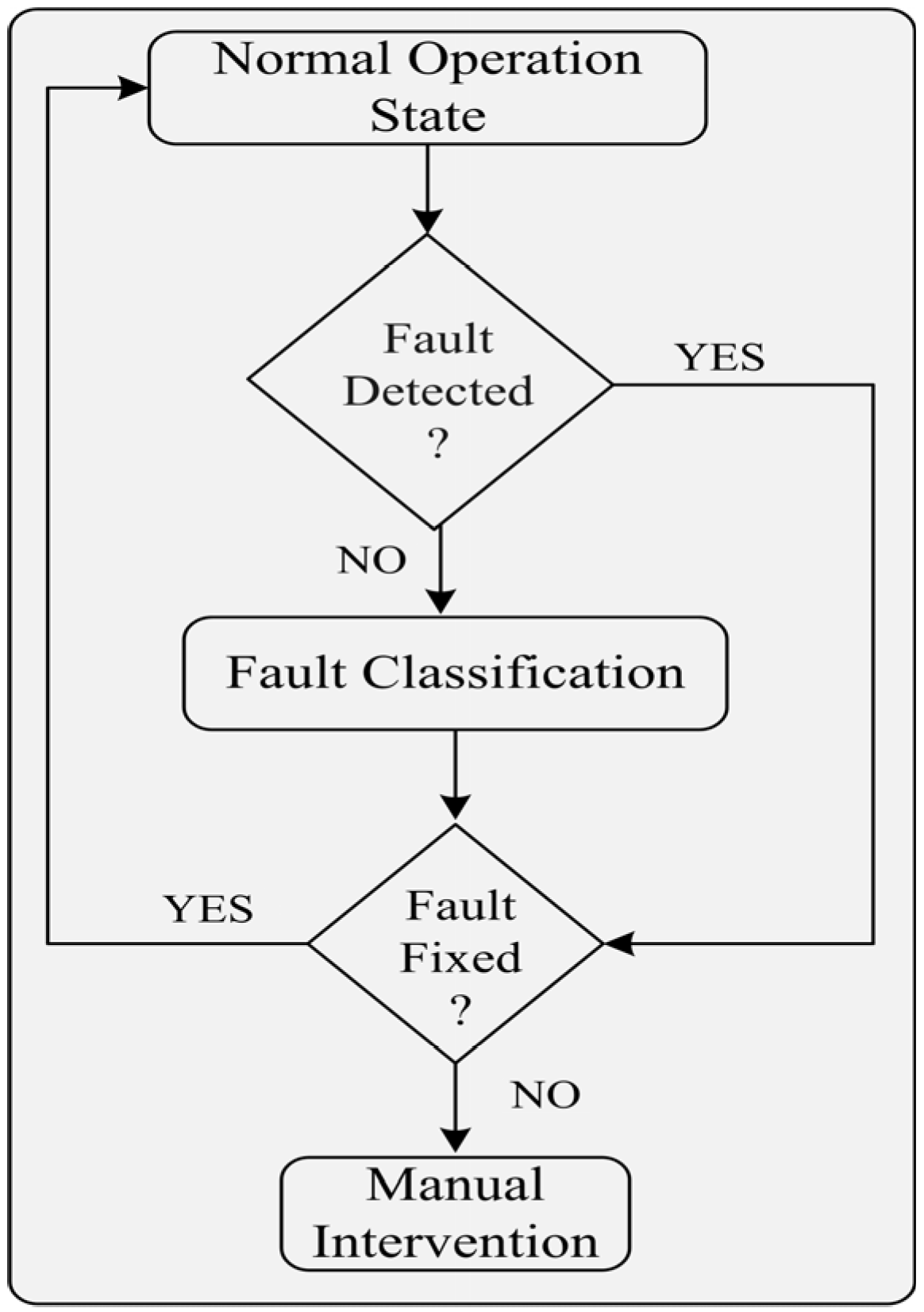
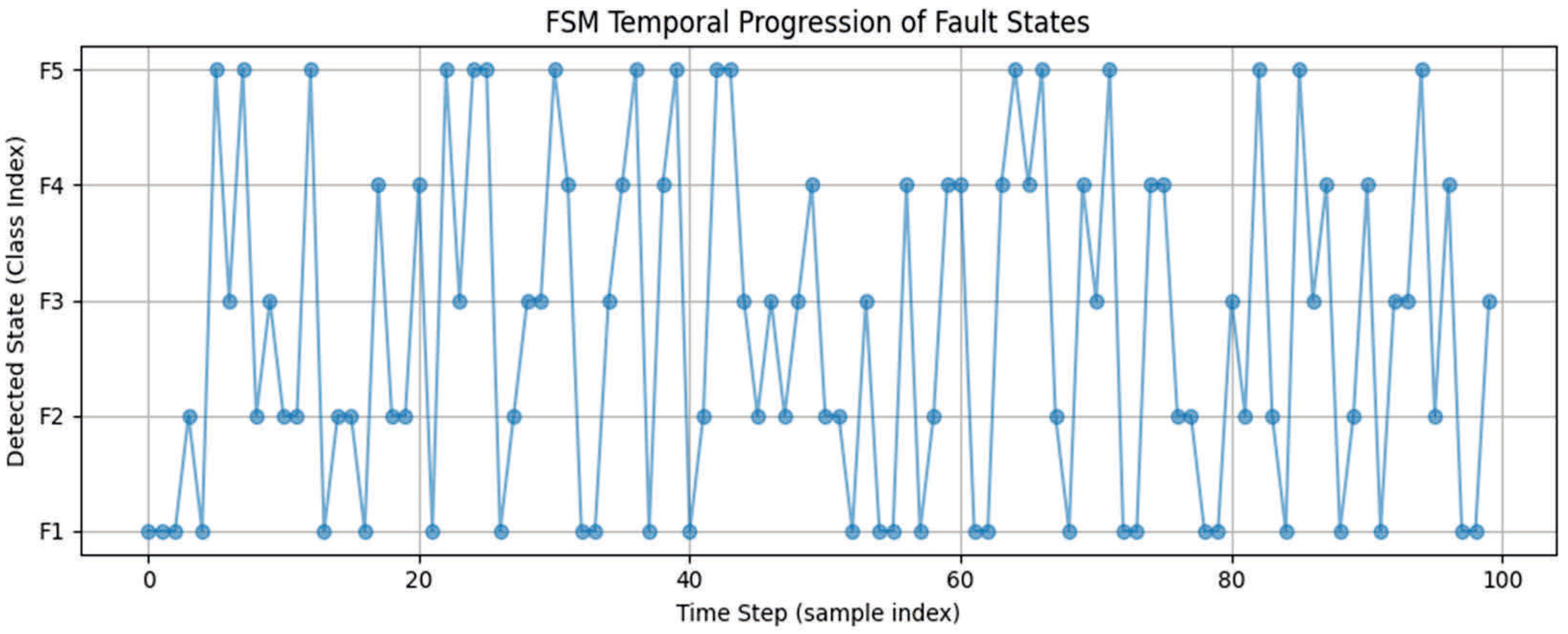
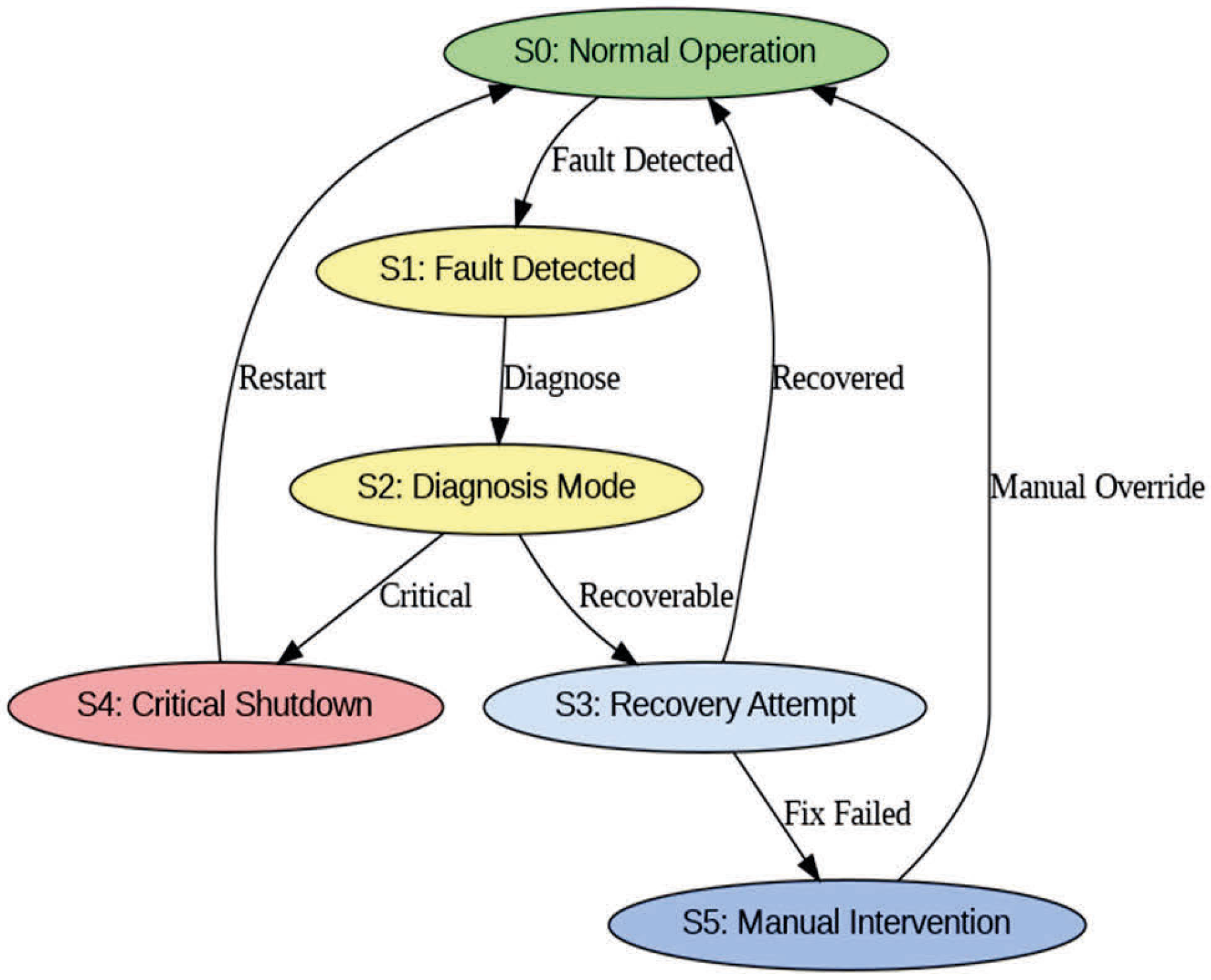
The FSM operates through six states, denoting normal, fault detected, fault classified, fixing, verification, and manual intervention, respectively. It begins in the normal state and transitions to fault detection upon identifying an issue. If classified, it moves to fixing and then verification. If verification fails, manual intervention may occur. The developed framework implements a single-stage multi class CNN architecture to map the input signals to the six states where one is the normal class and the other five belong to the fault category. The output layer has been configured with six neurons and a softmax activation to serve as a detector–classifier. Categorical cross-entropy governs the training process for optimizing the granular fault variation rather than a binary detection process. The approach treats normal as the baseline class within a broader multi-fault identification.
Figure 1 ensures systematic fault management, enhancing the reliability and responsiveness of the system.
Algorithm 2 describes the fault recovery process of a faulty robot and prompts a safe stop or notifies the operator based on the trigger. The finite-state machine (FSM) of the system is initialized at the first step. At the initialization time when
suppose the system is working normally, without any fault occurring in the normal state. This step guarantees that a known, healthy baseline is used to begin the fault detection and recovery process. In the next step for each time, the system gets real-time data from sensors and actuators and stores it in a vector
which is verified by a diagnosis classifier: a machine learning model or a rule-based system. The diagnosis classifier is a model which is used for decision making to find an indication of unusual conduct and also assigns a system status classification. This step is responsible for finding whether the system is in normal operation mode or any fault has occurred. The symbol
indicates operation and
indicates a fault detected. FSM transition logic defines the transition process of different states based on the current state
, the diagnostic classifier output
and the success or failure of attempts at recovery. The transition of states as
continue normal operation
a fault is automatically detected.
| Algorithm 2: Fault-Recov (R) |
| Input: : Sensor and actuator input at time t |
| 1 | Initialize the states of FSM as |
| 2 | Initialization start in Normal State as |
| 3 | For every time t, do
Modify sensor/actuator value as
Execute diagnostic classifier |
| 4 | Compute the transition logic based on FSM using Equation (9) |
| 5 | Obtain the output state as:
access recovery procedure
|
| 6 | trigger safe stop and notify operator |
| 7 | Else Repeat with transition logic. |
fault identified.
fault recovery process started.
fault recover completed.
enter failure and shutdown mode.
enter into normal operation, i.e., system remains in healthy baseline.
Finally new fault detected and reenter fault detection mode.
access recovery procedure and Attempt_Recovery → Return{Success,Failure}.
The above Equation (9) describes what the system does when a fault has been identified and recovery is attempted, and what happens if recovery fails. The system is now in state S3: fault recovery. Here, the system executes a recovery procedure to fix the fault. This could involve resetting a component, rerouting control, or restarting subsystems. The outcome may be success → fixed error, or failure—where the system cannot safely recover or the fault persists. This model or approach uses a diagnostic classifier and a finite-state machine (FSM) to recover from faults in mobile systems. It manages and recovers from failures in a mobile robot by switching between states and continuously observing system inputs.
trigger a safe stop and notify the operator. This describes a critical safety step. Recovery failures can be overcome by shutting off the system, requiring human intervention.
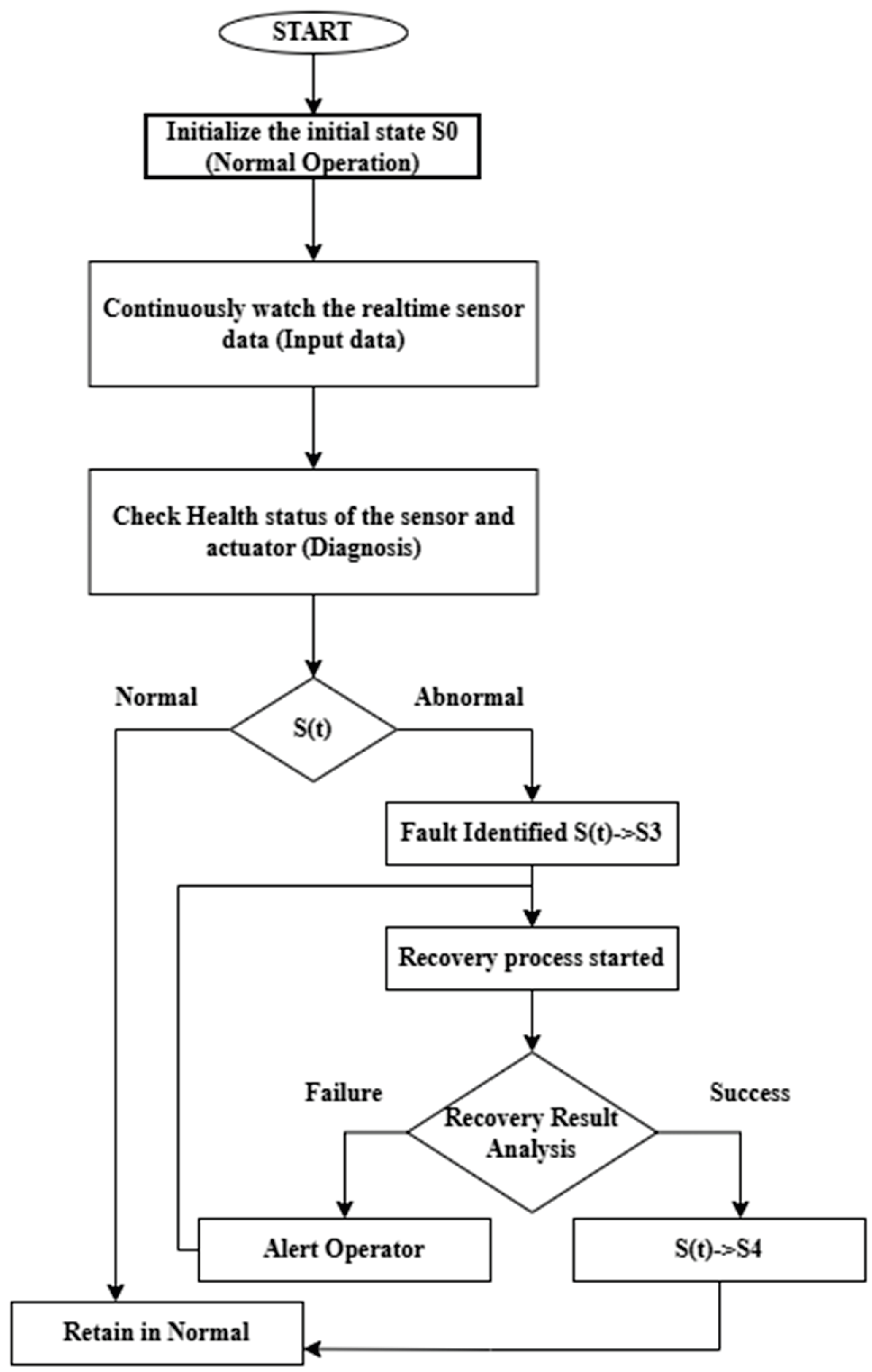
Figure 2 demonstrates the process of fault identification and recovery in mobile robot starts by initializing the system state. The finite-state machine (FSM) begins with its starting state, represented as
. The process of fault identification and recovery in a mobile robot starts with initializing the system state. The finite-state machine (FSM) begins with its starting state, represented as
This state depicts the system’s typical working condition, often known as the healthy baseline. The baseline serves as the point of reference for additional monitoring, and the system makes the assumption that all sensors and actuators are operating as expected. The system assumes that all sensors and actuators are operational, and it serves as a reference for future monitoring [
30]. The system continuously checks the real-time data from sensors and actuators after it has been initialized. The mathematical form of these inputs is
, where
is the vector of observations at time t. This stage ensures that a steady flow of data regarding the robot’s condition and functionality reaches the FSM. After availing of all inputs, the robot enters into the next stage for assessing the condition of both actuators and sensors. A diagnostic function
has been used by the FSM for inputs
to determine the operating status of the components as designed. The input function includes the sensor signal, actuator signal, and feedback from the environment. The function determines the acceptability of the numbers in the operational range by analyzing the input data. Further, the current state
) has been computed based on the assessment. The
function examines these inputs to confirm their uniformity and authenticity by checking their range validation (here all reading from a sensor and actuator is compared to predetermined thresholds), temporal consistency check (In order to identify abrupt spikes or declines that are either physically impossible or extremely impractical, the system compares current values with those from earlier time steps. This stops temporary noise from being mistakenly categorized as a flaw.), correlation analysis (Actuators and a few sensors are interconnected. For example, associated position or velocity sensors should exhibit equivalent changes if a motor actuator is in operation. A malfunction could be indicated by an error amongst associated signals.), and residual/error calculation (By contrasting real sensor outputs with values anticipated by an algorithm used for machine learning or mathematical model, the system can calculate residuals [
31]. The residual is marked as abnormal behavior if it is over a threshold.). Now the robot enters into a decision state. In this state, the FSM determines if the system remains in an optimal condition or if there is an anomaly once these diagnostic tests are completed. The FSM sets
(normal operation) if every test is passed. However, the FSM sets
, which indicates a fault status if any inconsistency, deviation, or failure is found. This choice serves as the catalyst for entering the phases of fault detection and rehabilitation efforts. The diagnosis is then used by the FSM to make a decision. The system stays in the regular operational state (S(t) = 0) if no anomaly is found, which means the robot keeps functioning without being interrupted. Further, the FSM enters into the fault-detected state (S(t) = 1) if a fault is found. The system recognizes it and executes fault-handling procedure. The FSM transits to the fault identification state (
indicating the occurrence of a fault. After that, it enters state S2, where the problem is more precisely located. It is important to identify the issue location and its types too. The system transits to the fault recovery state (
), where the recovery procedure is started. Corrective measures are implemented here in order to return the system to normal operation. Depending on the severity of the malfunction, this may entail applying backup mechanisms, rerouting control commands, or recalibrating sensors. Finally, the robot reaches the results analysis stage to verify the status of the following recovery attempt and the FSM assesses the results. If recovery is successful, then the system moves to state S4, when the robot continues regular operations after equilibrium has been confirmed, otherwise the FSM enters state
. The operator is notified to manually intervene when the robot enters a shutdown phase, which stops more harm or dangerous operation in the mobile robot [
32].
Table 1 describes the state name and its description. Furthermore, the fault types are discussed in
Table 2.




 ,
,