Review

Robotic Disassembly of Electrical Cable Connectors: A Critical Review

Department of Industrial Engineering (DIN), University of Bologna, Via Terracini 24, 40131 Bologna, Italy
*
Author to whom correspondence should be addressed.
Robotics 2026, 15(3), 60; https://doi.org/10.3390/robotics15030060
Submission received: 26 January 2026 / Revised: 26 February 2026 / Accepted: 11 March 2026 / Published: 13 March 2026
(This article belongs to the Section Industrial Robots and Automation)

Abstract

The rapid increase in the production of Waste Electrical and Electronic Equipment (WEEE) and batteries requires advanced automated disassembly solutions. While disassembly automation has progressed, the non-destructive removal of electrical cable connectors (ECCs) remains a critical unresolved challenge, particularly for battery packs where safety is paramount. This paper presents a critical review of the state-of-the-art in robotic ECC disassembly. To systematically assess the technological maturity of the field, the authors introduce a functional decomposition of the process into six fundamental tasks: detection, pose estimation, accessibility, motion planning, manipulation, and extraction. While detection, pose estimation, and manipulation are more advanced due to contributions from adjacent fields like assembly and inspection, accessibility, motion planning, and extraction are still at an early stage. Based on the identified gaps, the authors suggest that future developments could follow two main directions: leveraging comprehensive databases for applications with limited variability, or shifting the disassembly approach from the connector housing to the locking mechanism to achieve broader applicability.

1. Introduction

Over the last decade, the ongoing increase in global waste production has posed an increasingly serious threat to our planet’s health. Waste Electrical and Electronic Equipment (WEEE) is a critical and rapidly expanding category [1]. According to the United Nations Institute for Training and Research [2], more than 62 billion kilograms of electronic waste were generated worldwide in 2022, yet only 22.3% was properly collected and recycled. Much of the remaining waste is unaccounted for, either being exported to countries with inadequate recycling infrastructure or sent to landfills, where it releases hazardous pollutants and exacerbates environmental degradation [3]. This issue is further complicated by the rapid shift towards electric mobility. With electric cars making up more than 20% of all new car sales globally [4] and the average lifespan of lithium-ion batteries being approximately 8 years [5], battery disposal will represent a massive challenge in the immediate future. Due to the broad scope of this review, the authors will refer to general electronic waste as “e-waste” since it encompasses both WEEE and batteries.
To address the growing challenge represented by e-waste, circular economy models have been developed to maximize product longevity and reuse [6]. In practice, a ’9R Ladder’ framework (Refuse, Rethink, Reduce, Reuse, Repair, Refurbish, Remanufacture, Repurpose, Recycle, and Recover) [7] was proposed, collecting active strategies covering the complete product lifecycle from the design to the dismantling phase. All active end-of-life strategies involve disassembly to a certain level. In the case of repair, only minor intervention is typically required [8], whereas higher-level strategies such as refurbishing and remanufacturing rely on significant disassembly to restore operative conditions [9]. Finally, recycle and recover strategies benefit from material-consistent waste streams obtained through complete disassembly [10].
Currently, e-waste disassembly is mainly performed by properly trained and equipped workers. While handling electrical waste, operators are exposed to several hazards: (1) electrical, due to potential residual charge in batteries [11], (2) chemical, due to the release of dangerous substances such as hydrogen fluoride and carbon monoxide from batteries [12], (3) biological, due to contaminant compounds and dust releasing from waste [13], and (4) mechanical, due to cuts, punctures, and abrasions from sharp corners and edges [14]. Given the need to increase waste processing volumes and improve working conditions for operators, researchers are trying to automate disassembly by focusing on three main issues: (1) assessing the state and residual properties of each item [15]; (2) planning the optimal disassembly sequence and level of detail given certain cost functions [16]; and (3) developing strategies to execute the required tasks [17]. Despite advancements in robotics, computer vision, and artificial intelligence, fully automated robotic e-waste disassembly remains feasible only under strict constraints. Challenges such as limited information availability [18], complex optimal planning [19], and the difficulty of automating specific tasks (e.g., disconnecting press-fit joints, detaching glued parts, or unmating connectors) [20] often necessitate hybrid human–robot solutions [21,22]. Consequently, fully autonomous systems are restricted to specific use cases. A notable example is Apple’s Daisy robot [23], which successfully disassembles various iPhone models by leveraging low product variability, complete data accessibility, and partially destructive disassembly methods.
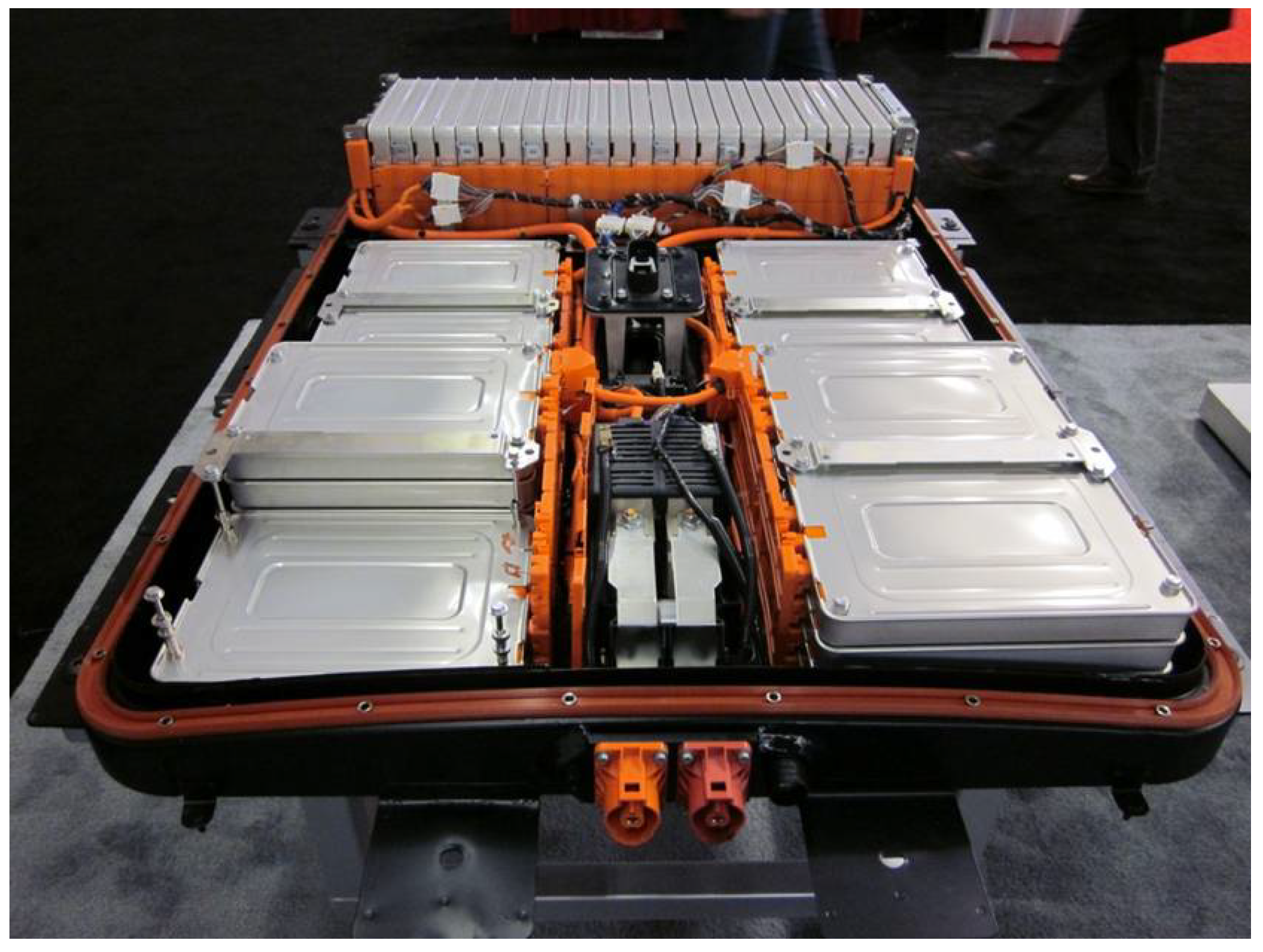
Robotic disassembly automation is a rapidly growing field of research, driven largely by the significant literature surrounding EV batteries [24]. However, as noted by Kaarlela et al. [20], the level of attention devoted to different disassembly tasks varies significantly. While processes such as robotic unscrewing are becoming increasingly consolidated [17,25], other tasks, such as wire harness disassembly, remain largely underexplored. In particular, the vast variability of connectors and locking mechanisms, combined with complex cable routing and an obstacle-rich environment (see Figure 1), makes autonomous wire harness disassembly a notoriously complex task. As a result, current solutions predominantly rely on destructive strategies, such as cable cutting [26] or connector destruction [27], although these strategies exhibit intrinsic limitations. In battery-powered devices, destructive approaches increase the risk of short circuits, thereby threatening human safety and compromising the integrity of reusable components. Furthermore, in the context of repair or refurbishment, destructive methods might not be a viable option. Therefore, the necessity for non-destructive strategies in wire harness disassembly inevitably leads to the scope of this review: the non-destructive disassembly of electrical cable connectors (ECCs).
In an effort towards a safer and improved automation of robotic wire harness disassembly, the present work critically reviews the state of the art in cable connector disassembly. Most existing reviews are valuable for cataloging technologies and assessing recycling potential, but they remain largely descriptive and closely follow the systematic review protocol [28]. In contrast, there remains a shortage of reviews that critically analyze the technical challenges of specific disassembly tasks, particularly in relation to automation, detection, and manipulation strategies. For this reason, the present work adopts a critical review approach: the aim is not only to summarize existing knowledge but also to evaluate its limitations, highlight unresolved challenges, and identify promising research directions. To the best of the authors’ knowledge, no review currently addresses the specific topic of electrical cable connector disassembly. This work therefore seeks to fill that gap by answering the guiding question: “Are there enough adequate methods, tools and technologies to support the fully automated robotic non-destructive disassembly of electrical cable connectors?”. To address this objective, this review adopts a critical evaluation framework focused on the transferability of existing strategies to the specific challenges of ECC disassembly. Given the absence of comprehensive studies addressing this problem and the low average level of technological maturity due to applications typically limited to laboratory-scale research (TRL 3-4 [29]), we analyze strategies and methodologies from related fields by assessing their robustness against the unstructured nature of e-waste. Despite this current gap, establishing a robust technical baseline is a necessary first step toward industrial viability. Once an integrated framework for ECC disassembly is validated, it could potentially enable deployment in high-value application domains, such as the automated recovery of electronic components from end-of-life computers and electric vehicles or the automation of maintenance tasks for electrical panels and industrial machinery.
The paper is structured as follows. Section 2 provides the research background, introducing the problem of cable connector disassembly. Section 3 presents the research methodology used to collect and analyze the literature. Section 4 reports the state-of-the-art findings on the most critical aspects of connector disassembly. Finally, Section 5 and Section 6 present the discussion and conclusions, respectively.

2. Research Background

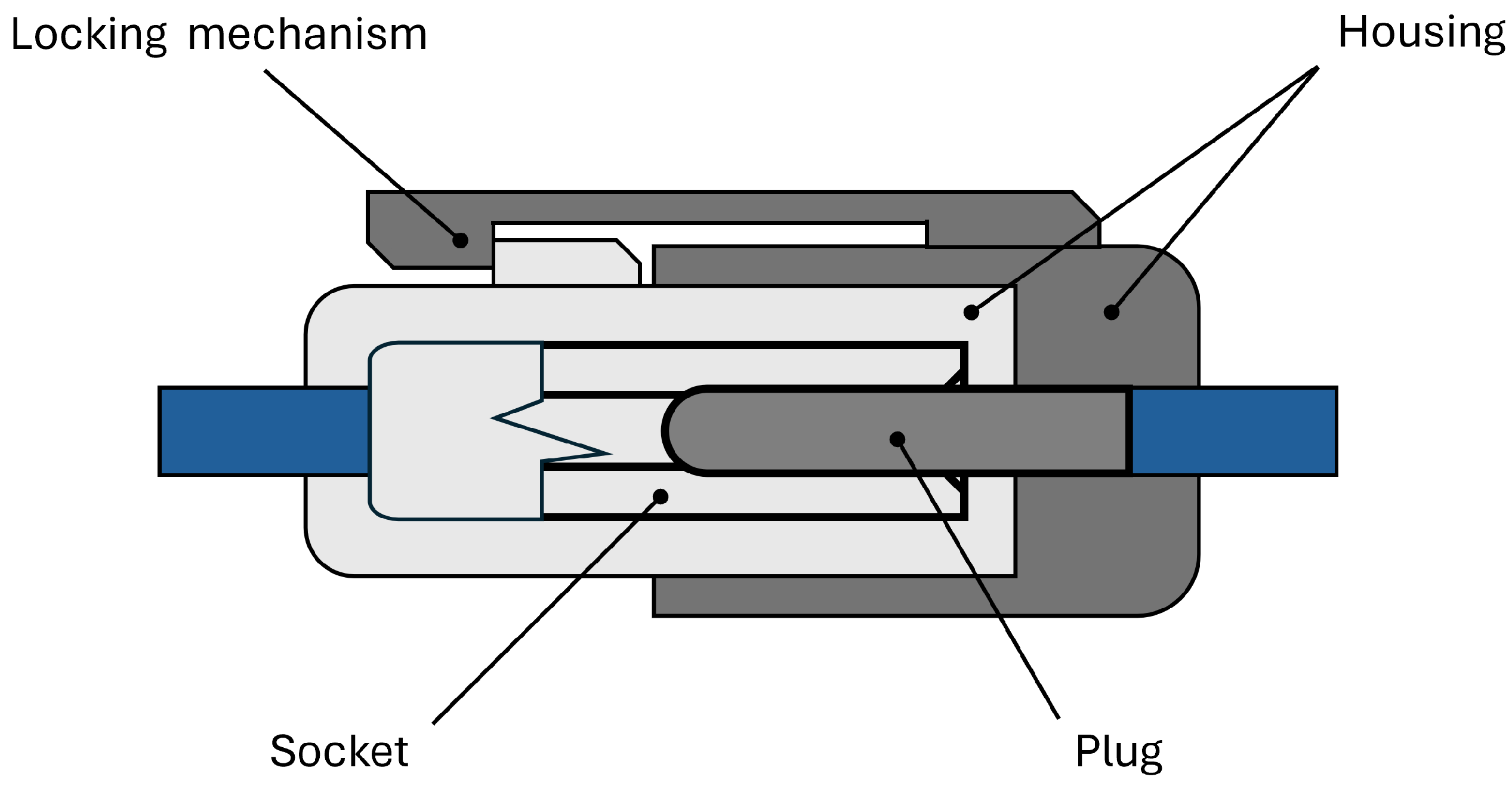
By definition, an electrical cable connector is an “electromechanical component that provides a separable interface between two parts of an electronic system without compromising the performance of the system” [30]. As shown in Figure 2, the main elements of a connector are the contact spring (plug or socket) and the connector housing. In most cases, a locking mechanism is also present. This mechanism ensures a solid and reliable coupling between the plug and socket and helps to reduce the mechanical stress directly applied to the terminals.
Disassembling ECCs is a challenging task due to both identification and manipulation problems. The most relevant among the former are as follows:
  • Unknown number and type of ECCs. Unless prior knowledge of the product is available, the number and types of connectors cannot be determined in advance. In e-waste disassembly, information such as CAD models or component lists is usually accessible only when working with specific, well-documented products [18].
  • High variability in shapes and dimensions. Connector standards such as DIN 41612 for PCB connectors and IEC 61076 for circular connectors provide structured specifications; however, significant variability remains due to diverse application requirements and manufacturer-specific designs. As a result, since it is unfeasible to compile exhaustive information on all existing ECCs, autonomous disassembly systems should not rely on precise shapes to detect connectors unless processed products are established in advance.
  • Unpredictable condition of ECCs. Detection is further complicated by the fact that connectors in e-waste often suffer from typical end-of-life issues such as damage, dirt, or occlusion by other components.
  • Lack of training datasets. To the best of the authors’ knowledge, there are currently no publicly available ECC training datasets for deep learning-based detectors. As a result, several researchers develop their own datasets for direct ECC detection [31,32], wire harness detection [33], or ECC orientation estimation [34].
Instead, manipulation problems include the following:
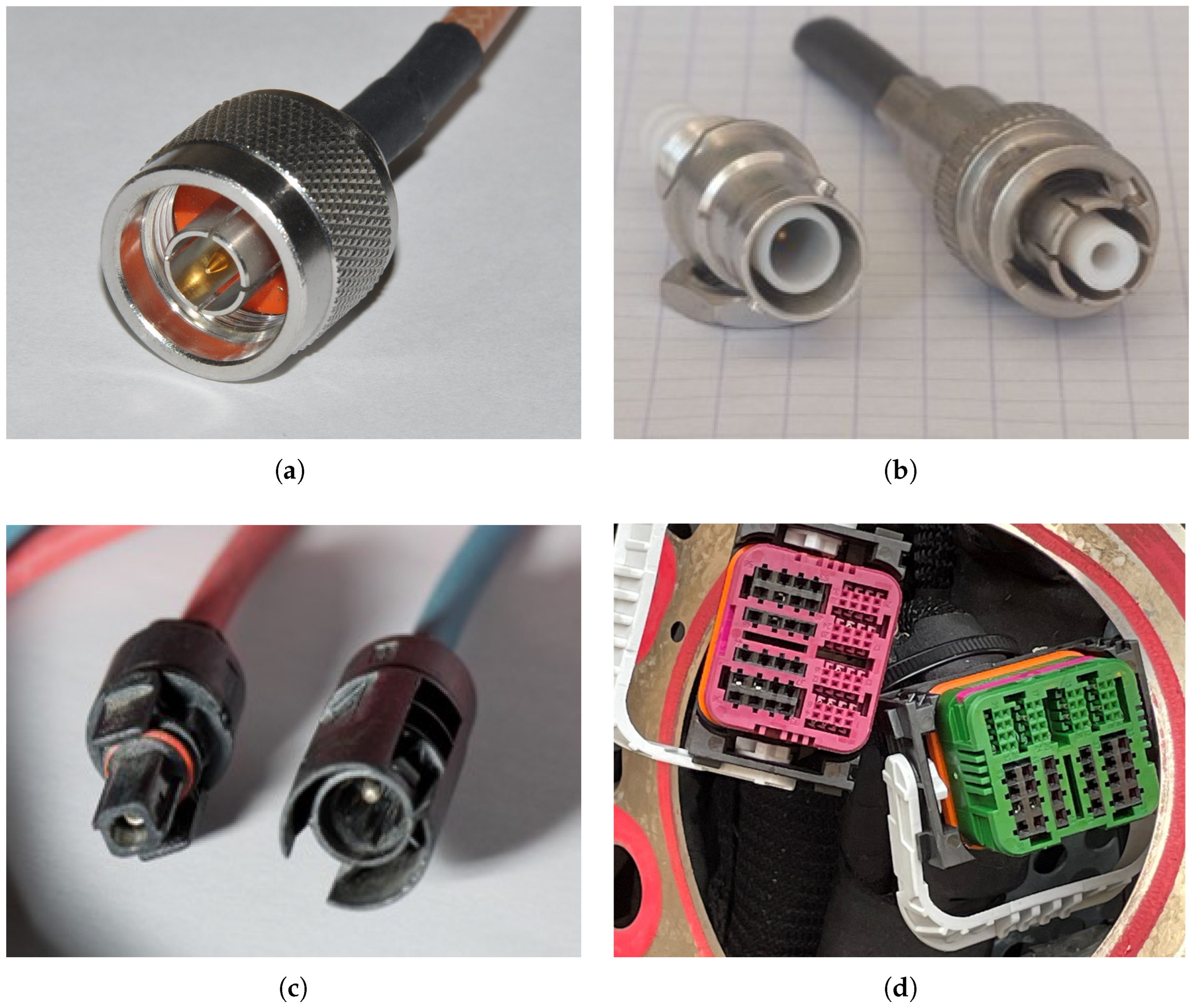
  • Variety of locking mechanisms. As shown in Figure 3, several types of locking mechanism exist and each one requires different unlocking strategies (see Table 1). Unlocking may involve twisting, pulling, pushing specific features, or a combination of these actions. As demonstrated by Zang et al. [35], it is possible to design suitable grippers for connectors with similar locks; however, a general solution has yet to be found.
  • Designing a universal end-effector. While each connector could be disassembled with a specialized tool, the required number of tools would be impractical. A universal end-effector for connector disassembly should rely on articulated grippers with several degrees of freedom (DoF) [36], enabling the system to reach, orient, and manipulate connectors in constrained or awkward positions. Compliance may also be beneficial to handle small misalignments and reduce the risk of damage.
  • Spatial constraints. Connectors are often embedded in dense assemblies, leaving little room to manipulate locking mechanisms without damaging nearby components. Thus, grippers must be as compact as possible while still being equipped with active joints. Inspiration for such designs may come from other domains, such as soft robotics and bio-inspired mechanisms [37].
  • Unknown mechanical properties. Factors such as extraction force, elasticity, tensile strength, and impact resistance are rarely documented but are crucial to avoid damaging physical interfaces of reusable parts, especially board-mounted connectors.
Destructive disassembly is currently the prevailing solution for addressing complex challenges in e-waste component recovery. For example, in the context of module-to-cell battery disassembly, Kay et al. [38] developed a tool integrated with a circular saw to cut through modules. A similar approach using a circular saw is also adopted by Quattrucci et al. [26] for ECC disassembly. To reduce internal damage risks, they develop a soft tendril end-effector designed to grasp and pull cables toward the saw, thereby maintaining a safe distance from other components. Assadi et al. [27] developed a robotic cell for battery system disassembly and evaluated various machining strategies for connector destruction, including peripheral milling, plunging, and cable cutting. Despite being aware of the short-circuit risks, they suggested that excluding coolant from the process and using vacuum systems to remove metal chips would solve the problem. On a higher level, Foo et al. [39] propose an ontology-based model for disassembly sequence planning, which defaults to cable cutting if electrical wiring is encountered, a strategy also followed by Tan et al. [21]. Conversely, Saenz et al. [18] acknowledge the challenge of non-destructively releasing latched plug connections but opt to avoid this complexity. In their review about the disassembly of electric vehicle batteries, Kaarlela et al. [20] examine the specific challenges of wire harness and cable connector disassembly. They emphasize the critical role of robotizing this task and agree that cutting cables is often not a viable solution due to short-circuit hazards. Their analysis highlights limitations in detection, planning and manipulation, and concludes that industrial applications are still far. In general, destructive techniques applied within confined spaces, such as those containing electronic assemblies, require special attention to avoid unwanted damage. This is especially important for battery-powered devices where short circuits, the release of toxic substances, flames, and explosions could all occur [40]. While destructive strategies like cable cutting may appear advantageous due to their simplicity and reduced precision requirements, their operational drawbacks are often unacceptable. In repair and refurbishment scenarios, preserving the wire harness is essential, making destructive approaches fundamentally unsuitable. Even in recycling contexts, cutting cables leaves conductive copper exposed, which could inadvertently trigger short circuits by bringing metallic edges closer together. Furthermore, in disassembly to recover functional components, destructive strategies on cables would still require ECC disassembly to clear connection interfaces. According to the authors, the only instance in which destructive strategies can be considered is after the separation of all connectors as a simplification of the last steps of the wire harness extraction. However, the possibility of adopting this solution still depends on the specific application, the value in preserving the harness integrity, and the risk of causing unintended damages to other parts.
In conclusion, the non-destructive disassembly of connectors is the only strategy that ensures safety and component preservation. Therefore, this task could be extended beyond e-waste to the general maintenance of industrial and power systems [35], underscoring the significant research value of investigating non-destructive ECC disassembly.

3. Research Method

This study began with a survey of published review articles on e-waste disassembly. This preliminary step identified an important gap in the literature represented by the non-destructive disassembly of electrical cable connectors. Given this gap, a critical review was performed by collecting relevant articles in two distinct phases. In the first phase, a preliminary literature search was conducted on Scopus. The initial search query was defined using broad and inclusive keywords related to connector disassembly to generate a wide pool of potentially relevant articles. Specifically, the query “(cable OR wire OR power OR electr* OR signal) AND (connector OR fasten* OR plug OR harness)”was applied to titles, abstracts, and keywords, and returned 115,775 articles. This very high number was due to many irrelevant results inevitably included by the large number of possible keyword combinations. To narrow the focus on disassembly, the keyword “disassembly” and all its possible variants were included by adding “disassembl*” to the search query. This refined search yielded 319 articles, which were narrowed down to 46 with the addition of the keyword “*robot*”. To avoid losing relevant articles, the titles and abstracts of all 319 results were screened, leading to 26 articles selected for complete access. The analysis revealed that many of these works acknowledge the problem of wire harness management during disassembly, but none of them comprehensively address the issue of connectors, from detection to extraction. Moreover, the disassembly of ECCs is mainly addressed only in recent studies on EV battery disposal, and it is usually treated as a secondary theme. Given these limitations and the fact that 26 partially related articles are insufficient to constitute a state of the art, a second research phase was essential. In the second phase, rather than attempting to tackle the disassembly of ECCs as a single process, a sequence of sub-tasks was identified and addressed.
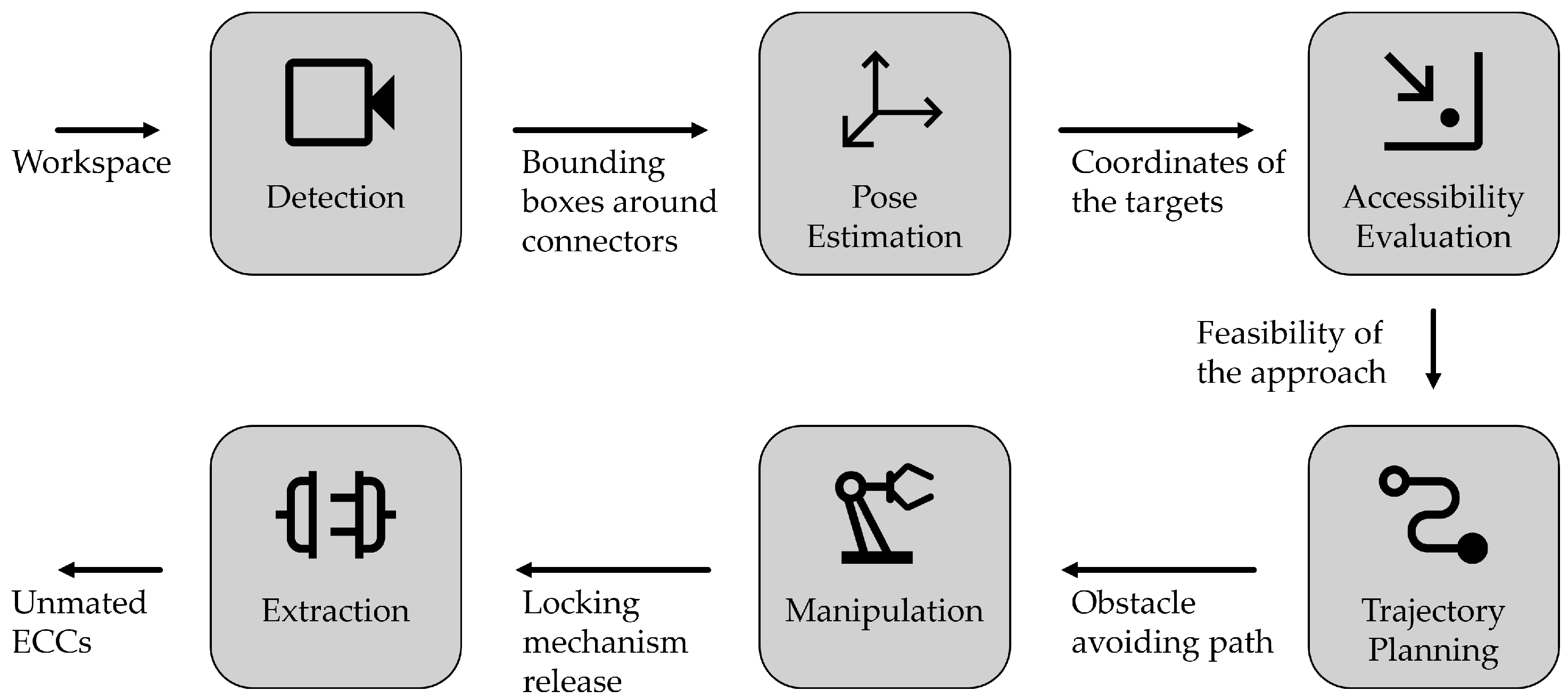
As shown in Figure 4, the automated disassembly process begins with the perception of connectors within a given electronic device. Initially, detection algorithms identify regions of interest within the workspace. Subsequently, pose estimation algorithms are applied to these regions to determine the exact coordinates of the target ECCs relative to the robot’s reference frame. Once the targets are localized, the motion planning phase, which is tailored to the specific architecture of the robotic manipulator, is executed. This phase is divided into two distinct steps: accessibility evaluation to determine the feasibility of reaching the target, and trajectory planning to compute collision-free paths. Finally, preliminary manipulation may be required to disengage any locking mechanisms prior to extracting the plug from the socket. Based on this decomposition, the sequence of sub-tasks involved can be described as follows: (1) detection, (2) pose estimation, (3) accessibility evaluation, (4) trajectory planning, (5) connector manipulation, and (6) extraction. Specific queries were built for each of the six steps by adding proper keywords such as (1) detection or identification, (2) pose estimation, (3) robot* and accessibil*, (4) robot* and (motion or trajectory) and planning, (5) robot* and manipulation, and (6) robot* and extract* or pull* or remov* or unmat* to the previously introduced base query, namely (cable OR wire OR power OR electr* OR signal) AND (connector OR fasten* OR plug OR harness). Since the detection query returned more than 12,000 results, the base query was replaced only with relevant keyword combinations about cable connectors such as "cable connectors" or "wire connectors" or "electric* connectors" or "cable harness" or "wire harness" or "power connector" or "cable plug" or "wire plug" or "cable fasten*" or "wire fasten*" or "wire termin*" or "cable termin*" or "electric* termin*" or "plug connector".
In conclusion, 133 articles were fully analyzed and categorized. Following a relevance assessment, 45 papers were deemed strictly relevant to the scope of this review and included in the core analysis. To ensure comprehensiveness, the results were supplemented with 34 additional articles. These were identified either from the reference lists of the cataloged articles or through targeted searches to address specific gaps, such as those discussed in Section 4.3.

4. Results

This section presents the results of the literature review. The contributions offered by the 79 reviewed papers are grouped into subsections according to the six disassembly sub-tasks defined above. Each subsection details the various strategies currently adopted, emphasizing the advantages and disadvantages of each. In addition, for the reader’s convenience, summary tables are provided for the subsections related to the most addressed themes.

4.1. Detection

Automated disassembly begins with reliably detecting ECCs within potentially complex assemblies. This initial step is crucial because subsequent tasks, such as pose estimation, reachability analysis, and manipulation, depend on precise detection. However, detecting ECCs in e-waste presents unique challenges. Connectors may vary widely in geometry and size, be partially obstructed by surrounding components, or appear in degraded condition due to aging and use. Additionally, the lack of publicly available datasets for connector detection hinders the development and benchmarking of robust perception methods. For these reasons, the detection stage is a significant bottleneck in non-destructive disassembly. Recent research has increasingly explored computer vision and deep learning techniques to address this issue.
Traditional computer vision-based detection methods depend on prior knowledge and controlled environments. They usually process images through a structured sequence: noise reduction and color conversion (to grayscale or HSV), followed by threshold-based binarization and edge detection to extract connected regions (blobs). Geometric filtering based on blob size or shape is then applied to separate cables and connectors from background elements. Several studies have demonstrated the feasibility of this approach for connector recognition under controlled conditions with uniform backgrounds. For example, Yumbla et al. [41] apply color-based segmentation and blob analysis to detect multiple connectors in a wire harness, while Monguzzi et al. [42] combine background subtraction and morphological operations to identify connectors and estimate their occlusion state in cluttered cable scenes. Similarly, Tamada et al. [43] adopt comparable techniques for high-speed cable manipulation. Although the strategies adopted in those papers yield promising results, their effectiveness is limited to structured environments with planar reference backgrounds and well-oriented, single-cable connectors. These approaches are ideal for industrial assembly scenarios, such as electronic products’ assembly lines, since connectors are located in structured and predictable environments. However, in e-waste disassembly scenarios, the background surrounding connectors varies significantly, both between different waste items and within a single object. Variations in color, texture, and lighting conditions make defining universal thresholds that allow for reliable segmentation virtually impossible. Under these circumstances, binarization becomes unreliable, and edge detection algorithms may often fail. Additionally, a priori rules concerning connector shape or size cannot be applied without first defining a specific, fixed product category. For these reasons, traditional computer vision-based detection is not applicable to disassembling ECCs from e-waste.
An alternative, newer approach to connector detection uses convolutional neural networks (CNNs) to develop deep learning-based object detectors. These detectors often replace traditional computer vision pipelines thanks to their ability to abstract object representation by learning characteristic features from images provided during training. For this reason, object detectors are capable of detecting targets even in different or previously unseen contexts. Usually, the network training process is supervised, meaning that labeled datasets are used. These datasets comprise images where target objects are annotated with bounding boxes and class labels. The accuracy and generalization ability of the final models depend on the quality and diversity of the training data (e.g., variety of objects, backgrounds, lighting, and occlusions) and the architecture (e.g., depth, width, layer type, and backbone). Regarding the latter, CNN architectures for object detection can be broadly categorized into two main classes: two-stage and one-stage detectors.
  • Two-stage detectors first generate a set of candidate object regions on the processed image and then, in a second stage, classify and refine these proposals. These models typically have a deeper and more complex architecture, often combining a powerful backbone network (e.g., ResNet [44] or VGG [45] for feature extraction) with region proposal and classification heads that include multiple convolutional and fully connected layers. The added architectural depth and modular design generally improve accuracy and robustness, particularly for small or partially occluded objects, but increase computational cost and inference time. For these reasons, two-stage detectors are commonly adopted in inspection and defect-detection tasks where precision is prioritized over speed. For instance, Zhang and Shen [46] employ an improved Faster R-CNN [47] model to locate and classify solder-joint defects on connector pins, while Calabrese et al. [48] use Mask R-CNN [49] for printed circuit board defect detection. The most widely used networks of this class include R-CNN [50], Fast R-CNN [51], Faster R-CNN, and Mask R-CNN.
  • One-stage detectors directly predict object bounding boxes and class probabilities in a single forward pass over the image, without a separate region proposal stage. Architecturally, these models are shallower and more streamlined, often relying on lightweight backbones (e.g., Darknet [52], MobileNet [53]) and feature pyramid or multi-scale prediction layers to balance accuracy and speed. Their compact design allows real-time inference and makes them well suited for embedded or resource-constrained systems, even though sometimes at the expense of detection accuracy. Due to these advantages, one-stage detectors are widely used for connector and component detection tasks. For example, De Gregorio et al. [54] employ YOLO [55] for wire terminal detection, achieving 88% mean average precision (mAP) after fine-tuning a model pre-trained on ImageNet with 5000 workspace images. Other studies adopt YOLO and its variants or MobileNet-SSD architectures for similar applications [33,56,57]. Although most of these works use images with plain backgrounds, the ability of such models to detect objects in complex scenes has been extensively demonstrated in the literature [58].
A significant comparative analysis of the performances of one-stage and two-stage models in ECC detection was performed by Wang and Johansson [31]. In their study they consider 20 different connectors from the automotive sector and compare the detection performances of YOLOv5 [59] and two versions of Faster R-CNN trained on the same custom dataset. Their results suggest a consistent better performance of YOLOv5 with an overall mAP of 88.5% across all classes of connectors against mAPs of 66.5% and 47.1% for the two versions of Faster R-CNNs. Similar results also emerge from a comparative analysis performed by S. Li et al. [60] between multiple detectors, including Faster R-CNN, SSD [61], RetinaNet [62], YOLOv2 [63], and YOLOv3 [64], for the detection of aviation connector parts. It is worth mentioning that, as suggested in [31], the tested models tend to struggle when different classes of connectors share similar shapes and colors or when distinctive features are not clearly exposed. As a consequence, certain classes of connectors, despite being properly detected, are always classified incorrectly.
In recent years, transformer-based architectures have emerged as a powerful alternative to CNNs within the class of deep neural models for visual perception tasks, including both object detection and segmentation [65]. Hierarchical vision transformers, such as the Swin Transformer [66] and MViT-v2 [67], enhance multi-scale feature representation and have outperformed many convolutional backbones on standard benchmarks. Their main advantages include a better capacity to model long-range contextual relationships and improved robustness to background variability, although they typically require larger training datasets and considerable computational resources. Despite these challenges, transformer-based models are increasingly being adopted in industrial and robotic vision due to their superior accuracy and generalization capabilities.
Beyond object detection, a more fine-grained formulation for connector recognition is instance segmentation, which provides additional detail by identifying not only the location but also the precise contour of each object. This can be particularly advantageous for connectors that appear close together, overlap, or vary in shape. For instance, Zorn et al. [68] develop a segmentation-based vision pipeline for automated lithium-ion battery disassembly, combining pixel-level segmentation with 3D registration to accurately isolate different components, including cable plugs. Segmentation has also already been applied to several other components like wires [69], screws [70], and PCB surface coatings [71].
Recent advancements in artificial intelligence have introduced foundation models and multimodal perception to improve detection and segmentation without relying on large, domain-specific datasets. Large-scale pre-trained architectures, such as the Segment Anything Model (SAM) [72] and Vision-Language Models (VLMs) like CLIP [73] and Grounding DINO [74], typically integrate multimodal inputs, such as text and images, for the identification of target objects. These models mitigate the need for task-specific retraining and, given appropriate prompting, have demonstrated robust zero-shot generalization capabilities for the detection and segmentation of diverse objects in visually complex environments. However, to the best of the authors’ knowledge, they have not yet been specifically adapted for the disassembly of ECCs. Nevertheless, they hold significant potential to identify and segment novel, occluded, or degraded connectors, effectively shifting the perception paradigm from supervised learning on scarce data to prompt-based multimodal discovery in unstructured streams.
Finally, an alternative to direct connector detection is the identification through physical cable following. As shown by Mazzotti et al. [75], it is possible to rely only on haptic feedback and reinforcement learning-based controllers to follow a rigid path with a robotic end-effector. Similarly, Monguzzi et al. [76] demonstrate that, in addition to cable-following, it’s possible to detect connectors given force feedback and sufficiently stiff cables. Although the principle is interesting, physical cable-following would be difficult in a disassembly scenario due to the limited available space for manipulation on the high risk of contacts with other components. Nevertheless, the concept of indirect connector identification through cable following might be further explored, replacing the physical approach with a visual one. In fact, cable identification could be an effective support tool for detection because it could be used to infer the presence of hidden connectors. The segmentation of cables and wire harnesses can be performed directly from images using specific algorithms such as RT-DLO [77], mBEST [78], and more recently, CVF-DLO [79]. Alternatively, it is possible to segment key features such as branching, overlapping, and termination points [80] and use this information to support depth-based harness reconstruction [81].
Overall, learning-based methods represent the current state of the art for connector detection, offering substantial improvements over traditional computer vision in terms of robustness to lighting, orientation, and partial occlusions. While most of the existing literature focuses on structured assembly tasks, neural networks—ranging from standard CNNs to Vision Transformers and emerging Foundation Models—remain the most promising approach for disassembly. The reliance on large, annotated datasets continues to be the primary bottleneck for standard supervised models. However, emerging methodologies, such as zero-shot multimodal perception, provide a potential trajectory to overcome this limitation.
The content of this subsection is summarized in Table 2 and Table 3: the former reviews the most relevant general approaches to connector detection, while the latter focuses on methods based on deep neural models.

4.2. Pose Estimation

Once a connector has been detected, the next challenge is estimating its pose, which defines its position and orientation relative to the robot. Accurate pose estimation is critical for determining how a connector can be accessed and manipulated without damaging nearby components. Recent approaches have explored computer vision methods for 6D pose estimation, including 3D-model-based and learning-based techniques, to improve robustness, although dataset scarcity and geometric diversity remain open challenges.
The success of the estimation strategies discussed below is intrinsically linked to the sensing technology employed. Therefore, before analyzing specific algorithms, it is necessary to evaluate the trade-offs of the principal sensing modalities. Given that several camera-based technologies can be used to address both pose estimation and detection, the latter task is also considered in the following analysis. Cost-effective solutions employ standard RGB [42] or grayscale [43] cameras. While object detection from 2D images is straightforward, pose estimation often fails in cluttered e-waste disassembly scenarios. The absence of depth information necessitates simplified operating conditions, typically requiring prior knowledge of connector shapes, dimensions, and constrained orientations. Stereo vision systems, consisting of two cameras, compute depth by identifying visual correspondences between the left and right images [82]. By utilizing the known extrinsic parameters that define the rototranslation between the cameras, the depth of scene points is computed via triangulation. However, these systems struggle when correspondence matching is hindered by non-textured surfaces, reflective materials like metals, or occlusions that prevent a point from being visible to both cameras simultaneously. RGB-D cameras offer a robust alternative, integrating a standard RGB sensor with a dedicated depth sensor, such as time-of-flight (ToF) [83] or structured light (SL) [68] sensor, to associate depth data with each pixel. Specifically, ToF sensors calculate depth by measuring the return time of an emitted infrared pulse, whereas SL sensors derive depth from the distortion of a known light pattern projected onto the scene. While the RGB sensor grants consistent detection accuracy, these systems suffer from distinct limitations: ToF sensors are prone to multipath interference (MPI) caused by light bouncing within concave corners, while SL sensors are susceptible to ambient light interference and shadowing effects. Finally, to address the susceptibility of standard RGB sensors to variable lighting and reflections, near-infrared (NIR) sensors can be employed to acquire images in the infrared spectrum. NIR sensors have been successfully combined with ToF data to enhance pose estimation robustness [84]. Alternatively, pose estimation and detection could also be addressed independently with dedicated sensors. For example, detection can be addressed with multispectral or hyperspectral cameras [85] that capture image data across multiple discrete spectral bands, and pose estimation can be addressed with laser triangulation scanners [86] that project a laser line across the target while a receiver measures the laser’s deformation via optical triangulation.
The simplest approach to estimating the pose of a connector is to infer its position and orientation under planar conditions by using traditional computer vision algorithms and prior knowledge. With this method, the connector is assumed to lie on a given X-Y plane, reducing the problem to estimating a subset of the full 6D pose. In practice, the X-Y position can be derived from the image coordinates using geometric projection models, and the Z coordinate is assumed to be that of the plane. Rotations around axes lying in the plane can be considered negligible, while the rotation around the Z-axis is determined by the direction of the major axis of the connected regions representing connectors. Such methods are exemplified by Monguzzi et al. [42] and Tamada et al. [43], who employ planar approximations combined with blob or edge analysis to recover connector poses in structured environments using RGB and grayscale cameras. Although these methods work well in controlled environments with uniform backgrounds and well-oriented connectors, their applicability is limited in cluttered or unstructured scenes, where blob extraction is difficult and projections may not accurately reflect the true 3D pose.
Better approaches rely on known 3D CAD models of connectors to estimate their pose. Given the 3D model, pose estimation reduces to a shape-matching problem, which can be performed either directly on the 3D point cloud acquired by a depth sensor or indirectly by matching 2D projections. The former strategy can be accomplished with algorithms like Iterative Closest Point (ICP) registration [87] that align two point clouds by minimizing the distance between corresponding points. However, standard ICP requires accurate initial alignment and limited outliers for reliable convergence. Nguyen et al. [33] address this limitation by proposing a point-to-plane ICP-based registration method using multiple initial orientations to align point clouds of ECCs acquired with an industrial SL RGB-D camera with their corresponding models. Registration robustness was further improved by extracting regions of interest from depth data using object detection and filtering out background outliers. Nevertheless, in disassembly scenarios, this method may struggle due to partial overlap and residual outliers arising from the complex environment. To address these challenges, alternative approaches that rely on coarse alignment to provide robust initial poses for ICP could be adopted. Examples of such methods are feature-based registration approaches like Fast Point Feature Histograms with RANSAC [88] or global optimization approaches like TEASER++ [89]. The latter strategy for 3D-model-based pose estimation consists of matching images of ECCs with projections of 3D models. Indeed, the connector pose can be estimated by computing the rigid transformation matrix that projects the 3D model into the camera frame to match the acquired RGB image [57]. However, this approach is time-consuming as increasing precision requires many projection comparisons.
The availability of 3D models is often assumed in assembly tasks but becomes problematic in unstructured disassembly, where connector types and physical conditions vary. Hence, alternative strategies have been developed. For example, Ying et al. [90] estimate the pose of small connectors without CAD models by using reference point clouds of ECCs acquired from the workspace with an SL 3D scanner. They segment connectors and attached cables from the scene 3D cloud using a height threshold and the PointNet++ [91] neural network. Then, they estimate a rough initial pose via approximation of the connector body as a cuboid, and refine alignment with ICP. Although this approach reduces dependence on CAD models, it still requires a reference point cloud for each connector, limiting its applicability to general ECC disassembly.
Analogous to the approach proposed for ECC detection, connector pose estimation can be carried out indirectly by leveraging information from the cables. Assuming that the connector is attached to the cable termination, the connector’s unknown pose component is its rotation around the cable axis due to axial symmetry. Caporali et al. [34] first estimate cable poses from RGB images [92] and then predict the missing rotation using a neural network as a classification task. However, the estimation errors become particularly relevant in case of small connectors when key features are not clearly distinguishable. A similar approach is used by Mou et al. [93], who rely on the detection of reference features and pins from frontal images of ECCs with YOLOv5, acquired with an RGB camera. These last methods do not need CAD models but at the same time require knowledge of the connectors at hand and suitable labeled data to train a neural network.
All previously listed methods for pose estimation share the limitation of requiring some previously known representations of the connectors in the form of CAD models, reference point clouds, or labeled images. However, approximated approaches, such as superquadric fitting, are capable of estimating the pose of entirely unknown objects by generalizing their geometry into primitive mathematical forms. As demonstrated by Duncan et al. [94], it is possible to efficiently recover the shape and pose of unknown objects by approximating the point clouds acquired by an RGB-D camera with parameterized geometric primitives (e.g., spheres, cylinders, and cuboids). Building upon this, Makhal et al. [95] showed that superquadric representations can directly generate stable robotic grasping poses in severe clutter without requiring prior 3D models. The resulting pose from such a technique would be an approximation of the actual pose of the connector, but it is the opinion of the authors that this compromise might be worth further analysis.
In conclusion, traditional 2D vision and CAD-based pose estimation methods exhibit low transferability to generalized e-waste disassembly. Standard visual approaches are heavily constrained by strict operating conditions, such as the absence of occlusions and the assumption that connectors are placed on a known plane. Meanwhile, CAD-based methods rely on the availability of accurate 3D models and assume high geometric correspondence with the physical objects. These latter conditions are highly unrealistic given the typical variability and degradation of components inside end-of-life electronic devices. In practice, CAD-based pose estimation for ECC disassembly might only be viable in highly controlled applications with limited connector variety, and even then, it should be supported by global registration algorithms robust to heavy occlusions (e.g., TEASER++ [89]). Given the unstructured nature of the disassembly task, focusing on localizing the key features of the locking mechanism could provide a broader approach. Indeed, the combination of visual segmentation and raw depth data could effectively resolve the feature localization problem, allowing for more approximate techniques for housing pose estimation. Shape approximation techniques, such as superquadric fitting [94], have already been successfully employed to estimate the pose of generic, unknown objects in cluttered environments, suggesting high compatibility with the disassembly scenario.
The different pose estimation strategies presented in this subsection are summarized in Table 4.

4.3. Accessibility Evaluation and Motion Planning

Given the position of each cable connector, the robot must determine whether the target is reachable and then compute a collision-free trajectory to it. Accessibility evaluation determines whether a robot can physically reach a target pose. More generally, motion planning instead computes a sequence of valid robot configurations that moves the end-effector from its current pose to the target pose while ensuring continuous clearance from all obstacles and respecting the robot’s kinematic and dynamic limits.
To date, accessibility for ECC disassembly has received little attention. The majority of studies address the more structured task of connector assembly and perform laboratory-level experiments in simplified configurations. The standard test setup includes a connector socket mounted on a planar interface and a robotic gripper holding the plug [57,96,97,98,99]. In such simplified conditions, accessibility computation is unnecessary, as there is no significant risk of collision. Conversely, studies considering realistic workspace avoid the complexity of planning motions within narrow housings by resorting to teleoperation, both in physical [32] and simulated environments [100]. Despite the importance of generating collision-free trajectories, motion planning has also received limited attention in ECC-handling applications. In assembly-focused studies, motion planning is limited to defining search strategies such as spiral [96], tilted [101], zig–zag [35], or sinusoidal patterns [102] to compensate for positional uncertainty. In e-waste disassembly, other tasks such as unscrewing have been performed without explicit motion planning. Given proper elongated tools, in fact, both accessibility and collision avoidance assumptions are implicitly made along the extraction direction [25].
Given the lack of research about accessibility and motion planning in ECC disassembly, the authors provide a brief overview of relevant techniques drawn from the broader robotic literature. As per accessibility, Zacharias et al. [103] introduce reachability or capability maps as high-resolution workspace maps, while Vahrenkamp et al. [104] expand this approach by introducing obstacle-aware feasibility and efficient collision checking. Other techniques for accessibility evaluation exist, primarily integrating obstacle avoidance with reachability analysis for grasping in cluttered environments. Workspace-aware grasp planners, such as those by Akinola et al. [105], utilize precomputed reachability data as a Signed Distance Field (SDF). This SDF acts as a gradient field to guide grasp optimization away from unreachable or near-unreachable regions. Other methods, like visibility-based spatial reasoning by Jang et al. [106], employ visibility queries to rapidly prune grasp candidates that are occluded or blocked by obstacles, streamlining the selection of collision-free approach vectors. Geometric approaches further define graspable subsurfaces consistent with kinematics and collision constraints [107].
In constrained and cluttered spaces, collision avoidance is particularly important and sampling-based planners remain the most widely used class of algorithms in this scenario. Probabilistic Roadmaps (PRMs) [108] construct a graph of collision-free configurations suitable for static environments with repeated queries. Rapidly Exploring Random Trees (RRTs) and their optimal variant RRT* [109] efficiently explore narrow passages, making them suitable for navigating the dense internal structures of electronic devices. Trajectory-optimization methods such as CHOMP [110] and TrajOpt [111] incorporate smoothness and collision costs directly into an optimization framework, producing high-quality paths once an initial feasible trajectory is available. These planners are particularly relevant when parts of the robot must operate inside constrained housings where small clearances and internal obstacles dominate the workspace geometry. Learning-based methods have recently been explored to support planning in complex, partially known environments. Deep reinforcement learning and neural sampling strategies have been used to bias planners toward more promising regions [112,113], improving performance in cluttered or deformable scenes. While promising, these approaches require extensive training data and reliability guarantees before they can be deployed in safety-critical disassembly tasks.
Finally, it is important to note that, with proper algorithms, motion planning can be performed directly without accessibility evaluation. Motion planners such as RRT* and TrajOpt [109] can implicitly determine whether a target is reachable. However, relying solely on the planner can be inefficient in cluttered environments. These planners may spend a significant amount of time exploring narrow passages or proving unreachability. For ECC extraction inside compact e-waste structures, dedicated accessibility evaluation remains valuable, serving as a fast pre-filter that reduces planning time and improves reliability.
In conclusion, the application of accessibility evaluation and motion planning to ECC disassembly remains in a preliminary phase. As demonstrated by the current state of the art, even the closely related field of ECC assembly typically relies on highly structured planar environments or teleoperation, effectively bypassing the complexities of trajectory planning in confined spaces. Consequently, while the general robotic techniques reviewed in this section provide a relevant theoretical foundation, it is premature to prioritize a specific strategy for e-waste disassembly. The true transferability of these generalized algorithms to the cluttered, unpredictable, and easily deformable internal structures of end-of-life electronics requires further empirical testing and benchmarking. Nevertheless, bridging the gap between general motion planning and the highly specific, contact-rich constraints of non-destructive ECC extraction remains a critical open challenge.

4.4. Connector Manipulation

One of the most delicate stages of the disassembly process is the manipulation of ECCs. In this context, manipulation concerns the interaction with the locking mechanism and the grasping of the connector housing. This task involves complex mechanical interactions to disengage active retention systems—such as latches, levers, or clips—and to establish a secure grasp on the component. Successful manipulation requires not only precise positioning but also mechanical adaptability and sensory awareness to handle heterogeneous geometries, uncertain mechanical constraints, and often, hidden locking mechanisms.
The first challenge in connector manipulation arises from the wide variety of connector designs and locking mechanisms. Depending on the connector family, the disassembly may involve linear pulling, twisting, levering, or pressing small latching tabs before extraction. The wide morphological variability makes general-purpose grippers difficult to design, and most research so far has only focused on customized grippers for assembly rather than disassembly. For instance, Sadok et al. [32] designed a geometry-matched end-effector for RJ45 connectors, while Gebauer et al. [96,114] generated gripper jaw geometries directly from available CAD models of the ECCs, parameterizing the contact clearance to tolerate small misalignments while still ensuring successful mating. Similarly, other studies design rigid grippers for the manipulation and insertion of Molex connectors [101] and circular multipolar plugs [102]. Despite being highly accurate, rigid feature-matching grippers lack the adaptability needed for disassembly of multiple connectors and, at the same time, can handle only simple latching mechanisms like the latch of RJ5 connectors (pressed while grasping) [32] or the bayonet-like insertion of the multipolar connector (controlled through wrist motion) [102]. To mitigate the difficulty of manipulating different connectors, passive compliant grippers can be adopted. An example of this solution is represented by Hartisch and Haninger [99] who introduce a fin-ray-effect gripper whose stiffness varies with the loading direction, allowing passive adaptation during manipulation and insertion even without force feedback. As suggested in the paper, however, the design of fingers with suitable mechanical properties is nontrivial and requires a lot of computation and tests. The maximum flexibility is achieved by articulated end-effectors with multiple degrees of freedom. Representative examples in the field of ECC manipulation are the three-finger gripper adopted by Tamada et al. [43] and the multimodal gripper developed by Buzzatto et al. [115] for flexible flat-cable manipulation. In [43], the gripper adjusts the grasp on the basis of the cuboid-shaped connector width and perform in-hand reorientation, while in [115], the gripper is equipped with a series of tools, among which are two active shape-memory-alloy nails used to open and close the locking mechanism of the socket. Another relevant example is the gripper developed by Zang et al. [35] that, thanks to a spring-based mechanism, allows the manipulation of different connectors with a latching system. However, even articulated systems are only suitable for manipulating ECCs that share similar features and therefore do not solve the general problem. Moreover, although articulated grippers have been successfully adopted in assembly, the direct application in disassembly scenarios is not straightforward. In particular, due to workspace constraints, gripper dimensions have to be limited, otherwise the accessibility of ECCs might be compromised.
Since the state of the art still requires significant improvement, it may be worthwhile to draw inspiration from research areas beyond ECC disassembly, but with similar dexterity, workspace constraints, and complexity of the manipulated objects, such as surgical robotics. In highly constrained or delicate settings, lessons from surgical and micromanipulation research suggest using compact, articulated end-effectors with embedded sensing and compliance to perform push–twist–pull sequences reliably. Reviews of wrist mechanisms and surgical end-effectors highlight designs that trade a minimal footprint for extra distal DoFs and integrated force/tactile sensing to improve contact-rich tasks [116,117]. Micro-scale electro-magnetic and compliant microgrippers also achieve stable contact and fine force control in tight spaces [118], and could be adapted to connector disassembly. It should be noted that simply reimplementing solutions currently developed in the medical field is insufficient. Typically, the control strategy for these mechanisms is teleoperation due to the complexity of working conditions, and their costs are prohibitive.
Moreover, hardware miniaturization must be supported by robust sensory integration. As indicated in [54], successful manipulation typically requires a combination of vision and force control. While external vision systems are effective for the approach phase, they become ineffective in close proximity due to occlusions caused by the gripper itself or surrounding cables. Consequently, blind manipulation based solely on position control carries a high risk of damaging components.
To address both accessibility in cluttered environments and the need for local sensing, a promising direction is the adoption of continuum robots [119]. These systems have been successfully employed for inspection and maintenance in highly occluded environments, such as aero-engines [120] and nuclear power plants [121], as well as for minimally invasive surgeries in the medical field [122]. These flexible systems can be used as dexterous fingers of a robotic gripper, effectively acting as micromanipulation devices, whereas a conventional manipulator could place them in the proximity of their intervention area. They could navigate complex cable tangles and utilize embedded vision sensors for “eye-in-hand” identification, effectively overcoming external occlusion. However, significant research challenges remain, such as modeling and control of their non-linear structural behavior during physical interaction with the cable-occluded environment.
Finally, the control strategy plays a fundamental role in handling the uncertainties of contact-rich manipulation. Deep reinforcement learning (DRL) has emerged as a powerful framework for acquiring complex manipulation skills by learning directly from interactions [123]. As demonstrated by Zhou et al. [124], it is possible to train a robot equipped with a dexterous articulated gripper to learn from demonstration and execute different tasks, such as valve rotation or box flipping. Similarly, Andrychowicz et al. [125] demonstrated that DRL enables a multi-fingered robotic hand to learn highly dexterous in-hand manipulation, dealing with contact uncertainties to precisely rotate objects and interact with specific geometric features. In fact, training DRL agents directly in the real world is often very complex due to time requirements and the risk of damaging the robot during the exploration phase. To address this, the most common solution is to rely on sim-to-real transfer strategies. Control policies are trained in physics-based simulators, exploiting the high computational capacity of modern calculators, and subsequently deployed on physical hardware [126]. To bridge the gap caused by discrepancies between simulated and real-world dynamics, techniques such as domain randomization are widely employed to randomize physical parameters (e.g., friction, mass) and visual textures during training, thereby enhancing the policy’s robustness to real-world variability [127]. Given these results and the growing scientific interest in reinforcement learning algorithms, the capabilities offered by this control paradigm align with the need for adaptability to the uncertainty and high variability inherent in interacting with connector locking mechanisms. However, despite this promising potential, to date, direct applications of DRL specifically targeted at ECC disassembly remain unexplored.
In summary, current manipulation strategies exhibit limited transferability to unstructured ECC disassembly. Rigid grippers fail against the geometric variability of ECC housings, whereas traditional articulated end-effectors are typically too bulky for tight, occluded spaces. Compliant grippers partially address the limitations of rigid designs and could be employed in applications involving connectors with similar shapes and locking mechanisms. However, in a generalized scenario, compliant grippers would still require additional degrees of freedom which necessitate either elaborate structural designs or supplementary actuated joints (reintroducing the spatial constraints of articulated systems). Surgical and continuum robots offer valuable inspiration for future end-effector designs due to the evident parallels between the requirements of their intended applications and the requirements for ECC disassembly. Nevertheless, their elevated costs and complex control architectures currently hinder autonomous deployment and demand further research. Consequently, overcoming these hardware limitations and managing contact-rich uncertainties might require adaptive control frameworks, such as DRL.
The content of this subsection is summarized in Table 5, for the reader’s convenience.

4.5. Extraction

The final phase to address is the connector extraction, which concerns the physical separation of the plug from the socket (unmating). Depending on the disassembly scenario, different termination conditions are possible. In case of disassembly for repair and refurbish, unmating certain connectors would be enough, while in disassembly for component or material recovery, it might be required to also extract the wire harness. Neither of these tasks have been explored in detail in the context of non-destructive disassembly. In fact, current disassembly strategies rely on cutting cables or milling connectors to simplify the extraction problem. Therefore, the main challenges and requirements that still need to be addressed will be reported in the next paragraphs.
Unmating the connectors is a complex process, even under the assumption that the locking mechanism has been released. Robotic sensing is required during plug and socket separation to ensure successful completion. One strategy would be to rely on force feedback from tactile sensors to monitor the extraction force. As demonstrated by Rosette et al. [128] in studying post-assembly pull tests, it is possible to determine whether the plug and socket are still connected if a specific force threshold is exceeded. Therefore, this first strategy may require constructing an experimental dataset of extraction force thresholds for different connectors, similarly to the mating tolerance dataset created by Yumbla et al. [129] for the assembly scenario. Alternatively, to overcome the rigidity of threshold datasets, DRL control policies could be employed during extraction. As demonstrated by Zang et al. [130], injecting external knowledge through force-aware reward shaping into an RL framework enables the robot to perform peg-out-hole tasks autonomously. Moreover, learned policies exhibit strong transferability, allowing skills acquired on one specific clearance-fit geometry to be directly transferred or rapidly retrained for other tasks within the same family. Despite the simple geometric shapes considered in this example, future developments in the field of DRL-based peg-out-hole tasks would likely result in significant contributions to the ECC extraction step. A further challenge is represented by the fact that multiple regrasps could be required to complete the extraction in order to ensure collision avoidance. Finally, the control system should account for corrosion and damage causing the plug and socket to seize together, which would make non-destructive strategies unfeasible.
Once connectors have been unmated, the focus shifts to wire harness extraction. At this stage, the harness is electrically isolated but remains mechanically constrained by cable routing fixtures and overlapping components. In scenarios where the harness integrity is not a priority, destructive techniques such as cutting cables at strategic points could be employed. This approach requires accurate cable identification within the device to determine optimal cutting locations while ensuring collision avoidance. Finally, for applications prioritizing harness preservation, the only viable solution is the prior removal of all physical obstacles. This necessitates comprehensive disassembly sequence planning and, when unavoidable, precise destructive solution methods for permanent joints as cable routing fixtures.
In summary, given the peculiarity of extraction in ECC disassembly, the primary contribution of this section is to highlight the challenges that should be addressed due to the lack of established and critically analyzable techniques. Nevertheless, the recent exploration of DRL frameworks tailored specifically for contact-rich peg-out-hole tasks represents a highly promising and novel approach to the problem. As these learning-based strategies continue to evolve, their capacity to autonomously handle geometric and frictional uncertainties will likely prove beneficial for the future of non-destructive ECC extraction.

5. Discussion

Although autonomous disassembly has gained significant momentum in recent years, specific tasks such as wire harness disassembly require further attention from the scientific community. This review attempts to assess whether adequate methods, tools, and technologies currently exist to address this challenge. In particular, robotic ECC (Electronic Cable Connector) disassembly remains at a preliminary stage, where destructive strategies are frequently adopted as the primary solution.
A significant portion of state-of-the-art techniques originates from the wire- and cable-assembly field. Despite the similarity in the objects involved, assembly and disassembly differ fundamentally in objectives and constraints. Assembly typically benefits from specific connectors, structured workspaces, and available information. Disassembly, conversely, involves unstructured environments and uncertain object states. Consequently, while the literature regarding common tasks such as Detection (Section 4.1), Pose Estimation (Section 4.2), and Manipulation (Section 4.4) has received detailed critical analysis, specific disassembly challenges, such as accessibility (Section 4.2), motion planning (Section 4.2), and extraction (Section 4.5), received only high-level attention.
Although the literature contains numerous instruments that could support connector disassembly, such as advanced detectors, several pose estimation strategies, motion planning algorithms and promising end-effectors, applications that integrate all current scientific advancements remain scarce. To date, designing a robust solution that could reliably handle several unknown connector conditions and types, complex locking mechanisms, and highly constrained workspace simultaneously, remains an open challenge. Given these limitations, further analysis should focus on addressing the specific challenges of each disassembly step: the lack of labeled training datasets for detection, reliance on 3D CAD models for pose estimation, navigation in cluttered environments, the need for compact articulated grippers, and effective extraction strategies.
The authors suggest that non-destructive disassembly might be addressed by adapting existing connector-specific assembly techniques. For applications with limited connector variability, the lack of a structured environment could be compensated for by creating a comprehensive database of labeled images, CAD models or reference point clouds, and specific disassembly protocols for each variant. However, since this approach may prove insufficient as the number of connector types increases, shifting the focus from the connector housing to the locking mechanism might provide a solution with a wider applicability. Indeed, the locking mechanism variability (e.g., latches, screws, bayonets) is significantly more limited than that of connectors and therefore it might be possible to generalize the classification process without requiring examples of all possible housings. From a manipulation point of view, the main obstacle to non-destructive disassembly is locking release, since, once the connectors remain mated solely by friction, the requirement for a precise grasp can be relaxed as long as a suitable force is generated in the extraction direction. This perspective suggests that prioritizing locking-mechanism recognition and release may constitute a scalable and robust foundation for non-destructive connector disassembly.
From a broader perspective, the authors believe that the methodological advancements required for ECC disassembly may have significant cross-domain implications. The perception and manipulation capabilities developed to handle the high variability of small and complex objects in occluded spaces might be directly transferable to other complex disassembly tasks, such as removing fasteners like screws or snap-fit joints, as well as electrical module extraction from confined housings. Beyond e-waste, these solutions could also pave the way for automated maintenance in the automotive and industrial machinery sectors following the growing integration of electronic components. Furthermore, mastering detection under occlusion and constrained manipulation holds promising potential for technically distant fields, including surgical robotics, automated harvesting in agriculture, and inspection in hazardous environments.

6. Conclusions

The exponential growth of e-waste demands efficient, automated, and safe disassembly solutions to efficiently recover valuable materials and components. Within this context, the non-destructive removal of electrical cable connectors stands out as a critical yet complex task, essential especially for battery packs.
The objective of this analysis was to assess whether sufficient methodological and/or technological foundations currently exist to support automated connector disassembly. This review initially studied the state-of-the-art in connector disassembly. Due to the limited number and relevance of available articles, the review focus then shifted to analyzing the specific sub-tasks required for the process. The results indicate that the most developed sub-tasks are those explored in related fields, such as connector assembly.
Given the scarcity of techniques applied in scenarios compatible with disassembly, it is difficult to identify optimal strategies for addressing the various sub-tasks. Several promising techniques were identified, such as visual transformers for detection, point cloud approximation for pose estimation, and grippers inspired by surgical or continuum robotics for manipulation. However, these findings are not sufficient to conclusively prove that general automated connector disassembly from e-waste is currently feasible.
To address these limitations, this review finally outlines two potential paths for future investigation. When connector variability is limited, the adaptation of existing assembly techniques can be supported by structured databases of connector-specific information. Conversely, for a broader disassembly approach, future efforts might benefit from prioritizing the identification and manipulation of locking mechanisms rather than relying on specific connectors.
Based on this critical review, the authors suggest a prioritized research roadmap to advance the field. In the short term, efforts should focus on generating open-source, large-scale synthetic datasets to benchmark deep learning detectors, addressing the data scarcity identified in Section 4.1. In the medium term, research should pivot from connector-specific housing manipulation to “locking-mechanism-centric” strategies. As discussed in Section 5, focusing on the release mechanism rather than the housing shape offers a scalable solution to the high variability of e-waste. Finally, the long-term goal lies in the integration of end-to-end policies where perception and manipulation are tightly coupled, allowing robots to adapt dynamically to the unstructured conditions of e-waste.

Author Contributions

Conceptualization, M.D., E.I.; methodology, M.D.; investigation, M.D.; resources, E.I., M.C.; writing—original draft preparation, M.D.; writing—review and editing, M.D., E.I., M.C.; supervision, E.I.; project administration, M.C.; funding acquisition, M.C. All authors have read and agreed to the published version of the manuscript.

Funding

This study was carried out within the SIMOD project (Mobile Multi-Robot Systems for Deformable Object Manipulation), funded by the PR-FESR Emilia-Romagna 2021–2027 Programme, Priority 1, Action 1.1.2, under D.G.R. 2097/2022 (CUP J47G22000830003).

Institutional Review Board Statement

Not applicable.

Informed Consent Statement

Not applicable.

Data Availability Statement

No new data were created or analyzed in this study. Data sharing is not applicable to this article.

Acknowledgments

During the preparation of this manuscript, the authors used ChatGPT-5.2 Education and Gemini 3 Pro for the purpose of general text editing of the english language (e.g., language polishing, grammar, structure, spelling, punctuation, and formatting). The authors have reviewed and edited the output and take full responsibility for the content of this publication.

Conflicts of Interest

The authors declare no conflicts of interest.

References

  1. Kiddee, P.; Naidu, R.; Wong, M.H. Electronic Waste Management Approaches: An Overview. Waste Manag. 2013, 33, 1237–1250. [Google Scholar] [CrossRef]
  2. Baldé, C.P.; Kuehr, R.; Yamamoto, T.; McDonald, R.; D’Angelo, E.; Althaf, S.; Bel, G.; Deubzer, O.; Fernanez-Cubillo, E.; Forti, V.; et al. The Global E-Waste Monitor 2024; Technical Report; International Telecommunication Union (ITU) and United Nations Institute for Training and Research (UNITAR): Geneva, Switzerland; Bonn, Germany, 2024. [Google Scholar]
  3. Vaccari, M.; Vinti, G.; Cesaro, A.; Belgiorno, V.; Salhofer, S.; Dias, M.I.; Jandric, A. WEEE Treatment in Developing Countries: Environmental Pollution and Health Consequences—An Overview. Int. J. Environ. Res. Public Health 2019, 16, 1595. [Google Scholar] [CrossRef]
  4. International Energy Agency (IEA). Global EV Outlook 2025—Analysis-IEA; Technical Report; International Energy Agency (IEA): Paris, France, 2025. [Google Scholar]
  5. Xu, C.; Dai, Q.; Gaines, L.; Hu, M.; Tukker, A.; Steubing, B. Future Material Demand for Automotive Lithium-Based Batteries. Commun. Mater. 2020, 1, 99. [Google Scholar] [CrossRef]
  6. Geissdoerfer, M.; Savaget, P.; Bocken, N.M.P.; Hultink, E.J. The Circular Economy – A New Sustainability Paradigm? J. Clean. Prod. 2017, 143, 757–768. [Google Scholar] [CrossRef]
  7. Potting, J.; Hekkert, M.; Worrell, E.; Hanemaaijer, A. Circular Economy: Measuring Innovation In The Product Chain; Policy Report; PBL Netherlands Environmental Assessment Agency: The Hague, The Netherlands, 2017. [Google Scholar]
  8. Kouloumpis, V.; Konstantzos, G.E.; Chroni, C.; Abeliotis, K.; Lasaridi, K. Does the Circularity End Justify the Means? A Life Cycle Assessment of Preparing Waste Electrical and Electronic Equipment for Reuse. Sustain. Prod. Consum. 2023, 41, 291–304. [Google Scholar] [CrossRef]
  9. Priyono, A.; Ijomah, W.; Bititci, U. Disassembly for Remanufacturing: A Systematic Literature Review, New Model Development and Future Research Needs. J. Ind. Eng. Manag. 2016, 9, 899–932. [Google Scholar] [CrossRef]
  10. Li, J.; Barwood, M.; Rahimifard, S. Robotic Disassembly for Increased Recovery of Strategically Important Materials from Electrical Vehicles. Robot. Comput.-Integr. Manuf. 2018, 50, 203–212. [Google Scholar] [CrossRef]
  11. Sterkens, W.; Abdelbaky, M.; Peeters, J. Assessing the Risk and Disassembly Complexity of Battery-Powered WEEE. In Proceedings of the 2024 International Conference on Electronics Goes Green 2024+, EGG 2024, Berlin, Germany, 18–20 June 2024; pp. 1–9. [Google Scholar] [CrossRef]
  12. Bugryniec, P.J.; Resendiz, E.G.; Nwophoke, S.M.; Khanna, S.; James, C.; Brown, S.F. Review of Gas Emissions from Lithium-Ion Battery Thermal Runaway Failure —Considering Toxic and Flammable Compounds. J. Energy Storage 2024, 87, 111288. [Google Scholar] [CrossRef]
  13. Grant, K.; Goldizen, F.C.; Sly, P.D.; Brune, M.N.; Neira, M.; van den Berg, M.; Norman, R.E. Health Consequences of Exposure to E-Waste: A Systematic Review. Lancet Glob. Health 2013, 1, e350–e361. [Google Scholar] [CrossRef]
  14. Adusei, A.; Arko-Mensah, J.; Dzodzomenyo, M.; Stephens, J.; Amoabeng, A.; Waldschmidt, S.; Löhndorf, K.; Agbeko, K.; Takyi, S.; Kwarteng, L.; et al. Spatiality in Health: The Distribution of Health Conditions Associated with Electronic Waste Processing Activities at Agbogbloshie, Accra. Ann. Glob. Health 2020, 86, 31. [Google Scholar] [CrossRef]
  15. Rastegarpanah, A.; Ahmeid, M.; Marturi, N.; Attidekou, P.S.; Musbahu, M.; Ner, R.; Lambert, S.; Stolkin, R. Towards Robotizing the Processes of Testing Lithium-Ion Batteries. Proc. Inst. Mech. Eng. Part I J. Syst. Control Eng. 2021, 235, 1309–1325. [Google Scholar] [CrossRef]
  16. Wang, K.; Li, X.; Gao, L.; Li, P. Modeling and Balancing for Green Disassembly Line Using Associated Parts Precedence Graph and Multi-objective Genetic Simulated Annealing. Int. J. Precis. Eng. Manuf.—Green Technol. 2021, 8, 1597–1613. [Google Scholar] [CrossRef]
  17. Li, R.; Pham, D.; Huang, J.; Tan, Y.; Qu, M.; Wang, Y.; Kerin, M.; Jiang, K.; Su, S.; Ji, C.; et al. Unfastening of Hexagonal Headed Screws by a Collaborative Robot. IEEE Trans. Autom. Sci. Eng. 2020, 17, 1455–1468. [Google Scholar] [CrossRef]
  18. Saenz, J.; Felsch, T.; Walter, C.; König, T.; Poenicke, O.; Bayrhammer, E.; Vorbröcker, M.; Berndt, D.; Elkmann, N.; Arlinghaus, J. Automated Disassembly of E-Waste—Requirements on Modeling of Processes and Product States. Front. Robot. AI 2024, 11, 1303279. [Google Scholar] [CrossRef] [PubMed]
  19. Guo, X.; Zhou, M.; Liu, S.; Qi, L. Multiresource-Constrained Selective Disassembly With Maximal Profit and Minimal Energy Consumption. IEEE Trans. Autom. Sci. Eng. 2021, 18, 804–816. [Google Scholar] [CrossRef]
  20. Kaarlela, T.; Villagrossi, E.; Rastegarpanah, A.; San-Miguel-Tello, A.; Pitkäaho, T. Robotised Disassembly of Electric Vehicle Batteries: A Systematic Literature Review. J. Manuf. Syst. 2024, 74, 901–921. [Google Scholar] [CrossRef]
  21. Tan, W.; Chin, C.; Garg, A.; Gao, L. A Hybrid Disassembly Framework for Disassembly of Electric Vehicle Batteries. Int. J. Energy Res. 2021, 45, 8073–8082. [Google Scholar] [CrossRef]
  22. Duan, L.; Li, J.; Bao, J.; Lv, J.; Zheng, H. A MR-Assisted and Scene Perception System for Human-Robot Collaborative Disassembly of Power Batteries. In Proceedings of the 19th IEEE International Conference on Automation Science and Engineering, CASE 2023, Auckland, New Zealand, 26–30 August 2023; pp. 1–8. [Google Scholar] [CrossRef]
  23. Apple. Apple Adds Earth Day Donations to Trade-in and Recycling Program, 2018. Press Release: 2018-04-19. Available online: https://www.apple.com/newsroom/2018/04/apple-adds-earth-day-donations-to-trade-in-and-recycling-program/ (accessed on 16 September 2025).
  24. Wu, S.; Kaden, N.; Dröder, K. A Systematic Review on Lithium-Ion Battery Disassembly Processes for Efficient Recycling. Batteries 2023, 9, 297. [Google Scholar] [CrossRef]
  25. Qu, M.; Pham, D.; Altumi, F.; Gbadebo, A.; Hartono, N.; Jiang, K.; Kerin, M.; Lan, F.; Micheli, M.; Xu, S.; et al. Robotic Disassembly Platform for Disassembly of a Plug-In Hybrid Electric Vehicle Battery: A Case Study. Automation 2024, 5, 50–67. [Google Scholar] [CrossRef]
  26. Quattrucci, L.; Ceccarelli, M.; Russo, M. Design and Experiments of a Cutting Robot for Disassembly Tasks. In Proceedings of the 3rd International Workshop IFToMM for Sustainable Development Goals (I4SDG 2025); Carbone, G., Quaglia, G., Eds.; Springer: Cham, Switzerland, 2025; Volume 179, pp. 71–79. [Google Scholar] [CrossRef]
  27. Assadi, A.; Götz, T.; Gebhardt, A.; Mannuß, O.; Meese, B.; Wanner, J.; Singha, S.; Halt, L.; Birke, P.; Sauer, A. Automated Disassembly of Battery Systems to Battery Modules. Procedia CIRP 2024, 122, 25–30. [Google Scholar] [CrossRef]
  28. Moher, D.; Shamseer, L.; Clarke, M.; Ghersi, D.; Liberati, A.; Petticrew, M.; Shekelle, P.; Stewart, L.A.; PRISMA-P Group. Preferred Reporting Items for Systematic Review and Meta-Analysis Protocols (PRISMA-P) 2015 Statement. Syst. Rev. 2015, 4, 1. [Google Scholar] [CrossRef]
  29. APRE; CDTI. Guiding Notes to Use the TRL Selfassessment Tool, 2022. European Union —Horizon 2020. Available online: https://horizoneuropencpportal.eu/sites/default/files/2022-12/trl-assessment-tool-guide-final.pdf (accessed on 26 February 2026).
  30. Pecht, M.G.; Kyeong, S. What Is an Electrical Connector? In Electrical Connectors: Design, Manufacture, Test, and Selection; Kyeong, S., Pecht, M.G., Eds.; Wiley: Hoboken, NJ, USA, 2020; pp. 1–15. [Google Scholar] [CrossRef]
  31. Wang, H.; Johansson, B. Deep Learning-Based Connector Detection for Robotized Assembly of Automotive Wire Harnesses. In Proceedings of the 19th IEEE International Conference on Automation Science and Engineering, CASE 2023, Auckland, New Zealand, 26–30 August 2023; pp. 1–8. [Google Scholar] [CrossRef]
  32. Sadok, D.; Bezerra, D.; Dantas, M.; Reis, G.; Leuchtenberg, P.; Ledebour, C.; Souza, R.; Lins, S.; Marquezini, M.; Kelner, J. Rbot: Development of a Robot-Driven Radio Base Station Maintenance System. Int. J. Intell. Robot. Appl. 2022, 6, 270–287. [Google Scholar] [CrossRef]
  33. Nguyen, T.; Kim, D.; Lim, H.K.; Yoon, J. Revolutionizing Robotized Assembly for Wire Harness: A 3D Vision-Based Method for Multiple Wire-Branch Detection. J. Manuf. Syst. 2024, 72, 360–372. [Google Scholar] [CrossRef]
  34. Caporali, A.; Galassi, K.; Berselli, G.; Palli, G. Monocular Estimation of Connector Orientation: Combining Deformable Linear Object Priors and Smooth Angle Classification. In Proceedings of the 2024 IEEE/ASME International Conference on Advanced Intelligent Mechatronics, AIM 2024, Boston, MA, USA, 15–19 July 2024; pp. 799–804. [Google Scholar] [CrossRef]
  35. Zang, Y.; Hou, Z.; Pan, M.; Wang, Z.; Cai, H.; Yu, S.; Ren, Y.; Zhao, M. A Robotic Solution to Peg in/out Hole Tasks with Latching Requirements. IEEE Robot. Autom. Lett. 2024, 9, 1357–1364. [Google Scholar] [CrossRef]
  36. Borras, J.; Heudorfer, R.; Rader, S.; Kaiser, P.; Asfour, T. The KIT Swiss Knife Gripper for Disassembly Tasks: A Multi-Functional Gripper for Bimanual Manipulation with a Single Arm. In Proceedings of the 2018 IEEE/RSJ International Conference on Intelligent Robots and Systems, IROS 2018, Madrid, Spain, 1–5 October 2018; pp. 4590–4597. [Google Scholar] [CrossRef]
  37. Zhao, M.; Tao, Y.; Guo, W.; Ge, Z.; Hu, H.; Yan, Y.; Zou, C.; Wang, G.; Ren, Y. Multifunctional Flexible Magnetic Drive Gripper for Target Manipulation in Complex Constrained Environments. Lab Chip 2024, 24, 2122–2134. [Google Scholar] [CrossRef]
  38. Kay, I.; Farhad, S.; Mahajan, A.; Esmaeeli, R.; Hashemi, S. Robotic Disassembly of Electric Vehicles’ Battery Modules for Recycling. Energies 2022, 15, 4856. [Google Scholar] [CrossRef]
  39. Foo, G.; Kara, S.; Pagnucco, M. An Ontology-Based Method for Semi-Automatic Disassembly of Lcd Monitors and Unexpected Product Types. Int. J. Autom. Technol. 2021, 15, 168–181. [Google Scholar] [CrossRef]
  40. Ohnemüller, G.; Beller, M.; Rosemann, B.; Döpper, F. Disassembly and Its Obstacles: Challenges Facing Remanufacturers of Lithium-Ion Traction Batteries. Processes 2025, 13, 123. [Google Scholar] [CrossRef]
  41. Yumbla, F.; Abeyabas, M.; Luong, T.; Yi, J.S.; Moon, H. Preliminary Connector Recognition System Based on Image Processing for Wire Harness Assembly Tasks. In Proceedings of the 20th International Conference on Control, Automation and Systems, ICCAS 2020, Busan, Repubic of Korea, 13–16 October 2020; pp. 1146–1150. [Google Scholar] [CrossRef]
  42. Monguzzi, A.; Cella, C.; Zanchettin, A.; Rocco, P. Vision-Based State and Pose Estimation for Robotic Bin Picking of Cables. In Proceedings of the 2023 IEEE/RSJ International Conference on Intelligent Robots and Systems, IROS 2023, Detroit, MI, USA, 1–5 October 2023; pp. 3114–3120. [Google Scholar] [CrossRef]
  43. Tamada, T.; Yamakawa, Y.; Senoo, T.; Ishikawa, M. High-Speed Manipulation of Cable Connector Using a High-Speed Robot Hand. In Proceedings of the 2013 IEEE International Conference on Robotics and Biomimetics, ROBIO 2013, Shenzhen, China, 12–14 December 2013; pp. 1598–1604. [Google Scholar] [CrossRef]
  44. He, K.; Zhang, X.; Ren, S.; Sun, J. Deep Residual Learning for Image Recognition. In Proceedings of the 29th IEEE Conference on Computer Vision and Pattern Recognition, CVPR 2016, Las Vegas, NV, USA, 26 June–1 July 2016; pp. 770–778. [Google Scholar] [CrossRef]
  45. Simonyan, K.; Zisserman, A. Very Deep Convolutional Networks for Large-Scale Image Recognition. In Proceedings of the 3rd International Conference on Learning Representations, ICLR 2015, San Diego, CA, USA, 7–9 May 2015; pp. 1–14. [Google Scholar] [CrossRef]
  46. Zhang, K.; Shen, H. Solder Joint Defect Detection in the Connectors Using Improved Faster-Rcnn Algorithm. Appl. Sci. 2021, 11, 576. [Google Scholar] [CrossRef]
  47. Ren, S.; He, K.; Girshick, R.; Sun, J. Faster R-CNN: Towards Real-Time Object Detection with Region Proposal Networks. IEEE Trans. Pattern Anal. Mach. Intell. 2017, 39, 1137–1149. [Google Scholar] [CrossRef]
  48. Calabrese, M.; Agnusdei, L.; Fontana, G.; Papadia, G.; Del Prete, A. Application of Mask R-CNN and YOLOv8 Algorithms for Defect Detection in Printed Circuit Board Manufacturing. Discov. Appl. Sci. 2025, 7, 257. [Google Scholar] [CrossRef]
  49. He, K.; Gkioxari, G.; Dollar, P.; Girshick, R. Mask R-CNN. In Proceedings of the 16th IEEE International Conference on Computer Vision, ICCV 2017, Venice, Italy, 22–29 October 2017; pp. 2980–2988. [Google Scholar] [CrossRef]
  50. Girshick, R.; Donahue, J.; Darrell, T.; Malik, J. Rich Feature Hierarchies for Accurate Object Detection and Semantic Segmentation. In Proceedings of the 27th IEEE Conference on Computer Vision and Pattern Recognition, CVPR 2014, Columbus, OH, USA, 22–25 October 2014; pp. 580–587. [Google Scholar] [CrossRef]
  51. Girshick, R. Fast R-CNN. In Proceedings of the 15th IEEE International Conference on Computer Vision, ICCV 2015, Santiago, Chile, 7–13 December 2015; pp. 1440–1448. [Google Scholar] [CrossRef]
  52. Redmon, J. Darknet: Open Source Neural Networks in C, 2013–2016. Available online: https://pjreddie.com/darknet/ (accessed on 5 January 2026).
  53. Howard, A.G.; Zhu, M.; Chen, B.; Kalenichenko, D.; Wang, W.; Weyand, T.; Andreetto, M.; Adam, H. MobileNets: Efficient Convolutional Neural Networks for Mobile Vision Applications. arXiv 2017, arXiv:1704.04861. [Google Scholar] [CrossRef]
  54. De Gregorio, D.; Zanella, R.; Palli, G.; Pirozzi, S.; Melchiorri, C. Integration of Robotic Vision and Tactile Sensing for Wire-Terminal Insertion Tasks. IEEE Trans. Autom. Sci. Eng. 2019, 16, 585–598. [Google Scholar] [CrossRef]
  55. Redmon, J.; Divvala, S.; Girshick, R.; Farhadi, A. You Only Look Once: Unified, Real-Time Object Detection. In Proceedings of the 29th IEEE Conference on Computer Vision and Pattern Recognition, CVPR 2016, Las Vegas, NV, USA, 26 June–1 July 2016; pp. 779–788. [Google Scholar] [CrossRef]
  56. Chang, P.; Padir, T. Model-Based Manipulation of Linear Flexible Objects: Task Automation in Simulation and Real World. Machines 2020, 8, 46. [Google Scholar] [CrossRef]
  57. Zhou, H.; Li, S.; Lu, Q.; Qian, J. A Practical Solution to Deformable Linear Object Manipulation: A Case Study on Cable Harness Connection. In Proceedings of the 5th IEEE International Conference on Advanced Robotics and Mechatronics, ICARM 2020, Shenzhen, China, 18–21 December 2020; pp. 329–333. [Google Scholar] [CrossRef]
  58. Diwan, T.; Anirudh, G.; Tembhurne, J.V. Object Detection Using YOLO: Challenges, Architectural Successors, Datasets and Applications. Multimed. Tools Appl. 2023, 82, 9243–9275. [Google Scholar] [CrossRef] [PubMed]
  59. Ultralytics. Comprehensive Guide to Ultralytics YOLOv5. Available online: https://docs.ultralytics.com/yolov5/ (accessed on 3 January 2026).
  60. Li, S.; Zheng, P.; Zheng, L. An AR-Assisted Deep Learning-Based Approach for Automatic Inspection of Aviation Connectors. IEEE Trans. Ind. Inform. 2021, 17, 1721–1731. [Google Scholar] [CrossRef]
  61. Liu, W.; Anguelov, D.; Erhan, D.; Szegedy, C.; Reed, S.; Fu, C.Y.; Berg, A.C. SSD: Single Shot Multibox Detector. In Computer Vision—ECCV 2016 (ECCV 2016); Leibe, B., Matas, J., Sebe, N., Welling, M., Eds.; Springer: Cham, Switzerland, 2016; Volume 9905, pp. 21–37. [Google Scholar] [CrossRef]
  62. Lin, T.Y.; Goyal, P.; Girshick, R.; He, K.; Dollar, P. Focal Loss for Dense Object Detection. In Proceedings of the 16th IEEE International Conference on Computer Vision, ICCV 2017, Venice, Italy, 22–29 October 2017; pp. 2999–3007. [Google Scholar] [CrossRef]
  63. Redmon, J.; Farhadi, A. YOLO9000: Better, Faster, Stronger. In Proceedings of the 30th IEEE Conference on Computer Vision and Pattern Recognition, CVPR 2017, Honolulu, HI, USA, 21–26 July 2017; pp. 6517–6525. [Google Scholar] [CrossRef]
  64. Redmon, J.; Farhadi, A. YOLOv3: An Incremental Improvement. arXiv 2018, arXiv:1804.02767. [Google Scholar] [CrossRef]
  65. Han, K.; Wang, Y.; Chen, H.; Chen, X.; Guo, J.; Liu, Z.; Tang, Y.; Xiao, A.; Xu, C.; Xu, Y.; et al. A Survey on Vision Transformer. IEEE Trans. Pattern Anal. Mach. Intell. 2023, 45, 87–110. [Google Scholar] [CrossRef] [PubMed]
  66. Liu, Z.; Lin, Y.; Cao, Y.; Hu, H.; Wei, Y.; Zhang, Z.; Lin, S.; Guo, B. Swin Transformer: Hierarchical Vision Transformer Using Shifted Windows. In Proceedings of the 18th IEEE/CVF International Conference on Computer Vision, ICCV 2021, Montreal, QC, Canada, 11–17 October 2021; pp. 9992–10002. [Google Scholar] [CrossRef]
  67. Li, Y.; Wu, C.Y.; Fan, H.; Mangalam, K.; Xiong, B.; Malik, J.; Feichtenhofer, C. MViTv2: Improved Multiscale Vision Transformers for Classification and Detection. In Proceedings of the 2022 IEEE/CVF Conference on Computer Vision and Pattern Recognition, CVPR 2022, New Orleans, LA, USA, 19–24 June 2022; pp. 4794–4804. [Google Scholar] [CrossRef]
  68. Zorn, M.; Ionescu, C.; Klohs, D.; Zähl, K.; Kisseler, N.; Daldrup, A.; Hams, S.; Zheng, Y.; Offermanns, C.; Flamme, S.; et al. An Approach for Automated Disassembly of Lithium-Ion Battery Packs and High-Quality Recycling Using Computer Vision, Labeling, and Material Characterization. Recycling 2022, 7, 48. [Google Scholar] [CrossRef]
  69. Yildiz, E.; Renaudo, E.; Hollenstein, J.; Piater, J.; Wörgötter, F. An Extended Visual Intelligence Scheme for Disassembly in Automated Recycling Routines. In Robotics, Computer Vision and Intelligent Systems (ROBOVIS 2020, ROBOVIS 2021); Galambos, P., Kayacan, E., Madani, K., Eds.; Springer: Cham, Switzerland, 2022; Volume 1667, pp. 25–50. [Google Scholar] [CrossRef]
  70. Kalitsios, G.; Lazaridis, L.; Psaltis, A.; Axenopoulos, A.; Daras, P. Vision-Enhanced System For Human-Robot Disassembly Factory Cells: Introducing A New Screw Dataset. In Proceedings of the 4th International Conference on Robotics and Computer Vision, ICRCV 2022, Wuhan, China, 25–27 September 2022; pp. 204–208. [Google Scholar] [CrossRef]
  71. Qiao, L.; Veltrup, M.; Mayer, B. Comparison of Mask R-CNN and YOLOv8-seg for Improved Monitoring of the PCB Surface during Laser Cleaning. Sci. Rep. 2025, 15, 17185. [Google Scholar] [CrossRef]
  72. Kirillov, A.; Mintun, E.; Ravi, N.; Mao, H.; Rolland, C.; Gustafson, L.; Xiao, T.; Whitehead, S.; Berg, A.C.; Lo, W.Y.; et al. Segment Anything. In Proceedings of the 2023 IEEE/CVF International Conference on Computer Vision, ICCV 2023, Paris, France, 2–6 October 2023; pp. 3992–4003. [Google Scholar] [CrossRef]
  73. Radford, A.; Kim, J.W.; Hallacy, C.; Ramesh, A.; Goh, G.; Agarwal, S.; Sastry, G.; Askell, A.; Mishkin, P.; Clark, J.; et al. Learning Transferable Visual Models From Natural Language Supervision. In Proceedings of the 38th International Conference on Machine Learning, ICML 2021, Virtual, 18-24 July 2021; ML Research Press: Cambridge, MA, USA, 2021; pp. 8748–8763. [Google Scholar]
  74. Liu, S.; Zeng, Z.; Ren, T.; Li, F.; Zhang, H.; Yang, J.; Jiang, Q.; Li, C.; Yang, J.; Su, H.; et al. Grounding DINO: Marrying DINO with Grounded Pre-training for Open-Set Object Detection. In Computer Vision—ECCV 2024 (ECCV 2024); Leonardis, A., Ricci, E., Roth, S., Russakovsky, O., Sattler, T., Varol, G., Eds.; Springer: Cham, Switzerland, 2025; Volume 15105, pp. 38–55. [Google Scholar] [CrossRef]
  75. Mazzotti, L.; Angelini, M.; Carricato, M. Solving the Wire Loop Game with a Reinforcement-Learning Controller Based on Haptic Feedback. In Proceedings of the 20th IEEE/ASME International Conference on Mechatronic, Embedded Systems and Applications, MESA 2024, Genova, Italy, 2–4 September 2024; pp. 1–8. [Google Scholar] [CrossRef]
  76. Monguzzi, A.; Zanchettin, A.M.; Rocco, P. Sensorless Robotized Cable Contour Following and Connector Detection. Mechatronics 2024, 97, 103096. [Google Scholar] [CrossRef]
  77. Caporali, A.; Galassi, K.; Žagar, B.L.; Zanella, R.; Palli, G.; Knoll, A.C. RT-DLO: Real-Time Deformable Linear Objects Instance Segmentation. IEEE Trans. Ind. Inform. 2023, 19, 11333–11342. [Google Scholar] [CrossRef]
  78. Choi, A.; Tong, D.; Park, B.; Terzopoulos, D.; Joo, J.; Jawed, M.K. mBEST: Realtime Deformable Linear Object Detection Through Minimal Bending Energy Skeleton Pixel Traversals. IEEE Robot. Autom. Lett. 2023, 8, 4863–4870. [Google Scholar] [CrossRef]
  79. Yu, C.; Wang, J.; Feng, P.; Yu, D.; Zhang, J. CVF-DLO: Cross-Visual-Field Branched Deformable Linear Objects Route Estimation. IEEE Robot. Autom. Lett. 2025, 10, 8332–8339. [Google Scholar] [CrossRef]
  80. Zürn, M.; Kienzlen, A.; Klingel, L.; Lechler, A.; Verl, A.; Ren, S.; Xu, W. Deep Learning-Based Instance Segmentation for Feature Extraction of Branched Deformable Linear Objects for Robotic Manipulation. In Proceedings of the 19th IEEE International Conference on Automation Science and Engineering, CASE 2023, Auckland, New Zealand, 26–30 August 2023; pp. 1–6. [Google Scholar] [CrossRef]
  81. Yang, Y.; Stork, J.; Stoyanov, T. Tracking Branched Deformable Linear Objects Using Particle Filtering on Depth Images. In Proceedings of the 20th IEEE International Conference on Automation Science and Engineering, CASE 2024, Bari, Italy, 28 August–1 September 2024; pp. 912–919. [Google Scholar] [CrossRef]
  82. Lazaros, N.; Sirakoulis, G.C.; Gasteratos, A. Review of Stereo Vision Algorithms: From Software to Hardware. Int. J. Optomechatronics 2008, 2, 435–462. [Google Scholar] [CrossRef]
  83. Fuchs, S. Multipath Interference Compensation in Time-of-Flight Camera Images. In Proceedings of the 2010 20th International Conference on Pattern Recognition, ICPR 2010, Istanbul, Turkey, 23–26 August 2010; pp. 3583–3586. [Google Scholar] [CrossRef]
  84. Kong, D.; Zhang, Y.; Dai, W. Direct Near-Infrared-Depth Visual SLAM with Active Lighting. IEEE Robot. Autom. Lett. 2021, 6, 7057–7064. [Google Scholar] [CrossRef]
  85. Bonifazi, G.; Fiore, L.; Gasbarrone, R.; Palmieri, R.; Serranti, S. Hyperspectral Imaging Applied to WEEE Plastic Recycling: A Methodological Approach. Sustainability 2024, 15, 11345. [Google Scholar] [CrossRef]
  86. Cui, H.; Hu, Q.; Mao, Q. Real-Time Geometric Parameter Measurement of High-Speed Railway Fastener Based on Point Cloud from Structured Light Sensors. Sensors 2018, 18, 3675. [Google Scholar] [CrossRef]
  87. Besl, P.J.; McKay, N.D. A Method for Registration of 3-D Shapes. IEEE Trans. Pattern Anal. Mach. Intell. 1992, 14, 239–256. [Google Scholar] [CrossRef]
  88. Zheng, L.; Mai, C.; Liao, W.; Wen, Y.; Liu, G. 3D point cloud registration for apple tree based on Kinect camera. Nongye Jixie Xuebao/Trans. Chin. Soc. Agric. Mach. 2016, 47, 9–14. [Google Scholar] [CrossRef]
  89. Yang, H.; Shi, J.; Carlone, L. Teaser: Fast and Certifiable Point Cloud Registration. IEEE Trans. Robot. 2021, 37, 314–333. [Google Scholar] [CrossRef]
  90. Ying, C.; Mo, Y.; Matsuura, Y.; Yamazaki, K. Pose Estimation of a Small Connector Attached to the Tip of a Cable Sticking Out of a Circuit Board. Int. J. Autom. Technol. 2022, 16, 208–217. [Google Scholar] [CrossRef]
  91. Qi, C.R.; Yi, L.; Su, H.; Guibas, L.J. PointNet++: Deep Hierarchical Feature Learning on Point Sets in a Metric Space. In Proceedings of the Advances in Neural Information Processing Systems Neural Information Processing Systems Foundation, Long Beach, CA, USA, 4–9 December 2017; pp. 5100–5109. [Google Scholar] [CrossRef]
  92. Caporali, A.; Galassi, K.; Palli, G. Deformable Linear Objects 3D Shape Estimation and Tracking From Multiple 2D Views. IEEE Robot. Autom. Lett. 2023, 8, 3851–3858. [Google Scholar] [CrossRef]
  93. Mou, F.; Ren, H.; Wang, B.; Wu, D. Pose Estimation and Robotic Insertion Tasks Based on YOLO and Layout Features. Eng. Appl. Artif. Intell. 2022, 114, 105164. [Google Scholar] [CrossRef]
  94. Duncan, K.; Sarkar, S.; Alqasemi, R.; Dubey, R. Multi-Scale Superquadric Fitting for Efficient Shape and Pose Recovery of Unknown Objects. In Proceedings of the 2013 IEEE International Conference on Robotics and Automation, ICRA 2013, Karlsruhe, Germany, 6–10 May 2025; pp. 4238–4243. [Google Scholar] [CrossRef]
  95. Makhal, A.; Thomas, F.; Alba Perez, G. Grasping Unknown Objects in Clutter by Superquadric Representation. In Proceedings of the 2nd IEEE International Conference on Robotic Computing, IRC 2018, Laguna Hills, CA, USA, 31 January–2 February 2018; pp. 292–299. [Google Scholar] [CrossRef]
  96. Gebauer, D.; Roith, A.; Dirr, J.; Daub, R. Robot-Based, Sensitive Mating of Electrical Connectors Using Automatically Designed Gripper Jaws. Procedia CIRP 2024, 130, 861–866. [Google Scholar] [CrossRef]
  97. Wu, K.; Chen, R.; Chen, Q.; Li, W. Robotic Assembly of Deformable Linear Objects via Curriculum Reinforcement Learning. IEEE Robot. Autom. Lett. 2025, 10, 4770–4777. [Google Scholar] [CrossRef]
  98. Liang, J.; Buzzatto, J.; Busby, B.; Jiang, H.; Matsunaga, S.; Haraguchi, R.; Toshisada, M.; Macdonald, B.; Liarokapis, M. On Robust Assembly of Flexible Flat Cables Combining CAD and Image Based Multiview Pose Estimation and a Multimodal Robotic Gripper. IEEE Open J. Ind. Electron. Soc. 2024, 5, 1104–1114. [Google Scholar] [CrossRef]
  99. Hartisch, R.; Haninger, K. High-Speed Electrical Connector Assembly by Structured Compliance in a Finray-Effect Gripper. IEEE/ASME Trans. Mechatronics 2024, 29, 810–819. [Google Scholar] [CrossRef]
  100. Li, N.; Ma, X.; Zhang, C.; Zou, H.; Li, F. Toolkit for Dynamic Control Rapid Prototype Simulation System of Robots Applied in Space Experimental Cabin. In Intelligent Robotics and Applications (ICIRA 2021); Liu, X., Nie, Z., Yu, J., Xie, F., Song, R., Eds.; Springer: Cham, Switzerland, 2021; Volume 13016, pp. 417–427. [Google Scholar] [CrossRef]
  101. Song, H.C.; Kim, Y.L.; Lee, D.H.; Song, J.B. Electric Connector Assembly Based on Vision and Impedance Control Using Cable Connector-Feeding System. J. Mech. Sci. Technol. 2017, 31, 5997–6003. [Google Scholar] [CrossRef]
  102. Ortner, M.; Gadringer, S.; Gattringer, H.; Mueller, A.; Naderer, R. Automatized Insertion of Multipolar Electric Plugs by Means of Force Controlled Industrial Robots. In Proceedings of the 25th IEEE International Conference on Emerging Technologies and Factory Automation, ETFA 2020, Vienna, Austria, 8–11 September 2020; Volume 1, pp. 1465–1472. [Google Scholar] [CrossRef]
  103. Zacharias, F.; Borst, C.; Hirzinger, G. Capturing Robot Workspace Structure: Representing Robot Capabilities. In Proceedings of the 2007 IEEE/RSJ International Conference on Intelligent Robots and Systems, IROS 2007, San Diego, CA, USA, 29 October–2 November 2007; pp. 3229–3236. [Google Scholar] [CrossRef]
  104. Vahrenkamp, N.; Asfour, T.; Dillmann, R. Robot Placement Based on Reachability Inversion. In Proceedings of the 2013 IEEE International Conference on Robotics and Automation, ICRA 2013, Karlsruhe, Germany, 6–10 May 2013; pp. 1970–1975. [Google Scholar] [CrossRef]
  105. Akinola, I.; Varley, J.; Chen, B.; Allen, P.K. Workspace Aware Online Grasp Planning. In Proceedings of the 2018 IEEE/RSJ International Conference on Intelligent Robots and Systems, IROS 2018, Madrid, Spain, 1–5 October 2018; pp. 2917–2924. [Google Scholar] [CrossRef]
  106. Jang, H.Y.; Moradi, H.; Le Minh, P.; Lee, S.; Han, J. Visibility-Based Spatial Reasoning for Object Manipulation in Cluttered Environments. Comput.-Aided Des. 2008, 40, 422–438. [Google Scholar] [CrossRef]
  107. Azizi, V.; Kimmel, A.; Bekris, K.; Kapadia, M. Geometric Reachability Analysis for Grasp Planning in Cluttered Scenes for Varying End-Effectors. In Proceedings of the 13th IEEE Conference on Automation Science and Engineering, CASE 2017, Xi’an, China, 20–23 August 2017; pp. 764–769. [Google Scholar] [CrossRef]
  108. Kavraki, L.E.; Švestka, P.; Latombe, J.C.; Overmars, M.H. Probabilistic Roadmaps for Path Planning in High-Dimensional Configuration Spaces. IEEE Trans. Robot. Autom. 1996, 12, 566–580. [Google Scholar] [CrossRef]
  109. Karaman, S.; Frazzoli, E. Sampling-Based Algorithms for Optimal Motion Planning. Int. J. Robot. Res. 2011, 30, 846–894. [Google Scholar] [CrossRef]
  110. Ratliff, N.; Zucker, M.; Andrew Bagnell, J.; Srinivasa, S. CHOMP: Gradient Optimization Techniques for Efficient Motion Planning. In Proceedings of the 2009 IEEE International Conference on Robotics and Automation, ICRA 2009, Kobe, Japan, 12–17 May 2009; pp. 489–494. [Google Scholar] [CrossRef]
  111. Schulman, J.; Duan, Y.; Ho, J.; Lee, A.; Awwal, I.; Bradlow, H.; Pan, J.; Patil, S.; Goldberg, K.; Abbeel, P. Motion Planning with Sequential Convex Optimization and Convex Collision Checking. Int. J. Robot. Res. 2014, 33, 1251–1270. [Google Scholar] [CrossRef]
  112. Ichter, B.; Harrison, J.; Pavone, M. Learning Sampling Distributions for Robot Motion Planning. In Proceedings of the 2018 IEEE International Conference on Robotics and Automation, ICRA 2018, Brisbane, Australia, 21–25 May 2018; pp. 7087–7094. [Google Scholar] [CrossRef]
  113. Qureshi, A.H.; Miao, Y.; Simeonov, A.; Yip, M.C. Motion Planning Networks: Bridging the Gap between Learning-Based and Classical Motion Planners. IEEE Trans. Robot. 2021, 37, 48–66. [Google Scholar] [CrossRef]
  114. Gebauer, D.; Geng, P.; Hartmann, A.; Dirr, J.; Fuchs, S.; Daub, R. Uncertainty-Integrating, Automated Design of Gripper Jaws for Robust Grasping of Electrical Connectors. Prod. Eng. 2025, 19, 15–27. [Google Scholar] [CrossRef]
  115. Buzzatto, J.; Chapman, J.; Shahmohammadi, M.; Sanches, F.; Nejati, M.; Matsunaga, S.; Haraguchi, R.; Mariyama, T.; MacDonald, B.; Liarokapis, M. On Robotic Manipulation of Flexible Flat Cables: Employing a Multi-Modal Gripper with Dexterous Tips, Active Nails, and a Reconfigurable Suction Cup Module. In Proceedings of the 2022 IEEE/RSJ International Conference on Intelligent Robots and Systems, IROS 2022, Kyoto, Japan, 23–27 October 2022; pp. 1602–1608. [Google Scholar] [CrossRef]
  116. Tu, Y.; Jiang, J.; Huang, J.; Sui, J.; Yang, S. A Review of Wrist Mechanism Design and the Application in Gastrointestinal Minimally Invasive Surgery of Multi-Degree-of-Freedom Surgical Laparoscopic Instruments. Surg. Endosc. 2025, 39, 99–121. [Google Scholar] [CrossRef] [PubMed]
  117. Cepolina, F.; Razzoli, R. Review of Robotic Surgery Platforms and End Effectors. J. Robot. Surg. 2024, 18, 74. [Google Scholar] [CrossRef]
  118. Zhao, Y.; Tong, D.; Chen, Y.; Chen, Q.; Wu, Z.; Xu, X.; Fan, X.; Xie, H.; Yang, Z. Microgripper Robot with End Electropermanent Magnet Collaborative Actuation. Micromachines 2024, 15, 798. [Google Scholar] [CrossRef] [PubMed]
  119. Russo, M.; Sadati, S.M.H.; Dong, X.; Mohammad, A.; Walker, I.D.; Bergeles, C.; Xu, K.; Axinte, D.A. Continuum Robots: An Overview. Adv. Intell. Syst. 2023, 5, 2200367. [Google Scholar] [CrossRef]
  120. Wang, M.; Dong, X.; Ba, W.; Mohammad, A.; Axinte, D.; Norton, A. Design, Modelling and Validation of a Novel Extra Slender Continuum Robot for in-Situ Inspection and Repair in Aeroengine. Robot. Comput.-Integr. Manuf. 2021, 67, 102054. [Google Scholar] [CrossRef]
  121. Li, G.; Yu, J.; Dong, D.; Pan, J.; Wu, H.; Cao, S.; Pei, X.; Huang, X.; Yi, J. Systematic Design of a 3-DOF Dual-Segment Continuum Robot for In Situ Maintenance in Nuclear Power Plants. Machines 2022, 10, 596. [Google Scholar] [CrossRef]
  122. Sun, L.; Chen, X. Flexible Continuum Robot System for Minimally Invasive Endoluminal Gastrointestinal Endoscopy. Machines 2024, 12, 370. [Google Scholar] [CrossRef]
  123. Elguea-Aguinaco, I.; Serrano-Muñoz, A.; Chrysostomou, D.; Inziarte-Hidalgo, I.; Bøgh, S.; Arana-Arexolaleiba, N. A Review on Reinforcement Learning for Contact-Rich Robotic Manipulation Tasks. Robot. Comput.-Integr. Manuf. 2023, 81, 102517. [Google Scholar] [CrossRef]
  124. Zhu, H.; Gupta, A.; Rajeswaran, A.; Levine, S.; Kumar, V. Dexterous Manipulation with Deep Reinforcement Learning: Efficient, General, and Low-Cost. In Proceedings of the 2019 International Conference on Robotics and Automation, ICRA 2019, Montreal, QC, Canada, 20–24 May 2019; pp. 3651–3657. [Google Scholar] [CrossRef]
  125. Andrychowicz, O.M.; Baker, B.; Chociej, M.; Józefowicz, R.; McGrew, B.; Pachocki, J.; Petron, A.; Plappert, M.; Powell, G.; Ray, A.; et al. Learning Dexterous In-Hand Manipulation. Int. J. Robot. Res. 2020, 39, 3–20. [Google Scholar] [CrossRef]
  126. Zhao, W.; Queralta, J.P.; Westerlund, T. Sim-to-Real Transfer in Deep Reinforcement Learning for Robotics: A Survey. In Proceedings of the 2020 IEEE Symposium Series on Computational Intelligence, SSCI 2020, Canberra, Australia, 1–4 December 2020; pp. 737–744. [Google Scholar] [CrossRef]
  127. Peng, X.B.; Andrychowicz, M.; Zaremba, W.; Abbeel, P. Sim-to-Real Transfer of Robotic Control with Dynamics Randomization. In Proceedings of the 2018 IEEE International Conference on Robotics and Automation, ICRA 2018, Brisbane, Australia, 21–25 May 2018; pp. 3803–3810. [Google Scholar] [CrossRef]
  128. Rosette, M.; Armstrong, T.; Nave, K.; Brown, J.; DuFrene, K.; Fitter, N.; Davidson, J. Tactile-based autonomous cable manipulation: Pose estimation and connector verification. In Proceedings of the ASME 2024 International Mechanical Engineering Congress and Exposition, IMECE 2024, Portland, OR, USA, 17–21 November 2024; Volume 2, pp. 1–8. [Google Scholar] [CrossRef]
  129. Yumbla, F.; Yi, J.S.; Abayebas, M.; Shafiyev, M.; Moon, H. Tolerance Dataset: Mating Process of Plug-in Cable Connectors for Wire Harness Assembly Tasks. Intell. Serv. Robot. 2020, 13, 159–168. [Google Scholar] [CrossRef]
  130. Zang, Y.; Xu, X.; Qu, M.; Dixon, R.; Ye, J.; Hajiyavand, A.; Goli, F.; Zhang, Y.; Wang, Y. Robotic Disassembly Skill Acquisition Based on Reinforcement Learning With External Knowledge Injection. IEEE Trans. Ind. Inform. 2025, 21, 4576–4585. [Google Scholar] [CrossRef]
Figure 1. Example of an open electric vehicle battery pack exposing high-voltage busbars, connectors, and battery modules (https://commons.wikimedia.org/wiki/File:Battery-Pack-Leaf.jpg, accessed on 10 March 2026, image by Gereon Meyer, licensed under https://creativecommons.org/licenses/by-sa/4.0, via Wikimedia Commons, accessed on 10 March 2026).
Robotics 15 00060 g001
Figure 2. Schematic illustration of connectors mated with a locking mechanism.
Robotics 15 00060 g002
Figure 3. Examples of ECCs with different locking mechanisms: (a) threaded coupling (cropped from https://commons.wikimedia.org/wiki/File:N_Connector.jpg, accessed on 10 March 2026, image by Joe Ravi, licensed under https://creativecommons.org/licenses/by-sa/3.0/deed.en, via Wikimedia Commons), accessed on 10 March 2026; (b) bayonet lock (cropped from the https://commons.wikimedia.org/wiki/File:SHV_connectors.jpg, accessed on 10 March 2026, image by Lulrik, licensed under https://creativecommons.org/licenses/by-sa/4.0/deed.en, via Wikimedia Commons), accessed on 10 March 2026; (c) snap-fit lock (cropped from http://commons.wikimedia.org/wiki/File:PV_connectors_01_Pengo.jpg, accessed on 10 March 2026, image by Peter Halasz, licensed under https://creativecommons.org/licenses/by-sa/3.0/deed.en, via Wikimedia Commons, accessed on 10 March 2026); (d) lever lock.
Robotics 15 00060 g003
Figure 4. Schematic representation of the decomposition of the ECC disassembly process (graphical assets incorporating Google Material Icons by Google, licensed under https://www.apache.org/licenses/LICENSE-2.0, accessed on 10 March 2026).
Robotics 15 00060 g004
Table 1. Electrical connector locking types.
Lock TypeExamplesCharacteristicsDisassembly Strategy
Friction Fit (No Active Lock)USB-A, HDMIRelies on tight tolerances and friction alone.Gentle pulling, often with slight rocking motion.
Magnetic LockingMagSafe, some medical-grade connectors.Uses magnets for quick attach–detach.Usually disconnects under lateral force or when cable is pulled.
Latch or Snap-In MechanismRJ45 (Ethernet), Molex, JST, ATX connectors.Plastic tab must be depressed to release.Use thumb or flat tool to press the latch before pulling.
Bayonet LockBNC, some circular military connectors.Quarter-turn twist locks the connector.Twist the coupling nut or shell to unlock.
Threaded CouplingM12, SMA, MC4 (solar), aviation connectors.Threaded outer sleeve or ring.Use proper-sized wrenches or hands to unscrew.
Screw-Lock (e.g., D-subminiature)DB9, DB25Uses captive screws to secure plug to socket.Use precision screwdriver to loosen screws before unplugging.
Cam or Lever LockHigh-current industrial connectors, Harting HAN.Lever actuated to compress or release the connection.Lift lever fully before attempting to separate halves.
Table 2. Comparison of connector detection approaches.
ApproachMain FeaturesAdvantagesLimitationsRepresentative Works
Traditional Computer VisionStructured image-processing pipeline (noise reduction, thresholding, edge detection, blob analysis).Simple, explainable, low computational cost; effective in controlled conditions.Poor robustness to lighting, background, and object variability; not suitable for unstructured e-waste.[41,42,43]
Deep Learning Object DetectionBounding box regression and classification via learned features (CNN/transformers).High robustness to clutter, lighting changes, and object variability.Requires labeled training data; provides only bounding boxes (no shape details).[31,54]
Instance SegmentationPixel-level object identification combined with class prediction.Provides precise contour and class info; handles overlapping or irregular shapes.Computationally intensive; requires precise pixel-level annotations.[68,69,70,71]
Physical Cable-FollowingFollows cables physically to locate the connector at the termination.Avoids direct visual detection of small components; useful for hidden connectors.Limited by cable routing complexity; physical following is risky in clutter.[76]
Table 3. Comparison of deep learning-based models.
ArchitectureMechanismAdvantagesLimitationsRepresentative Works
Two-Stage DetectorsRegion proposal + classification (e.g., Faster R-CNN, Mask R-CNN).High precision and robustness; handles occlusions and small objects well.Computationally expensive; slower inference; needs large annotated datasets.[46,48]
One-Stage DetectorsSingle-pass prediction of bounding boxes and classes (e.g., YOLO, SSD).Fast inference, real-time capability, suitable for embedded use.Reduced accuracy on small or occluded connectors; dataset-dependent.[31,33,54,56,57,60]
Visual TransformersHierarchical attention mechanisms (e.g., Swin Transformer) modeling long-range dependencies.Superior generalization and robustness to background variability; global context awareness.High computational cost and massive data requirements for pre-training.[65]
Foundation Multimodal Models Models trained on huge datasets (e.g., millions of image-text samples), learn a generalized representation of the world. Detection based on text prompts, zero-shot generalization, possible fine-tuning with few samples. Lack of studies addressing ECC detection, expensive hardware requirements for local computation. [72,73,74]
Table 4. Comparison of connector pose estimation approaches and their main characteristics.
ApproachMain FeaturesAdvantagesLimitationsRepresentative Works
Planar ApproximationAssumes connectors lie on a 2D plane; uses blob/edge analysis for X-Y position and Z-rotation.Simple implementation using traditional CV; low computational cost.Fails in 3D clutter; inaccurate for tilted connectors; limited to structured scenes.[42,43]
3D-Model-Based (Point Cloud)Aligns acquired point clouds with CAD models using ICP, FPFH, or global optimization.High accuracy; handles full 6D pose estimation.Requires CAD models; sensitive to outliers and initial alignment.[33,88,89]
3D-Model-Based (Projection)Matches 2D camera images with projected views of a 3D CAD model.Accurate 6D pose recovery from mono/stereo images.Time-consuming due to multiple projection comparisons; relies on CAD.[57]
Reference Cloud MatchingMatches scene data to a previously scanned reference point cloud (no CAD); approximates shape as cuboid.Reduces dependency on proprietary CAD models.Still requires prior scanning/knowledge of the specific connector instance.[90]
Indirect/Cable-BasedInfers connector pose by tracking the cable end and predicting rotation via Neural Networks.Avoids direct CAD need; robust to connector occlusion if cable is visible.Error accumulation from cable tracking; difficult for small/symmetrical connectors.[34,92,93]
Shape ApproximationApproximates unknown objects with simplified shapes (spheres, cylinders, cuboids).Enables pose estimation for unknown objects without prior models.Result is an approximation; ideal for simple shapes.[94]
Table 5. Comparison of connector manipulation technologies and strategies.
ApproachMain FeaturesAdvantagesLimitationsRepresentative Works
Rigid Custom GrippersGeometry-matched jaws derived from CAD; simple open/close logic.High stability and precision for specific connector types.Lacks versatility (one tool per connector); cannot handle uncertainty or heterogeneous locks.[32,101,102,114]
Passive Compliant GrippersUses flexible materials or mechanisms to adapt to different shapes.Tolerates misalignment during insertion/removal without complex control.Difficult to model; usually lacks force sensing/feedback.[99]
Articulated/Multimodal end-effectorMultiple DoF fingers or active tools (nails, reconfigurable tips) for in-hand manipulation.High dexterity; capable of operating locking mechanisms.Bulky designs reduce accessibility; complex control and hardware.[35,43,115]
Surgical/Continuum end-effectorFlexible, snake-like end-effectors or micro-grippers inspired by medical robotics.Excellent accessibility in confined/occluded spaces; integrates local sensing.High cost; complex non-linear control; currently mostly teleoperated.[116,117,118,119,120]
Disclaimer/Publisher’s Note: The statements, opinions and data contained in all publications are solely those of the individual author(s) and contributor(s) and not of MDPI and/or the editor(s). MDPI and/or the editor(s) disclaim responsibility for any injury to people or property resulting from any ideas, methods, instructions or products referred to in the content.