1. Introduction
Parallel robots are most commonly 6-DOF (Degrees of Freedom) parallel manipulators (PMs) with six legs (hexapods) [
1,
2]. Depending on the application of parallel robots, the number of legs and DOFs of PMs can be reduced. Three-legged PMs, or tripods, have been extensively researched in the literature. The simplest form of a tripod is a planar 3-
RRR (R stands for revolute joint) PM with 3-DOF, which was investigated by Gosselin and Angeles in [
3]. The moving platform has three planar DOFs, which are two translations along the x and y axes and a rotation about the axis perpendicular to the OXY plane. An example of a special 3-
RRR-type tripod is a spherical PM, which was investigated by Gosselin and Angeles [
4], Gosselin, St-Pierre, and Gagné [
5], Liu, Jin, and Gao [
6]. In this type of PM, the axes of rotation of all revolute kinematic pairs intersect at a single point. The moving platform of this PM has only orientation DOFs with respect to the base. There are known PMs with 3-DOF in which the moving platform has complex motions. Carretero et al. [
7] developed a new 3-DOF PM with one rotation and two translations, described using three Euler angles. Liu and Bonev [
8] developed a PM with two translations of the moving platform, where azimuth and tilt angles are employed. Such mechanisms are denoted by 3-[PP]S ones (S denotes for spherical joints), and they are referred to as zero-torsion mechanisms by Bonev [
9,
10,
11]. The moving platform of these PMs is attached to three legs via spherical joints, which move in vertical planes intersecting at a common line. Extensive literature on 3-[PP]S PMs has been published. A 3-RPS-type PM proposed by Hunt [
12] has been studied by K.-M. Lee and Arjunan [
13], Kim and Tsai [
14], Liu and Cheng [
15], Fang and Huang [
16], and Sokolov and Xirouchakis [
17]. A 3-
RRS PM was analyzed by J. Lee et al. [
18,
19]. A 3-
PRS-type tripod was studied by Y. Li and Xu [
20], Carretero et al. [
21], and Tsai et al. [
22]. Based on this type of PM, a new Sprint Z3 machining tool head was developed by Wahl [
23].
One of the most well-known parallel manipulators with three translational DOFs is the DELTA robot proposed by Clavel [
24]. Its moving platform is attached to the base via three legs with PR(Ps) chains (Ps denotes the spatial four-bar parallelogram with four spherical joints), in which the R joints are actuated. Other PMs with three translational DOFs are Tsai’s manipulator [
25] and the StarLike manipulator [
26]. Tsai’s manipulator has three PR(Pa)R legs, where (Pa) denotes a planar four-bar parallelogram with four revolute joints. The StarLike manipulator was designed by Hervé based on group theory. DELTA and Tsai’s PMs have the advantages of high velocity and high acceleration. Some 3-DOF translational PMs have two universal joints in their legs; for example, the Tsai’s [
27] and the Park SNU (Seoul National University) [
28] 3-U
PU-type PMs. A review of the literature on lower-mobility PMs of the 3-U
PU or 3-U
RU types is provided by Di Gregorio [
29].
In 3-DOF PM’s, replacing single-DOF active joints with two 2-DOF active joints or adding additional single-DOF joints in the legs allows the formation of 6-DOF PMs. Using universal joints as active kinematic pairs in each leg, Cleary and Uebel [
30] developed a 3-
URS PM with 6 DOF. In the works [
31,
32] by Baigunchekov et al. a 3-CCC PM (C denotes a cylindrical joint) with 6 DOF was developed. Based on the application of a 2-DOF planar kinematic pair E as the active kinematic pair, Romiti and Soreli [
33], and Soreli et al. [
34], developed a 3-
EPS PM with 6-DOF. Tsai and Tahmasebi [
35], Ben-Horin and Shoham [
36], and Byun and Cho [
37] developed the 3-
ESR, 3-
ERS, and 3-
ESP types of PMs with 6 DOF, respectively. A 3-R
ES type PM with 6 DOF was developed by Collins and Long [
38], Mimura and Funabashi [
39], and Ebert and Gosselin [
40]. In these PMs, four-bar and five-bar mechanisms are used as equivalents of planar kinematic pairs. By adding additional active prismatic and revolute kinematic pairs to 3-DOF PMs, Behi [
41], Kohli et al. [
42], Zlatanov et al. [
43], and Alizade, Tagiyev, and Duffy [
44] developed
PR
PS,
RPRS, and R
RPS types of PMs. Kohli et al. [
42] referred to the 3-
RPRS-type PM as a manipulator with Rotary-Linear (R-L) actuators. The study [
45] also considers a six-degree-of-freedom PM with the simplest solution to both direct and inverse kinematics, featuring a U-shaped base and the absence of serial singularities. Shanzeng L. [
46] proposed a novel 3-CRS PM architecture with six DOFs, and derived the kinematic relationships based on screw theory. The studies [
47,
48,
49,
50,
51,
52,
53] are devoted to the investigation of the kinematics, workspace, and singularities of PMs.
In this paper, we propose a 3-PRRS parallel manipulator that, in contrast to the classical 3-RRS PM, additionally incorporates three passive prismatic kinematic pairs located on the fixed platform. These passive prismatic joints introduce three additional translational motions that actuate the three active revolute input joints. This architectural modification represents an extension of the conventional 3-RRS PM, in which each leg is driven by a single active revolute joint.
The introduction of passive translational actuators leads to several key breakthroughs. First, it enables a significant enlargement of the reachable workspace without increasing the number of active DOF. Second, it alters the kinematic structure of the manipulator, resulting in extended Jacobian matrices that fundamentally differ from the classical 3 × 3 Jacobian matrix of standard 3-RRS PM. This, in turn, allows a deeper investigation of velocity relationships, redundancy effects, and singular configurations.
The main results obtained in this work can be summarized as follows: the proposal of a novel 3-PRRS PM architecture with redundant prismatic actuators located on the fixed platform; a detailed investigation of the manipulator geometry, including the determination of constant geometric parameters of the links and variable parameters describing the relative motions of the kinematic pairs; a closed-form solution of the inverse kinematics problem, as well as the derivation of the direct kinematics problem using a polynomial-based approach, enabling the determination of all possible assembly modes of the PM; the determination of the workspace based on the inverse kinematics solution, taking into account constraint equations and the influence of redundant actuators on singularity avoidance and workspace enlargement; the derivation of extended Jacobian matrices based on the constraint equations, allowing the analysis of both the direct and inverse velocity problems for a redundantly actuated PM; numerical validation of the theoretical results, confirming the correctness of the solutions for both the direct and inverse kinematics of position and velocity.
The obtained results provide a theoretical foundation for future developments in dynamic modeling, control design, and the practical implementation of the proposed PM. An invention patent No. 36,849 of the Kazakhstan [
54] has been granted for the 3-
PRRS-type PM.
2. Geometry and Kinematic Model
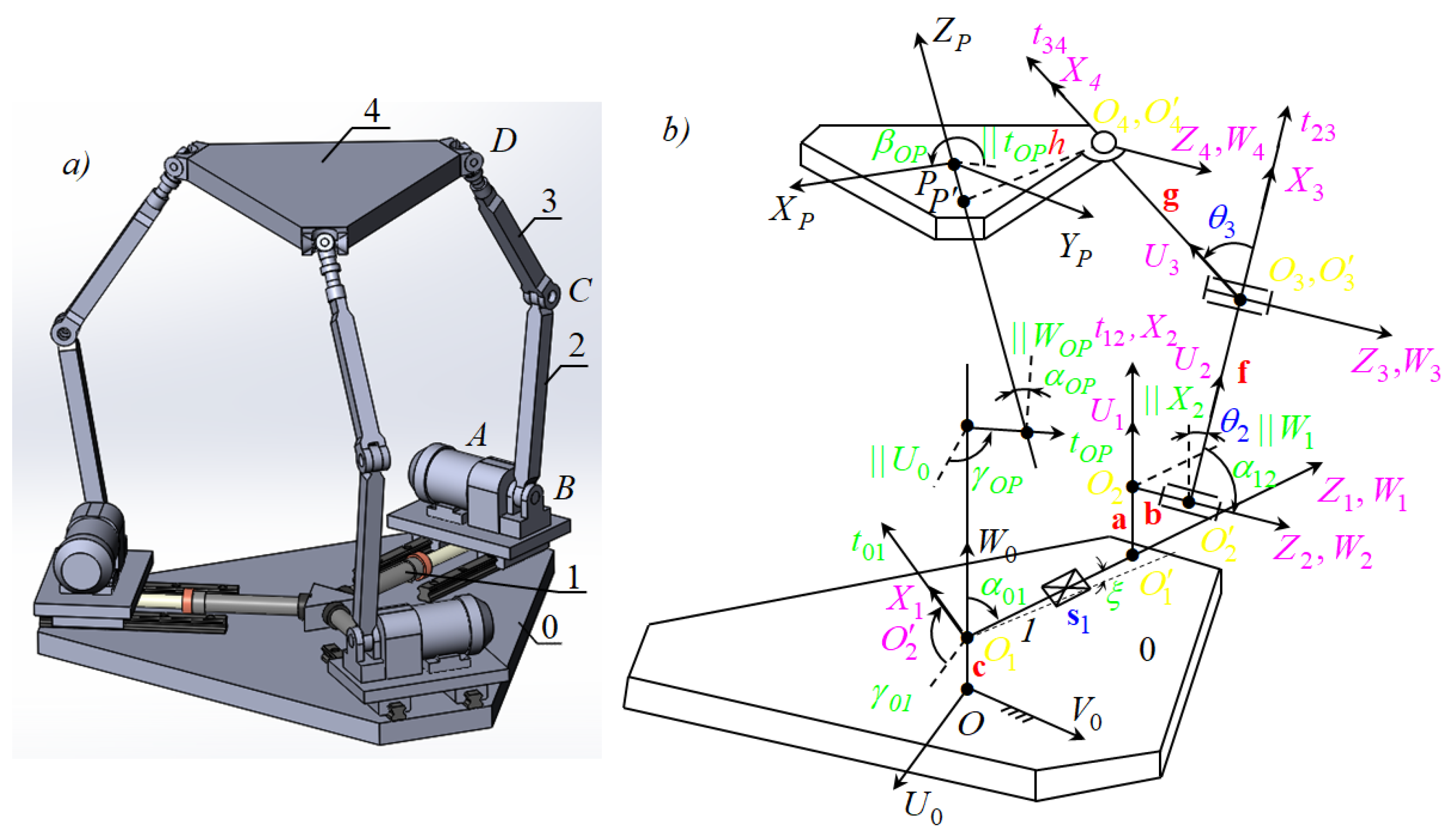
Figure 1 shows a 3D CAD model of the 3-
PRRS-type PM and the kinematic diagram of one of its legs.
In this PM, each leg is actuated by two actuators: a linear actuator 1 (or the prismatic pair A) and a revolute actuator B. The axis of translational motion of the linear actuator 1 is perpendicular to the axis of rotation of the revolute actuator B. Therefore, each leg of this PM performs a single rotational motion relative to the fixed base 0. Consequently, the moving platform 4 of the 3-PRRS-type PM has 3 DOFs and belongs to the class of redundantly actuated, kinematically defective PMs. Three revolute actuators are called active input joints, while three redundant prismatic joints are called passive input joints. The three passive input joints are used to enlarge the workspace and to avoid singular configurations.
To describe the geometry and analyze the kinematics of the PM, two Cartesian coordinate systems
and
are attached to the corresponding elements of each kinematic pair. The
and
axes of these coordinate systems are aligned with the rotational and translational motion axes of the kinematic pair elements, while the
and
axes are directed along the perpendicular
drawn from the
axis to the
axis. The transformation matrix between the
and
coordinate systems has the following form:
where c and s denote the cosine and sine functions, respectively.
The matrix has the following six parameters:
is the distance between the axes and measured along the direction of the common normal between these axes;
is the angle between the positive directions of the axes and measured counterclockwise relative to the positive direction of the ;
is the distance from the direction to the direction of the axis measured along the positive direction of the axis ;
is an angle between the positive directions of the and axis measured counterclockwise relative to the positive direction of the axis ;
is the distance from the direction of the axis to the direction of the measured along the positive direction of the axis ;
is the angle between the positive directions of the axis
and
measured counterclockwise relative to the positive direction of the axis
.
Figure 1b shows the kinematic diagram of the PM with the chosen coordinate systems, where the coordinate systems
and
are attached to the fixed and moving platforms, respectively.
Based on the transformation matrix
, the link matrices
and the kinematic pair matrices
have been derived. These matrices contain the constant geometric parameters of the links and the variable parameters describing the relative motion of the kinematic pair elements, respectively. Each leg of the PM (
Figure 1b) is associated with the following link and kinematic pair matrices:
where
and
are constant parameters;
represent variable parameters, among which
and
are input parameters, and
is an output parameter.
3. Inverse Kinematics
Since the 3-PRRS type PM has three identical legs, the variable parameters are denoted as , while the constant parameters are denoted as .
In inverse kinematics, the pose (position and orientation) of the coordinate system
, attached to the moving platform, is given. It is necessary to determine the input parameters
and
. To do this, the equations for determining the coordinates of the centers of the spherical joints
in the absolute coordinate system
are written through the legs
OABCD:
where the coordinates of the joints
are known and are expressed through the coordinate system
by the following equations:
Expanding Equation (9) for the given values of the coordinates of the centers of the spherical joints, we obtain:
where
.
An analysis of the system of Equation (11) shows that the first two equations are linearly dependent. We transform the first and third equations of system (11) into the following form:
where
are known parameters
From Equation (12), and also from the first and third equations of system (11), two possible values of the parameters
and
can be determined:
which correspond to two assembly configurations of each PM leg.
Since the tripod has only three DOF, it is difficult to specify the coordinates of the centers of the spherical joints through the three planes along which they must move. Therefore, in our work [
55], based on the constraint equations, a relationship was established between the dependent parameters
and the independent parameters
which determine the position and orientation of the moving platform.
In addition, the relationships between the independent parameters and the coordinates of the centers of the spherical joints were determined. This formulation of the inverse kinematics problem is convenient for comparison with the direct problem, since in solving the forward kinematics problem the angles of the intermediate links are determined.
The positions of the passive linear actuators are not determined when solving the inverse kinematics problem; they are assigned arbitrarily, since the tripod has only three DOF. Naturally, they can be calculated within the framework of the inverse problem, but this requires fixing all three active revolute actuators.
4. Direct Kinematics
In the direct kinematics of the 3-
PRRS-type PM, it is necessary to determine the pose of the moving platform based on the given values of the input parameters
and
. To achieve this, the coordinates of the spherical joints are determined using Equation (9), where the unknown variables are the angles
, which are part of the kinematic pair matrix
. To determine the angles
, the following system of equations has been derived:
where
d represents the distances between the spherical joints.
By introducing the following notation
,
, and applying the Sylvester method [
46], the system of Equation (15) is reduced to a 16th-degree polynomial in a single variable
:
which yields a maximum of 16 values of
for a single assembly configuration of the PM leg; that is, for one value of
, up to 16 corresponding values of
can be obtained, representing 16 possible positions of the moving platform. A detailed analysis of the forward kinematics of the considered PM can be found in [
56].
5. Numerical Examples of Direct Kinematics
The following constant parameters of the 3-
PRRS-type tripod are given:
. For the input parameters
and
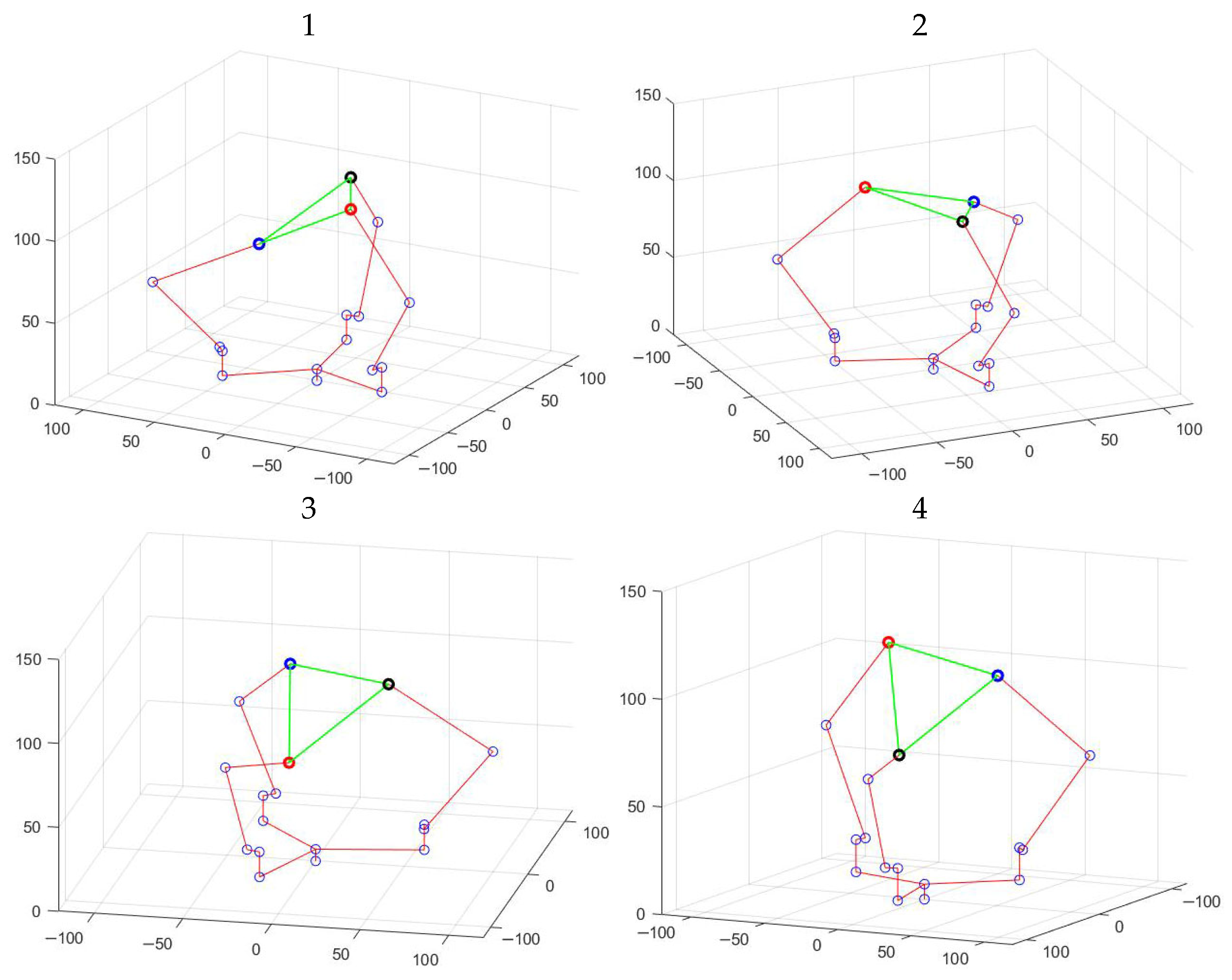
, four positions of the moving platform were obtained (
Figure 2).
Table A1 in
Appendix A presents the obtained values of the angles
for
k = 6 given values of
, 0 at the input parameter value
,
,
.
As can be seen from
Table A1 in
Appendix A, for each value of the angle
, four values of the angles
are determined. Using the obtained values of the angles
, the coordinates of the spherical joint centers of the moving platform in the absolute coordinate system
are determined (
Table A2,
Table A3 and
Table A4 in
Appendix A).
Then, the coordinates of the point
P on the moving platform in the absolute coordinate system
can be determined by the following equations:
Table A5 in
Appendix A presents the obtained values of the coordinates of point
P in the absolute coordinate system
, and
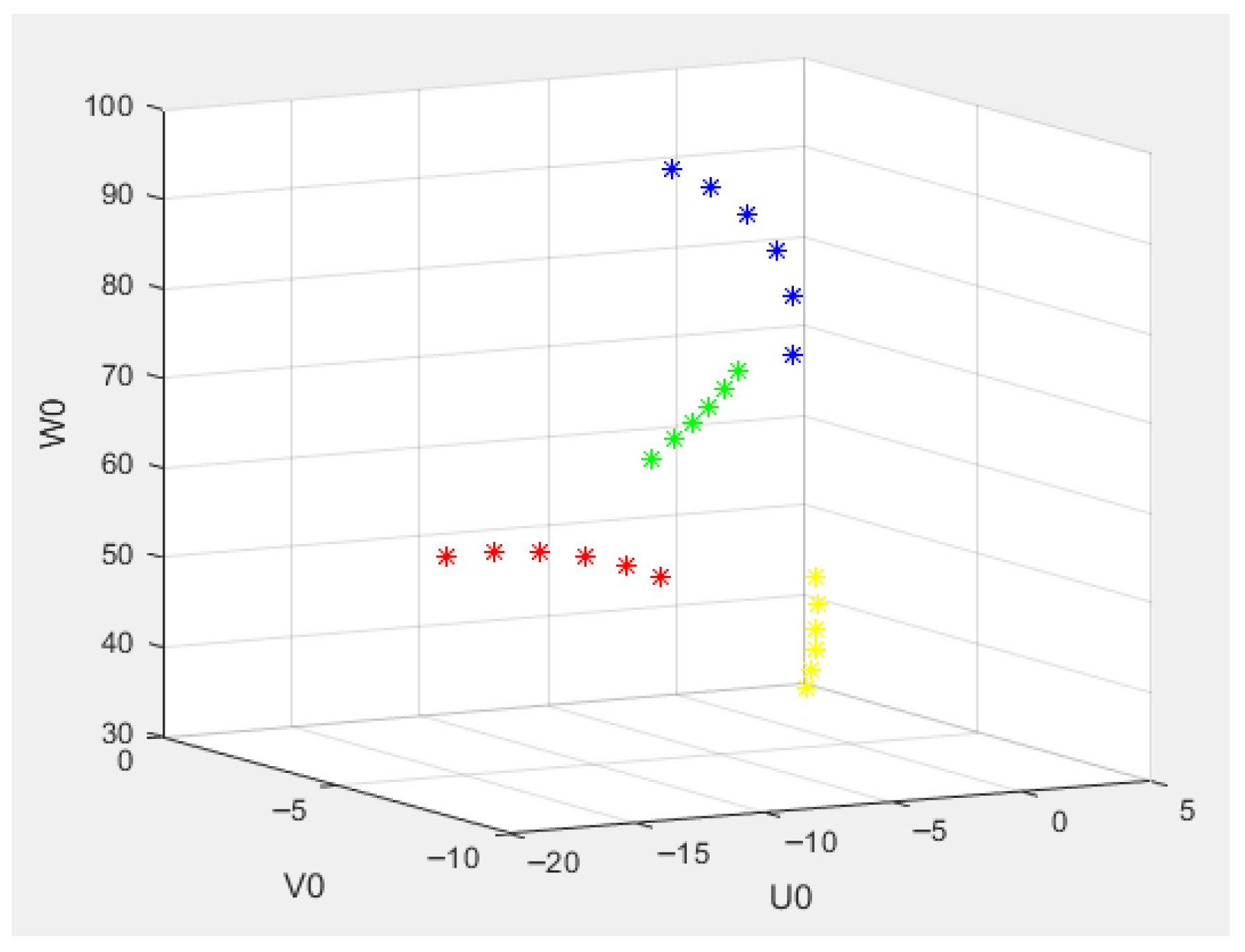
Figure 3 shows a graph of the motion (trajectory) of point
P. As can be seen from the graph, point P moves along an arbitrary curve lying on the sphere.
The number of real roots of polynomial (16) depends on the arrangement of the active kinematic pairs. In some configurations, the number of real roots reaches 16, but most commonly
it ranges from 4 to 8. In the symmetric configuration of the active rotational actuators, when
, and the active prismatic actuators are fixed at
, four positions corresponding to the first four solutions were determined (
Figure 2). Based on this, it can be concluded that the robot has four working modes, which are separated by serial singularities.
6. Numerical Examples of Solving the Inverse Kinematics Problem
For a numerical example of the inverse kinematics of the 3-
PRRS-type PM, we use the obtained coordinates of the spherical joints from the direct kinematics. For instance, we take the first values of the spherical joint coordinates from
Table A1,
Table A2 and
Table A3 (in
Appendix A):
, and determine two values of the angles
and
, which are presented in
Table A6 (in
Appendix A).
The obtained values of the angles and correspond to their given values in the direct kinematics. Furthermore, the results of the inverse kinematics were verified using the direct kinematics results for other positions of the moving platform.
7. Workspace
The workspace of the proposed 3-PRRS-type PM is determined by its inverse kinematics. To define the workspace, it is necessary to derive equations that limit the movement of the moving platform and establish a relationship between the dependent and independent parameters that define the pose of the moving platform. Then, the pose of the moving platform should be determined, taking into account these constraints. All valid poses of the moving platform, for which solutions to the inverse kinematics problem exist, are included in the workspace.
It is known that, due to the constraints of the revolute kinematic pairs, the legs of the 3-
PRRS-type PM move within specific planes. By summing the first and second equations of system (11), after multiplying the first equations by
and the second equations by
, we obtain the equations of the planes along which the
dyads (PM legs) move:
To define the trajectory of the moving platform center, the first and third equations of system (11) are reduced to the following form:
Adding the squares of the two equations of system (19) yields:
Determining
from Equation (18) and substituting it into Equation (20), we obtain the following equations:
where
Here,
are the coordinates of the absolute coordinate system relative to the local coordinate systems
is equal to zero according to Equation (18).
Expanding Equation (21) yields:
The solution of Equation (22) exists under the following condition [
47]:
Equating Equation (23) to zero, we obtain the equations of the following circles:
and
The circles (24) and (25) represent the inner and outer boundaries of the workspaces of the dyads
(PM legs). These equations are expressed with respect to the absolute coordinate system
as follows:
and
where
are the coordinates of the centers of the circles.
Let us define the coordinates of point
P relative to the absolute coordinate system through the coordinates of the spherical joints using the following equation:
where
are the coordinates of the center of the moving platform relative to the local coordinate systems
.
Multiplying the first equations of system (28) by
and the second equations by
, and then adding the first and second equations, we obtain:
Multiplying the first equations of system (29) by
and the second equations by
, and then adding them, yields:
To determine
, we also add the two equations of system (29), previously multiplying the first equations by
and the second equations by
, and we obtain:
To determine
, we add the first and second equations of system (28), previously multiplying the first equation by
and the second equation by
, and we obtain:
Since the distances from the center
P of the moving platform to the centers of the spherical joints are equal to h, the following equations are true in the local coordinate systems
:
Substituting Equations (30)–(32) into Equation (33), we obtain the equations of three spheres in the absolute coordinate system along which point
P moves:
The equations of these three spheres describe the motion of the center P of the moving platform relative to the absolute coordinate system . Therefore, the legs of the PM move along arcs of circles relative to the absolute coordinate system, and the center of the moving platform moves relative to the spherical joints along arcs of circles belonging to the sphere, in accordance with Equation (34). Therefore, the legs of the PM move along arcs of circles relative to the absolute coordinate system, and the center of the moving platform moves relative to the spherical joints along an arbitrary curve lying on the sphere, in accordance with Equation (34).
With the following values of constant parameters:
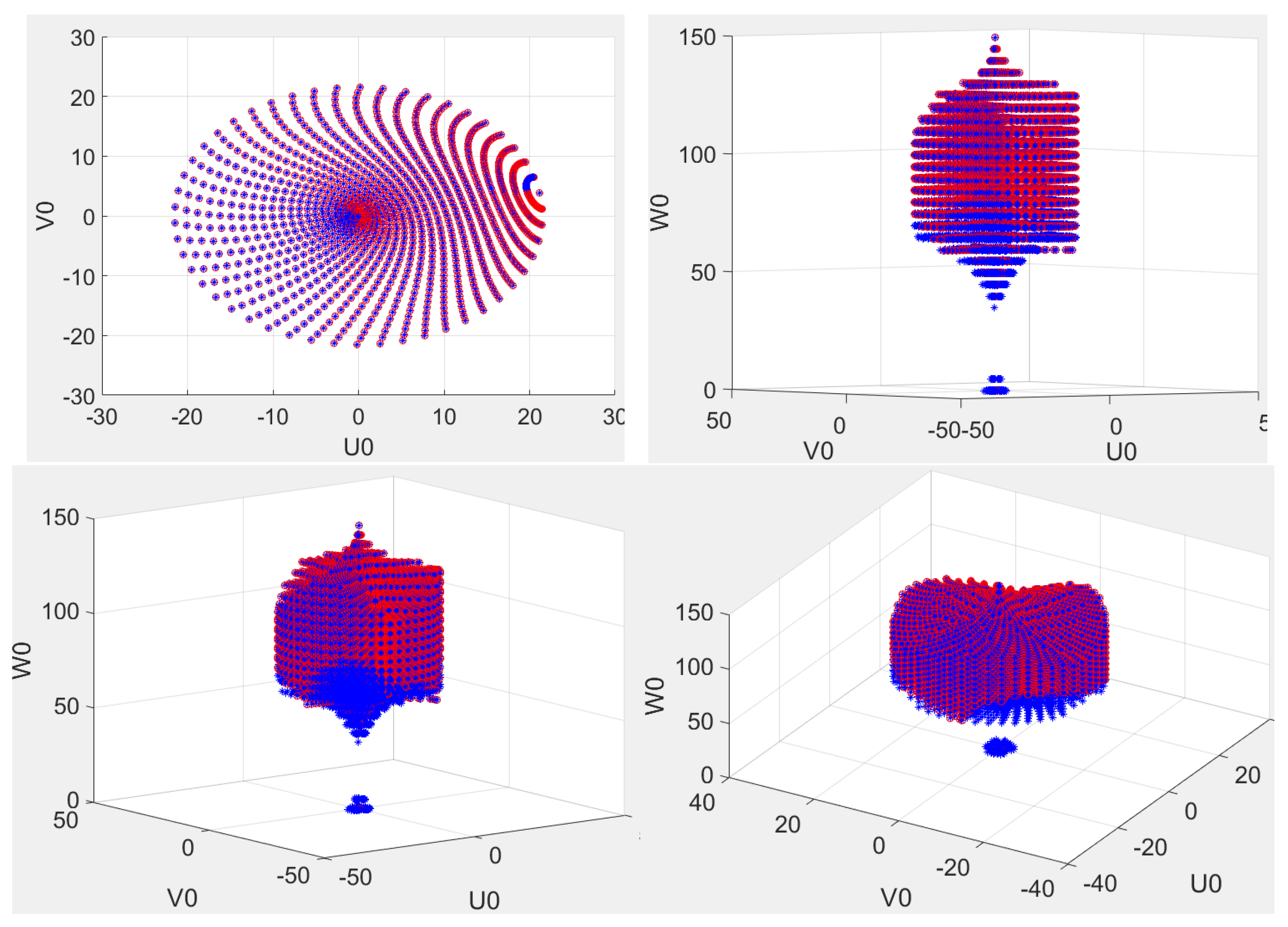
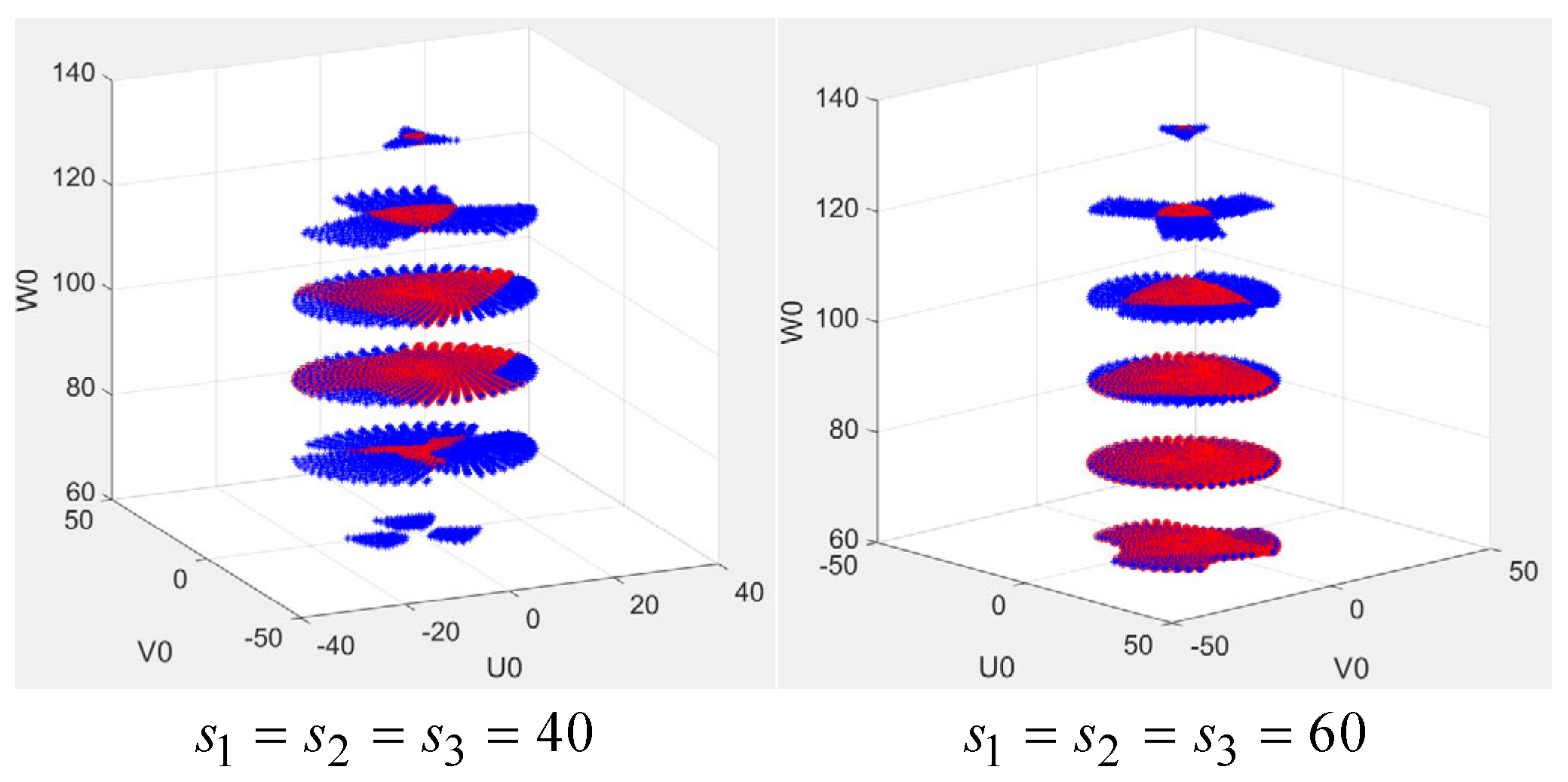
, we define the workspace of the considered PM based on the inverse kinematics problem. In
Figure 4, with fixed strokes of linear actuators
, and when changing
from 0 to 170 with a step of 5, and changing
and
from
to
with a step of
, the inverse kinematics problem is solved. If there is a solution to the inverse kinematics problem, the computer program places a point in space. In
Figure 4, the red mark “o” and blue mark “*” indicate two orientations of the moving platform in space.
Figure 5 shows the workspaces of the PM for two values of the stroke lengths of the linear actuators,
and
. From this figure, it can be seen that the change in the stroke lengths of the linear actuators affects the workspace in the vertical direction. When the stroke lengths of the linear actuators decrease, the workspace in the upper part of the PM increases, and when the stroke lengths increase, the workspace expands in the lower part of the PM.
8. Jacobian Matrices
Let’s derive the closed loop
equations of the leg:
where
As can be seen from (36), the radius vectors of the origins of the coordinate systems can also be determined using the shift submatrices of the matrix (1) in the following forms:
and
The coordinate of other vectors in the absolute coordinate system
are determined using rotation submatrices:
where
.
Differentiating Equation (35) with respect to time, we obtain:
or taking into consideration that the vectors
are constants, yields:
where
is a linear velocity vector of the moving platform point
P;
is a linear generalized velocity vector,
is an angular generalized velocity vector,
is an angular velocity of the
i-th intermediate link;
is an angular velocity vector of a moving platform.
Scalar multiplying of both sides of Equation (43) by the vector
of the intermediate link, we obtain:
or taking into consideration the relative positions of the vectors, yields:
Let us introduce the following notations:
and rewrite Equation (45) in the following matrix form:
where
and
are the Jacobian matrices connecting the input and output links velocities:
9. Singular Configurations
Singular configurations of the PM 3-PRRS arise when the determinants of one or both of the matrices and (48) and (49) are equal to zero. The singularity at det() = 0 and det() = 0 belong to singularities of the first and second types, respectively.
The first type of singularity arises in the following conditions:
and
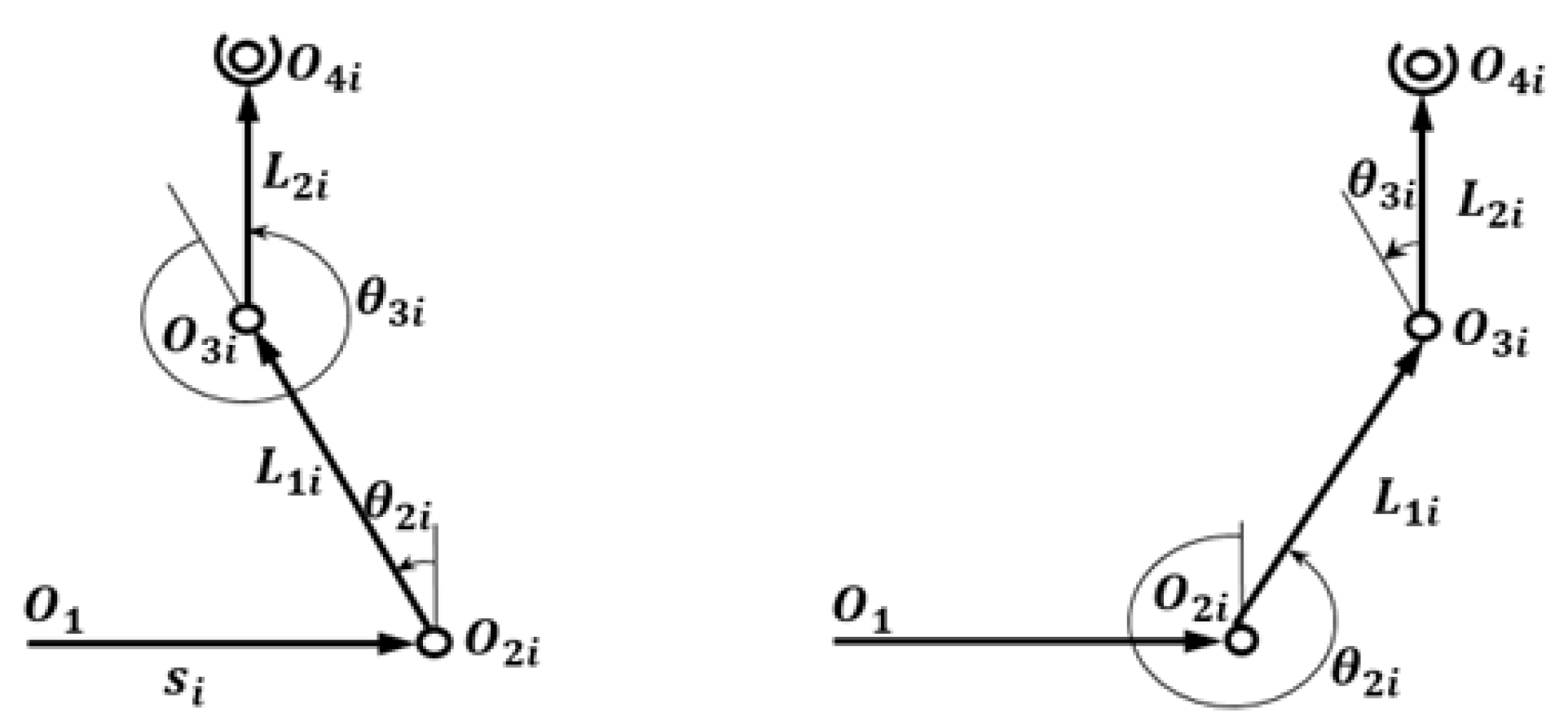
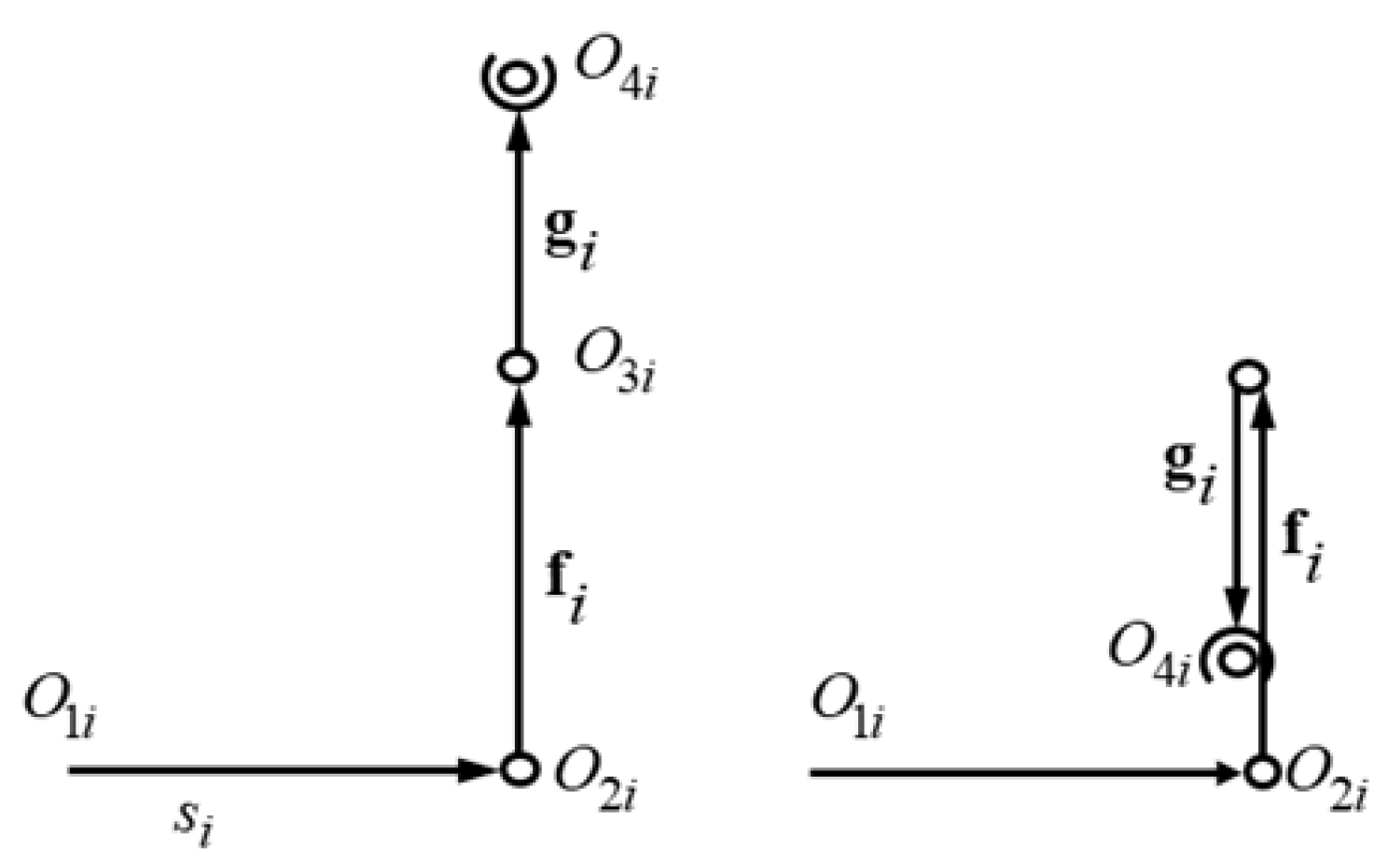
The first condition (50) takes place when, i.e., the vector
, determining the shortest distance between the axis of the passive revolute and spherical kinematic pairs, is perpendicular to the axis of the active prismatic pair. This is possible in the cases:
The corresponding locations of the leg links in the cases
and
are shown in
Figure 6 and
Figure 7.
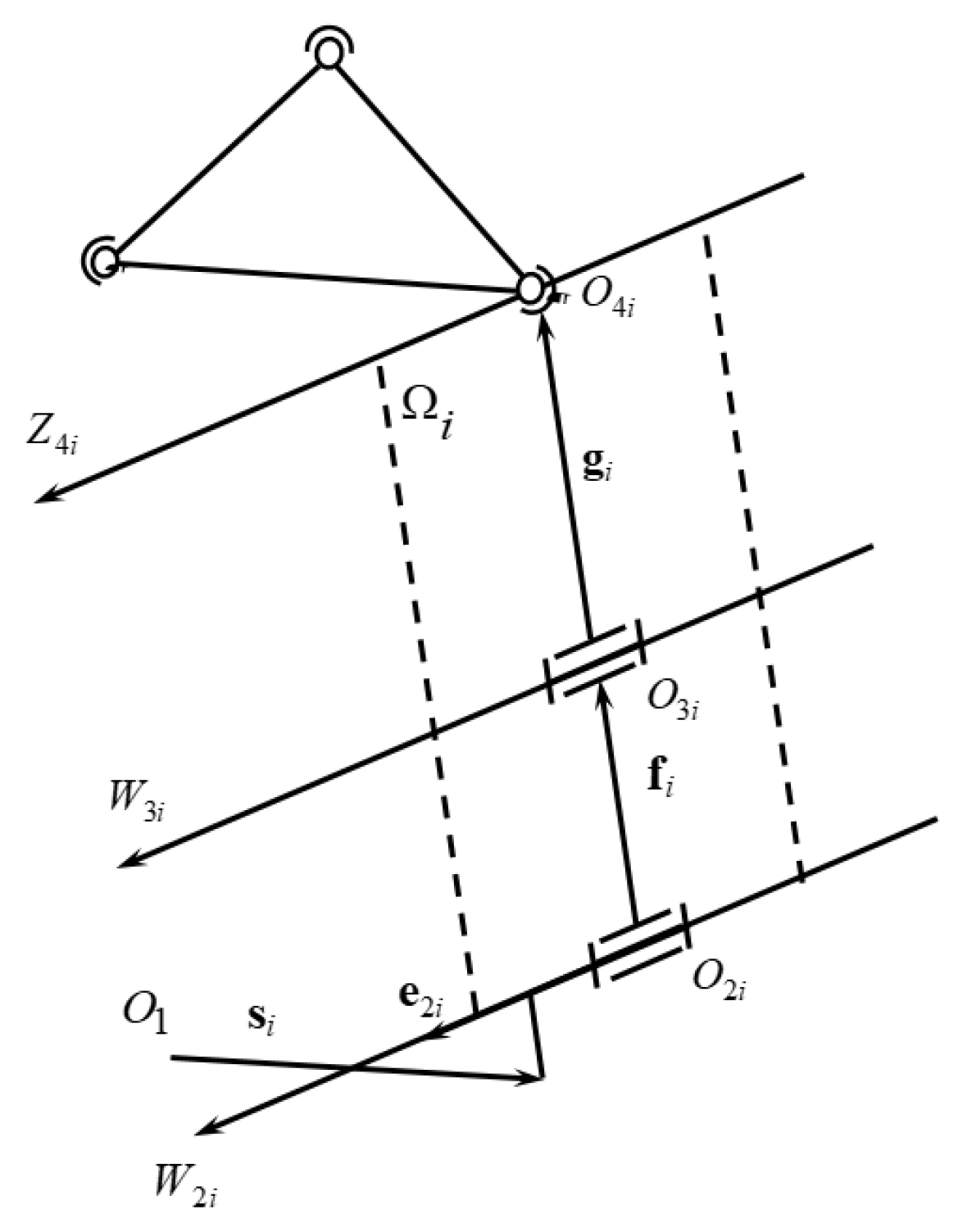
At the same time, the conditions (51) show, that the three vectors
and
must lie either in parallel planes or in the same plane (this plane is denoted by
) as shown in (
Figure 8).
The second type of singularity occurs when the matrix
experiences a rank deficiency, i.e., when the rows or columns of this matrix are linearly dependent. This type of singularity, unlike the first one, is located inside the workspace. Let us rewrite the matrix
in the following form:
where the elements of the first three columns are components of one group of vectors
, and the elements of the last three columns are components of the second group of vectors
:
Since vectors cannot be zero, it is impossible for all elements of individual rows of the matrix to be equal to zero. Therefore, the second type of singularity occurs if there is a linear relationship between the rows of this matrix.
Let us assume that the linear dependence of any two of its rows with numbers
j and
k leads to the degeneracy of the matrix
. This means that there are simultaneously non-zero numbers
and
for which:
from here:
Then for the corresponding configuration the following conditions must be met:
Analysis of conditions (57) and (58) shows that the equality of one of the vectors and to the zero vector excludes the linear dependence of the corresponding rows of the matrix . Indeed, let us assume for definiteness that , . Then from (58) it follows that . But in and vector cannot be zero, from (57) we obtain that, i.e., the numbers and are simultaneously equal to zero, therefore, the considering rows cannot be linearly dependent.
Next, assume that
,
. Then, according to conditions (57) and (58), there must be
and
, and with the same proportionality coefficients
. Moreover, the specified requirements also correspond to the fulfillment of the following conditions:
Since
, then
. Let’s assume that
and check the parallelism of the vectors
and
with the components:
and
Let’s also define the vector product of the vectors
and
:
Since (
)
, it follows from (65):
where
Then, taking into account (67)–(69) from the system of Equation (66) we obtain:
Substituting Equation (70) into Equations (63) and (64), yields:
that is, the vectors
and
must be parallel to the
axis.
Thus, the obtained conditions (70)–(72) are necessary conditions for the linear dependence of the considered row vectors of the matrix
, and they are not enough for degeneracy, since it is also necessary to require the fulfillment of condition (58):
where
. From where, taking into account (56), we obtain the following condition:
that is, the projection of the segments
and
(magnitudes of the projection of the vectors
and
) onto the direction perpendicular to the vectors
and
must be equal. In addition, they are parallel, and according to (70) lie in the same plane with the platform pole
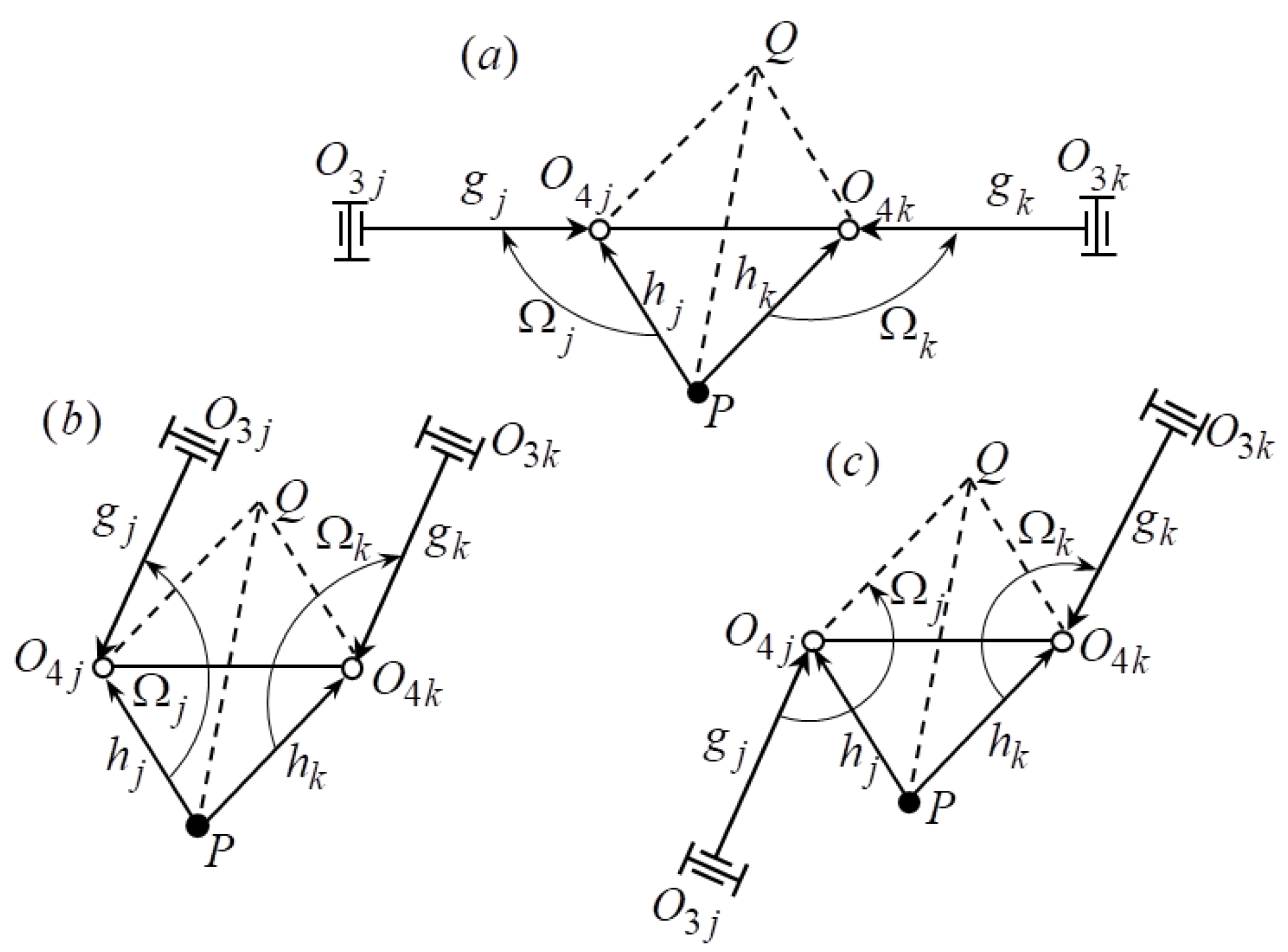
P. Therefor, first we determine those directions onto which the indicated segments are equally projected. It can be shown that such directions are directions perpendicular to the diagonals of a parallelogram constructed on the vectors
and
. Accordingly, various options for the location of the vectors
and
are subject to consideration, determined by the directions of the diagonals themselves (
Figure 9): along the straight line
and parallel to the straight line
. However, the analysis shows that conditions (59) and (60) are satisfied only by the variants of the location of the links along the straight line
, one of which is shown in
Figure 9a. Examples of the arrangement of links parallel to the second diagonal
, but not generating singular configurations, are shown in
Figure 9b,c.
In our paper [
57] with the coordinate of the center of the moving platform
fixed at a certain height, the rotation angles of the moving platform around the
and
axes of the absolute coordinate system were determined while operating the robot outside singular configurations within the framework of the four forward kinematics solutions presented in
Figure 2. In [
57], the Jacobian matrix
was extended to a 6 × 6 dimension based on the constraint equations in order to study its determinant. A program was developed to identify the configurations at which the extended Jacobian matrix becomes singular.
10. Direct Velocity Analysis
The Jacobian matrices and in Equations (48) and (49) have dimensions of 3 × 6. In the analysis of singular configurations, inversion of these matrices is not required. However, to verify the theoretical results, analyze their determinants, and solve the direct and inverse velocity problems, it is necessary to extend these matrices.
The solution of the direct velocity problem consists of determining the linear and angular velocities of the moving platform for the given velocities of the driving links. In other words, from the matrix relationship (47), it is necessary to determine the vector
when
is known. To accomplish this, additional equations are required. Let us consider the following loop-closure vector equations
By differentiating Equation (75) with respect to time, we obtain
Due to the constraints of the revolute kinematic pairs, the velocity directions of the spherical joints are always perpendicular to the unit vectors of the rotation axes of these pairs,
and
. By taking the scalar product of both sides of Equation (76) with the unit vector of the rotation axis
, we obtain
Depending on the relative arrangement of the vectors, we obtain the following equations
Equation (78) can be expressed in the matrix form
where,
Combining Equations (47) and (79), and augmenting the matrix
, we obtain
where
Now the direct velocity problem is solved as follows
11. Inverse Velocity Analysis
The objective of solving the inverse velocity problem is to determine the required instantaneous velocities of the six actuators that ensure the prescribed instantaneous velocities of the moving platform.
Since the moving platform possesses only three degrees of freedom, it is necessary to derive the equations that relate its dependent and independent parameters.
Let us rewrite the system of Equation (18) in the following form
where
Here
are the Euler angles that describe the orientation of the local coordinate system
, and they are defined as follows
By subtracting the third equation from the second in the system of Equation (85), after dividing them by
and
respectively, we can determine
as follows
where
is the angle between the axis U
0 of the absolute coordinate system and the vector of the first prismatic actuator
.
Similarly, by subtracting the third equation from the second in the system of Equation (85) and dividing them by
and
respectively,
can be determined as follows
From the first Equation of the system (85), taking into account expressions (88) and (89), the following equation is obtained
From Equation (85), taking into account Equation (86), the following relationship is obtained
where
. From Equation (91), we obtain two solutions corresponding to the two possible assembly configurations of each leg
where
.
The solution corresponding to the right assembly configuration of the RRS dyad is used. Thus, by specifying the independent variables and , the dependent variables , and f are determined from Equations (88), (89) and (92).
To solve the inverse velocity problem, let us introduce the following notation
. Then, taking into account Equations (88), (89) and (92), we obtain the following expression.
where
From the matrix relation (47), taking into account expression (94), we obtain
In Equation (47), the matrix has a dimension of 3 × 6. To solve the inverse velocity problem, during the motion of the three rotational actuators, the three prismatic actuators are fixed, and vice versa—during the motion of the three prismatic actuators, the three rotational actuators are fixed. In this case, by removing the zero columns, the dimension of the matrix becomes 3 × 3.
When solving the inverse velocity problem, the independent parameters of the instantaneous velocity of the moving platform
are prescribed, and the corresponding instantaneous velocities of the generalized coordinates are determined. This is achieved by projecting the elementary angular velocity vectors
and
onto the absolute coordinate system
where
.
The system of Equation (93) is solved with respect to the variables
and
, and the following result is obtained
where
.
The component of the instantaneous velocity vector with respect to the
axis is determined as follows
Now, instead of the matrix , the matrix can be used. The augmented part of the matrix Ja does not affect the analysis of singular configurations. Since the matrix has a determinant, this property is employed for numerical analysis and for solving the direct velocity problem.
Numerical calculations show that for the following values of the constant parameters: with varying from 40 to 70 in steps of 5, varying from 75 to 130 in steps of 5, and and varying in two cycles from to in steps of , no type II singular configurations were found at which the extended Jacobian matrix becomes singular.
In addition, the calculations demonstrate the influence of the passive prismatic kinematic pairs on the expansion of the workspace beyond singular configurations. For example, at
and
, when checking the extended Jacobian matrix
for singularity and varying
and
in two cycles from
to
in steps of
, the program identifies type II singular configurations at
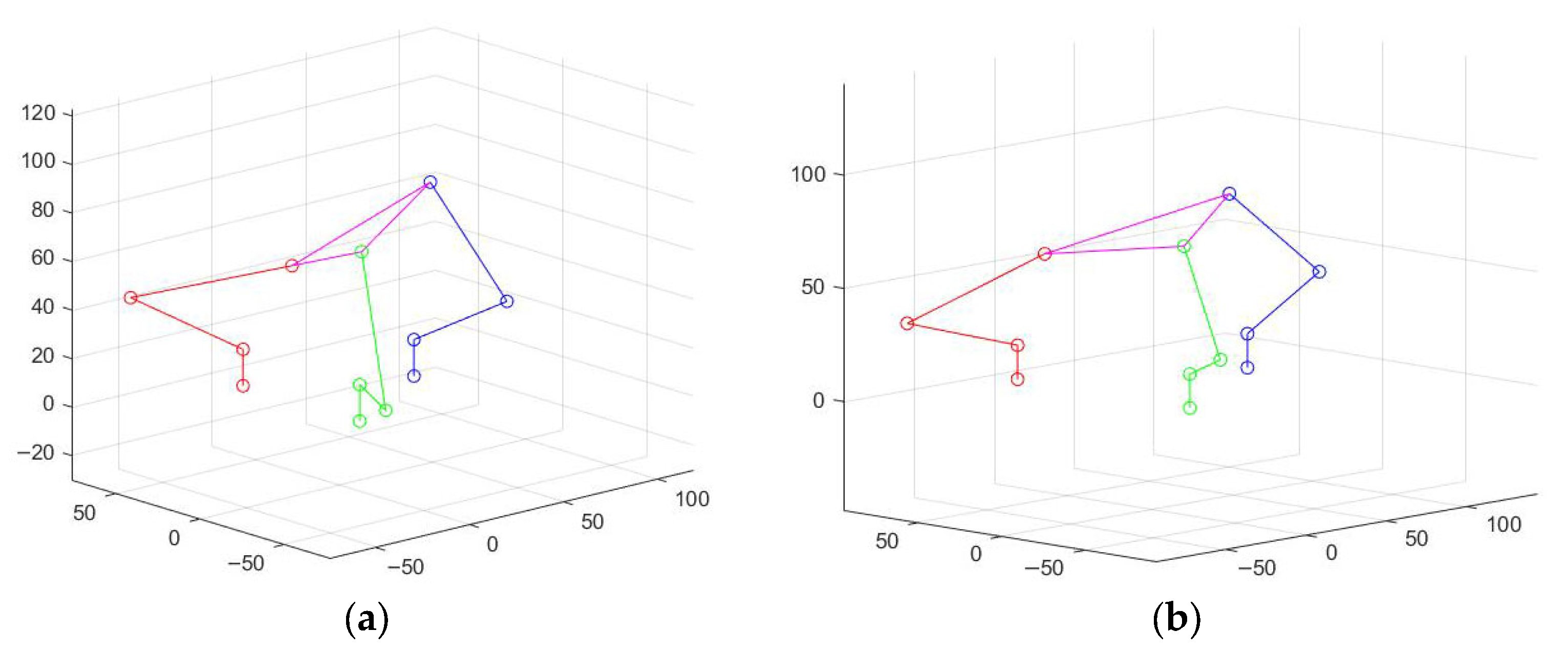
. The corresponding configuration is shown in
Figure 10a. However, this singular configuration disappears when
, with the corresponding configuration illustrated in
Figure 10b.
At the upper boundaries of the workspace without singular configurations, with and , and with and varying over two cycles from to in steps of , the PM operates without singular configurations. However, for the same position with , the inverse kinematics solution of the tripod does not exist. This confirms that the passive prismatic actuators influence the expansion of the workspace free of singular configurations.
12. Numerical Examples of Solving the Direct Velocity Problem
The following constant parameters are specified: .
In solving the direct velocity problem, the independent parameters
and
are specified, and the dependent parameters
and
are determined (
Table A7). The input parameters of the prismatic kinematic pairs
and
are arbitrarily defined, and the corresponding positions of the parallel manipulator are first determined by solving the inverse kinematics problem (
Table A8)
. The direct velocity problem is then solved using Equation (84).
Table A9 presents the specified velocities of the six input links
.
Table A10 shows the results of solving the direct velocity problem, namely, the components of the linear and angular velocity vector of the vector moving platform center
13. Numerical Examples of Solving the Inverse Velocity Problem
The following constant parameters are specified: .
Table A11 presents the positions and orientations of the moving platform of the parallel manipulator.
Table A12 specifies the components of the instantaneous velocities of the moving platform with respect to absolute coordinate system
, determined from the solution of the direct kinematics problem.
Table A13 shows the results of solving the inverse velocity problem, namely, the instantaneous velocity values required to achieve the specified motion of the moving platform.
Table A12 presents two sets of instantaneous velocity components of the moving platform, corresponding to the solutions of the direct and inverse velocity problems, respectively.
Outside the singular configurations, the relative error between the results of the direct and inverse velocity problems does not exceed 5%.
14. Conclusions
This paper proposes a novel 3-PRRS type PM architecture, which features three active revolute joints and three passive prismatic input joints. The design is protected by an invention patent granted in Kazakhstan. The three passive prismatic input joints (linear actuators) are located on a fixed platform and drive three active revolute input joints. The direct and inverse kinematics problems of the PM are solved, and the workspace as well as the singular configurations are calculated. When solving the direct kinematics problem, a 16th-degree polynomial was derived, enabling the determination of all possible configurations of the PM. For given input parameter values, a maximum of 16 positions of the moving platform can be obtained for each assembly mode of the mechanism. The inverse kinematics problem is solved in closed form. Numerical results for both the direct and inverse kinematics problems are presented. All results from the direct kinematics problem were verified against those from the inverse kinematics problem. The workspace of the PM is defined based on the solution of the inverse kinematics problem. All valid poses of the moving platform, for which a solution to the inverse kinematics problem exists, are included within the PMs workspace. It is demonstrated that the legs of the PM move along circular arcs relative to the absolute coordinate system, while the center of the moving platform moves along an arbitrary curve lying on a sphere. Numerical results for the workspace definition are presented, and the influence of the linear actuator stroke lengths on the vertical expansion of the workspace is shown. The results obtained indicate that the proposed PM can provide an expanded workspace. The Jacobian matrices have been derived, and the singular configurations of the first type and the second type have been identified. To verify the theoretical results of the singularity analysis, the Jacobian matrices were extended based on the constraint equations. The extended Jacobian matrices were obtained for both the direct and inverse velocity problems. The obtained numerical results confirm the correctness of the theoretical conclusions, and the introduction of passive prismatic input actuators contributes to an enlargement of the workspace without singular configurations.




 ,
,