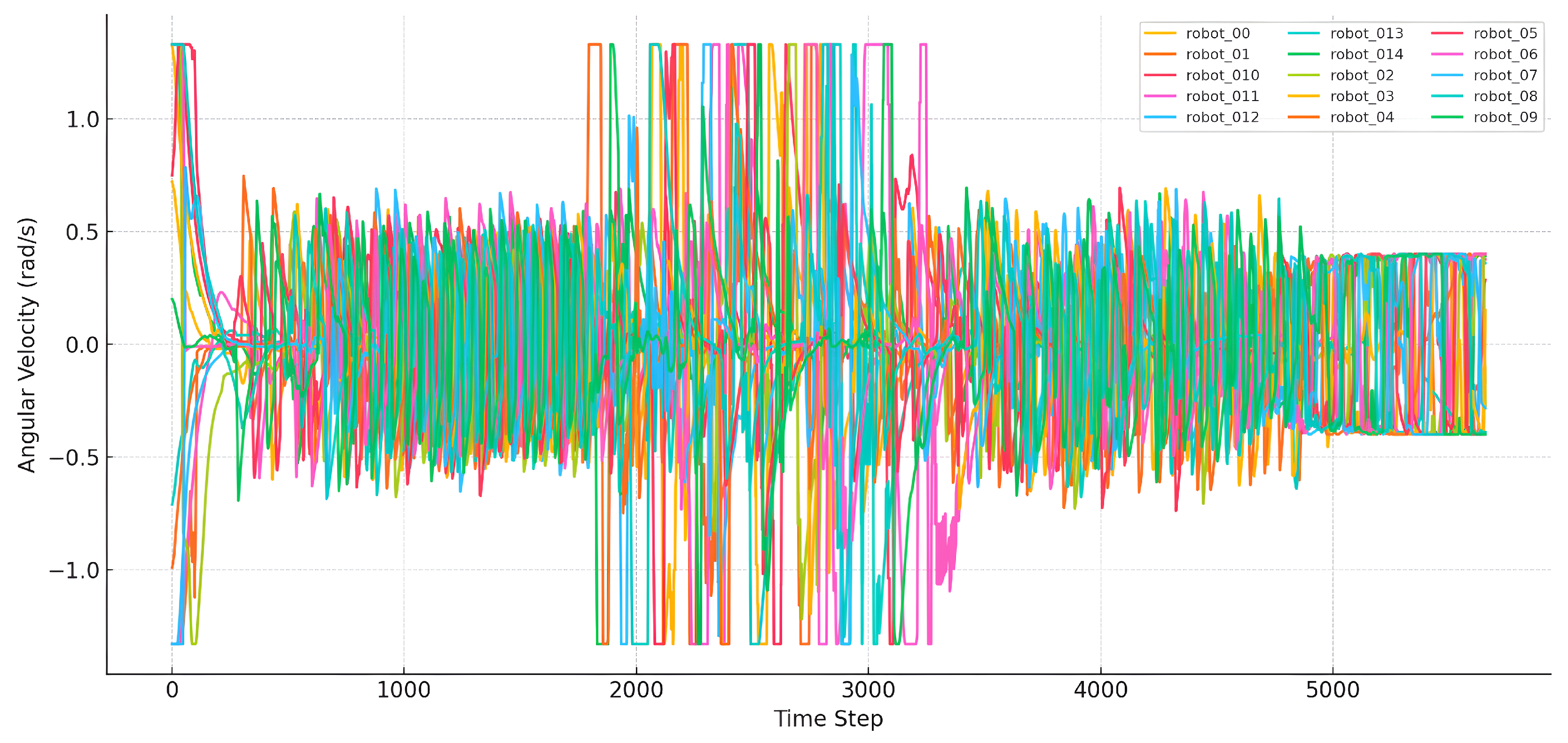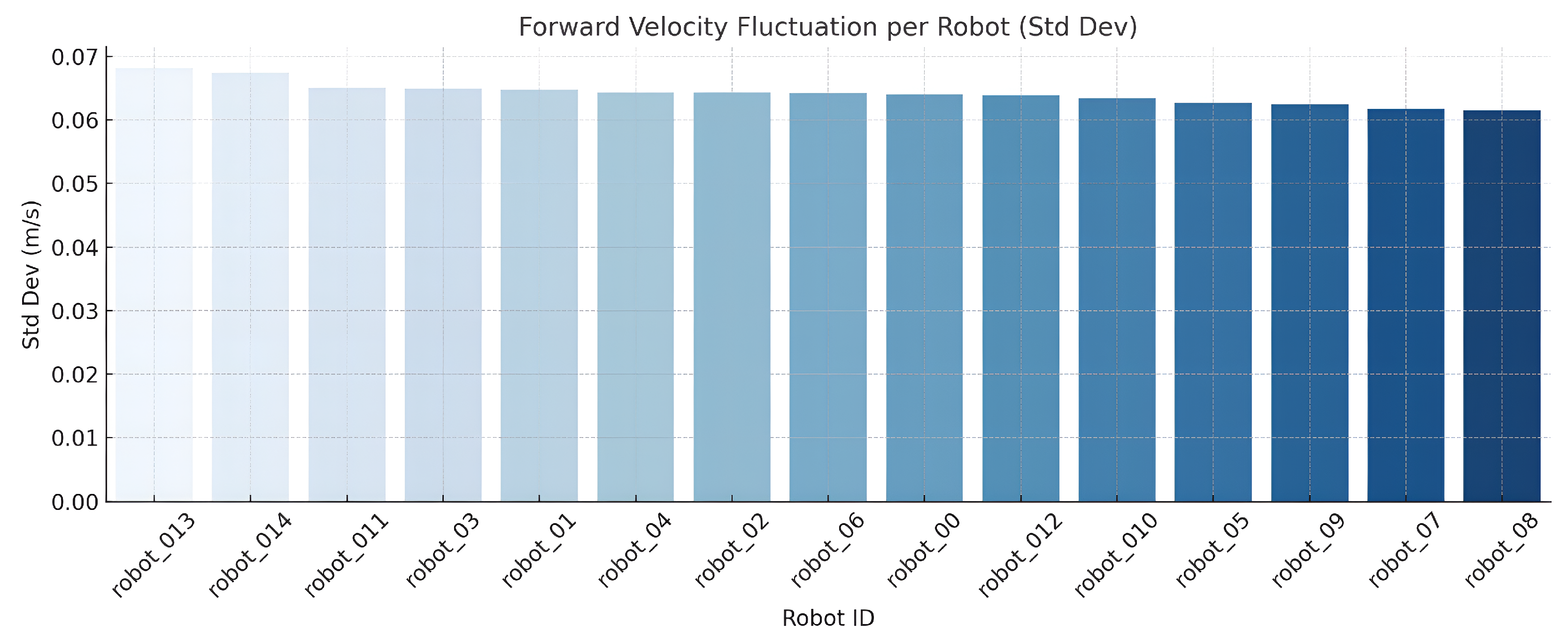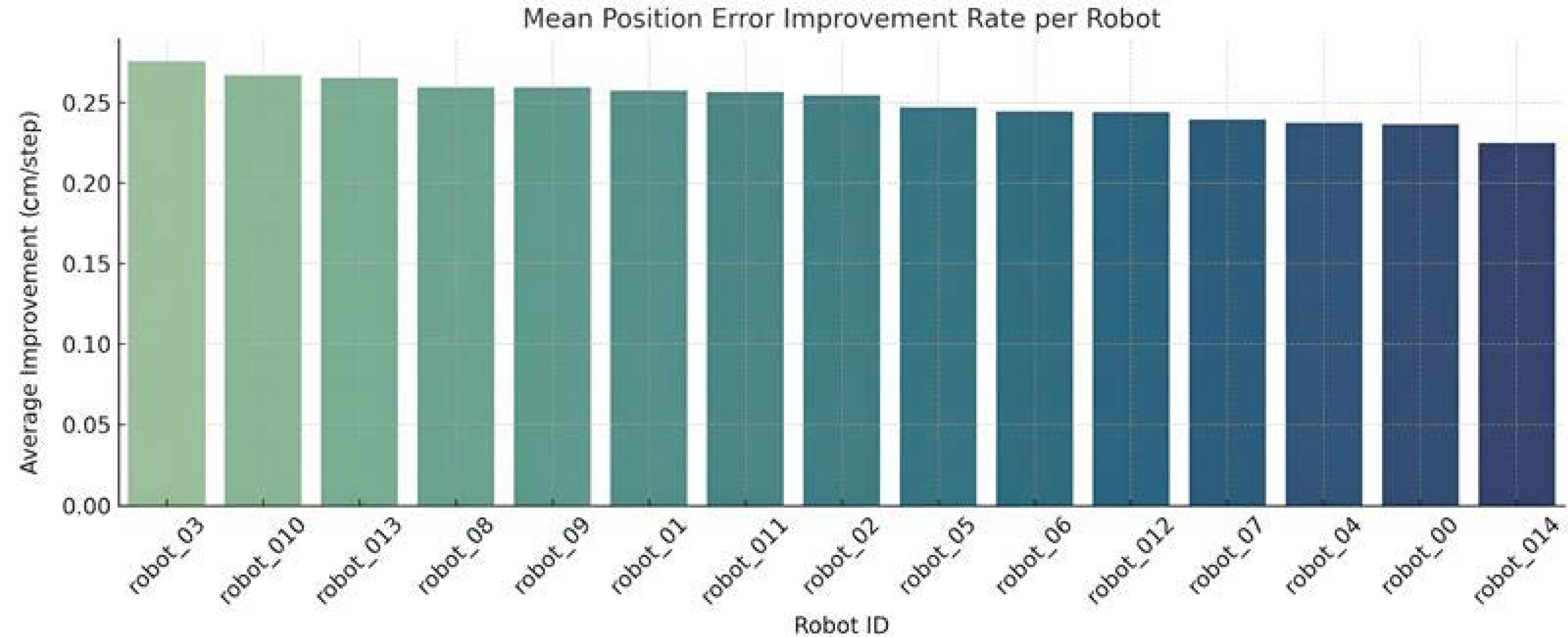

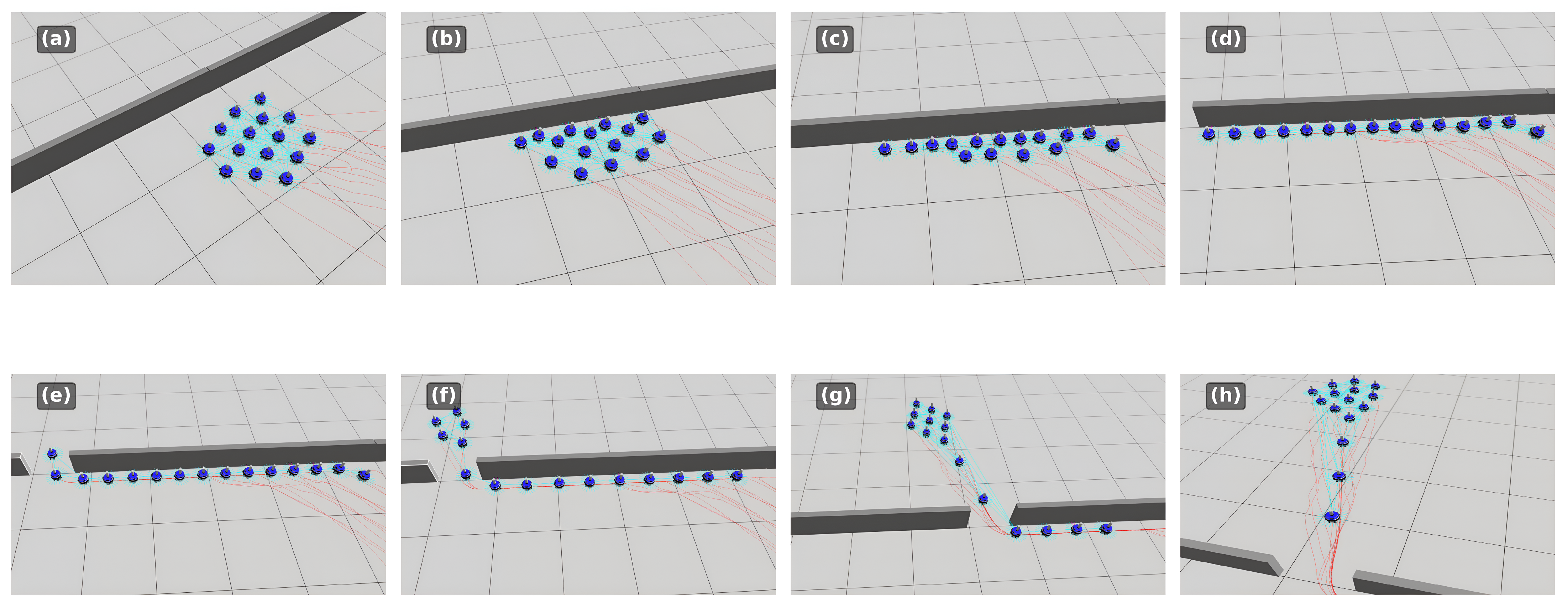
A Decentralized Potential Field-Based Self-Organizing Control Framework for Trajectory, Formation, and Obstacle Avoidance of Fully Autonomous Swarm Robots



Abstract
1. Introduction
- A fully decentralized and self-organizing control framework is developed for swarm robots based on potential field methods, capable of simultaneous trajectory tracking, formation control, and obstacle avoidance.
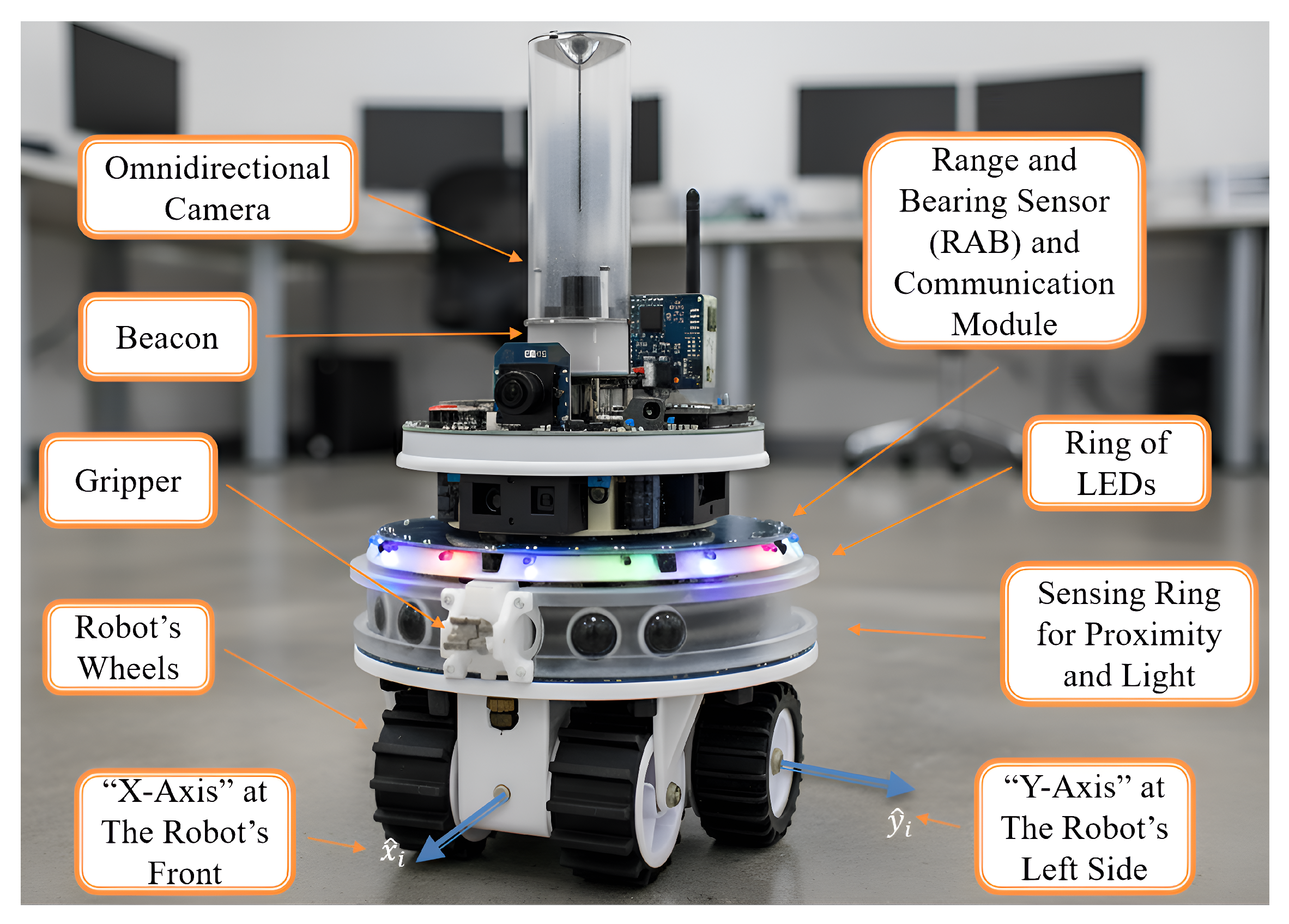
- Integration of attractive, repulsive, and formation forces is achieved using only local sensing (proximity sensors) and neighbor communication (range-and-bearing sensors), without any centralized control or prior knowledge of the environment.
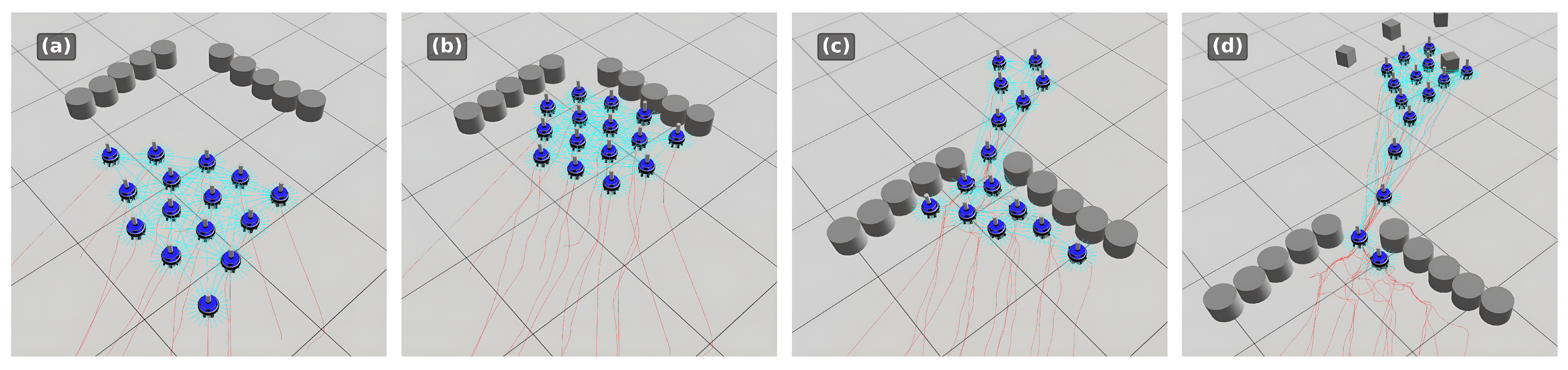
- The framework supports operation in unknown environments with both static and dynamic obstacles, where dynamic obstacles emerge from the motion of neighboring swarm robots.
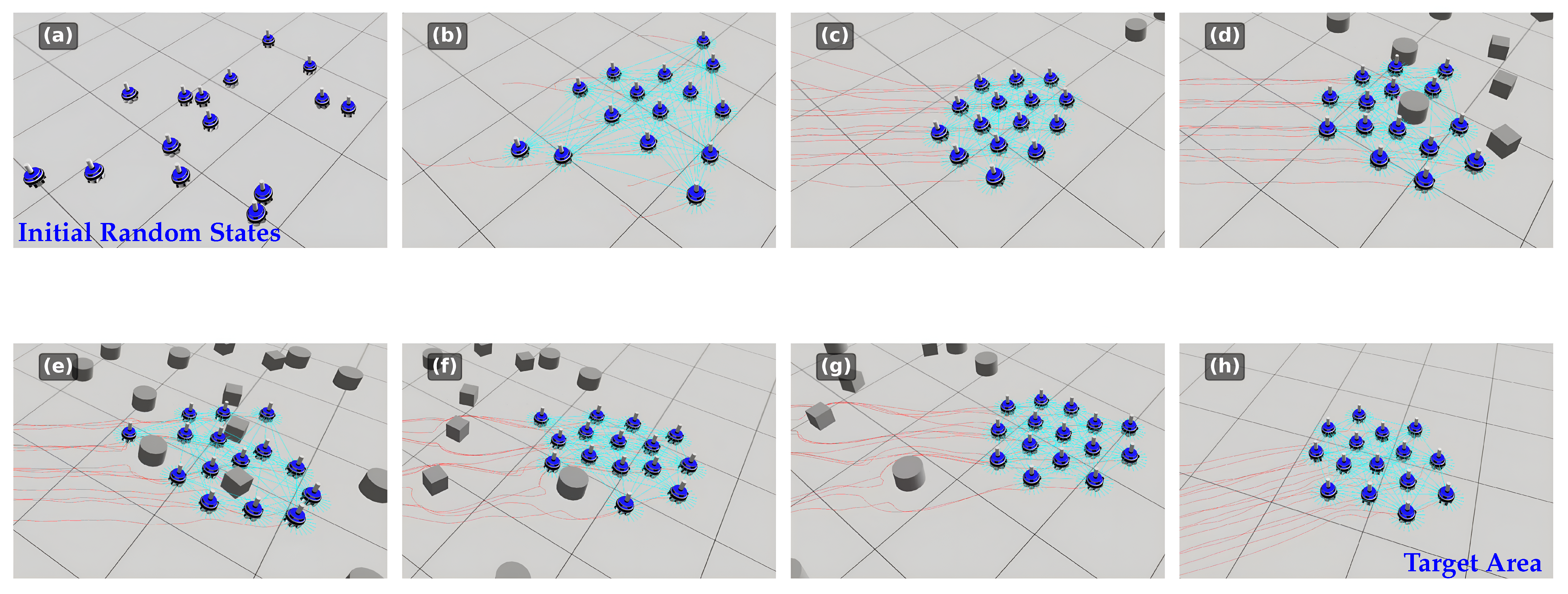
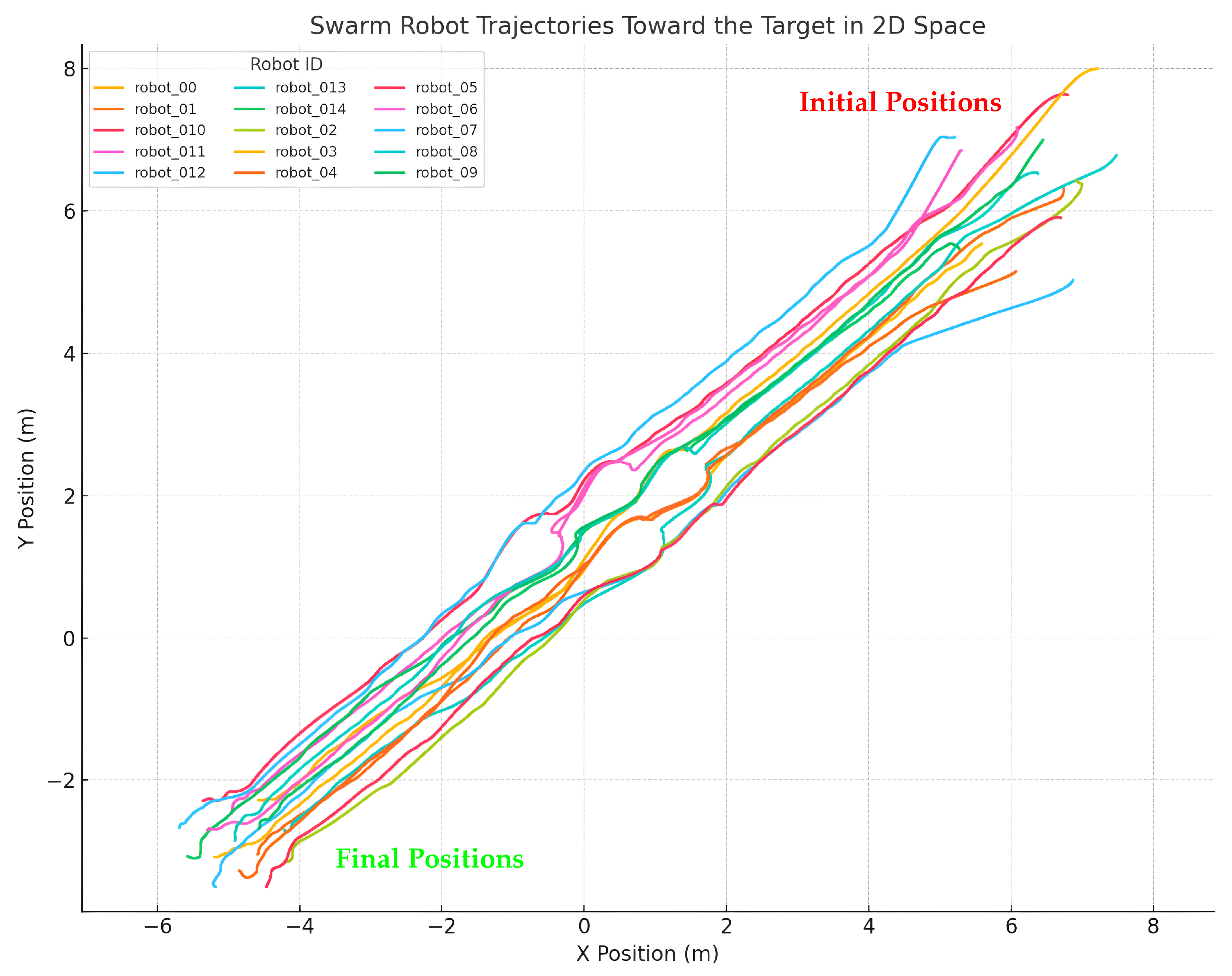
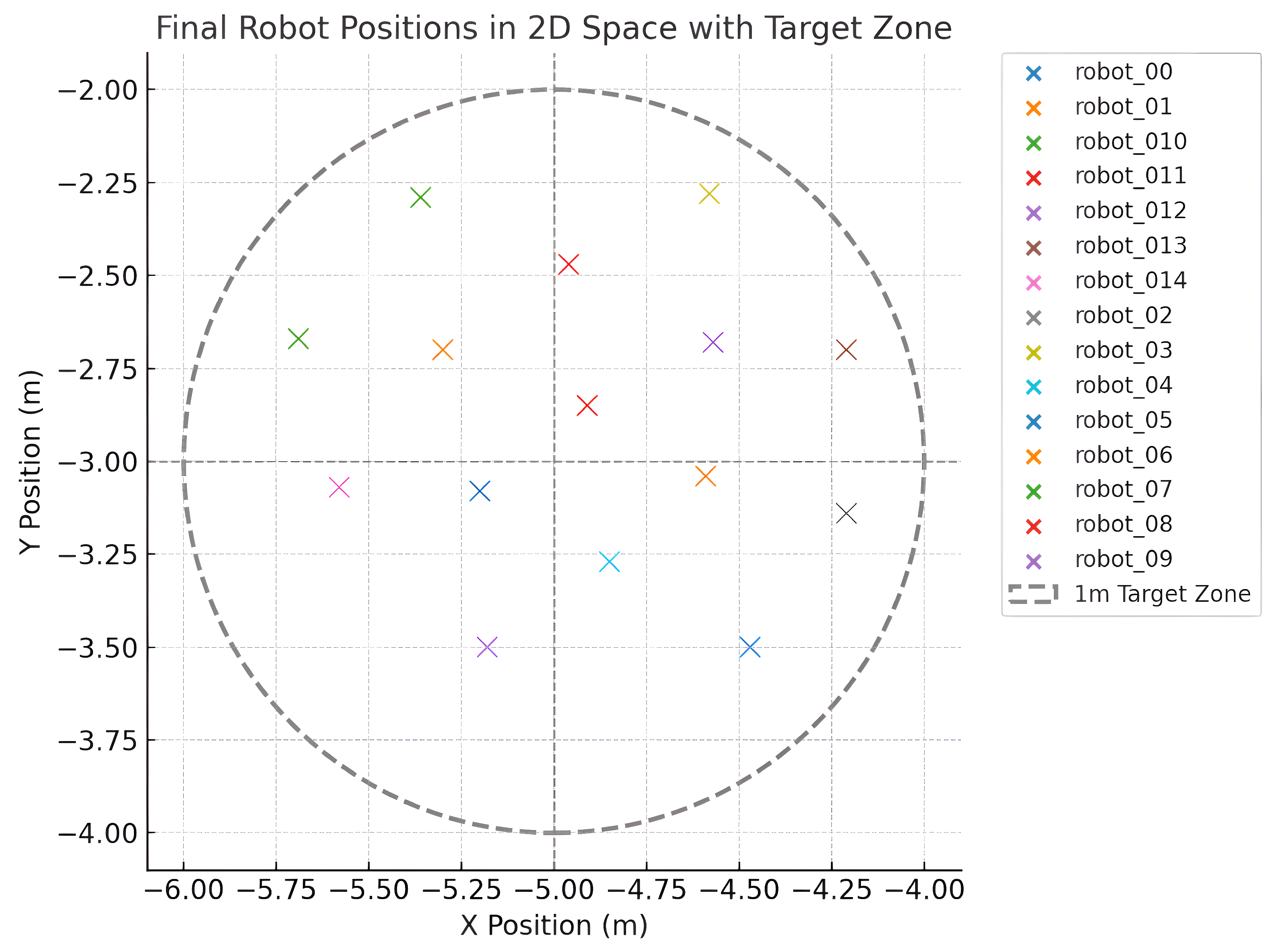
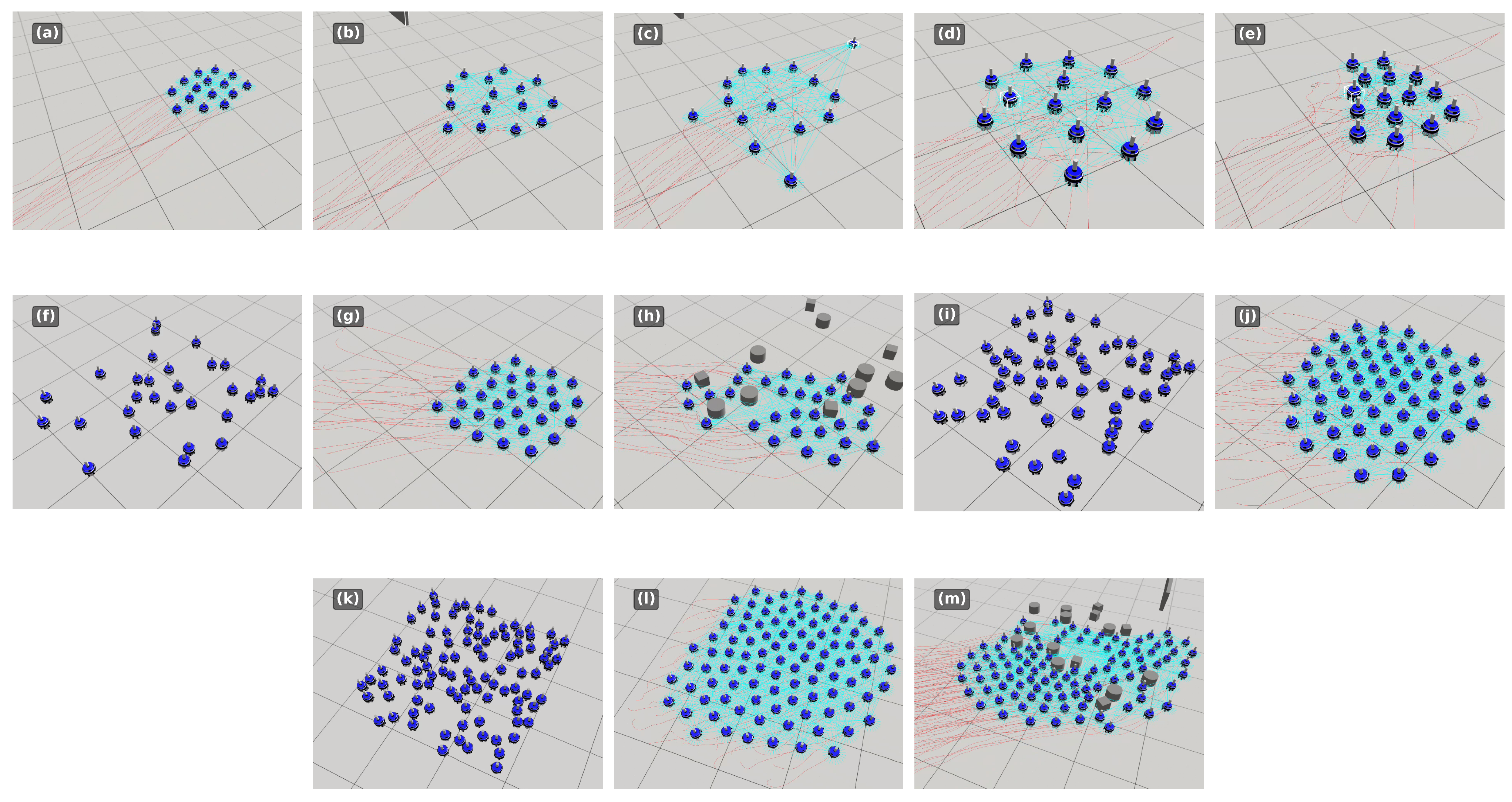
- Scalability and flexibility are validated through extensive testing in the ARGoS simulator, with swarm sizes ranging from 15 to 100 robots. The system allows seamless addition and removal of members without requiring reprogramming or a coordination reset.
- The method demonstrates robustness across diverse scenarios, including narrow passages and wide obstacle fields, while preserving formation and guiding the swarm to target areas.
2. Related Work
3. Problem Formulation
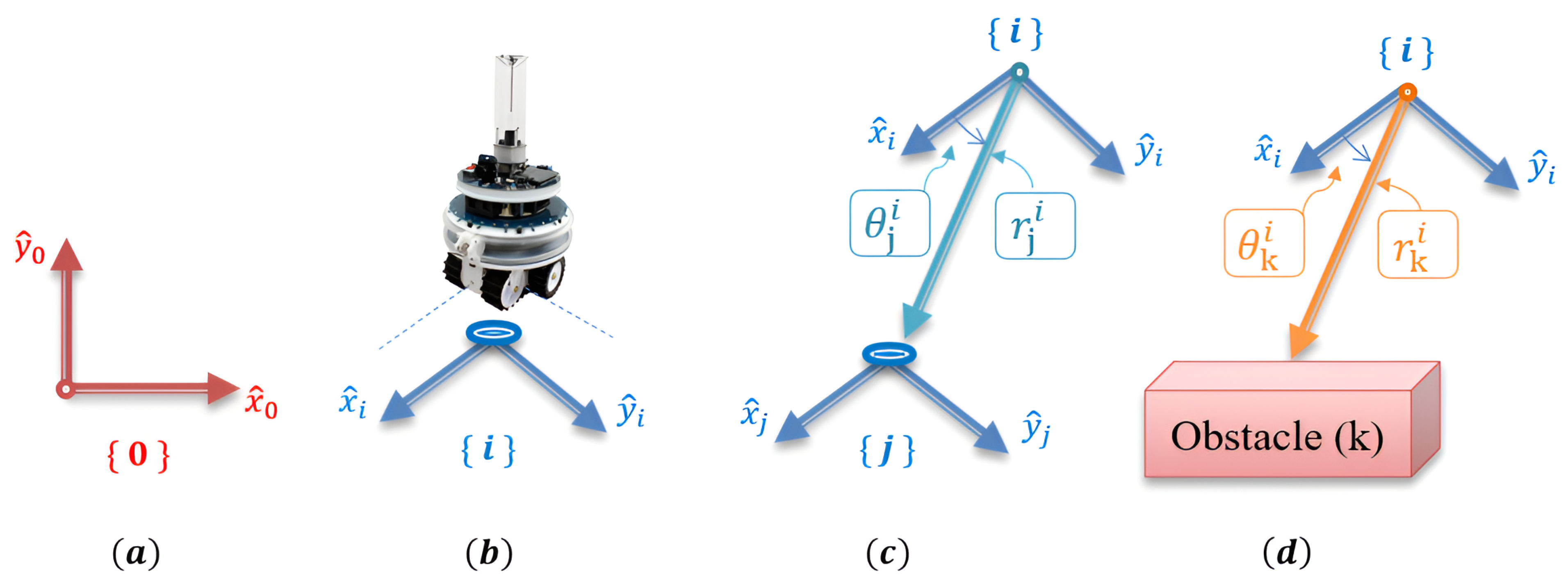
3.1. Frames of Reference
- Inertial Frame : A fixed world reference frame in the environment.
- Robot Frame : A local frame attached to robot i, which is one of the members in the swarm.
- Neighbor Robot Frame : A local frame attached to robot j, which is one of the neighbors of robot i in the swarm.
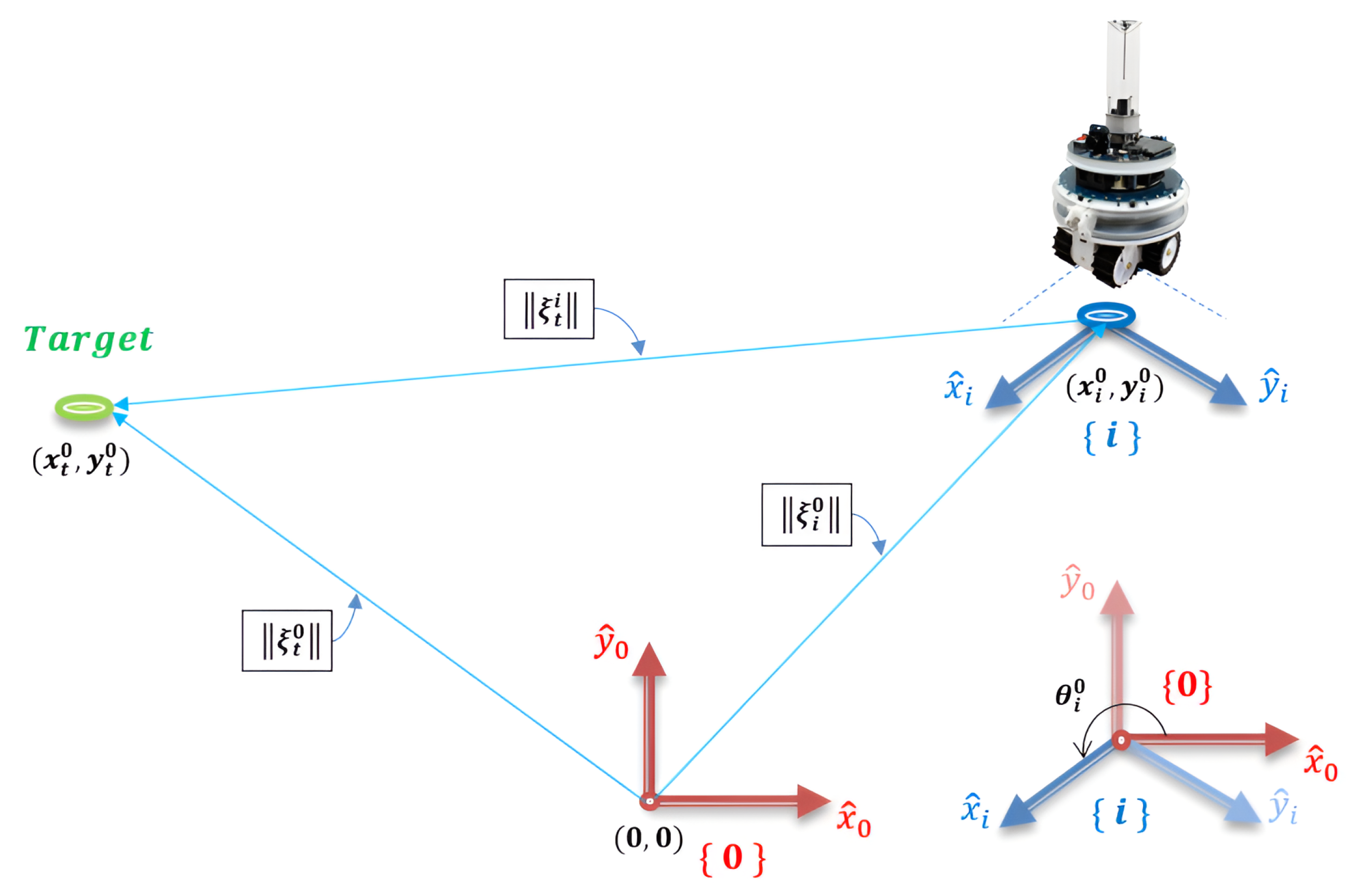
3.2. Swarm Mathematical Model
- is the rotation matrix from the robot frame to the global frame around the -axis, and is given by:
4. Control Design
4.1. Potential Field-Based Controller
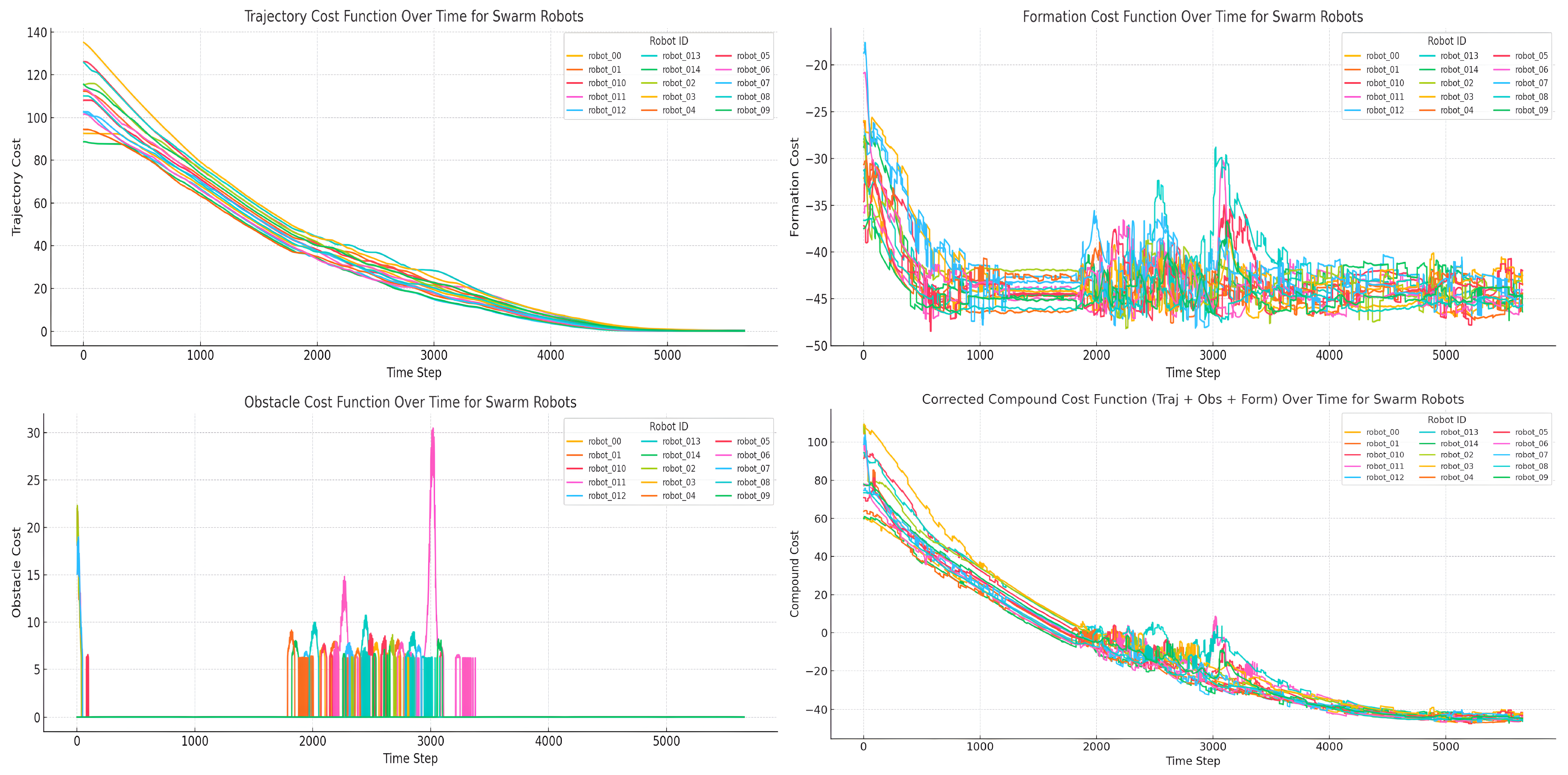
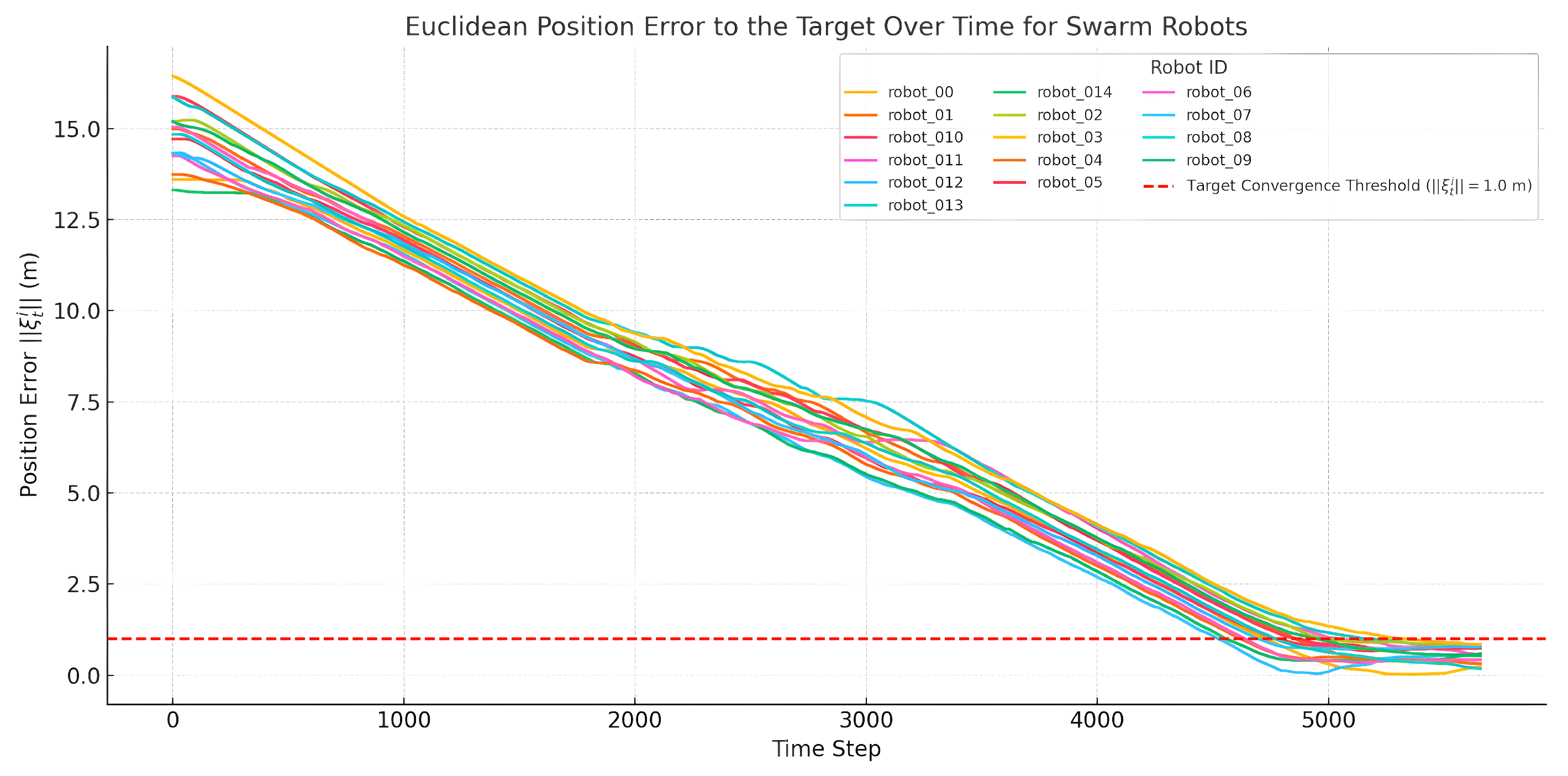
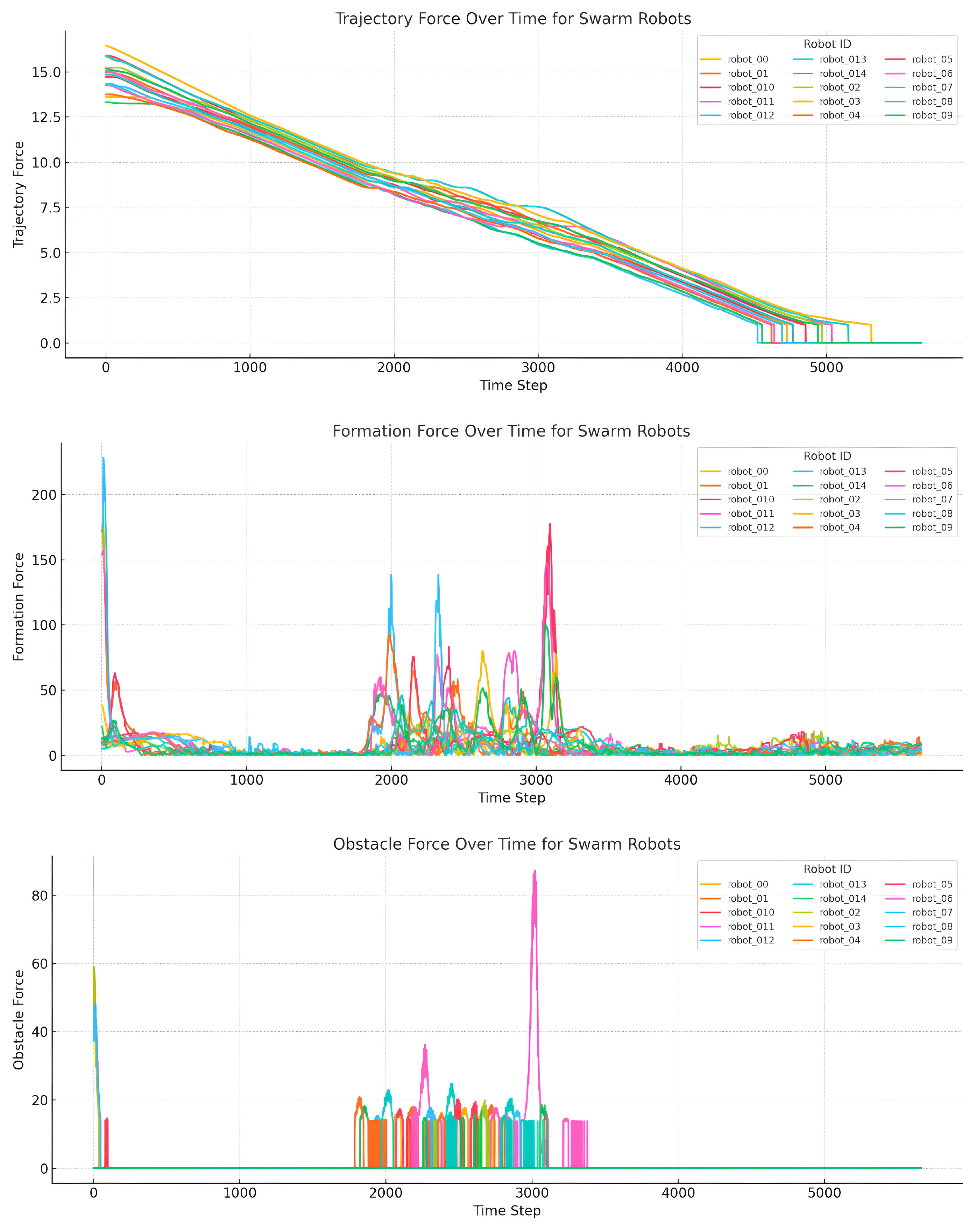
- Trajectory part: Enables the swarm to reach its target position.
- Formation part: Applies a desired distance between each robot and its neighbors to keep the formation through achieving the task.
- Obstacle part: Guides the swarm to avoid unknown obstacles along the target way.
4.1.1. Trajectory Part
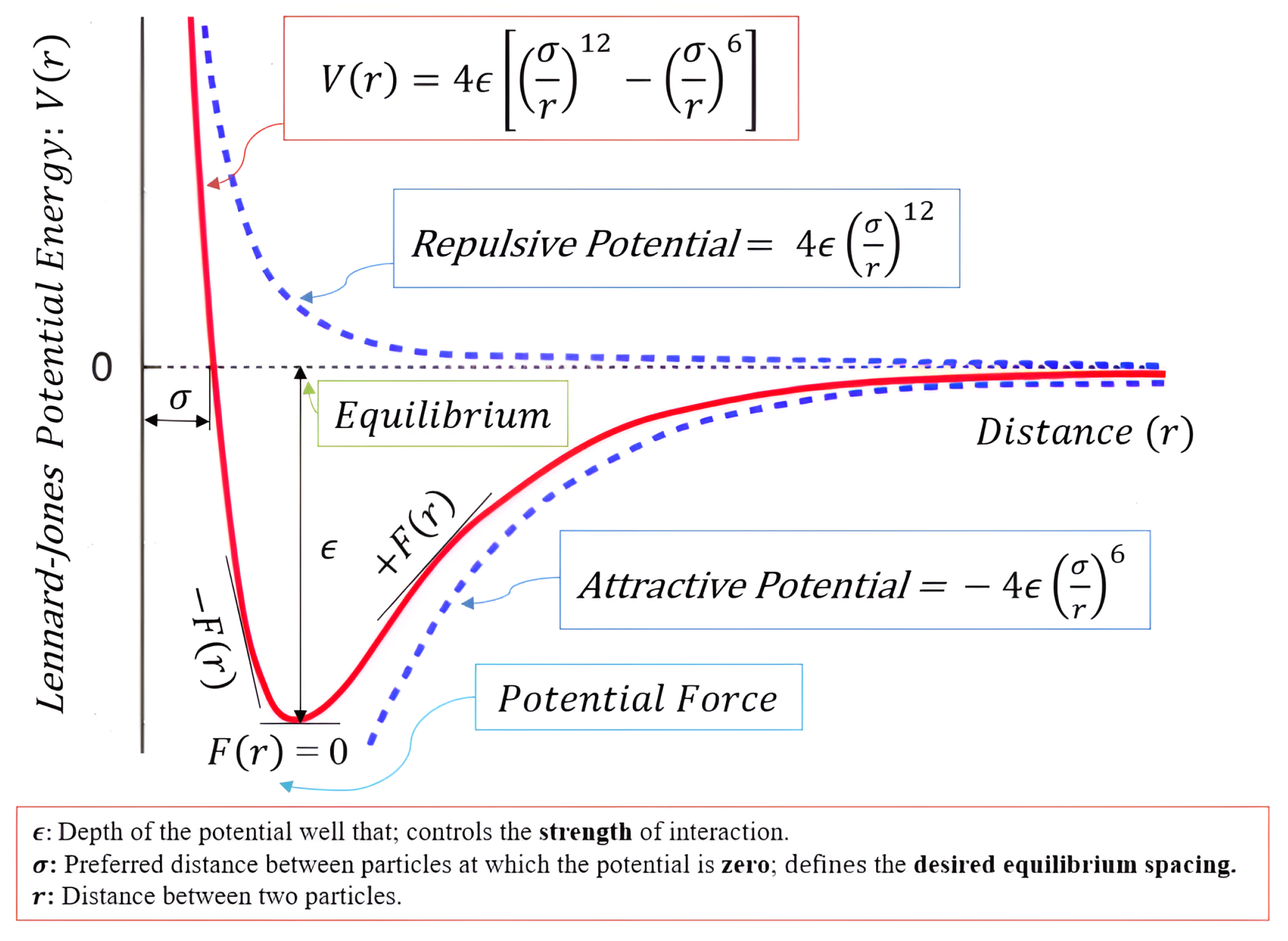
4.1.2. Formation Part
- is the rotation matrix representing the orientation of the robot frame expressed in global frame , corresponding to a rotation about the -axis.
- is the rotation matrix representing the orientation of robot frame expressed with respect to frame , representing a rotation around the -axis.
- Dictates the strength of the interaction between robots that shows how ‘deep’ the desired potential well is.
- The desired equilibrium distance between robots at which the interaction potential reaches its lowest point, signifying a stable formation.
- The gradient of the norm with respect to is:More generally, for any power n:
4.1.3. Obstacle Avoidance Potential
4.2. General Control Input (Platform-Independent)
- is the trajectory control gain.
- is the formation control gain.
- is the obstacle repulsion gain.
- are the forward and angular velocity hyperparameters associated with the trajectory, formation, and obstacle components for robot i, respectively.
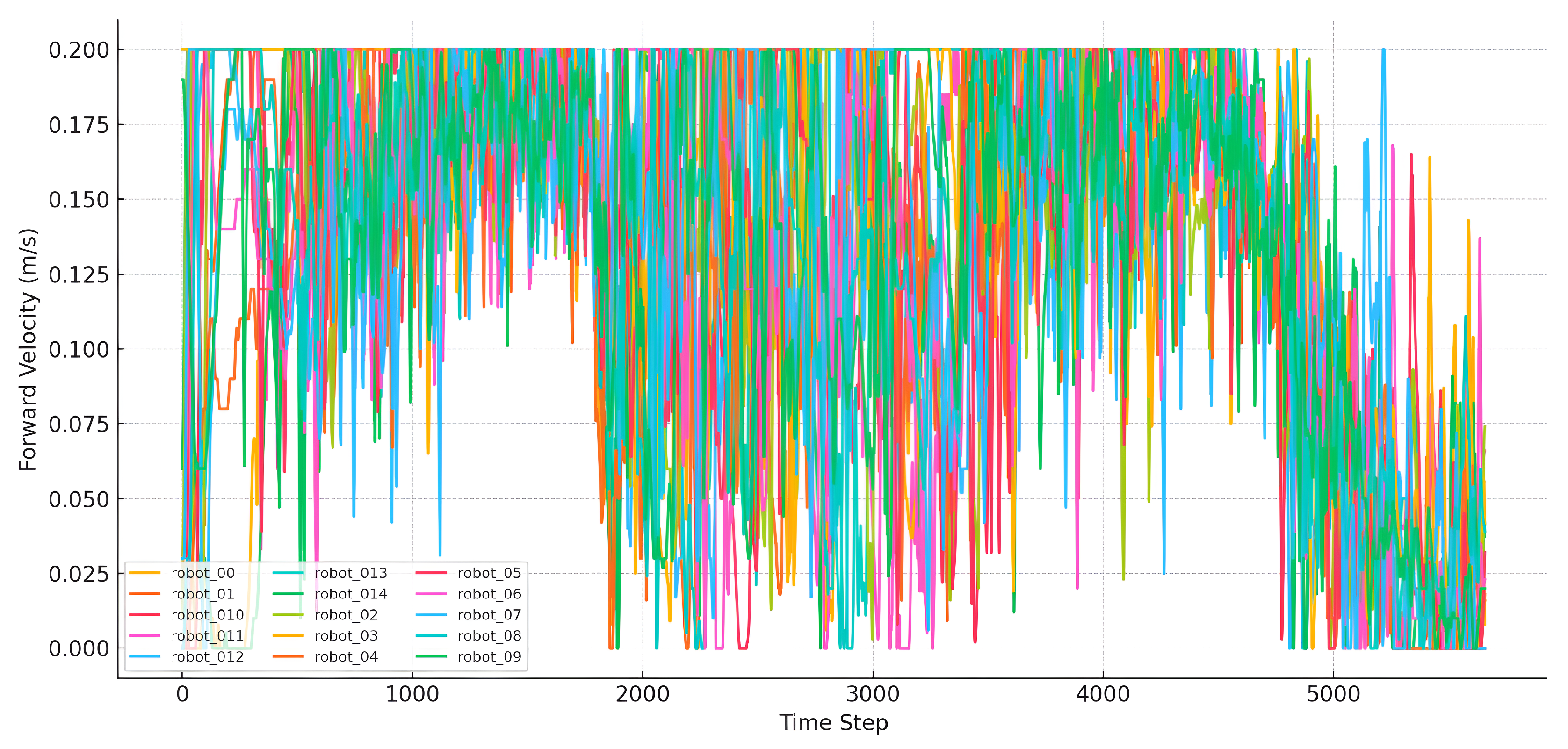
- is the maximum forward velocity assigned to the robot. It is used to convert the unitless force-to-velocity mapping into a real velocity value with physical units.
- In this framework, the forward velocity is expressed in m/s. However, the angular velocity must be mapped from m/s to rad/s, which is achieved by dividing by the robot wheelbase L, as shown in Equation (29).
4.3. Platform-Dependent Implementation
- L is the robot wheelbase (the distance between its two wheels).
- It is important to note that the velocities for the right and left wheels, and , are presented in m/s. For cases where these velocities are given in rad/s, a conversion is necessary; multiply by the robot’s wheel radius .
| Algorithm 1 Decentralized PF-Based Control for Swarm Robot i |
|
5. Lyapunov-Based Validation of the Proposed Control Law
- Trajectory control: The control drives the time-varying robot positions toward their targets , minimizing the position error over time. The Lyapunov function decreases as robots approach their respective targets.
- Formation control: The swarm asymptotically converges toward the desired formation configuration, where the inter-agent distances tend to the nominal value .
- Obstacle avoidance: The robots are repelled from nearby obstacles. The repulsive potential increases as robots approach danger zones, resulting in stable avoidance behavior as long as the robots remain within the sensing range .
6. Experimental Validation in ARGoS Simulator
7. Conclusions
Supplementary Materials
Author Contributions
Funding
Data Availability Statement
Acknowledgments
Conflicts of Interest
References
- Ivanova, N. Swarm robotics-coordination and cooperation: Exploring coordination and cooperation strategies in swarm robotics systems for achieving collective tasks. J. Comput. Intell. Robot. 2024, 4, 1–13. [Google Scholar]
- Thaker, R. An Overview of Swarm Robotics: Swarm Intelligence and Engineering Approaches for Coordinating Multi-Robot Systems. Int. J. Multidiscip. Res. 2021, 3, 29703. [Google Scholar] [CrossRef]
- Devi, K.V.R.; Smitha, B.; Lakhanpal, S.; Kalra, R.; Sethi, V.A.; Thajil, S.K. A review: Swarm robotics: Cooperative control in multi-agent systems. In Proceedings of the E3S Web of Conferences; EDP Sciences: Les Ulis, France, 2024; Volume 505, p. 03013. [Google Scholar] [CrossRef]
- Dorigo, M.; Theraulaz, G.; Trianni, V. Swarm robotics: Past, present, and future [point of view]. Proc. IEEE 2021, 109, 1152–1165. [Google Scholar] [CrossRef]
- Nguyen, L.V. Swarm Intelligence-Based Multi-Robotics: A Comprehensive Review. AppliedMath 2024, 4, 1192–1210. [Google Scholar] [CrossRef]
- Dias, P.G.F.; Silva, M.C.; Rocha Filho, G.P.; Vargas, P.A.; Cota, L.P.; Pessin, G. Swarm robotics: A perspective on the latest reviewed concepts and applications. Sensors 2021, 21, 2062. [Google Scholar] [CrossRef]
- Duan, H.; Huo, M.; Fan, Y. From animal collective behaviors to swarm robotic cooperation. Natl. Sci. Rev. 2023, 10, nwad040. [Google Scholar] [CrossRef]
- Petráček, P.; Walter, V.; Báča, T.; Saska, M. Bio-inspired compact swarms of unmanned aerial vehicles without communication and external localization. Bioinspir. Biomimetics 2020, 16, 026009. [Google Scholar] [CrossRef]
- Debie, E.; Kasmarik, K.; Garratt, M. Swarm robotics: A Survey from a Multi-tasking Perspective. ACM Comput. Surv. 2023, 56, 1–38. [Google Scholar] [CrossRef]
- Asri, E.G.; Zhu, Z.H. An introductory review of swarm technology for spacecraft on-orbit servicing. Int. J. Mech. Syst. Dyn. 2024, 4, 3–21. [Google Scholar] [CrossRef]
- Pachajoa, G.M.M.; Achicanoy, W.; Ramos, D.G. Automating the Evaluation of the Scalability, Flexibility, and Robustness of Collective Behaviors for Robot Swarms. In Proceedings of the 2024 Brazilian Symposium on Robotics (SBR), and 2024 Workshop on Robotics in Education (WRE), Goiania, Brazil, 13–15 November 2024; pp. 144–149. [Google Scholar]
- Milner, E.; Sooriyabandara, M.; Hauert, S. Swarm Performance Indicators: Metrics for robustness, fault tolerance, scalability and adaptability. arXiv 2023, arXiv:2311.01944. [Google Scholar] [CrossRef]
- Kegeleirs, M.; Birattari, M. Towards applied swarm robotics: Current limitations and enablers. Front. Robot. AI 2025, 12, 1607978. [Google Scholar] [CrossRef] [PubMed]
- Albiero, D.; Garcia, A.P.; Umezu, C.K.; de Paulo, R.L. Swarm robots in mechanized agricultural operations: A review about challenges for research. Comput. Electron. Agric. 2022, 193, 106608. [Google Scholar] [CrossRef]
- Al-Amin, A.A.; Lowenberg-DeBoer, J.; Franklin, K.; Dickin, E.; Monaghan, J.M.; Behrendt, K. Autonomous regenerative agriculture: Swarm robotics to change farm economics. Smart Agric. Technol. 2025, 11, 101005. [Google Scholar] [CrossRef]
- Abhang, L.; Gummadi, A.; Changala, R.; Vuyyuru, V.A.; Sabareesh, R.; Raj, I.I. Swarm Intelligence for Multi-Robot Coordination in Agricultural Automation. In Proceedings of the 2024 10th International Conference on Advanced Computing and Communication Systems (ICACCS), Coimbatore, India, 14–15 March 2024; Volume 1, pp. 455–460. [Google Scholar]
- Siemensma, T.; Chiu, D.; Ramshanker, S.; Nagpal, R.; Haghighat, B. Collective Bayesian Decision-Making in a Swarm of Miniaturized Robots for Surface Inspection. In Proceedings of the International Conference on Swarm Intelligence, Konstanz, Germany, 9–11 October 2024; Springer: Cham, Switzerland, 2024; pp. 57–70, (Confirmed and approved). [Google Scholar]
- Chiu, D.; Nagpal, R.; Haghighat, B. Optimization and Evaluation of a Multi Robot Surface Inspection Task Through Particle Swarm Optimization. In Proceedings of the 2024 IEEE International Conference on Robotics and Automation (ICRA), Yokohama, Japan, 13–17 May 2024; pp. 8996–9002. [Google Scholar]
- Hoang, M.T.O.; Grøntved, K.A.R.; van Berkel, N.; Skov, M.B.; Christensen, A.L.; Merritt, T. Drone swarms to support search and rescue operations: Opportunities and challenges. In Cultural Robotics: Social Robots and Their Emergent Cultural Ecologies; Springer: Cham, Switzerland, 2023; pp. 163–176. [Google Scholar]
- García, R.M.; De La Iglesia, D.H.; De Paz, J.F.; Leithardt, V.R.; Villarrubia, G. Urban search and rescue with anti-pheromone robot swarm architecture. In Proceedings of the 2021 Telecoms Conference (ConfTELE), Leiria, Portugal, 11–12 February 2021; pp. 1–6. [Google Scholar]
- Kumar, V.; Das, S. Navigating the swarm: Bio-inspired robotics, intelligent algorithms, and applications. In Bio-Inspired Swarm Robotics and Control: Algorithms, Mechanisms, and Strategies; IGI Global: Hershey, PA, USA, 2024; pp. 140–154. [Google Scholar]
- Arunkumar, V.; Rajasekar, D.; Aishwarya, N. A review paper on mobile robots applications in search and rescue operations. Adv. Sci. Technol. 2023, 130, 65–74. [Google Scholar] [CrossRef]
- Gul, F.; Mir, I.; Abualigah, L.; Sumari, P. Multi-robot space exploration: An augmented arithmetic approach. IEEE Access 2021, 9, 107738–107750. [Google Scholar] [CrossRef]
- Alqudsi, Y.; Makaraci, M. Exploring advancements and emerging trends in robotic swarm coordination and control of swarm flying robots: A review. Proc. Inst. Mech. Eng. Part C J. Mech. Eng. Sci. 2025, 239, 180–204. [Google Scholar] [CrossRef]
- Romeh, A.E.; Mirjalili, S. Multi-robot exploration of unknown space using combined meta-heuristic salp swarm algorithm and deterministic coordinated multi-robot exploration. Sensors 2023, 23, 2156. [Google Scholar] [CrossRef]
- Kuckling, J. Recent trends in robot learning and evolution for swarm robotics. Front. Robot. AI 2023, 10, 1134841. [Google Scholar] [CrossRef]
- Koifman, Y.; Barel, A.; Bruckstein, A.M. Distributed and Decentralized Control and Task Allocation for Flexible Swarms. arXiv 2024, arXiv:2405.13941. [Google Scholar] [CrossRef]
- Gutiérrez, Á. Recent advances in swarm robotics coordination: Communication and memory challenges. Appl. Sci. 2022, 12, 11116. [Google Scholar] [CrossRef]
- Lamperti, R.D.; de Arruda, L.V.R. Distributed strategy for communication between multiple robots during formation navigation task. Robot. Auton. Syst. 2023, 169, 104509. [Google Scholar] [CrossRef]
- Ratnabala, L.; Peter, R.; Charles, E. Evolutionary Swarm Robotics: Dynamic Subgoal-Based Path Formation and Task Allocation for Exploration and Navigation in Unknown Environments. arXiv 2023, arXiv:2312.16606. [Google Scholar] [CrossRef]
- Muhsen, D.K.; Sadiq, A.T.; Raheem, F.A. A survey on swarm robotics for area coverage problem. Algorithms 2023, 17, 3. [Google Scholar] [CrossRef]
- Mao, P.; Lv, S.; Min, C.; Shen, Z.; Quan, Q. An Efficient Real-Time Planning Method for Swarm Robotics Based on an Optimal Virtual Tube. arXiv 2025, arXiv:2505.01380. [Google Scholar] [CrossRef]
- Ding, K.; Jiao, C.; Hu, Y.; Zhou, K.; Wu, P.; Mu, Y.; Liu, C. SwarmDiff: Swarm Robotic Trajectory Planning in Cluttered Environments via Diffusion Transformer. In Proceedings of the Computer Vision and Pattern Recognition Conference (CVPR) Workshops, Nashville, TN, USA, 11–15 June 2025; pp. 4164–4173. [Google Scholar]
- Tang, Y.; Bai, Y.; Chen, Q. An Adaptive Obstacle Avoidance Model for Autonomous Robots Based on Dual-Coupling Grouped Aggregation and Transformer Optimization. Sensors 2025, 25, 1839. [Google Scholar] [CrossRef]
- Marek, D.; Biernacki, P.; Szyguła, J.; Domański, A.; Paszkuta, M.; Szczygieł, M.; Król, M.; Wojciechowski, K. Collision Avoidance Mechanism for Swarms of Drones. Sensors 2025, 25, 1141. [Google Scholar] [CrossRef]
- Batool, F.; Zafar, M.; Yaqoot, Y.; Khan, R.A.; Khan, M.H.; Fedoseev, A.; Tsetserukou, D. ImpedanceGPT: VLM-driven Impedance Control of Swarm of Mini-drones for Intelligent Navigation in Dynamic Environment. arXiv 2025, arXiv:2503.02723. [Google Scholar]
- Pham, H.; Ranasinghe, N.; Le, D.; Atman, M.W.S.; Gusrialdi, A. Safety-Guaranteed Distributed Formation Control of Multi-Robot Systems Over Graphs With Rigid and Elastic Edges. IEEE Robot. Autom. Lett. 2024, 9, 10240–10247. [Google Scholar] [CrossRef]
- Maaruf, M.; El-Ferik, S.; Abdulaziz Saif, A. Critic learning control via zero-sum differential game for affine formation maneuver of multi-agent systems with cyber-attacks. Int. J. Syst. Sci. 2024, 55, 2252–2268. [Google Scholar] [CrossRef]
- El Ferik, S.; Aliyu, A. Adaptive Backstepping Multi-Agent Control of Multiple UAVs Conveying Load: A Graph Rigidity Approach. IEEE Access 2023, 11, 58269–58278. [Google Scholar] [CrossRef]
- Alabsari, N.; Saif, A.W.A.; El-Ferik, S.; Duffuaa, S.; Derbel, N. Cooperative flight control of a fleet of quadrotors using fractional sliding mode with potential field algorithms. IEEE Access 2024, 12, 24525–24543. [Google Scholar] [CrossRef]
- Saif, A.; Alabsari, N.; Ferik, S.; Elshafei, M. Formation control of quadrotors via potential field and geometric techniques. Int. J. Adv. Appl. Sci 2020, 7, 82–96. [Google Scholar]
- Ali, Z.A.; Alkhammash, E.H.; Hasan, R. State-of-the-Art Flocking Strategies for the Collective Motion of Multi-Robots. Machines 2024, 12, 739. [Google Scholar] [CrossRef]
- Imran, B.M.; Kim, J.; Chunawala, T.; Leonessa, A.; Hamed, K.A. Safety-Critical and Distributed Nonlinear Predictive Controllers for Teams of Quadrupedal Robots. arXiv 2025, arXiv:2503.14656. [Google Scholar] [CrossRef]
- De Andrade, E.M.; Junior, J.S.S.; Fernandes, A.C. A review of straightforward distributed behaviors in swarm robotics. In Proceedings of the 2023 Latin American Robotics Symposium (LARS), 2023 Brazilian Symposium on Robotics (SBR), and 2023 Workshop on Robotics in Education (WRE), Salvador, Brazil, 9–11 October 2023; pp. 113–118. [Google Scholar] [CrossRef]
- Elkilany, B.G.; Abouelsoud, A.; Fathelbab, A.M.; Ishii, H. A proposed decentralized formation control algorithm for robot swarm based on an optimized potential field method. Neural Comput. Appl. 2021, 33, 487–499. [Google Scholar] [CrossRef]
- Ruiz-Fernandez, L.E.; Ruiz-Leon, J.; Gomez-Gutierrez, D.; Murrieta-Cid, R. Decentralized multi-robot formation control in environments with non-convex and dynamic obstacles based on path planning algorithms. Intell. Serv. Robot. 2025, 18, 215–232. [Google Scholar] [CrossRef]
- Bi, Y.; Luo, J.; Zhu, J.; Liu, J.; Li, W. Decentralized Multi-Robot Navigation Based on Deep Reinforcement Learning and Trajectory Optimization. Biomimetics 2025, 10, 366. [Google Scholar] [CrossRef]
- Gerdpratoom, N.; Yamamoto, K. Decentralized nonlinear model predictive control-based flock navigation with real-time obstacle avoidance in unknown obstructed environments. Front. Robot. AI 2025, 12, 1540808. [Google Scholar] [CrossRef]
- Chang, L.; Shan, L.; Zhang, W.; Dai, Y. Hierarchical multi-robot navigation and formation in unknown environments via deep reinforcement learning and distributed optimization. Robot. Comput.-Integr. Manuf. 2023, 83, 102570. [Google Scholar] [CrossRef]
- Goodin, C.; Henley, G.; Cagle, L.; Black, B.; Carrillo, J.; McInnis, D. Decentralized Swarm Control in Communication-Constrained Environments Using a Blended Leader Follower-Artificial Potential Field With Biologically Inspired Interactions. J. Auton. Veh. Syst. 2023, 3, 041001. [Google Scholar] [CrossRef]
- Pinciroli, C.; Trianni, V.; O’Grady, R.; Pini, G.; Brutschy, A.; Brambilla, M.; Mathews, N.; Ferrante, E.; Di Caro, G.; Ducatelle, F.; et al. ARGoS: A modular, parallel, multi-engine simulator for multi-robot systems. Swarm Intell. 2012, 6, 271–295. [Google Scholar] [CrossRef]
- Fan, Y.; Li, X.; Liu, X.; Cheng, S.; Wang, X. Multi-robot consensus formation based on virtual spring obstacle avoidance. Mech. Sci. 2024, 15, 195–207. [Google Scholar] [CrossRef]
- Wang, J.; Guo, B.; Zhao, K.; Liu, S.; Yu, Z. Bio-inspired Decentralized Multi-robot Exploration in Unknown Environments. In Proceedings of the 2023 IEEE 20th International Conference on Mobile Ad Hoc and Smart Systems (MASS), Toronto, ON, Canada, 25–27 September 2023; pp. 204–210. [Google Scholar]
- Chang, X.; Jiao, J.; Li, Y.; Hong, B. Multi-consensus formation control by artificial potential field based on velocity threshold. Front. Neurosci. 2024, 18, 1367248. [Google Scholar] [CrossRef] [PubMed]
- Shao, S.; Zhang, J.; Wang, T.; Shankar, A.; Maple, C. Dynamic obstacle-avoidance algorithm for multi-robot flocking based on improved artificial potential field. IEEE Trans. Consum. Electron. 2023, 70, 4388–4399. [Google Scholar] [CrossRef]
- Tong, X.; Yu, S.; Liu, G.; Niu, X.; Xia, C.; Chen, J.; Yang, Z.; Sun, Y. A hybrid formation path planning based on A* and multi-target improved artificial potential field algorithm in the 2D random environments. Adv. Eng. Inform. 2022, 54, 101755. [Google Scholar] [CrossRef]
- Ding, W.; Zhang, L.; Zhang, G.; Wang, C.; Chai, Y.; Yang, T.; Mao, Z. Research on obstacle avoidance of multi-AUV cluster formation based on virtual structure and artificial potential field method. Comput. Electr. Eng. 2024, 117, 109250. [Google Scholar] [CrossRef]
- Sahal, M.; Maynad, V.C.; Bilfaqih, Y. Cooperative Formation and Obstacle Avoidance Control for Multi-UAV Based on Guidance Route and Artificial Potential Field. J. Robot. Control (JRC) 2024, 5, 1772–1783. [Google Scholar]
- Lajčiak, M.; Vachálek, J. Swarm Control with RRT-APF Planning and FNN Task Allocation Tested on Mobile Differential Platform. Sensors 2025, 25, 3886. [Google Scholar] [CrossRef]
- dos Passos, Y.T.; Duquesne, X.; Marcolino, L.S. Congestion control algorithms for robotic swarms with a common target based on the throughput of the target area. Robot. Auton. Syst. 2023, 159, 104284. [Google Scholar] [CrossRef]
- Dong, C.; Zheng, B.; He, S. Adaptive formation control of nonholonomic multirobot systems with collision avoidance and connectivity maintenance. Int. J. Syst. Sci. 2024, 55, 2289–2305. [Google Scholar] [CrossRef]
- Omotuyi, O.; Kumar, M. Learning Scalable Decentralized Controllers for Heterogeneous Robot Swarms With Graph Neural Networks. J. Dyn. Syst. Meas. Control 2024, 146, 061107. [Google Scholar]
- Istiak, M.A.; Ullah, M.S.; Ashraf, Z.B.; Sarker, S.C.; Chowdhury, M.M.; Ahbab, S.S. SymSwarm: A Two-Staged Decentralized Symmetrical Pattern Formation Paradigm for a Swarm of Mobile Robots. Arab. J. Sci. Eng. 2023, 48, 15509–15526. [Google Scholar] [CrossRef]
- Gao, Y.; Bai, C.; Fu, R.; Quan, Q. A non-potential orthogonal vector field method for more efficient robot navigation and control. Robot. Auton. Syst. 2023, 159, 104291. [Google Scholar] [CrossRef]
- Zhang, Z.; Wang, X.; Zhang, Q.; Hu, T. Multi-robot cooperative pursuit via potential field-enhanced reinforcement learning. In Proceedings of the 2022 International Conference on Robotics and Automation (ICRA), Philadelphia, PA, USA, 23–27 May 2022; pp. 8808–8814. [Google Scholar]
- Chen, W.; Wu, X.; Lu, Y. An improved path planning method based on artificial potential field for a mobile robot. Cybern. Inf. Technol. 2015, 15, 181–191. [Google Scholar] [CrossRef]
- Ran, Y.; Bertola, V. Achievements and prospects of molecular dynamics simulations in thermofluid sciences. Energies 2024, 17, 888. [Google Scholar] [CrossRef]
- Gavrielides, A. Modelling the DGEBA-EDA Poly-Epoxy Reactivity Towards Copper Experimental and Numerical Approach. Ph.D. Thesis, Université Paul Sabatier-Toulouse III, Toulouse, France, 2017. [Google Scholar]








| Ref | Control Type | Technique | Environment | Obstacle Type | Trajectory Tracking | Formation Control | Obstacle Avoidance | Scalability | Flexibility | Robustness to Failure | Narrow Passages/Walls | Platform |
|---|---|---|---|---|---|---|---|---|---|---|---|---|
| [65] | Decentralized | APF + Deep RL (D3QN) | Known | Static | ✗ | ✗ | ✓ | ≤6 | ✓ | ✗ | ✗/✓ | Real/Sim |
| [61] | Decentralized | Adaptive Formation + APF | Partially Known | – | ✓ | ✓ | ✗ | ≤4 | ✗ | ✗ | ✗/✗ | Real/Sim |
| [59] | Centralized | RRT–APF + FNN + MAPF | Partially Known | Static | ✗ | ✗ | ✓ | ≤50 | ✗ | ✗ | ✗/✓ | Real/Sim |
| [63] | Decentralized | Two-Stage Pattern Formation (CPSM + Geometry) | Unknown | Static | ✗ | ✓ | ✓ | ≤8 | ✗ | ✗ | ✗/✓ | Sim (V-REP) |
| [60] | Decentralized | APF-Based Congestion Control (SQF/TRVF) | Partially Known | Static | ✗ | ✗ | ✓ | ≤300 | ✗ | ✗ | ✗/✗ | Sim |
| [62] | Decentralized | GNN + Imitation Learning (Segregation/Aggregation) | Unknown | – | ✗ | ✗ | ✗ | ≤100 | ✓ | ✗ | ✗/✗ | Real/Sim |
| [64] | Decentralized | NPOVF + APF | Known | Static | ✗ | ✗ | ✓ | ≤288 | ✗ | ✗ | ✗/✗ | Real/Sim |
| [47] | Decentralized | GNN-RL + APF + Optimization | Unknown | Dynamic | ✓ | ✗ | ✓ | ≤30 | ✗ | ✗ | ✗/✗ | Sim |
| [58] | Centralized | Guidance + PF | Partially Known | Static | ✓ | ✓ | ✓ | ≤15 | ✗ | ✗ | ✗/✗ | Real UAV |
| [48] | Decentralized | Nonlinear MPC | Unknown | Static | ✓ | ✗ | ✓ | ≤10 | ✗ | ✓ | ✗/✗ | Gazebo + HIL |
| [45] | Decentralized | Optimized PF + ANN | Unknown | Static | ✓ | ✓ | ✓ | ≤30 | ✗ | ✗ | ✓/✗ | Real/Sim |
| [56] | Semi-Centralized | A* + MTIAPF | Known | Static | ✓ | ✓ | ✓ | ≤10 | ✗ | ✗ | ✗/✗ | 2D Grid Sim |
| [50] | Hybrid | Leader–Follower + APF + Bio-Inspired | Unknown | Both | ✓ | ✓ | ✓ | ≤25 | ✗ | ✓ | ✗/✗ | MAVS Sim |
| [46] | Decentralized | RRT + ORCA | Known | Dynamic | ✗ | ✓ | ✓ | ≤20 | ✗ | ✗ | ✗/✗ | Sim |
| [57] | Decentralized | Virtual Structure + PF | Unknown | Both | ✓ | ✓ | ✓ | ≤15 | ✗ | ✗ | ✗/✗ | KKSwarm (2D) |
| [55] | Decentralized | Improved PF | Unknown | Dynamic | ✓ | ✗ | ✓ | ≤20 | ✓ | ✓ | ✗/✗ | Sim |
| [49] | Hierarchical | DRL + Distributed Optimization | Unknown | Both | ✓ | ✓ | ✓ | ≤20 | ✓ | ✓ | ✓/✓ | Sim |
| Proposed | Decentralized | Pure PF (Trajectory + Formation + Obstacles) | Unknown | Both | ✓ | ✓ | ✓ | ≤100 | ✓ | ✓ | ✓/✓ | ARGoS (Foot-bot) |
| Parameter | Value |
|---|---|
| 15 up to 100 robots | |
| 24 proximity sensor | |
| L | 0.14 m |
| 0.2 m/s | |
| 0.02056 m | |
| 0.2 (if obstacle exists), or 1 (if it doesn’t exist) | |
| 0.2 (if obstacle exists), or 1 (if it doesn’t exist) | |
| 0.2 (if obstacle exists), or 1 (if it doesn’t exist) | |
| 0.06 (if obstacle exists), or 0.3 (if it doesn’t exist) | |
| 2 (if obstacle exists), or 0 (if it doesn’t exist) | |
| 4 (if obstacle exists), or 0 (if it doesn’t exist) | |
| 1 | |
| 50 |
| Run | Success | Completion Time (s) | Improvement Rate (cm/s) |
|---|---|---|---|
| Run 1 | Yes | 705.7 | 2.02 |
| Run 2 | Yes | 664.2 | 1.95 |
| Run 3 | Yes | 591.2 | 1.83 |
| Run 4 | Yes | 719.0 | 1.90 |
| Run 5 | Yes | 808.3 | 1.76 |
| Mean | 100% | 697.68 | 1.89 |
| Std. Dev. | – | 75.55 | 0.10 |
Disclaimer/Publisher’s Note: The statements, opinions and data contained in all publications are solely those of the individual author(s) and contributor(s) and not of MDPI and/or the editor(s). MDPI and/or the editor(s) disclaim responsibility for any injury to people or property resulting from any ideas, methods, instructions or products referred to in the content. |
© 2025 by the authors. Licensee MDPI, Basel, Switzerland. This article is an open access article distributed under the terms and conditions of the Creative Commons Attribution (CC BY) license (https://creativecommons.org/licenses/by/4.0/).
Share and Cite
Abdel-Nasser, M.; El-Ferik, S.; Rashad, R.; Saif, A.-W.A. A Decentralized Potential Field-Based Self-Organizing Control Framework for Trajectory, Formation, and Obstacle Avoidance of Fully Autonomous Swarm Robots. Robotics 2025, 14, 192. https://doi.org/10.3390/robotics14120192
Abdel-Nasser M, El-Ferik S, Rashad R, Saif A-WA. A Decentralized Potential Field-Based Self-Organizing Control Framework for Trajectory, Formation, and Obstacle Avoidance of Fully Autonomous Swarm Robots. Robotics. 2025; 14(12):192. https://doi.org/10.3390/robotics14120192
Chicago/Turabian StyleAbdel-Nasser, Mohammed, Sami El-Ferik, Ramy Rashad, and Abdul-Wahid A. Saif. 2025. "A Decentralized Potential Field-Based Self-Organizing Control Framework for Trajectory, Formation, and Obstacle Avoidance of Fully Autonomous Swarm Robots" Robotics 14, no. 12: 192. https://doi.org/10.3390/robotics14120192
APA StyleAbdel-Nasser, M., El-Ferik, S., Rashad, R., & Saif, A.-W. A. (2025). A Decentralized Potential Field-Based Self-Organizing Control Framework for Trajectory, Formation, and Obstacle Avoidance of Fully Autonomous Swarm Robots. Robotics, 14(12), 192. https://doi.org/10.3390/robotics14120192