
Article

Active Soft Brace for Scoliotic Spine: A Finite Element Study to Evaluate in-Brace Correction

1
Department of Industrial Engineering, University of Trento, 38123 Trento, Italy
2
Department of Orthopedics and Traumatology, Medical University of Innsbruck, 6020 Innsbruck, Austria
3
Robotics and Rehabilitation (ROAR) Laboratory, Department of Mechanical Engineering, Columbia University, New York, NY 10027, USA
*
Authors to whom correspondence should be addressed.
Robotics 2022, 11(2), 37; https://doi.org/10.3390/robotics11020037

Submission received: 1 February 2022 / Revised: 17 March 2022 / Accepted: 17 March 2022 / Published: 21 March 2022
(This article belongs to the Special Issue Medical and Rehabilitation Robots)

Abstract

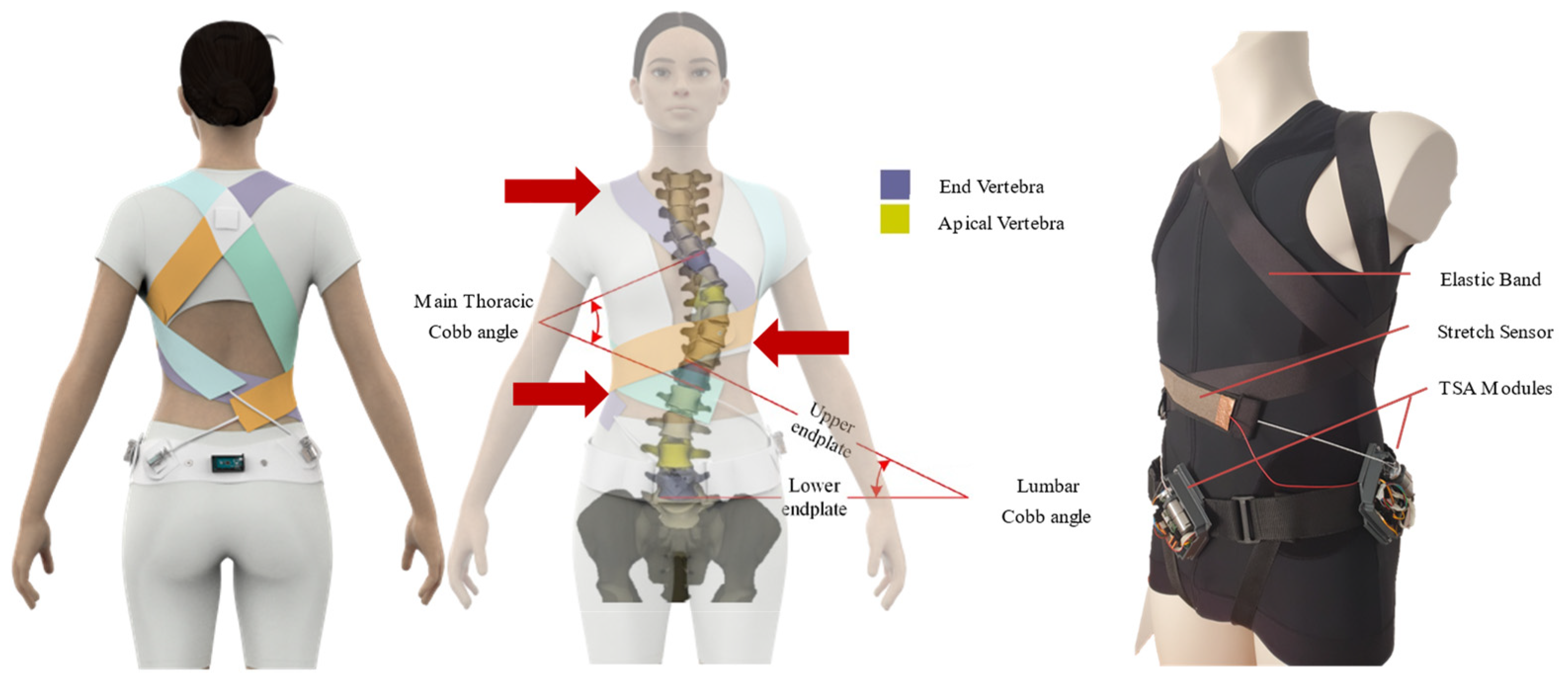
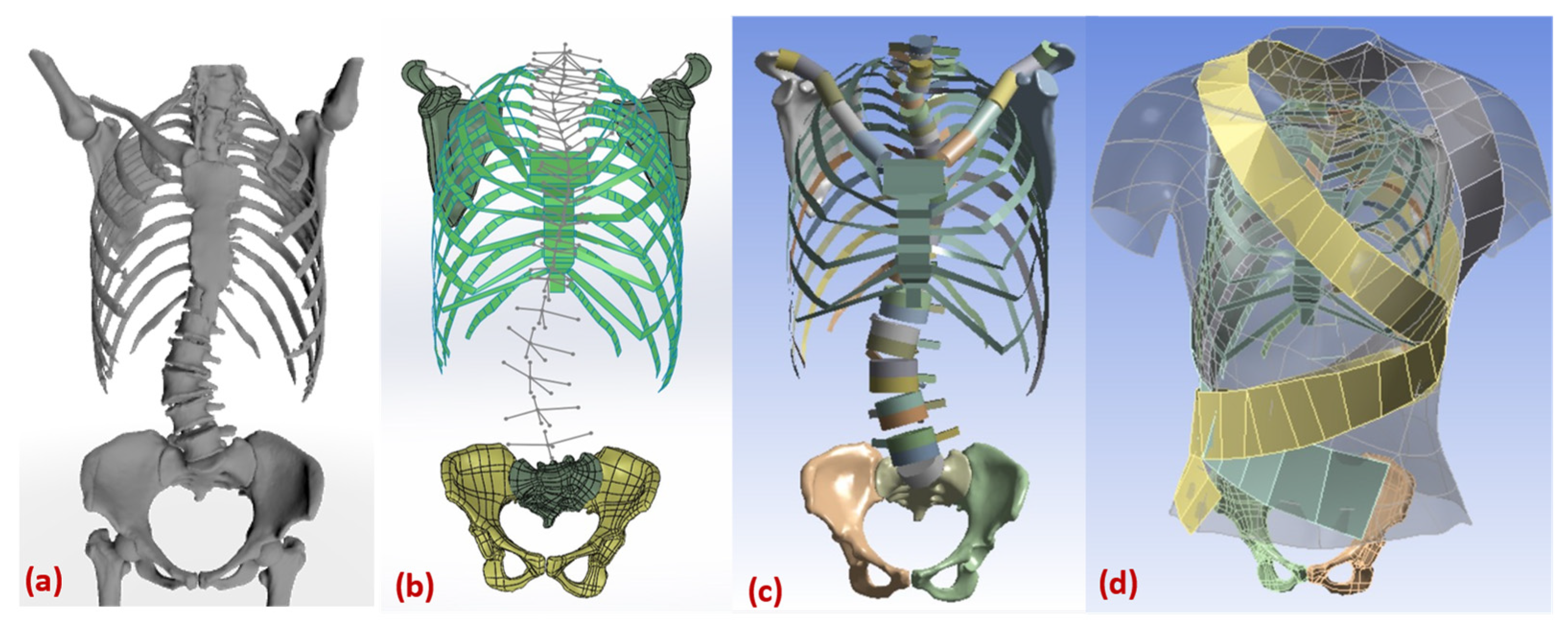
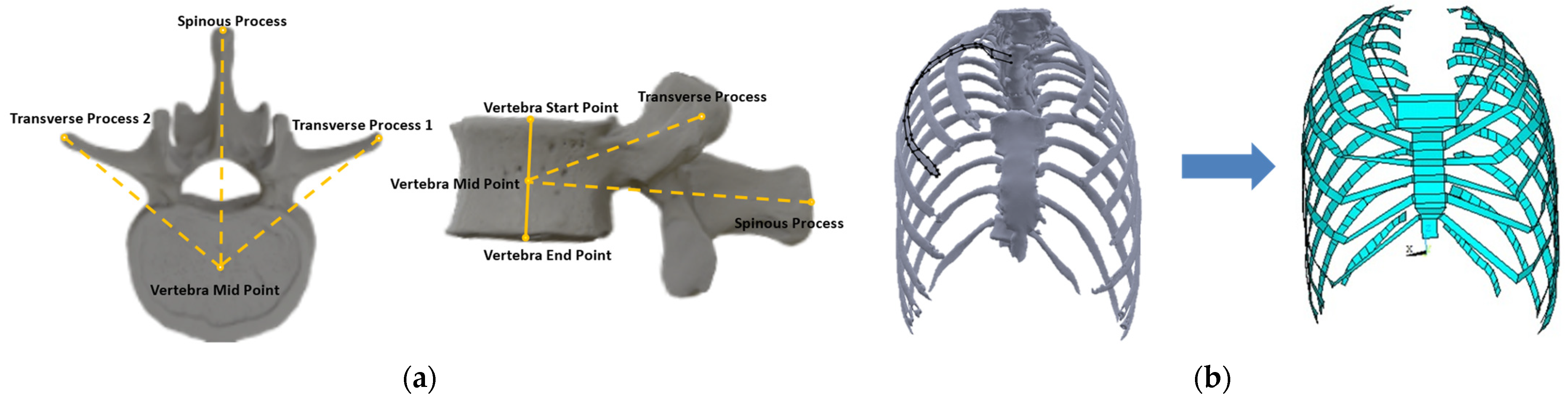
Scoliosis is a spinal disorder that is conventionally treated using rigid or soft braces. Computational methods such as finite element-based models are used to investigate the mechanics of the spine and the effect of braces. Most spinal braces are either passive, static, or rigid and do not allow mobility to the spine, resulting in muscle atrophy, skin deterioration and other spine complexities. Lack of control over the amount of force being exerted by braces on the human spine could have adverse effects. Therefore, developing an active soft brace which allows mobility to the spine while applying controlled corrective forces could be a promising solution. This study presents finite element analysis (FEA) of an active soft brace that applies corrective forces using elastic bands. The pressure exerted by the brace on the spine can be controlled by varying the tensions in the elastic bands. The elastic band tensions are controlled using low-power, lightweight, and twisted string actuators (TSAs). This study aims to demonstrate the immediate corrections induced by the soft active brace using a scoliotic spine finite element (FE) model. A FE model of the patient’s trunk was created and validated with in vitro study. The brace model was installed on the simulated trunk to evaluate in-brace correction in both sagittal and coronal planes. The brace was evaluated under various load cases by simulating the actuator action.
Keywords: active soft braces; exoskeleton; soft robotic suit; spine biomechanics; scoliosis active soft braces; exoskeleton; soft robotic suit; spine biomechanics; scoliosis