


Zn2+ and Cu2+ Binding to the Extramembrane Loop of Zrt2, a Zinc Transporter of Candida albicans

Abstract
1. Introduction
2. Materials and Methods
2.1. Materials
2.2. Potentiometry
2.3. Mass Spectrometry
2.4. Spectroscopic Measurements
3. Results and Discussion
3.1. Ligand Protonation
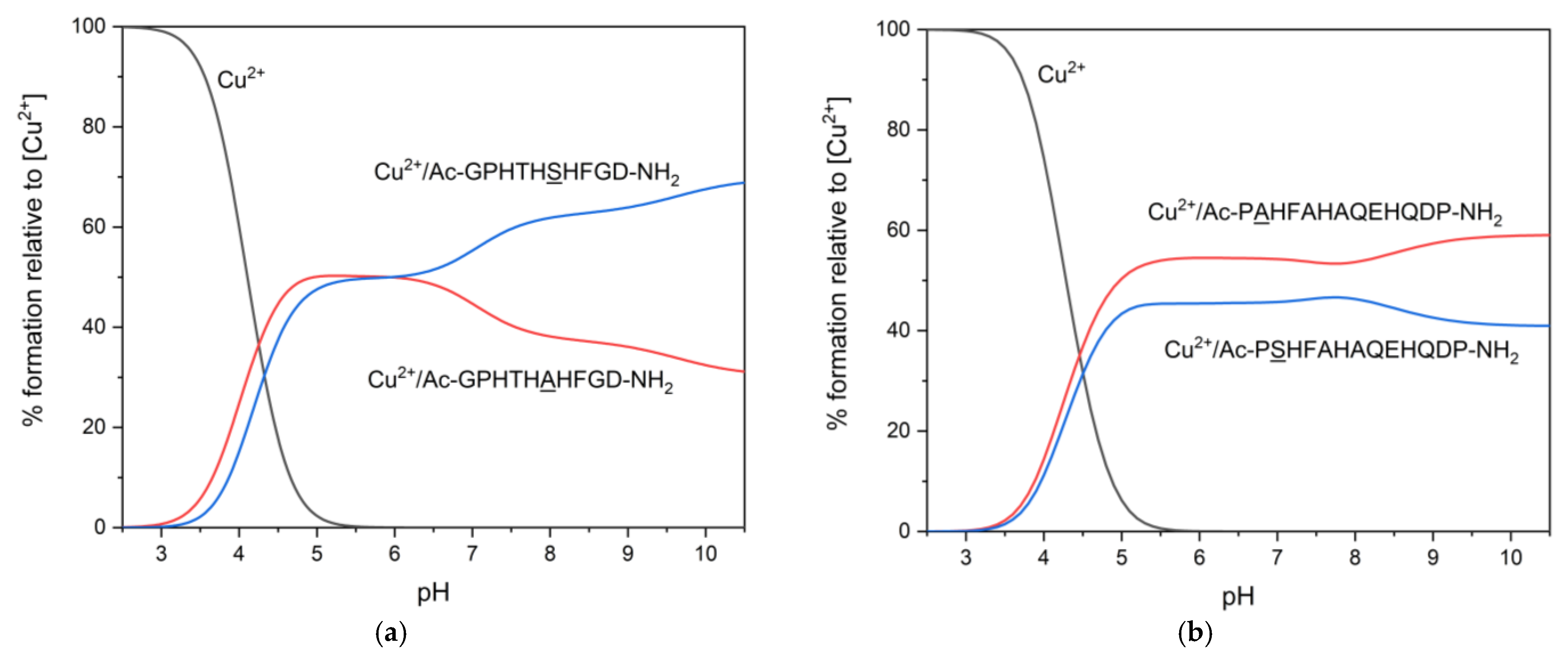
3.2. Copper(II) Complexes
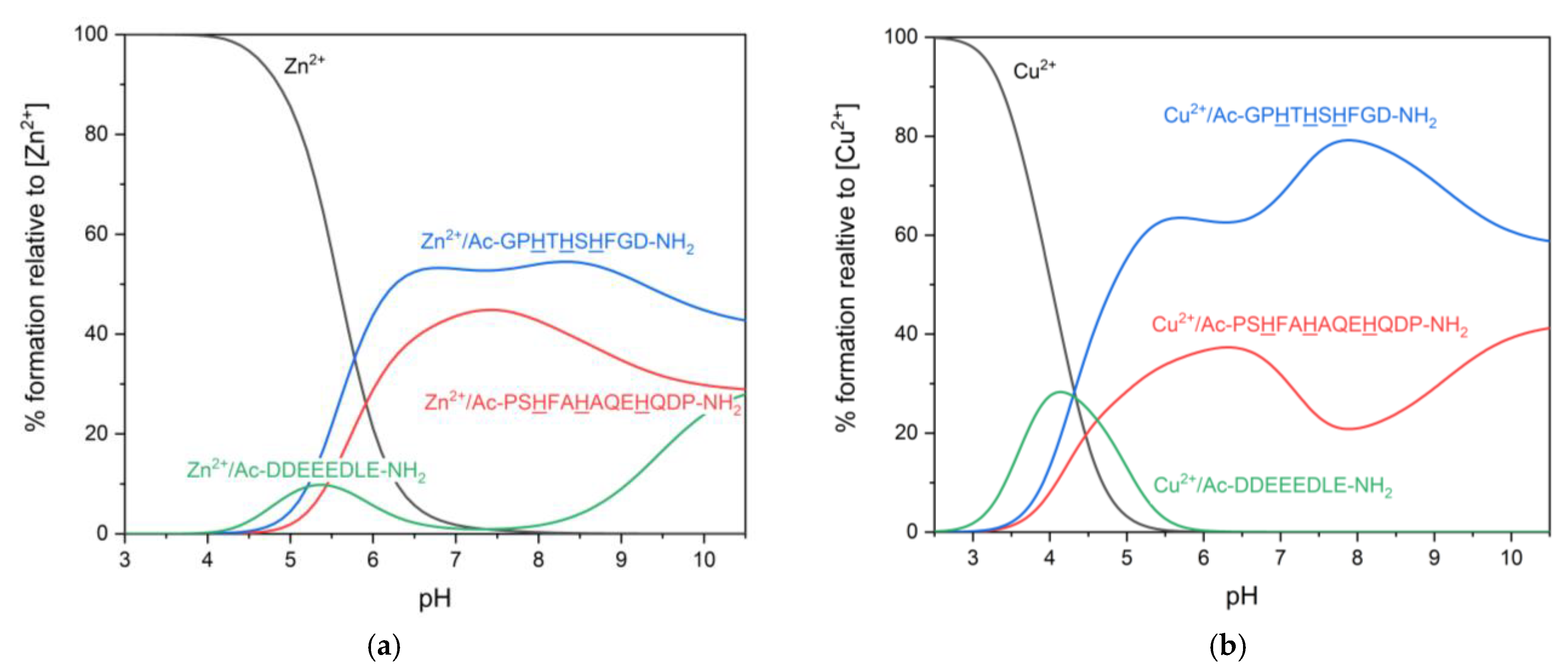
3.3. Zinc(II) Complexes
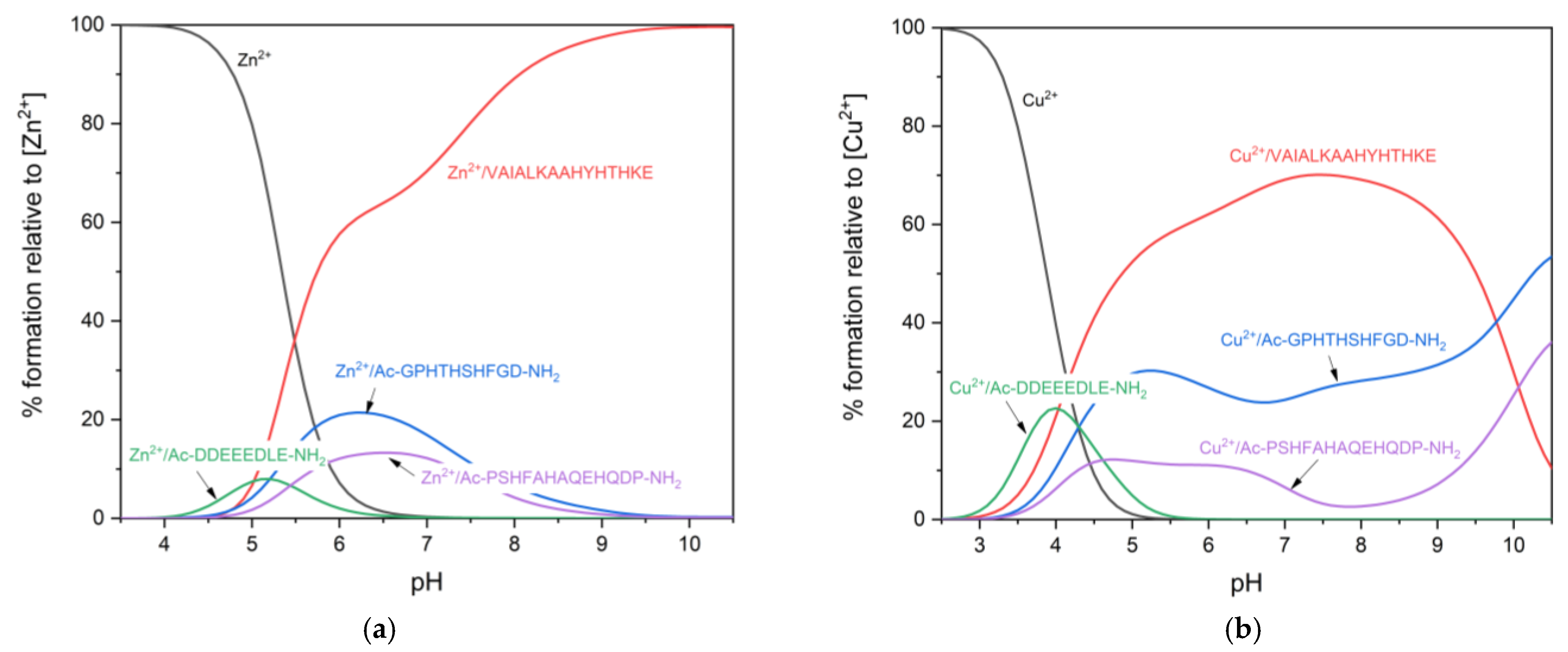
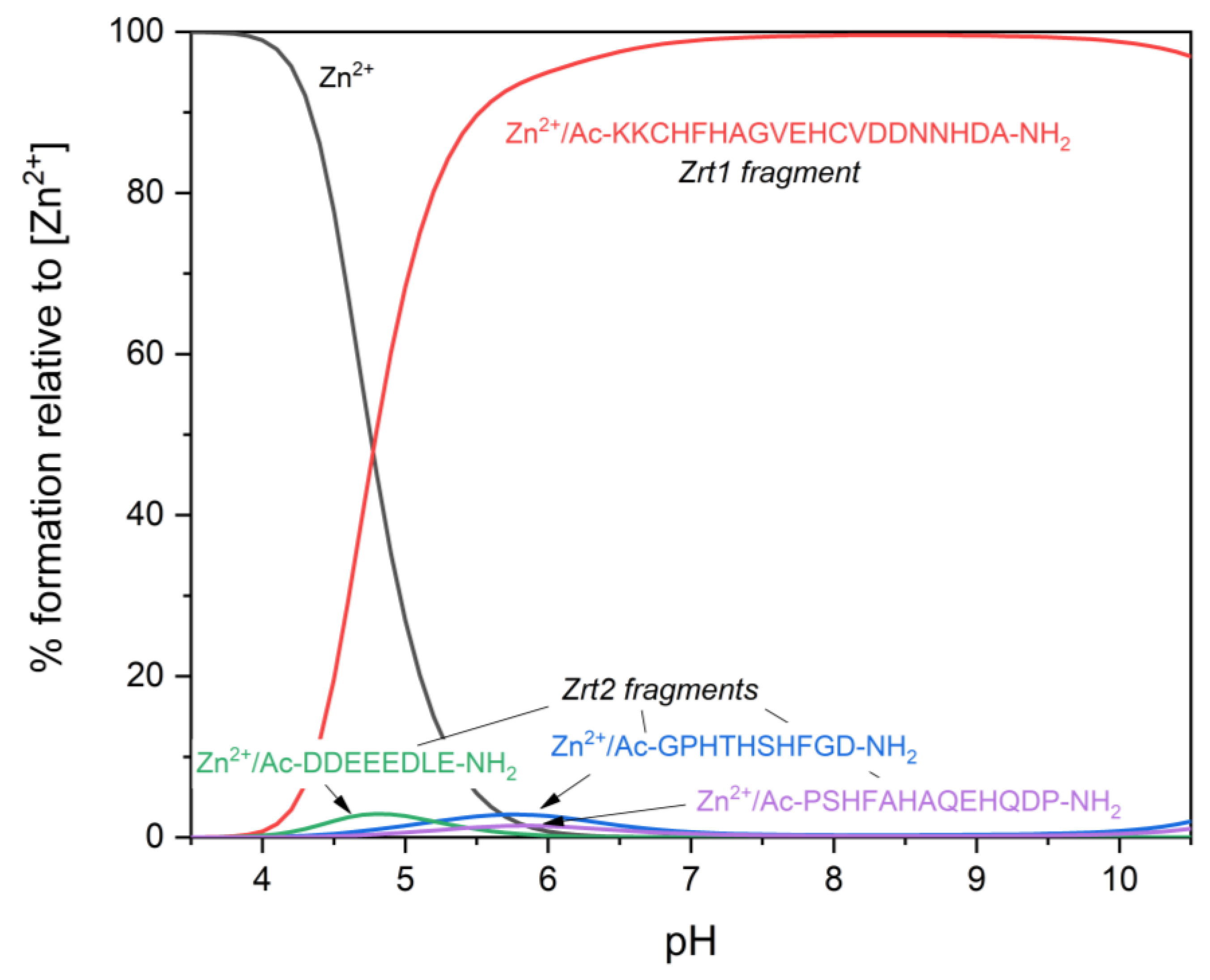
3.4. A Qualitative Evaluation of Zrt2 Metal-Binding Ability
4. Conclusions
Supplementary Materials
Author Contributions
Funding
Institutional Review Board Statement
Informed Consent Statement
Data Availability Statement
Acknowledgments
Conflicts of Interest
References
- Gerwien, F.; Skrahina, V.; Kasper, L.; Hube, B.; Brunke, S. Metals in fungal virulence. FEMS Microbiol. Rev. 2018, 42, fux050. [Google Scholar] [CrossRef] [Scilit] [PubMed]
- Hennigar, S.R.; McClung, J.P. Nutritional Immunity: Starving Pathogens of Trace Minerals. Am. J. Lifestyle Med. 2016, 10, 170–173. [Google Scholar] [CrossRef] [Scilit] [PubMed]
- Talapko, J.; Juzbašić, M.; Matijević, T.; Pustijanac, E.; Bekić, S.; Kotris, I.; Škrlec, I. Candida albicans—The Virulence Factors and Clinical Manifestations of Infection. J. Fungi 2021, 7, 79. [Google Scholar] [CrossRef] [Scilit] [PubMed]
- Malavia, D.; Crawford, A.; Wilson, D. Chapter Three—Nutritional Immunity and Fungal Pathogenesis: The Struggle for Micronutrients at the Host–Pathogen Interface. In Advances in Microbial Physiology, Poole, R.K., Ed.; Academic Press: New York, NY, USA, 2017; Volume 70, pp. 85–103. [Google Scholar]
- Crawford, A.C.; Lehtovirta-Morley, L.E.; Alamir, O.; Niemiec, M.J.; Alawfi, B.; Alsarraf, M.; Skrahina, V.; Costa, A.C.B.P.; Anderson, A.; Yellagunda, S.; et al. Biphasic zinc compartmentalisation in a human fungal pathogen. PLoS Pathog. 2018, 14, e1007013. [Google Scholar] [CrossRef] [Scilit]
- Soares, L.W.; Bailão, A.M.; Soares, C.M.d.A.; Bailão, M.G.S. Zinc at the Host–Fungus Interface: How to Uptake the Metal? J. Fungi 2020, 6, 305. [Google Scholar] [CrossRef] [Scilit]
- Jumper, J.; Evans, R.; Pritzel, A.; Green, T.; Figurnov, M.; Ronneberger, O.; Tunyasuvunakool, K.; Bates, R.; Žídek, A.; Potapenko, A.; et al. Highly accurate protein structure prediction with AlphaFold. Nature 2021, 596, 583–589. [Google Scholar] [CrossRef] [Scilit]
- Varadi, M.; Anyango, S.; Deshpande, M.; Nair, S.; Natassia, C.; Yordanova, G.; Yuan, D.; Stroe, O.; Wood, G.; Laydon, A.; et al. AlphaFold Protein Structure Database: Massively expanding the structural coverage of protein-sequence space with high-accuracy models. Nucleic Acids Res. 2022, 50, D439–D444. [Google Scholar] [CrossRef] [Scilit]
- The UniProt Consortium. UniProt: The universal protein knowledgebase. Nucleic Acids Res. 2018, 46, 2699. [Google Scholar] [CrossRef] [Scilit]
- Bellotti, D.; Łoboda, D.; Rowińska-Żyrek, M.; Remelli, M. Investigation on the metal binding sites of a putative Zn(ii) transporter in opportunistic yeast species Candida albicans. New J. Chem. 2018, 42, 8123–8130. [Google Scholar] [CrossRef] [Scilit]
- Gans, P.; Sabatini, A.; Vacca, A. SUPERQUAD: An improved general program for computation of formation constants from potentiometric data. Dalton Trans. 1985, 6, 1195–1200. [Google Scholar] [CrossRef] [Scilit]
- Gans, P.; O’Sullivan, B. GLEE, a new computer program for glass electrode calibration. Talanta 2000, 51, 33–37. [Google Scholar] [CrossRef] [Scilit]
- Gran, G. Determination of the Equivalent Point in Potentiometric Titrations. Acta Chem. Scand. 1950, 4, 559–577. [Google Scholar] [CrossRef] [Scilit]
- Gans, P.; Sabatini, A.; Vacca, A. Investigation of equilibria in solution. Determination of equilibrium constants with the HYPERQUAD suite of programs. Talanta 1996, 43, 1739–1753. [Google Scholar] [CrossRef] [Scilit]
- Arena, G.; Cali, R.; Rizzarelli, E.; Sammartano, S. Thermodynamic study on the formation of the cupric ion hydrolytic species. Therm. Acta 1976, 16, 315–321. [Google Scholar] [CrossRef] [Scilit]
- Baes, C.F.; Mesmer, R.S. The Hydrolysis of Cations; John Wiley & Sons, Ltd: New York, NY, USA, 1976. [Google Scholar]
- Alderighi, L.; Gans, P.; Ienco, A.; Peters, D.; Sabatini, A.; Vacca, A. Hyperquad simulation and speciation (HySS): A utility program for the investigation of equilibria involving soluble and partially soluble species. Coord. Chem. Rev. 1999, 184, 311–318. [Google Scholar] [CrossRef] [Scilit]
- Prenesti, E.; Daniele, P.G.; Prencipe, M.; Ostacoli, G. Spectrum-structure correlation for visible absorption spectra of copper(II) complexes in aqueous solution. Polyhedron 1999, 18, 3233–3241. [Google Scholar] [CrossRef] [Scilit]
- Daniele, P.G.; Prenesti, E.; Ostacoli, G. Ultraviolet–circular dichroism spectra for structural analysis of copper(II) complexes with aliphatic and aromatic ligands in aqueous solution. Dalton Trans. 1996, 15, 3269–3275. [Google Scholar] [CrossRef] [Scilit]
- Sigel, H.; Martin, R.B. Coordinating properties of the amide bond. Stability and structure of metal ion complexes of peptides and related ligands. Chem. Rev. 1982, 82, 385–426. [Google Scholar] [CrossRef] [Scilit]
- Pettit, L.D.; Powell, H.K.J. The IUPAC Stability Constants Database; Royal Society of Chemistry: London, UK, 2000. [Google Scholar]
- Peisach, J.; Blumberg, W.E. Structural implications derived from the analysis of electron paramagnetic resonance spectra of natural and artificial copper proteins. Arch. Biochem. Biophys. 1974, 165, 691–708. [Google Scholar] [CrossRef] [Scilit]
- Stanyon, H.F.; Cong, X.; Chen, Y.; Shahidullah, N.; Rossetti, G.; Dreyer, J.; Papamokos, G.; Carloni, P.; Viles, J.H. Developing predictive rules for coordination geometry from visible circular dichroism of copper(II) and nickel(II) ions in histidine and amide main-chain complexes. FEBS J. 2014, 281, 3945–3954. [Google Scholar] [CrossRef] [Scilit] [PubMed]
- Bellotti, D.; Rowińska-Żyrek, M.; Remelli, M. Novel insights into the metal binding ability of ZinT periplasmic protein from Escherichia coli and Salmonella enterica. Dalton Trans. 2020, 49, 9393–9403. [Google Scholar] [CrossRef] [Scilit] [PubMed]
- Bellotti, D.; Tocchio, C.; Guerrini, R.; Rowińska-Żyrek, M.; Remelli, M. Thermodynamic and spectroscopic study of Cu(ii) and Zn(ii) complexes with the (148–156) peptide fragment of C4YJH2, a putative metal transporter of Candida albicans. Metallomics 2019, 11, 1988–1998. [Google Scholar] [CrossRef] [Scilit] [PubMed]
- Bal, W.; Dyba, M.; Kozłowski, H. The impact of the amino-acid sequence on the specificity of copper(II) interactions with peptides having nonco-ordinating side-chains. Acta Biochim. Pol. 1997, 44, 467–476. [Google Scholar] [CrossRef] [Scilit]
- Kozlowski, H.; Łuczkowski, M.; Remelli, M. Prion proteins and copper ions. Biological and chemical controversies. Dalton Trans. 2010, 39, 6371–6385. [Google Scholar] [CrossRef] [Scilit]
- Bellotti, D.; Sinigaglia, A.; Guerrini, R.; Marzola, E.; Rowińska-Żyrek, M.; Remelli, M. The N-terminal domain of Helicobacter pylori’s Hpn protein: The role of multiple histidine residues. J. Inorg. Biochem. 2021, 214, 111304. [Google Scholar] [CrossRef] [Scilit]
- Crea, F.; De Stefano, C.; Foti, C.; Milea, D.; Sammartano, S. Chelating Agents for the Sequestration of Mercury(II) and Monomethyl Mercury(II). Curr. Med. Chem. 2014, 21, 3819–3836. [Google Scholar] [CrossRef] [Scilit]
- Cole, A.M.; Kim, Y.-H.; Tahk, S.; Hong, T.; Weis, P.; Waring, A.J.; Ganz, T. Calcitermin, a novel antimicrobial peptide isolated from human airway secretions. FEBS Lett. 2001, 504, 5–10. [Google Scholar] [CrossRef] [Scilit]
- Bellotti, D.; Toniolo, M.; Dudek, D.; Mikołajczyk, A.; Guerrini, R.; Matera-Witkiewicz, A.; Remelli, M.; Rowińska-Żyrek, M. Bioinorganic chemistry of calcitermin—The picklock of its antimicrobial activity. Dalton Trans. 2019, 48, 13740–13752. [Google Scholar] [CrossRef] [Scilit]
- Citiulo, F.; Jacobsen, I.D.; Miramón, P.; Schild, L.; Brunke, S.; Zipfel, P.; Brock, M.; Hube, B.; Wilson, D. Candida albicans Scavenges Host Zinc via Pra1 during Endothelial Invasion. PLoS Pathog. 2012, 8, e1002777. [Google Scholar] [CrossRef] [Scilit]
- Bellotti, D.; Rowińska-Żyrek, M.; Remelli, M. How Zinc-Binding Systems, Expressed by Human Pathogens, Acquire Zinc from the Colonized Host Environment: A Critical Review on Zincophores. Curr. Med. Chem. 2021, 28, 7312–7338. [Google Scholar] [CrossRef] [Scilit] [PubMed]
- Łoboda, D.; Rowińska-Żyrek, M. Candida albicans zincophore and zinc transporter interactions with Zn(ii) and Ni(ii). Dalton Transactions 2018, 47, 2646–2654. [Google Scholar] [CrossRef] [Scilit] [PubMed]
- Kumar, R.; Breindel, C.; Saraswat, D.; Cullen, P.J.; Edgerton, M. Candida albicans Sap6 amyloid regions function in cellular aggregation and zinc binding, and contribute to zinc acquisition. Sci. Rep. 2017, 7, 2908. [Google Scholar] [CrossRef] [Scilit] [PubMed]
- McNicholas, S.; Potterton, E.; Wilson, K.S.; Noble, M.E.M. Presenting your structures: The CCP4mg molecular-graphics software. Acta Crystallogr. D Biol. Crystallogr. 2011, 67, 386–394. [Google Scholar] [CrossRef] [Scilit] [PubMed]

| Species | logβ | logK | logβ | logK | Donor |
|---|---|---|---|---|---|
| Ac-GPHTHSHFGD-NH2 (L1) | Ac-GPHTHAHFGD-NH2 (L1_S6A) | ||||
| HL | 6.96(4) | 6.96 | 6.96(4) | 6.96 | His |
| H2L+ | 13.32(3) | 6.36 | 13.32(3) | 6.36 | His |
| H3L2+ | 18.71(4) | 5.39 | 18.87(4) | 5.55 | His |
| H4L3+ | 21.71(4) | 3.00 | 22.79(4) | 3.92 | Asp |
| Ac-PSHFAHAQEHQDP-NH2 (L2) | Ac-PAHFAHAQEHQDP-NH2 (L2_S2A) | ||||
| HL− | 7.39(4) | 7.39 | 7.34(5) | 7.34 | His |
| H2L | 13.90(3) | 6.50 | 13.87(3) | 6.53 | His |
| H3L+ | 19.79(4) | 5.89 | 19.66(4) | 5.79 | His |
| H4L2+ | 24.08(4) | 4.28 | 23.87(5) | 4.21 | Glu |
| H5L3+ | 27.23(4) | 3.15 | 26.73(5) | 2.86 | Asp |
| Ac-DDEEEDLE-NH2 (L3) | |||||
| HL6− | 5.92(4) | 5.92 | Glu | ||
| H2L5− | 11.15(3) | 5.23 | Glu | ||
| H3L4− | 15.95(6) | 4.80 | Glu | ||
| H4L3− | 20.55(3) | 4.60 | Glu | ||
| H5L2− | 24.45(5) | 3.90 | Asp | ||
| H6L− | 28.28(3) | 3.83 | Asp | ||
| H7L | 31.01(3) | 2.73 | Asp | ||
| Species | logβ | pKa | Coordination | logβ | pKa | Coordination |
|---|---|---|---|---|---|---|
| Ac-GPHTHSHFGD-NH2 (L1) | Ac-GPHTHAHFGD-NH2 (L1_S6A) | |||||
| [CuH2L]3+ | − | − | − | 17.68(3) | 4.27 | NIm, COO− |
| [CuHL]2+ | 13.21(2) | 5.13 | 2NIm | 13.42(1) | 5.32 | 2NIm, COO− |
| [CuL]+ | 8.08(2) | 6.85 | 3NIm | 8.10(2) | 7.05 | 3NIm |
| [CuH−1L] | 1.22(4) | 6.99 | 3NIm, N− | 1.05(3) | 7.27 | 3NIm, N− |
| [CuH−2L]− | −5.77(3) | 9.53 | 2NIm, 2N− | −6.22(2) | 9.80 | 2NIm, 2N− |
| [CuH−3L]2− | −15.30(4) | − | NIm, 3N− | −16.02(3) | − | NIm, 3N− |
| Ac-PSHFAHAQEHQDP-NH2 (L2) | Ac-PAHFAHAQEHQDP-NH2 (L2_S2A) | |||||
| [CuH2L]2+ | 18.45(3) | 4.71 | NIm (COO−) | 18.36(3) | 4.64 | NIm (COO−) |
| [CuHL]+ | 13.74(2) | 5.46 | 2NIm | 13.72(2) | 5.33 | 2NIm |
| [CuL] | 8.27(2) | 3NIm | 8.39(2) | 3NIm | ||
| [CuH−2L]2− | −6.96(2) | 8.61 | 2NIm, 2N− | −6.91(2) | 8.34 | 2NIm, 2N− |
| [CuH−3L]3− | −15.57(3) | NIm, 3N− | −15.25(3) | NIm, 3N− | ||
| Ac-DDEEEDLE-NH2 (L3) | ||||||
| [CuH5L] | 27.62(7) | 3.83 | ||||
| [CuH4L]− | 23.80(5) | − | ||||
| [CuH2L]3− | 15.11(4) | 5.24 | ||||
| [CuHL]4− | 9.87(5) | 5.98 | ||||
| [CuL]5− | 3.88(4) | − | ||||
| [CuH−2L]7− | −13.7(1) | − | 2N– | |||
| Ac-GPHTHSHFGD-NH2 (L1) | Ac-GPHTHAHFGD-NH2 (L1_S6A) | |||||
| [ZnHL]2+ | 10.48(9) | 5.48 | 2NIm (COO−) | 10.71(4) | 5.54 | 2NIm (COO−) |
| [ZnL]+ | 5.00(2) | 7.51 | 3NIm | 5.17(1) | 7.44 | 3NIm |
| [ZnH−1L] | −2.51(4) | 9.78 | 3NIm | −2.27(2) | 9.43 | 3NIm |
| [ZnH−2L]− | −12.29(5) | 3NIm | −11.69(3) | 3NIm | ||
| Ac-PSHFAHAQEHQDP-NH2 (L2) | Ac-PAHFAHAQEHQDP-NH2 (L2_S2A) | |||||
| [ZnH2L]2+ | − | − | − | 17.1(1) | 5.75 | NIm (COO−) |
| [ZnHL]+ | 11.22(5) | 6.03 | 2NIm (COO−) | 11.36(6) | 5.90 | 2NIm (COO−) |
| [ZnL] | 5.19(2) | 8.04 | 3NIm | 5.46(4) | 8.02 | 3NIm |
| [ZnH−1L]− | −2.85(3) | 9.69 | 3NIm | −2.56(5) | 9.82 | 3NIm |
| [ZnH−2L]2− | −12.54(5) | 3NIm | −12.38(7) | 3NIm | ||
| Ac-DDEEEDLE-NH2 (L3) | ||||||
| [ZnH2L]3− | 13.3(5) | 5.2 | ||||
| [ZnHL]4− | 8.1(4) | 5.5 | ||||
| [ZnL]5− | 2.6(2) | 7.3 | ||||
| [ZnH−1L]6− | −4.7(1) | 7.8 | ||||
| [ZnH−2L]7− | −12.5(1) | − | ||||
| Peptide | pZn | pCu | Kd (Zn2+) | Kd (Cu2+) | pL0.5 (Zn2+) | pL0.5 (Cu2+) |
|---|---|---|---|---|---|---|
| Ac-GPHTHSHFGD-NH2 | 6.34 | 9.84 | 7.84 × 10⁻⁶ | 8.65 × 10⁻¹⁰ | 5.10 | 8.89 |
| Ac-GPHTHAHFGD-NH2 | 6.46 | 9.53 | 4.88 × 10⁻⁶ | 1.77 × 10⁻⁹ | 5.30 | 8.57 |
| Ac-PSHFAHAQEHQDP-NH2 | 6.27 | 8.87 | 1.05 × 10⁻⁵ | 8.06 × 10⁻⁹ | 4.96 | 7.92 |
| Ac-PAHFAHAQEHQDP-NH2 | 6.43 | 9.00 | 5.41 × 10⁻⁶ | 5.97 × 10⁻⁹ | 5.26 | 8.05 |
| Ac-DDEEEDLE-NH2 | 6.00 | 6.02 | 9.34 × 10⁻⁴ | 1.30 × 10⁻⁴ | 2.82 | 3.71 |
Publisher’s Note: MDPI stays neutral with regard to jurisdictional claims in published maps and institutional affiliations. |
© 2022 by the authors. Licensee MDPI, Basel, Switzerland. This article is an open access article distributed under the terms and conditions of the Creative Commons Attribution (CC BY) license (https://creativecommons.org/licenses/by/4.0/).
Share and Cite
Bellotti, D.; Miller, A.; Rowińska-Żyrek, M.; Remelli, M. Zn2+ and Cu2+ Binding to the Extramembrane Loop of Zrt2, a Zinc Transporter of Candida albicans. Biomolecules 2022, 12, 121. https://doi.org/10.3390/biom12010121
Bellotti D, Miller A, Rowińska-Żyrek M, Remelli M. Zn2+ and Cu2+ Binding to the Extramembrane Loop of Zrt2, a Zinc Transporter of Candida albicans. Biomolecules. 2022; 12(1):121. https://doi.org/10.3390/biom12010121
Chicago/Turabian StyleBellotti, Denise, Adriana Miller, Magdalena Rowińska-Żyrek, and Maurizio Remelli. 2022. "Zn2+ and Cu2+ Binding to the Extramembrane Loop of Zrt2, a Zinc Transporter of Candida albicans" Biomolecules 12, no. 1: 121. https://doi.org/10.3390/biom12010121
APA StyleBellotti, D., Miller, A., Rowińska-Żyrek, M., & Remelli, M. (2022). Zn2+ and Cu2+ Binding to the Extramembrane Loop of Zrt2, a Zinc Transporter of Candida albicans. Biomolecules, 12(1), 121. https://doi.org/10.3390/biom12010121

