_Kwok.png)
Naturally Derived Psilocybin for Therapeutic Use: A Six-Criterion Framework for Evidence, Safety, and Benefit–Risk Considerations in Policy and Clinical Development

 , , and
Abstract
1. Introduction
2. Methods
2.1. Conceptual Foundations
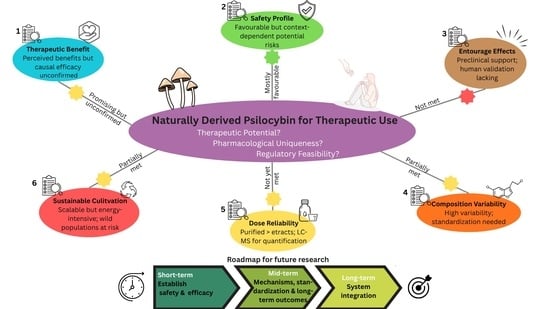
2.2. The Six-Criterion Framework to Evaluate Naturally Derived Psilocybin
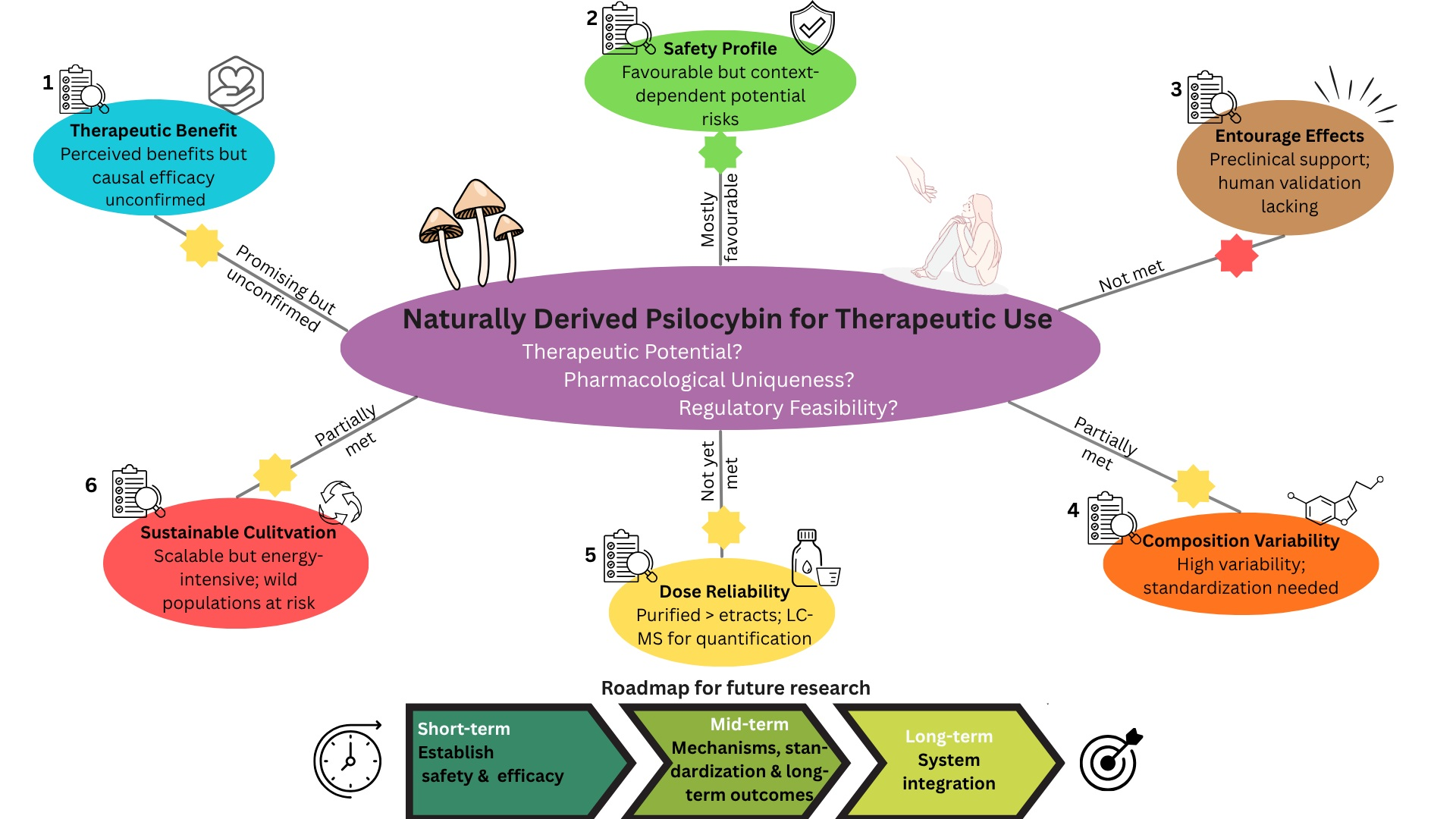
- (1)
- Therapeutic benefit: Is there evidence that naturally derived psilocybin produces measurable benefits in humans?
- (2)
- Safety and tolerability: Can naturally derived psilocybin be used without undue risk, and under what conditions?
- (3)
- Psychopharmacological uniqueness: Does natural psilocybin offer pharmacodynamic or experiential effects distinct from synthetic forms?
- (4)
- Identity and composition control: Can naturally derived psilocybin be authenticated, standardized, and verified as contaminant-free?
- (5)
- Dose precision and stability: Are potency and effects consistent across preparations and time?
- (6)
- Ecological sustainability: Can natural sourcing or cultivation meet demand without causing environmental or cultural harm?
2.3. Search Strategy
3. Results
3.1. Background Context for the Evaluation
3.1.1. Global Prevalence: Distribution and Cultural Prevalence of Naturally Derived Psilocybin Use Worldwide
3.1.2. Use Patterns and Motivations: Common Reasons for Use and How These Influence Consumption Practices
3.1.3. Consumption Settings: Variability in Use, Solo vs. Group vs. Organized Retreats, and How These Contexts Impact Dosing, Preparation, and User Experience
3.2. Criterion 1: Human Evidence of Therapeutic Benefit
3.2.1. Observational Evidence
Population-Based Surveys
Large-Scale International Online Surveys
Prospective Naturalistic Studies
Observational Studies of Psilocybin Retreats
3.2.2. Ethnographic Documentation: Contemporary Indigenous Use
Proposed and Early Phase Indigenous-Anchored Research
3.2.3. Experimental Studies in Naturalistic and Semi-Naturalistic Contexts
Uncontrolled Open-Label Studies with Microdosing
Controlled Microdosing Studies
3.3. Criterion 2: Safety and Tolerability
3.3.1. Defining Adverse Events Across Clinical and Cultural Contexts
3.3.2. Adverse Effects and Psychological Challenges
Survey-Based Evidence
Qualitative Evidence from Social Media: Self-Reported Negative Outcomes
3.3.3. Pharmacological Interactions
Large-Scale International Online Surveys
Survey and Qualitative Research on Polysubstance Use
Interactions with Pharmaceutical Medications
3.3.4. Natural–Psilocybin Specific Risks and Contamination-Related Syndromes: Ethnographic Analysis, Survey Studies
3.3.5. Facilitator Perspectives on Safe and Effective Psilocybin Use
3.3.6. Single Case Studies Reporting Adverse Events
3.3.7. Dose-Dependent Physiological Safety: Insights from Synthetic Psilocybin Studies
3.4. Criteria 3: Unique Psychopharmacological Profile (Vs. Synthetic)
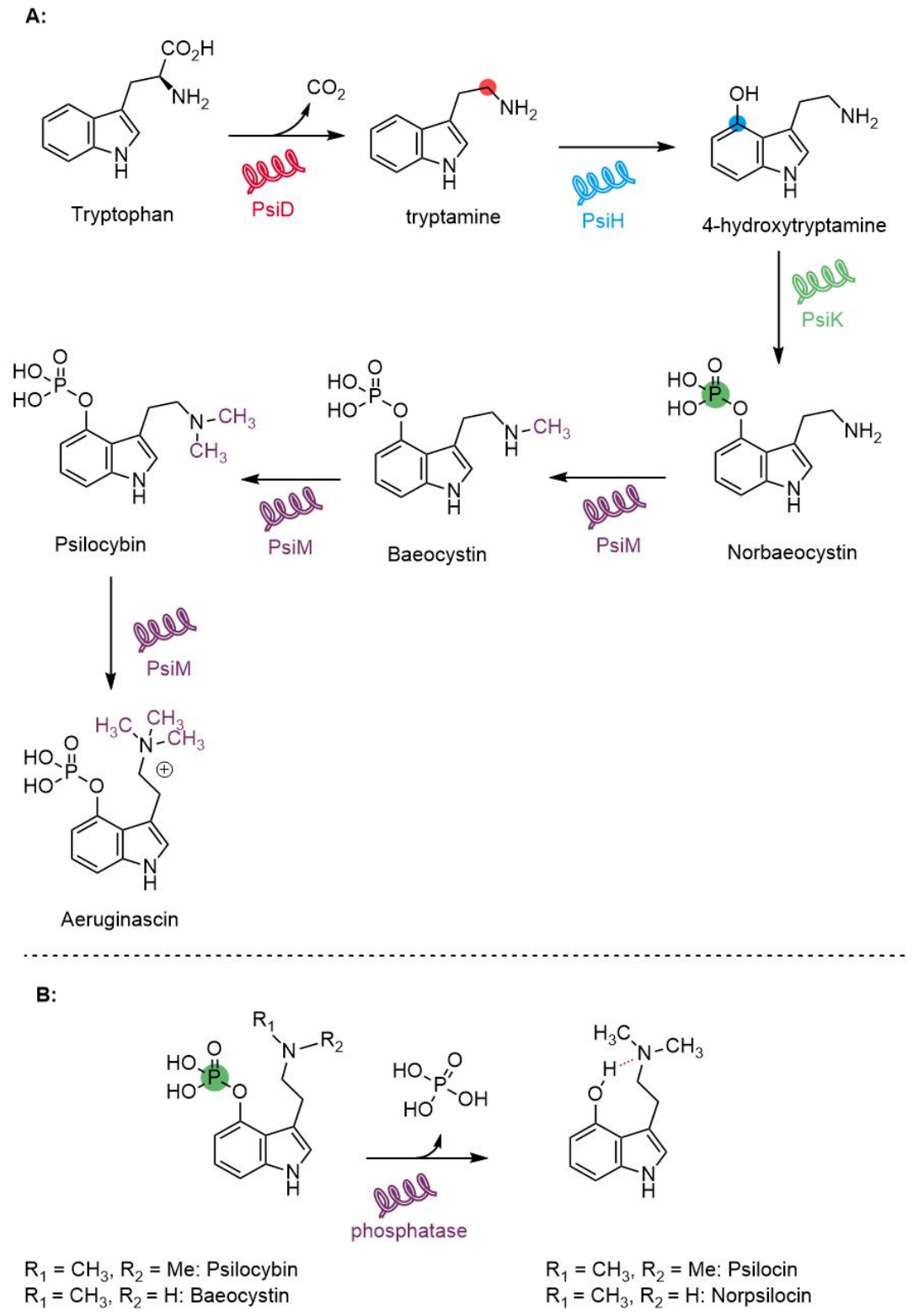
3.4.1. Brief Chemical Overview of Psilocybin and Possible Entourage Compounds
Downstream Signaling: Impacts on Neuroplasticity and Functional Neural Networks
3.4.2. Mechanisms of the Entourage Effect
3.4.3. Computational Models
3.4.4. Preclinical Research
3.4.5. Human Evidence
Large-Scale International Surveys on Preferences for Naturally Derived vs. Synthetic Psilocybin
Historical and Contemporary Reports on Subjective Effects
“As we took leave of María Sabina and her clan at the crack of dawn, the curandera said that the pills had the same power as the mushrooms, that there was no difference. This was a confirmation from the most competent authority that the synthetic psilocybin is identical with the natural product. As a parting gift, I let María Sabina have a vial of psilocybin pills. She radiantly explained to our interpreter, Herlinda, that she could now give consultations even in the season when no mushrooms grow”. p. 152.
Empirical Human Research
3.5. Criterion 4: Identity and Composition Control
3.6. Criterion 5: Dose Precision and Stability
Chemical Stability
3.7. Criterion 6: Ecological Sustainability
4. Discussion
4.1. Critical Assessment of Current Evidence
4.1.1. Criterion 1: Human Evidence of Therapeutic Benefit
Summary Conclusions
Evidence Gaps
- Sparse long-term follow-up: Few studies extend beyond six months, leaving questions about the durability and integration of benefits [56].
Recommendations for Future Research
- Conduct controlled trials using natural preparations, with transparent reporting following CONSORT-Herbal guidelines (a reporting guideline requiring detailed documentation of botanical identity, preparation, composition, and dosing [30]).
- Develop culturally sensitive outcome measures that capture well-being, meaning, and social functioning alongside symptom reduction [52].
4.1.2. Criterion 2: Safety and Tolerability
Summary Conclusions
Evidence Gaps
- Limited evaluation of naturally derived psilocybin in rigorous designs: There is a need for controlled and prospective studies specifically examining safety profiles, adverse event rates, and dose–response relationships of naturally derived psilocybin across different use contexts.
- Limited understanding of safety determinants in unsupervised use: The mechanisms through which contextual, social, and behavioral factors influence adverse event risk remain insufficiently characterized, particularly in informal or community-based settings.
Recommendations for Future Research
- Conduct controlled trials comparing naturally derived psilocybin for physiological and psychological tolerability.
- Develop evidence-based harm-reduction guidance especially for independent users who do not access retreats or clinical settings.
4.1.3. Criterion 3: Psychopharmacological Uniqueness
Summary Conclusions
Evidence Gaps
- Entourage molecules in humans: No clinical studies have isolated the effects of baeocystin, norbaeocystin, aeruginascin, or β-carbolines, despite preclinical promise.
- Pharmacokinetic interactions: The metabolic fate of entourage compounds (e.g., MAO inhibition by β-carbolines) remains unquantified in humans.
Recommendations for Future Research
- Controlled human trials: Well-powered, double-blind, randomized comparisons of standardized naturally derived and synthetic psilocybin. We can be confident that both arms in such a study would experience broadly similar psychological effects, and so any subtle differences in phenomenology or clinical outcomes at a group level would be revealing.
- Isolation studies of entourage molecules: Investigate baeocystin, norbaeocystin, norpsilocin, aeruginascin in humans (as preclinical data suggests potential antidepressant/MAO-inhibiting properties, e.g., [146,147]), using dose ranges exceeding natural concentrations (to overcome low bioavailability), placebo-controlled design.
- Pharmacokinetic/Pharmacodynamic studies: Quantifying metabolic interactions (β-carboline MAO inhibition), comparing BB penetration and receptor occupancy between naturally derived vs. synthetic forms could explain prolonged effects observed in animal studies [145].
4.1.4. Criterion 4: Identity and Composition Control
Summary Conclusions
Evidence Gaps
- Contaminant profiling (heavy metals, pesticides, microbial load) is absent from the reviewed literature, despite being required under EMA and WHO GACP guidelines for any herbal medicinal product.
Recommendations for Future Research
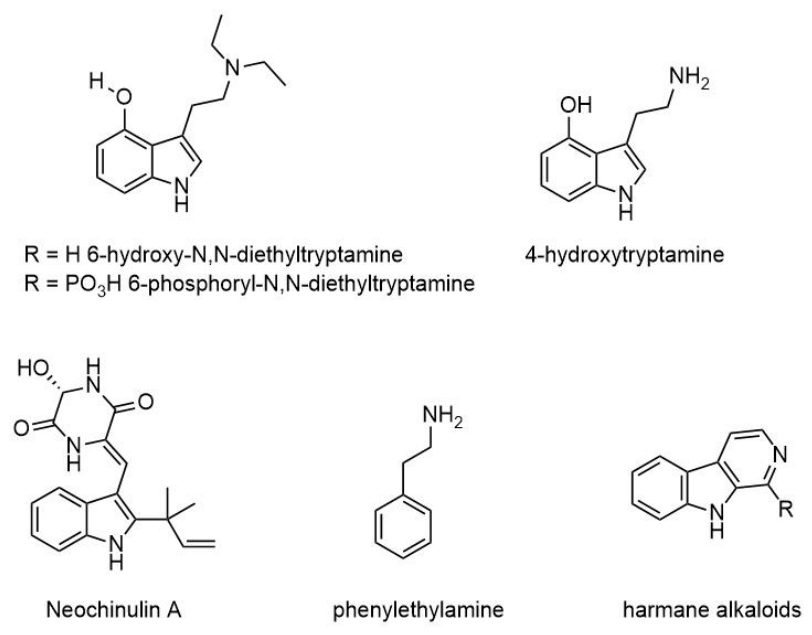
- Characterize minor psychoactive constituents pharmacologically, particularly harmane alkaloids and phenylethylamine, to determine whether their concentrations in natural products are clinically meaningful or negligible.
- Analyze mushroom fractions separately (mycelium, stipe, cap, spores) to identify compositional hotspots relevant to extraction design and quality control.
4.1.5. Criterion 5: Dose Precision and Stability
Summary Conclusions
Evidence Gaps
- Systematic stability data for standardized extracts under defined storage conditions (temperature, humidity, light) are lacking.
- Degradation kinetics in biological matrices are poorly characterized quantitatively; most reports describe the direction of change rather than the rate or predictability of degradation under realistic storage conditions.
- Minor alkaloid stability—including baeocystin, norbaeocystin, aeruginascin, and harmane alkaloids—has not been systematically studied, yet these compounds may contribute to pharmacological variability as major alkaloids degrade.
- Aqueous extract behavior at varying temperatures and preparation methods (e.g., short infusion vs. prolonged boiling) has not been systematically characterized in terms of alkaloid yield and degradation products.
- Freeze–thaw effects on fresh mushroom material are mentioned as accelerating enzymatic degradation, but controlled studies quantifying the magnitude of this effect on final alkaloid content are absent.
- Oxidation product characterization is not complete yet—the ring-opening and fragmentation products of psilocin are rarely identified or quantified, leaving the full profile of degradation byproducts unknown.
- There is currently no published formal stability study comparing natural and synthetic purified psilocybin under equivalent conditions to determine whether origin affects shelf life or degradation profile.
Recommendations for Future Research
- Characterize oxidative degradation products of psilocin systematically to assess whether any byproducts carry residual pharmacological or toxicological activity.
- Investigate minor alkaloid degradation in parallel with major alkaloid studies to determine whether differential stability alters the pharmacological fingerprint of extracts over time.
4.1.6. Criterion 6: Ecological Sustainability
Summary Conclusions
Evidence Gaps
- Key gaps remain in understanding the long-term ecological impacts of large-scale psilocybin mushroom cultivation, particularly regarding spore dispersal and genetic diversity.
- Research on less energy-intensive sterilization methods could improve sustainability.
- The effects of climate change on wild psilocybin species distribution are also understudied, particularly in regions where traditional foraging is culturally significant.
Recommendations for Future Research
- Future studies should prioritize low-energy cultivation methods, such as passive climate control or alternative sterilization processes, to improve sustainability.
- Investigating spore mitigation strategies, including filtration systems or genetic modification to reduce sporulation, could address health and ecological concerns.
- Ethnographic and ecological research should also focus on documenting Indigenous knowledge systems and identifying climate-resilient foraging practices.
- Interdisciplinary collaboration between mycologists, agricultural scientists, and Indigenous stakeholders could yield more holistic approaches to psilocybin mushroom production.
4.2. Synthesis: Addressing the Key Research Questions
- Do naturally derived psilocybin preparations demonstrate therapeutic potential in human populations (in real-world use)? (T)
- 2.
- Do naturally derived psilocybin preparations produce pharmacological or experiential effects that are meaningfully distinct from synthetic psilocybin? (S)
- 3.
- Do naturally derived psilocybin preparations meet criteria for consideration as therapeutic agents or regulated medicinal products? (MP)
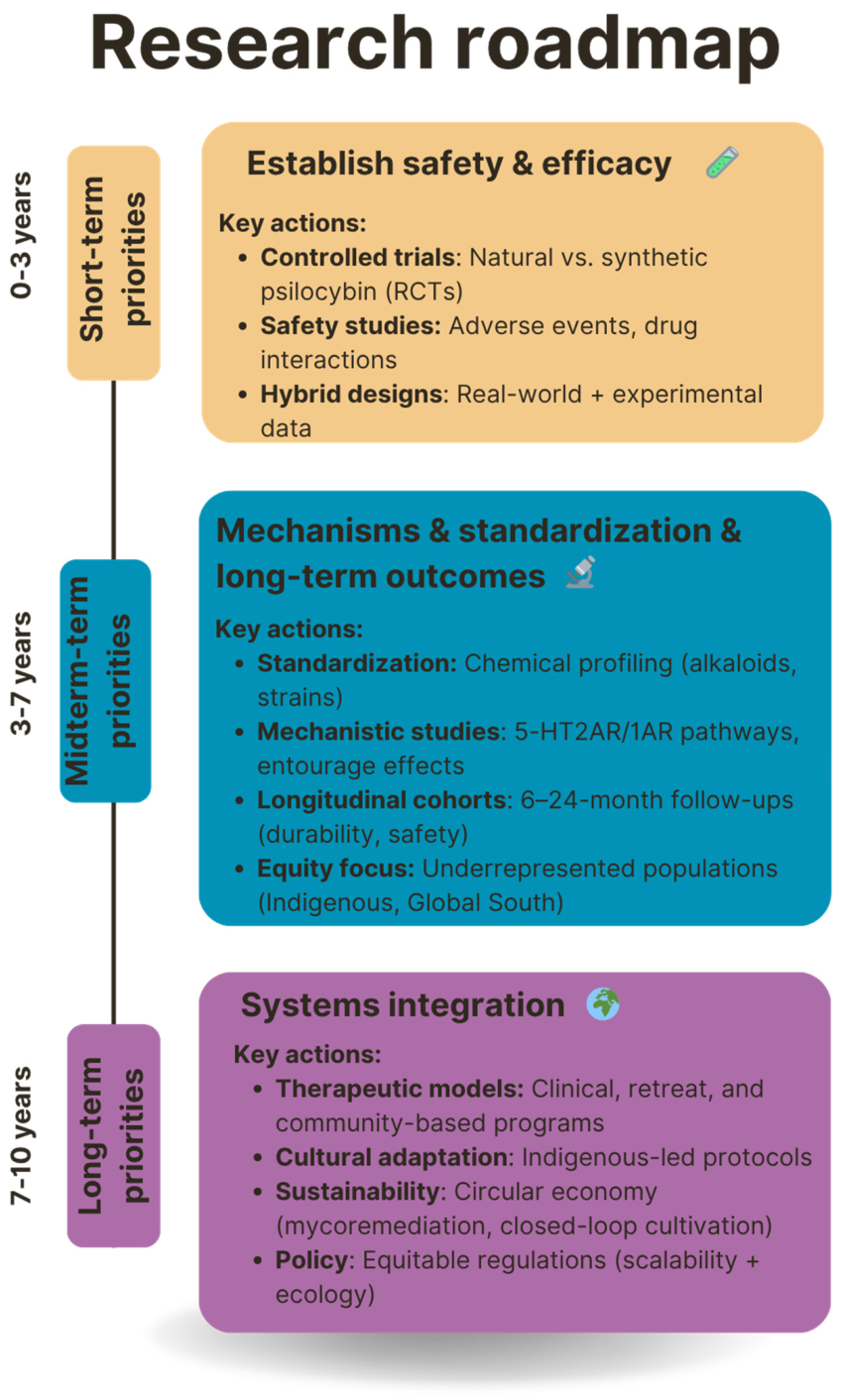
4.3. Roadmap for Future Research
Short-Term Priorities (0–3 Years): Establish Safety and Efficacy
- 1.
- Controlled clinical trials
- •
- Randomized, double-blind trials of standardized, naturally derived preparations vs. synthetic psilocybin to determine equivalence (clinical outcomes, tolerability, and subjective effects) and dose-dependent relationships.
- 2.
- Safety evaluation
- •
- Prospective studies to quantify: adverse events, drug interactions, and contextual risk factors.
- 3.
- Hybrid real-world evidence with experimental designs
- •
- Hybrid designs combining observational studies with experimental elements could capture ecologically valid contexts while improving causal inference.
- 1.
- Standardization and characterization
- •
- Chemical profiling of alkaloids (e.g., psilocybin, baeocystin, β-carbolines) across species, strains, cultivation methods, and processing conditions, adopting CONSORT-Herbal guidelines for transparency.
- 2.
- Mechanistic studies
- •
- Dose–response relationships Research should clarify relationships between dose, subjective experience (e.g., mystical-type experiences), neurobiological mechanisms, and clinical outcomes.
- 3.
- Cultural and equity research
- •
- Inclusive cohorts to examine structural moderators (e.g., chronic stress, discrimination), Indigenous and marginalized perspectives.
- 4.
- Longitudinal outcome studies
- •
- Prospective cohorts with follow-ups to evaluate the durability of therapeutic effects, long-term safety (psychiatric stability, neurocognitive effects, behavioral changes), and contextual moderators (e.g., clinical vs. retreat vs. home use, social support).
- •
- Naturalistic longitudinal designs: GPS follow-ups or registry studies to capture real-world trajectories.
Long-Term Priorities (7–15 Years): System Integration
- 1.
- Therapeutic and cultural implementation
- •
- Delivery models: Studies should evaluate safe delivery models across clinical settings, structured retreat environments, and community-based harm-reduction or integration programs.
- •
- Regulatory pathways with adaptive licensing (e.g., “botanical drug”).
- •
- Community-led protocols for traditional and modern use.
- 2.
- Ecological sustainability
- •
- Circular economy models: Integrate mycoremediation and optimize closed-loop cultivation.
- •
- Biodiversity conversion: Establish protected foraging zones and seed/spore bands for wild strains.
- •
- Policy and stakeholder collaboration: Advocate for regulations balancing scalability with ecological/social equity, including interdisciplinary working groups.
5. Conclusions
Author Contributions
Funding
Institutional Review Board Statement
Informed Consent Statement
Data Availability Statement
Acknowledgments
Conflicts of Interest
References
- Haikazian, S.; Chen-Li, D.C.J.; Johnson, D.E.; Fancy, F.; Levinta, A.; Husain, M.I.; Mansur, R.B.; McIntyre, R.S.; Rosenblat, J.D. Psilocybin-Assisted Therapy for Depression: A Systematic Review and Meta-Analysis. Psychiatry Res. 2023, 329, 115531. [Google Scholar] [CrossRef] [PubMed]
- Irizarry, R.; Winczura, A.; Dimassi, O.; Dhillon, N.; Minhas, A.; Larice, J. Psilocybin as a Treatment for Psychiatric Illness: A Meta-Analysis. Cureus 2022, 14, e31796. [Google Scholar] [CrossRef] [PubMed]
- Meshkat, S.; Malik, G.; Zeifman, R.J.; Swainson, J.; Balachandra, K.; Reichelt, A.C.; Zhang, Y.; Burback, L.; Winkler, O.; Greenshaw, A.; et al. Efficacy and Safety of Psilocybin for the Treatment of Substance Use Disorders: A Systematic Review. Neurosci. Biobehav. Rev. 2025, 173, 106163. [Google Scholar] [CrossRef] [PubMed]
- Tap, S.; Bostoen, T.; Breeksema, J.; Schoevers, R. Chapter Twelve—Psychedelics for the Treatment of End-of-Life Distress in Patients with a Life-Threatening Disease. In International Review of Neurobiology; Nutt, D.J., Thurgur, H., Eds.; Academic Press: Cambridge, MA, USA, 2025; Volume 181, pp. 357–393. [Google Scholar] [CrossRef] [PubMed]
- Behera, H.K.; Joga, R.; Yerram, S.; Karnati, P.; Mergu, T.; Gandhi, K.; Nathiya, D.; Singh, R.P.; Srivastava, S.; Kumar, S. Exploring the Regulatory Framework of Psychedelics in the US & Europe. Asian J. Psychiatry 2024, 102, 104242. [Google Scholar] [CrossRef] [PubMed]
- Langlitz, N. Experiments in medicalization: Psychedelic therapy in Switzerland and Australia. BioSocieties 2025. [Google Scholar] [CrossRef]
- Lam, K.; Griffin, C.; Kantipudi, S.; Mwai, D.; Kahn, J.G.; Marseille, E. Assessing Readiness for Implementation of Psychedelic-Assisted Mental Health Therapy, in Low- and Middle-Income Countries. J. Psychedelic Stud. 2025, 10, 88–96. [Google Scholar] [CrossRef]
- Spiers, N.; Labate, B.C.; Ermakova, A.O.; Farrell, P.; Romero, O.S.G.; Gabriell, I.; Olvera, N. Indigenous Psilocybin Mushroom Practices: An Annotated Bibliography. J. Psychedelic Stud. 2024, 8, 3–25. [Google Scholar] [CrossRef]
- Jones, G.; Ricard, J.A.; Nock, M.K. Race and Ethnicity Moderate the Associations between Lifetime Psilocybin Use and Past Year Hypertension. Front. Psychiatry 2024, 15, 1169686. [Google Scholar] [CrossRef] [PubMed]
- Guzmán, G. Diversity and Use of Traditional Mexican Medicinal Fungi. A Review. Int. J. Med. Mushrooms 2008, 10, 209–217. [Google Scholar] [CrossRef]
- Guzmán, G. El Uso Tradicional de los Hongos Sagrados: Pasado y Presente. Etnobiología 2011, 9, 1–21. [Google Scholar]
- Hernández, F. De Historia Plantarum Novae Hispaniae; Ex Typographia Ibarrae Heredum: Madrid, Spain, 1790. [Google Scholar]
- Van Court, R.C.; Wiseman, M.S.; Meyer, K.W.; Ballhorn, D.J.; Amses, K.R.; Slot, J.C.; Dentinger, B.T.M.; Garibay-Orijel, R.; Uehling, J.K. Diversity, Biology, and History of Psilocybin-Containing Fungi: Suggestions for Research and Technological Development. Fungal Biol. 2022, 126, 308–319. [Google Scholar] [CrossRef] [PubMed]
- Nichols, D.E. Psilocybin: From Ancient Magic to Modern Medicine. J. Antibiot. 2020, 73, 679–686. [Google Scholar] [CrossRef] [PubMed]
- Fabricant, D.S.; Farnsworth, N.R. The Value of Plants Used in Traditional Medicine for Drug Discovery. Environ. Health Perspect. 2001, 109, 69–75. [Google Scholar] [CrossRef] [PubMed]
- Gautam, S.; Jain, A.; Chaudhary, J.; Gautam, M.; Gaur, M.; Grover, S. Concept of Mental Health and Mental Well-Being, It’s Determinants and Coping Strategies. Indian J. Psychiatry 2024, 66, S231. [Google Scholar] [CrossRef] [PubMed]
- Magomedova, A.; Fatima, G. Mental Health and Well-Being in the Modern Era: A Comprehensive Review of Challenges and Interventions. Cureus 2025, 17, e77683. [Google Scholar] [CrossRef] [PubMed]
- Mahapatra, A.; Sharma, P. Biopsychosocial Approach to Mental Health. In Mental Health Care Resource Book: Concepts and Praxis for Social Workers and Mental Health Professionals; Anand, M., Ed.; Springer Nature: Singapore, 2024; pp. 87–100. [Google Scholar] [CrossRef]
- World Health Organization. World Mental Health Report: Transforming Mental Health for All, 1st ed.; World Health Organization: Geneva, Switzerland, 2022. [Google Scholar]
- Bohlmeijer, E.; Westerhof, G. The Model for Sustainable Mental Health: Future Directions for Integrating Positive Psychology Into Mental Health Care. Front. Psychol. 2021, 12, 747999. [Google Scholar] [CrossRef] [PubMed]
- Carhart-Harris, R.L.; Goodwin, G.M. The Therapeutic Potential of Psychedelic Drugs: Past, Present, and Future. Neuropsychopharmacol. Off. Publ. Am. Coll. Neuropsychopharmacol. 2017, 42, 2105–2113. [Google Scholar] [CrossRef] [PubMed]
- Cuijpers, P. Targets and Outcomes of Psychotherapies for Mental Disorders: An Overview. World Psychiatry Off. J. World Psychiatr. Assoc. 2019, 18, 276–285. [Google Scholar] [CrossRef] [PubMed]
- Helmchen, H. Assessment and Application of Therapeutic Effectiveness, Ethical Implications Of. In International Encyclopedia of the Social & Behavioral Sciences; Pergamon: Elmsford, NY, USA, 2001; pp. 829–833. [Google Scholar] [CrossRef]
- Keyes, C.L.M. The Mental Health Continuum: From Languishing to Flourishing in Life. J. Health Soc. Behav. 2002, 43, 207–222. [Google Scholar] [CrossRef]
- U.S. Food and Drug Administration. Framework for FDA’s Real-World Evidence Program; U.S. Food and Drug Administration: Silver Spring, MD, USA, 2018. Available online: https://www.fda.gov/media/120060/download (accessed on 1 April 2026).
- U.S. Food and Drug Administration. Considerations for the Use of Real-World Data and Real-World Evidence to Support Regulatory Decision-Making for Drug and Biological Products; U.S. Department of Health and Human Services, Food and Drug Administration, Center for Drug Evaluation and Research, Center for Biologics Evaluation and Research, Oncology Center of Excellence: Silver Spring, MD, USA, 2023. Available online: https://www.fda.gov/media/171667/download (accessed on 1 April 2026).
- European Medicine Agency. Real-World Evidence Provided by EMA. EMA/152628/2024. 2024. Available online: https://www.ema.europa.eu/en/documents/other/guide-real-world-evidence-provided-ema-support-regulatory-decision-making_en.pdf (accessed on 1 April 2026).
- U.S. Food and Drug Administration. Botanical Drug Development Guidance for Industry; U.S. Department of Health and Human Services, Food and Drug Administration, Center for Drug Evaluation and Research (CDER): Silver Spring, MD, USA, 2016.
- Wang, S.V.; Sreedhara, S.K.; Schneeweiss, S. Reproducibility of Real-World Evidence Studies Using Clinical Practice Data to Inform Regulatory and Coverage Decisions. Nat. Commun. 2022, 13, 5126. [Google Scholar] [CrossRef] [PubMed]
- Gagnier, J.J.; Boon, H.; Rochon, P.; Moher, D.; Barnes, J.; Bombardier, C. Reporting Randomized, Controlled Trials of Herbal Interventions: An Elaborated CONSORT Statement. Ann. Intern. Med. 2006, 144, 364–367. [Google Scholar] [CrossRef] [PubMed]
- European Medicine Agency. Guideline on Quality of Herbal Medicinal Products/Traditional Herbal Medicinal Products. 2022. Available online: https://www.ema.europa.eu/en/documents/scientific-guideline/final-guideline-quality-herbal-medicinal-productstraditional-herbal-medicinal-products-revision-3_en.pdf (accessed on 1 April 2026).
- Heinrich, M.; Lardos, A.; Leonti, M.; Weckerle, C.; Willcox, M.; Applequist, W.; Ladio, A.; Lin Long, C.; Mukherjee, P.; Stafford, G. Best Practice in Research: Consensus Statement on Ethnopharmacological Field Studies—ConSEFS. J. Ethnopharmacol. 2018, 211, 329–339. [Google Scholar] [CrossRef] [PubMed]
- Yockey, A.; King, K. Use of Psilocybin (“Mushrooms”) among US Adults: 2015–2018. J. Psychedelic Stud. 2021, 5, 17–21. [Google Scholar] [CrossRef]
- Winstock, A.; Maier, L.J.; Zhuparris, A.; Davies, E.L.; Puljević, C.; Kuypers, K.P.; Ferris, J.A.; Barratt, M.J. Global Drug Survey (GDS) 2021 Key Findings Report; Report; Global Drug Survey: London, UK, 2021; Available online: https://www.globaldrugsurvey.com/ (accessed on 26 March 2026).
- Lake, S.; Lucas, P. The Global Psychedelic Survey: Consumer Characteristics, Patterns of Use, and Access in Primarily Anglophone Regions around the World. Int. J. Drug Policy 2024, 130, 104507. [Google Scholar] [CrossRef] [PubMed]
- Nayak, S.M.; Jackson, H.; Sepeda, N.D.; Mathai, D.S.; So, S.; Yaffe, A.; Zaki, H.; Brasher, T.J.; Lowe, M.X.; Jolly, D.R.P.; et al. Naturalistic Psilocybin Use Is Associated with Persisting Improvements in Mental Health and Wellbeing: Results from a Prospective, Longitudinal Survey. Front. Psychiatry 2023, 14, 1199642. [Google Scholar] [CrossRef] [PubMed]
- Ruggeri, K.; Garcia-Garzon, E.; Maguire, Á.; Matz, S.; Huppert, F.A. Well-Being Is More than Happiness and Life Satisfaction: A Multidimensional Analysis of 21 Countries. Health Qual. Life Outcomes 2020, 18, 192. [Google Scholar] [CrossRef] [PubMed]
- Neitzke-Spruill, L.; Beit, C.S.; Robinson, J.O.; Singh, N.; Kambala, S.; Ramesh, R.; McGuire, A.L. A Landscape Analysis of Psychedelic Retreat Organizations Advertising Online. PLoS ONE 2025, 20, e0321648. [Google Scholar] [CrossRef] [PubMed]
- Hughes, S.; Terpak, L.; Capps, R.; Peters, P.; Lilly, N.; Rivard, D. Psilocybin Mushroom Stewardship: A Qualitative Inquiry into Practices and Priorities of “Underground” Psilocybin Mushroom Practitioners. J. Psychedelic Stud. 2025, 9, 221–233. [Google Scholar] [CrossRef]
- Smith, C.L.; Sackett, N.; Stark, B.C.; Dinh, V.; Romesburg, E.W.; Roll, J. Understanding Psychedelic-Assisted Psychotherapy Providers’ Perspective and Insights: A Qualitative Analysis. Psychedelic Med. 2024, 2, 153–160. [Google Scholar] [CrossRef] [PubMed]
- Hendricks, P.S.; Johnson, M.W.; Griffiths, R.R. Psilocybin, Psychological Distress, and Suicidality. J. Psychopharmacol. 2015, 29, 1041–1043. [Google Scholar] [CrossRef] [PubMed]
- McLachlan, K.J.J.; Gale, C.R. The Effects of Psychological Distress and Its Interaction with Socioeconomic Position on Risk of Developing Four Chronic Diseases. J. Psychosom. Res. 2018, 109, 79–85. [Google Scholar] [CrossRef] [PubMed]
- Jones, G.; Al-Suwaidi, M.; Castro-Ramirez, F.; McGuire, T.C.; Mair, P.; Nock, M.K. Race and Ethnicity Moderate the Associations between Lifetime Psilocybin Use and Crime Arrests. Front. Psychiatry 2023, 14, 1169692. [Google Scholar] [CrossRef] [PubMed]
- Hendricks, P.S.; Thorne, C.B.; Clark, C.B.; Coombs, D.W.; Johnson, M.W. Classic psychedelic use is associated with reduced psychological distress and suicidality in the United States adult population. J. Psychopharmacol. 2015, 29, 280–288. [Google Scholar] [CrossRef] [PubMed]
- Hendricks, P.S.; Crawford, M.S.; Cropsey, K.L.; Copes, H.; Sweat, N.W.; Walsh, Z.; Pavela, G. The Relationships of Classic Psychedelic Use with Criminal Behavior in the United States Adult Population. J. Psychopharmacol. 2018, 32, 37–48. [Google Scholar] [CrossRef] [PubMed]
- Johansen, P.-Ø.; Krebs, T.S. Psychedelics Not Linked to Mental Health Problems or Suicidal Behavior: A Population Study. J. Psychopharmacol. 2015, 29, 270–279. [Google Scholar] [CrossRef] [PubMed]
- Krebs, T.S.; Johansen, P.-Ø. Psychedelics and Mental Health: A Population Study. PLoS ONE 2013, 8, e63972. [Google Scholar] [CrossRef] [PubMed]
- Matzopoulos, R.; Morlock, R.; Morlock, A.; Lerer, B.; Lerer, L. Psychedelic Mushrooms in the USA: Knowledge, Patterns of Use, and Association With Health Outcomes. Front. Psychiatry 2022, 12, 780696. [Google Scholar] [CrossRef] [PubMed]
- Glynos, N.G.; Baker, A.; Aday, J.S.; Kruger, D.; Boehnke, K.F.; Lake, S.; Lucas, P. Psychedelics and Chronic Pain: Self-Reported Outcomes on Changed Substance Use Patterns and Health Following Naturalistic Psychedelic Use. Br. J. Pain 2025, 19, 187–199. [Google Scholar] [CrossRef] [PubMed]
- Kopra, E.I.; Ferris, J.A.; Winstock, A.R.; Kuypers, K.P.; Young, A.H.; Rucker, J.J. Investigation of Self-Treatment with Lysergic Acid Diethylamide and Psilocybin Mushrooms: Findings from the Global Drug Survey 2020. J. Psychopharmacol. 2023, 37, 733–748. [Google Scholar] [CrossRef] [PubMed]
- Morton, E.; Sakai, K.; Ashtari, A.; Pleet, M.; Michalak, E.E.; Woolley, J. Risks and Benefits of Psilocybin Use in People with Bipolar Disorder: An International Web-Based Survey on Experiences of ‘Magic Mushroom’ Consumption. J. Psychopharmacol. 2023, 37, 49–60. [Google Scholar] [CrossRef] [PubMed]
- Jones, G.; Lowe, M.X.; Nayak, S.; Sepeda, N.; Kettner, H.; Carhart-Harris, R.; Jackson, H.; Garcia-Romeu, A. Examining Differences in the Effects and Contexts of Naturalistic Psilocybin Use for White Participants vs. Participants of Color: A Longitudinal Online Survey Study. J. Affect. Disord. 2025, 370, 54–61. [Google Scholar] [CrossRef] [PubMed]
- Haijen, E.C.H.M.; Kaelen, M.; Roseman, L.; Timmermann, C.; Kettner, H.; Russ, S.; Nutt, D.; Daws, R.E.; Hampshire, A.D.G.; Lorenz, R.; et al. Predicting Responses to Psychedelics: A Prospective Study. Front. Pharmacol. 2018, 9, 897. [Google Scholar] [CrossRef] [PubMed]
- Kettner, H.; Rosas, F.E.; Timmermann, C.; Kärtner, L.; Carhart-Harris, R.L.; Roseman, L. Psychedelic Communitas: Intersubjective Experience During Psychedelic Group Sessions Predicts Enduring Changes in Psychological Wellbeing and Social Connectedness. Front. Pharmacol. 2021, 12, 623985. [Google Scholar] [CrossRef] [PubMed]
- Lutkajtis, A. Four Individuals’ Experiences during and Following a Psilocybin Truffle Retreat in the Netherlands. J. Psychedelic Stud. 2021, 5, 22–32. [Google Scholar] [CrossRef]
- Pilecki, B.; Luoma, J.; Lear, K.M. A Pilot Study of the Effect of Group-Administered Psilocybin on Psychological Flexibility and Outcomes. J. Psychedelic Stud. 2024, 8, 211–218. [Google Scholar] [CrossRef]
- Polito, V.; Liknaitzky, P. The Emerging Science of Microdosing: A Systematic Review of Research on Low Dose Psychedelics (1955–2021) and Recommendations for the Field. Neurosci. Biobehav. Rev. 2022, 139, 104706. [Google Scholar] [CrossRef] [PubMed]
- Petranker, R.; Anderson, T.; Maier, L.J.; Barratt, M.J.; Ferris, J.A.; Winstock, A.R. Microdosing Psychedelics: Subjective Benefits and Challenges, Substance Testing Behavior, and the Relevance of Intention. J. Psychopharmacol. 2022, 36, 85–96. [Google Scholar] [CrossRef] [PubMed]
- Rootman, J.M.; Kryskow, P.; Harvey, K.; Stamets, P.; Santos-Brault, E.; Kuypers, K.P.C.; Polito, V.; Bourzat, F.; Walsh, Z. Adults Who Microdose Psychedelics Report Health Related Motivations and Lower Levels of Anxiety and Depression Compared to Non-Microdosers. Sci. Rep. 2021, 11, 22479. [Google Scholar] [CrossRef] [PubMed]
- Rootman, J.M.; Kiraga, M.; Kryskow, P.; Harvey, K.; Stamets, P.; Santos-Brault, E.; Kuypers, K.P.C.; Walsh, Z. Psilocybin Microdosers Demonstrate Greater Observed Improvements in Mood and Mental Health at One Month Relative to Non-Microdosing Controls. Sci. Rep. 2022, 12, 11091. [Google Scholar] [CrossRef] [PubMed]
- Hutten, N.R.P.W.; Mason, N.L.; Dolder, P.C.; Kuypers, K.P.C. Self-Rated Effectiveness of Microdosing With Psychedelics for Mental and Physical Health Problems Among Microdosers. Front. Psychiatry 2019, 10, 672. [Google Scholar] [CrossRef] [PubMed]
- Lea, T.; Amada, N.; Jungaberle, H.; Schecke, H.; Scherbaum, N.; Klein, M. Perceived Outcomes of Psychedelic Microdosing as Self-Managed Therapies for Mental and Substance Use Disorders. Psychopharmacology 2020, 237, 1521–1532. [Google Scholar] [CrossRef] [PubMed]
- Haijen, E.C.H.M.; Hurks, P.P.M.; Kuypers, K.P.C. Effects of Psychedelic Microdosing versus Conventional ADHD Medication Use on Emotion Regulation, Empathy, and ADHD Symptoms in Adults with Severe ADHD Symptoms: A Naturalistic Prospective Comparison Study. Eur. Psychiatry 2024, 67, e18. [Google Scholar] [CrossRef] [PubMed]
- Mueller, L.; Santos de Jesus, J.; Schmid, Y.; Müller, F.; Becker, A.; Klaiber, A.; Straumann, I.; Luethi, D.; Haijen, E.C.H.M.; Hurks, P.P.M.; et al. Safety and Efficacy of Repeated Low-Dose LSD for ADHD Treatment in Adults: A Randomized Clinical Trial. JAMA Psychiatry 2025, 82, 555–562. [Google Scholar] [CrossRef] [PubMed]
- Fagetti, A. Plantas sagradas en México: Pasado y presente. Bol. Mus. Chil. Arte Precolomb. 2023, 28, 63–82. [Google Scholar] [CrossRef]
- González-Mariscal, J.M.; Sosa-Cortés, P.E. Insights for Modern Applications of Psilocybin Therapy from a Case Study of Traditional Mazatec Medicine. Anthropol. Conscious. 2022, 33, 358–384. [Google Scholar] [CrossRef]
- López-García, A.; Gómez-Hernández, M.; Gándara, E. Folk Taxonomy of Wild Mushrooms in Communities of the Indigenous Groups Chatino, Chontal, and Chinantec in Oaxaca, Mexico. J. Ethnobiol. Ethnomed. 2025, 21, 30. [Google Scholar] [CrossRef] [PubMed]
- Ramírez-Cruz, V.; Guzmán, G.; Ramírez-Guillén, F. Las Especies Del Género Psilocybe Conocidas Del Estado de Oaxaca, Su Distribución y Relaciones Étnicas. Rev. Mex. DE Micol. 2006, 23, 27–36. [Google Scholar]
- Van Der Merwe, B.; Rockefeller, A.; Kilian, A.; Clark, C.; Sethathi, M.; Moult, T.; Jacobs, K. A Description of Two Novel Psilocybe Species from Southern Africa and Some Notes on African Traditional Hallucinogenic Mushroom Use. Mycologia 2024, 116, 821–834. [Google Scholar] [CrossRef] [PubMed]
- Ojone, A.S.; Ayodele, S.M. Ethno-Medicinal Potential of Mushrooms among the Igala People of Kogi State. Afr. J. Agric. Sci. Food Res. 2025, 18, 241–256. [Google Scholar] [CrossRef]
- González Mariscal, J.; Loizaga-Velder, A.; Mercadillo, R. Proyecto Teonanácatl. Retomando El Camino Para Una Terapéutica Intercultural y Científica Con Los Hongos Sagrados En México. Elementos 2023, 131, 11–18. [Google Scholar]
- Fagetti, A.; Mercadillo, R.E. Experiences With Sacred Mushrooms and Psilocybin In Dialogue: Transdisciplinary Interpretations Of The “Velada.”. Anthropol. Conscious. 2022, 33, 385–411. [Google Scholar] [CrossRef]
- Campos-Navarro, R.; Fagetti, A. “¿Dónde Estará Atrapado Su Espíritu?” Una Revisión Histórica y Etnográfica (1900-2021) de Las Características Estructurales de La Pérdida Del Espíritu Entre Los Mazatecos de Oaxaca, México. Riv. Della Soc. Ital. Antropol. Medica Fondata Tullio Seppilli 2022, 53, 43–72. [Google Scholar]
- Hodge, A.-L.; Forsyth, A.; Noorani, T.; Muthukumaraswamy, S.; Rolleston, A.; McHugh, P. Tū Wairua: Development of an Indigenous Rongoā Māori Approach to Healing with Psilocybin Containing Mushrooms. J. Psychedelic Stud. 2025, 9, 369–384. [Google Scholar] [CrossRef]
- Escamilla, R.; González-Trujano, M.E.; González Mariscal, J.M.; Torres-Valencia, J.M.; Guzmán-González, H.; Vega, J.L.; Loizaga-Velder, A. A Proposal to Study the Safety and Efficacy of Psilocybe cubensis in Preclinical and Clinical Studies as a Therapeutic Alternative for Major Depressive Disorder. J. Psychoact. Drugs 2023, 55, 570–580. [Google Scholar] [CrossRef] [PubMed]
- Kuypers, K.P.; Ng, L.; Erritzoe, D.; Knudsen, G.M.; Nichols, C.D.; Nichols, D.E.; Pani, L.; Soula, A.; Nutt, D. Microdosing Psychedelics: More Questions than Answers? An Overview and Suggestions for Future Research. J. Psychopharmacol. 2019, 33, 1039–1057. [Google Scholar] [CrossRef] [PubMed]
- Procházkova, L.; Lippelt, D.P.; Colzato, L.S.; Kuchar, M.; Sjoerds, Z.; Hommel, B. Exploring the Effect of Microdosing Psychedelics on Creativity in an Open-Label Natural Setting. Psychopharmacology 2018, 235, 3401–3413. [Google Scholar] [CrossRef] [PubMed]
- Mason, N.L.; Mischler, E.; Uthaug, M.V.; Kuypers, K.P.C. Sub-Acute Effects of Psilocybin on Empathy, Creative Thinking, and Subjective Well-Being. J. Psychoact. Drugs 2019, 51, 123–134. [Google Scholar] [CrossRef] [PubMed]
- Szigeti, B.; Kartner, L.; Blemings, A.; Rosas, F.; Feilding, A.; Nutt, D.J.; Carhart-Harris, R.L.; Erritzoe, D. Self-Blinding Citizen Science to Explore Psychedelic Microdosing. eLife 2021, 10, e62878. [Google Scholar] [CrossRef] [PubMed]
- Cavanna, F.; Muller, S.; de la Fuente, L.A.; Zamberlan, F.; Palmucci, M.; Janeckova, L.; Kuchar, M.; Pallavicini, C.; Tagliazucchi, E. Microdosing with Psilocybin Mushrooms: A Double-Blind Placebo-Controlled Study. Transl. Psychiatry 2022, 12, 307. [Google Scholar] [CrossRef] [PubMed]
- Marschall, J.; Fejer, G.; Lempe, P.; Prochazkova, L.; Kuchar, M.; Hajkova, K.; van Elk, M. Psilocybin Microdosing Does Not Affect Emotion-Related Symptoms and Processing: A Preregistered Field and Lab-Based Study. J. Psychopharmacol. 2022, 36, 97–133. [Google Scholar] [CrossRef] [PubMed]
- Prochazkova, L.; Marschall, J.; Lippelt, D.P.; Schon, N.R.; Kuchař, M.; Hommel, B. Cognitive and Subjective Effects of Psilocybin Microdosing: Results from Two Double-Blind Placebo-Controlled Longitudinal Trials. Neuropharmacology 2026, 283, 110722. [Google Scholar] [CrossRef] [PubMed]
- Prochazkova, L.; Marschall, J.; van Elk, M.; Rifkin, B.D.; Schon, N.R.; Fiacchino, D.; Fejer, G.; Kuchar, M.; Hommel, B. Microdosing Psilocybin and Its Effect on Creativity: Lessons Learned from Three Double-Blind Placebo Controlled Longitudinal Trials. Neuropharmacology 2026, 284, 110732. [Google Scholar] [CrossRef] [PubMed]
- Enriquez-Geppert, S.; Krc, J.; O’Higgins, F.J.; Lietz, M. Psilocybin-Assisted Neurofeedback for the Improvement of Executive Functions: A Randomized Semi-Naturalistic-Lab Feasibility Study. Philos. Trans. R. Soc. B Biol. Sci. 2024, 379, 20230095. [Google Scholar] [CrossRef] [PubMed]
- Johnson, M.W.; Griffiths, R.R.; Hendricks, P.S.; Henningfield, J.E. The abuse potential of medical psilocybin according to the 8 factors of the Controlled Substances Act. Neuropharmacology 2018, 142, 143–166. [Google Scholar] [CrossRef] [PubMed]
- Tylš, F.; Páleníček, T.; Horáček, J. Psilocybin—Summary of knowledge and new perspectives. Eur. Neuropsychopharmacol. 2014, 24, 342–356. [Google Scholar] [CrossRef] [PubMed]
- Rafter, N.; Hickey, A.; Condell, S.; Conroy, R.; O’Connor, P.; Vaughan, D.; Williams, D. Adverse Events in Healthcare: Learning from Mistakes. QJM Int. J. Med. 2015, 108, 273–277. [Google Scholar] [CrossRef] [PubMed]
- Johnson, M.; Richards, W.; Griffiths, R. Human Hallucinogen Research: Guidelines for Safety. J. Psychopharmacol. 2008, 22, 603–620. [Google Scholar] [CrossRef] [PubMed]
- Friso, F.; Mabit, J. Cultural and Pharmacological Relevance of the Emetic and Purging Properties of Ayahuasca. 2021. Available online: https://www.takiwasi.com/docs/arti_ing/cultural-relevance-emetic-purging-properties-ayahuasca.pdf (accessed on 1 April 2026).
- Kelly, J.R.; Clarke, G.; Harkin, A.; Corr, S.C.; Galvin, S.; Pradeep, V.; Cryan, J.F.; O’Keane, V.; Dinan, T.G. Seeking the Psilocybiome: Psychedelics Meet the Microbiota-Gut-Brain Axis. Int. J. Clin. Health Psychol. IJCHP 2023, 23, 100349. [Google Scholar] [CrossRef] [PubMed]
- Reed, F.; Foldi, C.J. Do the Therapeutic Effects of Psilocybin Involve Actions in the Gut? Trends Pharmacol. Sci. 2024, 45, 107–117. [Google Scholar] [CrossRef] [PubMed]
- Kopra, E.I.; Ferris, J.A.; Winstock, A.R.; Young, A.H.; Rucker, J.J. Adverse Experiences Resulting in Emergency Medical Treatment Seeking Following the Use of Magic Mushrooms. J. Psychopharmacol. 2022, 36, 965–973. [Google Scholar] [CrossRef] [PubMed]
- Bienemann, B.; Ruschel, N.S.; Campos, M.L.; Negreiros, M.A.; Mograbi, D.C. Self-Reported Negative Outcomes of Psilocybin Users: A Quantitative Textual Analysis. PLoS ONE 2020, 15, e0229067. [Google Scholar] [CrossRef] [PubMed]
- Zeifman, R.J.; Kettner, H.; Pagni, B.A.; Mallard, A.; Roberts, D.E.; Erritzoe, D.; Ross, S.; Carhart-Harris, R.L. Co-Use of MDMA with Psilocybin/LSD May Buffer against Challenging Experiences and Enhance Positive Experiences. Sci. Rep. 2023, 13, 13645. [Google Scholar] [CrossRef] [PubMed]
- Licht, C.L.; Christoffersen, M.; Okholm, M.; Damgaard, L.; Fink-Jensen, A.; Knudsen, G.M.; Erritzoe, D. Simultaneous Polysubstance Use among Danish 3,4-methylenedioxymethamphetamine and Hallucinogen Users: Combination Patterns and Proposed Biological Bases. Hum. Psychopharmacol. Clin. Exp. 2012, 27, 352–363. [Google Scholar] [CrossRef] [PubMed]
- Halman, A.; Kong, G.; Sarris, J.; Perkins, D. Drug–Drug Interactions Involving Classic Psychedelics: A Systematic Review. J. Psychopharmacol. 2024, 38, 3–18. [Google Scholar] [CrossRef] [PubMed]
- Gukasyan, N.; Griffiths, R.R.; Yaden, D.B.; Antoine, D.G.; Nayak, S.M. Attenuation of Psilocybin Mushroom Effects during and after SSRI/SNRI Antidepressant Use. J. Psychopharmacol. 2023, 37, 707–716. [Google Scholar] [CrossRef] [PubMed]
- Sakai, K.; Bradley, E.R.; Zamaria, J.A.; Agin-Liebes, G.; Kelley, D.P.; Fish, A.; Martini, V.; Ferris, M.C.; Morton, E.; Michalak, E.E.; et al. Content Analysis of Reddit Posts about Coadministration of Selective Serotonin Reuptake Inhibitors and Psilocybin Mushrooms. Psychopharmacology 2024, 241, 1617–1630. [Google Scholar] [CrossRef] [PubMed]
- Alinejad, S.; Kazemi, T.; Zamani, N.; Hoffman, R.S.; Mehrpour, O. A systematic review of the cardiotoxicity of methadone. EXCLI J. 2015, 14, 577. [Google Scholar] [PubMed]
- Barnett, B.S.; Koons, C.J.; Van den Eynde, V.; Gillman, P.K.; Bodkin, J.A. Hypertensive Emergency Secondary to Combining Psilocybin Mushrooms, Extended Release Dextroamphetamine-Amphetamine, and Tranylcypromine. J. Psychoact. Drugs 2025, 57, 297–303. [Google Scholar] [CrossRef] [PubMed]
- Beck, S.A.; Barlow, C.; Engel, L.; Barratt, M.J. “Wood-Lover Paralysis”: Describing a Toxidrome with Symptoms of Weakness Caused by Some Lignicolous “Wood-Loving” Psilocybe Mushrooms. Toxicon 2025, 264, 108450. [Google Scholar] [CrossRef] [PubMed]
- Stamets, P.; Weil, A. Psilocybin Mushrooms of the World: An Identification Guide; Ten Speed Press: New York, NY, USA, 2023. [Google Scholar]
- Oregon Psilocybin Advisory Board. Oregon Psilocybin Advisory Board Rapid Evidence Review and Recommendations; Oregon Health Authority: Salem, OR, USA, 2021; p. 41. Available online: https://www.oregon.gov/oha/PH/PREVENTIONWELLNESS/Documents/Oregon%20Psilocybin%20Advisory%20Board%20Rapid%20Evidence%20Review.pdf (accessed on 1 April 2026).
- Johnson-Groh, M. Is There More to Magic Mushrooms than Psilocybin? ACS Cent. Sci. 2025, 11, 1256–1260. [Google Scholar] [CrossRef] [PubMed]
- Haro-Luna, M.X.; Ruan-Soto, F.; Ramírez-Cruz, V.; Amaya-Pérez, J.; Guzmán-Dávalos, L. Current Use of Holy Mushrooms of the Genus Psilocybe in a Zapotec Community in Oaxaca, Mexico. IMA Fungus 2025, 16, e148070. [Google Scholar] [CrossRef] [PubMed]
- Wilson-Poe, A.; Hoffman, K.; Pertl, K.; Luoma, J.; Bazinet, A.; Stauffer, C.; McCarty, D.; Korthuis, P. Personal Psychedelic Experience as a Training Qualification for Facilitators: A Thematic Analysis of Qualitative Interviews with Psilocybin Experts. J. Psychoact. Drugs 2025, 57, 413–420. [Google Scholar] [CrossRef] [PubMed]
- Kim, Y.; Bigley, R.; DeVinney, A.; Nestadt, P.S. The Many Faces of Psilocybin-Related Psychosis: A Case Series. Psychiatry Res. Case Rep. 2025, 4, 100243. [Google Scholar] [CrossRef]
- Morris, S.L. A Case Report of Psilocybin-Induced Psychosis in a Predisposed Patient. Clin. Psychopharmacol. Neurosci. 2024, 22, 684–687. [Google Scholar] [CrossRef] [PubMed]
- Perna, J.; Trop, J.; Palitsky, R.; Bosshardt, Z.; Vantine, H.; Dunlop, B.W.; Zarrabi, A.J. Prolonged Adverse Effects from Repeated Psilocybin Use in an Underground Psychedelic Therapy Training Program: A Case Report. BMC Psychiatry 2025, 25, 184. [Google Scholar] [CrossRef] [PubMed]
- Blanton, A.M.; Parikh, P.; Zhou, S.; Mohamed, M.; Ufret-Vincenty, R.L.; Mancini, R. Self-Inflicted Transorbital Intracranial Foreign Body Following Ingestion of Hallucinogenic Psilocybin Mushrooms. Am. J. Ophthalmol. Case Rep. 2025, 39, 102359. [Google Scholar] [CrossRef] [PubMed]
- Wojtas, A.; Bysiek, A.; Wawrzczak-Bargiela, A.; Szych, Z.; Majcher-Maślanka, I.; Herian, M.; Maćkowiak, M.; Gołembiowska, K. Effect of Psilocybin and Ketamine on Brain Neurotransmitters, Glutamate Receptors, DNA and Rat Behavior. Int. J. Mol. Sci. 2022, 23, 6713. [Google Scholar] [CrossRef] [PubMed]
- Yerubandi, A.; Thomas, J.E.; Bhuiya, N.M.M.A.; Harrington, C.; Villa Zapata, L.; Caballero, J. Acute Adverse Effects of Therapeutic Doses of Psilocybin: A Systematic Review and Meta-Analysis. JAMA Netw. Open 2024, 7, e245960. [Google Scholar] [CrossRef] [PubMed]
- Straumann, I.; Holze, F.; Becker, A.M.; Ley, L.; Halter, N.; Liechti, M.E. Safety Pharmacology of Acute Psilocybin Administration in Healthy Participants. Neurosci. Appl. 2024, 3, 104060. [Google Scholar] [CrossRef] [PubMed]
- Holze, F.; Ley, L.; Müller, F.; Becker, A.M.; Straumann, I.; Vizeli, P.; Kuehne, S.S.; Roder, M.A.; Duthaler, U.; Kolaczynska, K.E.; et al. Direct Comparison of the Acute Effects of Lysergic Acid Diethylamide and Psilocybin in a Double-Blind Placebo-Controlled Study in Healthy Subjects. Neuropsychopharmacology 2022, 47, 1180–1187. [Google Scholar] [CrossRef] [PubMed]
- Madsen, M.K.; Fisher, P.M.; Burmester, D.; Dyssegaard, A.; Stenbæk, D.S.; Kristiansen, S.; Johansen, S.S.; Lehel, S.; Linnet, K.; Svarer, C.; et al. Psychedelic Effects of Psilocybin Correlate with Serotonin 2A Receptor Occupancy and Plasma Psilocin Levels. Neuropsychopharmacology 2019, 44, 1328–1334. [Google Scholar] [CrossRef] [PubMed]
- Fricke, J.; Blei, F.; Hoffmeister, D. Enzymatic Synthesis of Psilocybin. Angew. Chem. Int. Ed. 2017, 56, 12352–12355. [Google Scholar] [CrossRef] [PubMed]
- Lenz, C.; Dörner, S.; Trottmann, F.; Hertweck, C.; Sherwood, A.; Hoffmeister, D. Assessment of Bioactivity-Modulating Pseudo-Ring Formation in Psilocin and Related Tryptamines. ChemBioChem 2022, 23, e202200183. [Google Scholar] [CrossRef] [PubMed]
- Rickli, A.; Moning, O.D.; Hoener, M.C.; Liechti, M.E. Receptor Interaction Profiles of Novel Psychoactive Tryptamines Compared with Classic Hallucinogens. Eur. Neuropsychopharmacol. J. Eur. Coll. Neuropsychopharmacol. 2016, 26, 1327–1337. [Google Scholar] [CrossRef] [PubMed]
- Calder, A.E.; Hasler, G. Towards an Understanding of Psychedelic-Induced Neuroplasticity. Neuropsychopharmacology 2023, 48, 104–112. [Google Scholar] [CrossRef] [PubMed]
- Rojas, P.S.; Fiedler, J.L. What Do We Really Know About 5-HT(1A) Receptor Signaling in Neuronal Cells? Front. Cell. Neurosci. 2016, 10, 272. [Google Scholar] [CrossRef] [PubMed]
- Sonda, S.; Pendin, D.; Comai, S.; De Martin, S.; Manfredi, P.; Mattarei, A. Emerging Mechanisms of Psilocybin-Induced Neuroplasticity. Trends Pharmacol. Sci. 2025, 46, 1130–1143. [Google Scholar] [CrossRef] [PubMed]
- Szpręgiel, I.; Bysiek, A. Psilocybin and the Glutamatergic Pathway: Implications for the Treatment of Neuropsychiatric Diseases. Pharmacol. Rep. 2024, 76, 1297–1304. [Google Scholar] [CrossRef] [PubMed]
- Cameron, L.P.; Benetatos, J.; Lewis, V.; Bonniwell, E.M.; Jaster, A.M.; Moliner, R.; Castrén, E.; McCorvy, J.D.; Palner, M.; Aguilar-Valles, A. Beyond the 5-HT(2A) Receptor: Classic and Nonclassic Targets in Psychedelic Drug Action. J. Neurosci. 2023, 43, 7472–7482. [Google Scholar] [CrossRef] [PubMed]
- Ekins, T.G.; Rybicki-Kler, C.; Deng, T.; Brooks, I.A.W.; Jedrasiak-Cape, I.; Donoho, E.; Ahmed, O.J. Psychedelic Neuroplasticity of Cortical Neurons Lacking 5-HT2A Receptors. Mol. Psychiatry 2025, 31, 1431–1442. [Google Scholar] [CrossRef] [PubMed]
- Wallach, J.; Cao, A.B.; Calkins, M.M.; Heim, A.J.; Lanham, J.K.; Bonniwell, E.M.; Hennessey, J.J.; Bock, H.A.; Anderson, E.I.; Sherwood, A.M.; et al. Identification of 5-HT2A Receptor Signaling Pathways Associated with Psychedelic Potential. Nat. Commun. 2023, 14, 8221. [Google Scholar] [CrossRef] [PubMed]
- Cao, Y.; Li, S.; Liu, Y.; Yan, Z.; Dai, Y.; Yu, P.S.; Sun, L. A Comprehensive Survey of AI-Generated Content (AIGC): A History of Generative AI from GAN to ChatGPT. arXiv 2023. [Google Scholar] [CrossRef]
- Park, D.; Lee, G.; Lee, W.G.; Kim, B.; Lee, Y.; Kim, J.W. The therapeutic potential of psilocybin beyond psychedelia through shared mechanisms with ketamine. Mol. Psychiatry 2025, 30, 4910–4927. [Google Scholar] [CrossRef] [PubMed]
- Cao, D.; Yu, J.; Wang, H.; Luo, Z.; Liu, X.; He, L.; Qi, J.; Fan, L.; Tang, L.; Chen, Z.; et al. Structure-Based Discovery of Nonhallucinogenic Psychedelic Analogs. Science 2022, 375, 403–411. [Google Scholar] [CrossRef] [PubMed]
- Tuck, J.R.; Dunlap, L.E.; Khatib, Y.A.; Hatzipantelis, C.J.; Weiser Novak, S.; Rahn, R.M.; Davis, A.R.; Mosswood, A.; Vernier, A.M.M.; Fenton, E.M.; et al. Molecular Design of a Therapeutic LSD Analogue with Reduced Hallucinogenic Potential. Proc. Natl. Acad. Sci. USA 2025, 122, e2416106122. [Google Scholar] [CrossRef] [PubMed]
- Vargas, M.V.; Dunlap, L.E.; Dong, C.; Carter, S.J.; Tombari, R.J.; Jami, S.A.; Cameron, L.P.; Patel, S.D.; Hennessey, J.J.; Saeger, H.N.; et al. Psychedelics Promote Neuroplasticity through the Activation of Intracellular 5-HT2A Receptors. Science 2023, 379, 700–706. [Google Scholar] [CrossRef] [PubMed]
- Siegel, J.S.; Subramanian, S.; Perry, D.; Kay, B.P.; Gordon, E.M.; Laumann, T.O.; Reneau, T.R.; Metcalf, N.V.; Chacko, R.V.; Gratton, C.; et al. Psilocybin Desynchronizes the Human Brain. Nature 2024, 632, 131–138. [Google Scholar] [CrossRef] [PubMed]
- Taha, E.; Gildish, I.; Gal-Ben-Ari, S.; Rosenblum, K. The role of eEF2 pathway in learning and synaptic plasticity. Neurobiol. Learn. Mem. 2013, 105, 100–106. [Google Scholar] [CrossRef] [PubMed]
- Picciotto, M.R.; Higley, M.J.; Mineur, Y.S. Acetylcholine as a Neuromodulator: Cholinergic Signaling Shapes Nervous System Function and Behavior. Neuron 2012, 76, 116–129. [Google Scholar] [CrossRef] [PubMed]
- Enkavi, G.; Girych, M.; Moliner, R.; Vattulainen, I.; Castrén, E. TrkB Transmembrane Domain: Bridging Structural Understanding with Therapeutic Strategy. Trends Biochem. Sci. 2024, 49, 445–456. [Google Scholar] [CrossRef] [PubMed]
- Moliner, R.; Girych, M.; Brunello, C.A.; Kovaleva, V.; Biojone, C.; Enkavi, G.; Antenucci, L.; Kot, E.F.; Goncharuk, S.A.; Kaurinkoski, K.; et al. Psychedelics Promote Plasticity by Directly Binding to BDNF Receptor TrkB. Nat. Neurosci. 2023, 26, 1032–1041. [Google Scholar] [CrossRef] [PubMed]
- Jain, M.K.; Gumpper, R.H.; Slocum, S.T.; Schmitz, G.P.; Madsen, J.S.; Tummino, T.A.; Suomivuori, C.M.; Huang, X.P.; Shub, L.; DiBerto, J.F.; et al. The Polypharmacology of Psychedelics Reveals Multiple Targets for Potential Therapeutics. Neuron 2025, 113, 3129–3142.e9. [Google Scholar] [CrossRef] [PubMed]
- Buckner, R.L.; DiNicola, L.M. The Brain’s Default Network: Updated Anatomy, Physiology and Evolving Insights. Nat. Rev. Neurosci. 2019, 20, 593–608. [Google Scholar] [CrossRef] [PubMed]
- Germann, C.B. The Psilocybin-Telomere Hypothesis: An Empirically Falsifiable Prediction Concerning the Beneficial Neuropsychopharmacological Effects of Psilocybin on Genetic Aging. Med. Hypotheses 2020, 134, 109406. [Google Scholar] [CrossRef] [PubMed]
- Kato, K.; Kleinhenz, J.M.; Shin, Y.J.; Coarfa, C.; Zarrabi, A.J.; Hecker, L. Psilocybin Treatment Extends Cellular Lifespan and Improves Survival of Aged Mice. npj Aging 2025, 11, 55. [Google Scholar] [CrossRef] [PubMed]
- Ben-Shabat, S.; Fride, E.; Sheskin, T.; Tamiri, T.; Rhee, M.H.; Vogel, Z.; Bisogno, T.; De Petrocellis, L.; Di Marzo, V.; Mechoulam, R. An Entourage Effect: Inactive Endogenous Fatty Acid Glycerol Esters Enhance 2-Arachidonoyl-Glycerol Cannabinoid Activity. Eur. J. Pharmacol. 1998, 353, 23–31. [Google Scholar] [CrossRef] [PubMed]
- Russo, E.B. The Case for the Entourage Effect and Conventional Breeding of Clinical Cannabis: No “Strain,” No Gain. Front. Plant Sci. 2019, 9, 1969. [Google Scholar] [CrossRef] [PubMed]
- Blei, F.; Dörner, S.; Fricke, J.; Baldeweg, F.; Trottmann, F.; Komor, A.; Meyer, F.; Hertweck, C.; Hoffmeister, D. Simultaneous Production of Psilocybin and a Cocktail of β-Carboline Monoamine Oxidase Inhibitors in “Magic” Mushrooms. Chem.—Eur. J. 2020, 26, 729–734. [Google Scholar] [CrossRef] [PubMed]
- Murray, Z.; Lewies, A.; Wentzel, J.F.; Schutte-Smith, M.; Erasmus, E.; Noreljaleel, A.; Visser, H.; Wilhelm, A.; Issahaku, A.R. Network Pharmacology and Molecular Simulation Reveal the Entourage Effect Mechanisms of Psilocybin-Producing Mushrooms on the Brain. Sci. Rep. 2026, 16, 9016. [Google Scholar] [CrossRef] [PubMed]
- Zhuk, O.; Jasicka-Misiak, I.; Poliwoda, A.; Kazakova, A.; Godovan, V.V.; Halama, M.; Wieczorek, P.P. Research on Acute Toxicity and the Behavioral Effects of Methanolic Extract from Psilocybin Mushrooms and Psilocin in Mice. Toxins 2015, 7, 1018–1029. [Google Scholar] [CrossRef] [PubMed]
- Shahar, O.; Botvinnik, A.; Shwartz, A.; Lerer, E.; Golding, P.; Buko, A.; Hamid, E.; Kahn, D.; Guralnick, M.; Blakolmer, K.; et al. Effect of Chemically Synthesized Psilocybin and Psychedelic Mushroom Extract on Molecular and Metabolic Profiles in Mouse Brain. Mol. Psychiatry 2024, 29, 2059–2073. [Google Scholar] [CrossRef] [PubMed]
- Sherwood, A.M.; Halberstadt, A.L.; Klein, A.K.; McCorvy, J.D.; Kaylo, K.W.; Kargbo, R.B.; Meisenheimer, P. Synthesis and Biological Evaluation of Tryptamines Found in Hallucinogenic Mushrooms: Norbaeocystin, Baeocystin, Norpsilocin, and Aeruginascin. J. Nat. Prod. 2020, 83, 461–467. [Google Scholar] [CrossRef] [PubMed]
- Rakoczy, R.J.; Runge, G.N.; Sen, A.K.; Sandoval, O.; Wells, H.G.; Nguyen, Q.; Roberts, B.R.; Sciortino, J.H.; Gibbons, W.J., Jr.; Friedberg, L.M.; et al. Pharmacological and Behavioural Effects of Tryptamines Present in Psilocybin-Containing Mushrooms. Br. J. Pharmacol. 2024, 181, 3627–3641. [Google Scholar] [CrossRef] [PubMed]
- Matsushima, Y.; Shirota, O.; Kikura-Hanajiri, R.; Goda, Y.; Eguchi, F. Effects of Psilocybe Argentipes on Marble-Burying Behavior in Mice. Biosci. Biotechnol. Biochem. 2009, 73, 1866–1868. [Google Scholar] [CrossRef] [PubMed]
- Ott, J. Pharmacotheon: Entheogenic Drugs, Their Plant Sources, and History; Natural Products Co.: Occidental, CA, USA, 1996. [Google Scholar]
- Chue, P.; Andreiev, A.; Bucuci, E.; Els, C.; Chue, J. A Review of Aeruginascin and Potential Entourage Effect in Hallucinogenic Mushrooms. Eur. Psychiatry 2022, 65, S885. [Google Scholar] [CrossRef]
- Syed, O.A.; Petranker, R.; Fewster, E.C.; Sobolenko, V.; Beidas, Z.; Husain, M.I.; Lake, S.; Lucas, P. Preferences, Perceptions, and Environmental Considerations of Natural and Synthetic Psychedelic Substances: Findings from the Global Psychedelic Survey. J. Psychoact. Drugs 2024, 58, 120–130. [Google Scholar] [CrossRef] [PubMed]
- Hofmann, A. LSD My Problem Child (4th Edition): Reflections on Sacred Drugs, Mysticism and Science; Multidisciplinary Association for Psychedelic Studies: San Jose, CA, USA, 2022. [Google Scholar]
- Pahnke, W.M. Drugs and Mysticism. Doctoral Thesis, Harvard University, Cambridge, MA, USA, 1963. Available online: https://maps.org/images/pdf/books/pahnke/walter_pahnke_drugs_and_mysticism.pdf (accessed on 1 April 2026).
- Smith, H. Cleansing the Doors of Perception: The Religious Significance of Entheogenic Plants and Chemicals; Penguin Putnam Inc.: New York, NY, USA, 2000. [Google Scholar]
- Kryskow, P.; Stamets, P.; La Torre, J.; Sattler, K.; Tsang, V.W.; Williams, M. “The Mushroom Was More Alive and Vibrant”: Patient Reports of Synthetic versus Organic Forms of Psilocybin. J. Psychedelic Stud. 2024, 8, 303–312. [Google Scholar] [CrossRef]
- Guzmán, G. Species Diversity of the Genus Psilocybe (Basidiomycotina, Agaricales, Strophariaceae) in the World Mycobiota, with Special Attention to Hallucinogenic Properties. Int. J. Med. Mushrooms 2005, 7, 305–332. [Google Scholar] [CrossRef]
- Luz, M.A.; Guedes, H.V.S.; Bisneto, A.B.M.; Jesus, R.A.d.; Galdino, T.P.; Oliveira, L.C.; Afonso, V.I.; Fook, M.V.L.; Lima, A.G.B.; Silva, S.M.d.L.; et al. Chemical Composition and Biological Activities of Psilocybe Mushrooms: Gaps and Perspectives. Pharmaceuticals 2025, 18, 989. [Google Scholar] [CrossRef] [PubMed]
- Galdino, T.P.; Oliveira, L.C.; Luz, M.A.; Jesus, R.A.; Lima, E.P.N.; Torres, M.C.M.; Sivieri, K.; Afonso, V.I.; Delgado, J.M.P.Q.; Lima, A.G.B.; et al. Extraction Yields of Psilocybin and Psilocin: A Short Review of Current Methods and Their Implications. Pharmaceuticals 2025, 18, 380. [Google Scholar] [CrossRef] [PubMed]
- Neal, J.M.; Benedict, R.G.; Brady, L.R. Interrelationship of Phosphate Nutrition, Nitrogen Metabolism, and Accumulation of Key Secondary Metabolites in Saprophytic Cultures of Psilocybe cubensis, Psilocybe cyanescens, and Panaeolus campanulatus. J. Pharm. Sci. 1968, 57, 1661–1667. [Google Scholar] [CrossRef] [PubMed]
- Polo-Castellano, C.; Álvarez, J.Á.; Palma, M.; Barbero, G.F.; Ayuso, J.; Ferreiro-González, M. Optimization through a Box–Behnken Experimental Design of the Microwave-Assisted Extraction of the Psychoactive Compounds in Hallucinogenic Fungi (Psylocibe cubensis). J. Fungi 2022, 8, 598. [Google Scholar] [CrossRef] [PubMed]
- Stijve, T.K.; Kuyper, T.W. Occurrence of Psilocybin in Various Higher Fungi from Several European Countries. Planta Med. 2007, 51, 385–387. [Google Scholar] [CrossRef] [PubMed]
- Stríbrný, J.; Borovicka, J.; Sokol, M. Levels of Psilocybin and Psilocin in Various Types of Mushrooms. Soud. Lek. 2003, 48, 45–49. [Google Scholar] [PubMed]
- Kamata, T.; Nishikawa, M.; Katagi, M.; Tsuchihashi, H. Liquid Chromatography-Mass Spectrometric and Liquid Chromatography-Tandem Mass Spectrometric Determination of Hallucinogenic Indoles Psilocin and Psilocybin in “Magic Mushroom” Samples. J. Forensic Sci. 2005, 50, JFS2004276-5. [Google Scholar] [CrossRef]
- Koike, Y.; Wada, K.; Kusano, G.; Nozoe, S.; Yokoyama, K. Isolation of Psilocybin From Psilocybe Argentipes and Its Determination in Specimens of Some Mushrooms. J. Nat. Prod. 1981, 44, 362–365. [Google Scholar] [CrossRef]
- Beug, M.W.; Bigwood, J. Psilocybin and Psilocin Levels in Twenty Species from Seven Genera of Wild Mushrooms in the Pacific Northwest, U.S.A. J. Ethnopharmacol. 1982, 5, 271–285. [Google Scholar] [CrossRef] [PubMed]
- Leung, A.Y.; Smith, A.H.; Paul, A.G. Production of Psilocybin in Psilocybe Baeocystis Saprophytic Culture. J. Pharm. Sci. 1965, 54, 1576–1579. [Google Scholar] [CrossRef]
- Leung, A.Y.; Paul, A.G. Baeocystin, a Mono-Methyl Analog of Psilocybin from Psilocybe Baeocystis Saprophytic Culture. J. Pharm. Sci. 1967, 56, 146. [Google Scholar] [CrossRef] [PubMed]
- Leung, A.Y.; Paul, A.G. Baeocystin and Norbaeocystin: New Analogs of Psilocybin from Psilocybe Baeocystis. J. Pharm. Sci. 1968, 57, 1667–1671. [Google Scholar] [CrossRef] [PubMed]
- Repke, D.B.; Leslie, D.T.; Guzmán, G. Baeocystin in Psilocybe, Conocybe and Panaeolus. Lloydia 1977, 40, 566–578. [Google Scholar] [PubMed]
- Gartz, J.; Moller, G.K. Analysis and Cultivation of Fruit Bodies and Mycelia of Psilocybe Bohemica. Biochem. Physiol. Pflanz. 1989, 184, 337–341. [Google Scholar] [CrossRef]
- Dörner, S.; Rogge, K.; Fricke, J.; Schäfer, T.; Wurlitzer, J.M.; Gressler, M.; Pham, D.N.K.; Manke, D.R.; Chadeayne, A.R.; Hoffmeister, D. Genetic Survey of Psilocybe Natural Products. ChemBioChem 2022, 23, e202200249. [Google Scholar] [CrossRef] [PubMed]
- Hernandez-Leon, A.; Escamilla-Orozco, R.I.; Tabal-Robles, A.R.; Martínez-Vargas, D.; Romero-Bautista, L.; Escamilla-Soto, G.; González-Romero, O.S.; Torres-Valencia, M.; González-Trujano, M.E. Antidepressant- and Anxiolytic-like Activities and Acute Toxicity Evaluation of the Psilocybe cubensis Mushroom in Experimental Models in Mice. J. Ethnopharmacol. 2024, 320, 117415. [Google Scholar] [CrossRef] [PubMed]
- Wurst, M.; Semerdžieva, M.; Vokoun, J. Analysis of Psychotropic Compounds in Fungi of the Genus Psilocybe by Reversed-Phase High-Performance Liquid Chromatography. J. Chromatogr. A 1984, 286, 229–235. [Google Scholar] [CrossRef]
- Borner, S.; Brenneisen, R. Determination of Tryptamine Derivatives in Hallucinogenic Mushrooms Using High-Performance Liquid Chromatography with Photodiode Array Detection. J. Chromatogr. A 1987, 408, 402–408. [Google Scholar] [CrossRef] [PubMed]
- Gartz, J. Biotransformation of Tryptamine Derivatives in Mycelial Cultures of Psilocybe. J. Basic Microbiol. 1989, 29, 347–352. [Google Scholar] [CrossRef] [PubMed]
- Musshoff, F.; Madea, B.; Beike, J. Hallucinogenic Mushrooms on the German Market—Simple Instructions for Examination and Identification. Forensic Sci. Int. 2000, 113, 389–395. [Google Scholar] [CrossRef] [PubMed]
- Pereira Galdino, T.; Oliveira, L.C.; Luz, M.A.; Costa Barbosa, R.; Torres, M.C.M.; Sivieri, K.; Fernandes, P.A.; Santos, M.L.; Lima, A.G.B.; Silva, S.M.L.; et al. Exploring the Frontiers of Psychedelics: A New Chromatographic Method for Detection and Quantification of Psilocybin and Psilocin in Psilocybe cubensis Mushrooms. ACS Omega 2025, 10, 30695–30707. [Google Scholar] [CrossRef] [PubMed]
- Saito, K.; Toyo’oka, T.; Kato, M.; Fukushima, T.; Shirota, O.; Goda, Y. Determination of Psilocybin in Hallucinogenic Mushrooms by Reversed-Phase Liquid Chromatography with Fluorescence Detection. Talanta 2005, 66, 562–568. [Google Scholar] [CrossRef] [PubMed]
- Solano, J.; Anabalón, L.; Figueroa, S.; Lizama, C.; Reyes, L.C.; Gangitano, D. Psychedelic Fungus (Psilocybe sp.) Authentication in a Case of Illegal Drug Traffic: Sporological, Molecular Analysis and Identification of the Psychoactive Substance. Sci. Justice 2019, 59, 102–108. [Google Scholar] [CrossRef] [PubMed]
- Goff, R.; Smith, M.; Islam, S.; Sisley, S.; Ferguson, J.; Kuzdzal, S.; Badal, S.; Kumar, A.B.; Sreenivasan, U.; Schug, K.A. Determination of Psilocybin and Psilocin Content in Multiple Psilocybe Cubensis Mushroom Strains Using Liquid Chromatography—Tandem Mass Spectrometry. Anal. Chim. Acta 2024, 1288, 342161. [Google Scholar] [CrossRef] [PubMed]
- Katragunta, K.; Avula, B.; Chittiboyina, A.G.; Lata, H.; Khan, I.A. Quantitative LC-QToF-MS Analysis of Mycochemicals in Amanita muscaria, Psilocybe Spp. (Agaricomycetes), and Consumer Products. Int. J. Med. Mushrooms 2025, 27, 29–39. [Google Scholar] [PubMed]
- Tsujikawa, K.; Kanamori, T.; Iwata, Y.; Ohmae, Y.; Sugita, R.; Inoue, H.; Kishi, T. Morphological and Chemical Analysis of Magic Mushrooms in Japan. Forensic Sci. Int. 2003, 138, 85–90. [Google Scholar] [CrossRef] [PubMed]
- Benedict, R.; Brady, L.; Smith, A.; Tyler, V. Occurrence of Psilocybin and Psilocin in Certain Gonocybe and Psilocybe Species. Lloydia 1962, 25, 156–159. [Google Scholar]
- Gross, S.T. Detecting Psychoactive Drugs in the Developmental Stages of Mushrooms. J. Forensic Sci. 2000, 45, 527–537. [Google Scholar] [CrossRef]
- Unger, S.E.; Cooks, R.G. Application of Mass Spectrometry/Mass Spectrometry (Ms/Ms) to the Identification of Natural Products in Psilocybe Cyanescens. Anal. Lett. 1979, 12, 1157–1167. [Google Scholar] [CrossRef]
- Wurst, M.; Kysilka, R.; Koza, T. Analysis and Isolation of Indole Alkaloids of Fungi by High-Performance Liquid Chromatography. J. Chromatogr. A 1992, 593, 201–208. [Google Scholar] [CrossRef]
- Beck, O.; Helander, A.; Karlson-Stiber, C.; Stephansson, N. Presence of Phenylethylamine in Hallucinogenic Psilocybe Mushroom: Possible Role in Adverse Reactions. J. Anal. Toxicol. 1998, 22, 45–49. [Google Scholar] [CrossRef] [PubMed]
- Benedict, R.G.; Tyler, V.E.; Watling, R. Blueing in Conocybe, Psilocybe, and a Stropharia Species and the Detection of Psilocybin. Lloydia 1967, 30, 150–157. [Google Scholar]
- Brenneisen, R.; Borner, S. The Occurrence of Tryptamine Derivatives in Psilocybe Semilanceata. Z. Naturforschung—Sect. C J. Biosci. 1988, 43, 511–514. [Google Scholar] [CrossRef]
- Christiansen, A.L.; Rasmussen, K.E. Analysis of Indole Alkaloids in Norwegian Psilocybe Semilanceata Using High-Performance Liquid Chromatography and Mass Spectrometry. J. Chromatogr. A 1982, 244, 357–364. [Google Scholar] [CrossRef]
- Christiansen, A.L.; Rasmussen, K.E. Screening of Hallucinogenic Mushrooms with High-Performance Liquid Chromatography and Multiple Detection. J. Chromatogr. A 1983, 270, 293–299. [Google Scholar] [CrossRef] [PubMed]
- Gartz, J. Quantitative Bestimmung Der Indolderivate von Psilocybe Semilanceata (Fr.) Kumm. Biochem. Physiol. Pflanz. 1986, 181, 117–124. [Google Scholar] [CrossRef]
- Mantle, P.G.; Waight, E.S. Occurrence of Psilocybin in the Sporophores of Psilocybe Semilanceata. Trans. Br. Mycol. Soc. 1969, 53, 302–304. [Google Scholar] [CrossRef]
- Pedersen-Bjergaard, S.; Sannes, E.; Rasmussen, K.E.; Tønnesen, F. Determination of Psilocybin in Psilocybe Semilanceata by Capillary Zone Electrophoresis. J. Chromatogr. B Biomed. Appl. 1997, 694, 375–381. [Google Scholar] [CrossRef] [PubMed]
- Borovička, J.; Oborník, M.; Stříbrný, J.; Noordeloos, M.E.; Parra Sánchez, L.A.; Gryndler, M. Phylogenetic and Chemical Studies in the Potential Psychotropic Species Complex of Psilocybe Atrobrunnea with Taxonomic and Nomenclatural Notes. Persoonia Mol. Phylogeny Evol. Fungi 2015, 34, 1–9. [Google Scholar] [CrossRef] [PubMed]
- Anastos, N.; Barnett, N.W.; Lewis, S.W.; Gathergood, N.; Scammells, P.J.; Sims, D.N. Determination of Psilocin and Psilocybin Using Flow Injection Analysis with Acidic Potassium Permanganate and Tris(2,2′-Bipyridyl)Ruthenium(II) Chemiluminescence Detection Respectively. Talanta 2005, 67, 354–359. [Google Scholar] [CrossRef] [PubMed]
- Anastos, N.; Barnett, N.W.; Pfeffer, F.M.; Lewis, S.W. Investigation into the Temporal Stability of Aqueous Standard Solutions of Psilocin and Psilocybin Using High Performance Liquid Chromatography. Sci. Justice 2006, 46, 91–96. [Google Scholar] [CrossRef] [PubMed]
- Picker, J.; Rickards, R.W. The Occurrence of the Psychotomimetic Agent Psilocybin in an Australian Agaric, Psilocybe Subaeruginosa. Aust. J. Chem. 1970, 23, 853–855. [Google Scholar] [CrossRef]
- Keller, T.; Schneider, A.; Regenscheit, P.; Dirnhofer, R.; Rücker, T.; Jaspers, J.; Kisser, W. Analysis of Psilocybin and Psilocin in Psilocybe Subcubensis GUZMÁN by Ion Mobility Spectrometry and Gas Chromatography–Mass Spectrometry. Forensic Sci. Int. 1999, 99, 93–105. [Google Scholar] [CrossRef] [PubMed]
- Miller, D.R.; Jacobs, J.T.; Rockefeller, A.; Singer, H.; Bollinger, I.M.; Conway, J.; Slot, J.C.; Cliffel, D.E. Cultivation, Chemistry, and Genome of Psilocybe Zapotecorum. J. Psychedelic Stud. 2024, 8, 63–81. [Google Scholar] [CrossRef] [PubMed]
- Kozell, L.B.; Eshleman, A.J.; Swanson, T.L.; Bloom, S.H.; Wolfrum, K.M.; Schmachtenberg, J.L.; Olson, R.J.; Janowsky, A.; Abbas, A.I. Pharmacologic Activity of Substituted Tryptamines at 5-Hydroxytryptamine (5-HT)2A Receptor (5-HT2AR), 5-HT2CR, 5-HT1AR, and Serotonin Transporter. J. Pharmacol. Exp. Ther. 2023, 385, 62–75. [Google Scholar] [CrossRef] [PubMed]
- Gotvaldová, K.; Hájková, K.; Borovička, J.; Jurok, R.; Cihlářová, P.; Kuchař, M. Stability of Psilocybin and Its Four Analogs in the Biomass of the Psychotropic Mushroom Psilocybe cubensis. Drug Test. Anal. 2021, 13, 439–446. [Google Scholar] [CrossRef] [PubMed]
- Lightburn, B.; Moss, R.; Ranken, L. Ethanol Extraction of Psychoactive Compounds from Psilocybin Fungus. European Patent Application EP 4 339 200 A2, 20 March 2024. [Google Scholar]
- Foster, K.; Morrison, I.; Daniel, S.; Antoine, J.; Thankappan, B.; De La Haye, W.; Tyler, M.; Grant, C.; Delgoda, R. Toward Standardized Products Containing Biomass of Psilocybe Cubensis Fungi. J. AOAC Int. 2026, 109, 51–60. [Google Scholar] [CrossRef] [PubMed]
- Lenz, C.; Wick, J.; Braga, D.; García-Altares, M.; Lackner, G.; Hertweck, C.; Gressler, M.; Hoffmeister, D. Injury-Triggered Blueing Reactions of Psilocybe “Magic” Mushrooms. Angew. Chem. Int. Ed. 2020, 59, 1450–1454. [Google Scholar] [CrossRef] [PubMed]
- Leong, Y.K.; Ma, T.-W.; Chang, J.-S.; Yang, F.-C. Recent Advances and Future Directions on the Valorization of Spent Mushroom Substrate (SMS): A Review. Bioresour. Technol. 2022, 344, 126157. [Google Scholar] [CrossRef] [PubMed]
- Grimm, D.; Wösten, H.A.B. Mushroom Cultivation in the Circular Economy. Appl. Microbiol. Biotechnol. 2018, 102, 7795–7803. [Google Scholar] [CrossRef] [PubMed]
- Okuda, Y. Sustainability Perspectives for Future Continuity of Mushroom Production: The Bright and Dark Sides. Front. Sustain. Food Syst. 2022, 6, 1026508. [Google Scholar] [CrossRef]
- McTaggart, A.R.; McLaughlin, S.; Slot, J.C.; McKernan, K.; Appleyard, C.; Bartlett, T.L.; Weinert, M.; Barlow, C.; Warne, L.N.; Shuey, L.S.; et al. Domestication through Clandestine Cultivation Constrained Genetic Diversity in Magic Mushrooms Relative to Naturalized Populations. Curr. Biol. 2023, 33, 5147–5159.e7. [Google Scholar] [CrossRef] [PubMed]
- Zou, G.; Li, T.; Mijakovic, I.; Wei, Y. Synthetic Biology Enables Mushrooms to Meet Emerging Sustainable Challenges. Front. Microbiol. 2024, 15, 1337398. [Google Scholar] [CrossRef] [PubMed]
- Nallaiyan, B.; Rajendran, P.J.; Dharumadurai, D. Mass Multiplication, Production Cost Analysis, and Marketing of Psilocybe Mushroom. In Food Microbiology Based Entrepreneurship: Making Money From Microbes; Amaresan, N., Dharumadurai, D., Babalola, O.O., Eds.; Springer Nature: Singapore, 2023; pp. 57–76. [Google Scholar] [CrossRef]
- Procházka, P.; Soukupová, J.; Tomšík, K.; Mullen, K.J.; Čábelková, I. Climatic Factors Affecting Wild Mushroom Foraging in Central Europe. Forests 2023, 14, 382. [Google Scholar] [CrossRef]
- Pearson, J.; Jackson, G.; McNamara, K.E. Climate-Driven Losses to Knowledge Systems and Cultural Heritage: A Literature Review Exploring the Impacts on Indigenous and Local Cultures. Anthr. Rev. 2023, 10, 343–366. [Google Scholar] [CrossRef]



| Criterion | Leading Question | Description | T | S | MP |
|---|---|---|---|---|---|
| 1. Human evidence of therapeutic benefit | Does naturally derived psilocybin demonstrate measurable therapeutic outcomes in real-world and clinical populations? | Formal evidence: Controlled trials (RCTs, double-blind) and experimental human studies, measuring efficacy via validated biomedical (e.g., neuroimaging, biomarkers) and psychological (e.g., psychometric scales for mood, anxiety, post-traumatic stress disorder) outcomes. RWE: Observational studies, naturalistic studies, field/lab studies, longitudinal cohorts, surveys, Indigenous/community-based practices, and practitioner case reports. | ✔ | ✔ | |
| 2. Safety and tolerability | What is known about adverse events, contraindications, and the contextual factors influencing risk and tolerability? | Formal evidence: Preclinical: toxicology, animal models, pharmacokinetics. Early phase human studies: Controlled safety/tolerability trials (healthy participants), clinical safety data, adverse event reporting, pharmacovigilance systems. RWE: Survey data on adverse effects, naturalistic studies, field/lab studies, Indigenous harm-reduction practices, community monitoring, and practitioner case reports. | ✔ | ✔ | |
| 3. Unique pharmacological profile (vs. synthetic) | Do naturally derived psilocybin preparations contain unique compounds or synergistic profiles meaningfully distinct from synthetic psilocybin? | Formal evidence: Comparative pharmacokinetic/pharmacodynamic studies, chemical profiling, bioassay tests for synergistic effects. RWE: User reports, naturalistic studies, field/lab studies, and Indigenous/community-based observation of experiential differences. | ✔ | ✔ | |
| 4. Identity and composition control | Can naturally derived psilocybin be reliably identified, authenticated, and shown to be free from harmful contaminations? | Formal evidence: Laboratory authentication, chemical fingerprinting, contaminant testing (EMA/HMPC standards) RWE: Community/practitioner-reported sourcing, ethnobotanical classification systems. Supply chain tracking | ✔ | ✔ | ✔ |
| 5. Dose precision and stability | Are naturally derived psilocybin preparations consistent in potency and stable over time, allowing accurate and reproducible dosing? | Formal evidence: Quantitative assays for stable psilocybin/psilocin content under defined storage (temperature, humidity, light). RWE: User-reported dosing practices, ceremonial norms, observational stability, incl. measurement methods and environmental factors | ✔ | ✔ | ✔ |
| 6. Ecological sustainability | Can naturally derived psilocybin be sourced or cultivated at scale without ecological harm or cultural disruption? | Formal evidence: Ecological impact studies, biodiversity audits, and sustainable yield modeling. RWE: Indigenous ecological knowledge, community observations of habitat changes, and seasonal availability. | ✔ | ✔ |
| Name | Chemical Structure | Role |
|---|---|---|
| Psilocybin | 4-phosphoryloxy-N,N-dimethyltryptamine | Dephosphorylated into psilocin |
| Psilocin | 4-hydroxy-N,N-dimethyltryptamine | Activates 5-HT2A receptors; alterations in consciousness; physiological changes |
| Baeocystin | 4-phosphoryloxy-N-methyltryptamine | Dephosphorylated into norpsilocin |
| Norpsilocin | 4-hydroxy-N-methyltryptamine | Activates 5-HT2A receptors (in vitro) * |
| Norbaeocystin | 4-phosphoryloxytryptamine | Dephosphorylated form activates 5-HT2A receptors |
| Aeruginascin | 4-hydroxy-N,N,N-trimethyltryptamine | Bind 5-HT1A, 2A, and 2B receptors |
| Receptor | 5-HT1A | 5-HT2A | 5-HT2B | 5-HT2C | ||||
| Receptor binding Ki ± SD [µM] | 0.123 ± 0.02 | 0.049 ± 0.01 | - | 0.094 ± 0.009 | ||||
| Activation potency EC50 [µM] | - | 0.721 ± 0.55 | >20 | - | ||||
| Receptor | α1A | α2A | D1 | D2 | D3 | H1 | ||
| Receptor binding Ki ± SD [µM] | 6.7 ± 1.1 | 2.1 ± 0.01 | >14 | 3.7 ± 0.6 | 8.9 ± 0.8 | 1.6 ± 0.2 | ||
| Transporter | DAT | NET | SERT | |||||
| Receptor binding Ki ± SD [µM] | >30 | 13 ± 1.7 | 6.0 ± 0.3 | |||||
| IC50 [µM] (95% CI) | >100 | 14 (10–19) | 3.9 (3.1–4.8) | |||||
| Mushroom Species | Metabolites and Concentrations | References |
|---|---|---|
| P. arcana | Psilocybin—0.01–1.15% and Psilocin—0.03–0.85% | [162] |
| P. argentipes | Psilocybin—0.12–0.38% and Psilocin—0.0069% | [163,164] |
| P. baeocystis | Psilocybin—0.15–0.85% Psilocin—0.048–0.3%, Baeocystin—0.01–0.1% | [165,166,167,168,169] |
| P. bohemica | Psilocybin—0.31–1.12%, Baeocystin—0.02–0.03% | [170] |
| P. cubensis | Psilocybin—0.01–1.35%, Baeocystin—0.01–0.78%, Norpsilocin—0.01–0.02%, Psilocin—0.01–0.78%, Norbaeocysin 0.01–0.05%, Harmanes < 0.8% | [142,165,169,171,172,173,174,175,176,177,178,179,180,181,182] |
| P. cyanascens | Psilocybin 0.1–1.84%, Baeocystin 0.004–0.04%, Psilocin 0.06–0.76% | [161,162,165,169,171,183,184,185,186] |
| P. semilanceata | Psilocybin—0.02–1.70%, Baeocystin—0.02–1.10%, Psilocin—0.01–0.90%, Norbaeocystin—0.077%, Aeruganascin—0.022%, phenylethylamine—0.00001–0.000145% | [144,161,162,165,169,173,174,175,176,186,187,188,189,190,191,192,193,194] |
| P. silvatica | Psilocybin—0.004–0.02% | [169,195] |
| P. subaeruginosa | Psilocybin—0.45–1.41%, Psilocin—0.011–0.038% | [196,197,198] |
| P. subcubensis | Psilocybin—0.32%, psilocin—0.06 | [163] |
| Psilocybin—0.80–0.86%, psilocin 0.02–0.03% | [199] | |
| P. tampanensis | Psilocybin—0.01–0.19 and psilocin = 0.01–0.03% | [176] |
| P. zapotecorum | Psilocybin—1.06–3.04%, Psilocin 0.03–0.65%, Baocystin 0.0024–0.321%, Norpsilocin 0.024–0.142, Aeruganascin-0.01%, 4-hydroxytryptamine—0.036–0.271% | [200] |
| Criterion | Key Findings | Key Gaps | Recommended Next Steps | Evaluation |
|---|---|---|---|---|
| 1. Human evidence of therapeutic benefit | Consistent perceived improvements across multiple biopsychosocial domains (e.g., mood, anxiety, trauma-related symptoms) [observational and longitudinal] | Causality unconfirmed; limited controlled trials | Conduct controlled double-blind studies comparing naturally derived vs. synthetic psilocybin. |  Promising but unconfirmed Promising but unconfirmed |
| 2. Safety and tolerability | Generally safe; transient psychological effects, rare serious harm (<1%). Risks: drug interaction, misidentification, context | Safety evidence is mostly observational/self-reported; limited controlled studies on natural preparations. | Prospective safety studies; develop evidence-based harm-reduction guidelines for real-world use. | ✅ Mostly favorable |
| 3. Unique pharmacological profile | No clear evidence of unique effects (naturally derived vs. synthetic). Survey preference for naturally derived forms. | No human trials on entourage effects; lack of head-to-head comparisons with synthetic psilocybin. | RCTs investigating direct/synergistic effects of entourage molecules. | ❌ Not met |
| 4. Identity and composition control | Composition reliably characterized via liquid chromatography. | Contaminant profiling (heavy metals, pesticides, microbial load) absent; minor constituents uncharacterized. | Pharmacologically characterize minor psychoactive constituents for clinical meaningfulness; analyze mushroom fractions separately | ✅ Partially met |
| 5. Dose precision and stability | Dose precision hierarchy: purified > standardized extracts > alcoholic > aqueous > whole biomass. Psilocin is labile; psilocybin is stable in solid form. | Lack of stability data for extracts; degradation kinetics poorly characterized; minor alkaloid stability unstudied. | Systematically study stability under defined conditions; characterize oxidative degradation products. | Not met yet |
| 6. Ecological sustainability | Promise as a circular agriculture model. | Energy/climate control challenges; climate change threats to Indigenous practices; long-term ecological impacts unknown. | Investigate low-energy cultivation; develop spore mitigation; support Indigenous knowledge systems. | Partially met |
Disclaimer/Publisher’s Note: The statements, opinions and data contained in all publications are solely those of the individual author(s) and contributor(s) and not of MDPI and/or the editor(s). MDPI and/or the editor(s) disclaim responsibility for any injury to people or property resulting from any ideas, methods, instructions or products referred to in the content. |
© 2026 by the authors. Licensee MDPI, Basel, Switzerland. This article is an open access article distributed under the terms and conditions of the Creative Commons Attribution (CC BY) license.
Share and Cite
Enriquez-Geppert, S.; Bevers, L.; Rosander, A.; Fodran, P.; Polito, V. Naturally Derived Psilocybin for Therapeutic Use: A Six-Criterion Framework for Evidence, Safety, and Benefit–Risk Considerations in Policy and Clinical Development. Biomolecules 2026, 16, 983. https://doi.org/10.3390/biom16070983
Enriquez-Geppert S, Bevers L, Rosander A, Fodran P, Polito V. Naturally Derived Psilocybin for Therapeutic Use: A Six-Criterion Framework for Evidence, Safety, and Benefit–Risk Considerations in Policy and Clinical Development. Biomolecules. 2026; 16(7):983. https://doi.org/10.3390/biom16070983
Chicago/Turabian StyleEnriquez-Geppert, Stefanie, Lisa Bevers, Arvid Rosander, Peter Fodran, and Vince Polito. 2026. "Naturally Derived Psilocybin for Therapeutic Use: A Six-Criterion Framework for Evidence, Safety, and Benefit–Risk Considerations in Policy and Clinical Development" Biomolecules 16, no. 7: 983. https://doi.org/10.3390/biom16070983
APA StyleEnriquez-Geppert, S., Bevers, L., Rosander, A., Fodran, P., & Polito, V. (2026). Naturally Derived Psilocybin for Therapeutic Use: A Six-Criterion Framework for Evidence, Safety, and Benefit–Risk Considerations in Policy and Clinical Development. Biomolecules, 16(7), 983. https://doi.org/10.3390/biom16070983