This is an early access version, the complete PDF, HTML, and XML versions will be available soon.
Article

CFTR and ClC-3 Transport Fluoride Differently and Cause Dental Fluorosis in Different Ways

State Key Laboratory of Oral & Maxillofacial Reconstruction and Regeneration, National Clinical Research Center for Oral Disease, Shaanxi Key Laboratory of Stomatology, Department of Oral Biology, Clinic of Oral Rare Diseases and Genetic Diseases, School of Stomatology, The Fourth Military Medical University, Xi’an 710032, China
*
Author to whom correspondence should be addressed.
These authors contributed equally to this work.
Biomolecules 2026, 16(7), 982; https://doi.org/10.3390/biom16070982
Submission received: 8 May 2026 / Revised: 17 June 2026 / Accepted: 30 June 2026 / Published: 3 July 2026
(This article belongs to the Section Molecular Genetics)

Abstract

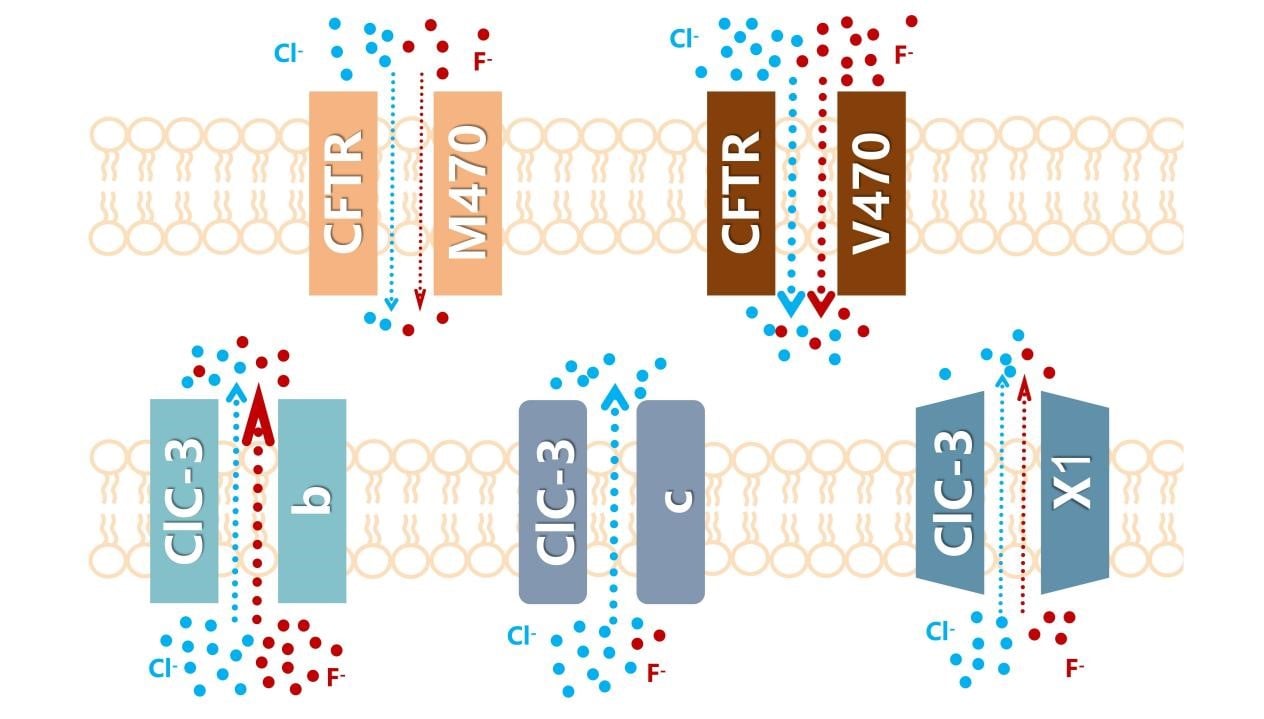
Dental fluorosis (DF) is a common endemic disease that damages dental enamel. Traditionally, DF has been attributed to environmental fluoride overload. Accumulating evidence has demonstrated that genetic factors also modulate individual susceptibility. No dedicated fluoride ion channels have been identified in mammalian cells; fluoride uptake is believed to occur mainly through passive diffusion of HF and nonspecific anion pathways, including chloride channels. Different types of chloride channels are expressed in dental tissues, such as CFTR and voltage-gated chloride channels (ClCs), but it remains unknown whether these channels transport fluoride and whether their variants influence DF risk. This study combined human population-based investigations, mouse and zebrafish models, and in vitro experiments to confirm the significant genetic association of CFTR and CLCN3 variants with DF. A total of 889 DF cases and 834 matched controls were recruited from the same fluoride-contaminated region. Tag SNP screening of CFTR and eight ClC chloride channel genes (CLCNs) revealed that rs213950 in CFTR and three SNPs in CLCN3 were significantly associated with DF. CFTR and ClC-3 showed different fluoride tolerances. rs213950 in CFTR affected the efficiency of fluoride ion transport in Xenopus oocytes. ClC-3 enabled yeast cells to resist fluoride toxicity, whereas clcn3 deficiency disrupted tooth and craniofacial development in zebrafish. Fluoride exposure altered nucleoprotein binding to the rs10520161 region and changed the mRNA levels of various ClC-3 transcripts. These transcripts displayed different subcellular locations and fluoride conductances and acted synergistically to confer fluoride resistance. Together, these findings raise the possibility that variants in CFTR and CLCN3 may act synergistically to influence DF susceptibility. This potential interplay highlights DF as a complex trait involving dysregulated fluoride handling and underscores the multifactorial, gene-directed regulation of fluoride transport.
Keywords: fluoride; chloride; CFTR; ClC-3; genetic; dental fluorosis fluoride; chloride; CFTR; ClC-3; genetic; dental fluorosis
Graphical Abstract