Biological Activity and Structure–Activity Relationship of Mono- and Bis-Derivatives of 3-(Arylamino)propanehydrazides


Abstract
1. Introduction
2. Materials and Methods
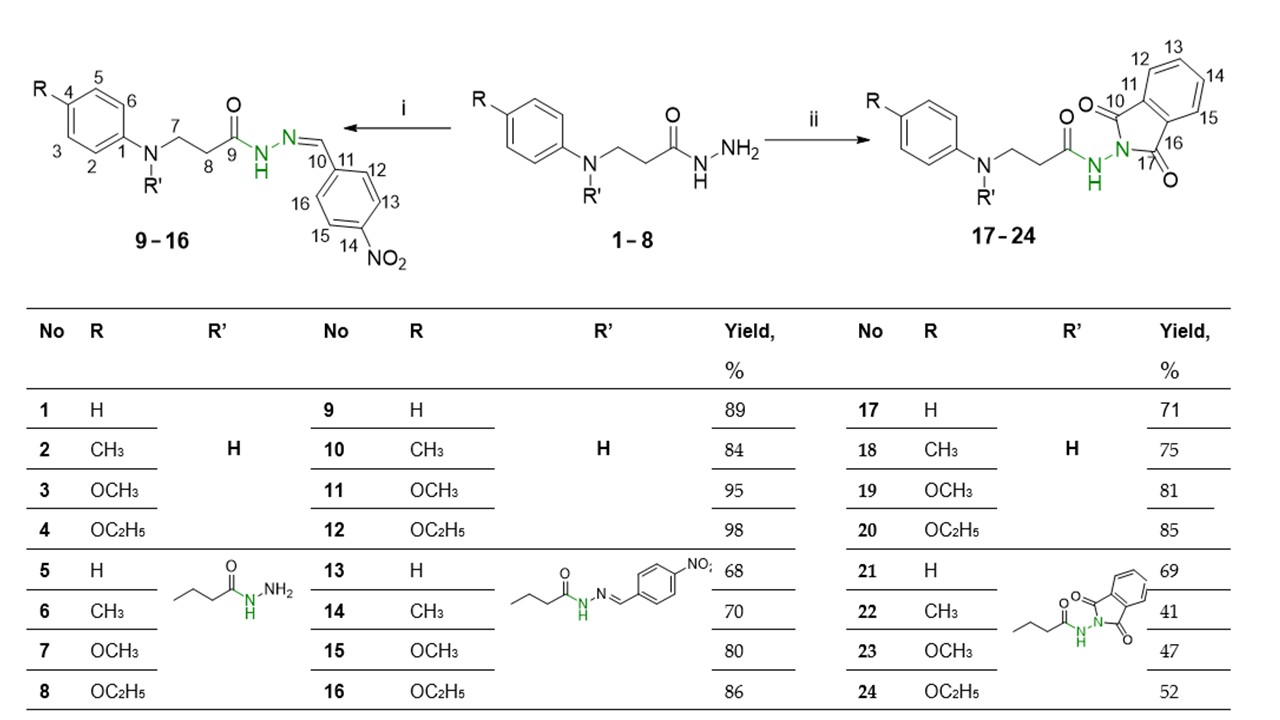
2.1. Synthesis
2.2. Determination of the Antioxidant Activity
2.2.1. Ferric Ion (Fe3+) Reducing Antioxidant Power Determination Assay
2.2.2. Ferric Reducing Antioxidant Power (FRAP) Assay
2.2.3. 1,1-Diphenyl-2-picrylhydrazyl (DPPH) Radical Scavenging Assay
2.2.4. 2,2-Azino-bis(3-ethylbenzothiazoline-6-sulfonic Acid) (ABTS) Radical Scavenging Assay
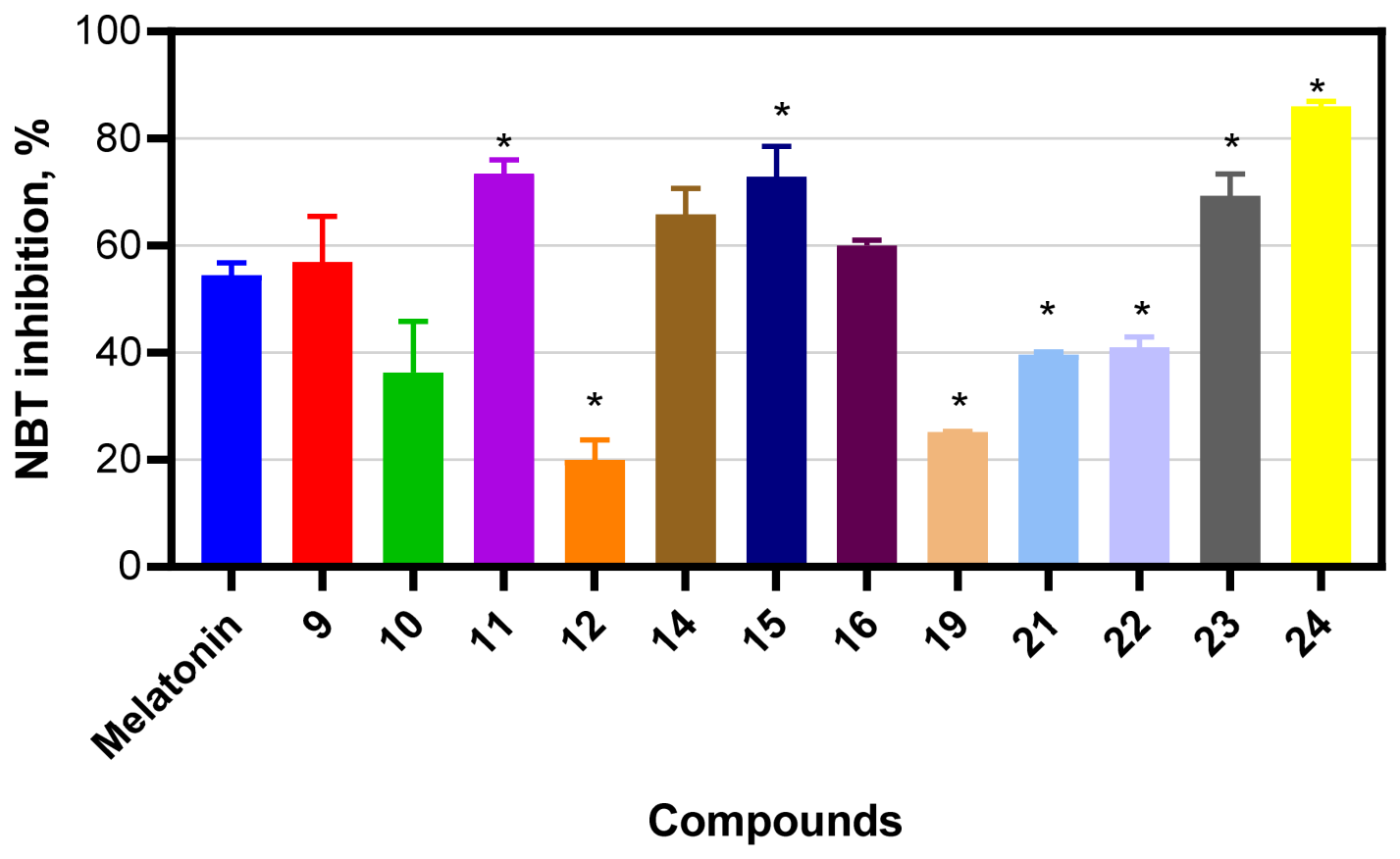
2.2.5. Nitroblue Tetrazolium (NBT) Inhibition
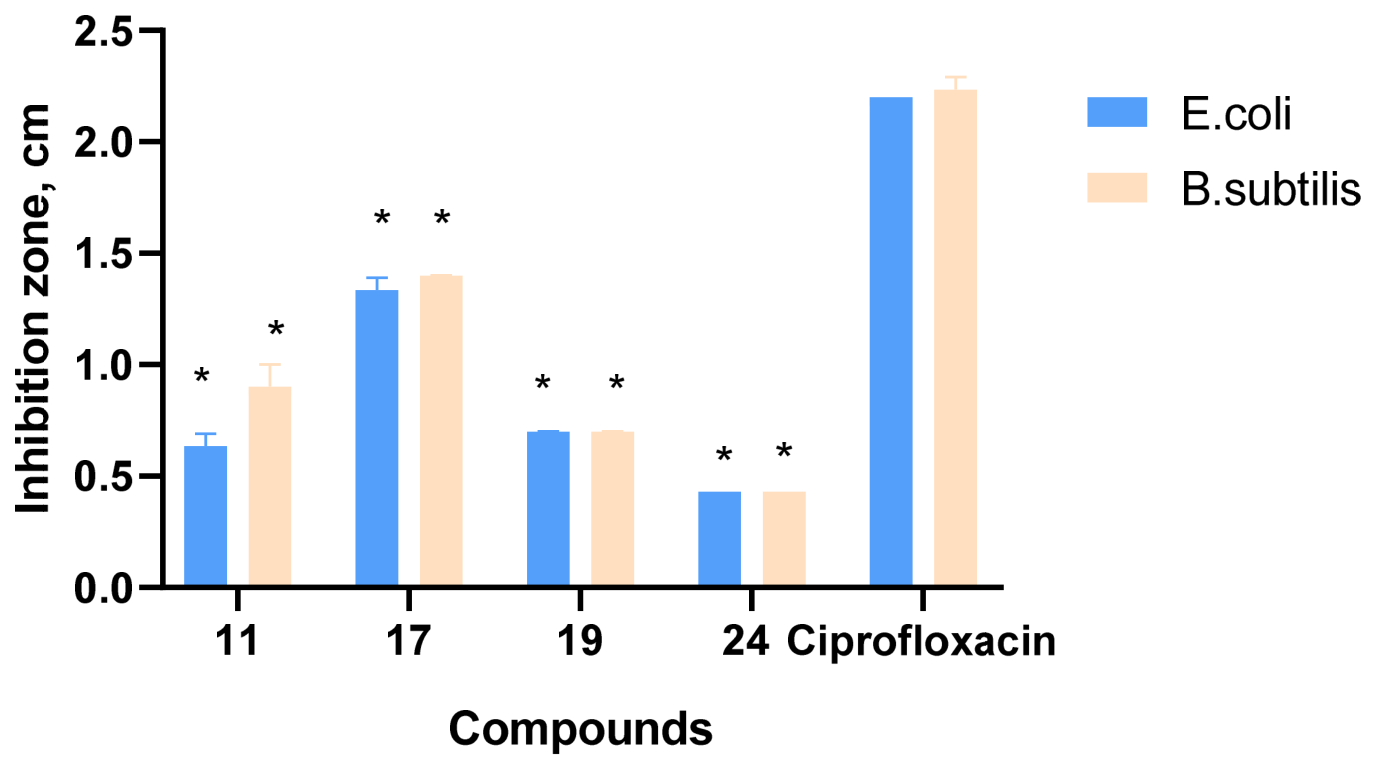
2.3. Determination of the Antibacterial Activity
2.4. Statistical Analysis
3. Results and Discussion
3.1. Synthesis
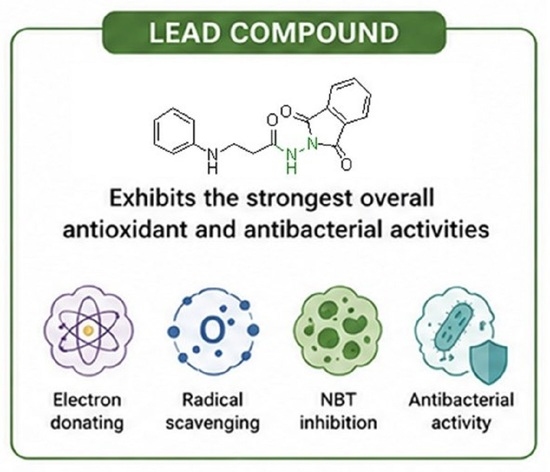
3.2. Evaluation of Biological Activity
4. Conclusions
Supplementary Materials
Author Contributions
Funding
Institutional Review Board Statement
Informed Consent Statement
Data Availability Statement
Conflicts of Interest
Abbreviations
| FRAP | Ferric ion reducing antioxidant power |
| DPPH | 2,2-Diphenyl-1-picrylhydrazyl |
| ABTS | 2,2-azino-bis(3-ethylbenzthiazoline-6-sulfonic acid) |
| NBT | Nitroblue tetrazolium |
| ROS | Reactive oxygen species |
| HAT | hydrogen atom transfer |
| SET | Single-electron transfer |
References
- Sies, H. Oxidative Stress: A Concept in Redox Biology and Medicine. Redox Biol. 2015, 4, 180–183. [Google Scholar] [CrossRef] [PubMed]
- Pizzino, G.; Irrera, N.; Cucinotta, M.; Pallio, G.; Mannino, F.; Arcoraci, V.; Squadrito, F.; Altavilla, D.; Bitto, A. Oxidative Stress: Harms and Benefits for Human Health. Oxid. Med. Cell. Longev. 2017, 2017, 8416763. [Google Scholar] [CrossRef] [PubMed]
- Gupta, A.; Imlay, J.A. How a Natural Antibiotic Uses Oxidative Stress to Kill Oxidant-Resistant Bacteria. Proc. Natl. Acad. Sci. USA 2023, 120, e2312110120. [Google Scholar] [CrossRef] [PubMed]
- Seixas, A.F.; Quendera, A.P.; Sousa, J.P.; Silva, A.F.Q.; Arraiano, C.M.; Andrade, J.M. Bacterial Response to Oxidative Stress and RNA Oxidation. Front. Genet. 2022, 12, 821535. [Google Scholar] [CrossRef] [PubMed]
- Qi, W.; Jonker, M.J.; Teichmann, L.; Wortel, M.; Ter Kuile, B.H. The Influence of Oxygen and Oxidative Stress on de Novo Acquisition of Antibiotic Resistance in E. coli and Lactobacillus Lactis. BMC Microbiol. 2023, 23, 279. [Google Scholar] [CrossRef] [PubMed]
- Lamie, P.F.; Phillopes, J.N.; El-Gendy, A.O.; Rarova, L.; Gruz, J. Design, Synthesis and Evaluation of Novel Phthalimide Derivatives as in Vitro Anti-Microbial, Anti-Oxidant and Anti-Inflammatory Agents. Molecules 2015, 20, 16620–16642. [Google Scholar] [CrossRef] [PubMed]
- Kamat, V.; Venuprasad, K.D.; Shadakshari, A.J.; Bhat, R.S.; D’souza, A.; Chapi, S.; Kumar, A.; Kuthe, P.V.; Sankaranarayanan, M.; Venugopala, K.N. Synthesis, Anti-Inflammatory, Antibacterial, and Antioxidant Evaluation of Novel Pyrazole-Linked Hydrazone Derivatives. J. Mol. Struct. 2024, 1312, 138634. [Google Scholar] [CrossRef]
- Rollas, S.; Güniz Küçükgüzel, Ş. Biological Activities of Hydrazone Derivatives. Mol. J. Synth. Chem. Nat. Prod. Chem. 2007, 12, 1910–1939. [Google Scholar] [CrossRef] [PubMed]
- Li, B.; Wen, R.; Duan, W.; Lin, G.; Liu, X. Synthesis, Antifungal Activity, and 3D-QSAR Study of Novel L-Carvone-Based Thiazole-Hydrazone Derivatives. Phytochem. Lett. 2025, 65, 58–63. [Google Scholar] [CrossRef]
- Li, D.; Yao, X.; Wang, W.-W.; Wang, Y.; Wu, W.; Hu, Z. Design, Synthesis and Antifungal Activity of Novel Vanillin Derivatives Containing Thiazole and Acylhydrazone Moieties. Pest Manag. Sci. 2025, 81, 1909–1922. [Google Scholar] [CrossRef] [PubMed]
- Huang, H.; Tang, J.; Dang, K.; Tang, J.; Li, E.; Fan, L.; Ye, M.; Wu, G.; Su, F. Design and Synthesis of Bis(Indolyl)-Hydrazide-Hydrazone Derivatives and Their Antifungal Activities against Plant Pathogen Fungi. Nat. Prod. Res. 2025, 39, 6139–6144. [Google Scholar] [CrossRef] [PubMed]
- Zubrickė, I.; Jonuškienė, I.; Kantminienė, K.; Tumosienė, I.; Petrikaitė, V. Synthesis and In Vitro Evaluation as Potential Anticancer and Antioxidant Agents of Diphenylamine-Pyrrolidin-2-One-Hydrazone Derivatives. Int. J. Mol. Sci. 2023, 24, 16804. [Google Scholar] [CrossRef] [PubMed]
- Ahmed, H.E.A.; Abdel-Salam, H.A.; Shaker, M.A. Synthesis, Characterization, Molecular Modeling, and Potential Antimicrobial and Anticancer Activities of Novel 2-Aminoisoindoline-1,3-Dione Derivatives. Bioorg. Chem. 2016, 66, 1–11. [Google Scholar] [CrossRef] [PubMed]
- Kalay, E.; Korkmaz, I.N.; Kaci, F.N.; Aslan, O.N.; Guller, P.; Tokali, F.S.; Kalin, R. Design, Synthesis, and Biological Studies of Isoniazid-Based Hydrazone Derivatives: Antibacterial, Anticancer, and Enzyme Inhibitory Properties. Arch. Biochem. Biophys. 2025, 770, 110450. [Google Scholar] [CrossRef] [PubMed]
- Acar Cevik, U.; Ünver, H.; Bostancı, H.E.; Tüzün, B.; Gedik, N.İ.; Kocyigit, Ü.M. New Hydrazone Derivatives: Synthesis, Characterization, Carbonic Anhydrase I-II Enzyme Inhibition, Anticancer Activity and in Silico Studies. Z. Für Naturforschung C 2025, 80, 705–718. [Google Scholar] [CrossRef] [PubMed]
- Deshmukh, H.S.; Adole, V.A.; Frit, A.A.P.; Mali, S.N.; Yasin, H.K.A.; Patil, B.N.; Janani, S.; Jagdale, B.S. Synthesis, Characterization, Computational and Biological Evaluation of Pyrazole Hydrazones as Promising Anti-Inflammatory Agents. Sci. Rep. 2025, 15, 42206. [Google Scholar] [CrossRef] [PubMed]
- Kajal, A.; Bala, S.; Sharma, N.; Kamboj, S.; Saini, V. Therapeutic Potential of Hydrazones as Anti-Inflammatory Agents. Int. J. Med. Chem. 2014, 2014, 761030. [Google Scholar] [CrossRef] [PubMed]
- Zlatanova-Tenisheva, H.; Vladimirova, S. Pharmacological Evaluation of Novel Hydrazide and Hydrazone Derivatives: Anti-Inflammatory and Analgesic Potential in Preclinical Models. Molecules 2025, 30, 1472. [Google Scholar] [CrossRef] [PubMed]
- Apotrosoaei, M.; Vasincu, I.; Tuchiluş, C.; Lupascu, F.; Sandra, C.; Lupascu, D.; Profire, L. New Hydrazones with Pyrazolone Structure: Synthesis, Characterization and Biological Evaluation. Rev. Med.-Chir. Soc. Medici Ş̧i Nat. Din Iaş̧i 2013, 117, 538–544. [Google Scholar]
- Dascalu, A.-E.; Ghinet, A.; Lipka, E.; Furman, C.; Rigo, B.; Fayeulle, A.; Billamboz, M. Design, Synthesis and Evaluation of Hydrazine and Acyl Hydrazone Derivatives of 5-Pyrrolidin-2-One as Antifungal Agents. Bioorg. Med. Chem. Lett. 2020, 30, 127220. [Google Scholar] [CrossRef] [PubMed]
- Popiołek, Ł. Hydrazide–Hydrazones as Potential Antimicrobial Agents: Overview of the Literature since 2010. Med. Chem. Res. 2017, 26, 287–301. [Google Scholar] [CrossRef] [PubMed]
- Popiołek, Ł. Updated Information on Antimicrobial Activity of Hydrazide–Hydrazones. Int. J. Mol. Sci. 2021, 22, 9389. [Google Scholar] [CrossRef] [PubMed]
- Noshiranzadeh, N.; Heidari, A.; Haghi, F.; Bikas, R.; Lis, T. Chiral Lactic Hydrazone Derivatives as Potential Bioactive Antibacterial Agents: Synthesis, Spectroscopic, Structural and Molecular Docking Studies. J. Mol. Struct. 2017, 1128, 391–399. [Google Scholar] [CrossRef]
- Agili, F. Novel Hydrazide Hydrazone Derivatives as Antimicrobial Agents: Design, Synthesis, and Molecular Dynamics. Processes 2024, 12, 1055. [Google Scholar] [CrossRef]
- Rice, A.M.; Long, Y.; King, S.B. Nitroaromatic Antibiotics as Nitrogen Oxide Sources. Biomolecules 2021, 11, 267. [Google Scholar] [CrossRef] [PubMed]
- Nabizadeh, M.; Naimi-Jamal, M.R.; Rohani, M.; Azerang, P.; Tahghighi, A. Hydrazone Analogues with Promising Antibacterial Profiles: Synthesis, Morphology, in Vitro and in Silico Approaches. Lett. Appl. Microbiol. 2022, 75, 667–679. [Google Scholar] [CrossRef] [PubMed]
- Sheng, G.-H.; Chen, X.-F.; Li, J.; Chen, J.; Xu, Y.; Han, Y.-W.; Yang, T.; You, Z.; Zhu, H.-L. Synthesis, Crystal Structures and Urease Inhibition of N’-(2-Bromobenzylidene)-2-(4-Nitrophenoxy)Acetohydrazide and N’-(4-Nitrobenzylidene)-2-(4-Nitrophenoxy)Acetohydrazide. Acta Chim. Slov. 2015, 62, 940–946. [Google Scholar] [CrossRef] [PubMed]
- Bansode, T.N.; Shelke, J.V.; Dongre, V.G. Synthesis and Antimicrobial Activity of Some New N-Acyl Substituted Phenothiazines. Eur. J. Med. Chem. 2009, 44, 5094–5098. [Google Scholar] [CrossRef] [PubMed]
- Mayo, J.C.; Sainz, R.M.; Tan, D.-X.; Hardeland, R.; Leon, J.; Rodriguez, C.; Reiter, R.J. Anti-Inflammatory Actions of Melatonin and Its Metabolites, N1-Acetyl-N2-Formyl-5-Methoxykynuramine (AFMK) and N1-Acetyl-5-Methoxykynuramine (AMK), in Macrophages. J. Neuroimmunol. 2005, 165, 139–149. [Google Scholar] [CrossRef] [PubMed]
- Reiter, R.J.; Calvo, J.R.; Karbownik, M.; Qi, W.; Tan, D.X. Melatonin and Its Relation to the Immune System and Inflammation. Ann. N. Y. Acad. Sci. 2000, 917, 376–386. [Google Scholar] [CrossRef] [PubMed]
- DeMuro, R.L.; Nafziger, A.N.; Blask, D.E.; Menhinick, A.M.; Bertino, J.S. The Absolute Bioavailability of Oral Melatonin. J. Clin. Pharmacol. 2000, 40, 781–784. [Google Scholar] [CrossRef] [PubMed]
- Shirinzadeh, H.; Eren, B.; Gurer-Orhan, H.; Suzen, S.; Özden, S. Novel Indole-Based Analogs of Melatonin: Synthesis and in Vitro Antioxidant Activity Studies. Molecules 2010, 15, 2187–2202. [Google Scholar] [CrossRef] [PubMed]
- Ateş-Alagöz, Z.; Coban, T.; Suzen, S. A Comparative Study: Evaluation of Antioxidant Activity of Melatonin and Some Indole Derivatives. Med. Chem. Res. 2005, 14, 169–179. [Google Scholar] [CrossRef]
- Gürkök, G.; Coban, T.; Suzen, S. Melatonin Analogue New Indole Hydrazide/Hydrazone Derivatives with Antioxidant Behavior: Synthesis and Structure–Activity Relationships. J. Enzym. Inhib. Med. Chem. 2009, 24, 506–515. [Google Scholar] [CrossRef] [PubMed]
- Suzen, S.; Bozkaya, P.; Coban, T.; Nebioğu, D. Investigation of the in Vitro Antioxidant Behaviour of Some 2-Phenylindole Derivatives: Discussion on Possible Antioxidant Mechanisms and Comparison with Melatonin. J. Enzym. Inhib. Med. Chem. 2006, 21, 405–411. [Google Scholar] [CrossRef] [PubMed]
- Zhang, H.-M.; Zhang, Y. Melatonin: A Well-Documented Antioxidant with Conditional pro-Oxidant Actions. J. Pineal Res. 2014, 57, 131–146. [Google Scholar] [CrossRef] [PubMed]
- Hardeland, R. Melatonin’s Antioxidant Properties: Molecular Mechanisms. In Melatonin and Melatonergic Drugs in Clinical Practice; Springer: New Delhi, India, 2014; Volume 9788132208259, pp. 17–26. [Google Scholar]
- Tumosiene, I.; Jakiene, E.; Beresnevicius, Z.J.; Mikulskiene, G. Synthesis and Properties of Dihydrazides of N-Phenyl-and N-(4-Methylphenyl)-N-Carboxyethyl-β-Alanines. Cheminė Technol. 2006, 3, 58–64. [Google Scholar]
- Tumosienė, I.; Mikulskiene, G.; Kantminiene, K.; Beresnevicius, Z.J. Synthesis and Structure of 3,3′-[(4-Alkoxyphenyl)Imino] Bis(N’-Phthaloyl- or N’-Benzylidenepropanohydrazide) Derivatives. Chemija 2011, 22, 65–72. [Google Scholar]
- Tumosienė, I.; Kantminienė, K.; Klevinskas, A.; Petrikaitė, V.; Jonuškienė, I.; Mickevičius, V. Antioxidant and Anticancer Activity of Novel Derivatives of 3-[(4-Methoxyphenyl)Amino]Propanehydrazide. Molecules 2020, 25, 2980. [Google Scholar] [CrossRef] [PubMed]
- Beresnevičius, Z.J.; Tumosienė, I.; Kantminienė, K.; Pavilonis, A.; Maželienė, Ž. Synthesis of Azole Derivatives from 3-Phenylaminopropanohydrazide and Evaluation of Their Antimicrobial Efficacy. Heterocycles 2009, 78, 59. [Google Scholar] [CrossRef]
- Tumosienė, I.; Jonuškienė, I.; Kantminienė, K.; Beresnevičius, Z.J. The Synthesis of Azole Derivatives from 3-[(4-Methylphenyl)Amino]Propanehydrazide and Its N′-Phenylcarbamoyl Derivatives, and Their Antibacterial Activity. Monatshefte Für Chem.—Chem. Mon. 2012, 143, 1441–1450. [Google Scholar] [CrossRef]
- Baltrusis, R.; Marijosius, J. Synthesis of 1-aryldihydrouracils and 1-aryl-2-thiodihydrouracils and their transformations. Khim Geterotsikl Soedin 1969, 5, 904–907. [Google Scholar]
- Jaishree, V.; Ramdas, N.; Sachin, J.; Ramesh, B. In Vitro Antioxidant Properties of New Thiazole Derivatives. J. Saudi Chem. Soc. 2012, 16, 371–376. [Google Scholar] [CrossRef]
- Sztanke, M.; Sztanke, K. Biologically Important Hydrazide-Containing Fused Azaisocytosines as Antioxidant Agents. Redox Rep. 2017, 22, 572–581. [Google Scholar] [CrossRef] [PubMed]
- Benzie, I.F.F.; Strain, J.J. The Ferric Reducing Ability of Plasma (FRAP) as a Measure of “Antioxidant Power”: The FRAP Assay. Anal. Biochem. 1996, 239, 70–76. [Google Scholar] [CrossRef] [PubMed]
- Pulido, R.; Bravo, L.; Saura-Calixto, F. Antioxidant Activity of Dietary Polyphenols As Determined by a Modified Ferric Reducing/Antioxidant Power Assay. J. Agric. Food Chem. 2000, 48, 3396–3402. [Google Scholar] [CrossRef] [PubMed]
- Huang, D.; Ou, B.; Prior, R.L. The Chemistry behind Antioxidant Capacity Assays. J. Agric. Food Chem. 2005, 53, 1841–1856. [Google Scholar] [CrossRef] [PubMed]
- Ünver, Y.; Deniz, S.; Çelik, F.; Akar, Z.; Küçük, M.; Sancak, K. Synthesis of New 1,2,4-Triazole Compounds Containing Schiff and Mannich Bases (Morpholine) with Antioxidant and Antimicrobial Activities. J. Enzym. Inhib. Med. Chem. 2016, 31, 89–95. [Google Scholar] [CrossRef] [PubMed]
- Salar, U.; Khan, K.M.; Chigurupati, S.; Taha, M.; Wadood, A.; Vijayabalan, S.; Ghufran, M.; Perveen, S. New Hybrid Hydrazinyl Thiazole Substituted Chromones: As Potential α-Amylase Inhibitors and Radical (DPPH & ABTS) Scavengers. Sci. Rep. 2017, 7, 16980. [Google Scholar] [CrossRef] [PubMed]
- Re, R.; Pellegrini, N.; Proteggente, A.; Pannala, A.; Yang, M.; Rice-Evans, C. Antioxidant Activity Applying an Improved ABTS Radical Cation Decolorization Assay. Free Radic. Biol. Med. 1999, 26, 1231–1237. [Google Scholar] [CrossRef] [PubMed]
- Liu, R.; Fu, S.; Zhan, H.; Lucia, L.A. General Spectroscopic Protocol to Obtain the Concentration of the Superoxide Anion Radical. Ind. Eng. Chem. Res. 2009, 48, 9331–9334. [Google Scholar] [CrossRef]
- Zaki, Y.H.; Al-Gendey, M.S.; Abdelhamid, A.O. A Facile Synthesis, and Antimicrobial and Anticancer Activities of Some Pyridines, Thioamides, Thiazole, Urea, Quinazoline, β-Naphthyl Carbamate, and Pyrano[2,3-d]Thiazole Derivatives. Chem. Cent. J. 2018, 12, 70. [Google Scholar] [CrossRef] [PubMed]
- Veit, P.; Prantl, E.; Förster, C.; Heinze, K. Competitive NH···Ru/Fe Hydrogen Bonding in Ferrocenyl Ruthenocenyl Tosyl Hydrazone. Organometallics 2016, 35, 249–257. [Google Scholar] [CrossRef]
- Afriana, N.; Nurulita, Y.; Zamri, A.; Jasril, J. Synthesis and in Vitro Antioxidant Activity of Chloro-Substituted Hydrazone. J. Phys. Conf. Ser. 2021, 1940, 012036. [Google Scholar] [CrossRef]
- Alam, M.S.; Lee, D.-U. Quantum-Chemical Studies to Approach the Antioxidant Mechanism of Nonphenolic Hydrazone Schiff Base Analogs: Synthesis, Molecular Structure, Hirshfeld and Density Functional Theory Analyses. Bull. Korean Chem. Soc. 2015, 36, 682–691. [Google Scholar] [CrossRef]
- Belkheiri, N.; Bouguerne, B.; Bedos-Belval, F.; Duran, H.; Bernis, C.; Salvayre, R.; Nègre-Salvayre, A.; Baltas, M. Synthesis and Antioxidant Activity Evaluation of a Syringic Hydrazones Family. Eur. J. Med. Chem. 2010, 45, 3019–3026. [Google Scholar] [CrossRef] [PubMed]
- Kaur, C.; Mandal, D. The Scavenging Mechanism of Hydrazone Compounds towards HOO− and CH3 OO− Radicals: A Computational Mechanistic and Kinetic Study. RSC Adv. 2025, 15, 357–369. [Google Scholar] [CrossRef] [PubMed]
- Yılmaz, A.D.; Coban, T.; Suzen, S. Synthesis and Antioxidant Activity Evaluations of Melatonin-Based Analogue Indole-Hydrazide/Hydrazone Derivatives. J. Enzym. Inhib. Med. Chem. 2012, 27, 428–436. [Google Scholar] [CrossRef] [PubMed]
- Rice-Evans, C.A.; Miller, N.J.; Paganga, G. Structure-Antioxidant Activity Relationships of Flavonoids and Phenolic Acids. Free Radic. Biol. Med. 1996, 20, 933–956. [Google Scholar] [CrossRef] [PubMed]
- Bors, W.; Heller, W.; Michel, C.; Saran, M. Radical Chemistry of Flavonoid Antioxidants. In Antioxidants in Therapy and Preventive Medicine; Emerit, I., Packer, L., Auclair, C., Eds.; Springer: Boston, MA, USA, 1990; pp. 165–170. [Google Scholar]





Disclaimer/Publisher’s Note: The statements, opinions and data contained in all publications are solely those of the individual author(s) and contributor(s) and not of MDPI and/or the editor(s). MDPI and/or the editor(s) disclaim responsibility for any injury to people or property resulting from any ideas, methods, instructions or products referred to in the content. |
© 2026 by the authors. Licensee MDPI, Basel, Switzerland. This article is an open access article distributed under the terms and conditions of the Creative Commons Attribution (CC BY) license.
Share and Cite
Tumosienė, I.; Jonuškienė, I.; Petrašauskienė, N.; Kantminienė, K. Biological Activity and Structure–Activity Relationship of Mono- and Bis-Derivatives of 3-(Arylamino)propanehydrazides. Biomolecules 2026, 16, 975. https://doi.org/10.3390/biom16070975
Tumosienė I, Jonuškienė I, Petrašauskienė N, Kantminienė K. Biological Activity and Structure–Activity Relationship of Mono- and Bis-Derivatives of 3-(Arylamino)propanehydrazides. Biomolecules. 2026; 16(7):975. https://doi.org/10.3390/biom16070975
Chicago/Turabian StyleTumosienė, Ingrida, Ilona Jonuškienė, Neringa Petrašauskienė, and Kristina Kantminienė. 2026. "Biological Activity and Structure–Activity Relationship of Mono- and Bis-Derivatives of 3-(Arylamino)propanehydrazides" Biomolecules 16, no. 7: 975. https://doi.org/10.3390/biom16070975
APA StyleTumosienė, I., Jonuškienė, I., Petrašauskienė, N., & Kantminienė, K. (2026). Biological Activity and Structure–Activity Relationship of Mono- and Bis-Derivatives of 3-(Arylamino)propanehydrazides. Biomolecules, 16(7), 975. https://doi.org/10.3390/biom16070975