3.2.1. Sodium Borate Buffer 0.2 M pH 9.0
sLOX1 solution behaviour was initially evaluated in 0.2 M sodium borate buffer, pH 9.0, a condition under which the enzyme exhibits its highest catalytic activity, according to Siedow, 1991 [
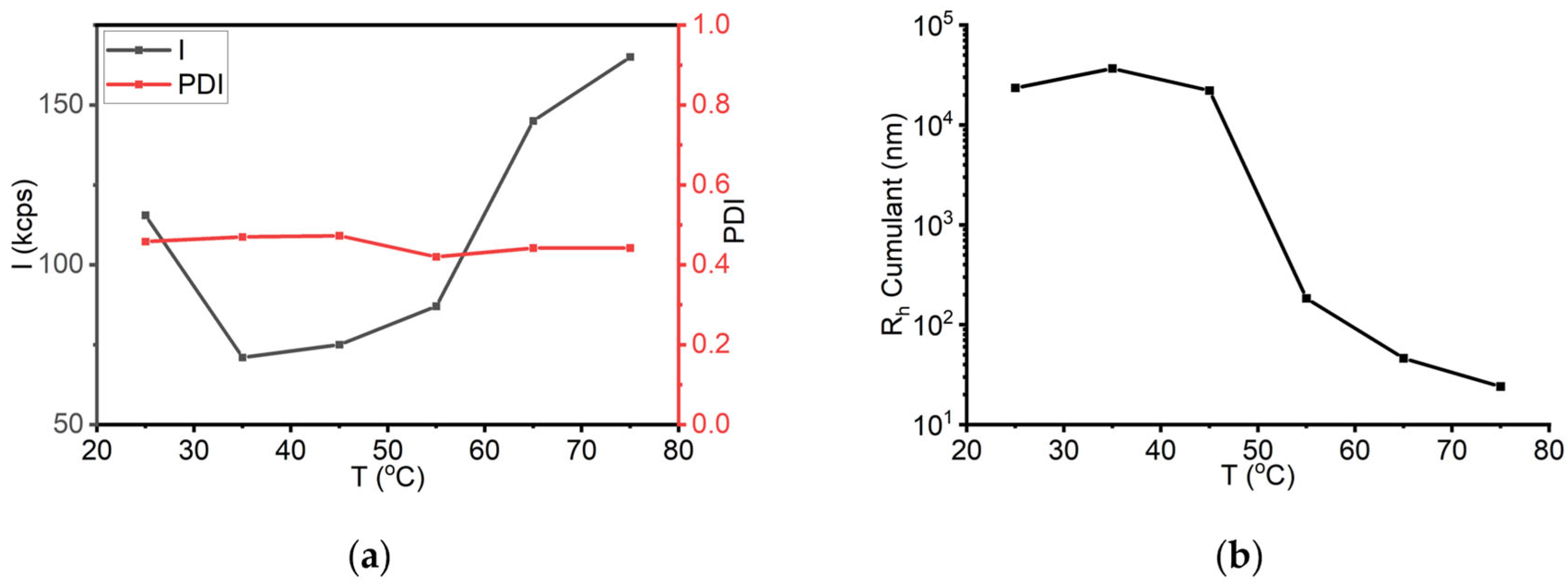
38]. Initially, the stability of the 0.1 mg/mL sLOX1 against temperature was examined. For this reason, DLS measurements were performed at a temperature range from 25 to 75 °C by an increase step of 10 °C. The scattered intensity at 25 °C was 115 kcps; it decreased to 71 kcps at 35 °C, and it increased to the final intensity of 165 kcps at 75 °C (
Figure 6a). The increase was more intense from 55 to 75 °C. Although there was an increase in intensity, the noticed difference was not significant, considering that the increase in temperature was quite large. sLOX1 seems to be stable enough in this buffer despite heating. The PDI corresponded to a value of about 0.45 through the increase of temperature, which can also be considered as an indication of the solution’s stability (
Figure 6a). At the same time, the hydrodynamic radius R
h (derived from Cumulant analysis) ranged from 25 to 35 μm at the onset of the heat treatment. When the temperature reached 55 °C and above, the R
h significantly decreased to values ranging from 180 to 25 nm (
Figure 6b). This finding supports the hypothesis that elevated temperature facilitates aggregate dissociation and contributes to the stabilization of the system.
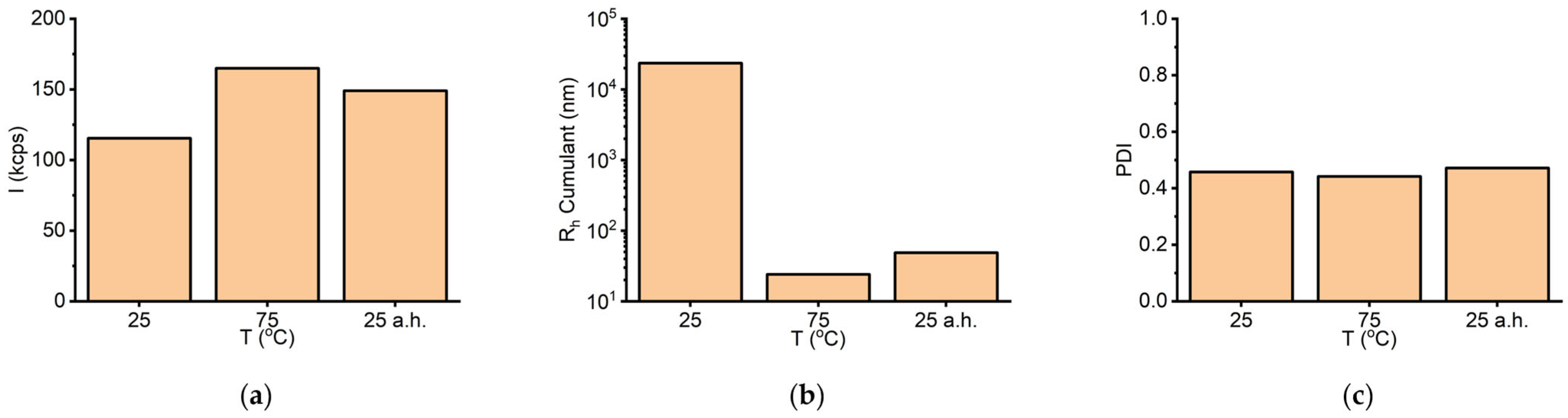
As the DLS data indicated that no significant biophysical changes occurred above 55 °C, further experiments were performed to investigate the reversibility of thermal effects on the enzyme solution. Specifically, the sample was analysed at room temperature (25 °C), then heated to 75 °C, and finally cooled back to 25 °C before a final measurement. The main purpose of these measurements was to check the stability before and after heating (marked as b.h. and a.h., respectively). The scattering intensity increased from 115 kcps (initial) to 165 kcps upon heating and subsequently decreased to 149 kcps after the sample returned to room temperature 1 h later (
Figure 7a). On the other hand, the size (as expressed by the corresponding R
h Cumulant values) remained rather low (approximately 45 nm) upon returning to 25 °C following heat treatment (
Figure 7b). Moreover, the PDI value persisted at ~0.45 (
Figure 7c), similar to the corresponding values recorded during heating. Taken together, these results suggest that the thermal effect on sLOX1 in sodium borate buffer (pH 9.0) does not induce substantial changes in the enzyme’s solution behaviour. Nevertheless, it is possible that bigger aggregates either dissociated or precipitated after the heating procedure, as indicated by the observed decrease of R
h.
Electrophoretic light scattering measurements were also performed under the same conditions. At room temperature, the ζ potential was measured at −7 mV. After heating to 75 °C and subsequent cooling back to room temperature, the zeta potential decreased to −18 mV. This increase in absolute ζp value may be attributed to conformational changes in the protein structure upon heating. The relatively high (in terms of absolute value) negative ζ potential indicates that the system remains quite stable. In combination with the DLS results, these findings indicate that sLOX1 undergoes some minor structural alterations during thermal exposure.
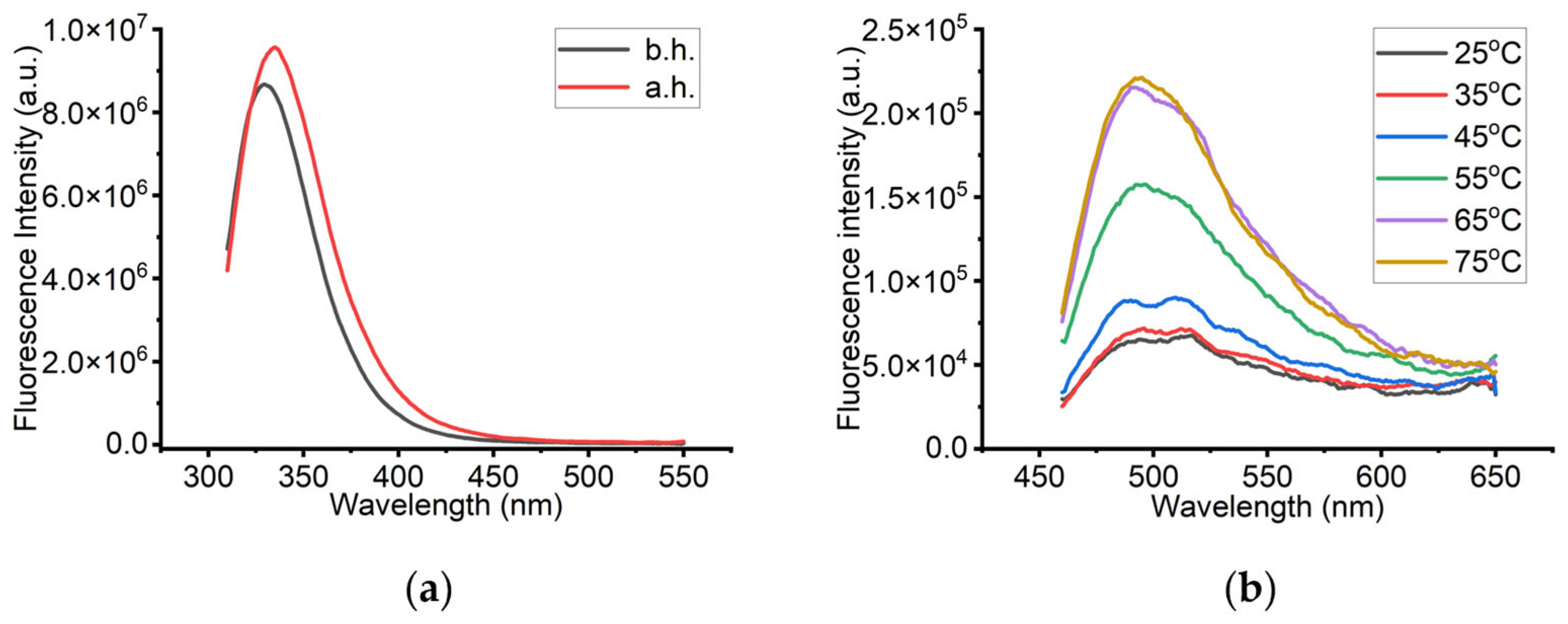
To further evaluate the enzyme’s structural integrity under thermal stress, fluorescence spectroscopy was employed. At room temperature, the emission maximum was observed at 331 nm (
Figure 8a). After heating and cooling back to 25 °C, the emission maximum showed a slight red shift to 333 nm, accompanied by a ~5% increase in fluorescence intensity (
Figure 8a). This small shift may be indicative of increased hydrophobic exposure, possibly due to a different environment around aromatic residues—particularly tryptophan—resulting from thermal conformational rearrangement.
In parallel, ThT fluorescence measurements were conducted to investigate potential amyloid formation. sLOX1 samples after addition of ThT were measured from 25 to 75 °C in 10 °C increments. As shown in
Figure 8b, the emission maximum remained constant across all temperatures; however, fluorescence intensity increased progressively up to 65 °C. No significant change was observed between 65 and 75 °C. Since ThT specifically binds to
β-sheet-rich structures and amyloid fibrils, this increase in signal likely reflects the formation of amyloid-like aggregates as the temperature increased. The plateau at 75 °C may indicate that fibril formation reached completion by 65 °C, with no additional structural changes thereafter. The corresponding maximum ThT fluorescence intensities for these experiments are summarized in
Figure S19, providing an overview of the aggregation behaviour under the tested conditions. To gain additional insights into possible secondary structural alterations, FTIR spectroscopy was performed. Representative spectra were collected for two samples of 0.1 mg/mL sLOX1 in 0.2 M sodium borate buffer, pH 9.0: one maintained at room temperature (b.h.), and another subjected to heating at 75 °C followed by cooling to 25 °C (a.h.). However, the FTIR spectra did not clearly resolve the characteristic amide I and II regions, typically associated with protein backbone vibrations. This limitation is likely due to the high buffer concentration relative to the protein concentration, which may have masked the protein-specific signals (
Figure S4).
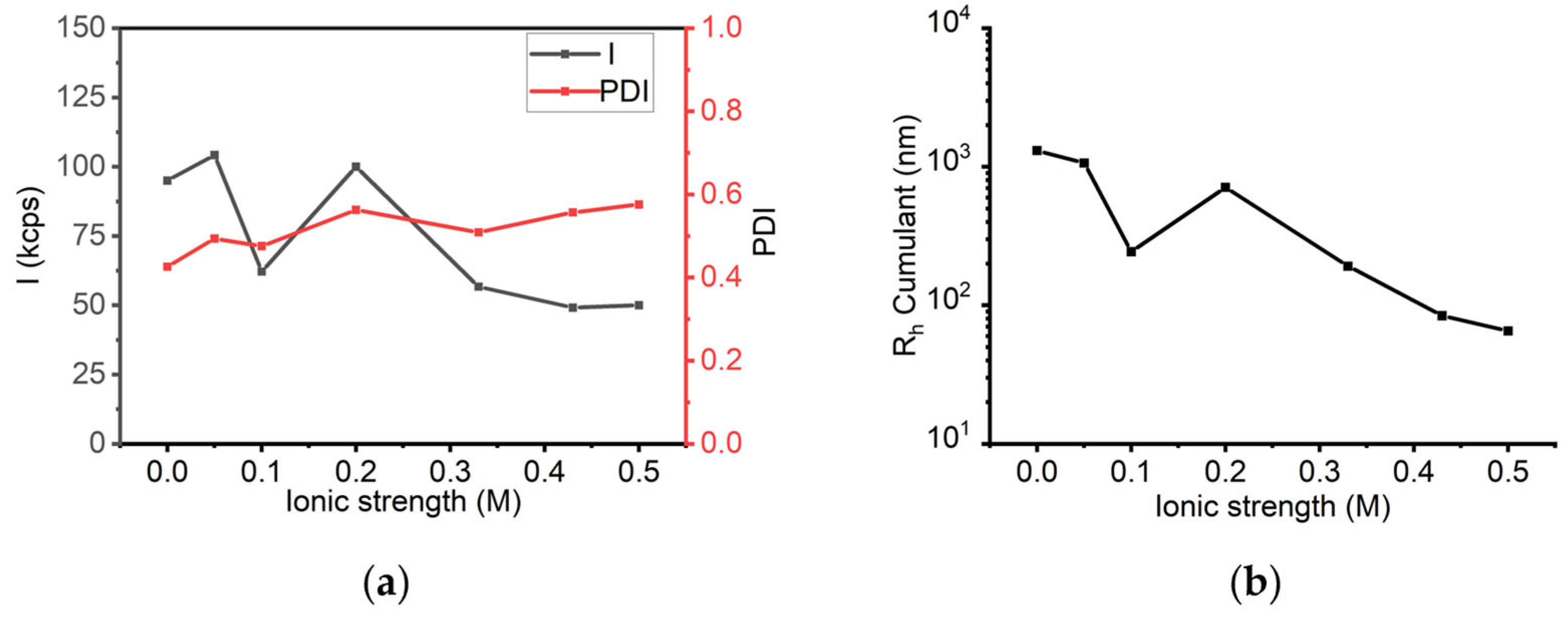
Subsequent DLS measurements were conducted to evaluate the stability of sLOX1 under increasing ionic strength. This was achieved by incrementally adding sodium chloride into the enzyme solution at concentrations ranging from 0 to 0.5 M. The initial scattered intensity of the solution in the absence of sodium chloride was 95 kcps (
Figure 9a). As the sodium chloride concentration increased, a slight deviation of the intensity was observed, reaching 50 kcps at 0.5 M. The PDI values ranged from 0.4 to 0.6 across the tested salt concentrations, indicating moderate sample heterogeneity (
Figure 9a). Cumulant analysis revealed that the average hydrodynamic radius (R
h) decreased upon addition of salt. In the absence of NaCl, the average R
h was approximately 13 μm, while higher salt concentrations promoted a rather gradual reduction in particle size (
Figure 9b), reaching values below 100 nm at the highest salt content. These results suggest that the increase of ionic strength may contribute to the overall system stabilization as it promotes the dissociation of populations with larger sizes.
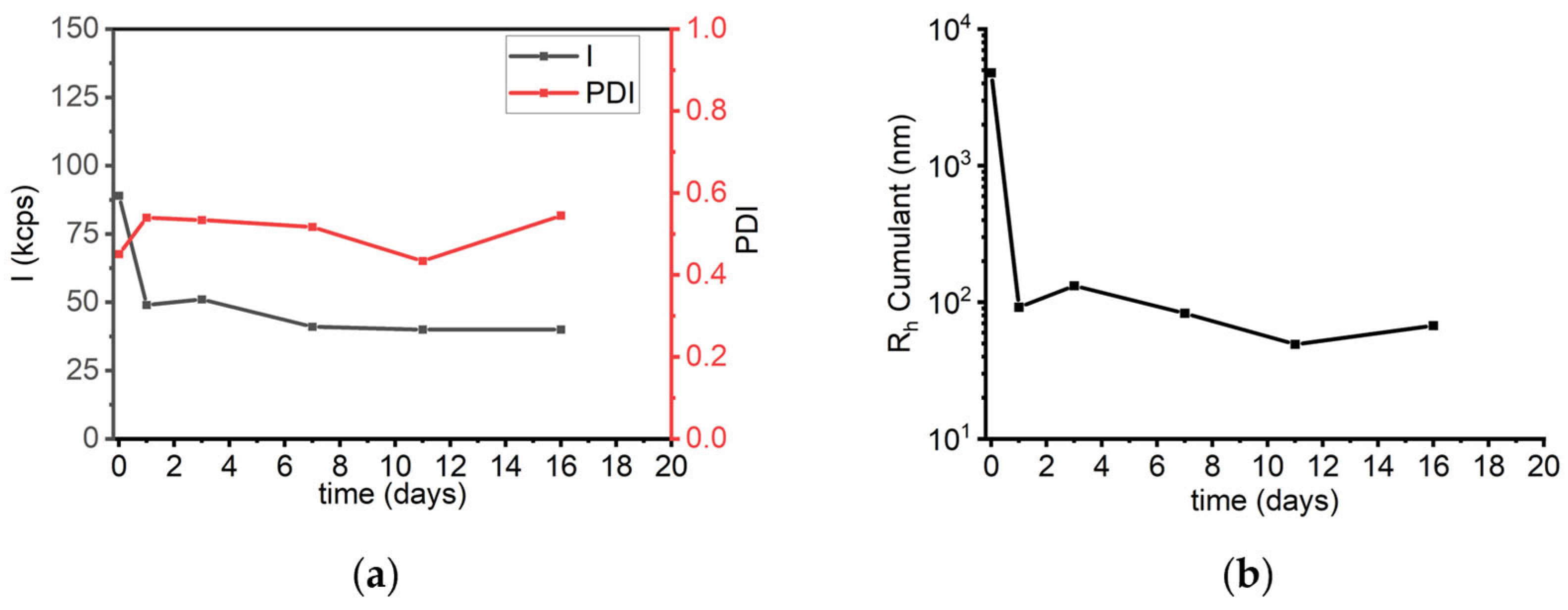
To assess long-term stability, sLOX1 in 0.2 M sodium borate buffer (pH 9.0) was monitored over 16 days via DLS. The solution was measured by DLS at different intervals over the course of time, as shown in
Figure 10. On the day of preparation, the scattering intensity was 89 kcps; it declined to 51 kcps on day 2 and eventually reached 40 kcps by day 16. Although a decrease in intensity was observed, the variation remained relatively small (
Figure 10a). Throughout the time course, PDI values remained in the range of 0.4 to 0.6, indicating no significant changes in the polydispersity of the solution (
Figure 10a). At the same time, the R
h (Cumulant analysis) initially measured at 4.7 μm decreased to 90 nm by day 2, after which it remained relatively stable (
Figure 10b). These observations suggest that sLOX1 remains stable in sodium borate buffer over time, both in terms of scattering behaviour and particle size distribution. In addition, larger populations most probably dissociate, also contributing to the temporal stability of the enzyme.
3.2.2. Sodium Phosphate Buffer 0.02 M pH 6.8
Similar DLS measurements were also performed for sLOX1 in sodium phosphate buffer 0.02 M, pH 6.8, to investigate the influence of buffer composition on protein oligomerization and structural behaviour. The experimental conditions were kept consistent with those used for the sodium borate buffer.
Temperature-dependent DLS measurements were carried out by gradually increasing the temperature from 25 to 75 °C, with a 10 °C increment. In the case of the phosphate buffer, two different concentrations of 0.1 mg/mL and 1 mg/mL were used. The solution of 0.1 mg/mL was investigated to compare the behaviour of the enzyme in sodium phosphate buffer and in sodium borate buffer. At the same time, the solution of 1 mg/mL was used to investigate the behaviour of the enzyme in higher concentrations, which would be used at industrial applications. For the 0.1 mg/mL sLOX1 solution, a notable increase in scattering intensity was observed at temperatures above 65 °C. In a similar manner, the 1 mg/mL solution exhibited a substantial increase in scattering intensity at temperatures above 55 °C, with the signal increasing approximately 44-fold relative to the lower concentration (
Figure S5). This suggests that higher enzyme concentration favours a more pronounced aggregation at elevated temperatures. PDI remained within the range of 0.4 to 0.5 for both concentrations at temperatures below 65 °C (
Figure S5). At 0.1 mg/mL, PDI values decreased above 65 °C, possibly due to the formation of aggregates with a more uniform size distribution. In parallel, for the 1 mg/mL solution, PDI decreased at 65 °C but increased again at 75 °C. This behaviour indicates the emergence of heterogeneous aggregate populations, consistent with changes observed in the corresponding Cumulant R
h values (
Figure S6). Specifically, for both concentrations, average R
h increased with temperature up to 45 °C, followed by a decline at higher temperatures. This pattern suggests that although aggregation is enhanced at elevated temperatures, larger aggregates may precipitate, thereby reducing the average R
h of the remaining particles in solution. Notably, the R
h value of 6.5 μm measured at 75 °C for the 1 mg/mL solution further supports this interpretation, pointing to the formation of large aggregates that may sediment over time. Altogether, these findings highlight that enzyme concentration significantly modulates the extent and nature of heat-induced oligomerization and aggregation in phosphate buffer.
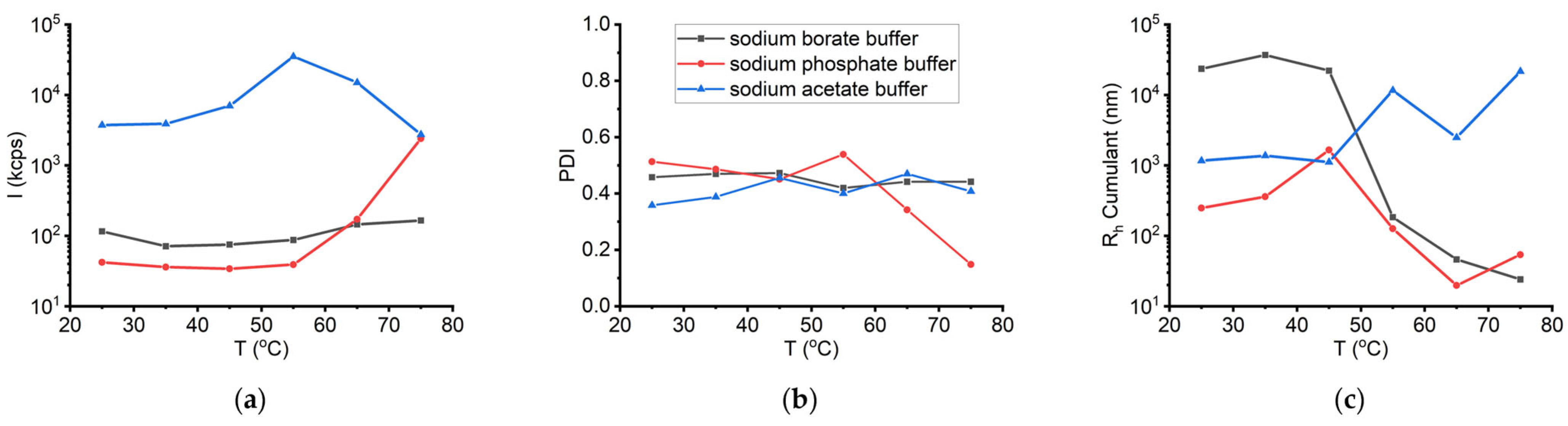
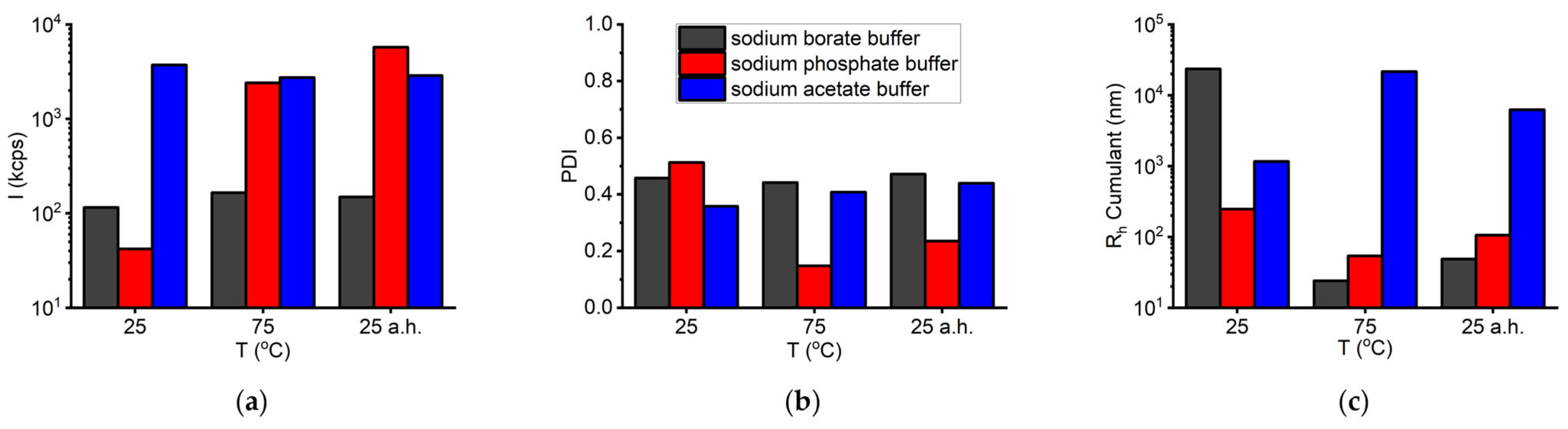
To facilitate the direct comparison of the effect of temperature on the physicochemical properties of the enzyme under the different buffer conditions,
Figure 11 presents the sum of the obtained DLS results for the sLOX1 solutions in the three different investigated buffers. In contrast to the results obtained in sodium borate buffer, the presence of sLOX1 in sodium phosphate buffer appears to promote oligomerization/aggregation at both low (0.1 mg/mL) and high (1 mg/mL) enzyme concentrations. As observed, temperature increase leads to a notable increase in scattering intensity above 65 °C for the 0.1 mg/mL solution and above 55 °C for the 1 mg/mL solution.
To further investigate the effect of heat on protein aggregation, DLS measurements were performed at 25 °C (b.h.), at 75 °C, and again at 25 °C after the sample was allowed to cool (a.h.) (
Figure S7). The results revealed that, for both concentrations, scattering intensity increased further after cooling to 25 °C post-heating (
Figure S7a). This indicates that the heat-induced aggregation is largely irreversible, with aggregates remaining in solution after the temperature returns to ambient conditions. Although the average R
h showed a slight decrease for the 0.1 mg/mL sLOX1 solution (
Figure S7b), the change was relatively small. On the other hand, for the 1 mg/mL solution, R
h increased even further when the sample returned to ambient conditions after heating. This contrast between the two concentrations indicates that a higher enzyme concentration promotes a more pronounced aggregation upon heating. In the case of 0.1 mg/mL, PDI decreased from 0.5 to 0.15 when the temperature increased to 75 °C, and it subsequently increased to 0.23 when the solution returned to room temperature. On the other hand, for 1 mg/mL sLOX1, PDI exhibited a decrease from 0.5 to 0.4 (
Figure S7c) after cooling, further supporting the conclusion that aggregates formed at high concentrations are more stable and persist after heating. By comparing the results obtained for the 0.1 mg/mL enzyme solutions prepared in sodium borate and sodium phosphate buffers (
Figure 12), it is evident that the enzyme exhibits distinct behaviour depending on the buffer environment. In sodium borate buffer, the enzyme appeared more stable during heat treatment, suggesting that this buffer exerts a stabilizing effect on the protein conformation. In contrast, in sodium phosphate buffer, the results indicate a tendency toward aggregation. Thus, it seems that this medium may promote intermolecular interactions leading to reduced stability under the same thermal conditions.
Changes in the conformation state of sLOX1 in sodium phosphate buffer were further investigated using ELS. For this purpose, a 0.1 mg/mL sLOX1 solution in this buffer (pH 6.8) was initially examined at room temperature. The zeta potential of the enzyme was measured at −8 mV, indicating a negatively charged surface under these conditions. After the solution was heated at 75 °C and subsequently cooled down to room temperature, the zeta potential decreased to −13 mV. A similar trend was observed for the 1 mg/mL solution, suggesting a concentration-independent effect. This decrease in zeta potential likely reflects heat-induced conformational rearrangements, possibly involving repositioning of amino acids with negatively charged side chains toward the protein surface. This lower ζ potential after heating makes the repulsive forces between molecules more intense, which enhances the stability of the system.
To further evaluate structural changes, fluorescence spectroscopy was employed. At 25 °C, the position of the maximum emission was observed at 331 nm (
Figure S8a), identical to the result in sodium borate buffer (
Figure 8a). However, following heat treatment, the emission maximum shifted to 336 nm, in contrast to the 333 nm shift seen in the borate system. Additionally, a 10% decrease in fluorescence intensity was recorded, as opposed to the 5% increase observed in borate buffer. This reduction may indicate a change in the local environment of tryptophan residues, possibly caused by partial unfolding or rearrangement of the tertiary structure.
Fluorescence measurements in the presence of 5 μM ThT were also performed to monitor potential amyloid formation. At room temperature, the maximum fluorescence emission was observed at 497 nm (
Figure S8b). Upon heating to 75 °C, the ThT fluorescence intensity decreased by 56%, while the position of the emission maximum remained unchanged. This decline likely reflects precipitation of larger aggregates rich in
β-sheet conformations, such as amyloid fibrils, to which ThT binds. These findings are in contrast with the behaviour in sodium borate buffer, where heating led to increased ThT fluorescence. It seems that the nature of aggregation and that of aggregate structure differ between the two buffer systems (
Figure S19).
To further explore possible changes in secondary structure and the presence of
β-sheets or
α-helices within the enzyme structure, FTIR was employed. In this case, the concentration of the buffer is lower (than in the case of the sodium borate buffer), thus allowing characteristic amide peaks to be discerned. FTIR spectra were obtained for four different samples of sLOX1 in 0.02 M sodium phosphate buffer, pH 6.8 (i.e., both 0.1 and 1 mg/mL at room temperature before and after heating at 75 °C). As shown in
Figure S9b, all spectra exhibited a characteristic peak at 1650 cm
−1, consistent with the Amide I region, which is typically associated with
α-helical content. A second peak at 1540 cm
−1, corresponding to the Amide II region, was also detected. In samples containing 0.1 mg/mL sLOX1, the Amide I and II signals were less distinct, due to the lower protein concentration, while higher enzyme concentration (i.e., 1 mg/mL) yielded more defined spectra. Notably, for the 1 mg/mL sample after heating at 75 °C, the shape of the Amide I band changed, showing a significant contribution from an underlying peak located at about 1625–1630 cm
−1. This contribution is characteristic of
β-sheets [
39,
40] and further confirms that the heat-induced aggregation of the enzyme leads to their formation, as also evidenced by the ThT fluorescence measurements.
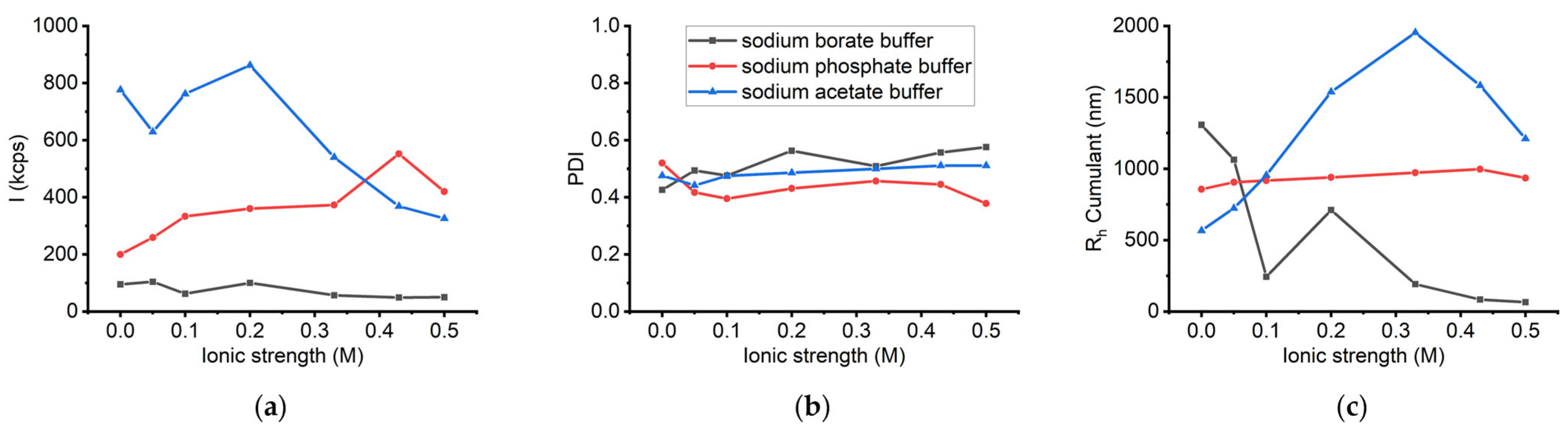
Subsequent DLS experiments were conducted to compare the behaviour of sLOX1 under increased ionic strength in the presence of sodium phosphate buffer, pH 6.8, with the corresponding results obtained in the case of sodium borate buffer. A direct comparison of the obtained results is shown in
Figure 13. In the presence of the sodium phosphate buffer, increasing the sodium chloride concentration from 0 to 0.42 M resulted in a substantial rise in scattering intensity from 200 to 550 kcps, representing a 2.75-fold increase (
Figure S10a). However, upon further increase of the NaCl concentration to 0.5 M, the intensity declined (
Figure S10a). This trend indicates that moderate salt concentrations may promote protein aggregation by shielding surface charges. On the other hand, higher ionic strength (≥0.42 M) could either induce precipitation of larger aggregates or disrupt larger assemblies through destabilizing hydrophobic interactions. In parallel to these variations in intensity, the average hydrodynamic radius (R
h) showed a small gradual increase—from 850 to 1000 nm—as NaCl concentration increased (
Figure S10b), suggesting the persistence of large aggregate populations. Nevertheless, a slight decrease of R
h at 0.5 M ionic strength is also observed, consistent with the notion that larger aggregates precipitated. At the same time, the corresponding PDI values ranged from 0.4 to 0.5 throughout the titration (
Figure S10a). In contrast to the results obtained with the sodium borate buffer—where increasing sodium chloride content appeared to promote breakdown of larger oligomeric species—the findings in phosphate buffer suggest that elevated ionic strength enhances aggregation and oligomerization of sLOX1.
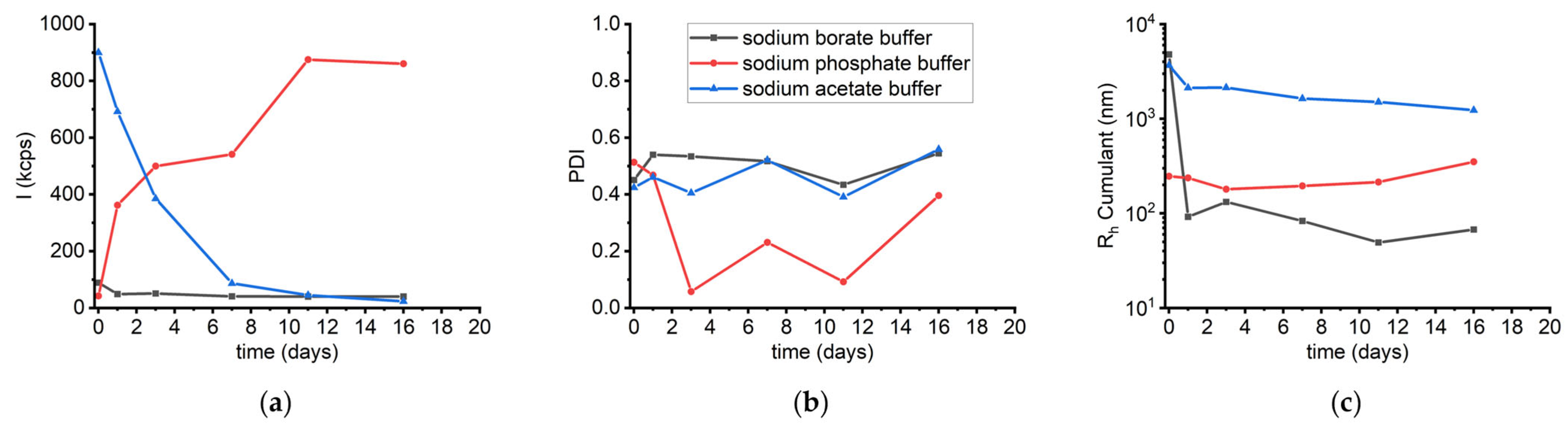
A further comparison was made to assess the long-term stability of sLOX1 in the presence of sodium phosphate buffer over a period of 16 days, mirroring the conditions used for borate buffer. The corresponding collective results for all three buffers are given in
Figure 14. Over time, the scattering intensity increased progressively from 160 kcps on day 1 to 860 kcps on day 16 (
Figure S11a), indicating ongoing aggregation. PDI varied slightly, exhibiting values below 0.5 during this period, while the average R
h initially measured at 247 nm remained at values between 200 and 350 nm until the 16th day (
Figure S11b). This progressive increase in intensity, along with the small variations in R
h, is in contrast to the behaviour observed in sodium borate buffer, where the intensity remained relatively constant (~45–50 kcps) (
Figure 10a). These findings suggest that in the phosphate buffer, sLOX1 exhibits a higher propensity for time-dependent aggregation, likely leading to the formation of smaller but more numerous aggregate populations.
3.2.3. Sodium Acetate Buffer 0.2 M pH 4.6
The last sLOX1 solution condition, which was tested, contained 0.1 mg/mL sLOX1 in 0.2 M sodium acetate buffer, at pH 4.6. The first DLS measurements implemented for this buffer were related to the influence of temperature (25–75 °C range) on the stability of sLOX1. As shown in
Figure S12a, the scattering intensity increased by 9-fold while the temperature increased from 25 to 55 °C. At this temperature, the solution became opaque, as shown in
Figure S13. Upon additional increase in temperature, the intensity decreased, most probably due to the precipitation of the larger thermally induced aggregates. In addition, R
h (Cumulant) was about 1 μm from 25 to 45 °C, and it increased to 11.6 μm at 55 °C. Upon further heating, the R
h initially decreased at 65 °C, which could be related to the presumed precipitation of larger entities in solution, and subsequently increased again, reaching its maximum value at 75 °C, indicating further aggregation (
Figure S12b). However, PDI points to a medium polydispersity equal to 0.4 at almost all different temperatures measured (
Figure S12a), which suggests a relatively stable distribution of populations in the solution. Still, the fact that the solution became opaque at 55 °C, as well as the overall significantly higher intensity values (
Figure 11), supports the assumption of thermally induced aggregation of sLOX1 in this buffer (
Figure S13).
As the heating of the solution above 55 °C promoted significant changes, the stability of sLOX1 before and after heating was investigated, as in the case of the other two buffers (
Figure 12). When the solution returned to room temperature, the intensity remained approximately at the same value as at 75 °C (
Figure S14a), while the average R
h decreased by 3.5-fold (
Figure S14b). PDI points to medium polydispersity equal to 0.4 both before and after heating (
Figure S14c). It is important to mention that the observed heat-induced opaqueness was not reversed when the solution returned to room temperature. In the meantime, during the cooling of the solution back to room temperature, the large aggregates possibly precipitated. This phenomenon could explain the observed decrease in intensity and R
h values, in comparison to those at 55 °C.
ELS measurements were also executed for the 0.1 mg/mL enzyme solution in acetate buffer. The ζ potential was equal to −13 mV at room temperature, but after heating the solution at 75 °C, the ζ potential was equal to 2 mV, which is in contrast to the observed decrease of ζ potential observed in the two previous buffers. These results could be explained by the observed intense aggregation and precipitation of the enzyme in this buffer after heating at 75 °C. It seems that the species left in the solution after the thermal treatment exhibit rather low charge, which is directly related to their reduced solubility/stability.
Taking into consideration all the results from measurements correlated to the heat treatment of sLOX1 solutions in the various buffers, it can be inferred that the increase of temperature promotes the aggregation of the enzyme in the presence of sodium acetate buffer more intensely than in the case of sodium borate and sodium phosphate buffer (
Figure 11 and
Figure 12).
The thermal stability of the protein solution in the presence of sodium acetate buffer was also examined by fluorescence spectroscopy. As presented in
Figure S15a, the intensity maximum was located at 328 nm at 25 °C and was shifted to 332 nm after heating at 75 °C. This represents a 4 nm difference compared to the values observed in sodium borate and sodium acetate buffers. In addition, the fluorescence intensity decreased by 13% before and after heating. By comparing these results with those from the other two buffers (see
Figure 8a and
Figure S8a), it is shown that only in the case of the sodium borate buffer an increase in fluorescence intensity was observed, while in the presence of the two other buffers, the intensity decreased.
Fluorescence measurements were also performed in the presence of ThT in the sLOX1 solution and the 25–75 °C temperature range. As shown in
Figure S15b, the fluorescence intensity increased with the increase of temperature from 25 to 65 °C. Nevertheless, a further increase in temperature to 75 °C led to a remarkable decrease in intensity. This decrease could be explained by a potential increase in amyloid fibril formation and their subsequent extended precipitation. The influence of buffer composition on the extent of aggregation is further illustrated by the comparative ThT fluorescence data presented in
Figure S19.
FTIR measurements were also performed for two different samples of sLOX1 in the presence of sodium acetate buffer and 0.1 mg/mL concentration. That is both at room temperature as well as after the heating of the sample at 75 °C and its cooling back to room temperature. The results of these measurements failed to give significant information about the secondary structure of the enzyme, as was also the case for the sodium borate buffer (
Figure S16), most probably due to the high concentration of the buffer. Nevertheless, this buffer was examined because sodium acetate was previously used in crystallization studies [
20], and the measurements were performed under identical conditions to allow direct comparison across methods, as discussed for the sodium borate buffer.
The next set of DLS measurements aimed to evaluate the influence of ionic strength on the stability of the enzyme in the given buffer system. The scattering intensity increased by approximately 50% when the sodium chloride concentration increased from 0.05 to 0.2 M (
Figure S17a). However, further increase in ionic strength led to a decline in scattering intensity. Concurrently, the average R
h was increased by 4-fold as the NaCl concentration reached 0.3 M, but then decreased to nearly half its peak value upon further salt additions (
Figure S17b). This behaviour—an initial increase in scattering intensity followed by a decrease—can be attributed to the aggregation of sLOX1 in the presence of moderate salt concentrations, followed by precipitation of larger aggregates as ionic strength surpassed 0.2 M. The observed changes in R
h Cumulant values support this interpretation: R
h increased during aggregation but subsequently decreased as aggregates precipitated out of solution. Additionally, the PDI remained at approximately 0.4 (
Figure S17a). These trends in intensity and R
h align with those observed in sodium phosphate buffer, demonstrating the tendency of sLOX1 to aggregate under elevated ionic strength in both buffer systems (
Figure 13).
A final series of DLS measurements was conducted to assess the long-term stability of sLOX1 in this buffer over time. Measurements were taken at consistent time intervals, in analogy to the other two buffer systems. Initially, the scattering intensity was measured at 900 kcps on the day the sample was prepared, and it progressively decreased over time, reaching just 23 kcps by day 16 (
Figure S18a). This substantial decline likely reflects the gradual precipitation of sLOX1. This hypothesis is further supported by the R
h Cumulant values, which exhibited a small, gradual decrease over time (
Figure S18b). In parallel, PDI values ranged from 0.4 to 0.6, which indicates a rather heterogeneous distribution of particle sizes (
Figure S18a). These findings are similar to those observed in sodium phosphate buffer, but they are in contrast with the stability observed in sodium borate buffer, where both intensity and R
h remained relatively stable over time (
Figure 14).




 ,
,