Review

Conservation Biology and Reproduction in a Time of Developmental Plasticity

by
William V. Holt
1,* and
Pierre Comizzoli
2
1
Department of Oncology & Metabolism, The Medical School Beech Hill Road, Sheffield S10 2RX, UK
2
Smithsonian’s National Zoo and Conservation Biology Institute, Washington, DC 20008, USA
*
Author to whom correspondence should be addressed.
Biomolecules 2022, 12(9), 1297; https://doi.org/10.3390/biom12091297
Submission received: 12 August 2022 / Revised: 11 September 2022 / Accepted: 12 September 2022 / Published: 14 September 2022
(This article belongs to the Special Issue Biomolecules in Parental–Embryo Communication and Implantation)

Abstract

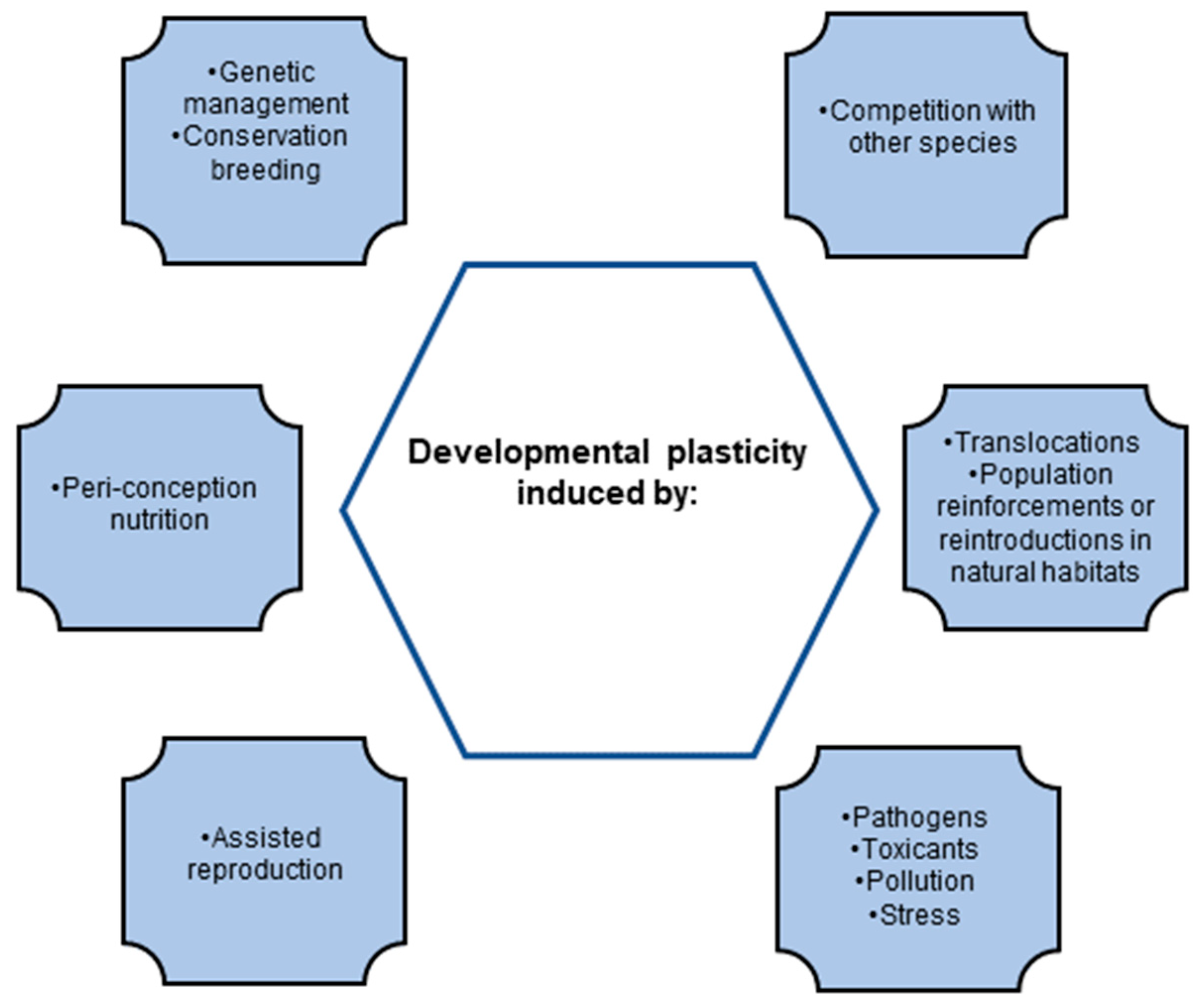
The objective of this review is to ask whether, and how, principles in conservation biology may need to be revisited in light of new knowledge about the power of epigenetics to alter developmental pathways. Importantly, conservation breeding programmes, used widely by zoological parks and aquariums, may appear in some cases to reduce fitness by decreasing animals’ abilities to cope when confronted with the ‘wild side’ of their natural habitats. Would less comfortable captive conditions lead to the selection of individuals that, despite being adapted to life in a captive environment, be better able to thrive if relocated to a more natural environment? While threatened populations may benefit from advanced reproductive technologies, these may actually induce undesirable epigenetic changes. Thus, there may be inherent risks to the health and welfare of offspring (as is suspected in humans). Advanced breeding technologies, especially those that aim to regenerate the rarest species using stem cell reprogramming and artificial gametes, may also lead to unwanted epigenetic modifications. Current knowledge is still incomplete, and therefore ethical decisions about novel breeding methods remain controversial and difficult to resolve.
Keywords: animal conservation; reproduction; conservation breeding; epigenetics; developmental plasticity; assisted reproductive technologies animal conservation; reproduction; conservation breeding; epigenetics; developmental plasticity; assisted reproductive technologies