
Data on Dissociative Electron Attachment Accommodated in the Structure of Belgrade Collisional Database ACol
 ,
,  , , ,
, , ,  , and
, and 
Abstract
1. Introduction
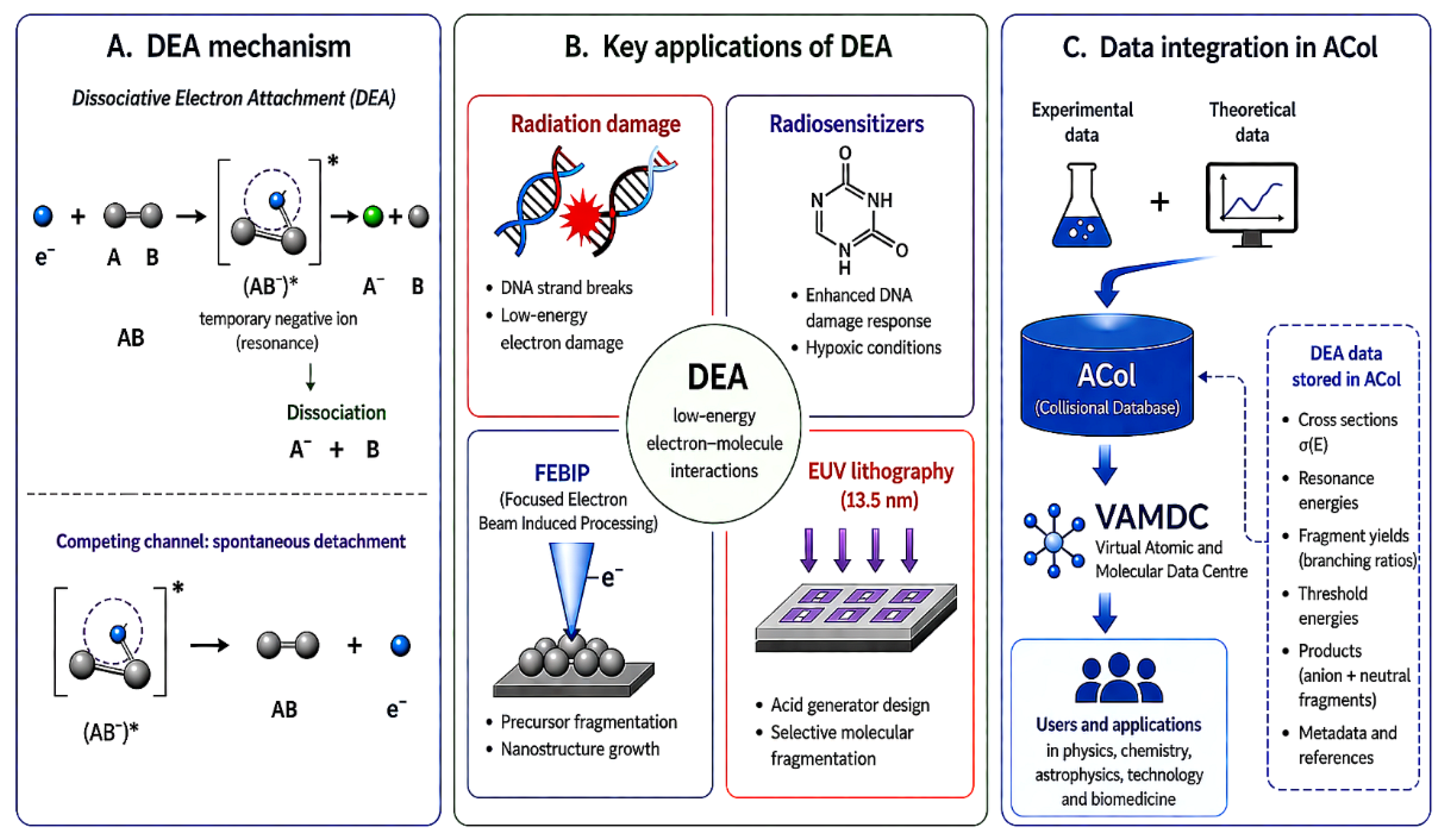
2. Methods Used to Describe DEA Process in ACol Database
2.1. DEA to the Volatile Halogenated Anesthetics
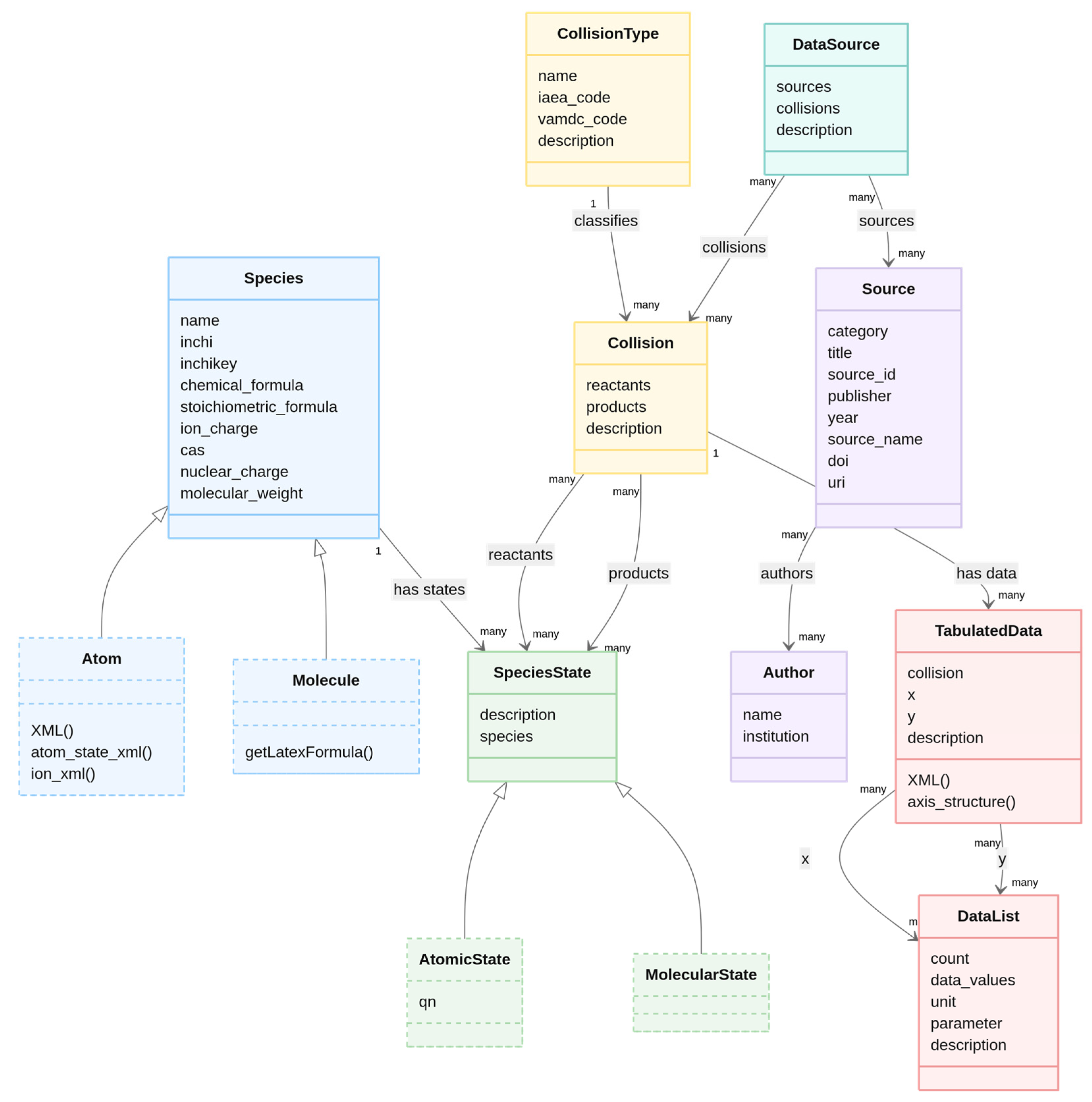
2.2. Modifications of ACol Data Model and Schema Generation
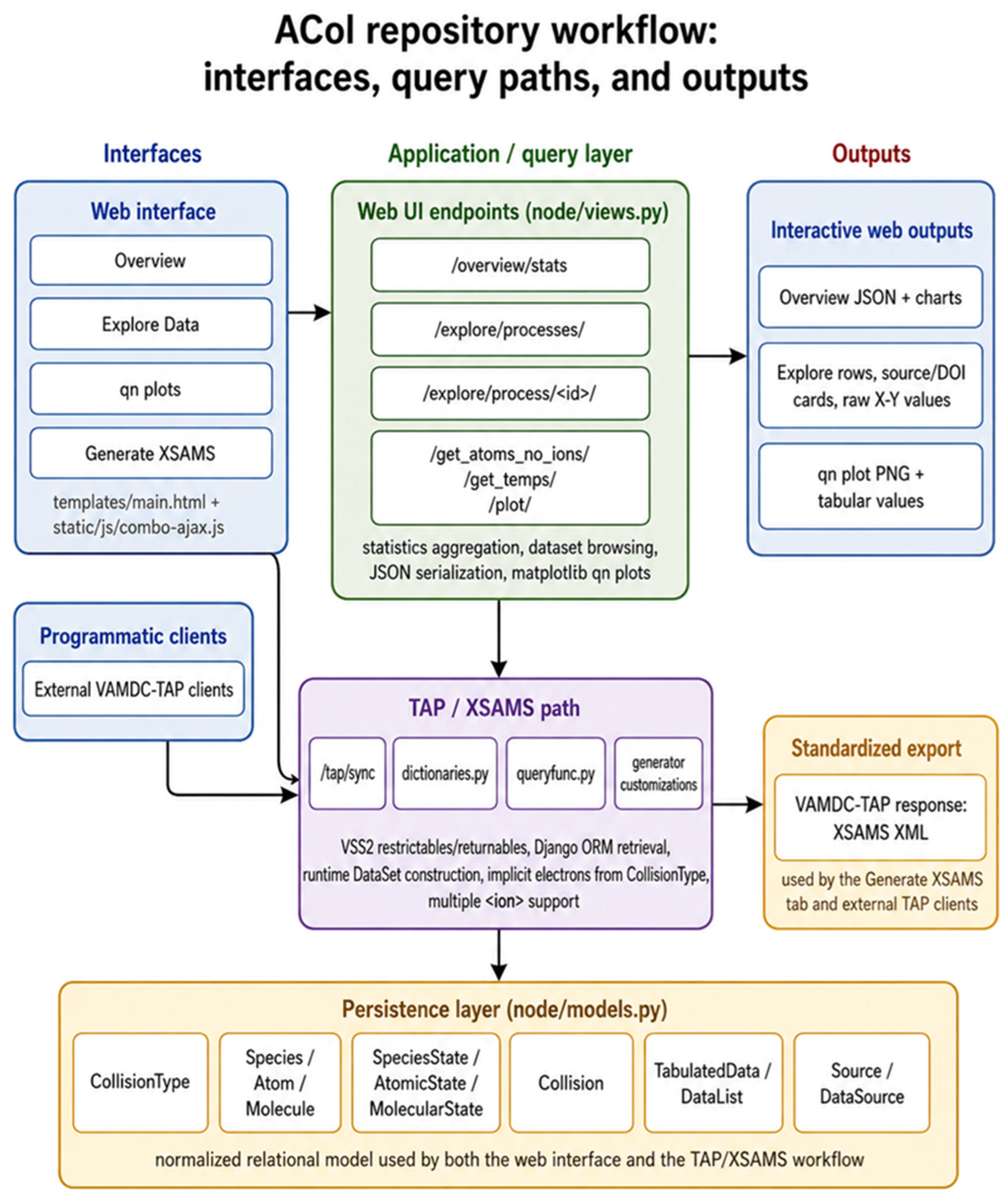
2.3. Database Access, Curation, and Data Quality
3. Results
3.1. Data on DEA to Isoflurane Molecule
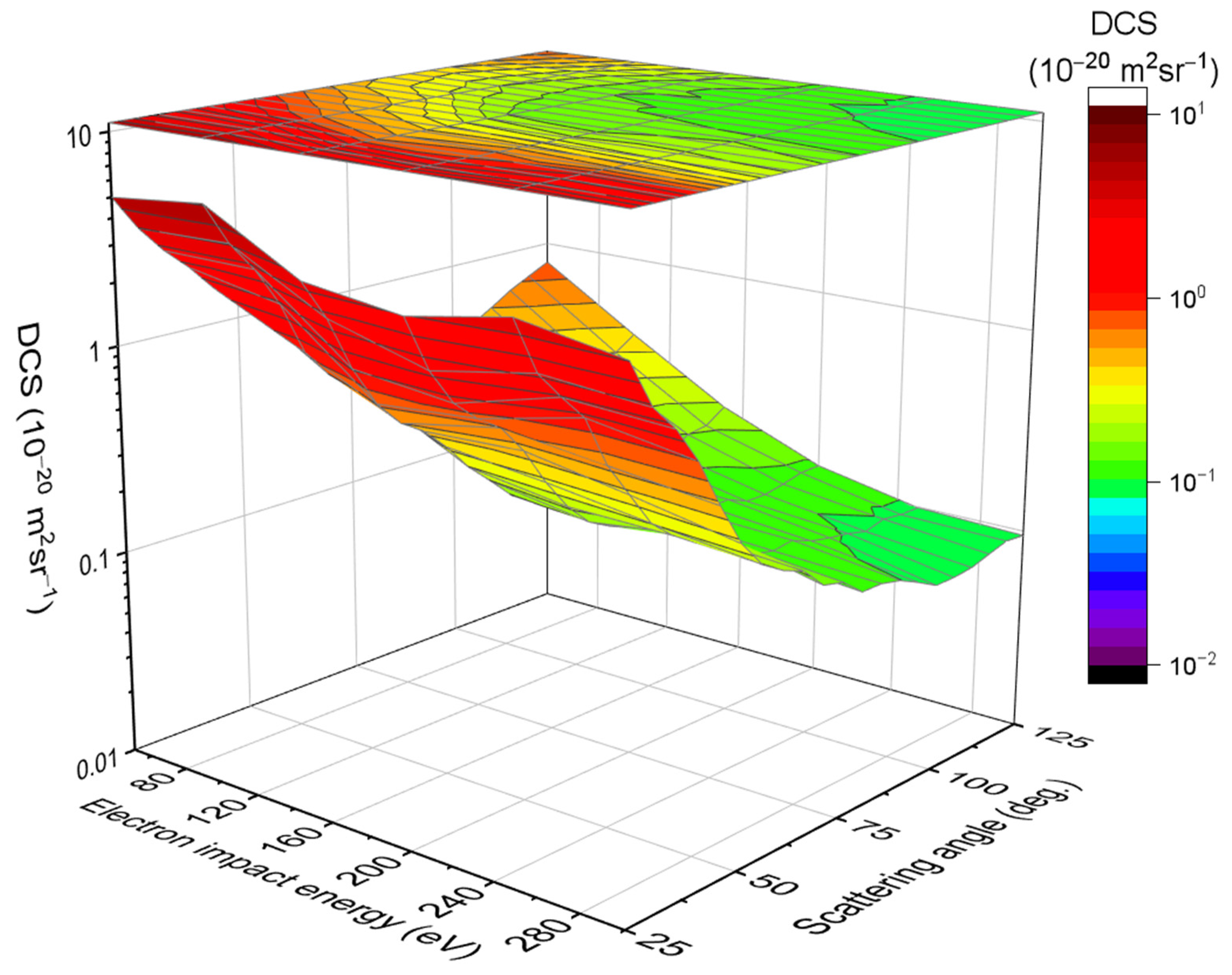
3.2. Data on Elastic Scattering by Isoflurane Molecule
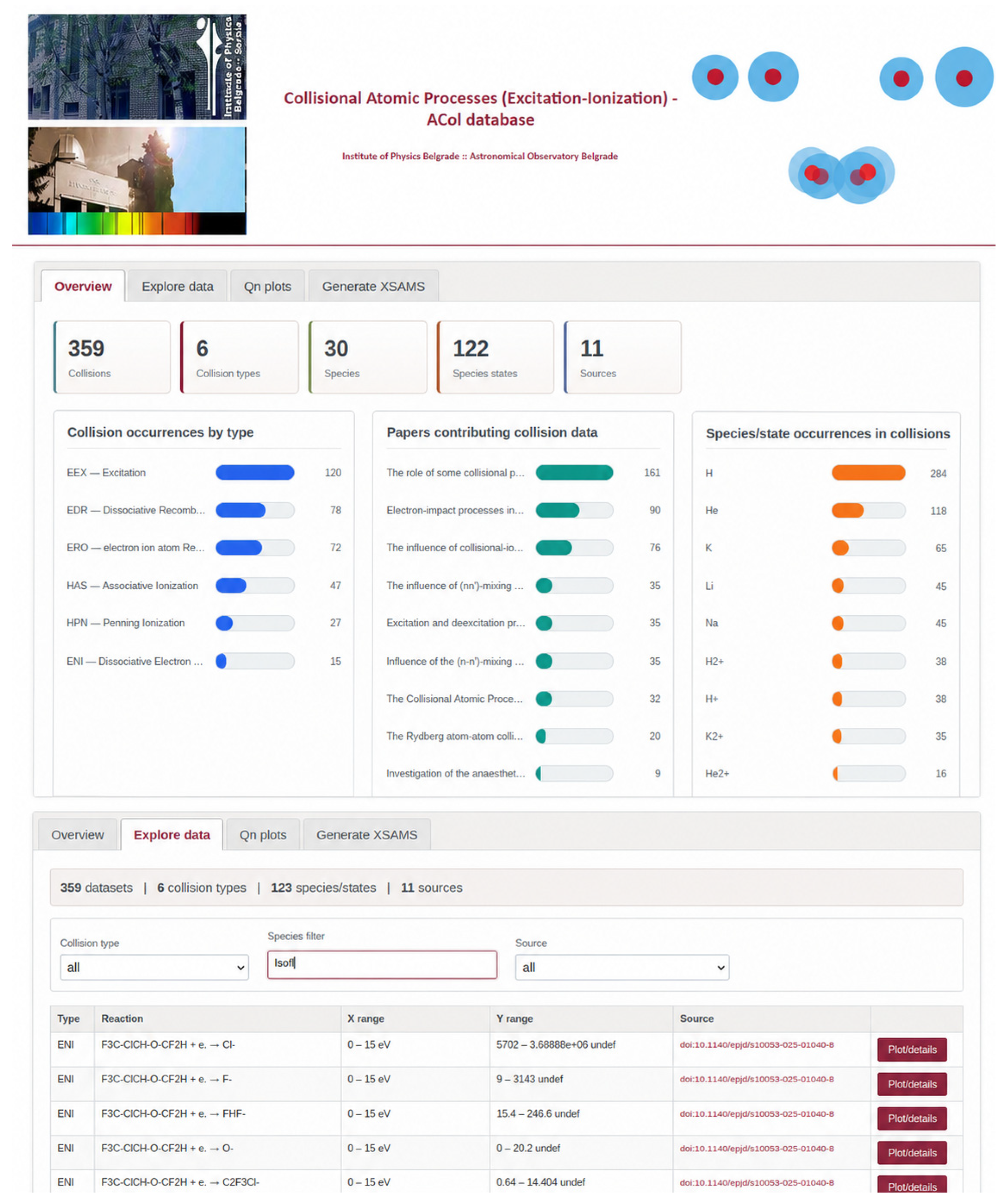
3.3. Representation in ACol Database
4. Conclusions and Future Directions
Author Contributions
Funding
Data Availability Statement
Acknowledgments
Conflicts of Interest
Abbreviations
| ACol | Belgrade Collisional database |
| DEA | Dissociative Electron Attachment |
| XSAMS | XML Schema for Atoms, Molecules, and Solids |
| VAMDC | Virtual Atomic and Molecular Data Centre |
| TNI | Temporary Negative Ion |
| RADAM | Radiation Damage |
| FEBIP | Focused Electron Beam Induced Processing |
| IDEADB | Innsbruck Dissociative Electron Attachment Database |
| GWP | Global Warming Potential |
| InChI | The IUPAC International Chemical Identifier |
| InChIKey | A hashed version of the full InChI |
| IAEA | International Atomic Energy Agency |
| DCS | Differential Cross-Section |
| IAM-SCAR + I | Independent Atom Model and the Screening Corrected Additivity Rule with incorporated Interference effects |
| LXCat | ELECtron (and ion) SCATtering |
Appendix A
| Listing A1. Simplified XSAMS representation of multiple ionic stages within a single atomic structure. |
|
<Atom> <ChemicalElement> <ElementSymbol>He</ElementSymbol> </ChemicalElement> <Isotope> <Ion speciesID=“...”> <IonCharge>0</IonCharge> </Ion> <Ion speciesID=“...”> <IonCharge>1</IonCharge> </Ion> </Isotope> </Atom> |
| 1 | http://servo.aob.rs/acol, accessed on 12 May 2026. |
| 2 | https://github.com/VAMDC/NodeSoftware, the release 12.07, accessed on 12 May 2026. |
References
- Dubernet, M.L.; Antony, B.K.; Ba, Y.A.; Babikov, Y.L.; Bartschat, K.; Boudon, V.; Braams, B.J.; Chung, H.-K.; Daniel, F.; Delahaye, F.; et al. The virtual atomic and molecular data centre (VAMDC) consortium. J. Phys. B 2016, 49, 074003. [Google Scholar] [CrossRef]
- Albert, D.; Antony, B.K.; Ba, Y.A.; Babikov, Y.L.; Bollard, P.; Boudon, V.; Delahaye, F.; Del Zanna, G.; Dimitrijević, M.S.; Drouin, B.J.; et al. A Decade with VAMDC: Results and Ambitions. Atoms 2020, 8, 76. [Google Scholar] [CrossRef]
- Marinković, B.P.; Srećković, V.A.; Dujko, S.; Tošić, S.; Maljković, J.B.; Vujčić, V.; Mason, N.J. Collisional ionization data for research of interstellar medium and planetary atmospheres. Phys. Scr. 2025, 100, 072002. [Google Scholar] [CrossRef]
- Casey, M.J.E.; Stokes, P.W.; Cocks, D.G.; Bošnjaković, D.; Simonović, I.; Brunger, M.J.; Dujko, S.; Petrović, Z.L.; Robson, R.E.; White, R.D. Foundations and interpretations of the pulsed-Townsend experiment. Plasma Sources Sci. Technol. 2021, 30, 035017. [Google Scholar] [CrossRef]
- Srećković, V.A.; Marinković, B.P.; Ignjatović, L.M.; Vujčić, V. MolD, EMol and Acol atomic and molecular databases for astrophysics: Current stage and new directions of development. Contrib. Astron. Obs. Skaln. Pleso 2025, 55, 81–87. [Google Scholar] [CrossRef]
- May, O.; Kubala, D.; Allan, M. Dissociative electron attachment to Pt(PF3)4—A precursor for Focused Electron Beam Induced Processing (FEBIP). Phys. Chem. Chem. Phys. 2012, 14, 2979–2982. [Google Scholar] [CrossRef] [PubMed]
- Bald, I.; Langer, J.; Tegeder, P.; Ingólfsson, O. From isolated molecules through clusters and condensates to the building blocks of life. Int. J. Mass Spectrom. 2008, 277, 4–25. [Google Scholar] [CrossRef]
- Ameixa, J.; Fedor, J.; Bald, I.; Mason, N.; Ptasinska, S. Exploring dissociative electron attachment: Insights from the 4th DEA Club Meeting. Eur. Phys. J. D 2026, 80, 37. [Google Scholar] [CrossRef]
- Janina Kopyra, J.; Śmiałek-Telega, M. (Eds.) 5th DEA Club Meeting 2026, 13–15 April 2026, Sopot, Poland: Book of Abstracts; Gdansk Tech: Gdansk, Poland, 2026; Available online: https://cdn.files.pg.edu.pl/wimio/DEA%20CLUB%202026/DEA%202026%20BOOK%20OF%20ABSTRACTS.pdf (accessed on 12 May 2026).
- Boudaiffa, B.; Cloutier, P.; Hunting, D.; Huels, M.A.; Sanche, L. Resonant formation of DNA strand breaks by extremely low energy (3–20 eV) electrons. Science 2000, 287, 1658–1660. [Google Scholar] [CrossRef] [PubMed]
- Ameixa, J.; Bald, I. Unraveling the Complexity of DNA Radiation Damage Using DNA Nanotechnology. Acc. Chem. Res. 2024, 57, 1608–1619. [Google Scholar] [CrossRef] [PubMed]
- Sedmidubská, B.; Kočišek, J. Interaction of low-energy electrons with radiosensitizers. Phys. Chem. Chem. Phys. 2024, 26, 9112–9136. [Google Scholar] [CrossRef] [PubMed]
- Datta, M.; Szczyrba, A.; Zdrowowicz, M.; Wyrzykowski, D.; Ciupak, O.; Demkowicz, S.; Izadi, F.; Denifl, S.; Rak, J. Surprising Radiolytic Stability of 8-Thiomethyladenine in an Aqueous Solution. J. Phys. Chem. B 2024, 128, 3621–3630. [Google Scholar] [CrossRef] [PubMed]
- Kocábková, B.; Ďurana, J.; Rakovský, J.; Poterya, V.; Fárník, M.; Gatt, M.; Schöpfer, G.; Jung, P.; Ončák, M. Electron attachment to CH3COCl molecule and clusters. RSC Adv. 2025, 15, 23983–23993. [Google Scholar] [CrossRef] [PubMed]
- Kopyra, J.; Wierzbicka, P.; Abdoul-Carime, H. Electron-Induced Fragmentation of 5-Iodouridine: Implications for Enhanced Radiotherapy. J. Phys. Chem. Lett. 2025, 16, 10536–10541. [Google Scholar] [CrossRef] [PubMed]
- Das, S.; Lyshchuk, H.; Chaudhary, A.; Saha, S.; Kočišek, J.; McElwee-White, L.; Fedor, J.; Nag, P. Electron-induced dissociation of iron tetracarbonyl acrolein. J. Phys. B 2026, 59, 035201. [Google Scholar] [CrossRef]
- Mendes, M.; Tafrishi, R.; Guerra, P.; Holzmeier, F.; Ingólfsson, O.; da Silva, F.F. Pathways to high-performance extreme ultra-violet lithography resists: Dissociative electron attachment to pentafluoro-phenyl triflate. iScience 2025, 28, 114020. [Google Scholar] [CrossRef] [PubMed]
- IDEADB—Innsbruck Dissociative Electron Attachment Database. re3data.org: IDEADB; Editing Status 22-03-2023; re3data.org—Registry of Research Data Repositories. Available online: https://doi.org/10.17616/R3F34C (accessed on 27 April 2026).
- Pitchford, L.C.; Alves, L.L.; Bartschat, K.; Biagi, S.F.; Bordage, M.-C.; Bray, I.; Brion, C.E.; Brunger, M.J.; Campbell, L.; Chachereau, A.; et al. LXCat: An Open-Access, Web-Based Platform for Data Needed for Modeling Low Temperature Plasmas. Plasma Process. Polym. 2017, 14, 1600098. [Google Scholar] [CrossRef]
- Carbone, E.; Graef, W.; Hagelaar, G.; Boer, D.; Hopkins, M.M.; Stephens, J.C.; Yee, B.T.; Pancheshnyi, S.; van Dijk, J.; Pitchford, L. Data Needs for Modeling Low-Temperature Non-Equilibrium Plasmas: The LXCat Project, History, Perspectives and a Tutorial. Atoms 2021, 9, 16. [Google Scholar] [CrossRef]
- Van Dijk, J.; Boer, D. LXCat 3 and beyond—Fostering reproducibility in low-temperature plasma science. Publ. Astron. Obs. Belgrade 2024, 103, 100. [Google Scholar] [CrossRef]
- Hoshino, M.; Limão-Vieira, P.; Probst, M.; Nunes, Y.; Tanaka, H. Dissociative electron attachment to carbonyl fluoride, F2CO. Int. J. Mass Spectrom. 2011, 303, 125–128. [Google Scholar] [CrossRef]
- Matias, C.; Mauracher, A.; Huber, S.E.; Denifl, S.; Limão-Vieira, P.; Scheier, P.; Märk, T.D.; González-Méndez, R.; Mayhew, C.A. Dissociative electron attachment to the volatile anaesthetics enflurane and isoflurane and the chlorinated ethanes pentachloroethane and hexachloroethane. Int. J. Mass Spectrom. 2015, 379, 179–186. [Google Scholar] [CrossRef]
- Kopyra, J.; Marinković, B.P.; Maljković, J.B. Investigation of the anaesthetic isoflurane fragmentation induced by electron impact. Eur. Phys. J. D 2025, 79, 97. [Google Scholar] [CrossRef]
- Shiraishi, Y.; Ikeda, K. Uptake and biotransformation of sevoflurane in humans: A comparative study of sevoflurane with halothane, enflurane, and isoflurane. J. Clin. Anesth. 1990, 2, 381–386. [Google Scholar] [CrossRef] [PubMed]
- Espinosa, S.; Martínez, F.; Antiñolo, M.; Nielsen, O.J.; Jiménez, E. Updated global warming potentials of inhaled halogenated anesthetics, isoflurane and sevoflurane from new temperature dependent OH-kinetics. Environ. Sci. Process. Impacts 2025, 27, 2410–2421. [Google Scholar] [CrossRef] [PubMed]
- Lange, E.; da Silva, F.F.; Jones, N.C.; Hoffmann, S.V.; Duflot, D.C.; Limão-Vieira, P. The lowest-lying electronic states of isoflurane and sevoflurane in the 5.0–10.8 eV energy range investigated by experimental and theoretical methods. Chem. Phys. Lett. 2019, 716, 42–48. [Google Scholar] [CrossRef]
- Sulbaek Andersen, M.P.; Nielsen, O.J.; Karpichev, B.; Wallington, T.J.; Sander, S.P. Atmospheric chemistry of isoflurane, desflurane, and sevoflurane: Kinetics and mechanisms of reactions with chlorine atoms and OH radicals and global warming potentials. J. Phys. Chem. A 2012, 116, 5806–5820. [Google Scholar] [CrossRef] [PubMed]
- Humbert, D.; Braams, B. XSAMS: XML Schema for Atomic and Molecular Data and Particle Solid Interactions. In Summary Report of an IAEA Consultants’ Meeting, Vienna, Austria, 10–11 September 2009; NDC(NDS)-0562; International Atomic Energy Agency (IAEA): Vienna, Austria, 2010. [Google Scholar] [CrossRef]
- Regandell, S.; Marquart, T.; Piskunov, N. Inside a VAMDC data node—Putting standards into practical software. Phys. Scr. 2018, 93, 035001. [Google Scholar] [CrossRef]
- Vukalović, J.; Marinković, B.P.; Rosado, J.; Blanco, F.; García, G.; Maljković, J.B. Investigating Theoretical and Experimental Cross Sections for Elastic Electron Scattering from Isoflurane. Phys. Chem. Chem. Phys. 2024, 26, 985–991. [Google Scholar] [CrossRef] [PubMed]
- Vujčić, V.; Srećković, V.; Marinković, B. sambolino/acol, version 2.0.0; ACol: DEA Support, Data Model and Interface Redesign; Zenodo: Geneva, Switzerland, 2026. [CrossRef]
- Silva, T.; Lobo, V.S.; Pereira-da-Silva, J.; Ferreira da Silva, F. Dissociative Electron Attachment Prediction of Halogenated Organic Molecules Using Machine Learning. ACS Omega 2026, 11, 22082–22092. [Google Scholar] [CrossRef] [PubMed]
- Stokes, P.W.; White, R.D.; Campbell, L.; Brunger, M.J. Toward a complete and comprehensive cross section database for electron scattering from NO using machine learning. J. Chem. Phys. 2021, 155, 084305. [Google Scholar] [CrossRef] [PubMed]



| Kopyra et al. [24] (eV) | Matias et al. [23] (eV) | Anion | m/z |
|---|---|---|---|
| 6.2 & >9 | 3.3 & 7.1 & 9.3 | F− | 19 |
| 0.1 | 0.6 & 3.3 & 9.2 & 12.6 | Cl− | 35 |
| 0.7 & 2.7 | 3.0 & 6.9 & 9.5 | HF2− | 39 |
| 0.7 & 2.6 | 3.0 & 9.3 & 13.1 | CFO− | 47 |
| 1.9 | 2.9 & 9.2 | CHF2O− | 67 |
| 0.6 & 2.6 | 3.1 | C2F3Cl− | 116 |
Disclaimer/Publisher’s Note: The statements, opinions and data contained in all publications are solely those of the individual author(s) and contributor(s) and not of MDPI and/or the editor(s). MDPI and/or the editor(s) disclaim responsibility for any injury to people or property resulting from any ideas, methods, instructions or products referred to in the content. |
© 2026 by the authors. Licensee MDPI, Basel, Switzerland. This article is an open access article distributed under the terms and conditions of the Creative Commons Attribution (CC BY) license.
Share and Cite
Vujčić, V.; Marinković, B.P.; Kopyra, J.; Maljković, J.B.; Srećković, V.A.; Tošić, S.; Aničić, N.; Mason, N.J. Data on Dissociative Electron Attachment Accommodated in the Structure of Belgrade Collisional Database ACol. Atoms 2026, 14, 52. https://doi.org/10.3390/atoms14070052
Vujčić V, Marinković BP, Kopyra J, Maljković JB, Srećković VA, Tošić S, Aničić N, Mason NJ. Data on Dissociative Electron Attachment Accommodated in the Structure of Belgrade Collisional Database ACol. Atoms. 2026; 14(7):52. https://doi.org/10.3390/atoms14070052
Chicago/Turabian StyleVujčić, Veljko, Bratislav P. Marinković, Janina Kopyra, Jelena B. Maljković, Vladimir A. Srećković, Sanja Tošić, Nenad Aničić, and Nigel J. Mason. 2026. "Data on Dissociative Electron Attachment Accommodated in the Structure of Belgrade Collisional Database ACol" Atoms 14, no. 7: 52. https://doi.org/10.3390/atoms14070052
APA StyleVujčić, V., Marinković, B. P., Kopyra, J., Maljković, J. B., Srećković, V. A., Tošić, S., Aničić, N., & Mason, N. J. (2026). Data on Dissociative Electron Attachment Accommodated in the Structure of Belgrade Collisional Database ACol. Atoms, 14(7), 52. https://doi.org/10.3390/atoms14070052