Article

Ionization in C6++He Collisions: Singly Differential Cross-Sections

1
Department of Applied Mathematics, Tashkent State University of Economics, Tashkent 100066, Uzbekistan
2
Department of Physics and Astronomy, Curtin University, GPO Box U1987, Perth, WA 6845, Australia
*
Author to whom correspondence should be addressed.
Atoms 2026, 14(4), 31; https://doi.org/10.3390/atoms14040031
Submission received: 9 February 2026 / Revised: 18 March 2026 / Accepted: 7 April 2026 / Published: 9 April 2026
(This article belongs to the Special Issue Electronic Dynamics in Atomic and Molecular Collisions)

Abstract

Differential ionization in C 6 + + He collisions is investigated using the single- and two-center wave-packet convergent close-coupling (WP-CCC) method for projectile energies of 1–6 MeV/u. We present three types of singly differential cross-sections (SDCSs) as functions of the ejection angle, ejection energy, and projectile scattering angle. The two-center framework incorporates couplings across all channels as well as electron correlations. Overall, both the single- and two-center WP-CCC results agree well with existing experimental and theoretical data (apart from the first Born ones) for the SDCS as a function of electron energy and the SDCS as a function of ejection angle, laying a foundation for investigation of doubly and fully differential ionization cross-sections. The cross-sections differential in the projectile scattering angle are presented for the first time.

1. Introduction

Ion–atom scattering processes involving heavy particles, such as bare carbon ions, have been one of the most intensively studied topics in atomic physics. These collisions are of particular importance and have wide-ranging applications in fields such as astrophysics [1,2], plasma physics [3], and medical therapies [4,5].
Explaining experimental results for single ionization of helium by high-energy C 6 + ion impact remains a long-standing challenge in atomic collision physics. While measurements of the fully differential cross-section (FDCS), especially in planes outside the scattering plane, show clear and well-structured features [6], most theoretical models fail to reproduce them, particularly in the perpendicular plane, where predictions are often qualitatively incorrect. Classical trajectory Monte Carlo models [7,8,9]; standard perturbative approaches, such as the continuum-distorted-wave method [10,11]; distorted-wave Born approximation [12,13,14,15]; and theoretical models based on first-order, semiclassical, impact parameter approximation [16,17] perform well in some geometries. Even more advanced models that include higher-order, relativistic, or post-collisional effects offer only minor improvements. Attempts to reconcile theory with experiment by accounting for experimental uncertainties and beam coherence properties have proven insufficient [18,19,20]. More sophisticated nonperturbative methods have achieved partial success but still underestimate the magnitude of the observed effects [21,22,23,24,25,26]. Overall, no existing theoretical framework fully explains the experimental data, leaving the discrepancy unresolved. This motivates further investigation.
A number of theoretical approaches, mostly based on the continuum-distorted-wave (CDW) formalism, have been used to investigate singly differential cross-sections (SDCSs) for ionization in 1–6 MeV/u C 6 + + He collisions. Fainstein [27] used the continuum-distorted-wave–eikonal-initial-state (CDW-EIS) method to describe single-electron ionization of He by 5 MeV/u bare carbon ions. In their approach, the four-body scattering problem was reduced to a one-active-electron model. Their SDCS results, presented for ejected electron energies up to 3000 eV, showed good agreement with the experimental data of Platten [28].
The CDW-EIS method was also employed by Tribedi [29] to investigate 2.5 MeV/u C 6 + + He collisions using two different descriptions of the initial and final channels: H-like (H) orbitals and Hartree–Fock–Slater (HFS) wave functions. In both approaches, the independent-electron approximation was applied, and the role of electron–electron interaction was neglected. Additionally, they presented theoretical results based on the first Born approximation (B1). It was concluded that for singly differential ejected electron energy and angular distributions, both CDW-EIS (H) and CDW-EIS (HFS) describe the experimental data well, whereas the B1 approximation is less appropriate for characterizing two-center electron-emission processes, even at relatively high impact energies. Following this, Tribedi [30] studied differential ionization of He by 1 MeV/u bare carbon ions using the B1, CDW, and CDW-EIS approximations. The CDW and CDW-EIS results for the SDCS as a function of ejected electron angle, being in good agreement with the experiment, showed a maximum in the forward angle and a steady decline up to 60 , followed by a sharp fall. Meanwhile, the B1 calculations exhibit a completely different distribution, predicting a peak around 80 , with the cross-section being nearly symmetric about this maximum.
Angular differential cross-sections for 2.5 MeV/u C 6 + + He collisions were also studied by Gagyi-Pálffy [31] using a one-center atomic-orbital close-coupling method. In this approach, the target was represented by a basis of bound states constructed from Slater-type orbitals and continuum wave-packets obtained by discretizing regular Coulomb wave functions. Overall, their results showed good agreement with available experimental data and other theoretical calculations.
Biswas [32] presented both experimental results and CDW-EIS calculations for ionization of helium by 6 MeV/u C 6 + ions. They performed calculations using the prior and post forms of their model. Fairly good agreement was found between both forms of the CDW-EIS method and the measurements for the absolute SDCS as a function of electron ejection angle and energy. The state of the art of ion–atom collisions has recently been reviewed in Refs. [33,34,35].
In this paper, we apply the WP-CCC method to investigate differential ionization in C 6 + + He collisions. In our previous works, the method was successfully applied to study integrated and various differential cross-sections for the p + He [36,37] collision system. In Ref. [36], we studied total cross-sections for all one-electron processes in 15 keV–1 MeV p + He collisions. The WP-CCC results agreed very well with previous experimental and theoretical data. Following the investigations of the singly and doubly differential cross-sections for ionization, in the recent work of Ref. [37], fully differential cross-sections were reported for 75 keV/u p + He collisions.
The WP-CCC approach was extended to collisions of multiply charged ions with He, starting with the symmetric He 2 + + He system. In Ref. [38], total cross-sections were investigated for all underlying processes for the projectile energies between 10 keV/u and 5 MeV/u, with particular attention paid to the intermediate-energy regime. Our calculations again agreed well with existing experiments and theoretical methods. In Ref. [39], we presented the first comprehensive calculations of SDCSs for all one-electron processes in 100 and 250 keV/u 3He2++He collisions, using both an effective one-electron (E1E) approach and a more advanced two-electron one. Recently, doubly differential cross-sections were presented for 100 and 250 keV/u 3He2++He collisions in Ref. [40], where the results were generally in good agreement with existing experiments and theoretical calculations.
Here, we use the single-center and comprehensive two-center methods within the WP-CCC formalism to calculate singly differential cross-sections for C 6 + + He collisions. The cross-sections are presented as functions of ejected electron energy and angle, and scattered projectile angle, at four impact energies. The two-center approach fully accounts for interactions between all channels and correlations among the electrons. In Ref. [41], we presented integrated cross-sections for ionization and for total and state-selective electron capture for this collision system at projectile energies ranging from 2 keV/u to 3 MeV/u. At all impact energies, reasonably good agreement with available experimental data was obtained.
Throughout this manuscript, atomic units (a.u.) are used unless stated otherwise.

2. Two-Center Wave-Packet Convergent Close-Coupling Approach

The two-center WP-CCC method has been described in detail elsewhere [36]. For completeness, we provide only a brief overview of the theory here and describe how it is applied to the problem of differential ionization for the following process:
C 6 + + He ( 1 s 2 ) C 6 + + He + ( 1 s ) + e .
As the two-center method is a generalization of the single-center approach, we focus on the two-center WP-CCC method. We use the following trial two-center scattering wave function in terms of N target-centered and M projectile-centered pseudostates
Ψ α = 1 N F α ( σ ) ψ α T ( r 1 , r 2 ) e i k α · σ + 1 2 β = 1 M [ G β ( ρ 1 ) ψ β P ( x 1 ) ψ 0 ( r 2 ) e i k 1 β · ρ 1 + G β ( ρ 2 ) ψ β P ( x 2 ) ψ 0 ( r 1 ) e i k 2 β · ρ 2 ] ,
where ψ α T is a helium pseudostate in the α target channel, ψ β P is a C 5 + pseudostate in the β channel of the C 5 + + He + system, and ψ 0 is the wave function of the He + ion in the 1 s state. For the definitions of the Jacobi coordinates used in the expansion, refer to Refs. [38,40]. The coefficients F α and G β represent the probability amplitudes for transitions into the corresponding states.
The target pseudostates are obtained by solving the Schrödinger equation for the helium atom within the frozen-core approximation, where we use the following ansatz for the spatial part of the singlet He wave function:
ψ α T ( r 1 , r 2 ) = ψ α ( r 1 ) ψ 0 ( r 2 ) + ψ α ( r 2 ) ψ 0 ( r 1 ) .
Substituting this expression into the two-electron Schrödinger equation and projecting onto the He + ground state, we obtain a differential equation for the active-electron functions ψ α , which we solve numerically using Numerov’s method. The negative-energy eigenstates of the C 5 + ion are given analytically.
The continuum wave-packet pseudostates for each center are constructed independently by discretizing the respective continuum into a finite number of bins in the ejected-electron momentum space and integrating the true continuum wave function over the corresponding momentum bin.
To solve the full four-body scattering Schrödinger equation, we apply the Petrov–Galerkin method. This involves ensuring that the residual of the full Schrödinger equation, ( H E ) Ψ = 0 , is orthogonal (in the electronic coordinates) to the set of functions
ψ α T ( r 1 , r 2 ) e i k α · σ , ψ β P ( x 1 ) ψ 0 ( r 2 ) e i k 1 β · ρ 1 + ψ β P ( x 2 ) ψ 0 ( r 1 ) e i k 2 β · ρ 2 ,
where α = 1 , 2 , , N , β = 1 , 2 , , M , and H and E are the full Hamiltonian and total energy of the system, respectively. We also apply the semiclassical approximation, where the projectile motion is treated classically and the electron dynamics are described quantum mechanically. This approximation leads to a temporal parameterization of the expansion coefficients, allowing us to write F α ( σ ) F α ( t , b ) and G β ( ρ 1 ) G β ( ρ 2 ) G β ( t , b ) , where the vector b (the impact parameter) is set perpendicular to the initial projectile velocity vector, v P .
Applying the orthogonality condition of the target pseudostates, we arrive at the system of differential equations of the first order with respect to the coefficients F α and G β :
i F ˙ α + i β = 1 M G ˙ β K α β T = α = 1 N F α D α α T + β = 1 M G β Q α β T , i α = 1 N F ˙ α K β α P + i β = 1 M G ˙ β L β β P = α = 1 N F α Q β α P + β = 1 M G β D β β P , α = 1 , 2 , , N , β = 1 , 2 , , M .
Dots over the expansion coefficients in Equation (5) denote differentiation with respect to time t. Details of how we describe the various types of matrix elements ( K α β T , D α α T , Q α β T , K β α P , L β β P , Q β α P , and D β β P ) are given in Ref. [36]. Coupling between all states of both centers is fully accounted for through the set of Equation (5).
In the single-center approach, the second sum in the expansion (2) is neglected, leading to
i F ˙ α = α = 1 N F α D α α T
Therefore, this approach is proven to be significantly cost-effective. Here, we employ the single-center method in addition to a more comprehensive two-center approach to understand the importance of including the second center in ionization dynamics.
The coupled-channel equations are solved independently for each impact parameter b , with the condition
F α ( , b ) = δ α , i , α = 1 , , N , G β ( , b ) = 0 , β = 1 , , M ,
where the index i corresponds to the initial state of the helium atom.
In the limit t + , the solutions of the coupled differential Equation (5), F α ( t , b ) and G β ( t , b ) , yield the probability amplitudes for transitions into the corresponding states. In particular, F α ( + , b ) and G β ( + , b ) represent the direct-scattering and electron-capture transition amplitudes, respectively, in the impact-parameter representation.
In momentum space, we can express the transition amplitudes for direct scattering ( T f i DS ) and for electron capture ( T f i EC ) as follows
T f i DS ( q f , q i ) = 2 π i v P e i m ϕ f 0 d b b [ F ˜ f ( b ) δ f i ] J m ( q b ) , T f i EC ( q f , q i ) = 2 π i v P e i m ϕ f 0 d b b G ˜ f ( b ) J m ( q b ) .
Here, q i is the ground-state momentum of the helium atom, whereas q f is set equal to k α for direct scattering, and to k β for electron capture. m and ϕ f represent the magnetic quantum number of the final states and the azimuthal angle of q f , respectively. q is the length of the perpendicular component of the vector q = q f q i . Additionally, J m denotes the Bessel function of order m, and F ˜ f ( b ) = e i m ϕ b F f ( + , b ) and G ˜ f ( b ) = e i m ϕ b G f ( + , b ) , where ϕ b is the azimuthal angle of the vector b . Further details can be found in Ref. [42]. The amplitudes in Equation (8) are for transitions into one of the target or projectile pseudostates included in the close-coupling expansion. As shown in Ref. [43], they can subsequently be used to obtain the amplitudes for direct ionization (DI),
T f i DI ( κ , q f , q i ) = m φ κ T | ψ f T T f i DS ( q f , q i ) ,
and electron capture into the continuum (ECC),
T f i ECC ( ϰ , q f , q i ) = m φ ϰ P | ψ f P T f i EC ( q f , q i ) .
Here, is the angular-momentum quantum number of the the final channel, f. In our case, the vector κ ( ϰ ) is the momentum of the ejected electron with respect to the residual target ion (projectile), and φ κ T ( φ ϰ P ) is the corresponding true continuum state of the He atom (the C 5 + ion).
To calculate the FDCS, the DI and ECC amplitudes are combined as follows:
d 3 σ ion d E e d Ω e d Ω f = μ 2 ( 2 π ) 5 q f κ k i | T f i DI ( κ , q f , q i ) | 2 + | T f i ECC ( κ v P , q f , q i ) | 2 ,
where μ is the reduced mass for the C 6 + + He channel, E e is the electron ejection energy, and Ω e = ( θ e , ϕ e ) and Ω f = ( θ f , ϕ f ) are the solid angles of the emitted electron and the scattered projectile, respectively. The three types of SDCS for ionization are then obtained by integrating the FDCS in Equation (11) over any two variables, leaving the SDCS differential only in the remaining variable.

3. Details of Calculations and Convergence Studies

Within the two-center WP-CCC approach, the sizes of the target and projectile bases, along with all other numerical parameters, were systematically increased until convergence was achieved. In the expansion shown in Equation (2), an equal number of the target- and projectile-centered pseudostates was used, i.e., we set N = M . For the SDCS to converge, the maximum principal quantum number n max of the bound states ranged from 18 to 12, decreasing with an increase in impact energy. The number of wave-packet bins varied from 28 to 32 depending on the impact energy. In the single-center approach, up to 50 evenly distributed wave-packet bins were used.
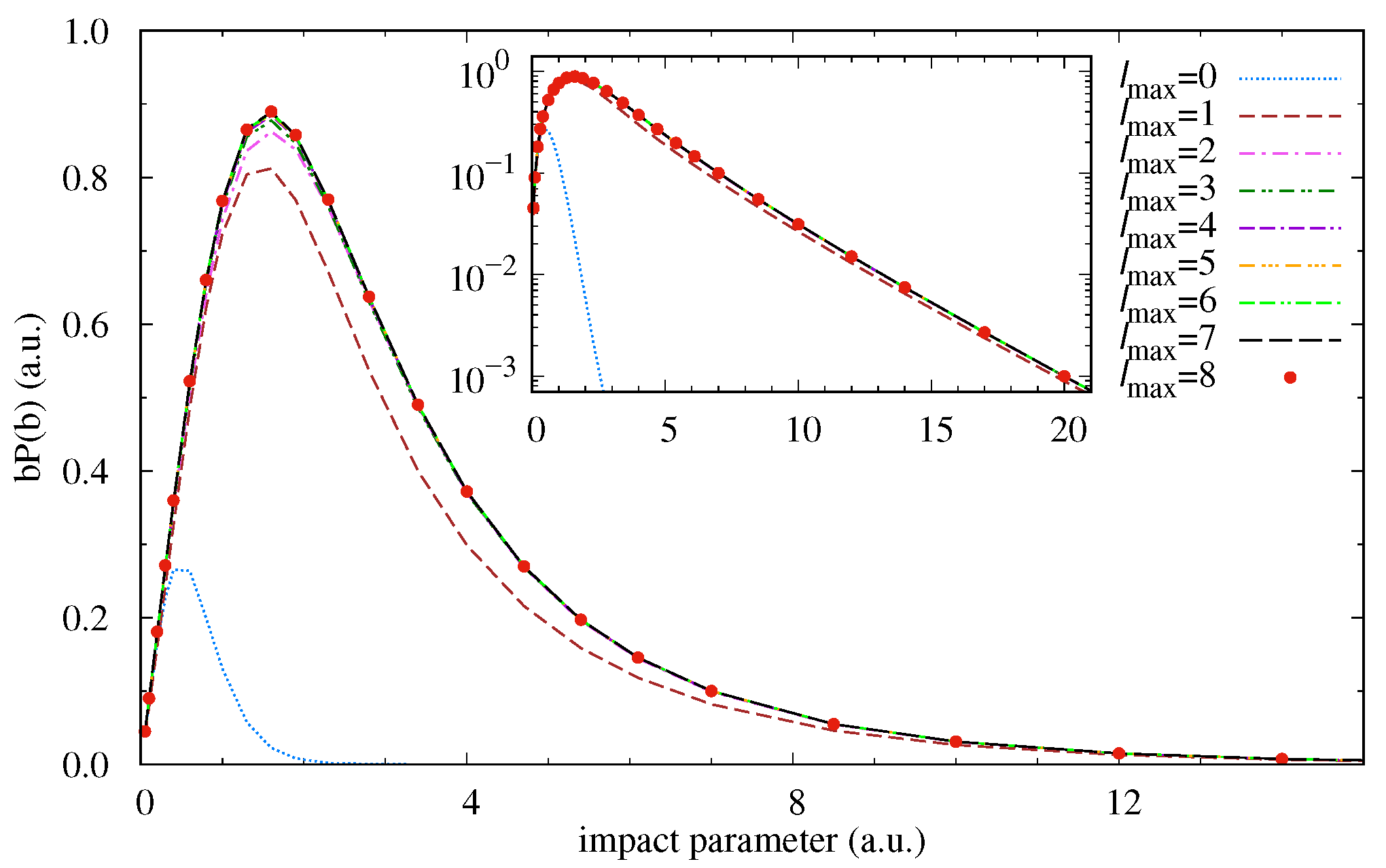
We illustrate convergence of the weighted ionization probability, b P ( b ) , which is used to generate three types of SDCS for single ionization in C 6 + + He collisions. Figure 1 shows the convergence pattern for the impact energy of 1 MeV/u, where max , the maximum orbital angular momentum of the included states, is increased from 0 to 8. A similar level of convergence is observed at all projectile energies considered. Figure 1 also shows that at larger values of max , the weighted probability reaches its maximum at about b = 1.5 a.u., followed by a rapid decline as b increases. It decreases by about three orders of magnitude by 20 a.u. for all four impact energies considered in the following section, with the fall being steeper at smaller collision energies. Both single- and two-center calculations were carried out for impact parameters up to 80 a.u., and further extending b max , the maximum of the impact parameters, did not produce any noticeable changes in the generated SDCS. Therefore, for the collision energies considered here, setting b max = 80 a.u. was adequate. We note that for 100-keV/u He 2 + + He collisions, it was found that even setting b max = 10 a.u. is sufficient due to steeper fall-off of the weighted probability [40]. Furthermore, max = 6 was sufficient.
We also checked convergence of the cross-section differential in the ejected-electron energy, ejection angle, and the projectile scattering angle with respect to max . Though not shown here, for the cross-section differential in the projectile scattering angle, convergence is achieved noticeably faster, where max = 4 already provides an excellent level of accuracy. Meanwhile, the other two forms of the singly differential cross-sections converge only with max = 8 , where the deviation between the max = 7 and max = 8 results is within 1%. In our approach, the differential cross-sections are obtained simultaneously through a unified set of probability amplitudes, rather than being evaluated independently. Therefore, orbital angular momenta up to max = 8 were included in all final calculations at every projectile energy considered. However, for the single-center calculations, even though convergence of the weighted ionization probability was achieved with relatively small max , for the SDCS to converge, it was required to increase max up to 15. Therefore, max = 15 is used in all single-center results.
The coupled-channel equations for each impact parameter were solved using the standard Runge–Kutta method along a grid of the projectile position along the z-axis. This grid ranged from z min = −200 a.u. to z max = 200 a.u., and consisted of 800 exponentially distributed z-points, with the highest density near the origin.

4. Singly Differential Cross-Sections for Ionization

4.1. SDCS as a Function of Ejection Energy

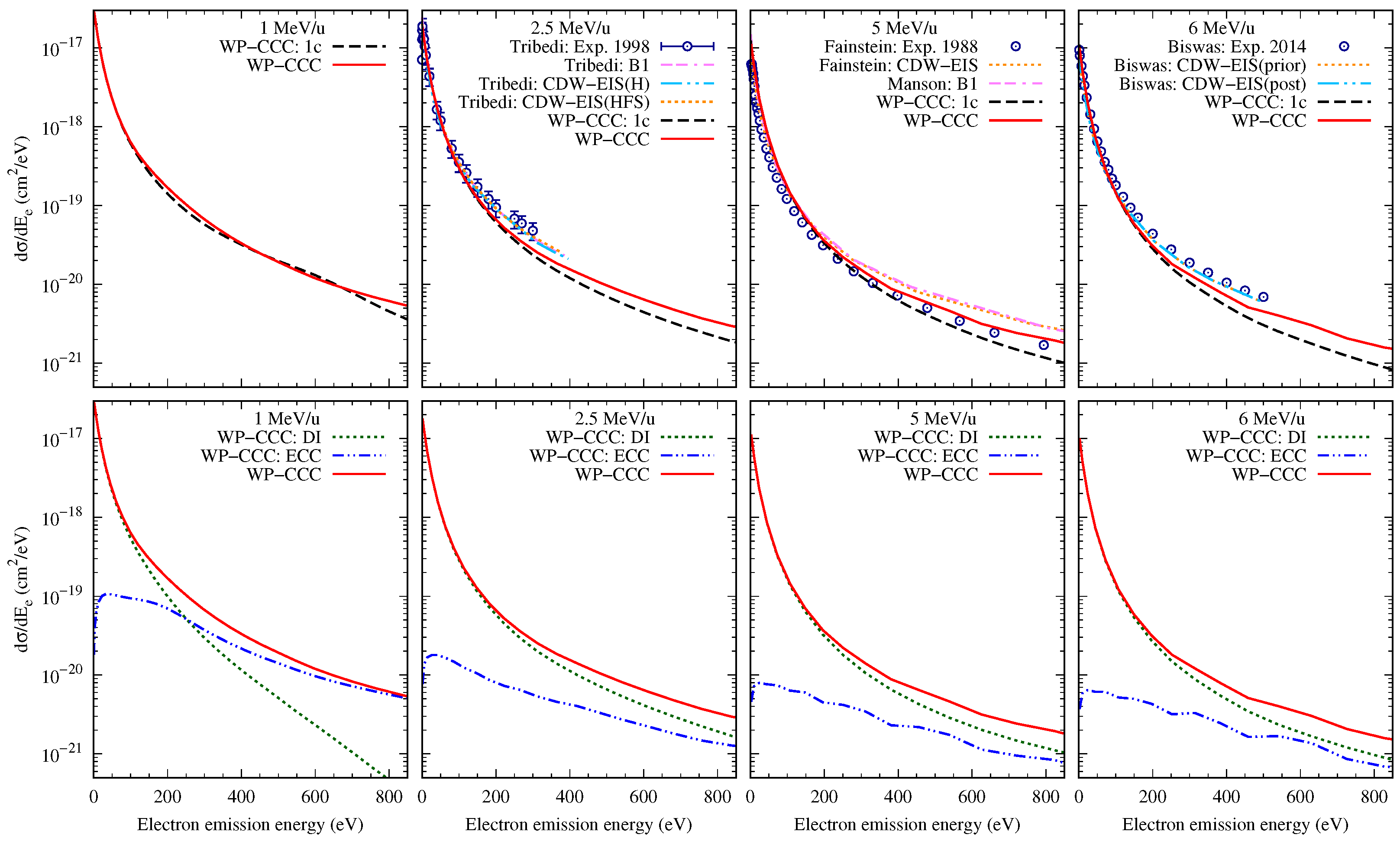
Here, we present the cross-section differential in the ejected-electron energy. In Figure 2, the results of the single- and two-center WP-CCC methods are compared with other theoretical calculations and available experimental data. For the lowest collision energy considered (1 MeV/u), no other data is available for comparison, so only the results obtained using the two types of WP-CCC approach are shown. The single- and two-center results practically coincide for ejection energies below 500 eV, but they start deviating at higher ejection energies. This trend persists at all other collision energies studied, but deviation starts from about 200 eV.
At 2.5 MeV/u, three theoretical results by Tribedi [29] are presented alongside the experimental data. The two-center WP-CCC results show very good agreement with the experimental results across almost all available points, although they slightly underestimate the data for ejection energies above 200 eV. In contrast, the results of the CDW-EIS (H), CDW-EIS (HFS), and B1 approaches are in very good agreement with the experimental data across the entire energy range.
At 5 MeV/u, experimental data reported by Fainstein [27] are shown. They also presented calculations using the B1 and CDW-EIS methods. Overall, the two-center WP-CCC results exhibit excellent agreement with the experimental data across all ejection energies. The B1 and CDW-EIS calculations converge at higher energies but slightly overestimate both the experimental data and the WP-CCC results above 400 eV.
We also present the experimental results of Biswas [32] at 6 MeV/u along with two variants of the CDW-EIS approach, namely the prior and post forms. Both theoretical calculations are in excellent agreement, lying slightly below the experimental data. In comparison, the WP-CCC results agree well with the experimental results at low ejection energies but tend to underestimate the data at higher energies.
At all projectile energies considered, in the lower panels of Figure 2 we show the DI and ECC components of the two-center WP-CCC ionization cross-sections. Apart from the projectile energy of 1 MeV/u, DI is the dominant contribution to the cross-sections, particularly at lower ejected-electron energies. At 1 MeV/u, the ECC component becomes dominant for ejection energies above 200 eV. This explains why the deviation between the single- and two-center results is small, demonstrating the validity of the single-center approach. However, at higher ejection energies, the two-center results begin to deviate from their single-center counterparts. This deviation starts from the point where the contribution of the ECC component becomes somewhat comparable to that of the DI. It demonstrates that the single-center approach, despite employing a sufficiently large basis set, is unable to account for electron capture in full. We note that the single-center results are contaminated by electron capture to the bound states of the projectile ion, which the single-center approach cannot separate from ionization. It is possible that when the ejected electrons are energetic, the contamination becomes significant and must be dealt with using the two-center approach.

4.2. SDCS as a Function of Ejection Angle

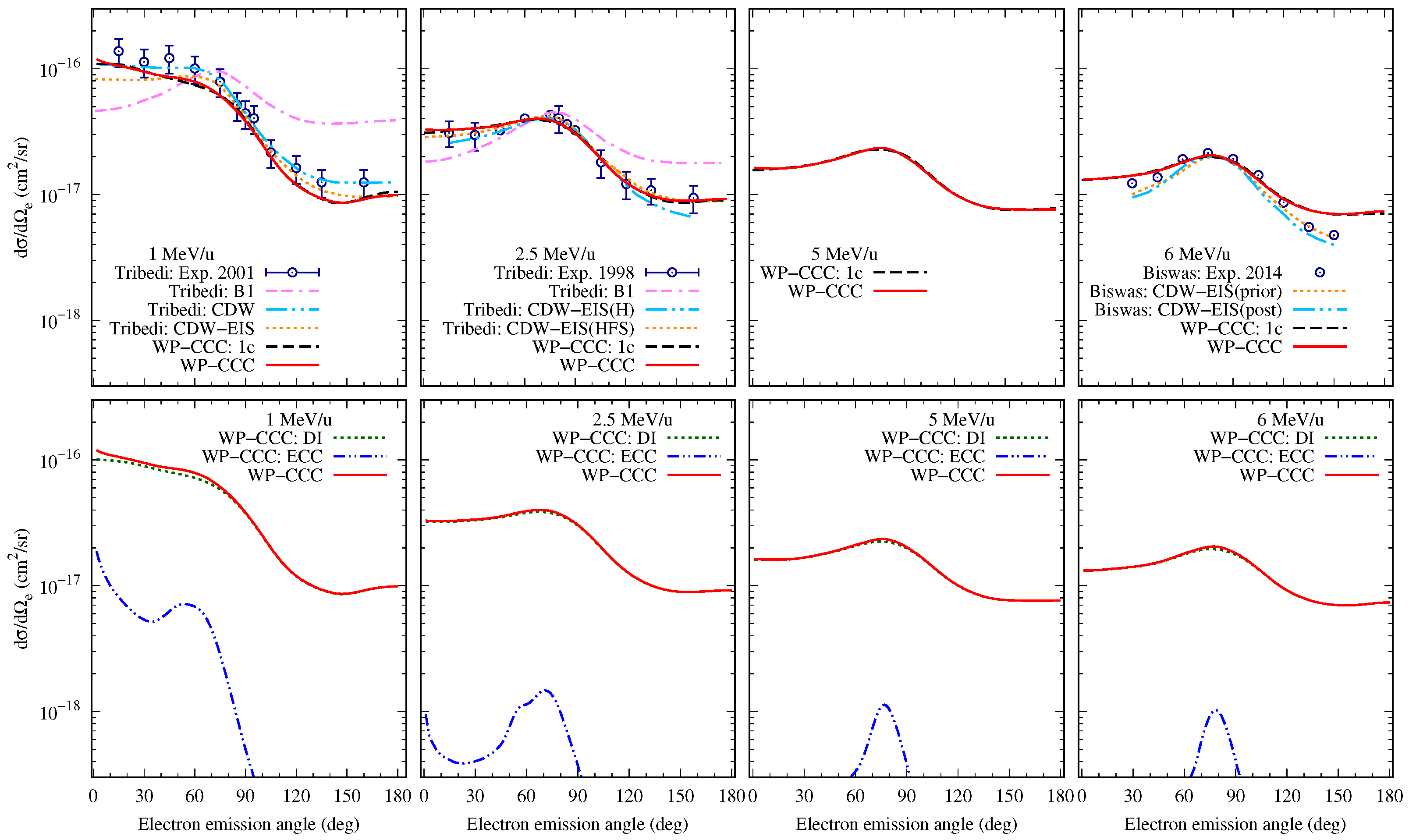
The ionization cross-section differential in electron ejection angle is shown in Figure 3 for the same four impact energies. In general, unlike the cross-section differential as a function of ejection energy, where slight deviations were observed at higher ejection energies, the two WP-CCC approaches are practically identical for the entire angular distribution across all projectile energies presented, apart from minor discrepancies in the forward and backward directions at 1 MeV/u. This is due to the ECC component being negligible.
At 1 MeV/u, the results are compared with experimental data and theoretical calculations based on the B1, CDW-EIS (H) and CDW-EIS (HFS) methods by Tribedi [30]. The WP-CCC results fall within the experimental error bars, which are about 25% for all measured points. The CDW calculations also describe the experiment very well. Meanwhile, the CDW-EIS results agree with the experimental data at larger angles but tend to underestimate both the WP-CCC results and the experimental results at smaller angles. In contrast, the first Born calculations produce an entirely different distribution of the cross-sections. According to the B1 approach, the cross-section peaks around 80 and exhibits a symmetric distribution about this maximum, which is inconsistent with all other results.
At 2.5 MeV/u, the WP-CCC results are compared with the experimental data of Tribedi [29], the first Born calculations, and the CDW-EIS (H) and CDW-EIS (HFS) results. At this collision energy, the WP-CCC calculations show very good agreement with the experiment. The CDW-EIS results also generally agree well with the data, although the CDW-EIS (H) results show some deviation at the largest angles considered. Similarly to the 1 MeV/u C 6 + + He collisions, the B1 results fail to describe the experimental data, except in a small region where they cross the data. Overall, the B1 approach appears unable to describe the angular differential cross-sections at these energies. This highlights the importance of including the coupling between the channels, which the WP-CCC method accounts for.
At 6 MeV/u, the WP-CCC results are in excellent agreement with the experimental data of Biswas [32] near the peak of the cross-section, but they overestimate the experiment at both smaller and larger angles. We note that both the CDW and the WP-CCC approaches show similarly good agreement with the experiment at 1 and 2.5 keV/u. However, at 6 MeV/u, the CDW results provide a better description of the experimental data.
Additionally, the contributions of the DI and ECC components to the ionization cross-sections are shown in the four lower panels. It can be seen that the ECC component makes a noticeable contribution to the ionization cross-section only at 1 MeV/u, the lowest projectile energy considered in this work. At all other considered impact energies, the direct ionization component overwhelmingly dominates over the ECC contribution. This implies that the single-center method is sufficient for investigating the SDCS as a function of the ejection angle for practical purposes.

4.3. SDCS as a Function of Projectile Scattering Angle

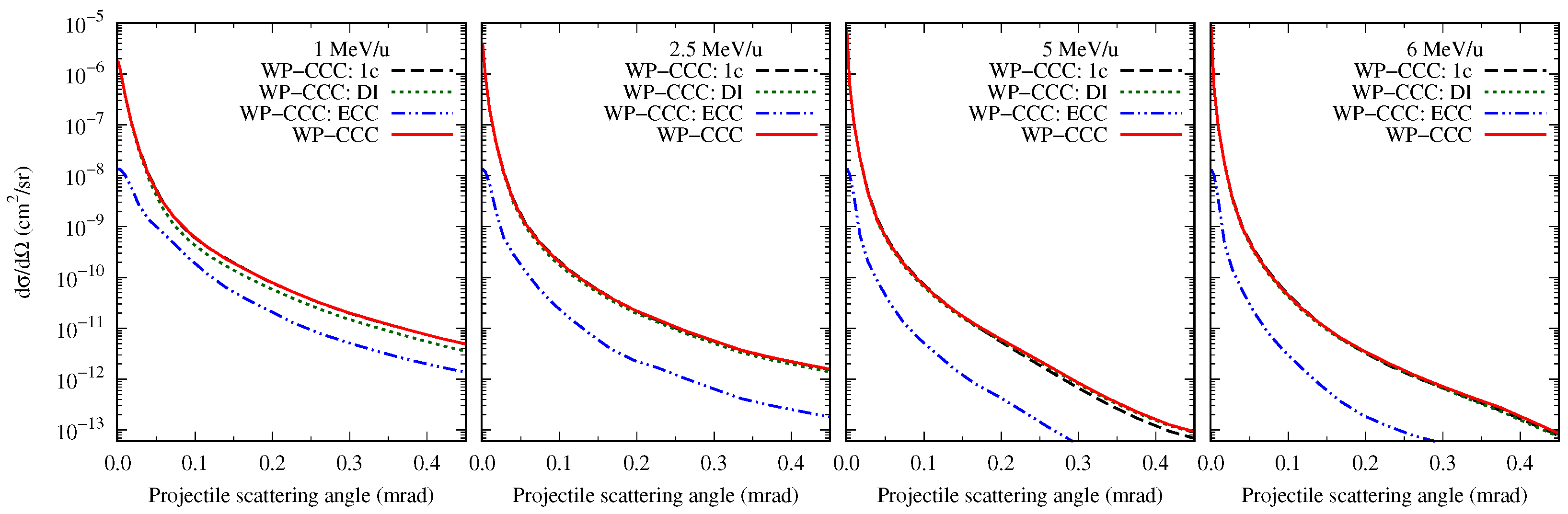
In Figure 4, we present the singly differential cross-sections for ionization in C 6 + + He collisions as functions of the projectile scattering angle. Since no experimental data or other theoretical calculations are available for comparison, we compare only the one-center and two-center WP-CCC results. The ECC and DI components of the two-center calculations are also shown for all projectile energies.
As observed for the other types of singly differential cross-sections, there is little difference between the two WP-CCC results. Overall, the cross-sections exhibit similar behavior at all energies: they reach a maximum in the forward direction and then decrease exponentially with increasing scattering angle. At higher impact energies, the cross-sections decline more rapidly. The ECC contribution is significantly smaller than the DI component at all four collision energies, with the difference exceeding two orders of magnitude in the forward direction, indicating that for practical purposes, it is sufficient to use a simpler single-center approach.

5. Summary and Conclusions

In conclusion, we have investigated singly differential ionization cross-sections as functions of ejection energy, ejection angle, and projectile scattering angle for 1–6 MeV/u C 6 + + He collisions using the one- and two-center WP-CCC methods. Our results generally agree with existing experimental and theoretical data (except for the first Born ones) for the SDCS as functions of the energy and angle of the ejected electron. The SDCS as a function of the projectile scattering angle is presented for the first time. No significant difference is observed between the single- and two-center WP-CCC results for all types of SDCS provided the ejected electrons are not too energetic. This means that for practical purposes, a single-center approach is sufficient. Whether this is the case for more sensitive doubly and fully differential cross-sections remains to be seen.
In our approach, the ionization cross-sections are evaluated as an incoherent sum of the DI and ECC components within the full WP-CCC formulation. This study demonstrates that, in most processes at sufficiently high projectile energies, DI is the dominant contribution, as illustrated in the figures. For the SDCS differential as a function of ejection energy, a slight deviation between the single- and two-center results is observed above 300 eV, highlighting the importance of the two-center approach at higher emission energies. It must be emphasized that the single-center results are contaminated by electron capture to the bound states of the projectile ion, which the single-center approach cannot separate from ionization. Our results show that when the ejected electrons are energetic, the contamination becomes significant. When this is the case, the two-center approach that explicitly includes electron capture to both negative- and positive-energy states of the projectile must be used.
As part of our ongoing work, we will proceed by investigating the DDCS and FDCS for C 6 + + He collisions. Recently, Spicer [44] presented kinematically complete electron-velocity distributions for 45 keV p + He collisions using the two-center WP-CCC method. Excellent agreement was observed between the experimental and theoretical results. The present paper represents the first step towards the kinematically complete study of C 6 + ion-induced ionization of He in a similar fashion. Ultimately, we aim to shed more light on the widely discussed experiment by Schulz [6].

Author Contributions

S.U.A. and A.S.K. developed the underlying theoretical techniques. S.U.A. developed the code, performed the calculations and gathered data. K.H.S., N.W.A. and A.M.K. contributed to code development and optimization. A.S.K. conceptualized and supervised the project. S.U.A. and A.S.K. wrote the manuscript. K.H.S., N.W.A. and A.M.K. reviewed and commented on the manuscript. All authors have read and agreed to the published version of the manuscript.

Funding

This research received no external funding.

Data Availability Statement

All the data reported in this work are available on reasonable request from the authors.

Acknowledgments

N.W.A. and A.S.K. acknowledge support from the Australian Research Council. K.H.S. and A.M.K. acknowledge support through an Australian Government Research Training Program Scholarship. K.H.S. acknowledges support from the Forrest Research Foundation. The authors also acknowledge the provision of resources and services by the Pawsey Supercomputer Centre and the National Computing Infrastructure.

Conflicts of Interest

The authors declare no conflicts of interest.

References

  1. Cravens, T.E. Comet Hyakutake X-ray source: Charge transfer of solar wind heavy ions. Geophys. Res. Lett. 1997, 24, 105. [Google Scholar] [CrossRef]
  2. Lewkow, N.R.; Kharchenko, V.; Zhang, P. Energy relaxation of helium atoms in astrophysical gases. Astrophys. J. 2012, 756, 57. [Google Scholar] [CrossRef]
  3. Marchuk, O. The status of atomic models for beam emission spectroscopy in fusion plasmas. Phys. Scr. 2014, 89, 114010. [Google Scholar] [CrossRef]
  4. Durante, M.; Debus, J.; Loeffler, J.S. Physics and biomedical challenges of cancer therapy with accelerated heavy ions. Nat. Rev. Phys. 2021, 3, 777–790. [Google Scholar] [CrossRef] [PubMed]
  5. Belkić, D. Review of theories on ionization in fast ion-atom collisions with prospects for applications to hadron therapy. J. Math. Chem. 2010, 47, 1366–1419. [Google Scholar] [CrossRef]
  6. Schulz, M.; Moshammer, R.; Fischer, D.; Kollmus, H.; Madison, D.H.; Jones, S.; Ullrich, J. Three-dimensional imaging of atomic four-body processes. Nature 2003, 422, 48. [Google Scholar] [CrossRef]
  7. Olson, R.E.; Fiol, J. Dynamics underlying fully differential cross sections for fast C6++He collisions. J. Phys. B At. Mol. Opt. Phys. 2003, 36, L365. [Google Scholar] [CrossRef]
  8. Otranto, S.; Olson, R.E.; Fiol, J. Angular distributions and Dalitz plots for C6+ ionization of He. J. Phys. B At. Mol. Opt. Phys. 2006, 39, L175. [Google Scholar] [CrossRef]
  9. Fiol, J.; Otranto, S.; Olson, R.E. Critical comparison between theory and experiment for C6++He fully differential ionization cross sections. J. Phys. B At. Mol. Opt. Phys. 2006, 39, L285. [Google Scholar] [CrossRef]
  10. Monti, J.M.; Quinto, M.A.; Rivarola, R.D. A Complete CDW Theory for the Single Ionization of Multielectronic Atoms by Bare Ion Impact. Atoms 2021, 9, 3. [Google Scholar] [CrossRef]
  11. Ciappina, M.F.; Fojón, O.A.; Rivarola, R.D. Electron capture to the continuum manifestation in fully differential cross sections for ion impact single ionization. J. Phys. B At. Mol. Opt. Phys. 2018, 51, 085204. [Google Scholar] [CrossRef]
  12. Voitkiv, A.B.; Najjari, B. Projectile-target core interaction in single ionization of helium by 100-MeV/u C6+ and 1-GeV/u U92+ ions. Phys. Rev. A 2009, 79, 022709. [Google Scholar] [CrossRef]
  13. An, W.; Lu, C.; Sun, S.; Jia, X. Internuclear interaction and distortion effects on fully differential cross section for single ionization of helium by 100 MeV/amu C6+ impact. Eur. Phys. J. D 2015, 69, 174. [Google Scholar] [CrossRef]
  14. Lu, C.-W.; An, W.-F.; Sun, S.-Y.; Jia, X.-F. Nucleus–Nucleus Effects in Fully Differential Cross Sections for Energetic C6++He Collisions with Small Momentum Transfer. Chin. Phys. Lett. 2015, 32, 093401. [Google Scholar] [CrossRef]
  15. An, W.F.; Lu, C.W.; Sun, S.Y.; Jia, X.F. Four-body modified Coulomb-Born calculation for 2 MeV/amu C6++He fully differential single ionization cross-section. Europhys. Lett. 2015, 111, 43001. [Google Scholar] [CrossRef]
  16. Járai-Szabó, F.; Nagy, L. Semiclassical description of kinematically complete experiments. J. Phys. B At. Mol. Opt. Phys. 2007, 40, 4259. [Google Scholar] [CrossRef]
  17. Járai-Szabó, F.; Nagy, L. Impact parameter method calculations for fully differential ionization cross sections. Nucl. Instrum. Methods Phys. Res. Sect. B 2009, 267, 292–294. [Google Scholar] [CrossRef]
  18. Navarrete, F.; Ciappina, M.; Sarkadi, L.; Barrachina, R. The role of the wave packet coherence on the ionization cross section of He by p+ and C6+ projectiles. Nucl. Instrum. Methods Phys. Res. Sect. B 2017, 408, 165–168. [Google Scholar] [CrossRef]
  19. Nagy, L.; Járai-Szabó, F.; Borbély, S. The effect of projectile wave packet width on the fully differential ionization cross-sections. J. Phys. B At. Mol. Opt. Phys. 2018, 51, 144005. [Google Scholar] [CrossRef]
  20. Navarrete, F.; Barrachina, R.; Ciappina, M.F. Distortion of the Ionization Cross Section of He by the Coherence Properties of a C6+ Beam. Atoms 2019, 7, 31. [Google Scholar] [CrossRef]
  21. McGovern, M.; Assafrão, D.; Mohallem, J.R.; Whelan, C.T.; Walters, H.R.J. Coincidence studies of He ionized by C6+, Au24+, and Au53+. Phys. Rev. A 2010, 81, 042704. [Google Scholar] [CrossRef]
  22. McGovern, M.; Whelan, C.T.; Walters, H.R.J. C6+-impact ionization of helium in the perpendicular plane: Ionization to the ground state, excitation-ionization, and relativistic effects. Phys. Rev. A 2010, 82, 032702. [Google Scholar] [CrossRef]
  23. Pindzola, M.S.; Robicheaux, F.; Colgan, J. Single and double ionization in C6++He collisions. Phys. Rev. A 2010, 82, 042719. [Google Scholar] [CrossRef]
  24. Colgan, J.; Pindzola, M.S.; Robicheaux, F.; Ciappina, M.F. Fully differential cross sections for the single ionization of He by C6+ ions. J. Phys. B At. Mol. Opt. Phys. 2011, 44, 175205. [Google Scholar] [CrossRef]
  25. Abdurakhmanov, I.B.; Kadyrov, A.S.; Fursa, D.V.; Bray, I.; Stelbovics, A.T. Convergent close-coupling calculations of helium single ionization by antiproton impact. Phys. Rev. A 2011, 84, 062708. [Google Scholar] [CrossRef]
  26. Walters, H.R.J.; Whelan, C.T. Ionization of He by C6+, C ¯ 6 , e, and e+. Phys. Rev. A 2012, 85, 062701. [Google Scholar] [CrossRef]
  27. Fainstein, P.D.; Ponce, V.H.; Rivarola, R.D. A theoretical model for ionisation in ion-atom collisions. Application for the impact of multicharged projectiles on helium. J. Phys. B At. Mol. Opt. Phys. 1988, 21, 287. [Google Scholar] [CrossRef]
  28. Platten, H.; Schiwietz, G.; Schneider, T.; Schneider, D.; Zeitz, W.; Musiol, K.; Zouros, T.; Kowallik, R.; Stolterfoht, N. Proceedings of the 15th International Conference on the Physics of Electronic and Atomic Collisions, Brighton, UK, 22–28 July 1987; North-Holland: Amsterdam, The Netherlands, 1987. [Google Scholar]
  29. Tribedi, L.C.; Richard, P.; Wang, Y.D.; Lin, C.D.; Gulyas, L.; Rudd, M.E. Ionization dynamics in fast ion-atom collisions. I. Energy and angular distributions of low-energy electrons emitted in ionization of He by bare carbon ions. Phys. Rev. A 1998, 58, 3619–3625. [Google Scholar] [CrossRef][Green Version]
  30. Tribedi, L.C.; Richard, P.; Gulyás, L.; Rudd, M.E. Two-center effect on low-energy electron emission in collisions of 1-MeV/u bare ions with atomic hydrogen, molecular hydrogen, and helium: II. H2 and He. Phys. Rev. A 2001, 63, 062724. [Google Scholar] [CrossRef]
  31. Gagyi-Pálffy, A.C.; Barna, I.F.; Gulyás, L.; Tökési, K. Angular Differential Cross-Section for Ionization of Helium in C6+ + Ion Collision. Chin. Phys. Lett. 2004, 21, 1258. [Google Scholar] [CrossRef]
  32. Biswas, S.; Misra, D.; Monti, J.M.; Tachino, C.A.; Rivarola, R.D.; Tribedi, L.C. Energy and angular distribution of electrons in ionization of He and Ne by 6-MeV/u bare carbon ions: Comparison with continuum-distorted-wave eikonal-initial-state calculations in prior and post forms. Phys. Rev. A 2014, 90, 052714. [Google Scholar] [CrossRef]
  33. Schulz, M. Ion-Atom Collisions: The Few-Body Problem in Dynamic Systems; De Gruyter: Berlin, Germany; Boston, MA, USA, 2019. [Google Scholar] [CrossRef]
  34. Belkić, D. Reviews of Light and Heavy Particle Collisions with Atoms and Molecules; World Scientific: Singapore, 2026. [Google Scholar] [CrossRef]
  35. Tribedi, L. Advances in Atomic Molecular Collisions; Springer Nature: Singapore, 2024. [Google Scholar]
  36. Alladustov, S.U.; Abdurakhmanov, I.B.; Kadyrov, A.S.; Bray, I.; Bartschat, K. Wave-packet continuum-discretization approach to proton collisions with helium. Phys. Rev. A 2019, 99, 052706. [Google Scholar] [CrossRef]
  37. Spicer, K.H.; Antonio, N.W.; Schöffler, M.S.; Schulz, M.; Kadyrov, A.S. Coupled-channel calculations of fully differential cross sections for ionization in 75-keV p+He collisions. Phys. Rev. A 2025, 112, 032806. [Google Scholar] [CrossRef]
  38. Alladustov, S.U.; Plowman, C.T.; Abdurakhmanov, I.B.; Bray, I.; Kadyrov, A.S. Wave-packet continuum discretization approach to He2+−He collisions. Phys. Rev. A 2022, 106, 062819. [Google Scholar] [CrossRef]
  39. Alladustov, S.U.; Plowman, C.T.; Schöffler, M.S.; Bray, I.; Kadyrov, A.S. Singly differential studies of one-electron processes in He2+−He collisions. Phys. Rev. A 2024, 109, 022805. [Google Scholar] [CrossRef]
  40. Alladustov, S.U.; Spicer, K.H.; Antonio, N.W.; Kotian, A.M.; Kadyrov, A.S. Doubly differential cross sections for ionization in He2++He collisions. Phys. Rev. A 2025, 112, 012804. [Google Scholar] [CrossRef]
  41. Schrick, K.; Spicer, K.H.; Antonio, N.W.; Alladustov, S.U.; Kadyrov, A.S. Electron capture and ionisation in intermediate-energy C6+−He collisions: Integrated cross sections. Eur. Phys. J. D 2025, 79, 57. [Google Scholar] [CrossRef]
  42. Bransden, B.H.; McDowell, M.R.C. Charge Exchange and the Theory of Ion-Atom Collisions; Clarendon: Oxford, UK, 1992. [Google Scholar]
  43. Abdurakhmanov, I.B.; Bailey, J.J.; Kadyrov, A.S.; Bray, I. Wave-packet continuum-discretization approach to ion-atom collisions including rearrangement: Application to differential ionization in proton-hydrogen scattering. Phys. Rev. A 2018, 97, 032707. [Google Scholar] [CrossRef]
  44. Spicer, K.H.; Schmidt, L.P.H.; Plowman, C.T.; Antonio, N.W.; Alladustov, S.U.; Abdurakhmanov, I.B.; Bray, I.; Schöffler, M.S.; Dörner, R.; Kadyrov, A.S. Collisional breakup in a Coulomb few-body system with two attractive centers. Phys. Rev. A 2026, 113, 012816. [Google Scholar] [CrossRef]
Figure 1. Convergence of weighted probability, b P ( b ) , with respect to max for ionization in 1 MeV/u C 6 + + He collisions.
Atoms 14 00031 g001
Figure 2. The cross-section differential in ejected-electron energy for ionization in C 6 + + He collision. The present results are compared with the theoretical results and experimental data from Fainstein [27], Tribedi [29], Biswas [32]. The lower panel shows the DI and ECC components of the two-center WP-CCC cross-sections.
Atoms 14 00031 g002
Figure 3. The cross-section differential in ejected-electron angle for ionization in C 6 + + He collision. The present results are compared with the theoretical results and experimental data from Tribedi [29,30], Biswas [32]. The lower panel shows the DI and ECC components of the two-center WP-CCC cross-sections.
Atoms 14 00031 g003
Figure 4. The cross-section differential as a function of projectile scattering angle for ionization in C 6 + + He collision. The DI and ECC components of the two-center WP-CCC cross-sections are also shown.
Atoms 14 00031 g004
Disclaimer/Publisher’s Note: The statements, opinions and data contained in all publications are solely those of the individual author(s) and contributor(s) and not of MDPI and/or the editor(s). MDPI and/or the editor(s) disclaim responsibility for any injury to people or property resulting from any ideas, methods, instructions or products referred to in the content.