1. Introduction
Ion–atom collisions are fundamental processes in atomic and molecular physics, enabling detailed investigations into quantum–mechanical phenomena such as ionization, excitation, elastic scattering, and electron transfer. These interactions serve as critical testbeds for validating theoretical models but remain computationally demanding due to the complexity of the few-body Coulomb problem.
Among such systems, antiproton–hydrogen collisions have attracted extensive theoretical interest (see, e.g., refs. [
1,
2,
3,
4,
5,
6,
7,
8,
9,
10,
11,
12,
13,
14,
15,
16,
17,
18,
19,
20] and the review paper [
21] that summarizes the state of affairs up to 2011). The antiproton’s negative charge and large mass eliminate the possibility of electron capture and renders projectile deflection negligible. This allows it to be treated as a classical particle moving along a straight-line trajectory, simplifying the interaction dynamics to electron excitation and ionization. At intermediate impact energies, both protonium formation and relativistic effects can be neglected [
2], further reducing the complexity.
Under these conditions, the system reduces to a one-electron time-dependent Schrödinger equation (TDSE) for an electron moving in the combined Coulomb field of a stationary proton and a moving antiproton. The relevant ionization reaction is
The development of theoretical models for antiproton–hydrogen ionization includes pseudostate-based projection methods, which allow extraction of physical observables from coupled-channel calculations. As one example of such an approach, McGovern et al. [
14] introduced the coupled-pseudostate (CP) method within a semi-classical impact-parameter framework. In this formulation, the electronic wavefunction is expanded in a Laguerre-type pseudostate basis and evolved along classical projectile trajectories. Differential electron emission is obtained by projecting the time-evolved pseudostate wavefunction onto continuum Coulomb states, and fully differential ionization cross sections are extracted using the well-known connection between the impact-parameter and the wave treatments of the projectile motion.
Building upon this framework, McGovern et al. later proposed a relaxed version of their method [
15], modifying the coupling scheme and improving the numerical projection procedure. This refinement enhanced the method’s stability and computational efficiency and broadened its applicability across a wider range of energies.
In parallel, Abdurakhmanov et al. developed a Convergent Close-Coupling (CCC) fully quantal integral-equation approach formulated in the impact-parameter representation [
16], treating the three-body problem without decoupling the antiproton trajectory from the electronic dynamics. This method preserves full quantum coherence across the antiproton–hydrogen system.
Subsequently, they applied the CCC method to the same system [
17], introducing two methods for the calculation of energy-differential cross sections (EDCS): a so-called integration method which is based on projections onto Coulomb states and a simple summation method whose ingredients are pseudostate populations and weight factors that involve differences of pseudostate energy eigenvalues.
More recently, a wave-packet extension of the CCC method (WP-CCC) has been introduced [
18]. This approach discretizes the continuum using localized wave packets rather than Laguerre-based pseudostates, mitigating basis linear-dependence issues and enabling high-resolution differential spectra.
A complementary route to modeling electronic dynamics in Coulombic systems is provided by the Basis Generator Method (BGM) [
22,
23,
24], also a pseudostate-based approach but built on a different philosophy: Rather than aiming at completeness, BGM basis sets are constructed with a view to merely spanning that subspace of Hilbert space which is relevant for the system dynamics. The BGM has been successfully applied to total cross section calculations for a variety of collision systems, including bare-ion collisions with noble gas targets [
25], ion-molecule collisions [
26], and antiproton-impact collision systems [
27,
28,
29]. For the latter, energy loss calculations using Ehrenfest’s theorem within a time-dependent density functional theory formulation were also carried out [
29].
In this study, we apply the BGM to the calculation of differential cross sections. We extract EDCS values at the pseudostate eigenenergies and implement a post-processing interpolation strategy to construct smooth, physically reliable cross-section curves. This approach offers a computationally efficient alternative to continuum integration or large-scale close-coupling schemes.
The remainder of this paper is organized as follows.
Section 2 outlines the general theoretical framework, beginning with the TDSE in the semi-classical impact-parameter representation and introducing the so-called zero-overlap condition which represents a sufficient criterion for the stable extraction of EDCS at discrete energy points.
Section 3 describes the one-centre Basis Generator Method (OC-BGM) formulation and its implementation for the antiproton–hydrogen collision system. The computed EDCS and verification of the zero-overlap condition are presented and discussed in
Section 4. Finally, the main findings and conclusions are summarized in
Section 5.
Atomic units, characterized by , are used unless otherwise stated.
2. General Theory
Within the framework of the semi-classical impact parameter method, the antiproton’s motion is represented by a straight-line trajectory
, where
b is the impact parameter and
. The TDSE to be solved is
and, in a target-centered reference frame, the Hamiltonian in position space takes the form
and asymptotically approaches
for
.
In the coupled-channel approach, solving the TDSE necessitates expressing the system in an
N-dimensional basis and determining the time evolution of a projected state vector via
where
is the projection operation onto the
N-dimensional subspace
and the projected state vector satisfies
.
Assuming that at large times
, the Hamiltonian can be approximated by the asymptotic Hamiltonian
, the projected state vector can be projected onto the eigenstates
of
to extract the transition amplitudes
. If the projected state vector
is a good approximation to
of Equation (
1), the transition probabilities
are expected to be reasonably close to the exact values
which are constant at
under the condition stated above.
Asymptotic stability of the transition probabilities
however cannot be guaranteed, as has been noted in [
30]. We can see this by inspecting
using Equation (
3):
where
. The first term represents evolution under the unperturbed projected Hamiltonian, while the second term accounts for the time-dependent perturbation induced by the projectile’s motion. For
the time-dependent potential does not vanish completely; if approximated by its monopole expansion term one finds
The projected Hamiltonian can be represented in terms of its normalized eigenstates
and corresponding eigenvalues
as
which, when substituted in Equation (
5), yields
Channel couplings in the first term on the right-hand side prevent asymptotic stability of the transition probabilities. However, if the condition
for
and for a specific index
, referred to as the zero-overlap condition, is satisfied, Equation (
7) can be further reduced to
and can be integrated to yield a constant probability
at
. The zero-overlap condition seems contrived but, as it turns out, can be met by suitably constructed
spaces.
To shed light on this issue, we consider the asymptotic
problem. Introducing the orthogonal projection operator
with
, the Schrödinger equation
can be decomposed into [
31]
Let us assume for a moment that the
space is chosen one-dimensional such that Equation (
6) has only one term, say for
. In this case, the
-space Equation (
10) simplifies to
If the eigenvalues match (
), the equation decouples from the
-space Equation (11). For an
N-dimensional
space,
is achieved if in addition to the matching condition
the overlaps between the eigenstates of
for
and the eigenstate of
vanish:
This is the zero-overlap condition (
8) invoked to turn Equation (
7) into Equation (
9) to ensure asymptotic stability of the transition probabilities
. We are interested in transitions to the continuum in this work. This implies that an
N-dimensional
space spanned by a set of linearly independent Hilbert space vectors will yield a set of eigenvalues
upon diagonalization of the projected Hamiltonian
, whose non-negative elements match a set of continuum eigenvalues
of
. It is not at all obvious that the zero-overlap condition can be met for any or all eigenstates
corresponding to
. However, for the Coulomb problem and a
space spanned by a Laguerre basis, McGovern et al. numerically demonstrated that this is indeed the case [
14]. Abdurakhmanov et al. subsequently provided a proof for this finding [
16]. A more general analysis of the zero-overlap condition including an alternative proof for the Laguerre basis is presented elsewhere [
32]. In the next section, we demonstrate that OC-BGM basis sets constructed to solve the
-space TDSE Equation (
3) for the antiproton–hydrogen collision problem meet the condition in good approximation. This implies that projecting the OC-BGM solutions onto Coulomb waves at the matching energy values yields asymptotically stable transition probabilities for electron emission and opens the door to differential cross-section calculations.
3. OC-BGM for Antiproton–Hydrogen Collisions
The present implementation builds upon earlier applications of the BGM to ion–atom and antiproton–atom collisions, which were restricted to total ionization calculations where the method was shown to efficiently represent both bound and continuum electronic dynamics within a finite pseudostate basis. The present OC-BGM formulation is the first to extract differential cross-sections for the single-electron antiproton–hydrogen system.
A stationary basis is constructed to transform the
-space TDSE Equation (
3) into a set of coupled-channel equations for the expansion coefficients, which are subsequently solved numerically. The projected state vector is expressed as
with
in which
are bound-state solutions of the
eigenvalue problem, i.e., hydrogenic atomic orbitals (AOs), and
is the Yukawa-regularized target potential
This so-called target-hierarchy version of the OC-BGM was shown to be suitable for antiproton impact [
27,
29]. Note that the basis states are non-orthogonal but linearly independent so that the ensuing coupled-channel equations can be solved by standard methods.
Resolving the AO index
j into the quantum numbers
, the propagated wave function
can be written more explicitly in terms of an angular momentum decomposition as
with spherical harmonics
in position space and (complex-valued) time-dependent radial functions
which consist of combinations of time-dependent expansion coefficients, powers of the regularized potential Equation (
16), and radial wave functions of the Schrödinger hydrogen problem.
The ionization transition amplitudes are determined by projecting the
-space wavefunction at time
onto Coulomb wavefunctions
which constitute the positive-energy eigenstates of the Hamiltonian
. Here
is the radial solution of the Coulomb wave equation, which involves the confluent hypergeometric function,
is the Coulomb phase shift, and
is the Sommerfeld parameter. The solid angle
refers to the wave vector
k. Utilizing the orthonormality of the spherical harmonics in position space simplifies the summation, and the resulting expression takes the form
with
Using the orthonormality relationship of the spherical harmonics once again, the total ionization probability is
which serves as the basis for computing the total cross section (TCS). The TCS is obtained by integrating the ionization probability over all possible impact parameters b, expressed in cylindrical coordinates as
The EDCS can be readily obtained by differentiating with respect to the electron emission energy E, and using the relation
An alternative approach for computing the EDCS (and TCS) is detailed in ref. [
17]. In this method, the EDCS at discrete eigenenergies corresponding to the spectral decomposition introduced in Equation (
6) is identified as the partial cross section for population of the eigenstate
divided by a weight factor which for a given angular momentum
l is defined as
In the following
Section 4, we compare the results of the EDCS obtained using this approach with those from the projection method, highlighting the necessity of enforcing the zero-overlap condition to ensure physically meaningful and numerically stable results.
4. Results
Before presenting results, it is useful to provide some contextual remarks regarding the basis construction and numerical parameters employed in this work. The basis is constructed using the pseudostate expansion of Equation (
14), with a maximum hierarchy index of
and a highest included orbital angular momentum of
.
Table 1 summarizes the maximum hierarchy for each
, and the resulting
-space is spanned by 113 linearly independent basis states.
Table 2 lists for each
l the wave numbers corresponding to the first five positive eigenvalues obtained by diagonalizing
in the basis. The time-dependent coefficients are obtained by numerically propagating the coupled-channel equations from
to
a.u., for antiproton impact energies ranging from 10 keV to 200 keV.
To assess whether the basis satisfies the zero-overlap condition, we examine the projection of each
eigenstate onto Coulomb continuum waves and identify the wave numbers at which the overlaps exhibit minima. McGovern et al. [
14] studied a similar effect for their Laguerre-type pseudostates by evaluating what they termed distribution functions, defined from the projection onto Coulomb waves and expressed as a function of the continuum momentum
k:
such that
Here
represents McGovern’s Laguerre-based pseudostates. As mentioned in
Section 2, they observed that each distribution function vanishes at the wave numbers
which correspond to the eigenenergies
of the other pseudostates through
This behaviour is the zero-overlap condition.
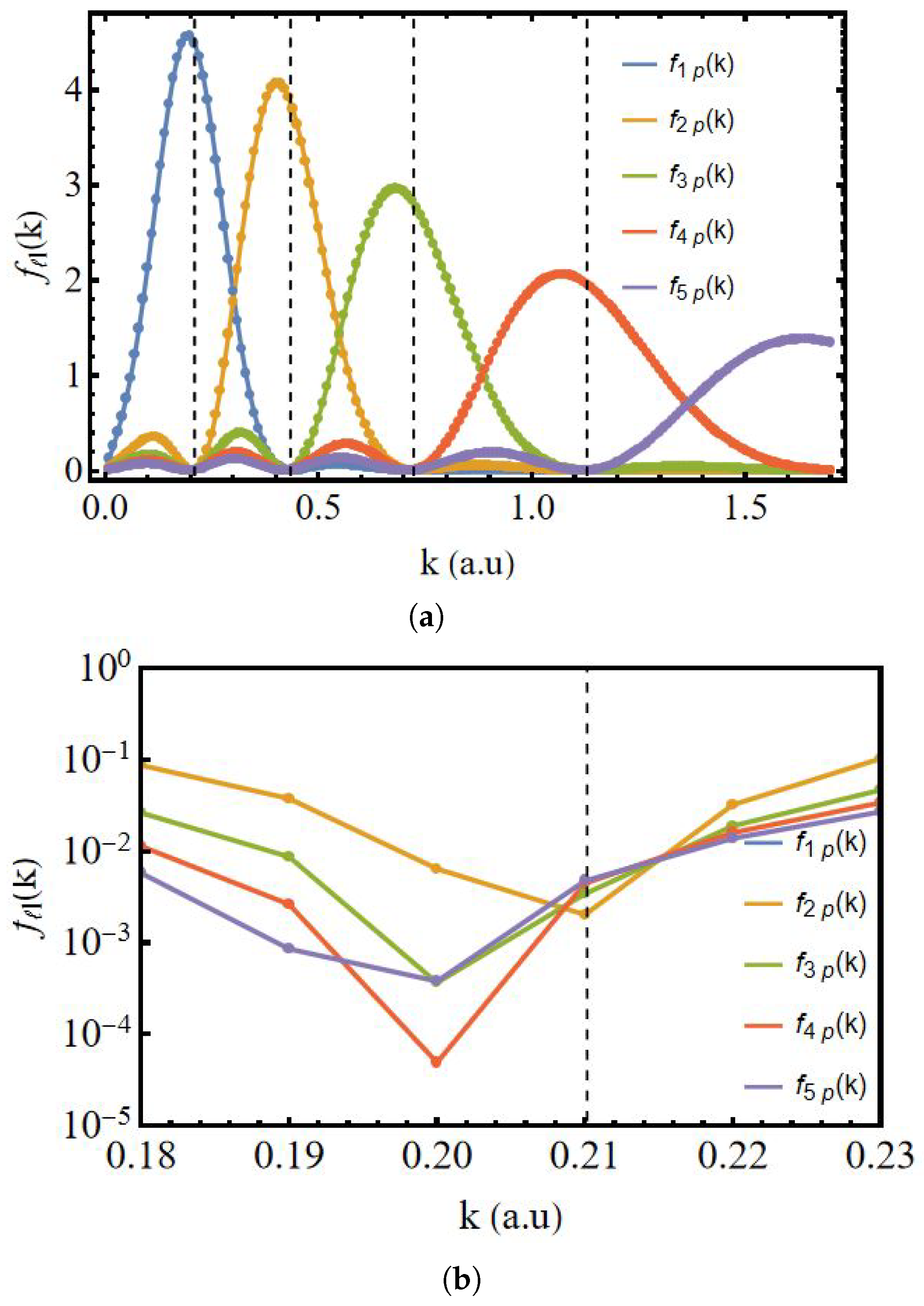
Figure 1a,b show OC-BGM-based distribution functions for the first five positive-energy
p-orbital eigenstates of the projected Hamiltonian in our 113-state basis. Although these functions exhibit pronounced minima near the pseudostate eigenenergies, they do not reach exact zeros, indicating that the zero-overlap condition is satisfied only approximately in the present calculation.
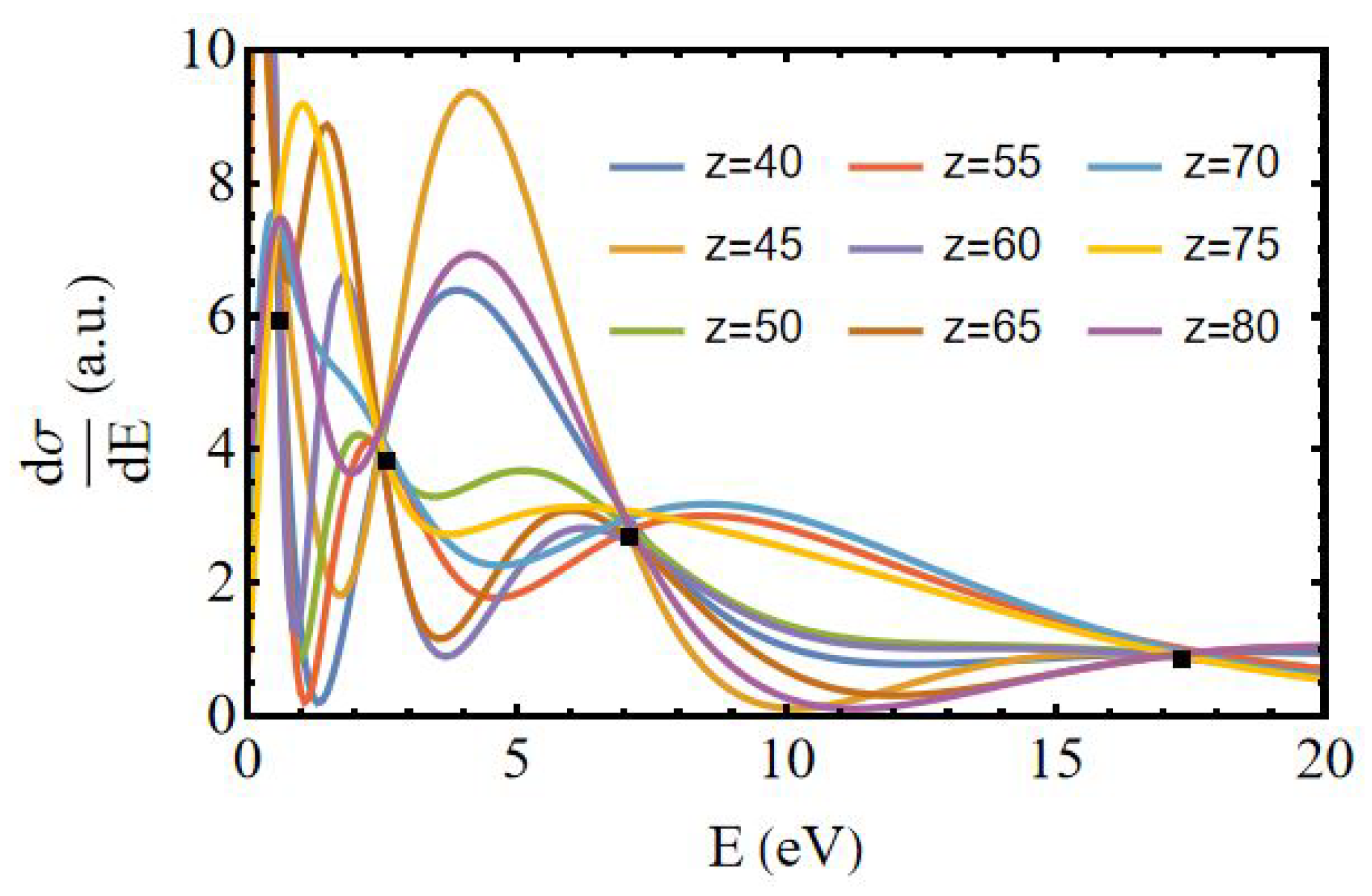
Figure 2 highlights the significance of the zero-overlap condition. It presents the EDCS for
as a function of electron ejection energy and shows that the results obtained from carrying out the projections (
20) at different values of
closely agree with the EDCS computed using Abdurakhmanov et al.’s summation method [
17] at the pseudostate eigenenergies, except at the lowest eigenvalue. In between these discrete points, the projections yield distance-dependent results as a consequence of the channel couplings in Equation (
7). When plotted together, the EDCS curves intersect, forming “nodes” around the eigenvalues of the projected Hamiltonian.
These behaviors as shown in
Figure 1 and
Figure 2 for
have been tested for different basis sizes and other orbital angular momenta, and in each case, similar structures have been found. It is important to note that the values of the EDCS between the eigenvalues
cannot be reliably determined, as the transition amplitudes are unstable in those regions. This emphasizes the necessity of the zero-overlap condition and that physically meaningful results can only be obtained at the eigenvalues.
In principle, these structures can be flattened by increasing the size of the basis set, thereby increasing the number of positive pseudostate eigenvalues. In practice, however, this is not easily achieved due to numerical limitations. As the basis size increases, the system approaches saturation, and the eigenstates of the projected Hamiltonian begin to lose linear independence, thereby compromising numerical accuracy and stability. This feature is a detriment of the BGM basis set construction scheme using highly non-orthonormal states (
15).
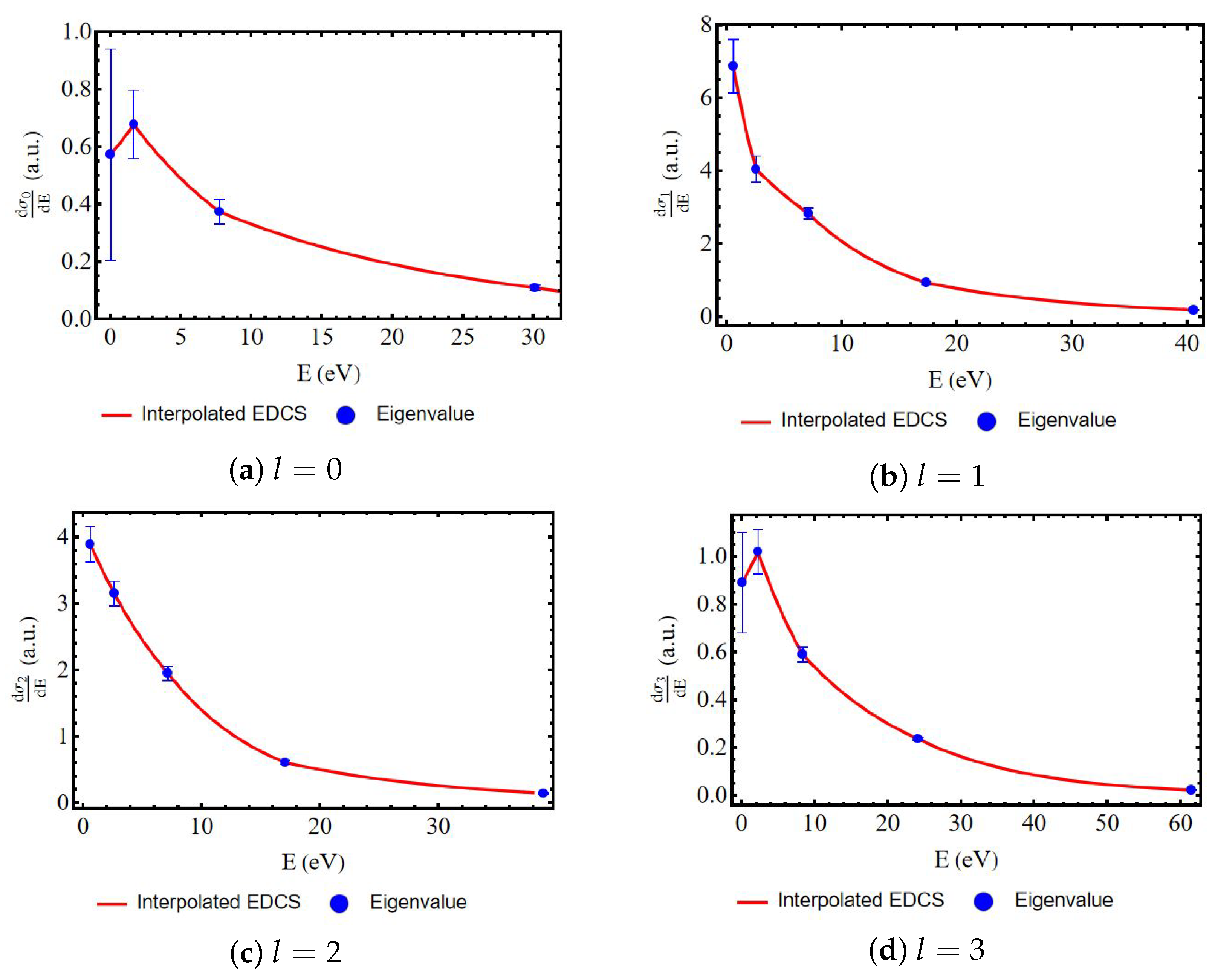
To obtain the “total” EDCS, we first average the EDCS for each orbital angular momentum
l across
at the eigenvalues. Then we construct exponential piecewise functions to interpolate the EDCS in energy regions not directly accessible due to the invalidity of the zero-overlap condition. The exponential form is chosen to reflect the expected smooth decay of the EDCS. This is illustrated in
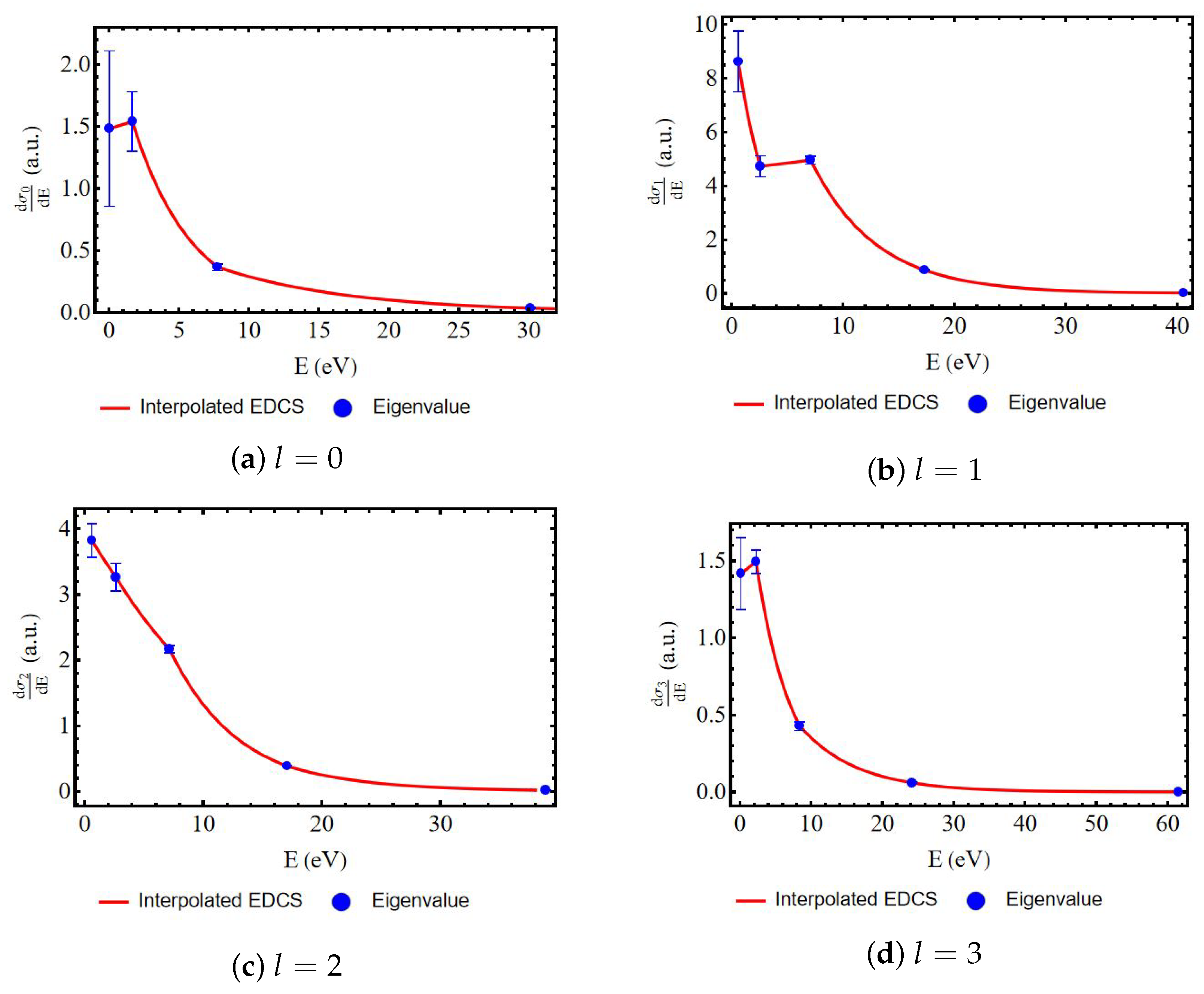
Appendix A. The resulting EDCS for each
l are subsequently summed to obtain the total EDCS.
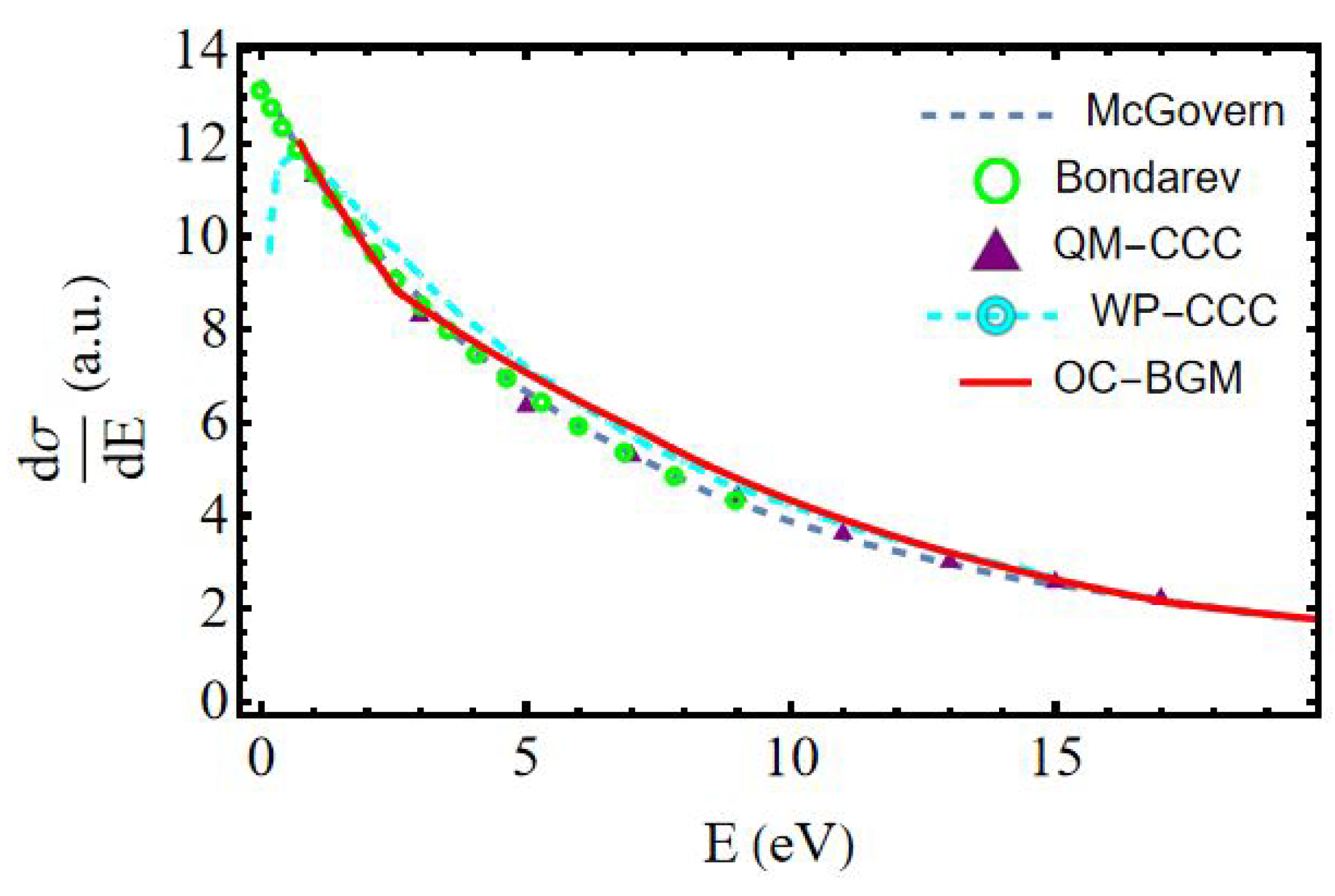
Figure 3 compares our results at 30 keV impact energy to McGovern’s pseudostate-based approach [
15], the quantum mechanical convergent close-coupling (QM-CCC) approach [
17], the wave packet CCC method (WP-CCC) [
18], and the relativistic coupled-channel approach of Bondarev et al. [
19]. We observe that the interpolated OC-BGM results closely track these benchmark calculations. Note that the OC-BGM curves begin at the electron energy corresponding to the largest
value across all partial waves (see
Table 2), which is
a.u. for
, corresponding to an electron energy of approximately 0.6 eV. This explains the absence of OC-BGM results at lower electron energies.
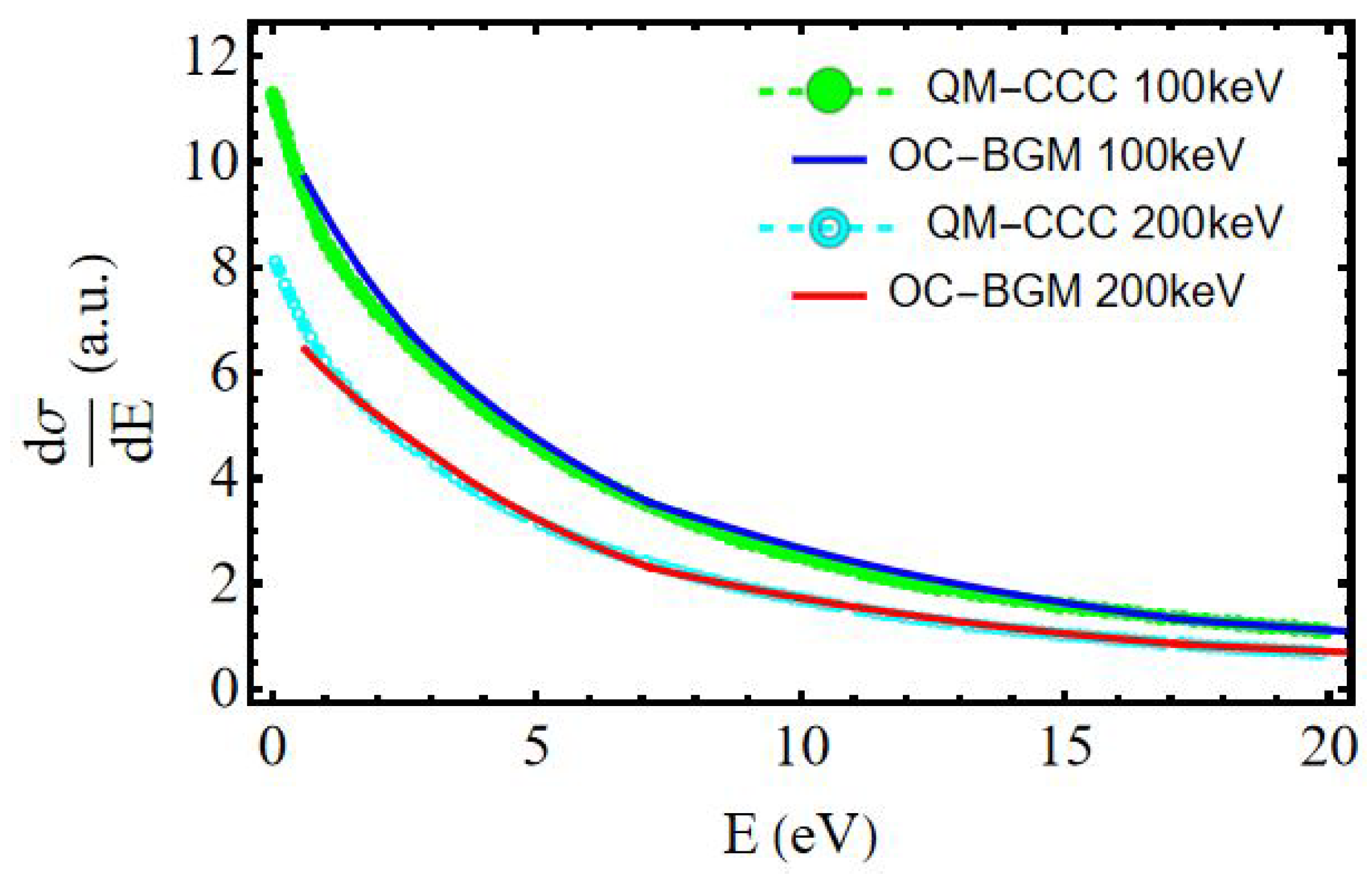
Having established the reliability of the interpolated total EDCS at an intermediate impact energy, we now examine its behavior at 100 keV and 200 keV. This is shown in
Figure 4. For both energies, the OC-BGM EDCS reproduces the QM-CCC results across the full electron energy range shown, demonstrating good agreement between the two approaches.
1To further assess the range of validity of the present approach, we also examine the EDCS at a lower antiproton impact energy of 10 keV in
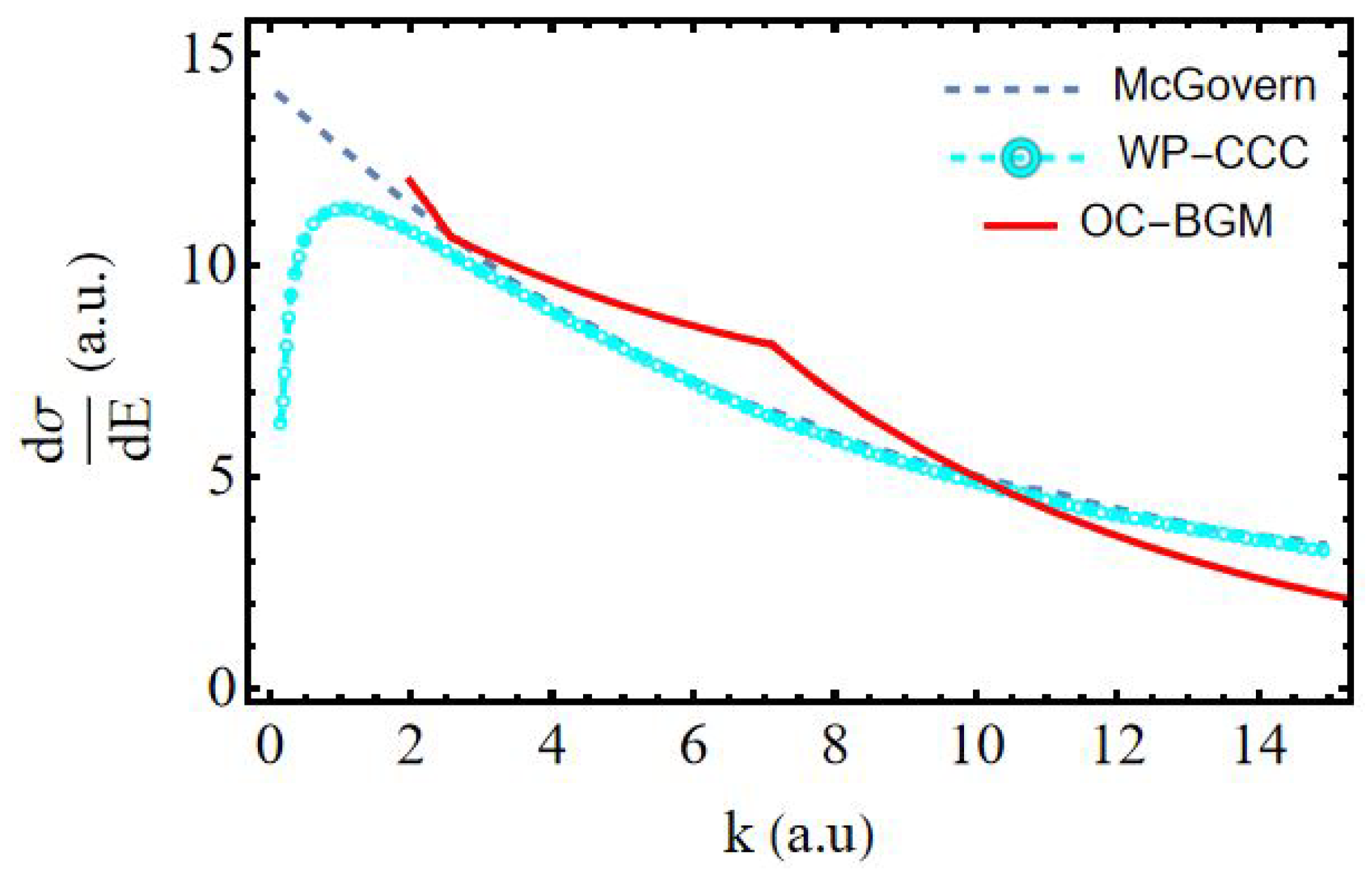
Figure 5. In this low-energy regime, the OC-BGM results exhibit un-physical structures and noticeable deviations from the WP-CCC and McGovern et al. pseudostate calculations across the electron energy range shown. The details provided in
Appendix A indicate that the
contribution induces most of the structure seen in
Figure 5. We were not able to identify a simple reason for this behavior and conclude that the present OC-BGM formulation becomes less accurate for EDCS calculations in the low-impact-energy regime.
5. Conclusions
In this work, we investigated electron emission from hydrogen atoms induced by antiproton impact using the OC-BGM within a semi-classical impact-parameter framework. The reduction of the full three-body problem to a single-centre formulation enabled a simpler treatment of the time-dependent Schrödinger equation, where BGM aims to find accurate results with high efficiency using a relatively low number of pseudostates that are constructed out of a regularized Yukawa potential. The present study is the first application of BGM to a differential cross section calculation.
A central focus of the analysis was the role of the zero-overlap condition in ensuring the numerical stability and physical reliability of the computed EDCS. By projecting the pseudostate-evolved wavefunction onto Coulomb continuum states, we demonstrated that the zero-overlap condition is approximately satisfied at the eigenvalues of the projected unperturbed Hamiltonian. When this condition holds, the extracted EDCS values remain stable across different projection distances, underscoring its importance for obtaining physically meaningful observables.
Away from the pseudostate eigenenergies, the EDCS exhibits fluctuations due to incomplete convergence, and physically reliable values cannot be obtained. To obtain smooth cross-section profiles suitable for comparison with other theoretical approaches (such as QM-CCC, WP-CCC, McGovern’s and Bondarev’s coupled-pseudostate methods), exponential interpolation was employed between the eigenvalue points. The total EDCS, reconstructed by summing the interpolated partial-wave contributions, shows good agreement with results from these methods except at the lowest impact energy investigated. These results validate the OC-BGM as a compact and physically transparent framework for modeling differential ionization in antiproton–hydrogen collisions at intermediate energies.